
How to Talk About Medicaid Work Reporting
A
Published · 30 slides · 0 views
1 / 1
Description
How to Talk About Medicaid Work Reporting Requirements: Explainer Presentation Template for State Communicators Prepared by GMMB October 2026 About State Health and Value Strategies State Health and Value Strategies (SHVS) assists states in
Related Topics
Share
Embed code
Download this presentation From Below
"How to Talk About Medicaid Work Reporting" is the property of its rightful owner. Permission is granted to download and print the materials on this website for personal, non-commercial use only, and to display it on your personal computer provided you do not modify the materials and that you retain all copyright notices contained in the materials. By downloading content from our website, you accept the terms of this agreement.
Presentation Transcript
01
How to Talk About Medicaid Work Reporting Requirements:
Explainer Presentation Template
for State Communicators Prepared by GMMB
October 2026<br>
October 2026<br>
02
About State Health and Value Strategies State Health and Value Strategies (SHVS) assists states in their efforts to transform health and healthcare by providing targeted technical assistance to state officials and agencies. The program is a grantee of the Robert Wood Johnson Foundation, led by staff at Princeton University’s School of Public and International Affairs. The program connects states with experts and peers to undertake healthcare transformation initiatives. By engaging state officials, the program provides lessons learned, highlights successful strategies, and brings together states with experts in the field. Learn more at www.shvs.org. Questions? Email Heather Howard at heatherh@Princeton.edu.
Support for this toolkit was provided by the Robert Wood Johnson Foundation.
The views expressed here do not necessarily reflect the views of the Foundation.<br>
Support for this toolkit was provided by the Robert Wood Johnson Foundation.
The views expressed here do not necessarily reflect the views of the Foundation.<br>
03
About GMMB This toolkit was prepared by Melissa Morales and McKenzie Perrow. GMMB is a full-service communications firm dedicated to creating real and lasting positive change in the world. We work across the healthcare sector and have expertise developing communications at the intersection of policy development and program implementation. For more than 40 years, we have been on the front line of issue-based communications, earning a reputation for shaping public opinion by developing research-based communications strategies that achieve real results. Our work has helped enroll millions of individuals in affordable health coverage and increased access to needed care and services. For more information, visit www.gmmb.com.<br>
04
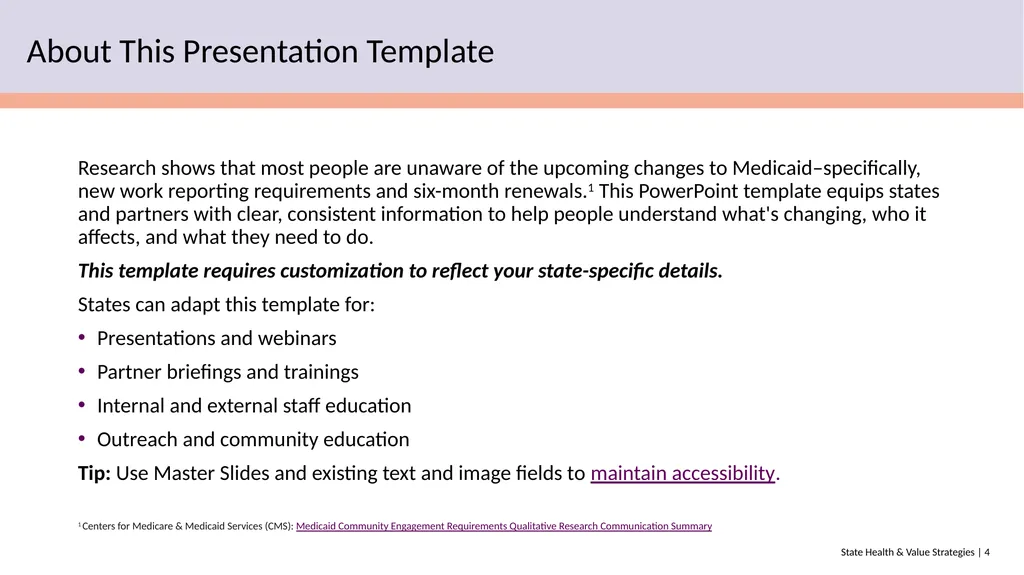
About This Presentation Template Research shows that most people are unaware of the upcoming changes to Medicaid–specifically, new work reporting requirements and six-month renewals.1 This PowerPoint template equips states and partners with clear, consistent information to help people understand what's changing, who it affects, and what they need to do.
This template requires customization to reflect your state-specific details.
States can adapt this template for:
Presentations and webinars
Partner briefings and trainings
Internal and external staff education
Outreach and community education
Tip: Use Master Slides and existing text and image fields to maintain accessibility. 1 Centers for Medicare & Medicaid Services (CMS): Medicaid Community Engagement Requirements Qualitative Research Communication Summary<br>
This template requires customization to reflect your state-specific details.
States can adapt this template for:
Presentations and webinars
Partner briefings and trainings
Internal and external staff education
Outreach and community education
Tip: Use Master Slides and existing text and image fields to maintain accessibility. 1 Centers for Medicare & Medicaid Services (CMS): Medicaid Community Engagement Requirements Qualitative Research Communication Summary<br>
05
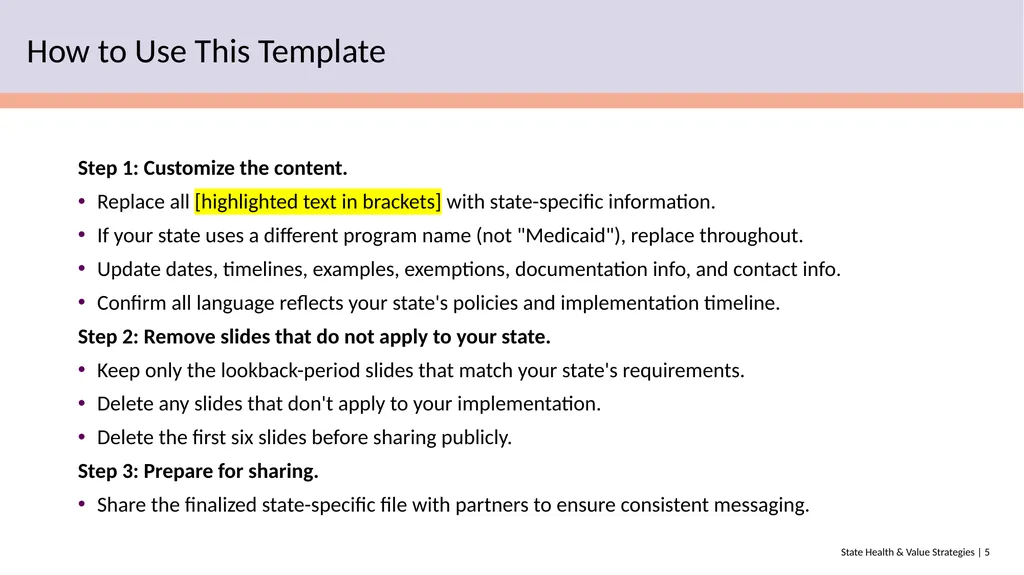
How to Use This Template Step 1: Customize the content.
Replace all [highlighted text in brackets] with state-specific information.
If your state uses a different program name (not "Medicaid"), replace throughout.
Update dates, timelines, examples, exemptions, documentation info, and contact info.
Confirm all language reflects your state's policies and implementation timeline.
Step 2: Remove slides that do not apply to your state.
Keep only the lookback-period slides that match your state's requirements.
Delete any slides that don't apply to your implementation.
Delete the first six slides before sharing publicly.
Step 3: Prepare for sharing.
Share the finalized state-specific file with partners to ensure consistent messaging.<br>
Replace all [highlighted text in brackets] with state-specific information.
If your state uses a different program name (not "Medicaid"), replace throughout.
Update dates, timelines, examples, exemptions, documentation info, and contact info.
Confirm all language reflects your state's policies and implementation timeline.
Step 2: Remove slides that do not apply to your state.
Keep only the lookback-period slides that match your state's requirements.
Delete any slides that don't apply to your implementation.
Delete the first six slides before sharing publicly.
Step 3: Prepare for sharing.
Share the finalized state-specific file with partners to ensure consistent messaging.<br>
06
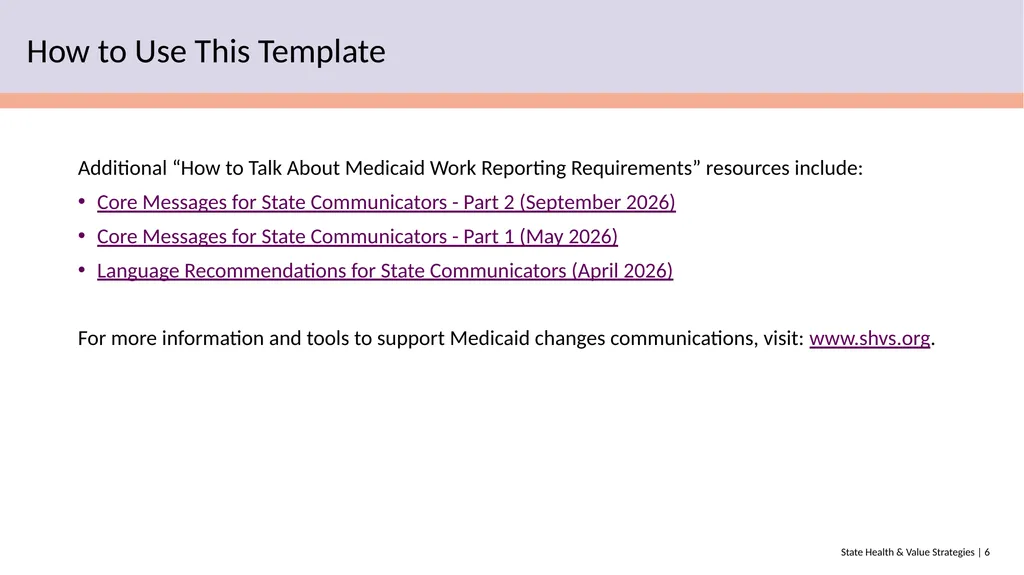
How to Use This Template Additional “How to Talk About Medicaid Work Reporting Requirements” resources include:
Core Messages for State Communicators - Part 2 (September 2026)
Core Messages for State Communicators - Part 1 (May 2026)
Language Recommendations for State Communicators (April 2026)
For more information and tools to support Medicaid changes communications, visit: www.shvs.org.<br>
Core Messages for State Communicators - Part 2 (September 2026)
Core Messages for State Communicators - Part 1 (May 2026)
Language Recommendations for State Communicators (April 2026)
For more information and tools to support Medicaid changes communications, visit: www.shvs.org.<br>
07
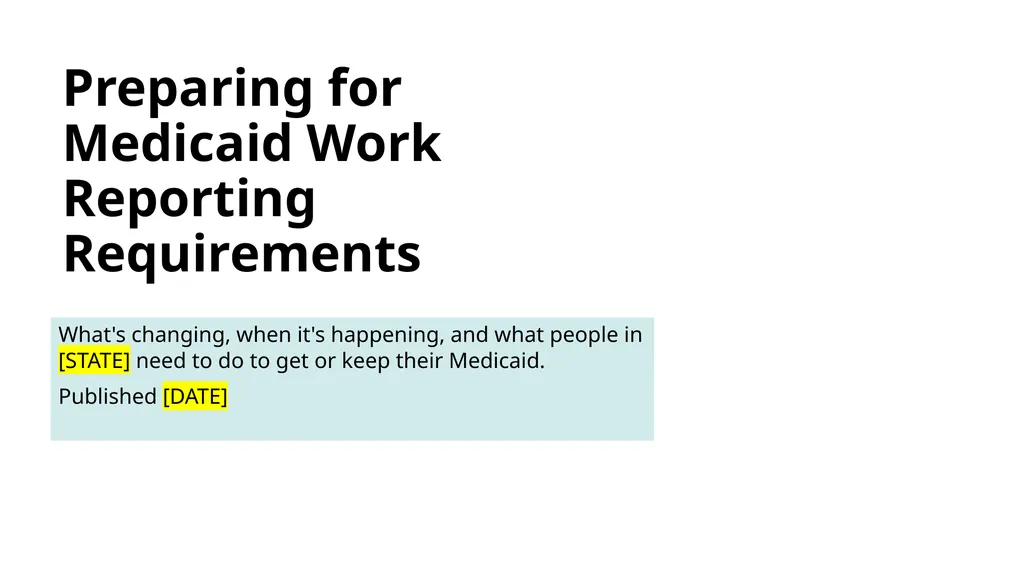
Preparing for
Medicaid Work
Reporting Requirements What's changing, when it's happening, and what people in [STATE] need to do to get or keep their Medicaid.
Published [DATE]<br>
Published [DATE]<br>
08
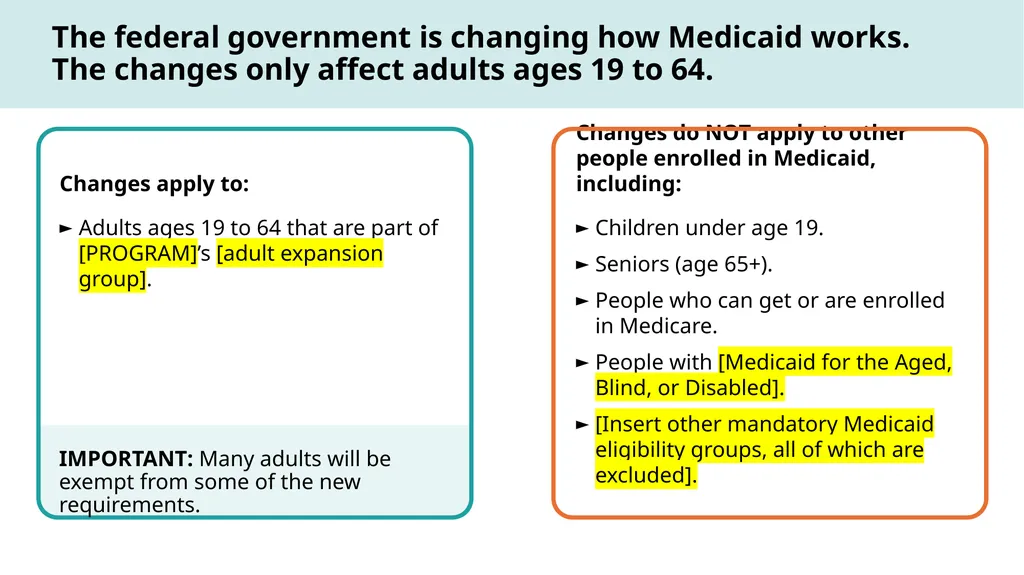
Changes apply to: Adults ages 19 to 64 that are part of [PROGRAM]’s [adult expansion group]. Changes do NOT apply to other people enrolled in Medicaid, including: Children under age 19.
Seniors (age 65+).
People who can get or are enrolled in Medicare.
People with [Medicaid for the Aged, Blind, or Disabled].
[Insert other mandatory Medicaid eligibility groups, all of which are excluded]. The federal government is changing how Medicaid works. The changes only affect adults ages 19 to 64. IMPORTANT: Many adults will be exempt from some of the new requirements.<br>
Seniors (age 65+).
People who can get or are enrolled in Medicare.
People with [Medicaid for the Aged, Blind, or Disabled].
[Insert other mandatory Medicaid eligibility groups, all of which are excluded]. The federal government is changing how Medicaid works. The changes only affect adults ages 19 to 64. IMPORTANT: Many adults will be exempt from some of the new requirements.<br>
09
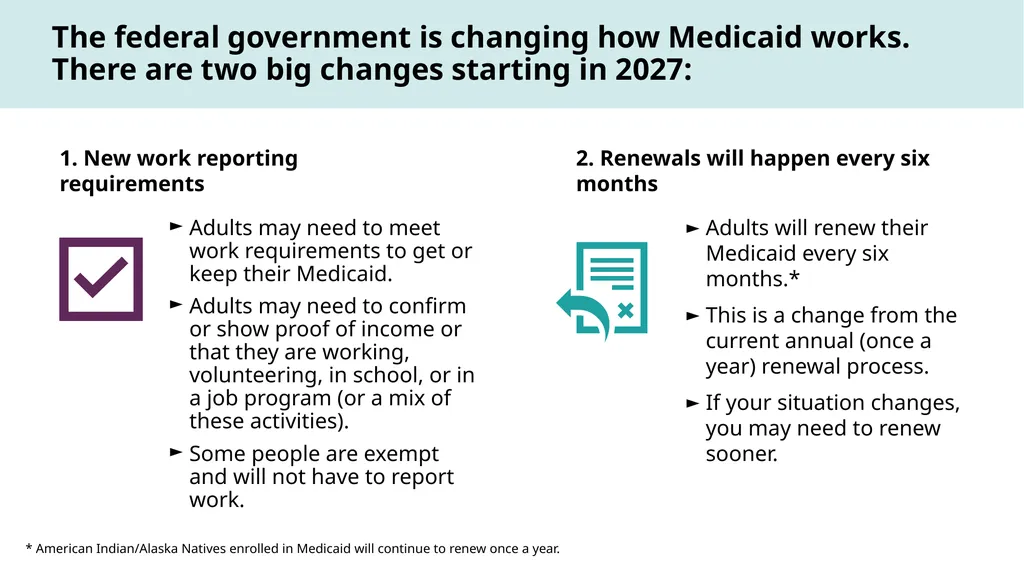
1. New work reporting requirements Adults may need to meet work requirements to get or keep their Medicaid.
Adults may need to confirm or show proof of income or that they are working, volunteering, in school, or in a job program (or a mix of these activities).
Some people are exempt and will not have to report work. 2. Renewals will happen every six months Adults will renew their Medicaid every six months.*
This is a change from the current annual (once a year) renewal process.
If your situation changes, you may need to renew sooner. The federal government is changing how Medicaid works. There are two big changes starting in 2027: * American Indian/Alaska Natives enrolled in Medicaid will continue to renew once a year.<br>
Adults may need to confirm or show proof of income or that they are working, volunteering, in school, or in a job program (or a mix of these activities).
Some people are exempt and will not have to report work. 2. Renewals will happen every six months Adults will renew their Medicaid every six months.*
This is a change from the current annual (once a year) renewal process.
If your situation changes, you may need to renew sooner. The federal government is changing how Medicaid works. There are two big changes starting in 2027: * American Indian/Alaska Natives enrolled in Medicaid will continue to renew once a year.<br>
10
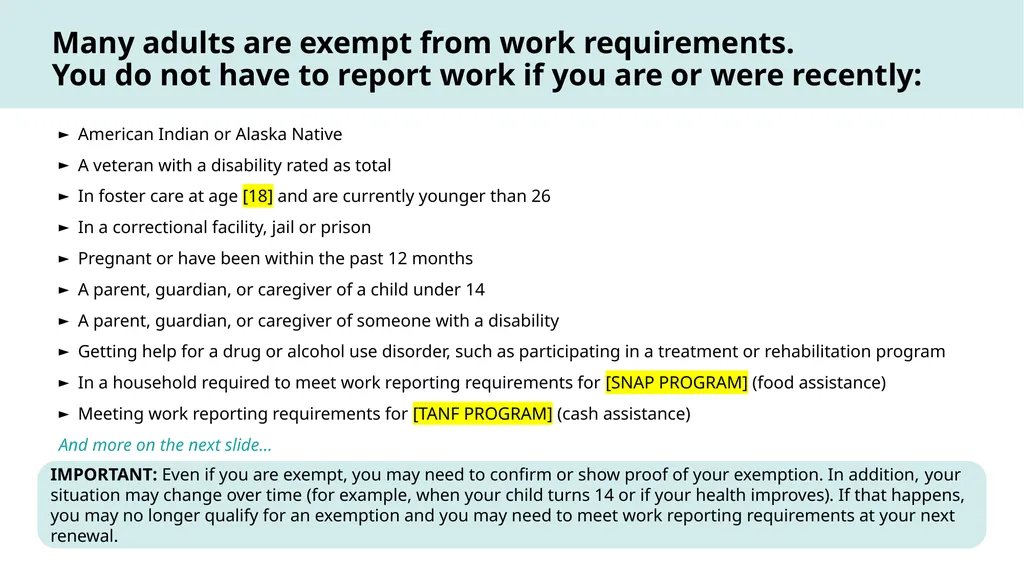
Many adults are exempt from work requirements.
You do not have to report work if you are or were recently: IMPORTANT ACTION: Confirm this exemption list against state policy before use. Add examples that align with your policy. Then delete this text box. American Indian or Alaska Native
A veteran with a disability rated as total
In foster care at age [18] and are currently younger than 26
In a correctional facility, jail or prison
Pregnant or have been within the past 12 months
A parent, guardian, or caregiver of a child under 14
A parent, guardian, or caregiver of someone with a disability
Getting help for a drug or alcohol use disorder, such as participating in a treatment or rehabilitation program
In a household required to meet work reporting requirements for [SNAP PROGRAM] (food assistance)
Meeting work reporting requirements for [TANF PROGRAM] (cash assistance)
And more on the next slide… IMPORTANT: Even if you are exempt, you may need to confirm or show proof of your exemption. In addition, your situation may change over time (for example, when your child turns 14 or if your health improves). If that happens, you may no longer qualify for an exemption and you may need to meet work reporting requirements at your next renewal.<br>
A veteran with a disability rated as total
In foster care at age [18] and are currently younger than 26
In a correctional facility, jail or prison
Pregnant or have been within the past 12 months
A parent, guardian, or caregiver of a child under 14
A parent, guardian, or caregiver of someone with a disability
Getting help for a drug or alcohol use disorder, such as participating in a treatment or rehabilitation program
In a household required to meet work reporting requirements for [SNAP PROGRAM] (food assistance)
Meeting work reporting requirements for [TANF PROGRAM] (cash assistance)
And more on the next slide… IMPORTANT: Even if you are exempt, you may need to confirm or show proof of your exemption. In addition, your situation may change over time (for example, when your child turns 14 or if your health improves). If that happens, you may no longer qualify for an exemption and you may need to meet work reporting requirements at your next renewal.<br>
11
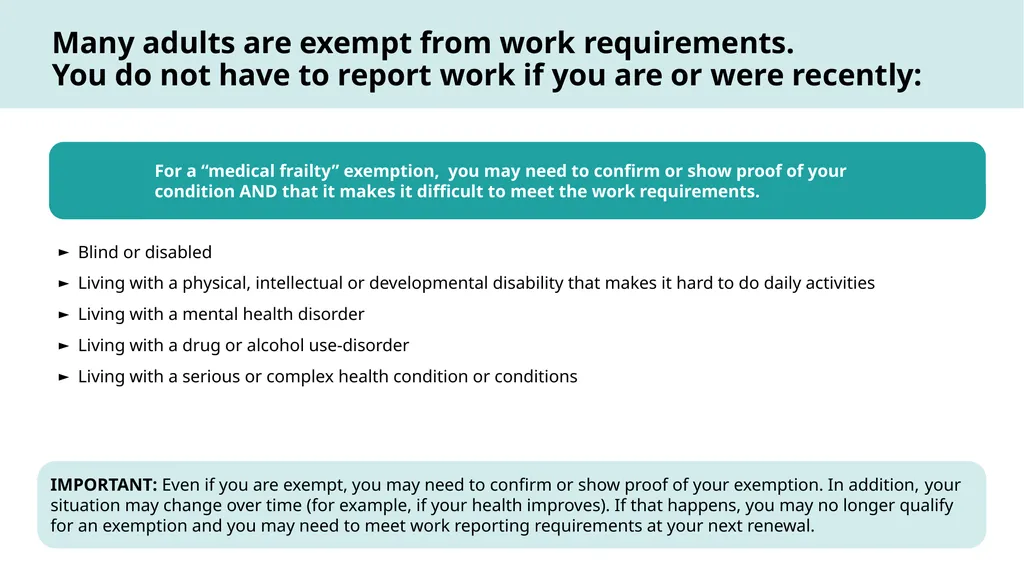
IMPORTANT: Even if you are exempt, you may need to confirm or show proof of your exemption. In addition, your situation may change over time (for example, if your health improves). If that happens, you may no longer qualify for an exemption and you may need to meet work reporting requirements at your next renewal. Many adults are exempt from work requirements.
You do not have to report work if you are or were recently: IMPORTANT ACTION: Confirm this exemption list against state policy before use. Add examples that align with your policy. Then delete this text box. Blind or disabled
Living with a physical, intellectual or developmental disability that makes it hard to do daily activities
Living with a mental health disorder
Living with a drug or alcohol use-disorder
Living with a serious or complex health condition or conditions<br>
Living with a physical, intellectual or developmental disability that makes it hard to do daily activities
Living with a mental health disorder
Living with a drug or alcohol use-disorder
Living with a serious or complex health condition or conditions<br>
12
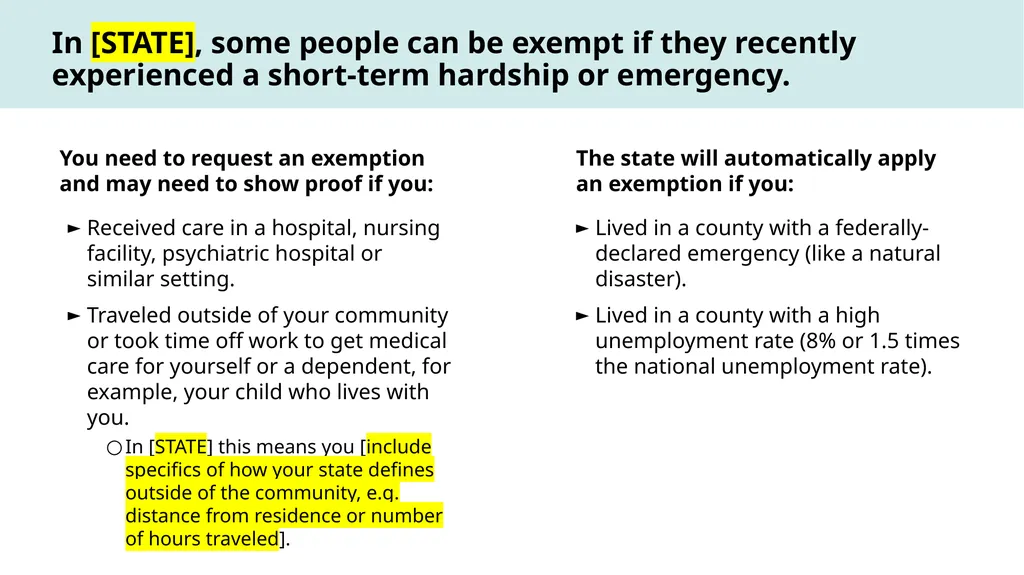
You need to request an exemption and may need to show proof if you: Received care in a hospital, nursing facility, psychiatric hospital or similar setting.
Traveled outside of your community or took time off work to get medical care for yourself or a dependent, for example, your child who lives with you.
In [STATE] this means you [include specifics of how your state defines outside of the community, e.g. distance from residence or number of hours traveled]. The state will automatically apply an exemption if you: Lived in a county with a federally-declared emergency (like a natural disaster).
Lived in a county with a high unemployment rate (8% or 1.5 times the national unemployment rate). In [STATE], some people can be exempt if they recently experienced a short-term hardship or emergency. IMPORTANT ACTION: Only include this slide if your state has adopted short-term exemptions. Then delete this text box.<br>
Traveled outside of your community or took time off work to get medical care for yourself or a dependent, for example, your child who lives with you.
In [STATE] this means you [include specifics of how your state defines outside of the community, e.g. distance from residence or number of hours traveled]. The state will automatically apply an exemption if you: Lived in a county with a federally-declared emergency (like a natural disaster).
Lived in a county with a high unemployment rate (8% or 1.5 times the national unemployment rate). In [STATE], some people can be exempt if they recently experienced a short-term hardship or emergency. IMPORTANT ACTION: Only include this slide if your state has adopted short-term exemptions. Then delete this text box.<br>
13
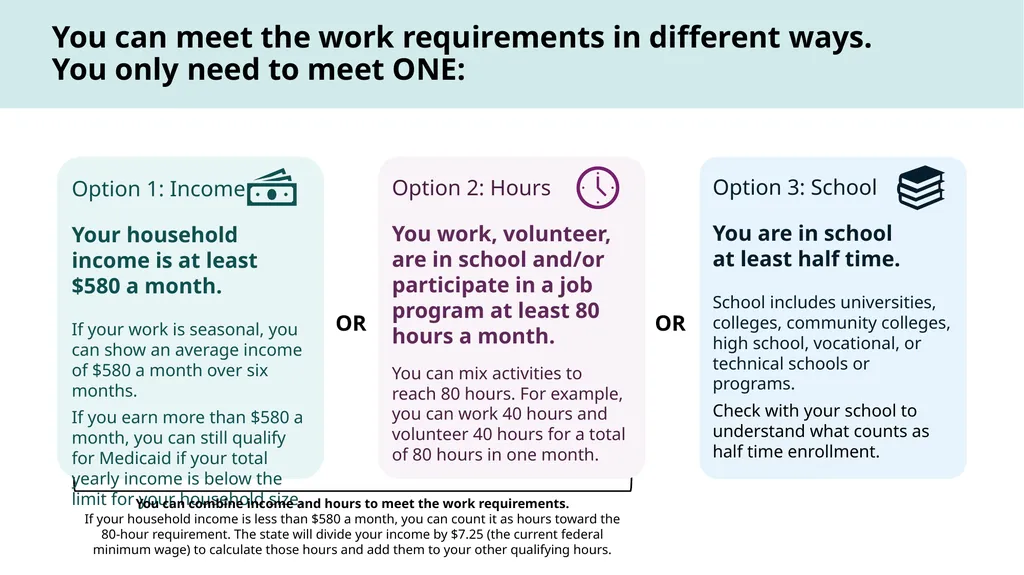
You can meet the work requirements in different ways.
You only need to meet ONE: Option 1: Income
Your household income is at least $580 a month.
If your work is seasonal, you can show an average income of $580 a month over six months.
If you earn more than $580 a month, you can still qualify for Medicaid if your total yearly income is below the limit for your household size. Option 2: Hours
You work, volunteer, are in school and/or participate in a job program at least 80 hours a month.
You can mix activities to reach 80 hours. For example, you can work 40 hours and volunteer 40 hours for a total of 80 hours in one month. Option 3: School
You are in school at least half time.
School includes universities, colleges, community colleges, high school, vocational, or technical schools or programs.
Check with your school to understand what counts as half time enrollment. OR OR You can combine income and hours to meet the work requirements.
If your household income is less than $580 a month, you can count it as hours toward the 80-hour requirement. The state will divide your income by $7.25 (the current federal minimum wage) to calculate those hours and add them to your other qualifying hours.<br>
Your household income is at least $580 a month.
If your work is seasonal, you can show an average income of $580 a month over six months.
If you earn more than $580 a month, you can still qualify for Medicaid if your total yearly income is below the limit for your household size. Option 2: Hours
You work, volunteer, are in school and/or participate in a job program at least 80 hours a month.
You can mix activities to reach 80 hours. For example, you can work 40 hours and volunteer 40 hours for a total of 80 hours in one month. Option 3: School
You are in school at least half time.
School includes universities, colleges, community colleges, high school, vocational, or technical schools or programs.
Check with your school to understand what counts as half time enrollment. OR OR You can combine income and hours to meet the work requirements.
If your household income is less than $580 a month, you can count it as hours toward the 80-hour requirement. The state will divide your income by $7.25 (the current federal minimum wage) to calculate those hours and add them to your other qualifying hours.<br>
14
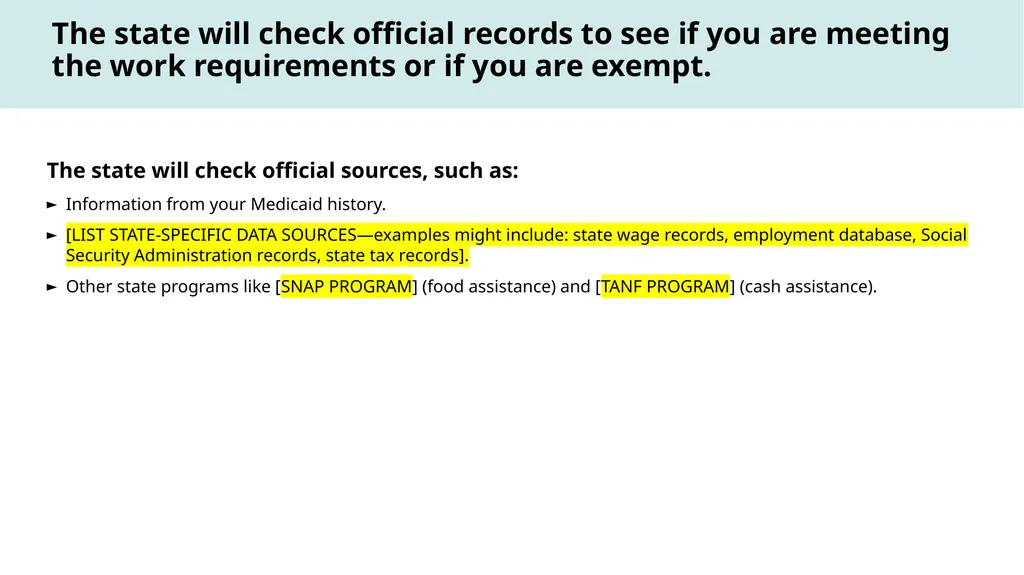
The state will check official sources, such as:
Information from your Medicaid history.
[LIST STATE-SPECIFIC DATA SOURCES—examples might include: state wage records, employment database, Social Security Administration records, state tax records].
Other state programs like [SNAP PROGRAM] (food assistance) and [TANF PROGRAM] (cash assistance). The state will check official records to see if you are meeting the work requirements or if you are exempt. IMPORTANT ACTION: Insert other examples of accepted documents. Then delete this text box.<br>
Information from your Medicaid history.
[LIST STATE-SPECIFIC DATA SOURCES—examples might include: state wage records, employment database, Social Security Administration records, state tax records].
Other state programs like [SNAP PROGRAM] (food assistance) and [TANF PROGRAM] (cash assistance). The state will check official records to see if you are meeting the work requirements or if you are exempt. IMPORTANT ACTION: Insert other examples of accepted documents. Then delete this text box.<br>
15
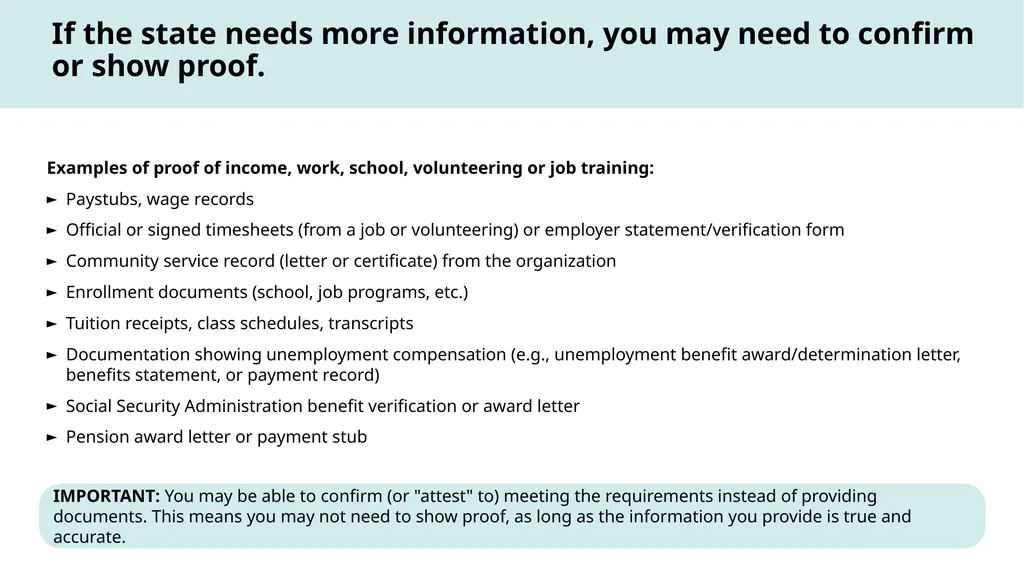
Examples of proof of income, work, school, volunteering or job training:
Paystubs, wage records
Official or signed timesheets (from a job or volunteering) or employer statement/verification form
Community service record (letter or certificate) from the organization
Enrollment documents (school, job programs, etc.)
Tuition receipts, class schedules, transcripts
Documentation showing unemployment compensation (e.g., unemployment benefit award/determination letter, benefits statement, or payment record)
Social Security Administration benefit verification or award letter
Pension award letter or payment stub If the state needs more information, you may need to confirm or show proof. IMPORTANT ACTION: Insert or replace examples of accepted documents. Then delete this text box. IMPORTANT: You may be able to confirm (or "attest" to) meeting the requirements instead of providing documents. This means you may not need to show proof, as long as the information you provide is true and accurate.<br>
Paystubs, wage records
Official or signed timesheets (from a job or volunteering) or employer statement/verification form
Community service record (letter or certificate) from the organization
Enrollment documents (school, job programs, etc.)
Tuition receipts, class schedules, transcripts
Documentation showing unemployment compensation (e.g., unemployment benefit award/determination letter, benefits statement, or payment record)
Social Security Administration benefit verification or award letter
Pension award letter or payment stub If the state needs more information, you may need to confirm or show proof. IMPORTANT ACTION: Insert or replace examples of accepted documents. Then delete this text box. IMPORTANT: You may be able to confirm (or "attest" to) meeting the requirements instead of providing documents. This means you may not need to show proof, as long as the information you provide is true and accurate.<br>
16
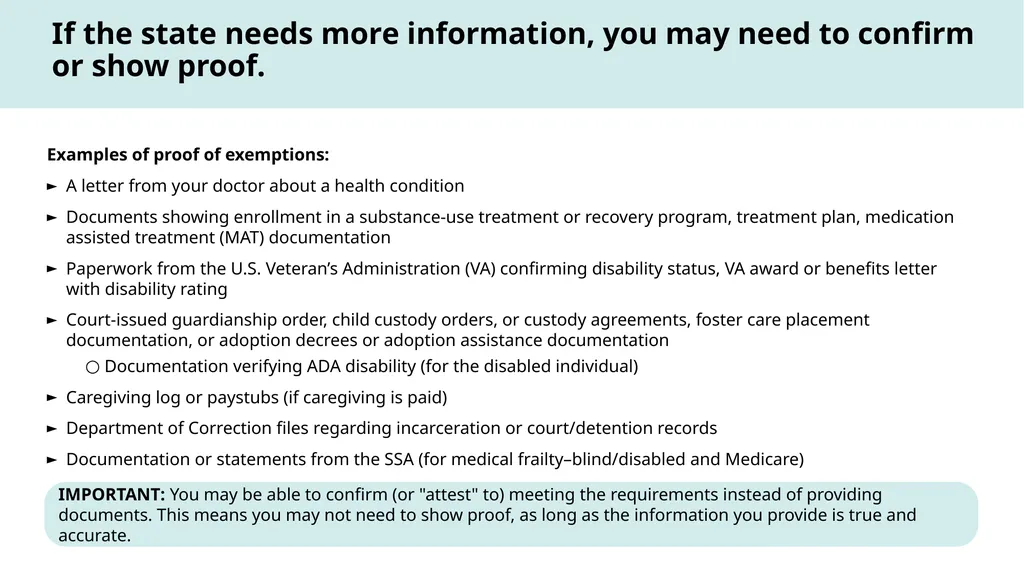
Examples of proof of exemptions:
A letter from your doctor about a health condition
Documents showing enrollment in a substance-use treatment or recovery program, treatment plan, medication assisted treatment (MAT) documentation
Paperwork from the U.S. Veteran’s Administration (VA) confirming disability status, VA award or benefits letter with disability rating
Court-issued guardianship order, child custody orders, or custody agreements, foster care placement documentation, or adoption decrees or adoption assistance documentation
Documentation verifying ADA disability (for the disabled individual)
Caregiving log or paystubs (if caregiving is paid)
Department of Correction files regarding incarceration or court/detention records
Documentation or statements from the SSA (for medical frailty–blind/disabled and Medicare) If the state needs more information, you may need to confirm or show proof. IMPORTANT ACTION: Insert or replace examples of accepted documents. Then delete this text box. IMPORTANT: You may be able to confirm (or "attest" to) meeting the requirements instead of providing documents. This means you may not need to show proof, as long as the information you provide is true and accurate.<br>
A letter from your doctor about a health condition
Documents showing enrollment in a substance-use treatment or recovery program, treatment plan, medication assisted treatment (MAT) documentation
Paperwork from the U.S. Veteran’s Administration (VA) confirming disability status, VA award or benefits letter with disability rating
Court-issued guardianship order, child custody orders, or custody agreements, foster care placement documentation, or adoption decrees or adoption assistance documentation
Documentation verifying ADA disability (for the disabled individual)
Caregiving log or paystubs (if caregiving is paid)
Department of Correction files regarding incarceration or court/detention records
Documentation or statements from the SSA (for medical frailty–blind/disabled and Medicare) If the state needs more information, you may need to confirm or show proof. IMPORTANT ACTION: Insert or replace examples of accepted documents. Then delete this text box. IMPORTANT: You may be able to confirm (or "attest" to) meeting the requirements instead of providing documents. This means you may not need to show proof, as long as the information you provide is true and accurate.<br>
17
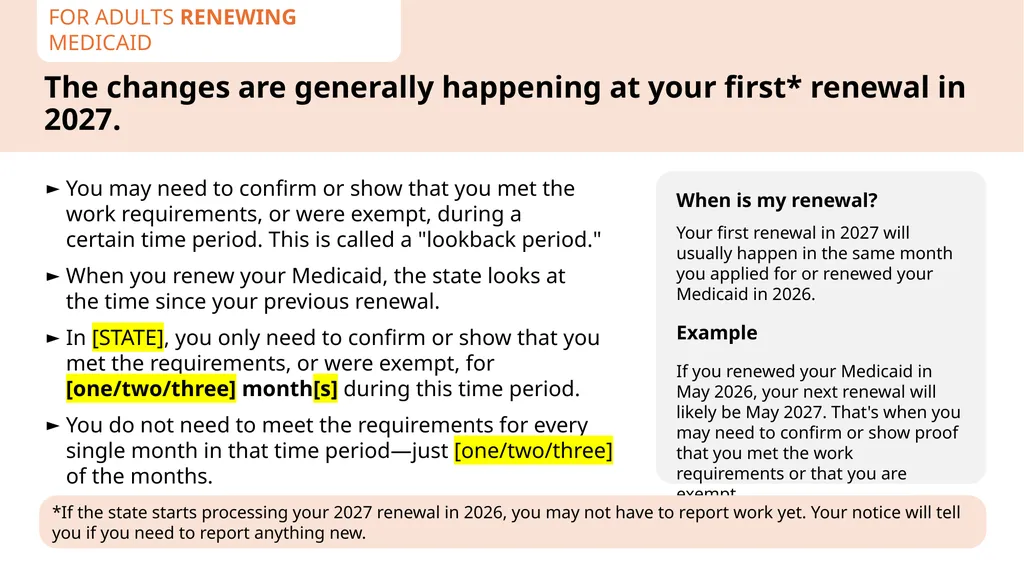
The changes are generally happening at your first* renewal in 2027. You may need to confirm or show that you met the work requirements, or were exempt, during a certain time period. This is called a "lookback period."
When you renew your Medicaid, the state looks at the time since your previous renewal.
In [STATE], you only need to confirm or show that you met the requirements, or were exempt, for [one/two/three] month[s] during this time period.
You do not need to meet the requirements for every single month in that time period—just [one/two/three] of the months. When is my renewal?
Your first renewal in 2027 will usually happen in the same month you applied for or renewed your Medicaid in 2026.
Example
If you renewed your Medicaid in May 2026, your next renewal will likely be May 2027. That's when you may need to confirm or show proof that you met the work requirements or that you are exempt. *If the state starts processing your 2027 renewal in 2026, you may not have to report work yet. Your notice will tell you if you need to report anything new. FOR ADULTS RENEWING MEDICAID<br>
When you renew your Medicaid, the state looks at the time since your previous renewal.
In [STATE], you only need to confirm or show that you met the requirements, or were exempt, for [one/two/three] month[s] during this time period.
You do not need to meet the requirements for every single month in that time period—just [one/two/three] of the months. When is my renewal?
Your first renewal in 2027 will usually happen in the same month you applied for or renewed your Medicaid in 2026.
Example
If you renewed your Medicaid in May 2026, your next renewal will likely be May 2027. That's when you may need to confirm or show proof that you met the work requirements or that you are exempt. *If the state starts processing your 2027 renewal in 2026, you may not have to report work yet. Your notice will tell you if you need to report anything new. FOR ADULTS RENEWING MEDICAID<br>
18
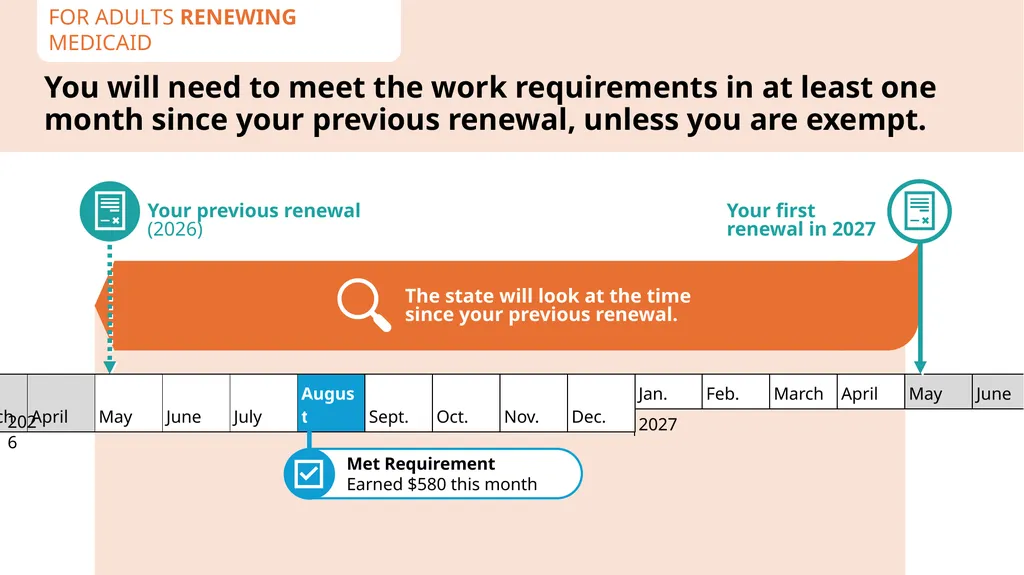
You will need to meet the work requirements in at least one month since your previous renewal, unless you are exempt. Your previous renewal
(2026) Your first renewal in 2027 2026 The state will look at the time since your previous renewal. IMPORTANT ACTION: Only keep if your state has a ONE-month lookback period. Then delete this text box. FOR ADULTS RENEWING MEDICAID<br>
(2026) Your first renewal in 2027 2026 The state will look at the time since your previous renewal. IMPORTANT ACTION: Only keep if your state has a ONE-month lookback period. Then delete this text box. FOR ADULTS RENEWING MEDICAID<br>
19
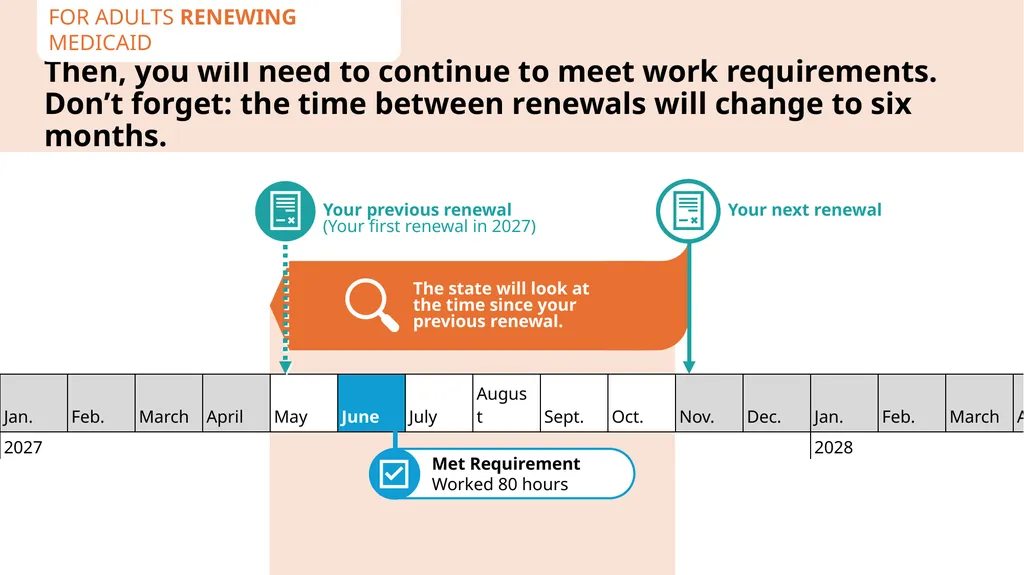
Your previous renewal
(Your first renewal in 2027) Your next renewal The state will look at the time since your previous renewal. Then, you will need to continue to meet work requirements. Don’t forget: the time between renewals will change to six months. IMPORTANT ACTION: Only keep if your state has a ONE-month lookback period. Then delete this text box. FOR ADULTS RENEWING MEDICAID<br>
(Your first renewal in 2027) Your next renewal The state will look at the time since your previous renewal. Then, you will need to continue to meet work requirements. Don’t forget: the time between renewals will change to six months. IMPORTANT ACTION: Only keep if your state has a ONE-month lookback period. Then delete this text box. FOR ADULTS RENEWING MEDICAID<br>
20
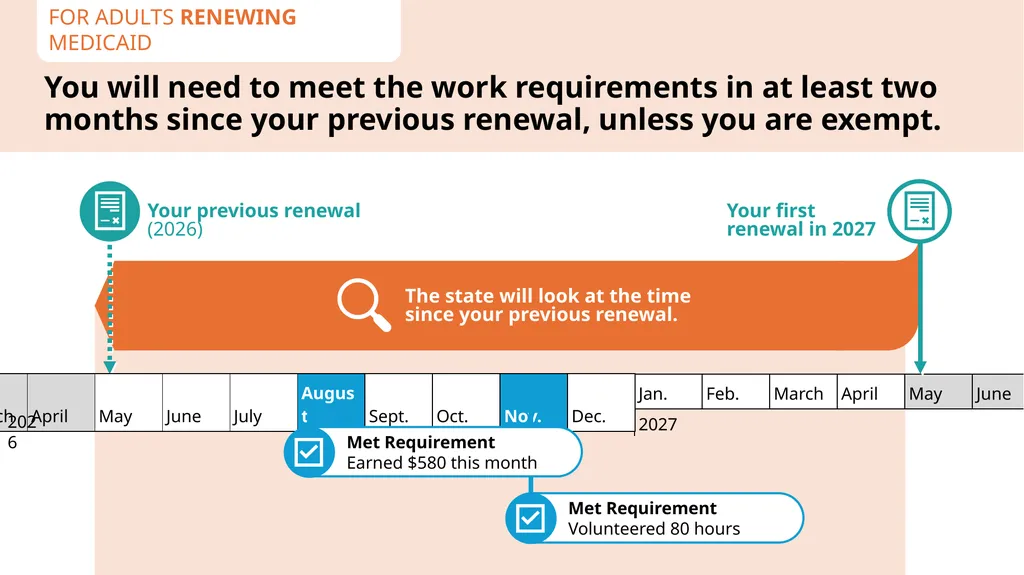
You will need to meet the work requirements in at least two months since your previous renewal, unless you are exempt. Your previous renewal
(2026) Your first renewal in 2027 2026 The state will look at the time since your previous renewal. IMPORTANT ACTION: Only keep if your state has a TWO-month lookback period. Then delete this text box. FOR ADULTS RENEWING MEDICAID<br>
(2026) Your first renewal in 2027 2026 The state will look at the time since your previous renewal. IMPORTANT ACTION: Only keep if your state has a TWO-month lookback period. Then delete this text box. FOR ADULTS RENEWING MEDICAID<br>
21
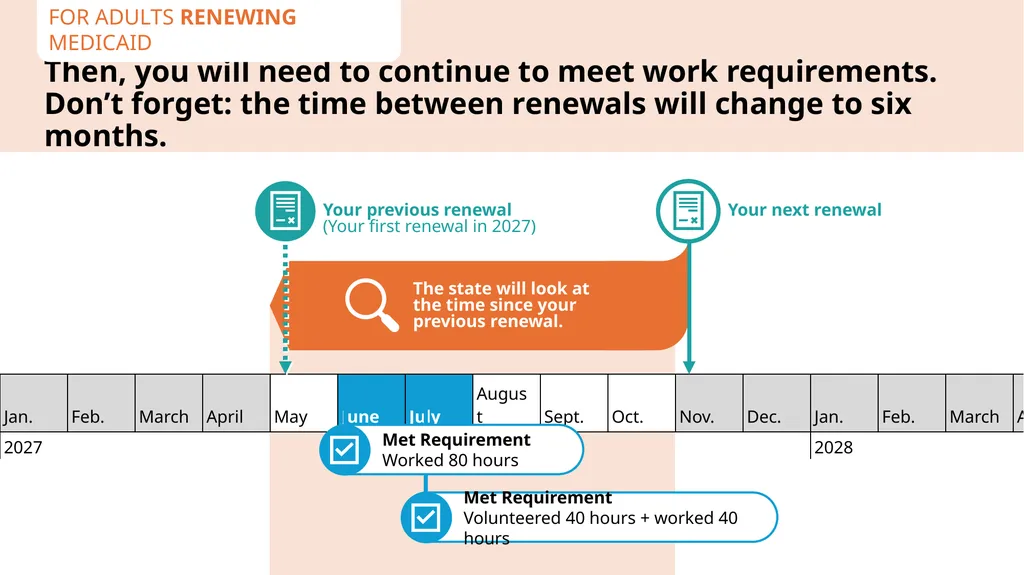
Your previous renewal
(Your first renewal in 2027) Your next renewal The state will look at the time since your previous renewal. Then, you will need to continue to meet work requirements. Don’t forget: the time between renewals will change to six months. IMPORTANT ACTION: Only keep if your state has a TWO-month lookback period. Then delete this text box. FOR ADULTS RENEWING MEDICAID<br>
(Your first renewal in 2027) Your next renewal The state will look at the time since your previous renewal. Then, you will need to continue to meet work requirements. Don’t forget: the time between renewals will change to six months. IMPORTANT ACTION: Only keep if your state has a TWO-month lookback period. Then delete this text box. FOR ADULTS RENEWING MEDICAID<br>
22
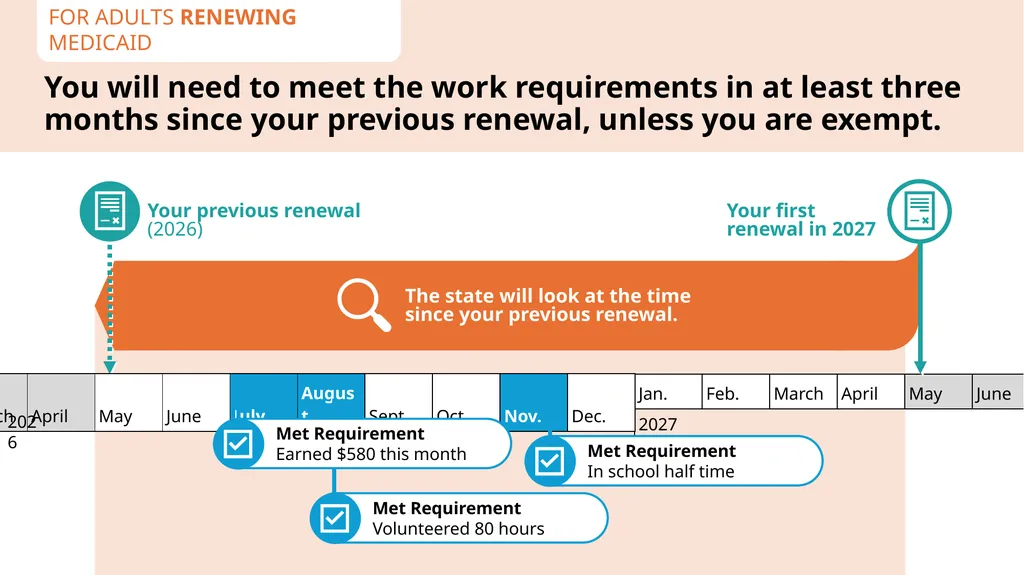
You will need to meet the work requirements in at least three months since your previous renewal, unless you are exempt. Your previous renewal
(2026) Your first renewal in 2027 2026 The state will look at the time since your previous renewal. IMPORTANT ACTION: Only keep if your state has a THREE-month lookback period. Then delete this text box. FOR ADULTS RENEWING MEDICAID<br>
(2026) Your first renewal in 2027 2026 The state will look at the time since your previous renewal. IMPORTANT ACTION: Only keep if your state has a THREE-month lookback period. Then delete this text box. FOR ADULTS RENEWING MEDICAID<br>
23
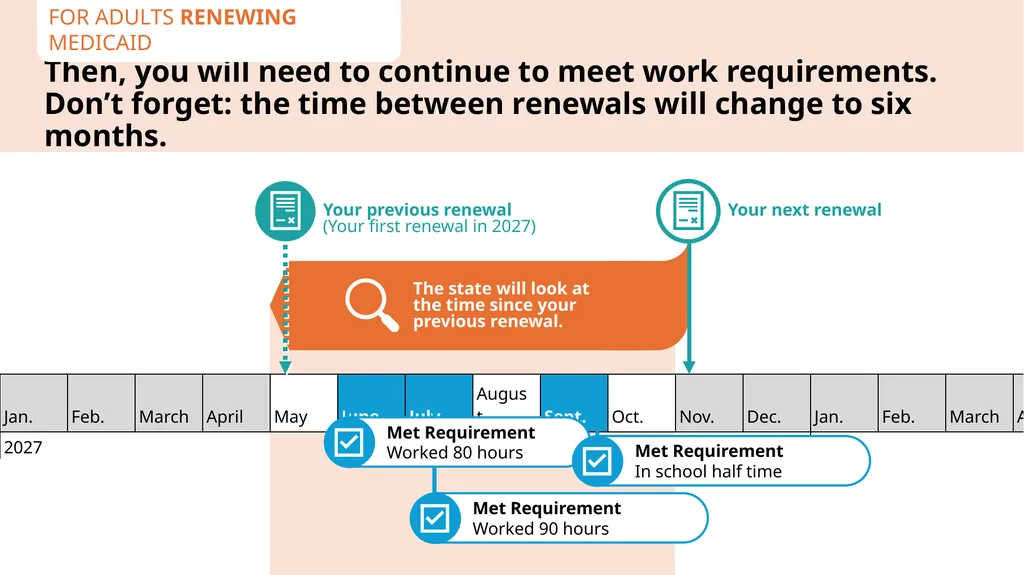
Your previous renewal
(Your first renewal in 2027) Your next renewal The state will look at the time since your previous renewal. Then, you will need to continue to meet work requirements. Don’t forget: the time between renewals will change to six months. IMPORTANT ACTION: Only keep if your state has a THREE-month lookback period. Then delete this text box. FOR ADULTS RENEWING MEDICAID<br>
(Your first renewal in 2027) Your next renewal The state will look at the time since your previous renewal. Then, you will need to continue to meet work requirements. Don’t forget: the time between renewals will change to six months. IMPORTANT ACTION: Only keep if your state has a THREE-month lookback period. Then delete this text box. FOR ADULTS RENEWING MEDICAID<br>
24
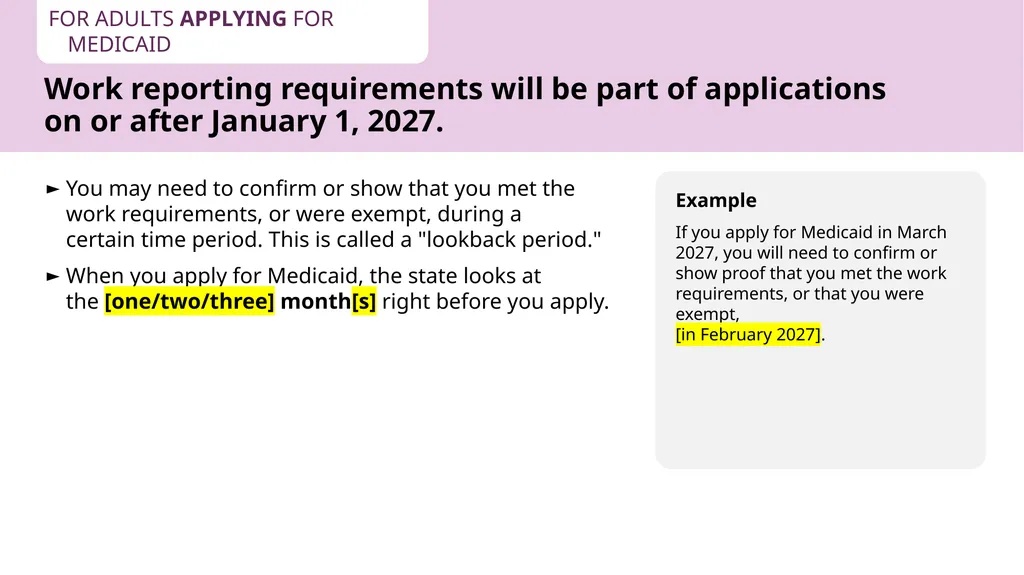
Work reporting requirements will be part of applications
on or after January 1, 2027. You may need to confirm or show that you met the work requirements, or were exempt, during a certain time period. This is called a "lookback period."
When you apply for Medicaid, the state looks at the [one/two/three] month[s] right before you apply. Example
If you apply for Medicaid in March 2027, you will need to confirm or show proof that you met the work requirements, or that you were exempt, [in February 2027]. FOR ADULTS APPLYING FOR MEDICAID<br>
When you apply for Medicaid, the state looks at the [one/two/three] month[s] right before you apply. Example
If you apply for Medicaid in March 2027, you will need to confirm or show proof that you met the work requirements, or that you were exempt, [in February 2027]. FOR ADULTS APPLYING FOR MEDICAID<br>
25
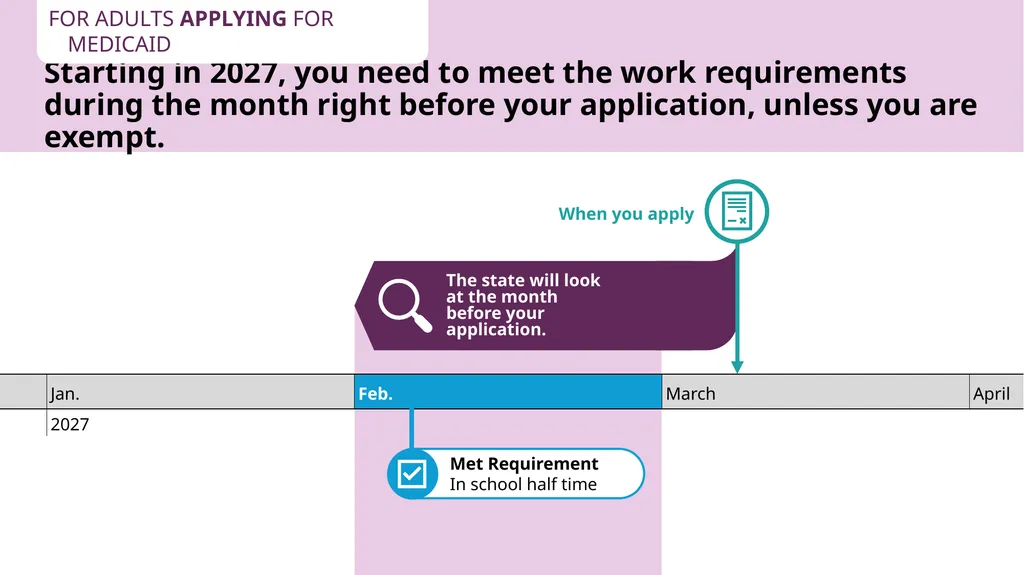
When you apply The state will look at the month before your application. Starting in 2027, you need to meet the work requirements during the month right before your application, unless you are exempt. IMPORTANT ACTION: Only keep if your state has a ONE-month lookback period. Then delete this text box. FOR ADULTS APPLYING FOR MEDICAID<br>
26
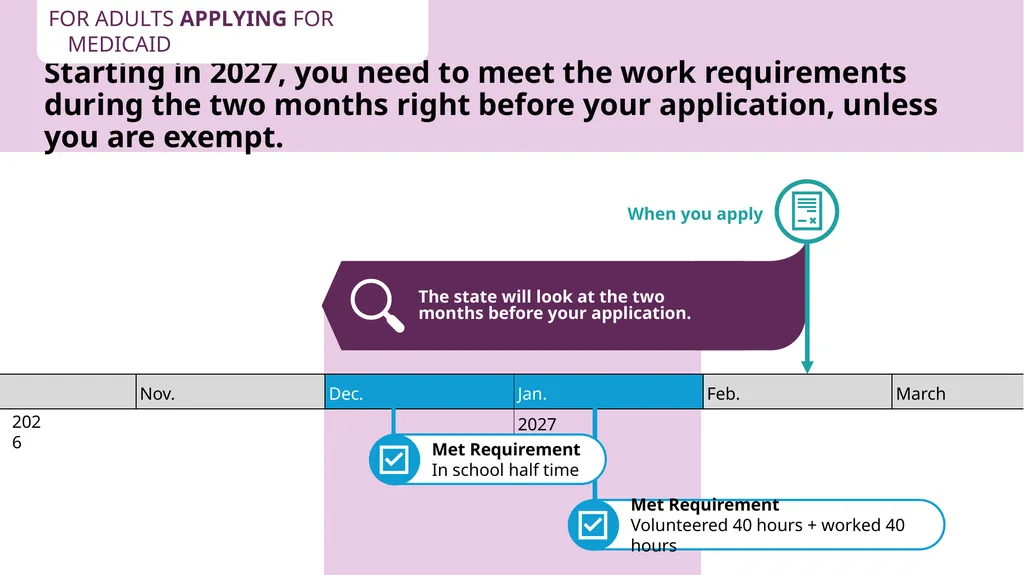
When you apply The state will look at the two months before your application. Starting in 2027, you need to meet the work requirements during the two months right before your application, unless you are exempt. 2026 IMPORTANT ACTION: Only keep if your state has a TWO-month lookback period. Then delete this text box. FOR ADULTS APPLYING FOR MEDICAID<br>
27
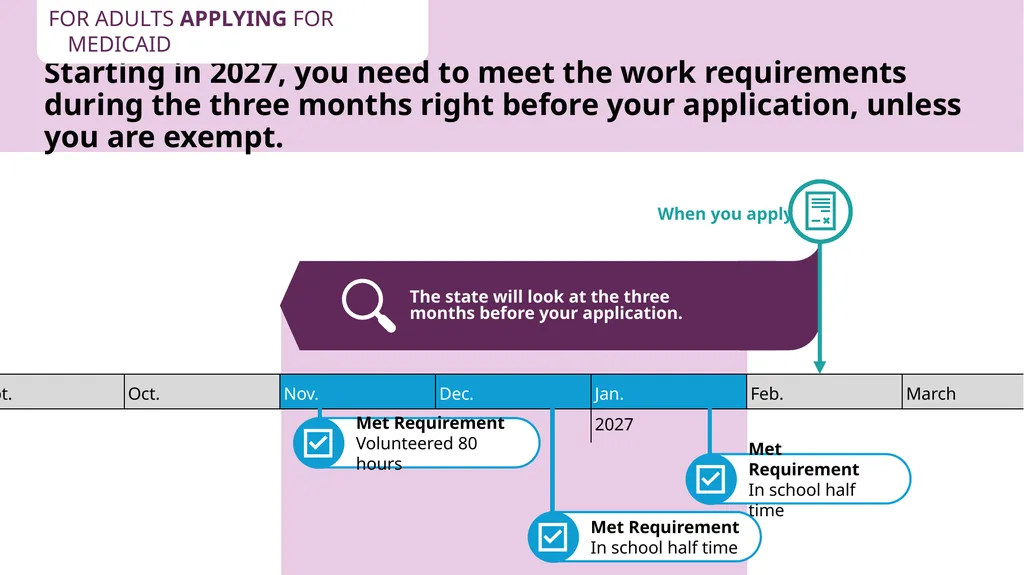
When you apply The state will look at the three months before your application. Starting in 2027, you need to meet the work requirements during the three months right before your application, unless you are exempt. IMPORTANT ACTION: Only keep if your state has a THREE-month lookback period. Then delete this text box. FOR ADULTS APPLYING FOR MEDICAID<br>
28
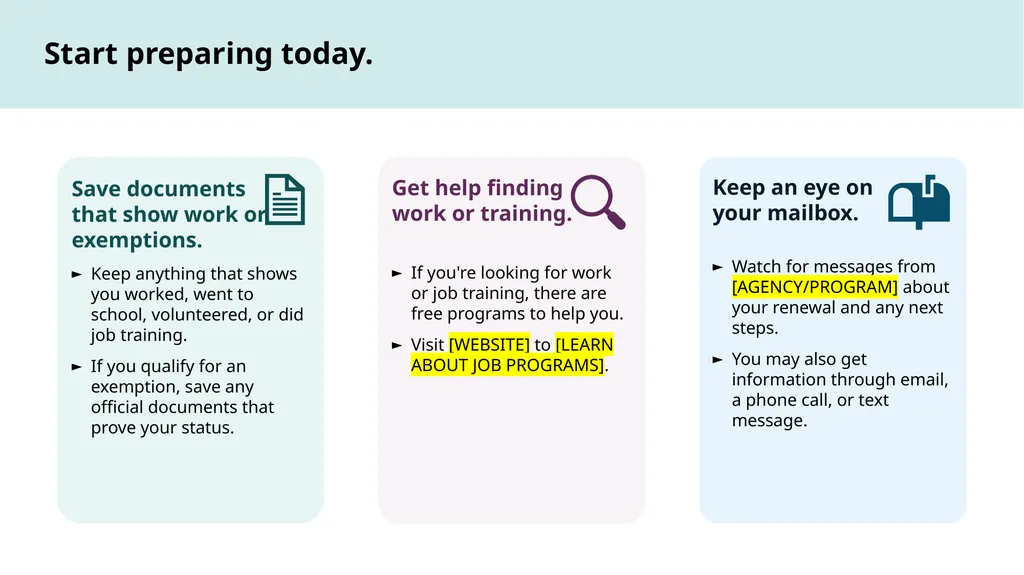
Start preparing today. Save documents
that show work or exemptions.
Keep anything that shows you worked, went to school, volunteered, or did job training.
If you qualify for an exemption, save any official documents that prove your status. Get help finding
work or training.
If you're looking for work or job training, there are free programs to help you.
Visit [WEBSITE] to [LEARN ABOUT JOB PROGRAMS]. Keep an eye on your mailbox.
Watch for messages from [AGENCY/PROGRAM] about your renewal and any next steps.
You may also get information through email, a phone call, or text message.<br>
that show work or exemptions.
Keep anything that shows you worked, went to school, volunteered, or did job training.
If you qualify for an exemption, save any official documents that prove your status. Get help finding
work or training.
If you're looking for work or job training, there are free programs to help you.
Visit [WEBSITE] to [LEARN ABOUT JOB PROGRAMS]. Keep an eye on your mailbox.
Watch for messages from [AGENCY/PROGRAM] about your renewal and any next steps.
You may also get information through email, a phone call, or text message.<br>
29
Make sure your contact information is up to date. If your contact information is wrong, you might miss important notices and could lose your coverage.
Report a change if you:
Moved or have a new mailing address.
Changed your phone number.
Changed your email address.
Go to [WEBSITE] and [INSTRUCTIONS] to update your information today. IMPORTANT ACTION: Insert program logo or other identifier to give a visual clue of what to look out for. Then delete this text box.<br>
Report a change if you:
Moved or have a new mailing address.
Changed your phone number.
Changed your email address.
Go to [WEBSITE] and [INSTRUCTIONS] to update your information today. IMPORTANT ACTION: Insert program logo or other identifier to give a visual clue of what to look out for. Then delete this text box.<br>
30
We’re here to help. You don't have to figure this out alone. We have resources available:
Learn about the changes: [WEBSITE]
See if the changes apply to you: [SCREENER]
Read frequently asked questions: [FAQ PAGE]
Get free help: [WEBSITE OR PHONE]
Not sure if the changes apply to you? Call [PHONE NUMBER] to talk to someone who can review your situation and tell you exactly what you need to do.<br>
Learn about the changes: [WEBSITE]
See if the changes apply to you: [SCREENER]
Read frequently asked questions: [FAQ PAGE]
Get free help: [WEBSITE OR PHONE]
Not sure if the changes apply to you? Call [PHONE NUMBER] to talk to someone who can review your situation and tell you exactly what you need to do.<br>