
How to use this resource NOTES FOR FACILITATOR.
MT
Published · 59 slides · 0 views
1 / 1



Description
How to use this resource NOTES FOR FACILITATOR. REMOVE BEFORE SHARING. Suggested learning format: The modules are designed for peer-facilitated and interactive sessions. Each module can be completed in one session or can be divided across
Related Topics
Download this presentation From Below
"How to use this resource NOTES FOR FACILITATOR." is the property of its rightful owner. Permission is granted to download and print the materials on this website for personal, non-commercial use only, and to display it on your personal computer provided you do not modify the materials and that you retain all copyright notices contained in the materials. By downloading content from our website, you accept the terms of this agreement.
Share
Embed code
Presentation Transcript
01
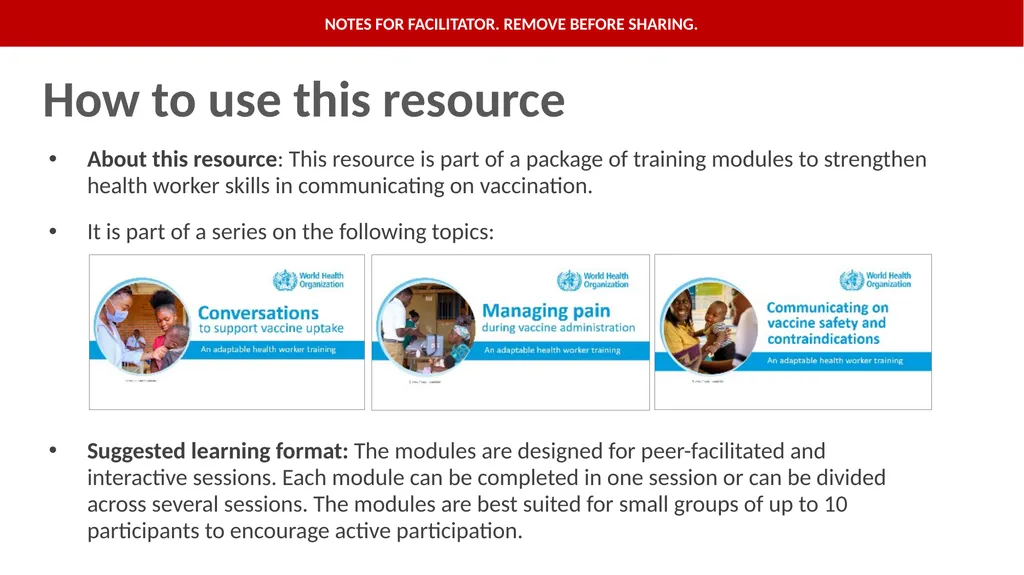
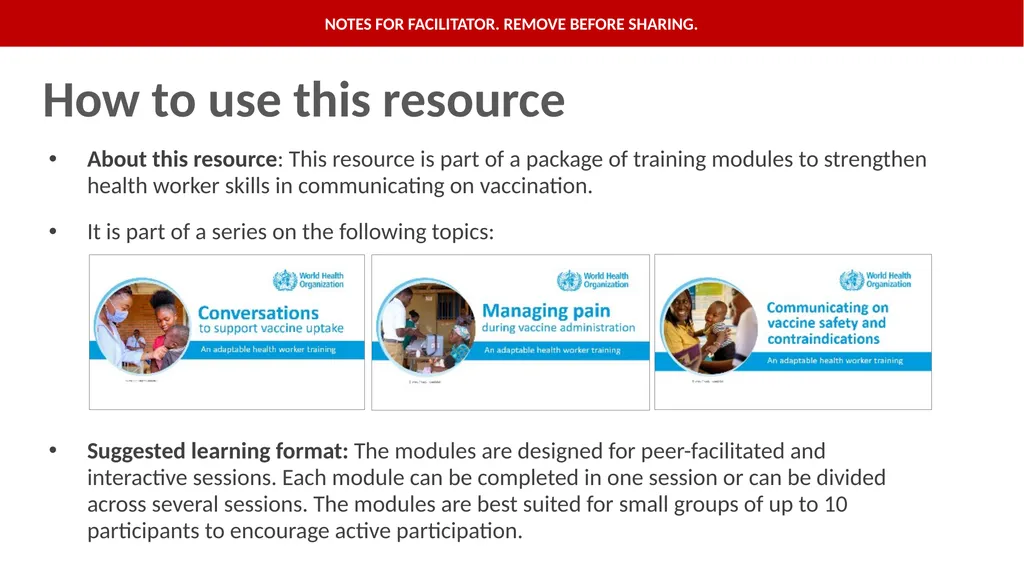
How to use this resource NOTES FOR FACILITATOR. REMOVE BEFORE SHARING. Suggested learning format: The modules are designed for peer-facilitated and interactive sessions. Each module can be completed in one session or can be divided across several sessions. The modules are best suited for small groups of up to 10 participants to encourage active participation. About this resource: This resource is part of a package of training modules to strengthen health worker skills in communicating on vaccination.
It is part of a series on the following topics:<br>
It is part of a series on the following topics:<br>
02
How to use this resource NOTES FOR FACILITATOR. REMOVE BEFORE SHARING. Adapt the modules for your local use. The contents of the modules are based on evidence and best practices. Please retain the main concepts as you make the deck your own. Customize this resource for your local needs by:
Modifying examples, sample conversations and visuals,
Translating to your local language,
Tailoring the suggested exercises.
Share your feedback. We would like to learn how you have been using these modules, what aspects have been helpful and in what ways we can improve the content and approach. After using the module, please fill out the online form linked below. Link to Microsoft Forms https://forms.microsoft.com/e/vJBakm3PCx<br>
Modifying examples, sample conversations and visuals,
Translating to your local language,
Tailoring the suggested exercises.
Share your feedback. We would like to learn how you have been using these modules, what aspects have been helpful and in what ways we can improve the content and approach. After using the module, please fill out the online form linked below. Link to Microsoft Forms https://forms.microsoft.com/e/vJBakm3PCx<br>
03
. Conversations An adaptable health worker training to support vaccine uptake © WHO / Fanjan Combrink<br>
04
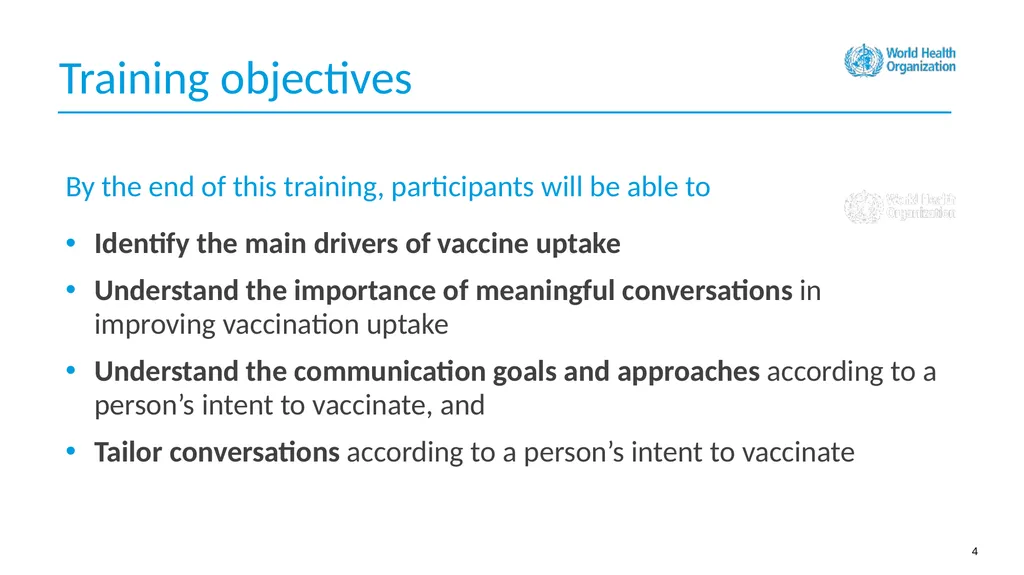
By the end of this training, participants will be able to
Identify the main drivers of vaccine uptake
Understand the importance of meaningful conversations in improving vaccination uptake
Understand the communication goals and approaches according to a person’s intent to vaccinate, and
Tailor conversations according to a person’s intent to vaccinate Training objectives<br>
Identify the main drivers of vaccine uptake
Understand the importance of meaningful conversations in improving vaccination uptake
Understand the communication goals and approaches according to a person’s intent to vaccinate, and
Tailor conversations according to a person’s intent to vaccinate Training objectives<br>
05
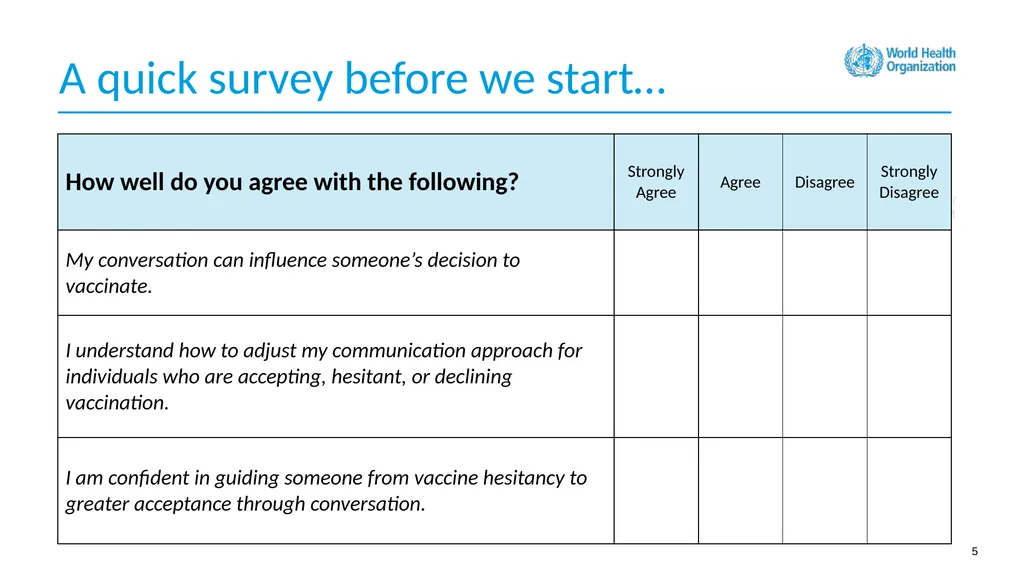
A quick survey before we start…<br>
06
Understanding drivers and barriers to vaccine uptake
Health workers and meaningful conversations
Meaningful conversations about vaccination
Tailoring vaccination conversations Outline<br>
Health workers and meaningful conversations
Meaningful conversations about vaccination
Tailoring vaccination conversations Outline<br>
07
Understanding drivers and barriers to vaccine uptake
Health workers and meaningful conversations
Meaningful conversations about vaccination
Tailoring vaccination conversations Outline<br>
Health workers and meaningful conversations
Meaningful conversations about vaccination
Tailoring vaccination conversations Outline<br>
08
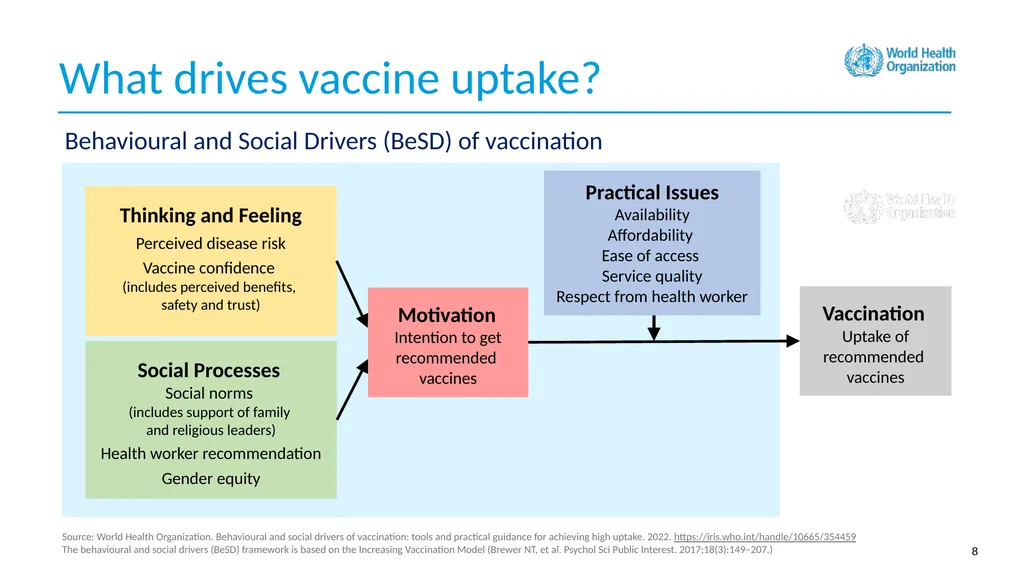
Source: World Health Organization. Behavioural and social drivers of vaccination: tools and practical guidance for achieving high uptake. 2022. https://iris.who.int/handle/10665/354459
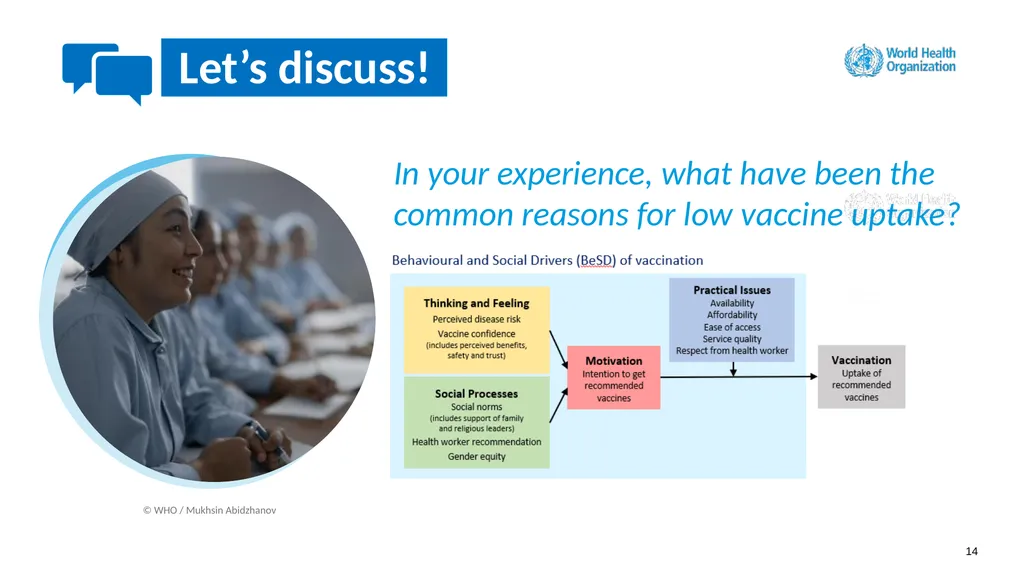
The behavioural and social drivers (BeSD) framework is based on the Increasing Vaccination Model (Brewer NT, et al. Psychol Sci Public Interest. 2017;18(3):149–207.) What drives vaccine uptake? Behavioural and Social Drivers (BeSD) of vaccination Thinking and Feeling
Perceived disease risk
Vaccine confidence (includes perceived benefits, safety and trust) Vaccination Uptake of recommended
vaccines Motivation
Intention to get recommended
vaccines Social Processes
Social norms
(includes support of family
and religious leaders)
Health worker recommendation
Gender equity Practical Issues
Availability
Affordability
Ease of access
Service quality
Respect from health worker<br>
The behavioural and social drivers (BeSD) framework is based on the Increasing Vaccination Model (Brewer NT, et al. Psychol Sci Public Interest. 2017;18(3):149–207.) What drives vaccine uptake? Behavioural and Social Drivers (BeSD) of vaccination Thinking and Feeling
Perceived disease risk
Vaccine confidence (includes perceived benefits, safety and trust) Vaccination Uptake of recommended
vaccines Motivation
Intention to get recommended
vaccines Social Processes
Social norms
(includes support of family
and religious leaders)
Health worker recommendation
Gender equity Practical Issues
Availability
Affordability
Ease of access
Service quality
Respect from health worker<br>
09
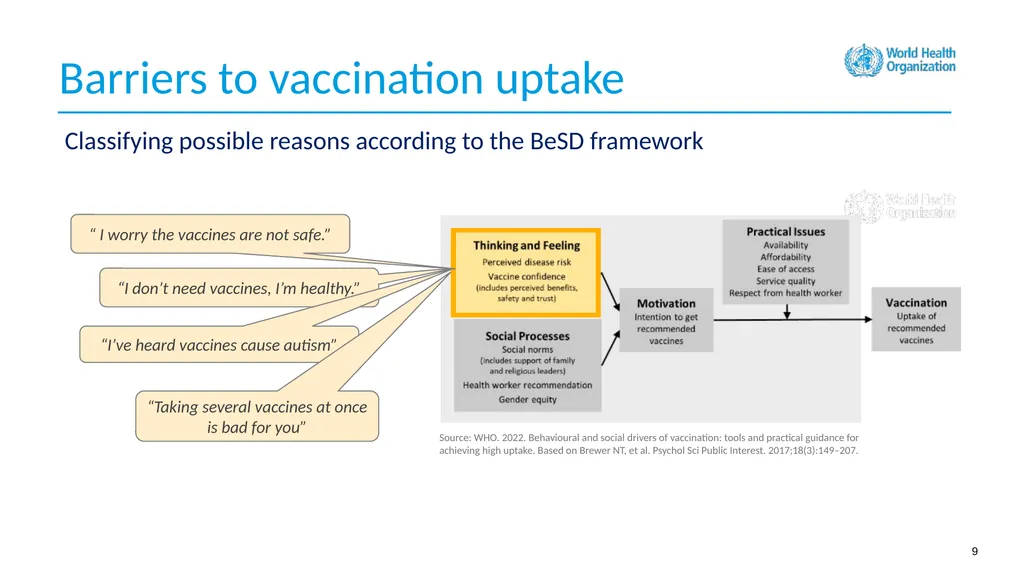
Barriers to vaccination uptake Classifying possible reasons according to the BeSD framework “ I worry the vaccines are not safe.” “I don’t need vaccines, I’m healthy.” “I’ve heard vaccines cause autism” “Taking several vaccines at once
is bad for you” Source: WHO. 2022. Behavioural and social drivers of vaccination: tools and practical guidance for achieving high uptake. Based on Brewer NT, et al. Psychol Sci Public Interest. 2017;18(3):149–207.<br>
is bad for you” Source: WHO. 2022. Behavioural and social drivers of vaccination: tools and practical guidance for achieving high uptake. Based on Brewer NT, et al. Psychol Sci Public Interest. 2017;18(3):149–207.<br>
10
“ My family does not want me
/ my child to get vaccinated.” “I have to ask my husband permission to take the children for their vaccination.” “My village chief is against vaccination.” “A health worker hasn’t recommended vaccination for me / my child.” Barriers to vaccination uptake Classifying possible reasons according to the BeSD framework Source: WHO. 2022. Behavioural and social drivers of vaccination: tools and practical guidance for achieving high uptake. Based on Brewer NT, et al. Psychol Sci Public Interest. 2017;18(3):149–207.<br>
/ my child to get vaccinated.” “I have to ask my husband permission to take the children for their vaccination.” “My village chief is against vaccination.” “A health worker hasn’t recommended vaccination for me / my child.” Barriers to vaccination uptake Classifying possible reasons according to the BeSD framework Source: WHO. 2022. Behavioural and social drivers of vaccination: tools and practical guidance for achieving high uptake. Based on Brewer NT, et al. Psychol Sci Public Interest. 2017;18(3):149–207.<br>
11
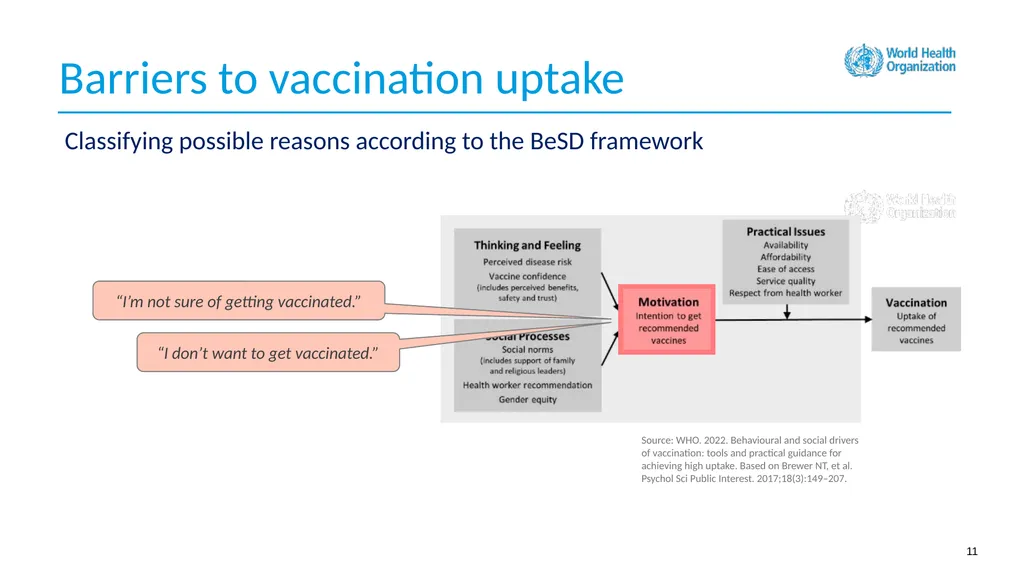
“I’m not sure of getting vaccinated.” “I don’t want to get vaccinated.” Barriers to vaccination uptake Classifying possible reasons according to the BeSD framework Source: WHO. 2022. Behavioural and social drivers of vaccination: tools and practical guidance for achieving high uptake. Based on Brewer NT, et al. Psychol Sci Public Interest. 2017;18(3):149–207.<br>
12
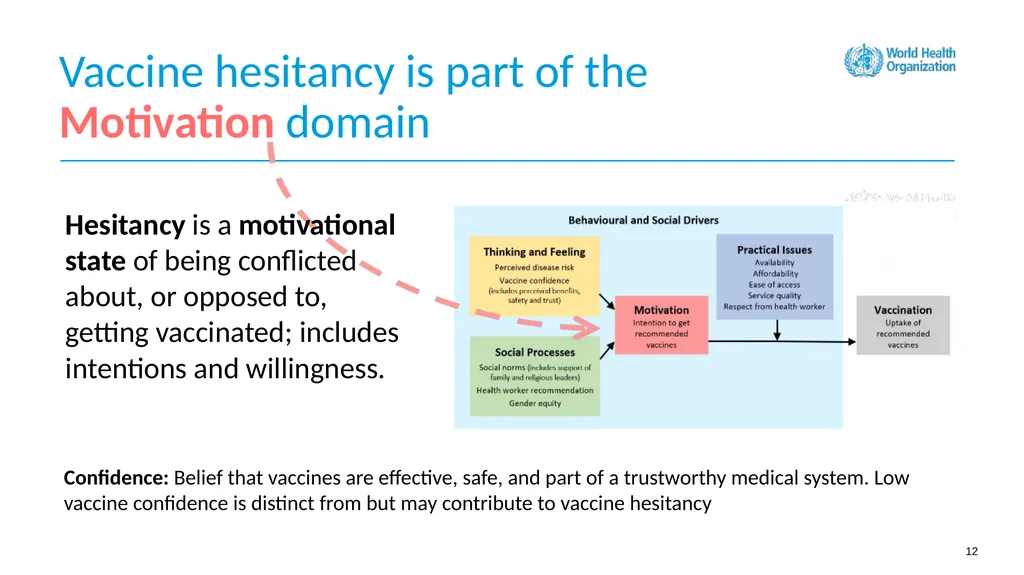
Vaccine hesitancy is part of the Motivation domain Confidence: Belief that vaccines are effective, safe, and part of a trustworthy medical system. Low vaccine confidence is distinct from but may contribute to vaccine hesitancy Hesitancy is a motivational state of being conflicted about, or opposed to, getting vaccinated; includes intentions and willingness.<br>
13
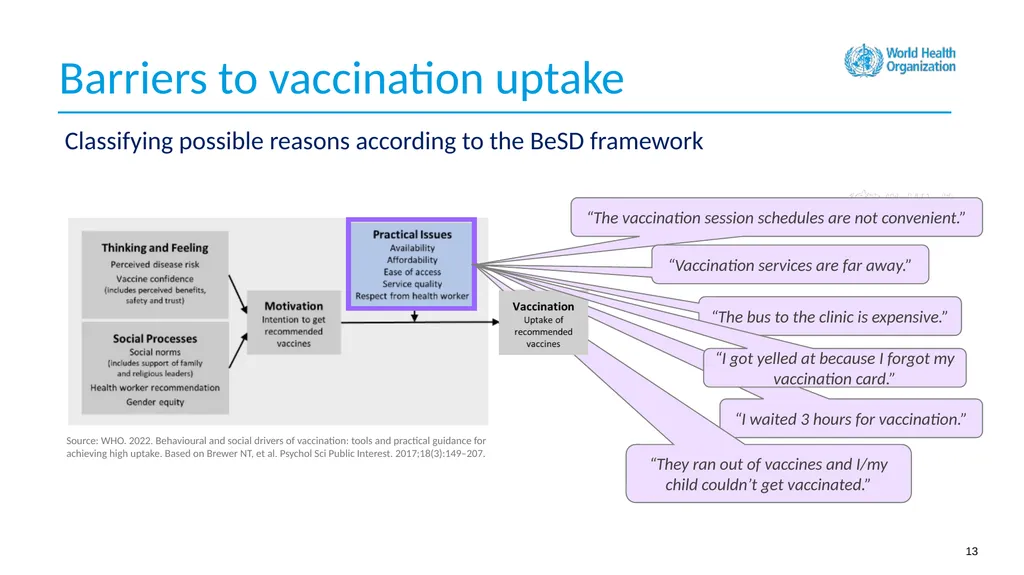
“The vaccination session schedules are not convenient.” “Vaccination services are far away.” “The bus to the clinic is expensive.” “I waited 3 hours for vaccination.” “They ran out of vaccines and I/my child couldn’t get vaccinated.” “I got yelled at because I forgot my vaccination card.” Barriers to vaccination uptake Classifying possible reasons according to the BeSD framework Source: WHO. 2022. Behavioural and social drivers of vaccination: tools and practical guidance for achieving high uptake. Based on Brewer NT, et al. Psychol Sci Public Interest. 2017;18(3):149–207.<br>
14
In your experience, what have been the common reasons for low vaccine uptake? © WHO / Mukhsin Abidzhanov Let’s discuss!<br>
15
Understanding drivers and barriers to vaccine uptake
Health workers and meaningful conversations
Meaningful conversations about vaccination
Tailoring vaccination conversations Outline<br>
Health workers and meaningful conversations
Meaningful conversations about vaccination
Tailoring vaccination conversations Outline<br>
16
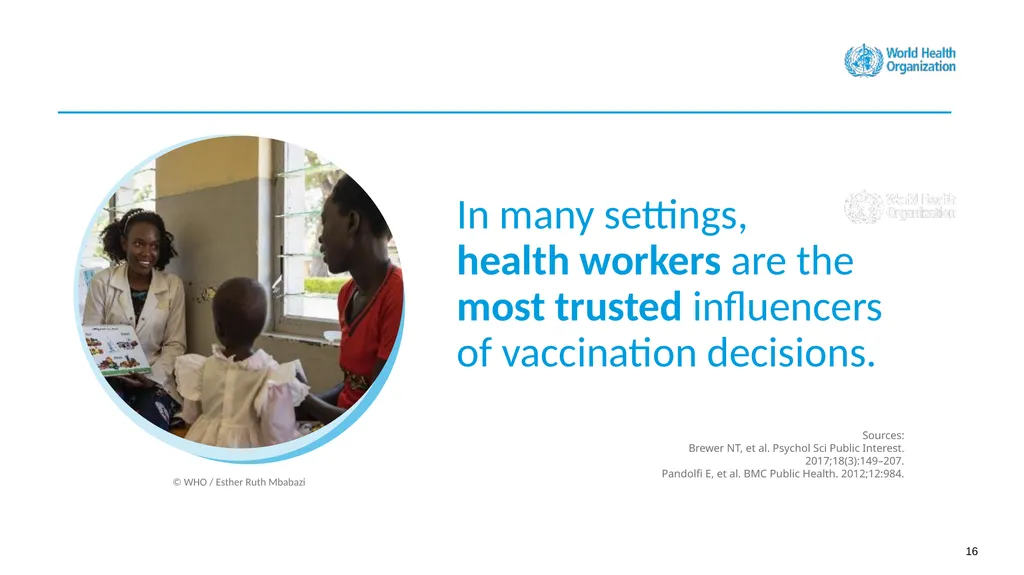
In many settings,
health workers are the most trusted influencers of vaccination decisions. © WHO / Esther Ruth Mbabazi Sources:
Brewer NT, et al. Psychol Sci Public Interest. 2017;18(3):149–207.
Pandolfi E, et al. BMC Public Health. 2012;12:984.<br>
health workers are the most trusted influencers of vaccination decisions. © WHO / Esther Ruth Mbabazi Sources:
Brewer NT, et al. Psychol Sci Public Interest. 2017;18(3):149–207.
Pandolfi E, et al. BMC Public Health. 2012;12:984.<br>
17
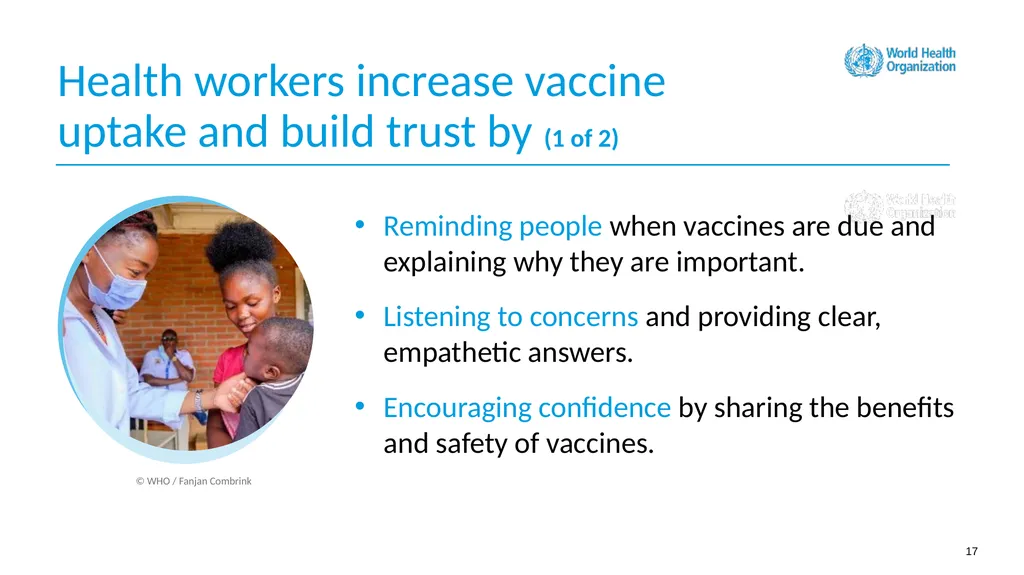
Reminding people when vaccines are due and explaining why they are important.
Listening to concerns and providing clear, empathetic answers.
Encouraging confidence by sharing the benefits and safety of vaccines. Health workers increase vaccine uptake and build trust by (1 of 2) © WHO / Fanjan Combrink<br>
Listening to concerns and providing clear, empathetic answers.
Encouraging confidence by sharing the benefits and safety of vaccines. Health workers increase vaccine uptake and build trust by (1 of 2) © WHO / Fanjan Combrink<br>
18
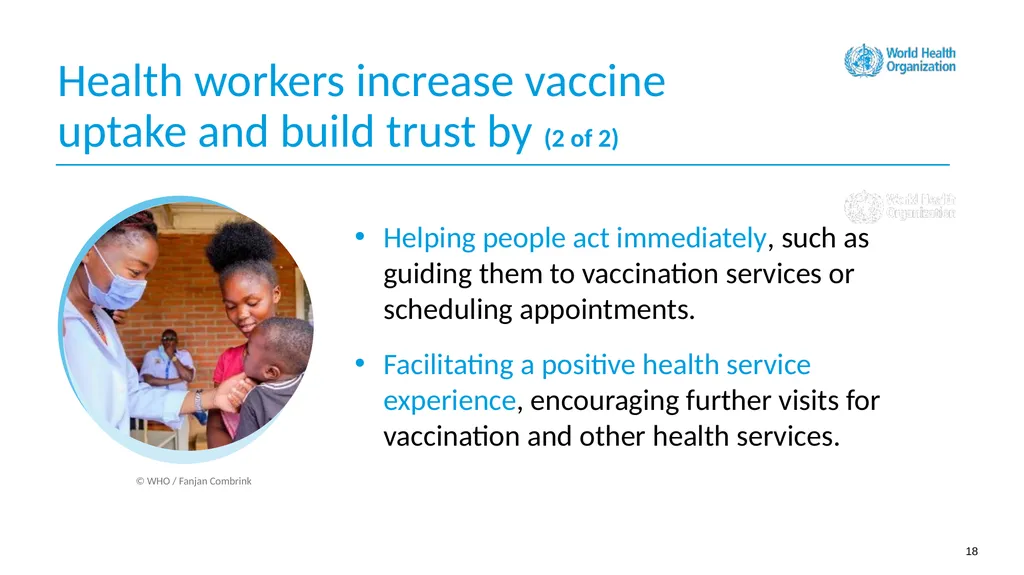
Helping people act immediately, such as guiding them to vaccination services or scheduling appointments.
Facilitating a positive health service experience, encouraging further visits for vaccination and other health services. © WHO / Fanjan Combrink Health workers increase vaccine uptake and build trust by (2 of 2)<br>
Facilitating a positive health service experience, encouraging further visits for vaccination and other health services. © WHO / Fanjan Combrink Health workers increase vaccine uptake and build trust by (2 of 2)<br>
19
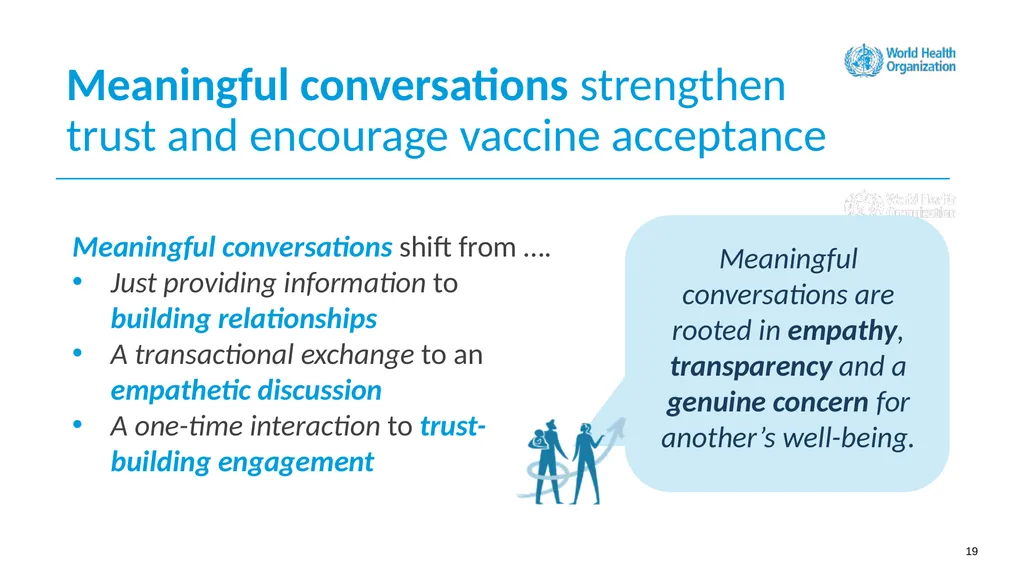
Meaningful conversations strengthen trust and encourage vaccine acceptance Meaningful conversations shift from ….
Just providing information to building relationships
A transactional exchange to an empathetic discussion
A one-time interaction to trust-building engagement Meaningful conversations are rooted in empathy, transparency and a genuine concern for another’s well-being.<br>
Just providing information to building relationships
A transactional exchange to an empathetic discussion
A one-time interaction to trust-building engagement Meaningful conversations are rooted in empathy, transparency and a genuine concern for another’s well-being.<br>
20
Understanding drivers and barriers to vaccine uptake
Health workers and meaningful conversations
Meaningful conversations about vaccination
Tailoring vaccination conversations Outline<br>
Health workers and meaningful conversations
Meaningful conversations about vaccination
Tailoring vaccination conversations Outline<br>
21
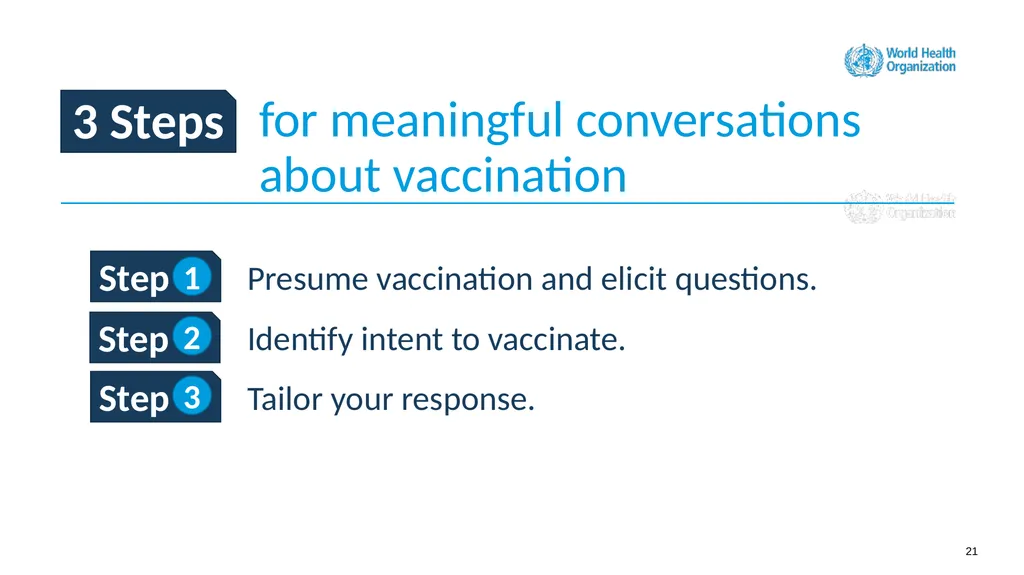
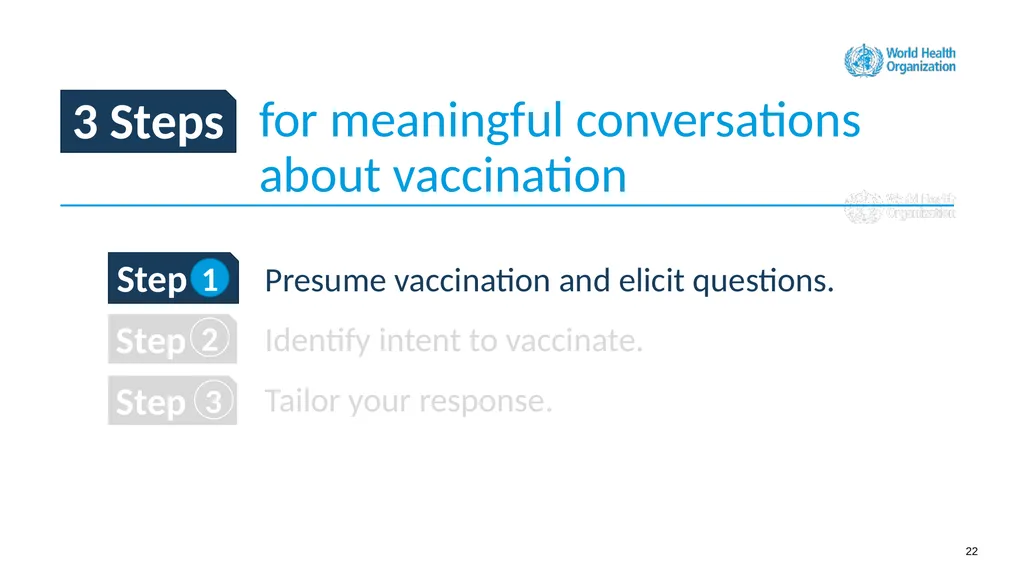
1 2 3 Presume vaccination and elicit questions.
Identify intent to vaccinate.
Tailor your response. for meaningful conversations
about vaccination 3 Steps<br>
Identify intent to vaccinate.
Tailor your response. for meaningful conversations
about vaccination 3 Steps<br>
22
1 2 Presume vaccination and elicit questions.
Identify intent to vaccinate.
Tailor your response. for meaningful conversations
about vaccination 3 Steps 3<br>
Identify intent to vaccinate.
Tailor your response. for meaningful conversations
about vaccination 3 Steps 3<br>
23
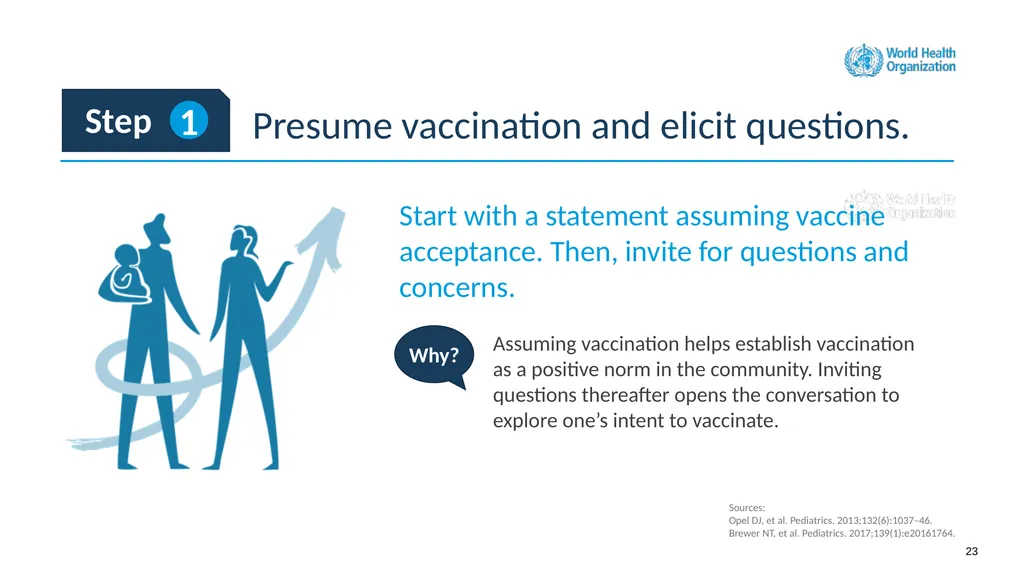
Step 1 Presume vaccination and elicit questions. Start with a statement assuming vaccine acceptance. Then, invite for questions and concerns. Assuming vaccination helps establish vaccination as a positive norm in the community. Inviting questions thereafter opens the conversation to explore one’s intent to vaccinate. Why? Sources:
Opel DJ, et al. Pediatrics. 2013;132(6):1037–46.
Brewer NT, et al. Pediatrics. 2017;139(1):e20161764.<br>
Opel DJ, et al. Pediatrics. 2013;132(6):1037–46.
Brewer NT, et al. Pediatrics. 2017;139(1):e20161764.<br>
24
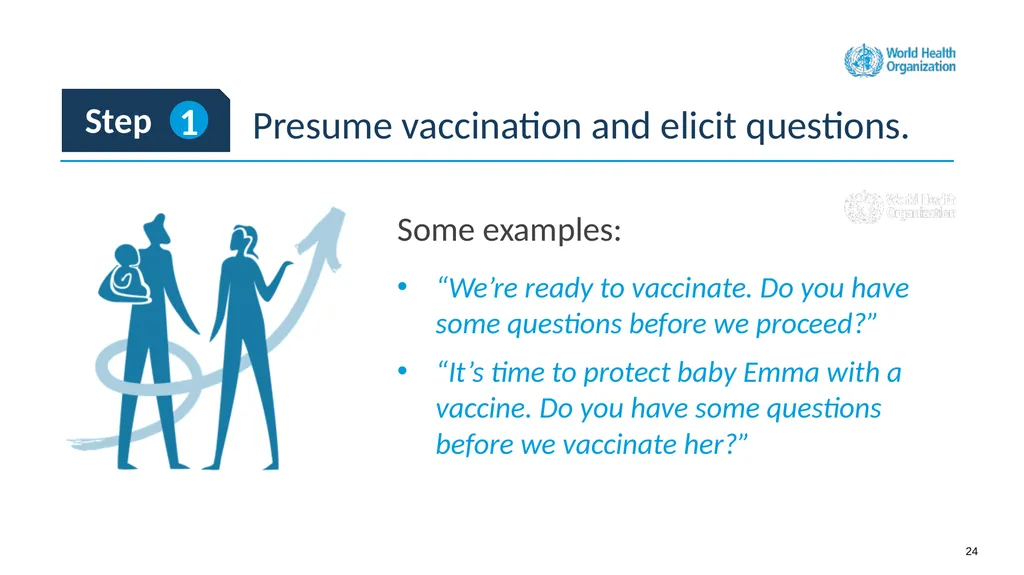
Step 1 Some examples:
“We’re ready to vaccinate. Do you have some questions before we proceed?”
“It’s time to protect baby Emma with a vaccine. Do you have some questions before we vaccinate her?” Presume vaccination and elicit questions.<br>
“We’re ready to vaccinate. Do you have some questions before we proceed?”
“It’s time to protect baby Emma with a vaccine. Do you have some questions before we vaccinate her?” Presume vaccination and elicit questions.<br>
25
Presume vaccination and elicit questions.
Identify intent to vaccinate.
Tailor your response. for meaningful conversations
about vaccination 3 Steps 2 3 1<br>
Identify intent to vaccinate.
Tailor your response. for meaningful conversations
about vaccination 3 Steps 2 3 1<br>
26
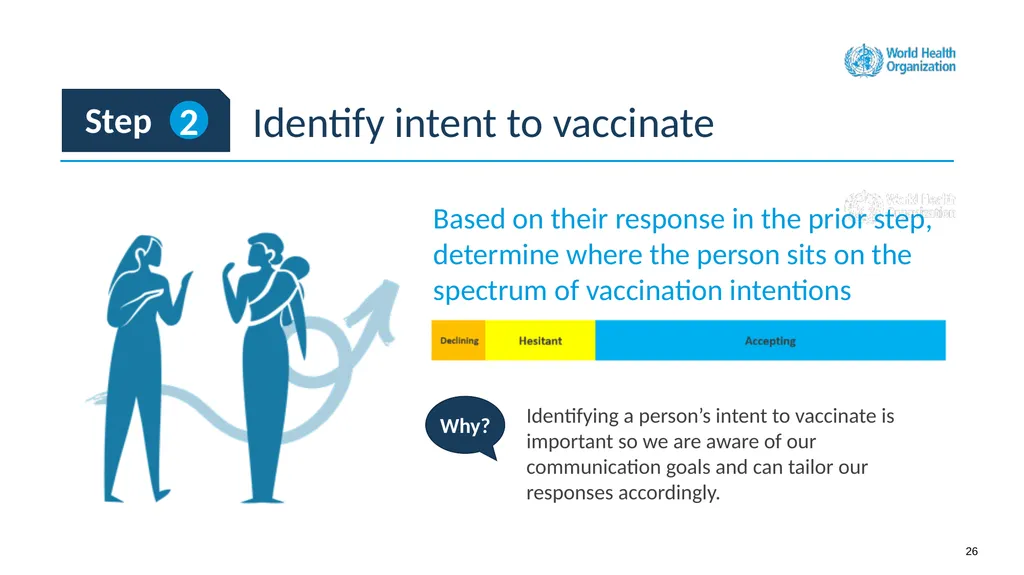
Step 2 Identify intent to vaccinate Based on their response in the prior step, determine where the person sits on the spectrum of vaccination intentions Why? Identifying a person’s intent to vaccinate is important so we are aware of our communication goals and can tailor our responses accordingly.<br>
27
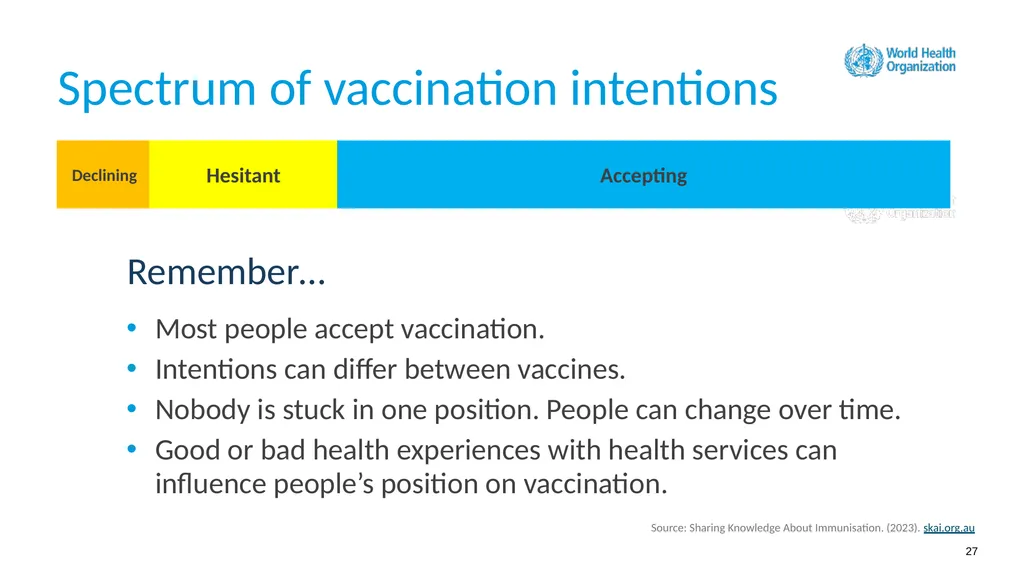
Declining Hesitant Accepting Remember… Most people accept vaccination.
Intentions can differ between vaccines.
Nobody is stuck in one position. People can change over time.
Good or bad health experiences with health services can influence people’s position on vaccination. Spectrum of vaccination intentions Source: Sharing Knowledge About Immunisation. (2023). skai.org.au<br>
Intentions can differ between vaccines.
Nobody is stuck in one position. People can change over time.
Good or bad health experiences with health services can influence people’s position on vaccination. Spectrum of vaccination intentions Source: Sharing Knowledge About Immunisation. (2023). skai.org.au<br>
28
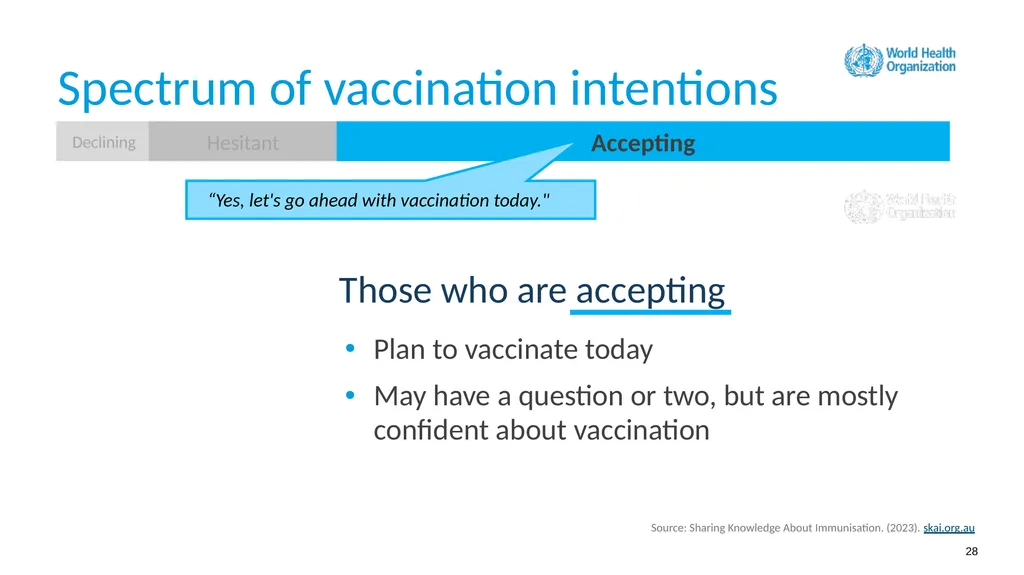
Spectrum of vaccination intentions Declining Hesitant Accepting Those who are accepting Plan to vaccinate today
May have a question or two, but are mostly confident about vaccination “Yes, let's go ahead with vaccination today." Source: Sharing Knowledge About Immunisation. (2023). skai.org.au<br>
May have a question or two, but are mostly confident about vaccination “Yes, let's go ahead with vaccination today." Source: Sharing Knowledge About Immunisation. (2023). skai.org.au<br>
29
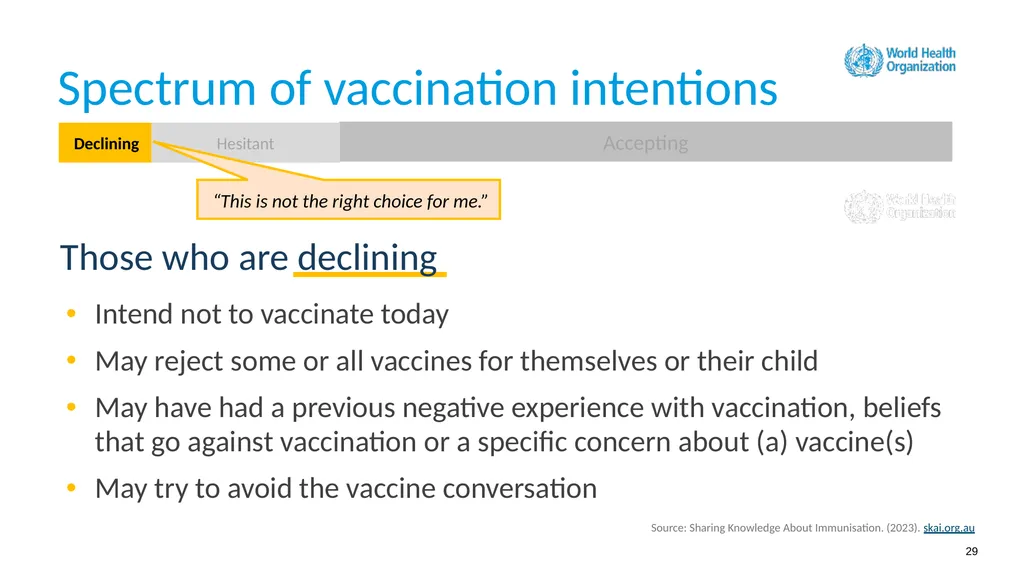
Spectrum of vaccination intentions Those who are declining Intend not to vaccinate today
May reject some or all vaccines for themselves or their child
May have had a previous negative experience with vaccination, beliefs that go against vaccination or a specific concern about (a) vaccine(s)
May try to avoid the vaccine conversation Accepting Declining Hesitant “This is not the right choice for me.” Source: Sharing Knowledge About Immunisation. (2023). skai.org.au<br>
May reject some or all vaccines for themselves or their child
May have had a previous negative experience with vaccination, beliefs that go against vaccination or a specific concern about (a) vaccine(s)
May try to avoid the vaccine conversation Accepting Declining Hesitant “This is not the right choice for me.” Source: Sharing Knowledge About Immunisation. (2023). skai.org.au<br>
30
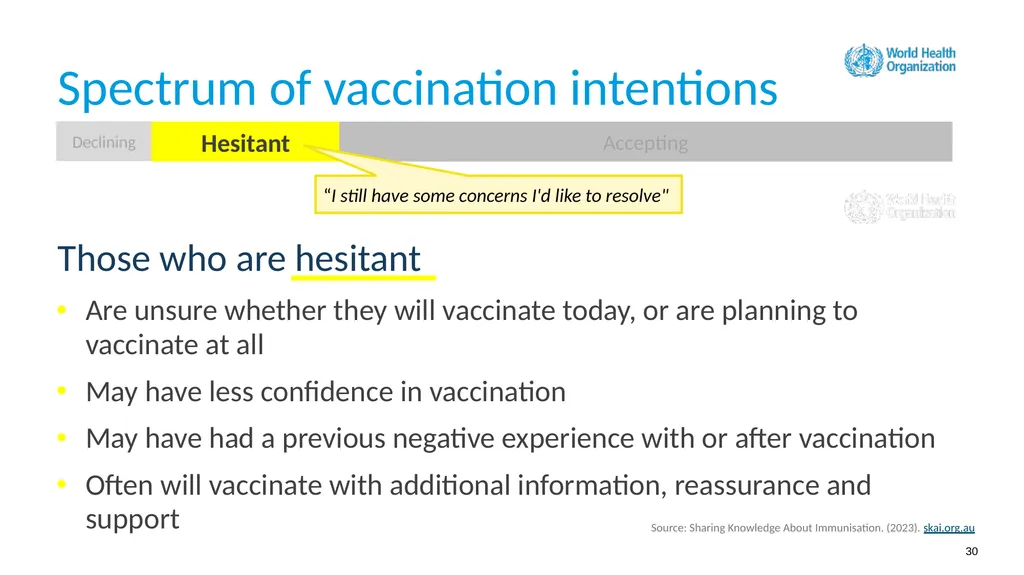
Spectrum of vaccination intentions Declining Those who are hesitant Are unsure whether they will vaccinate today, or are planning to vaccinate at all
May have less confidence in vaccination
May have had a previous negative experience with or after vaccination
Often will vaccinate with additional information, reassurance and support Hesitant Accepting “I still have some concerns I'd like to resolve" Source: Sharing Knowledge About Immunisation. (2023). skai.org.au<br>
May have less confidence in vaccination
May have had a previous negative experience with or after vaccination
Often will vaccinate with additional information, reassurance and support Hesitant Accepting “I still have some concerns I'd like to resolve" Source: Sharing Knowledge About Immunisation. (2023). skai.org.au<br>
31
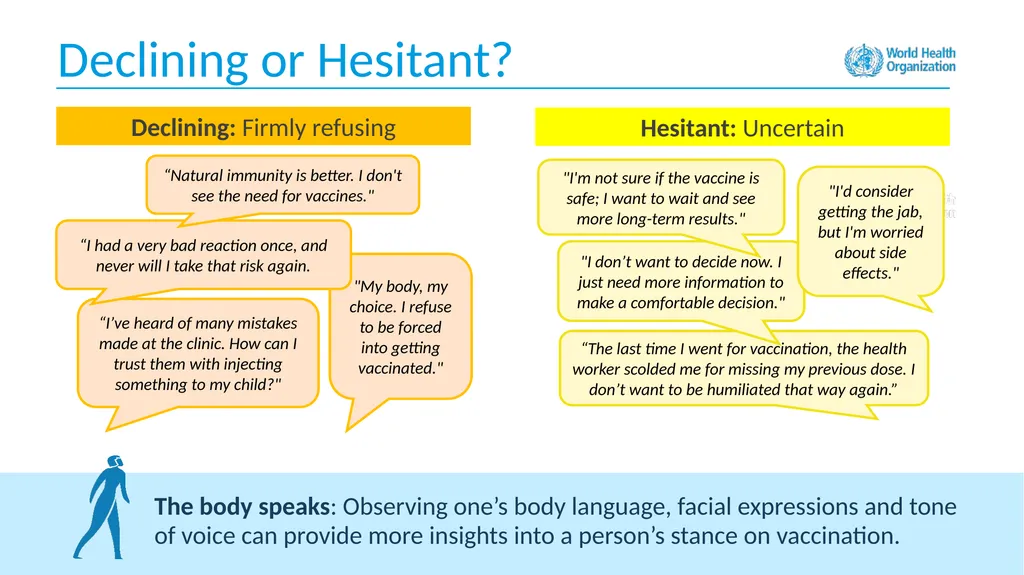
“The last time I went for vaccination, the health worker scolded me for missing my previous dose. I don’t want to be humiliated that way again.” "I don’t want to decide now. I just need more information to make a comfortable decision." Declining or Hesitant? Declining: Firmly refusing Hesitant: Uncertain "I'm not sure if the vaccine is safe; I want to wait and see more long-term results." "I'd consider getting the jab, but I'm worried about side effects." “I’ve heard of many mistakes made at the clinic. How can I trust them with injecting something to my child?" "My body, my choice. I refuse to be forced into getting vaccinated." “I had a very bad reaction once, and never will I take that risk again. “Natural immunity is better. I don't see the need for vaccines." The body speaks: Observing one’s body language, facial expressions and tone of voice can provide more insights into a person’s stance on vaccination.<br>
32
Understanding drivers and barriers to vaccine uptake
Health workers and meaningful conversations
Meaningful conversations about vaccination
Tailoring vaccination conversations Outline<br>
Health workers and meaningful conversations
Meaningful conversations about vaccination
Tailoring vaccination conversations Outline<br>
33
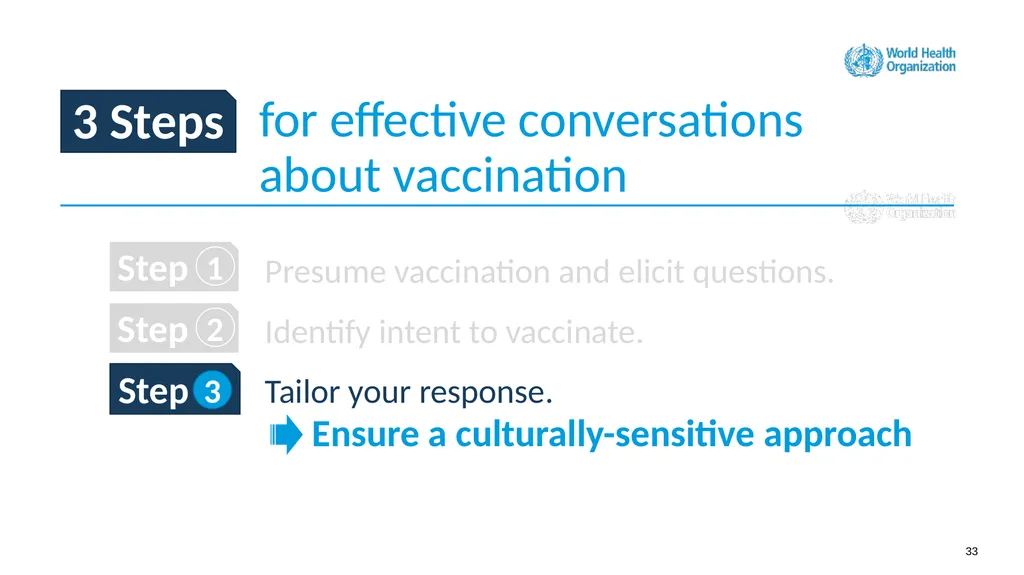
Presume vaccination and elicit questions.
Identify intent to vaccinate.
Tailor your response. for effective conversations
about vaccination 3 Steps 3 2 1 Ensure a culturally-sensitive approach<br>
Identify intent to vaccinate.
Tailor your response. for effective conversations
about vaccination 3 Steps 3 2 1 Ensure a culturally-sensitive approach<br>
34
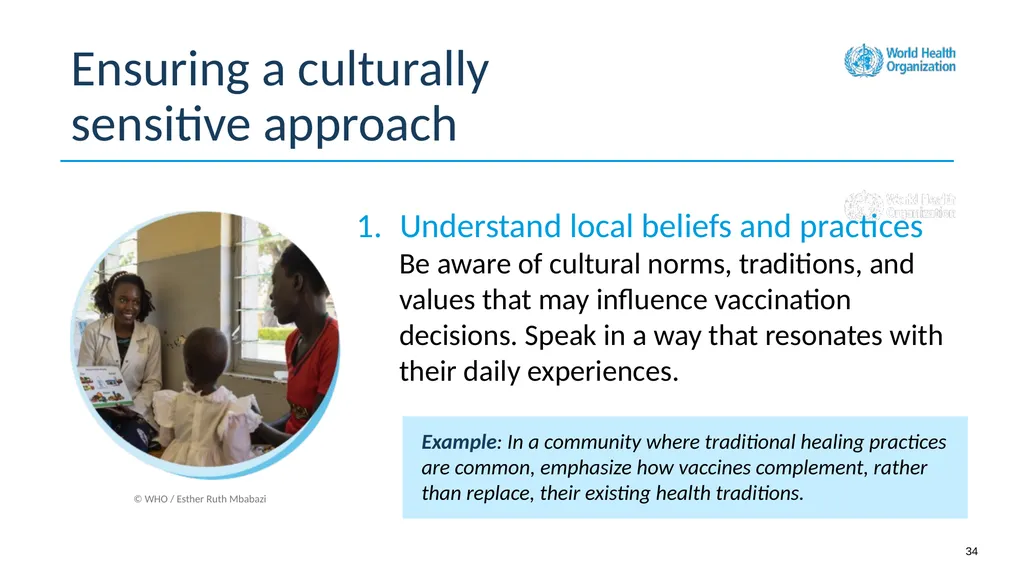
Ensuring a culturally sensitive approach Understand local beliefs and practices
Be aware of cultural norms, traditions, and values that may influence vaccination decisions. Speak in a way that resonates with their daily experiences. © WHO / Esther Ruth Mbabazi Example: In a community where traditional healing practices are common, emphasize how vaccines complement, rather than replace, their existing health traditions.<br>
Be aware of cultural norms, traditions, and values that may influence vaccination decisions. Speak in a way that resonates with their daily experiences. © WHO / Esther Ruth Mbabazi Example: In a community where traditional healing practices are common, emphasize how vaccines complement, rather than replace, their existing health traditions.<br>
35
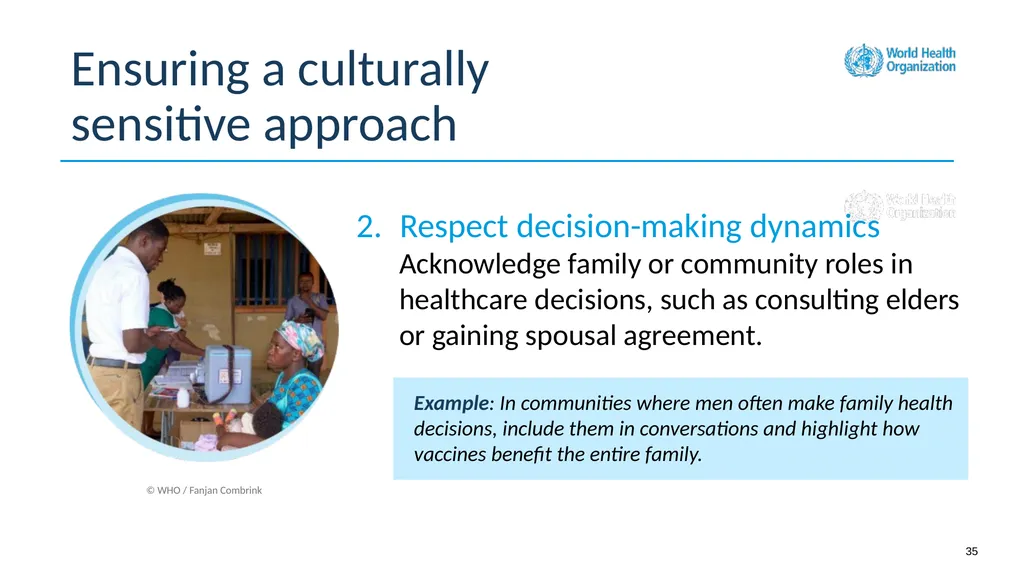
Respect decision-making dynamics
Acknowledge family or community roles in healthcare decisions, such as consulting elders or gaining spousal agreement. Example: In communities where men often make family health decisions, include them in conversations and highlight how vaccines benefit the entire family. Ensuring a culturally sensitive approach © WHO / Fanjan Combrink<br>
Acknowledge family or community roles in healthcare decisions, such as consulting elders or gaining spousal agreement. Example: In communities where men often make family health decisions, include them in conversations and highlight how vaccines benefit the entire family. Ensuring a culturally sensitive approach © WHO / Fanjan Combrink<br>
36
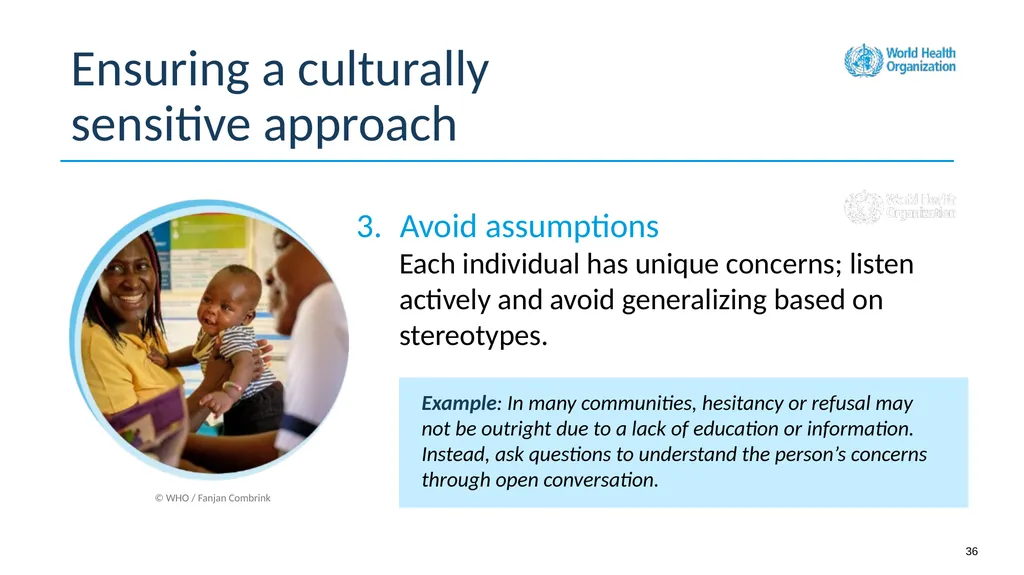
Avoid assumptions
Each individual has unique concerns; listen actively and avoid generalizing based on stereotypes. Example: In many communities, hesitancy or refusal may not be outright due to a lack of education or information. Instead, ask questions to understand the person’s concerns through open conversation. Ensuring a culturally sensitive approach © WHO / Fanjan Combrink<br>
Each individual has unique concerns; listen actively and avoid generalizing based on stereotypes. Example: In many communities, hesitancy or refusal may not be outright due to a lack of education or information. Instead, ask questions to understand the person’s concerns through open conversation. Ensuring a culturally sensitive approach © WHO / Fanjan Combrink<br>
37
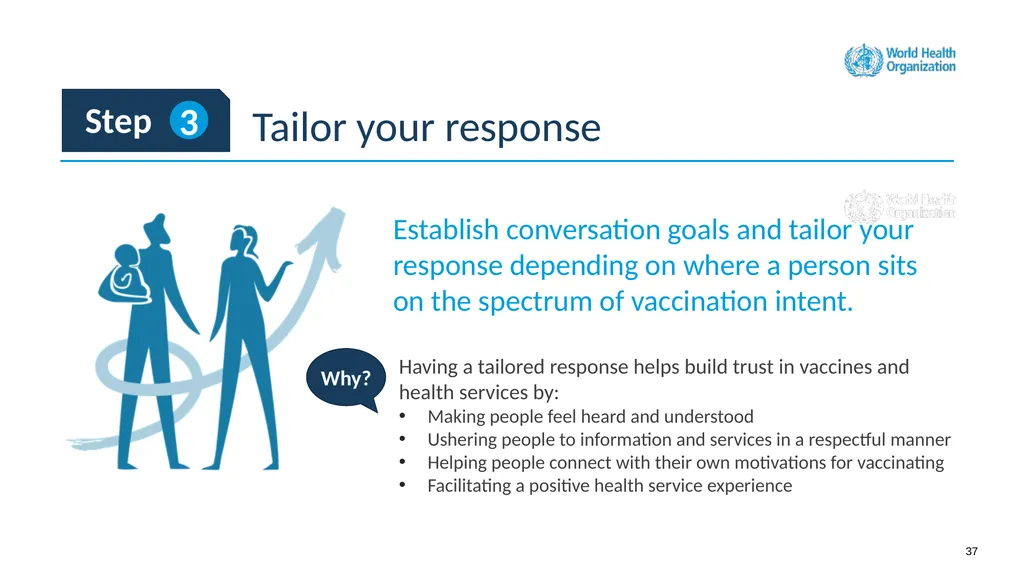
Step 3 Tailor your response Establish conversation goals and tailor your response depending on where a person sits on the spectrum of vaccination intent. Why? Having a tailored response helps build trust in vaccines and health services by:
Making people feel heard and understood
Ushering people to information and services in a respectful manner
Helping people connect with their own motivations for vaccinating
Facilitating a positive health service experience<br>
Making people feel heard and understood
Ushering people to information and services in a respectful manner
Helping people connect with their own motivations for vaccinating
Facilitating a positive health service experience<br>
38
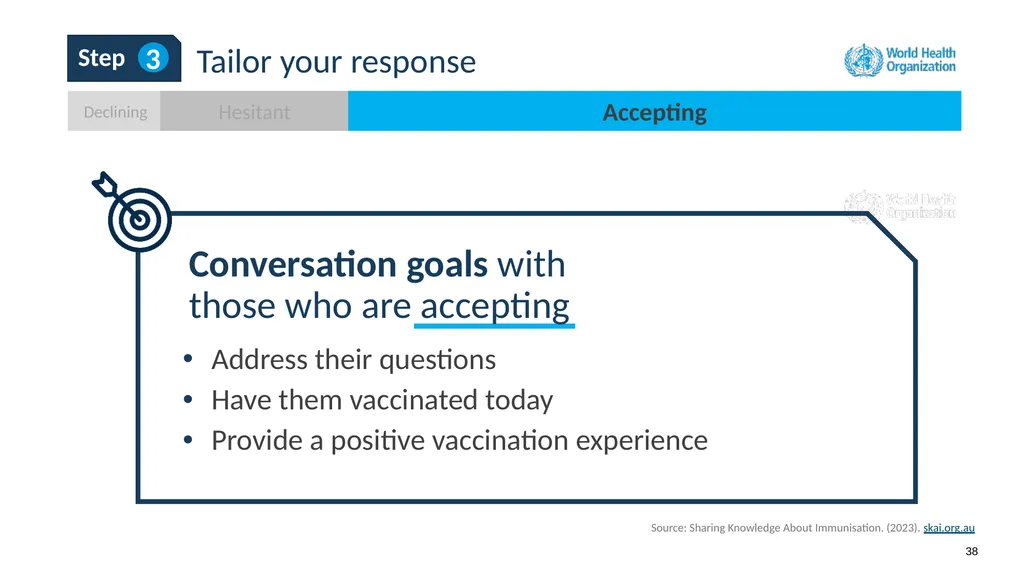
Declining Hesitant Accepting Conversation goals with those who are accepting Address their questions
Have them vaccinated today
Provide a positive vaccination experience Step 3 Tailor your response Source: Sharing Knowledge About Immunisation. (2023). skai.org.au<br>
Have them vaccinated today
Provide a positive vaccination experience Step 3 Tailor your response Source: Sharing Knowledge About Immunisation. (2023). skai.org.au<br>
39
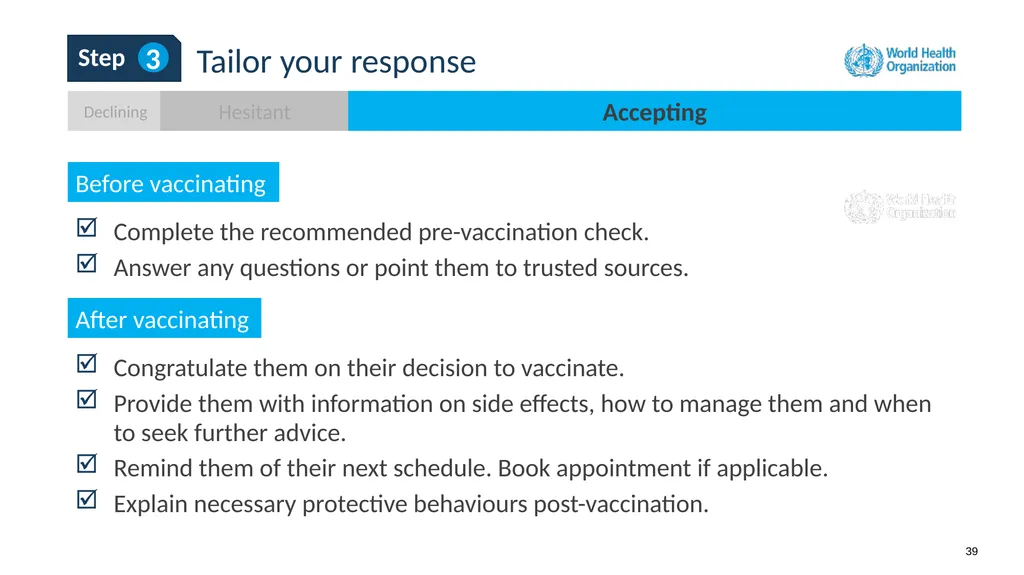
Declining Hesitant Accepting Complete the recommended pre-vaccination check.
Answer any questions or point them to trusted sources. Step 3 Tailor your response Before vaccinating Congratulate them on their decision to vaccinate.
Provide them with information on side effects, how to manage them and when to seek further advice.
Remind them of their next schedule. Book appointment if applicable.
Explain necessary protective behaviours post-vaccination. After vaccinating<br>
Answer any questions or point them to trusted sources. Step 3 Tailor your response Before vaccinating Congratulate them on their decision to vaccinate.
Provide them with information on side effects, how to manage them and when to seek further advice.
Remind them of their next schedule. Book appointment if applicable.
Explain necessary protective behaviours post-vaccination. After vaccinating<br>
40
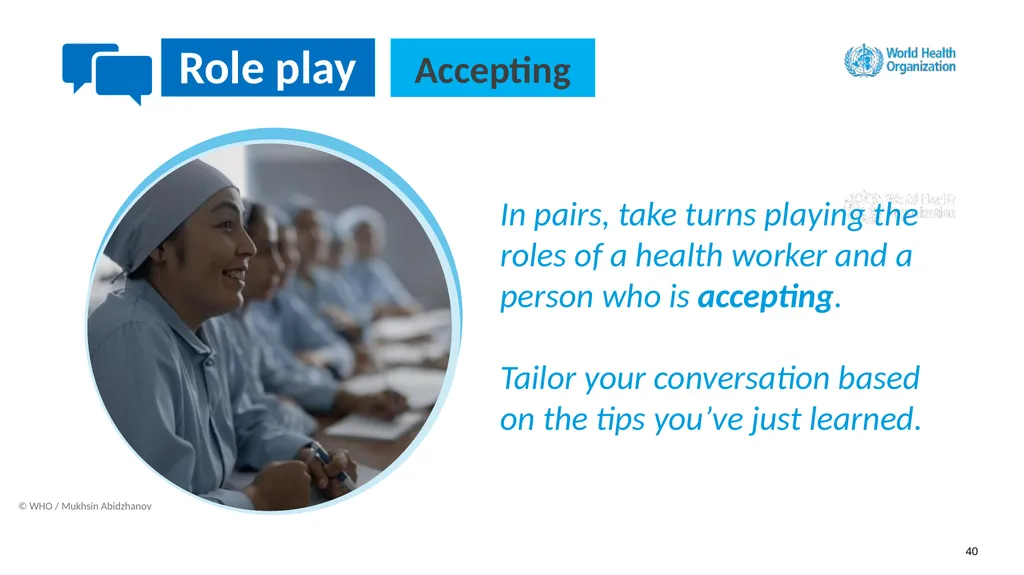
© WHO / Mukhsin Abidzhanov In pairs, take turns playing the roles of a health worker and a person who is accepting.
Tailor your conversation based on the tips you’ve just learned. Role play Accepting<br>
Tailor your conversation based on the tips you’ve just learned. Role play Accepting<br>
41
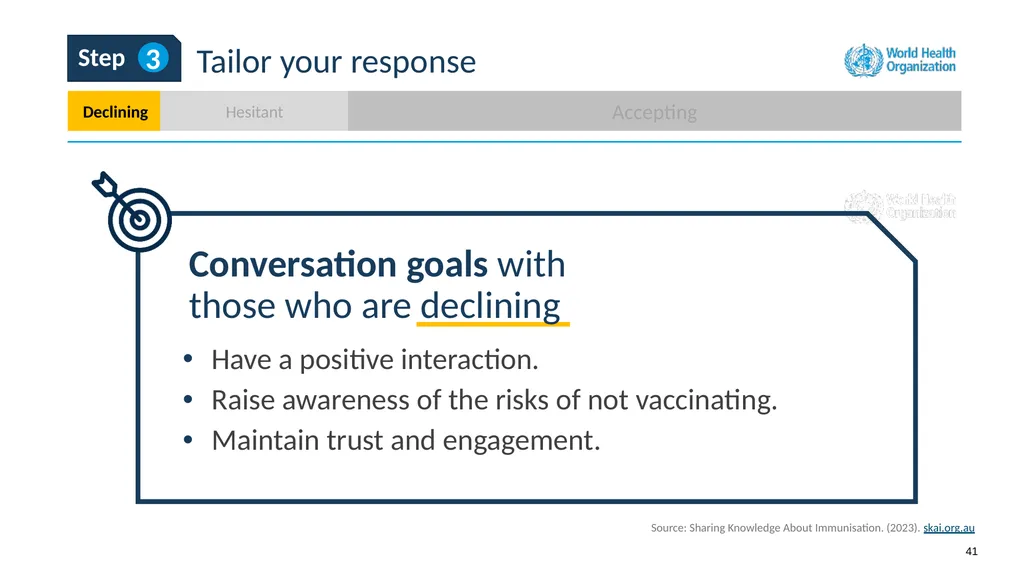
Declining Hesitant Accepting Conversation goals with those who are declining Have a positive interaction.
Raise awareness of the risks of not vaccinating.
Maintain trust and engagement. Step 3 Tailor your response Source: Sharing Knowledge About Immunisation. (2023). skai.org.au<br>
Raise awareness of the risks of not vaccinating.
Maintain trust and engagement. Step 3 Tailor your response Source: Sharing Knowledge About Immunisation. (2023). skai.org.au<br>
42
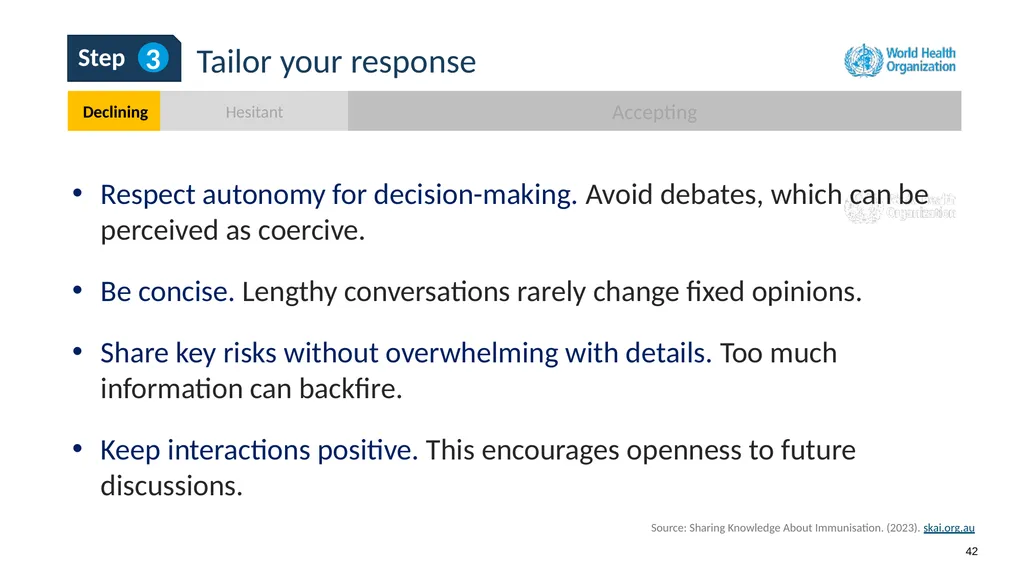
Step 3 Tailor your response Declining Hesitant Accepting Respect autonomy for decision-making. Avoid debates, which can be perceived as coercive.
Be concise. Lengthy conversations rarely change fixed opinions.
Share key risks without overwhelming with details. Too much information can backfire.
Keep interactions positive. This encourages openness to future discussions. Source: Sharing Knowledge About Immunisation. (2023). skai.org.au<br>
Be concise. Lengthy conversations rarely change fixed opinions.
Share key risks without overwhelming with details. Too much information can backfire.
Keep interactions positive. This encourages openness to future discussions. Source: Sharing Knowledge About Immunisation. (2023). skai.org.au<br>
43
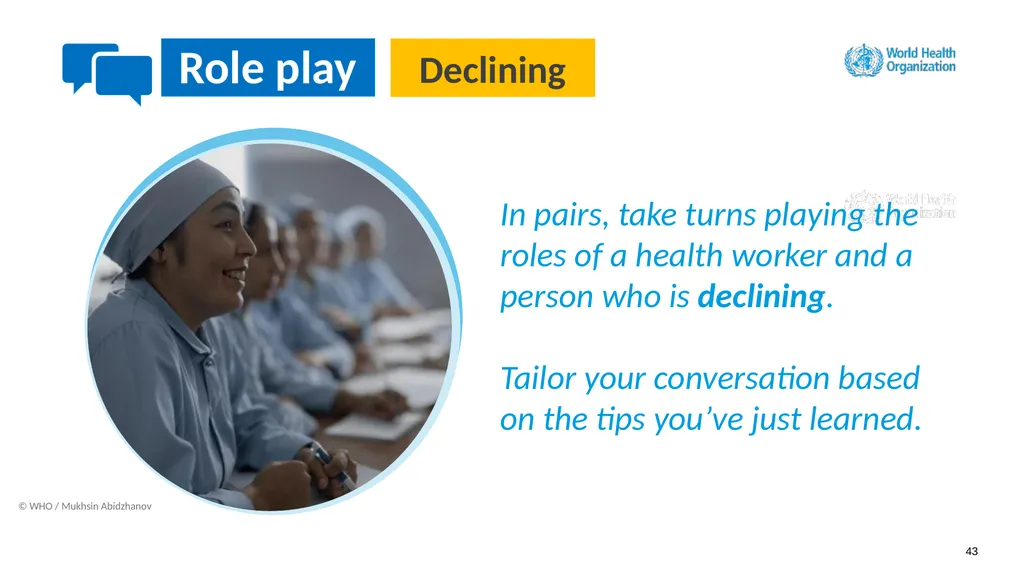
© WHO / Mukhsin Abidzhanov In pairs, take turns playing the roles of a health worker and a person who is declining.
Tailor your conversation based on the tips you’ve just learned. Role play Declining<br>
Tailor your conversation based on the tips you’ve just learned. Role play Declining<br>
44
Declining Hesitant Accepting Conversation goals with those who are hesitant Address concerns.
Increase vaccine confidence.
Encourage vaccination. Step 3 Tailor your response Source: Sharing Knowledge About Immunisation. (2023). skai.org.au<br>
Increase vaccine confidence.
Encourage vaccination. Step 3 Tailor your response Source: Sharing Knowledge About Immunisation. (2023). skai.org.au<br>
45
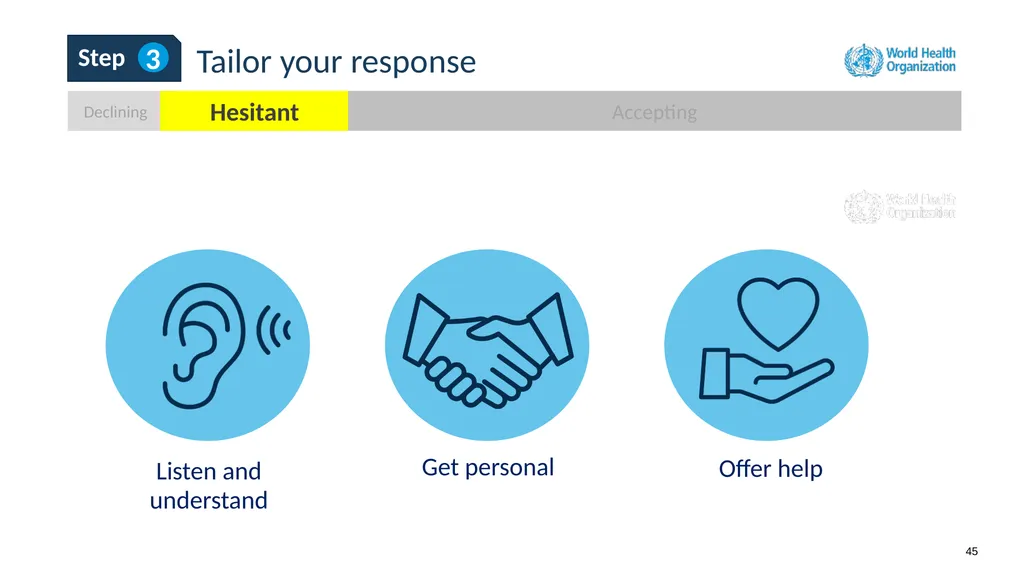
Listen and understand Step 3 Tailor your response Get personal Offer help Declining Hesitant Accepting<br>
46
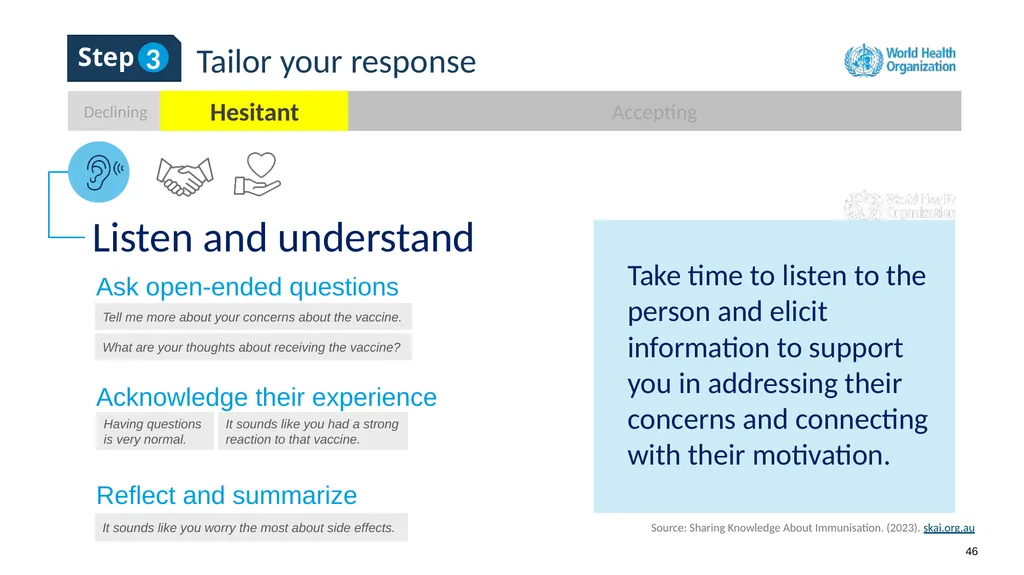
Listen and understand Step 3 Tailor your response Ask open-ended questions Acknowledge their experience Reflect and summarize Having questions is very normal. Tell me more about your concerns about the vaccine. It sounds like you worry the most about side effects. What are your thoughts about receiving the vaccine? It sounds like you had a strong reaction to that vaccine. Take time to listen to the person and elicit information to support you in addressing their concerns and connecting with their motivation. Declining Hesitant Accepting Source: Sharing Knowledge About Immunisation. (2023). skai.org.au<br>
47
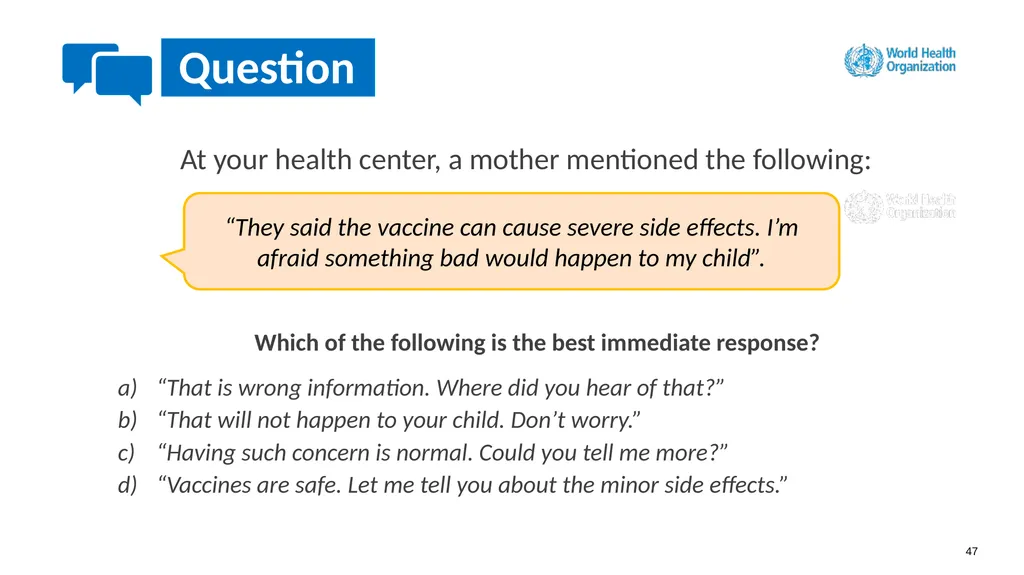
Question At your health center, a mother mentioned the following: “They said the vaccine can cause severe side effects. I’m afraid something bad would happen to my child”. Which of the following is the best immediate response?
“That is wrong information. Where did you hear of that?”
“That will not happen to your child. Don’t worry.”
“Having such concern is normal. Could you tell me more?”
“Vaccines are safe. Let me tell you about the minor side effects.”<br>
“That is wrong information. Where did you hear of that?”
“That will not happen to your child. Don’t worry.”
“Having such concern is normal. Could you tell me more?”
“Vaccines are safe. Let me tell you about the minor side effects.”<br>
48
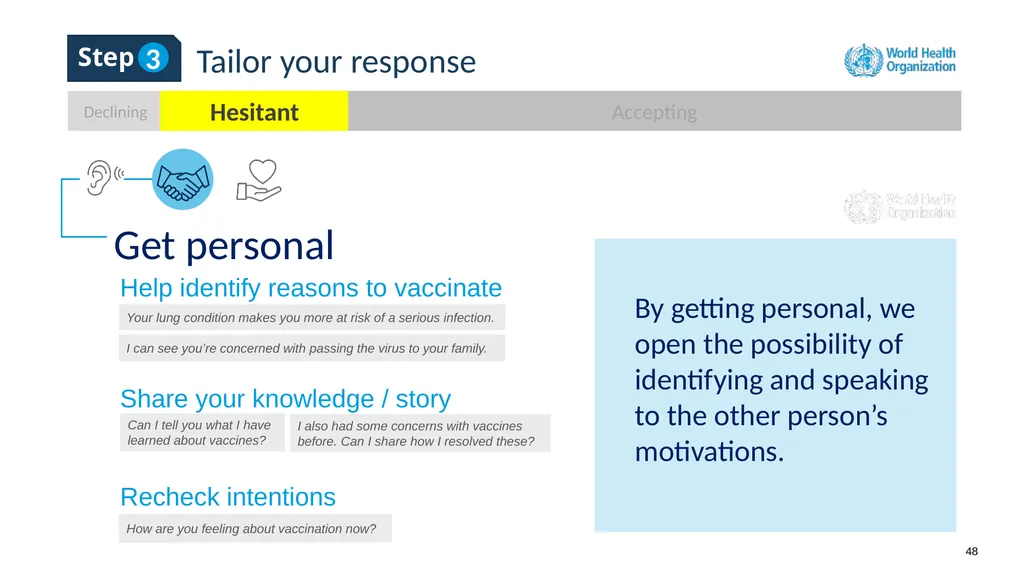
Get personal Step 3 Tailor your response Help identify reasons to vaccinate Share your knowledge / story Recheck intentions Can I tell you what I have learned about vaccines? Your lung condition makes you more at risk of a serious infection. How are you feeling about vaccination now? I can see you’re concerned with passing the virus to your family. I also had some concerns with vaccines before. Can I share how I resolved these? By getting personal, we open the possibility of identifying and speaking to the other person’s motivations. Declining Hesitant Accepting<br>
49
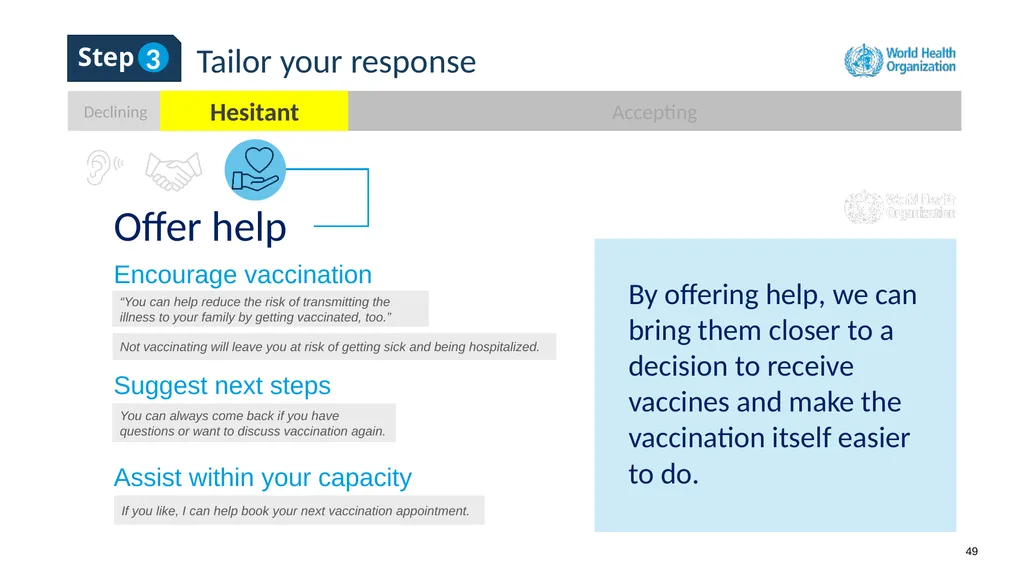
Offer help Step 3 Tailor your response Encourage vaccination Suggest next steps Assist within your capacity “You can help reduce the risk of transmitting the illness to your family by getting vaccinated, too.” You can always come back if you have questions or want to discuss vaccination again. Not vaccinating will leave you at risk of getting sick and being hospitalized. By offering help, we can bring them closer to a decision to receive vaccines and make the vaccination itself easier to do. If you like, I can help book your next vaccination appointment. Declining Hesitant Accepting<br>
50
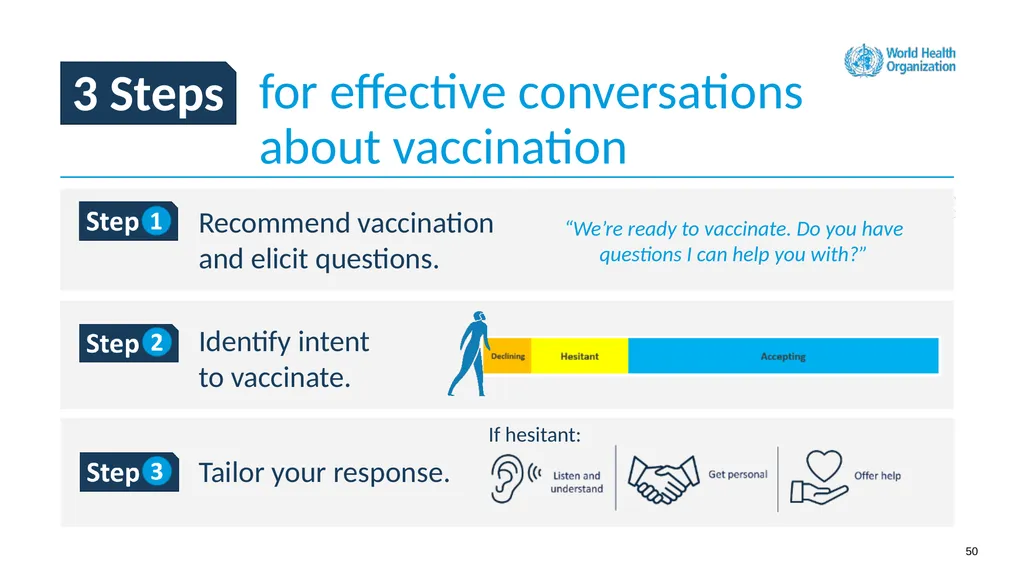
Recommend vaccination and elicit questions. for effective conversations
about vaccination 3 Steps Identify intent to vaccinate. Tailor your response. If hesitant: “We’re ready to vaccinate. Do you have questions I can help you with?”<br>
about vaccination 3 Steps Identify intent to vaccinate. Tailor your response. If hesitant: “We’re ready to vaccinate. Do you have questions I can help you with?”<br>
51
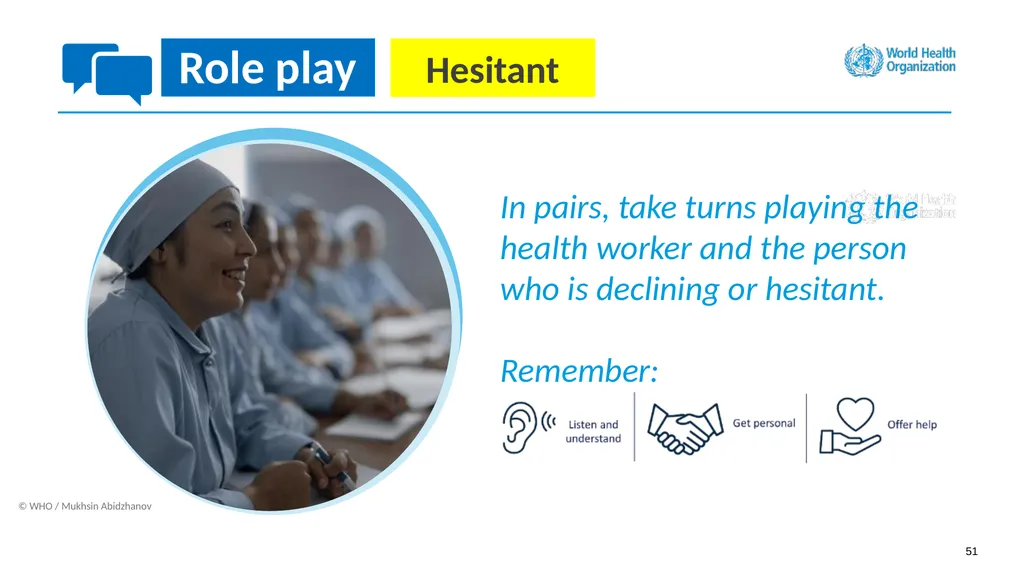
© WHO / Mukhsin Abidzhanov In pairs, take turns playing the health worker and the person who is declining or hesitant.
Remember: Role play Hesitant<br>
Remember: Role play Hesitant<br>
52
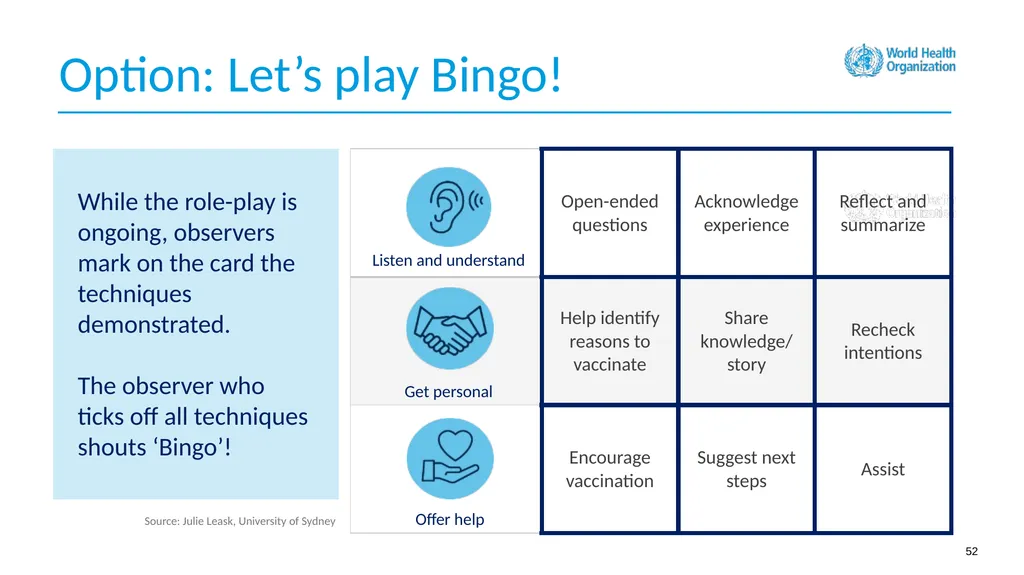
Option: Let’s play Bingo! Listen and understand Get personal Offer help While the role-play is ongoing, observers mark on the card the techniques demonstrated.
The observer who ticks off all techniques shouts ‘Bingo’! Source: Julie Leask, University of Sydney<br>
The observer who ticks off all techniques shouts ‘Bingo’! Source: Julie Leask, University of Sydney<br>
53
© WHO / Mukhsin Abidzhanov What is something new that you have learned today?
How confident do you feel about applying the conversation skills in your work? Reflections<br>
How confident do you feel about applying the conversation skills in your work? Reflections<br>
54
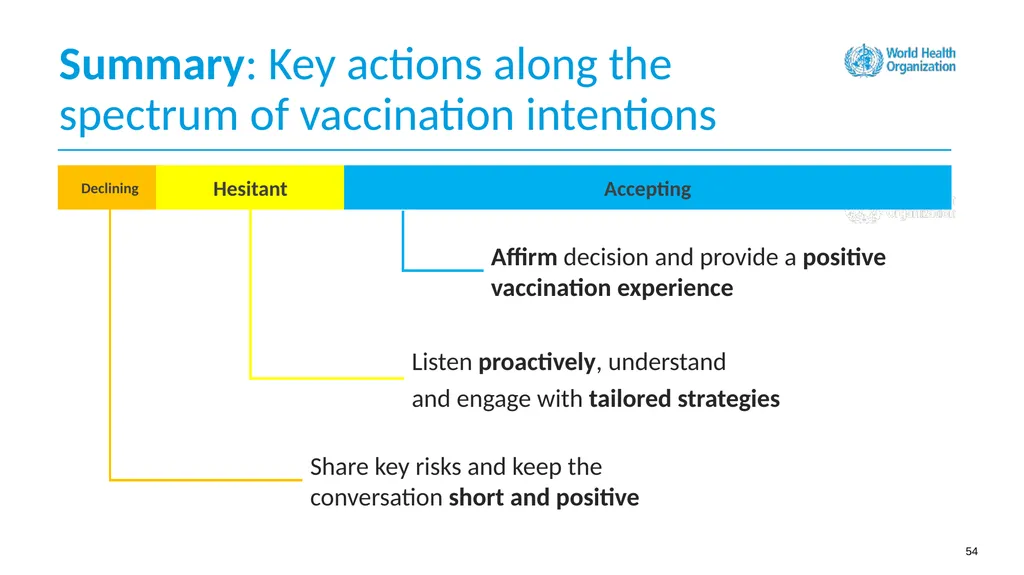
Declining Hesitant Accepting Listen proactively, understand
and engage with tailored strategies Summary: Key actions along the spectrum of vaccination intentions Share key risks and keep the conversation short and positive Affirm decision and provide a positive vaccination experience<br>
and engage with tailored strategies Summary: Key actions along the spectrum of vaccination intentions Share key risks and keep the conversation short and positive Affirm decision and provide a positive vaccination experience<br>
55
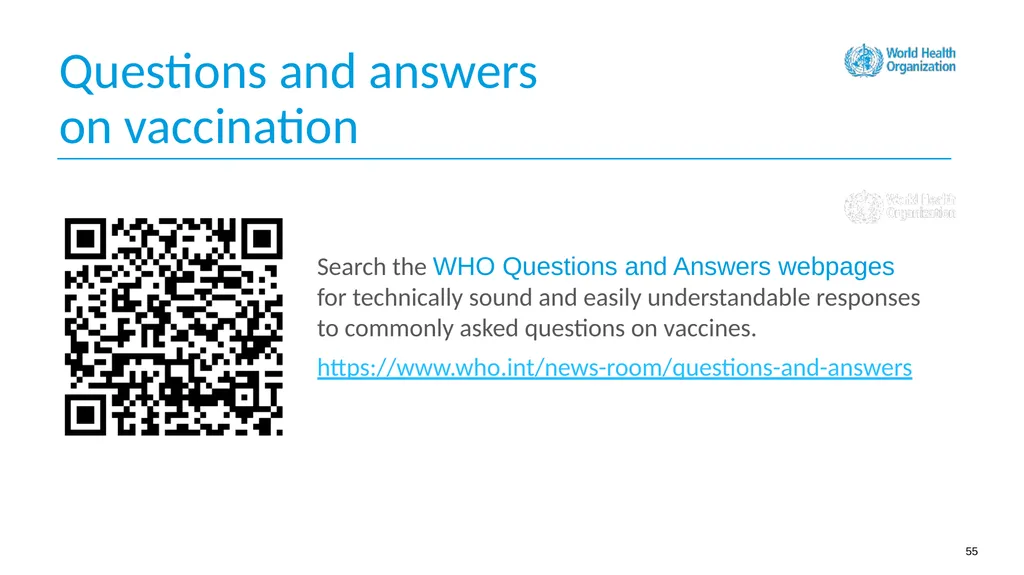
Search the WHO Questions and Answers webpages
for technically sound and easily understandable responses to commonly asked questions on vaccines. https://www.who.int/news-room/questions-and-answers Questions and answers on vaccination<br>
for technically sound and easily understandable responses to commonly asked questions on vaccines. https://www.who.int/news-room/questions-and-answers Questions and answers on vaccination<br>
56
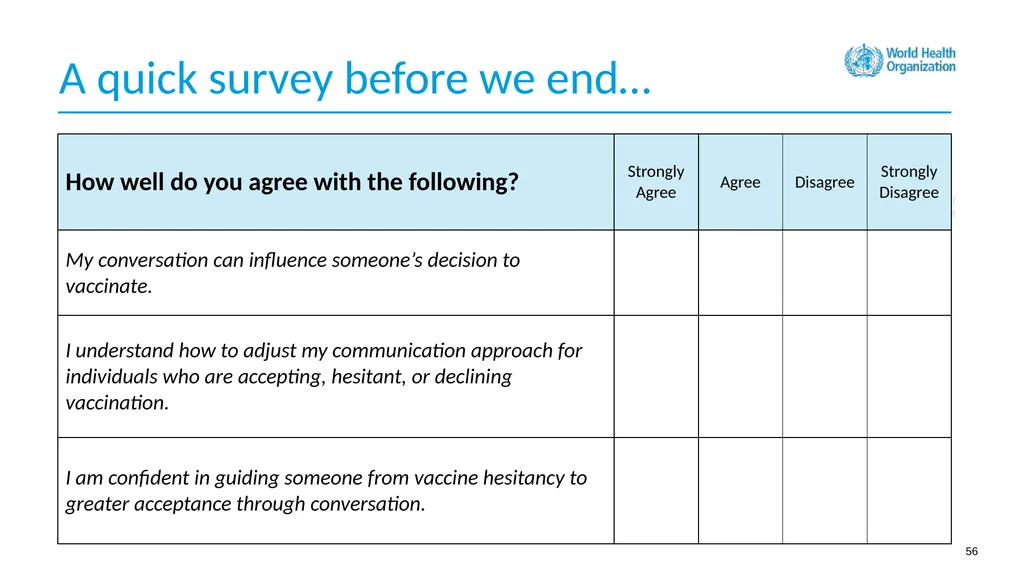
A quick survey before we end…<br>
57
Thank you! 57 For more information please visit:
https://www.who.int/teams/immunization-vaccines-and-biologicals/essential-programme-on-immunization/demand<br>
https://www.who.int/teams/immunization-vaccines-and-biologicals/essential-programme-on-immunization/demand<br>
58
References World Health Organization. 2022. Behavioural and social drivers of vaccination: tools and practical guidance for achieving high uptake. World Health Organization. https://apps.who.int/iris/handle/10665/354459
World Health Organization. (2022). Understanding the behavioural and social drivers of vaccine uptake. WHO Position Paper – May 2022. Weekly Epidemiological Record, No 20, 2022, 97, 209–224. https://apps.who.int/iris/bitstream/handle/10665/354458/WER9720-eng-fre.pdf
Brewer NT, Chapman GB, Rothman AJ, Leask J, Kempe A. Increasing vaccination: putting psychological science into action. Psychol Sci Public Interest. 2017;18(3):149–207. DOI: 10.1177/1529100618760521
Sharing Knowledge About Immunisation (SKAI). 2023. Discussion Guides. https://skai.org.au/healthcare-professionals
Randall, S., Leask, J., Robinson, P., Danchin, M., Kinnersley, P., Witteman, H., Trevena, L., Berry, N. Underpinning of the sharing knowledge about immunisation (SKAI) communication approach: A qualitative study using recorded observations. Patient Education and Counseling 2020;103:1118-1124. https://doi.org/10.1016/j.pec.2019.12.014
Gagneur A. Motivational interviewing: A powerful tool to address vaccine hesitancy. Can Commun Dis Rep. 2020 Apr 2;46(4):93-97. DOI: 10.14745/ccdr.v46i04a06
Opel DJ, Heritage J, Taylor JA, Mangione-Smith R, Salas HS, Devere V, et al. The architecture of provider–parent vaccine discussions at health supervision visits. Pediatrics. 2013;132(6):1037–46. DOI: 10.1542/peds.2013-2037
Leask, J., Kinnersley, P., Jackson, C. et al. Communicating with parents about vaccination: a framework for health professionals. BMC Pediatr 12, 154 (2012). https://doi.org/10.1186/1471-2431-12-154<br>
World Health Organization. (2022). Understanding the behavioural and social drivers of vaccine uptake. WHO Position Paper – May 2022. Weekly Epidemiological Record, No 20, 2022, 97, 209–224. https://apps.who.int/iris/bitstream/handle/10665/354458/WER9720-eng-fre.pdf
Brewer NT, Chapman GB, Rothman AJ, Leask J, Kempe A. Increasing vaccination: putting psychological science into action. Psychol Sci Public Interest. 2017;18(3):149–207. DOI: 10.1177/1529100618760521
Sharing Knowledge About Immunisation (SKAI). 2023. Discussion Guides. https://skai.org.au/healthcare-professionals
Randall, S., Leask, J., Robinson, P., Danchin, M., Kinnersley, P., Witteman, H., Trevena, L., Berry, N. Underpinning of the sharing knowledge about immunisation (SKAI) communication approach: A qualitative study using recorded observations. Patient Education and Counseling 2020;103:1118-1124. https://doi.org/10.1016/j.pec.2019.12.014
Gagneur A. Motivational interviewing: A powerful tool to address vaccine hesitancy. Can Commun Dis Rep. 2020 Apr 2;46(4):93-97. DOI: 10.14745/ccdr.v46i04a06
Opel DJ, Heritage J, Taylor JA, Mangione-Smith R, Salas HS, Devere V, et al. The architecture of provider–parent vaccine discussions at health supervision visits. Pediatrics. 2013;132(6):1037–46. DOI: 10.1542/peds.2013-2037
Leask, J., Kinnersley, P., Jackson, C. et al. Communicating with parents about vaccination: a framework for health professionals. BMC Pediatr 12, 154 (2012). https://doi.org/10.1186/1471-2431-12-154<br>
59
Acknowledgments This training module was developed by the Demand and Behavioural Science Team, Department of Immunization, Vaccines and Biologicals, WHO Headquarters: Lisa Menning, Jun Ryan Orbina and Francine Ganter-Restrepo (former staff).
Special thanks for the technical review by collaborators from the University of Sydney, Australia: Professor Julie Leask, Ikram Abdi and Maria Christou-Ergos.<br>
Special thanks for the technical review by collaborators from the University of Sydney, Australia: Professor Julie Leask, Ikram Abdi and Maria Christou-Ergos.<br>