Human Speech Recognition Julia Hirschberg CS4706 (thanks to John-Paul Hosum for some slides) Linguistic View of Speech Perception Speech is a sequence of articulatory gestures Many parallel levels of description Phonetic, Phonologic
"Human Speech Recognition Julia Hirschberg CS4706" is the property of its rightful owner. Permission is granted to
download and print the materials on this website for personal, non-commercial use only, and to display it
on your personal computer provided you do not modify the materials and that you retain all copyright
notices contained in the materials. By downloading content from our website, you accept the terms of this
agreement.
Presentation Transcript
01
Human Speech Recognition Julia Hirschberg
CS4706
(thanks to John-Paul Hosum for some slides)<br>
02
Linguistic View of Speech Perception Speech is a sequence of articulatory gestures
Many parallel levels of description
Phonetic, Phonologic
Prosodic
Lexical
Syntactic, Semantic, Pragmatic
Human listeners make use of all these levels in speech perception<br>
03
Lexical Access Frequency sensitive
We access high-frequency words faster and more accurately – with less information – than low frequency
Access in parallel
We access multiple hypotheses simultaneously
Based on multiple cues<br>
04
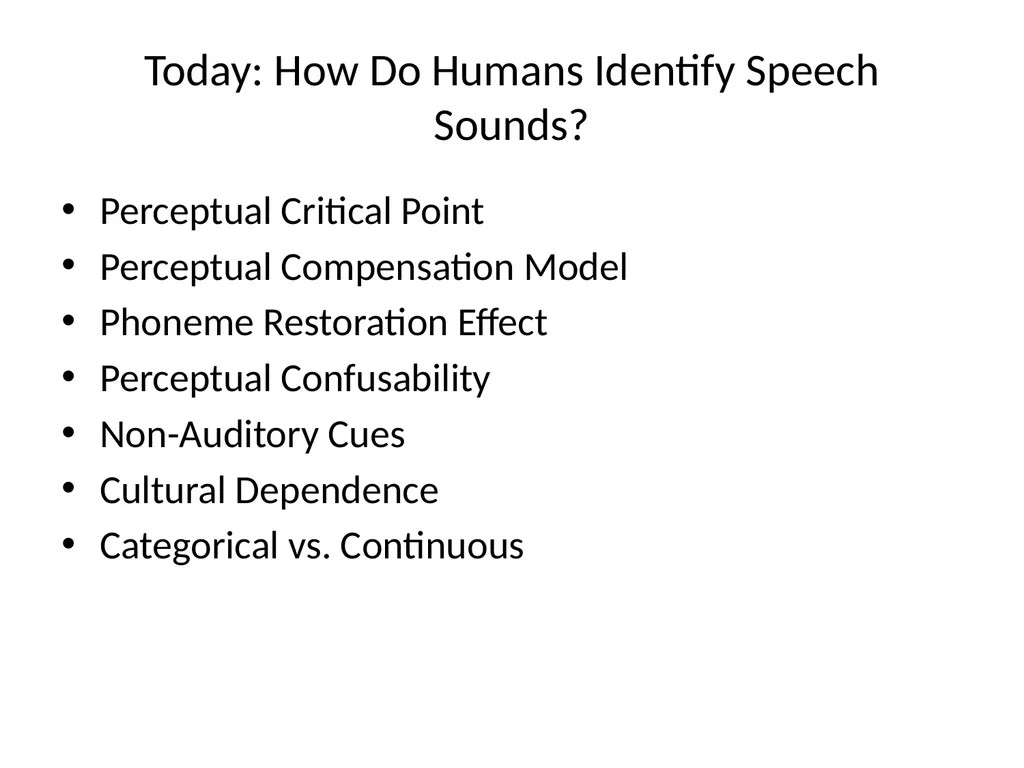
Today: How Do Humans Identify Speech Sounds? Perceptual Critical Point
Perceptual Compensation Model
Phoneme Restoration Effect
Perceptual Confusability
Non-Auditory Cues
Cultural Dependence
Categorical vs. Continuous<br>
05
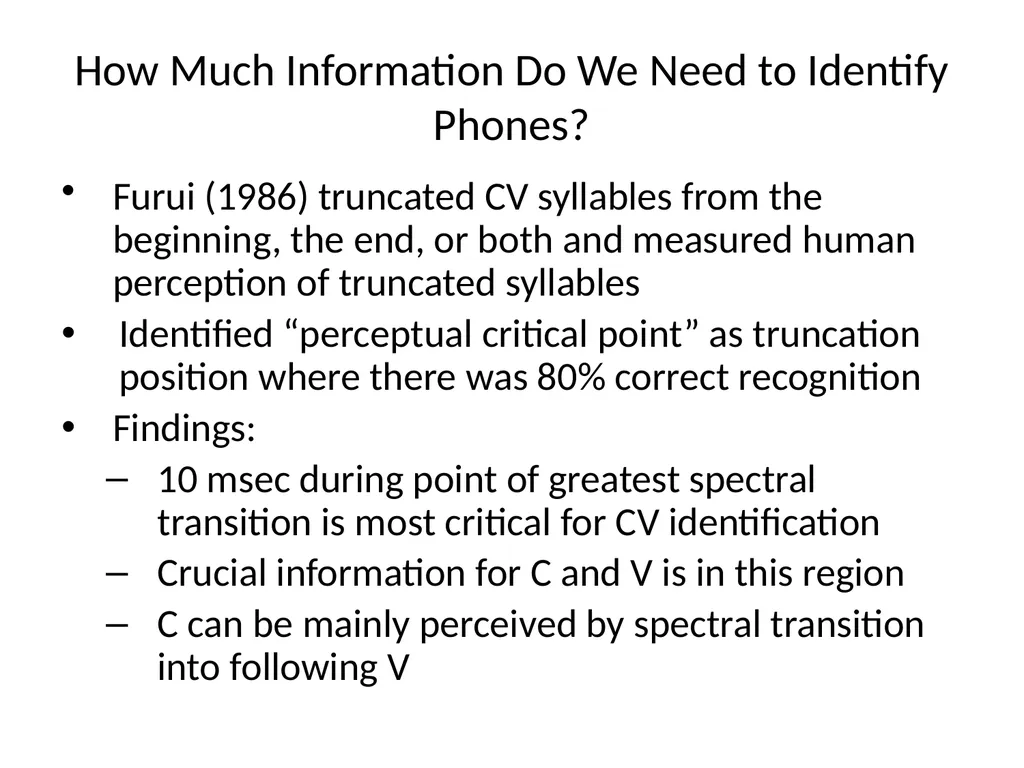
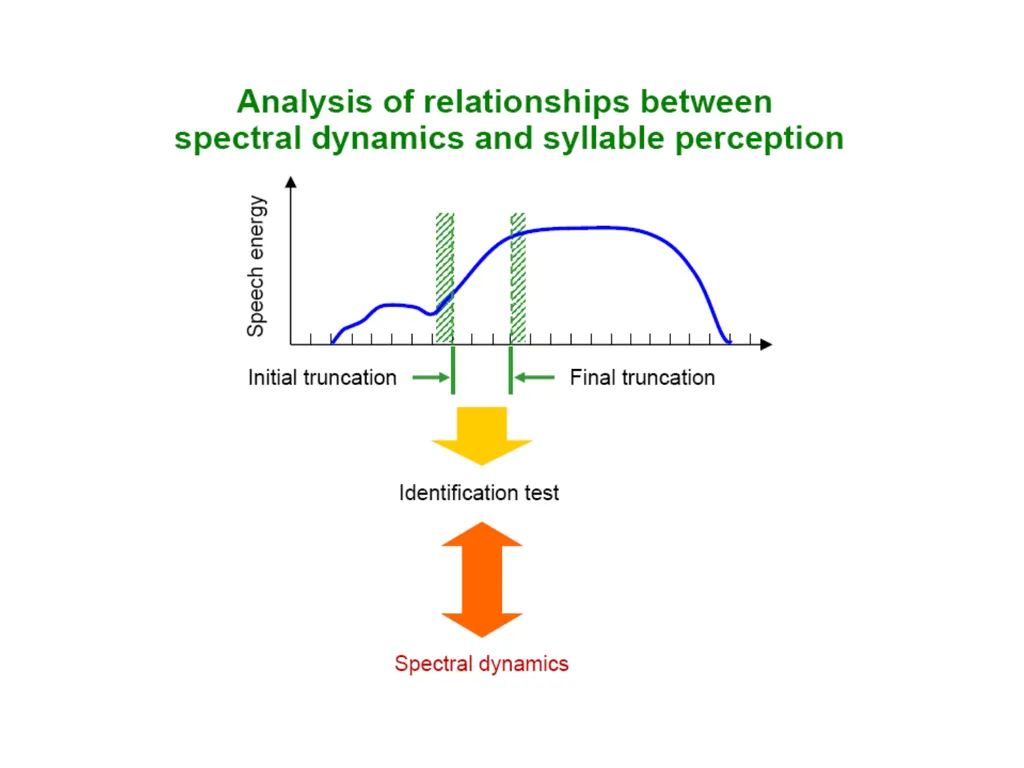
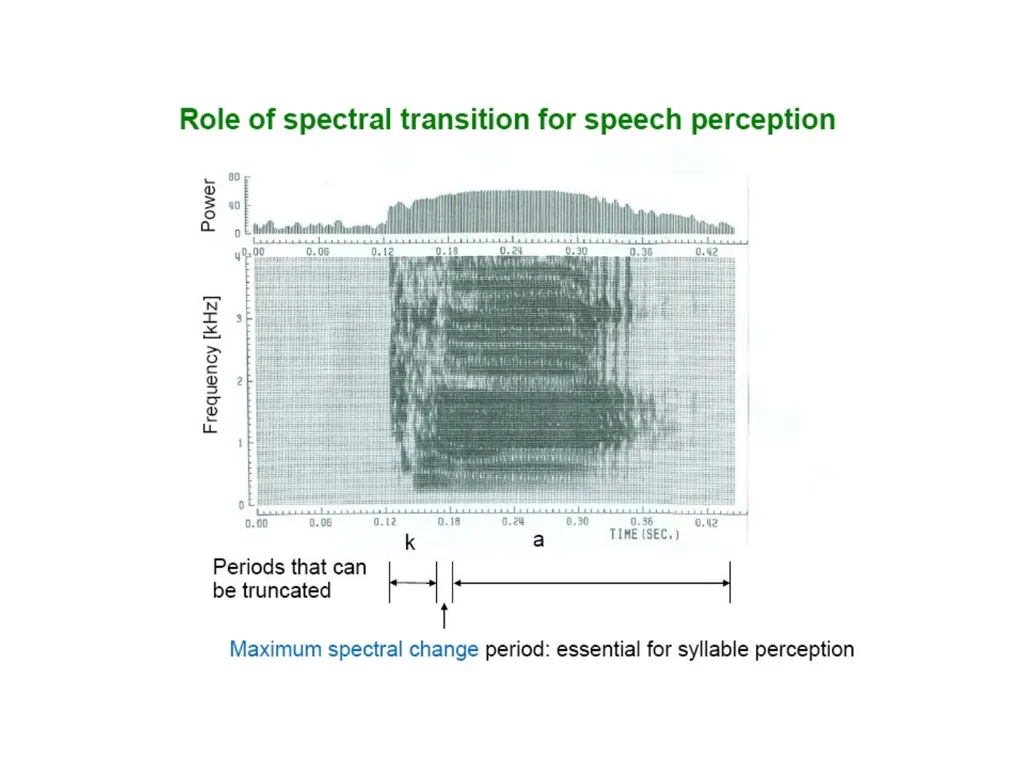
How Much Information Do We Need to Identify Phones? Furui (1986) truncated CV syllables from the beginning, the end, or both and measured human perception of truncated syllables
Identified “perceptual critical point” as truncation position where there was 80% correct recognition
Findings:
10 msec during point of greatest spectral transition is most critical for CV identification
Crucial information for C and V is in this region
C can be mainly perceived by spectral transition into following V<br>
06
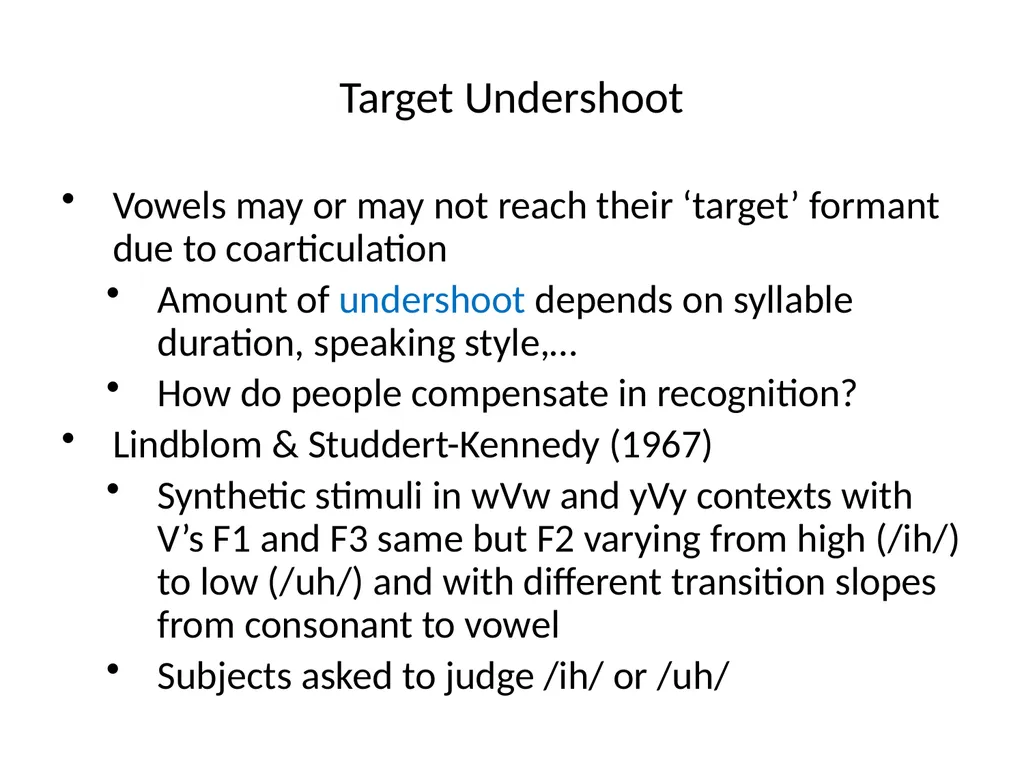
Target Undershoot Vowels may or may not reach their ‘target’ formant due to coarticulation
Amount of undershoot depends on syllable duration, speaking style,…
How do people compensate in recognition?
Lindblom & Studdert-Kennedy (1967)
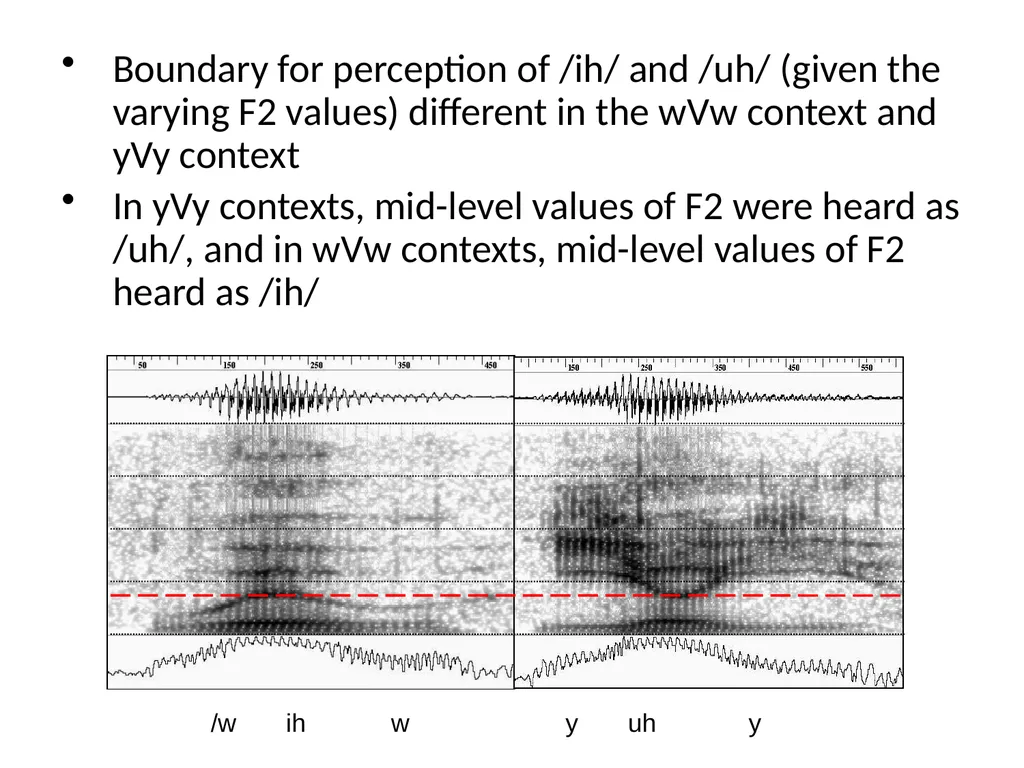
Synthetic stimuli in wVw and yVy contexts with V’s F1 and F3 same but F2 varying from high (/ih/) to low (/uh/) and with different transition slopes from consonant to vowel
Subjects asked to judge /ih/ or /uh/<br>
07
/w ih w y uh y Boundary for perception of /ih/ and /uh/ (given the varying F2 values) different in the wVw context and yVy context
In yVy contexts, mid-level values of F2 were heard as /uh/, and in wVw contexts, mid-level values of F2 heard as /ih/<br>
08
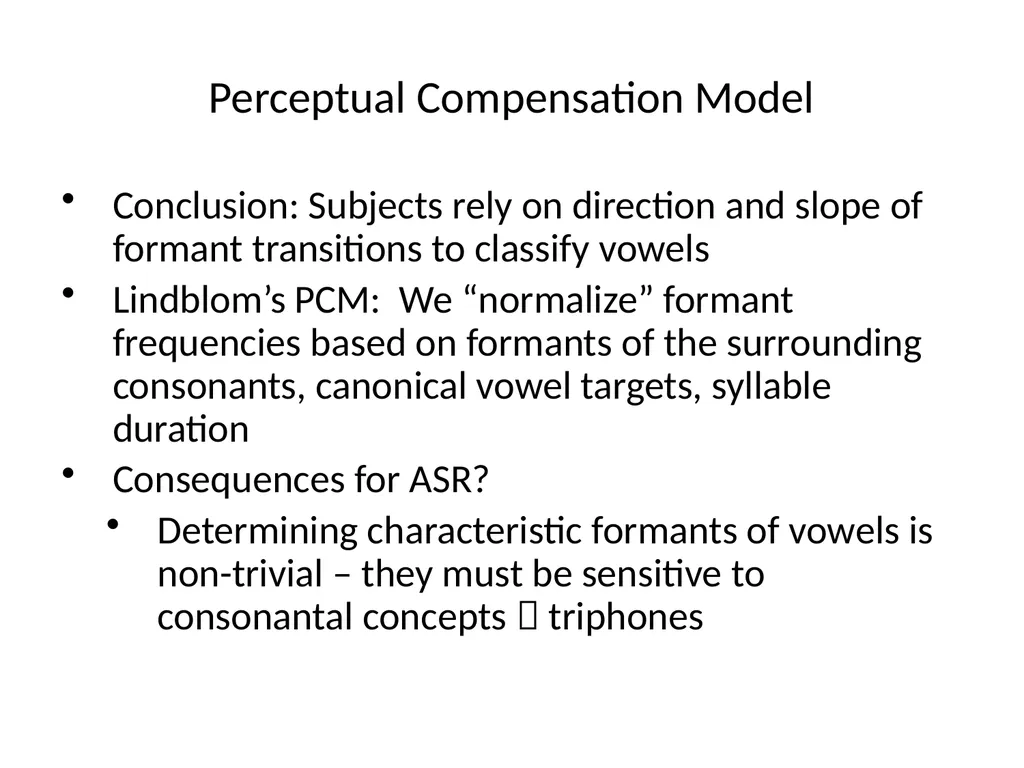
Perceptual Compensation Model Conclusion: Subjects rely on direction and slope of formant transitions to classify vowels
Lindblom’s PCM: We “normalize” formant frequencies based on formants of the surrounding consonants, canonical vowel targets, syllable duration
Consequences for ASR?
Determining characteristic formants of vowels is non-trivial – they must be sensitive to consonantal concepts triphones<br>
09
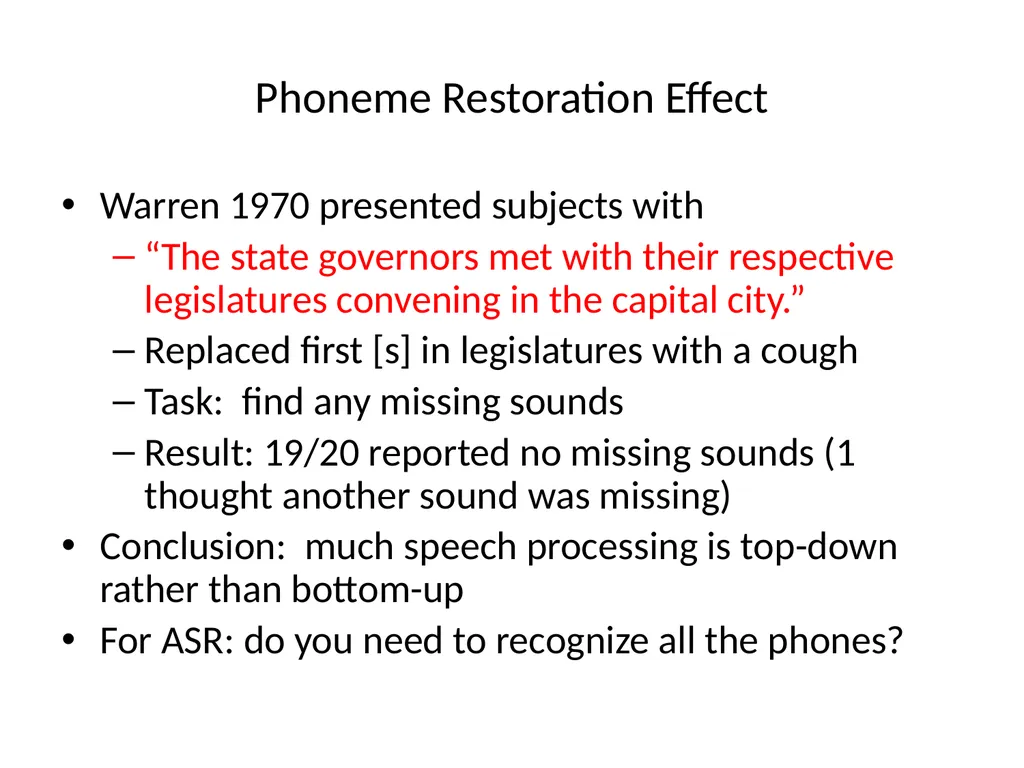
Phoneme Restoration Effect Warren 1970 presented subjects with
“The state governors met with their respective legislatures convening in the capital city.”
Replaced first [s] in legislatures with a cough
Task: find any missing sounds
Result: 19/20 reported no missing sounds (1 thought another sound was missing)
Conclusion: much speech processing is top-down rather than bottom-up
For ASR: do you need to recognize all the phones?<br>
10
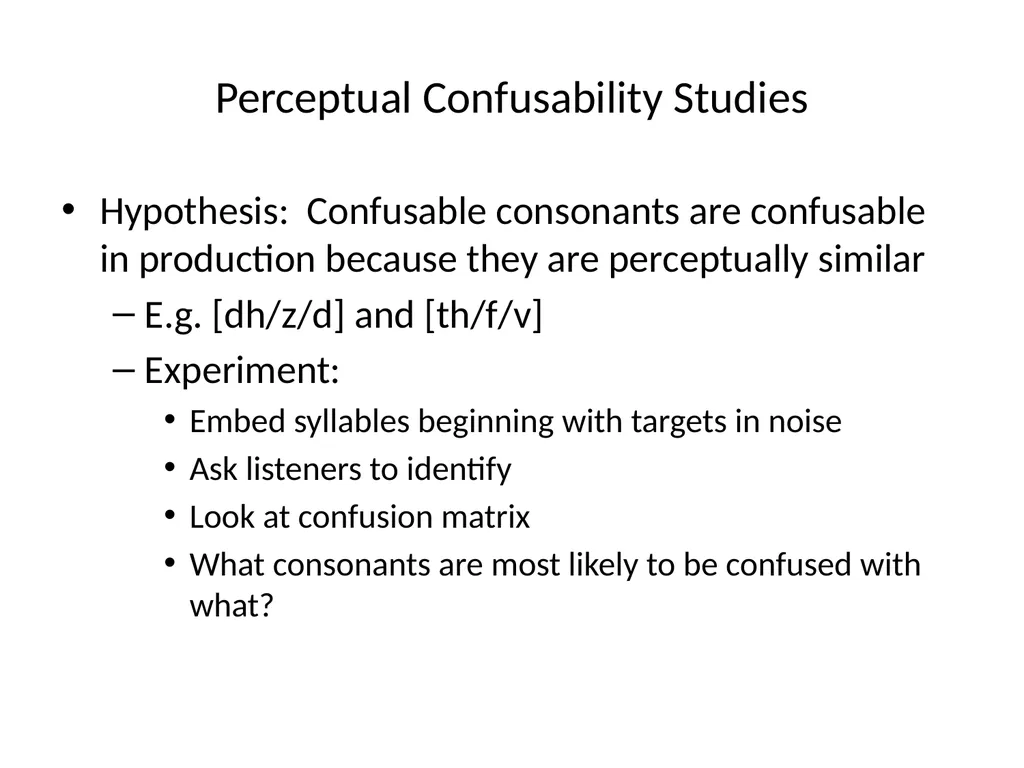
Perceptual Confusability Studies Hypothesis: Confusable consonants are confusable in production because they are perceptually similar
E.g. [dh/z/d] and [th/f/v]
Experiment:
Embed syllables beginning with targets in noise
Ask listeners to identify
Look at confusion matrix
What consonants are most likely to be confused with what?<br>
11
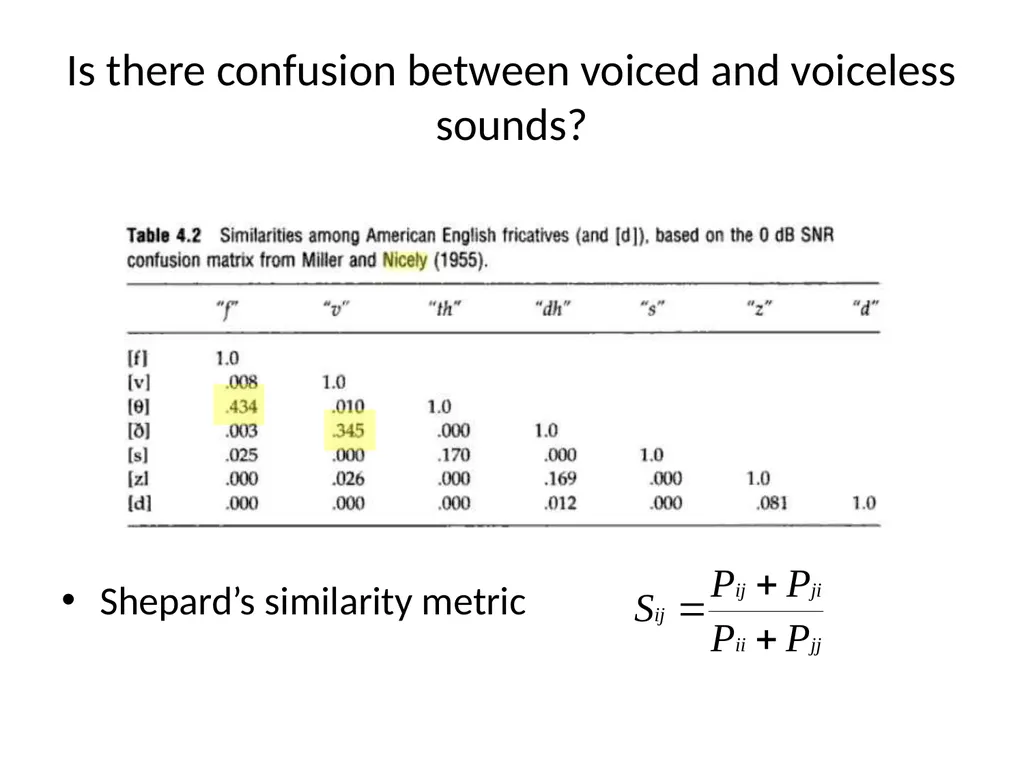
Is there confusion between voiced and voiceless sounds? Shepard’s similarity metric<br>
12
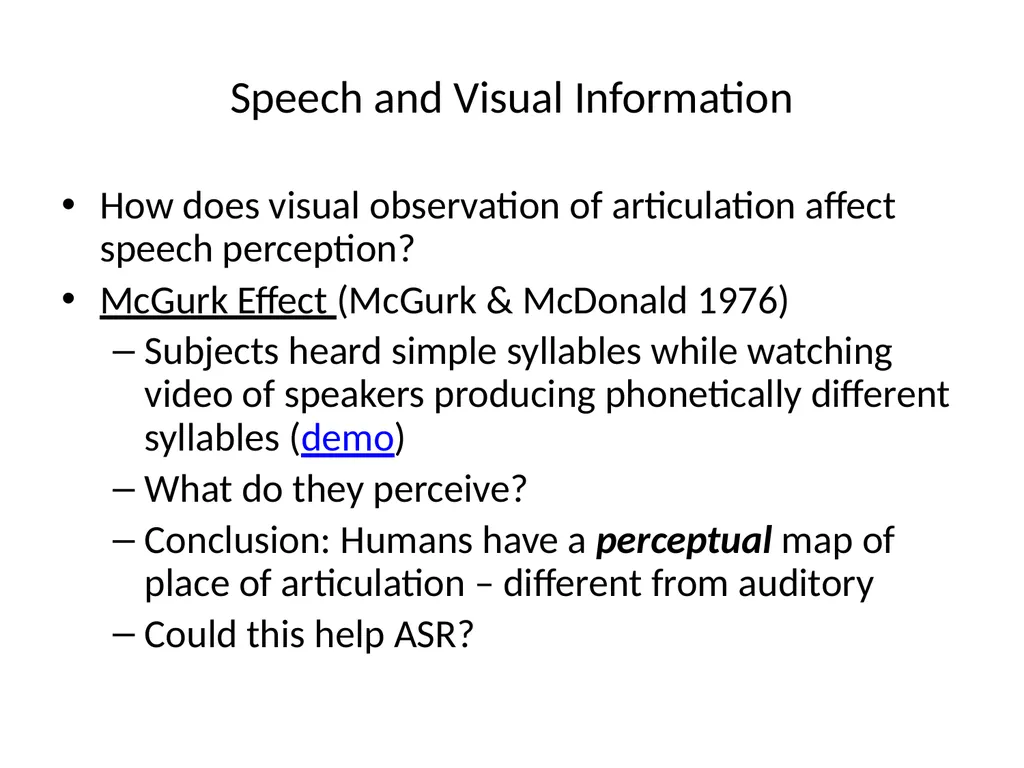
Speech and Visual Information How does visual observation of articulation affect speech perception?
McGurk Effect (McGurk & McDonald 1976)
Subjects heard simple syllables while watching video of speakers producing phonetically different syllables (demo)
What do they perceive?
Conclusion: Humans have a perceptual map of place of articulation – different from auditory
Could this help ASR?<br>
13
Speech/Somatosensory Connection Ito et al 2008 show that stretching mouth can influence speech perception
Subjects heard head, had, or something on a continuum in between
Robotic device stretches mouth up, down, or backward
Upward stretch leads to ‘head’ judgments and downward to ‘had’ but only when timing of stretch imitates production of vowel
What does this mean about our perceptual maps?
Is there any way this could help ASR?<br>
14
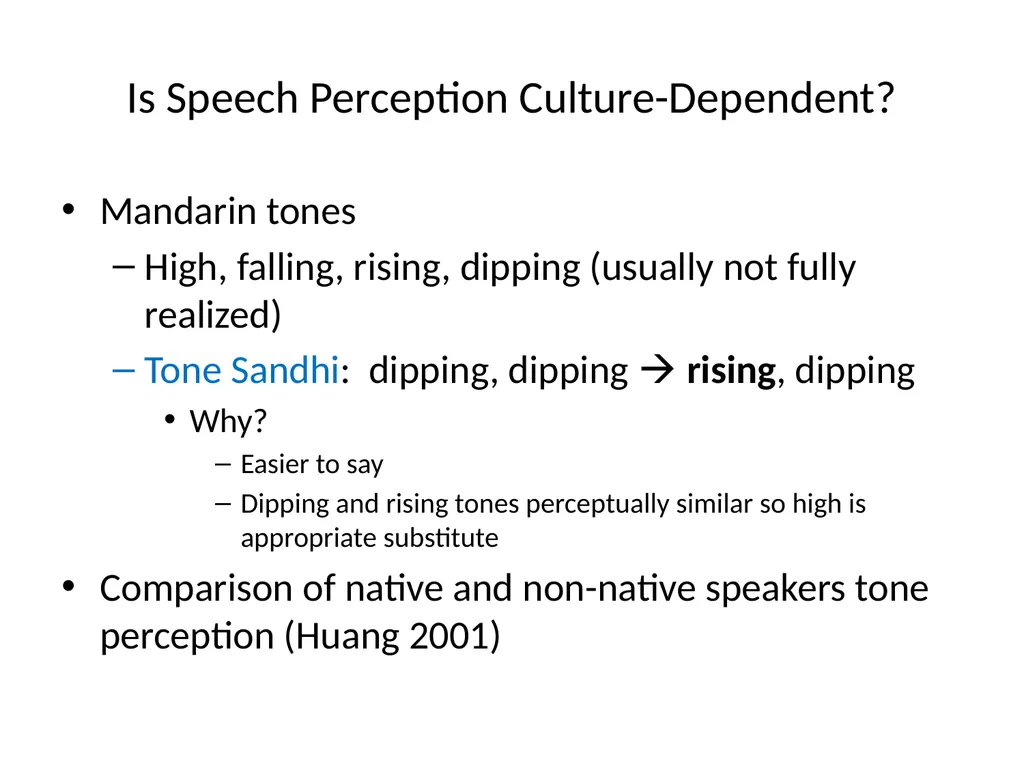
Is Speech Perception Culture-Dependent? Mandarin tones
High, falling, rising, dipping (usually not fully realized)
Tone Sandhi: dipping, dipping rising, dipping
Why?
Easier to say
Dipping and rising tones perceptually similar so high is appropriate substitute
Comparison of native and non-native speakers tone perception (Huang 2001)<br>
15
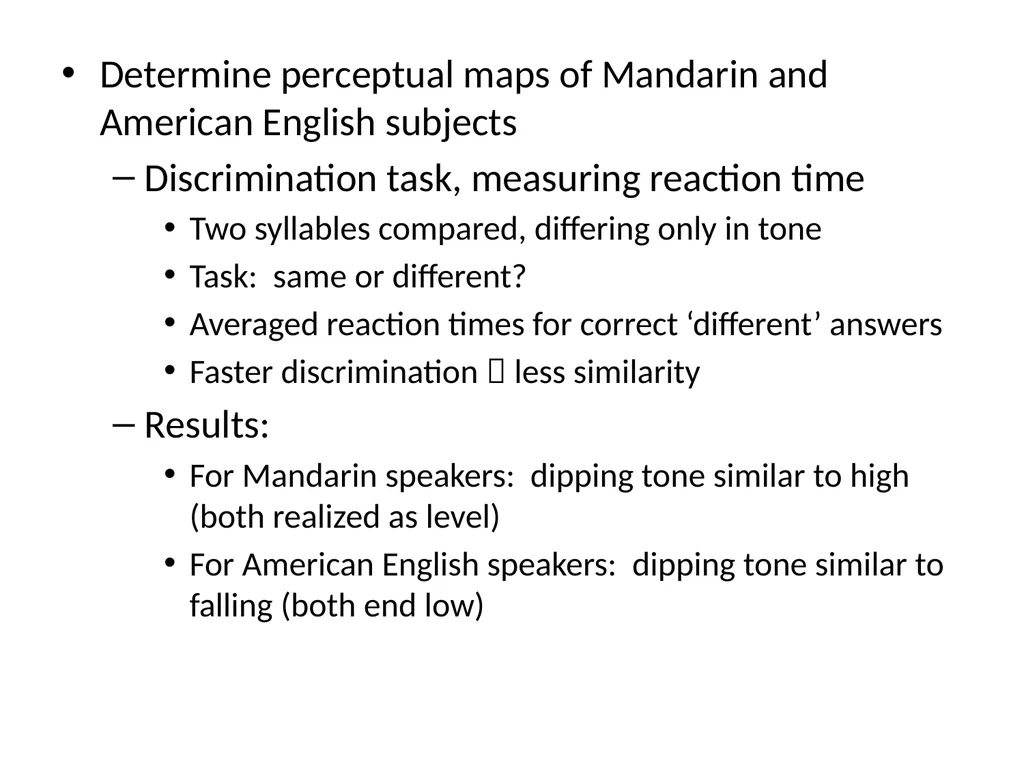
Determine perceptual maps of Mandarin and American English subjects
Discrimination task, measuring reaction time
Two syllables compared, differing only in tone
Task: same or different?
Averaged reaction times for correct ‘different’ answers
Faster discrimination less similarity
Results:
For Mandarin speakers: dipping tone similar to high (both realized as level)
For American English speakers: dipping tone similar to falling (both end low)<br>
16
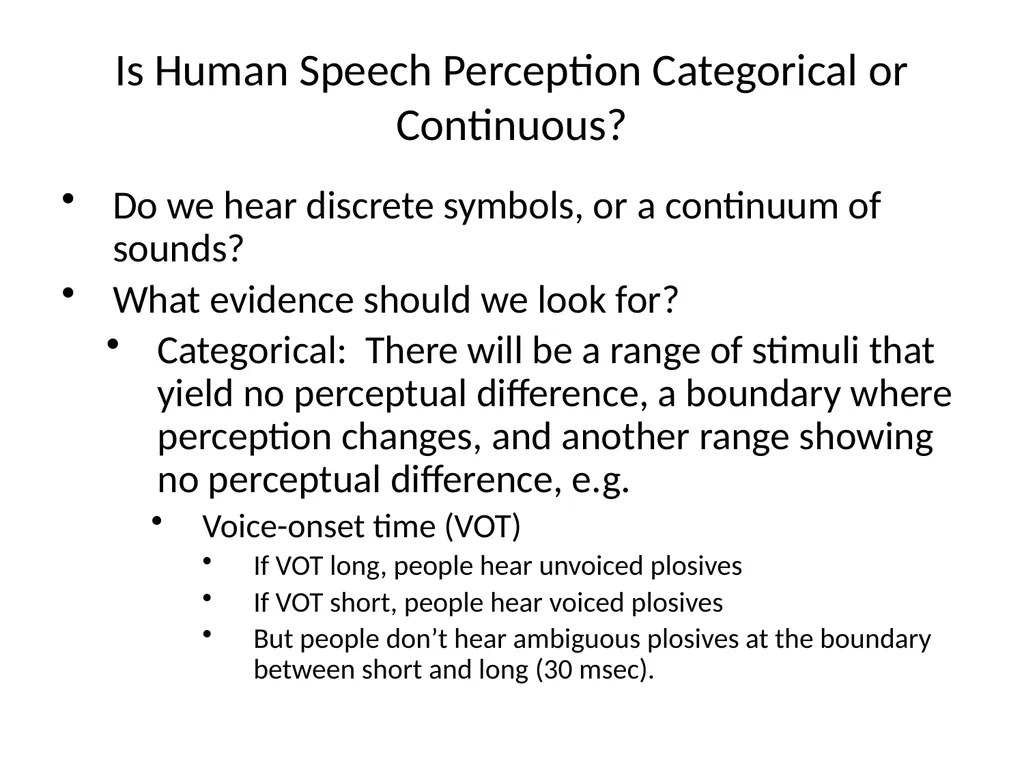
Is Human Speech Perception Categorical or Continuous? Do we hear discrete symbols, or a continuum of sounds?
What evidence should we look for?
Categorical: There will be a range of stimuli that yield no perceptual difference, a boundary where perception changes, and another range showing no perceptual difference, e.g.
Voice-onset time (VOT)
If VOT long, people hear unvoiced plosives
If VOT short, people hear voiced plosives
But people don’t hear ambiguous plosives at the boundary between short and long (30 msec).<br>
17
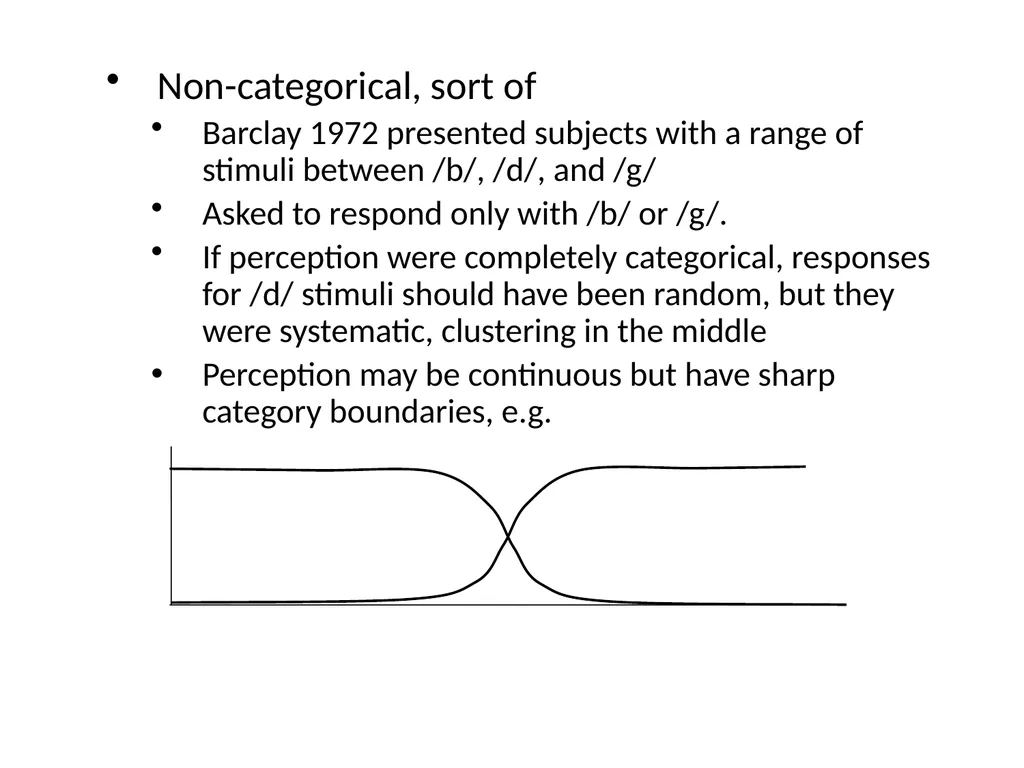
Non-categorical, sort of
Barclay 1972 presented subjects with a range of stimuli between /b/, /d/, and /g/
Asked to respond only with /b/ or /g/.
If perception were completely categorical, responses for /d/ stimuli should have been random, but they were systematic, clustering in the middle
Perception may be continuous but have sharp category boundaries, e.g.<br>
18
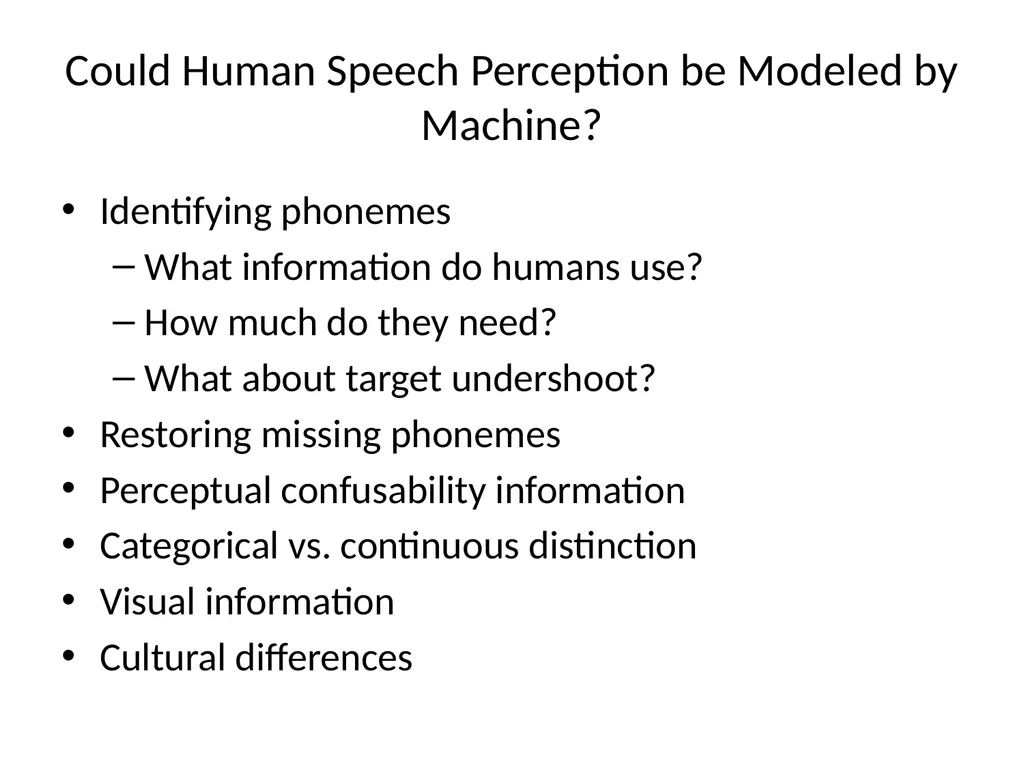
Could Human Speech Perception be Modeled by Machine? Identifying phonemes
What information do humans use?
How much do they need?
What about target undershoot?
Restoring missing phonemes
Perceptual confusability information
Categorical vs. continuous distinction
Visual information
Cultural differences<br>
19
Next Class Automatic Speech Recognition Overview<br>