Identifying and Responding to Child Abuse Responding to Child Abuse - International Context UNCRC Article 3 (best interests of the child) The best interests of the child must be a top priority in all decisions and actions that affect
"Identifying and Responding to Child Abuse" is the property of its rightful owner. Permission is granted to
download and print the materials on this website for personal, non-commercial use only, and to display it
on your personal computer provided you do not modify the materials and that you retain all copyright
notices contained in the materials. By downloading content from our website, you accept the terms of this
agreement.
Presentation Transcript
01
Identifying and Responding to Child Abuse<br>
02
Responding to Child Abuse - International Context UNCRC
Article 3 (best interests of the child) The best interests of the child must be a top priority in all decisions and actions that affect children.
Article 9 (separation from parents) Children must not be separated from their parents against their will unless it is in their best interests (for example, if a parent is hurting or neglecting a child). Children whose parents have separated have the right to stay in contact with both parents, unless this could cause them harm.
Article 19 (protection from violence, abuse and neglect) Governments must do all they can to ensure that children are protected from all forms of violence, abuse, neglect and bad treatment by their parents or anyone else who looks after them
Article 20 (children unable to live with their family) If a child cannot be looked after by their immediate family, the government must give them special protection and assistance. This includes making sure the child is provided with alternative care that is continuous and respects the child’s culture, language and religion.<br>
03
European Commission’s Ten Principles of Child Protection 1. every child is recognised, respected and protected as a rights holder, with non-negotiable rights to protection
2. no child is discriminated against
3. child protection systems include prevention measures
4. families are supported in their role as primary caregivers
5. society is aware and supportive of the child's right to freedom from all forms of violence
6. child protection systems ensure adequate care, including:
standards, indicators and systems of monitoring and evaluation
child safeguarding policies and reporting mechanisms for organisations working with children
certification and training for all professionals working for and with children.
7. child protection systems have transnational and cross-border mechanisms in place
8. no child should be without the support and protection of a legal guardian or other responsible adult or competent public body at any time
9. training on identification of risks is given to teachers, health sector professionals, and social workers
10. safe, well-publicised, confidential and accessible reporting mechanisms are in place<br>
04
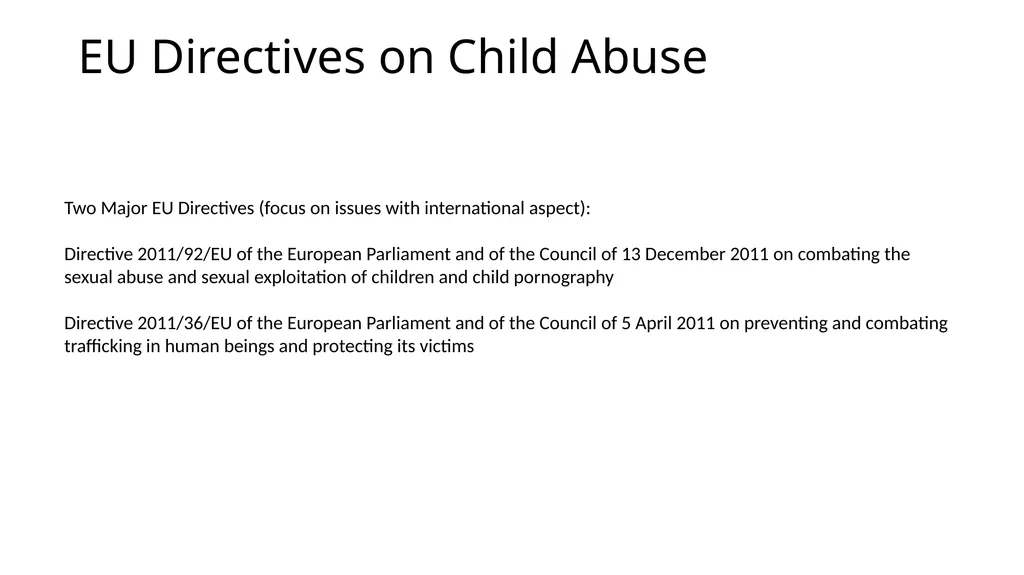
EU Directives on Child Abuse Two Major EU Directives (focus on issues with international aspect):
Directive 2011/92/EU of the European Parliament and of the Council of 13 December 2011 on combating the sexual abuse and sexual exploitation of children and child pornography
Directive 2011/36/EU of the European Parliament and of the Council of 5 April 2011 on preventing and combating trafficking in human beings and protecting its victims<br>
05
655,630 referrals made to social services in 2017/18 407,380 assessments where child was judged to be in need 68,770 child protection plans started Neglect 32,520 Physical Abuse 5,840 Sexual Abuse 2,960 Emotional Abuse 23,880 Multiple Forms 3,580 32,050 children became Looked After (15,990 by voluntary agreement) Child Protection Statistics in England<br>
06
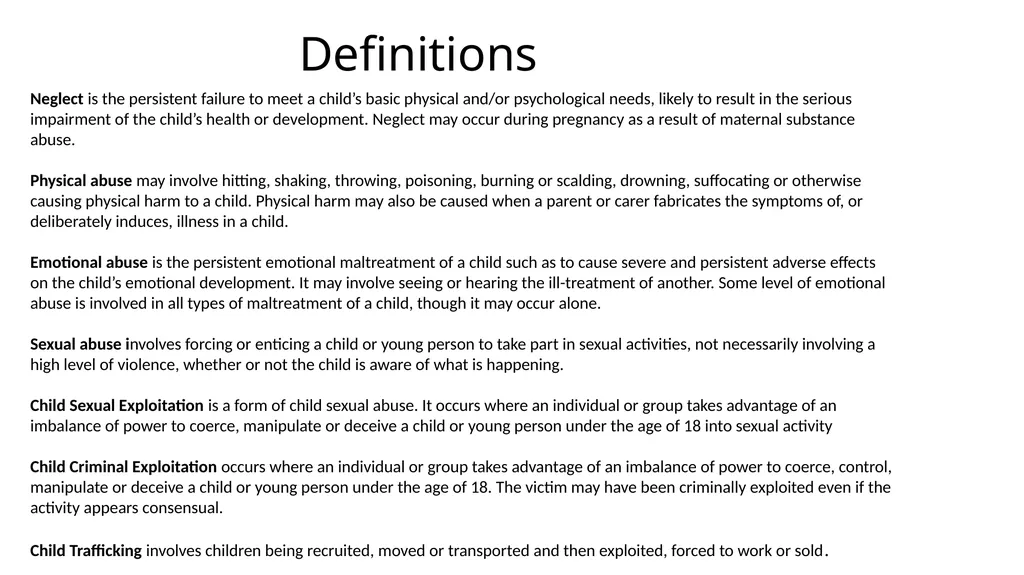
Definitions Neglect is the persistent failure to meet a child’s basic physical and/or psychological needs, likely to result in the serious impairment of the child’s health or development. Neglect may occur during pregnancy as a result of maternal substance abuse.
Physical abuse may involve hitting, shaking, throwing, poisoning, burning or scalding, drowning, suffocating or otherwise causing physical harm to a child. Physical harm may also be caused when a parent or carer fabricates the symptoms of, or deliberately induces, illness in a child.
Emotional abuse is the persistent emotional maltreatment of a child such as to cause severe and persistent adverse effects on the child’s emotional development. It may involve seeing or hearing the ill-treatment of another. Some level of emotional abuse is involved in all types of maltreatment of a child, though it may occur alone.
Sexual abuse involves forcing or enticing a child or young person to take part in sexual activities, not necessarily involving a high level of violence, whether or not the child is aware of what is happening.
Child Sexual Exploitation is a form of child sexual abuse. It occurs where an individual or group takes advantage of an imbalance of power to coerce, manipulate or deceive a child or young person under the age of 18 into sexual activity
Child Criminal Exploitation occurs where an individual or group takes advantage of an imbalance of power to coerce, control, manipulate or deceive a child or young person under the age of 18. The victim may have been criminally exploited even if the activity appears consensual.
Child Trafficking involves children being recruited, moved or transported and then exploited, forced to work or sold.<br>
07
What are the signs?<br>
08
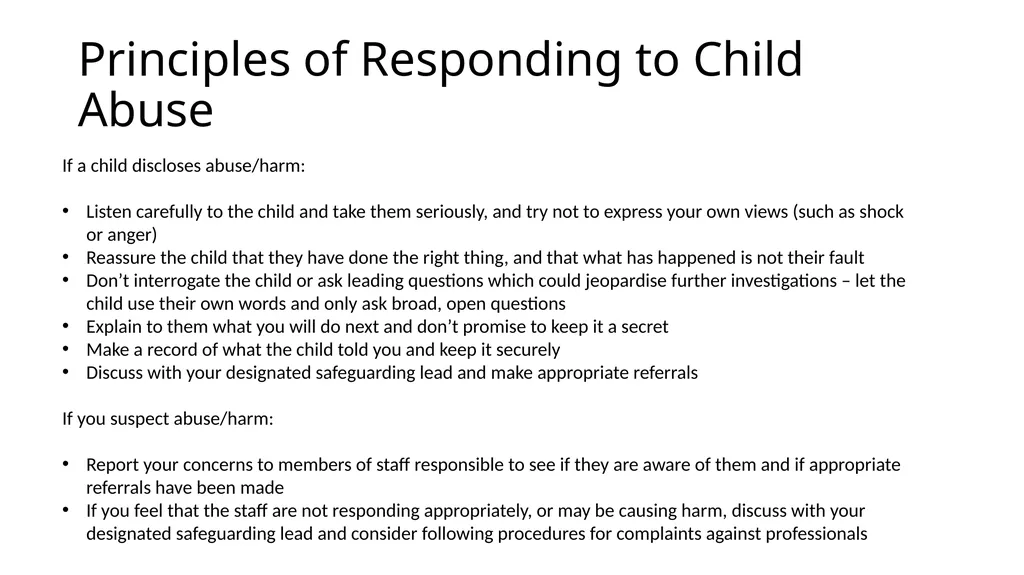
Principles of Responding to Child Abuse If a child discloses abuse/harm:
Listen carefully to the child and take them seriously, and try not to express your own views (such as shock or anger)
Reassure the child that they have done the right thing, and that what has happened is not their fault
Don’t interrogate the child or ask leading questions which could jeopardise further investigations – let the child use their own words and only ask broad, open questions
Explain to them what you will do next and don’t promise to keep it a secret
Make a record of what the child told you and keep it securely
Discuss with your designated safeguarding lead and make appropriate referrals
If you suspect abuse/harm:
Report your concerns to members of staff responsible to see if they are aware of them and if appropriate referrals have been made
If you feel that the staff are not responding appropriately, or may be causing harm, discuss with your designated safeguarding lead and consider following procedures for complaints against professionals<br>