IEP and Frontline Updates Presented by: Nita
Description: IEP and Frontline Updates Presented by: Nita McAuliffe and LJ Garcia Topics for the day: RDA Overview IEP Procedural Guidance: Exceptional Student Service Unit Technical Assistance IEP Planning File Review Reminders Frontline Updates
Related Topics
Download Presentation
"IEP and Frontline Updates Presented by: Nita" is the property of its rightful owner. Permission is granted to download and print the materials on this website for personal, non-commercial use only, and to display it on your personal computer provided you do not modify the materials and that you retain all copyright notices contained in the materials. By downloading content from our website, you accept the terms of this agreement.
Presentation Transcript
slide1. IEP and Frontline Updates Presented by: Nita McAuliffe and LJ Garcia<br>
slide2. Topics for the day: RDA Overview
IEP Procedural Guidance: Exceptional Student Service Unit Technical Assistance
IEP Planning
File Review Reminders
Frontline Updates
Website Updates and Resources
Questions and answer<br>
slide3. RDA (Results Driven Accountability)<br>
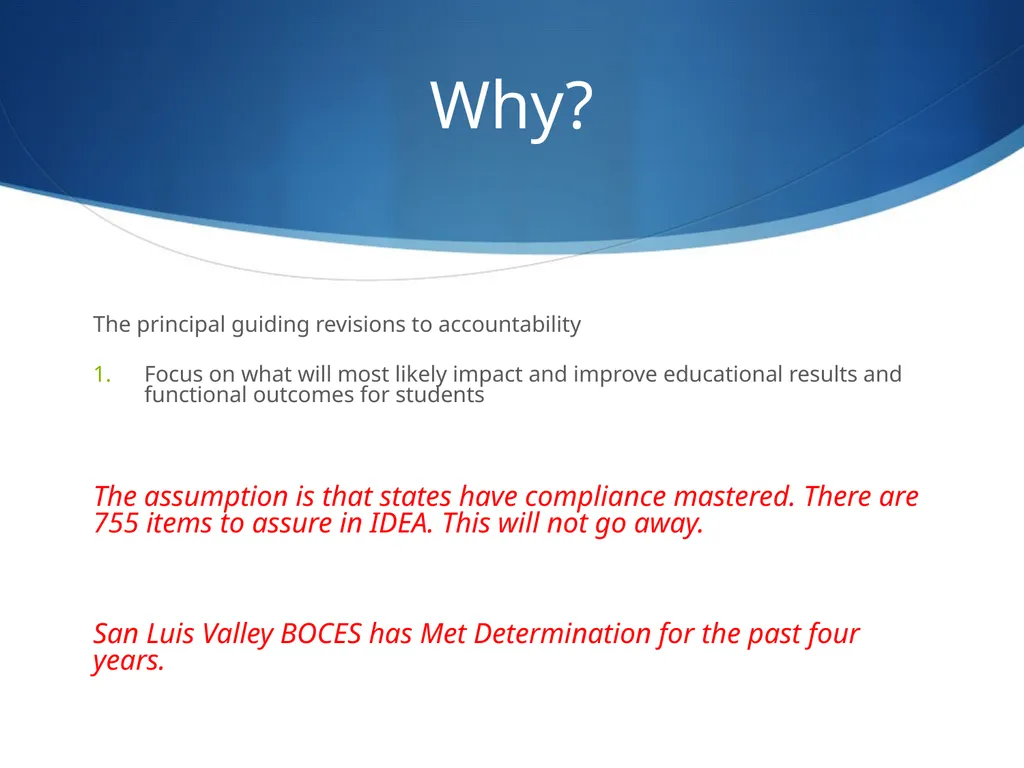
slide4. Why? The principal guiding revisions to accountability
Focus on what will most likely impact and improve educational results and functional outcomes for students
The assumption is that states have compliance mastered. There are 755 items to assure in IDEA. This will not go away.
San Luis Valley BOCES has Met Determination for the past four years.<br>
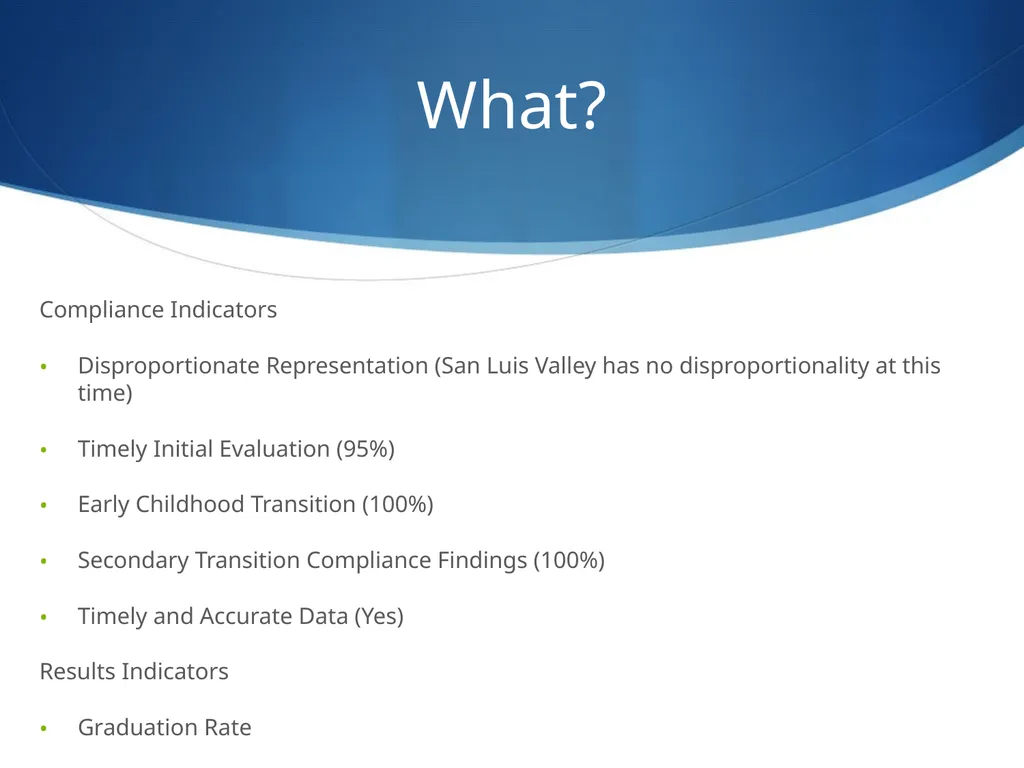
slide5. What? Compliance Indicators
Disproportionate Representation (San Luis Valley has no disproportionality at this time)
Timely Initial Evaluation (95%)
Early Childhood Transition (100%)
Secondary Transition Compliance Findings (100%)
Timely and Accurate Data (Yes)
Results Indicators
Graduation Rate
Drop-Out Rate
Statewide Assessment
Suspension and Expulsion
Educational Environment
Preschool Environment
Parent Involvement
Postsecondary Outcomes
Resolution Session Agreements
Mediation Agreements<br>
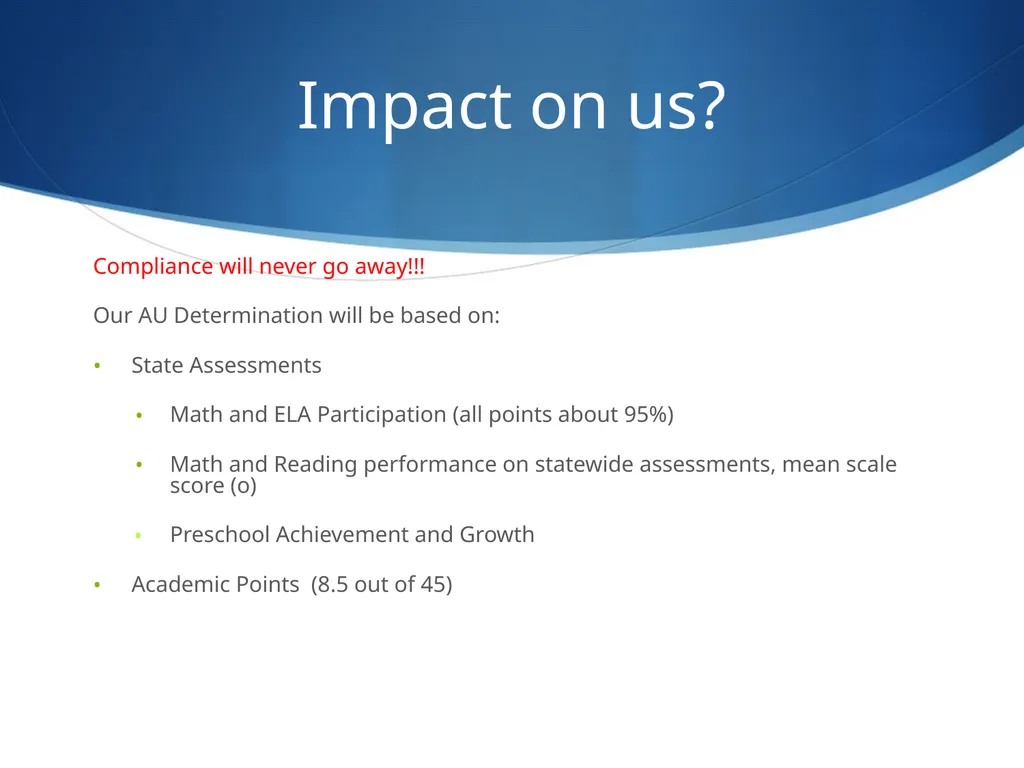
slide6. Impact on us? Compliance will never go away!!!
Our AU Determination will be based on:
State Assessments
Math and ELA Participation (all points about 95%)
Math and Reading performance on statewide assessments, mean scale score (o)
Preschool Achievement and Growth
Academic Points (8.5 out of 45)<br>
slide7. Impact on us? Academic Growth Points
Includes Math and ELA (85 out of 150)- Rise up and Keep up
PS and Workforce (64 out of 105)- Graduation rate, dropout, outcomes for graduates
Combine compliance and results for final determination.<br>
slide8. Impact on us? Our challenge is to
balance the continued
pressure of compliance
with high expectations of results and outcomes for
students.<br>
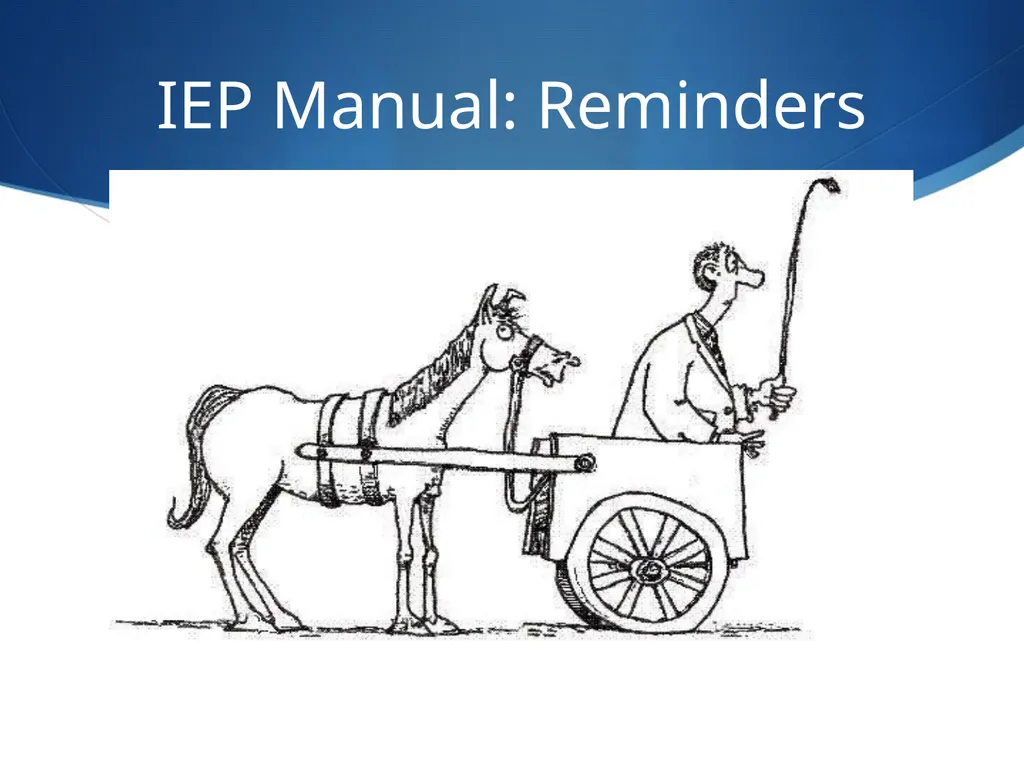
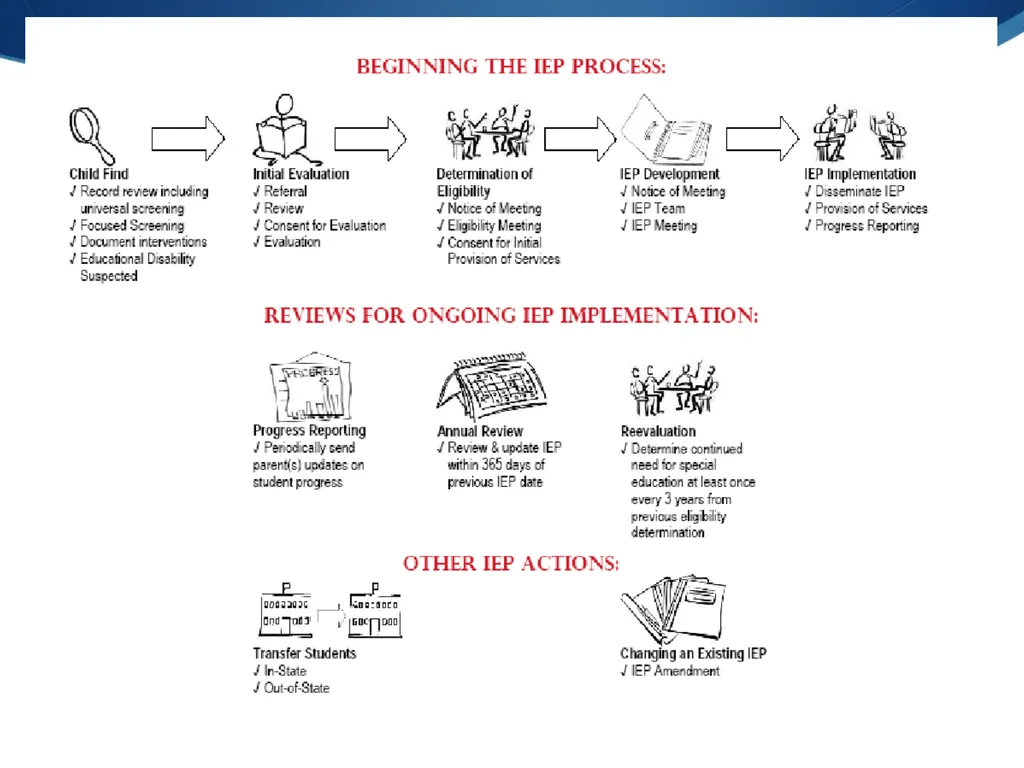
slide9. IEP Manual: Reminders<br>
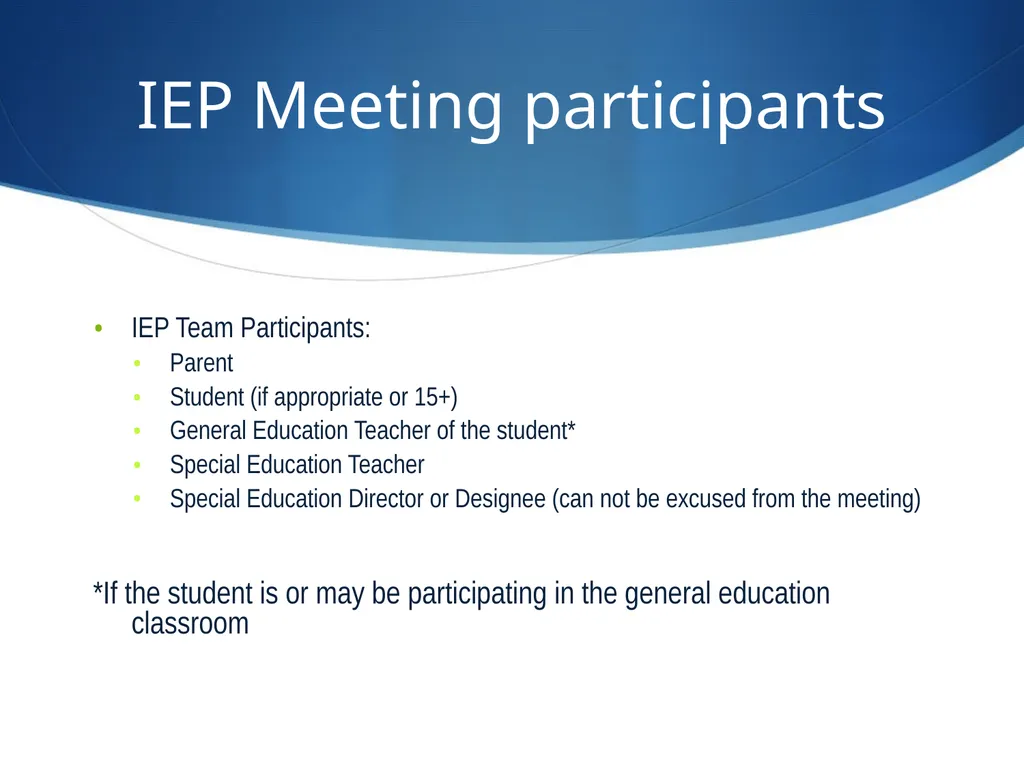
slide11. IEP Meeting participants IEP Team Participants:
Parent
Student (if appropriate or 15+)
General Education Teacher of the student*
Special Education Teacher
Special Education Director or Designee (can not be excused from the meeting)
*If the student is or may be participating in the general education classroom<br>
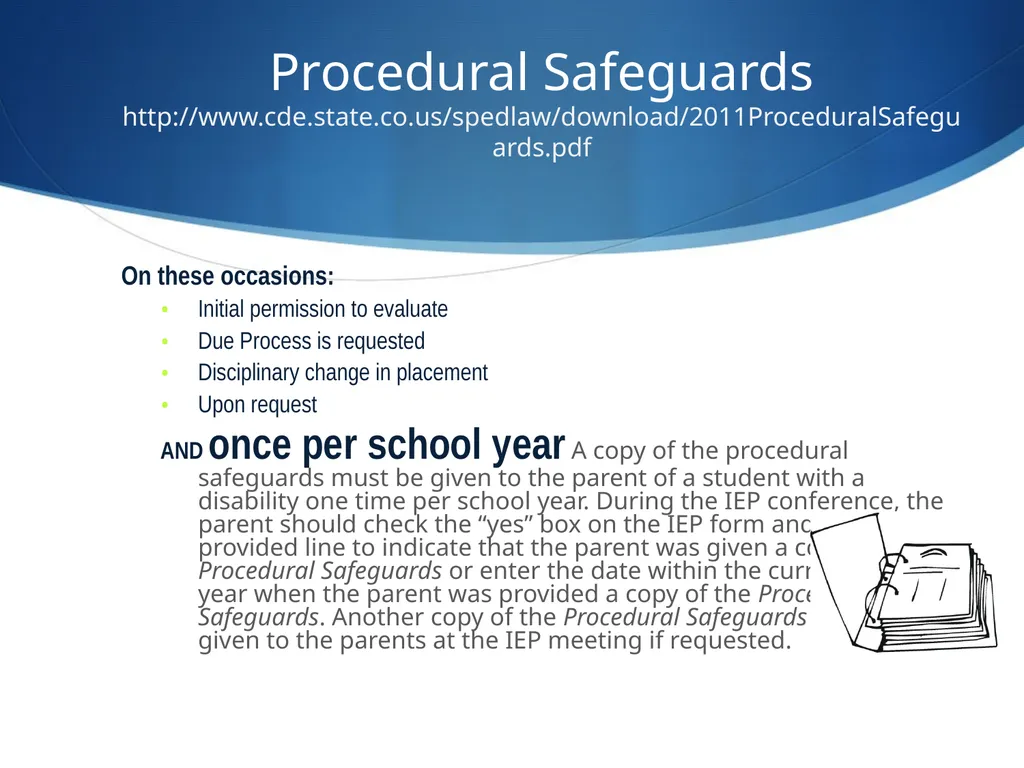
slide12. Procedural Safeguardshttp://www.cde.state.co.us/spedlaw/download/2011ProceduralSafeguards.pdf On these occasions:
Initial permission to evaluate
Due Process is requested
Disciplinary change in placement
Upon request
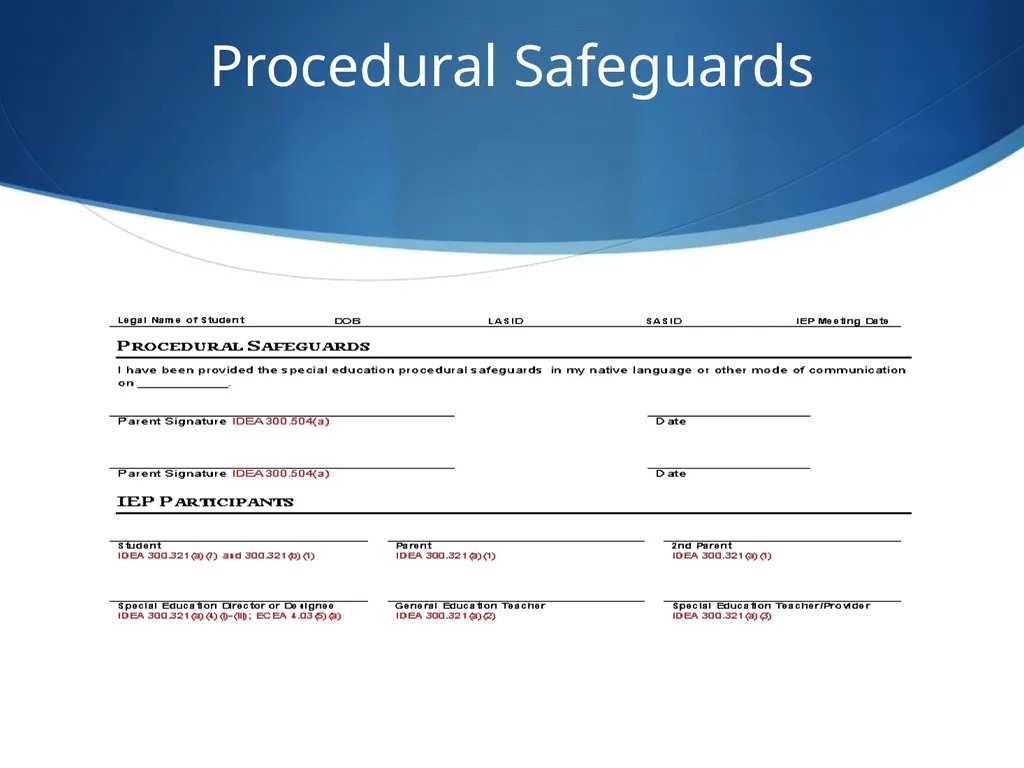
AND once per school year A copy of the procedural safeguards must be given to the parent of a student with a disability one time per school year. During the IEP conference, the parent should check the “yes” box on the IEP form and sign the provided line to indicate that the parent was given a copy of the Procedural Safeguards or enter the date within the current school year when the parent was provided a copy of the Procedural Safeguards. Another copy of the Procedural Safeguards should be given to the parents at the IEP meeting if requested.<br>
slide13. Procedural Safeguards<br>
slide14. Procedural Safeguards Key points to cover:
parent access to student records,
parent rights to ask that those records be amended,
parent rights to participate in groups and meetings where decisions are made about their child’s education,
parent notification requirements (prior written notice and the procedural safeguards notice), and
selected other safeguards (e.g., independent educational evaluation, surrogate parents, age of majority).<br>
slide15. IEP team Parent partnerships
Student (if 15 or older)
Multidisciplinary Team:
Parent
Student (if appropriate)
At least 1 teacher or specialist with knowledge in suspected area of disability
As necessary: other qualified professionals such
as OT/PT, SLP, school psych, RN<br>
slide16. IEP evaluation Consider strengths and needs, as well as concerns about the student
Identify data Team already has, and data needed to determine eligibility
Prior Written Notice & Consent for Evaluation<br>
slide17. PLAAFP Data in PLAAFP suggests need(s) – get away from stating “See attached”
Statement of the child’s present levels of academic achievement and functional performance – compliance vs. quality (Appendix D – Pg. 135)
Statement about progress on goals and post secondary goals for Transition IEP’s<br>
slide18. Annual Goals-Alignment Measurable goal should align directly to PLAAFP
Prioritize & consolidate goals as appropriate
Standard(s) reflected after goal
Unit of measurement (criteria) relate to skill being taught (SMART goals)<br>
slide19. Annual Goals-objectives Objectives:
Only required for students taking state
alternate assessment(s)<br>
slide20. Goals SMART Goal Criteria
Specific
Measurable
Achievable
Reasonable
Timeline<br>
slide21. Goals (cont.) Make sure we are aligning goals to standards.
If we forget to align one goal, it will not meet compliance
Every discipline needs to be doing this
Examples: Appendix d – Pg. 12
CDE quotation “It is denial of FAPE if not making growth on annual goals year after year”. (year after year with same goal and lack of progress).
For Transition to Adulthood Focus on skills to be in place 12-24 months AFTER graduation.<br>
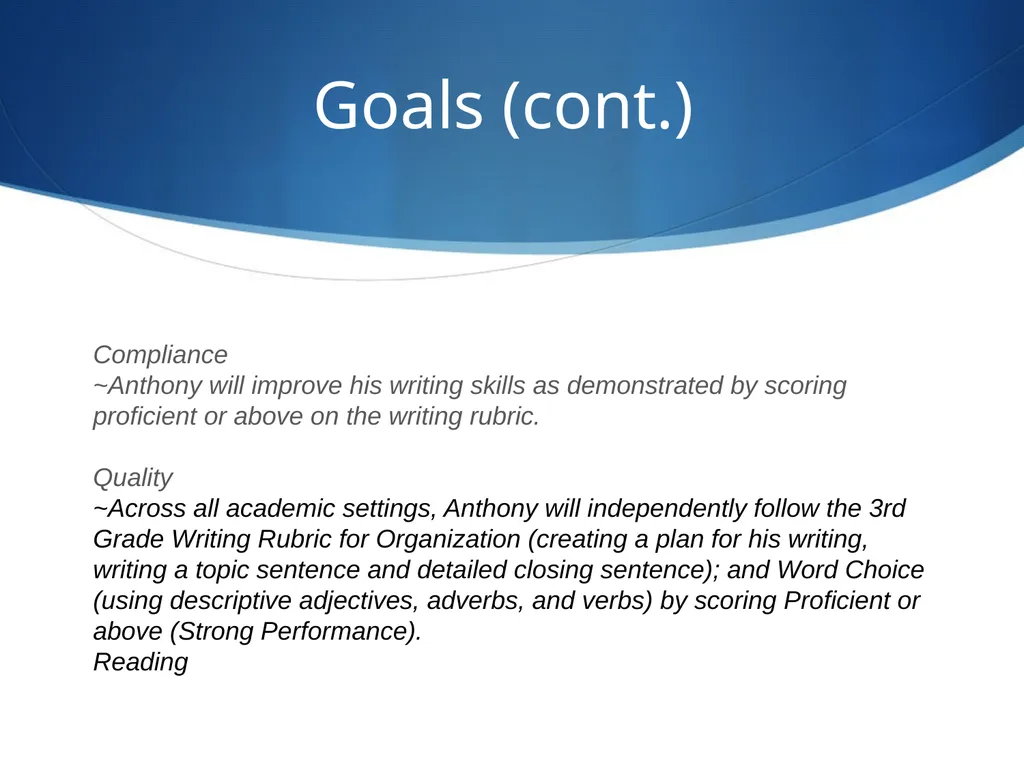
slide22. Goals (cont.) Compliance
~Anthony will improve his writing skills as demonstrated by scoring proficient or above on the writing rubric.
Quality
~Across all academic settings, Anthony will independently follow the 3rd Grade Writing Rubric for Organization (creating a plan for his writing, writing a topic sentence and detailed closing sentence); and Word Choice (using descriptive adjectives, adverbs, and verbs) by scoring Proficient or above (Strong Performance).
Reading<br>
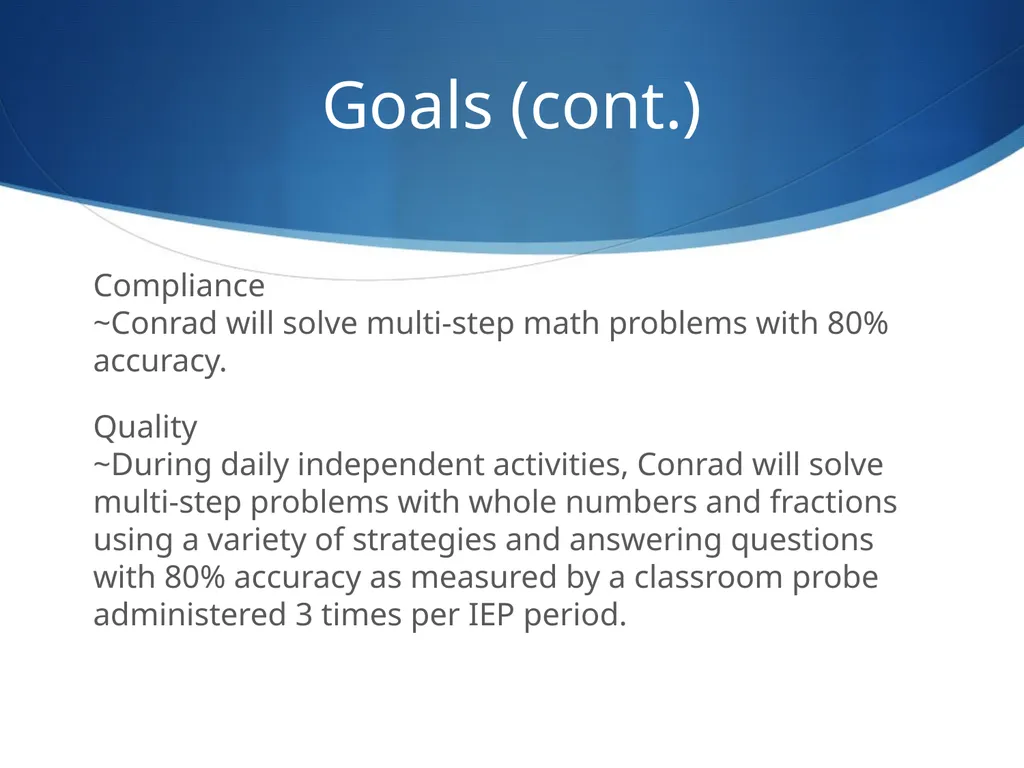
slide23. Goals (cont.) Compliance
~Conrad will solve multi-step math problems with 80% accuracy.
Quality
~During daily independent activities, Conrad will solve multi-step problems with whole numbers and fractions using a variety of strategies and answering questions with 80% accuracy as measured by a classroom probe administered 3 times per IEP period.<br>
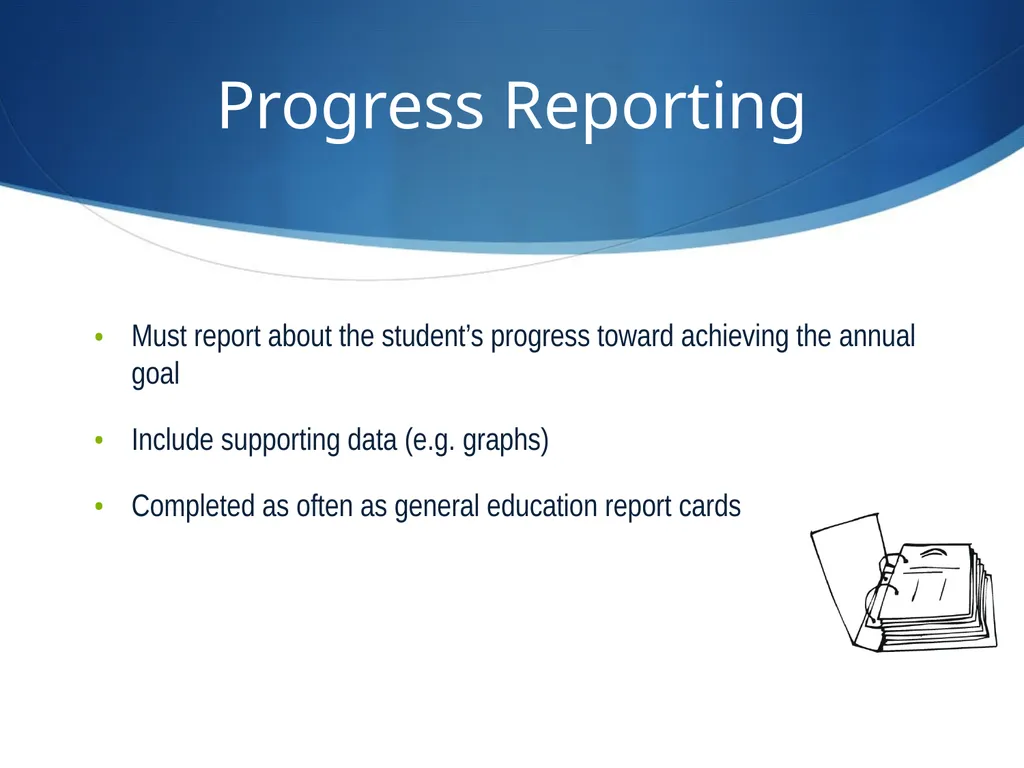
slide24. Progress Reporting Must report about the student’s progress toward achieving the annual goal
Include supporting data (e.g. graphs)
Completed as often as general education report cards<br>
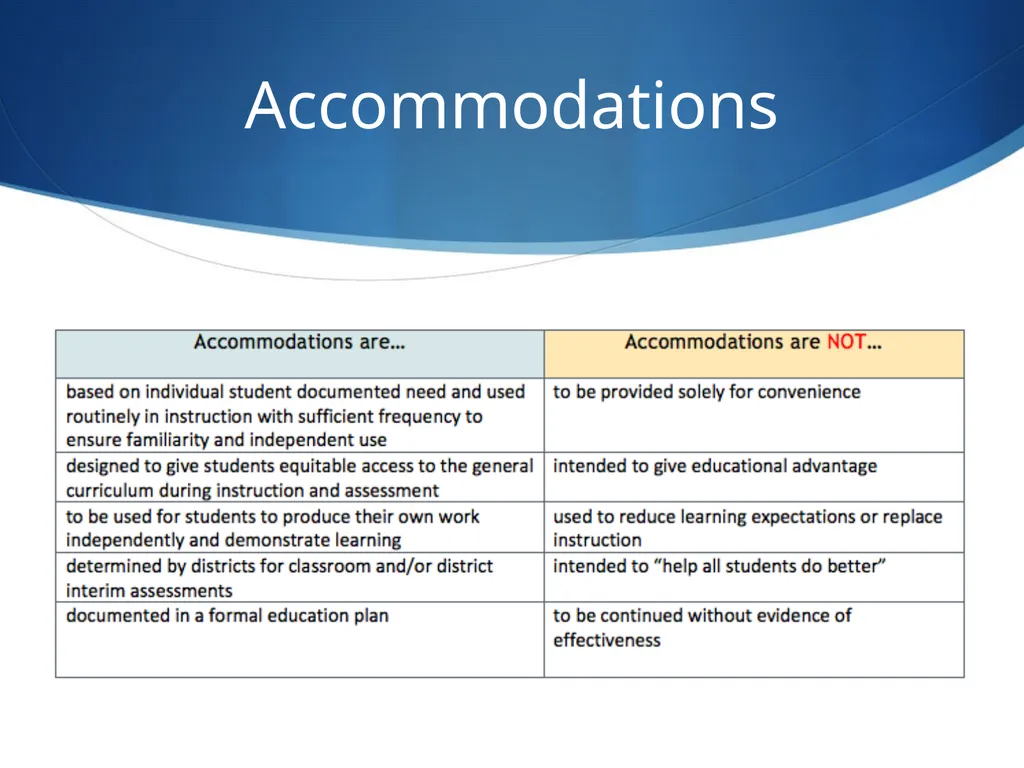
slide25. Accommodations<br>
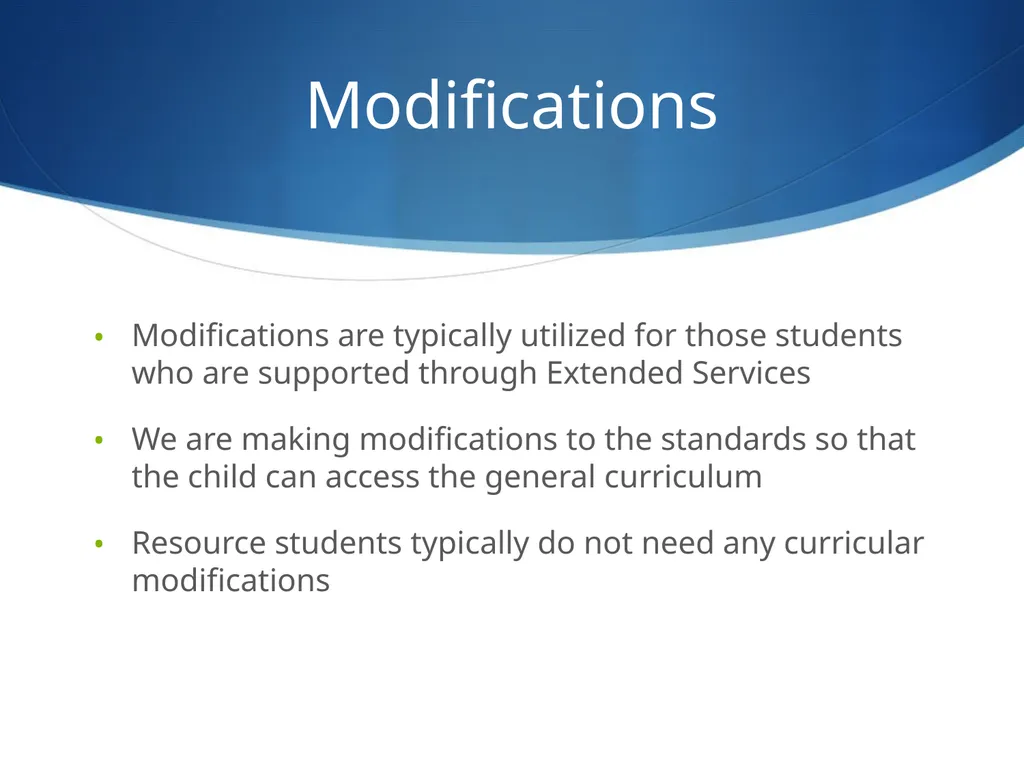
slide26. Modifications Modifications are typically utilized for those students who are supported through Extended Services
We are making modifications to the standards so that the child can access the general curriculum
Resource students typically do not need any curricular modifications<br>
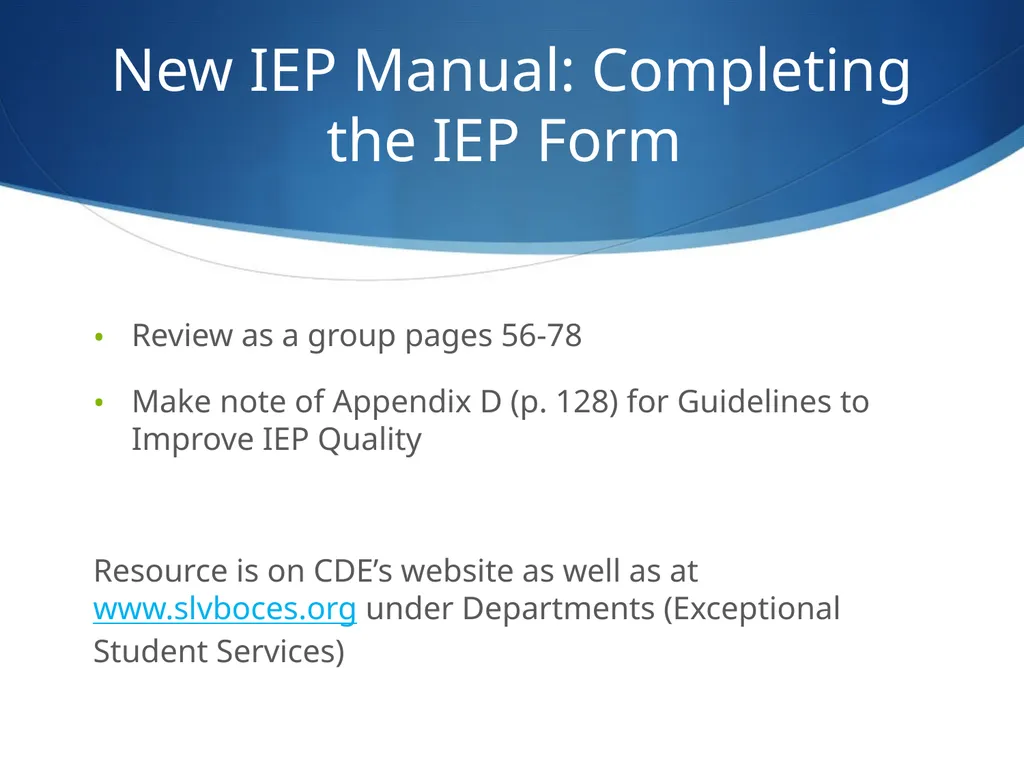
slide27. New IEP Manual: Completing the IEP Form Review as a group pages 56-78
Make note of Appendix D (p. 128) for Guidelines to Improve IEP Quality
Resource is on CDE’s website as well as at www.slvboces.org under Departments (Exceptional Student Services)<br>
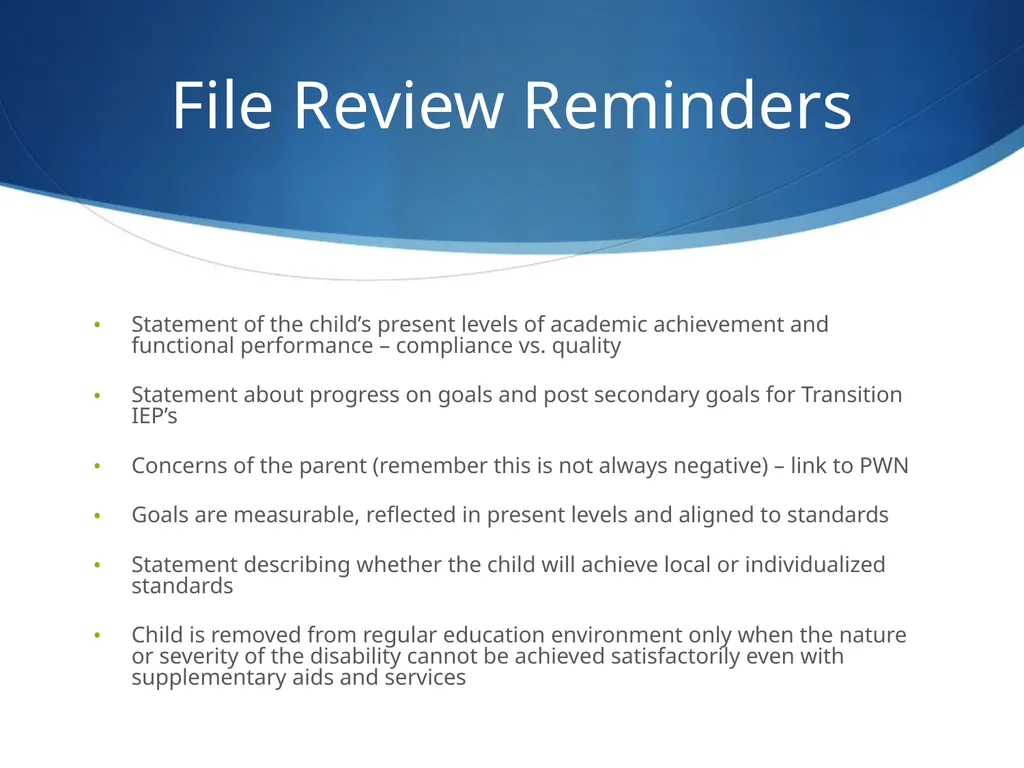
slide28. File Review Reminders Statement of the child’s present levels of academic achievement and functional performance – compliance vs. quality
Statement about progress on goals and post secondary goals for Transition IEP’s
Concerns of the parent (remember this is not always negative) – link to PWN
Goals are measurable, reflected in present levels and aligned to standards
Statement describing whether the child will achieve local or individualized standards
Child is removed from regular education environment only when the nature or severity of the disability cannot be achieved satisfactorily even with supplementary aids and services<br>
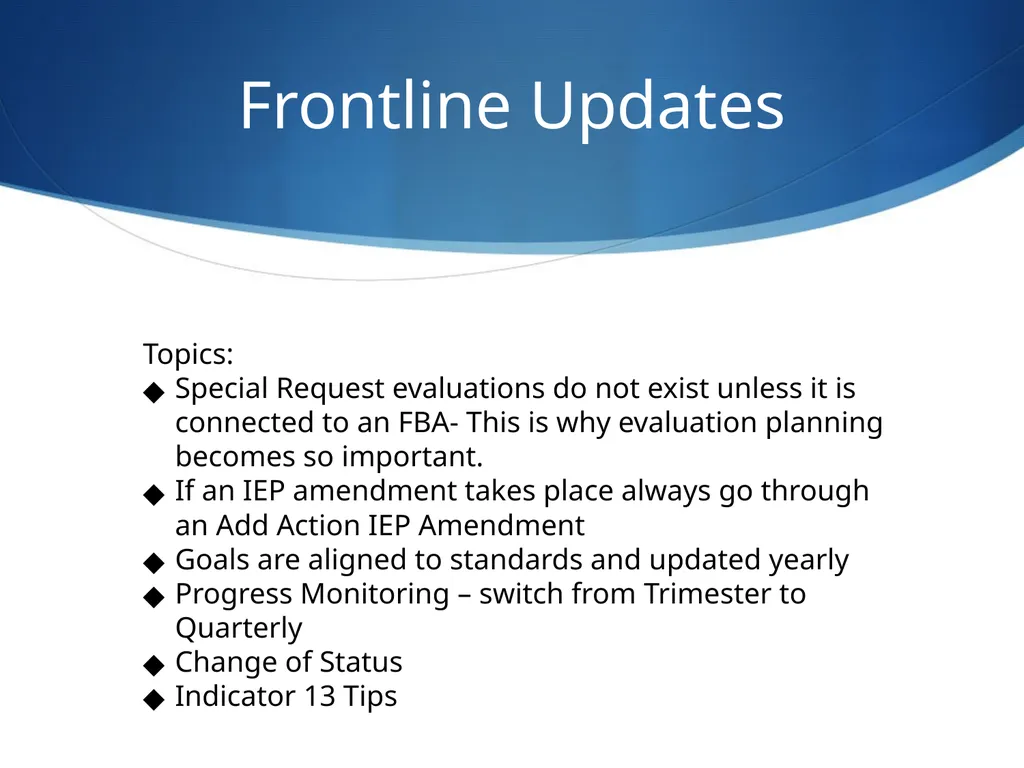
slide29. Frontline Updates Topics:
Special Request evaluations do not exist unless it is connected to an FBA- This is why evaluation planning becomes so important.
If an IEP amendment takes place always go through an Add Action IEP Amendment
Goals are aligned to standards and updated yearly
Progress Monitoring – switch from Trimester to Quarterly
Change of Status
Indicator 13 Tips<br>
slide30. Forms to be uploaded due to signatures Permission for evaluation
Initial consent of Services
Amendment
Attendance at IEP meeting (parent also signs they received rights)
Eligibility determination disability pages<br>
slide31. Frontline Tips Dashboard
Batch printing
Help Tips
Probe Scoring
Audit logs
Tips: Administrator use can see who has accessed a student at anytime. If a student moves please turn in change of status.<br>
slide32. File Reviews Review Standard Checklist for File Reviews to State<br>
slide33. Web Site Resources Tour of www.slvboces.org
Indicator 13 Tips Manual
Related Services Providers<br>
slide34. Parent Survey Requirements/Information about Parent Surveys
Responsibilities of Case Managers<br>
slide35. Question and AnswerGetting our ducks in a row!<br>
slide2. Topics for the day: RDA Overview
IEP Procedural Guidance: Exceptional Student Service Unit Technical Assistance
IEP Planning
File Review Reminders
Frontline Updates
Website Updates and Resources
Questions and answer<br>
slide3. RDA (Results Driven Accountability)<br>
slide4. Why? The principal guiding revisions to accountability
Focus on what will most likely impact and improve educational results and functional outcomes for students
The assumption is that states have compliance mastered. There are 755 items to assure in IDEA. This will not go away.
San Luis Valley BOCES has Met Determination for the past four years.<br>
slide5. What? Compliance Indicators
Disproportionate Representation (San Luis Valley has no disproportionality at this time)
Timely Initial Evaluation (95%)
Early Childhood Transition (100%)
Secondary Transition Compliance Findings (100%)
Timely and Accurate Data (Yes)
Results Indicators
Graduation Rate
Drop-Out Rate
Statewide Assessment
Suspension and Expulsion
Educational Environment
Preschool Environment
Parent Involvement
Postsecondary Outcomes
Resolution Session Agreements
Mediation Agreements<br>
slide6. Impact on us? Compliance will never go away!!!
Our AU Determination will be based on:
State Assessments
Math and ELA Participation (all points about 95%)
Math and Reading performance on statewide assessments, mean scale score (o)
Preschool Achievement and Growth
Academic Points (8.5 out of 45)<br>
slide7. Impact on us? Academic Growth Points
Includes Math and ELA (85 out of 150)- Rise up and Keep up
PS and Workforce (64 out of 105)- Graduation rate, dropout, outcomes for graduates
Combine compliance and results for final determination.<br>
slide8. Impact on us? Our challenge is to
balance the continued
pressure of compliance
with high expectations of results and outcomes for
students.<br>
slide9. IEP Manual: Reminders<br>
slide11. IEP Meeting participants IEP Team Participants:
Parent
Student (if appropriate or 15+)
General Education Teacher of the student*
Special Education Teacher
Special Education Director or Designee (can not be excused from the meeting)
*If the student is or may be participating in the general education classroom<br>
slide12. Procedural Safeguardshttp://www.cde.state.co.us/spedlaw/download/2011ProceduralSafeguards.pdf On these occasions:
Initial permission to evaluate
Due Process is requested
Disciplinary change in placement
Upon request
AND once per school year A copy of the procedural safeguards must be given to the parent of a student with a disability one time per school year. During the IEP conference, the parent should check the “yes” box on the IEP form and sign the provided line to indicate that the parent was given a copy of the Procedural Safeguards or enter the date within the current school year when the parent was provided a copy of the Procedural Safeguards. Another copy of the Procedural Safeguards should be given to the parents at the IEP meeting if requested.<br>
slide13. Procedural Safeguards<br>
slide14. Procedural Safeguards Key points to cover:
parent access to student records,
parent rights to ask that those records be amended,
parent rights to participate in groups and meetings where decisions are made about their child’s education,
parent notification requirements (prior written notice and the procedural safeguards notice), and
selected other safeguards (e.g., independent educational evaluation, surrogate parents, age of majority).<br>
slide15. IEP team Parent partnerships
Student (if 15 or older)
Multidisciplinary Team:
Parent
Student (if appropriate)
At least 1 teacher or specialist with knowledge in suspected area of disability
As necessary: other qualified professionals such
as OT/PT, SLP, school psych, RN<br>
slide16. IEP evaluation Consider strengths and needs, as well as concerns about the student
Identify data Team already has, and data needed to determine eligibility
Prior Written Notice & Consent for Evaluation<br>
slide17. PLAAFP Data in PLAAFP suggests need(s) – get away from stating “See attached”
Statement of the child’s present levels of academic achievement and functional performance – compliance vs. quality (Appendix D – Pg. 135)
Statement about progress on goals and post secondary goals for Transition IEP’s<br>
slide18. Annual Goals-Alignment Measurable goal should align directly to PLAAFP
Prioritize & consolidate goals as appropriate
Standard(s) reflected after goal
Unit of measurement (criteria) relate to skill being taught (SMART goals)<br>
slide19. Annual Goals-objectives Objectives:
Only required for students taking state
alternate assessment(s)<br>
slide20. Goals SMART Goal Criteria
Specific
Measurable
Achievable
Reasonable
Timeline<br>
slide21. Goals (cont.) Make sure we are aligning goals to standards.
If we forget to align one goal, it will not meet compliance
Every discipline needs to be doing this
Examples: Appendix d – Pg. 12
CDE quotation “It is denial of FAPE if not making growth on annual goals year after year”. (year after year with same goal and lack of progress).
For Transition to Adulthood Focus on skills to be in place 12-24 months AFTER graduation.<br>
slide22. Goals (cont.) Compliance
~Anthony will improve his writing skills as demonstrated by scoring proficient or above on the writing rubric.
Quality
~Across all academic settings, Anthony will independently follow the 3rd Grade Writing Rubric for Organization (creating a plan for his writing, writing a topic sentence and detailed closing sentence); and Word Choice (using descriptive adjectives, adverbs, and verbs) by scoring Proficient or above (Strong Performance).
Reading<br>
slide23. Goals (cont.) Compliance
~Conrad will solve multi-step math problems with 80% accuracy.
Quality
~During daily independent activities, Conrad will solve multi-step problems with whole numbers and fractions using a variety of strategies and answering questions with 80% accuracy as measured by a classroom probe administered 3 times per IEP period.<br>
slide24. Progress Reporting Must report about the student’s progress toward achieving the annual goal
Include supporting data (e.g. graphs)
Completed as often as general education report cards<br>
slide25. Accommodations<br>
slide26. Modifications Modifications are typically utilized for those students who are supported through Extended Services
We are making modifications to the standards so that the child can access the general curriculum
Resource students typically do not need any curricular modifications<br>
slide27. New IEP Manual: Completing the IEP Form Review as a group pages 56-78
Make note of Appendix D (p. 128) for Guidelines to Improve IEP Quality
Resource is on CDE’s website as well as at www.slvboces.org under Departments (Exceptional Student Services)<br>
slide28. File Review Reminders Statement of the child’s present levels of academic achievement and functional performance – compliance vs. quality
Statement about progress on goals and post secondary goals for Transition IEP’s
Concerns of the parent (remember this is not always negative) – link to PWN
Goals are measurable, reflected in present levels and aligned to standards
Statement describing whether the child will achieve local or individualized standards
Child is removed from regular education environment only when the nature or severity of the disability cannot be achieved satisfactorily even with supplementary aids and services<br>
slide29. Frontline Updates Topics:
Special Request evaluations do not exist unless it is connected to an FBA- This is why evaluation planning becomes so important.
If an IEP amendment takes place always go through an Add Action IEP Amendment
Goals are aligned to standards and updated yearly
Progress Monitoring – switch from Trimester to Quarterly
Change of Status
Indicator 13 Tips<br>
slide30. Forms to be uploaded due to signatures Permission for evaluation
Initial consent of Services
Amendment
Attendance at IEP meeting (parent also signs they received rights)
Eligibility determination disability pages<br>
slide31. Frontline Tips Dashboard
Batch printing
Help Tips
Probe Scoring
Audit logs
Tips: Administrator use can see who has accessed a student at anytime. If a student moves please turn in change of status.<br>
slide32. File Reviews Review Standard Checklist for File Reviews to State<br>
slide33. Web Site Resources Tour of www.slvboces.org
Indicator 13 Tips Manual
Related Services Providers<br>
slide34. Parent Survey Requirements/Information about Parent Surveys
Responsibilities of Case Managers<br>
slide35. Question and AnswerGetting our ducks in a row!<br>