
IEP Development and Implementation Considerations


Description: IEP Development and Implementation Considerations for the 2020-21 School Year September 2020 How To View This Presentation In a group as part of a school or department Individually With and IEP available and using the stopstart feature of
Related Topics
Download Presentation
"IEP Development and Implementation Considerations" is the property of its rightful owner. Permission is granted to download and print the materials on this website for personal, non-commercial use only, and to display it on your personal computer provided you do not modify the materials and that you retain all copyright notices contained in the materials. By downloading content from our website, you accept the terms of this agreement.
Presentation Transcript
slide1. IEP Development and Implementation Considerations for the 2020-21 School Year
September 2020<br>
slide2. How To View This Presentation In a group as part of a school or department
Individually
With and IEP available and using the stop/start feature of the recording play back<br>
slide3. Agenda 3<br>
slide4. Strategies and Reflections for the 2020-21 School Year 4<br>
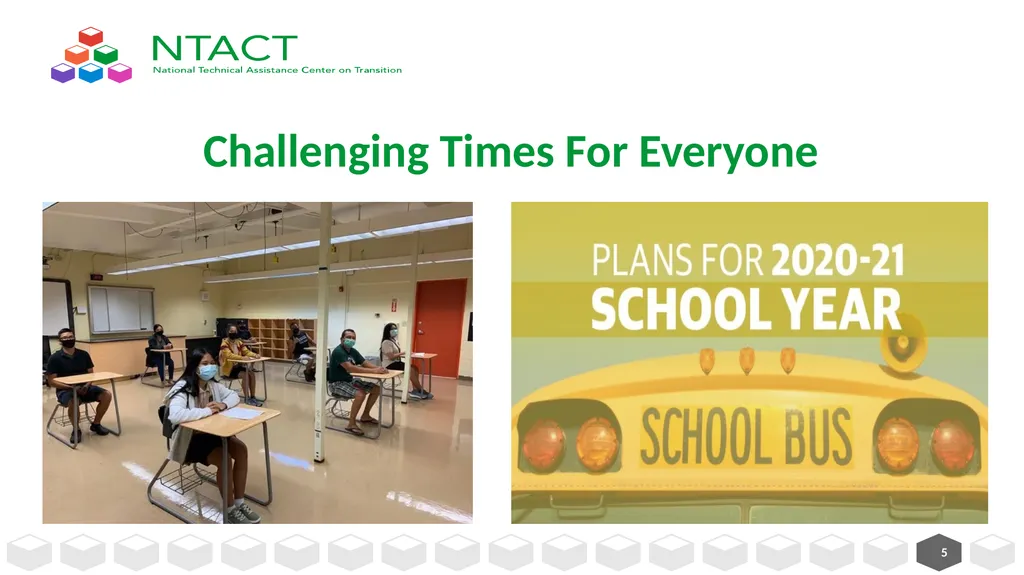
slide5. Challenging Times For Everyone 5<br>
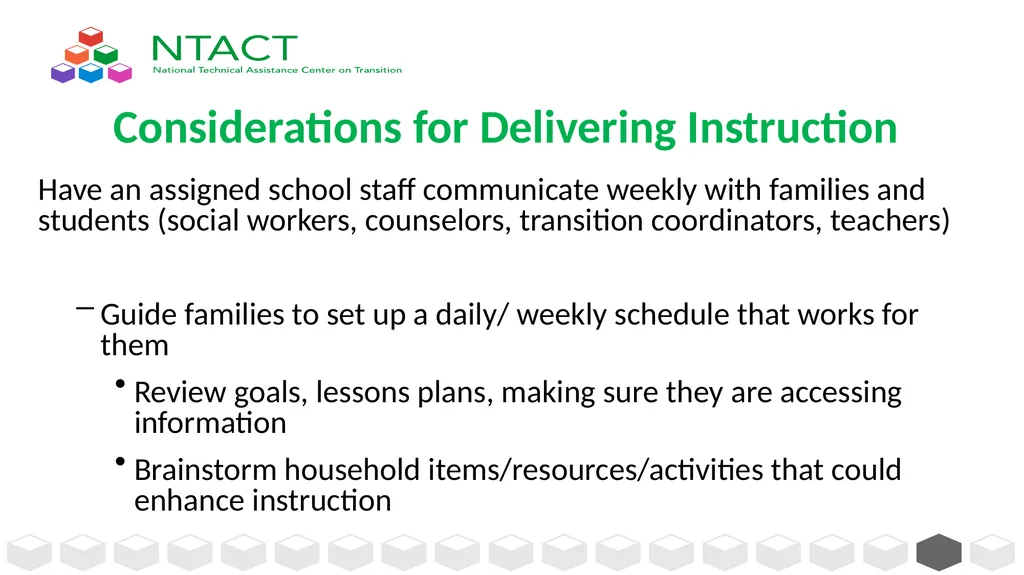
slide6. Considerations for Delivering Instruction Have an assigned school staff communicate weekly with families and students (social workers, counselors, transition coordinators, teachers)
Guide families to set up a daily/ weekly schedule that works for them
Review goals, lessons plans, making sure they are accessing information
Brainstorm household items/resources/activities that could enhance instruction<br>
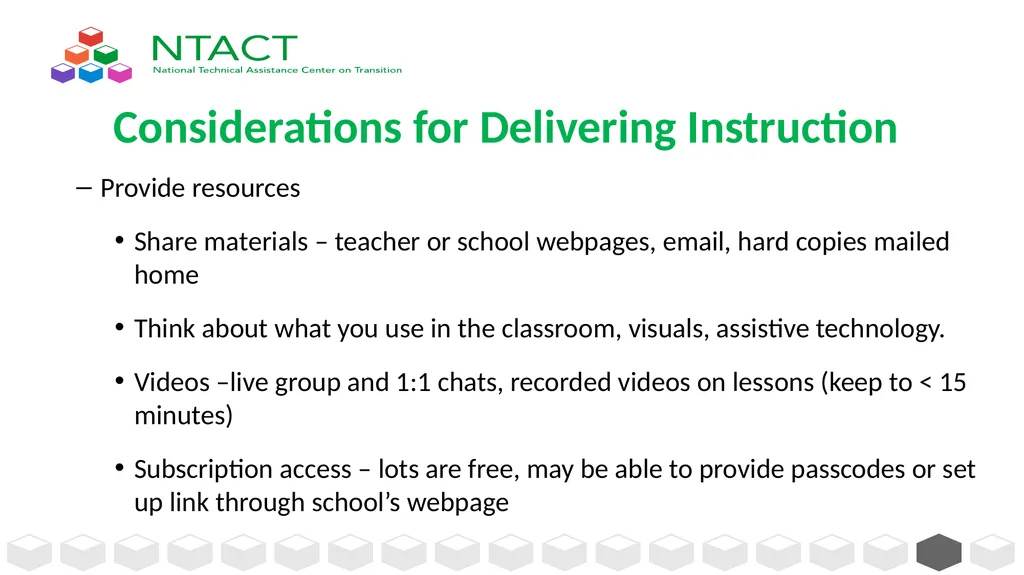
slide7. Considerations for Delivering Instruction Provide resources
Share materials – teacher or school webpages, email, hard copies mailed home
Think about what you use in the classroom, visuals, assistive technology.
Videos –live group and 1:1 chats, recorded videos on lessons (keep to < 15 minutes)
Subscription access – lots are free, may be able to provide passcodes or set up link through school’s webpage<br>
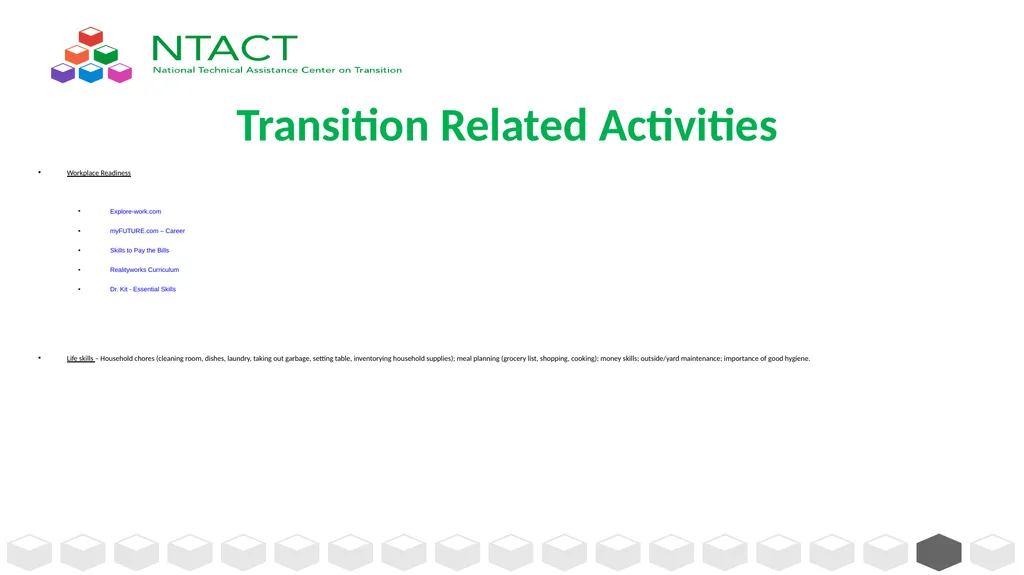
slide8. Transition Related Activities Workplace Readiness
Explore-work.com
myFUTURE.com – Career
Skills to Pay the Bills
Realityworks Curriculum
Dr. Kit - Essential Skills
Life skills – Household chores (cleaning room, dishes, laundry, taking out garbage, setting table, inventorying household supplies); meal planning (grocery list, shopping, cooking); money skills; outside/yard maintenance; importance of good hygiene.<br>
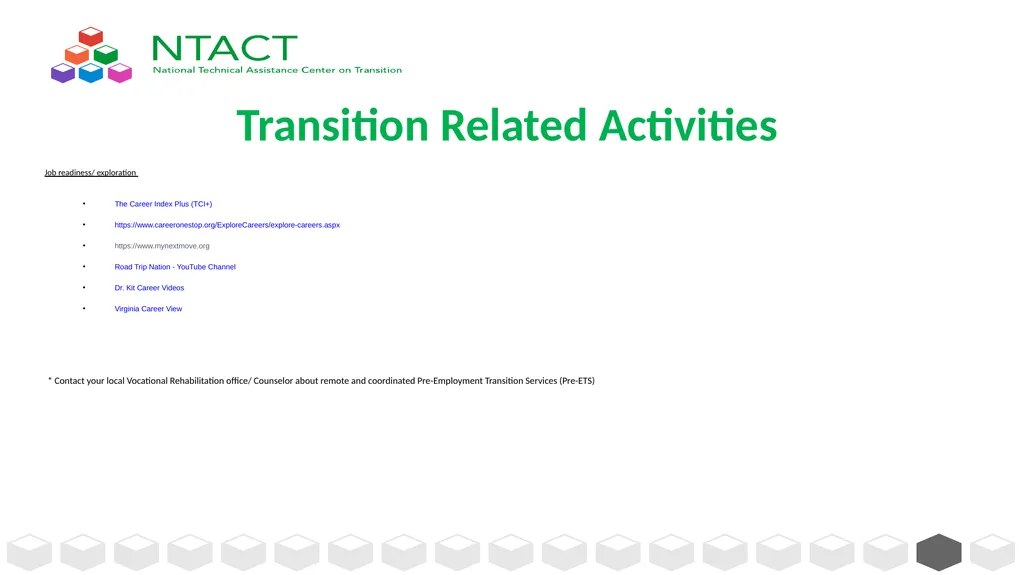
slide9. Transition Related Activities Job readiness/ exploration
The Career Index Plus (TCI+)
https://www.careeronestop.org/ExploreCareers/explore-careers.aspx
https://www.mynextmove.org
Road Trip Nation - YouTube Channel
Dr. Kit Career Videos
Virginia Career View
* Contact your local Vocational Rehabilitation office/ Counselor about remote and coordinated Pre-Employment Transition Services (Pre-ETS)<br>
slide10. Transition Related Activities Transition Assessments – Student and parent transition surveys many on-line assessments of self- determination, career interests and strengths, etc.
Transition Assessment Matrix
www.transitioncoalition.org
Personal Preference Indicators: A Guide for Planning
Life Course Framework
I’m Determined.org
Social Skills - practice using various media to keep in contact with family and friends – phone calls, text, FaceTime, social media (safely), Zoom, etc.<br>
slide11. Transition Related Activities Even though this is a challenging time, this can be an opportune time for in-depth, person-centered transition planning with students, their families, and other IEP team members.
Discuss what a meaningful day / week will look like
Work, learn, play, and healthy living
Discuss what supports the student/family will need post-school
Discover agency linkages the student/family may need<br>
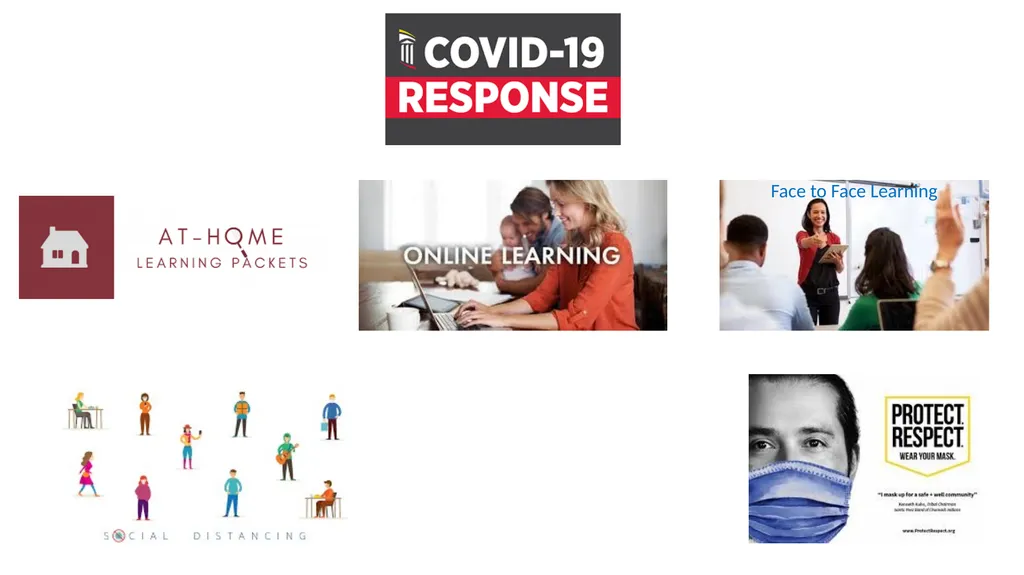
slide12. Face to Face Learning<br>
slide13. Ultimately take care of yourself and your family
These are difficult times - take time to breathe and
think about doing what is appropriate and reasonable for your
students and/or sons and daughters and yourself given your
time and environment
Engage the youth as much as possible in decision making
Keep track of what you are doing (documentation)
Provide a routine or schedule for learning
When possible, coordinate with other school/agency personnel Reminders 13<br>
slide14. IEP Considerations for 2020-21 School Year An IEP is a legally binding document updated annually that describes an offer of FAPE to a student with a disability
It may be necessary to convene a meeting to update the IEP with a temporary plan that outlines the extent to which IEP services and accommodations must be delivered differently due to emergency health and safety restrictions related to COVID-19.
Indicate the instructional model the student will participate in
At home learning packets (paper based hard copy curriculum)
At home learning - Online/virtual learning
Face to face learning for part of the week with at home assignments for the days the students are not in physical attendance<br>
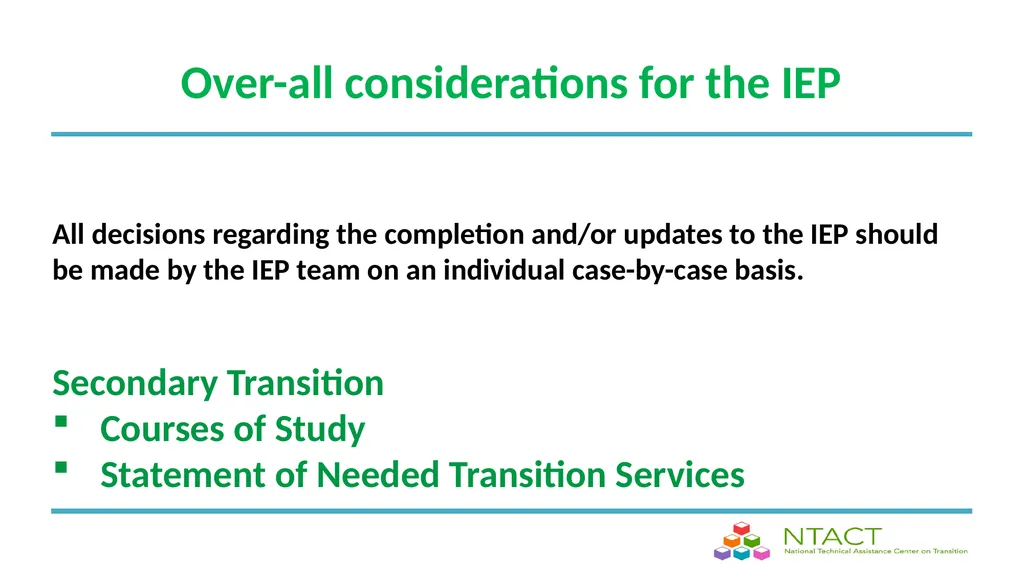
slide15. Over-all considerations for the IEP All decisions regarding the completion and/or updates to the IEP should be made by the IEP team on an individual case-by-case basis.
Present Levels of Academic Achievement and Functional Performance (PLAAFP)<br>
slide16. PLAAFP It is impossible to write clear and measurable annual goals if you don’t have clear and measurable present levels of academic achievement and functional performance. 16<br>
slide17. PLAAFP Reflects and indicates the instructional model the student will participate
Succinctly describes the student
Describe instructional level versus grade level expectations
Refer to summative, formative, benchmark assessments (and diagnostic as appropriate)
Directly relate to assessments and evaluation information
Provide information on student’s rate of progress
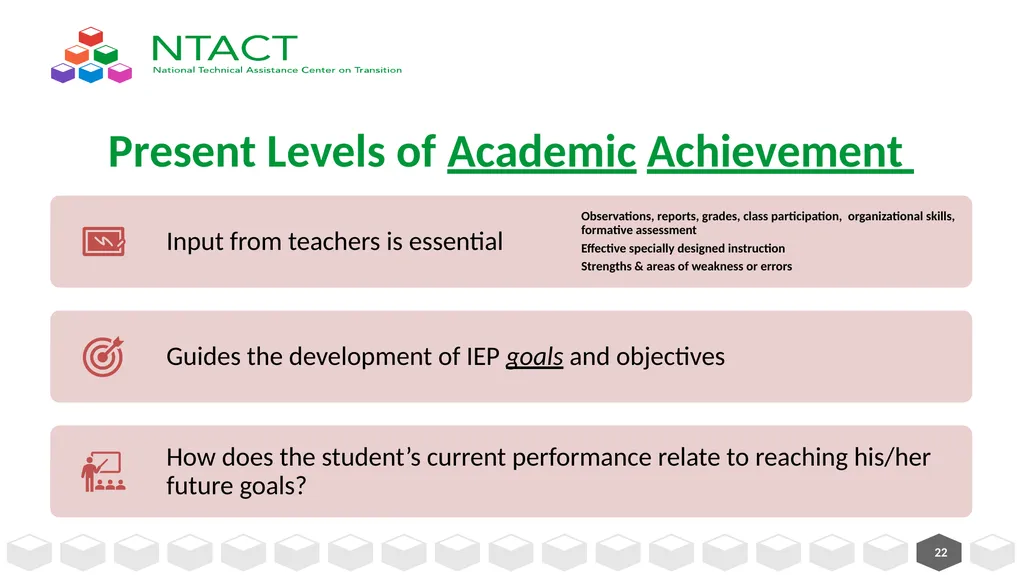
Guide the development of IEP goals and objectives<br>
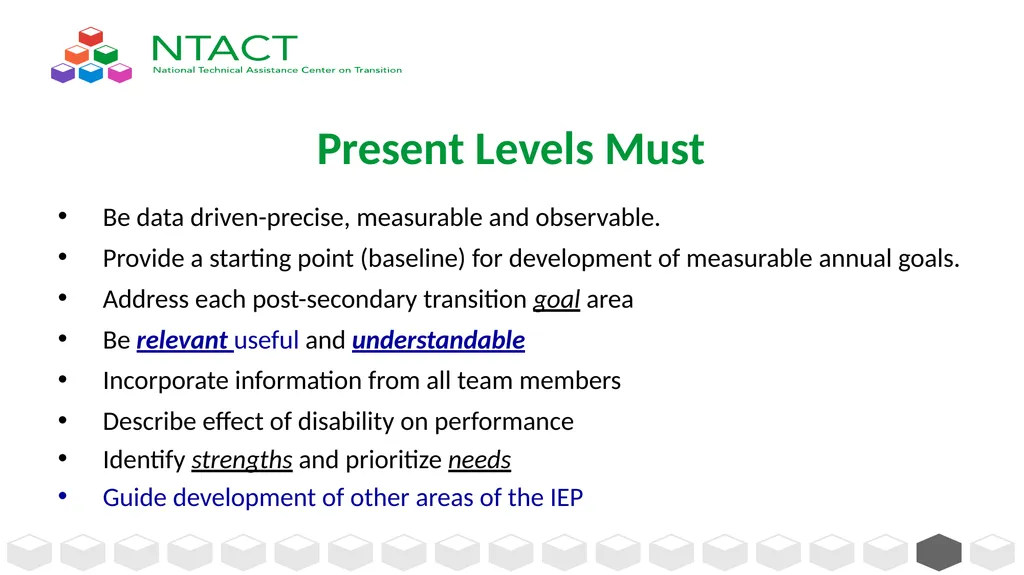
slide18. Present Levels Must Be data driven-precise, measurable and observable.
Provide a starting point (baseline) for development of measurable annual goals.
Address each post-secondary transition goal area
Be relevant useful and understandable
Incorporate information from all team members
Describe effect of disability on performance
Identify strengths and prioritize needs
Guide development of other areas of the IEP<br>
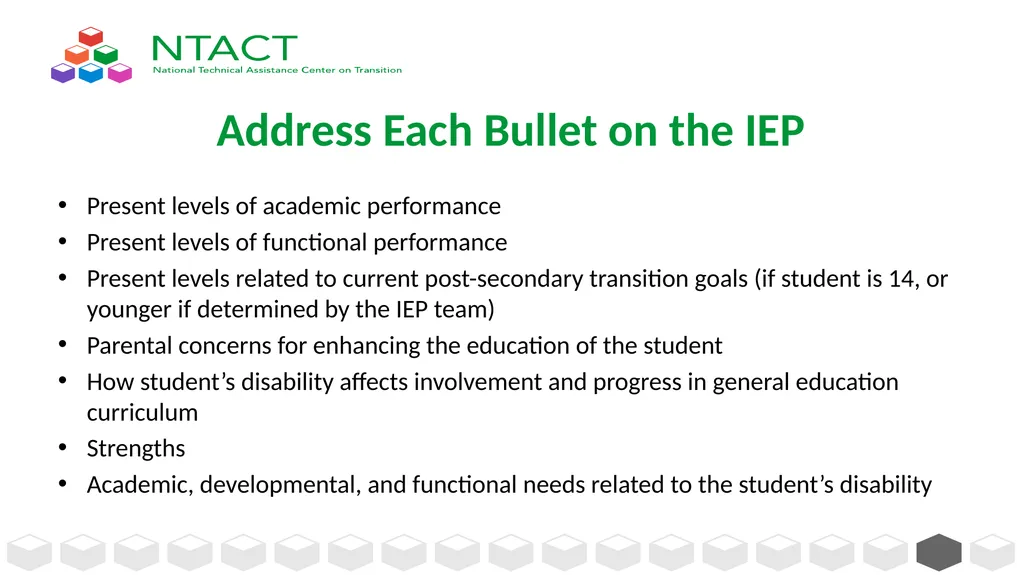
slide19. Address Each Bullet on the IEP Present levels of academic performance
Present levels of functional performance
Present levels related to current post-secondary transition goals (if student is 14, or younger if determined by the IEP team)
Parental concerns for enhancing the education of the student
How student’s disability affects involvement and progress in general education curriculum
Strengths
Academic, developmental, and functional needs related to the student’s disability<br>
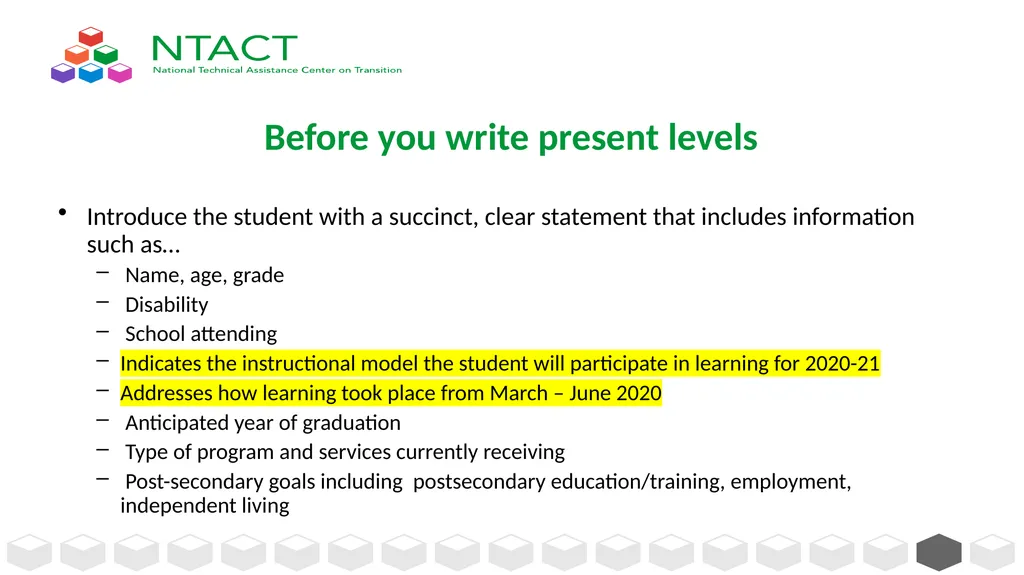
slide20. Before you write present levels Introduce the student with a succinct, clear statement that includes information such as…
Name, age, grade
Disability
School attending
Indicates the instructional model the student will participate in learning for 2020-21
Addresses how learning took place from March – June 2020
Anticipated year of graduation
Type of program and services currently receiving
Post-secondary goals including postsecondary education/training, employment, independent living<br>
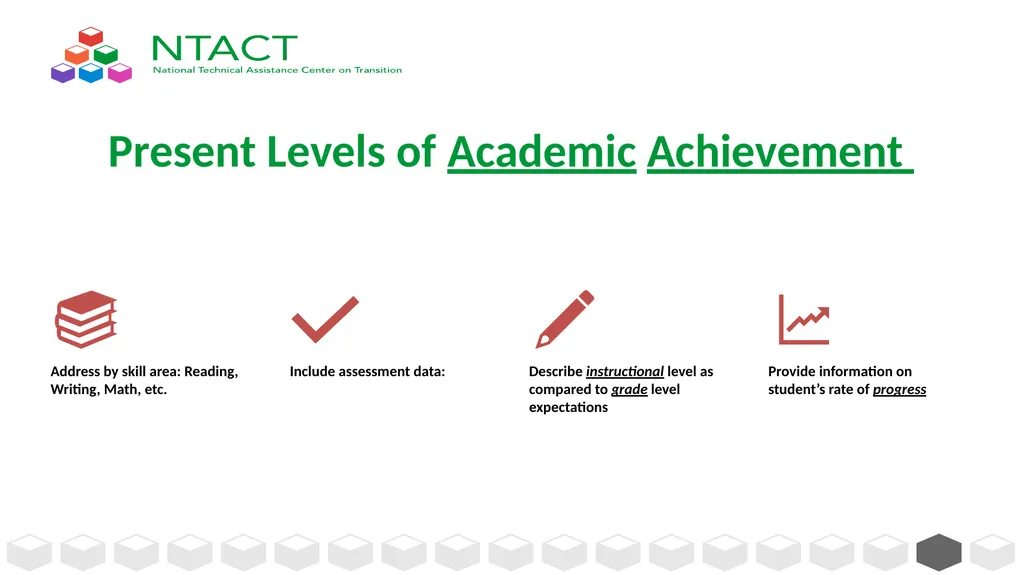
slide21. Present Levels of Academic Achievement<br>
slide22. Present Levels of Academic Achievement 22<br>
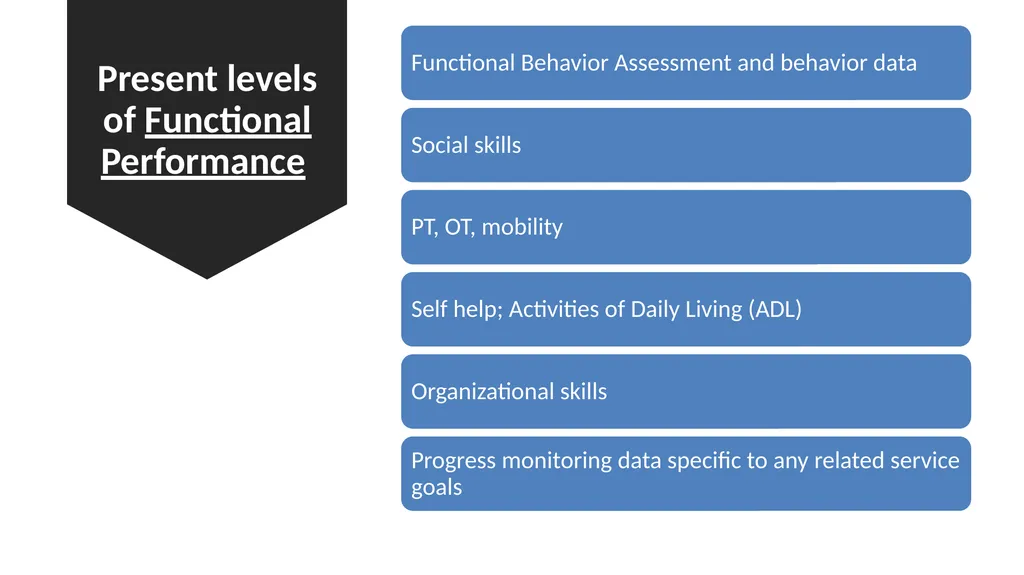
slide23. Present levels of Functional Performance 23<br>
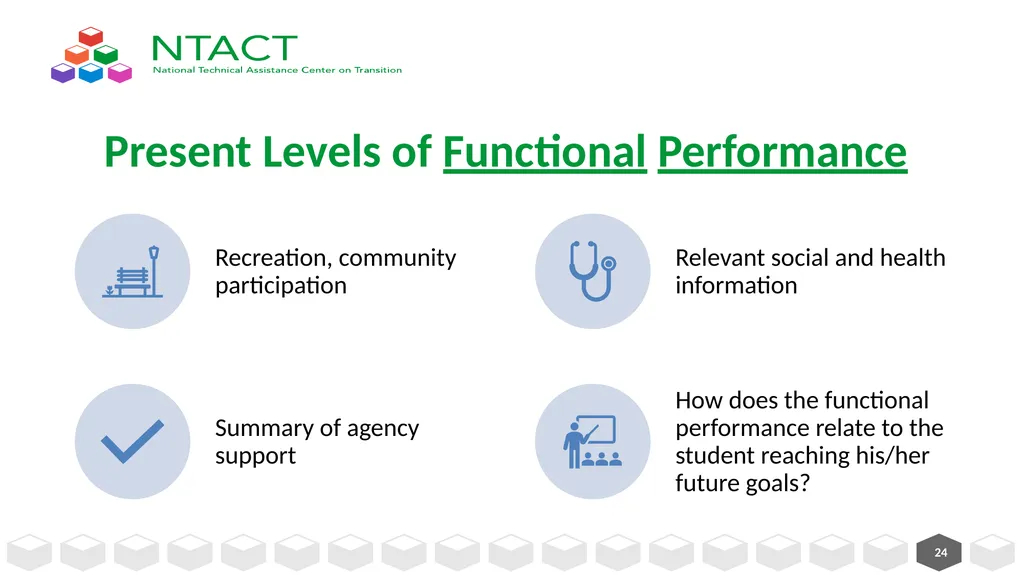
slide24. Present Levels of Functional Performance 24<br>
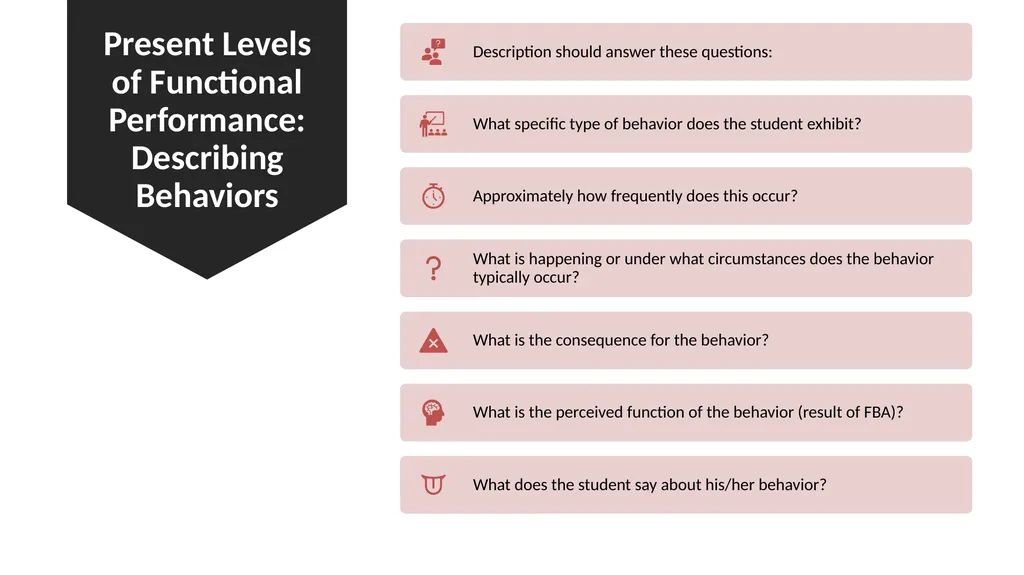
slide25. Present Levels of Functional Performance: Describing Behaviors 25<br>
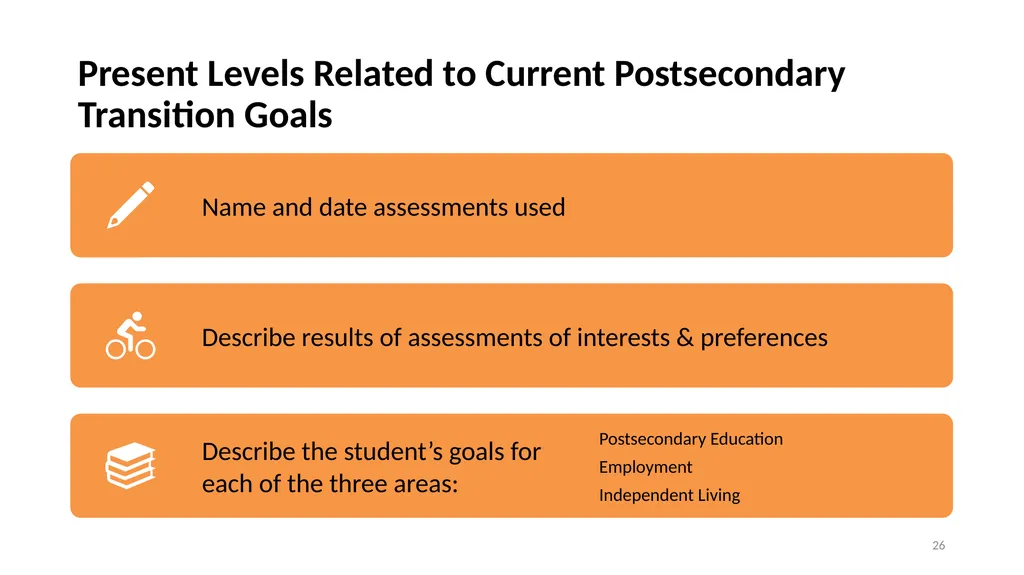
slide26. Present Levels Related to Current Postsecondary Transition Goals 26<br>
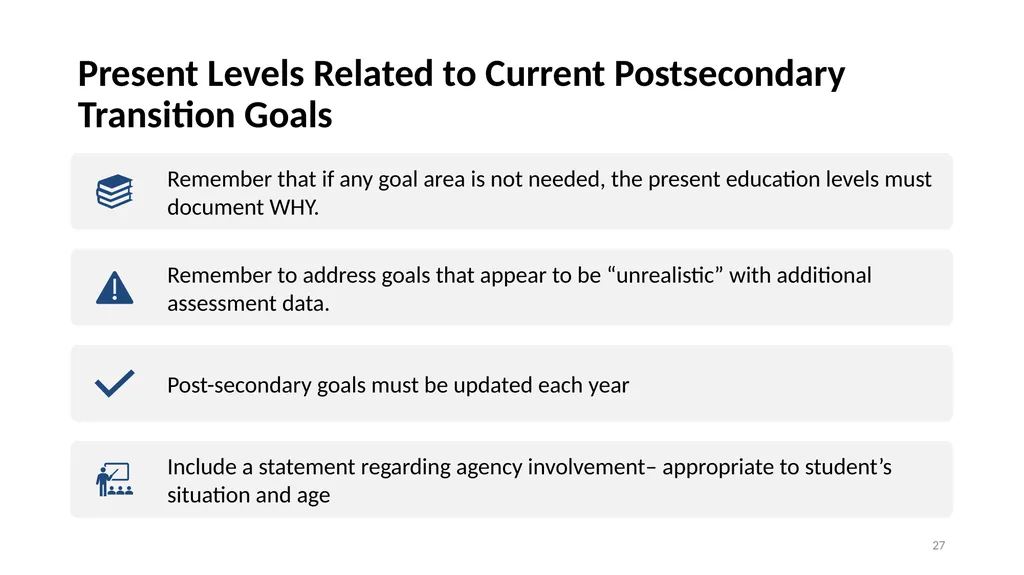
slide27. Present Levels Related to Current Postsecondary Transition Goals 27<br>
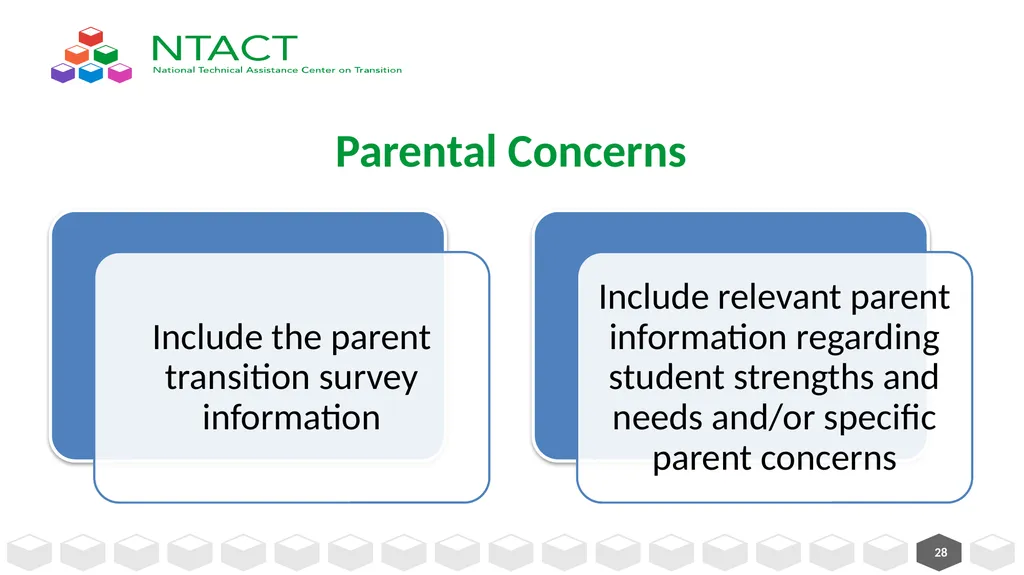
slide28. Parental Concerns 28<br>
slide29. How the student’s disability affects involvement and progress in the general education curriculum How does the information presented in the previous sections impact the student’s ability to be successful in the curriculum?
How might the disability affect the student’s ability to be successful in his/her post-secondary goals?<br>
slide30. Strengths 30<br>
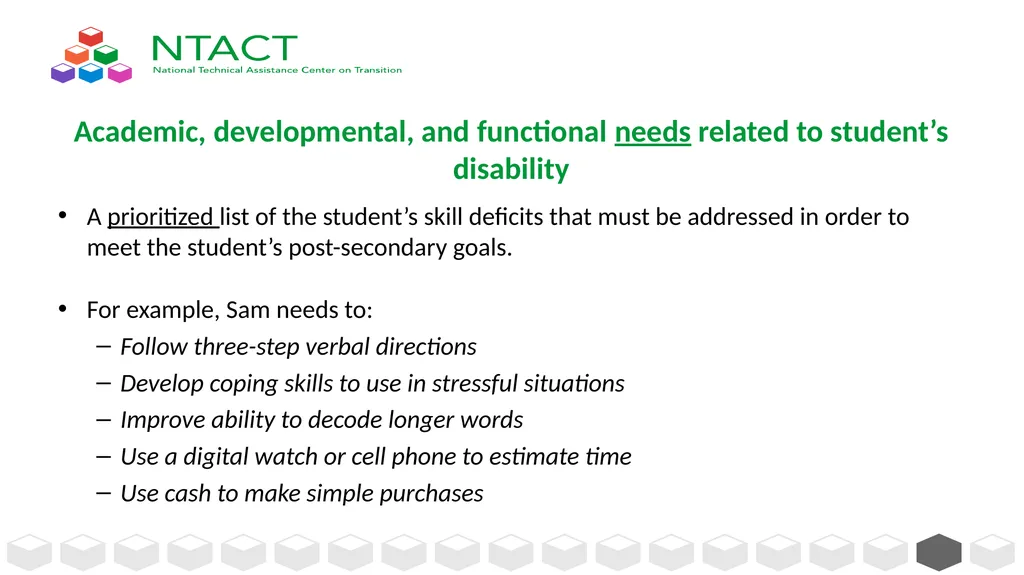
slide31. Academic, developmental, and functional needs related to student’s disability A prioritized list of the student’s skill deficits that must be addressed in order to meet the student’s post-secondary goals.
For example, Sam needs to:
Follow three-step verbal directions
Develop coping skills to use in stressful situations
Improve ability to decode longer words
Use a digital watch or cell phone to estimate time
Use cash to make simple purchases<br>
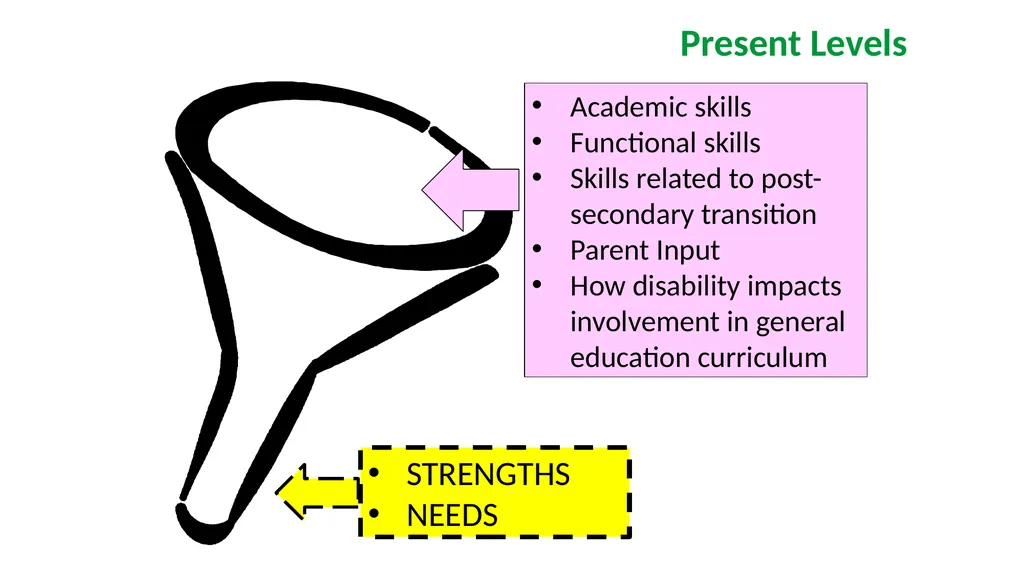
slide32. Academic skills
Functional skills
Skills related to post-secondary transition
Parent Input
How disability impacts involvement in general education curriculum Present Levels STRENGTHS
NEEDS<br>
slide33. All needs must be met through: Measurable annual goals (MAG)
Transition activities
Specially designed instruction (SDI)
Related service<br>
slide34. Stop – Think - Consider How do you see the PLAAFP impacted by:
At home learning packets (paper based hard copy curriculum)
At home learning - Online/virtual learning
Face to face learning for part of the week with at home assignments for the days the students are not in physical attendance 34<br>
slide35. Over-all considerations for the IEP All decisions regarding the completion and/or updates to the IEP should be made by the IEP team on an individual case-by-case basis.
Measurable Annual Goals<br>
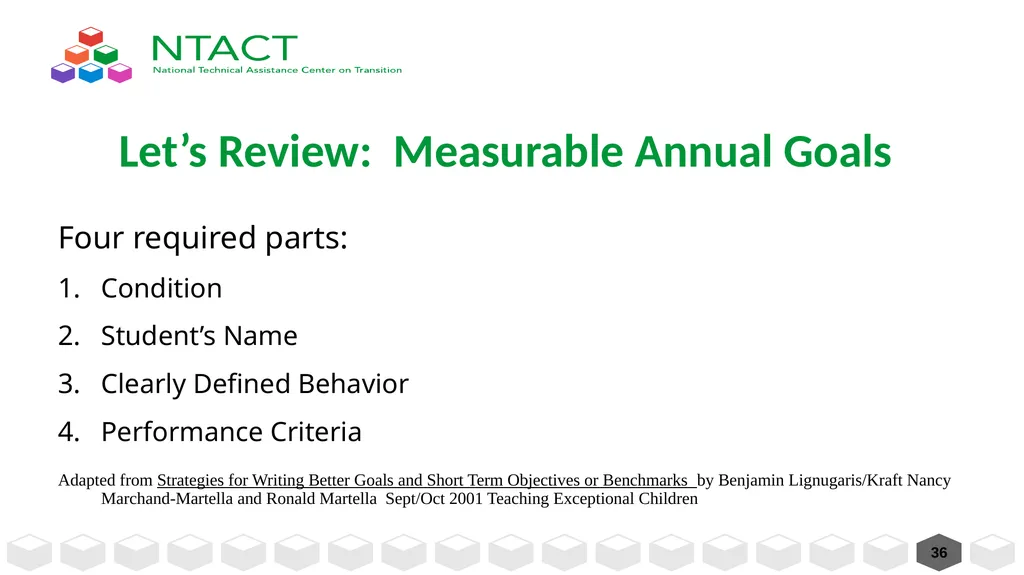
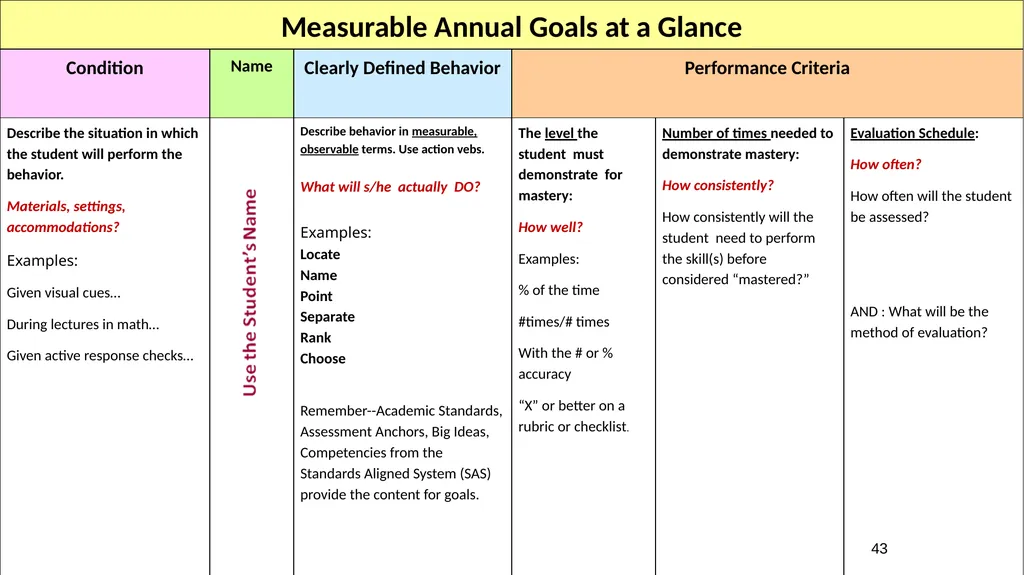
slide36. Let’s Review: Measurable Annual Goals Four required parts:
Condition
Student’s Name
Clearly Defined Behavior
Performance Criteria
Adapted from Strategies for Writing Better Goals and Short Term Objectives or Benchmarks by Benjamin Lignugaris/Kraft Nancy Marchand-Martella and Ronald Martella Sept/Oct 2001 Teaching Exceptional Children 36<br>
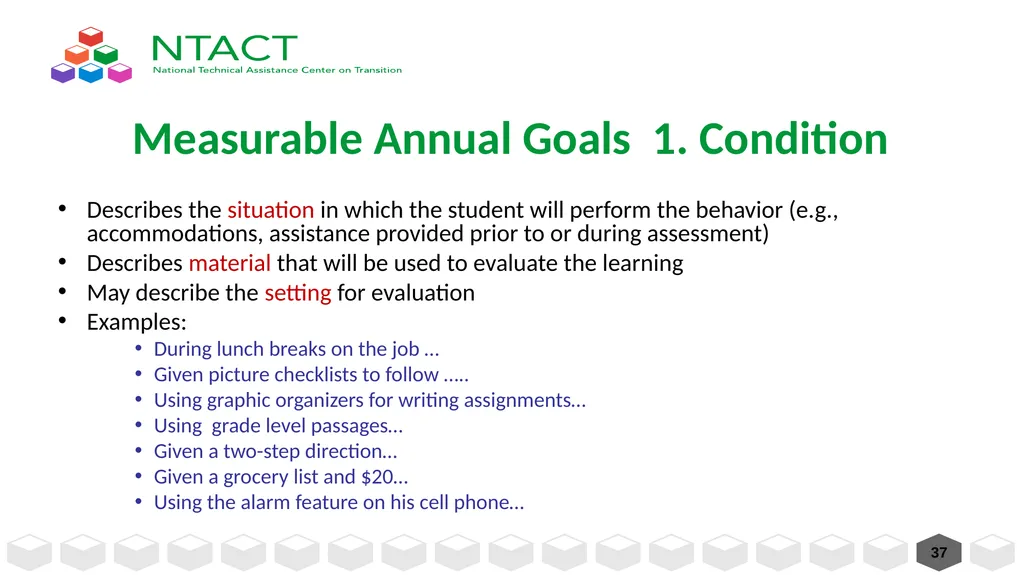
slide37. Measurable Annual Goals 1. Condition Describes the situation in which the student will perform the behavior (e.g., accommodations, assistance provided prior to or during assessment)
Describes material that will be used to evaluate the learning
May describe the setting for evaluation
Examples:
During lunch breaks on the job …
Given picture checklists to follow …..
Using graphic organizers for writing assignments…
Using grade level passages…
Given a two-step direction…
Given a grocery list and $20…
Using the alarm feature on his cell phone… 37<br>
slide38. Measurable Annual Goals 2. Student Name Should not be a problem!
Caution if using “copy/paste”
Names
Pronouns (she/he and him/her) 38<br>
slide39. Measurable Annual Goals 3. Clearly Defined Behavior Use State Academic Standards as basis
Describe the behavior in measurable, observable terms
Ask yourself…what will the student actually DO?
Examples:
Say, print, write, read orally, point to, solve…
Non-examples:
Understand, know, recognize, behave, comprehend, improve… 39<br>
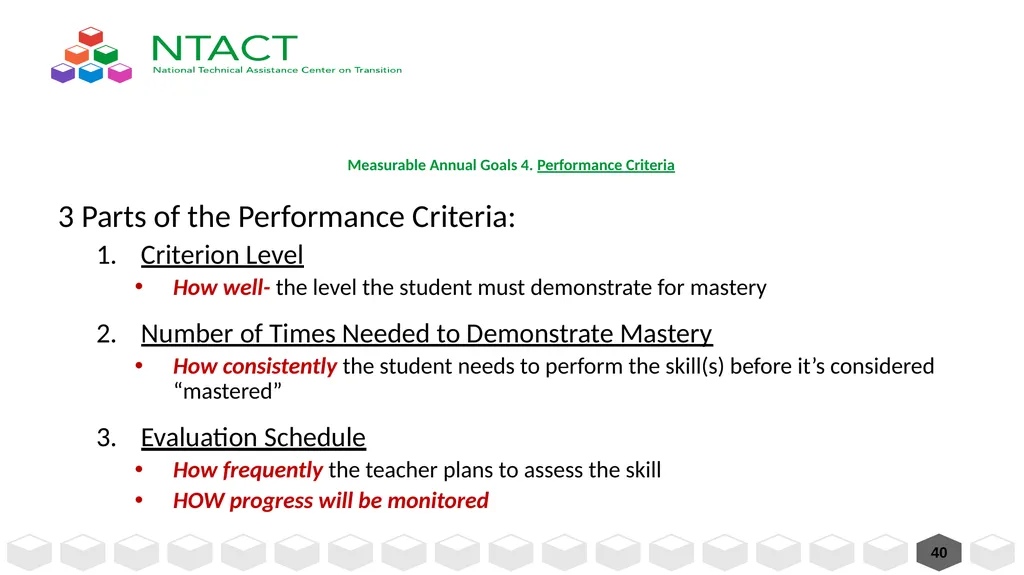
slide40. Measurable Annual Goals 4. Performance Criteria 3 Parts of the Performance Criteria:
Criterion Level
How well- the level the student must demonstrate for mastery
Number of Times Needed to Demonstrate Mastery
How consistently the student needs to perform the skill(s) before it’s considered “mastered”
Evaluation Schedule
How frequently the teacher plans to assess the skill
HOW progress will be monitored 40<br>
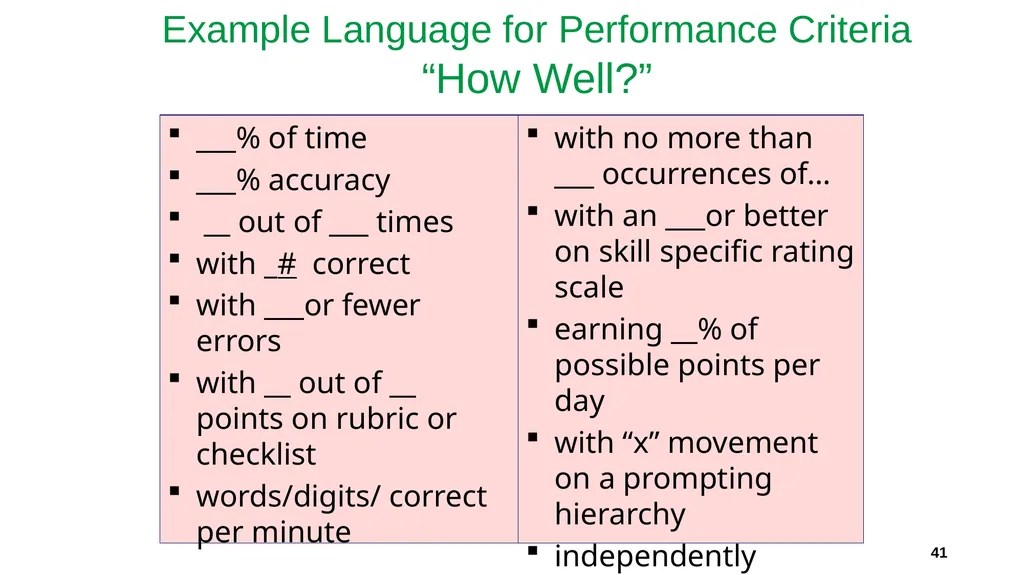
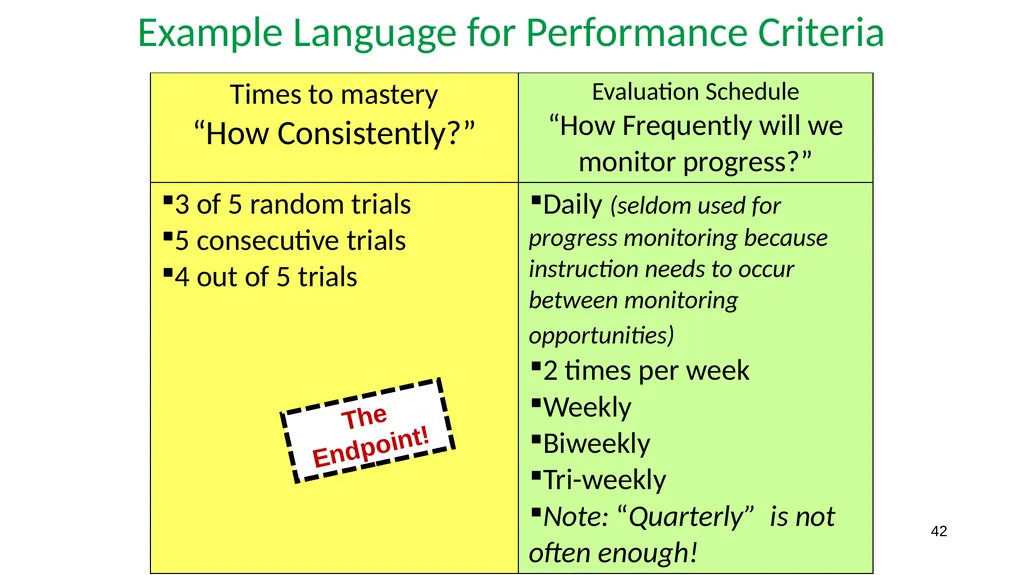
slide41. Example Language for Performance Criteria
“How Well?” ___% of time
___% accuracy
__ out of ___ times
with _# correct
with ___or fewer errors
with __ out of __ points on rubric or checklist
words/digits/ correct per minute with no more than ___ occurrences of…
with an ___or better on skill specific rating scale
earning __% of possible points per day
with “x” movement on a prompting hierarchy
independently 41<br>
slide42. Example Language for Performance Criteria 42 The Endpoint!<br>
slide43. 43<br>
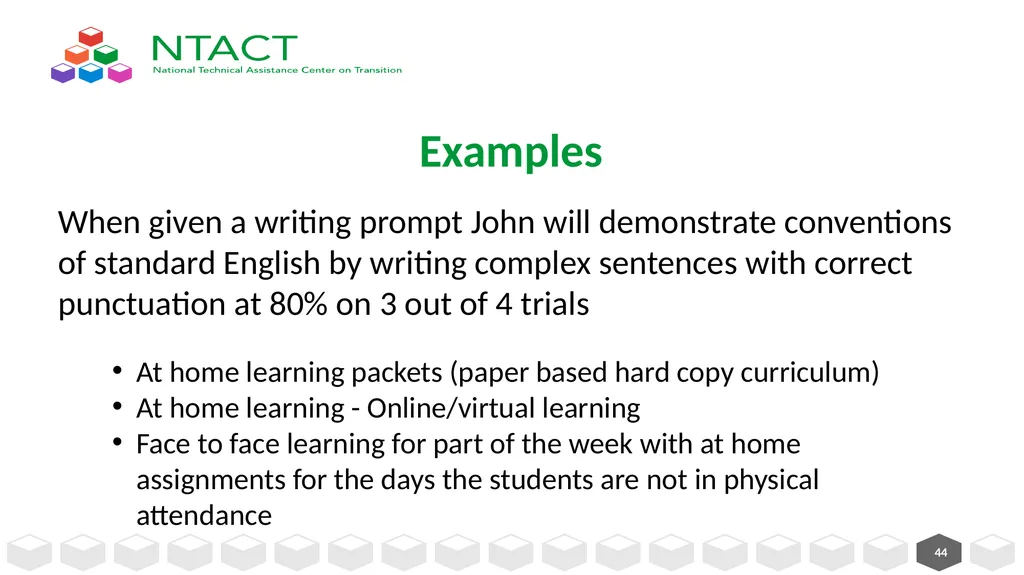
slide44. Examples When given a writing prompt John will demonstrate conventions of standard English by writing complex sentences with correct punctuation at 80% on 3 out of 4 trials 44 At home learning packets (paper based hard copy curriculum)
At home learning - Online/virtual learning
Face to face learning for part of the week with at home assignments for the days the students are not in physical attendance<br>
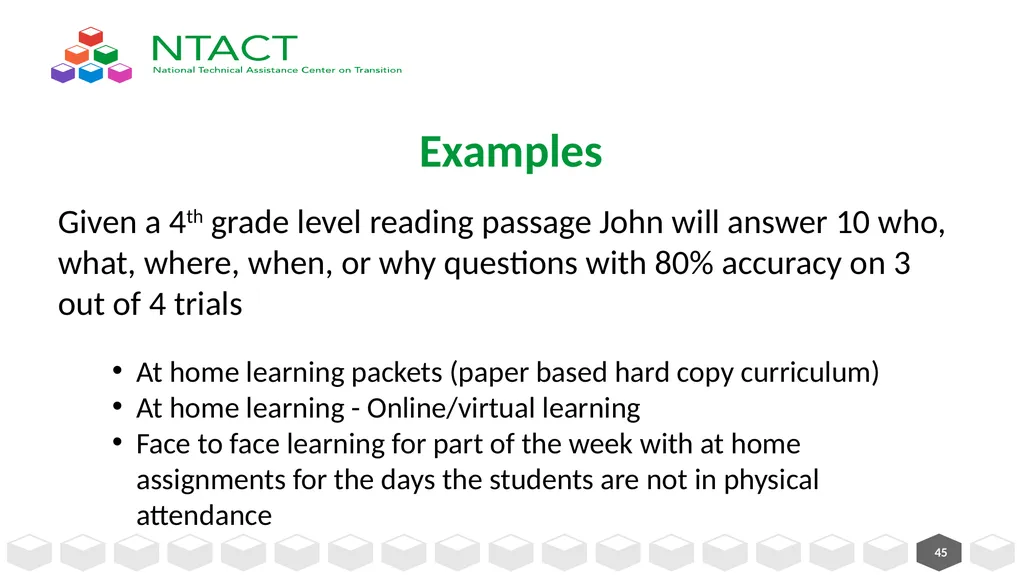
slide45. Examples Given a 4th grade level reading passage John will answer 10 who, what, where, when, or why questions with 80% accuracy on 3 out of 4 trials 45 At home learning packets (paper based hard copy curriculum)
At home learning - Online/virtual learning
Face to face learning for part of the week with at home assignments for the days the students are not in physical attendance<br>
slide46. Examples When given 10, 2 step word problems involving addition and subtraction John will draw a model or use manipulatives to solve the problems with 75% on 3 out of 4 trials 46 At home learning packets (paper based hard copy curriculum)
At home learning - Online/virtual learning
Face to face learning for part of the week with at home assignments for the days the students are not in physical attendance<br>
slide47. Examples With guidance and prompting from teacher/school staff, John will sit at his seat and remain on task until task completion with 3 out of 5 prompts for redirection 47 At home learning packets (paper based hard copy curriculum)
At home learning - Online/virtual learning
Face to face learning for part of the week with at home assignments for the days the students are not in physical attendance<br>
slide48. Examples With guidance and redirection from teachers and staff John will come to class on time with 3 or less prompts for all academic classes with 80% consistency for 4 out of 5 school days. 48 At home learning packets (paper based hard copy curriculum)
At home learning - Online/virtual learning
Face to face learning for part of the week with at home assignments for the days the students are not in physical attendance<br>
slide49. Discussion How do you see Measurable Annual Goals impacted by:
At home learning packets (paper based hard copy curriculum)
At home learning - Online/virtual learning
Face to face learning for part of the week with at home assignments for the days the students are not in physical attendance 49<br>
slide50. Over-all considerations for the IEP All decisions regarding the completion and/or updates to the IEP should be made by the IEP team on an individual case-by-case basis.
Secondary Transition
Courses of Study
Statement of Needed Transition Services<br>
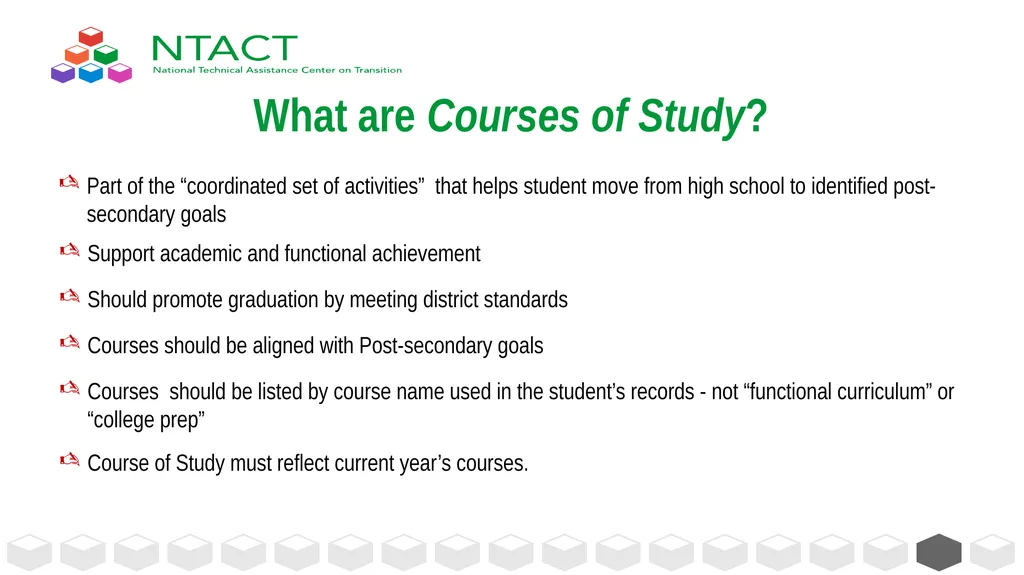
slide51. What are Courses of Study? Part of the “coordinated set of activities” that helps student move from high school to identified post-secondary goals Support academic and functional achievement
Should promote graduation by meeting district standards
Courses should be aligned with Post-secondary goals
Courses should be listed by course name used in the student’s records - not “functional curriculum” or “college prep”
Course of Study must reflect current year’s courses.<br>
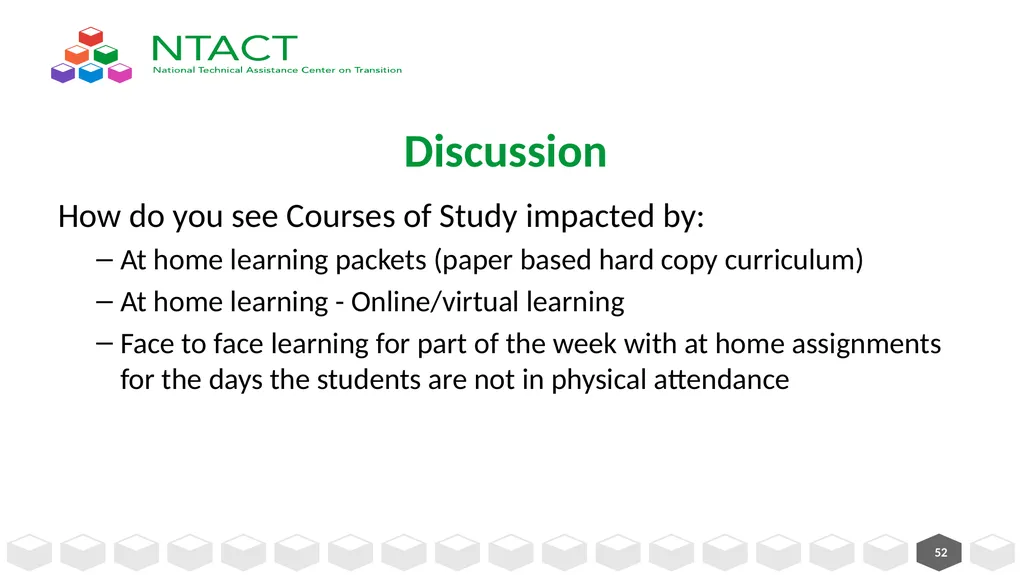
slide52. Discussion How do you see Courses of Study impacted by:
At home learning packets (paper based hard copy curriculum)
At home learning - Online/virtual learning
Face to face learning for part of the week with at home assignments for the days the students are not in physical attendance 52<br>
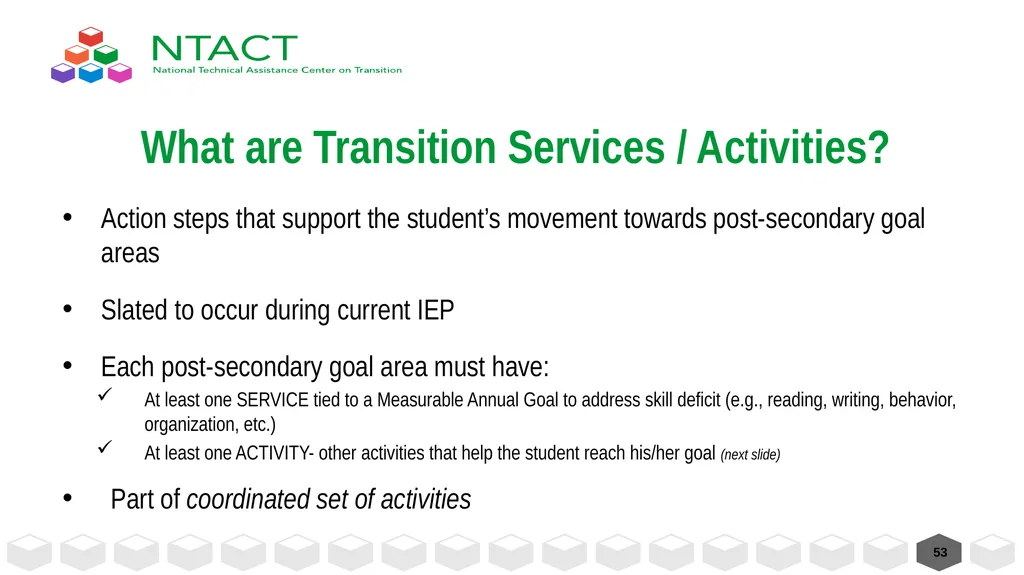
slide53. What are Transition Services / Activities? Action steps that support the student’s movement towards post-secondary goal areas
Slated to occur during current IEP
Each post-secondary goal area must have:
At least one SERVICE tied to a Measurable Annual Goal to address skill deficit (e.g., reading, writing, behavior, organization, etc.)
At least one ACTIVITY- other activities that help the student reach his/her goal (next slide)
Part of coordinated set of activities 53<br>
slide54. Post-Secondary Education/ Training: Examples of Activities Explore post-secondary programs
College fairs
“Virtual tours”
Guest speakers
College visits
Learn about accommodations
Contact Disability Services Office
Information on registration for SAT
Time management
Practice disability disclosure<br>
slide55. Employment: Examples of Activities Career exploration
Visit / tour CTC
Career portfolio
Job fairs
Guest speakers
Community visits/ field trips
Research paper on a career of interest
Review employment ads
Community service Job shadowing
Resume writing
Graduation project
Group meeting with VR
Military visits / Jr. ROTC
Work experience
Explore Job Accommodations Network<br>
slide56. Independent Living: Examples of Activities Clubs (socialization and participation)
Shopping
Family and Consumer Science activities
Budgeting skills
Food preparation
Checking listings for apartments
Visiting community recreational facilities
Open case with agency
Obtain bus pass 56<br>
slide57. Discussion How do you see transition activities impacted by:
At home learning packets (paper based hard copy curriculum)
At home learning - Online/virtual learning
Face to face learning for part of the week with at home assignments for the days the students are not in physical attendance 57<br>
slide58. Checklist Considerations The following three checklist are being provided as a quick check guide for administrator or self-check review:
Present Levels Considerations
Measurable Annual Goals Considerations
Secondary Transition Considerations 58<br>
slide59. Key Points to Remember Don’t feel you can do everything!
We are all in this unprecedented time together
Communication
Reaching out to your students and their families – checking in regularly goes a long way!!!
Asking them what they need most from you.
Asking what are their resources to providing instruction at home virtually that are reasonable and reliable (internet access, computer – laptop, printer, cell phone, household items)
Touch base with student’s outside school supports – ID/DD and/or MH supports coordinator, VR counselor, in-home support services, post –school placements, etc.<br>
slide60. 60 Graphic of word collage of “thank you” in numerous languages<br>
slide61. Find us, follow us, like and share us Facebook Pinterest Teachers Pay Teachers Twitter Medium #transitionta www.transitionta.org
ntactmail@uncc.edu 61<br>
slide2. How To View This Presentation In a group as part of a school or department
Individually
With and IEP available and using the stop/start feature of the recording play back<br>
slide3. Agenda 3<br>
slide4. Strategies and Reflections for the 2020-21 School Year 4<br>
slide5. Challenging Times For Everyone 5<br>
slide6. Considerations for Delivering Instruction Have an assigned school staff communicate weekly with families and students (social workers, counselors, transition coordinators, teachers)
Guide families to set up a daily/ weekly schedule that works for them
Review goals, lessons plans, making sure they are accessing information
Brainstorm household items/resources/activities that could enhance instruction<br>
slide7. Considerations for Delivering Instruction Provide resources
Share materials – teacher or school webpages, email, hard copies mailed home
Think about what you use in the classroom, visuals, assistive technology.
Videos –live group and 1:1 chats, recorded videos on lessons (keep to < 15 minutes)
Subscription access – lots are free, may be able to provide passcodes or set up link through school’s webpage<br>
slide8. Transition Related Activities Workplace Readiness
Explore-work.com
myFUTURE.com – Career
Skills to Pay the Bills
Realityworks Curriculum
Dr. Kit - Essential Skills
Life skills – Household chores (cleaning room, dishes, laundry, taking out garbage, setting table, inventorying household supplies); meal planning (grocery list, shopping, cooking); money skills; outside/yard maintenance; importance of good hygiene.<br>
slide9. Transition Related Activities Job readiness/ exploration
The Career Index Plus (TCI+)
https://www.careeronestop.org/ExploreCareers/explore-careers.aspx
https://www.mynextmove.org
Road Trip Nation - YouTube Channel
Dr. Kit Career Videos
Virginia Career View
* Contact your local Vocational Rehabilitation office/ Counselor about remote and coordinated Pre-Employment Transition Services (Pre-ETS)<br>
slide10. Transition Related Activities Transition Assessments – Student and parent transition surveys many on-line assessments of self- determination, career interests and strengths, etc.
Transition Assessment Matrix
www.transitioncoalition.org
Personal Preference Indicators: A Guide for Planning
Life Course Framework
I’m Determined.org
Social Skills - practice using various media to keep in contact with family and friends – phone calls, text, FaceTime, social media (safely), Zoom, etc.<br>
slide11. Transition Related Activities Even though this is a challenging time, this can be an opportune time for in-depth, person-centered transition planning with students, their families, and other IEP team members.
Discuss what a meaningful day / week will look like
Work, learn, play, and healthy living
Discuss what supports the student/family will need post-school
Discover agency linkages the student/family may need<br>
slide12. Face to Face Learning<br>
slide13. Ultimately take care of yourself and your family
These are difficult times - take time to breathe and
think about doing what is appropriate and reasonable for your
students and/or sons and daughters and yourself given your
time and environment
Engage the youth as much as possible in decision making
Keep track of what you are doing (documentation)
Provide a routine or schedule for learning
When possible, coordinate with other school/agency personnel Reminders 13<br>
slide14. IEP Considerations for 2020-21 School Year An IEP is a legally binding document updated annually that describes an offer of FAPE to a student with a disability
It may be necessary to convene a meeting to update the IEP with a temporary plan that outlines the extent to which IEP services and accommodations must be delivered differently due to emergency health and safety restrictions related to COVID-19.
Indicate the instructional model the student will participate in
At home learning packets (paper based hard copy curriculum)
At home learning - Online/virtual learning
Face to face learning for part of the week with at home assignments for the days the students are not in physical attendance<br>
slide15. Over-all considerations for the IEP All decisions regarding the completion and/or updates to the IEP should be made by the IEP team on an individual case-by-case basis.
Present Levels of Academic Achievement and Functional Performance (PLAAFP)<br>
slide16. PLAAFP It is impossible to write clear and measurable annual goals if you don’t have clear and measurable present levels of academic achievement and functional performance. 16<br>
slide17. PLAAFP Reflects and indicates the instructional model the student will participate
Succinctly describes the student
Describe instructional level versus grade level expectations
Refer to summative, formative, benchmark assessments (and diagnostic as appropriate)
Directly relate to assessments and evaluation information
Provide information on student’s rate of progress
Guide the development of IEP goals and objectives<br>
slide18. Present Levels Must Be data driven-precise, measurable and observable.
Provide a starting point (baseline) for development of measurable annual goals.
Address each post-secondary transition goal area
Be relevant useful and understandable
Incorporate information from all team members
Describe effect of disability on performance
Identify strengths and prioritize needs
Guide development of other areas of the IEP<br>
slide19. Address Each Bullet on the IEP Present levels of academic performance
Present levels of functional performance
Present levels related to current post-secondary transition goals (if student is 14, or younger if determined by the IEP team)
Parental concerns for enhancing the education of the student
How student’s disability affects involvement and progress in general education curriculum
Strengths
Academic, developmental, and functional needs related to the student’s disability<br>
slide20. Before you write present levels Introduce the student with a succinct, clear statement that includes information such as…
Name, age, grade
Disability
School attending
Indicates the instructional model the student will participate in learning for 2020-21
Addresses how learning took place from March – June 2020
Anticipated year of graduation
Type of program and services currently receiving
Post-secondary goals including postsecondary education/training, employment, independent living<br>
slide21. Present Levels of Academic Achievement<br>
slide22. Present Levels of Academic Achievement 22<br>
slide23. Present levels of Functional Performance 23<br>
slide24. Present Levels of Functional Performance 24<br>
slide25. Present Levels of Functional Performance: Describing Behaviors 25<br>
slide26. Present Levels Related to Current Postsecondary Transition Goals 26<br>
slide27. Present Levels Related to Current Postsecondary Transition Goals 27<br>
slide28. Parental Concerns 28<br>
slide29. How the student’s disability affects involvement and progress in the general education curriculum How does the information presented in the previous sections impact the student’s ability to be successful in the curriculum?
How might the disability affect the student’s ability to be successful in his/her post-secondary goals?<br>
slide30. Strengths 30<br>
slide31. Academic, developmental, and functional needs related to student’s disability A prioritized list of the student’s skill deficits that must be addressed in order to meet the student’s post-secondary goals.
For example, Sam needs to:
Follow three-step verbal directions
Develop coping skills to use in stressful situations
Improve ability to decode longer words
Use a digital watch or cell phone to estimate time
Use cash to make simple purchases<br>
slide32. Academic skills
Functional skills
Skills related to post-secondary transition
Parent Input
How disability impacts involvement in general education curriculum Present Levels STRENGTHS
NEEDS<br>
slide33. All needs must be met through: Measurable annual goals (MAG)
Transition activities
Specially designed instruction (SDI)
Related service<br>
slide34. Stop – Think - Consider How do you see the PLAAFP impacted by:
At home learning packets (paper based hard copy curriculum)
At home learning - Online/virtual learning
Face to face learning for part of the week with at home assignments for the days the students are not in physical attendance 34<br>
slide35. Over-all considerations for the IEP All decisions regarding the completion and/or updates to the IEP should be made by the IEP team on an individual case-by-case basis.
Measurable Annual Goals<br>
slide36. Let’s Review: Measurable Annual Goals Four required parts:
Condition
Student’s Name
Clearly Defined Behavior
Performance Criteria
Adapted from Strategies for Writing Better Goals and Short Term Objectives or Benchmarks by Benjamin Lignugaris/Kraft Nancy Marchand-Martella and Ronald Martella Sept/Oct 2001 Teaching Exceptional Children 36<br>
slide37. Measurable Annual Goals 1. Condition Describes the situation in which the student will perform the behavior (e.g., accommodations, assistance provided prior to or during assessment)
Describes material that will be used to evaluate the learning
May describe the setting for evaluation
Examples:
During lunch breaks on the job …
Given picture checklists to follow …..
Using graphic organizers for writing assignments…
Using grade level passages…
Given a two-step direction…
Given a grocery list and $20…
Using the alarm feature on his cell phone… 37<br>
slide38. Measurable Annual Goals 2. Student Name Should not be a problem!
Caution if using “copy/paste”
Names
Pronouns (she/he and him/her) 38<br>
slide39. Measurable Annual Goals 3. Clearly Defined Behavior Use State Academic Standards as basis
Describe the behavior in measurable, observable terms
Ask yourself…what will the student actually DO?
Examples:
Say, print, write, read orally, point to, solve…
Non-examples:
Understand, know, recognize, behave, comprehend, improve… 39<br>
slide40. Measurable Annual Goals 4. Performance Criteria 3 Parts of the Performance Criteria:
Criterion Level
How well- the level the student must demonstrate for mastery
Number of Times Needed to Demonstrate Mastery
How consistently the student needs to perform the skill(s) before it’s considered “mastered”
Evaluation Schedule
How frequently the teacher plans to assess the skill
HOW progress will be monitored 40<br>
slide41. Example Language for Performance Criteria
“How Well?” ___% of time
___% accuracy
__ out of ___ times
with _# correct
with ___or fewer errors
with __ out of __ points on rubric or checklist
words/digits/ correct per minute with no more than ___ occurrences of…
with an ___or better on skill specific rating scale
earning __% of possible points per day
with “x” movement on a prompting hierarchy
independently 41<br>
slide42. Example Language for Performance Criteria 42 The Endpoint!<br>
slide43. 43<br>
slide44. Examples When given a writing prompt John will demonstrate conventions of standard English by writing complex sentences with correct punctuation at 80% on 3 out of 4 trials 44 At home learning packets (paper based hard copy curriculum)
At home learning - Online/virtual learning
Face to face learning for part of the week with at home assignments for the days the students are not in physical attendance<br>
slide45. Examples Given a 4th grade level reading passage John will answer 10 who, what, where, when, or why questions with 80% accuracy on 3 out of 4 trials 45 At home learning packets (paper based hard copy curriculum)
At home learning - Online/virtual learning
Face to face learning for part of the week with at home assignments for the days the students are not in physical attendance<br>
slide46. Examples When given 10, 2 step word problems involving addition and subtraction John will draw a model or use manipulatives to solve the problems with 75% on 3 out of 4 trials 46 At home learning packets (paper based hard copy curriculum)
At home learning - Online/virtual learning
Face to face learning for part of the week with at home assignments for the days the students are not in physical attendance<br>
slide47. Examples With guidance and prompting from teacher/school staff, John will sit at his seat and remain on task until task completion with 3 out of 5 prompts for redirection 47 At home learning packets (paper based hard copy curriculum)
At home learning - Online/virtual learning
Face to face learning for part of the week with at home assignments for the days the students are not in physical attendance<br>
slide48. Examples With guidance and redirection from teachers and staff John will come to class on time with 3 or less prompts for all academic classes with 80% consistency for 4 out of 5 school days. 48 At home learning packets (paper based hard copy curriculum)
At home learning - Online/virtual learning
Face to face learning for part of the week with at home assignments for the days the students are not in physical attendance<br>
slide49. Discussion How do you see Measurable Annual Goals impacted by:
At home learning packets (paper based hard copy curriculum)
At home learning - Online/virtual learning
Face to face learning for part of the week with at home assignments for the days the students are not in physical attendance 49<br>
slide50. Over-all considerations for the IEP All decisions regarding the completion and/or updates to the IEP should be made by the IEP team on an individual case-by-case basis.
Secondary Transition
Courses of Study
Statement of Needed Transition Services<br>
slide51. What are Courses of Study? Part of the “coordinated set of activities” that helps student move from high school to identified post-secondary goals Support academic and functional achievement
Should promote graduation by meeting district standards
Courses should be aligned with Post-secondary goals
Courses should be listed by course name used in the student’s records - not “functional curriculum” or “college prep”
Course of Study must reflect current year’s courses.<br>
slide52. Discussion How do you see Courses of Study impacted by:
At home learning packets (paper based hard copy curriculum)
At home learning - Online/virtual learning
Face to face learning for part of the week with at home assignments for the days the students are not in physical attendance 52<br>
slide53. What are Transition Services / Activities? Action steps that support the student’s movement towards post-secondary goal areas
Slated to occur during current IEP
Each post-secondary goal area must have:
At least one SERVICE tied to a Measurable Annual Goal to address skill deficit (e.g., reading, writing, behavior, organization, etc.)
At least one ACTIVITY- other activities that help the student reach his/her goal (next slide)
Part of coordinated set of activities 53<br>
slide54. Post-Secondary Education/ Training: Examples of Activities Explore post-secondary programs
College fairs
“Virtual tours”
Guest speakers
College visits
Learn about accommodations
Contact Disability Services Office
Information on registration for SAT
Time management
Practice disability disclosure<br>
slide55. Employment: Examples of Activities Career exploration
Visit / tour CTC
Career portfolio
Job fairs
Guest speakers
Community visits/ field trips
Research paper on a career of interest
Review employment ads
Community service Job shadowing
Resume writing
Graduation project
Group meeting with VR
Military visits / Jr. ROTC
Work experience
Explore Job Accommodations Network<br>
slide56. Independent Living: Examples of Activities Clubs (socialization and participation)
Shopping
Family and Consumer Science activities
Budgeting skills
Food preparation
Checking listings for apartments
Visiting community recreational facilities
Open case with agency
Obtain bus pass 56<br>
slide57. Discussion How do you see transition activities impacted by:
At home learning packets (paper based hard copy curriculum)
At home learning - Online/virtual learning
Face to face learning for part of the week with at home assignments for the days the students are not in physical attendance 57<br>
slide58. Checklist Considerations The following three checklist are being provided as a quick check guide for administrator or self-check review:
Present Levels Considerations
Measurable Annual Goals Considerations
Secondary Transition Considerations 58<br>
slide59. Key Points to Remember Don’t feel you can do everything!
We are all in this unprecedented time together
Communication
Reaching out to your students and their families – checking in regularly goes a long way!!!
Asking them what they need most from you.
Asking what are their resources to providing instruction at home virtually that are reasonable and reliable (internet access, computer – laptop, printer, cell phone, household items)
Touch base with student’s outside school supports – ID/DD and/or MH supports coordinator, VR counselor, in-home support services, post –school placements, etc.<br>
slide60. 60 Graphic of word collage of “thank you” in numerous languages<br>
slide61. Find us, follow us, like and share us Facebook Pinterest Teachers Pay Teachers Twitter Medium #transitionta www.transitionta.org
ntactmail@uncc.edu 61<br>