Implementation Planning Objectives Describe the
Description: Implementation Planning Objectives Describe the steps involved in implementing TeamSTEPPS Develop a TeamSTEPPS Implementation Plan Shift Toward a Culture of Safety Key Principles of Implementation The Implementation Guide is based on the
Related Topics
Download Presentation
"Implementation Planning Objectives Describe the" is the property of its rightful owner. Permission is granted to download and print the materials on this website for personal, non-commercial use only, and to display it on your personal computer provided you do not modify the materials and that you retain all copyright notices contained in the materials. By downloading content from our website, you accept the terms of this agreement.
Presentation Transcript
slide1. Implementation Planning<br>
slide2. Objectives Describe the steps involved in implementing TeamSTEPPS
Develop a TeamSTEPPS Implementation Plan<br>
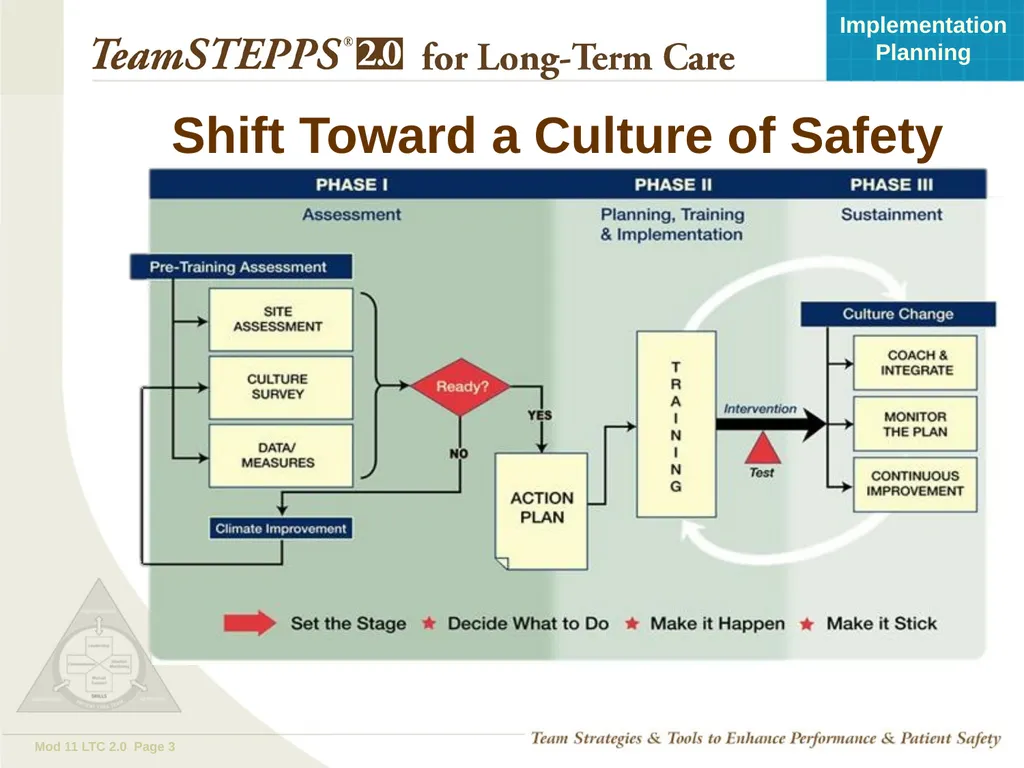
slide3. Shift Toward a Culture of Safety<br>
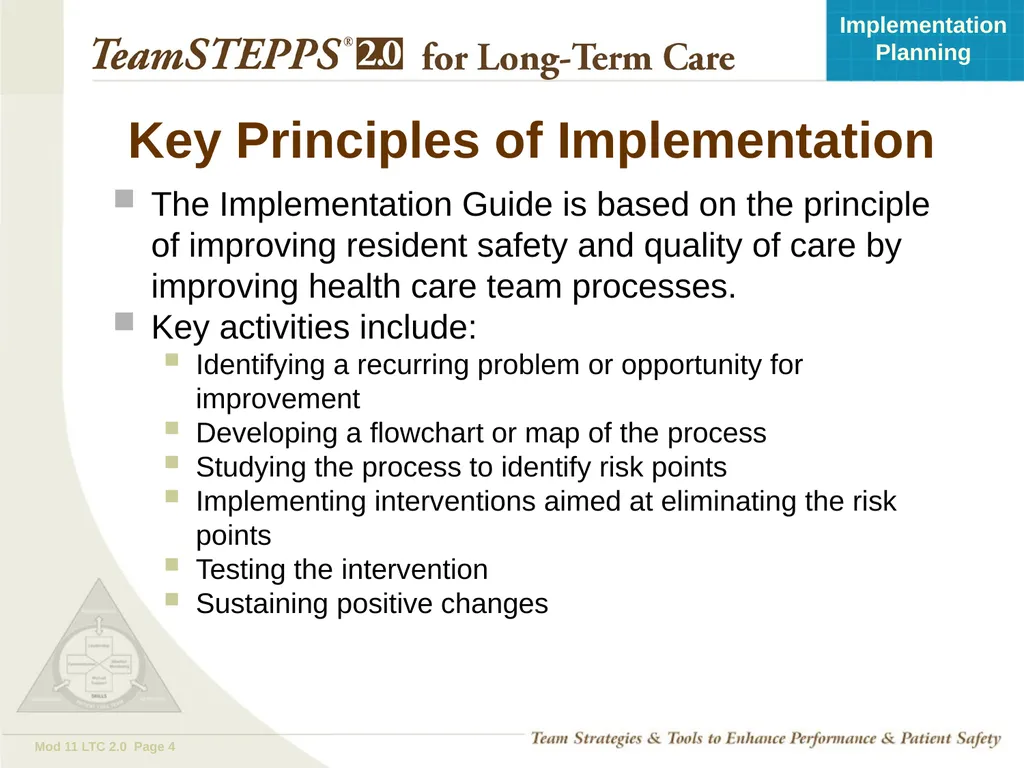
slide4. Key Principles of Implementation The Implementation Guide is based on the principle of improving resident safety and quality of care by improving health care team processes.
Key activities include:
Identifying a recurring problem or opportunity for improvement
Developing a flowchart or map of the process
Studying the process to identify risk points
Implementing interventions aimed at eliminating the risk points
Testing the intervention
Sustaining positive changes<br>
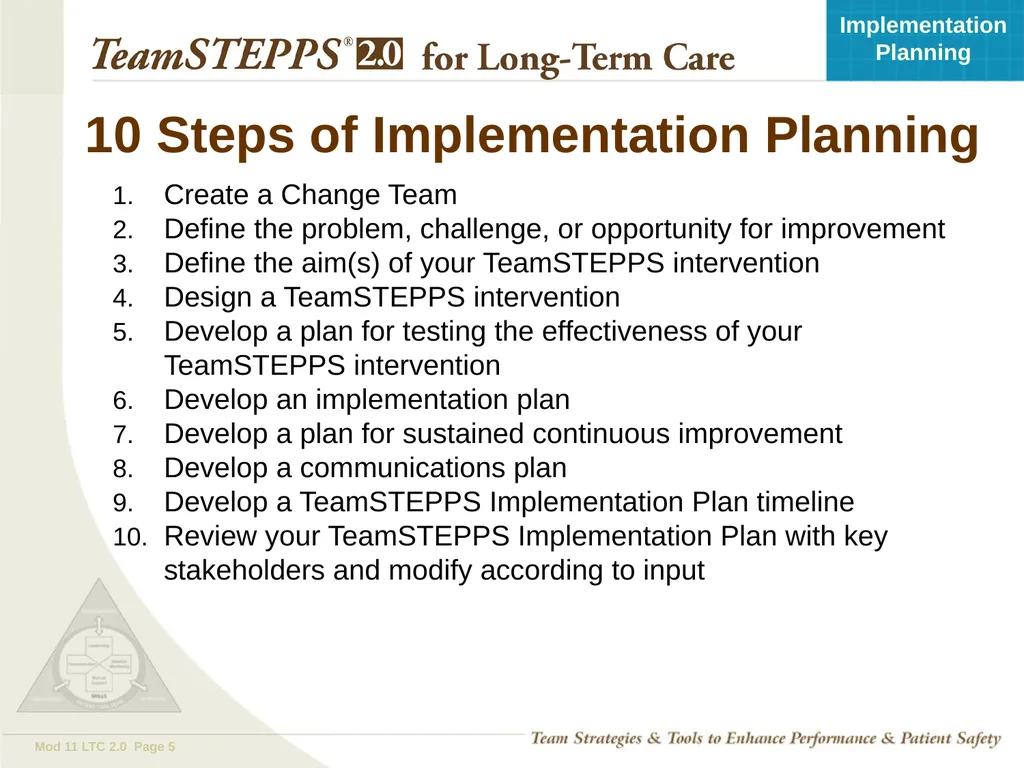
slide5. 10 Steps of Implementation Planning Create a Change Team
Define the problem, challenge, or opportunity for improvement
Define the aim(s) of your TeamSTEPPS intervention
Design a TeamSTEPPS intervention
Develop a plan for testing the effectiveness of your TeamSTEPPS intervention
Develop an implementation plan
Develop a plan for sustained continuous improvement
Develop a communications plan
Develop a TeamSTEPPS Implementation Plan timeline
Review your TeamSTEPPS Implementation Plan with key stakeholders and modify according to input<br>
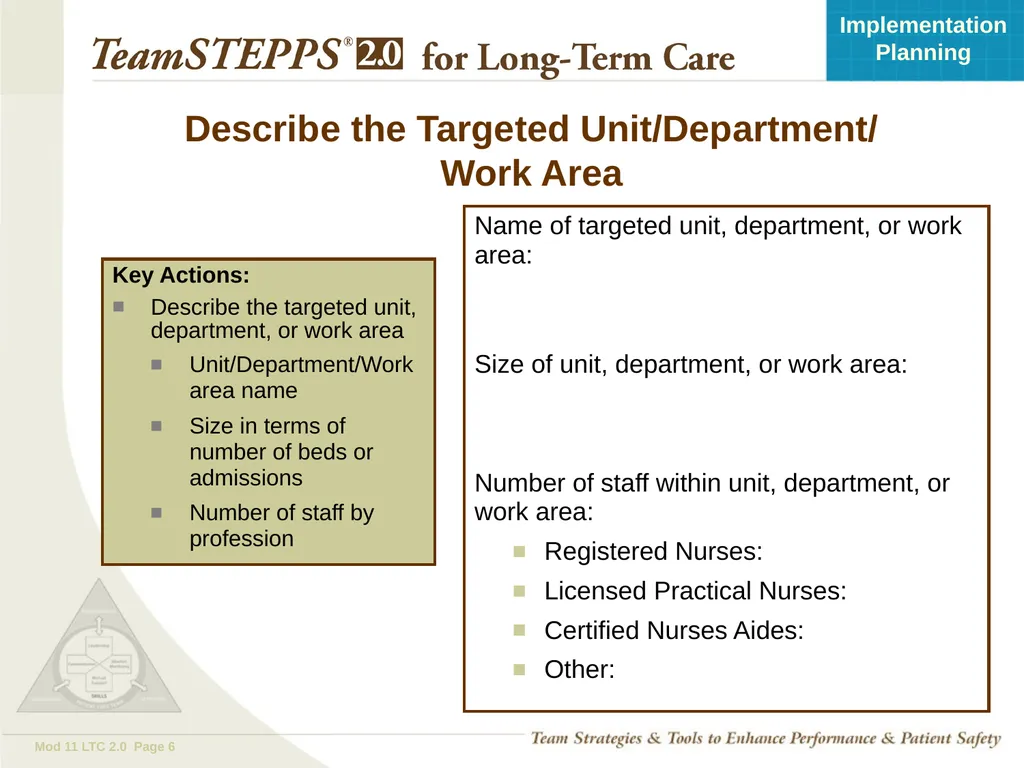
slide6. Describe the Targeted Unit/Department/Work Area Name of targeted unit, department, or work area:
Size of unit, department, or work area:
Number of staff within unit, department, or work area:
Registered Nurses:
Licensed Practical Nurses:
Certified Nurses Aides:
Other: Key Actions:
Describe the targeted unit, department, or work area
Unit/Department/Work area name
Size in terms of number of beds or admissions
Number of staff by profession<br>
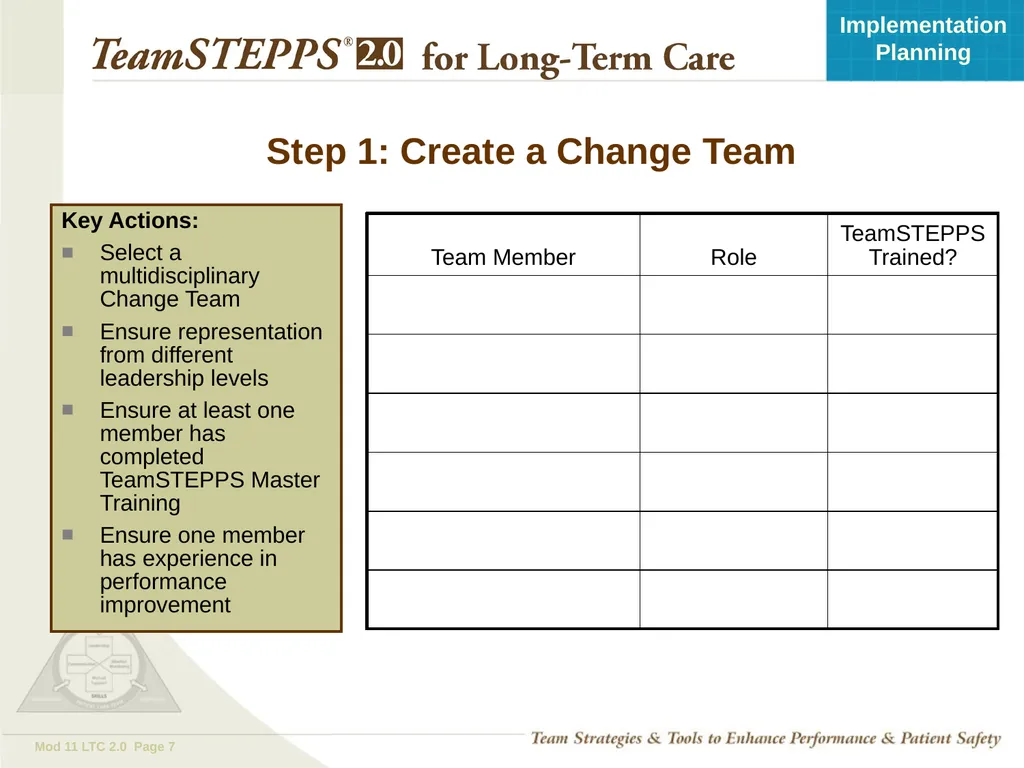
slide7. Step 1: Create a Change Team Key Actions:
Select a multidisciplinary Change Team
Ensure representation from different leadership levels
Ensure at least one member has completed TeamSTEPPS Master Training
Ensure one member has experience in performance improvement<br>
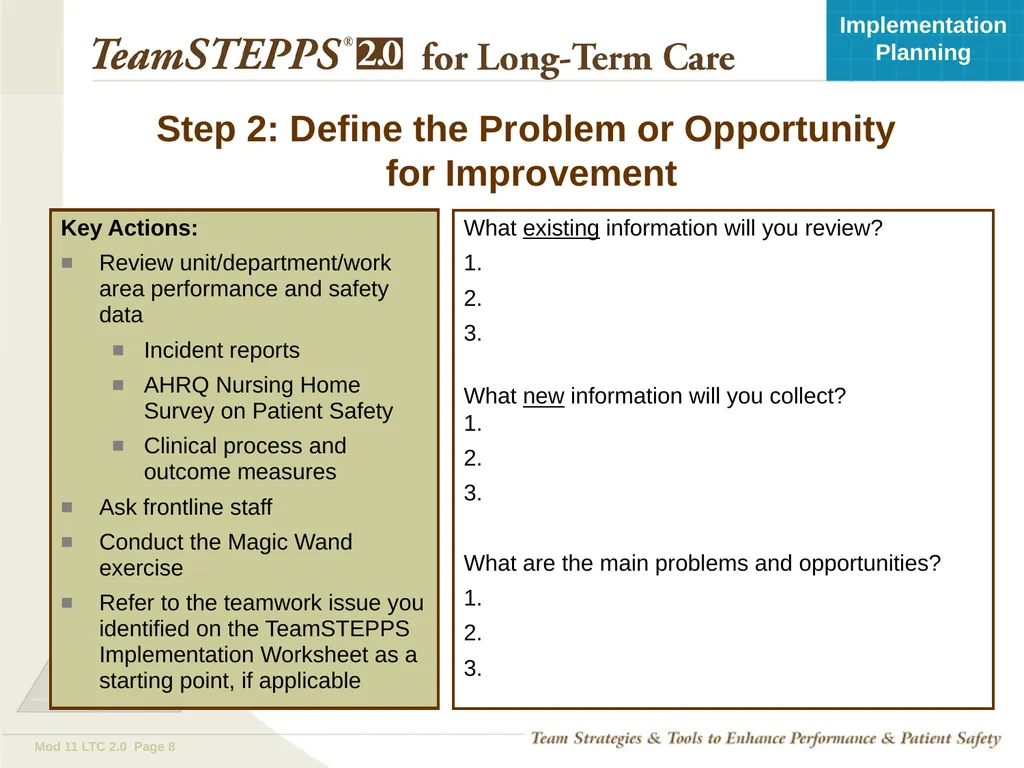
slide8. Step 2: Define the Problem or Opportunity for Improvement What existing information will you review?
1.
2.
3.
What new information will you collect?
1.
2.
3.
What are the main problems and opportunities?
1.
2.
3. Key Actions:
Review unit/department/work area performance and safety data
Incident reports
AHRQ Nursing Home Survey on Patient Safety
Clinical process and outcome measures
Ask frontline staff
Conduct the Magic Wand exercise
Refer to the teamwork issue you identified on the TeamSTEPPS Implementation Worksheet as a starting point, if applicable<br>
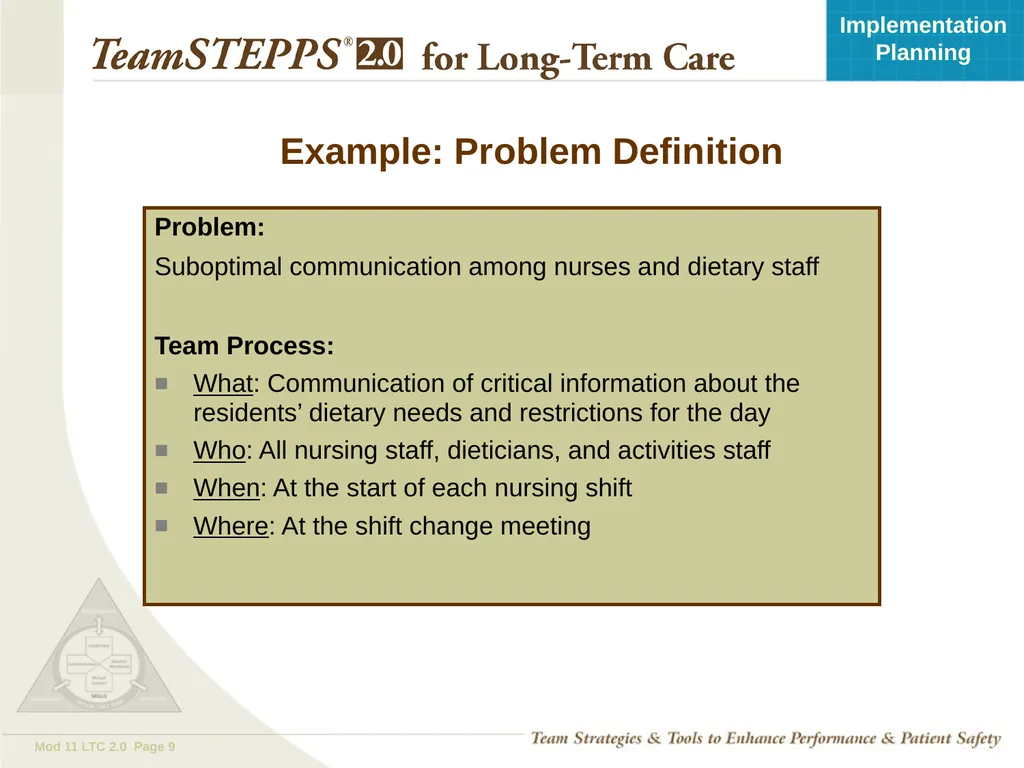
slide9. Example: Problem Definition Problem:
Suboptimal communication among nurses and dietary staff
Team Process:
What: Communication of critical information about the residents’ dietary needs and restrictions for the day
Who: All nursing staff, dieticians, and activities staff
When: At the start of each nursing shift
Where: At the shift change meeting<br>
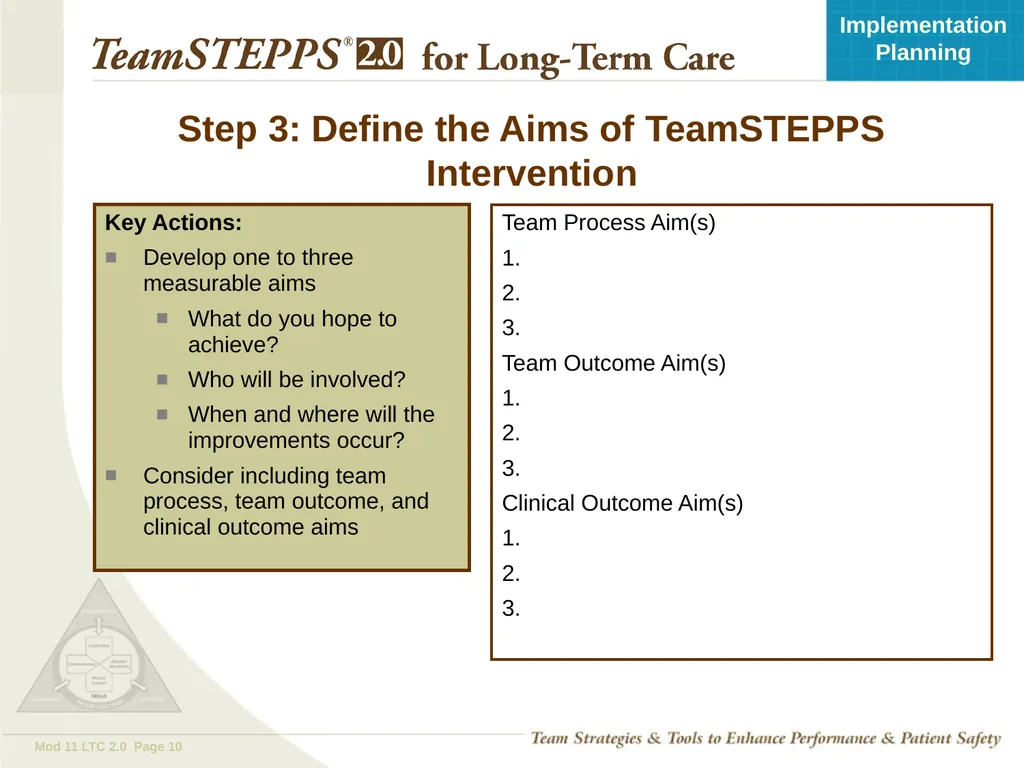
slide10. Step 3: Define the Aims of TeamSTEPPS Intervention Team Process Aim(s)
1.
2.
3.
Team Outcome Aim(s)
1.
2.
3.
Clinical Outcome Aim(s)
1.
2.
3. Key Actions:
Develop one to three measurable aims
What do you hope to achieve?
Who will be involved?
When and where will the improvements occur?
Consider including team process, team outcome, and clinical outcome aims<br>
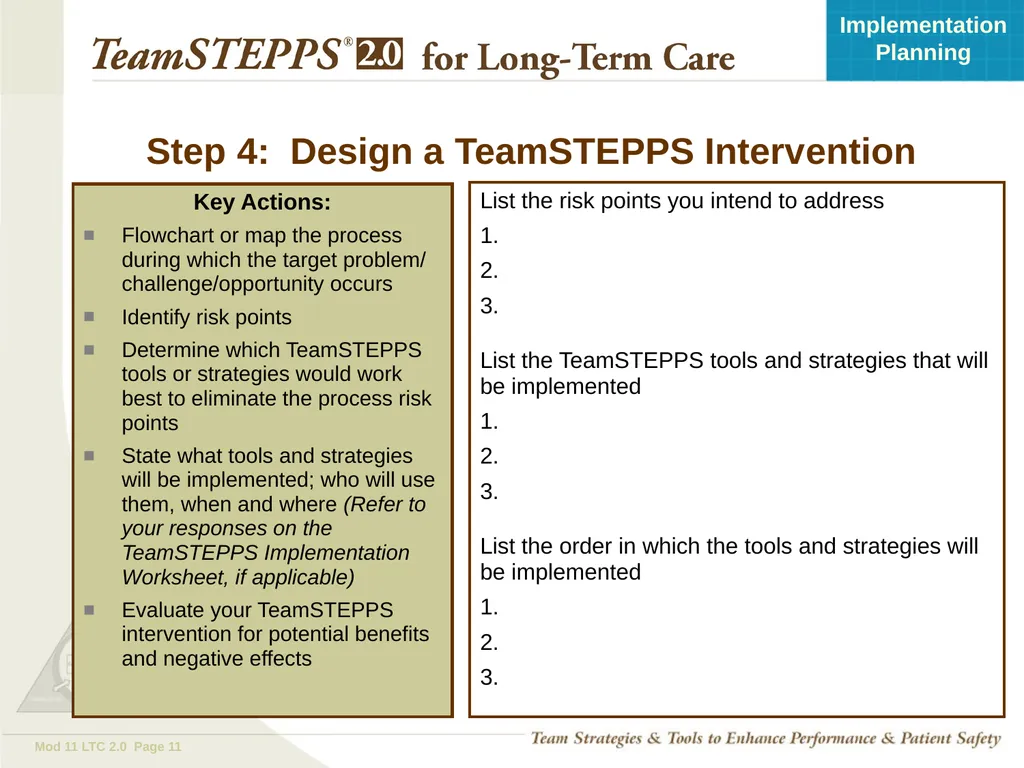
slide11. Step 4: Design a TeamSTEPPS Intervention List the risk points you intend to address
1.
2.
3.
List the TeamSTEPPS tools and strategies that will be implemented
1.
2.
3.
List the order in which the tools and strategies will be implemented
1.
2.
3. Key Actions:
Flowchart or map the process during which the target problem/ challenge/opportunity occurs
Identify risk points
Determine which TeamSTEPPS tools or strategies would work best to eliminate the process risk points
State what tools and strategies will be implemented; who will use them, when and where (Refer to your responses on the TeamSTEPPS Implementation Worksheet, if applicable)
Evaluate your TeamSTEPPS intervention for potential benefits and negative effects<br>
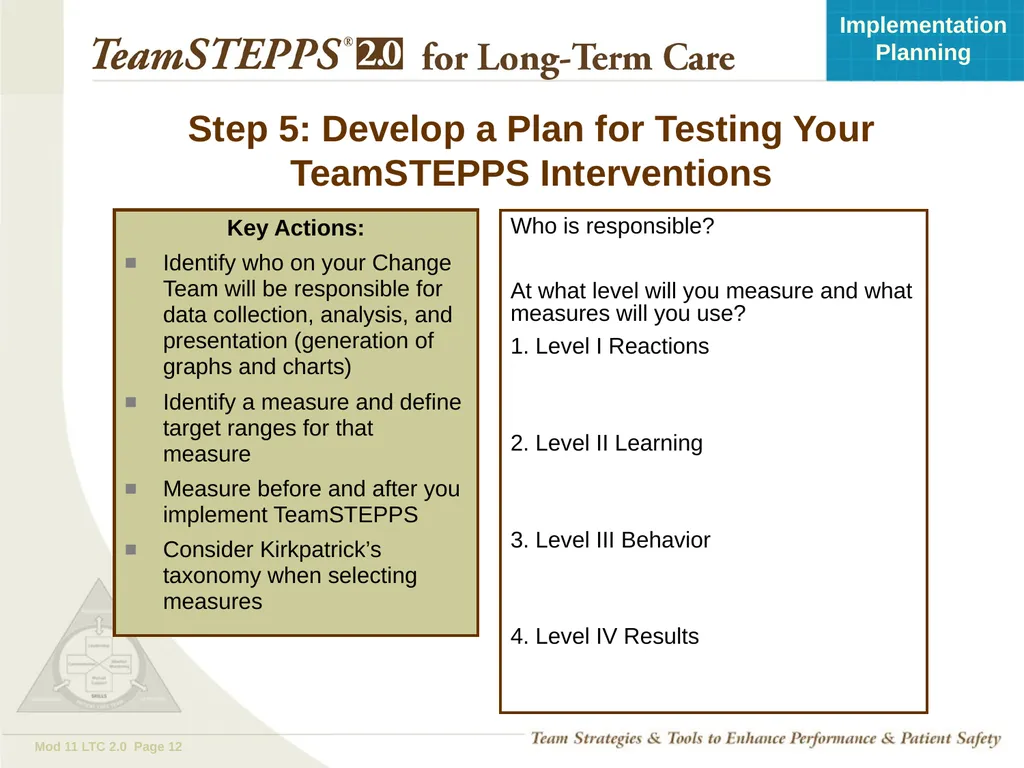
slide12. Step 5: Develop a Plan for Testing Your TeamSTEPPS Interventions Who is responsible?
At what level will you measure and what measures will you use?
1. Level I Reactions
2. Level II Learning
3. Level III Behavior
4. Level IV Results Key Actions:
Identify who on your Change Team will be responsible for data collection, analysis, and presentation (generation of graphs and charts)
Identify a measure and define target ranges for that measure
Measure before and after you implement TeamSTEPPS
Consider Kirkpatrick’s taxonomy when selecting measures<br>
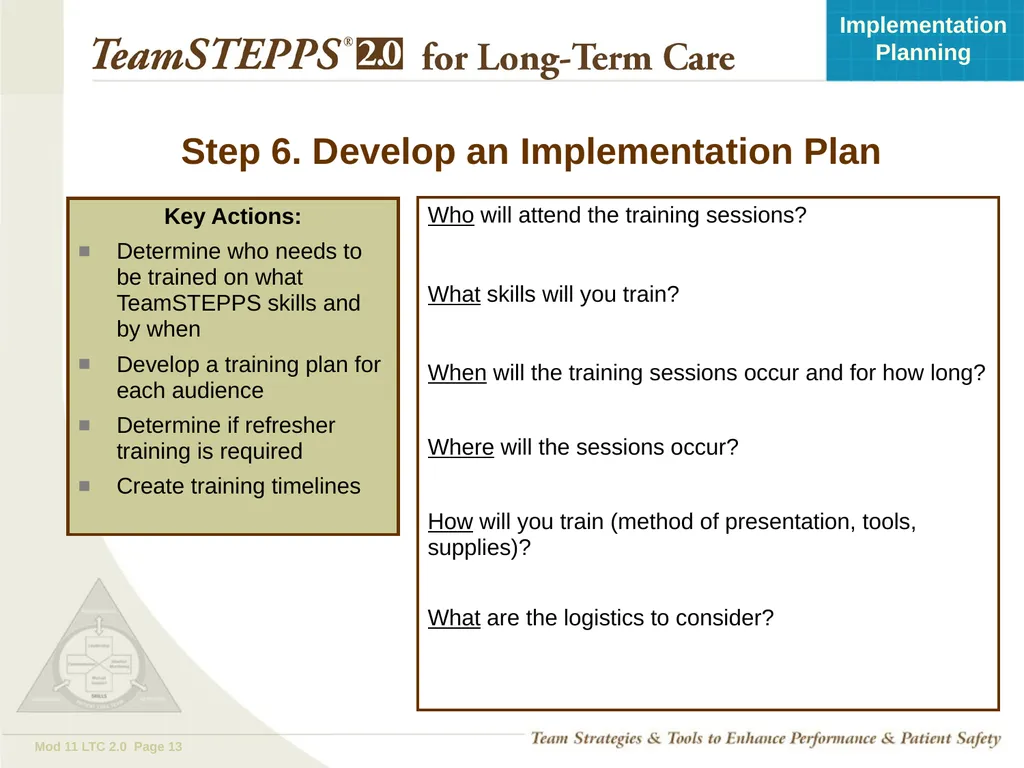
slide13. Step 6. Develop an Implementation Plan Who will attend the training sessions?
What skills will you train?
When will the training sessions occur and for how long?
Where will the sessions occur?
How will you train (method of presentation, tools, supplies)?
What are the logistics to consider? Key Actions:
Determine who needs to be trained on what TeamSTEPPS skills and by when
Develop a training plan for each audience
Determine if refresher training is required
Create training timelines<br>
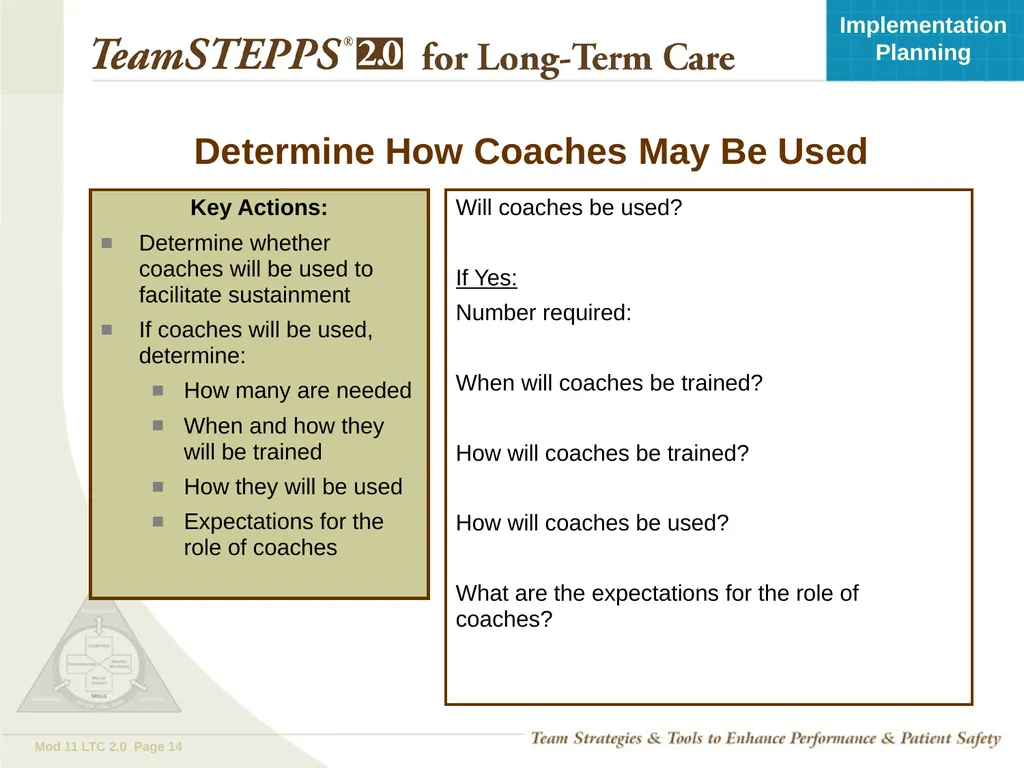
slide14. Determine How Coaches May Be Used Will coaches be used?
If Yes:
Number required:
When will coaches be trained?
How will coaches be trained?
How will coaches be used?
What are the expectations for the role of coaches? Key Actions:
Determine whether coaches will be used to facilitate sustainment
If coaches will be used, determine:
How many are needed
When and how they will be trained
How they will be used
Expectations for the role of coaches<br>
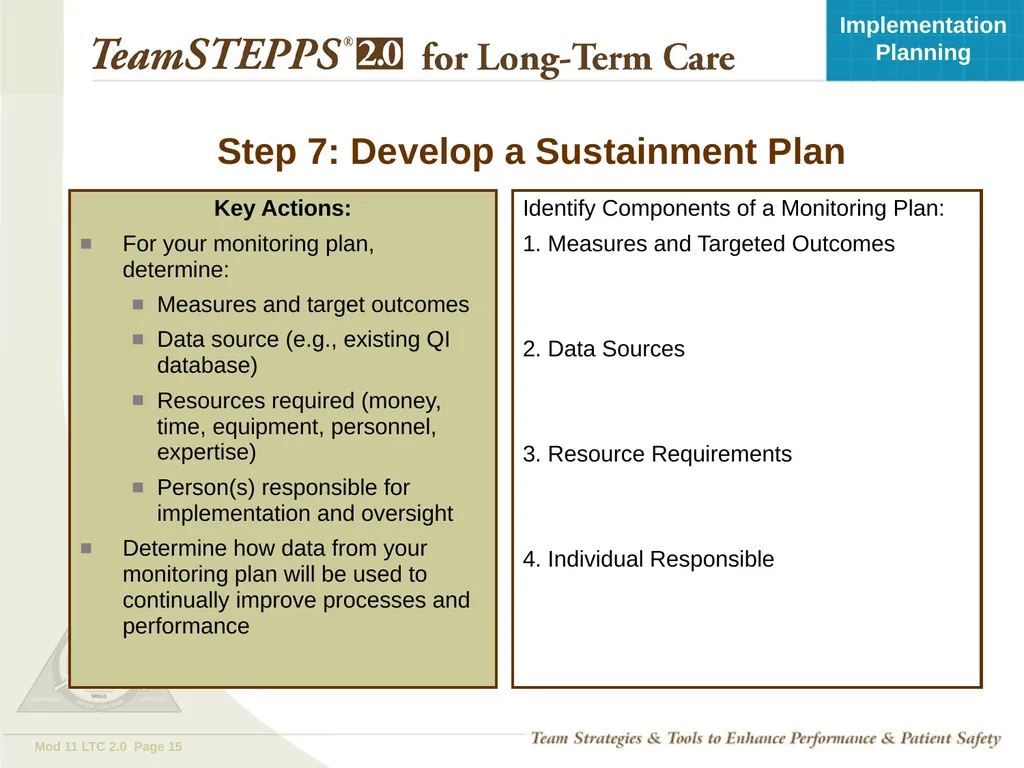
slide15. Step 7: Develop a Sustainment Plan Identify Components of a Monitoring Plan:
1. Measures and Targeted Outcomes
2. Data Sources
3. Resource Requirements
4. Individual Responsible Key Actions:
For your monitoring plan, determine:
Measures and target outcomes
Data source (e.g., existing QI database)
Resources required (money, time, equipment, personnel, expertise)
Person(s) responsible for implementation and oversight
Determine how data from your monitoring plan will be used to continually improve processes and performance<br>
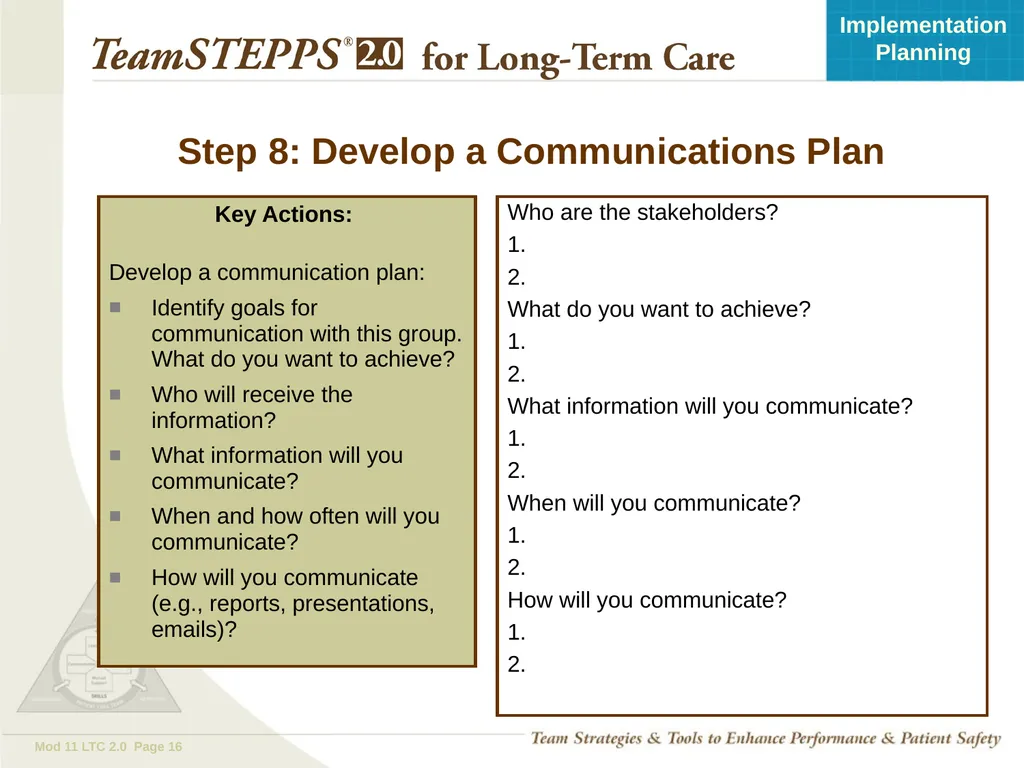
slide16. Step 8: Develop a Communications Plan Who are the stakeholders?
1.
2.
What do you want to achieve?
1.
2.
What information will you communicate?
1.
2.
When will you communicate?
1.
2.
How will you communicate?
1.
2. Key Actions:
Develop a communication plan:
Identify goals for communication with this group. What do you want to achieve?
Who will receive the information?
What information will you communicate?
When and how often will you communicate?
How will you communicate (e.g., reports, presentations, emails)?<br>
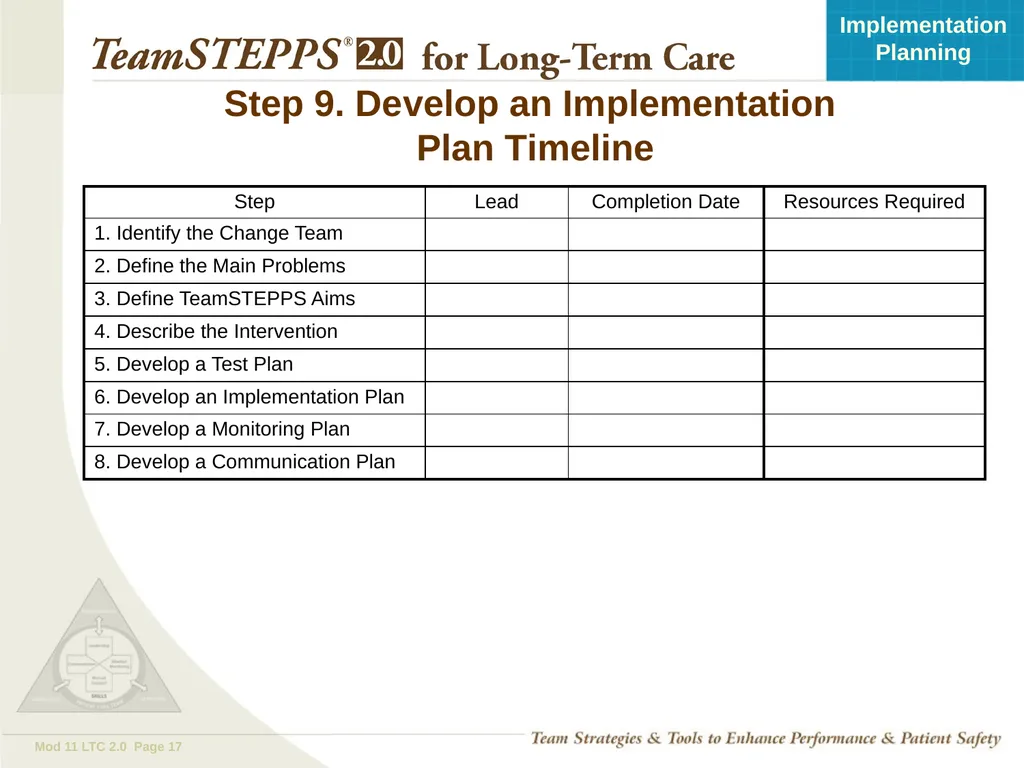
slide17. Step 9. Develop an Implementation Plan Timeline<br>
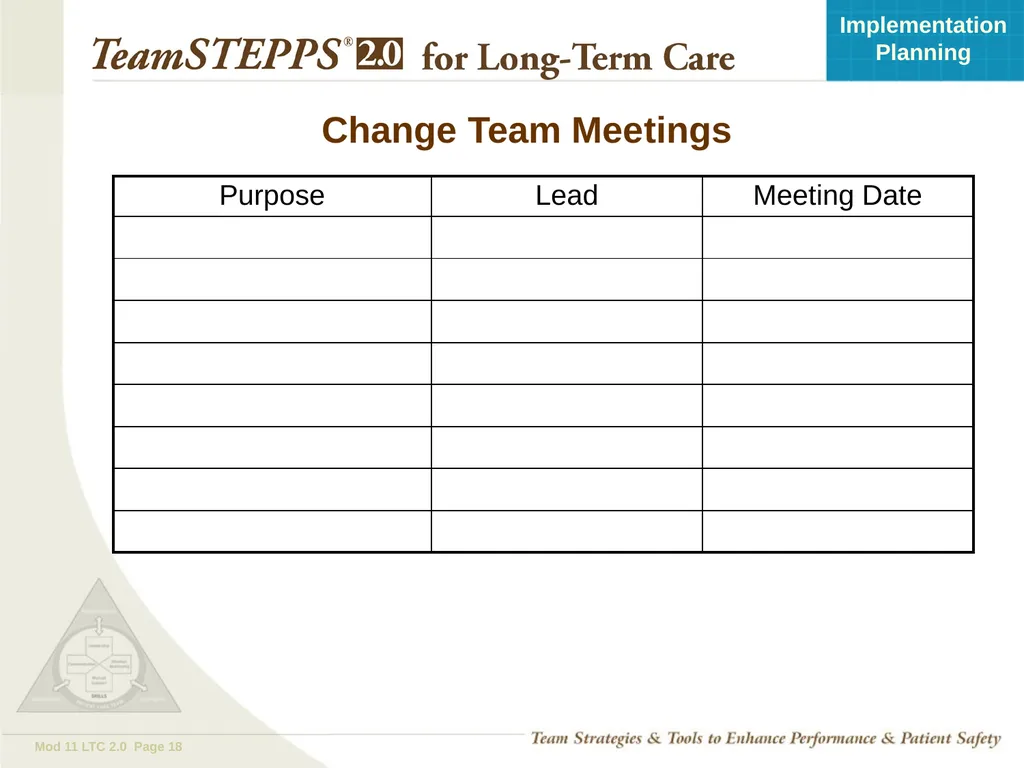
slide18. Change Team Meetings<br>
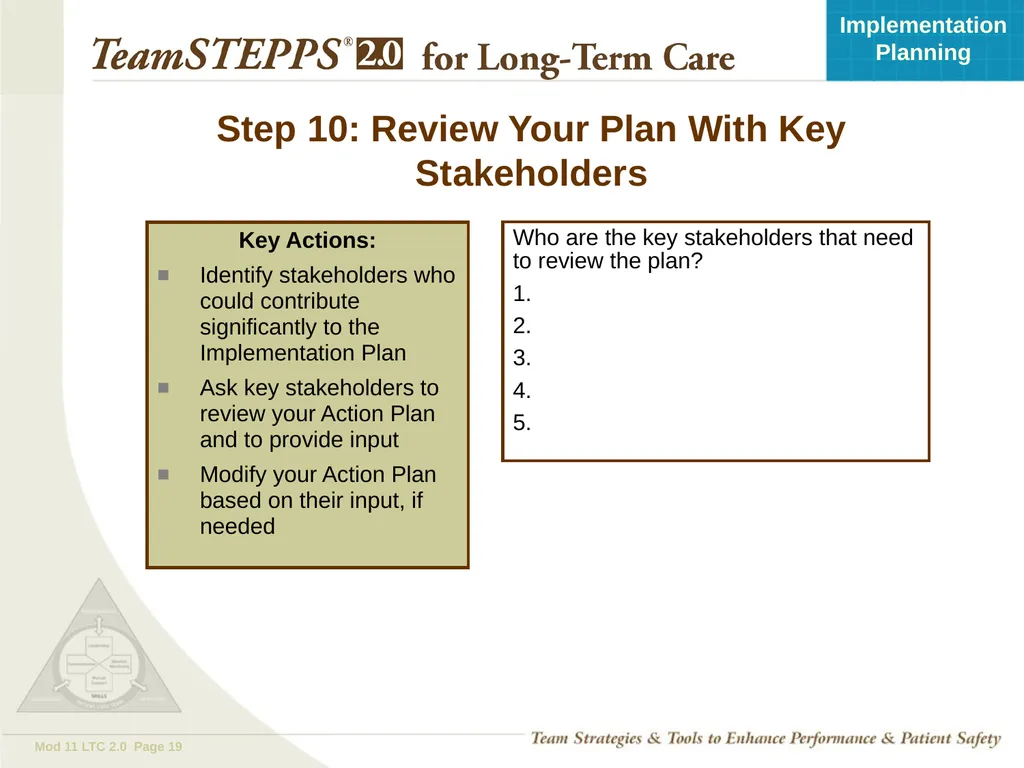
slide19. Step 10: Review Your Plan With Key Stakeholders Who are the key stakeholders that need to review the plan?
1.
2.
3.
4.
5. Key Actions:
Identify stakeholders who could contribute significantly to the Implementation Plan
Ask key stakeholders to review your Action Plan and to provide input
Modify your Action Plan based on their input, if needed<br>
slide20. TeamSTEPPS Implementation Planning Exercise Break into working groups by unit, department, or work area, or by best alignment of common issues
Develop your Action Plan based on the 10-step process
Be ready to present and discuss your Action Plan with the larger group<br>

slide2. Objectives Describe the steps involved in implementing TeamSTEPPS
Develop a TeamSTEPPS Implementation Plan<br>
slide3. Shift Toward a Culture of Safety<br>
slide4. Key Principles of Implementation The Implementation Guide is based on the principle of improving resident safety and quality of care by improving health care team processes.
Key activities include:
Identifying a recurring problem or opportunity for improvement
Developing a flowchart or map of the process
Studying the process to identify risk points
Implementing interventions aimed at eliminating the risk points
Testing the intervention
Sustaining positive changes<br>
slide5. 10 Steps of Implementation Planning Create a Change Team
Define the problem, challenge, or opportunity for improvement
Define the aim(s) of your TeamSTEPPS intervention
Design a TeamSTEPPS intervention
Develop a plan for testing the effectiveness of your TeamSTEPPS intervention
Develop an implementation plan
Develop a plan for sustained continuous improvement
Develop a communications plan
Develop a TeamSTEPPS Implementation Plan timeline
Review your TeamSTEPPS Implementation Plan with key stakeholders and modify according to input<br>
slide6. Describe the Targeted Unit/Department/Work Area Name of targeted unit, department, or work area:
Size of unit, department, or work area:
Number of staff within unit, department, or work area:
Registered Nurses:
Licensed Practical Nurses:
Certified Nurses Aides:
Other: Key Actions:
Describe the targeted unit, department, or work area
Unit/Department/Work area name
Size in terms of number of beds or admissions
Number of staff by profession<br>
slide7. Step 1: Create a Change Team Key Actions:
Select a multidisciplinary Change Team
Ensure representation from different leadership levels
Ensure at least one member has completed TeamSTEPPS Master Training
Ensure one member has experience in performance improvement<br>
slide8. Step 2: Define the Problem or Opportunity for Improvement What existing information will you review?
1.
2.
3.
What new information will you collect?
1.
2.
3.
What are the main problems and opportunities?
1.
2.
3. Key Actions:
Review unit/department/work area performance and safety data
Incident reports
AHRQ Nursing Home Survey on Patient Safety
Clinical process and outcome measures
Ask frontline staff
Conduct the Magic Wand exercise
Refer to the teamwork issue you identified on the TeamSTEPPS Implementation Worksheet as a starting point, if applicable<br>
slide9. Example: Problem Definition Problem:
Suboptimal communication among nurses and dietary staff
Team Process:
What: Communication of critical information about the residents’ dietary needs and restrictions for the day
Who: All nursing staff, dieticians, and activities staff
When: At the start of each nursing shift
Where: At the shift change meeting<br>
slide10. Step 3: Define the Aims of TeamSTEPPS Intervention Team Process Aim(s)
1.
2.
3.
Team Outcome Aim(s)
1.
2.
3.
Clinical Outcome Aim(s)
1.
2.
3. Key Actions:
Develop one to three measurable aims
What do you hope to achieve?
Who will be involved?
When and where will the improvements occur?
Consider including team process, team outcome, and clinical outcome aims<br>
slide11. Step 4: Design a TeamSTEPPS Intervention List the risk points you intend to address
1.
2.
3.
List the TeamSTEPPS tools and strategies that will be implemented
1.
2.
3.
List the order in which the tools and strategies will be implemented
1.
2.
3. Key Actions:
Flowchart or map the process during which the target problem/ challenge/opportunity occurs
Identify risk points
Determine which TeamSTEPPS tools or strategies would work best to eliminate the process risk points
State what tools and strategies will be implemented; who will use them, when and where (Refer to your responses on the TeamSTEPPS Implementation Worksheet, if applicable)
Evaluate your TeamSTEPPS intervention for potential benefits and negative effects<br>
slide12. Step 5: Develop a Plan for Testing Your TeamSTEPPS Interventions Who is responsible?
At what level will you measure and what measures will you use?
1. Level I Reactions
2. Level II Learning
3. Level III Behavior
4. Level IV Results Key Actions:
Identify who on your Change Team will be responsible for data collection, analysis, and presentation (generation of graphs and charts)
Identify a measure and define target ranges for that measure
Measure before and after you implement TeamSTEPPS
Consider Kirkpatrick’s taxonomy when selecting measures<br>
slide13. Step 6. Develop an Implementation Plan Who will attend the training sessions?
What skills will you train?
When will the training sessions occur and for how long?
Where will the sessions occur?
How will you train (method of presentation, tools, supplies)?
What are the logistics to consider? Key Actions:
Determine who needs to be trained on what TeamSTEPPS skills and by when
Develop a training plan for each audience
Determine if refresher training is required
Create training timelines<br>
slide14. Determine How Coaches May Be Used Will coaches be used?
If Yes:
Number required:
When will coaches be trained?
How will coaches be trained?
How will coaches be used?
What are the expectations for the role of coaches? Key Actions:
Determine whether coaches will be used to facilitate sustainment
If coaches will be used, determine:
How many are needed
When and how they will be trained
How they will be used
Expectations for the role of coaches<br>
slide15. Step 7: Develop a Sustainment Plan Identify Components of a Monitoring Plan:
1. Measures and Targeted Outcomes
2. Data Sources
3. Resource Requirements
4. Individual Responsible Key Actions:
For your monitoring plan, determine:
Measures and target outcomes
Data source (e.g., existing QI database)
Resources required (money, time, equipment, personnel, expertise)
Person(s) responsible for implementation and oversight
Determine how data from your monitoring plan will be used to continually improve processes and performance<br>
slide16. Step 8: Develop a Communications Plan Who are the stakeholders?
1.
2.
What do you want to achieve?
1.
2.
What information will you communicate?
1.
2.
When will you communicate?
1.
2.
How will you communicate?
1.
2. Key Actions:
Develop a communication plan:
Identify goals for communication with this group. What do you want to achieve?
Who will receive the information?
What information will you communicate?
When and how often will you communicate?
How will you communicate (e.g., reports, presentations, emails)?<br>
slide17. Step 9. Develop an Implementation Plan Timeline<br>
slide18. Change Team Meetings<br>
slide19. Step 10: Review Your Plan With Key Stakeholders Who are the key stakeholders that need to review the plan?
1.
2.
3.
4.
5. Key Actions:
Identify stakeholders who could contribute significantly to the Implementation Plan
Ask key stakeholders to review your Action Plan and to provide input
Modify your Action Plan based on their input, if needed<br>
slide20. TeamSTEPPS Implementation Planning Exercise Break into working groups by unit, department, or work area, or by best alignment of common issues
Develop your Action Plan based on the 10-step process
Be ready to present and discuss your Action Plan with the larger group<br>