04
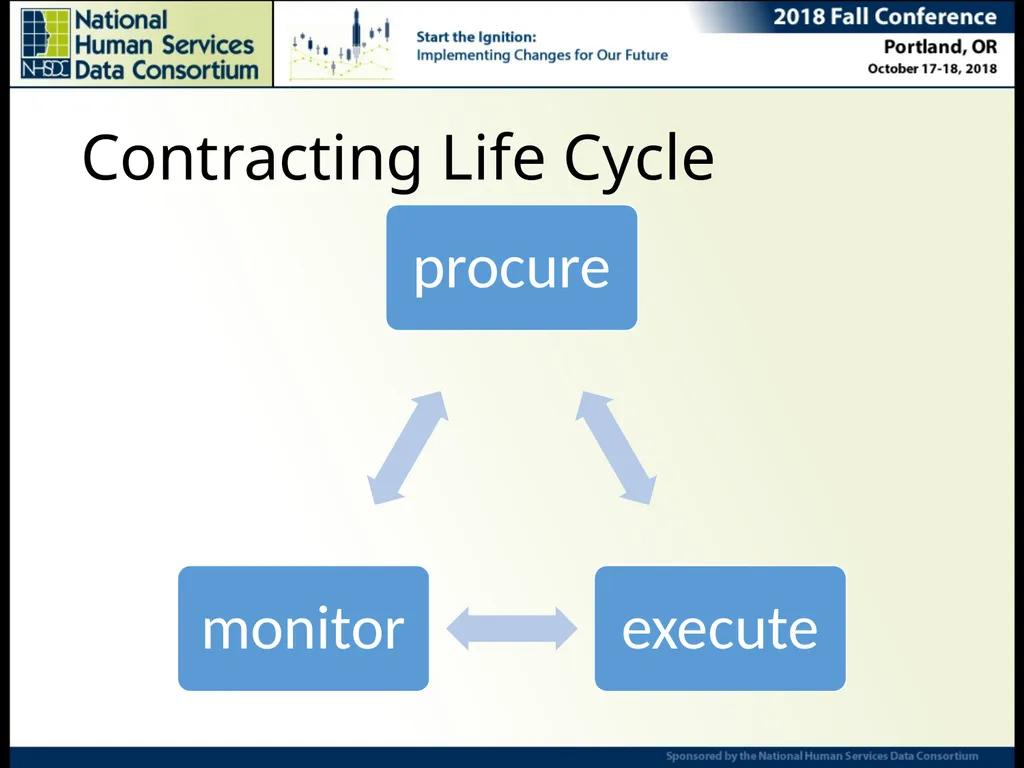
Contracting Life Cycle<br>
05
Procurement means to purchase a new system based upon an RFP, RFQ, RFQQ, or other type of official solicitation
Brainstorm: Who can purchase office supplies in your agency? Who can hire people? Who can sign contracts?
Search out the people that can help you solicit and purchase software
Get examples of past solicitations
The harder the process, the better! It means more oversight and, ultimately, more teeth!<br>
06
Write measureable requirements
“Tech Support” becomes “live person email/phone, 7a – 7p, no answering machine, monthly response repts that include…”
“Details for each report” becomes “PersonID, HHID, Project Name, Start, Exit, Living, Dest, etc.” with each canned rpt
“Ad Hoc Reports” becomes “Unlimited access to all data in database (including meta data), on demand, live, all users, etc.)
Request responses in terms of what performance looks like to respondent
Use the same document to score & use the scoring process to game out performance criteria
Transfer requirements and responses to contract SOW<br>
07
Learning Objective: Living Scopes of Work This means three-ish things:
Requirement is measureable
Measurement is in vendor’s own words
Money is tied to completion for each requirement
“Living” comes from reviewing the SOW each month with each invoice
Pay for requirements that are completed
Hold back payment for requirements that are not – pay once completed, even if months down the road
Large Group Discussion: How does this play out differently in different CoC jurisdictions (sm, md, lg)?<br>
08
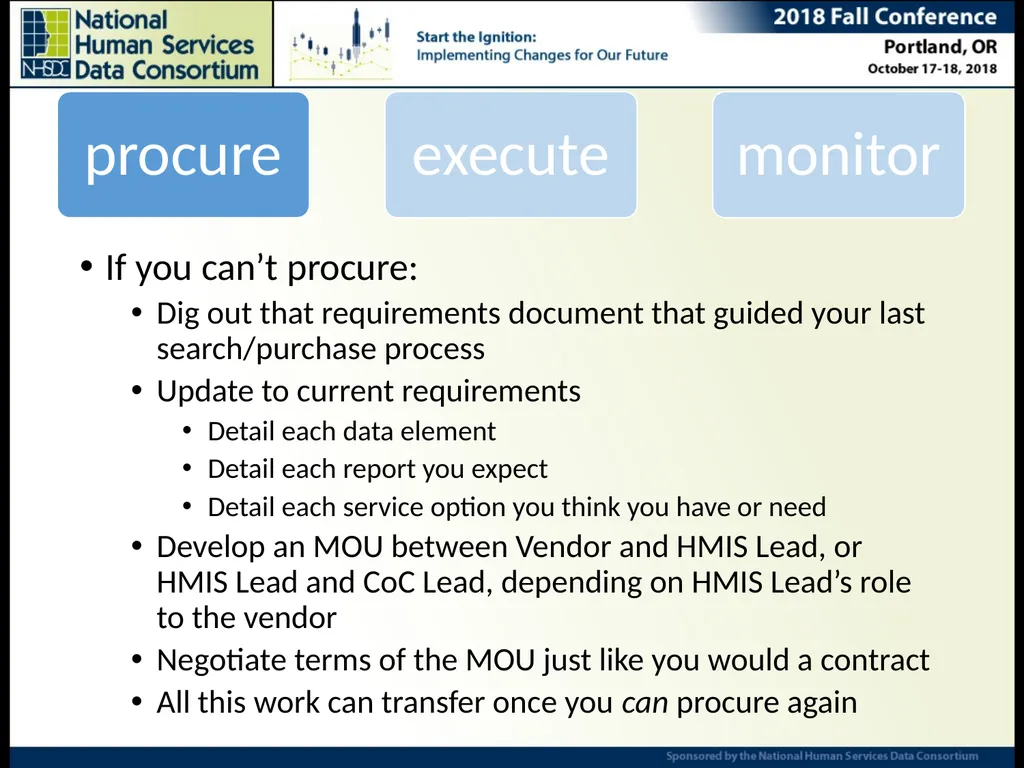
If you can’t procure:
Dig out that requirements document that guided your last search/purchase process
Update to current requirements
Detail each data element
Detail each report you expect
Detail each service option you think you have or need
Develop an MOU between Vendor and HMIS Lead, or HMIS Lead and CoC Lead, depending on HMIS Lead’s role to the vendor
Negotiate terms of the MOU just like you would a contract
All this work can transfer once you can procure again<br>
09
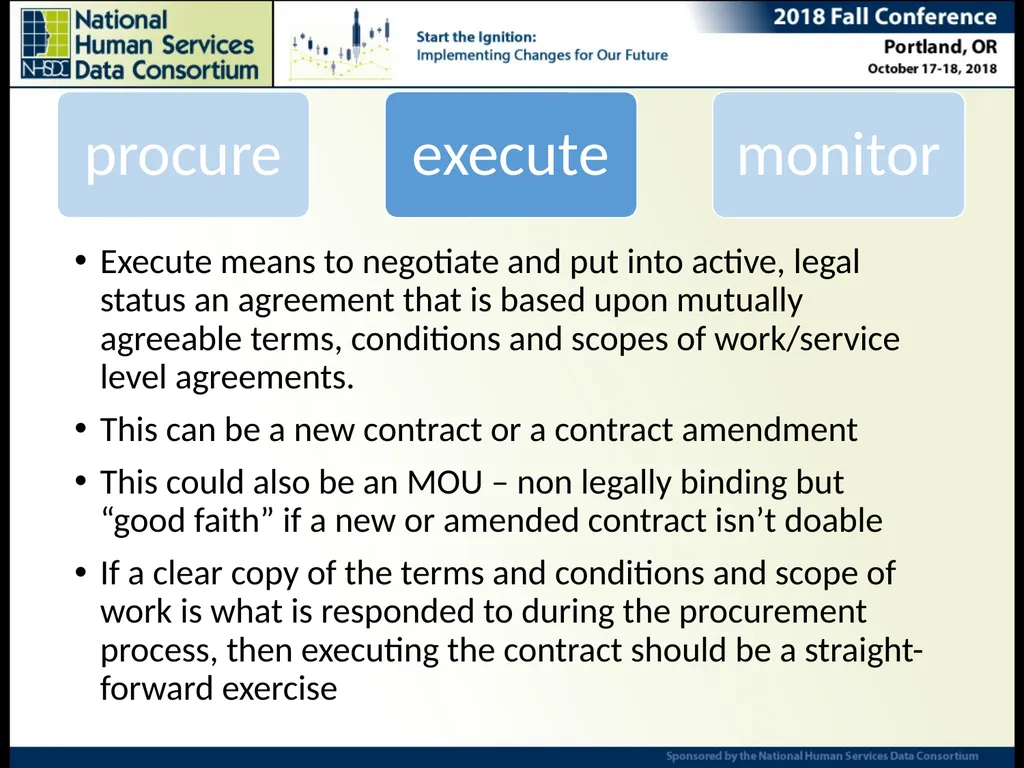
Execute means to negotiate and put into active, legal status an agreement that is based upon mutually agreeable terms, conditions and scopes of work/service level agreements.
This can be a new contract or a contract amendment
This could also be an MOU – non legally binding but “good faith” if a new or amended contract isn’t doable
If a clear copy of the terms and conditions and scope of work is what is responded to during the procurement process, then executing the contract should be a straight-forward exercise<br>
10
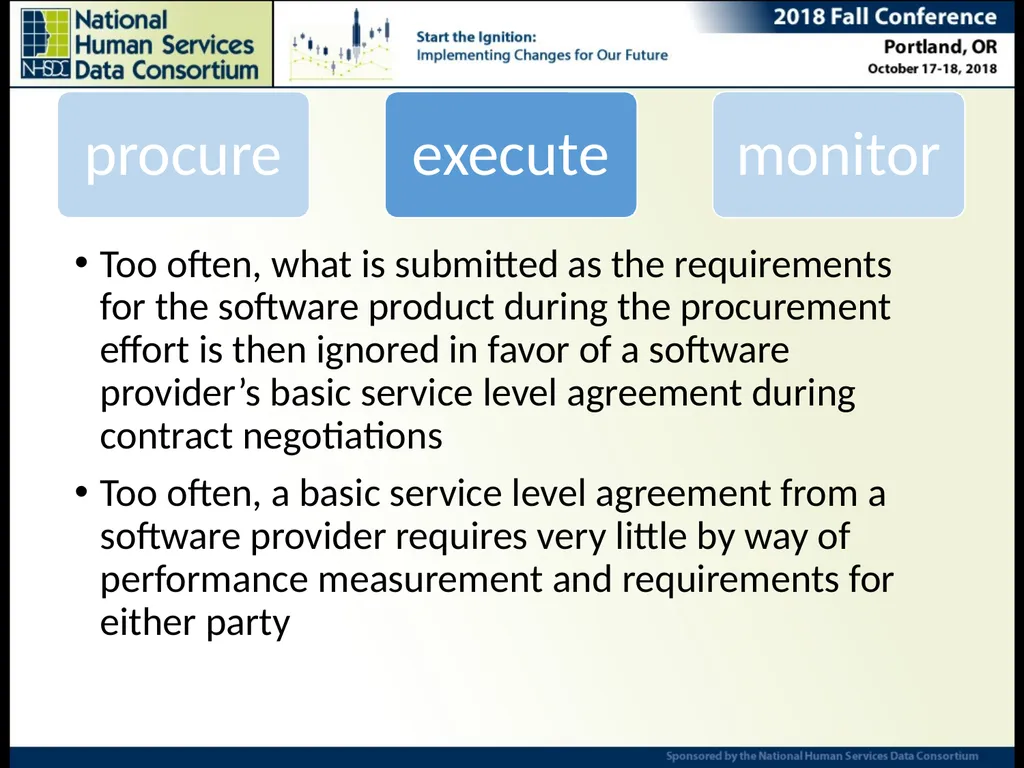
Too often, what is submitted as the requirements for the software product during the procurement effort is then ignored in favor of a software provider’s basic service level agreement during contract negotiations
Too often, a basic service level agreement from a software provider requires very little by way of performance measurement and requirements for either party<br>
11
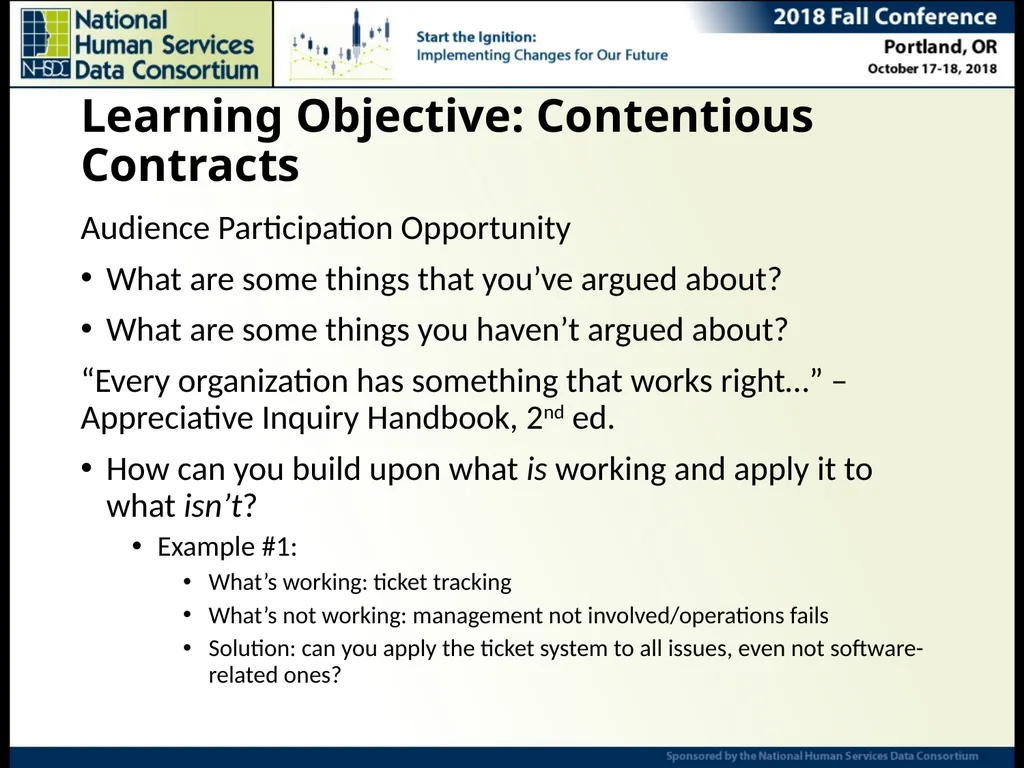
Learning Objective: Contentious Contracts Audience Participation Opportunity
What are some things that you’ve argued about?
What are some things you haven’t argued about?
“Every organization has something that works right…” – Appreciative Inquiry Handbook, 2nd ed.
How can you build upon what is working and apply it to what isn’t?
Example #1:
What’s working: ticket tracking
What’s not working: management not involved/operations fails
Solution: can you apply the ticket system to all issues, even not software-related ones?<br>
12
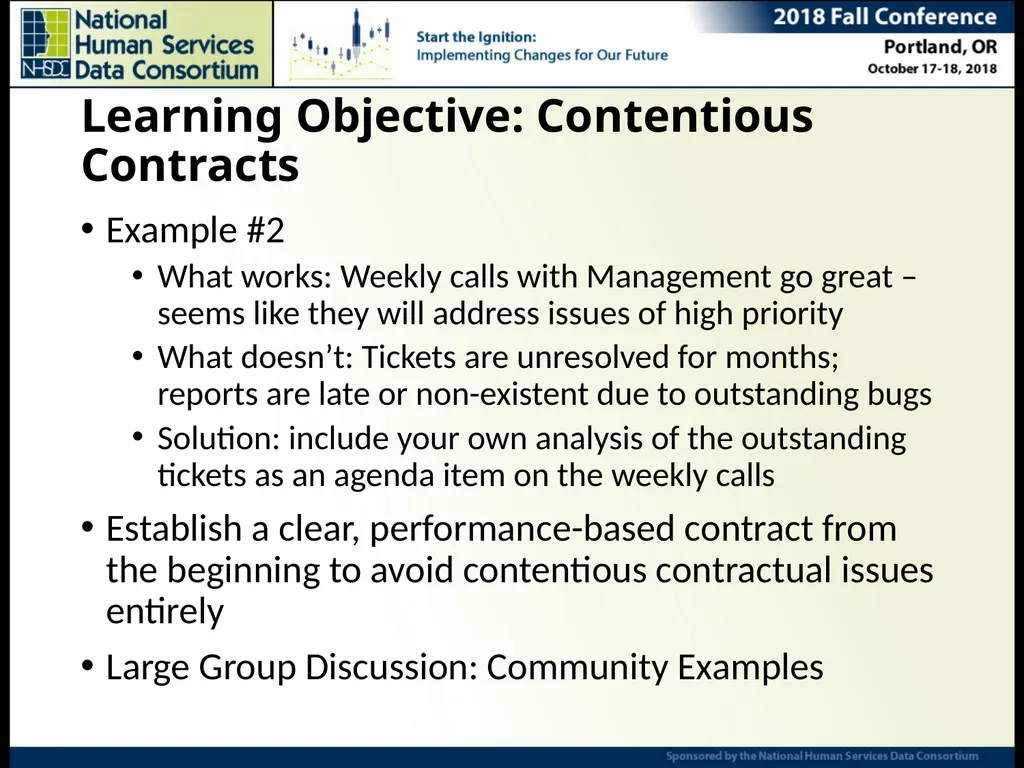
Learning Objective: Contentious Contracts Example #2
What works: Weekly calls with Management go great – seems like they will address issues of high priority
What doesn’t: Tickets are unresolved for months; reports are late or non-existent due to outstanding bugs
Solution: include your own analysis of the outstanding tickets as an agenda item on the weekly calls
Establish a clear, performance-based contract from the beginning to avoid contentious contractual issues entirely
Large Group Discussion: Community Examples<br>
13
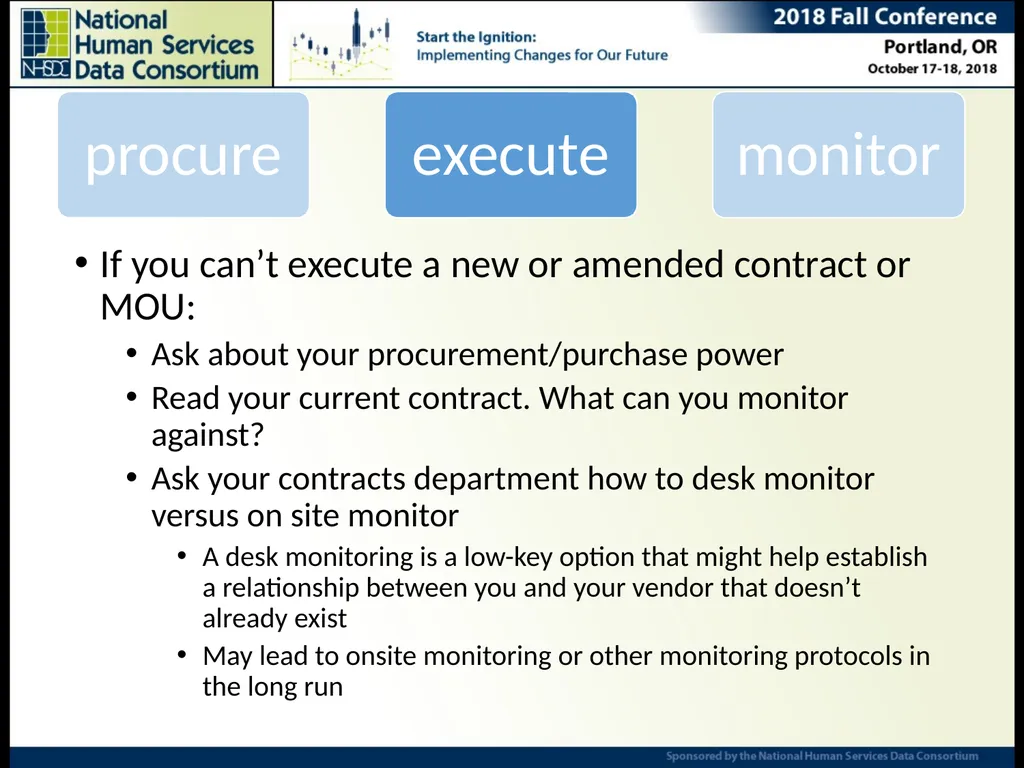
If you can’t execute a new or amended contract or MOU:
Ask about your procurement/purchase power
Read your current contract. What can you monitor against?
Ask your contracts department how to desk monitor versus on site monitor
A desk monitoring is a low-key option that might help establish a relationship between you and your vendor that doesn’t already exist
May lead to onsite monitoring or other monitoring protocols in the long run<br>
14
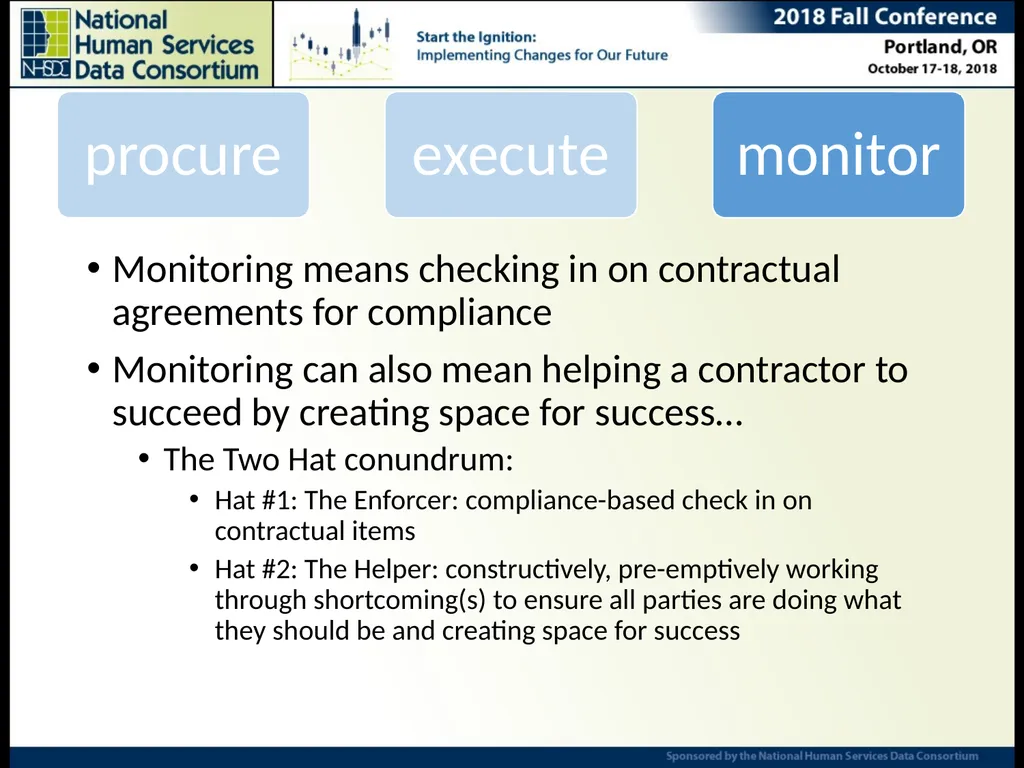
Monitoring means checking in on contractual agreements for compliance
Monitoring can also mean helping a contractor to succeed by creating space for success…
The Two Hat conundrum:
Hat #1: The Enforcer: compliance-based check in on contractual items
Hat #2: The Helper: constructively, pre-emptively working through shortcoming(s) to ensure all parties are doing what they should be and creating space for success<br>
15
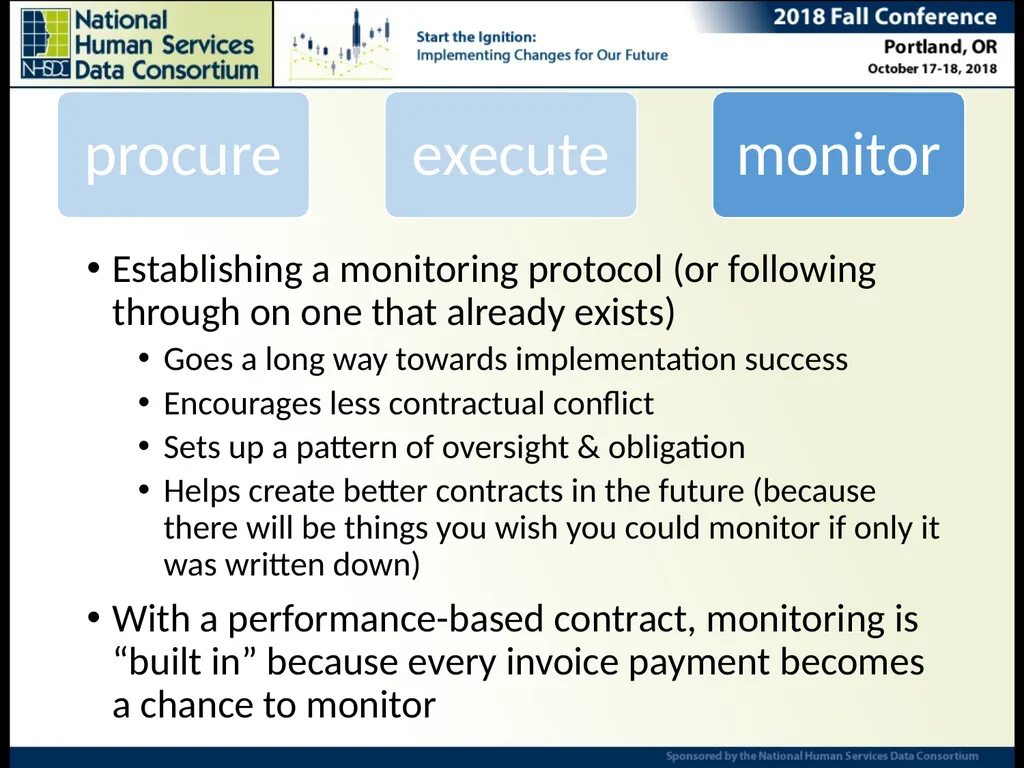
Establishing a monitoring protocol (or following through on one that already exists)
Goes a long way towards implementation success
Encourages less contractual conflict
Sets up a pattern of oversight & obligation
Helps create better contracts in the future (because there will be things you wish you could monitor if only it was written down)
With a performance-based contract, monitoring is “built in” because every invoice payment becomes a chance to monitor<br>
16
Learning Objective: Relationship Building Think of your relationship like an ATM
Starting balance is positive (for both)
Issues create withdrawals
Successes create deposits
There is a human behind the machine
Small Group Exercise
Get together with peers in the room (same size CoC, same vendor, etc.)
Do a pro/con list – what deposits have you made to the relationship? What withdrawals? Which side is bigger?
PS: Money is a deposit even with a hypothetical ATM <br>
17
Learning Objective: Relationship Building Small group report-out
What does this mean for our relationships?
Each side must invest continually
Monitoring that creates space for success can thwart potential conflict if employed early enough
Don’t let the small fish get away – too many small fish ends up creating a much larger fish down the road – “Fry ‘em all”
Write it down in your words and let them write it down in theirs – then use those words over and over and over and over – come back each month<br>
18
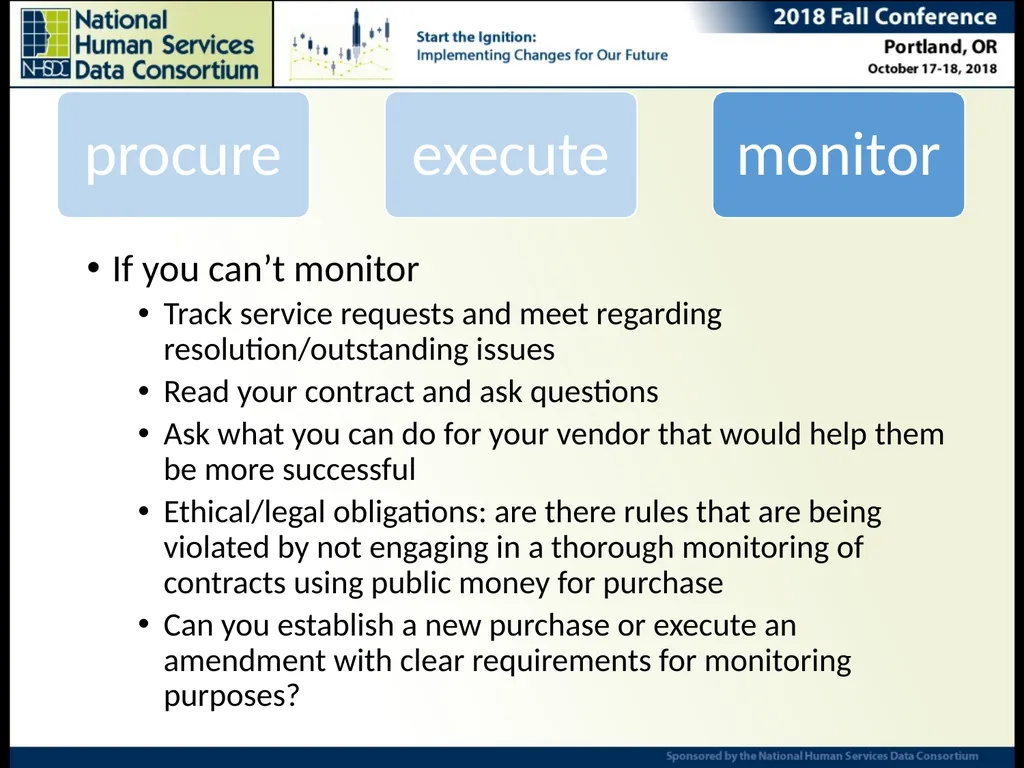
If you can’t monitor
Track service requests and meet regarding resolution/outstanding issues
Read your contract and ask questions
Ask what you can do for your vendor that would help them be more successful
Ethical/legal obligations: are there rules that are being violated by not engaging in a thorough monitoring of contracts using public money for purchase
Can you establish a new purchase or execute an amendment with clear requirements for monitoring purposes?<br>
19
Additional Resources Vendor Contracting 101: https://nhsdc.org/wp-content/uploads/2018/04/Session-8A-Vendor-Contracting-101-MSchwartz-MMcEvilley-RBurger.pdf
Vendor Relations and Changing Software: https://www.hudexchange.info/resources/documents/HMISVendorRelations_Presentation.pdf
Managing Vendor Relations & HMIS Contracting: https://www.hudexchange.info/resources/documents/ManagingVendorRelationsAndContracting.pdf
HMIS Cost Estimation Guidelines: https://www.hud.gov/sites/documents/DOC_14249.PDF<br>