
Implementing Integrated Behavioral Healthcare
OM
Published · 49 slides · 0 views
1 / 1
Description
Implementing Integrated Behavioral Healthcare Module 7 Victoria Stanhope, PhD New York University Module Objectives To provide an overview of the multi-level change that accompanies primary and behavioral healthcare integration To describe
Related Topics
Share
Embed code
Download this presentation From Below
"Implementing Integrated Behavioral Healthcare" is the property of its rightful owner. Permission is granted to download and print the materials on this website for personal, non-commercial use only, and to display it on your personal computer provided you do not modify the materials and that you retain all copyright notices contained in the materials. By downloading content from our website, you accept the terms of this agreement.
Presentation Transcript
01
Implementing Integrated Behavioral Healthcare Module 7
Victoria Stanhope, PhD
New York University<br>
Victoria Stanhope, PhD
New York University<br>
02
Module Objectives To provide an overview of the multi-level change that accompanies primary and behavioral healthcare integration
To describe the different roles and functions of providers involved in integrating care and identify the role of social workers
To delineate the barriers and facilitators to implementing primary and behavioral healthcare integration
To understand how to evaluate the implementation and effectiveness of primary and behavioral healthcare integration<br>
To describe the different roles and functions of providers involved in integrating care and identify the role of social workers
To delineate the barriers and facilitators to implementing primary and behavioral healthcare integration
To understand how to evaluate the implementation and effectiveness of primary and behavioral healthcare integration<br>
03
What does IBH Look Like? Integrating Mental Health into Primary Care
IMPACT – Evidence Based Depression Care
TEAMcare<br>
IMPACT – Evidence Based Depression Care
TEAMcare<br>
04
Adopting IBH Requires multi-level change:
Systems Level
Organizational Level
Provider Level
Provider-Consumer Relationships
Consumer<br>
Systems Level
Organizational Level
Provider Level
Provider-Consumer Relationships
Consumer<br>
05
Care Management What is it?
Identifying and recruiting clients for care management based on service utilization
Client activation and education
Assessing barriers to treatment participation
Monitoring consumer’s participation and response to treatment
Use of clinical registries
Care Coordination
Strategies to help providers communicate with each other
Who does it?
Determined by training & credentials
Best Qualified Social Workers & Nurses<br>
Identifying and recruiting clients for care management based on service utilization
Client activation and education
Assessing barriers to treatment participation
Monitoring consumer’s participation and response to treatment
Use of clinical registries
Care Coordination
Strategies to help providers communicate with each other
Who does it?
Determined by training & credentials
Best Qualified Social Workers & Nurses<br>
06
Self Management Defined by IOM as:
“the tasks that individuals must undertake to live well with one or more chronic conditions”
Programs
Chronic Disease Self-Management Program
Wellness and Recovery Action Plan (WRAP)
Self Management and Recovery Training (SMART)
Screening, Brief Intervention and Referral to Treatment (SBIRT)<br>
“the tasks that individuals must undertake to live well with one or more chronic conditions”
Programs
Chronic Disease Self-Management Program
Wellness and Recovery Action Plan (WRAP)
Self Management and Recovery Training (SMART)
Screening, Brief Intervention and Referral to Treatment (SBIRT)<br>
07
Decision Support Access to Medical Specialists
Time limited
Embedding clinical guidelines
Decision flow charts to navigate evidence-based treatment options
Use of clinical decision support tools<br>
Time limited
Embedding clinical guidelines
Decision flow charts to navigate evidence-based treatment options
Use of clinical decision support tools<br>
08
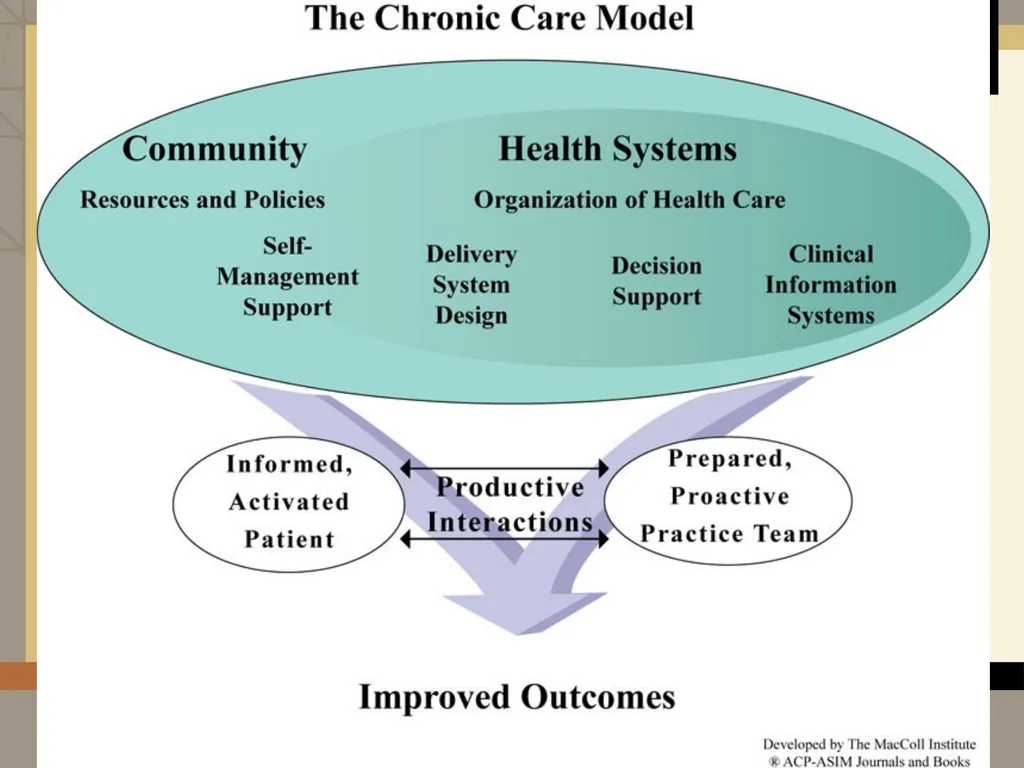
Clinical Information Systems Organize patient and population data to facilitate efficient and effective care
Provide timely reminders for providers and patients
Identify relevant subpopulations for proactive care
Facilitate individual patient care planning
Share information with patients and providers to coordinate care
Monitor performance of practice team and care system
(http://www.improvingchroniccare.org/)<br>
Provide timely reminders for providers and patients
Identify relevant subpopulations for proactive care
Facilitate individual patient care planning
Share information with patients and providers to coordinate care
Monitor performance of practice team and care system
(http://www.improvingchroniccare.org/)<br>
09
Team Approach Interdisciplinary Teams
Primary Care Physician and Nurse Practitioner play key role
Care Manager (Social Worker)
Peer Specialist
Mental Health Provider (e.g., Social Worker, Psychologist, Psychiatrist )
Addictions Professional
Community Health Worker<br>
Primary Care Physician and Nurse Practitioner play key role
Care Manager (Social Worker)
Peer Specialist
Mental Health Provider (e.g., Social Worker, Psychologist, Psychiatrist )
Addictions Professional
Community Health Worker<br>
10
Inter-Professional1 “It is no longer enough for health workers to be professional. In the current global climate, health workers also need to be inter-professional”
- WHO, 2010<br>
- WHO, 2010<br>
11
Defining Inter-professional2 Inter-professional collaborative practice: Occurs when multiple healthcare workers from different professions work together with those they serve (patients, families, caregivers, communities) to provide high quality healthcare
Inter-professional education (IPE): “When students from two or more professions learn about, from and with each other to enable effective collaboration and improve health outcomes.”<br>
Inter-professional education (IPE): “When students from two or more professions learn about, from and with each other to enable effective collaboration and improve health outcomes.”<br>
12
The Need for Inter-professional Education and Competencies3 Integrated behavioral healthcare cannot move forward without a healthcare work force that is trained in and embraces inter-professional collaboration
Our current healthcare system operates predominantly in professional silos
Education of healthcare professionals is also done in silos - few students have an opportunity to work together and are not prepared to function as part of a team in an integrated approach to care<br>
Our current healthcare system operates predominantly in professional silos
Education of healthcare professionals is also done in silos - few students have an opportunity to work together and are not prepared to function as part of a team in an integrated approach to care<br>
13
Calls for Change from the IOM4, 5, 6, 7 1972: “How should we educate students and health professionals in order that they might work in teams?”
2000/2001: “How care is delivered is as important as what care is delivered” - requires retraining and inter-professional education
2003: Development of health professions competencies – yet, “interdisciplinary education has yet to become the norm in health professions education”<br>
2000/2001: “How care is delivered is as important as what care is delivered” - requires retraining and inter-professional education
2003: Development of health professions competencies – yet, “interdisciplinary education has yet to become the norm in health professions education”<br>
14
Benefits of Inter-professional Collaboration Inter-professional team care improves health outcomes in settings such as acute care or prevention programs8
Improves patient experiences of care
Improves efficiency of healthcare delivery
Increases job satisfaction for health professionals9<br>
Improves patient experiences of care
Improves efficiency of healthcare delivery
Increases job satisfaction for health professionals9<br>
15
Need for Inter-professional Competencies Some professions have well developed competencies, e.g., CSWE’s Educational Policies and Standards and ACGME Core Competencies
However, development of IPE competencies has been slow in the US<br>
However, development of IPE competencies has been slow in the US<br>
16
IOM IPE Competency Domains In 2003, at an IOM sponsored summer, 5 IPE competencies were identified:
Provide patient-centered care
Apply quality improvement
Employ EBP
Utilize informatics
Work in interdisciplinary teams<br>
Provide patient-centered care
Apply quality improvement
Employ EBP
Utilize informatics
Work in interdisciplinary teams<br>
17
Canadian IPE Competency Domains10 In 2010, the Canadian Inter-professional Health Collaborative published a competency framework and identified 6 domains:
Patient/client/family/community-centered care
Role clarification
Team functioning
Interprofessional communication
Interprofessional conflict resolution
Collaborative leadership<br>
Patient/client/family/community-centered care
Role clarification
Team functioning
Interprofessional communication
Interprofessional conflict resolution
Collaborative leadership<br>
18
Medical IPE Competency Domains In 2011, the Interprofessional Education Collaborative (made up of 6 American medical associations) released their core competency domains (38 competencies identified across the domains):
Values and ethics
Roles and responsibilities for collaborative practice
Inter-professional communication
Teamwork and team-based care<br>
Values and ethics
Roles and responsibilities for collaborative practice
Inter-professional communication
Teamwork and team-based care<br>
19
Social Work Roles Care Coordinators
Care Managers
Patient Educators
Behavioral Health Providers
Mental health
Addiction
Outreach Specialists
Supervisors for Community Health Workers<br>
Care Managers
Patient Educators
Behavioral Health Providers
Mental health
Addiction
Outreach Specialists
Supervisors for Community Health Workers<br>
20
Social Work Functions Comprehensive assessment
Care planning
Care coordination
Patient activation
Patient navigation
Patient and family support
Psychotherapy/clinical intervention
Advance care planning<br>
Care planning
Care coordination
Patient activation
Patient navigation
Patient and family support
Psychotherapy/clinical intervention
Advance care planning<br>
21
Training The Certificate Program in Primary Care Behavioral Health is a training program for behavioral health professionals seeking to practice in primary care settings
This training is particularly targeted to prepare behavioral health professionals for the patient centered medical home model
Approved for CEs through NASW<br>
This training is particularly targeted to prepare behavioral health professionals for the patient centered medical home model
Approved for CEs through NASW<br>
22
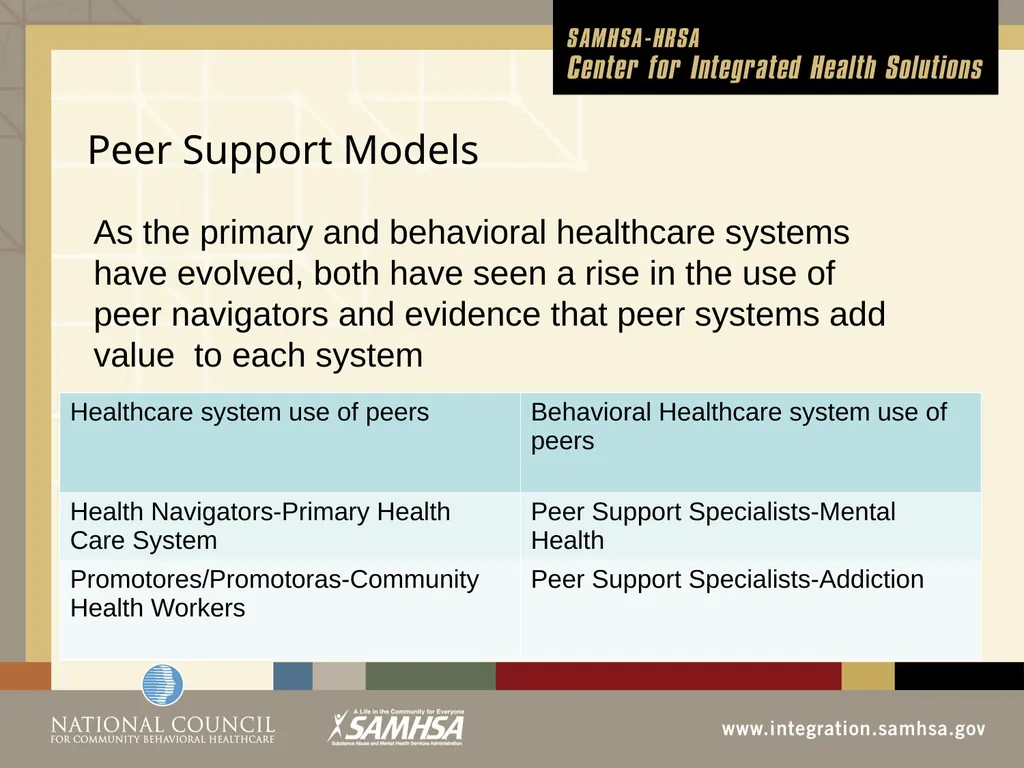
Peer Support Models As the primary and behavioral healthcare systems have evolved, both have seen a rise in the use of peer navigators and evidence that peer systems add value to each system<br>
23
Where Social Workers Fit In Social Work Profession is well positioned to play a major role in a transformed healthcare system
Behavioral health is integrated into the overall healthcare system
Unique skills sets:
collaboration across systems and disciplines;
ecological focus that promotes mobilization of community, safety net and social supports for highly vulnerable populations
Negotiating and overcoming barriers to access to a range of needed services
Values system of the SW professions is in alignment with
Wrap around care for the most vulnerable
Reducing health disparities
Coordinated care<br>
Behavioral health is integrated into the overall healthcare system
Unique skills sets:
collaboration across systems and disciplines;
ecological focus that promotes mobilization of community, safety net and social supports for highly vulnerable populations
Negotiating and overcoming barriers to access to a range of needed services
Values system of the SW professions is in alignment with
Wrap around care for the most vulnerable
Reducing health disparities
Coordinated care<br>
24
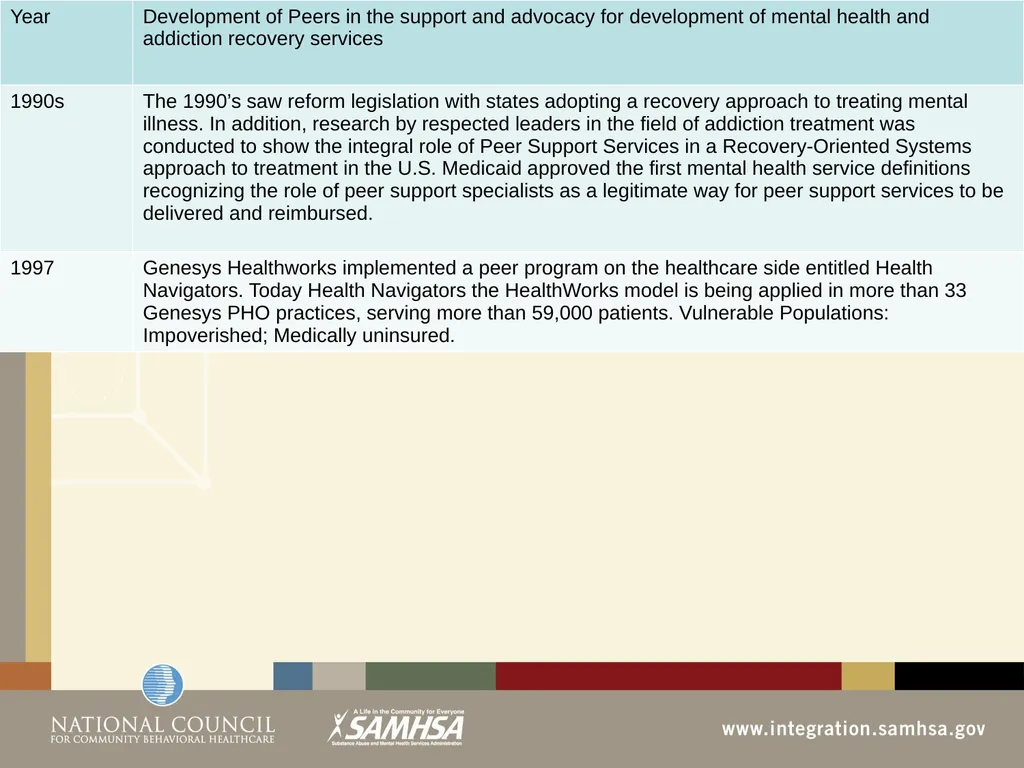
Health Navigators In 1997, Genesys Healthworks, Flint Michigan implemented a health navigator program using a combination of health coaching, case manager, and care coordinator skills, health navigators help insured and uninsured patients cared for by patient-centered primary care medical homes adopt healthier behaviors and better manage chronic diseases.
As members of the care team, health navigators establish close, supportive relationships with patients through in-person visits and phone calls, helping them set health-related goals and access medical and community-based services and resources to help achieve these goals.
Health navigators may operate out of a practice site or community setting. The program improved lifestyle-related and self-management behaviors, leading to better health outcomes and significant reductions in emergency department and inpatient utilization.
Navigators primarily play a reactive role by trouble-shooting a patient’s problems as they arise. Navigators may be inserted into a health care setting to facilitate adherence to a particular component of care, such as mammography or colon cancer screening. The barriers to be addressed often are not specified in advance but emerge during interactions with patients.<br>
As members of the care team, health navigators establish close, supportive relationships with patients through in-person visits and phone calls, helping them set health-related goals and access medical and community-based services and resources to help achieve these goals.
Health navigators may operate out of a practice site or community setting. The program improved lifestyle-related and self-management behaviors, leading to better health outcomes and significant reductions in emergency department and inpatient utilization.
Navigators primarily play a reactive role by trouble-shooting a patient’s problems as they arise. Navigators may be inserted into a health care setting to facilitate adherence to a particular component of care, such as mammography or colon cancer screening. The barriers to be addressed often are not specified in advance but emerge during interactions with patients.<br>
25
Community Health Workers-Promotores/Promotoras All of the world's cultures have a lay health care system made up of people who are natural helpers-community members whom neighbors turned to for social support and advice11
In the United States, formal participation of trained workers in this role has been documented since the 1950s.12
The federal Migrant Health Act of 1962 and the Economic Opportunity Act of 1964 mandated such outreach, which included employment of community-based service aides in many neighborhoods and migrant worker camps.13
The largest system to formally use the skills of CHWs was established in 1968, when the Indian Health Service adopted the fledgling Community Health Representative Program from the Office of Economic Opportunity. The program was designed to bridge gaps between people and resources and to integrate basic medical knowledge about disease prevention and care with local knowledge.
Currently about 1,400 community health representatives work with tribally managed or Indian Health Service programs in more than 560 federally recognized American Indian and Alaska Native Nations.<br>
In the United States, formal participation of trained workers in this role has been documented since the 1950s.12
The federal Migrant Health Act of 1962 and the Economic Opportunity Act of 1964 mandated such outreach, which included employment of community-based service aides in many neighborhoods and migrant worker camps.13
The largest system to formally use the skills of CHWs was established in 1968, when the Indian Health Service adopted the fledgling Community Health Representative Program from the Office of Economic Opportunity. The program was designed to bridge gaps between people and resources and to integrate basic medical knowledge about disease prevention and care with local knowledge.
Currently about 1,400 community health representatives work with tribally managed or Indian Health Service programs in more than 560 federally recognized American Indian and Alaska Native Nations.<br>
26
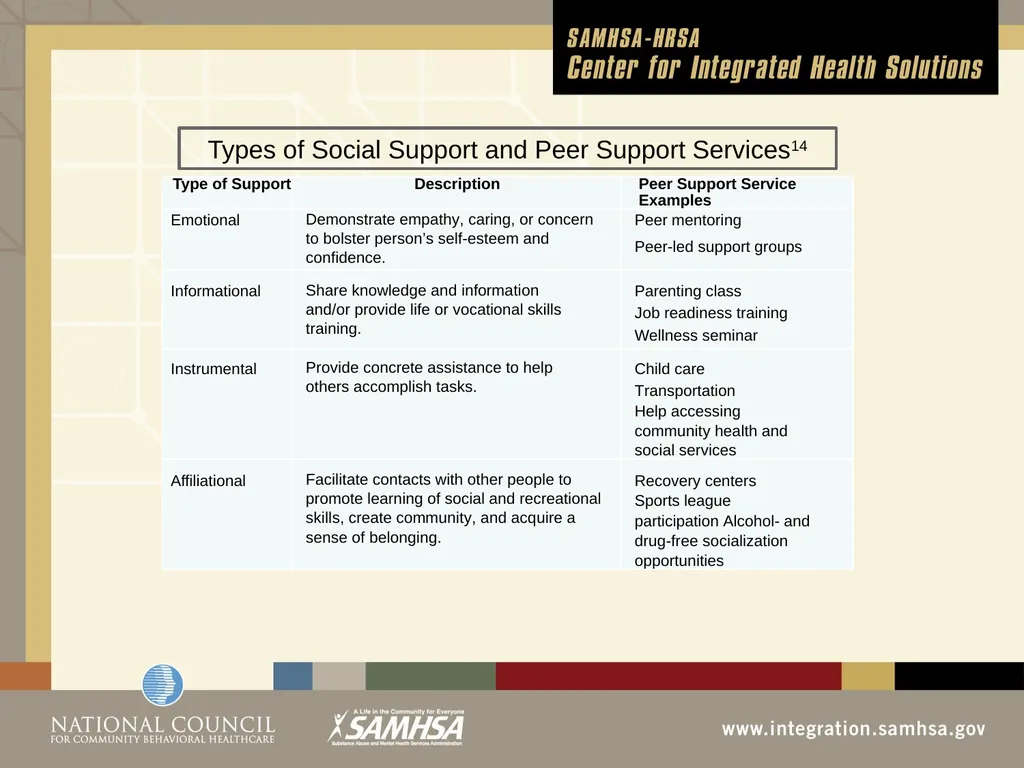
Types of Social Support and Peer Support Services14<br>
27
Peer Recovery Support Services Peer Mentoring or Coaching
one-on-one relationship in which a peer leader with more recovery experience than the person served encourages, motivates, and supports a peer who is seeking to establish or strengthen his or her recovery
Peer resource connecting
purpose of resource connecting services is to connect the peer with professional and nonprofessional services and resources available in the community that can help meet his or her individual needs on the road to recovery
Facilitating and leading recovery groups
The group activities that are structured as support groups typically involve the sharing of personal stories and some degree of collective problem-solving. Many of these groups are formed around shared identity, such as belonging to a common cultural or religious group, or shared experience related to the substance use disorder, such as the need to re-enter the community following incarceration, being HIV positive, or facing challenges in parenting
Building community
Peer recovery support service providers can help such peers make new friends and begin to
build alternative social networks<br>
one-on-one relationship in which a peer leader with more recovery experience than the person served encourages, motivates, and supports a peer who is seeking to establish or strengthen his or her recovery
Peer resource connecting
purpose of resource connecting services is to connect the peer with professional and nonprofessional services and resources available in the community that can help meet his or her individual needs on the road to recovery
Facilitating and leading recovery groups
The group activities that are structured as support groups typically involve the sharing of personal stories and some degree of collective problem-solving. Many of these groups are formed around shared identity, such as belonging to a common cultural or religious group, or shared experience related to the substance use disorder, such as the need to re-enter the community following incarceration, being HIV positive, or facing challenges in parenting
Building community
Peer recovery support service providers can help such peers make new friends and begin to
build alternative social networks<br>
28
Assessing Your Organization Board of Directors
aware of and prepared to respond to health care reform
Workforce
number of staff licensed/credentialed
Patient record
presence of and full use of electronic record
Providing holistic care
Outcome measurement
Quality management principles in place
Patient Health Technology
Administrative Information Technology (IT)
Finance
revenue from third-party billing, adequate cash reserves<br>
aware of and prepared to respond to health care reform
Workforce
number of staff licensed/credentialed
Patient record
presence of and full use of electronic record
Providing holistic care
Outcome measurement
Quality management principles in place
Patient Health Technology
Administrative Information Technology (IT)
Finance
revenue from third-party billing, adequate cash reserves<br>
29
Are We Ready? Organizations are the least ready in the area of
Patient Health Technology
Patient Record
Workforce
Board of Directors
Larger organizations are more ready than smaller organizations
Smaller organizations are currently at a disadvantage when it comes time to forge partnerships needed for integrated care<br>
Patient Health Technology
Patient Record
Workforce
Board of Directors
Larger organizations are more ready than smaller organizations
Smaller organizations are currently at a disadvantage when it comes time to forge partnerships needed for integrated care<br>
30
Promoting Integration16 Mauch’s keys for the integration of mental disorders and substance use disorders approaches and treatment are applicable in behavioral health/physical health integration
Leadership
Engage Consumers and Stakeholders
Tackle Structural Barriers/Opportunities
Shared aspirations for results
These principles are relevant at every level – from national leadership to a single agency<br>
Leadership
Engage Consumers and Stakeholders
Tackle Structural Barriers/Opportunities
Shared aspirations for results
These principles are relevant at every level – from national leadership to a single agency<br>
31
Health Reform Readiness Measure
Health Reform Readiness Index15
Domains
Patient/Family Role involved in decision-making
Evidence-based Treatment
Accountability for Patient Care
Integrated Continuum of Care<br>
Health Reform Readiness Index15
Domains
Patient/Family Role involved in decision-making
Evidence-based Treatment
Accountability for Patient Care
Integrated Continuum of Care<br>
32
Leadership Balanced and fair leadership
A strong leader or leadership team communicates the benefits of change and serves as a champion for new initiatives
Acknowledges that changing professional roles and professional identify are to be expected
Creates a positive organizational climate by
Fairness
Growth and advancement
Role Clarity (vitally important in times of change)<br>
A strong leader or leadership team communicates the benefits of change and serves as a champion for new initiatives
Acknowledges that changing professional roles and professional identify are to be expected
Creates a positive organizational climate by
Fairness
Growth and advancement
Role Clarity (vitally important in times of change)<br>
33
Engage Stakeholders Vision and mission must be established
Joint planning with key stakeholders including end users (and whatever level) must be ongoing
Find common ground
Deal with roadblocks devise solutions
Define expectations
Report on outcomes
Persistent focus on customers (at all levels)<br>
Joint planning with key stakeholders including end users (and whatever level) must be ongoing
Find common ground
Deal with roadblocks devise solutions
Define expectations
Report on outcomes
Persistent focus on customers (at all levels)<br>
34
Tackle Barriers/Opportunities17 Workforce requirements, training, credentials, recruitment
Align fiscal policy with services
Strengthen quality assurance activities
Develop data driven systems
High-value health care organizations – go beyond the data required by outside parities and collect detail data that informs staff about all phases of the agency<br>
Align fiscal policy with services
Strengthen quality assurance activities
Develop data driven systems
High-value health care organizations – go beyond the data required by outside parities and collect detail data that informs staff about all phases of the agency<br>
35
Shared aspirations for results Client-centered approach
Commitment to evidence-based practice
Continuous quality improvement (CQI)
Transparency – including regular feedback on performance and a commitment to excellence.<br>
Commitment to evidence-based practice
Continuous quality improvement (CQI)
Transparency – including regular feedback on performance and a commitment to excellence.<br>
36
Drivers of Change Survival
Stand-alone behavioral healthcare organizations are a risk in a changing health care and fiscal environment. There are myriad threats and myriad opportunities
Values
Clients are not only included in the formal organizational chart – they are at the top. The key question that should guide healthcare organizations is what should be done to benefit the person served.<br>
Stand-alone behavioral healthcare organizations are a risk in a changing health care and fiscal environment. There are myriad threats and myriad opportunities
Values
Clients are not only included in the formal organizational chart – they are at the top. The key question that should guide healthcare organizations is what should be done to benefit the person served.<br>
37
What It Takes to Integrate Is not solely a technical enterprise requires “high touch” as well as “high tech”
Involves changing culture, professional roles, and issues of professional autonomy
Involves adopting flexible professional roles
Requires the hard work of team work
Altering old routines and approaches
There are myriad threats and myriad opportunities<br>
Involves changing culture, professional roles, and issues of professional autonomy
Involves adopting flexible professional roles
Requires the hard work of team work
Altering old routines and approaches
There are myriad threats and myriad opportunities<br>
38
Evaluating Integrated Behavioral Healthcare Process Outcomes
Improved access
Higher quality of care
More care coordination
Better patient experiences18
Cost Outcomes
Reduced costs by reducing ER visits, hospitalization & intervention use<br>
Improved access
Higher quality of care
More care coordination
Better patient experiences18
Cost Outcomes
Reduced costs by reducing ER visits, hospitalization & intervention use<br>
39
Measureable Outcomes Performance Measures
Reduce 30 day hospital admissions
Reducing avoidable ER visits
Delay permanent nursing home placement
Increase access to PC
Improving patient satisfaction
Decreasing health disparities
Better patient experiences19<br>
Reduce 30 day hospital admissions
Reducing avoidable ER visits
Delay permanent nursing home placement
Increase access to PC
Improving patient satisfaction
Decreasing health disparities
Better patient experiences19<br>
40
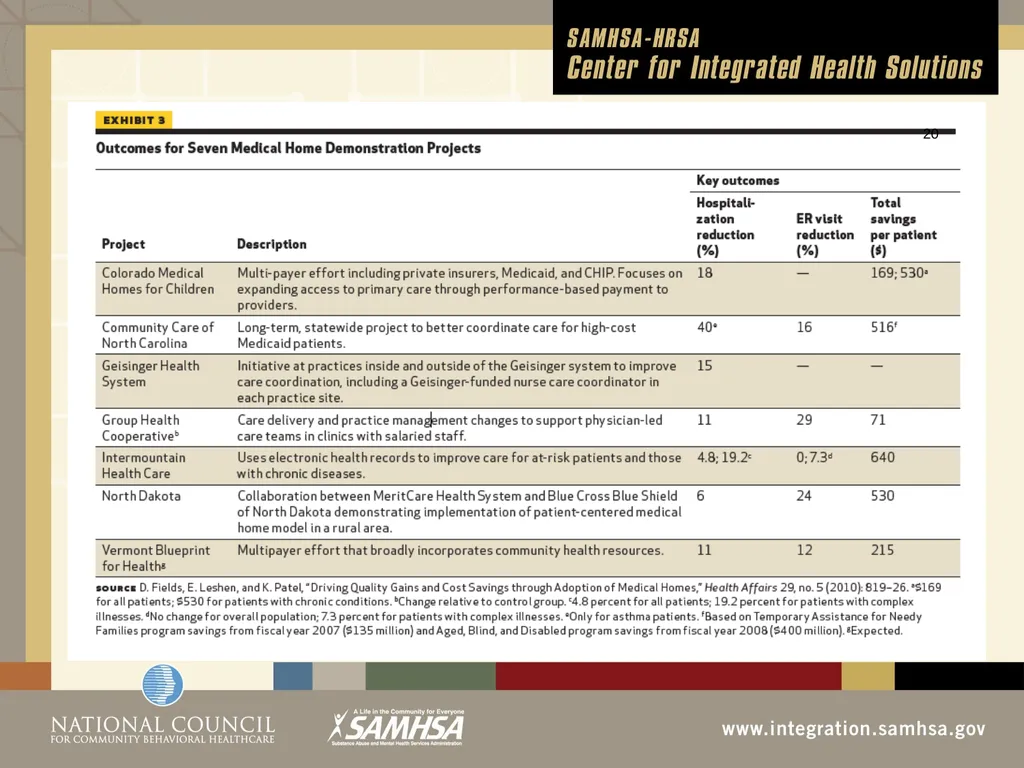
20<br>
41
Just Do It Link to CHIS Do it tool (maybe graphic too)<br>
42
References World Health Organization (2010). Framework for action on interprofessional education & collaborative practice. Geneva: World Health Organization. Retrieved from http://whqlibdoc.who.int/hq/2010/WHO_HRH_HPN_10.3_eng.pdf
World Health Organization (2010). Framework for action on interprofessional education & collaborative practice. Geneva: World Health Organization. Retrieved from http://whqlibdoc.who.int/hq/2010/WHO_HRH_HPN_10.3_eng.pdf
IPEC. (2011). Team-based communications: Building a shared foundation for education and clinical practice. Conference Proceedings. Washington DC: IPEC.
Institute of Medicine (1972). Educating for the health team. Washington, DC: National Academy of Sciences.
Institute of Medicine (2000). To err is human. Building a safer health system. Washington, DC: National Academy Press.
Institute of Medicine (2001). Crossing the quality chasm. Washington, DC: National Academy Press.
Institute of Medicine (2003). Health professions education: A bridge to quality. Washington, DC: the National Academies Press.
Aston, S. J. et al. (2012). Interprofessional education: A review and analysis of programs from three academic health centers. Academic Medicine, 87(7), 949-955.
IPEC (2011). Team-based communications: Building a shared foundation for education and clinical practice. Conference Proceedings. Washington DC: IPEC.
Canadian Interprofessional Health Collaborative (2010). A national interprofessional competency framework. Vancouver, BC: Canadian Interprofessional Health Collaborative. See: http://www.cihc.ca/resources/publications
Leininger MM. (2006).<br>
World Health Organization (2010). Framework for action on interprofessional education & collaborative practice. Geneva: World Health Organization. Retrieved from http://whqlibdoc.who.int/hq/2010/WHO_HRH_HPN_10.3_eng.pdf
IPEC. (2011). Team-based communications: Building a shared foundation for education and clinical practice. Conference Proceedings. Washington DC: IPEC.
Institute of Medicine (1972). Educating for the health team. Washington, DC: National Academy of Sciences.
Institute of Medicine (2000). To err is human. Building a safer health system. Washington, DC: National Academy Press.
Institute of Medicine (2001). Crossing the quality chasm. Washington, DC: National Academy Press.
Institute of Medicine (2003). Health professions education: A bridge to quality. Washington, DC: the National Academies Press.
Aston, S. J. et al. (2012). Interprofessional education: A review and analysis of programs from three academic health centers. Academic Medicine, 87(7), 949-955.
IPEC (2011). Team-based communications: Building a shared foundation for education and clinical practice. Conference Proceedings. Washington DC: IPEC.
Canadian Interprofessional Health Collaborative (2010). A national interprofessional competency framework. Vancouver, BC: Canadian Interprofessional Health Collaborative. See: http://www.cihc.ca/resources/publications
Leininger MM. (2006).<br>
43
References University of Arizona & Annie E.Casey Foundation (1998). The National Community Health Advisor Study: Weaving the Future.Tucson, Arizona: University of Arizona Press (410-223-2890). Retrieved from http://www.usm.edu/csho/
Hill MN, Bone LR, and Butz AM. (1996). Enhancing the role of community-health workers in research. Journal of Nursing Scholarship, 28(3), 221-226.
U. S. Department of Health and Human Services. (2009). HHS Publication No. (SMA) 09-4454 Substance Abuse and Mental Health Services.
Molfenter, T., Capoccia, V., Boyle, M., & Sherbeck, C. (2011). The readiness of addiction treatment agencies for health care reform. Substance Abuse Treatment, Prevention, and Policy, 7(16)
Mauch, D. (2011). Implementing Mental Health and Substance Abuse Integration: Drivers and Consideration. NASMPHD Meeting, July 17, 2001. Abt Associates.
Bohmer, R. (2011). The four habits of high-value health care organizations. The New England Journal of Medicine, 365(22), 2045-2047.
PCPCC, 2012
PCPCC, 2012
Health Policy Brief: Patient-Centered Medical Homes. Health Affairs, September 14, 2010. Retrieved from http://www.healthaffairs.org/healthpolicybriefs/brief.php?brief_id=25<br>
Hill MN, Bone LR, and Butz AM. (1996). Enhancing the role of community-health workers in research. Journal of Nursing Scholarship, 28(3), 221-226.
U. S. Department of Health and Human Services. (2009). HHS Publication No. (SMA) 09-4454 Substance Abuse and Mental Health Services.
Molfenter, T., Capoccia, V., Boyle, M., & Sherbeck, C. (2011). The readiness of addiction treatment agencies for health care reform. Substance Abuse Treatment, Prevention, and Policy, 7(16)
Mauch, D. (2011). Implementing Mental Health and Substance Abuse Integration: Drivers and Consideration. NASMPHD Meeting, July 17, 2001. Abt Associates.
Bohmer, R. (2011). The four habits of high-value health care organizations. The New England Journal of Medicine, 365(22), 2045-2047.
PCPCC, 2012
PCPCC, 2012
Health Policy Brief: Patient-Centered Medical Homes. Health Affairs, September 14, 2010. Retrieved from http://www.healthaffairs.org/healthpolicybriefs/brief.php?brief_id=25<br>