
Inclusion, Wellbeing and Equalities Professional
Description: Inclusion, Wellbeing and Equalities Professional Learning Framework Talking about Diversity Level Informed For Scotlands learners, with Scotlands educators Do luchd-ionnsachaidh na h-Alba, le luchd-foghlaim Alba ESInclusionTeam
Related Topics
Download Presentation
"Inclusion, Wellbeing and Equalities Professional" is the property of its rightful owner. Permission is granted to download and print the materials on this website for personal, non-commercial use only, and to display it on your personal computer provided you do not modify the materials and that you retain all copyright notices contained in the materials. By downloading content from our website, you accept the terms of this agreement.
Presentation Transcript
slide1. Inclusion, Wellbeing and Equalities Professional Learning Framework
Talking about Diversity
Level – Informed For Scotland's learners, with Scotland's educators
Do luchd-ionnsachaidh na h-Alba, le luchd-foghlaim Alba @ESInclusionTeam<br>
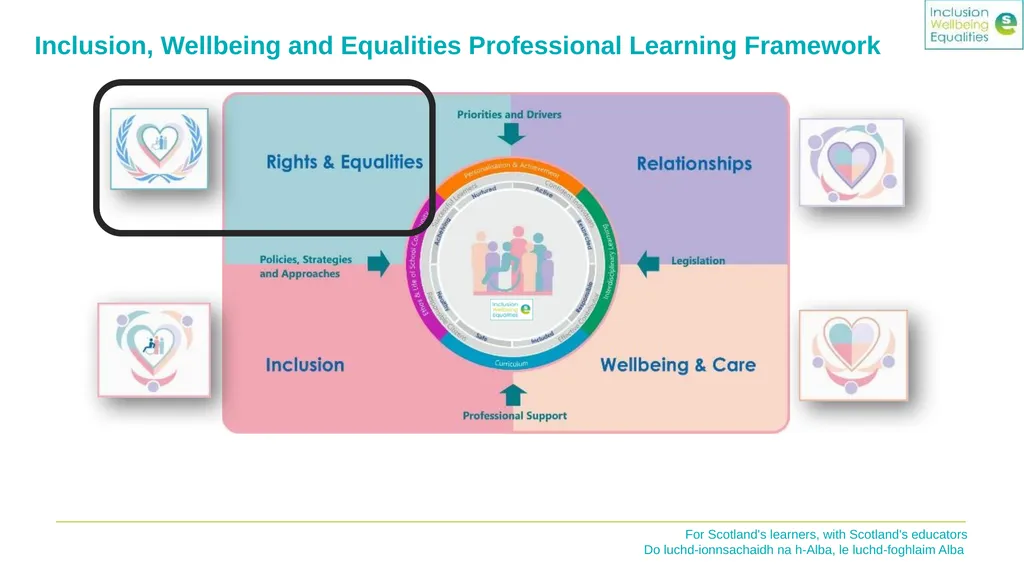
slide2. Inclusion, Wellbeing and Equalities Professional Learning Framework<br>
slide3. Pause for Thought… How to use this resource These slides can be used to facilitate professional learning in a group or whole-setting, or as a self-directed learning activity as an individual.
Facilitation notes are included at the bottom of each slide
Please do not remove or change any of the slides included.
Facilitators are welcome to add slides or activities relevant to your own setting, to support discussion and exploration of the topic. Facilitators will know their participants’ needs best.
Anyone who works in an educational setting can be a facilitator and use these slides.
For reflection or discussion activities, it is important to establish a safe space which encourages respect and honesty to ensure that everyone is able to participate.<br>
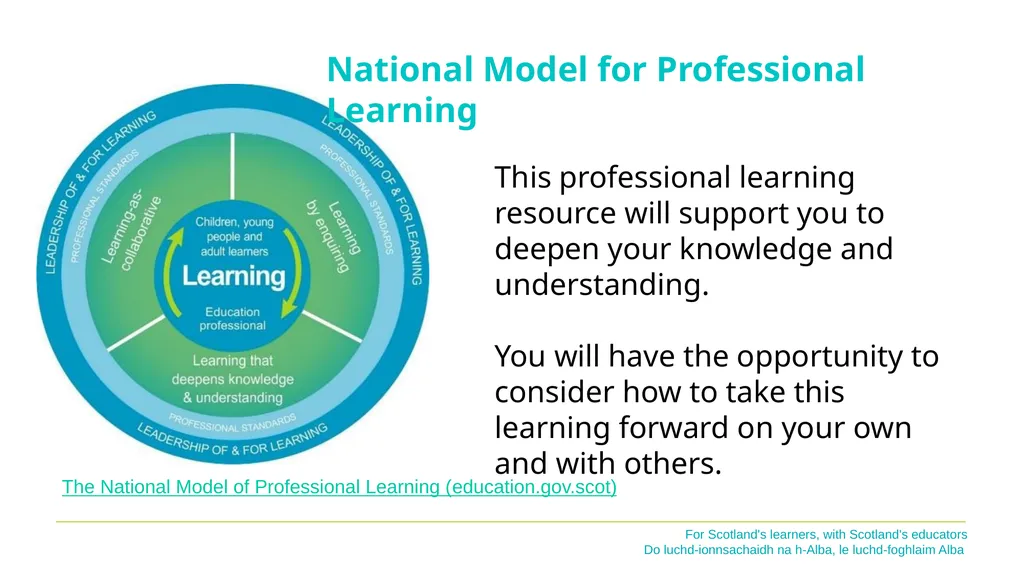
slide4. The National Model of Professional Learning (education.gov.scot) This professional learning resource will support you to deepen your knowledge and understanding.
You will have the opportunity to consider how to take this learning forward on your own and with others. National Model for Professional Learning<br>
slide5. Pause for Thought… Welcome This session aims to provide an opportunity to:
Explore some of the different types of human diversity that exist in the Scottish context.
Consider the language of diversity and useful approaches to support you to talk about diversity and take action.<br>
slide6. Pause for Thought… What do we mean by "diversity"
and "diverse people"?<br>
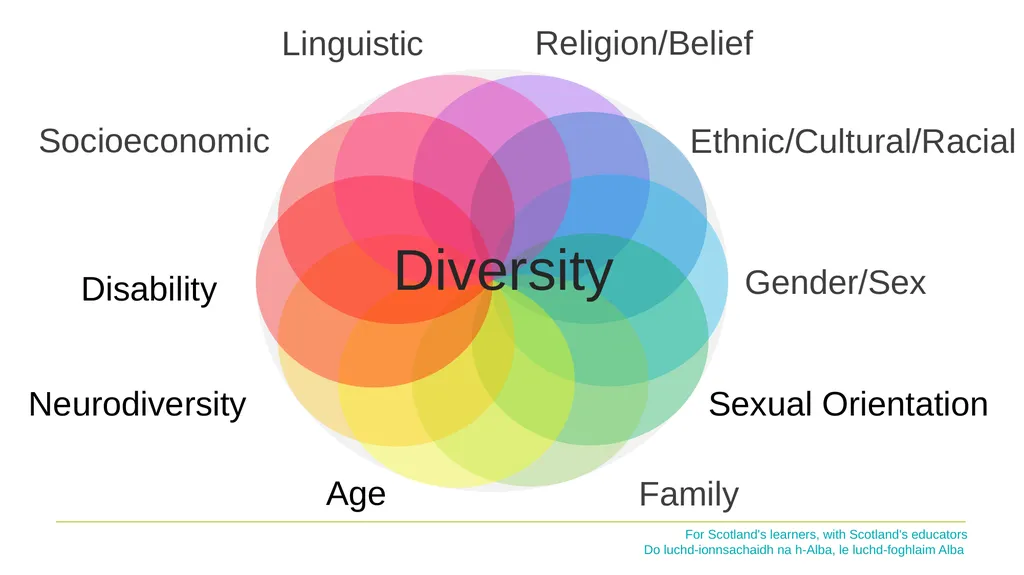
slide7. Pause for Thought… Disability Socioeconomic Linguistic Religion/Belief Gender/Sex Ethnic/Cultural/Racial Sexual Orientation Family Age Neurodiversity Diversity<br>
slide8. Common Challenge: Language Paralysis Professor Rowena Arshad uses the term "language paralysis" to describe the common feeling of being stuck when we don't know which language to use when talking about diversity.
This is often because of our lack of confidence, fear of embarrassment and fear of offending.
Language is complex and constantly evolving; words that were acceptable in the past are no longer appropriate today.
For example, "coloured people" and "that's gay" are no longer acceptable.<br>
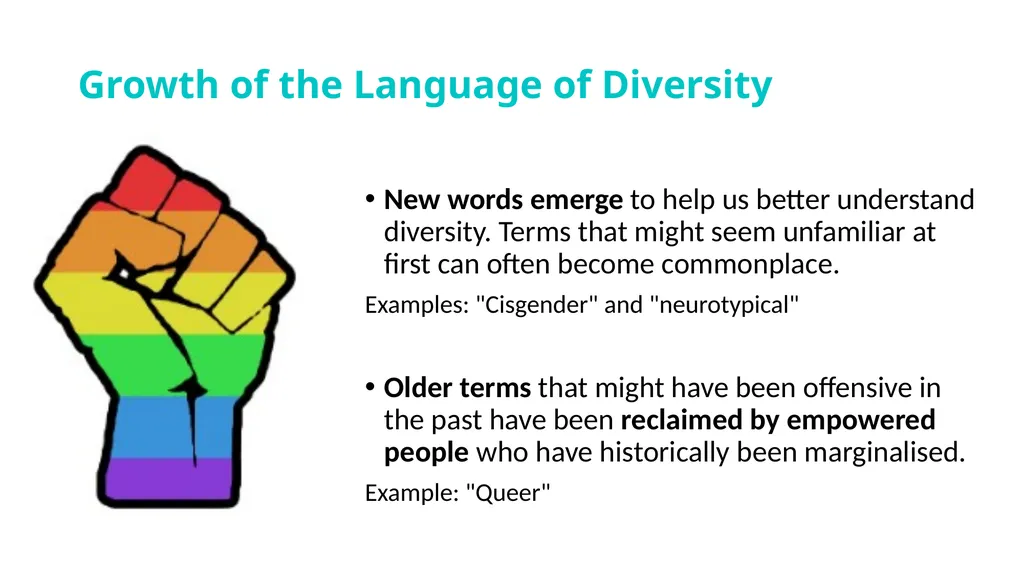
slide9. Growth of the Language of Diversity New words emerge to help us better understand diversity. Terms that might seem unfamiliar at first can often become commonplace.
Examples: "Cisgender" and "neurotypical"
Older terms that might have been offensive in the past have been reclaimed by empowered people who have historically been marginalised.
Example: "Queer"<br>
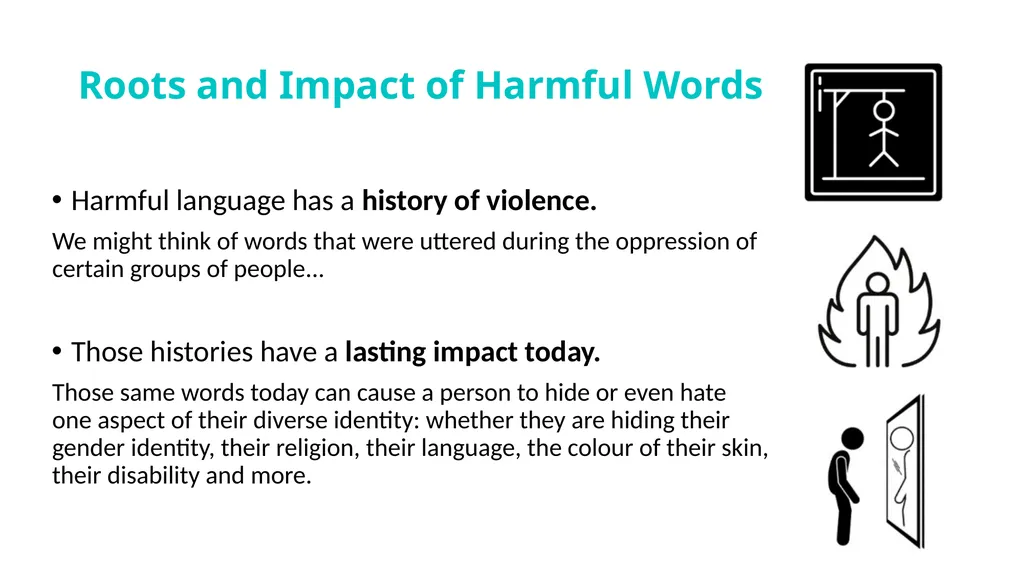
slide10. Roots and Impact of Harmful Words Harmful language has a history of violence.
We might think of words that were uttered during the oppression of certain groups of people...
Those histories have a lasting impact today.
Those same words today can cause a person to hide or even hate one aspect of their diverse identity: whether they are hiding their gender identity, their religion, their language, the colour of their skin, their disability and more.<br>
slide11. When we make mistakes... Developing language that is respectful and inclusive is a skill that requires time and practice.
Instead of feeling defensive or embarrassed when someone points out that we used the wrong language...
It’s more effective to be curious, humble and open, adopting a growth mindset.
When we make a mistake:
we can apologise and thank people for raising our awareness
do our best to listen and learn from the mistake (so we don’t keep repeating the mistake)
keep learning, talking about, and taking action on the issues.<br>
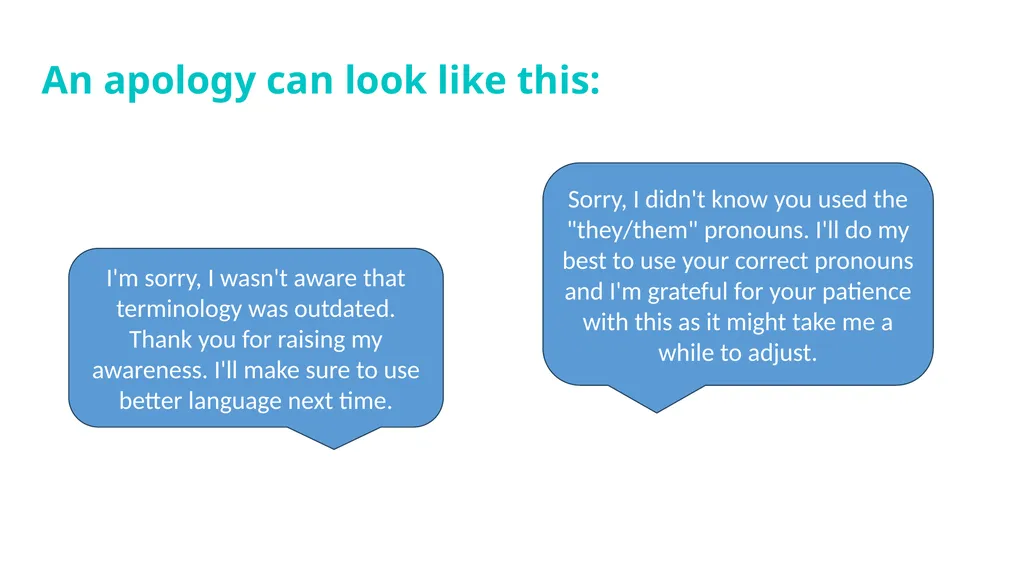
slide12. An apology can look like this: I'm sorry, I wasn't aware that terminology was outdated. Thank you for raising my awareness. I'll make sure to use better language next time. Sorry, I didn't know you used the "they/them" pronouns. I'll do my best to use your correct pronouns and I'm grateful for your patience with this as it might take me a while to adjust.<br>
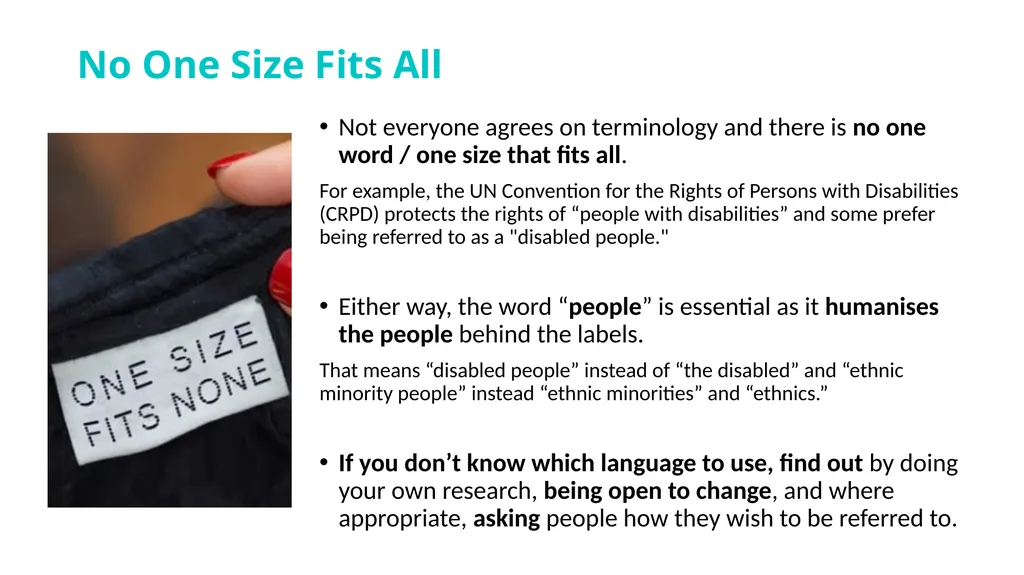
slide13. No One Size Fits All Not everyone agrees on terminology and there is no one word / one size that fits all.
For example, the UN Convention for the Rights of Persons with Disabilities (CRPD) protects the rights of “people with disabilities” and some prefer being referred to as a "disabled people."
Either way, the word “people” is essential as it humanises the people behind the labels.
That means “disabled people” instead of “the disabled” and “ethnic minority people” instead “ethnic minorities” and “ethnics.”
If you don’t know which language to use, find out by doing your own research, being open to change, and where appropriate, asking people how they wish to be referred to.<br>
slide14. Culture: Normalising Diversity If anyone does not understand a particular word or underlying concept, it is fine to ask and find out.
When we model the process of:
apologising
being curious and respectful
asking questions about diversity...
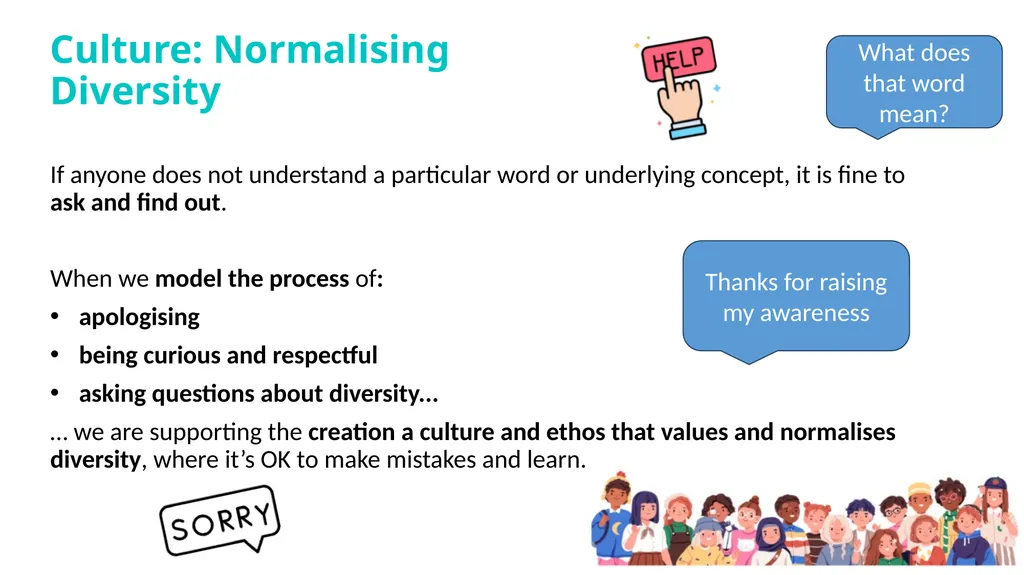
… we are supporting the creation a culture and ethos that values and normalises diversity, where it’s OK to make mistakes and learn. What does that word mean? Thanks for raising my awareness<br>
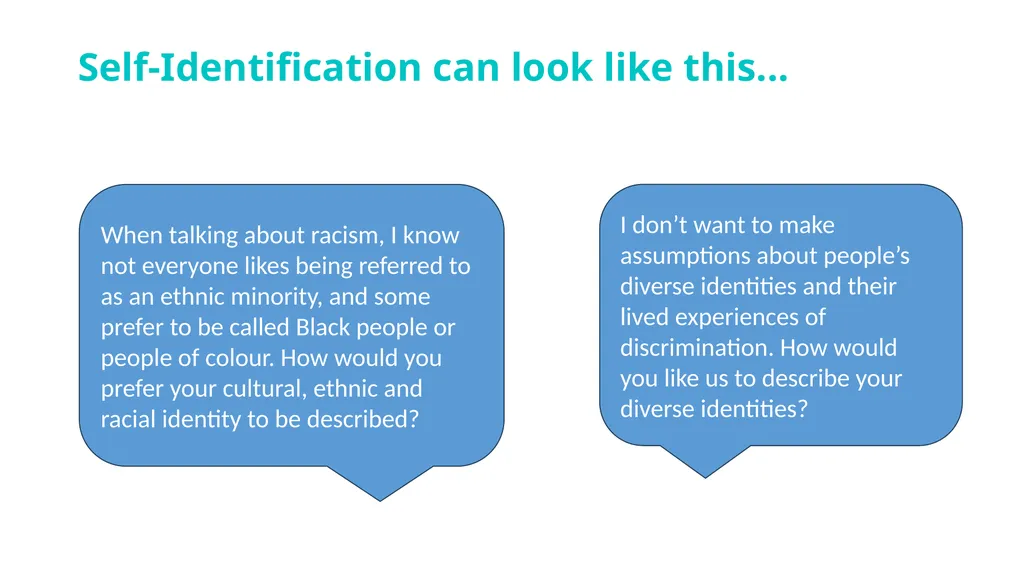
slide15. Self-Identification Sometimes, we don’t have much choice about which language to use (e.g. when referring to a specific study or filling in a census form).
But when we do have the choice, it is best to encourage self-identification where possible.
That means, giving people the opportunity to choose the language they feel most comfortable with.
Opportunities to self-identify can create a sense of respect, agency and of being valued.<br>
slide16. Self-Identification can look like this... When talking about racism, I know not everyone likes being referred to as an ethnic minority, and some prefer to be called Black people or people of colour. How would you prefer your cultural, ethnic and racial identity to be described? I don’t want to make assumptions about people’s diverse identities and their lived experiences of discrimination. How would you like us to describe your diverse identities?<br>
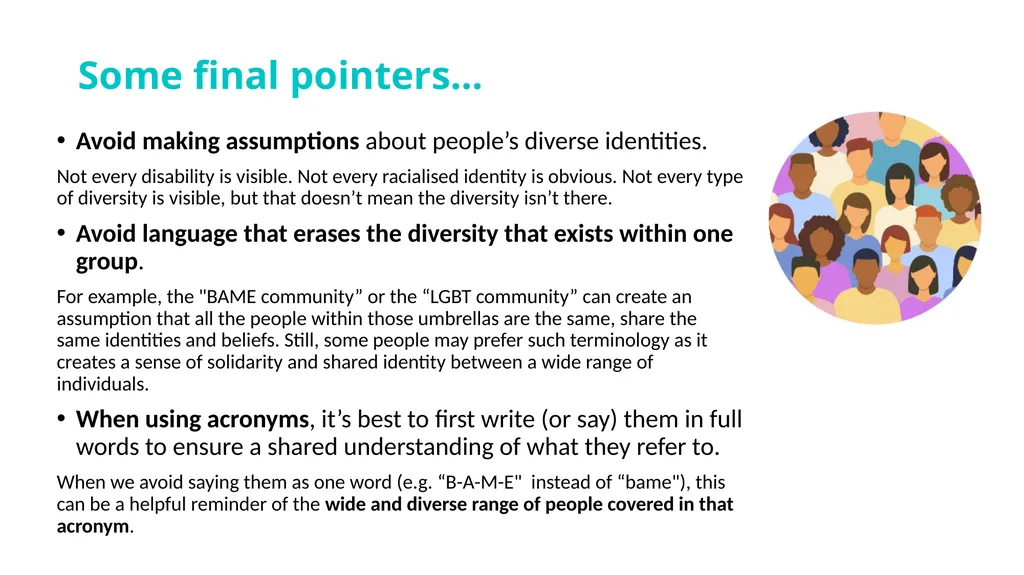
slide17. Some final pointers... Avoid making assumptions about people’s diverse identities.
Not every disability is visible. Not every racialised identity is obvious. Not every type of diversity is visible, but that doesn’t mean the diversity isn’t there.
Avoid language that erases the diversity that exists within one group.
For example, the "BAME community” or the “LGBT community” can create an assumption that all the people within those umbrellas are the same, share the same identities and beliefs. Still, some people may prefer such terminology as it creates a sense of solidarity and shared identity between a wide range of individuals.
When using acronyms, it’s best to first write (or say) them in full words to ensure a shared understanding of what they refer to.
When we avoid saying them as one word (e.g. “B-A-M-E" instead of “bame"), this can be a helpful reminder of the wide and diverse range of people covered in that acronym.<br>
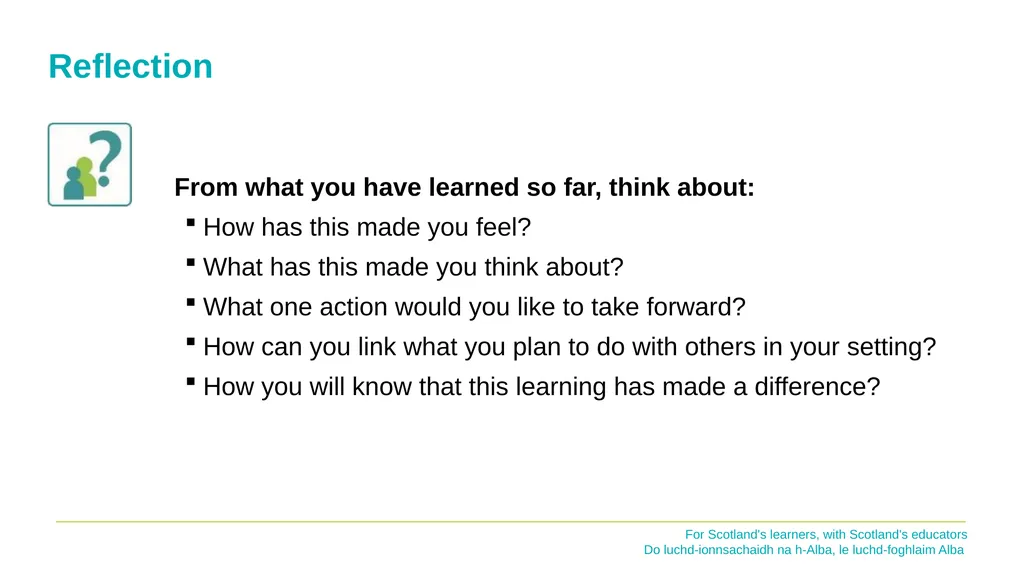
slide18. Reflection From what you have learned so far, think about:
How has this made you feel?
What has this made you think about?
What one action would you like to take forward?
How can you link what you plan to do with others in your setting?
How you will know that this learning has made a difference?<br>
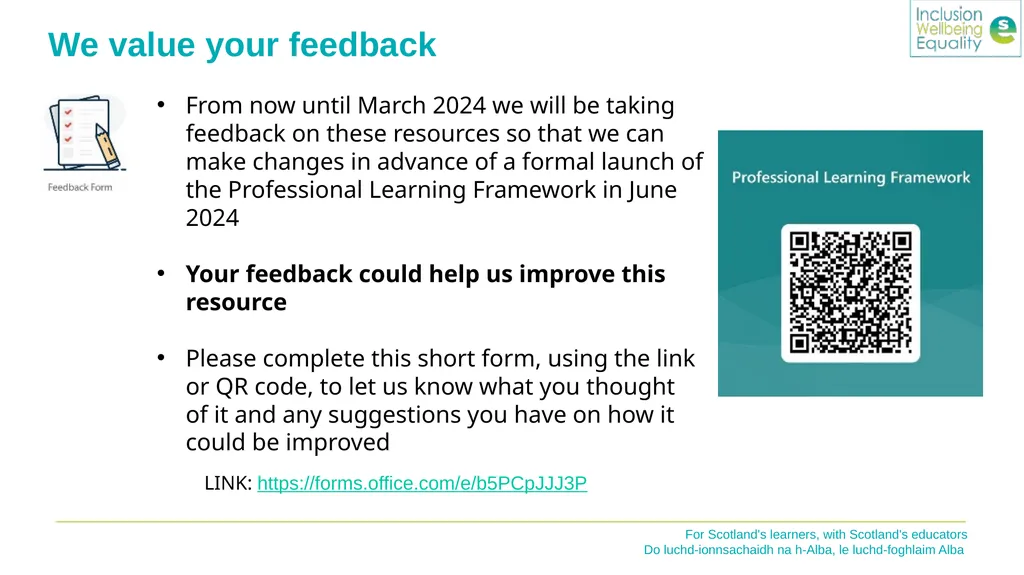
slide19. We value your feedback From now until March 2024 we will be taking feedback on these resources so that we can make changes in advance of a formal launch of the Professional Learning Framework in June 2024
Your feedback could help us improve this resource
Please complete this short form, using the link or QR code, to let us know what you thought of it and any suggestions you have on how it could be improved LINK: https://forms.office.com/e/b5PCpJJJ3P<br>
Talking about Diversity
Level – Informed For Scotland's learners, with Scotland's educators
Do luchd-ionnsachaidh na h-Alba, le luchd-foghlaim Alba @ESInclusionTeam<br>
slide2. Inclusion, Wellbeing and Equalities Professional Learning Framework<br>
slide3. Pause for Thought… How to use this resource These slides can be used to facilitate professional learning in a group or whole-setting, or as a self-directed learning activity as an individual.
Facilitation notes are included at the bottom of each slide
Please do not remove or change any of the slides included.
Facilitators are welcome to add slides or activities relevant to your own setting, to support discussion and exploration of the topic. Facilitators will know their participants’ needs best.
Anyone who works in an educational setting can be a facilitator and use these slides.
For reflection or discussion activities, it is important to establish a safe space which encourages respect and honesty to ensure that everyone is able to participate.<br>
slide4. The National Model of Professional Learning (education.gov.scot) This professional learning resource will support you to deepen your knowledge and understanding.
You will have the opportunity to consider how to take this learning forward on your own and with others. National Model for Professional Learning<br>
slide5. Pause for Thought… Welcome This session aims to provide an opportunity to:
Explore some of the different types of human diversity that exist in the Scottish context.
Consider the language of diversity and useful approaches to support you to talk about diversity and take action.<br>
slide6. Pause for Thought… What do we mean by "diversity"
and "diverse people"?<br>
slide7. Pause for Thought… Disability Socioeconomic Linguistic Religion/Belief Gender/Sex Ethnic/Cultural/Racial Sexual Orientation Family Age Neurodiversity Diversity<br>
slide8. Common Challenge: Language Paralysis Professor Rowena Arshad uses the term "language paralysis" to describe the common feeling of being stuck when we don't know which language to use when talking about diversity.
This is often because of our lack of confidence, fear of embarrassment and fear of offending.
Language is complex and constantly evolving; words that were acceptable in the past are no longer appropriate today.
For example, "coloured people" and "that's gay" are no longer acceptable.<br>
slide9. Growth of the Language of Diversity New words emerge to help us better understand diversity. Terms that might seem unfamiliar at first can often become commonplace.
Examples: "Cisgender" and "neurotypical"
Older terms that might have been offensive in the past have been reclaimed by empowered people who have historically been marginalised.
Example: "Queer"<br>
slide10. Roots and Impact of Harmful Words Harmful language has a history of violence.
We might think of words that were uttered during the oppression of certain groups of people...
Those histories have a lasting impact today.
Those same words today can cause a person to hide or even hate one aspect of their diverse identity: whether they are hiding their gender identity, their religion, their language, the colour of their skin, their disability and more.<br>
slide11. When we make mistakes... Developing language that is respectful and inclusive is a skill that requires time and practice.
Instead of feeling defensive or embarrassed when someone points out that we used the wrong language...
It’s more effective to be curious, humble and open, adopting a growth mindset.
When we make a mistake:
we can apologise and thank people for raising our awareness
do our best to listen and learn from the mistake (so we don’t keep repeating the mistake)
keep learning, talking about, and taking action on the issues.<br>
slide12. An apology can look like this: I'm sorry, I wasn't aware that terminology was outdated. Thank you for raising my awareness. I'll make sure to use better language next time. Sorry, I didn't know you used the "they/them" pronouns. I'll do my best to use your correct pronouns and I'm grateful for your patience with this as it might take me a while to adjust.<br>
slide13. No One Size Fits All Not everyone agrees on terminology and there is no one word / one size that fits all.
For example, the UN Convention for the Rights of Persons with Disabilities (CRPD) protects the rights of “people with disabilities” and some prefer being referred to as a "disabled people."
Either way, the word “people” is essential as it humanises the people behind the labels.
That means “disabled people” instead of “the disabled” and “ethnic minority people” instead “ethnic minorities” and “ethnics.”
If you don’t know which language to use, find out by doing your own research, being open to change, and where appropriate, asking people how they wish to be referred to.<br>
slide14. Culture: Normalising Diversity If anyone does not understand a particular word or underlying concept, it is fine to ask and find out.
When we model the process of:
apologising
being curious and respectful
asking questions about diversity...
… we are supporting the creation a culture and ethos that values and normalises diversity, where it’s OK to make mistakes and learn. What does that word mean? Thanks for raising my awareness<br>
slide15. Self-Identification Sometimes, we don’t have much choice about which language to use (e.g. when referring to a specific study or filling in a census form).
But when we do have the choice, it is best to encourage self-identification where possible.
That means, giving people the opportunity to choose the language they feel most comfortable with.
Opportunities to self-identify can create a sense of respect, agency and of being valued.<br>
slide16. Self-Identification can look like this... When talking about racism, I know not everyone likes being referred to as an ethnic minority, and some prefer to be called Black people or people of colour. How would you prefer your cultural, ethnic and racial identity to be described? I don’t want to make assumptions about people’s diverse identities and their lived experiences of discrimination. How would you like us to describe your diverse identities?<br>
slide17. Some final pointers... Avoid making assumptions about people’s diverse identities.
Not every disability is visible. Not every racialised identity is obvious. Not every type of diversity is visible, but that doesn’t mean the diversity isn’t there.
Avoid language that erases the diversity that exists within one group.
For example, the "BAME community” or the “LGBT community” can create an assumption that all the people within those umbrellas are the same, share the same identities and beliefs. Still, some people may prefer such terminology as it creates a sense of solidarity and shared identity between a wide range of individuals.
When using acronyms, it’s best to first write (or say) them in full words to ensure a shared understanding of what they refer to.
When we avoid saying them as one word (e.g. “B-A-M-E" instead of “bame"), this can be a helpful reminder of the wide and diverse range of people covered in that acronym.<br>
slide18. Reflection From what you have learned so far, think about:
How has this made you feel?
What has this made you think about?
What one action would you like to take forward?
How can you link what you plan to do with others in your setting?
How you will know that this learning has made a difference?<br>
slide19. We value your feedback From now until March 2024 we will be taking feedback on these resources so that we can make changes in advance of a formal launch of the Professional Learning Framework in June 2024
Your feedback could help us improve this resource
Please complete this short form, using the link or QR code, to let us know what you thought of it and any suggestions you have on how it could be improved LINK: https://forms.office.com/e/b5PCpJJJ3P<br>