
Indian Actuarial Profession Serving the Cause of
A
Published · 21 slides · 0 views
1 / 1


Description
Indian Actuarial Profession Serving the Cause of Public Interest Rishabh Prakash Ramnath Shenoy Guide Anuradha Lal Indian Fellowship Seminar USE OF INTEREST RATE SWAPS IN INSURANCE WHY THE MARKET IS NOT GROWING? AGENDA 2 Interest Rate Swaps
Related Topics
Share
Embed code
Download this presentation From Below
"Indian Actuarial Profession Serving the Cause of" is the property of its rightful owner. Permission is granted to download and print the materials on this website for personal, non-commercial use only, and to display it on your personal computer provided you do not modify the materials and that you retain all copyright notices contained in the materials. By downloading content from our website, you accept the terms of this agreement.
Presentation Transcript
01
Indian Actuarial Profession
Serving the Cause of Public Interest Rishabh Prakash
Ramnath Shenoy
Guide
Anuradha Lal Indian Fellowship Seminar USE OF INTEREST RATE SWAPS IN INSURANCE WHY THE MARKET IS NOT GROWING?<br>
Serving the Cause of Public Interest Rishabh Prakash
Ramnath Shenoy
Guide
Anuradha Lal Indian Fellowship Seminar USE OF INTEREST RATE SWAPS IN INSURANCE WHY THE MARKET IS NOT GROWING?<br>
02
AGENDA 2 Interest Rate Swaps – Overview
Interest Rate Swaps – Types
Interest Rate Swaps – Regulation
Interest Rate Swaps – Use in Insurance
Interest Rate Swaps – Market Overview
Why the market is not growing
Take Aways<br>
Interest Rate Swaps – Types
Interest Rate Swaps – Regulation
Interest Rate Swaps – Use in Insurance
Interest Rate Swaps – Market Overview
Why the market is not growing
Take Aways<br>
03
INTEREST RATE SWAP | OVERVIEW
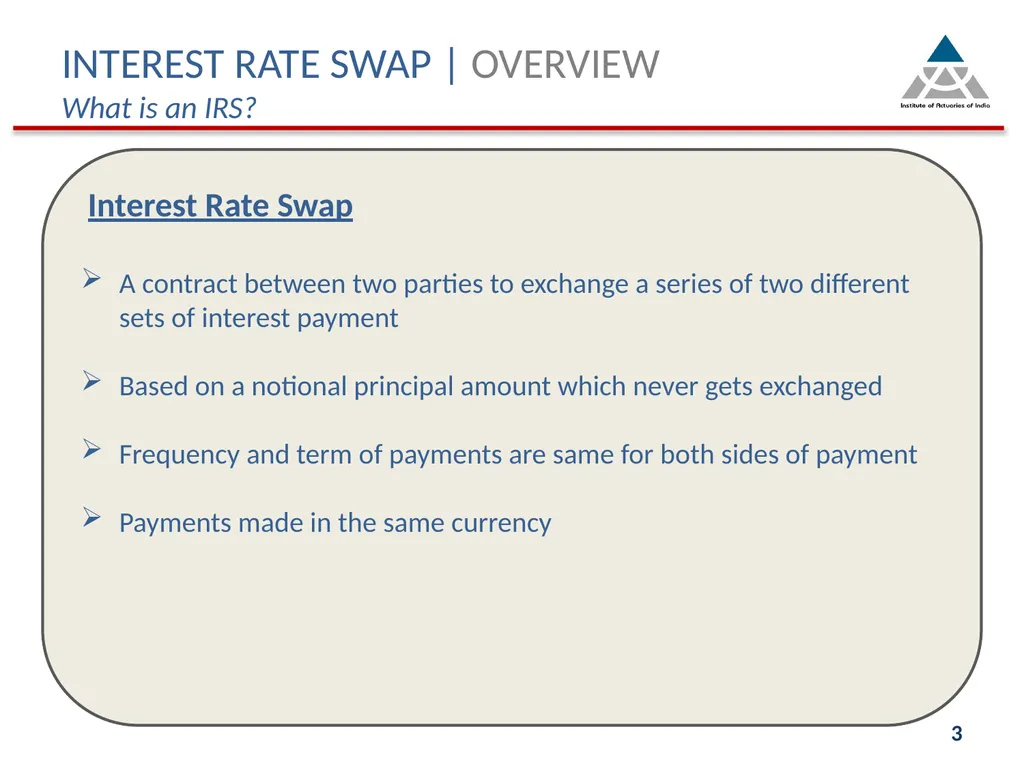
What is an IRS? 3 Interest Rate Swap
A contract between two parties to exchange a series of two different sets of interest payment
Based on a notional principal amount which never gets exchanged
Frequency and term of payments are same for both sides of payment
Payments made in the same currency<br>
A contract between two parties to exchange a series of two different sets of interest payment
Based on a notional principal amount which never gets exchanged
Frequency and term of payments are same for both sides of payment
Payments made in the same currency<br>
04
INTEREST RATE SWAP | TYPES
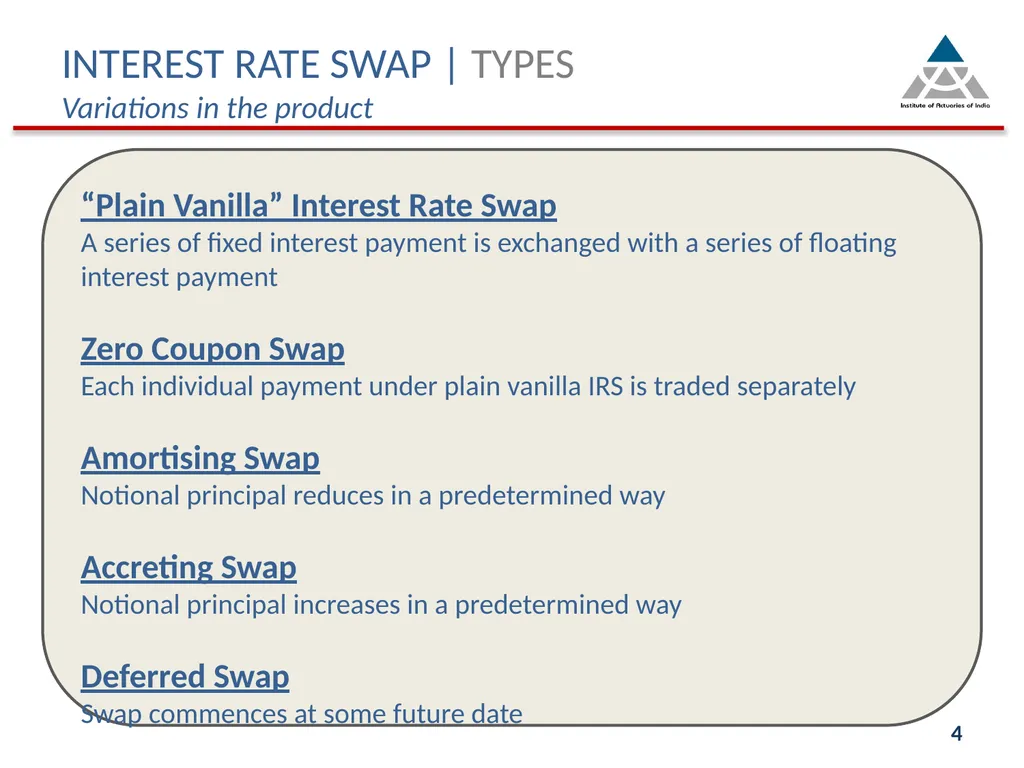
Variations in the product 4 “Plain Vanilla” Interest Rate Swap
A series of fixed interest payment is exchanged with a series of floating interest payment
Zero Coupon Swap
Each individual payment under plain vanilla IRS is traded separately
Amortising Swap
Notional principal reduces in a predetermined way
Accreting Swap
Notional principal increases in a predetermined way
Deferred Swap
Swap commences at some future date<br>
A series of fixed interest payment is exchanged with a series of floating interest payment
Zero Coupon Swap
Each individual payment under plain vanilla IRS is traded separately
Amortising Swap
Notional principal reduces in a predetermined way
Accreting Swap
Notional principal increases in a predetermined way
Deferred Swap
Swap commences at some future date<br>
05
INTEREST RATE SWAP | REGULATION
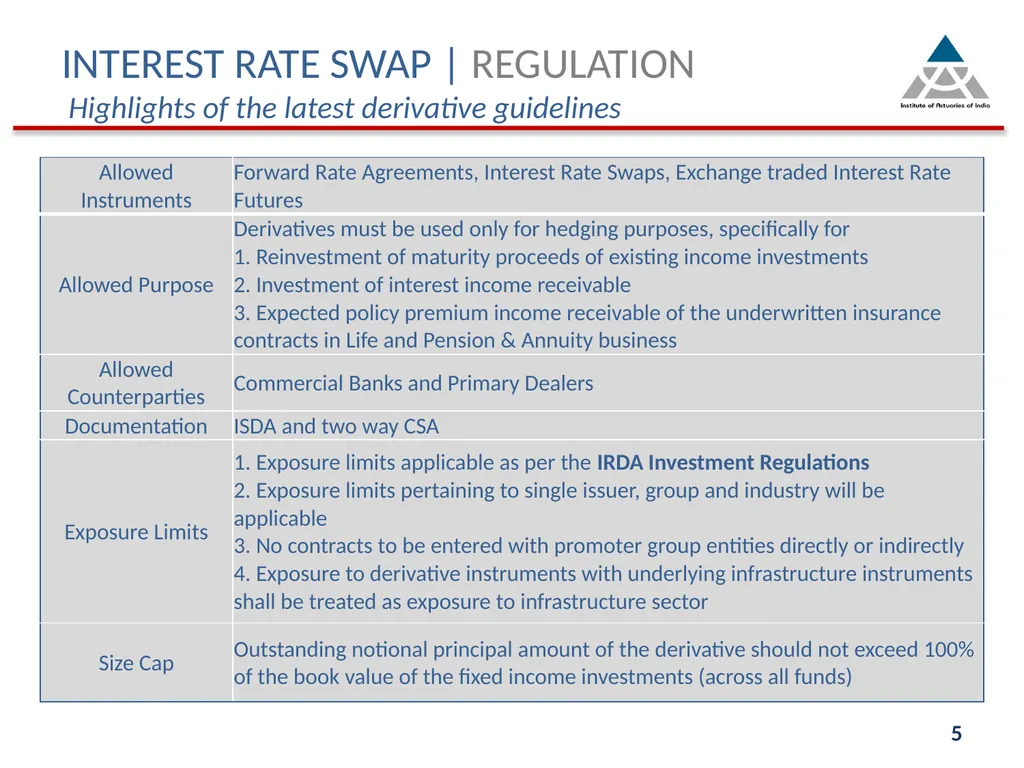
Highlights of the latest derivative guidelines 5<br>
06
INTEREST RATE SWAP | USE IN INSURANCE
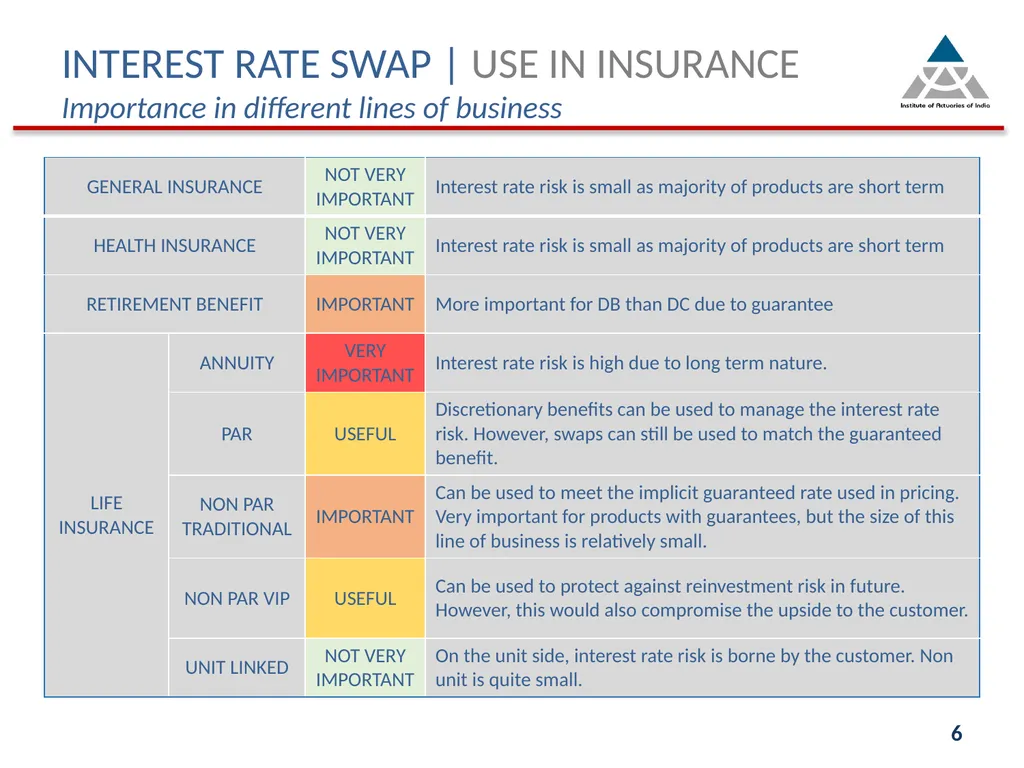
Importance in different lines of business 6<br>
07
INTEREST RATE SWAP | USE IN INSURANCE
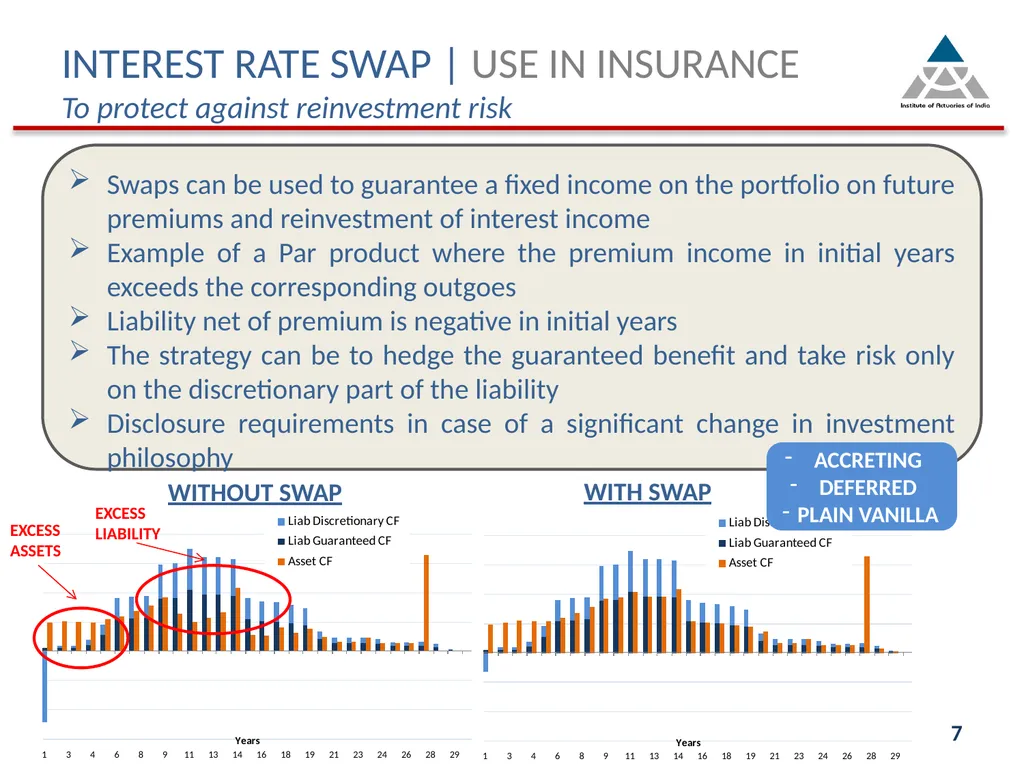
To protect against reinvestment risk 7 Swaps can be used to guarantee a fixed income on the portfolio on future premiums and reinvestment of interest income
Example of a Par product where the premium income in initial years exceeds the corresponding outgoes
Liability net of premium is negative in initial years
The strategy can be to hedge the guaranteed benefit and take risk only on the discretionary part of the liability
Disclosure requirements in case of a significant change in investment philosophy ACCRETING
DEFERRED
PLAIN VANILLA EXCESS ASSETS EXCESS LIABILITY WITHOUT SWAP WITH SWAP<br>
Example of a Par product where the premium income in initial years exceeds the corresponding outgoes
Liability net of premium is negative in initial years
The strategy can be to hedge the guaranteed benefit and take risk only on the discretionary part of the liability
Disclosure requirements in case of a significant change in investment philosophy ACCRETING
DEFERRED
PLAIN VANILLA EXCESS ASSETS EXCESS LIABILITY WITHOUT SWAP WITH SWAP<br>
08
INTEREST RATE SWAP | USE IN INSURANCE
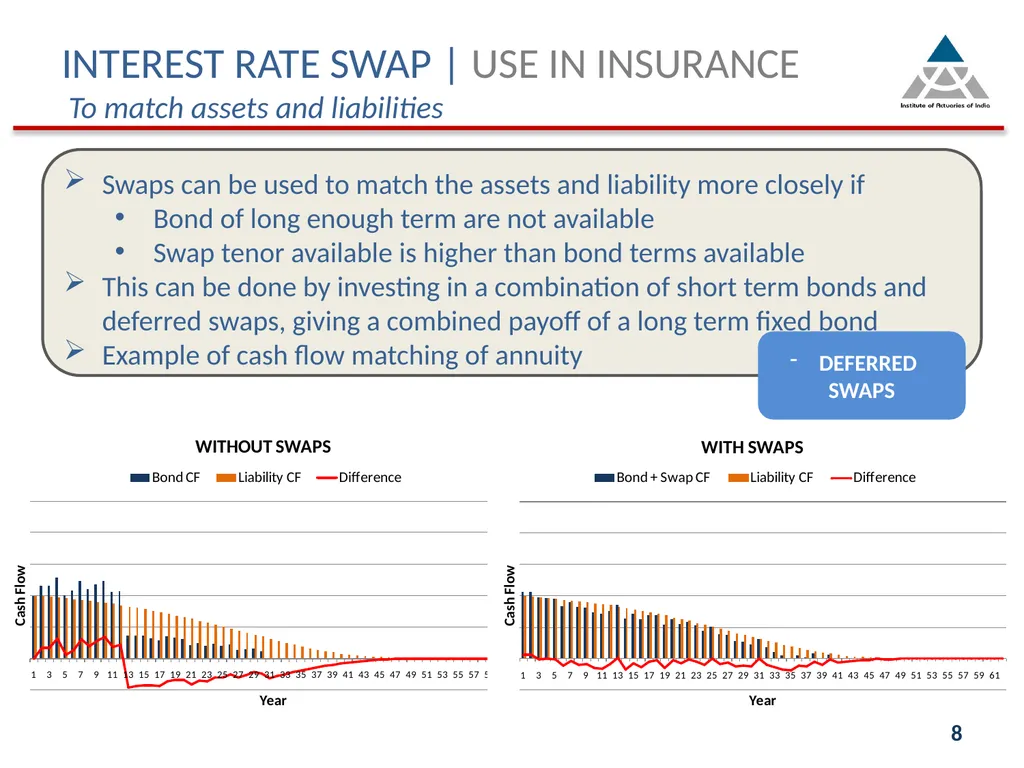
To match assets and liabilities 8 Swaps can be used to match the assets and liability more closely if
Bond of long enough term are not available
Swap tenor available is higher than bond terms available
This can be done by investing in a combination of short term bonds and deferred swaps, giving a combined payoff of a long term fixed bond
Example of cash flow matching of annuity DEFERRED SWAPS<br>
Bond of long enough term are not available
Swap tenor available is higher than bond terms available
This can be done by investing in a combination of short term bonds and deferred swaps, giving a combined payoff of a long term fixed bond
Example of cash flow matching of annuity DEFERRED SWAPS<br>
09
INTEREST RATE SWAP | USE IN INSURANCE
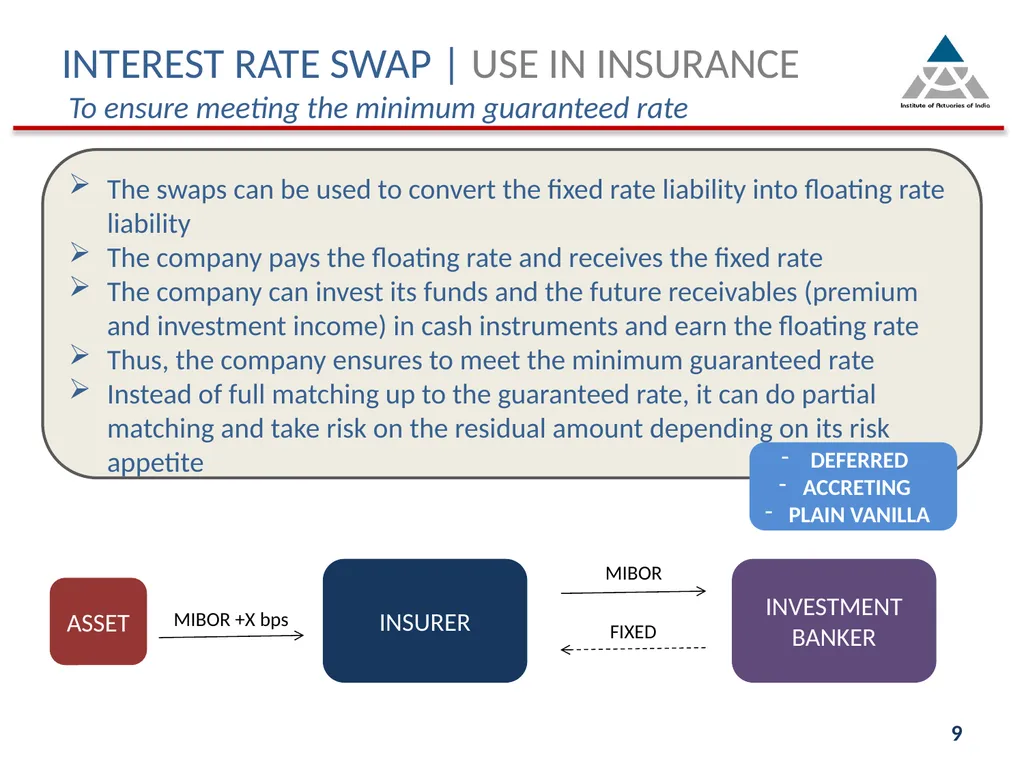
To ensure meeting the minimum guaranteed rate 9 The swaps can be used to convert the fixed rate liability into floating rate liability
The company pays the floating rate and receives the fixed rate
The company can invest its funds and the future receivables (premium and investment income) in cash instruments and earn the floating rate
Thus, the company ensures to meet the minimum guaranteed rate
Instead of full matching up to the guaranteed rate, it can do partial matching and take risk on the residual amount depending on its risk appetite DEFERRED
ACCRETING
PLAIN VANILLA MIBOR +X bps MIBOR FIXED ASSET INSURER INVESTMENT BANKER<br>
The company pays the floating rate and receives the fixed rate
The company can invest its funds and the future receivables (premium and investment income) in cash instruments and earn the floating rate
Thus, the company ensures to meet the minimum guaranteed rate
Instead of full matching up to the guaranteed rate, it can do partial matching and take risk on the residual amount depending on its risk appetite DEFERRED
ACCRETING
PLAIN VANILLA MIBOR +X bps MIBOR FIXED ASSET INSURER INVESTMENT BANKER<br>
10
INTEREST RATE SWAP | USE IN INSURANCE
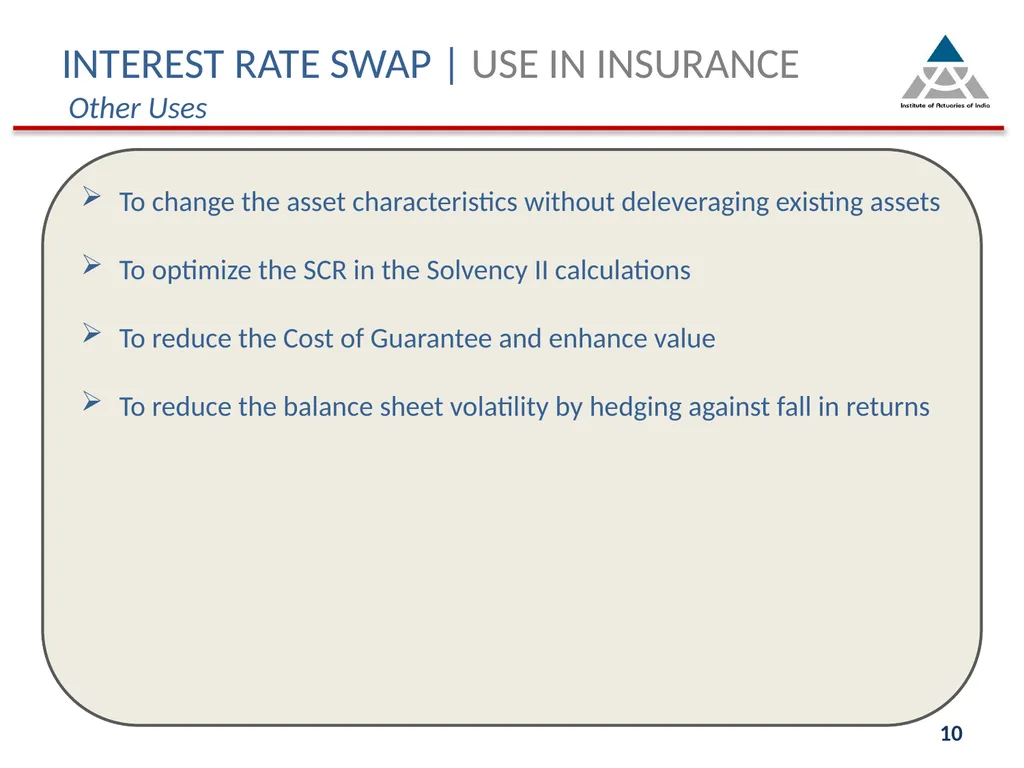
Other Uses 10 To change the asset characteristics without deleveraging existing assets
To optimize the SCR in the Solvency II calculations
To reduce the Cost of Guarantee and enhance value
To reduce the balance sheet volatility by hedging against fall in returns<br>
To optimize the SCR in the Solvency II calculations
To reduce the Cost of Guarantee and enhance value
To reduce the balance sheet volatility by hedging against fall in returns<br>
11
INTEREST RATE SWAP | MARKET OVERVIEW
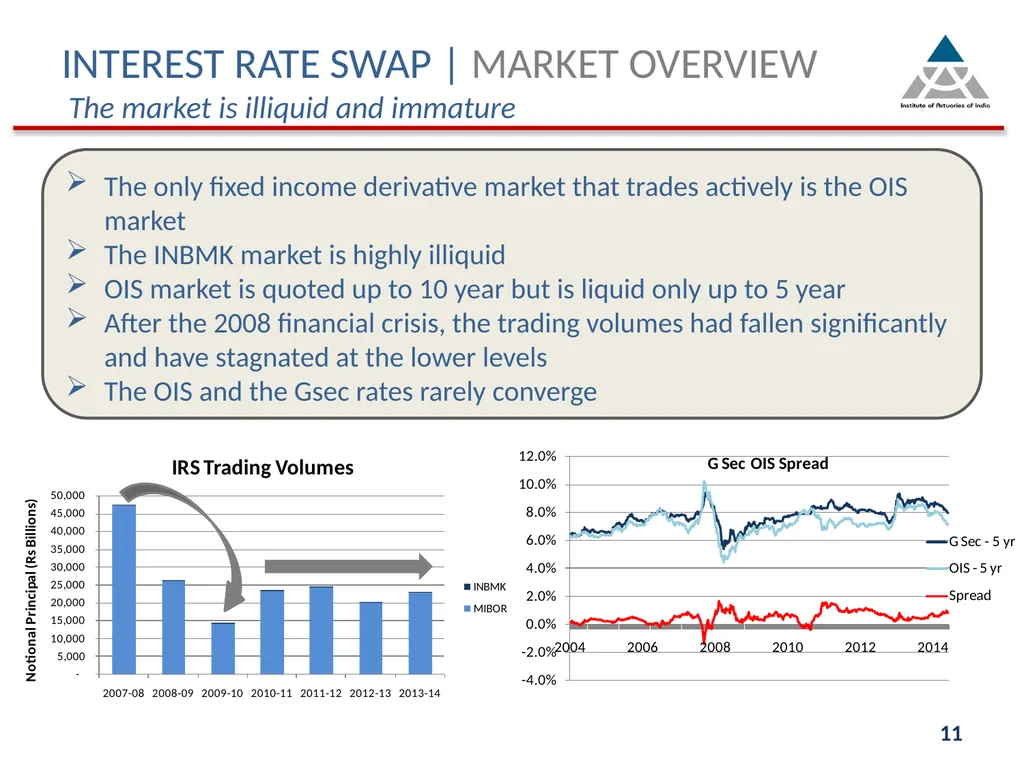
The market is illiquid and immature 11 The only fixed income derivative market that trades actively is the OIS market
The INBMK market is highly illiquid
OIS market is quoted up to 10 year but is liquid only up to 5 year
After the 2008 financial crisis, the trading volumes had fallen significantly and have stagnated at the lower levels
The OIS and the Gsec rates rarely converge<br>
The INBMK market is highly illiquid
OIS market is quoted up to 10 year but is liquid only up to 5 year
After the 2008 financial crisis, the trading volumes had fallen significantly and have stagnated at the lower levels
The OIS and the Gsec rates rarely converge<br>
12
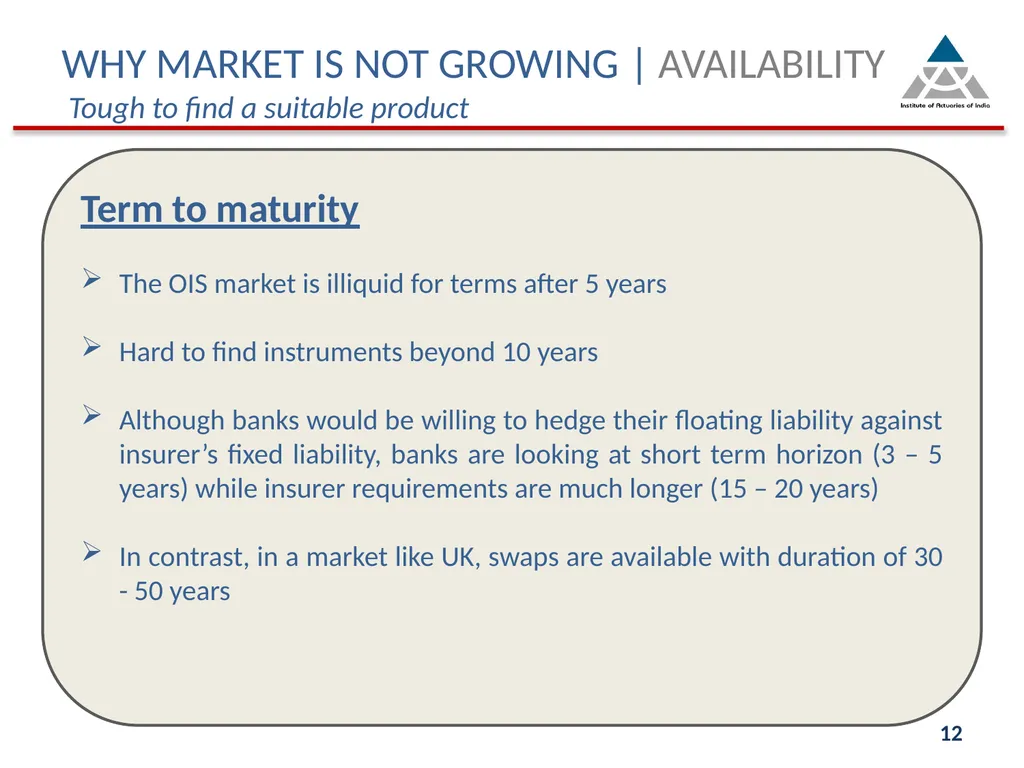
WHY MARKET IS NOT GROWING | AVAILABILITY
Tough to find a suitable product 12 Term to maturity
The OIS market is illiquid for terms after 5 years
Hard to find instruments beyond 10 years
Although banks would be willing to hedge their floating liability against insurer’s fixed liability, banks are looking at short term horizon (3 – 5 years) while insurer requirements are much longer (15 – 20 years)
In contrast, in a market like UK, swaps are available with duration of 30 - 50 years<br>
The OIS market is illiquid for terms after 5 years
Hard to find instruments beyond 10 years
Although banks would be willing to hedge their floating liability against insurer’s fixed liability, banks are looking at short term horizon (3 – 5 years) while insurer requirements are much longer (15 – 20 years)
In contrast, in a market like UK, swaps are available with duration of 30 - 50 years<br>
13
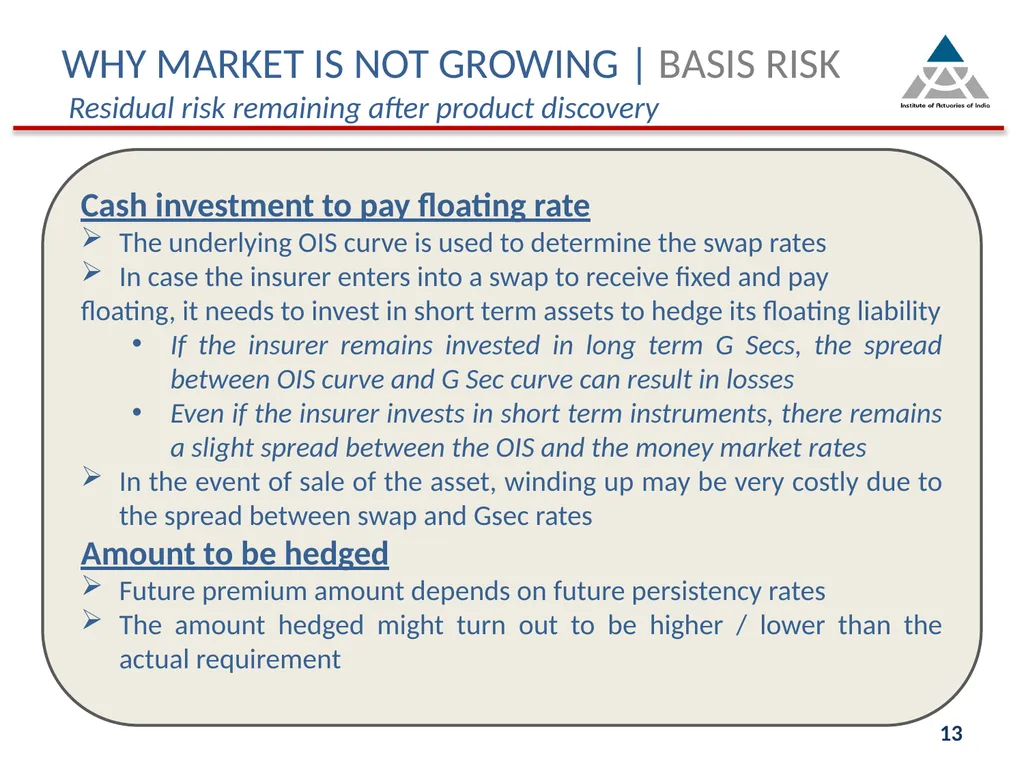
WHY MARKET IS NOT GROWING | BASIS RISK
Residual risk remaining after product discovery 13 Cash investment to pay floating rate
The underlying OIS curve is used to determine the swap rates
In case the insurer enters into a swap to receive fixed and pay
floating, it needs to invest in short term assets to hedge its floating liability
If the insurer remains invested in long term G Secs, the spread between OIS curve and G Sec curve can result in losses
Even if the insurer invests in short term instruments, there remains a slight spread between the OIS and the money market rates
In the event of sale of the asset, winding up may be very costly due to the spread between swap and Gsec rates
Amount to be hedged
Future premium amount depends on future persistency rates
The amount hedged might turn out to be higher / lower than the actual requirement<br>
The underlying OIS curve is used to determine the swap rates
In case the insurer enters into a swap to receive fixed and pay
floating, it needs to invest in short term assets to hedge its floating liability
If the insurer remains invested in long term G Secs, the spread between OIS curve and G Sec curve can result in losses
Even if the insurer invests in short term instruments, there remains a slight spread between the OIS and the money market rates
In the event of sale of the asset, winding up may be very costly due to the spread between swap and Gsec rates
Amount to be hedged
Future premium amount depends on future persistency rates
The amount hedged might turn out to be higher / lower than the actual requirement<br>
14
WHY MARKET IS NOT GROWING | COMPLEXITIES - 1
Complex product to manage 14 Board Approval
Need for detailed pre approved policy from Board
Should cover authorized products, ensure adequate staff resources and establish management responsibilities
Infrastructure requirements
Investment Management Systems to be prepared to manage derivatives
Initial expenses to be incurred in setting systems and processes and staff
Risk Management Policy
Identification of potential risks, suitable measurement parameters, suitable VaR level, and risk limits
Decisions to be discussed in ALCO and IC<br>
Need for detailed pre approved policy from Board
Should cover authorized products, ensure adequate staff resources and establish management responsibilities
Infrastructure requirements
Investment Management Systems to be prepared to manage derivatives
Initial expenses to be incurred in setting systems and processes and staff
Risk Management Policy
Identification of potential risks, suitable measurement parameters, suitable VaR level, and risk limits
Decisions to be discussed in ALCO and IC<br>
15
WHY MARKET IS NOT GROWING | COMPLEXITIES - 2
Complex product to manage 15 Monitoring and rebalancing / regular MIS
Board review at least once a year
Quarterly report to IRDA
Demonstrating that swap is used only for hedging purposes
Hedge effectiveness needs to be proved
Hedging instrument should cover the risk within 80% – 125%
ISDA Documentation / CSA Agreement
ISDA documentation requirement
Need to enter into a two way CSA agreement to reduce Credit risk
Can be expensive and time consuming<br>
Board review at least once a year
Quarterly report to IRDA
Demonstrating that swap is used only for hedging purposes
Hedge effectiveness needs to be proved
Hedging instrument should cover the risk within 80% – 125%
ISDA Documentation / CSA Agreement
ISDA documentation requirement
Need to enter into a two way CSA agreement to reduce Credit risk
Can be expensive and time consuming<br>
16
WHY MARKET IS NOT GROWING | COMPLEXITIES - 3
What is an IRS? 16 Credit Exposure Calculation
Future Credit exposure based on tenor dependent conversion factors
With periodic collateral exchange under CSA agreements, conversion factor of tenor 1 year or less should be used
Accounting and Disclosure
Accounting as per AS 30 and disclosure as per AS 31 and AS 32
Disclosure on nature and terms of outstanding derivatives and potential losses on counterparty failure
Audit Requirements
Prior approval from the concurrent auditor about adequacy of systems and processes to handle derivatives<br>
Future Credit exposure based on tenor dependent conversion factors
With periodic collateral exchange under CSA agreements, conversion factor of tenor 1 year or less should be used
Accounting and Disclosure
Accounting as per AS 30 and disclosure as per AS 31 and AS 32
Disclosure on nature and terms of outstanding derivatives and potential losses on counterparty failure
Audit Requirements
Prior approval from the concurrent auditor about adequacy of systems and processes to handle derivatives<br>
17
WHY MARKET IS NOT GROWING | COUNTERPARTY RISK
Risk and Issues in management 17 In case of counterparty default, there might be losses and also the cost of entering into a new hedge
Collateralisation requires exchange and investments of collateral on a regular basis
Insurer not allowed to borrow funds, acceptance of cash collateral amounts to borrowing
In case of using bond collateral, the market value will be volatile
Diversification hard to achieve for insurers with the limited swap market<br>
Collateralisation requires exchange and investments of collateral on a regular basis
Insurer not allowed to borrow funds, acceptance of cash collateral amounts to borrowing
In case of using bond collateral, the market value will be volatile
Diversification hard to achieve for insurers with the limited swap market<br>
18
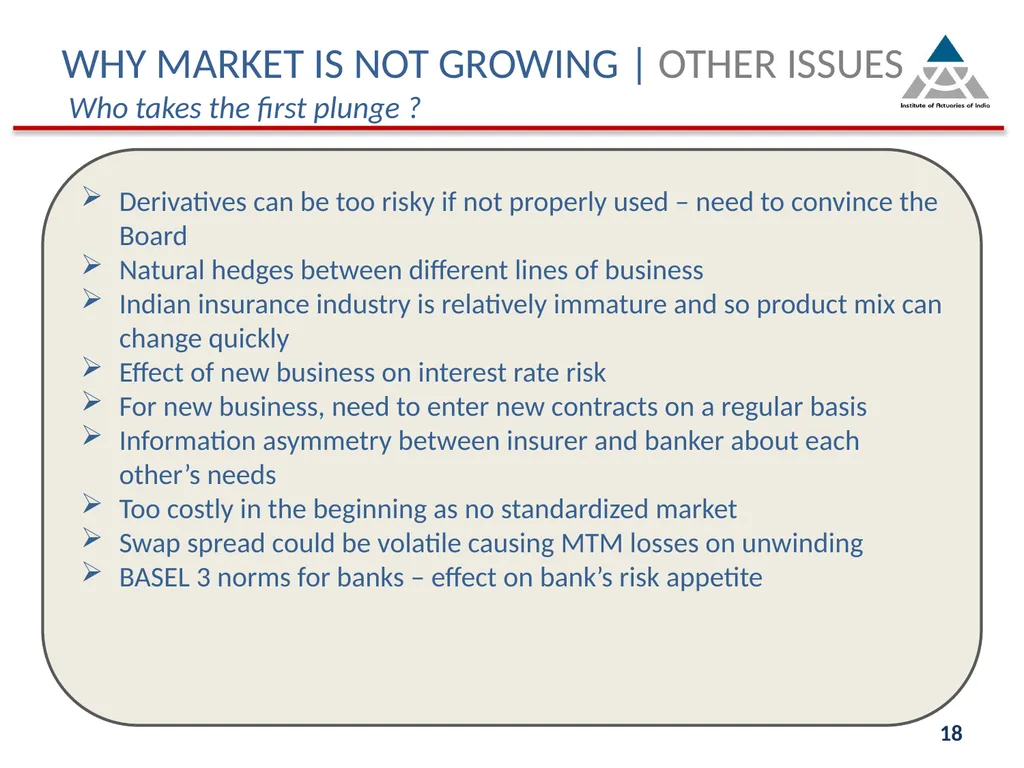
WHY MARKET IS NOT GROWING | OTHER ISSUES
Who takes the first plunge ? 18 Derivatives can be too risky if not properly used – need to convince the Board
Natural hedges between different lines of business
Indian insurance industry is relatively immature and so product mix can change quickly
Effect of new business on interest rate risk
For new business, need to enter new contracts on a regular basis
Information asymmetry between insurer and banker about each other’s needs
Too costly in the beginning as no standardized market
Swap spread could be volatile causing MTM losses on unwinding
BASEL 3 norms for banks – effect on bank’s risk appetite<br>
Natural hedges between different lines of business
Indian insurance industry is relatively immature and so product mix can change quickly
Effect of new business on interest rate risk
For new business, need to enter new contracts on a regular basis
Information asymmetry between insurer and banker about each other’s needs
Too costly in the beginning as no standardized market
Swap spread could be volatile causing MTM losses on unwinding
BASEL 3 norms for banks – effect on bank’s risk appetite<br>
19
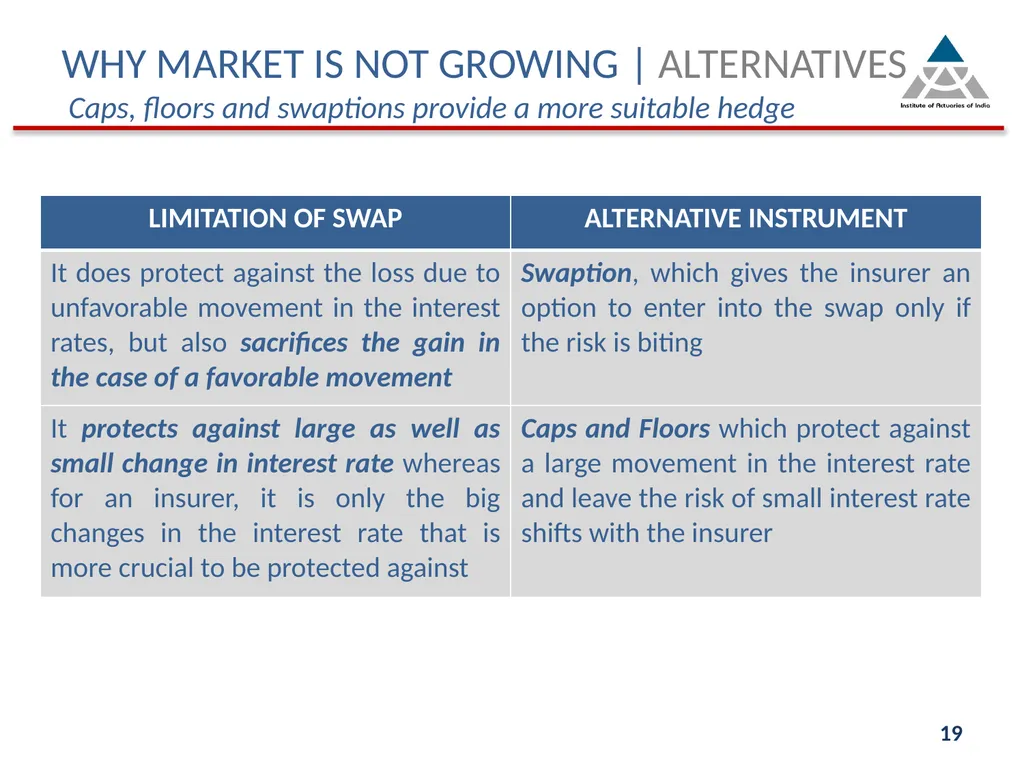
WHY MARKET IS NOT GROWING | ALTERNATIVES
Caps, floors and swaptions provide a more suitable hedge 19<br>
20
INTEREST RATE SWAP | TAKE AWAYS
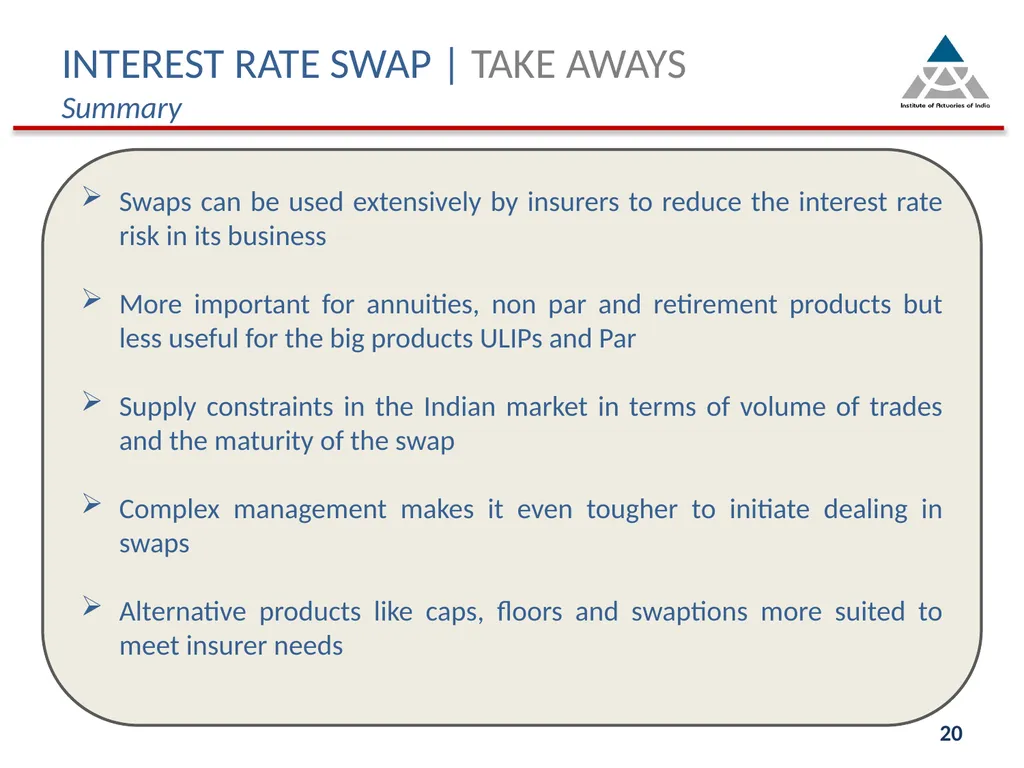
Summary 20 Swaps can be used extensively by insurers to reduce the interest rate risk in its business
More important for annuities, non par and retirement products but less useful for the big products ULIPs and Par
Supply constraints in the Indian market in terms of volume of trades and the maturity of the swap
Complex management makes it even tougher to initiate dealing in swaps
Alternative products like caps, floors and swaptions more suited to meet insurer needs<br>
More important for annuities, non par and retirement products but less useful for the big products ULIPs and Par
Supply constraints in the Indian market in terms of volume of trades and the maturity of the swap
Complex management makes it even tougher to initiate dealing in swaps
Alternative products like caps, floors and swaptions more suited to meet insurer needs<br>
21
Questions / Suggestions ? Rishabh Prakash prakash.rishabh@gmail.com
Ramnath Shenoy ramnath.shenoy@gmail.com<br>
Ramnath Shenoy ramnath.shenoy@gmail.com<br>