Infection Prevention and Control (IPC) Role descriptor for IPC Champions What is an IPC Champion Someone who is passionate and enthusiastic about safe infection prevention and control, constantly striving to protect patients, residents,
"Infection Prevention and Control (IPC) Role" is the property of its rightful owner. Permission is granted to
download and print the materials on this website for personal, non-commercial use only, and to display it
on your personal computer provided you do not modify the materials and that you retain all copyright
notices contained in the materials. By downloading content from our website, you accept the terms of this
agreement.
Presentation Transcript
01
Infection Prevention and Control (IPC) Role descriptor for IPC Champions<br>
02
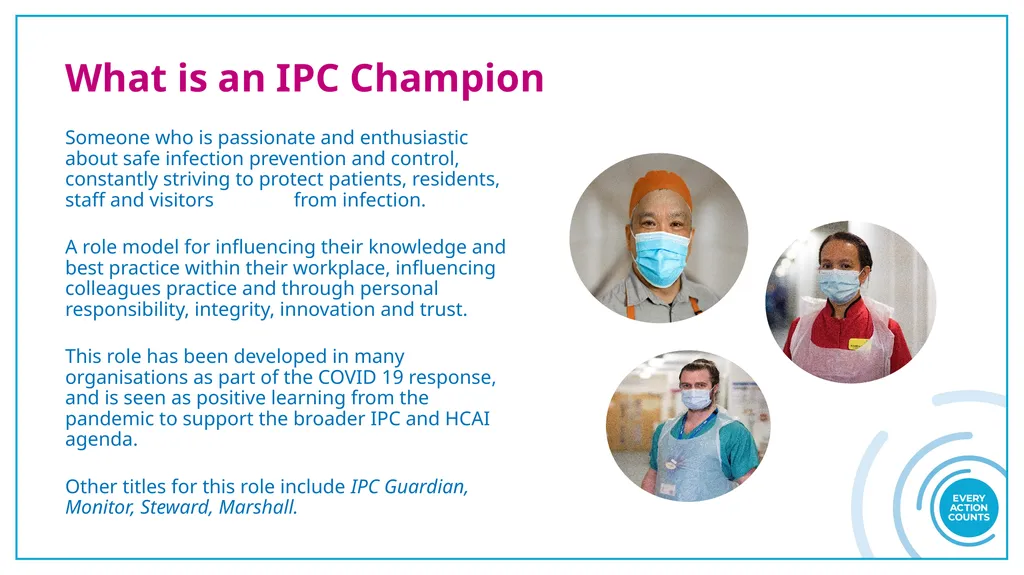
What is an IPC Champion Someone who is passionate and enthusiastic about safe infection prevention and control, constantly striving to protect patients, residents, staff and visitors from infection.
A role model for influencing their knowledge and best practice within their workplace, influencing colleagues practice and through personal responsibility, integrity, innovation and trust.
This role has been developed in many organisations as part of the COVID 19 response, and is seen as positive learning from the pandemic to support the broader IPC and HCAI agenda.
Other titles for this role include IPC Guardian, Monitor, Steward, Marshall.<br>
03
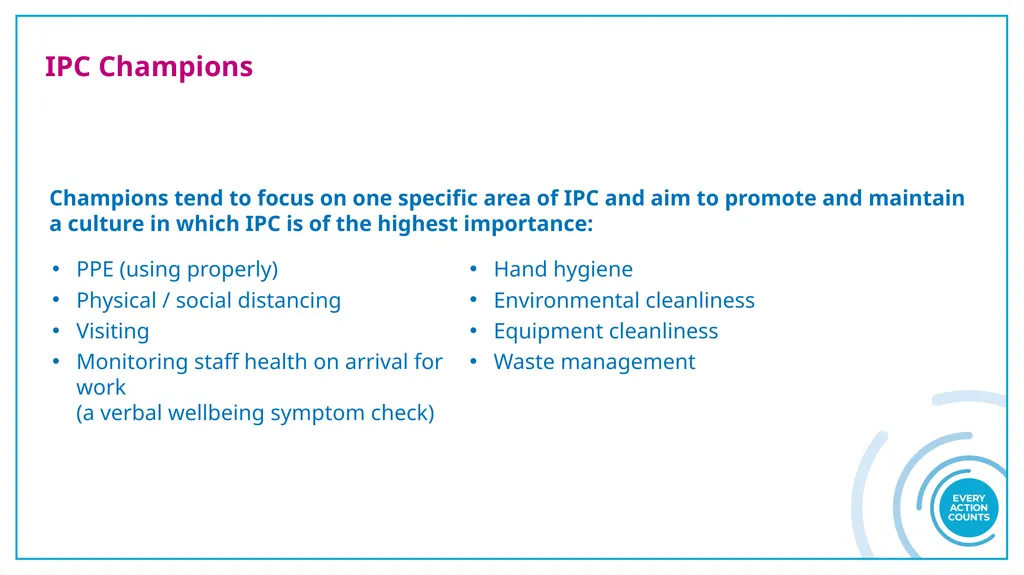
IPC Champions Champions tend to focus on one specific area of IPC and aim to promote and maintain a culture in which IPC is of the highest importance: PPE (using properly)
Physical / social distancing
Visiting
Monitoring staff health on arrival for work (a verbal wellbeing symptom check)
Hand hygiene
Environmental cleanliness
Equipment cleanliness
Waste management<br>
04
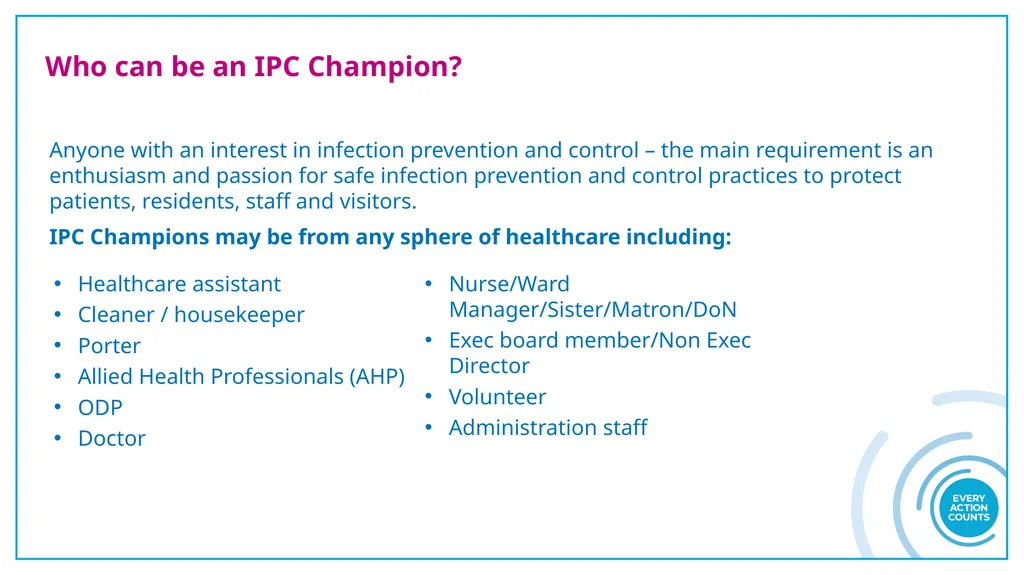
Who can be an IPC Champion? Anyone with an interest in infection prevention and control – the main requirement is an enthusiasm and passion for safe infection prevention and control practices to protect patients, residents, staff and visitors.
IPC Champions may be from any sphere of healthcare including: Healthcare assistant
Cleaner / housekeeper
Porter
Allied Health Professionals (AHP)
ODP
Doctor
Nurse/Ward Manager/Sister/Matron/DoN
Exec board member/Non Exec Director
Volunteer
Administration staff<br>
05
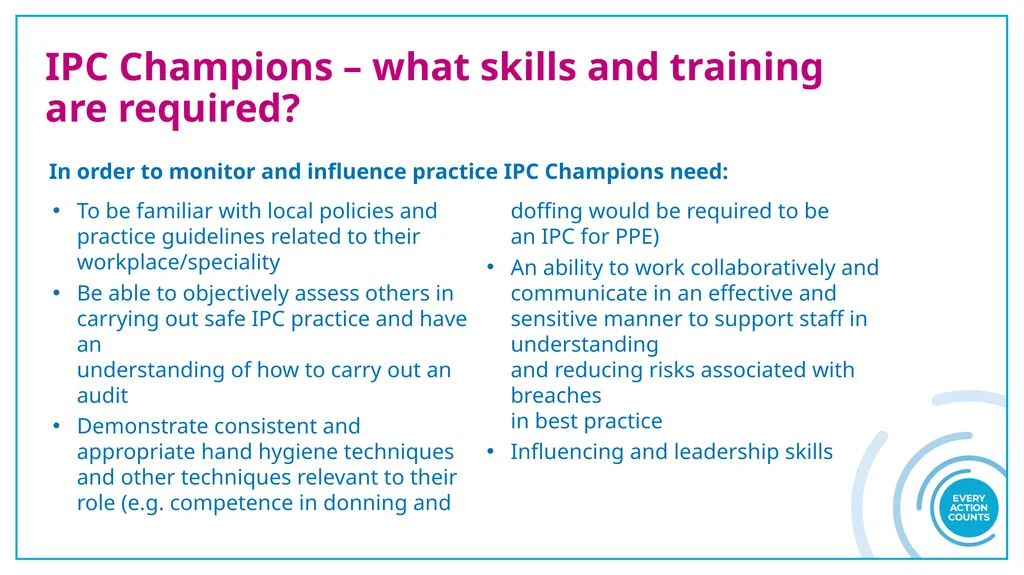
IPC Champions – what skills and training are required? In order to monitor and influence practice IPC Champions need: To be familiar with local policies and practice guidelines related to their workplace/speciality
Be able to objectively assess others in carrying out safe IPC practice and have an understanding of how to carry out an audit
Demonstrate consistent and appropriate hand hygiene techniques and other techniques relevant to their role (e.g. competence in donning and doffing would be required to be an IPC for PPE)
An ability to work collaboratively and communicate in an effective and sensitive manner to support staff in understanding and reducing risks associated with breaches in best practice
Influencing and leadership skills<br>
06
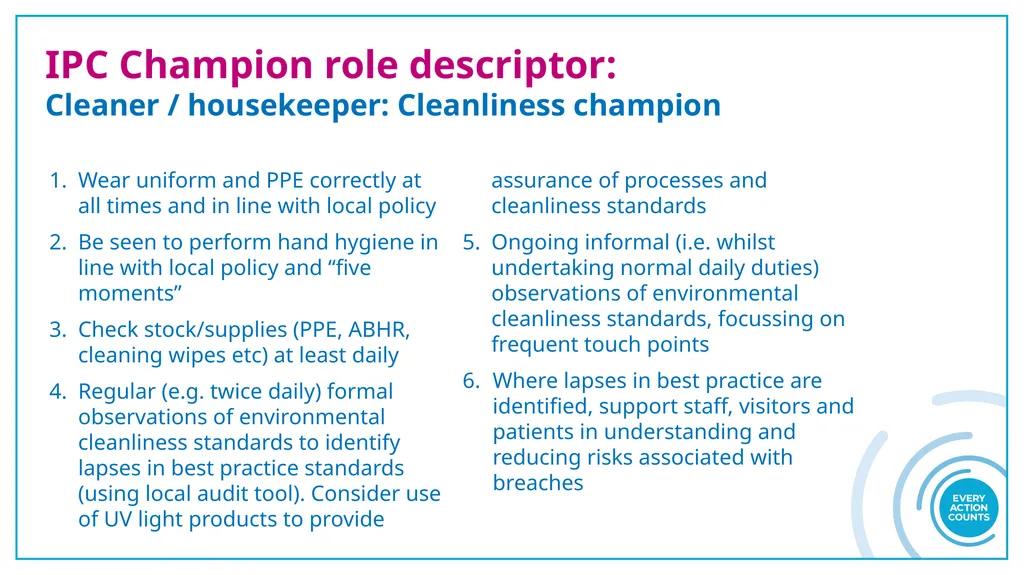
IPC Champion role descriptor: Cleaner / housekeeper: Cleanliness champion Wear uniform and PPE correctly at all times and in line with local policy
Be seen to perform hand hygiene in line with local policy and “five moments”
Check stock/supplies (PPE, ABHR, cleaning wipes etc) at least daily
Regular (e.g. twice daily) formal observations of environmental cleanliness standards to identify lapses in best practice standards (using local audit tool). Consider use of UV light products to provide assurance of processes and cleanliness standards
Ongoing informal (i.e. whilst undertaking normal daily duties) observations of environmental cleanliness standards, focussing on frequent touch points
Where lapses in best practice are identified, support staff, visitors and patients in understanding and reducing risks associated with breaches<br>
07
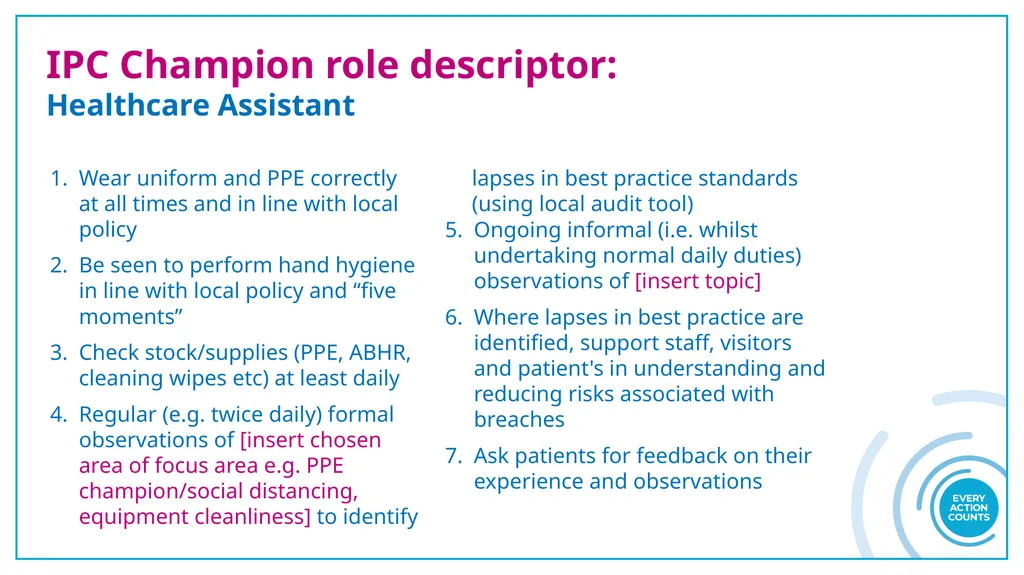
IPC Champion role descriptor: Healthcare Assistant Wear uniform and PPE correctly at all times and in line with local policy
Be seen to perform hand hygiene in line with local policy and “five moments”
Check stock/supplies (PPE, ABHR, cleaning wipes etc) at least daily
Regular (e.g. twice daily) formal observations of [insert chosen area of focus area e.g. PPE champion/social distancing, equipment cleanliness] to identify lapses in best practice standards (using local audit tool) Ongoing informal (i.e. whilst undertaking normal daily duties) observations of [insert topic]
Where lapses in best practice are identified, support staff, visitors and patient's in understanding and reducing risks associated with breaches
Ask patients for feedback on their experience and observations<br>
08
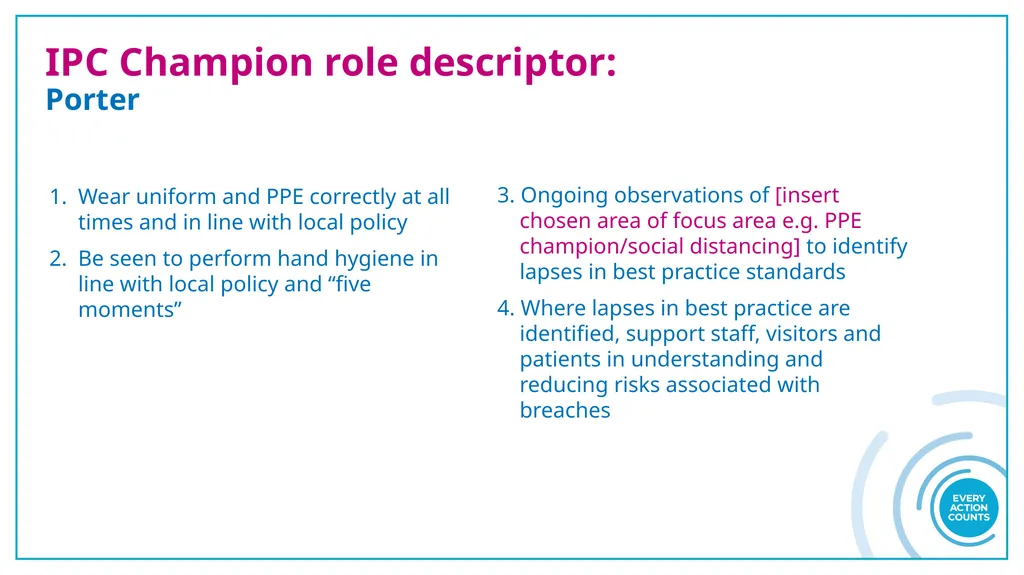
IPC Champion role descriptor: Porter 3. Ongoing observations of [insert chosen area of focus area e.g. PPE champion/social distancing] to identify lapses in best practice standards
4. Where lapses in best practice are identified, support staff, visitors and patients in understanding and reducing risks associated with breaches Wear uniform and PPE correctly at all times and in line with local policy
Be seen to perform hand hygiene in line with local policy and “five moments”<br>
09
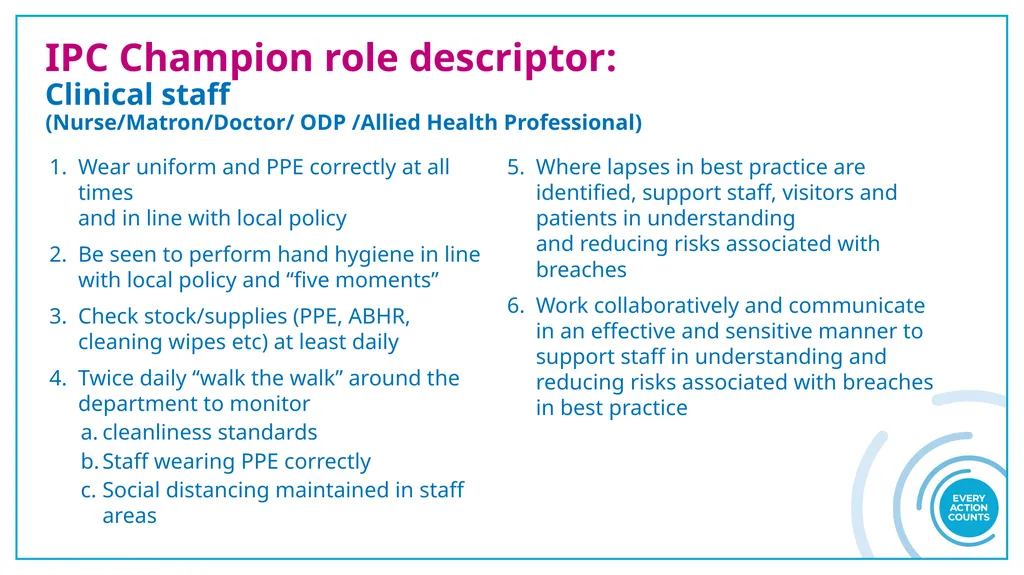
IPC Champion role descriptor: Clinical staff (Nurse/Matron/Doctor/ ODP /Allied Health Professional) Wear uniform and PPE correctly at all times and in line with local policy
Be seen to perform hand hygiene in line with local policy and “five moments”
Check stock/supplies (PPE, ABHR, cleaning wipes etc) at least daily
Twice daily “walk the walk” around the department to monitor
cleanliness standards
Staff wearing PPE correctly
Social distancing maintained in staff areas
Where lapses in best practice are identified, support staff, visitors and patients in understanding and reducing risks associated with breaches
Work collaboratively and communicate in an effective and sensitive manner to support staff in understanding and reducing risks associated with breaches in best practice<br>
10
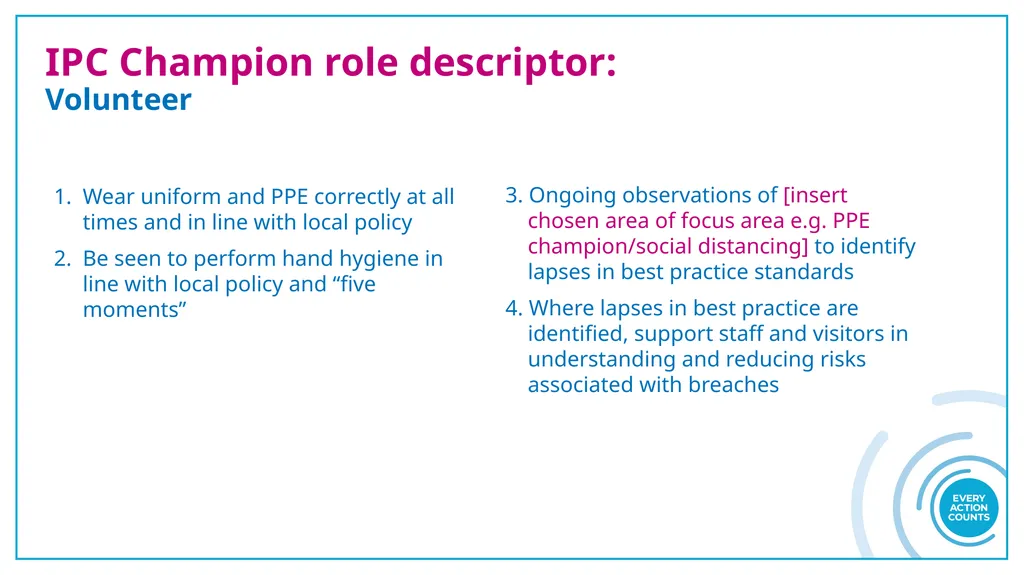
IPC Champion role descriptor: Volunteer 3. Ongoing observations of [insert chosen area of focus area e.g. PPE champion/social distancing] to identify lapses in best practice standards
4. Where lapses in best practice are identified, support staff and visitors in understanding and reducing risks associated with breaches Wear uniform and PPE correctly at all times and in line with local policy
Be seen to perform hand hygiene in line with local policy and “five moments”<br>