04
Government of India has embarked on an ambitious program of developing
100 Smart Cities on fast track. SMART CITIES – IN INDIA<br>
05
Smart Cities in the developed nations: main focus
Asset optimization
Operations monitoring
Data communications and analytics
Transition to a low carbon economy SMART CITIES – IN INDIA<br>
06
Smart Cities in the developing nations: main focus
Building modern physical infrastructure,
Scalable, intelligent and interoperable
as existing cities have inadequate physical infrastructure SMART CITIES – IN INDIA<br>
07
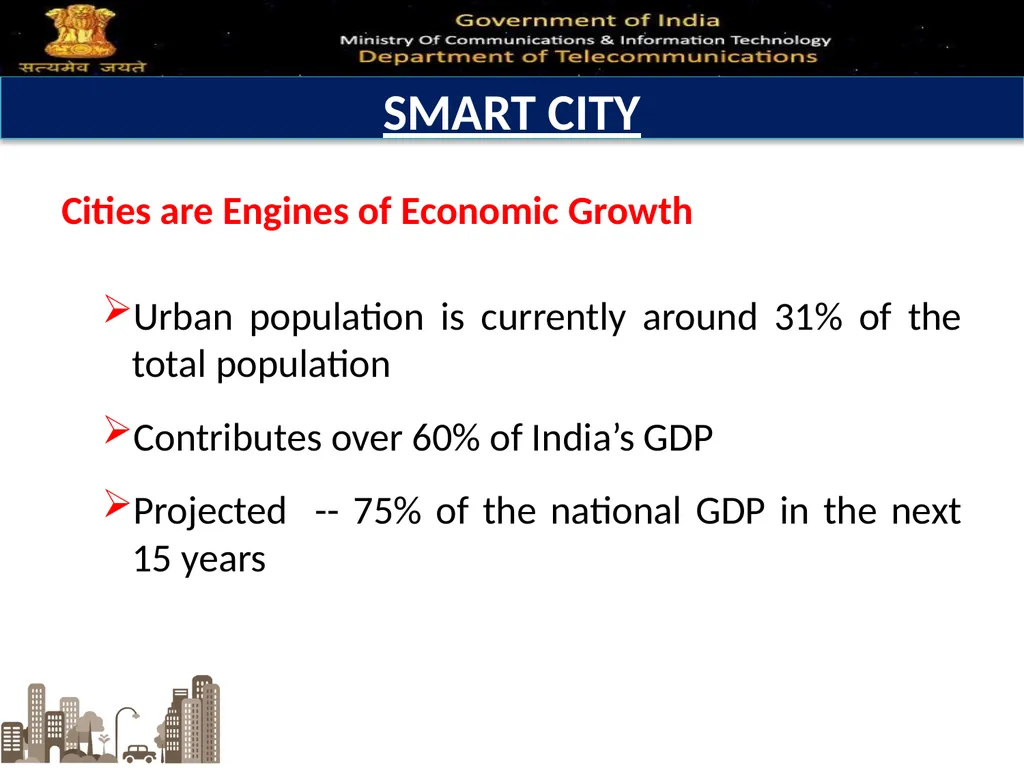
Massive urbanisation
Urbanisation accompanies economic growth
30% urban population contributes 60% of GDP
Urban centers are engines of economic growth
India is at the cusp of transition point from where urbanisation will speed up
Pressure on existing resources due to population explosion
Need to manage them efficiently & effectively SMART CITY: DRIVERS<br>
08
Need for sustainable development
Reduce green house gases emission
Evolution of ICTs (IoT, IPv6, sensors etc.) to support such initiatives on a societal scale.
Rapidly declining technology costs SMART CITY: DRIVERS<br>
09
ROLE OF ICT IN SMART CITY ICT
Acts as an enabler to make a city smart
Planning of ICT infrastructure be the prime focus area both for Greenfield & Brownfield smart cities.
Intelligent and efficient use of resources
Cost and energy savings
Reduced environmental footprint
Different systems and nodes are interconnected on common ICT infrastructure<br>
10
ROLE OF ICT IN SMART CITY Interconnected and Independent services should evolve through
Well Defined Digital Master Plan for the City
Under centralized governance dashboard of stakeholders<br>
11
Smart-Grid & Energy Efficiency
Intelligent Transport System
Smart Health Care
Intelligent Water Distribution System
Intelligent piped GAS (cooking) Distribution System
Intelligent Waste Management System
Intelligent Public Safety & Surveillance
Smart Apartments & Office Buildings
And many more….. THRUST AREAS – FOR A SMART CITY<br>
12
TELECOM ENABLERS OF SMART CITY Telecom Network
Cloud Computing
Internet of Things(IoT) & IPv6
Sensor Network
Mobile Broadband<br>
13
TELECOM ENABLERS OF SMART CITY Telecom Network
connectivity of several hundreds of nodes talking seamlessly with one another and transferring vital data.
multiple cellular/mobile networks plus cable, satellite, RF mesh, microwave, radio, fiber optics, WiFi for homes and offices, 6LowPAN ,smart meters and appliances.
Fibre optic network as a metro loop around the city
Wireless access to this underlying Fibre network by WiFi / RF Mesh/ cellular/mobile technologies or some combination.<br>
14
TELECOM ENABLERS OF SMART CITY Cloud computing
Cloud computing delivers powerful solutions via the Internet with tremendous economies of scale, as users don’t have to buy and maintain giant data centers or hire and train large IT staffs.
Cloud computing framework delivers efficiency and optimization in processing the big data generated by the thousands of sensors across the city.<br>
15
TELECOM ENABLERS OF SMART CITY Internet of Things & IPv6
Multitude of devices interacting with control units and dashboards, through sensors, RFID, M2M, satellite and GPS.
Not just about connecting humans with things, things could also interact with each other.
By 2020, 30 billion things will be connected or will be smart each having unique IP address, thanks to IPv6.<br>
16
TELECOM ENABLERS OF SMART CITY Sensor Network
utilizes wire line and/or wireless sensor networks.
interconnected autonomous devices, distributed across the location, and use sensors to collectively monitor physical/environmental conditions (e.g., temperature, sound, vibration, pressure, motion or pollutants).
Smart meters and smart sensors - intelligent electric power grids, water and gas networks.
Smart thermostats and building management systems - being able to ‘talk’ and ‘listen.’
Electronic records, analytics and better access to healthcare with in-home consultations.
Intelligent transportation management software, roadway sensors and smart parking apps.<br>
17
TELECOM ENABLERS OF SMART CITY Mobile Broadband
National Telecom Policy-2012 envisages transformation of mobile phone from a mere communication device to an instrument of empowerment
Smart Phones- dual role:
Smart phones - a “delivery platform” - to receive alerts and access city services.
Smart phones – as a “sensor network” - are equipped with a GPS, a microphone, a gyroscope, a light sensor, a camera, an accelerometer, a barometer, a thermometer, a magnetometer and a hygrometer.<br>
18
TELECOM RELATED CONSIDERATIONS Standards consisting of well-defined set of parameters - needs to be followed for smart telecom components and attendant services in each vertical.<br>
19
TELECOM RELATED CONSIDERATIONS Finalization & enforcement of standards for different layers in each of the smart services.
Ensure interoperability of the components
Service agnostic underlying architecture<br>
20
TELECOM RELATED CONSIDERATIONS Resolution of telecom related issues in smart services is underway in DoT
KYC norms,
SIM related issues,
Roaming related issues,
Numbering plan to be followed in case of smart devices,
spectrum requirement in local network<br>
21
TELECOM RELATED CONSIDERATIONS National Telecom M2M Roadmap to be released soon.
Home and neighborhood networks - to use free bands as much as possible through common home gateway for multiple services<br>
22
TELECOM RELATED CONSIDERATIONS Smart services in smart city should necessarily be IP based and not on propriety standards
Provides flexibility to the planners in future so as to have interoperability.
DoT has already mandated use of IPv6 through its related roadmaps.
Government Communication Network – consideration for TErrestrial TRunked Radio (TETRA) - digital trunked radio systems, defined by ETSI to meet the emergency and security requirements of the Government Departments<br>
23
Cities account for 70 per cent of global greenhouse gas (GHG) emissions
Over 60-80 per cent of global energy consumption
70 per cent of the world’s population will live in cities by 2050
90% of the world’s urban population growth will take place in developing countries, with India taking a significant share of that CLEAN TECHNOLOGY<br>
24
Carbon emissions 2013
9.9 bn tonnes – 61% more than 1990
Contributed by China 28%, US 14%,EU 10%, India 7%
Per capita per year
Global : 1.4 tonnes
US 4.5; China :2.0; EU 1.9;India 0.5 (in tonnes)
(source: Global Carbon Project) CLEAN TECHNOLOGY<br>
25
AN OPTIMAL APPROACH Building a smart city requires a system-wide view and an integrated approach
Adoption of open standards to ensure interoperability
Holistic thinking and collaborative work vs traditional separate, “siloed” departments with little interaction
Reduce overall information technology (IT) costs by as much as 25% just by implementing a master IT architecture and technology roadmap
This is not to suggest that cities must finance and implement dozens of investments at one time. In fact, it is entirely fine to begin with just one or two projects.<br>
26
Smart City Life is better in a smart city
– better for people,
–better for Governance
–and better for businesses Life is better in a smart city
– better for people
–better for Governance
–better for business
– and not the least better for the earth<br>