INFRASTRUCTURE AND SAFE LEARNING ENVIRONMENT IN KANO STATE BY Dr. Auwalu Halilu Department of Adult Education Community Services Bayero University, Kano North West Kano State Coordinator Civil Society Action Coalition on Education for
"INFRASTRUCTURE AND SAFE LEARNING ENVIRONMENT IN" is the property of its rightful owner. Permission is granted to
download and print the materials on this website for personal, non-commercial use only, and to display it
on your personal computer provided you do not modify the materials and that you retain all copyright
notices contained in the materials. By downloading content from our website, you accept the terms of this
agreement.
Presentation Transcript
01
INFRASTRUCTURE AND SAFE LEARNING ENVIRONMENT IN KANO STATE BY
Dr. Auwalu Halilu
Department of Adult Education & Community Services
Bayero University, Kano
North West & Kano State Coordinator
Civil Society Action Coalition on Education for All (CSACEFA)<br>
02
Introduction Over years, the infrastructure deficit in Nigeria has become an issue of major concern, despite the Nigerian government's recent establishment of the Revised National Integrated Infrastructure Master Plan (NIIMP, 2020–2043) to improve the country's deteriorating infrastructure.
The country continues to suffer from infrastructural deficits as a result of poor management of funds and maintenance of existing civil engineering infrastructure especially in our schools
This has remained a huge threat to the safety and livelihood of a nation with more than 200 million people.
To effectively tackle this problem, sustainable civil engineering infrastructures must be constructed and implemented at all stages to harness sustainable development especially in our schools<br>
03
What is School Infrastructure? The term “school infrastructure” refers to things like school buildings, playgrounds, public amenities, libraries, laboratories, and other facilities.
School infrastructure contributes to a positive learning environment.
It has an influence on student teaching and learning activities
For instance, the state of the classroom which is part of the school building when in good condition will support the continuity of learning.
Students will feel comfortable, excited and facilitated in the learning process when it is fully and well infrastructured.<br>
04
SDGs and School Infrastructure The Sustainable Development Goals, which are defined by the United Nations and scope the development agenda for all countries in the world, require countries to:
“build and upgrade education facilities that are child, disability and gender sensitive, and provide safe, non-violent, inclusive, and effective learning environments for all”<br>
05
SUBEB Annual Report and the Status quo According to Kano State SUBEB Annual Report (2015), the board awarded contracts for the provision of classroom blocks, toilets facilities and furniture for both teachers and pupils.
The projects were carried out in primary and secondary schools across the 44 Local Government areas of the State.
This resulted in massive renovations of schools across the state.
Despite the huge spending in the provision of school facilities in Kano State, one could still notice that the desired results of students from external examinations are still a mirage.
The quality of learning therefore has been below standard because the school facilities are not properly maintained (Danjuma and Adeleye, 2015).
Asiyai (2012) rightly noted that facilities in public schools currently have dilapidated buildings, empty libraries, poor hostel facilities, broken tables and chairs, unclean clinics, unkempt school compound, abandoned broken down school vehicles and so on.
This situation may affect students’ readiness to learn.<br>
06
Let’s Answer these questions below: To ensure that investments in school infrastructure have the greatest positive impact on learning, it is important to address the following questions for the education sector in Kano state:
Do all students have equal access to seating in classrooms?
Are the school buildings safe and conducive to a healthy environment?
Are the current learning environments well-suited for effective learning?
Does the school’s layout promote advanced learning and community involvement?
How can school infrastructure be planned and adapted sustainably over time?<br>
07
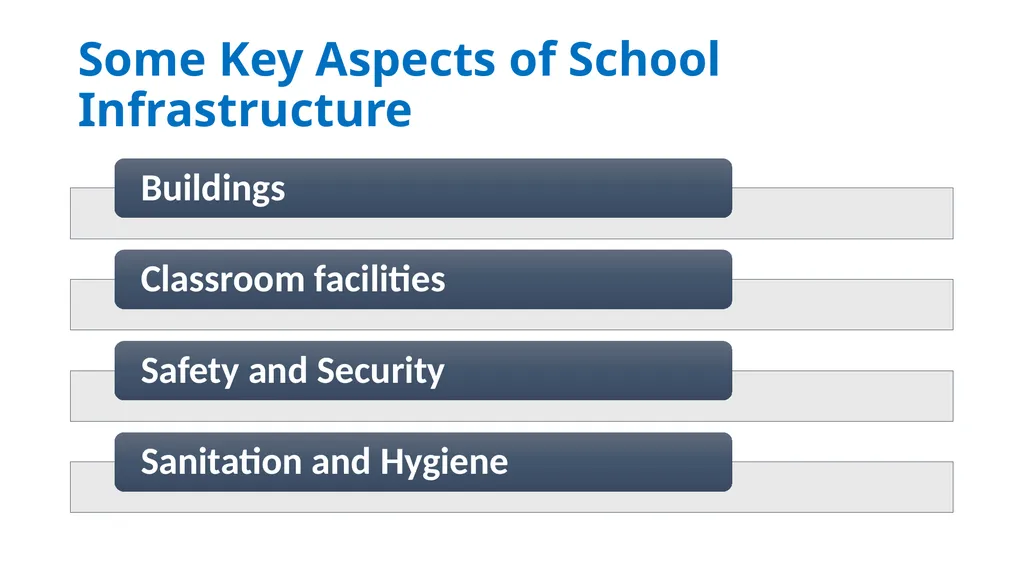
Some Key Aspects of School Infrastructure<br>
08
Importance of Infrastructure in the Education Space Having a good library should be at the top of the list for the school management.
Comfortable classrooms should be a priority to ensure student comfort.
Relax/play area should be there to help the students refresh themselves.
Co-curricular activity space is a must for the schools.
A healthy environment is another thing to take care of.
Safe campus should not be missed.
A food zone/canteen with healthy food options would be great.<br>
09
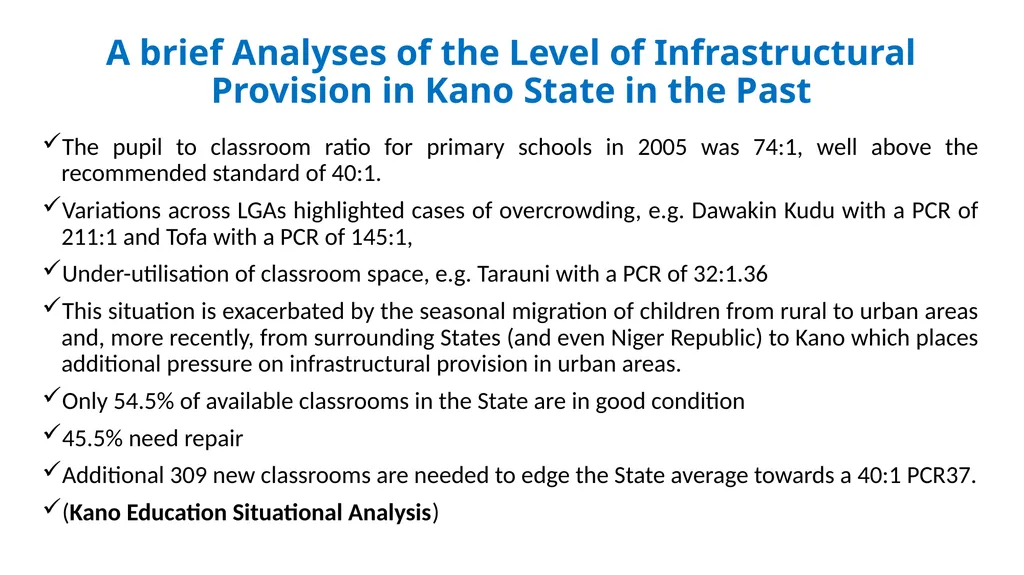
A brief Analyses of the Level of Infrastructural Provision in Kano State in the Past The pupil to classroom ratio for primary schools in 2005 was 74:1, well above the recommended standard of 40:1.
Variations across LGAs highlighted cases of overcrowding, e.g. Dawakin Kudu with a PCR of 211:1 and Tofa with a PCR of 145:1,
Under-utilisation of classroom space, e.g. Tarauni with a PCR of 32:1.36
This situation is exacerbated by the seasonal migration of children from rural to urban areas and, more recently, from surrounding States (and even Niger Republic) to Kano which places additional pressure on infrastructural provision in urban areas.
Only 54.5% of available classrooms in the State are in good condition
45.5% need repair
Additional 309 new classrooms are needed to edge the State average towards a 40:1 PCR37.
(Kano Education Situational Analysis)<br>
10
Conclusion and Recommendations Good school infrastructure plays a vital role in measuring the progress and growth of education. It encompasses the coordination of the physical environment with the organization’s activities, combining school administration, architecture, and behavioral and engineering sciences.
Research shows that students perform better in recently built or renovated schools compared to older institutions. The overall condition of the building, its grade level, and the presence of windows in classrooms have a positive correlation with student achievement.
School infrastructure facilities significantly impact the efficiency of learning in the classroom. Maximizing the efficiency of school infrastructure can enhance the quality of learning, promoting active engagement and stimulating the minds of children.
However, infrastructure also faces challenges in adapting to ever-evolving 21st-century learning methods and strategies. The active participation of teachers and students greatly influences the effectiveness of the learning process.
Investing in infrastructure may require spending money, but the advantages it brings usually result in a valuable payoff, making it a worthwhile effort.
Funds should also be provided to upgrade ageing, inadequate, unsafe, and poor school infrastructure in previously disadvantaged communities.
PPP, or Public-Private Partnership, a funding model that involves collaboration between government agencies and private companies to finance and implement public projects should be explored<br>