
Institutional Repositories as a Veritable Tool
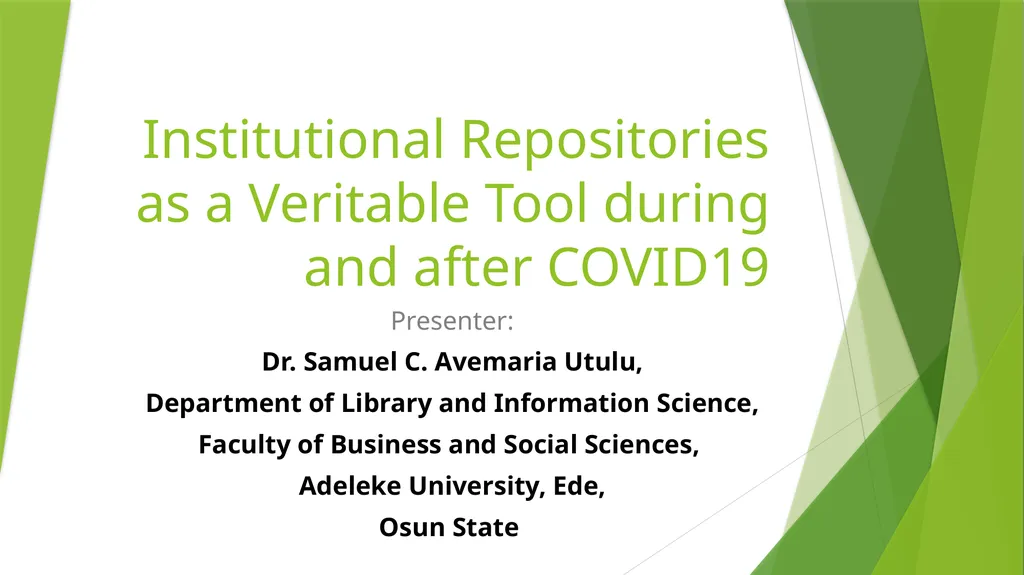
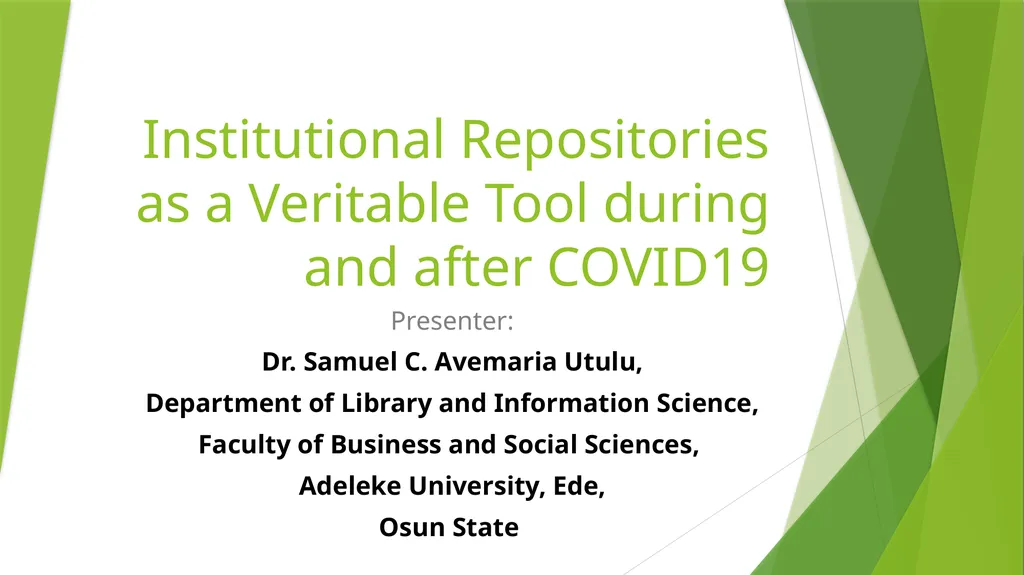

Description: Institutional Repositories as a Veritable Tool during and after COVID19 Presenter: Dr. Samuel C. Avemaria Utulu, Department of Library and Information Science, Faculty of Business and Social Sciences, Adeleke University, Ede, Osun State
Related Topics
Download Presentation
"Institutional Repositories as a Veritable Tool" is the property of its rightful owner. Permission is granted to download and print the materials on this website for personal, non-commercial use only, and to display it on your personal computer provided you do not modify the materials and that you retain all copyright notices contained in the materials. By downloading content from our website, you accept the terms of this agreement.
Presentation Transcript
slide1. Institutional Repositories as a Veritable Tool during and after COVID19 Presenter:
Dr. Samuel C. Avemaria Utulu,
Department of Library and Information Science,
Faculty of Business and Social Sciences,
Adeleke University, Ede,
Osun State<br>
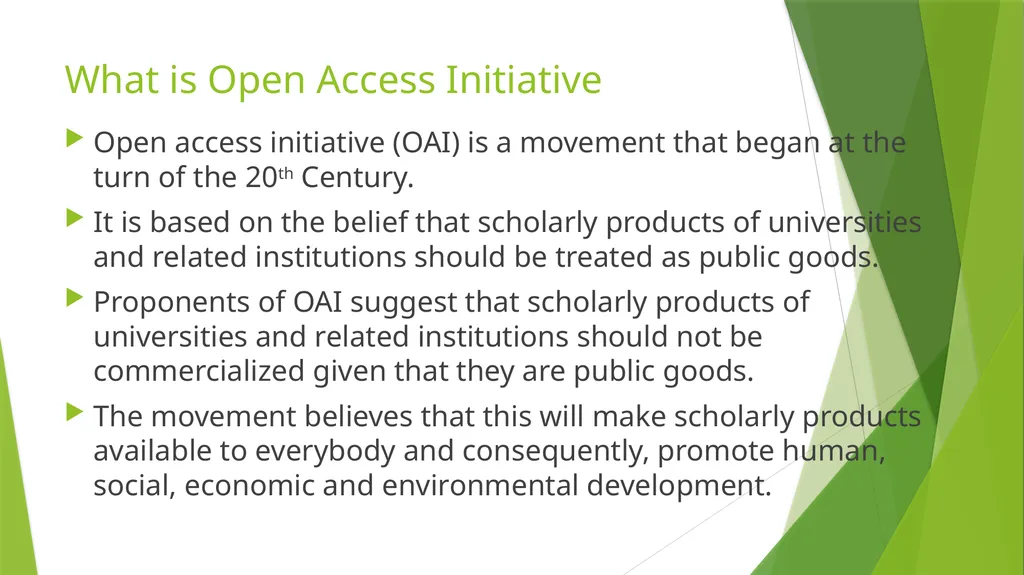
slide2. What is Open Access Initiative Open access initiative (OAI) is a movement that began at the turn of the 20th Century.
It is based on the belief that scholarly products of universities and related institutions should be treated as public goods.
Proponents of OAI suggest that scholarly products of universities and related institutions should not be commercialized given that they are public goods.
The movement believes that this will make scholarly products available to everybody and consequently, promote human, social, economic and environmental development.<br>
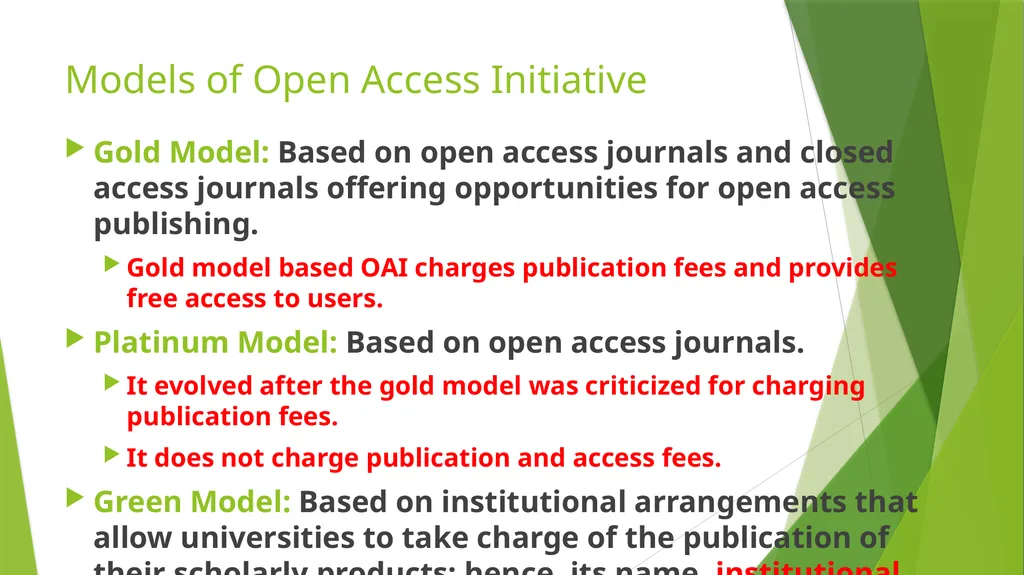
slide3. Models of Open Access Initiative Gold Model: Based on open access journals and closed access journals offering opportunities for open access publishing.
Gold model based OAI charges publication fees and provides free access to users.
Platinum Model: Based on open access journals.
It evolved after the gold model was criticized for charging publication fees.
It does not charge publication and access fees.
Green Model: Based on institutional arrangements that allow universities to take charge of the publication of their scholarly products; hence, its name, institutional repository.<br>
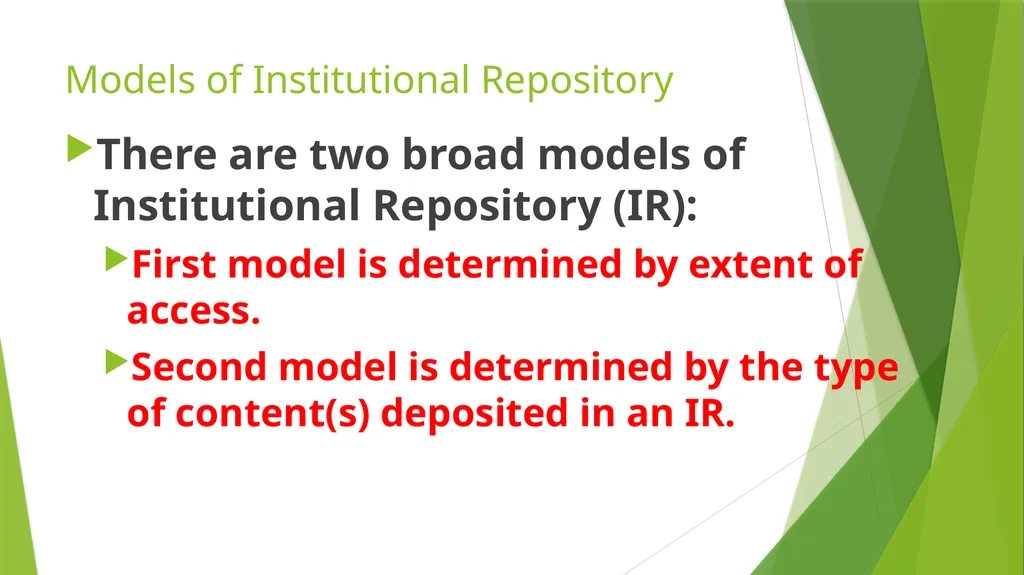
slide4. Models of Institutional Repository There are two broad models of Institutional Repository (IR):
First model is determined by extent of access.
Second model is determined by the type of content(s) deposited in an IR.<br>
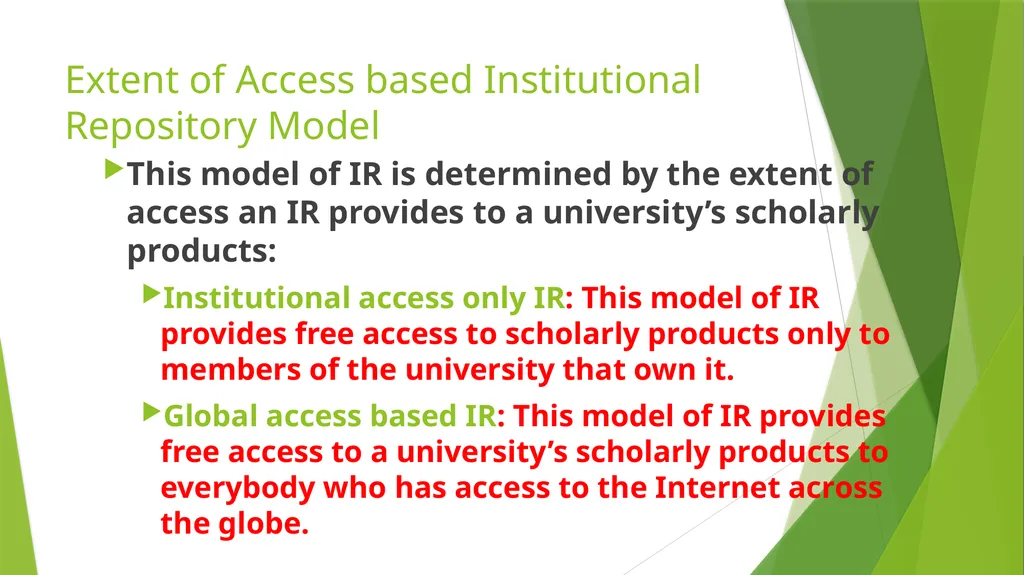
slide5. Extent of Access based Institutional Repository Model This model of IR is determined by the extent of access an IR provides to a university’s scholarly products:
Institutional access only IR: This model of IR provides free access to scholarly products only to members of the university that own it.
Global access based IR: This model of IR provides free access to a university’s scholarly products to everybody who has access to the Internet across the globe.<br>
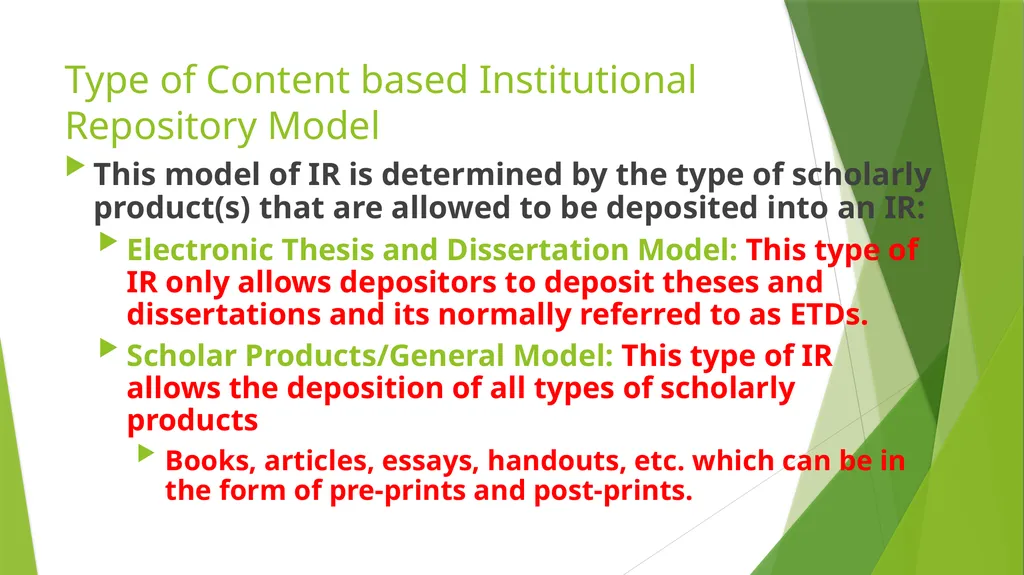
slide6. Type of Content based Institutional Repository Model This model of IR is determined by the type of scholarly product(s) that are allowed to be deposited into an IR:
Electronic Thesis and Dissertation Model: This type of IR only allows depositors to deposit theses and dissertations and its normally referred to as ETDs.
Scholar Products/General Model: This type of IR allows the deposition of all types of scholarly products
Books, articles, essays, handouts, etc. which can be in the form of pre-prints and post-prints.<br>
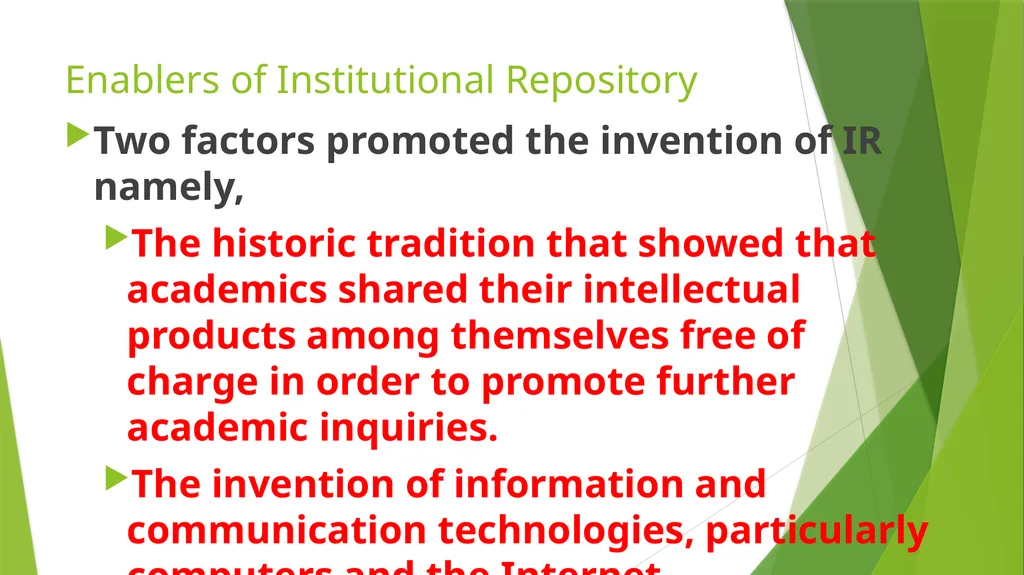
slide7. Enablers of Institutional Repository Two factors promoted the invention of IR namely,
The historic tradition that showed that academics shared their intellectual products among themselves free of charge in order to promote further academic inquiries.
The invention of information and communication technologies, particularly computers and the Internet<br>
slide8. Constraints to Institutional Repository Conversely, three factors militate against IR adoption and diffusion namely,
Capitalism
Commercial publishers incursion into research dissemination practices of universities, and by extension, academic reward systems.
The influence of the two factors above on academics willingness to freely share their intellectual products<br>
slide9. Implications on Library & Information Services during and after COVID19 Free acquisition of information resources.
Promotion of local contents.
Unrestricted access to information resources provided by the university library.
Provision and dissemination of context specific information resources.
Participation in the 2.0 world where content users are the primary producers of the contents they use.
Increase in the relevance and usefulness of information resource provided by university libraries.<br>
slide10. Implications on Universities during and after COVID19 IR can help universities to improve their rating in global ranking of universities, particularly webometric ranking.
IR can help universities to keep track of their research and publication trends.
IR provides ground for training young academics in the art and science of scientific research publication management.
Helps universities to easily contribute to the stock of global scholarly knowledge, and
To eradicate knowledge divide.<br>
slide11. Felicitation Thank you for listening<br>
Dr. Samuel C. Avemaria Utulu,
Department of Library and Information Science,
Faculty of Business and Social Sciences,
Adeleke University, Ede,
Osun State<br>
slide2. What is Open Access Initiative Open access initiative (OAI) is a movement that began at the turn of the 20th Century.
It is based on the belief that scholarly products of universities and related institutions should be treated as public goods.
Proponents of OAI suggest that scholarly products of universities and related institutions should not be commercialized given that they are public goods.
The movement believes that this will make scholarly products available to everybody and consequently, promote human, social, economic and environmental development.<br>
slide3. Models of Open Access Initiative Gold Model: Based on open access journals and closed access journals offering opportunities for open access publishing.
Gold model based OAI charges publication fees and provides free access to users.
Platinum Model: Based on open access journals.
It evolved after the gold model was criticized for charging publication fees.
It does not charge publication and access fees.
Green Model: Based on institutional arrangements that allow universities to take charge of the publication of their scholarly products; hence, its name, institutional repository.<br>
slide4. Models of Institutional Repository There are two broad models of Institutional Repository (IR):
First model is determined by extent of access.
Second model is determined by the type of content(s) deposited in an IR.<br>
slide5. Extent of Access based Institutional Repository Model This model of IR is determined by the extent of access an IR provides to a university’s scholarly products:
Institutional access only IR: This model of IR provides free access to scholarly products only to members of the university that own it.
Global access based IR: This model of IR provides free access to a university’s scholarly products to everybody who has access to the Internet across the globe.<br>
slide6. Type of Content based Institutional Repository Model This model of IR is determined by the type of scholarly product(s) that are allowed to be deposited into an IR:
Electronic Thesis and Dissertation Model: This type of IR only allows depositors to deposit theses and dissertations and its normally referred to as ETDs.
Scholar Products/General Model: This type of IR allows the deposition of all types of scholarly products
Books, articles, essays, handouts, etc. which can be in the form of pre-prints and post-prints.<br>
slide7. Enablers of Institutional Repository Two factors promoted the invention of IR namely,
The historic tradition that showed that academics shared their intellectual products among themselves free of charge in order to promote further academic inquiries.
The invention of information and communication technologies, particularly computers and the Internet<br>
slide8. Constraints to Institutional Repository Conversely, three factors militate against IR adoption and diffusion namely,
Capitalism
Commercial publishers incursion into research dissemination practices of universities, and by extension, academic reward systems.
The influence of the two factors above on academics willingness to freely share their intellectual products<br>
slide9. Implications on Library & Information Services during and after COVID19 Free acquisition of information resources.
Promotion of local contents.
Unrestricted access to information resources provided by the university library.
Provision and dissemination of context specific information resources.
Participation in the 2.0 world where content users are the primary producers of the contents they use.
Increase in the relevance and usefulness of information resource provided by university libraries.<br>
slide10. Implications on Universities during and after COVID19 IR can help universities to improve their rating in global ranking of universities, particularly webometric ranking.
IR can help universities to keep track of their research and publication trends.
IR provides ground for training young academics in the art and science of scientific research publication management.
Helps universities to easily contribute to the stock of global scholarly knowledge, and
To eradicate knowledge divide.<br>
slide11. Felicitation Thank you for listening<br>