Instructional objectives (general, specific) Paper 6-i Unit-i Concept of instructional objectives An instructional objective is a statement that will describe what the learner will be able to do after completing the instruction. ...
"Instructional objectives (general, specific) Paper" is the property of its rightful owner. Permission is granted to
download and print the materials on this website for personal, non-commercial use only, and to display it
on your personal computer provided you do not modify the materials and that you retain all copyright
notices contained in the materials. By downloading content from our website, you accept the terms of this
agreement.
Presentation Transcript
01
Instructional objectives (general, specific) Paper – 6-i
Unit-i<br>
02
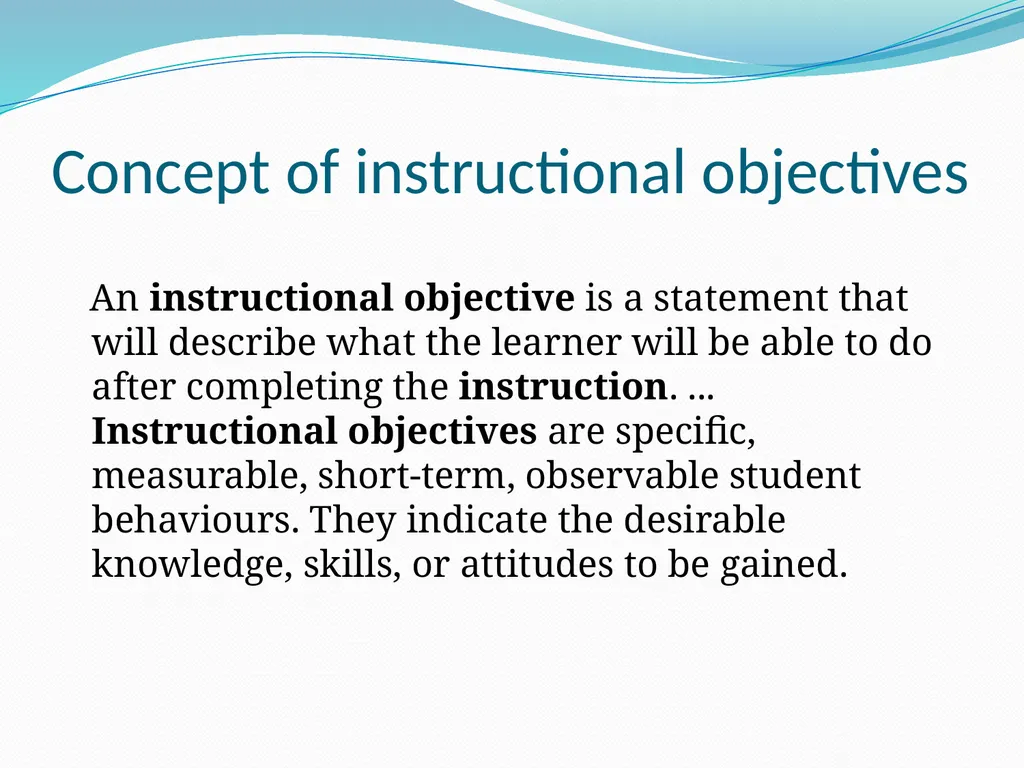
Concept of instructional objectives An instructional objective is a statement that will describe what the learner will be able to do after completing the instruction. ... Instructional objectives are specific, measurable, short-term, observable student behaviours. They indicate the desirable knowledge, skills, or attitudes to be gained.<br>
03
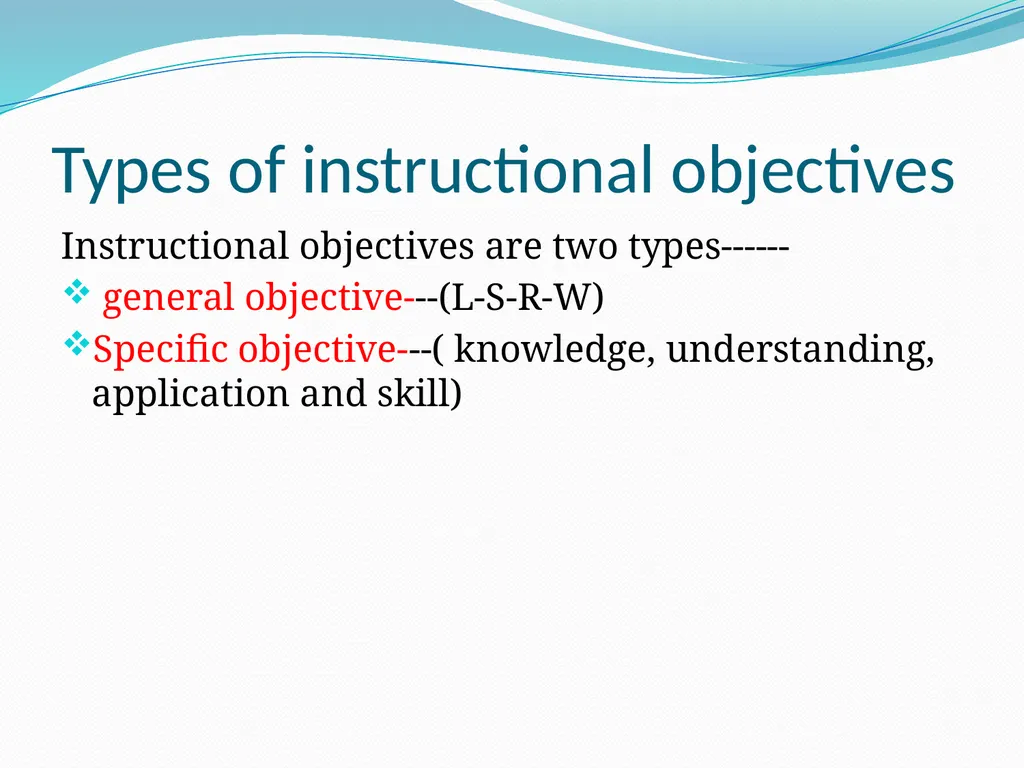
Types of instructional objectives Instructional objectives are two types------
general objective---(L-S-R-W)
Specific objective---( knowledge, understanding, application and skill)<br>
04
General objectives of teaching English 1 - Develop their intellectual, personal and professional abilities.
2 - Acquire basic language skills (listening, speaking, reading and writing) in order to communication with speakers of English language.
3 - Acquire the linguistic competence necessarily required in various life situations.
4 - Acquire the linguistic competence required in different professions.
5 - Develop their awareness of the importance of English as a means of international communication.
6 - Develop positive attitudes towards learning English.
7 - Develop the linguistic competence that enables them to be aware of the cultural, economical and social issues of their society in order to contribute in giving solution.<br>
05
8 - Develop the linguistic competence that enables them, in the future
9 - Develop the linguistic competence that enables them, in the future, to present the culture and civilization of their nation.
10 -Benefit from English-speaking nations, in order to enhance the concepts of international co-operation that develop understanding and respect of cultural differences among nations.
11 - Acquire the linguistic bases that enable them to participate in transferring the scientific and technological advances of other nations to their nation.<br>
06
Specific objectives of teaching English Pupils should be able to make simple sentences and statement in English so as to able to express himself through speech and writing.
Pupils should be able to speak the language with reasonably correct pronunciation and should have command over the language. He should also be able to speak English with due attention to stress and intonation.
Pupils should able to write English properly. That is, he should use legible and coherent language to use legible marks and punctuation and selling.
He should be able to respond to short conversation questions and should be able to ask simple question himself
he should able to read material as may be suitable for his level.
He should able to mastery in vocabulary as should be available to him at his level.
He should able to use English as and when he may require in his social circle; as such he should be able to respond to calls, requests, greetings and other social interactions which he is likely to involve himself in his day by day activities.
8) He should be able to understand English expected of him in the class and society with fluency
9) He should be able to acquire abilities as regards conversational English rather than mugging up only the next matter.<br>
07
.
10) A student be able to exercise command over English, use English with reasonable fluency and correctness including the formation of adequate speech habits, proper use of stress, pronunciation, intonation etc.
11) He should be able to originally think in English rather translating his ideas from his native language.
He should be able to express himself in the language irrespective of the situation he may be faced with.
12) He should be able to understand the speech given by him.
13) He should be able to write and compose his ideas and other requirement in both speech and writing.
14) He should be able to involve himself in self reading and should be able to understand what he is reading.
15) He should become proficient at the use of reference materials like dictionaries, vocabularies encyclopaedias etc.
16) Rhythm , locate words, express imagination or fancy of the poet and make a word picture in his mind<br>