
Instructions for use Instructions for the teacher
Description: Instructions for use Instructions for the teacher This resource is not a teaching and learning program. It should be used in conjunction with 12.4 The craft of writing English Advanced program available on the English Advanced page of
Related Topics
Download Presentation
"Instructions for use Instructions for the teacher" is the property of its rightful owner. Permission is granted to download and print the materials on this website for personal, non-commercial use only, and to display it on your personal computer provided you do not modify the materials and that you retain all copyright notices contained in the materials. By downloading content from our website, you accept the terms of this agreement.
Presentation Transcript
slide1. Instructions for use Instructions for the teacher This resource is not a teaching and learning program. It should be used in conjunction with 12.4 – ‘The craft of writing’ English Advanced program available on the English Advanced page of Planning programming and assessing English 11–12.
Classroom teachers are encouraged to add and adapt slides as required to meet the needs of their students.
Save a copy of the file to make changes to the slide deck. Go to File > Download a Copy (this downloads a copy to the computer to edit in the PowerPoint app).
To convert the PowerPoint to Google Slides:
Upload the file into Google Drive and open it.
Go to File > Save as Google Slides.
(Note – conversion may cause formatting changes in the slides.) 1<br>
slide2. Index 2<br>
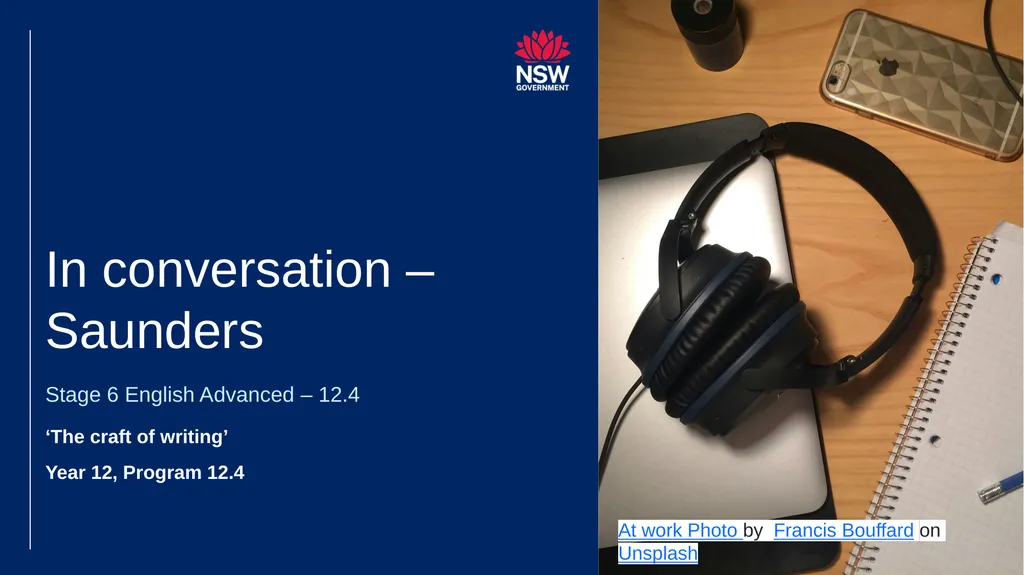
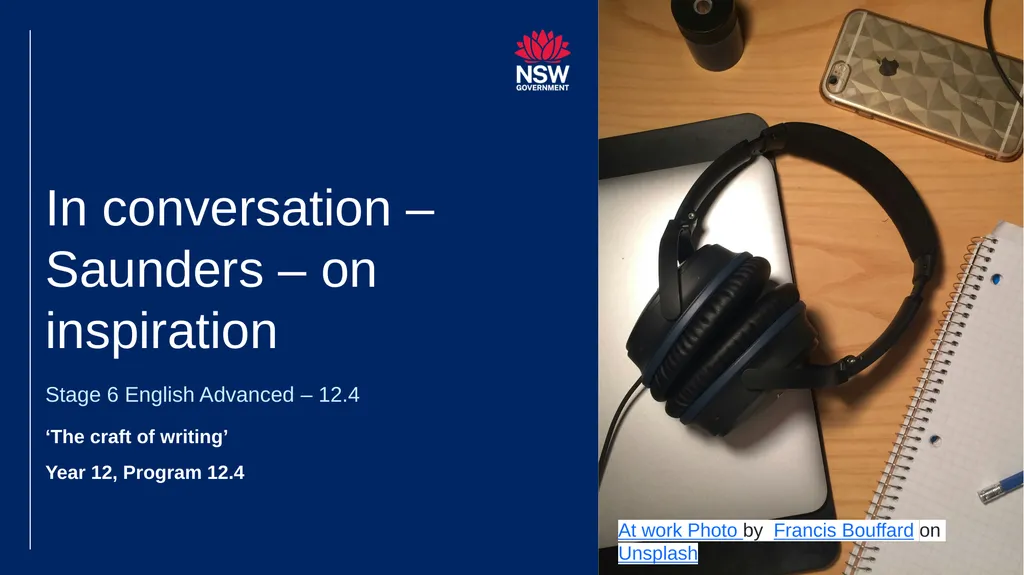
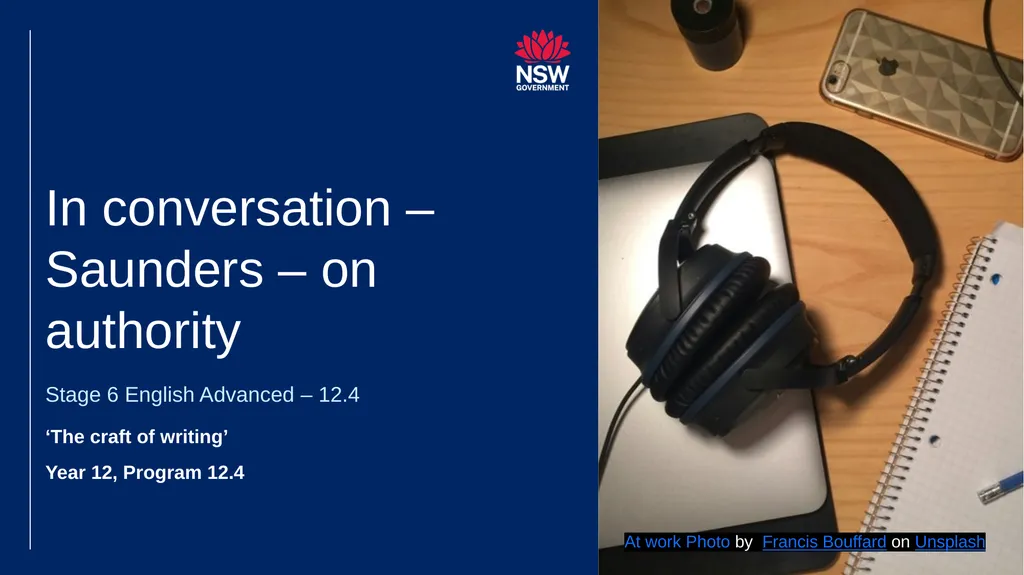
slide3. In conversation – Saunders Stage 6 English Advanced – 12.4 ‘The craft of writing’ Year 12, Program 12.4 At work Photo by Francis Bouffard on Unsplash<br>
slide4. Text complexity details Core text 1 – ‘Overture’ in This All Come Back Now by Mykaela Saunders This Australian print, non-fiction text, is a discursive piece of writing, by an Aboriginal author, that introduces and frames a contemporary anthology of Aboriginal and Torres Strait Islander speculative fiction. It uses a confident, conversational authorial voice, extended metaphor, direct address and rhetorical questioning to position the reader, while also weaving cultural reference points and critical commentary throughout the piece. The prose blends varied sentence structures, layered inferences and purposeful repetition. These features align with the complex and highly complex levels of the Text complexity scale which can be downloaded on the General capabilities downloads page of the Australian Curriculum webpage. 4<br>
slide5. Licence agreement details Core text 1 – ‘Overture’ in This All Come Back Now by Mykaela Saunders Saunders M (2022) ‘Overture’, in Saunders M (ed), This All Come Back Now, University of Queensland Press, St Lucia, ISBN: 978-0702263257
Reproduced and made available for copying and communication by NSW Department of Education for its educational purposes with the permission of University of Queensland press. This resource is licensed up until October 2030. 5<br>
slide6. Working with Aboriginal and Torres Strait Islander Histories and Cultures Aboriginal and Torres Strait Islander principles and protocols Some consistent principles associated with the teaching of Aboriginal and Torres Strait Islander Histories and Cultures include:
respect for, and protection of, the knowledge and cultural expressions of Aboriginal and Torres Strait Islander Peoples
ongoing consultation with Aboriginal and Torres Strait Islander knowledge holders and keepers, custodians and stakeholders
reciprocity between education providers and communities
recognition of Indigenous Cultural and Intellectual Property 6<br>
slide7. Connection with community and elders NSW Aboriginal Education Consultative Group Connection with community and Elders would help with the learning and understanding of this text. This could happen through connection with your local NSW Aboriginal Education Consultative Group (AEGC) NSW AECG Inc. and/or Aboriginal communities.
Note
‘The NSW AECG is a non for profit (sic) Aboriginal organisation that provides advice on all matters relevant to education and training with the mandate that this advice represents the Aboriginal community viewpoint.
The NSW AECG Inc. promotes respect, empowerment and self-determination and believes the process of collaborative consultation is integral to equal partnership and is fundamental to the achievement of equality.’ (AECG, n.d.) 7<br>
slide8. Promoting culturally inclusive classrooms How to use the English core texts Many texts by Aboriginal and/or Torres Strait Islander authors that are valuable teaching tools for the classroom, explore the ongoing impacts of colonisation. Due to the potentially sensitive nature of some of the content, it is essential that teachers create a safe space for students and help develop mutual respect and understanding between members of the classroom community.
Be aware of cultural load
Know your students' backgrounds
Prepare students for the topic
Safe and respectful discussions 8<br>
slide9. In conversation – Saunders – on inspiration Stage 6 English Advanced – 12.4 ‘The craft of writing’ Year 12, Program 12.4 At work Photo by Francis Bouffard on Unsplash<br>
slide10. Sharing learning intentions and success criteria<br>
slide11. Learning intentions and success criteria We are learning to:
explain how a writer’s context, identity and decisions about genre influence the authority of their perspective
critically analyse how a writer uses language, tone and discursive features to establish authority
reflect on how a writer’s insights about inspiration and storytelling can inform choices in our own writing.
We can:
[classroom teacher to insert sample success criteria]
[classroom teacher to insert sample success criteria]
[classroom teacher to insert sample success criteria]. 11<br>
slide12. Podcast preview Activating curiosity Before listening to the podcast, use the following questions to complete a quick write:
What makes a writer’s authorial voice feel genuine or trustworthy?
How might a writer’s context, identity and experiences shape the stories they tell?
Why might an author choose a conversational tone?
After reading the extracts explored so far, predict:
What sources of inspiration might Saunders discuss and how could these shape her storytelling in ‘Overture’? 12<br>
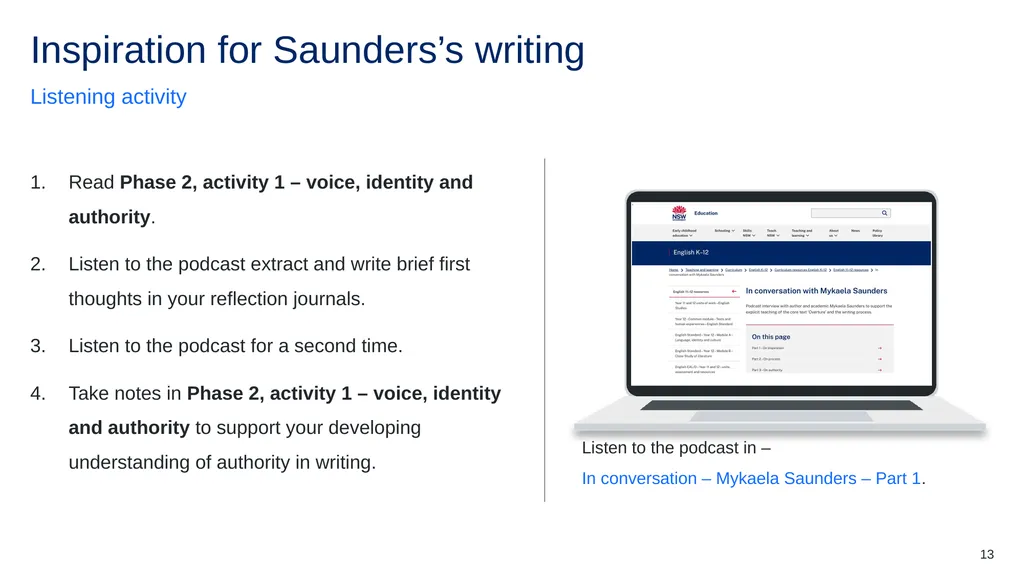
slide13. Inspiration for Saunders’s writing Listening activity Read Phase 2, activity 1 – voice, identity and authority.
Listen to the podcast extract and write brief first thoughts in your reflection journals.
Listen to the podcast for a second time.
Take notes in Phase 2, activity 1 – voice, identity and authority to support your developing understanding of authority in writing. Listen to the podcast in – In conversation – Mykaela Saunders – Part 1. 13<br>
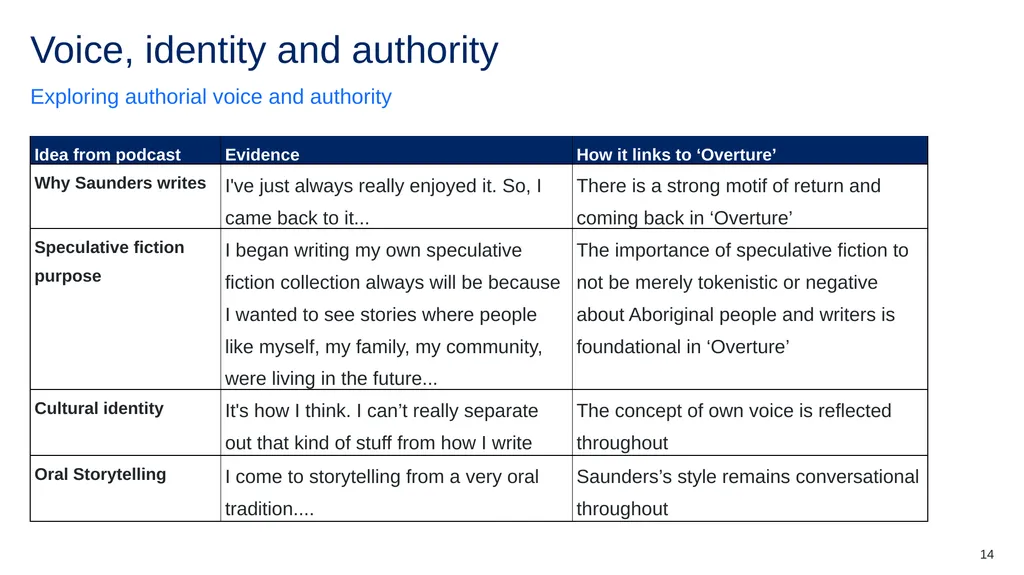
slide14. Voice, identity and authority Exploring authorial voice and authority 14<br>
slide15. Podcast and activities<br>
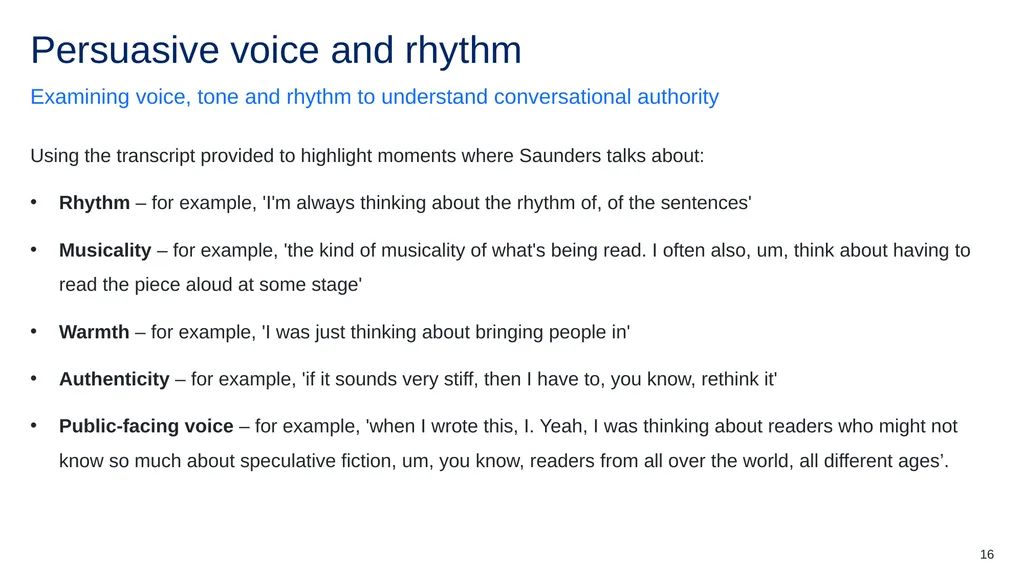
slide16. Persuasive voice and rhythm Examining voice, tone and rhythm to understand conversational authority Using the transcript provided to highlight moments where Saunders talks about:
Rhythm – for example, 'I'm always thinking about the rhythm of, of the sentences'
Musicality – for example, 'the kind of musicality of what's being read. I often also, um, think about having to read the piece aloud at some stage'
Warmth – for example, 'I was just thinking about bringing people in'
Authenticity – for example, 'if it sounds very stiff, then I have to, you know, rethink it'
Public-facing voice – for example, 'when I wrote this, I. Yeah, I was thinking about readers who might not know so much about speculative fiction, um, you know, readers from all over the world, all different ages’. 16<br>
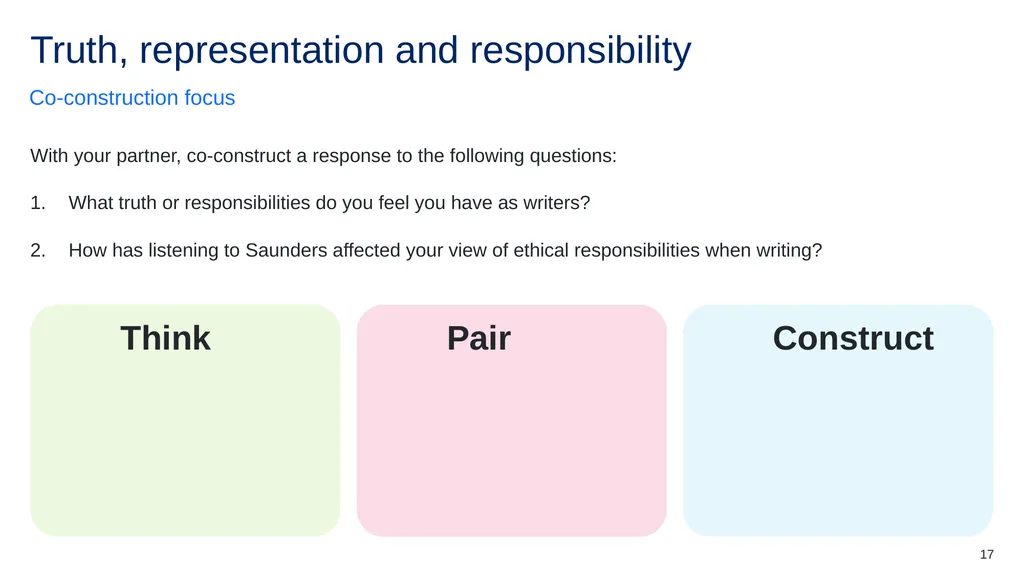
slide17. Truth, representation and responsibility Co-construction focus With your partner, co-construct a response to the following questions:
What truth or responsibilities do you feel you have as writers?
How has listening to Saunders affected your view of ethical responsibilities when writing? Think Pair Construct 17<br>
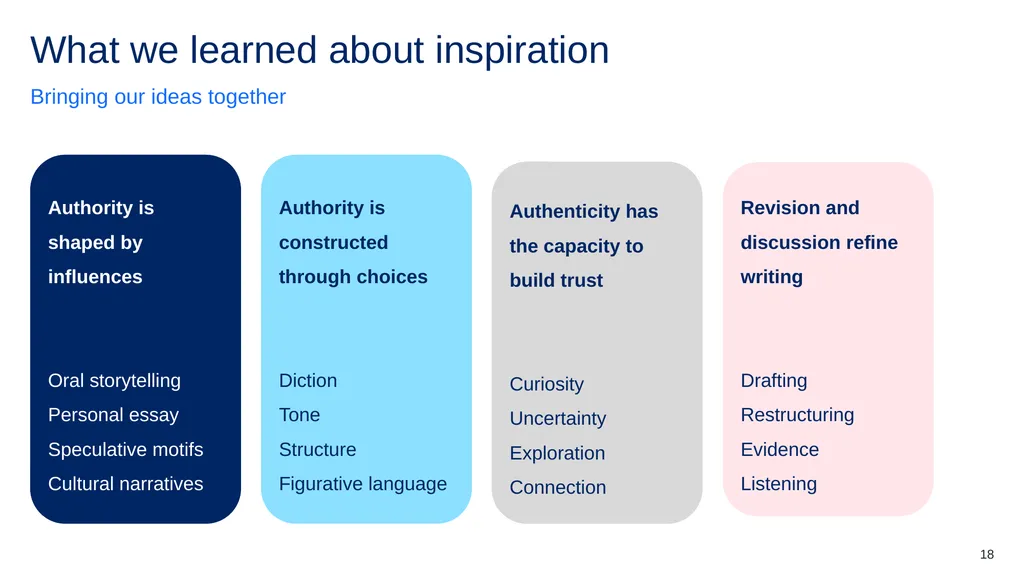
slide18. What we learned about inspiration Bringing our ideas together Authority is shaped by influences
Oral storytelling
Personal essay
Speculative motifs
Cultural narratives Authority is constructed through choices
Diction
Tone
Structure
Figurative language Authenticity has the capacity to build trust
Curiosity
Uncertainty
Exploration
Connection Revision and discussion refine writing
Drafting
Restructuring
Evidence
Listening 18<br>
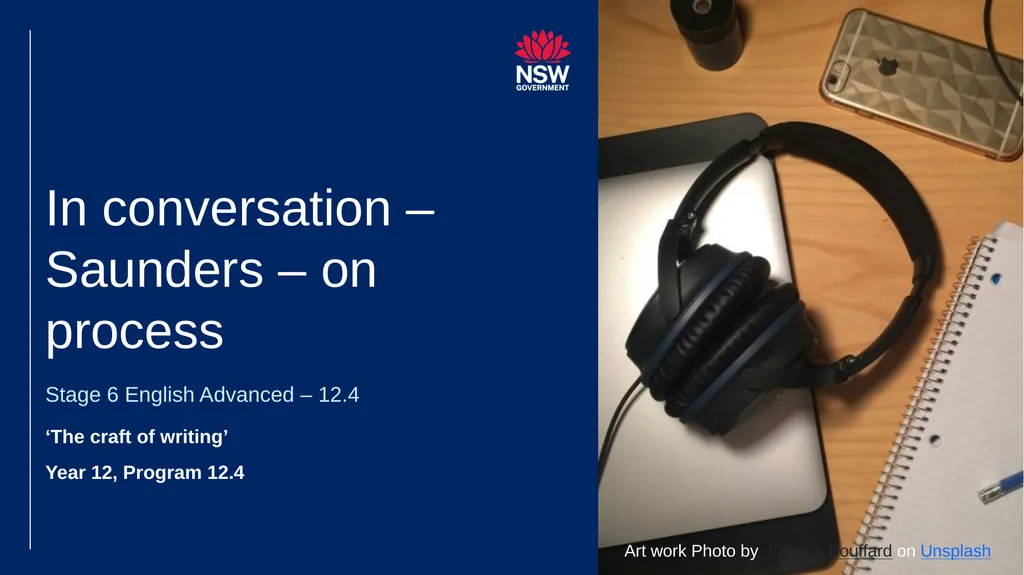
slide19. In conversation – Saunders – on process Stage 6 English Advanced – 12.4 ‘The craft of writing’ Year 12, Program 12.4 Art work Photo by Francis Bouffard on Unsplash<br>
slide20. Sharing learning intentions and success criteria<br>
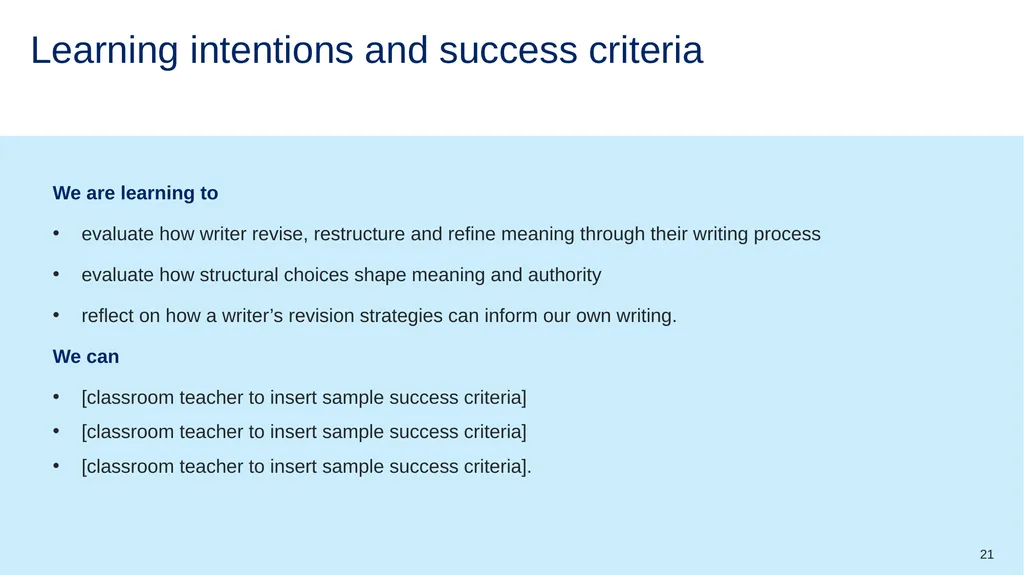
slide21. Learning intentions and success criteria We are learning to
evaluate how writer revise, restructure and refine meaning through their writing process
evaluate how structural choices shape meaning and authority
reflect on how a writer’s revision strategies can inform our own writing.
We can
[classroom teacher to insert sample success criteria]
[classroom teacher to insert sample success criteria]
[classroom teacher to insert sample success criteria]. 21<br>
slide22. Podcast and activities<br>
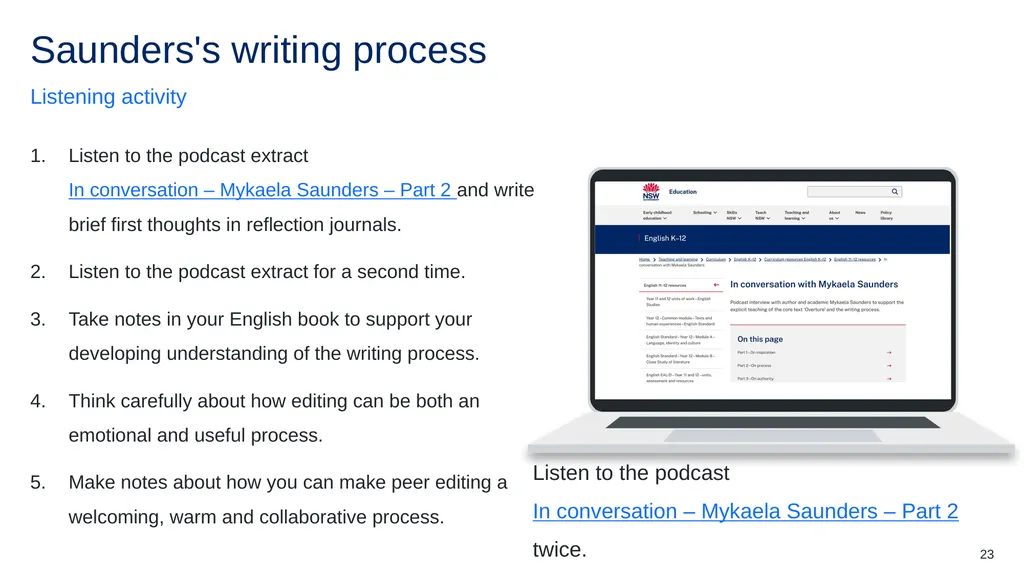
slide23. Saunders's writing process Listening activity Listen to the podcast extract In conversation – Mykaela Saunders – Part 2 and write brief first thoughts in reflection journals.
Listen to the podcast extract for a second time.
Take notes in your English book to support your developing understanding of the writing process.
Think carefully about how editing can be both an emotional and useful process.
Make notes about how you can make peer editing a welcoming, warm and collaborative process. 23<br>
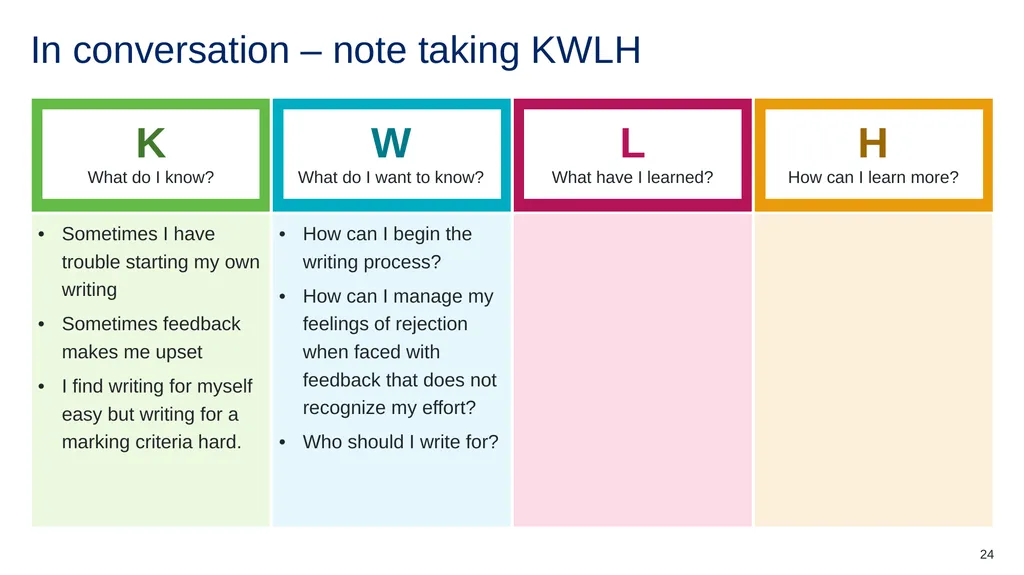
slide24. In conversation – note taking KWLH 24<br>
slide25. Saunders's writing process continued Listening activity As you listen to the podcast, think about the importance of:
handwriting
transcription methods
thinking of writing as a conversation
framing editing as a jigsaw puzzle
accepting emotions as they arise
who to have as your audience
making feedback welcoming, warm and collaborative. 25<br>
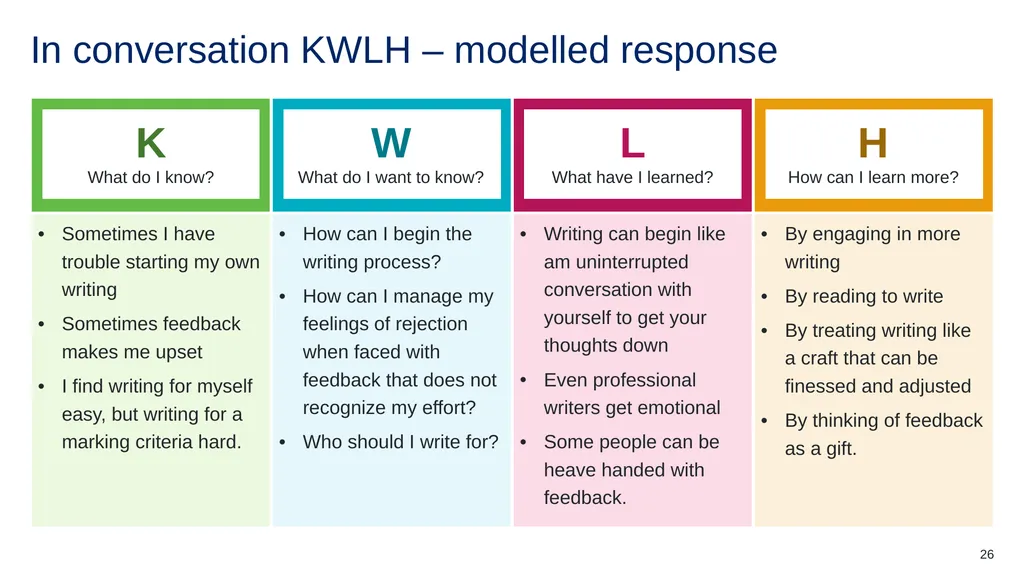
slide26. In conversation KWLH – modelled response 26<br>
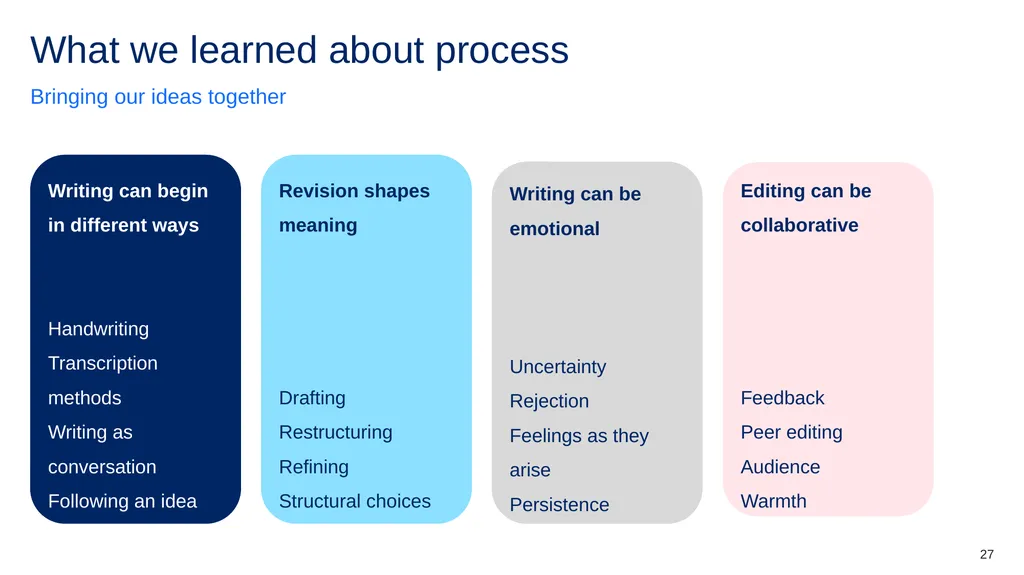
slide27. What we learned about process Bringing our ideas together Writing can begin in different ways
Handwriting
Transcription methods
Writing as conversation
Following an idea Revision shapes meaning
Drafting
Restructuring
Refining
Structural choices Writing can be emotional
Uncertainty
Rejection
Feelings as they arise
Persistence Editing can be collaborative
Feedback
Peer editing
Audience
Warmth 27<br>
slide28. In conversation – Saunders – on authority Stage 6 English Advanced – 12.4 ‘The craft of writing’ Year 12, Program 12.4 At work Photo by Francis Bouffard on Unsplash<br>
slide29. Sharing learning intentions and success criteria<br>
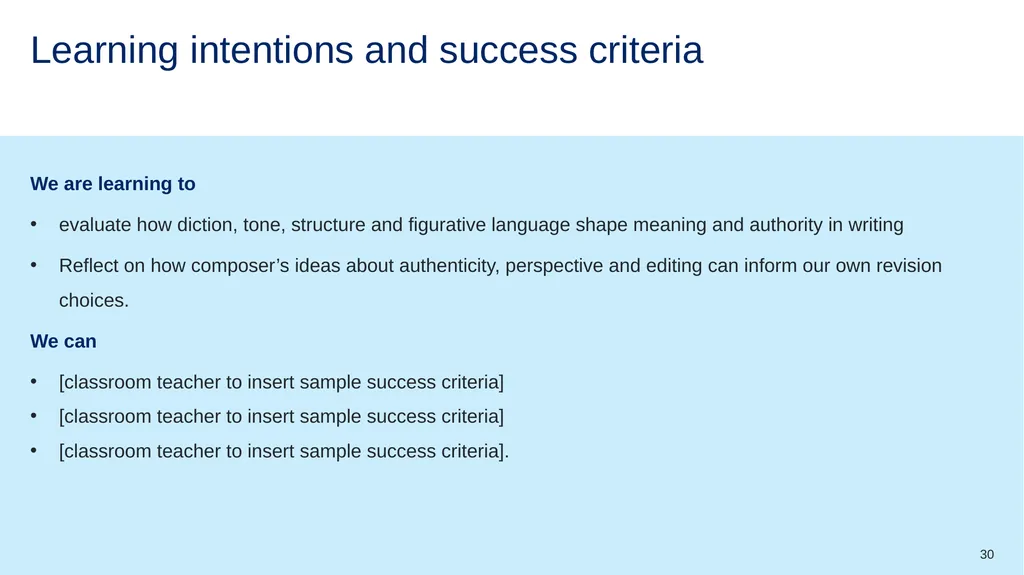
slide30. Learning intentions and success criteria We are learning to
evaluate how diction, tone, structure and figurative language shape meaning and authority in writing
Reflect on how composer’s ideas about authenticity, perspective and editing can inform our own revision choices.
We can
[classroom teacher to insert sample success criteria]
[classroom teacher to insert sample success criteria]
[classroom teacher to insert sample success criteria]. 30<br>
slide31. Podcast and activities<br>
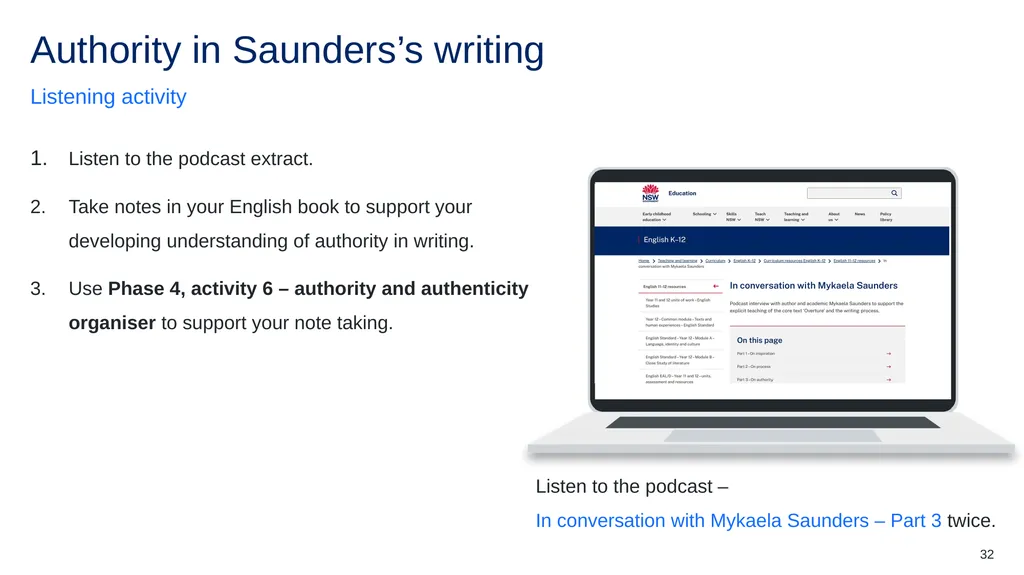
slide32. Authority in Saunders’s writing Listening activity Listen to the podcast extract.
Take notes in your English book to support your developing understanding of authority in writing.
Use Phase 4, activity 6 – authority and authenticity organiser to support your note taking. 32<br>
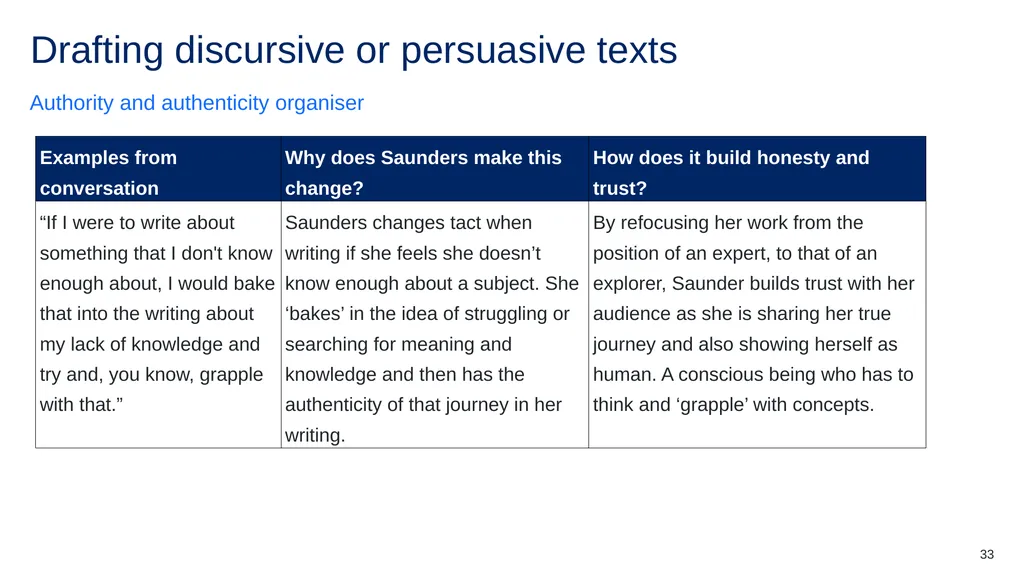
slide33. Drafting discursive or persuasive texts Authority and authenticity organiser 33<br>
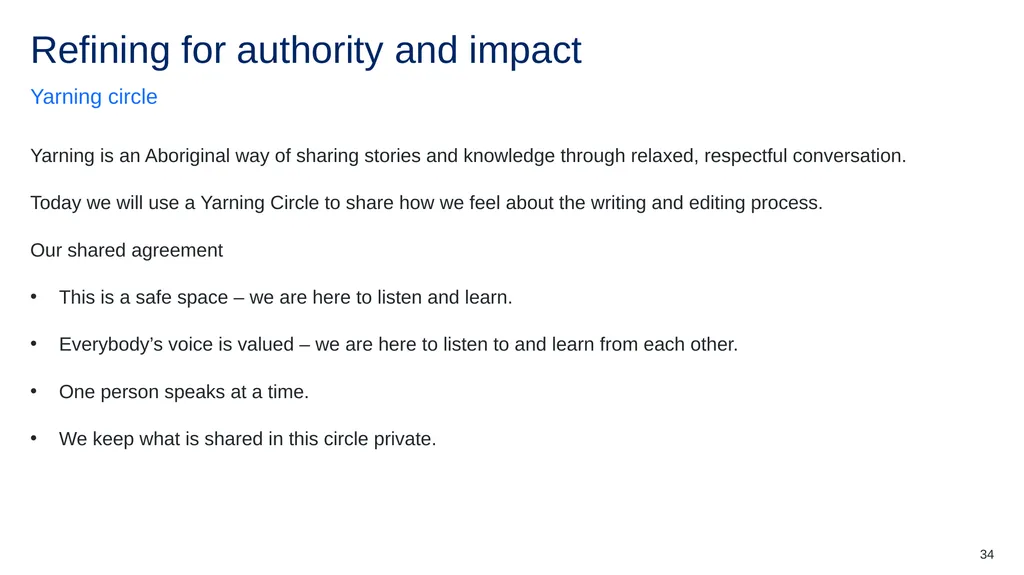
slide34. Refining for authority and impact Yarning circle Yarning is an Aboriginal way of sharing stories and knowledge through relaxed, respectful conversation.
Today we will use a Yarning Circle to share how we feel about the writing and editing process.
Our shared agreement
This is a safe space – we are here to listen and learn.
Everybody’s voice is valued – we are here to listen to and learn from each other.
One person speaks at a time.
We keep what is shared in this circle private. 34<br>
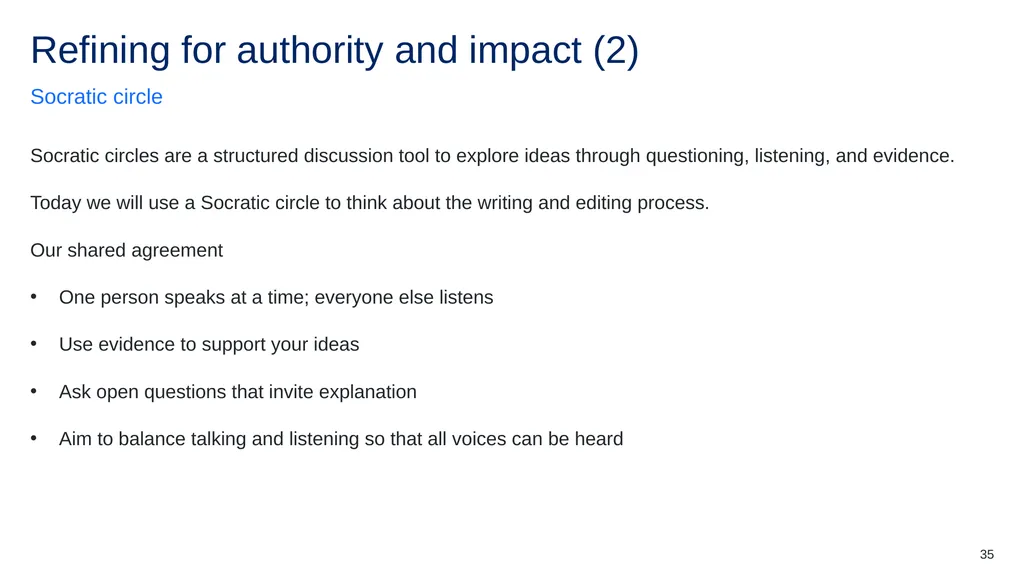
slide35. Refining for authority and impact (2) Socratic circle Socratic circles are a structured discussion tool to explore ideas through questioning, listening, and evidence.
Today we will use a Socratic circle to think about the writing and editing process.
Our shared agreement
One person speaks at a time; everyone else listens
Use evidence to support your ideas
Ask open questions that invite explanation
Aim to balance talking and listening so that all voices can be heard 35<br>
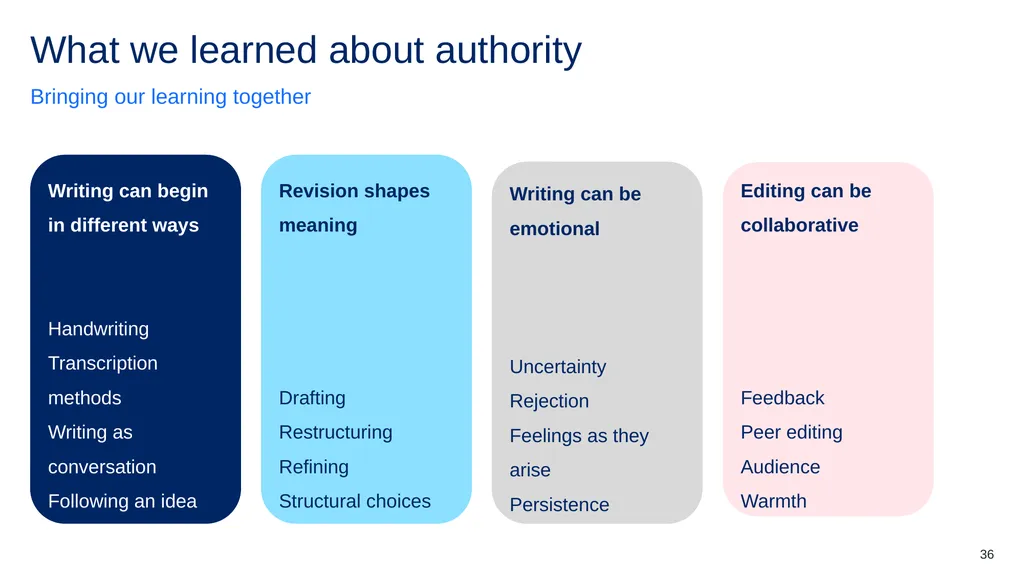
slide36. What we learned about authority Bringing our learning together Writing can begin in different ways
Handwriting
Transcription methods
Writing as conversation
Following an idea Revision shapes meaning
Drafting
Restructuring
Refining
Structural choices Writing can be emotional
Uncertainty
Rejection
Feelings as they arise
Persistence Editing can be collaborative
Feedback
Peer editing
Audience
Warmth 36<br>
slide37. References This presentation contains NSW Curriculum and syllabus content. The NSW Curriculum is developed by the NSW Education Standards Authority. This content is prepared by NESA for and on behalf of the Crown in the right of the State of New South Wales. The material is protected by Crown copyright.
Please refer to the NESA Copyright Disclaimer for more information.
NESA holds the only official and up-to-date versions of the NSW Curriculum and syllabus documents. Please visit the NSW Education Standards Authority (NESA) website https://educationstandards.nsw.edu.au/wps/portal/nesa/home and the NSW Curriculum website https://curriculum.nsw.edu.au. English Advanced 11–12 Syllabus (2024) © NSW Education Standards Authority (NESA) for and on behalf of the Crown in right of the State of New South Wales, 2024.
Australian Education Research Organisation (AERO) (2024a) Explain learning objectives, AERO, accessed 13 April 2026.
AERO (Australian Education Research Organisation) (2024b) Why explicit instruction works, AERO website, accessed 13 April 2026.
Australian Curriculum, Assessment and Reporting Authority (ACARA) (2026) General capabilities downloads, accessed 13 April 2026.
ACCA Melbourne. (n.d.) This all come back now [Webpage], https://acca.melbourne/product/this-all-come-back-now, accessed 13 April 2026.
Black P and Wiliam D (2018) ‘Classroom assessment and pedagogy’, Assessment in Education Principles Policy and Practice, 25(1):1–25, accessed 13 April 2026.
Bouffard F (2019) At work [photograph] Black corded headphones photo – Free School Image on Unsplash, accessed 13 April 2026.
CESE (Centre for Education Statistics and Evaluation) (2017) Cognitive load theory: Research that teachers really need to understand, NSW Department of Education, accessed 13 April 2026.
Clarke S (2014) Outstanding formative assessment: culture and practice, Hodder Education, Great Britain. 37<br>
slide38. 38 References (2) Clarke S, Timperley H, Hattie J (2003) Unlocking formative assessment: Practical strategies for enhancing students’ learning in the primary and intermediate classroom, Hodder Moa Beckett, Auckland NZ, 2003.
Griffin P (2018) Assessment for teaching, Cambridge University Press.
McCausland J (2021) desert [image] Unsplash website, accessed 13 April 2026.
NESA (NSW Education Standards Authority) (n.d.) Collaborative curriculum planning, NESA website, accessed 13 April 2026.
Saunders M (2022) ‘Overture’, in Saunders M (ed), This All Come Back Now, University of Queensland Press, St Lucia. Reproduced and made available for copying and communication by NSW Department of Education for its educational purposes with the permission of Mykaela Saunders. This resource is licensed until 31 July 2030.
State of New South Wales (Department of Education) (n.d.) Explicit teaching strategies, NSW Department of Education website, accessed 13 April 2026.
——(2024) the Explicit teaching – Driving learning and engagement, Centre for Education Statistics and Evaluation website, accessed 13 April 2026.
——(n.d.) Digital Learning Selector, NSW Department of Education website, accessed 13 April 2026.
Wiliam D (2014) ‘The right questions, the right way ’, Educational Leadership, 71(6), accessed 13 April 2026.
Winch T J (2021) The Yield, Penguin Random House Australia, Sydney. Reproduced and made available for copying and communication by NSW Department of Education for its educational purposes with the permission of The Penguin Random House Australia Pty Ltd. This resource is licenced up until April 2031.<br>
slide39. Copyright © State of New South Wales (Department of Education), 2026 The copyright material published in this resource is subject to the Copyright Act 1968 (Cth) and is owned by the NSW Department of Education or, where indicated, by a party other than the NSW Department of Education (third-party material).
Copyright material available in this resource and owned by the NSW Department of Education is licensed under a Creative Commons Attribution 4.0 International (CC BY 4.0) license.
This license allows you to share and adapt the material for any purpose, even commercially.
Attribution should be given to © State of New South Wales (Department of Education), 2026.
Material in this resource not available under a Creative Commons license:
the NSW Department of Education logo, other logos and trademark-protected material
Material owned by a third party that has been reproduced with permission. You will need to obtain permission from the third party to reuse its material.
Links to third-party material and websites
Please note that the provided (reading/viewing material/list/links/texts) are a suggestion only and implies no endorsement, by the New South Wales Department of Education, of any author, publisher, or book title. School principals and teachers are best placed to assess the suitability of resources that would complement the curriculum and reflect the needs and interests of their students.
If you use the links provided in this document to access a third-party’s website, you acknowledge that the terms of use, including licence terms set out on the third-party’s website apply to the use which may be made of the materials on that third-party website or where permitted by the Copyright Act 1968 (Cth). The department accepts no responsibility for content on third-party websites.<br>
Classroom teachers are encouraged to add and adapt slides as required to meet the needs of their students.
Save a copy of the file to make changes to the slide deck. Go to File > Download a Copy (this downloads a copy to the computer to edit in the PowerPoint app).
To convert the PowerPoint to Google Slides:
Upload the file into Google Drive and open it.
Go to File > Save as Google Slides.
(Note – conversion may cause formatting changes in the slides.) 1<br>
slide2. Index 2<br>
slide3. In conversation – Saunders Stage 6 English Advanced – 12.4 ‘The craft of writing’ Year 12, Program 12.4 At work Photo by Francis Bouffard on Unsplash<br>
slide4. Text complexity details Core text 1 – ‘Overture’ in This All Come Back Now by Mykaela Saunders This Australian print, non-fiction text, is a discursive piece of writing, by an Aboriginal author, that introduces and frames a contemporary anthology of Aboriginal and Torres Strait Islander speculative fiction. It uses a confident, conversational authorial voice, extended metaphor, direct address and rhetorical questioning to position the reader, while also weaving cultural reference points and critical commentary throughout the piece. The prose blends varied sentence structures, layered inferences and purposeful repetition. These features align with the complex and highly complex levels of the Text complexity scale which can be downloaded on the General capabilities downloads page of the Australian Curriculum webpage. 4<br>
slide5. Licence agreement details Core text 1 – ‘Overture’ in This All Come Back Now by Mykaela Saunders Saunders M (2022) ‘Overture’, in Saunders M (ed), This All Come Back Now, University of Queensland Press, St Lucia, ISBN: 978-0702263257
Reproduced and made available for copying and communication by NSW Department of Education for its educational purposes with the permission of University of Queensland press. This resource is licensed up until October 2030. 5<br>
slide6. Working with Aboriginal and Torres Strait Islander Histories and Cultures Aboriginal and Torres Strait Islander principles and protocols Some consistent principles associated with the teaching of Aboriginal and Torres Strait Islander Histories and Cultures include:
respect for, and protection of, the knowledge and cultural expressions of Aboriginal and Torres Strait Islander Peoples
ongoing consultation with Aboriginal and Torres Strait Islander knowledge holders and keepers, custodians and stakeholders
reciprocity between education providers and communities
recognition of Indigenous Cultural and Intellectual Property 6<br>
slide7. Connection with community and elders NSW Aboriginal Education Consultative Group Connection with community and Elders would help with the learning and understanding of this text. This could happen through connection with your local NSW Aboriginal Education Consultative Group (AEGC) NSW AECG Inc. and/or Aboriginal communities.
Note
‘The NSW AECG is a non for profit (sic) Aboriginal organisation that provides advice on all matters relevant to education and training with the mandate that this advice represents the Aboriginal community viewpoint.
The NSW AECG Inc. promotes respect, empowerment and self-determination and believes the process of collaborative consultation is integral to equal partnership and is fundamental to the achievement of equality.’ (AECG, n.d.) 7<br>
slide8. Promoting culturally inclusive classrooms How to use the English core texts Many texts by Aboriginal and/or Torres Strait Islander authors that are valuable teaching tools for the classroom, explore the ongoing impacts of colonisation. Due to the potentially sensitive nature of some of the content, it is essential that teachers create a safe space for students and help develop mutual respect and understanding between members of the classroom community.
Be aware of cultural load
Know your students' backgrounds
Prepare students for the topic
Safe and respectful discussions 8<br>
slide9. In conversation – Saunders – on inspiration Stage 6 English Advanced – 12.4 ‘The craft of writing’ Year 12, Program 12.4 At work Photo by Francis Bouffard on Unsplash<br>
slide10. Sharing learning intentions and success criteria<br>
slide11. Learning intentions and success criteria We are learning to:
explain how a writer’s context, identity and decisions about genre influence the authority of their perspective
critically analyse how a writer uses language, tone and discursive features to establish authority
reflect on how a writer’s insights about inspiration and storytelling can inform choices in our own writing.
We can:
[classroom teacher to insert sample success criteria]
[classroom teacher to insert sample success criteria]
[classroom teacher to insert sample success criteria]. 11<br>
slide12. Podcast preview Activating curiosity Before listening to the podcast, use the following questions to complete a quick write:
What makes a writer’s authorial voice feel genuine or trustworthy?
How might a writer’s context, identity and experiences shape the stories they tell?
Why might an author choose a conversational tone?
After reading the extracts explored so far, predict:
What sources of inspiration might Saunders discuss and how could these shape her storytelling in ‘Overture’? 12<br>
slide13. Inspiration for Saunders’s writing Listening activity Read Phase 2, activity 1 – voice, identity and authority.
Listen to the podcast extract and write brief first thoughts in your reflection journals.
Listen to the podcast for a second time.
Take notes in Phase 2, activity 1 – voice, identity and authority to support your developing understanding of authority in writing. Listen to the podcast in – In conversation – Mykaela Saunders – Part 1. 13<br>
slide14. Voice, identity and authority Exploring authorial voice and authority 14<br>
slide15. Podcast and activities<br>
slide16. Persuasive voice and rhythm Examining voice, tone and rhythm to understand conversational authority Using the transcript provided to highlight moments where Saunders talks about:
Rhythm – for example, 'I'm always thinking about the rhythm of, of the sentences'
Musicality – for example, 'the kind of musicality of what's being read. I often also, um, think about having to read the piece aloud at some stage'
Warmth – for example, 'I was just thinking about bringing people in'
Authenticity – for example, 'if it sounds very stiff, then I have to, you know, rethink it'
Public-facing voice – for example, 'when I wrote this, I. Yeah, I was thinking about readers who might not know so much about speculative fiction, um, you know, readers from all over the world, all different ages’. 16<br>
slide17. Truth, representation and responsibility Co-construction focus With your partner, co-construct a response to the following questions:
What truth or responsibilities do you feel you have as writers?
How has listening to Saunders affected your view of ethical responsibilities when writing? Think Pair Construct 17<br>
slide18. What we learned about inspiration Bringing our ideas together Authority is shaped by influences
Oral storytelling
Personal essay
Speculative motifs
Cultural narratives Authority is constructed through choices
Diction
Tone
Structure
Figurative language Authenticity has the capacity to build trust
Curiosity
Uncertainty
Exploration
Connection Revision and discussion refine writing
Drafting
Restructuring
Evidence
Listening 18<br>
slide19. In conversation – Saunders – on process Stage 6 English Advanced – 12.4 ‘The craft of writing’ Year 12, Program 12.4 Art work Photo by Francis Bouffard on Unsplash<br>
slide20. Sharing learning intentions and success criteria<br>
slide21. Learning intentions and success criteria We are learning to
evaluate how writer revise, restructure and refine meaning through their writing process
evaluate how structural choices shape meaning and authority
reflect on how a writer’s revision strategies can inform our own writing.
We can
[classroom teacher to insert sample success criteria]
[classroom teacher to insert sample success criteria]
[classroom teacher to insert sample success criteria]. 21<br>
slide22. Podcast and activities<br>
slide23. Saunders's writing process Listening activity Listen to the podcast extract In conversation – Mykaela Saunders – Part 2 and write brief first thoughts in reflection journals.
Listen to the podcast extract for a second time.
Take notes in your English book to support your developing understanding of the writing process.
Think carefully about how editing can be both an emotional and useful process.
Make notes about how you can make peer editing a welcoming, warm and collaborative process. 23<br>
slide24. In conversation – note taking KWLH 24<br>
slide25. Saunders's writing process continued Listening activity As you listen to the podcast, think about the importance of:
handwriting
transcription methods
thinking of writing as a conversation
framing editing as a jigsaw puzzle
accepting emotions as they arise
who to have as your audience
making feedback welcoming, warm and collaborative. 25<br>
slide26. In conversation KWLH – modelled response 26<br>
slide27. What we learned about process Bringing our ideas together Writing can begin in different ways
Handwriting
Transcription methods
Writing as conversation
Following an idea Revision shapes meaning
Drafting
Restructuring
Refining
Structural choices Writing can be emotional
Uncertainty
Rejection
Feelings as they arise
Persistence Editing can be collaborative
Feedback
Peer editing
Audience
Warmth 27<br>
slide28. In conversation – Saunders – on authority Stage 6 English Advanced – 12.4 ‘The craft of writing’ Year 12, Program 12.4 At work Photo by Francis Bouffard on Unsplash<br>
slide29. Sharing learning intentions and success criteria<br>
slide30. Learning intentions and success criteria We are learning to
evaluate how diction, tone, structure and figurative language shape meaning and authority in writing
Reflect on how composer’s ideas about authenticity, perspective and editing can inform our own revision choices.
We can
[classroom teacher to insert sample success criteria]
[classroom teacher to insert sample success criteria]
[classroom teacher to insert sample success criteria]. 30<br>
slide31. Podcast and activities<br>
slide32. Authority in Saunders’s writing Listening activity Listen to the podcast extract.
Take notes in your English book to support your developing understanding of authority in writing.
Use Phase 4, activity 6 – authority and authenticity organiser to support your note taking. 32<br>
slide33. Drafting discursive or persuasive texts Authority and authenticity organiser 33<br>
slide34. Refining for authority and impact Yarning circle Yarning is an Aboriginal way of sharing stories and knowledge through relaxed, respectful conversation.
Today we will use a Yarning Circle to share how we feel about the writing and editing process.
Our shared agreement
This is a safe space – we are here to listen and learn.
Everybody’s voice is valued – we are here to listen to and learn from each other.
One person speaks at a time.
We keep what is shared in this circle private. 34<br>
slide35. Refining for authority and impact (2) Socratic circle Socratic circles are a structured discussion tool to explore ideas through questioning, listening, and evidence.
Today we will use a Socratic circle to think about the writing and editing process.
Our shared agreement
One person speaks at a time; everyone else listens
Use evidence to support your ideas
Ask open questions that invite explanation
Aim to balance talking and listening so that all voices can be heard 35<br>
slide36. What we learned about authority Bringing our learning together Writing can begin in different ways
Handwriting
Transcription methods
Writing as conversation
Following an idea Revision shapes meaning
Drafting
Restructuring
Refining
Structural choices Writing can be emotional
Uncertainty
Rejection
Feelings as they arise
Persistence Editing can be collaborative
Feedback
Peer editing
Audience
Warmth 36<br>
slide37. References This presentation contains NSW Curriculum and syllabus content. The NSW Curriculum is developed by the NSW Education Standards Authority. This content is prepared by NESA for and on behalf of the Crown in the right of the State of New South Wales. The material is protected by Crown copyright.
Please refer to the NESA Copyright Disclaimer for more information.
NESA holds the only official and up-to-date versions of the NSW Curriculum and syllabus documents. Please visit the NSW Education Standards Authority (NESA) website https://educationstandards.nsw.edu.au/wps/portal/nesa/home and the NSW Curriculum website https://curriculum.nsw.edu.au. English Advanced 11–12 Syllabus (2024) © NSW Education Standards Authority (NESA) for and on behalf of the Crown in right of the State of New South Wales, 2024.
Australian Education Research Organisation (AERO) (2024a) Explain learning objectives, AERO, accessed 13 April 2026.
AERO (Australian Education Research Organisation) (2024b) Why explicit instruction works, AERO website, accessed 13 April 2026.
Australian Curriculum, Assessment and Reporting Authority (ACARA) (2026) General capabilities downloads, accessed 13 April 2026.
ACCA Melbourne. (n.d.) This all come back now [Webpage], https://acca.melbourne/product/this-all-come-back-now, accessed 13 April 2026.
Black P and Wiliam D (2018) ‘Classroom assessment and pedagogy’, Assessment in Education Principles Policy and Practice, 25(1):1–25, accessed 13 April 2026.
Bouffard F (2019) At work [photograph] Black corded headphones photo – Free School Image on Unsplash, accessed 13 April 2026.
CESE (Centre for Education Statistics and Evaluation) (2017) Cognitive load theory: Research that teachers really need to understand, NSW Department of Education, accessed 13 April 2026.
Clarke S (2014) Outstanding formative assessment: culture and practice, Hodder Education, Great Britain. 37<br>
slide38. 38 References (2) Clarke S, Timperley H, Hattie J (2003) Unlocking formative assessment: Practical strategies for enhancing students’ learning in the primary and intermediate classroom, Hodder Moa Beckett, Auckland NZ, 2003.
Griffin P (2018) Assessment for teaching, Cambridge University Press.
McCausland J (2021) desert [image] Unsplash website, accessed 13 April 2026.
NESA (NSW Education Standards Authority) (n.d.) Collaborative curriculum planning, NESA website, accessed 13 April 2026.
Saunders M (2022) ‘Overture’, in Saunders M (ed), This All Come Back Now, University of Queensland Press, St Lucia. Reproduced and made available for copying and communication by NSW Department of Education for its educational purposes with the permission of Mykaela Saunders. This resource is licensed until 31 July 2030.
State of New South Wales (Department of Education) (n.d.) Explicit teaching strategies, NSW Department of Education website, accessed 13 April 2026.
——(2024) the Explicit teaching – Driving learning and engagement, Centre for Education Statistics and Evaluation website, accessed 13 April 2026.
——(n.d.) Digital Learning Selector, NSW Department of Education website, accessed 13 April 2026.
Wiliam D (2014) ‘The right questions, the right way ’, Educational Leadership, 71(6), accessed 13 April 2026.
Winch T J (2021) The Yield, Penguin Random House Australia, Sydney. Reproduced and made available for copying and communication by NSW Department of Education for its educational purposes with the permission of The Penguin Random House Australia Pty Ltd. This resource is licenced up until April 2031.<br>
slide39. Copyright © State of New South Wales (Department of Education), 2026 The copyright material published in this resource is subject to the Copyright Act 1968 (Cth) and is owned by the NSW Department of Education or, where indicated, by a party other than the NSW Department of Education (third-party material).
Copyright material available in this resource and owned by the NSW Department of Education is licensed under a Creative Commons Attribution 4.0 International (CC BY 4.0) license.
This license allows you to share and adapt the material for any purpose, even commercially.
Attribution should be given to © State of New South Wales (Department of Education), 2026.
Material in this resource not available under a Creative Commons license:
the NSW Department of Education logo, other logos and trademark-protected material
Material owned by a third party that has been reproduced with permission. You will need to obtain permission from the third party to reuse its material.
Links to third-party material and websites
Please note that the provided (reading/viewing material/list/links/texts) are a suggestion only and implies no endorsement, by the New South Wales Department of Education, of any author, publisher, or book title. School principals and teachers are best placed to assess the suitability of resources that would complement the curriculum and reflect the needs and interests of their students.
If you use the links provided in this document to access a third-party’s website, you acknowledge that the terms of use, including licence terms set out on the third-party’s website apply to the use which may be made of the materials on that third-party website or where permitted by the Copyright Act 1968 (Cth). The department accepts no responsibility for content on third-party websites.<br>