Instructions for use This resource is not a
Description: Instructions for use This resource is not a teaching and learning program. It should be used in conjunction with sample program of learning Case and site study: The construction of ancient Egyptian pyramids. Classroom teachers are
Related Topics
Download Presentation
"Instructions for use This resource is not a" is the property of its rightful owner. Permission is granted to download and print the materials on this website for personal, non-commercial use only, and to display it on your personal computer provided you do not modify the materials and that you retain all copyright notices contained in the materials. By downloading content from our website, you accept the terms of this agreement.
Presentation Transcript
slide1. Instructions for use This resource is not a teaching and learning program. It should be used in conjunction with sample program of learning – Case and site study: The construction of ancient Egyptian pyramids.
Classroom teachers are encouraged to add and adapt slides as required to meet the needs of their students.
Save a copy of the file to make changes to the slide deck. Go to File > Download a Copy (this downloads a copy to the computer to edit in the PowerPoint app).
To convert the PowerPoint to Google Slides:
Upload the file into Google Drive and open it.
Go to File > Save as Google Slides.
(Note – conversion may cause formatting changes in the slides.) 1<br>
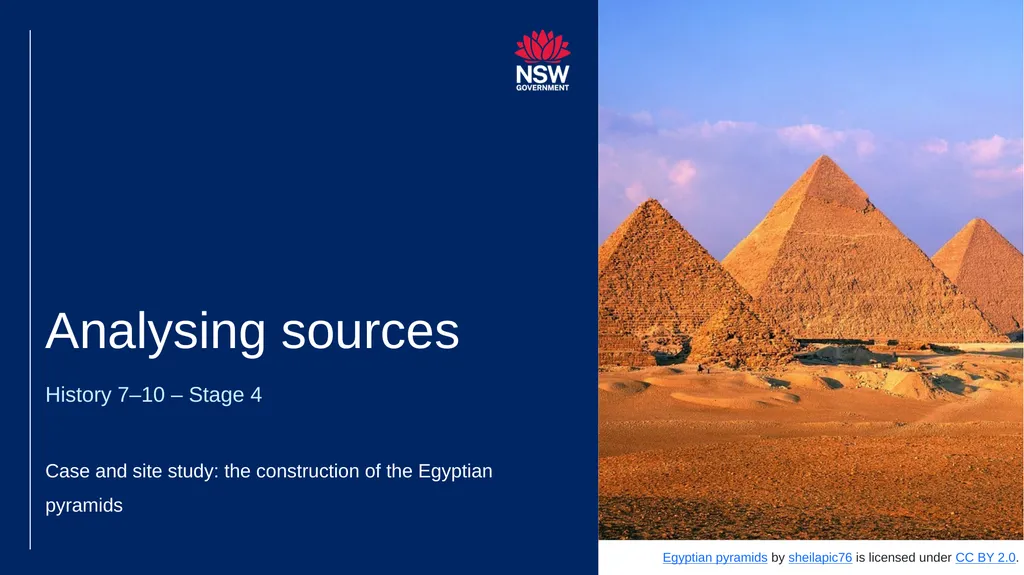
slide2. Analysing sources History 7–10 – Stage 4 Case and site study: the construction of the Egyptian pyramids Egyptian pyramids by sheilapic76 is licensed under CC BY 2.0.<br>
slide3. Learning intentions and success criteria We are learning to
analyse sources effectively
collect evidence for a historical inquiry.
We can
identify the origin, context and purpose of a source
find relevant evidence in a source
communicate an interpretation using evidence. 3<br>
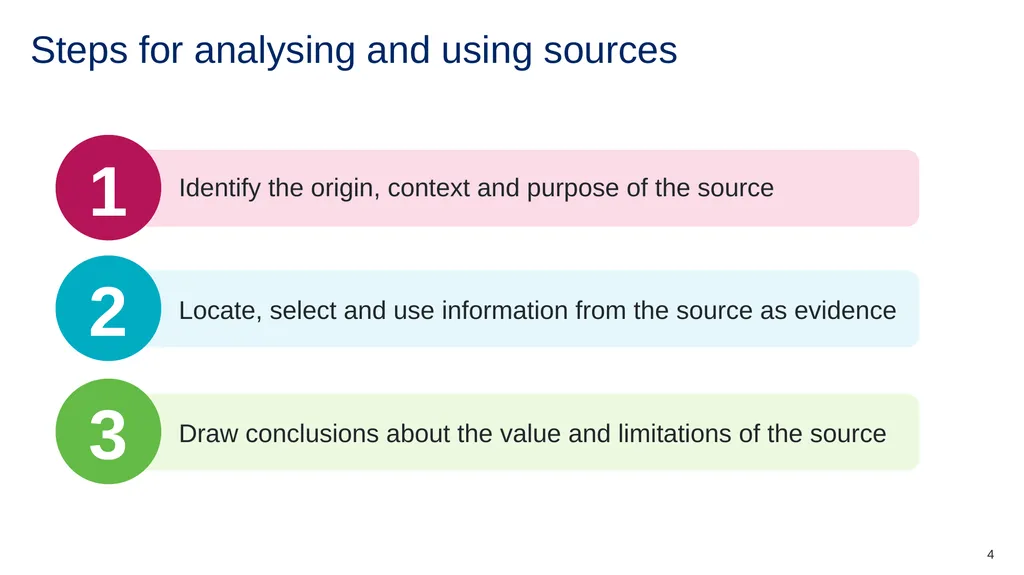
slide4. Steps for analysing and using sources 4<br>
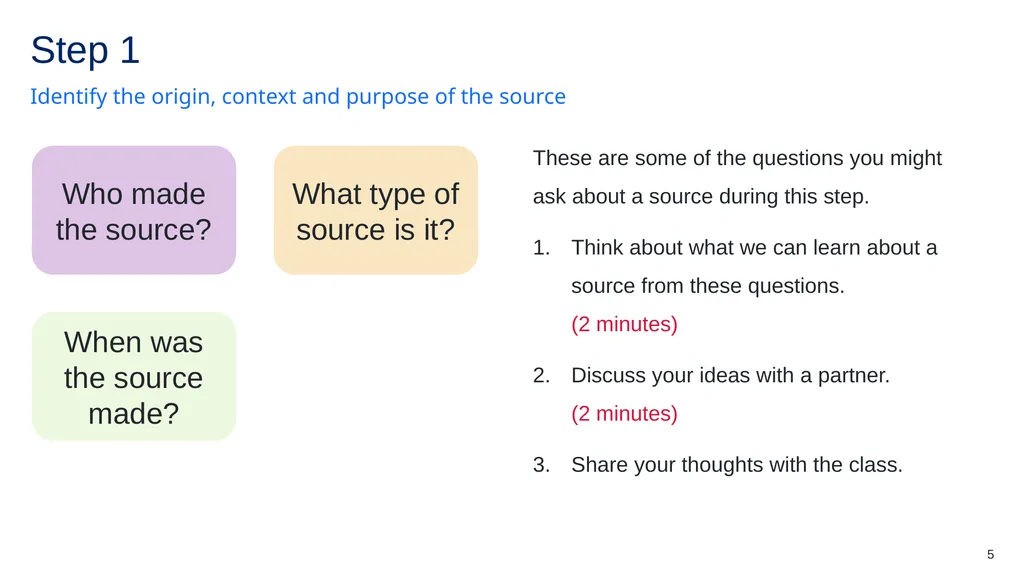
slide5. Step 1 Identify the origin, context and purpose of the source Who made the source? What type of source is it? When was the source made? These are some of the questions you might ask about a source during this step.
Think about what we can learn about a source from these questions.(2 minutes)
Discuss your ideas with a partner. (2 minutes)
Share your thoughts with the class. 5<br>
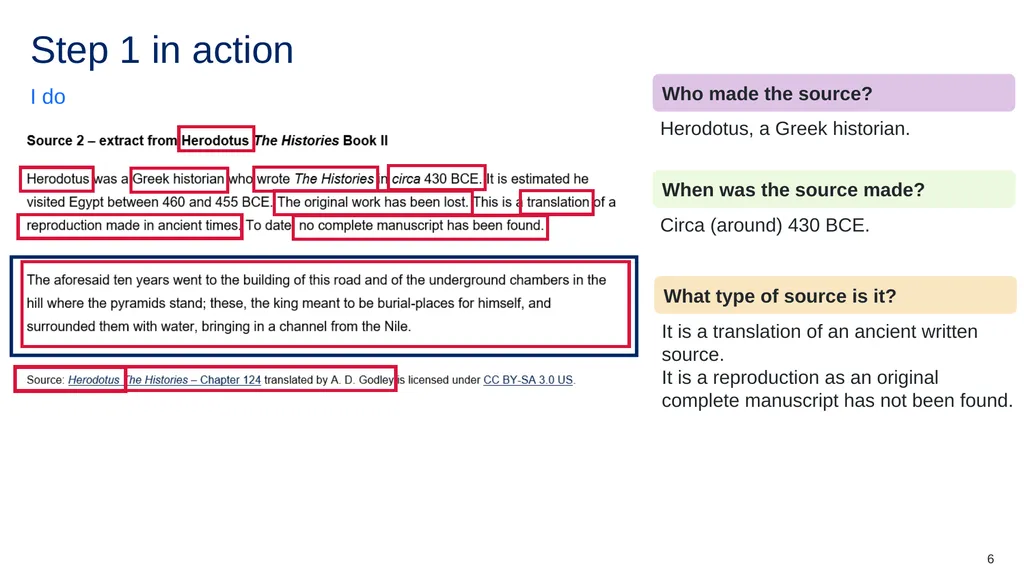
slide6. Step 1 in action I do Who made the source? Herodotus, a Greek historian. When was the source made? Circa (around) 430Â BCE. What type of source is it? It is a translation of an ancient written source.
It is a reproduction as an original complete manuscript has not been found. 6<br>
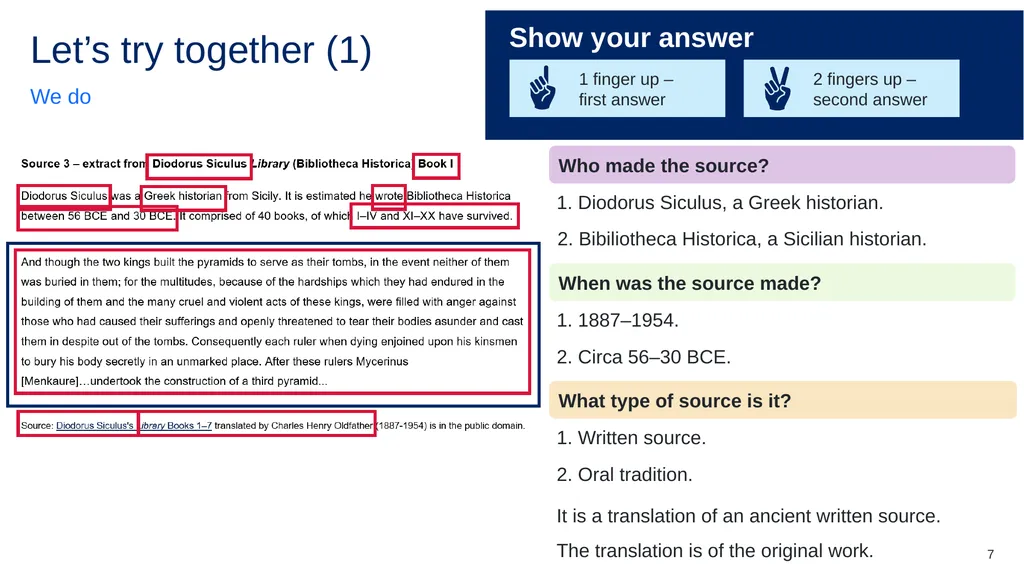
slide7. Let’s try together (1) We do Who made the source? 1. Diodorus Siculus, a Greek historian. 2. Bibiliotheca Historica, a Sicilian historian. When was the source made? 1. 1887–1954. 2. Circa 56–30 BCE. What type of source is it? 1. Written source. 2. Oral tradition. It is a translation of an ancient written source.
The translation is of the original work. 7<br>
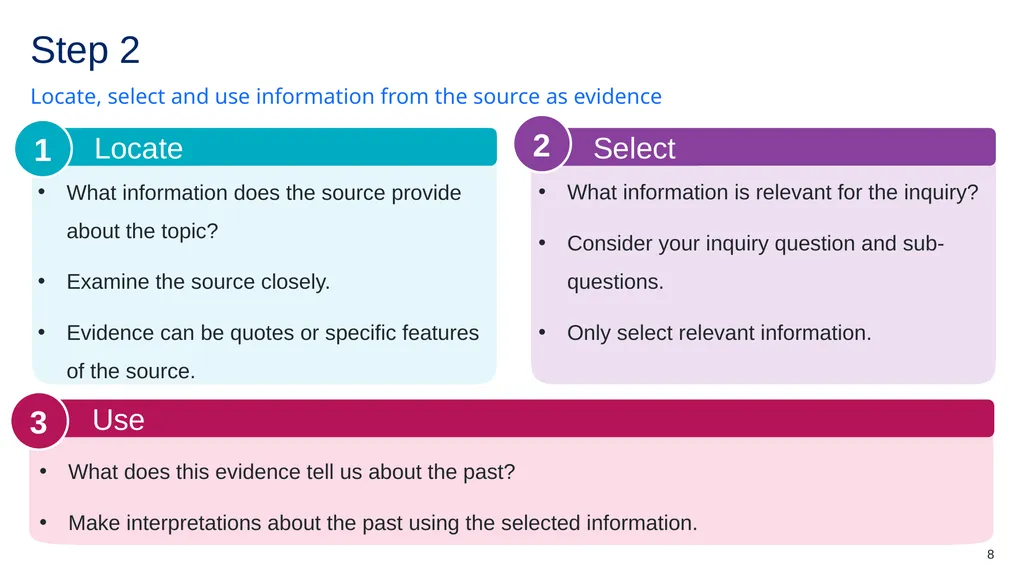
slide8. Step 2 Locate, select and use information from the source as evidence What information does the source provide about the topic?
Examine the source closely.
Evidence can be quotes or specific features of the source. What information is relevant for the inquiry?
Consider your inquiry question and sub-questions.
Only select relevant information. What does this evidence tell us about the past?
Make interpretations about the past using the selected information. 8<br>
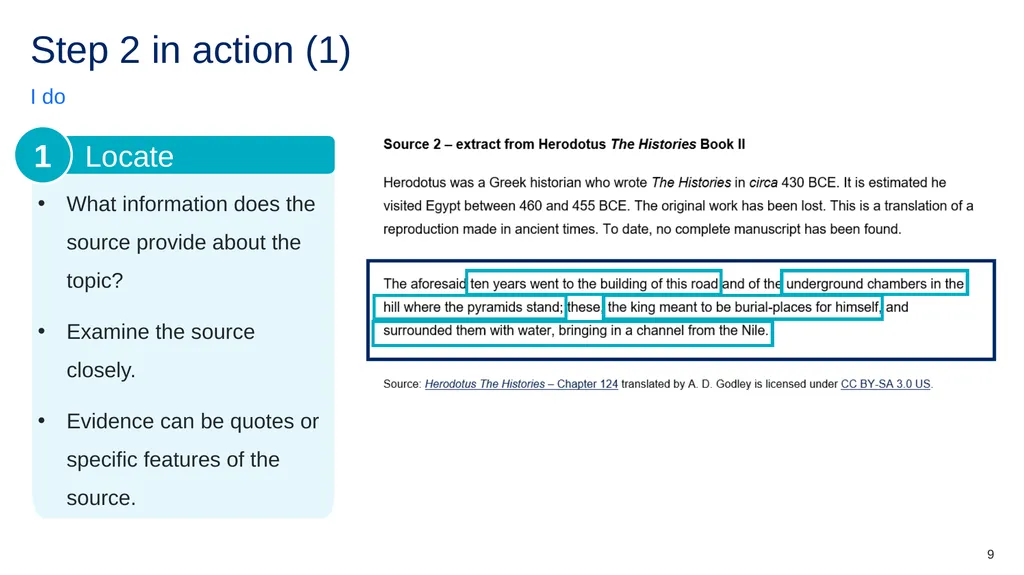
slide9. Step 2 in action (1) I do What information does the source provide about the topic?
Examine the source closely.
Evidence can be quotes or specific features of the source. 9<br>
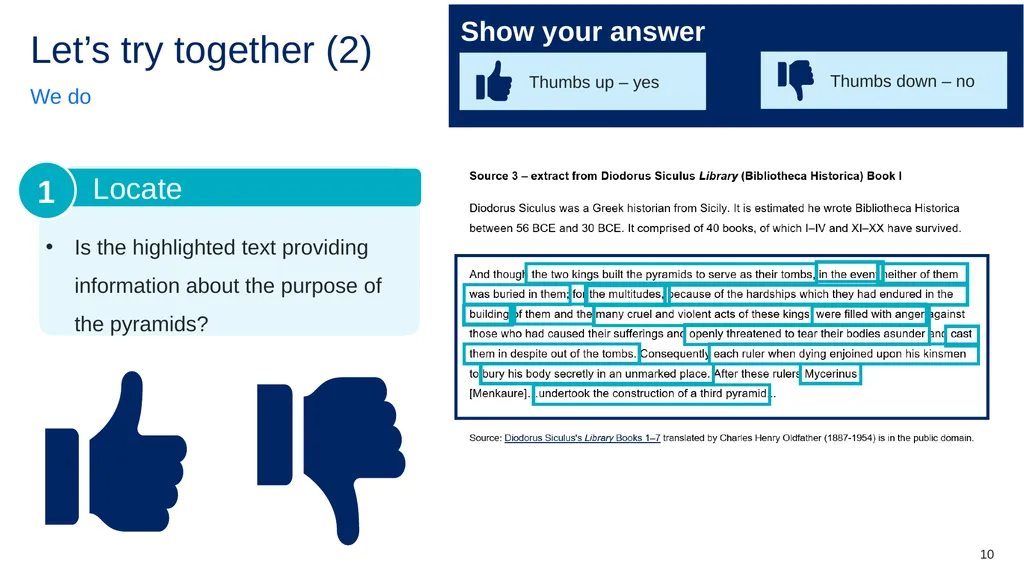
slide10. Let’s try together (2) We do Is the highlighted text providing information about the purpose of the pyramids? 10<br>
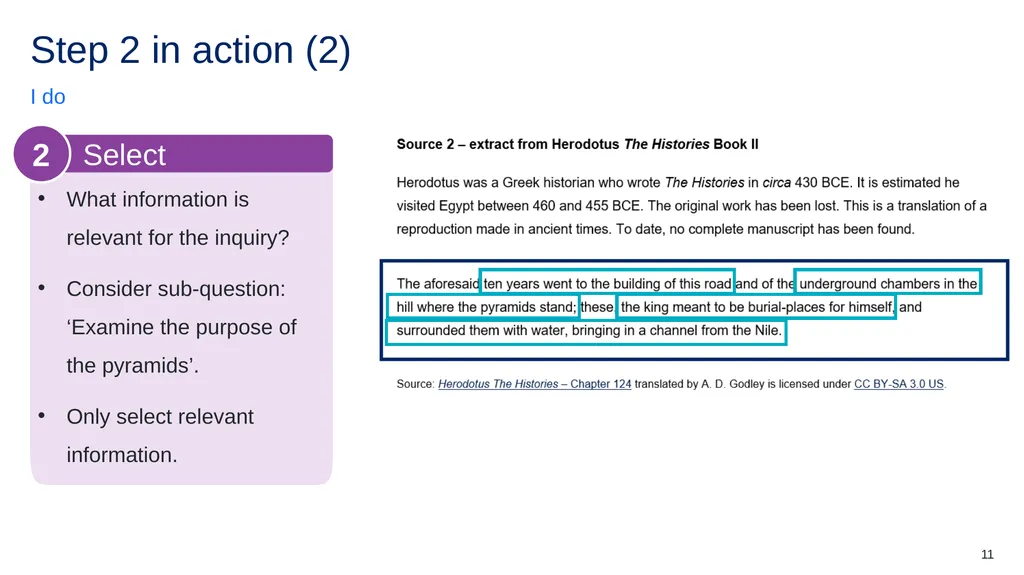
slide11. Step 2 in action (2) I do What information is relevant for the inquiry?
Consider sub-question: ‘Examine the purpose of the pyramids’.
Only select relevant information. 11<br>
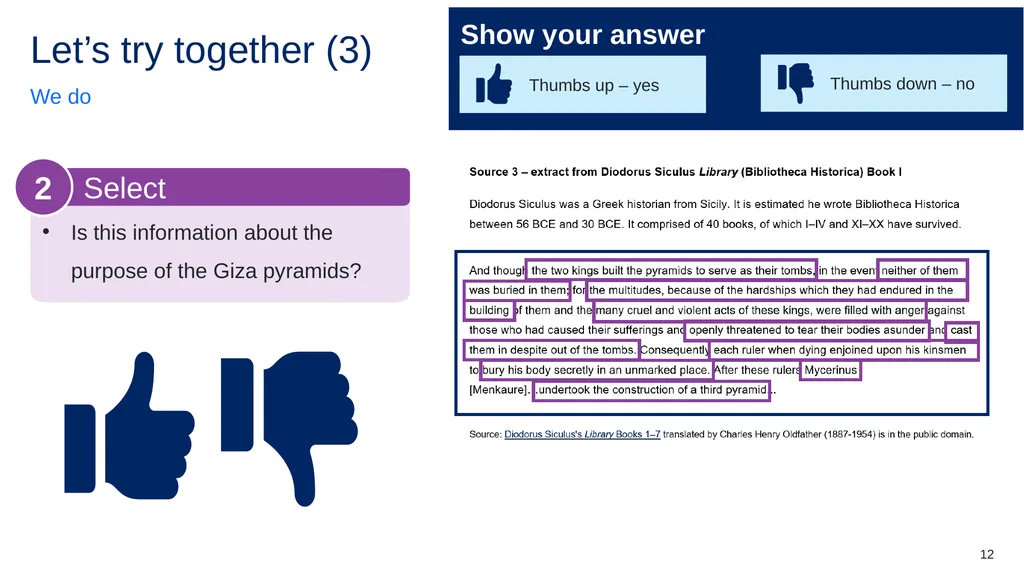
slide12. Let’s try together (3) We do Is this information about the purpose of the Giza pyramids? 12<br>
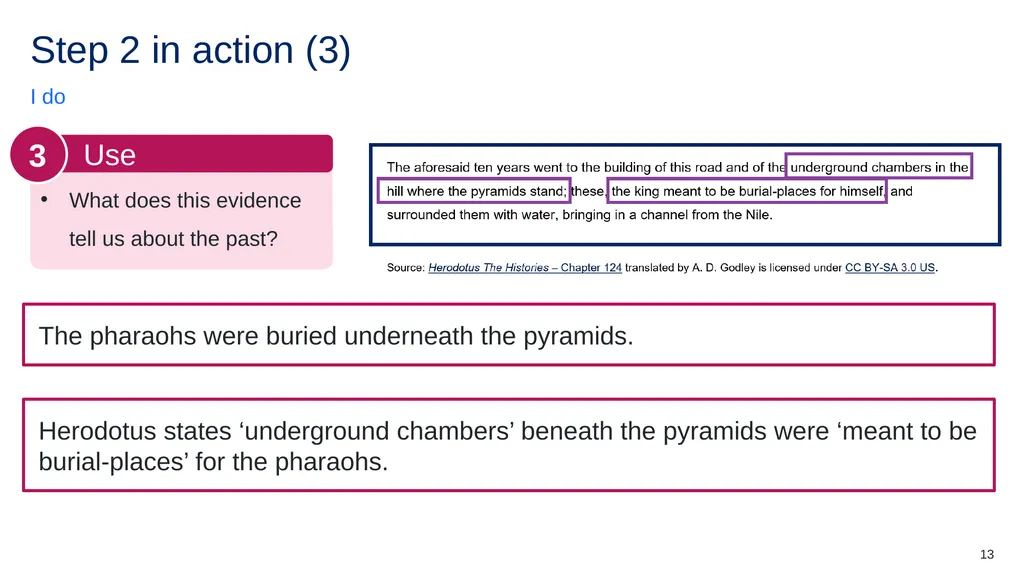
slide13. Step 2 in action (3) I do What does this evidence tell us about the past? The pharaohs were buried underneath the pyramids. Herodotus states ‘underground chambers’ beneath the pyramids were ‘meant to be burial-places’ for the pharaohs. 13<br>
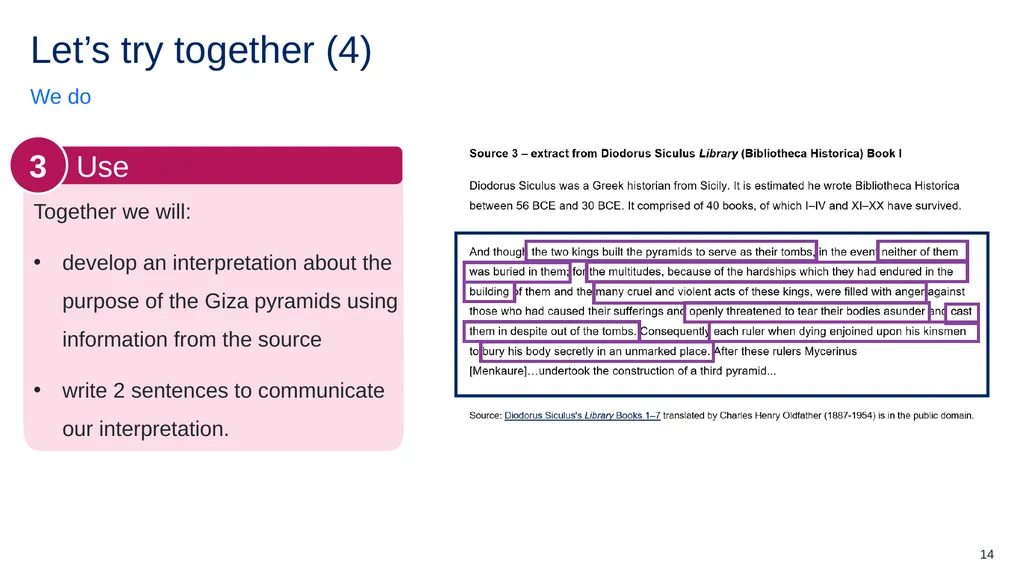
slide14. Let’s try together (4) We do Together we will:
develop an interpretation about the purpose of the Giza pyramids using information from the source
write 2 sentences to communicate our interpretation. 14<br>
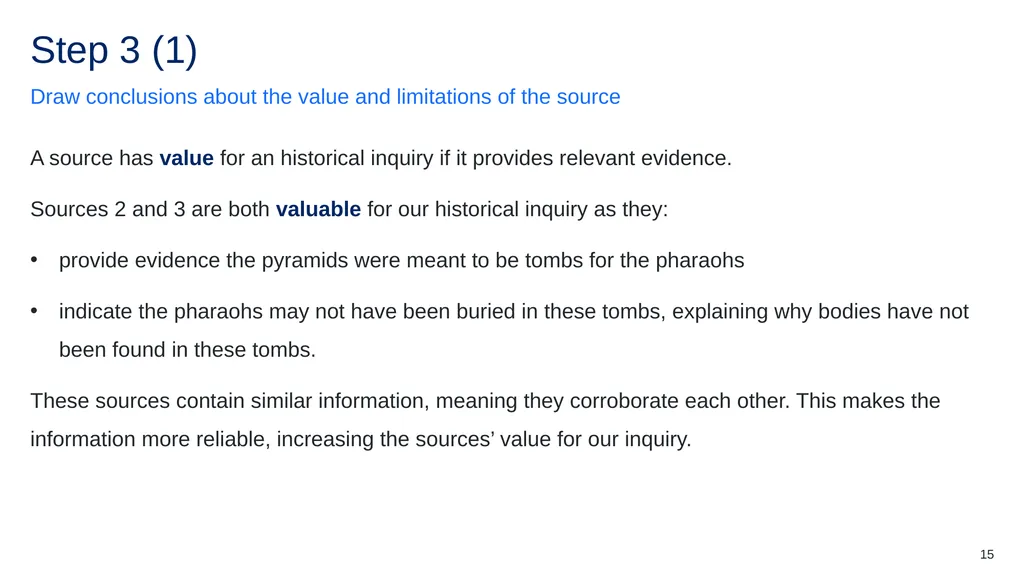
slide15. Step 3 (1) Draw conclusions about the value and limitations of the source A source has value for an historical inquiry if it provides relevant evidence.
Sources 2 and 3 are both valuable for our historical inquiry as they:
provide evidence the pyramids were meant to be tombs for the pharaohs
indicate the pharaohs may not have been buried in these tombs, explaining why bodies have not been found in these tombs.
These sources contain similar information, meaning they corroborate each other. This makes the information more reliable, increasing the sources’ value for our inquiry. 15<br>
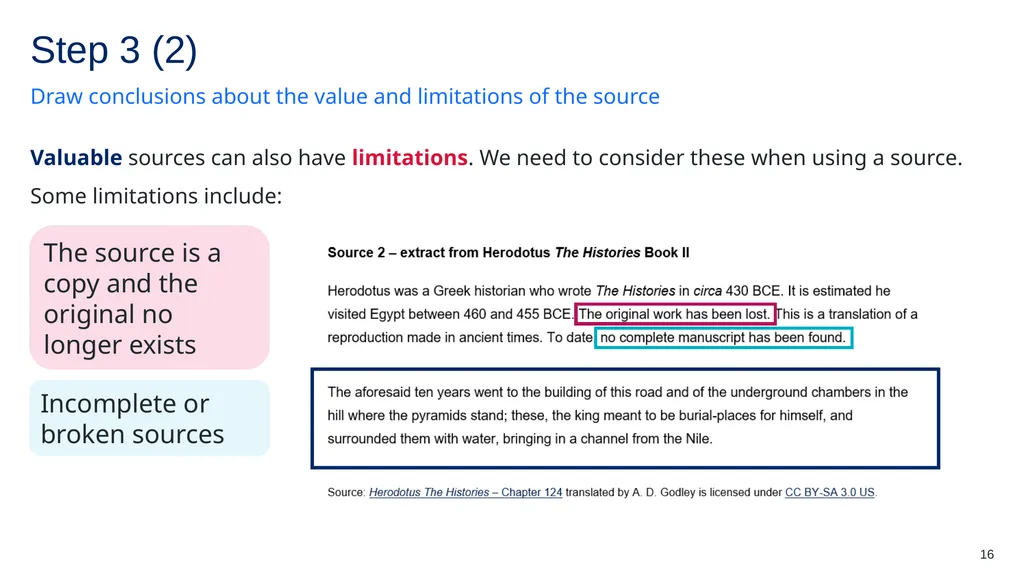
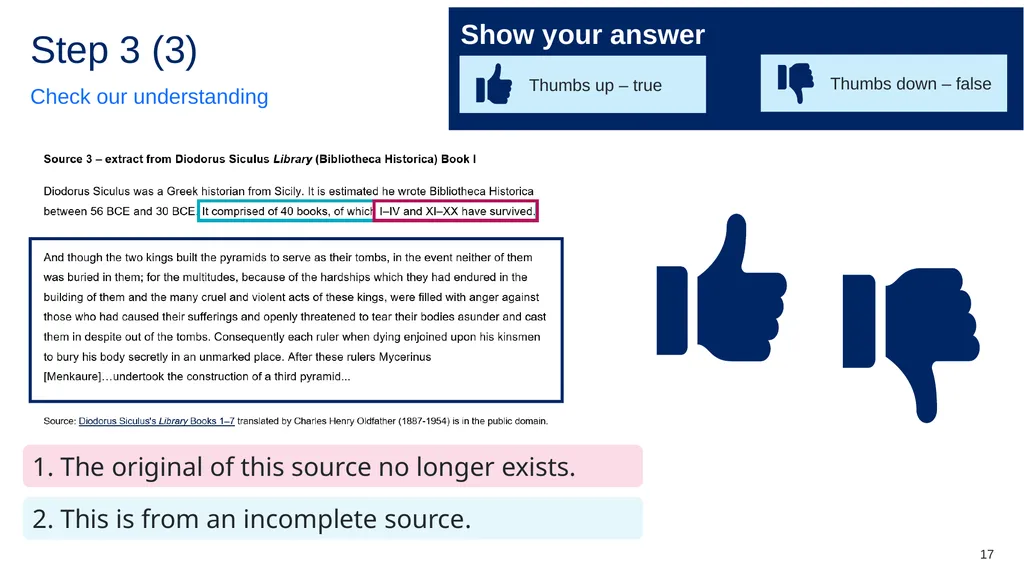
slide16. Step 3 (2) Draw conclusions about the value and limitations of the source Valuable sources can also have limitations. We need to consider these when using a source. Some limitations include: The source is a copy and the original no longer exists Incomplete or broken sources 16<br>
slide17. Step 3 (3) Check our understanding 1. The original of this source no longer exists. 2. This is from an incomplete source. 17<br>

slide18. References This presentation contains NSW Curriculum and syllabus content. The NSW Curriculum is developed by the NSW Education Standards Authority. This content is prepared by NESA for and on behalf of the Crown in the right of the State of New South Wales. The material is protected by Crown copyright.
Please refer to the NESA Copyright Disclaimer for more information https://educationstandards.nsw.edu.au/wps/portal/nesa/mini-footer/copyright.
NESA holds the only official and up-to-date versions of the NSW Curriculum and syllabus documents. Please visit the NSW Education Standards Authority (NESA) website https://educationstandards.nsw.edu.au/wps/portal/nesa/home and the NSW Curriculum website https://curriculum.nsw.edu.au. History 7–10 Syllabus © Syllabus NSW Education Standards Authority (NESA) for and on behalf of the Crown in right of the State of New South Wales, 2024.
Godley AD (1920) Herodotus, The Histories, Perseus Digital Library, accessed 26 June 2025.
Oldfather CH (1933) Diodorus Siculus, Library 1-7, ToposText, accessed 26 June 2025.
sheilapic76 (11 September 2010) Egyptian pyramids [image], Flickr, accessed 18 June 2025. 18<br>
slide19. Copyright © State of New South Wales (Department of Education), 2026 The copyright material published in this resource is subject to the Copyright Act 1968 (Cth) and is owned by the NSW Department of Education or, where indicated, by a party other than the NSW Department of Education (third-party material).
Copyright material available in this resource and owned by the NSW Department of Education is licensed under a Creative Commons Attribution 4.0 International (CC BY 4.0) license.
This license allows you to share and adapt the material for any purpose, even commercially.
Attribution should be given to © State of New South Wales (Department of Education), 2026.
Material in this resource not available under a Creative Commons license:
the NSW Department of Education logo, other logos and trademark-protected material
Material owned by a third party that has been reproduced with permission. You will need to obtain permission from the third party to reuse its material.
Links to third-party material and websites
Please note that the provided (reading/viewing material/list/links/texts) are a suggestion only and implies no endorsement, by the New South Wales Department of Education, of any author, publisher, or book title. School principals and teachers are best placed to assess the suitability of resources that would complement the curriculum and reflect the needs and interests of their students.
If you use the links provided in this document to access a third-party’s website, you acknowledge that the terms of use, including licence terms set out on the third-party’s website apply to the use which may be made of the materials on that third-party website or where permitted by the Copyright Act 1968 (Cth). The department accepts no responsibility for content on third-party websites.<br>
Classroom teachers are encouraged to add and adapt slides as required to meet the needs of their students.
Save a copy of the file to make changes to the slide deck. Go to File > Download a Copy (this downloads a copy to the computer to edit in the PowerPoint app).
To convert the PowerPoint to Google Slides:
Upload the file into Google Drive and open it.
Go to File > Save as Google Slides.
(Note – conversion may cause formatting changes in the slides.) 1<br>
slide2. Analysing sources History 7–10 – Stage 4 Case and site study: the construction of the Egyptian pyramids Egyptian pyramids by sheilapic76 is licensed under CC BY 2.0.<br>
slide3. Learning intentions and success criteria We are learning to
analyse sources effectively
collect evidence for a historical inquiry.
We can
identify the origin, context and purpose of a source
find relevant evidence in a source
communicate an interpretation using evidence. 3<br>
slide4. Steps for analysing and using sources 4<br>
slide5. Step 1 Identify the origin, context and purpose of the source Who made the source? What type of source is it? When was the source made? These are some of the questions you might ask about a source during this step.
Think about what we can learn about a source from these questions.(2 minutes)
Discuss your ideas with a partner. (2 minutes)
Share your thoughts with the class. 5<br>
slide6. Step 1 in action I do Who made the source? Herodotus, a Greek historian. When was the source made? Circa (around) 430Â BCE. What type of source is it? It is a translation of an ancient written source.
It is a reproduction as an original complete manuscript has not been found. 6<br>
slide7. Let’s try together (1) We do Who made the source? 1. Diodorus Siculus, a Greek historian. 2. Bibiliotheca Historica, a Sicilian historian. When was the source made? 1. 1887–1954. 2. Circa 56–30 BCE. What type of source is it? 1. Written source. 2. Oral tradition. It is a translation of an ancient written source.
The translation is of the original work. 7<br>
slide8. Step 2 Locate, select and use information from the source as evidence What information does the source provide about the topic?
Examine the source closely.
Evidence can be quotes or specific features of the source. What information is relevant for the inquiry?
Consider your inquiry question and sub-questions.
Only select relevant information. What does this evidence tell us about the past?
Make interpretations about the past using the selected information. 8<br>
slide9. Step 2 in action (1) I do What information does the source provide about the topic?
Examine the source closely.
Evidence can be quotes or specific features of the source. 9<br>
slide10. Let’s try together (2) We do Is the highlighted text providing information about the purpose of the pyramids? 10<br>
slide11. Step 2 in action (2) I do What information is relevant for the inquiry?
Consider sub-question: ‘Examine the purpose of the pyramids’.
Only select relevant information. 11<br>
slide12. Let’s try together (3) We do Is this information about the purpose of the Giza pyramids? 12<br>
slide13. Step 2 in action (3) I do What does this evidence tell us about the past? The pharaohs were buried underneath the pyramids. Herodotus states ‘underground chambers’ beneath the pyramids were ‘meant to be burial-places’ for the pharaohs. 13<br>
slide14. Let’s try together (4) We do Together we will:
develop an interpretation about the purpose of the Giza pyramids using information from the source
write 2 sentences to communicate our interpretation. 14<br>
slide15. Step 3 (1) Draw conclusions about the value and limitations of the source A source has value for an historical inquiry if it provides relevant evidence.
Sources 2 and 3 are both valuable for our historical inquiry as they:
provide evidence the pyramids were meant to be tombs for the pharaohs
indicate the pharaohs may not have been buried in these tombs, explaining why bodies have not been found in these tombs.
These sources contain similar information, meaning they corroborate each other. This makes the information more reliable, increasing the sources’ value for our inquiry. 15<br>
slide16. Step 3 (2) Draw conclusions about the value and limitations of the source Valuable sources can also have limitations. We need to consider these when using a source. Some limitations include: The source is a copy and the original no longer exists Incomplete or broken sources 16<br>
slide17. Step 3 (3) Check our understanding 1. The original of this source no longer exists. 2. This is from an incomplete source. 17<br>
slide18. References This presentation contains NSW Curriculum and syllabus content. The NSW Curriculum is developed by the NSW Education Standards Authority. This content is prepared by NESA for and on behalf of the Crown in the right of the State of New South Wales. The material is protected by Crown copyright.
Please refer to the NESA Copyright Disclaimer for more information https://educationstandards.nsw.edu.au/wps/portal/nesa/mini-footer/copyright.
NESA holds the only official and up-to-date versions of the NSW Curriculum and syllabus documents. Please visit the NSW Education Standards Authority (NESA) website https://educationstandards.nsw.edu.au/wps/portal/nesa/home and the NSW Curriculum website https://curriculum.nsw.edu.au. History 7–10 Syllabus © Syllabus NSW Education Standards Authority (NESA) for and on behalf of the Crown in right of the State of New South Wales, 2024.
Godley AD (1920) Herodotus, The Histories, Perseus Digital Library, accessed 26 June 2025.
Oldfather CH (1933) Diodorus Siculus, Library 1-7, ToposText, accessed 26 June 2025.
sheilapic76 (11 September 2010) Egyptian pyramids [image], Flickr, accessed 18 June 2025. 18<br>
slide19. Copyright © State of New South Wales (Department of Education), 2026 The copyright material published in this resource is subject to the Copyright Act 1968 (Cth) and is owned by the NSW Department of Education or, where indicated, by a party other than the NSW Department of Education (third-party material).
Copyright material available in this resource and owned by the NSW Department of Education is licensed under a Creative Commons Attribution 4.0 International (CC BY 4.0) license.
This license allows you to share and adapt the material for any purpose, even commercially.
Attribution should be given to © State of New South Wales (Department of Education), 2026.
Material in this resource not available under a Creative Commons license:
the NSW Department of Education logo, other logos and trademark-protected material
Material owned by a third party that has been reproduced with permission. You will need to obtain permission from the third party to reuse its material.
Links to third-party material and websites
Please note that the provided (reading/viewing material/list/links/texts) are a suggestion only and implies no endorsement, by the New South Wales Department of Education, of any author, publisher, or book title. School principals and teachers are best placed to assess the suitability of resources that would complement the curriculum and reflect the needs and interests of their students.
If you use the links provided in this document to access a third-party’s website, you acknowledge that the terms of use, including licence terms set out on the third-party’s website apply to the use which may be made of the materials on that third-party website or where permitted by the Copyright Act 1968 (Cth). The department accepts no responsibility for content on third-party websites.<br>