
Instructions for use This resource is not a


Description: Instructions for use This resource is not a teaching and learning program. It should be used in conjunction with Interconnections and trade. Classroom teachers are encouraged to add and adapt slides as required to meet the needs of their
Related Topics
Download Presentation
"Instructions for use This resource is not a" is the property of its rightful owner. Permission is granted to download and print the materials on this website for personal, non-commercial use only, and to display it on your personal computer provided you do not modify the materials and that you retain all copyright notices contained in the materials. By downloading content from our website, you accept the terms of this agreement.
Presentation Transcript
slide1. Instructions for use This resource is not a teaching and learning program. It should be used in conjunction with Interconnections and trade.
Classroom teachers are encouraged to add and adapt slides as required to meet the needs of their students.
Save a copy of the file to make changes to the slide deck. Go to File > Download a Copy (this downloads a copy to the computer to edit in the PowerPoint app).
To convert the PowerPoint to Google Slides:
Upload the file into Google Drive and open it.
Go to File > Save as Google Slides.
(Note – conversion may cause formatting changes in the slides.) 1<br>
slide2. Interconnections and trade Lesson 15 – perspectives on Fair Trade NSW Department of Education<br>
slide3. Learning intentions and success criteria We are learning :
how people involved in global trade may have different perspective and priorities
how fair trade attempts to address inequality in global trade.
We can:
identify the perspectives of different people involved in the clothing trade
explain why their views about fair trade might differ
describes how fair trade attempts to address issues in global supply chains. 3<br>
slide4. Activate prior knowledge A t-shirt sells in Australia for $20.
A garment worker who helped produce the shirt earns about $4.50 per day. Do you think this situation seems fair or unfair? Explain your reasoning.
Who do you think is involved in producing and selling a t-shirt? 4<br>
slide5. Connecting learning Fair Trade – True or False Fair trade aims to improve conditions for workers by paying fairer wages? True
Fair trade is not concerned with ensuring safe working environments? False
Fair trade improves global trade flow by supporting ethical supply chains? True
Fair trade does not give consumers the option to support responsible businesses? False 5<br>
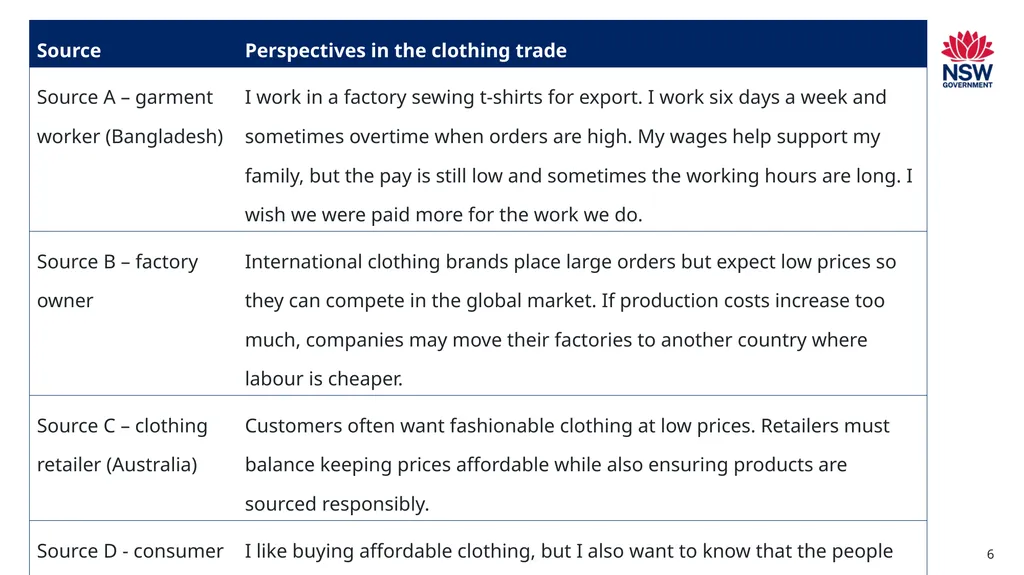
slide6. 6 Perspectives summary table<br>
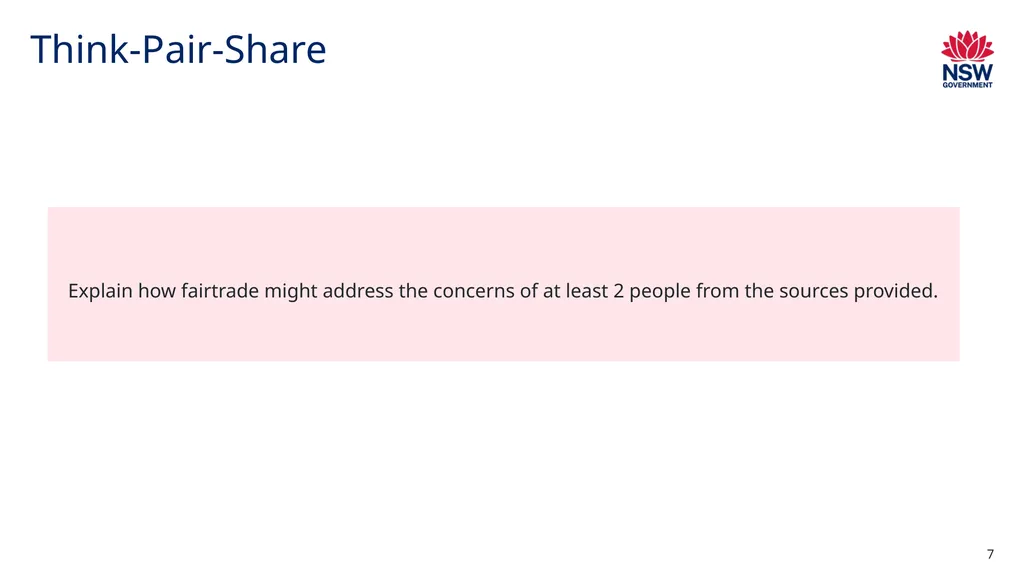
slide7. Think-Pair-Share Explain how fairtrade might address the concerns of at least 2 people from the sources provided. 7<br>
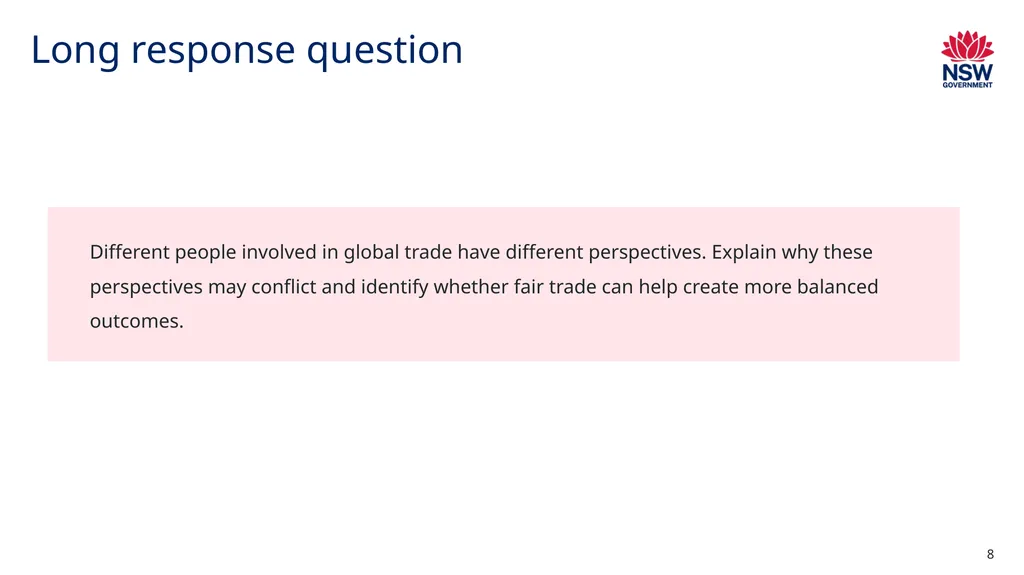
slide8. Long response question Different people involved in global trade have different perspectives. Explain why these perspectives may conflict and identify whether fair trade can help create more balanced outcomes. 8<br>
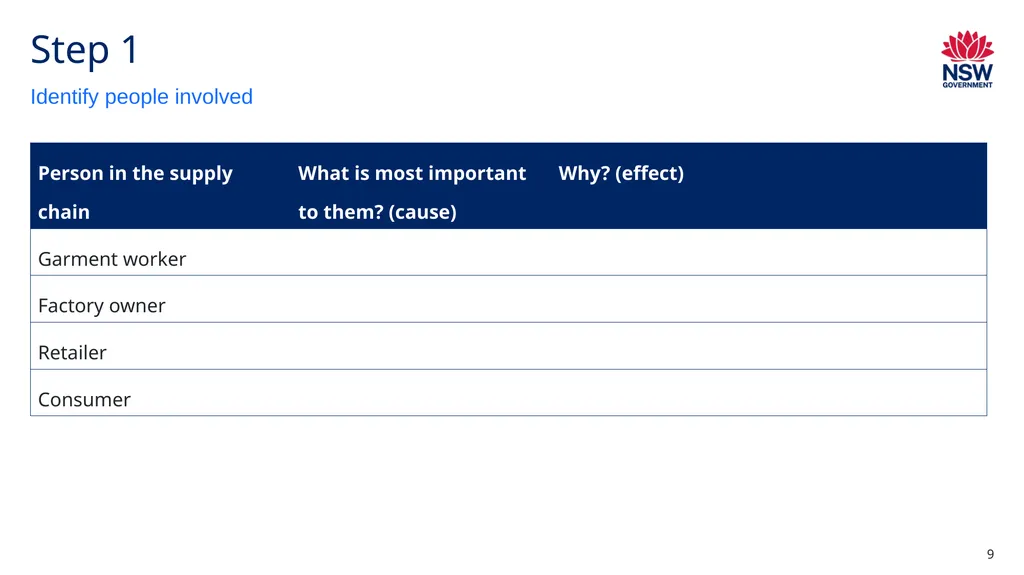
slide9. Step 1 Identify people involved 9<br>
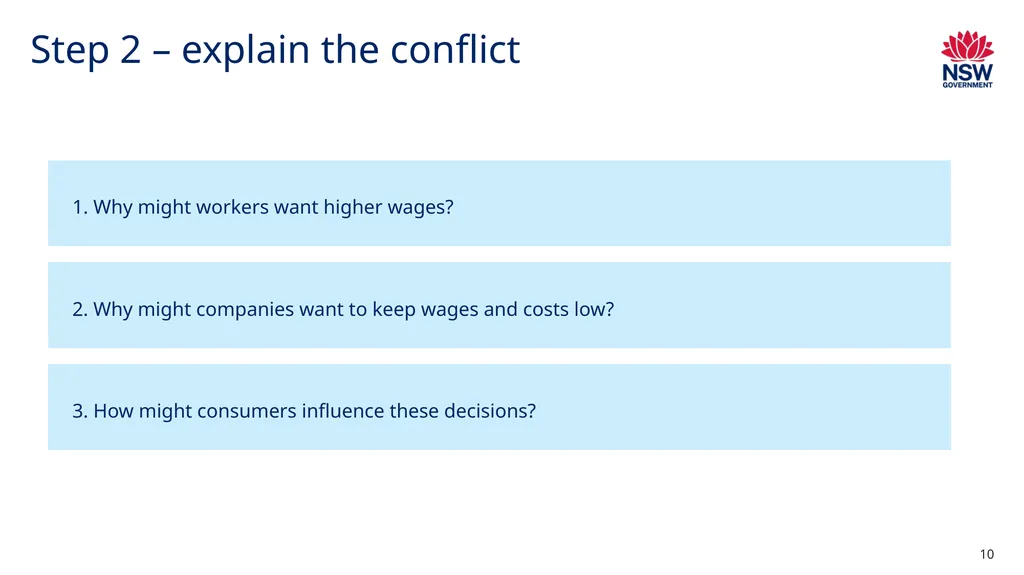
slide10. Step 2 – explain the conflict 1. Why might workers want higher wages? 2. Why might companies want to keep wages and costs low? 3. How might consumers influence these decisions? 10<br>
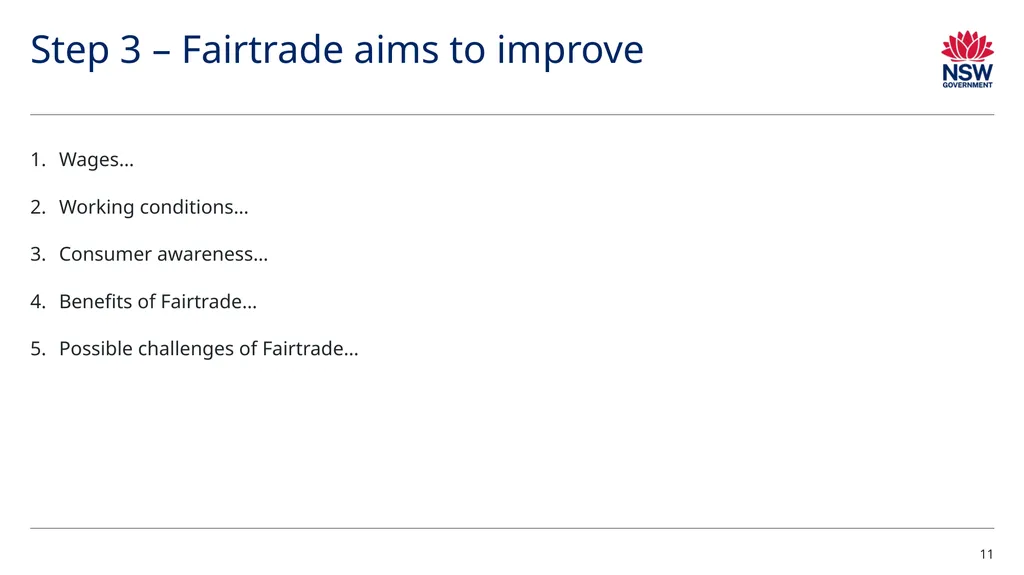
slide11. Step 3 – Fairtrade aims to improve Wages…
Working conditions…
Consumer awareness…
Benefits of Fairtrade…
Possible challenges of Fairtrade… 11<br>
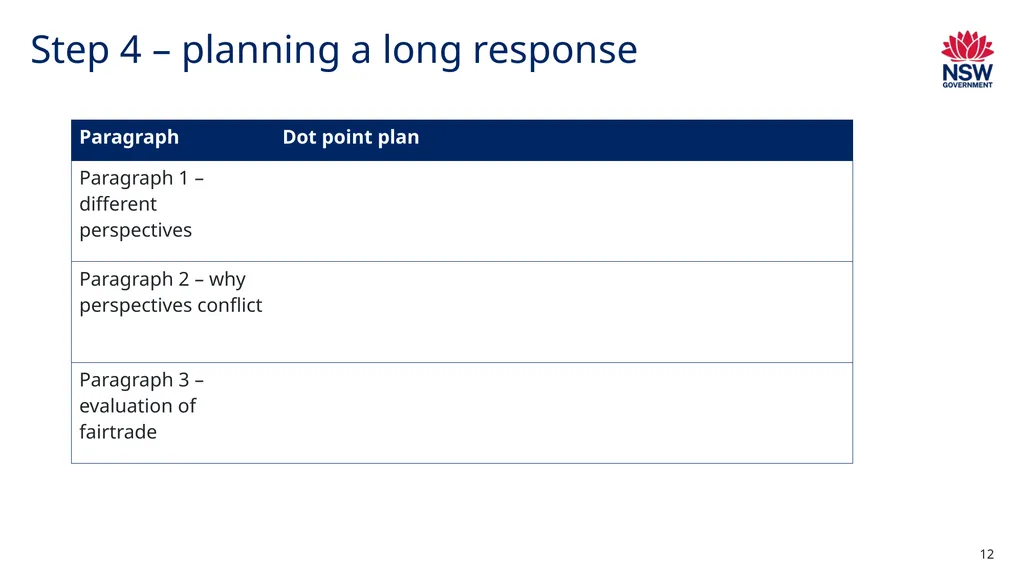
slide12. Step 4 – planning a long response 12<br>
slide13. How to respond to an explain question<br>
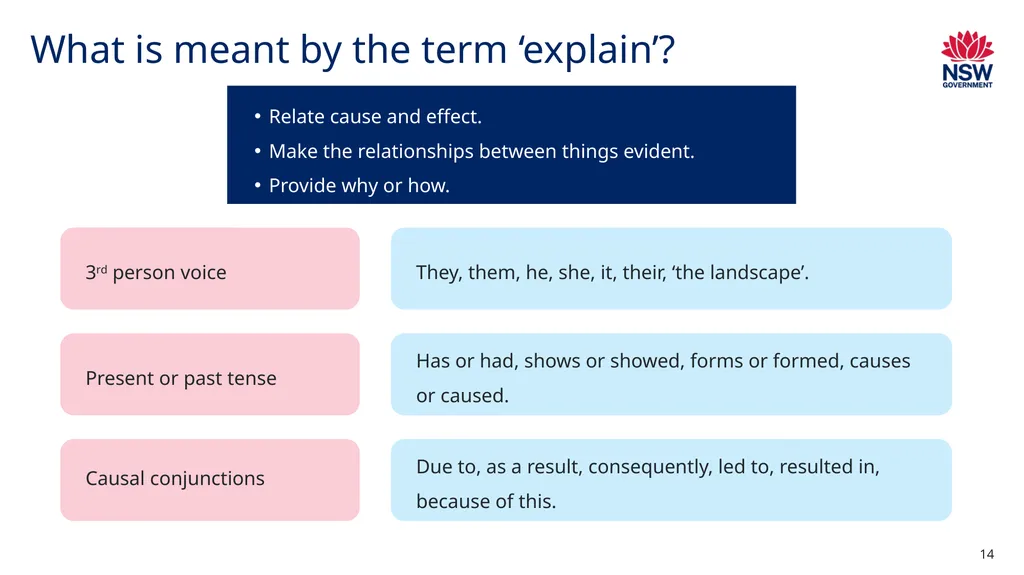
slide14. What is meant by the term ‘explain’? Relate cause and effect.
Make the relationships between things evident.
Provide why or how. 3rd person voice They, them, he, she, it, their, ‘the landscape’. Present or past tense Has or had, shows or showed, forms or formed, causes or caused. Causal conjunctions Due to, as a result, consequently, led to, resulted in, because of this. 14<br>
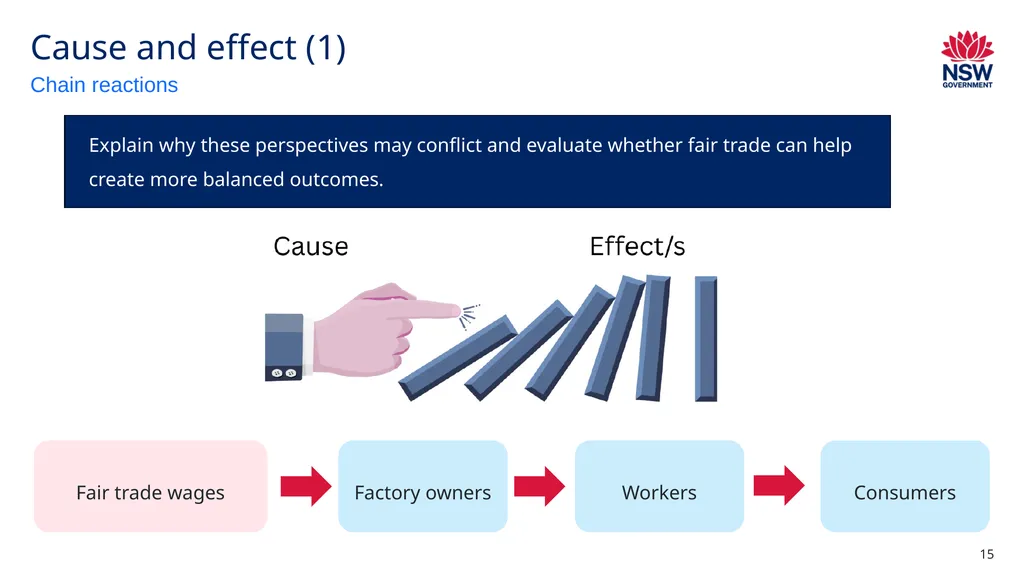
slide15. Cause and effect (1) Chain reactions Explain why these perspectives may conflict and evaluate whether fair trade can help create more balanced outcomes. Fair trade wages Factory owners Workers Consumers 15<br>
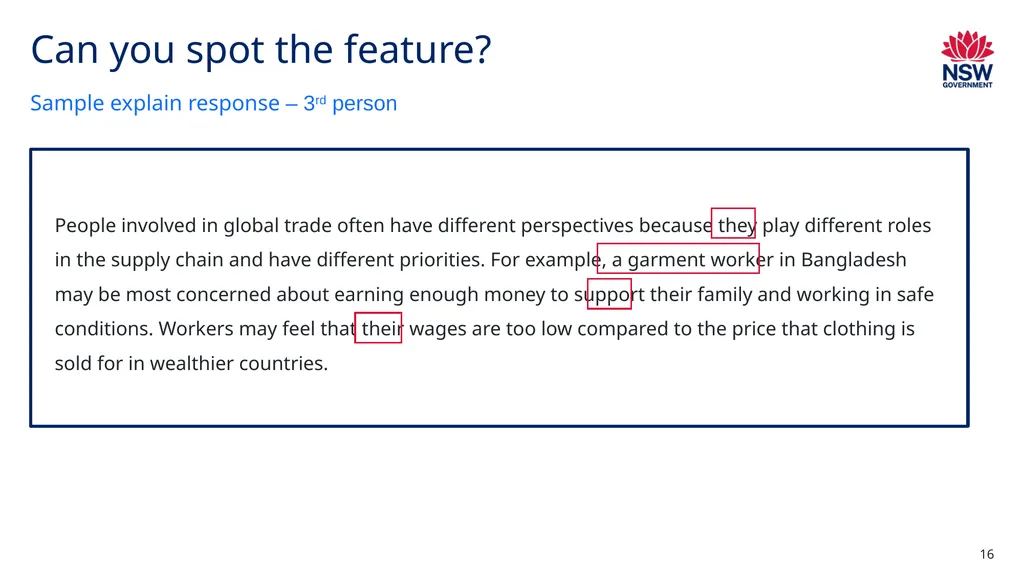
slide16. Can you spot the feature? Sample explain response – 3rd person People involved in global trade often have different perspectives because they play different roles in the supply chain and have different priorities. For example, a garment worker in Bangladesh may be most concerned about earning enough money to support their family and working in safe conditions. Workers may feel that their wages are too low compared to the price that clothing is sold for in wealthier countries. 16<br>
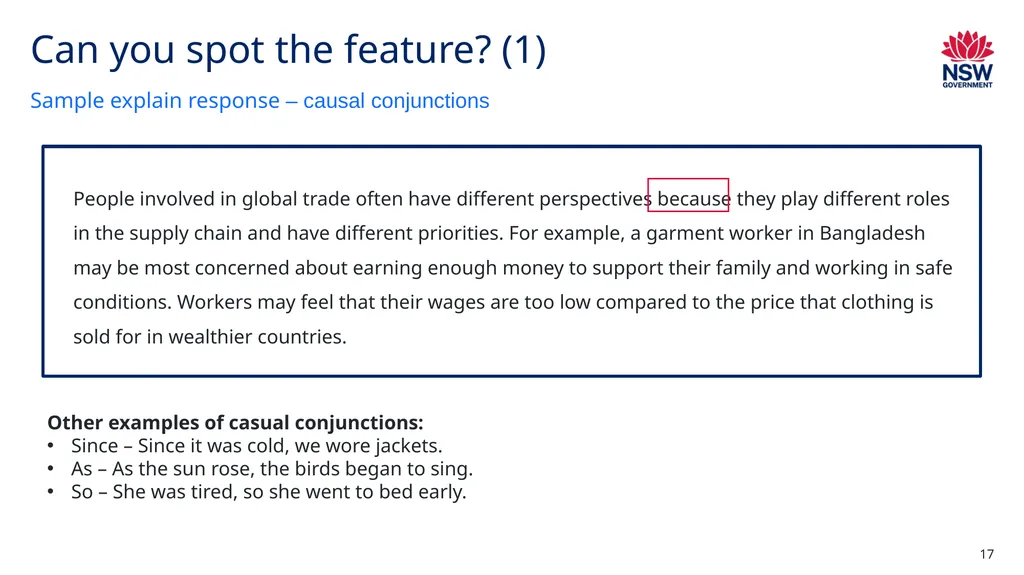
slide17. Can you spot the feature? (1) Sample explain response – causal conjunctions People involved in global trade often have different perspectives because they play different roles in the supply chain and have different priorities. For example, a garment worker in Bangladesh may be most concerned about earning enough money to support their family and working in safe conditions. Workers may feel that their wages are too low compared to the price that clothing is sold for in wealthier countries. Other examples of casual conjunctions:
Since – Since it was cold, we wore jackets.
As – As the sun rose, the birds began to sing.
So – She was tired, so she went to bed early. 17<br>
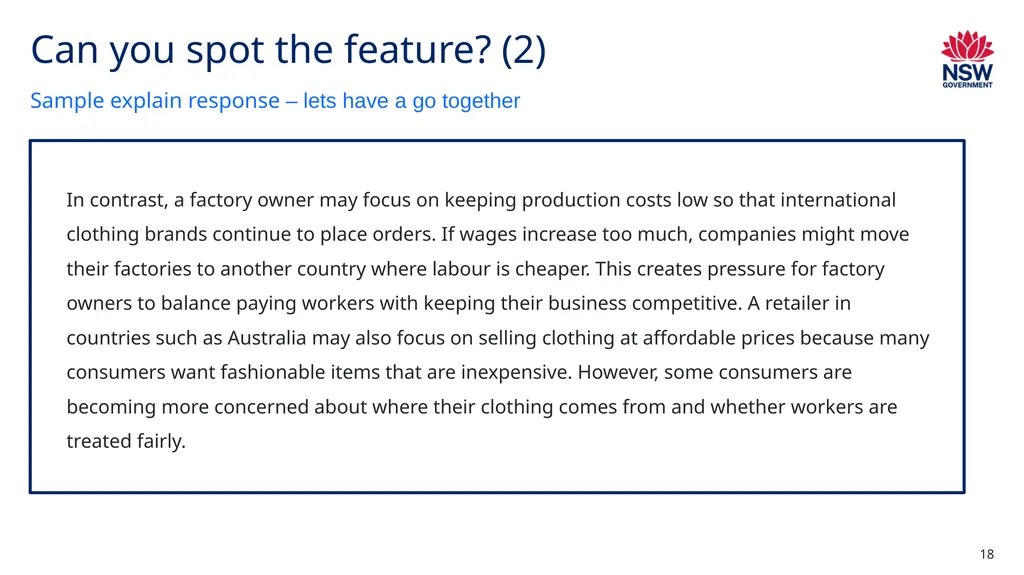
slide18. Can you spot the feature? (2) Sample explain response – lets have a go together In contrast, a factory owner may focus on keeping production costs low so that international clothing brands continue to place orders. If wages increase too much, companies might move their factories to another country where labour is cheaper. This creates pressure for factory owners to balance paying workers with keeping their business competitive. A retailer in countries such as Australia may also focus on selling clothing at affordable prices because many consumers want fashionable items that are inexpensive. However, some consumers are becoming more concerned about where their clothing comes from and whether workers are treated fairly. 18<br>
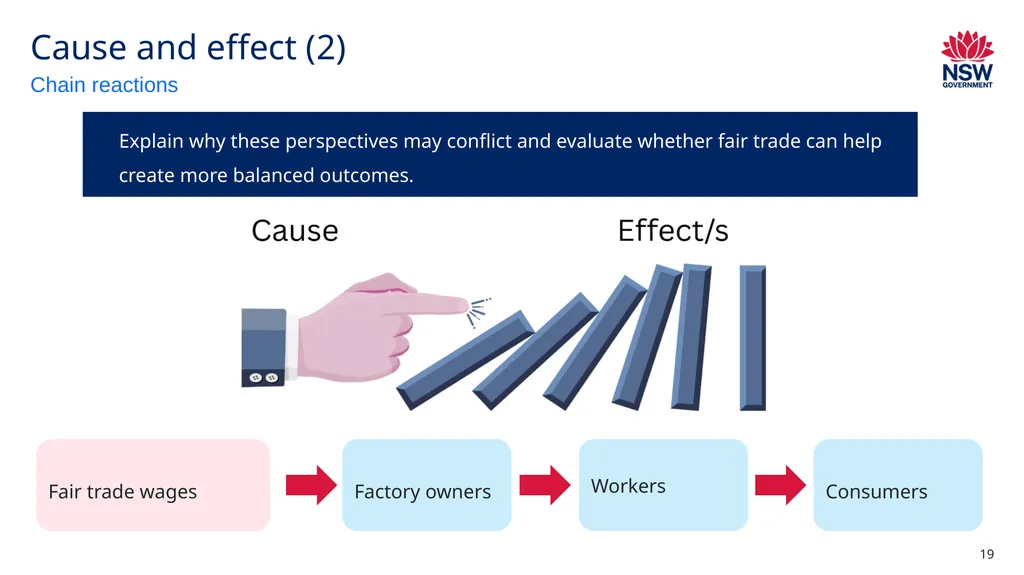
slide19. Cause and effect (2) Chain reactions Explain why these perspectives may conflict and evaluate whether fair trade can help create more balanced outcomes. Fair trade wages Factory owners Workers Consumers 19<br>
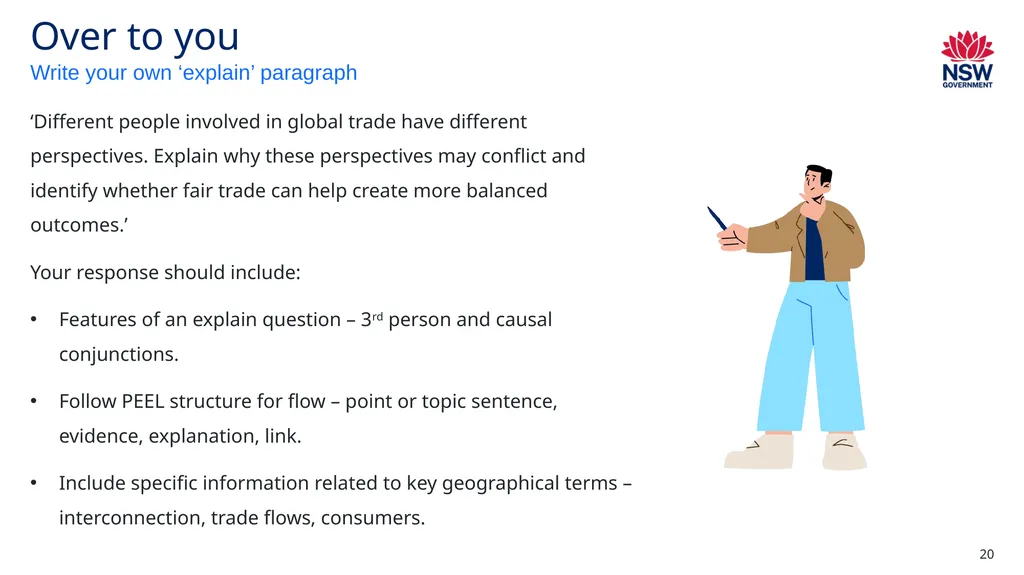
slide20. Over to you Write your own ‘explain’ paragraph ‘Different people involved in global trade have different perspectives. Explain why these perspectives may conflict and identify whether fair trade can help create more balanced outcomes.’
Your response should include:
Features of an explain question – 3rd person and causal conjunctions.
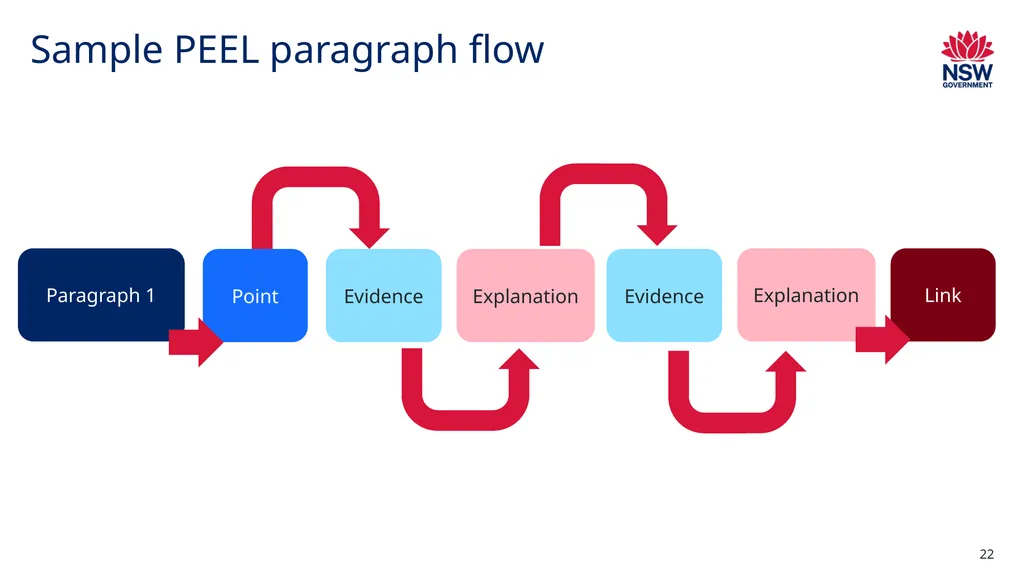
Follow PEEL structure for flow – point or topic sentence, evidence, explanation, link.
Include specific information related to key geographical terms – interconnection, trade flows, consumers. 20<br>
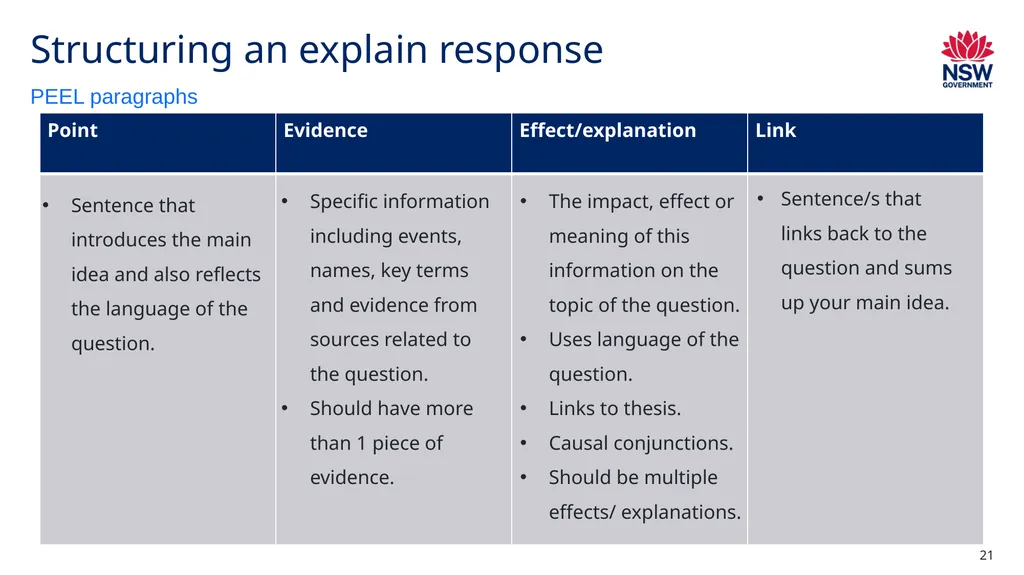
slide21. Structuring an explain response PEEL paragraphs Sentence that introduces the main idea and also reflects the language of the question. Specific information including events, names, key terms and evidence from sources related to the question.
Should have more than 1 piece of evidence. The impact, effect or meaning of this information on the topic of the question.
Uses language of the question.
Links to thesis.
Causal conjunctions.
Should be multiple effects/ explanations. Sentence/s that links back to the question and sums up your main idea. 21<br>
slide22. Sample PEEL paragraph flow Paragraph 1 Point Evidence Explanation Evidence Explanation Link 22<br>
slide23. References This presentation contains NSW Curriculum and syllabus content. The NSW Curriculum is developed by the NSW Education Standards Authority. This content is prepared by NESA for and on behalf of the Crown in the right of the State of New South Wales. The material is protected by Crown copyright.
Please refer to the NESA Copyright Disclaimer for more information https://educationstandards.nsw.edu.au/wps/portal/nesa/mini-footer/copyright.
NESA holds the only official and up-to-date versions of the NSW Curriculum and syllabus documents. Please visit the NSW Education Standards Authority (NESA) website https://educationstandards.nsw.edu.au/wps/portal/nesa/home and the NSW Curriculum website https://curriculum.nsw.edu.au. Geography 7-10 © Syllabus NSW Education Standards Authority (NESA) for and on behalf of the Crown in right of the State of New South Wales, 2024. 23<br>
slide24. Copyright © State of New South Wales (Department of Education), 2024 The copyright material published in this resource is subject to the Copyright Act 1968 (Cth) and is owned by the NSW Department of Education or, where indicated, by a party other than the NSW Department of Education (third-party material).
Copyright material available in this resource and owned by the NSW Department of Education is licensed under a Creative Commons Attribution 4.0 International (CC BY 4.0) licence.
This licence allows you to share and adapt the material for any purpose, even commercially.
Attribution should be given to © State of New South Wales (Department of Education), 2024.
Material in this resource not available under a Creative Commons licence:
the NSW Department of Education logo, other logos and trademark-protected material
Material owned by a third party that has been reproduced with permission. You will need to obtain permission from the third party to reuse its material.
Links to third-party material and websites
Please note that the provided (reading/viewing material/list/links/texts) are a suggestion only and implies no endorsement, by the New South Wales Department of Education, of any author, publisher, or book title. School principals and teachers are best placed to assess the suitability of resources that would complement the curriculum and reflect the needs and interests of their students.
If you use the links provided in this document to access a third party’s website, you acknowledge that the terms of use, including licence terms set out on the third-party’s website apply to the use which may be made of the materials on that third-party website or where permitted by the Copyright Act 1968 (Cth). The department accepts no responsibility for content on third-party websites. 24<br>
Classroom teachers are encouraged to add and adapt slides as required to meet the needs of their students.
Save a copy of the file to make changes to the slide deck. Go to File > Download a Copy (this downloads a copy to the computer to edit in the PowerPoint app).
To convert the PowerPoint to Google Slides:
Upload the file into Google Drive and open it.
Go to File > Save as Google Slides.
(Note – conversion may cause formatting changes in the slides.) 1<br>
slide2. Interconnections and trade Lesson 15 – perspectives on Fair Trade NSW Department of Education<br>
slide3. Learning intentions and success criteria We are learning :
how people involved in global trade may have different perspective and priorities
how fair trade attempts to address inequality in global trade.
We can:
identify the perspectives of different people involved in the clothing trade
explain why their views about fair trade might differ
describes how fair trade attempts to address issues in global supply chains. 3<br>
slide4. Activate prior knowledge A t-shirt sells in Australia for $20.
A garment worker who helped produce the shirt earns about $4.50 per day. Do you think this situation seems fair or unfair? Explain your reasoning.
Who do you think is involved in producing and selling a t-shirt? 4<br>
slide5. Connecting learning Fair Trade – True or False Fair trade aims to improve conditions for workers by paying fairer wages? True
Fair trade is not concerned with ensuring safe working environments? False
Fair trade improves global trade flow by supporting ethical supply chains? True
Fair trade does not give consumers the option to support responsible businesses? False 5<br>
slide6. 6 Perspectives summary table<br>
slide7. Think-Pair-Share Explain how fairtrade might address the concerns of at least 2 people from the sources provided. 7<br>
slide8. Long response question Different people involved in global trade have different perspectives. Explain why these perspectives may conflict and identify whether fair trade can help create more balanced outcomes. 8<br>
slide9. Step 1 Identify people involved 9<br>
slide10. Step 2 – explain the conflict 1. Why might workers want higher wages? 2. Why might companies want to keep wages and costs low? 3. How might consumers influence these decisions? 10<br>
slide11. Step 3 – Fairtrade aims to improve Wages…
Working conditions…
Consumer awareness…
Benefits of Fairtrade…
Possible challenges of Fairtrade… 11<br>
slide12. Step 4 – planning a long response 12<br>
slide13. How to respond to an explain question<br>
slide14. What is meant by the term ‘explain’? Relate cause and effect.
Make the relationships between things evident.
Provide why or how. 3rd person voice They, them, he, she, it, their, ‘the landscape’. Present or past tense Has or had, shows or showed, forms or formed, causes or caused. Causal conjunctions Due to, as a result, consequently, led to, resulted in, because of this. 14<br>
slide15. Cause and effect (1) Chain reactions Explain why these perspectives may conflict and evaluate whether fair trade can help create more balanced outcomes. Fair trade wages Factory owners Workers Consumers 15<br>
slide16. Can you spot the feature? Sample explain response – 3rd person People involved in global trade often have different perspectives because they play different roles in the supply chain and have different priorities. For example, a garment worker in Bangladesh may be most concerned about earning enough money to support their family and working in safe conditions. Workers may feel that their wages are too low compared to the price that clothing is sold for in wealthier countries. 16<br>
slide17. Can you spot the feature? (1) Sample explain response – causal conjunctions People involved in global trade often have different perspectives because they play different roles in the supply chain and have different priorities. For example, a garment worker in Bangladesh may be most concerned about earning enough money to support their family and working in safe conditions. Workers may feel that their wages are too low compared to the price that clothing is sold for in wealthier countries. Other examples of casual conjunctions:
Since – Since it was cold, we wore jackets.
As – As the sun rose, the birds began to sing.
So – She was tired, so she went to bed early. 17<br>
slide18. Can you spot the feature? (2) Sample explain response – lets have a go together In contrast, a factory owner may focus on keeping production costs low so that international clothing brands continue to place orders. If wages increase too much, companies might move their factories to another country where labour is cheaper. This creates pressure for factory owners to balance paying workers with keeping their business competitive. A retailer in countries such as Australia may also focus on selling clothing at affordable prices because many consumers want fashionable items that are inexpensive. However, some consumers are becoming more concerned about where their clothing comes from and whether workers are treated fairly. 18<br>
slide19. Cause and effect (2) Chain reactions Explain why these perspectives may conflict and evaluate whether fair trade can help create more balanced outcomes. Fair trade wages Factory owners Workers Consumers 19<br>
slide20. Over to you Write your own ‘explain’ paragraph ‘Different people involved in global trade have different perspectives. Explain why these perspectives may conflict and identify whether fair trade can help create more balanced outcomes.’
Your response should include:
Features of an explain question – 3rd person and causal conjunctions.
Follow PEEL structure for flow – point or topic sentence, evidence, explanation, link.
Include specific information related to key geographical terms – interconnection, trade flows, consumers. 20<br>
slide21. Structuring an explain response PEEL paragraphs Sentence that introduces the main idea and also reflects the language of the question. Specific information including events, names, key terms and evidence from sources related to the question.
Should have more than 1 piece of evidence. The impact, effect or meaning of this information on the topic of the question.
Uses language of the question.
Links to thesis.
Causal conjunctions.
Should be multiple effects/ explanations. Sentence/s that links back to the question and sums up your main idea. 21<br>
slide22. Sample PEEL paragraph flow Paragraph 1 Point Evidence Explanation Evidence Explanation Link 22<br>
slide23. References This presentation contains NSW Curriculum and syllabus content. The NSW Curriculum is developed by the NSW Education Standards Authority. This content is prepared by NESA for and on behalf of the Crown in the right of the State of New South Wales. The material is protected by Crown copyright.
Please refer to the NESA Copyright Disclaimer for more information https://educationstandards.nsw.edu.au/wps/portal/nesa/mini-footer/copyright.
NESA holds the only official and up-to-date versions of the NSW Curriculum and syllabus documents. Please visit the NSW Education Standards Authority (NESA) website https://educationstandards.nsw.edu.au/wps/portal/nesa/home and the NSW Curriculum website https://curriculum.nsw.edu.au. Geography 7-10 © Syllabus NSW Education Standards Authority (NESA) for and on behalf of the Crown in right of the State of New South Wales, 2024. 23<br>
slide24. Copyright © State of New South Wales (Department of Education), 2024 The copyright material published in this resource is subject to the Copyright Act 1968 (Cth) and is owned by the NSW Department of Education or, where indicated, by a party other than the NSW Department of Education (third-party material).
Copyright material available in this resource and owned by the NSW Department of Education is licensed under a Creative Commons Attribution 4.0 International (CC BY 4.0) licence.
This licence allows you to share and adapt the material for any purpose, even commercially.
Attribution should be given to © State of New South Wales (Department of Education), 2024.
Material in this resource not available under a Creative Commons licence:
the NSW Department of Education logo, other logos and trademark-protected material
Material owned by a third party that has been reproduced with permission. You will need to obtain permission from the third party to reuse its material.
Links to third-party material and websites
Please note that the provided (reading/viewing material/list/links/texts) are a suggestion only and implies no endorsement, by the New South Wales Department of Education, of any author, publisher, or book title. School principals and teachers are best placed to assess the suitability of resources that would complement the curriculum and reflect the needs and interests of their students.
If you use the links provided in this document to access a third party’s website, you acknowledge that the terms of use, including licence terms set out on the third-party’s website apply to the use which may be made of the materials on that third-party website or where permitted by the Copyright Act 1968 (Cth). The department accepts no responsibility for content on third-party websites. 24<br>