
Instructions for use This resource is not a
Description: Instructions for use This resource is not a teaching and learning program. It should be used in conjunction with the Sample program of learning - Making a nation Classroom teachers are encouraged to add and adapt slides as required to meet
Related Topics
Download Presentation
"Instructions for use This resource is not a" is the property of its rightful owner. Permission is granted to download and print the materials on this website for personal, non-commercial use only, and to display it on your personal computer provided you do not modify the materials and that you retain all copyright notices contained in the materials. By downloading content from our website, you accept the terms of this agreement.
Presentation Transcript
slide1. Instructions for use This resource is not a teaching and learning program. It should be used in conjunction with the Sample program of learning - Making a nation
Classroom teachers are encouraged to add and adapt slides as required to meet the needs of their students.
Save a copy of the file to make changes to the slide deck. Go to File > Download a Copy (this downloads a copy to the computer to edit in the PowerPoint app).
To convert the PowerPoint to Google Slides:
Upload the file into Google Drive and open it.
Go to File > Save as Google Slides.
(Note – conversion may cause formatting changes in the slides.) 1<br>
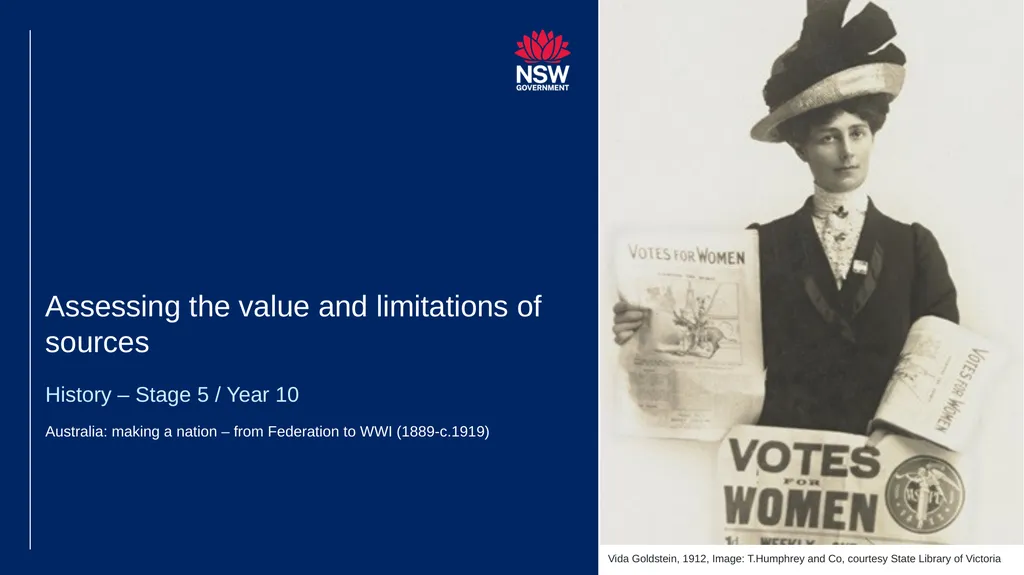
slide2. Assessing the value and limitations of sources History – Stage 5 / Year 10 Australia: making a nation – from Federation to WWI (1889-c.1919) Vida Goldstein, 1912, Image: T.Humphrey and Co, courtesy State Library of Victoria<br>
slide3. Learning intentions and success criteria We are learning:
To assess the value and limitations of sources by weighing up the features that make them useful and the features that limit their usefulness.
I can:
identify and explain the features of a source that make it valuable
identify and explain the features of a source that limit its value
make an overall judgment about the value of the source. 3<br>
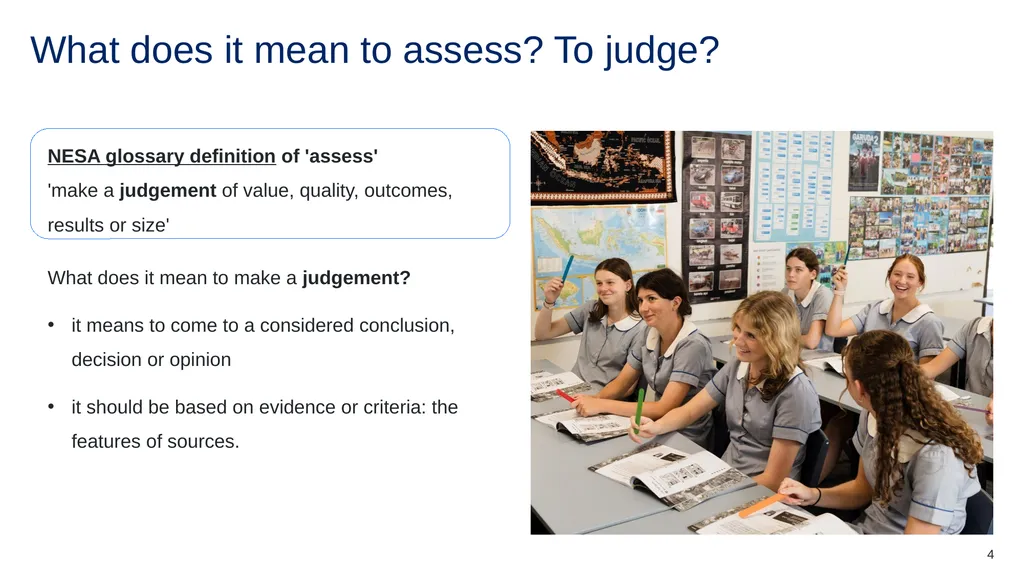
slide4. What does it mean to assess? To judge? NESA glossary definition of 'assess' 'make a judgement of value, quality, outcomes, results or size' What does it mean to make a judgement?
it means to come to a considered conclusion, decision or opinion
it should be based on evidence or criteria: the features of sources. 4<br>
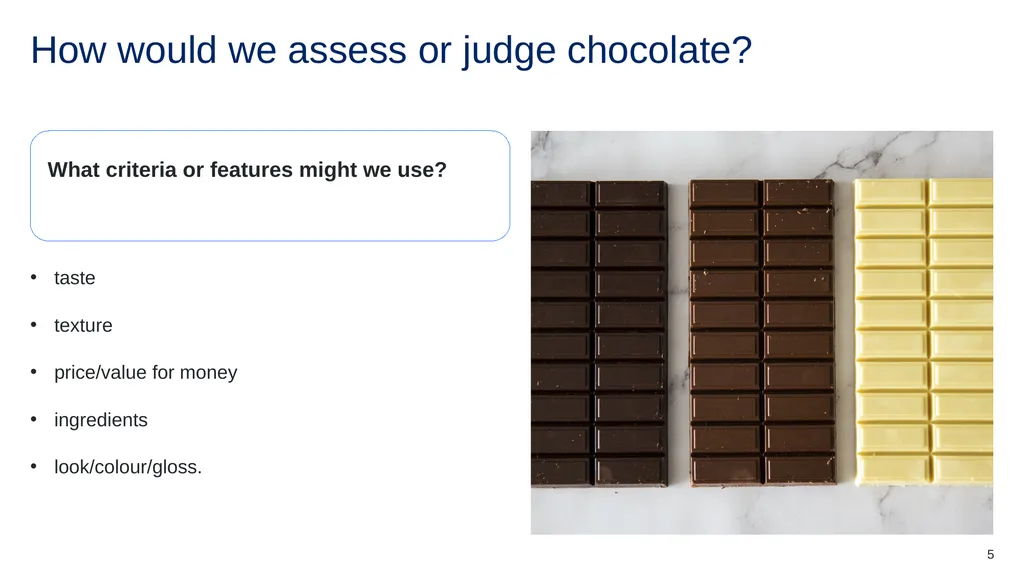
slide5. How would we assess or judge chocolate? What criteria or features might we use? taste
texture
price/value for money
ingredients
look/colour/gloss. 5<br>
slide6. Why assess sources? They are the basis for how we claim to understand the past. They are the evidence and support for what we say and think
Sources are also imperfect, they can be incomplete, biased and misused
By assessing their value and limitations, we can determine how reliable they are to use. 6<br>
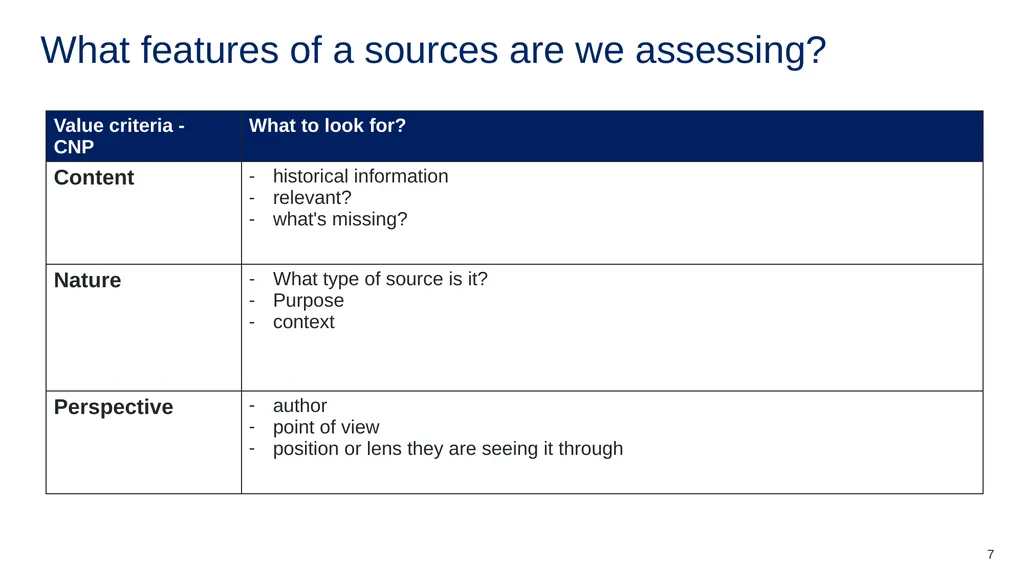
slide7. What features of a sources are we assessing? 7<br>
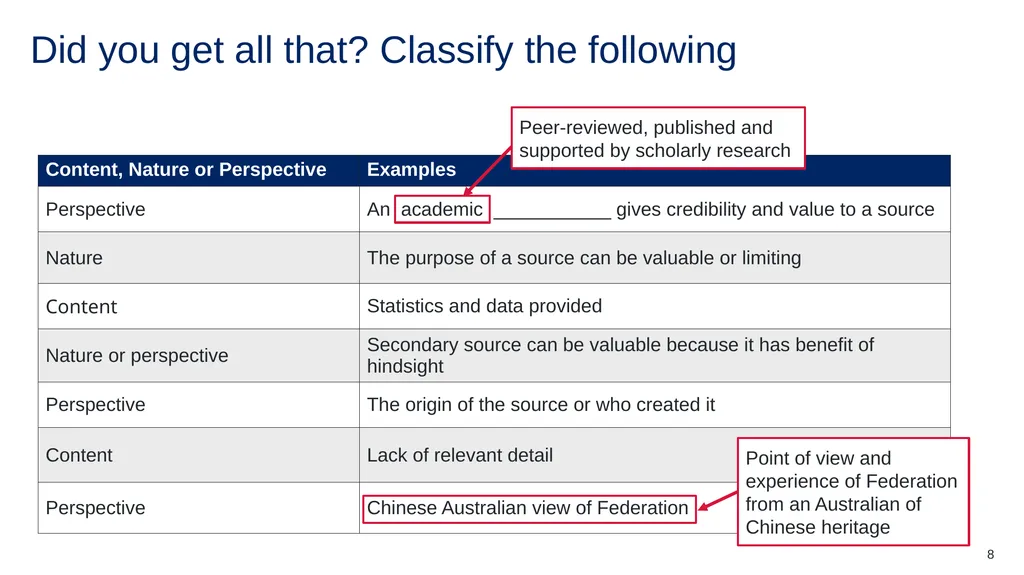
slide8. Did you get all that? Classify the following 8<br>
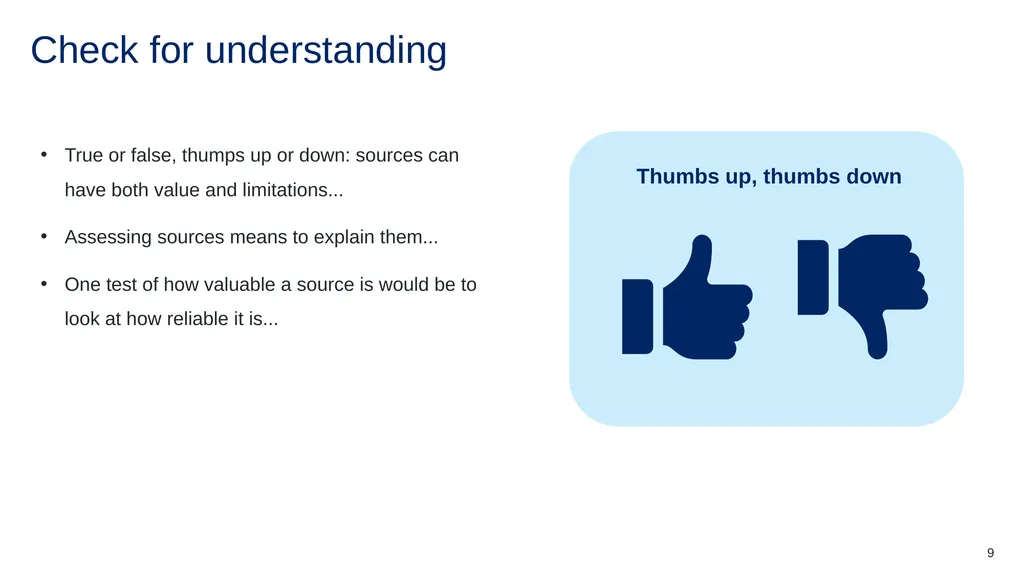
slide9. Check for understanding True or false, thumps up or down: sources can have both value and limitations...
Assessing sources means to explain them...
One test of how valuable a source is would be to look at how reliable it is... 9<br>
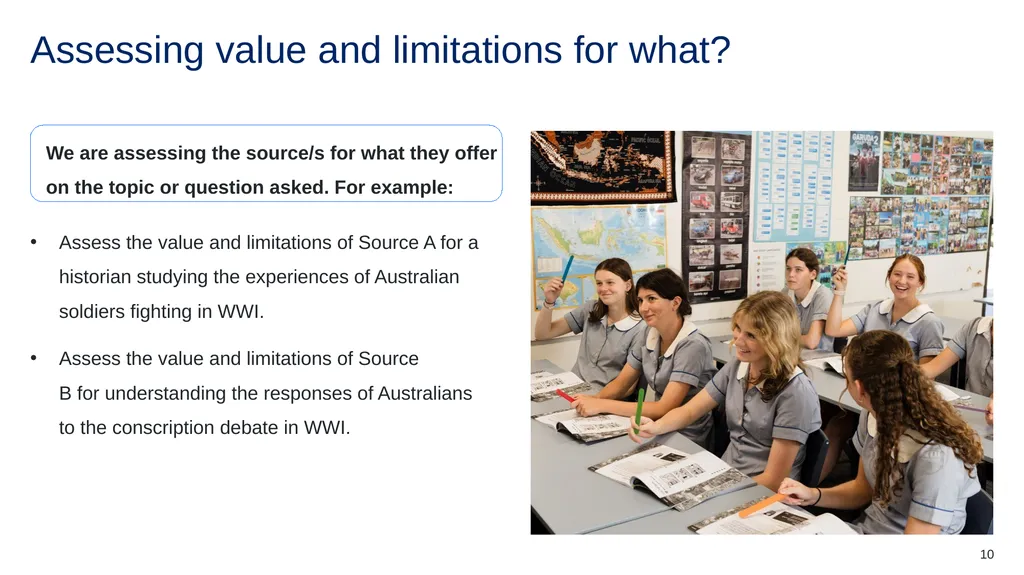
slide10. Assessing value and limitations for what? We are assessing the source/s for what they offer on the topic or question asked. For example: Assess the value and limitations of Source A for a historian studying the experiences of Australian soldiers fighting in WWI.
Assess the value and limitations of Source B for understanding the responses of Australians to the conscription debate in WWI. 10<br>
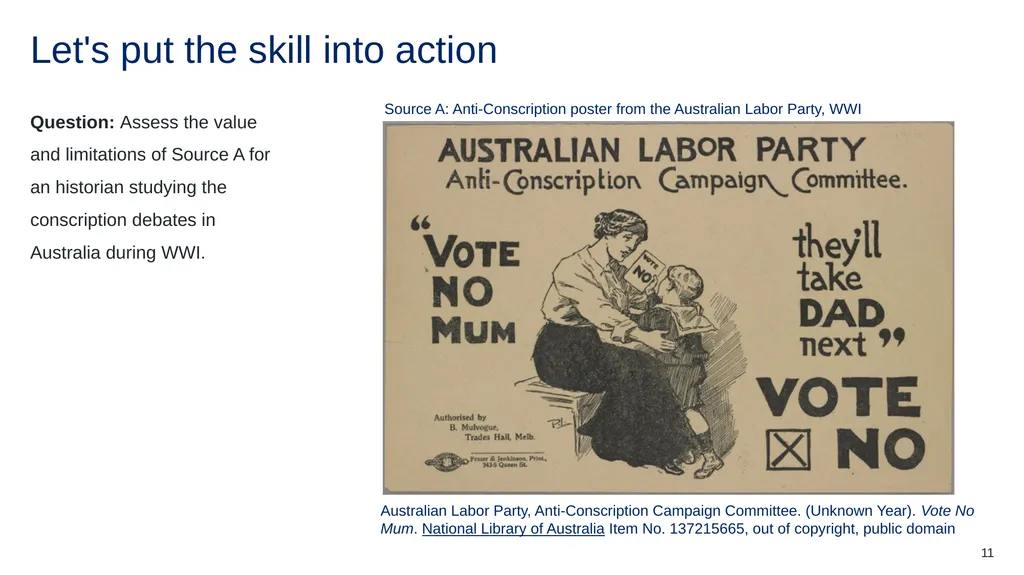
slide11. Let's put the skill into action Question: Assess the value and limitations of Source A for an historian studying the conscription debates in Australia during WWI. Source A: Anti-Conscription poster from the Australian Labor Party, WWI Australian Labor Party, Anti-Conscription Campaign Committee. (Unknown Year). Vote No Mum. National Library of Australia Item No. 137215665, out of copyright, public domain 11<br>
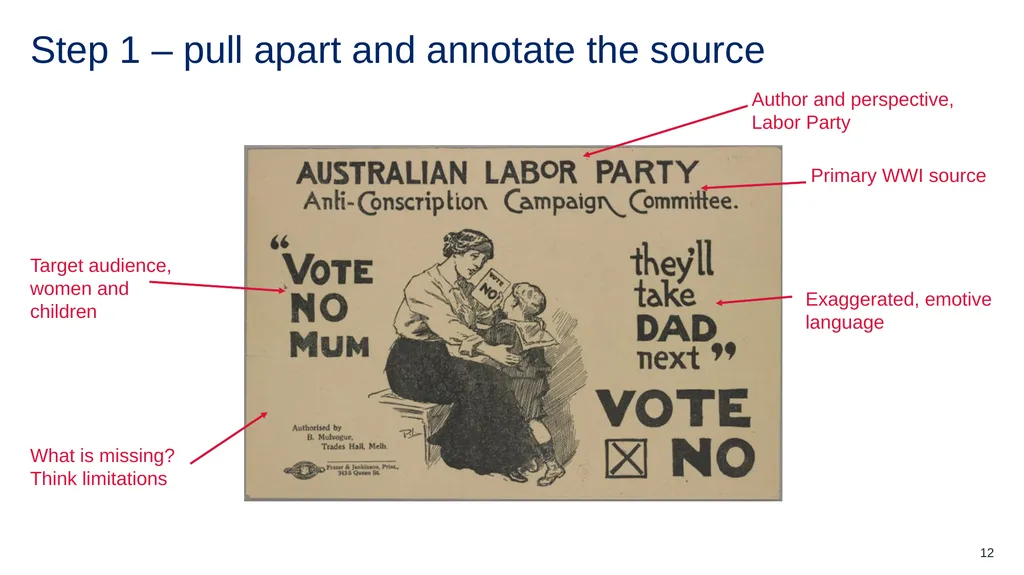
slide12. Step 1 – pull apart and annotate the source 12 Author and perspective, Labor Party Primary WWI source Exaggerated, emotive language Target audience, women and children What is missing? Think limitations<br>
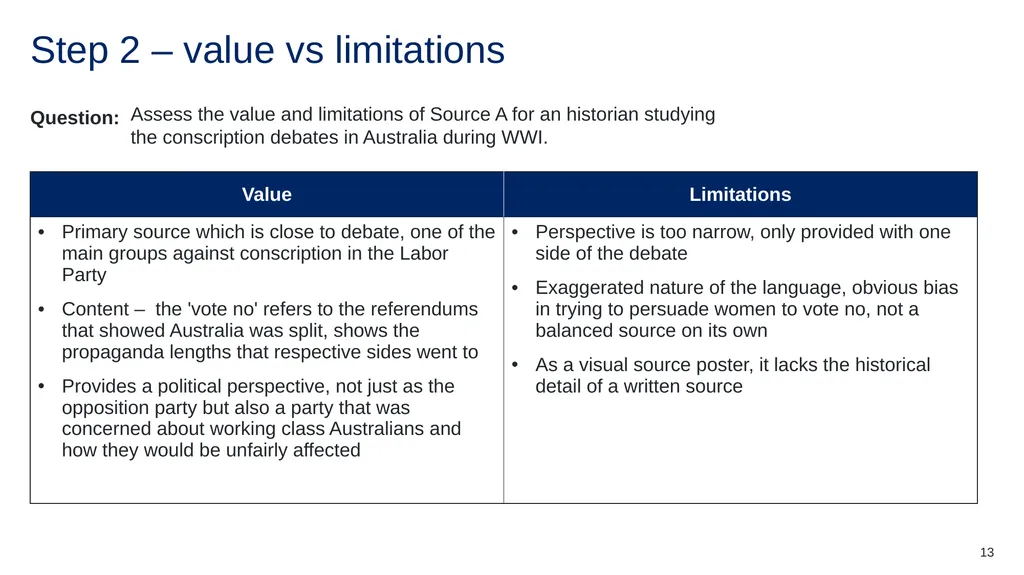
slide13. Step 2 – value vs limitations Question: Assess the value and limitations of Source A for an historian studying the conscription debates in Australia during WWI. 13<br>
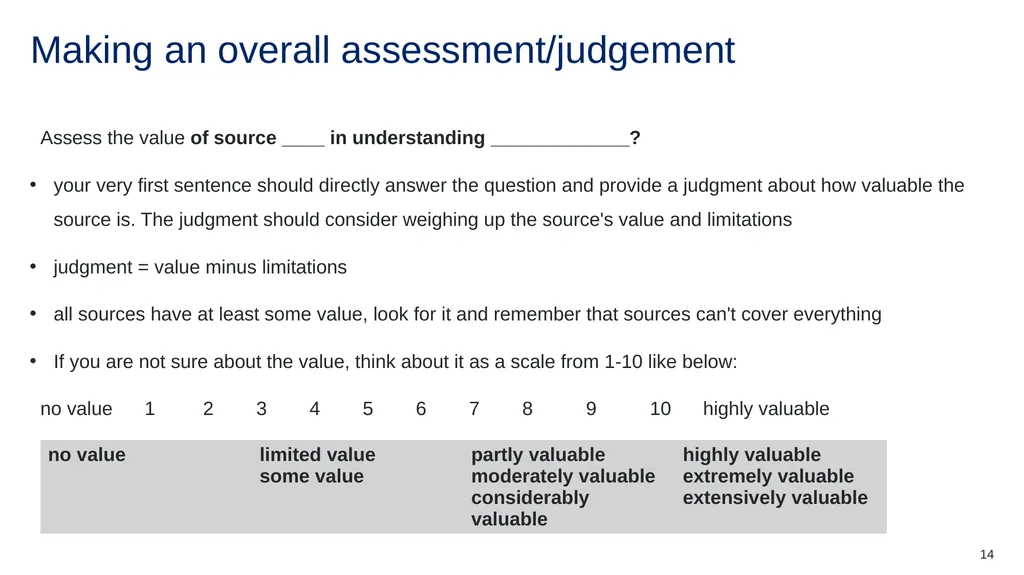
slide14. Making an overall assessment/judgement Assess the value of source ____ in understanding _____________?
your very first sentence should directly answer the question and provide a judgment about how valuable the source is. The judgment should consider weighing up the source's value and limitations
judgment = value minus limitations
all sources have at least some value, look for it and remember that sources can't cover everything
If you are not sure about the value, think about it as a scale from 1-10 like below:
no value 1 2 3 4 5 6 7 8 9 10 highly valuable 14<br>
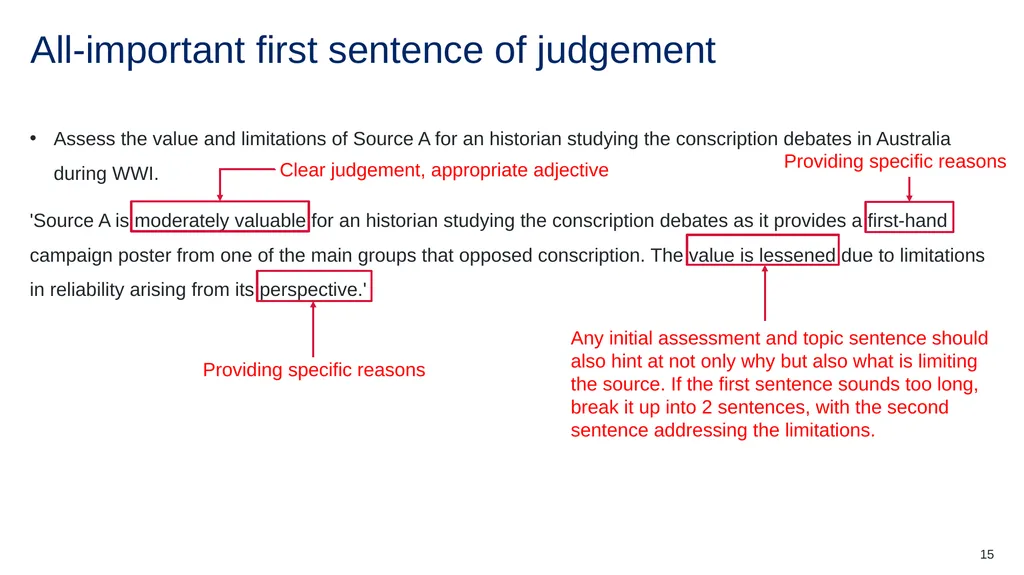
slide15. All-important first sentence of judgement Assess the value and limitations of Source A for an historian studying the conscription debates in Australia during WWI.
'Source A is moderately valuable for an historian studying the conscription debates as it provides a first-hand campaign poster from one of the main groups that opposed conscription. The value is lessened due to limitations in reliability arising from its perspective.' 15<br>
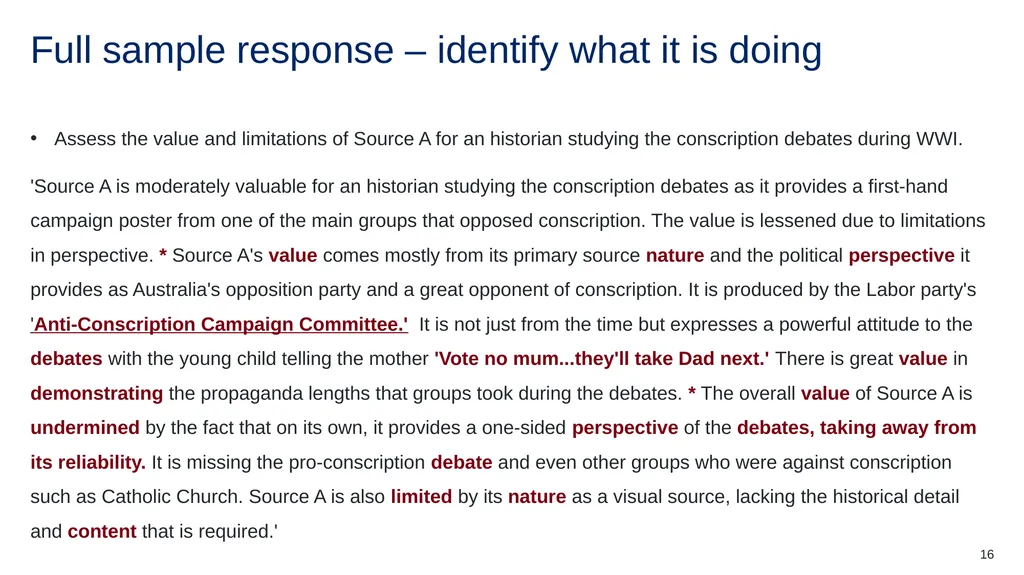
slide16. Full sample response – identify what it is doing Assess the value and limitations of Source A for an historian studying the conscription debates during WWI.
'Source A is moderately valuable for an historian studying the conscription debates as it provides a first-hand campaign poster from one of the main groups that opposed conscription. The value is lessened due to limitations in perspective. * Source A's value comes mostly from its primary source nature and the political perspective it provides as Australia's opposition party and a great opponent of conscription. It is produced by the Labor party's 'Anti-Conscription Campaign Committee.' It is not just from the time but expresses a powerful attitude to the debates with the young child telling the mother 'Vote no mum...they'll take Dad next.' There is great value in demonstrating the propaganda lengths that groups took during the debates. * The overall value of Source A is undermined by the fact that on its own, it provides a one-sided perspective of the debates, taking away from its reliability. It is missing the pro-conscription debate and even other groups who were against conscription such as Catholic Church. Source A is also limited by its nature as a visual source, lacking the historical detail and content that is required.' 16<br>
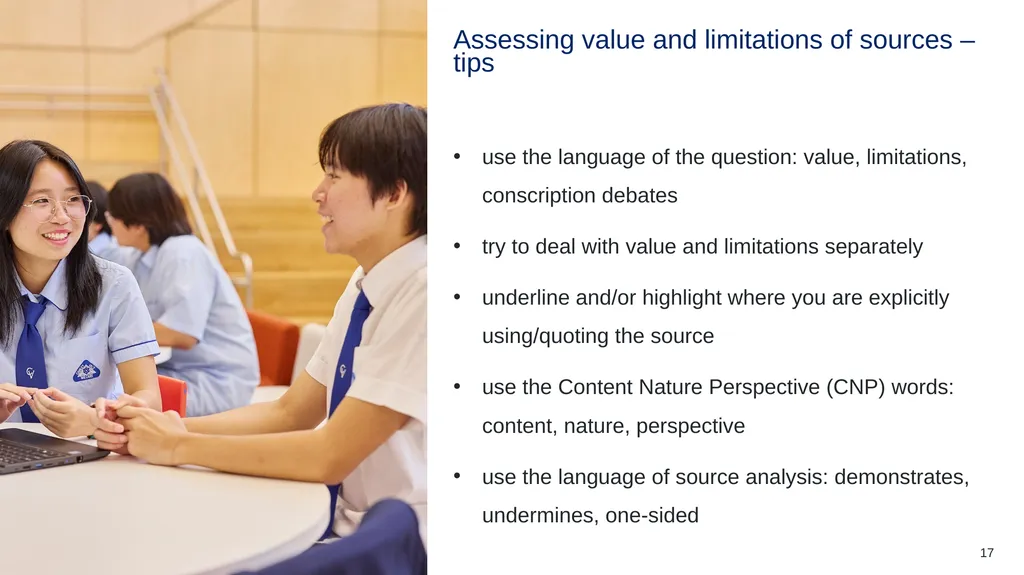
slide17. Assessing value and limitations of sources – tips use the language of the question: value, limitations, conscription debates
try to deal with value and limitations separately
underline and/or highlight where you are explicitly using/quoting the source
use the Content Nature Perspective (CNP) words: content, nature, perspective
use the language of source analysis: demonstrates, undermines, one-sided 17<br>
slide18. References This presentation contains NSW Curriculum and syllabus content. The NSW Curriculum is developed by the NSW Education Standards Authority. This content is prepared by NESA for and on behalf of the Crown in the right of the State of New South Wales. The material is protected by Crown copyright.
Please refer to the NESA Copyright Disclaimer for more information https://www.nsw.gov.au/education-and-training/nesa/copyright.
NESA holds the only official and up-to-date versions of the NSW Curriculum and syllabus documents. Please visit NESA https://www.nsw.gov.au/education-and-training/nesa and NSW Curriculum https://curriculum.nsw.edu.au. History Year 7-10 2024 © Syllabus NSW Education Standards Authority (NESA) for and on behalf of the Crown in right of the State of New South Wales, 2026
National Library of Australia, accessed on 22/5/26
State Library of Victoria, accessed on 22/5/26 18<br>
slide19. Copyright © State of New South Wales (Department of Education), 2026 The copyright material published in this resource is subject to the Copyright Act 1968 (Cth) and is owned by the NSW Department of Education or, where indicated, by a party other than the NSW Department of Education (third-party material).
Copyright material available in this resource and owned by the NSW Department of Education is licensed under a Creative Commons Attribution 4.0 International (CC BY 4.0) license.
This license allows you to share and adapt the material for any purpose, even commercially.
Attribution should be given to © State of New South Wales (Department of Education), 2026.
Material in this resource not available under a Creative Commons license:
the NSW Department of Education logo, other logos and trademark-protected material
Material owned by a third party that has been reproduced with permission. You will need to obtain permission from the third party to reuse its material.
Links to third-party material and websites
Please note that the provided (reading/viewing material/list/links/texts) are a suggestion only and implies no endorsement, by the New South Wales Department of Education, of any author, publisher, or book title. School principals and teachers are best placed to assess the suitability of resources that would complement the curriculum and reflect the needs and interests of their students.
If you use the links provided in this document to access a third-party’s website, you acknowledge that the terms of use, including licence terms set out on the third-party’s website apply to the use which may be made of the materials on that third-party website or where permitted by the Copyright Act 1968 (Cth). The department accepts no responsibility for content on third-party websites.<br>
Classroom teachers are encouraged to add and adapt slides as required to meet the needs of their students.
Save a copy of the file to make changes to the slide deck. Go to File > Download a Copy (this downloads a copy to the computer to edit in the PowerPoint app).
To convert the PowerPoint to Google Slides:
Upload the file into Google Drive and open it.
Go to File > Save as Google Slides.
(Note – conversion may cause formatting changes in the slides.) 1<br>
slide2. Assessing the value and limitations of sources History – Stage 5 / Year 10 Australia: making a nation – from Federation to WWI (1889-c.1919) Vida Goldstein, 1912, Image: T.Humphrey and Co, courtesy State Library of Victoria<br>
slide3. Learning intentions and success criteria We are learning:
To assess the value and limitations of sources by weighing up the features that make them useful and the features that limit their usefulness.
I can:
identify and explain the features of a source that make it valuable
identify and explain the features of a source that limit its value
make an overall judgment about the value of the source. 3<br>
slide4. What does it mean to assess? To judge? NESA glossary definition of 'assess' 'make a judgement of value, quality, outcomes, results or size' What does it mean to make a judgement?
it means to come to a considered conclusion, decision or opinion
it should be based on evidence or criteria: the features of sources. 4<br>
slide5. How would we assess or judge chocolate? What criteria or features might we use? taste
texture
price/value for money
ingredients
look/colour/gloss. 5<br>
slide6. Why assess sources? They are the basis for how we claim to understand the past. They are the evidence and support for what we say and think
Sources are also imperfect, they can be incomplete, biased and misused
By assessing their value and limitations, we can determine how reliable they are to use. 6<br>
slide7. What features of a sources are we assessing? 7<br>
slide8. Did you get all that? Classify the following 8<br>
slide9. Check for understanding True or false, thumps up or down: sources can have both value and limitations...
Assessing sources means to explain them...
One test of how valuable a source is would be to look at how reliable it is... 9<br>
slide10. Assessing value and limitations for what? We are assessing the source/s for what they offer on the topic or question asked. For example: Assess the value and limitations of Source A for a historian studying the experiences of Australian soldiers fighting in WWI.
Assess the value and limitations of Source B for understanding the responses of Australians to the conscription debate in WWI. 10<br>
slide11. Let's put the skill into action Question: Assess the value and limitations of Source A for an historian studying the conscription debates in Australia during WWI. Source A: Anti-Conscription poster from the Australian Labor Party, WWI Australian Labor Party, Anti-Conscription Campaign Committee. (Unknown Year). Vote No Mum. National Library of Australia Item No. 137215665, out of copyright, public domain 11<br>
slide12. Step 1 – pull apart and annotate the source 12 Author and perspective, Labor Party Primary WWI source Exaggerated, emotive language Target audience, women and children What is missing? Think limitations<br>
slide13. Step 2 – value vs limitations Question: Assess the value and limitations of Source A for an historian studying the conscription debates in Australia during WWI. 13<br>
slide14. Making an overall assessment/judgement Assess the value of source ____ in understanding _____________?
your very first sentence should directly answer the question and provide a judgment about how valuable the source is. The judgment should consider weighing up the source's value and limitations
judgment = value minus limitations
all sources have at least some value, look for it and remember that sources can't cover everything
If you are not sure about the value, think about it as a scale from 1-10 like below:
no value 1 2 3 4 5 6 7 8 9 10 highly valuable 14<br>
slide15. All-important first sentence of judgement Assess the value and limitations of Source A for an historian studying the conscription debates in Australia during WWI.
'Source A is moderately valuable for an historian studying the conscription debates as it provides a first-hand campaign poster from one of the main groups that opposed conscription. The value is lessened due to limitations in reliability arising from its perspective.' 15<br>
slide16. Full sample response – identify what it is doing Assess the value and limitations of Source A for an historian studying the conscription debates during WWI.
'Source A is moderately valuable for an historian studying the conscription debates as it provides a first-hand campaign poster from one of the main groups that opposed conscription. The value is lessened due to limitations in perspective. * Source A's value comes mostly from its primary source nature and the political perspective it provides as Australia's opposition party and a great opponent of conscription. It is produced by the Labor party's 'Anti-Conscription Campaign Committee.' It is not just from the time but expresses a powerful attitude to the debates with the young child telling the mother 'Vote no mum...they'll take Dad next.' There is great value in demonstrating the propaganda lengths that groups took during the debates. * The overall value of Source A is undermined by the fact that on its own, it provides a one-sided perspective of the debates, taking away from its reliability. It is missing the pro-conscription debate and even other groups who were against conscription such as Catholic Church. Source A is also limited by its nature as a visual source, lacking the historical detail and content that is required.' 16<br>
slide17. Assessing value and limitations of sources – tips use the language of the question: value, limitations, conscription debates
try to deal with value and limitations separately
underline and/or highlight where you are explicitly using/quoting the source
use the Content Nature Perspective (CNP) words: content, nature, perspective
use the language of source analysis: demonstrates, undermines, one-sided 17<br>
slide18. References This presentation contains NSW Curriculum and syllabus content. The NSW Curriculum is developed by the NSW Education Standards Authority. This content is prepared by NESA for and on behalf of the Crown in the right of the State of New South Wales. The material is protected by Crown copyright.
Please refer to the NESA Copyright Disclaimer for more information https://www.nsw.gov.au/education-and-training/nesa/copyright.
NESA holds the only official and up-to-date versions of the NSW Curriculum and syllabus documents. Please visit NESA https://www.nsw.gov.au/education-and-training/nesa and NSW Curriculum https://curriculum.nsw.edu.au. History Year 7-10 2024 © Syllabus NSW Education Standards Authority (NESA) for and on behalf of the Crown in right of the State of New South Wales, 2026
National Library of Australia, accessed on 22/5/26
State Library of Victoria, accessed on 22/5/26 18<br>
slide19. Copyright © State of New South Wales (Department of Education), 2026 The copyright material published in this resource is subject to the Copyright Act 1968 (Cth) and is owned by the NSW Department of Education or, where indicated, by a party other than the NSW Department of Education (third-party material).
Copyright material available in this resource and owned by the NSW Department of Education is licensed under a Creative Commons Attribution 4.0 International (CC BY 4.0) license.
This license allows you to share and adapt the material for any purpose, even commercially.
Attribution should be given to © State of New South Wales (Department of Education), 2026.
Material in this resource not available under a Creative Commons license:
the NSW Department of Education logo, other logos and trademark-protected material
Material owned by a third party that has been reproduced with permission. You will need to obtain permission from the third party to reuse its material.
Links to third-party material and websites
Please note that the provided (reading/viewing material/list/links/texts) are a suggestion only and implies no endorsement, by the New South Wales Department of Education, of any author, publisher, or book title. School principals and teachers are best placed to assess the suitability of resources that would complement the curriculum and reflect the needs and interests of their students.
If you use the links provided in this document to access a third-party’s website, you acknowledge that the terms of use, including licence terms set out on the third-party’s website apply to the use which may be made of the materials on that third-party website or where permitted by the Copyright Act 1968 (Cth). The department accepts no responsibility for content on third-party websites.<br>