
Instructions for use This resource is not a
MY
Published · 27 slides · 0 views
1 / 1
Description
Instructions for use This resource is not a teaching and learning program. It should be used in conjunction with Reading to write: Transition to English Studies 11.1. Classroom teachers are encouraged to add and adapt slides as required
Related Topics
Download this presentation From Below
"Instructions for use This resource is not a" is the property of its rightful owner. Permission is granted to download and print the materials on this website for personal, non-commercial use only, and to display it on your personal computer provided you do not modify the materials and that you retain all copyright notices contained in the materials. By downloading content from our website, you accept the terms of this agreement.
Share
Embed code
Presentation Transcript
01
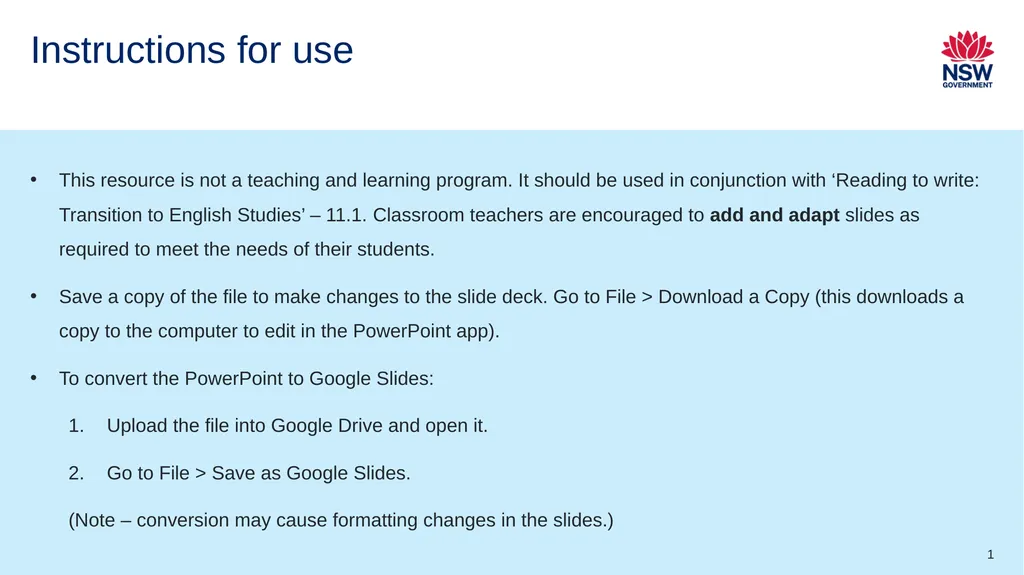
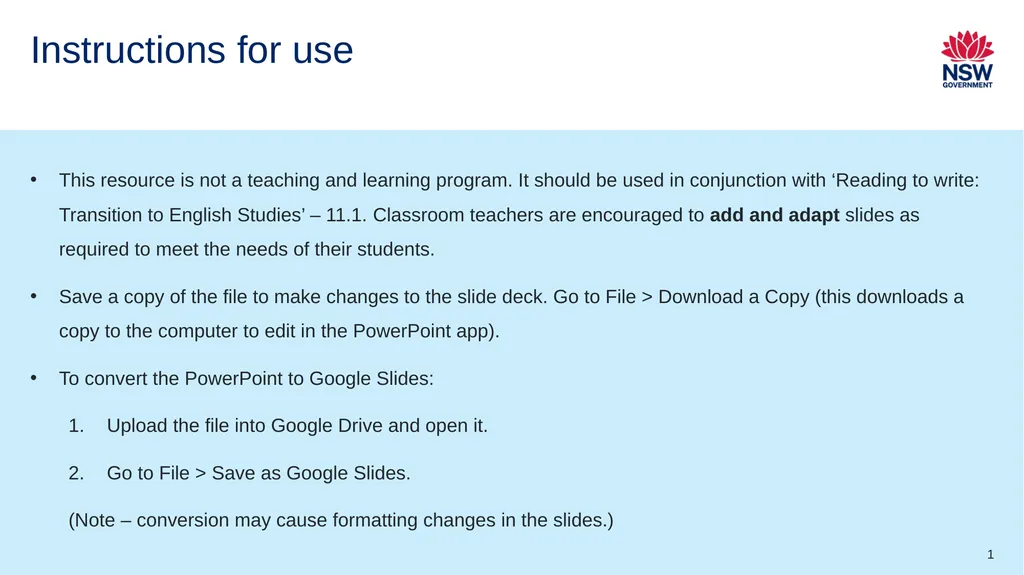
Instructions for use This resource is not a teaching and learning program. It should be used in conjunction with ‘Reading to write: Transition to English Studies’ – 11.1. Classroom teachers are encouraged to add and adapt slides as required to meet the needs of their students.
Save a copy of the file to make changes to the slide deck. Go to File > Download a Copy (this downloads a copy to the computer to edit in the PowerPoint app).
To convert the PowerPoint to Google Slides:
Upload the file into Google Drive and open it.
Go to File > Save as Google Slides.
(Note – conversion may cause formatting changes in the slides.) 1<br>
Save a copy of the file to make changes to the slide deck. Go to File > Download a Copy (this downloads a copy to the computer to edit in the PowerPoint app).
To convert the PowerPoint to Google Slides:
Upload the file into Google Drive and open it.
Go to File > Save as Google Slides.
(Note – conversion may cause formatting changes in the slides.) 1<br>
02
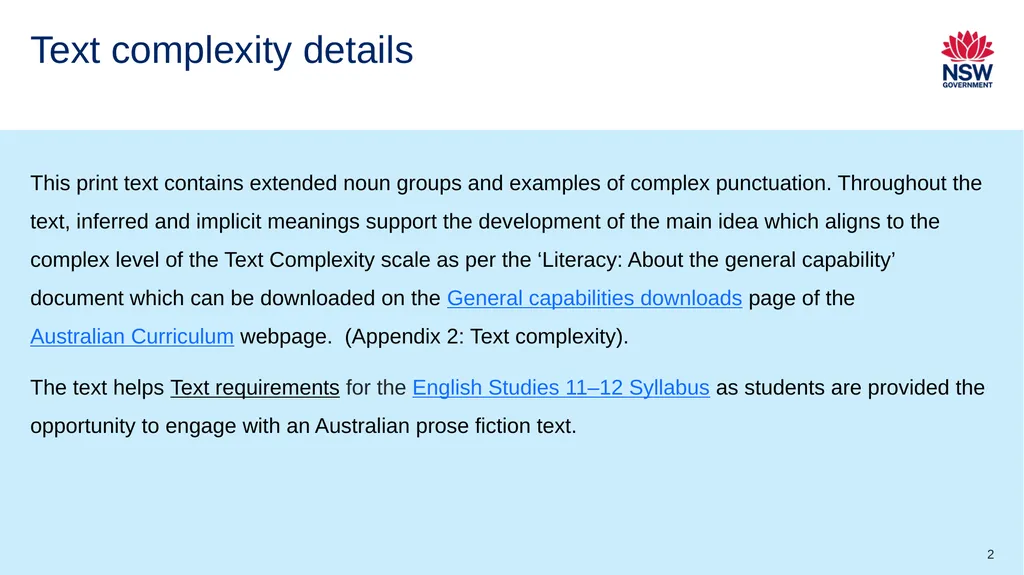
Text complexity details This print text contains extended noun groups and examples of complex punctuation. Throughout the text, inferred and implicit meanings support the development of the main idea which aligns to the complex level of the Text Complexity scale as per the ‘Literacy: About the general capability’ document which can be downloaded on the General capabilities downloads page of the Australian Curriculum webpage. (Appendix 2: Text complexity).
The text helps Text requirements for the English Studies 11–12 Syllabus as students are provided the opportunity to engage with an Australian prose fiction text. 2<br>
The text helps Text requirements for the English Studies 11–12 Syllabus as students are provided the opportunity to engage with an Australian prose fiction text. 2<br>
03
Licence agreement details Chan Q (2016) ‘What the doctor recommended’ in Ridge J (ed) The Book That Made Me, Walker Books Australia Pty Ltd, Newtown.
Reproduced and made available for copying and communication by NSW Department of Education for its educational purposes with the permission of Queenie Chan. 3<br>
Reproduced and made available for copying and communication by NSW Department of Education for its educational purposes with the permission of Queenie Chan. 3<br>
04
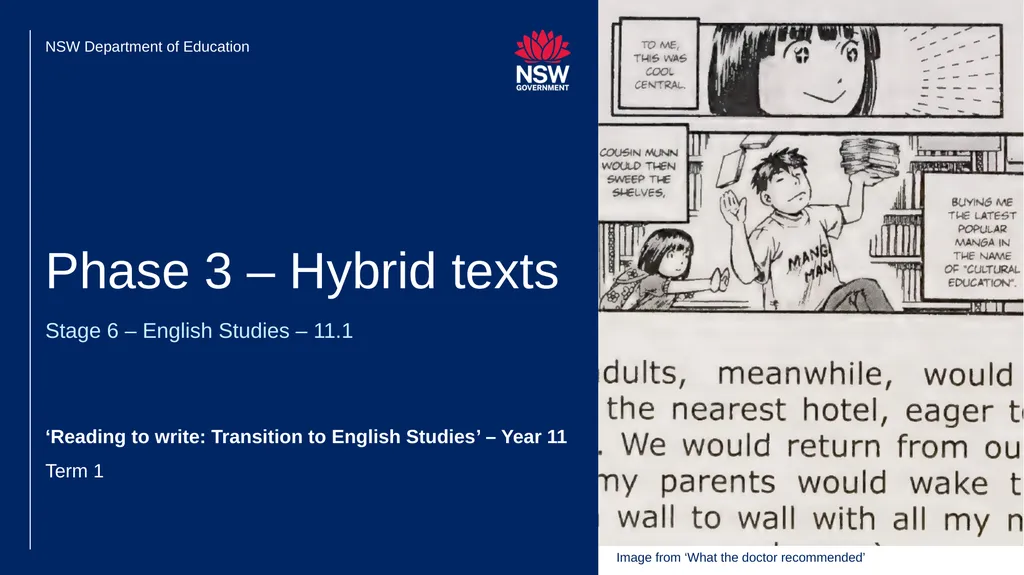
Phase 3 – Hybrid texts Stage 6 – English Studies – 11.1 ‘Reading to write: Transition to English Studies’ – Year 11 Term 1 Image from ‘What the doctor recommended’ NSW Department of Education<br>
05
Sharing learning intentions and success criteria<br>
06
Learning intentions and success criteria (1) We are learning to
understand what makes a text hybrid
identify elements of textual hybridity in the core text
be able to experiment with textual hybridity.
We can
[classroom teacher to insert sample success criteria]
[classroom teacher to insert sample success criteria]
[classroom teacher to insert sample success criteria]. 6<br>
understand what makes a text hybrid
identify elements of textual hybridity in the core text
be able to experiment with textual hybridity.
We can
[classroom teacher to insert sample success criteria]
[classroom teacher to insert sample success criteria]
[classroom teacher to insert sample success criteria]. 6<br>
07
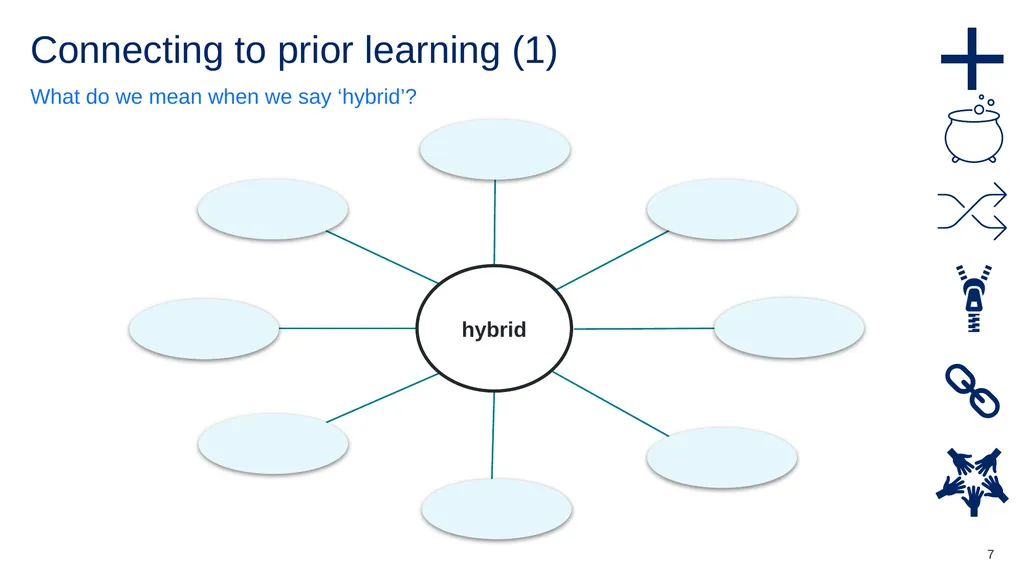
Connecting to prior learning (1) What do we mean when we say ‘hybrid’? hybrid 7<br>
08
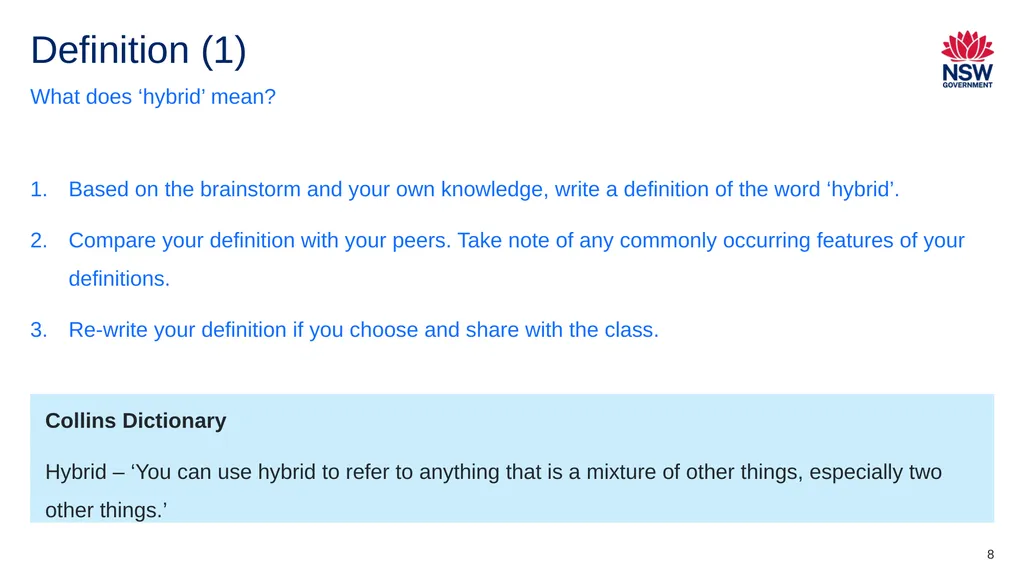
Definition (1) What does ‘hybrid’ mean? Based on the brainstorm and your own knowledge, write a definition of the word ‘hybrid’.
Compare your definition with your peers. Take note of any commonly occurring features of your definitions.
Re-write your definition if you choose and share with the class. Collins Dictionary
Hybrid – ‘You can use hybrid to refer to anything that is a mixture of other things, especially two other things.’ 8<br>
Compare your definition with your peers. Take note of any commonly occurring features of your definitions.
Re-write your definition if you choose and share with the class. Collins Dictionary
Hybrid – ‘You can use hybrid to refer to anything that is a mixture of other things, especially two other things.’ 8<br>
09
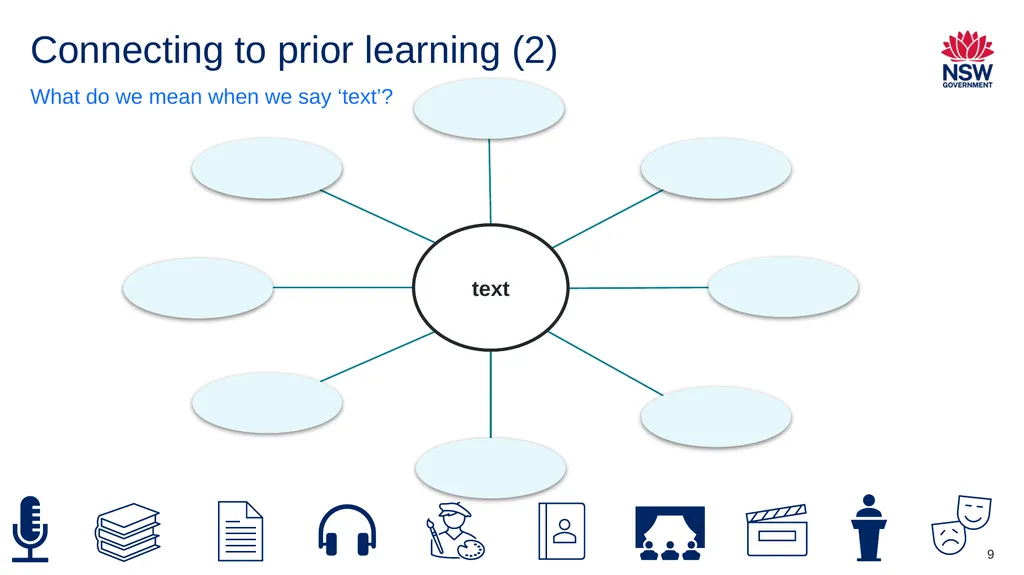
Connecting to prior learning (2) What do we mean when we say ‘text’? text 9<br>
10
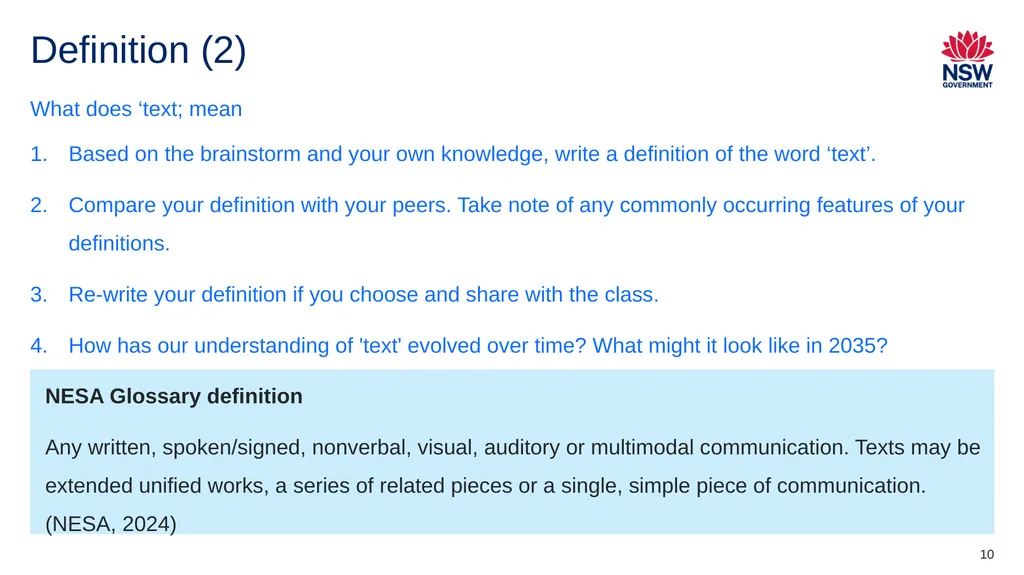
Definition (2) What does ‘text; mean Based on the brainstorm and your own knowledge, write a definition of the word ‘text’.
Compare your definition with your peers. Take note of any commonly occurring features of your definitions.
Re-write your definition if you choose and share with the class.
How has our understanding of 'text' evolved over time? What might it look like in 2035? NESA Glossary definition
Any written, spoken/signed, nonverbal, visual, auditory or multimodal communication. Texts may be extended unified works, a series of related pieces or a single, simple piece of communication. (NESA, 2024) 10<br>
Compare your definition with your peers. Take note of any commonly occurring features of your definitions.
Re-write your definition if you choose and share with the class.
How has our understanding of 'text' evolved over time? What might it look like in 2035? NESA Glossary definition
Any written, spoken/signed, nonverbal, visual, auditory or multimodal communication. Texts may be extended unified works, a series of related pieces or a single, simple piece of communication. (NESA, 2024) 10<br>
11
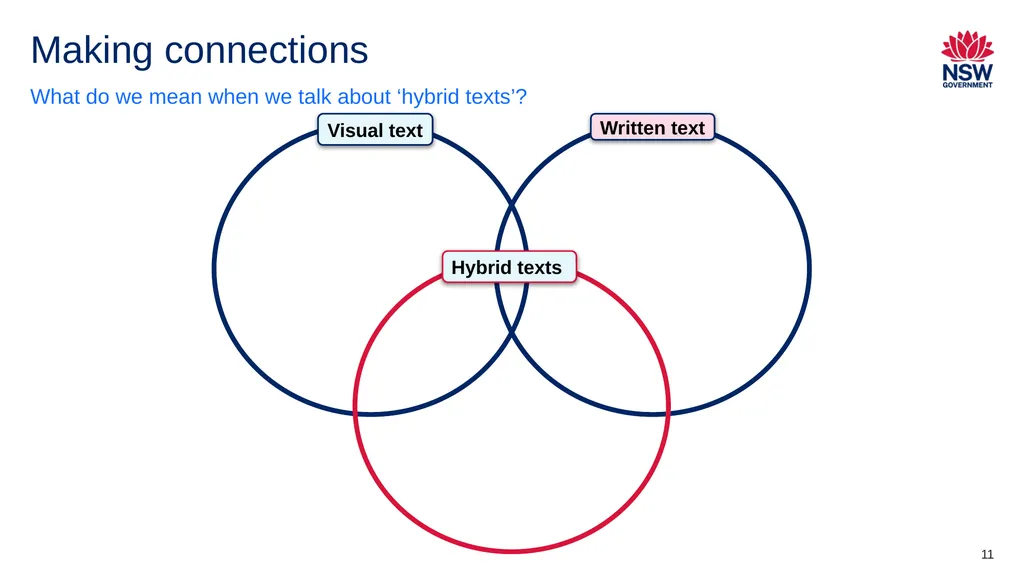
Making connections What do we mean when we talk about ‘hybrid texts’? 11<br>
12
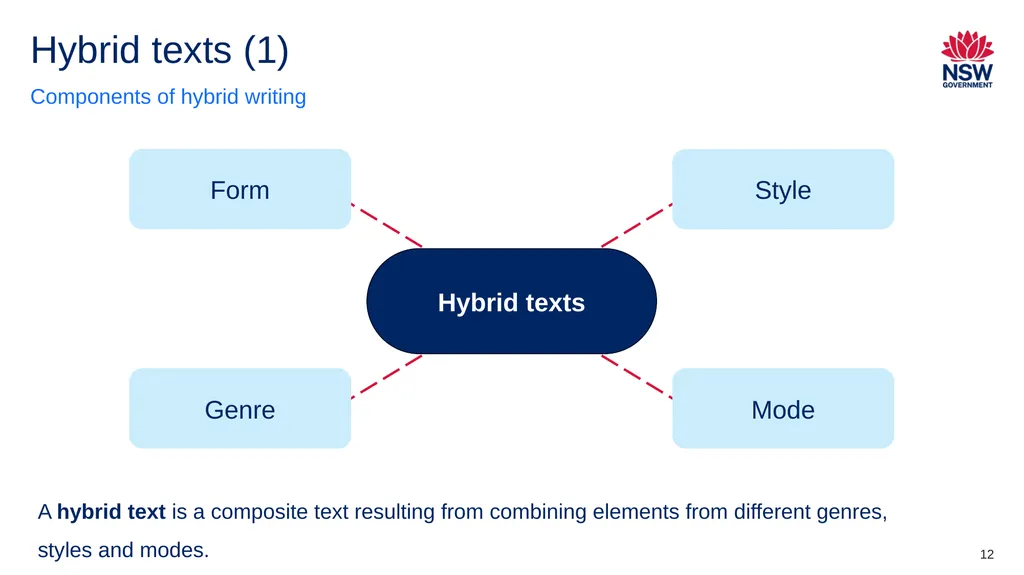
Hybrid texts (1) Components of hybrid writing Hybrid texts Genre Form Style Mode A hybrid text is a composite text resulting from combining elements from different genres, styles and modes. 12<br>
13
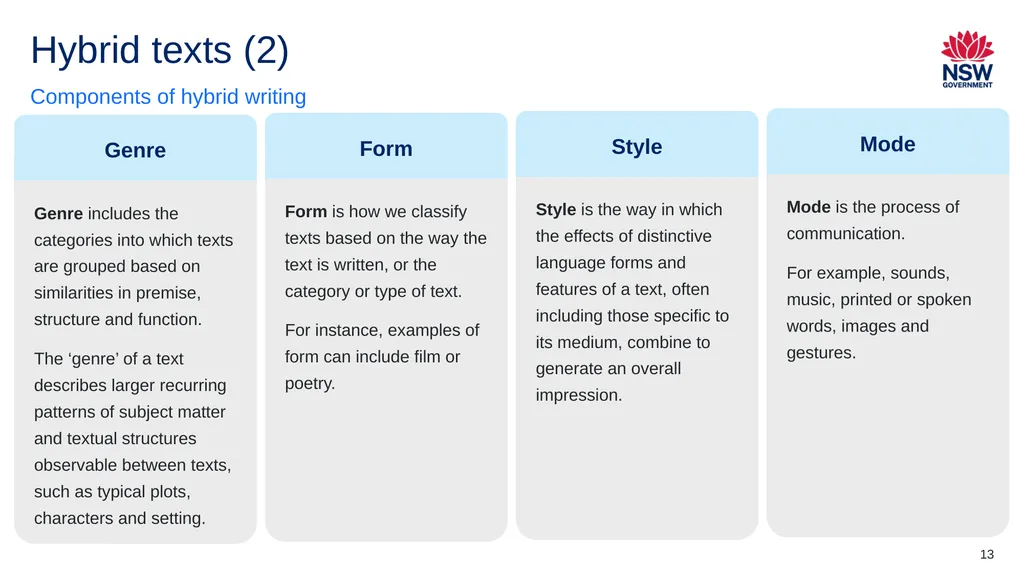
Hybrid texts (2) Components of hybrid writing Genre Genre includes the categories into which texts are grouped based on similarities in premise, structure and function.
The ‘genre’ of a text describes larger recurring patterns of subject matter and textual structures observable between texts, such as typical plots, characters and setting. Form Form is how we classify texts based on the way the text is written, or the category or type of text.
For instance, examples of form can include film or poetry. Style Style is the way in which the effects of distinctive language forms and features of a text, often including those specific to its medium, combine to generate an overall impression. Mode Mode is the process of communication.
For example, sounds, music, printed or spoken words, images and gestures. 13<br>
The ‘genre’ of a text describes larger recurring patterns of subject matter and textual structures observable between texts, such as typical plots, characters and setting. Form Form is how we classify texts based on the way the text is written, or the category or type of text.
For instance, examples of form can include film or poetry. Style Style is the way in which the effects of distinctive language forms and features of a text, often including those specific to its medium, combine to generate an overall impression. Mode Mode is the process of communication.
For example, sounds, music, printed or spoken words, images and gestures. 13<br>
14
Checking for understanding (1)<br>
15
Checking for understanding (2) Hybrid texts A hybrid text is … 15<br>
16
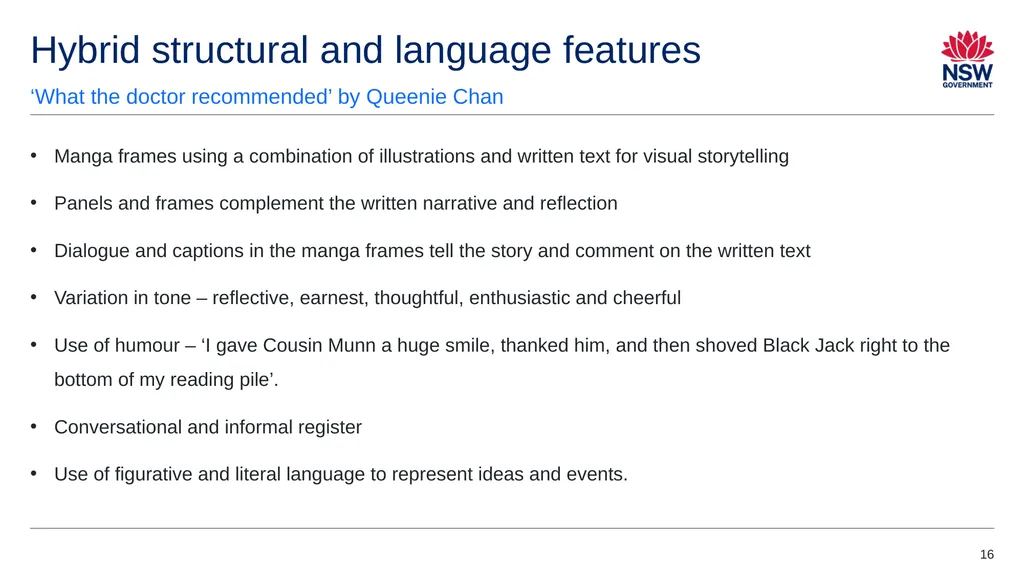
Hybrid structural and language features ‘What the doctor recommended’ by Queenie Chan Manga frames using a combination of illustrations and written text for visual storytelling
Panels and frames complement the written narrative and reflection
Dialogue and captions in the manga frames tell the story and comment on the written text
Variation in tone – reflective, earnest, thoughtful, enthusiastic and cheerful
Use of humour – ‘I gave Cousin Munn a huge smile, thanked him, and then shoved Black Jack right to the bottom of my reading pile’.
Conversational and informal register
Use of figurative and literal language to represent ideas and events. 16<br>
Panels and frames complement the written narrative and reflection
Dialogue and captions in the manga frames tell the story and comment on the written text
Variation in tone – reflective, earnest, thoughtful, enthusiastic and cheerful
Use of humour – ‘I gave Cousin Munn a huge smile, thanked him, and then shoved Black Jack right to the bottom of my reading pile’.
Conversational and informal register
Use of figurative and literal language to represent ideas and events. 16<br>
17
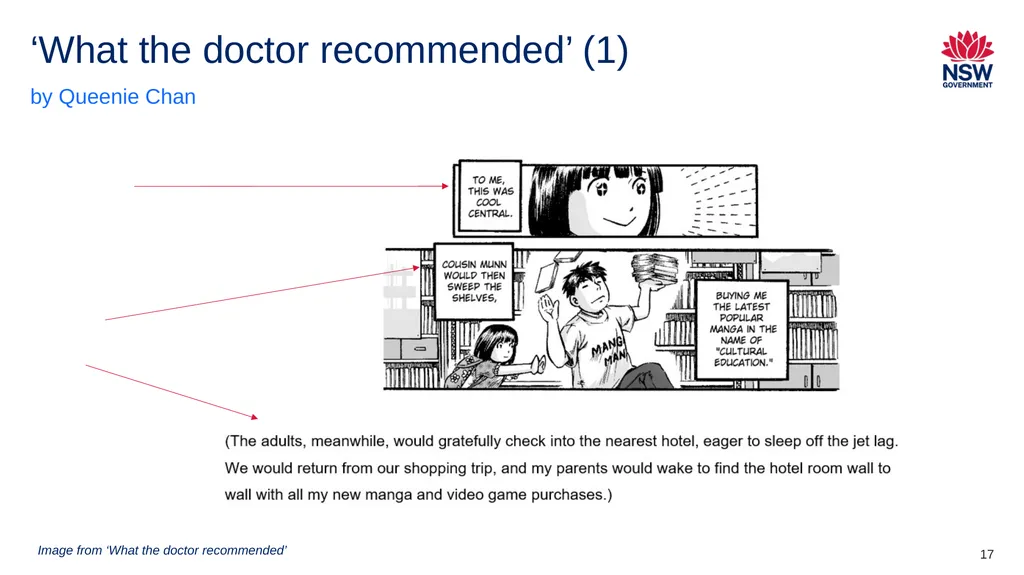
‘What the doctor recommended’ (1) by Queenie Chan Image from ‘What the doctor recommended’ 17<br>
18
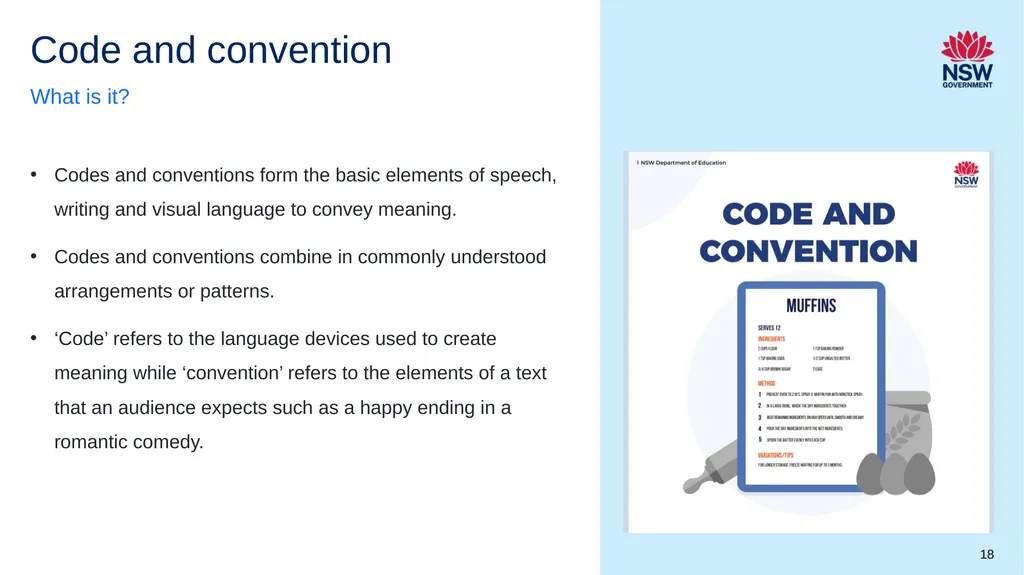
Code and convention What is it? Codes and conventions form the basic elements of speech, writing and visual language to convey meaning.
Codes and conventions combine in commonly understood arrangements or patterns.
‘Code’ refers to the language devices used to create meaning while ‘convention’ refers to the elements of a text that an audience expects such as a happy ending in a romantic comedy. 18<br>
Codes and conventions combine in commonly understood arrangements or patterns.
‘Code’ refers to the language devices used to create meaning while ‘convention’ refers to the elements of a text that an audience expects such as a happy ending in a romantic comedy. 18<br>
19
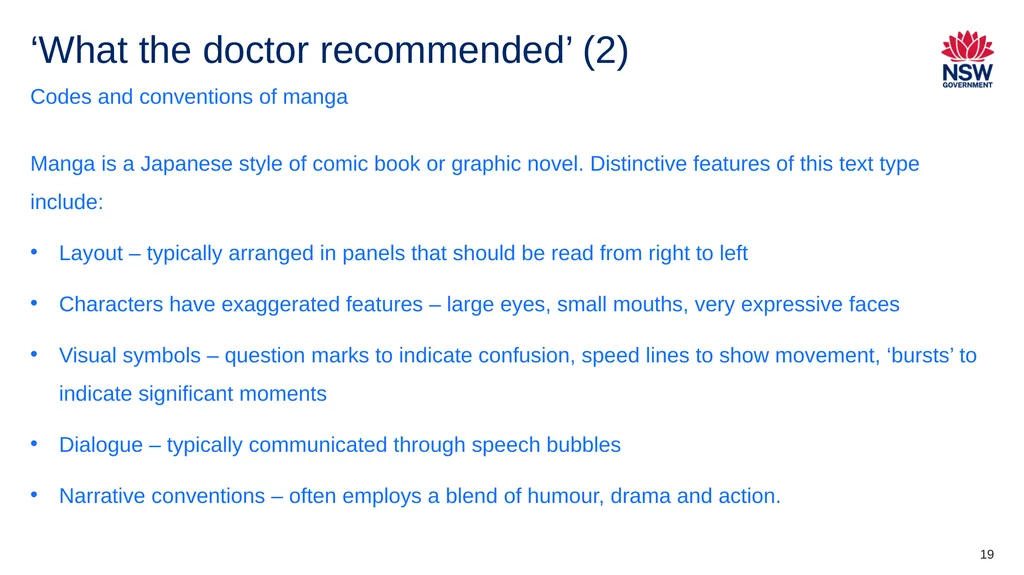
‘What the doctor recommended’ (2) Codes and conventions of manga Manga is a Japanese style of comic book or graphic novel. Distinctive features of this text type include:
Layout – typically arranged in panels that should be read from right to left
Characters have exaggerated features – large eyes, small mouths, very expressive faces
Visual symbols – question marks to indicate confusion, speed lines to show movement, ‘bursts’ to indicate significant moments
Dialogue – typically communicated through speech bubbles
Narrative conventions – often employs a blend of humour, drama and action. 19<br>
Layout – typically arranged in panels that should be read from right to left
Characters have exaggerated features – large eyes, small mouths, very expressive faces
Visual symbols – question marks to indicate confusion, speed lines to show movement, ‘bursts’ to indicate significant moments
Dialogue – typically communicated through speech bubbles
Narrative conventions – often employs a blend of humour, drama and action. 19<br>
20
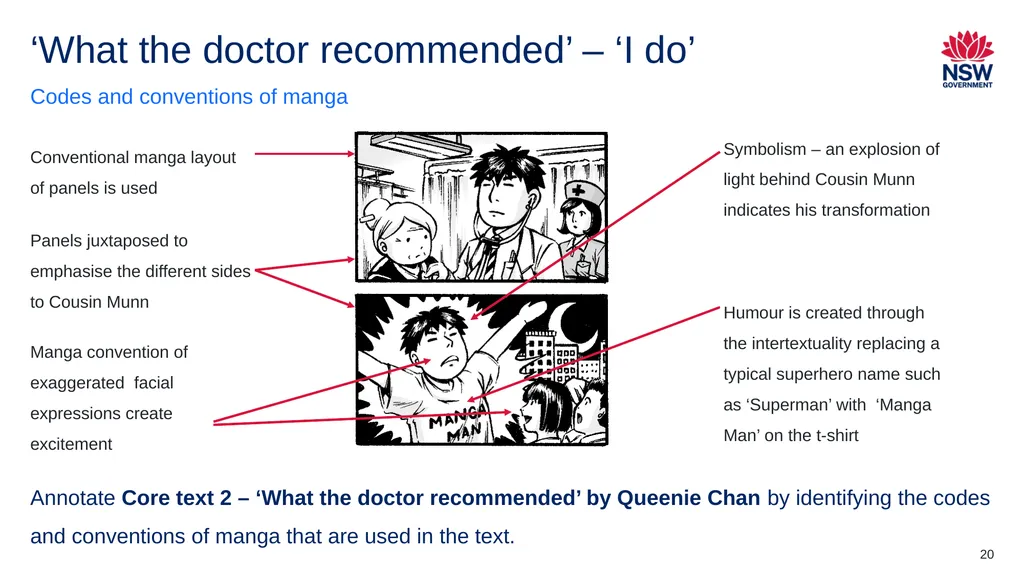
‘What the doctor recommended’ – ‘I do’ Codes and conventions of manga Conventional manga layout of panels is used Panels juxtaposed to emphasise the different sides to Cousin Munn Manga convention of exaggerated facial expressions create excitement Symbolism – an explosion of light behind Cousin Munn indicates his transformation Humour is created through the intertextuality replacing a typical superhero name such as ‘Superman’ with ‘Manga Man’ on the t-shirt Annotate Core text 2 – ‘What the doctor recommended’ by Queenie Chan by identifying the codes and conventions of manga that are used in the text. 20<br>
21
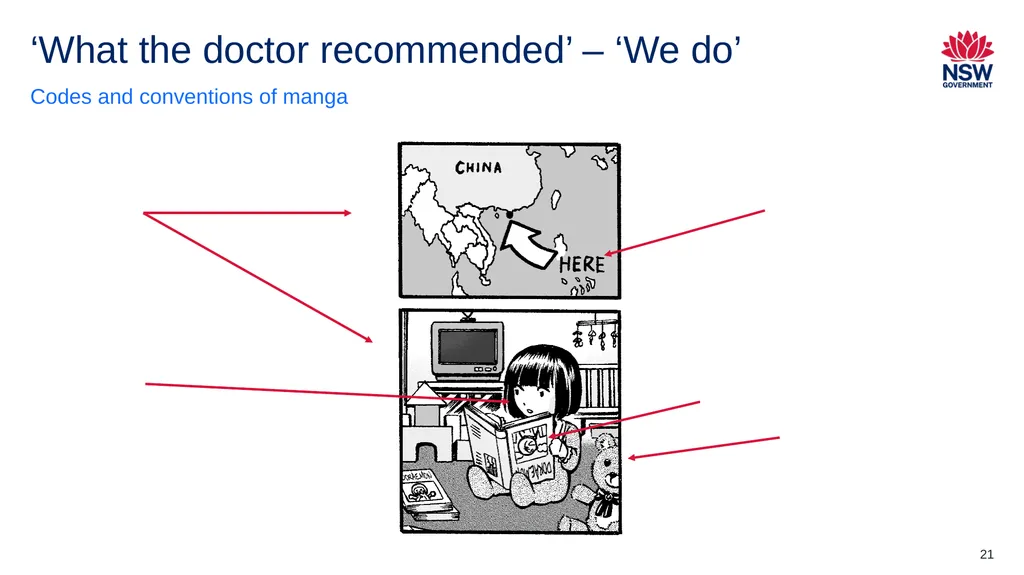
‘What the doctor recommended’ – ‘We do’ Codes and conventions of manga 21<br>
22
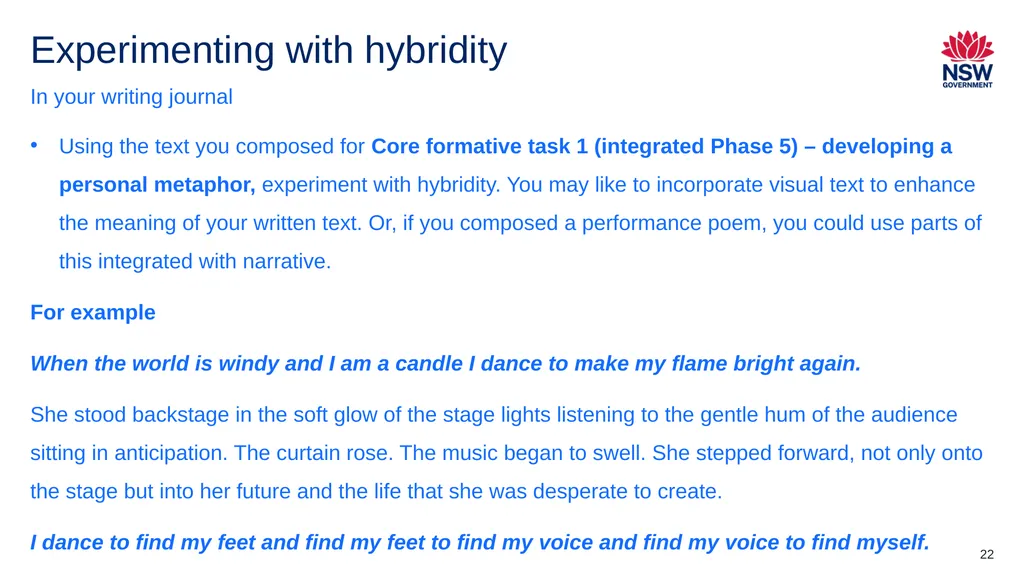
Experimenting with hybridity In your writing journal Using the text you composed for Core formative task 1 (integrated Phase 5) – developing a personal metaphor, experiment with hybridity. You may like to incorporate visual text to enhance the meaning of your written text. Or, if you composed a performance poem, you could use parts of this integrated with narrative.
For example
When the world is windy and I am a candle I dance to make my flame bright again.
She stood backstage in the soft glow of the stage lights listening to the gentle hum of the audience sitting in anticipation. The curtain rose. The music began to swell. She stepped forward, not only onto the stage but into her future and the life that she was desperate to create.
I dance to find my feet and find my feet to find my voice and find my voice to find myself. 22<br>
For example
When the world is windy and I am a candle I dance to make my flame bright again.
She stood backstage in the soft glow of the stage lights listening to the gentle hum of the audience sitting in anticipation. The curtain rose. The music began to swell. She stepped forward, not only onto the stage but into her future and the life that she was desperate to create.
I dance to find my feet and find my feet to find my voice and find my voice to find myself. 22<br>
23
Returning to the learning intentions and success criteria<br>
24
Learning intentions and success criteria (2) We are learning to
understand what makes a text hybrid
identify elements of textual hybridity in the core text
be able to experiment with textual hybridity.
We can
[classroom teacher to insert success criteria]
[classroom teacher to insert success criteria]
[classroom teacher to insert success criteria]. 24<br>
understand what makes a text hybrid
identify elements of textual hybridity in the core text
be able to experiment with textual hybridity.
We can
[classroom teacher to insert success criteria]
[classroom teacher to insert success criteria]
[classroom teacher to insert success criteria]. 24<br>
25
References (1) This presentation contains NSW Curriculum and syllabus content. The NSW Curriculum is developed by the NSW Education Standards Authority. This content is prepared by NESA for and on behalf of the Crown in the right of the State of New South Wales. The material is protected by Crown copyright.
Please refer to the NESA Copyright Disclaimer for more information https://educationstandards.nsw.edu.au/wps/portal/nesa/mini-footer/copyright.
NESA holds the only official and up-to-date versions of the NSW Curriculum and syllabus documents. Please visit the NSW Education Standards Authority (NESA) website https://educationstandards.nsw.edu.au/wps/portal/nesa/home and the NSW Curriculum website https://curriculum.nsw.edu.au. [English Studies 11–12 © Syllabus NSW Education Standards Authority (NESA) for and on behalf of the Crown in right of the State of New South Wales, 2024.
Australian Education Research Organisation (AERO) (2024a) Explain learning objectives, AERO, accessed 16 April 2024.
AERO (Australian Education Research Organisation) (2024b) Why explicit instruction works, AERO website, accessed 16 April 2024.
Black P and Wiliam D (2018) ‘Classroom assessment and pedagogy’, Assessment in Education Principles Policy and Practice, 25(1):1–25.
CESE (Centre for Education Statistics and Evaluation) (2017) Cognitive load theory: Research that teachers really need to understand, NSW Department of Education, accessed 16 April 2024.
Chan Q (2016) ‘What the doctor recommended’ in Ridge J (ed) The Book That Made Me, Walker Books Australia Pty Ltd, Newtown.
Clarke S (2014) Outstanding formative assessment: culture and practice, Hodder Education, Great Britain. 25<br>
Please refer to the NESA Copyright Disclaimer for more information https://educationstandards.nsw.edu.au/wps/portal/nesa/mini-footer/copyright.
NESA holds the only official and up-to-date versions of the NSW Curriculum and syllabus documents. Please visit the NSW Education Standards Authority (NESA) website https://educationstandards.nsw.edu.au/wps/portal/nesa/home and the NSW Curriculum website https://curriculum.nsw.edu.au. [English Studies 11–12 © Syllabus NSW Education Standards Authority (NESA) for and on behalf of the Crown in right of the State of New South Wales, 2024.
Australian Education Research Organisation (AERO) (2024a) Explain learning objectives, AERO, accessed 16 April 2024.
AERO (Australian Education Research Organisation) (2024b) Why explicit instruction works, AERO website, accessed 16 April 2024.
Black P and Wiliam D (2018) ‘Classroom assessment and pedagogy’, Assessment in Education Principles Policy and Practice, 25(1):1–25.
CESE (Centre for Education Statistics and Evaluation) (2017) Cognitive load theory: Research that teachers really need to understand, NSW Department of Education, accessed 16 April 2024.
Chan Q (2016) ‘What the doctor recommended’ in Ridge J (ed) The Book That Made Me, Walker Books Australia Pty Ltd, Newtown.
Clarke S (2014) Outstanding formative assessment: culture and practice, Hodder Education, Great Britain. 25<br>
26
References (2) Clarke S, Timperley H, Hattie J (2003) Unlocking formative assessment: Practical strategies for enhancing students’ learning in the primary and intermediate classroom, Hodder Moa Beckett, Auckland NZ, 2003.
Griffin P (2018) Assessment for teaching, Cambridge University Press.
NESA (NSW Education Standards Authority) (n.d.) Collaborative curriculum planning, NESA website, accessed 19 May 2025.
State of New South Wales (Department of Education) (2024.) Explicit teaching strategies, NSW Department of Education website, accessed 5 April 2024.
State of New South Wales (Department of Education) (2024) the Explicit teaching – Driving learning and engagement, Centre for Education Statistics and Evaluation website, accessed 5 April 2024.
State of New South Wales (Department of Education) (n.d.) Digital Learning Selector, NSW Department of Education website, accessed 5 April 2024.
Wiliam D (2014) ‘The right questions, the right way ’, Educational Leadership, 71(6). 26<br>
Griffin P (2018) Assessment for teaching, Cambridge University Press.
NESA (NSW Education Standards Authority) (n.d.) Collaborative curriculum planning, NESA website, accessed 19 May 2025.
State of New South Wales (Department of Education) (2024.) Explicit teaching strategies, NSW Department of Education website, accessed 5 April 2024.
State of New South Wales (Department of Education) (2024) the Explicit teaching – Driving learning and engagement, Centre for Education Statistics and Evaluation website, accessed 5 April 2024.
State of New South Wales (Department of Education) (n.d.) Digital Learning Selector, NSW Department of Education website, accessed 5 April 2024.
Wiliam D (2014) ‘The right questions, the right way ’, Educational Leadership, 71(6). 26<br>
27
Copyright © State of New South Wales (Department of Education), 2025 The copyright material published in this resource is subject to the Copyright Act 1968 (Cth) and is owned by the NSW Department of Education or, where indicated, by a party other than the NSW Department of Education (third-party material).
Copyright material available in this resource and owned by the NSW Department of Education is licensed under a Creative Commons Attribution 4.0 International (CC BY 4.0) license.
This license allows you to share and adapt the material for any purpose, even commercially.
Attribution should be given to © State of New South Wales (Department of Education), 2025.
Material in this resource not available under a Creative Commons license:
the NSW Department of Education logo, other logos and trademark-protected material
Material owned by a third party that has been reproduced with permission. You will need to obtain permission from the third party to reuse its material.
Links to third-party material and websites
Please note that the provided (reading/viewing material/list/links/texts) are a suggestion only and implies no endorsement, by the New South Wales Department of Education, of any author, publisher, or book title. School principals and teachers are best placed to assess the suitability of resources that would complement the curriculum and reflect the needs and interests of their students.
If you use the links provided in this document to access a third-party’s website, you acknowledge that the terms of use, including licence terms set out on the third-party’s website apply to the use which may be made of the materials on that third-party website or where permitted by the Copyright Act 1968 (Cth). The department accepts no responsibility for content on third-party websites.<br>
Copyright material available in this resource and owned by the NSW Department of Education is licensed under a Creative Commons Attribution 4.0 International (CC BY 4.0) license.
This license allows you to share and adapt the material for any purpose, even commercially.
Attribution should be given to © State of New South Wales (Department of Education), 2025.
Material in this resource not available under a Creative Commons license:
the NSW Department of Education logo, other logos and trademark-protected material
Material owned by a third party that has been reproduced with permission. You will need to obtain permission from the third party to reuse its material.
Links to third-party material and websites
Please note that the provided (reading/viewing material/list/links/texts) are a suggestion only and implies no endorsement, by the New South Wales Department of Education, of any author, publisher, or book title. School principals and teachers are best placed to assess the suitability of resources that would complement the curriculum and reflect the needs and interests of their students.
If you use the links provided in this document to access a third-party’s website, you acknowledge that the terms of use, including licence terms set out on the third-party’s website apply to the use which may be made of the materials on that third-party website or where permitted by the Copyright Act 1968 (Cth). The department accepts no responsibility for content on third-party websites.<br>