
Instructions for use This resource is not a
DJ
Published · 34 slides · 0 views
1 / 1

Description
Instructions for use This resource is not a teaching and learning program. It should be used in conjunction with Shakespeare retold Year 10, Term 3. Classroom teachers are encouraged to add and adapt slides as required to meet the needs
Related Topics
Share
Embed code
Download this presentation From Below
"Instructions for use This resource is not a" is the property of its rightful owner. Permission is granted to download and print the materials on this website for personal, non-commercial use only, and to display it on your personal computer provided you do not modify the materials and that you retain all copyright notices contained in the materials. By downloading content from our website, you accept the terms of this agreement.
Presentation Transcript
01
Instructions for use This resource is not a teaching and learning program. It should be used in conjunction with ‘Shakespeare retold’ – Year 10, Term 3.
Classroom teachers are encouraged to add and adapt slides as required to meet the needs of their students.
Save a copy of the file to make changes to the slide deck. Go to File > Download a Copy (this downloads a copy to the computer to edit in the PowerPoint app).
To convert the PowerPoint to Google Slides:
Upload the file into Google Drive and open it.
Go to File > Save as Google Slides.
(Note – conversion may cause formatting changes in the slides.) 1<br>
Classroom teachers are encouraged to add and adapt slides as required to meet the needs of their students.
Save a copy of the file to make changes to the slide deck. Go to File > Download a Copy (this downloads a copy to the computer to edit in the PowerPoint app).
To convert the PowerPoint to Google Slides:
Upload the file into Google Drive and open it.
Go to File > Save as Google Slides.
(Note – conversion may cause formatting changes in the slides.) 1<br>
02
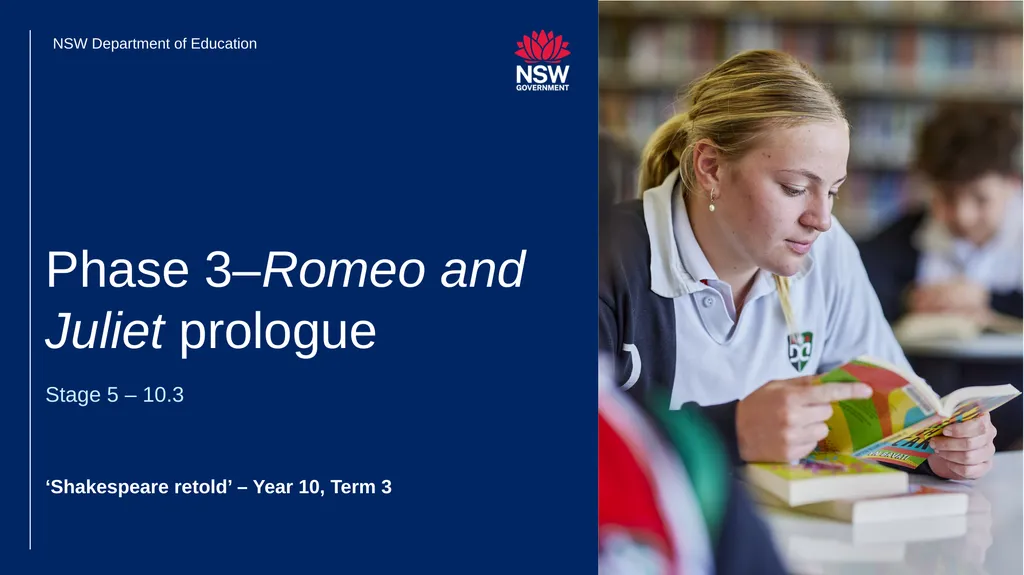
‘Shakespeare retold’ – Year 10, Term 3 Stage 5 – 10.3 Phase 3–Romeo and Juliet prologue NSW Department of Education<br>
03
Sharing learning intentions NSW Department of Education<br>
04
4 Learning intention
We are learning to:
understand the structure, purpose and features of the prologue of The Tragedy of Romeo and Juliet.
Success criteria
I will know I am successful when I can:
[these could be co-constructed with the class or used as per the notes]. Learning intentions and success criteria (1)<br>
We are learning to:
understand the structure, purpose and features of the prologue of The Tragedy of Romeo and Juliet.
Success criteria
I will know I am successful when I can:
[these could be co-constructed with the class or used as per the notes]. Learning intentions and success criteria (1)<br>
05
Connecting to prior learning NSW Department of Education<br>
06
Connecting to prior knowledge of epigraphs NSW Department of Education<br>
07
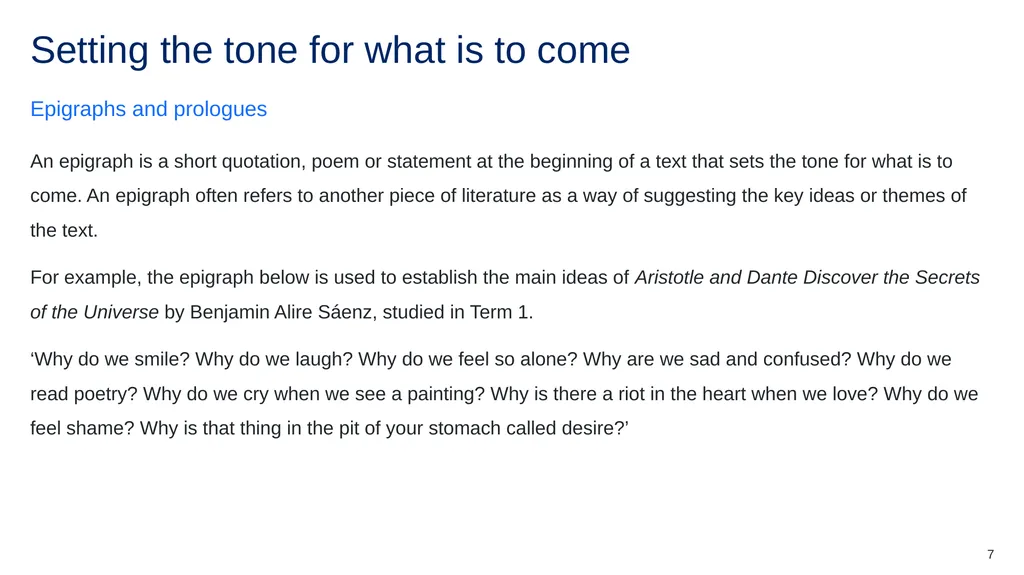
7 An epigraph is a short quotation, poem or statement at the beginning of a text that sets the tone for what is to come. An epigraph often refers to another piece of literature as a way of suggesting the key ideas or themes of the text.
For example, the epigraph below is used to establish the main ideas of Aristotle and Dante Discover the Secrets of the Universe by Benjamin Alire Sáenz, studied in Term 1.
‘Why do we smile? Why do we laugh? Why do we feel so alone? Why are we sad and confused? Why do we read poetry? Why do we cry when we see a painting? Why is there a riot in the heart when we love? Why do we feel shame? Why is that thing in the pit of your stomach called desire?’ Epigraphs and prologues Setting the tone for what is to come<br>
For example, the epigraph below is used to establish the main ideas of Aristotle and Dante Discover the Secrets of the Universe by Benjamin Alire Sáenz, studied in Term 1.
‘Why do we smile? Why do we laugh? Why do we feel so alone? Why are we sad and confused? Why do we read poetry? Why do we cry when we see a painting? Why is there a riot in the heart when we love? Why do we feel shame? Why is that thing in the pit of your stomach called desire?’ Epigraphs and prologues Setting the tone for what is to come<br>
08
8 A prologue can be used to:
provide necessary backstory
set up an event that comes later in the text
establish the setting
introduce the protagonist or antagonist
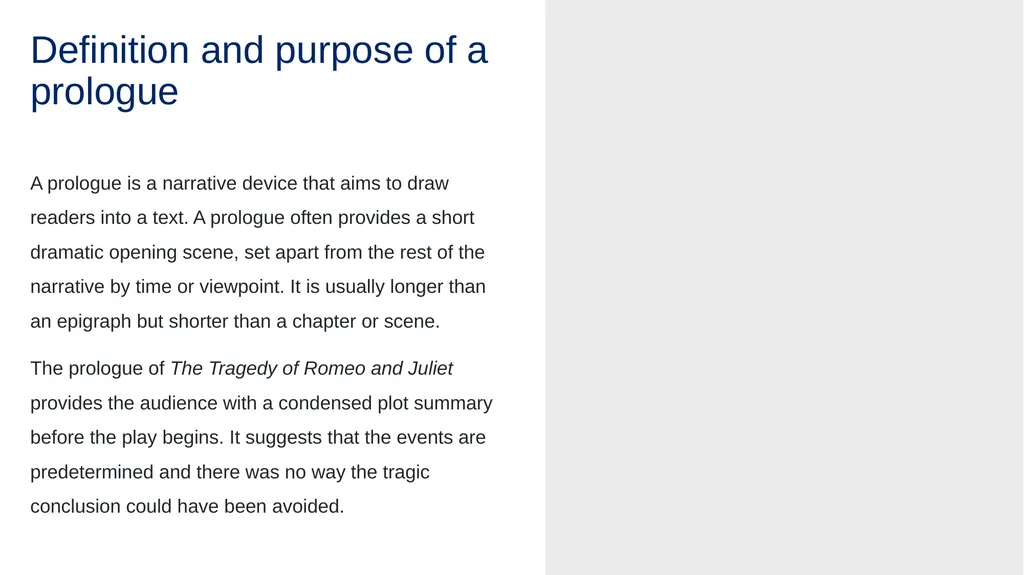
set the tone of the text. A prologue is a narrative device that aims to draw readers into a text. A prologue often provides a short dramatic opening scene, set apart from the rest of the narrative by time or viewpoint. It is usually longer than an epigraph but shorter than a chapter or scene.
The prologue of The Tragedy of Romeo and Juliet provides the audience with a condensed plot summary before the play begins. It suggests that the events are predetermined and there was no way the tragic conclusion could have been avoided. Definition and purpose of a prologue<br>
provide necessary backstory
set up an event that comes later in the text
establish the setting
introduce the protagonist or antagonist
set the tone of the text. A prologue is a narrative device that aims to draw readers into a text. A prologue often provides a short dramatic opening scene, set apart from the rest of the narrative by time or viewpoint. It is usually longer than an epigraph but shorter than a chapter or scene.
The prologue of The Tragedy of Romeo and Juliet provides the audience with a condensed plot summary before the play begins. It suggests that the events are predetermined and there was no way the tragic conclusion could have been avoided. Definition and purpose of a prologue<br>
09
Connecting to prior knowledge of sonnets NSW Department of Education<br>
10
10 Remember that an iamb consists of an unstressed syllable, followed by a stressed syllable, such as ap-PLE or New YORK – the second syllable has greater emphasis than the first.
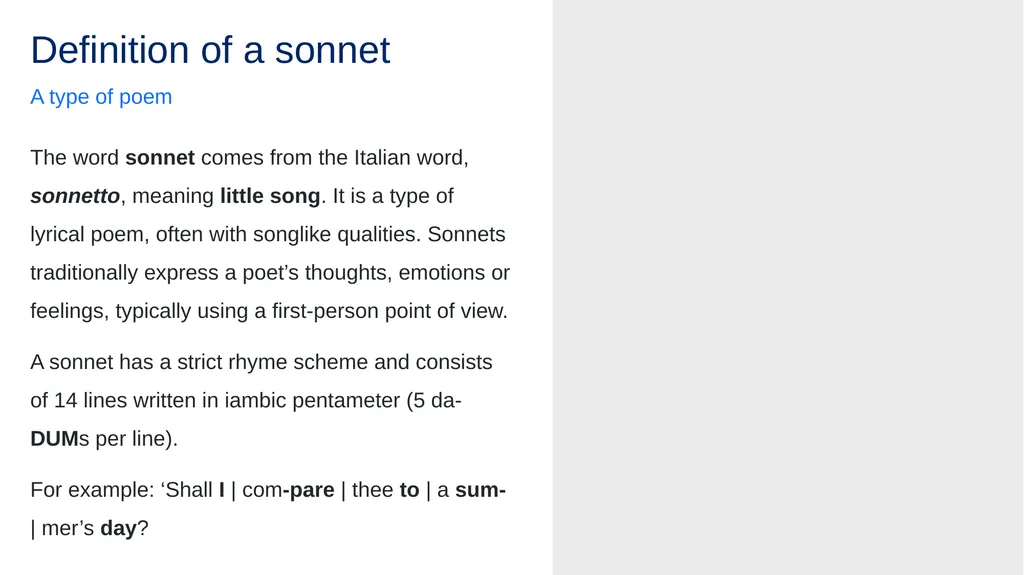
Iambic pentameter means that there are exactly 5 iambs (called feet) per line – 10 syllables in total. The word sonnet comes from the Italian word, sonnetto, meaning little song. It is a type of lyrical poem, often with songlike qualities. Sonnets traditionally express a poet’s thoughts, emotions or feelings, typically using a first-person point of view.
A sonnet has a strict rhyme scheme and consists of 14 lines written in iambic pentameter (5 da-DUMs per line).
For example: ‘Shall I | com-pare | thee to | a sum- | mer’s day? A type of poem Definition of a sonnet<br>
Iambic pentameter means that there are exactly 5 iambs (called feet) per line – 10 syllables in total. The word sonnet comes from the Italian word, sonnetto, meaning little song. It is a type of lyrical poem, often with songlike qualities. Sonnets traditionally express a poet’s thoughts, emotions or feelings, typically using a first-person point of view.
A sonnet has a strict rhyme scheme and consists of 14 lines written in iambic pentameter (5 da-DUMs per line).
For example: ‘Shall I | com-pare | thee to | a sum- | mer’s day? A type of poem Definition of a sonnet<br>
11
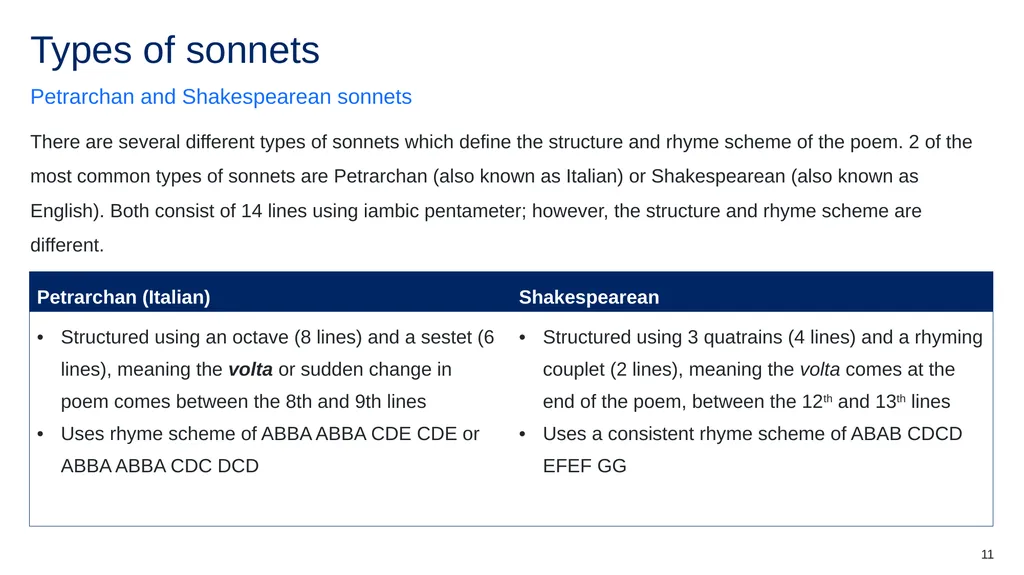
11 There are several different types of sonnets which define the structure and rhyme scheme of the poem. 2 of the most common types of sonnets are Petrarchan (also known as Italian) or Shakespearean (also known as English). Both consist of 14 lines using iambic pentameter; however, the structure and rhyme scheme are different. Petrarchan and Shakespearean sonnets Types of sonnets<br>
12
12 Volta is the Italian word for turn. In a sonnet, a volta signifies a turn in thought or argument. A volta is often indicated by words such as but, yet or and yet, and is generally used to give a response to a question, give a solution to a problem or resolve tension established earlier in the poem.
All sonnets include a volta, though they may come at a different point in the poem, depending on the type of sonnet. In Petrarchan sonnets, the volta occurs between the octave and the sestet, whereas in Shakespearean sonnets, the volta falls before the final couplet. The twist or turn Definition of a volta<br>
All sonnets include a volta, though they may come at a different point in the poem, depending on the type of sonnet. In Petrarchan sonnets, the volta occurs between the octave and the sestet, whereas in Shakespearean sonnets, the volta falls before the final couplet. The twist or turn Definition of a volta<br>
13
Checking for understanding NSW Department of Education<br>
14
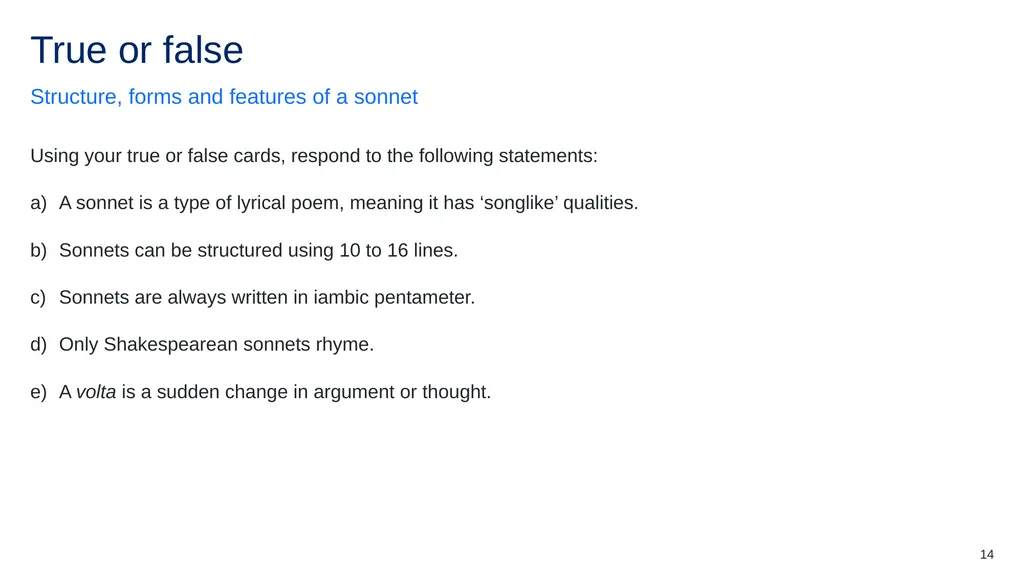
14 Using your true or false cards, respond to the following statements:
A sonnet is a type of lyrical poem, meaning it has ‘songlike’ qualities.
Sonnets can be structured using 10 to 16 lines.
Sonnets are always written in iambic pentameter.
Only Shakespearean sonnets rhyme.
A volta is a sudden change in argument or thought. Structure, forms and features of a sonnet True or false<br>
A sonnet is a type of lyrical poem, meaning it has ‘songlike’ qualities.
Sonnets can be structured using 10 to 16 lines.
Sonnets are always written in iambic pentameter.
Only Shakespearean sonnets rhyme.
A volta is a sudden change in argument or thought. Structure, forms and features of a sonnet True or false<br>
15
Gradual release of responsibility NSW Department of Education<br>
16
The Tragedy of Romeo and Juliet – prologue NSW Department of Education<br>
17
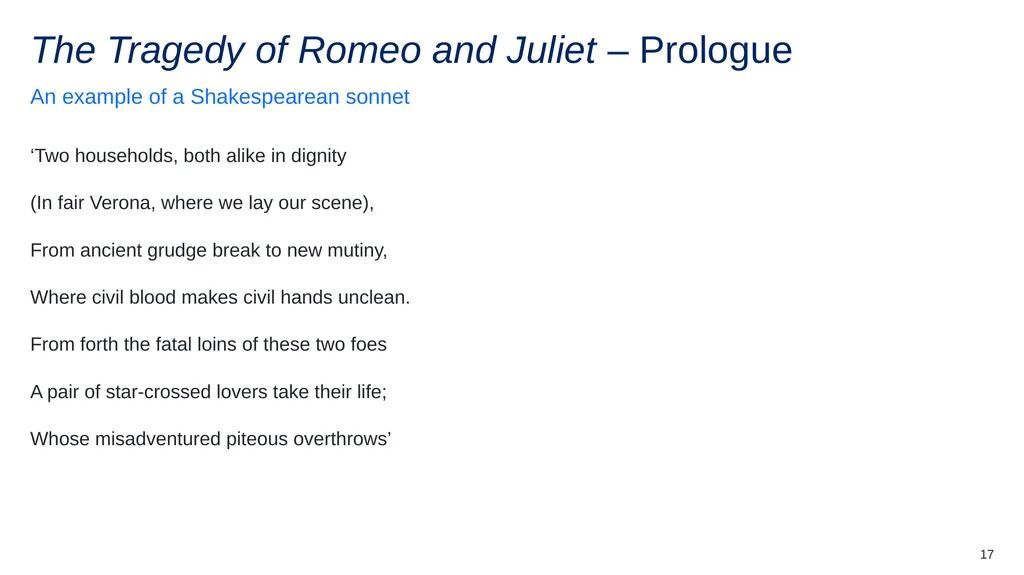
17 ‘Two households, both alike in dignity
(In fair Verona, where we lay our scene),
From ancient grudge break to new mutiny,
Where civil blood makes civil hands unclean.
From forth the fatal loins of these two foes
A pair of star-crossed lovers take their life;
Whose misadventured piteous overthrows’ An example of a Shakespearean sonnet The Tragedy of Romeo and Juliet – Prologue (1)<br>
(In fair Verona, where we lay our scene),
From ancient grudge break to new mutiny,
Where civil blood makes civil hands unclean.
From forth the fatal loins of these two foes
A pair of star-crossed lovers take their life;
Whose misadventured piteous overthrows’ An example of a Shakespearean sonnet The Tragedy of Romeo and Juliet – Prologue (1)<br>
18
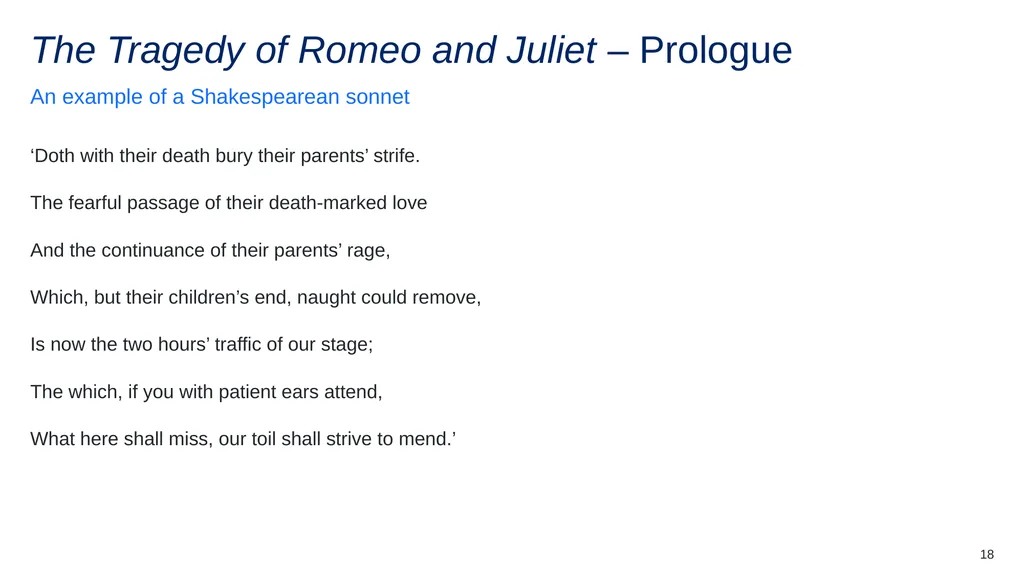
18 ‘Doth with their death bury their parents’ strife.
The fearful passage of their death-marked love
And the continuance of their parents’ rage,
Which, but their children’s end, naught could remove,
Is now the two hours’ traffic of our stage;
The which, if you with patient ears attend,
What here shall miss, our toil shall strive to mend.’ An example of a Shakespearean sonnet The Tragedy of Romeo and Juliet – Prologue (2)<br>
The fearful passage of their death-marked love
And the continuance of their parents’ rage,
Which, but their children’s end, naught could remove,
Is now the two hours’ traffic of our stage;
The which, if you with patient ears attend,
What here shall miss, our toil shall strive to mend.’ An example of a Shakespearean sonnet The Tragedy of Romeo and Juliet – Prologue (2)<br>
19
Identifying the features of a sonnet NSW Department of Education<br>
20
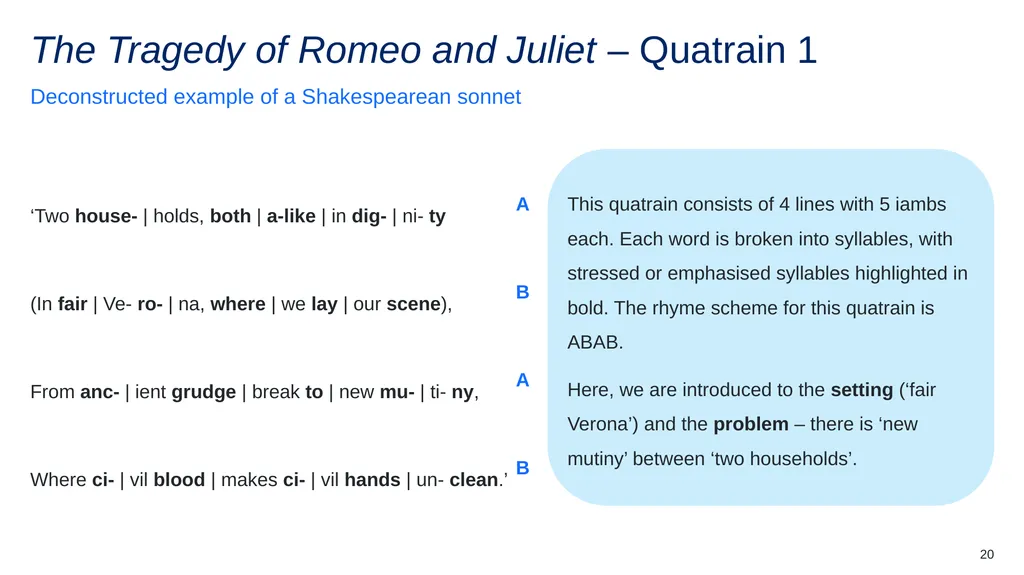
20 This quatrain consists of 4 lines with 5 iambs each. Each word is broken into syllables, with stressed or emphasised syllables highlighted in bold. The rhyme scheme for this quatrain is ABAB.
Here, we are introduced to the setting (‘fair Verona’) and the problem – there is ‘new mutiny’ between ‘two households’. B Where ci- | vil blood | makes ci- | vil hands | un- clean.’ A From anc- | ient grudge | break to | new mu- | ti- ny, B (In fair | Ve- ro- | na, where | we lay | our scene), A ‘Two house- | holds, both | a-like | in dig- | ni- ty Deconstructed example of a Shakespearean sonnet The Tragedy of Romeo and Juliet – Quatrain 1<br>
Here, we are introduced to the setting (‘fair Verona’) and the problem – there is ‘new mutiny’ between ‘two households’. B Where ci- | vil blood | makes ci- | vil hands | un- clean.’ A From anc- | ient grudge | break to | new mu- | ti- ny, B (In fair | Ve- ro- | na, where | we lay | our scene), A ‘Two house- | holds, both | a-like | in dig- | ni- ty Deconstructed example of a Shakespearean sonnet The Tragedy of Romeo and Juliet – Quatrain 1<br>
21
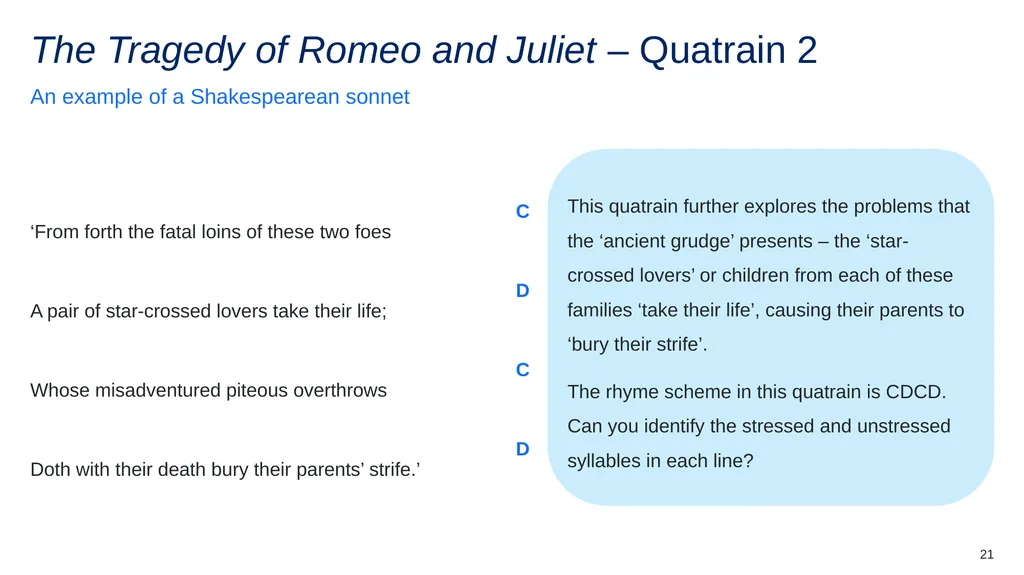
21 This quatrain further explores the problems that the ‘ancient grudge’ presents – the ‘star-crossed lovers’ or children from each of these families ‘take their life’, causing their parents to ‘bury their strife’.
The rhyme scheme in this quatrain is CDCD. Can you identify the stressed and unstressed syllables in each line? D Doth with their death bury their parents’ strife.’ C Whose misadventured piteous overthrows D A pair of star-crossed lovers take their life; C ‘From forth the fatal loins of these two foes An example of a Shakespearean sonnet The Tragedy of Romeo and Juliet – Quatrain 2 (1)<br>
The rhyme scheme in this quatrain is CDCD. Can you identify the stressed and unstressed syllables in each line? D Doth with their death bury their parents’ strife.’ C Whose misadventured piteous overthrows D A pair of star-crossed lovers take their life; C ‘From forth the fatal loins of these two foes An example of a Shakespearean sonnet The Tragedy of Romeo and Juliet – Quatrain 2 (1)<br>
22
22 This quatrain further explores the problems that the ‘ancient grudge’ presents – the ‘star-crossed lovers’ or children from each of these families ‘take their life’, causing their parents to ‘bury their strife’.
The rhyme scheme in this quatrain is CDCD. There are 5 iambic feet per line, with stressed syllables identified in bold. D Doth with | their death | bu- ry | their pa- | rents’ strife.’ C Whose mis- | ad- ven- | tured pit- | eous o- | ver- throws D A pair | of star- | crossed lo- | vers take | their life; C ‘From forth | the fa- | tal loins | of these | two foes Deconstructed example of a Shakespearean sonnet The Tragedy of Romeo and Juliet – Quatrain 2 (2)<br>
The rhyme scheme in this quatrain is CDCD. There are 5 iambic feet per line, with stressed syllables identified in bold. D Doth with | their death | bu- ry | their pa- | rents’ strife.’ C Whose mis- | ad- ven- | tured pit- | eous o- | ver- throws D A pair | of star- | crossed lo- | vers take | their life; C ‘From forth | the fa- | tal loins | of these | two foes Deconstructed example of a Shakespearean sonnet The Tragedy of Romeo and Juliet – Quatrain 2 (2)<br>
23
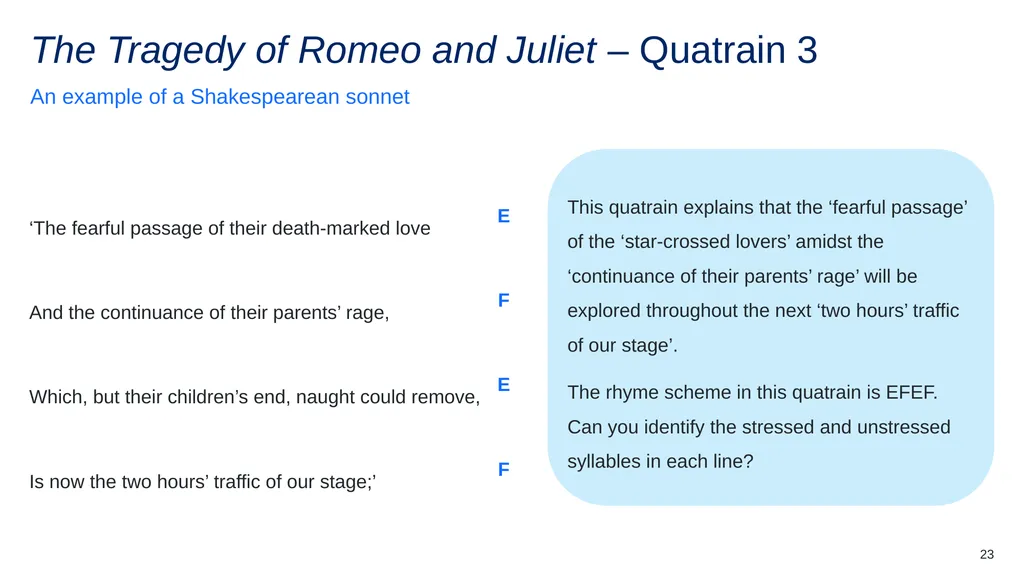
23 This quatrain explains that the ‘fearful passage’ of the ‘star-crossed lovers’ amidst the ‘continuance of their parents’ rage’ will be explored throughout the next ‘two hours’ traffic of our stage’.
The rhyme scheme in this quatrain is EFEF. Can you identify the stressed and unstressed syllables in each line? F Is now the two hours’ traffic of our stage;’ E Which, but their children’s end, naught could remove, F And the continuance of their parents’ rage, E ‘The fearful passage of their death-marked love An example of a Shakespearean sonnet The Tragedy of Romeo and Juliet – Quatrain 3 (1)<br>
The rhyme scheme in this quatrain is EFEF. Can you identify the stressed and unstressed syllables in each line? F Is now the two hours’ traffic of our stage;’ E Which, but their children’s end, naught could remove, F And the continuance of their parents’ rage, E ‘The fearful passage of their death-marked love An example of a Shakespearean sonnet The Tragedy of Romeo and Juliet – Quatrain 3 (1)<br>
24
24 F Is now | the two | hours’ tra- | ffic of | our stage;’ E Which, but | their chil- | dren’s end, | naught could | re- move, F And the | con- tin - | uance of | their pa- | rents’ rage, E ‘The fear- |ful pas- | sage of | their death- | marked love Deconstructed example of a Shakespearean sonnet The Tragedy of Romeo and Juliet – Quatrain 3 (2)<br>
25
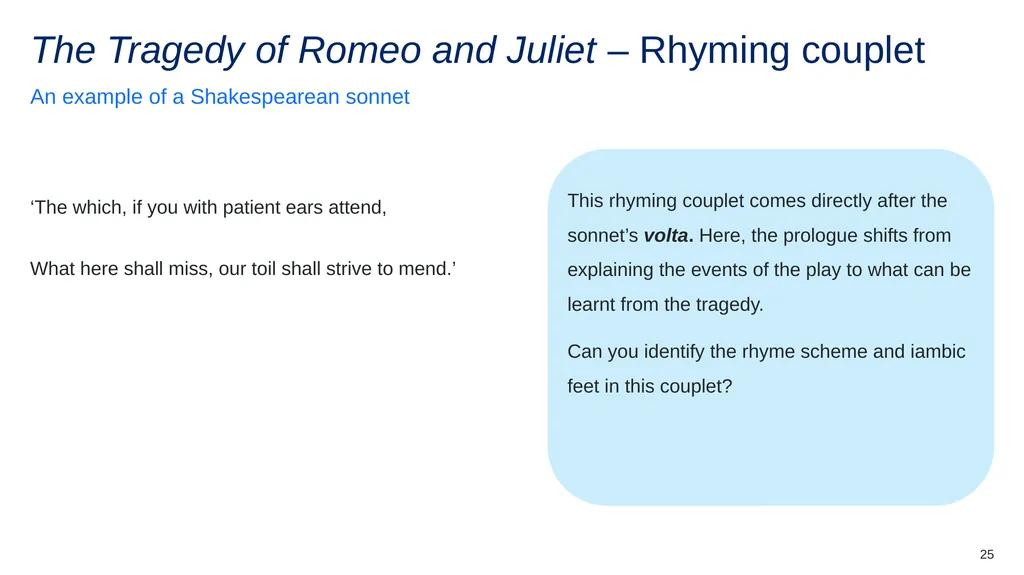
25 This rhyming couplet comes directly after the sonnet’s volta. Here, the prologue shifts from explaining the events of the play to what can be learnt from the tragedy.
Can you identify the rhyme scheme and iambic feet in this couplet? What here shall miss, our toil shall strive to mend.’ ‘The which, if you with patient ears attend, An example of a Shakespearean sonnet The Tragedy of Romeo and Juliet – Rhyming couplet (1)<br>
Can you identify the rhyme scheme and iambic feet in this couplet? What here shall miss, our toil shall strive to mend.’ ‘The which, if you with patient ears attend, An example of a Shakespearean sonnet The Tragedy of Romeo and Juliet – Rhyming couplet (1)<br>
26
26 G What here | shall miss, | our toil | shall strive | to mend.’ G ‘The which, | if you | with pa- | tient ears | at- tend, Deconstructed example of a Shakespearean sonnet The Tragedy of Romeo and Juliet – Rhyming couplet (2)<br>
27
Identifying noun groups NSW Department of Education<br>
28
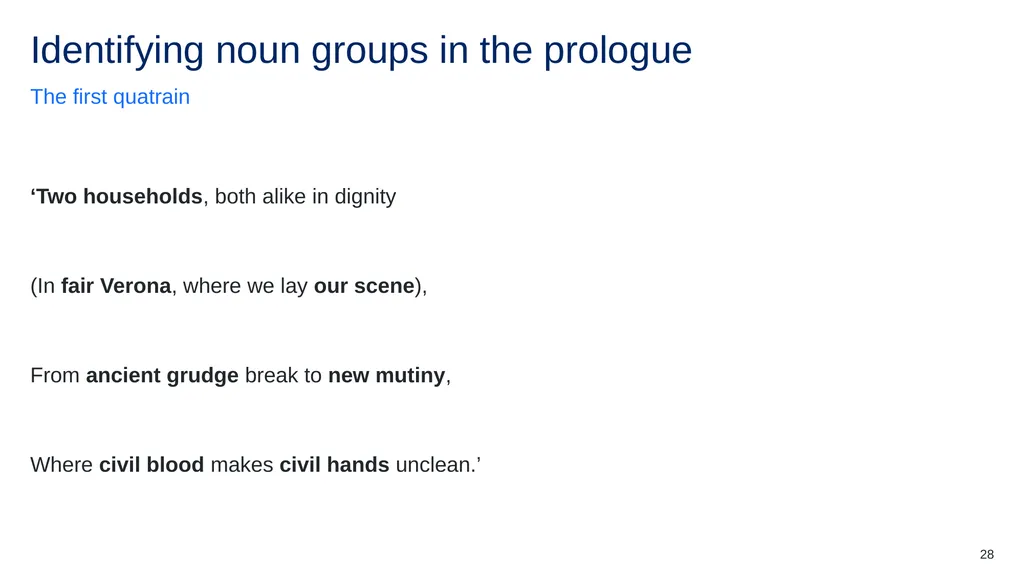
28 ‘Two households, both alike in dignity
(In fair Verona, where we lay our scene),
From ancient grudge break to new mutiny,
Where civil blood makes civil hands unclean.’ The first quatrain Identifying noun groups in the prologue<br>
(In fair Verona, where we lay our scene),
From ancient grudge break to new mutiny,
Where civil blood makes civil hands unclean.’ The first quatrain Identifying noun groups in the prologue<br>
29
‘Translating’ the prologue (1) NSW Department of Education<br>
30
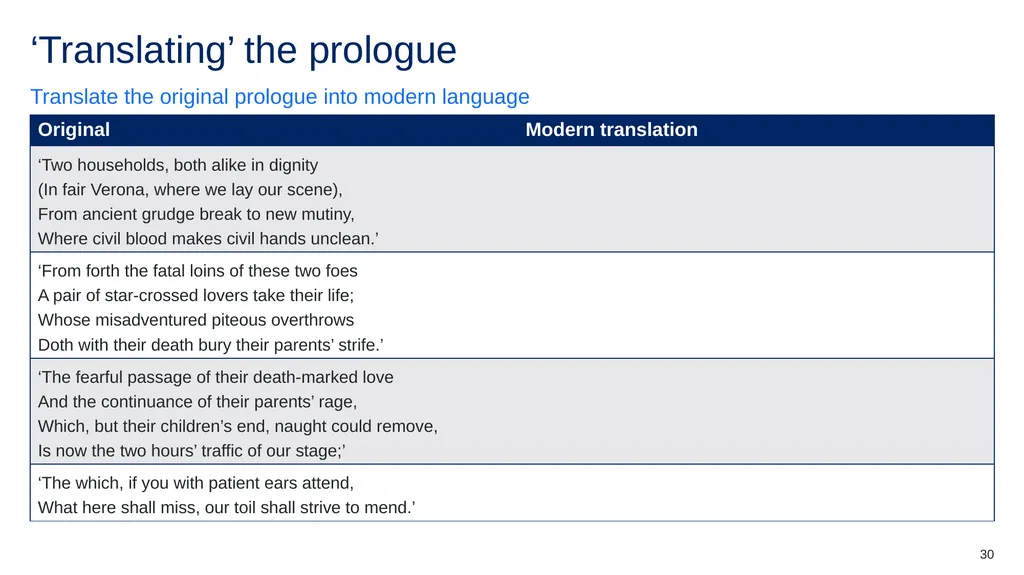
30 Translate the original prologue into modern language ‘Translating’ the prologue (2)<br>
31
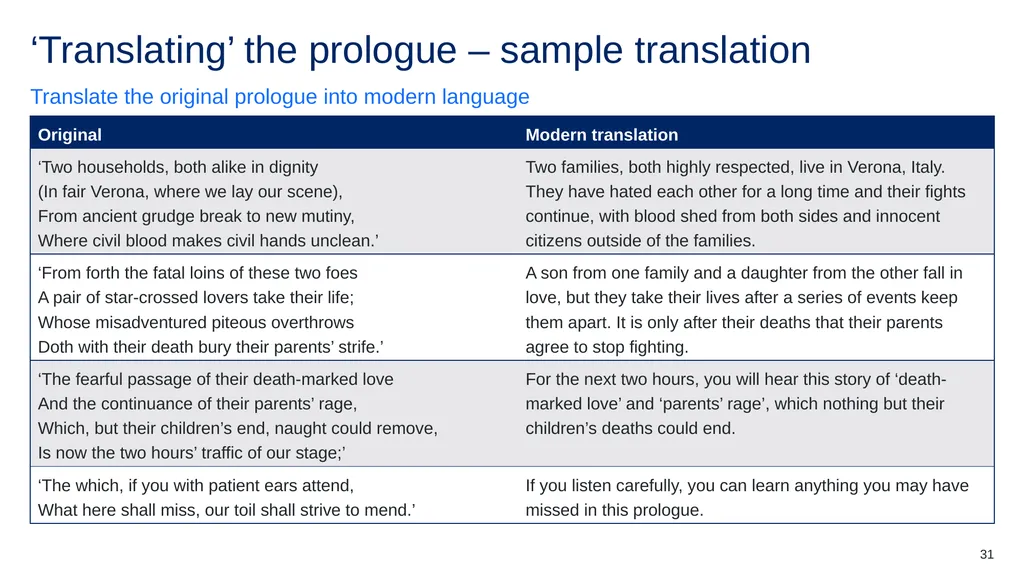
31 Translate the original prologue into modern language ‘Translating’ the prologue – sample translation<br>
32
Writing an emoji prologue (1) NSW Department of Education<br>
33
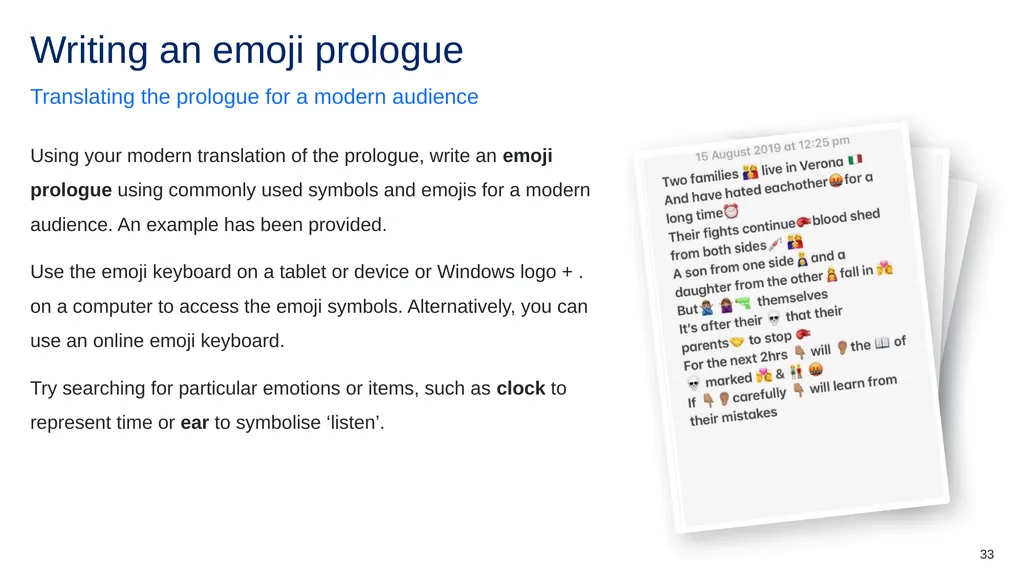
33 Using your modern translation of the prologue, write an emoji prologue using commonly used symbols and emojis for a modern audience. An example has been provided.
Use the emoji keyboard on a tablet or device or Windows logo + . on a computer to access the emoji symbols. Alternatively, you can use an online emoji keyboard.
Try searching for particular emotions or items, such as clock to represent time or ear to symbolise ‘listen’. Translating the prologue for a modern audience Writing an emoji prologue (2)<br>
Use the emoji keyboard on a tablet or device or Windows logo + . on a computer to access the emoji symbols. Alternatively, you can use an online emoji keyboard.
Try searching for particular emotions or items, such as clock to represent time or ear to symbolise ‘listen’. Translating the prologue for a modern audience Writing an emoji prologue (2)<br>
34
Returning to the success criteria NSW Department of Education<br>
35
35 Learning intention
We are learning to:
understand the structure, purpose and features of the prologue of The Tragedy of Romeo and Juliet.
Success criteria
I will know I am successful when I can:
[These could be co-constructed with the class or used as per the notes]. Learning intentions and success criteria (2)<br>
We are learning to:
understand the structure, purpose and features of the prologue of The Tragedy of Romeo and Juliet.
Success criteria
I will know I am successful when I can:
[These could be co-constructed with the class or used as per the notes]. Learning intentions and success criteria (2)<br>
36
36 English K–10 Syllabus © NSW Education Standards Authority (NESA) for and on behalf of the Crown in right of the State of New South Wales, 2022.
Cottier C (2022) ‘Parts of a book’, CC Editing Services website, accessed 20 May 2024.
Koehne-Drube P (19 April 2024) ‘Preface, Introduction, Foreword, and Prologue: What They Are and How To Use Them’, novlr website, accessed 20 May 2024.
Muniz H ‘What Is a Sonnet? The 6 Forms, Explained’, ACT Prep Online Guides and Tips, PrepScholar website, accessed 20 May 2024.
Shakespeare W (n.d.) ‘Romeo and Juliet’, The Folger Shakespeare, Folger Shakespeare Library website, accessed 20 May 2024.
State of New South Wales (Department of Education) (2024) ‘Novel voices – Year 10, Term 1’, English K-12, NSW Department of Education website, accessed 20 May 2024.
State of New South Wales (Department of Education) (2024) ‘Reshaping the world – Year 10, Term 2’, English K-12, NSW Department of Education website, accessed 28 August 2024.
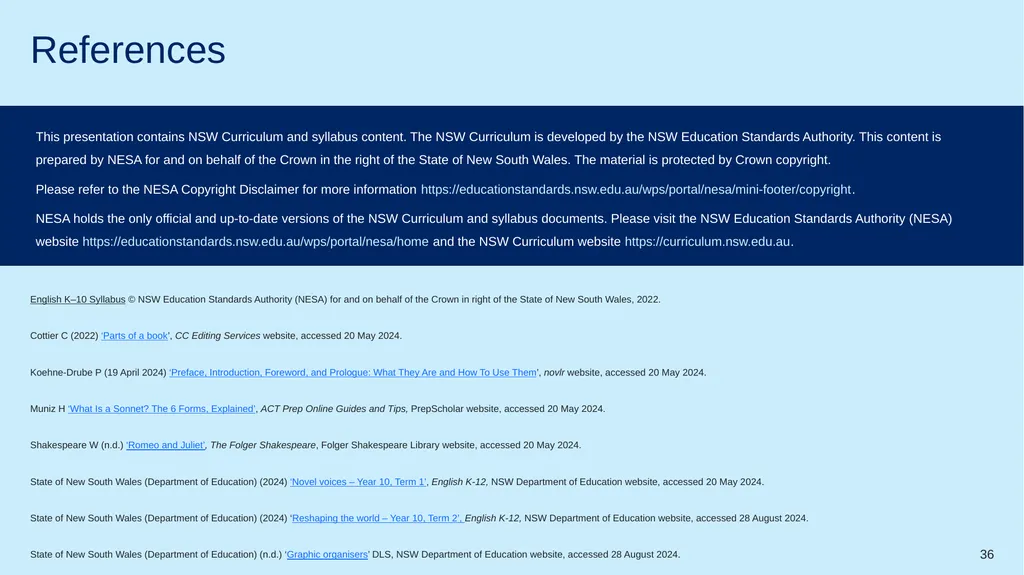
State of New South Wales (Department of Education) (n.d.) ‘Graphic organisers’ DLS, NSW Department of Education website, accessed 28 August 2024. This presentation contains NSW Curriculum and syllabus content. The NSW Curriculum is developed by the NSW Education Standards Authority. This content is prepared by NESA for and on behalf of the Crown in the right of the State of New South Wales. The material is protected by Crown copyright.
Please refer to the NESA Copyright Disclaimer for more information https://educationstandards.nsw.edu.au/wps/portal/nesa/mini-footer/copyright.
NESA holds the only official and up-to-date versions of the NSW Curriculum and syllabus documents. Please visit the NSW Education Standards Authority (NESA) website https://educationstandards.nsw.edu.au/wps/portal/nesa/home and the NSW Curriculum website https://curriculum.nsw.edu.au. References<br>
Cottier C (2022) ‘Parts of a book’, CC Editing Services website, accessed 20 May 2024.
Koehne-Drube P (19 April 2024) ‘Preface, Introduction, Foreword, and Prologue: What They Are and How To Use Them’, novlr website, accessed 20 May 2024.
Muniz H ‘What Is a Sonnet? The 6 Forms, Explained’, ACT Prep Online Guides and Tips, PrepScholar website, accessed 20 May 2024.
Shakespeare W (n.d.) ‘Romeo and Juliet’, The Folger Shakespeare, Folger Shakespeare Library website, accessed 20 May 2024.
State of New South Wales (Department of Education) (2024) ‘Novel voices – Year 10, Term 1’, English K-12, NSW Department of Education website, accessed 20 May 2024.
State of New South Wales (Department of Education) (2024) ‘Reshaping the world – Year 10, Term 2’, English K-12, NSW Department of Education website, accessed 28 August 2024.
State of New South Wales (Department of Education) (n.d.) ‘Graphic organisers’ DLS, NSW Department of Education website, accessed 28 August 2024. This presentation contains NSW Curriculum and syllabus content. The NSW Curriculum is developed by the NSW Education Standards Authority. This content is prepared by NESA for and on behalf of the Crown in the right of the State of New South Wales. The material is protected by Crown copyright.
Please refer to the NESA Copyright Disclaimer for more information https://educationstandards.nsw.edu.au/wps/portal/nesa/mini-footer/copyright.
NESA holds the only official and up-to-date versions of the NSW Curriculum and syllabus documents. Please visit the NSW Education Standards Authority (NESA) website https://educationstandards.nsw.edu.au/wps/portal/nesa/home and the NSW Curriculum website https://curriculum.nsw.edu.au. References<br>
37
The copyright material published in this resource is subject to the Copyright Act 1968 (Cth) and is owned by the NSW Department of Education or, where indicated, by a party other than the NSW Department of Education (third-party material).
Copyright material available in this resource and owned by the NSW Department of Education is licensed under a Creative Commons Attribution 4.0 International (CC BY 4.0) license.
This license allows you to share and adapt the material for any purpose, even commercially.
Attribution should be given to © State of New South Wales (Department of Education), 2024.
Material in this resource not available under a Creative Commons license:
the NSW Department of Education logo, other logos and trademark-protected material
Material owned by a third party that has been reproduced with permission. You will need to obtain permission from the third party to reuse its material.
Links to third-party material and websites
Please note that the provided (reading/viewing material/list/links/texts) are a suggestion only and implies no endorsement, by the New South Wales Department of Education, of any author, publisher, or book title. School principals and teachers are best placed to assess the suitability of resources that would complement the curriculum and reflect the needs and interests of their students.
If you use the links provided in this document to access a third-party’s website, you acknowledge that the terms of use, including licence terms set out on the third-party’s website apply to the use which may be made of the materials on that third-party website or where permitted by the Copyright Act 1968 (Cth). The department accepts no responsibility for content on third-party websites. © State of New South Wales (Department of Education), 2024 Copyright<br>
Copyright material available in this resource and owned by the NSW Department of Education is licensed under a Creative Commons Attribution 4.0 International (CC BY 4.0) license.
This license allows you to share and adapt the material for any purpose, even commercially.
Attribution should be given to © State of New South Wales (Department of Education), 2024.
Material in this resource not available under a Creative Commons license:
the NSW Department of Education logo, other logos and trademark-protected material
Material owned by a third party that has been reproduced with permission. You will need to obtain permission from the third party to reuse its material.
Links to third-party material and websites
Please note that the provided (reading/viewing material/list/links/texts) are a suggestion only and implies no endorsement, by the New South Wales Department of Education, of any author, publisher, or book title. School principals and teachers are best placed to assess the suitability of resources that would complement the curriculum and reflect the needs and interests of their students.
If you use the links provided in this document to access a third-party’s website, you acknowledge that the terms of use, including licence terms set out on the third-party’s website apply to the use which may be made of the materials on that third-party website or where permitted by the Copyright Act 1968 (Cth). The department accepts no responsibility for content on third-party websites. © State of New South Wales (Department of Education), 2024 Copyright<br>