Intellectual Property and Copyright POLICY PRINCIPLES ACTIVITY Intellectual property (IP) is a term used to cover a range of legal rights that protect creations of the mind and creative effort. Copyright is the form of IP most commonly
"Intellectual Property and Copyright POLICY" is the property of its rightful owner. Permission is granted to
download and print the materials on this website for personal, non-commercial use only, and to display it
on your personal computer provided you do not modify the materials and that you retain all copyright
notices contained in the materials. By downloading content from our website, you accept the terms of this
agreement.
Presentation Transcript
01
Intellectual Property and Copyright
POLICY PRINCIPLES ACTIVITY<br>
02
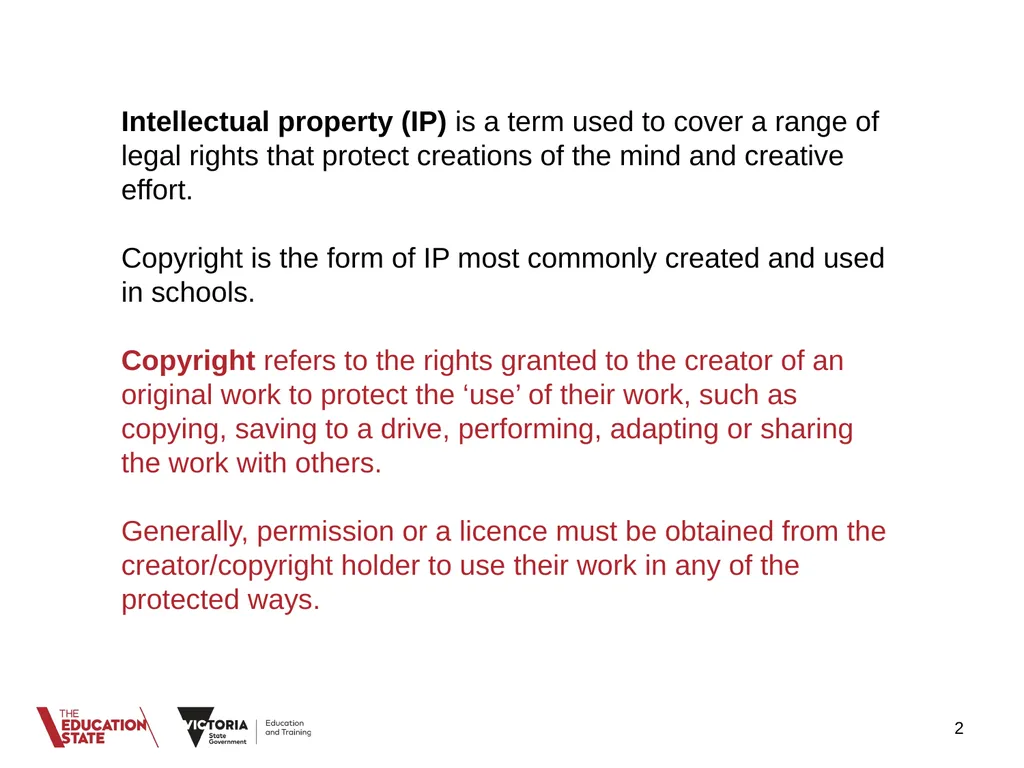
Intellectual property (IP) is a term used to cover a range of legal rights that protect creations of the mind and creative effort.
Copyright is the form of IP most commonly created and used in schools.
Copyright refers to the rights granted to the creator of an original work to protect the ‘use’ of their work, such as copying, saving to a drive, performing, adapting or sharing the work with others.
Generally, permission or a licence must be obtained from the creator/copyright holder to use their work in any of the protected ways.<br>
03
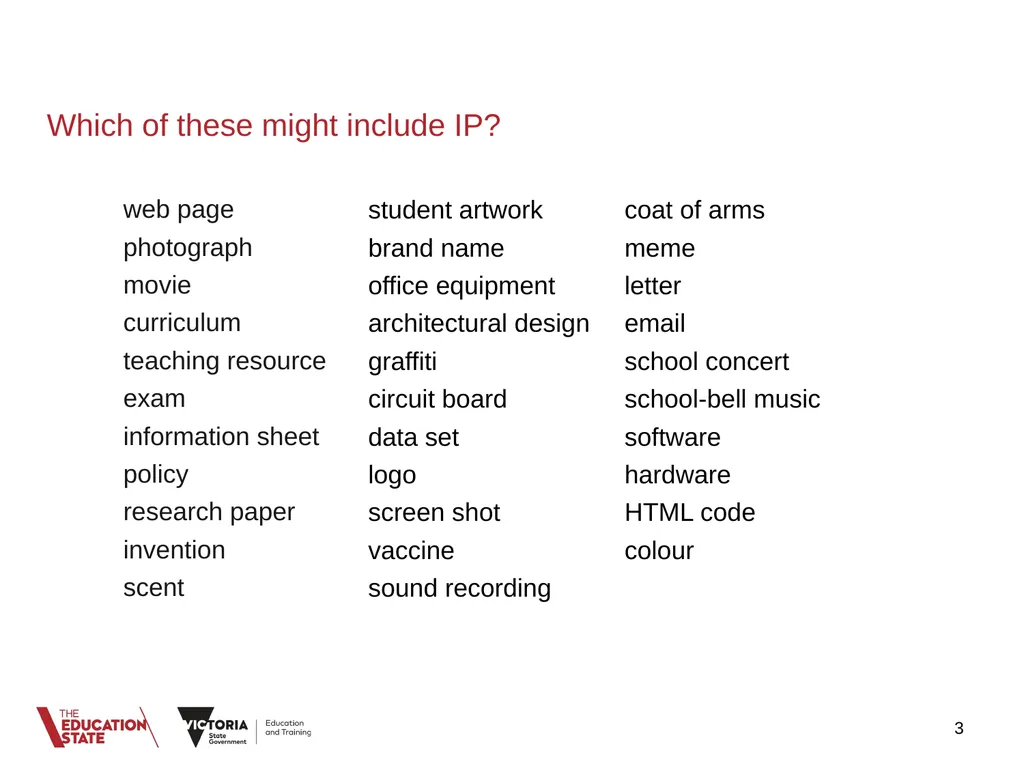
Which of these might include IP? web page
photograph
movie
curriculum
teaching resource
exam
information sheet
policy
research paper
invention
scent coat of arms
meme
letter
email
school concert
school-bell music
software
hardware
HTML code
colour student artwork
brand name
office equipment
architectural design
graffiti
circuit board
data set
logo
screen shot
vaccine
sound recording<br>
04
Schools are obliged to manage and use IP, including copyright, in line with the Department’s Intellectual Property and Copyright Policy and the law.
Use the policy’s seven principles to guide your management and use of IP and copyright.<br>
05
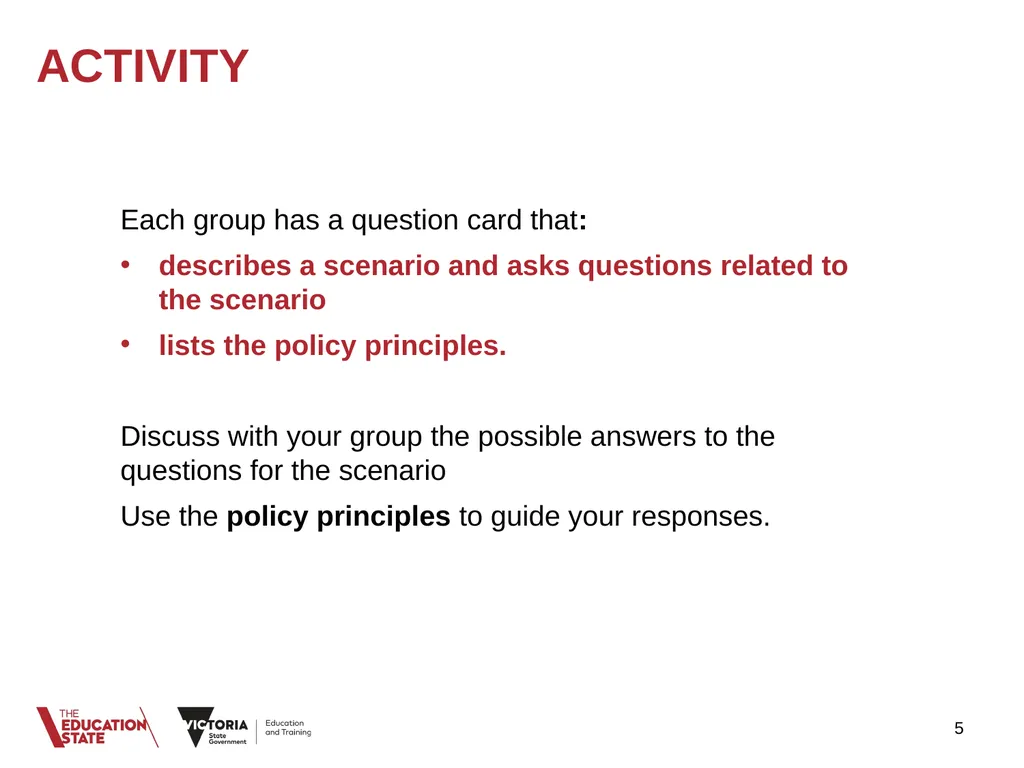
ACTIVITY Each group has a question card that:
describes a scenario and asks questions related to the scenario
lists the policy principles.
Discuss with your group the possible answers to the questions for the scenario
Use the policy principles to guide your responses.<br>
06
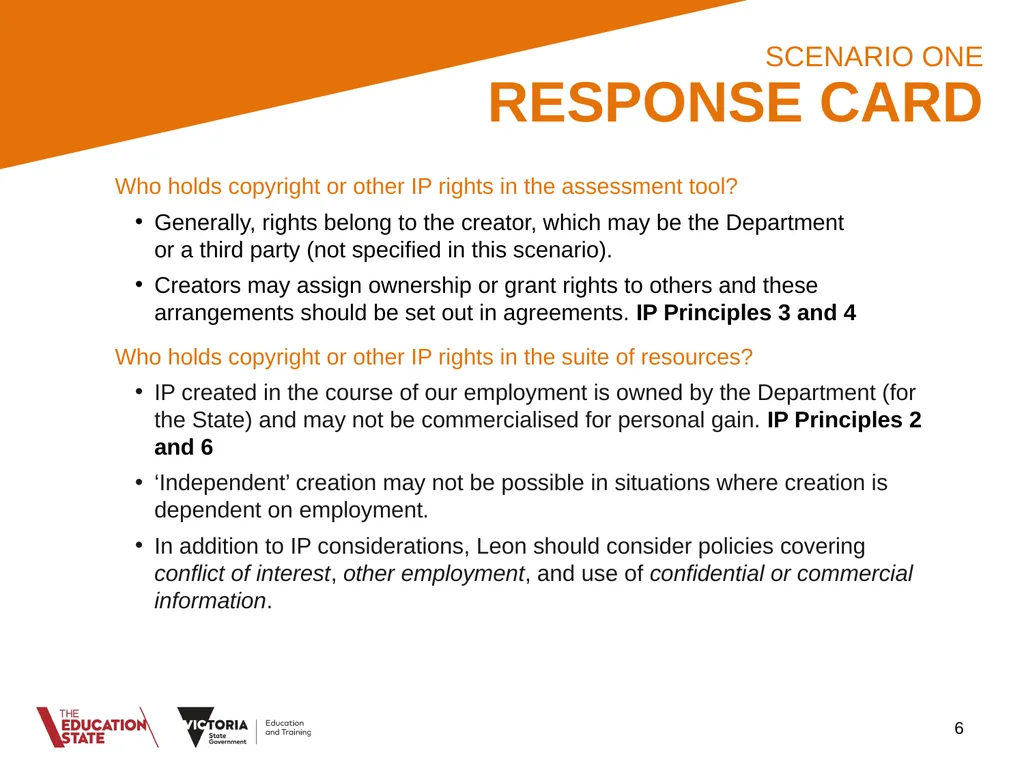
SCENARIO ONE RESPONSE CARD Who holds copyright or other IP rights in the assessment tool?
Generally, rights belong to the creator, which may be the Department or a third party (not specified in this scenario).
Creators may assign ownership or grant rights to others and these arrangements should be set out in agreements. IP Principles 3 and 4
Who holds copyright or other IP rights in the suite of resources?
IP created in the course of our employment is owned by the Department (for the State) and may not be commercialised for personal gain. IP Principles 2 and 6
‘Independent’ creation may not be possible in situations where creation is dependent on employment.
In addition to IP considerations, Leon should consider policies covering conflict of interest, other employment, and use of confidential or commercial information.<br>
07
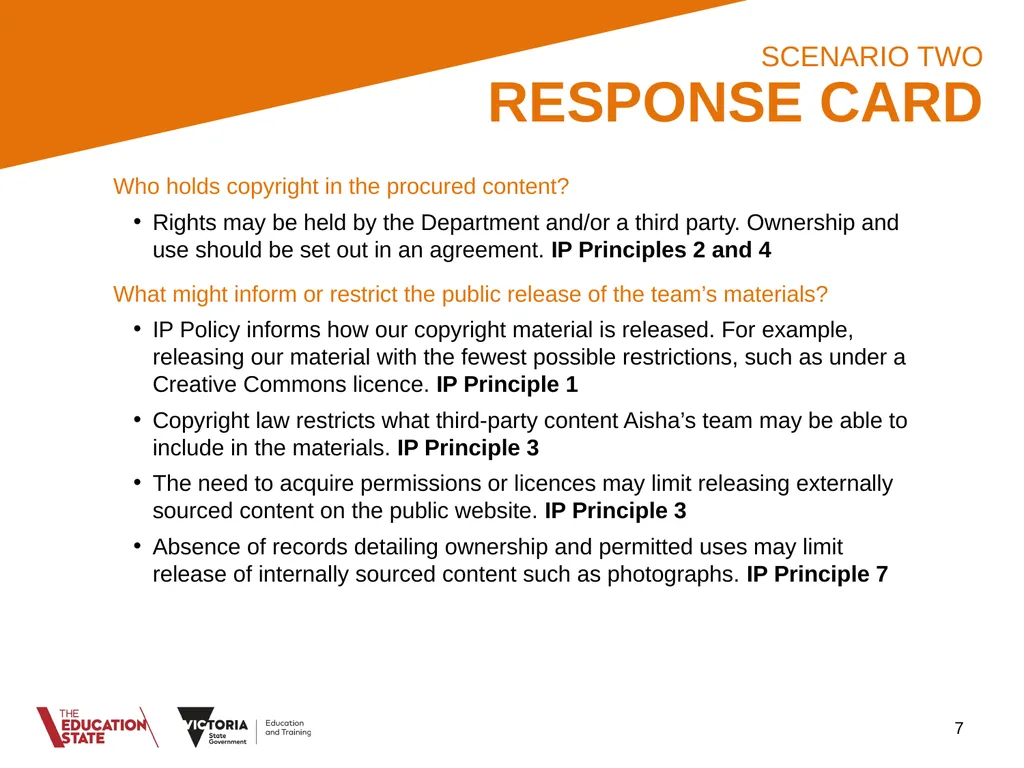
SCENARIO TWO RESPONSE CARD Who holds copyright in the procured content?
Rights may be held by the Department and/or a third party. Ownership and use should be set out in an agreement. IP Principles 2 and 4
What might inform or restrict the public release of the team’s materials?
IP Policy informs how our copyright material is released. For example, releasing our material with the fewest possible restrictions, such as under a Creative Commons licence. IP Principle 1
Copyright law restricts what third-party content Aisha’s team may be able to include in the materials. IP Principle 3
The need to acquire permissions or licences may limit releasing externally sourced content on the public website. IP Principle 3
Absence of records detailing ownership and permitted uses may limit release of internally sourced content such as photographs. IP Principle 7<br>
08
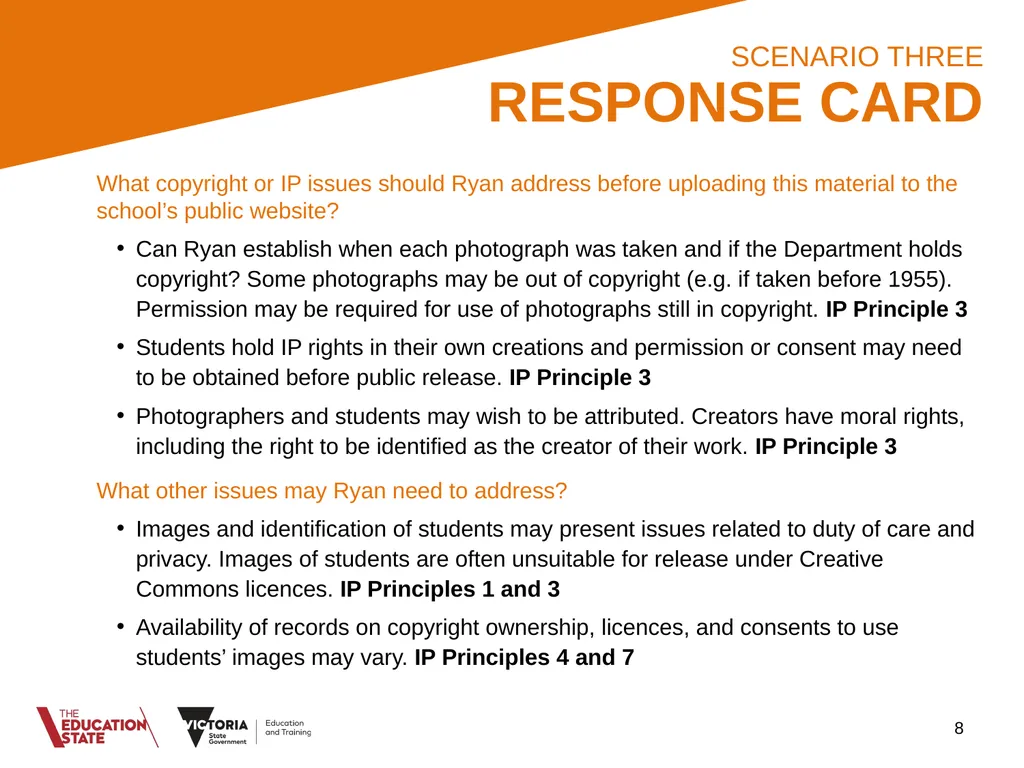
SCENARIO THREE RESPONSE CARD What copyright or IP issues should Ryan address before uploading this material to the school’s public website?
Can Ryan establish when each photograph was taken and if the Department holds copyright? Some photographs may be out of copyright (e.g. if taken before 1955). Permission may be required for use of photographs still in copyright. IP Principle 3
Students hold IP rights in their own creations and permission or consent may need to be obtained before public release. IP Principle 3
Photographers and students may wish to be attributed. Creators have moral rights, including the right to be identified as the creator of their work. IP Principle 3
What other issues may Ryan need to address?
Images and identification of students may present issues related to duty of care and privacy. Images of students are often unsuitable for release under Creative Commons licences. IP Principles 1 and 3
Availability of records on copyright ownership, licences, and consents to use students’ images may vary. IP Principles 4 and 7<br>
09
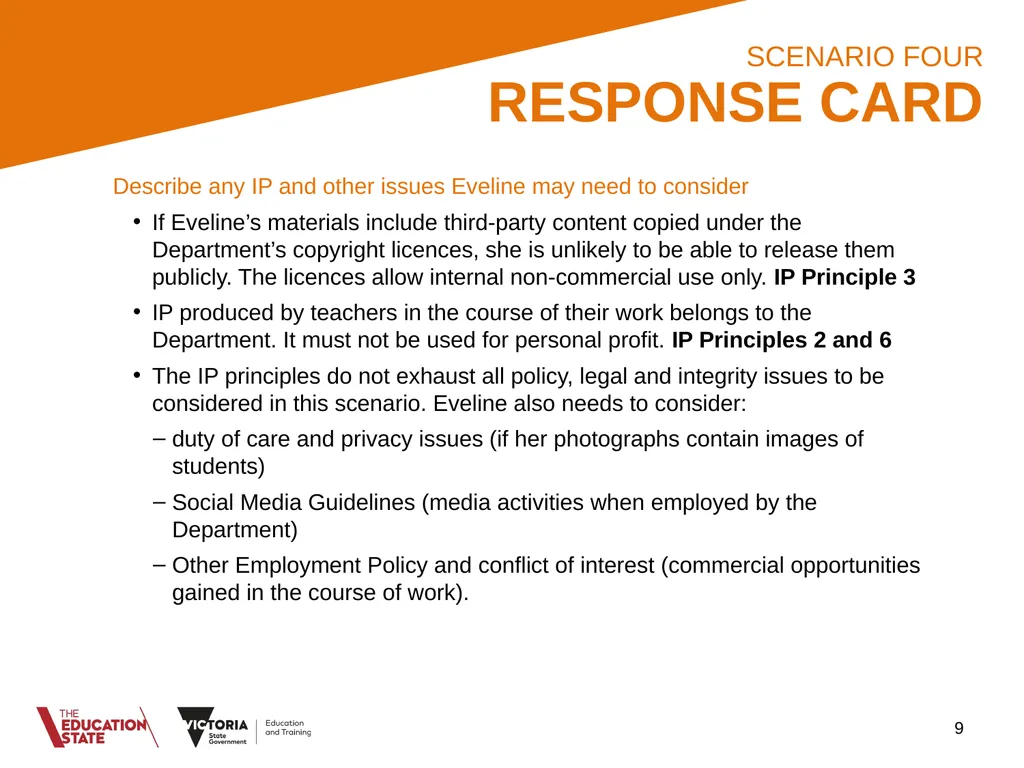
SCENARIO FOUR RESPONSE CARD Describe any IP and other issues Eveline may need to consider
If Eveline’s materials include third-party content copied under the Department’s copyright licences, she is unlikely to be able to release them publicly. The licences allow internal non-commercial use only. IP Principle 3
IP produced by teachers in the course of their work belongs to the Department. It must not be used for personal profit. IP Principles 2 and 6
The IP principles do not exhaust all policy, legal and integrity issues to be considered in this scenario. Eveline also needs to consider:
duty of care and privacy issues (if her photographs contain images of students)
Social Media Guidelines (media activities when employed by the Department)
Other Employment Policy and conflict of interest (commercial opportunities gained in the course of work).<br>
10
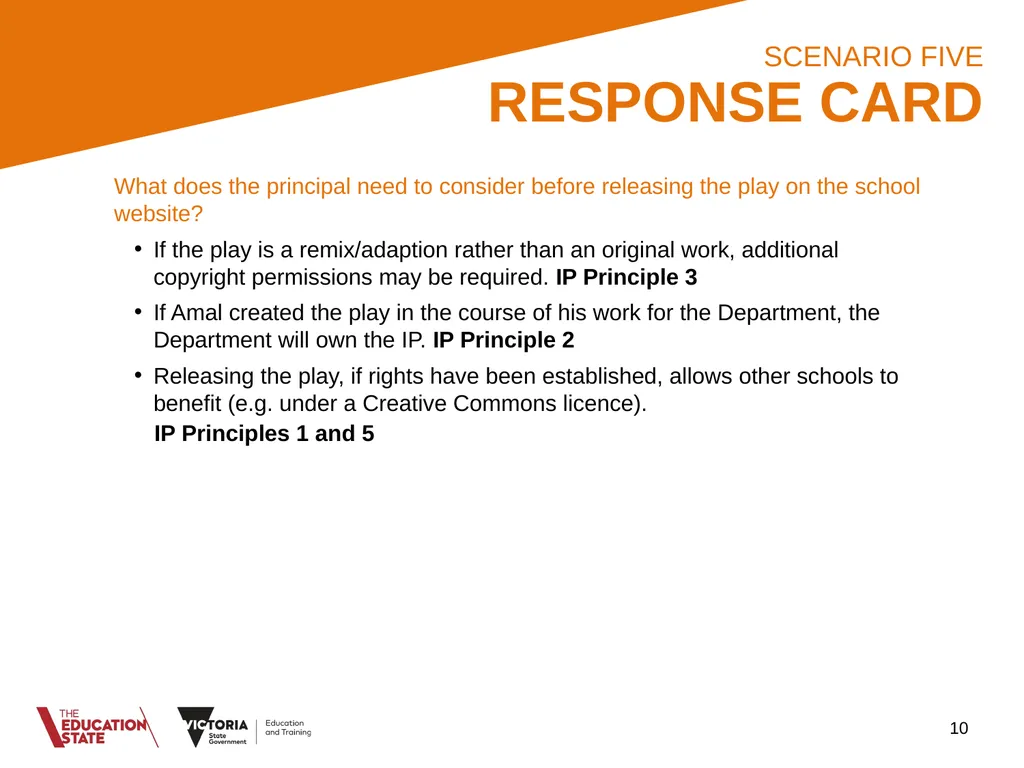
SCENARIO FIVE RESPONSE CARD What does the principal need to consider before releasing the play on the school website?
If the play is a remix/adaption rather than an original work, additional copyright permissions may be required. IP Principle 3
If Amal created the play in the course of his work for the Department, the Department will own the IP. IP Principle 2
Releasing the play, if rights have been established, allows other schools to benefit (e.g. under a Creative Commons licence).
IP Principles 1 and 5<br>
11
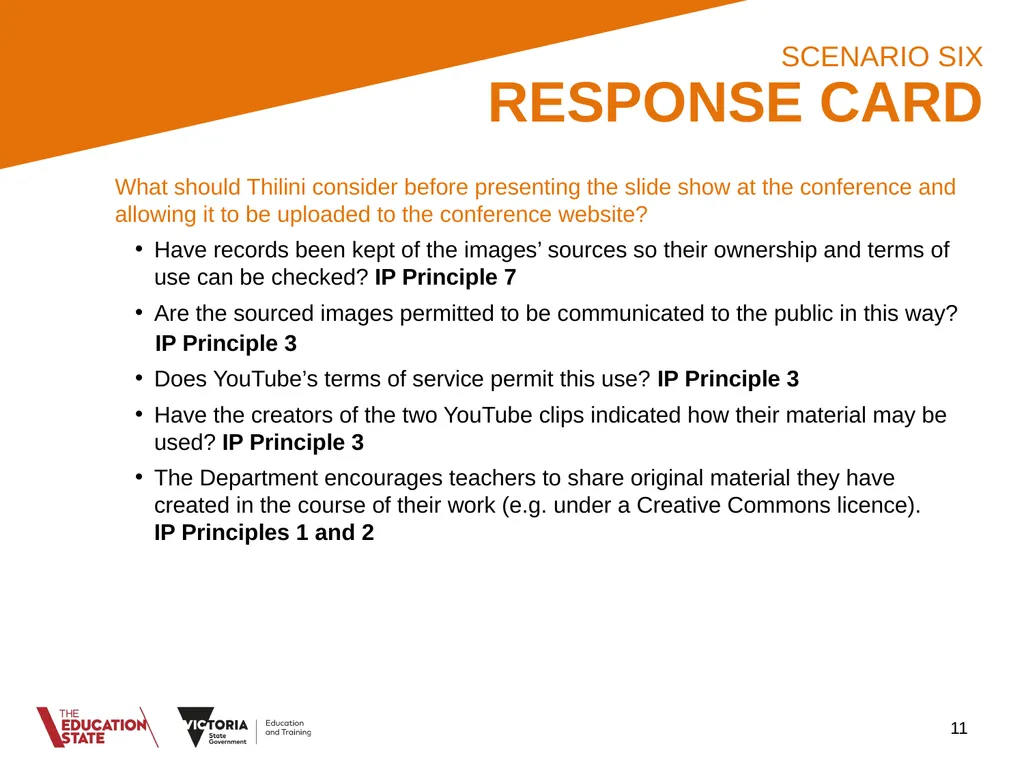
SCENARIO SIX RESPONSE CARD What should Thilini consider before presenting the slide show at the conference and allowing it to be uploaded to the conference website?
Have records been kept of the images’ sources so their ownership and terms of use can be checked? IP Principle 7
Are the sourced images permitted to be communicated to the public in this way?
IP Principle 3
Does YouTube’s terms of service permit this use? IP Principle 3
Have the creators of the two YouTube clips indicated how their material may be used? IP Principle 3
The Department encourages teachers to share original material they have created in the course of their work (e.g. under a Creative Commons licence). IP Principles 1 and 2<br>
12
Where to find help The Conversation Cards and links to related policies and guidelines referenced in the activity can be found on the schools’ Intellectual Property and Copyright Policy page.
Please contact the copyright team with any questions:
Cate Mills Sharon Stewart
7022 0507 9084 8615
email: copyright@edumail.vic.gov.au<br>
IP Policy Principles Activity is provided under a Creative Commons Attribution 4.0 International licence. You are free to re-use the work under that licence, on the condition that you credit the State of Victoria (Department of Education and Training), indicate if changes were made and comply with the other licence terms, see: Creative Commons Attribution 4.0 International (http://creativecommons.org/licenses/by/4.0/)
The licence does not apply to: • any images, photographs, trademarks or branding, including the Victorian Government logo and the DET logo; and • content supplied by third parties.
Copyright queries may be directed to copyright@edumail.vic.gov.au<br>