INTELLIGENCE BY-KAVITA SRIVASTAVA Mob No. 7292979906 Email Id ks1132467gmail.com DEFINATION OF INTELLIGENCE Intelligence the dictionary says, the capacity to acquire and apply knowledge. A number of definitions have been evolved by
"INTELLIGENCE BY-KAVITA SRIVASTAVA Mob No. –" is the property of its rightful owner. Permission is granted to
download and print the materials on this website for personal, non-commercial use only, and to display it
on your personal computer provided you do not modify the materials and that you retain all copyright
notices contained in the materials. By downloading content from our website, you accept the terms of this
agreement.
Intelligence the dictionary says, “ the capacity to acquire and apply knowledge.” A number of definitions have been evolved by psychologists according to their own concept of the term intelligence.
“ Intelligence is the aggregate or global capacity of the individual to act purposefully, to think rationally and to deal effectively with his environment." - D. Weschler, 1958<br>
03
Freeman’s Classification
Freeman classified all definitions of intelligence into three categories :
Adjustment or adaptation ability: the definitions of this category lay emphasis on
the adjustment ability of an individual to his environment.
Ability to learn : the definitions of this category emphasize the importance of an
individual’s ability to learn.
Ability to carry on abstract thinking : this category of definitions lays more
emphasis on the effective use of concepts and symbols in dealing with situations.<br>
04
Types of intelligence
Concrete intelligence:
Concrete intelligence means intelligence in relation to concrete materials. It is the ability of an
individual to comprehend actual situations and react to them adequately. This kind of intelligence
is measured by performance tests in which the individual has to manipulate concrete materials.
(b) Abstract intelligence :
Abstract intelligence is the ability to respond to words, numbers and letters, etc. The highest level of
abstract intelligence is manifested in the thought of philosophers and in the use of mathematical
formula.
(C) Social intelligence :
Social intelligence means ability of an individual to react to social situations of daily life. High social
intelligence is possessed by those who are able to handle people well. Adequate adjustment in social
situations is the index of social intelligence.<br>
05
Measuring Intelligence Binet had divided development of intelligence testing into three distinctive periods :
Pre-Binet Period
Binet Period
Post-Binet Period<br>
06
1. PRE-BINET PERIOD The first experimentation on individual differences arose among astronomers in 1776
in the observatory of Greenwich. In the 19th century, good deal of interest in the field
psycho-physics.
Sir Francis galton(1822-1911) was the first psychologist who devoted his time to study
whether individual characteristics are inherited.
The first laboratory of experimental psychology was established by Wundt in 1879, in
Leipzig. He mainly employed physiological method and introspection as the major
technique to study vision, hearing, reaction –time and psychophysical problems.<br>
07
Weakness of Pre-Binet Period Failed to identify the nature of intelligence.
Complex functions were not measurable.
Test were too simple and limited to measure intelligence
Fine mental abilities were not measured physical sensory tests.<br>
08
2. BINET PERIOD The first scale was produced by Binet and Simon in 1905. The 1905 scale consisted of thirty items arranged in order of increasing difficulty. Some items of this scale are –
Visual co-ordination.
Recognition of food.
Naming of objects designated in a picture.
Definition of familiar objects.<br>
09
The 1908 Binet-Simon Scale The items have been grouped at the appropriate age levels from 3 to 13years.
Age 3 years
Points to nose, eyes and mouth
Repeats two digits 3,5.
Age 8 years
Reads a passage and remembers two items
Adds up the value of five coins<br>
10
The 1911 Revision of the Binet Scale Binet incorporated the suggestions in the revised scale of 1911. he died the same year
Age of 6 years
Distinguishes between morning and afternoon.
Defines names of familiar objects in terms of their use.
Age 8 years
Gives differences between two objects.
Counts backward from 20 to 0.
Age 10 years
Arrange five blocks in order of weight.
Reproduces two geometric designs from memory<br>
11
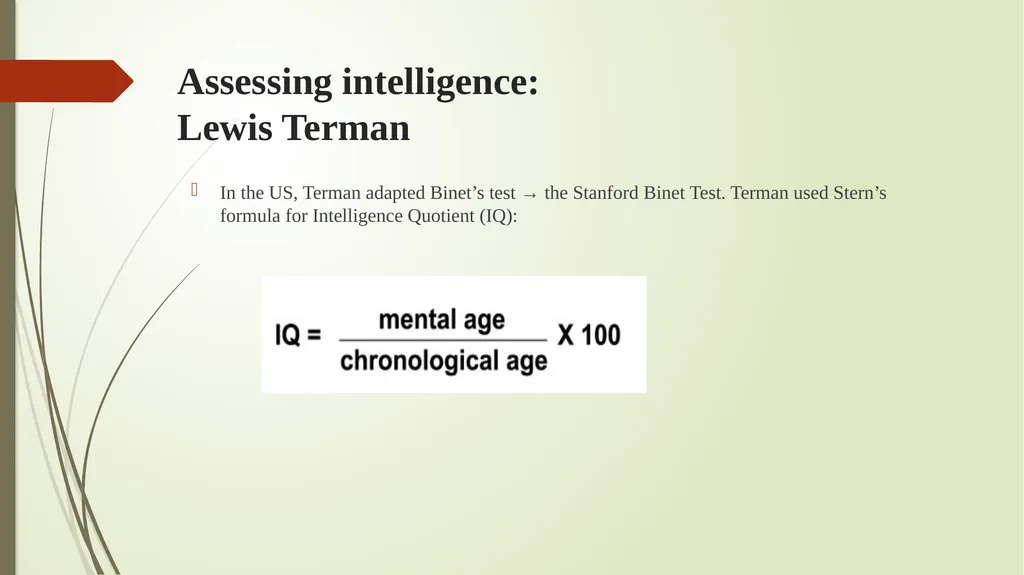
Assessing intelligence: Lewis Terman In the US, Terman adapted Binet’s test → the Stanford Binet Test. Terman used Stern’s formula for Intelligence Quotient (IQ):<br>
12
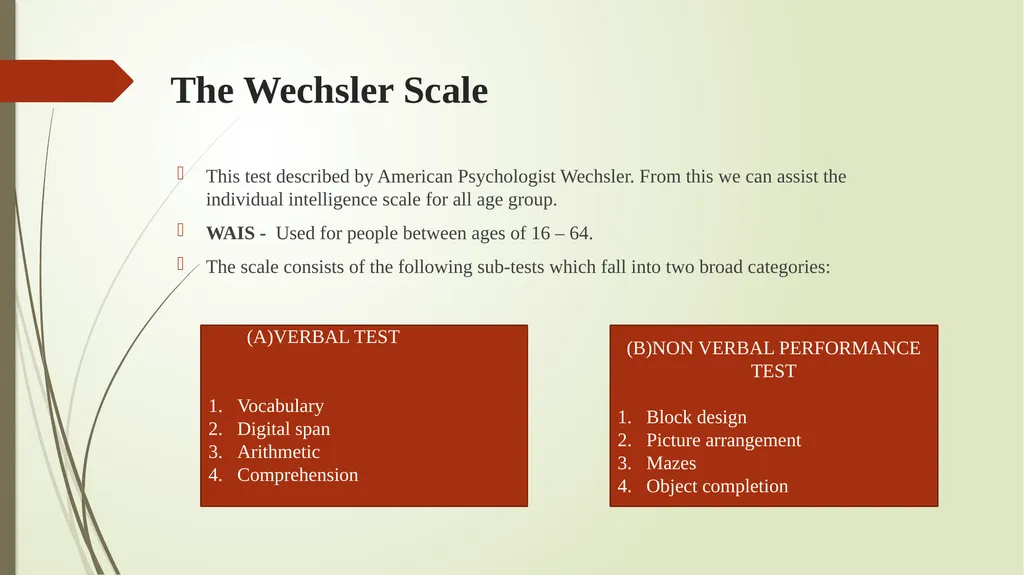
The Wechsler Scale This test described by American Psychologist Wechsler. From this we can assist the individual intelligence scale for all age group.
WAIS - Used for people between ages of 16 – 64.
The scale consists of the following sub-tests which fall into two broad categories: (A)VERBAL TEST
Vocabulary
Digital span
Arithmetic
Comprehension (B)NON VERBAL PERFORMANCE TEST
A group test is one that can be given to a number of subjects at the same time by a single examiner
The Army Alpha and Army Beta were developed in a shot period. Army Alpha is verbal group test of intelligence and is meant for literate persons. Army Beta is a non-verbal group test of intelligence and is meant for illiterate persons.
The Cattell Culture Free Test
Some psychologists attempted to develop group scales which may not be influenced by verbal material and form or acquired skills and experiences in the environment of different cultures.<br>
14
PERFORMANCE TESTS OF INTELLIGEENCE
A performance test is one in which the subject has to perform something or to manipulate some concrete material without much use of the language ability.
Deaf and dumb
Illiterates
Shy and withdrawn children
Educationally deficient
Foreign children
Some performance tests
For study of mental growth
For homogeneous grouping
Use in research<br>
15
Limitation of Intelligence Test The appraisal of intelligence is limited by the fact that it cannot be measured directly.
Intelligence tests sample intellectual capabilities that relate to classroom achievement better than they relate to anything else.
Intelligence test scores can be improved with systematic instruction.
Anything that enhances classroom performance will likely have a positive effect on intelligence test performance.<br>
16
Misconception regarding Use of Intelligence Test in Education The Misconception is related to the notion that intelligence tests measure something called ‘native ability,’ something fixed and immutable within the individual that determine his level of expectation for all time, but intelligence tests do not measure such entity, at least not directly. Intelligence tests measure the individual’s performance on certain type of mental tasks.<br>