
Intensive and extensive reading Paper—6-i Unit-ii

Description: Intensive and extensive reading Paper6-i Unit-ii Intensive reading Intensive reading involves the learners working through a relevantly short passage under the guidance of the teacher and examining it closely and it detail. The main aims
Related Topics
Download Presentation
"Intensive and extensive reading Paper—6-i Unit-ii" is the property of its rightful owner. Permission is granted to download and print the materials on this website for personal, non-commercial use only, and to display it on your personal computer provided you do not modify the materials and that you retain all copyright notices contained in the materials. By downloading content from our website, you accept the terms of this agreement.
Presentation Transcript
slide1. Intensive and extensive reading Paper—6-i
Unit-ii<br>
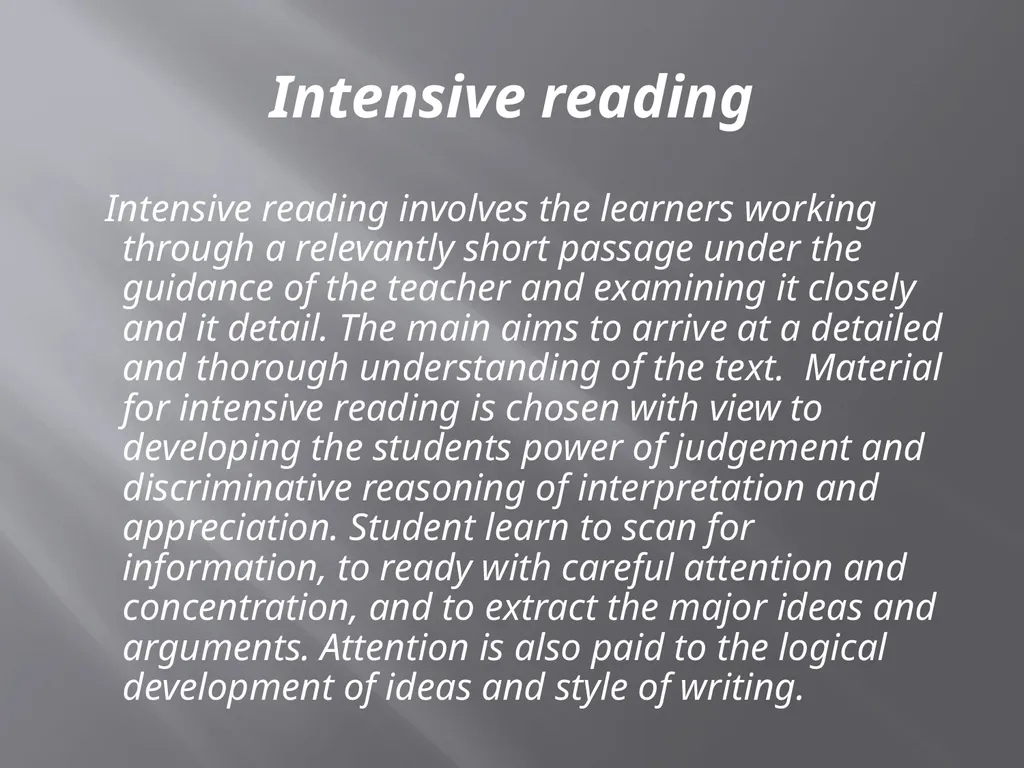
slide2. Intensive reading Intensive reading involves the learners working through a relevantly short passage under the guidance of the teacher and examining it closely and it detail. The main aims to arrive at a detailed and thorough understanding of the text. Material for intensive reading is chosen with view to developing the students power of judgement and discriminative reasoning of interpretation and appreciation. Student learn to scan for information, to ready with careful attention and concentration, and to extract the major ideas and arguments. Attention is also paid to the logical development of ideas and style of writing.<br>
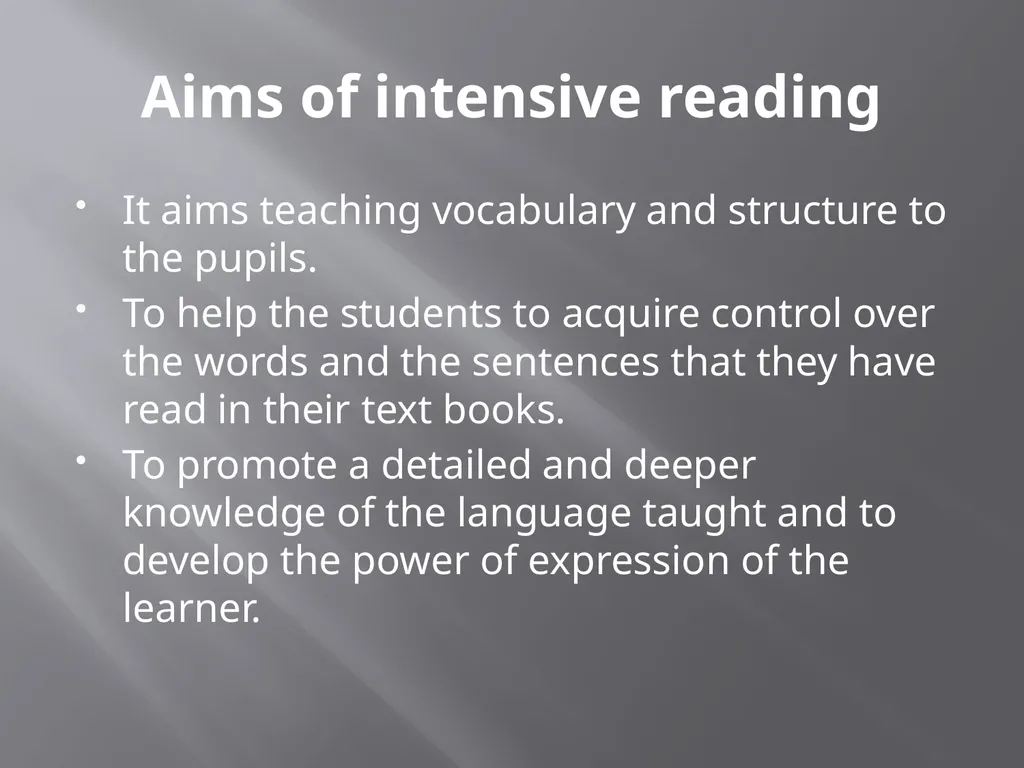
slide3. Aims of intensive reading It aims teaching vocabulary and structure to the pupils.
To help the students to acquire control over the words and the sentences that they have read in their text books.
To promote a detailed and deeper knowledge of the language taught and to develop the power of expression of the learner.<br>
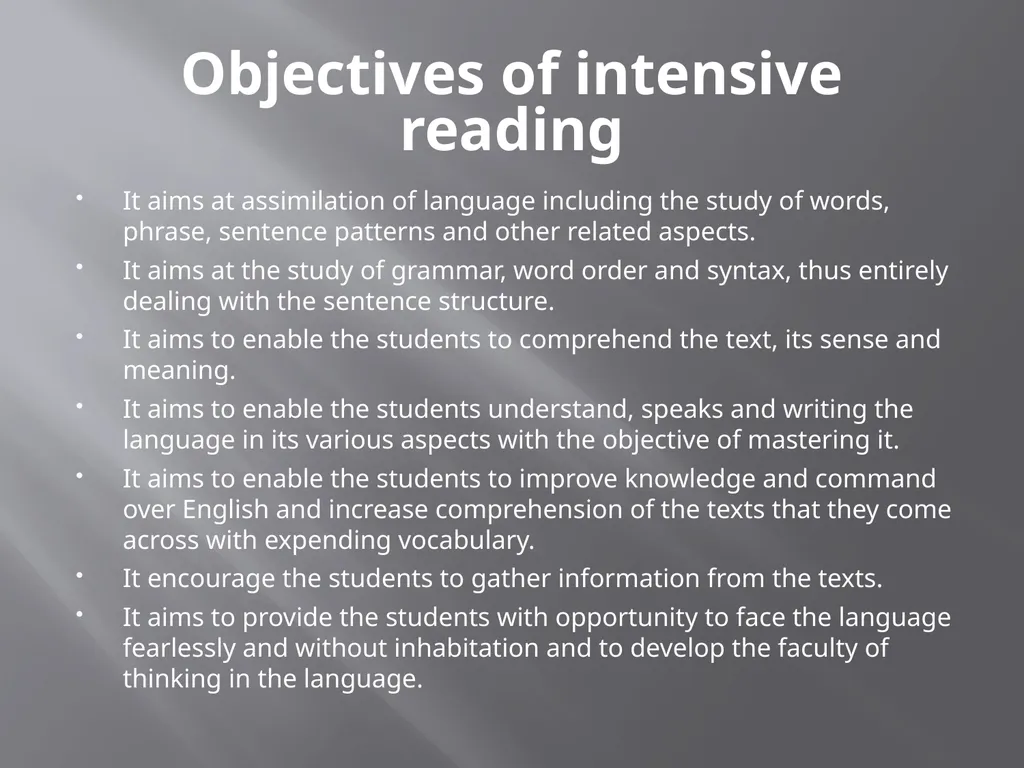
slide4. Objectives of intensive reading It aims at assimilation of language including the study of words, phrase, sentence patterns and other related aspects.
It aims at the study of grammar, word order and syntax, thus entirely dealing with the sentence structure.
It aims to enable the students to comprehend the text, its sense and meaning.
It aims to enable the students understand, speaks and writing the language in its various aspects with the objective of mastering it.
It aims to enable the students to improve knowledge and command over English and increase comprehension of the texts that they come across with expending vocabulary.
It encourage the students to gather information from the texts.
It aims to provide the students with opportunity to face the language fearlessly and without inhabitation and to develop the faculty of thinking in the language.<br>
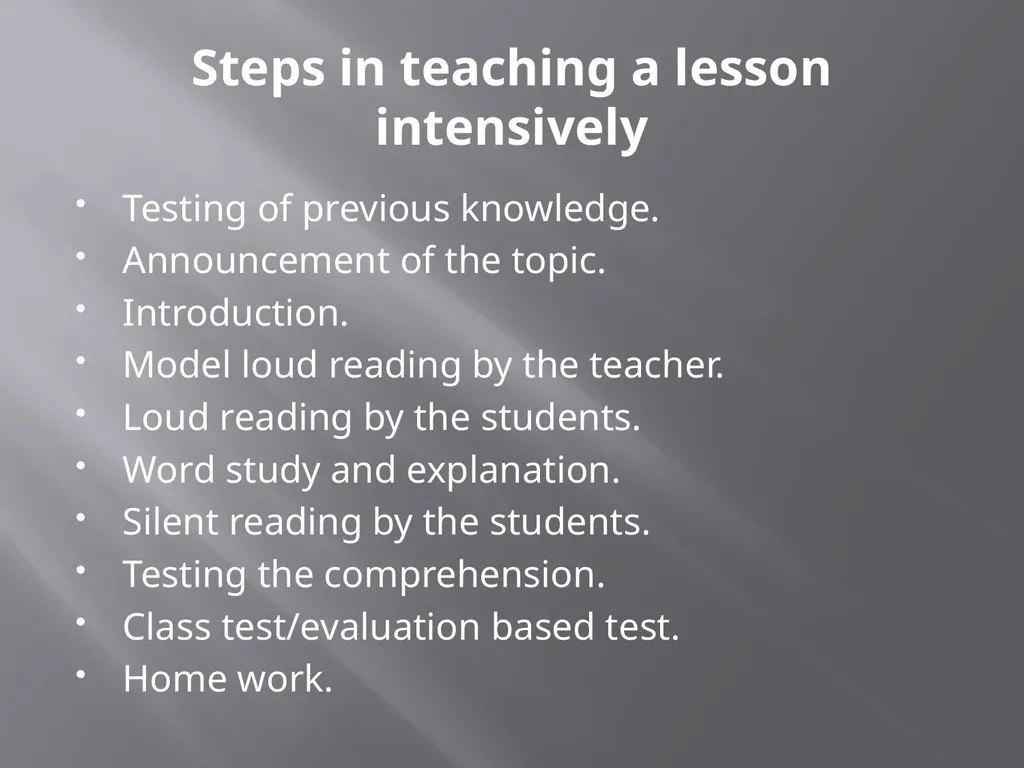
slide5. Steps in teaching a lesson intensively Testing of previous knowledge.
Announcement of the topic.
Introduction.
Model loud reading by the teacher.
Loud reading by the students.
Word study and explanation.
Silent reading by the students.
Testing the comprehension.
Class test/evaluation based test.
Home work.<br>
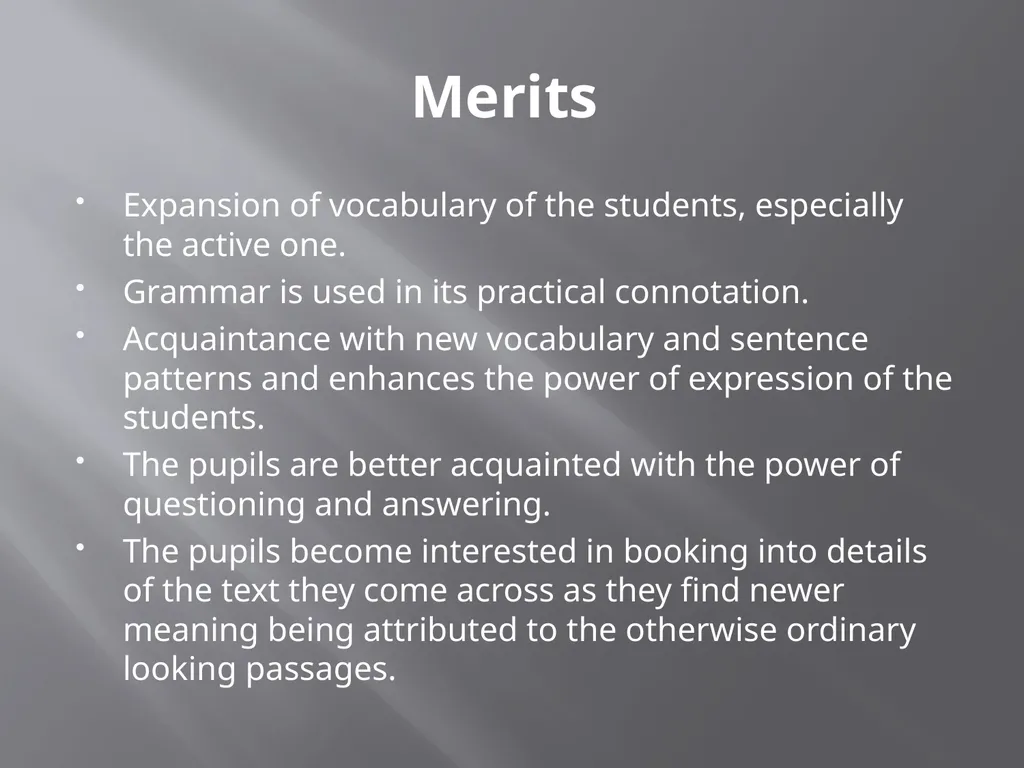
slide6. Merits Expansion of vocabulary of the students, especially the active one.
Grammar is used in its practical connotation.
Acquaintance with new vocabulary and sentence patterns and enhances the power of expression of the students.
The pupils are better acquainted with the power of questioning and answering.
The pupils become interested in booking into details of the text they come across as they find newer meaning being attributed to the otherwise ordinary looking passages.<br>
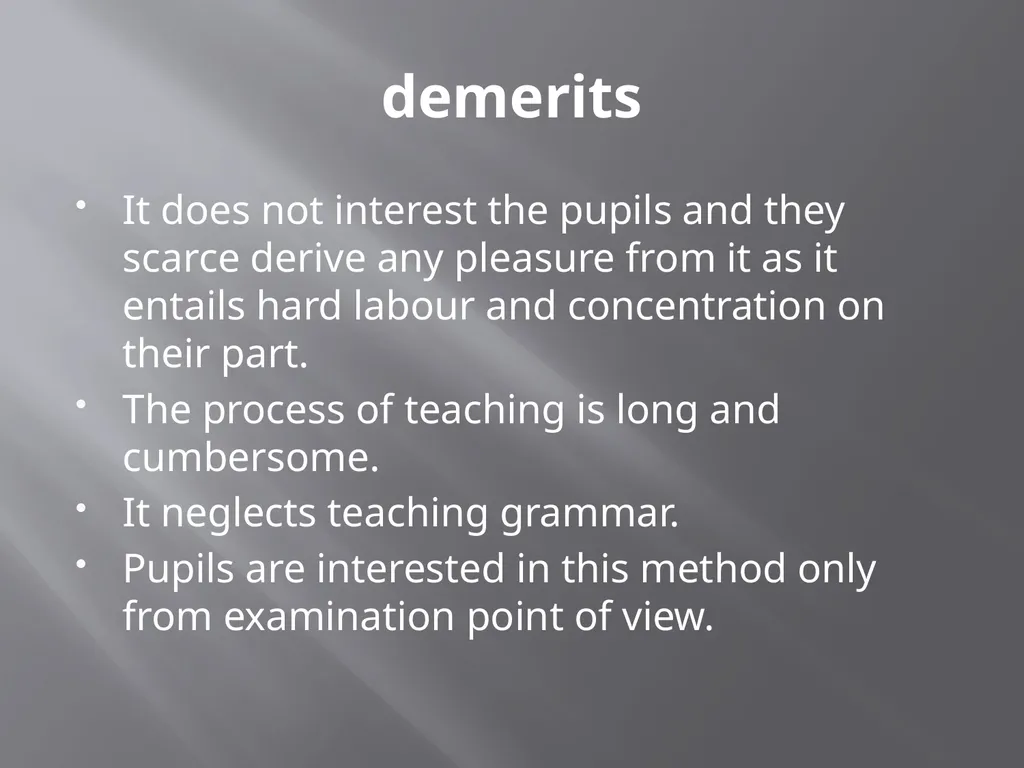
slide7. demerits It does not interest the pupils and they scarce derive any pleasure from it as it entails hard labour and concentration on their part.
The process of teaching is long and cumbersome.
It neglects teaching grammar.
Pupils are interested in this method only from examination point of view.<br>
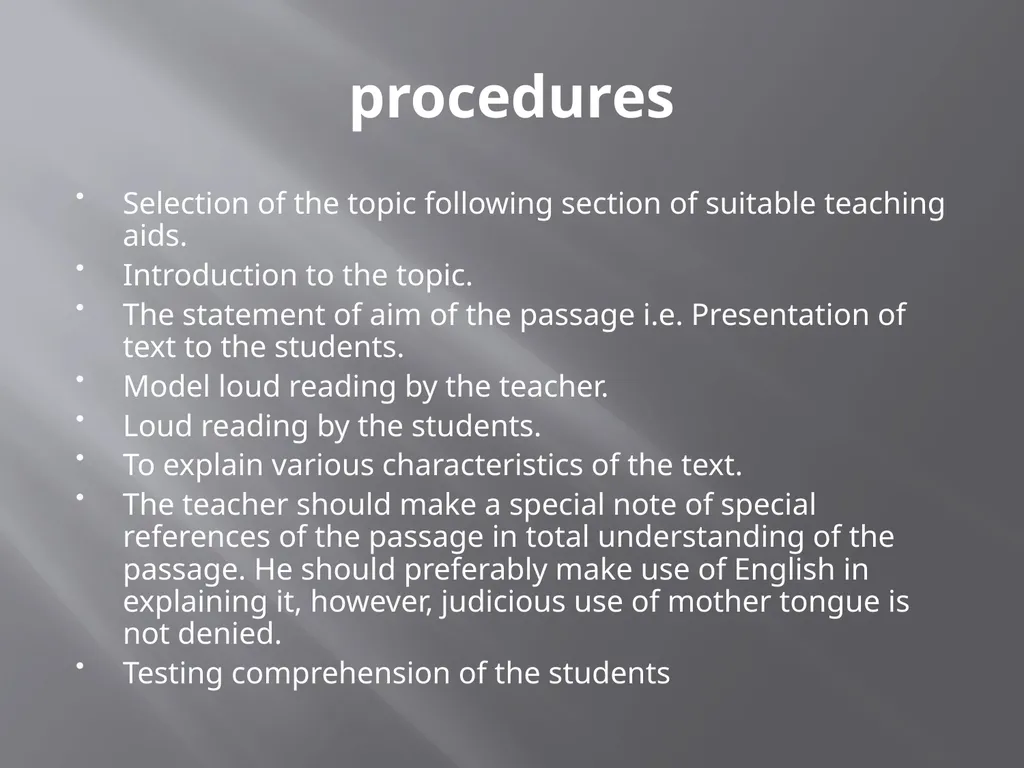
slide8. procedures Selection of the topic following section of suitable teaching aids.
Introduction to the topic.
The statement of aim of the passage i.e. Presentation of text to the students.
Model loud reading by the teacher.
Loud reading by the students.
To explain various characteristics of the text.
The teacher should make a special note of special references of the passage in total understanding of the passage. He should preferably make use of English in explaining it, however, judicious use of mother tongue is not denied.
Testing comprehension of the students<br>
slide9. Extensive reading Extensive reading involves reading in quality without bothering to check every unknown word or structure. Our main purpose to extensive reading is to train them to read fluently in English for their own enjoyment and with out the help of a teacher. Students are encourage to read widely on subject which interest them personally(art, games, literature, politics, society science etc.) and share they have enjoyed with their follow students.<br>
slide10. Aims of extensive reading To enrich the knowledge of the students by adding to the experiences and information.
It helps the students to learn language.
To create interest in the students for reading.
To concentrate upon the subject matter and it is undertaken for the purpose of information.<br>
slide11. objectives To enable the students to understand the meaning of the passage as early as possible.
To increase the passive vocabulary of the students.
To develop a taste for reading in the students.
To develop the power of concentration.
To enable the students to read for pleasure and reaction.<br>
slide12. Procedures of teaching extensive reading The teacher should given in introductory talk about the text or story for extensive reading. He can ponder over the points of special difficulties for the students and can draw the attention of the students to some special points.
The students should be given the text of suitable length in the consonance with the level of the students. In case of text being longer, then teacher can break it up into units. When the students undertake silent reading the teacher should keep a vigil over them of murmuring them, movement of lips or their posture.
The teacher should pose questions as regards comprehension level of the students after they have finished silent reading. However, the question should never concern the fine details of the text they should only test the comprehension level on a broad scale.
When the students have finished reading of all units, the students can be asked to narrate the gist in their own words or reproduce the passage in their own words.<br>
slide13. Steps in teaching a lesson extensively Introduction.
Meaning of unfamiliar words.
Silent reading by the students.
Writing the questions on the blackboard
Testing the comprehension.
Home work.<br>
slide14. merits The whole class is active and busy.
It helps in assimilation of ideas gathered for the text.
It helps widen the vocabulary especially the passive vocabulary of the pupils.
It inculcates the habit of self study in the students who in turn develop their own method suitable to them
It prepares the pupils for intensive reading as well as the pupils feel interest about library reading.<br>
slide15. Difference between Intensive and Extensive reading<br>
Unit-ii<br>
slide2. Intensive reading Intensive reading involves the learners working through a relevantly short passage under the guidance of the teacher and examining it closely and it detail. The main aims to arrive at a detailed and thorough understanding of the text. Material for intensive reading is chosen with view to developing the students power of judgement and discriminative reasoning of interpretation and appreciation. Student learn to scan for information, to ready with careful attention and concentration, and to extract the major ideas and arguments. Attention is also paid to the logical development of ideas and style of writing.<br>
slide3. Aims of intensive reading It aims teaching vocabulary and structure to the pupils.
To help the students to acquire control over the words and the sentences that they have read in their text books.
To promote a detailed and deeper knowledge of the language taught and to develop the power of expression of the learner.<br>
slide4. Objectives of intensive reading It aims at assimilation of language including the study of words, phrase, sentence patterns and other related aspects.
It aims at the study of grammar, word order and syntax, thus entirely dealing with the sentence structure.
It aims to enable the students to comprehend the text, its sense and meaning.
It aims to enable the students understand, speaks and writing the language in its various aspects with the objective of mastering it.
It aims to enable the students to improve knowledge and command over English and increase comprehension of the texts that they come across with expending vocabulary.
It encourage the students to gather information from the texts.
It aims to provide the students with opportunity to face the language fearlessly and without inhabitation and to develop the faculty of thinking in the language.<br>
slide5. Steps in teaching a lesson intensively Testing of previous knowledge.
Announcement of the topic.
Introduction.
Model loud reading by the teacher.
Loud reading by the students.
Word study and explanation.
Silent reading by the students.
Testing the comprehension.
Class test/evaluation based test.
Home work.<br>
slide6. Merits Expansion of vocabulary of the students, especially the active one.
Grammar is used in its practical connotation.
Acquaintance with new vocabulary and sentence patterns and enhances the power of expression of the students.
The pupils are better acquainted with the power of questioning and answering.
The pupils become interested in booking into details of the text they come across as they find newer meaning being attributed to the otherwise ordinary looking passages.<br>
slide7. demerits It does not interest the pupils and they scarce derive any pleasure from it as it entails hard labour and concentration on their part.
The process of teaching is long and cumbersome.
It neglects teaching grammar.
Pupils are interested in this method only from examination point of view.<br>
slide8. procedures Selection of the topic following section of suitable teaching aids.
Introduction to the topic.
The statement of aim of the passage i.e. Presentation of text to the students.
Model loud reading by the teacher.
Loud reading by the students.
To explain various characteristics of the text.
The teacher should make a special note of special references of the passage in total understanding of the passage. He should preferably make use of English in explaining it, however, judicious use of mother tongue is not denied.
Testing comprehension of the students<br>
slide9. Extensive reading Extensive reading involves reading in quality without bothering to check every unknown word or structure. Our main purpose to extensive reading is to train them to read fluently in English for their own enjoyment and with out the help of a teacher. Students are encourage to read widely on subject which interest them personally(art, games, literature, politics, society science etc.) and share they have enjoyed with their follow students.<br>
slide10. Aims of extensive reading To enrich the knowledge of the students by adding to the experiences and information.
It helps the students to learn language.
To create interest in the students for reading.
To concentrate upon the subject matter and it is undertaken for the purpose of information.<br>
slide11. objectives To enable the students to understand the meaning of the passage as early as possible.
To increase the passive vocabulary of the students.
To develop a taste for reading in the students.
To develop the power of concentration.
To enable the students to read for pleasure and reaction.<br>
slide12. Procedures of teaching extensive reading The teacher should given in introductory talk about the text or story for extensive reading. He can ponder over the points of special difficulties for the students and can draw the attention of the students to some special points.
The students should be given the text of suitable length in the consonance with the level of the students. In case of text being longer, then teacher can break it up into units. When the students undertake silent reading the teacher should keep a vigil over them of murmuring them, movement of lips or their posture.
The teacher should pose questions as regards comprehension level of the students after they have finished silent reading. However, the question should never concern the fine details of the text they should only test the comprehension level on a broad scale.
When the students have finished reading of all units, the students can be asked to narrate the gist in their own words or reproduce the passage in their own words.<br>
slide13. Steps in teaching a lesson extensively Introduction.
Meaning of unfamiliar words.
Silent reading by the students.
Writing the questions on the blackboard
Testing the comprehension.
Home work.<br>
slide14. merits The whole class is active and busy.
It helps in assimilation of ideas gathered for the text.
It helps widen the vocabulary especially the passive vocabulary of the pupils.
It inculcates the habit of self study in the students who in turn develop their own method suitable to them
It prepares the pupils for intensive reading as well as the pupils feel interest about library reading.<br>
slide15. Difference between Intensive and Extensive reading<br>