
International Organizations Paper- CC 10- Topic no
BR
Published · 16 slides · 0 views

1 / 1




Description
International Organizations Paper- CC 10- Topic no 1- Evolution of International organizations SEM IV Faculty- SAYANI MALAKAR Teaching note Study material What are International Organizations International organizations are institution
Related Topics
Share
Embed code
Download this presentation From Below
"International Organizations Paper- CC 10- Topic no" is the property of its rightful owner. Permission is granted to download and print the materials on this website for personal, non-commercial use only, and to display it on your personal computer provided you do not modify the materials and that you retain all copyright notices contained in the materials. By downloading content from our website, you accept the terms of this agreement.
Presentation Transcript
01
International Organizations Paper- CC 10- Topic no 1- Evolution of International organizations
SEM IV
Faculty- SAYANI MALAKAR
Teaching note/ Study material<br>
SEM IV
Faculty- SAYANI MALAKAR
Teaching note/ Study material<br>
02
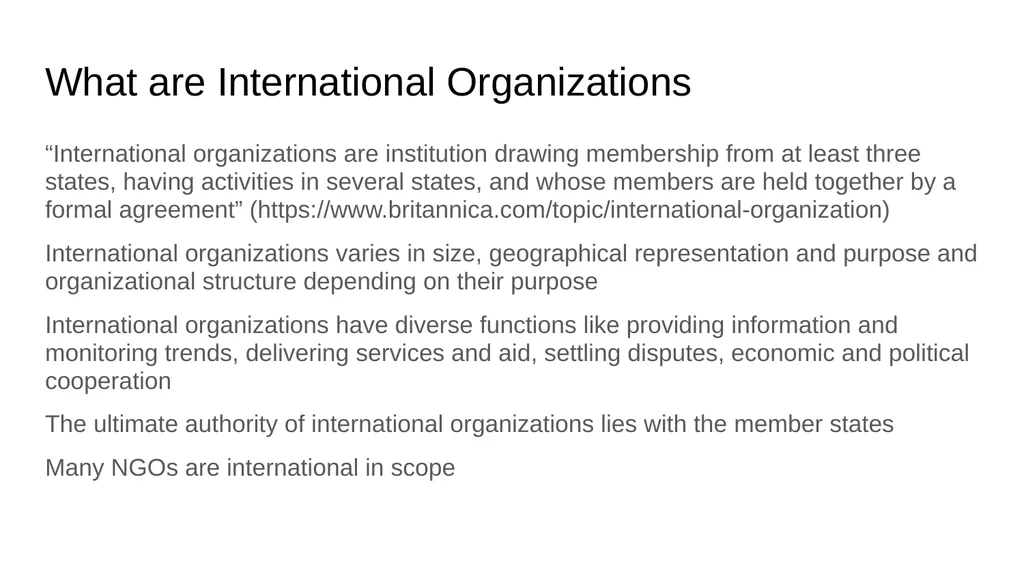
What are International Organizations “International organizations are institution drawing membership from at least three states, having activities in several states, and whose members are held together by a formal agreement” (https://www.britannica.com/topic/international-organization)
International organizations varies in size, geographical representation and purpose and organizational structure depending on their purpose
International organizations have diverse functions like providing information and monitoring trends, delivering services and aid, settling disputes, economic and political cooperation
The ultimate authority of international organizations lies with the member states
Many NGOs are international in scope<br>
International organizations varies in size, geographical representation and purpose and organizational structure depending on their purpose
International organizations have diverse functions like providing information and monitoring trends, delivering services and aid, settling disputes, economic and political cooperation
The ultimate authority of international organizations lies with the member states
Many NGOs are international in scope<br>
03
Major International Organizations UNO
APEC
OPEC
NATO
ARF
SAARC
ASEAN<br>
APEC
OPEC
NATO
ARF
SAARC
ASEAN<br>
04
Evolution of International Organizations In their contemporary form International Organizations did not appear before 19th century
“Following the French Revolution and the Napoleonic Wars of the late 18th and early 19th centuries, leaders of the major European powers met periodically, in a system of consultation known as the Concert of Europe, to attempt to preserve the status quo and to protect their governments from internal rebellion.” (https://www.britannica.com/topic/international-organization)
“Later in the 19th century, various international organizations, such as the International Telegraph Union (1865; now the International Telecommunication Union), were established to provide specialized services and to perform specific tasks. In 1899 and 1907 European and non-European states met to develop rules to regulate armaments and the conduct of war. These conferences produced the Hague Conventions, which included agreements on the peaceful settlement of war, the treatment of prisoners of war, and the rights of neutral states. These various meetings and agreements served as precursors to the international organizations of the 20th century, such as the League of Nations and the United Nations (UN)” (https://www.britannica.com/topic/international-organization)<br>
“Following the French Revolution and the Napoleonic Wars of the late 18th and early 19th centuries, leaders of the major European powers met periodically, in a system of consultation known as the Concert of Europe, to attempt to preserve the status quo and to protect their governments from internal rebellion.” (https://www.britannica.com/topic/international-organization)
“Later in the 19th century, various international organizations, such as the International Telegraph Union (1865; now the International Telecommunication Union), were established to provide specialized services and to perform specific tasks. In 1899 and 1907 European and non-European states met to develop rules to regulate armaments and the conduct of war. These conferences produced the Hague Conventions, which included agreements on the peaceful settlement of war, the treatment of prisoners of war, and the rights of neutral states. These various meetings and agreements served as precursors to the international organizations of the 20th century, such as the League of Nations and the United Nations (UN)” (https://www.britannica.com/topic/international-organization)<br>
05
Evolution of International Organizations “ The evolution of international organizations (IOs) can be divided into three phrases.
The first phase started with the Congress of Vienna (1814–15), which set in motion a series of innovations, inventions, and learning processes, shaping the core of what we now call IOs.
The second phase of international organization in the nineteenth century is characterized by the building of permanent institutions. This is reflected in the new and dominant term “union” for organization. The term “public international union” (PIU) became the overarching term for the by intergovernmental organizations (IGOs) of the late nineteenth and early twentieth centuries.
PIUs have been regarded as “early IGOs” which later transformed into specialized agencies of the UN system, with their subdivisions as institutional prototypes for the League of Nations and the UN.<br>
The first phase started with the Congress of Vienna (1814–15), which set in motion a series of innovations, inventions, and learning processes, shaping the core of what we now call IOs.
The second phase of international organization in the nineteenth century is characterized by the building of permanent institutions. This is reflected in the new and dominant term “union” for organization. The term “public international union” (PIU) became the overarching term for the by intergovernmental organizations (IGOs) of the late nineteenth and early twentieth centuries.
PIUs have been regarded as “early IGOs” which later transformed into specialized agencies of the UN system, with their subdivisions as institutional prototypes for the League of Nations and the UN.<br>
06
Evolution of International Organizations “ The third phase of international organization is the continued existence of IOs during the first half of the twentieth century. The outbreak of World War I can be regarded as an exogenous shock to the evolutionary development of IOs.
During the war, the concept of international organization was not lost and was even central to the thinking on international politics in the UK and the US.
Detailed plans for an international peace organization, using the term “international government”, were produced and discussed by politicians and citizens.
These plans, which became part of the institutional strategy devised by the US, strongly reflected the organizational experiences of the PIUs”<br>
During the war, the concept of international organization was not lost and was even central to the thinking on international politics in the UK and the US.
Detailed plans for an international peace organization, using the term “international government”, were produced and discussed by politicians and citizens.
These plans, which became part of the institutional strategy devised by the US, strongly reflected the organizational experiences of the PIUs”<br>
07
Congress of Vienna Congress of Vienna can be considered as the first systematic effort for regulating international affairs through the means of regular international conferences
This principal architect of the peace settlement in this conference was- Austrian Foreign Minister- Prince Klemens Von Matternich- balance of power was to be maintained for peace
Enforcement of the Vienna settlement by- Austria, Great Britain, Prussia, Russia
France joined the alliance in 1818
It laid the foundation for the evolution of international organizations<br>
This principal architect of the peace settlement in this conference was- Austrian Foreign Minister- Prince Klemens Von Matternich- balance of power was to be maintained for peace
Enforcement of the Vienna settlement by- Austria, Great Britain, Prussia, Russia
France joined the alliance in 1818
It laid the foundation for the evolution of international organizations<br>
08
“First, despite the hostilities, the alliance, which was formed in this conference, continued to enforce peace. Second, there were frequent periodic conferences. Third, despite the suspicions of the smaller powers it was generally agreed that the maintenance of peace depended on this sort of big power collaboration” (https www.scribd.com/doc/37994331/Evolution-of-International-Organisations)
These ideas were followed later in the League of Nations and United Nations
Informal consultations, conferences, occasional actions<br>
These ideas were followed later in the League of Nations and United Nations
Informal consultations, conferences, occasional actions<br>
09
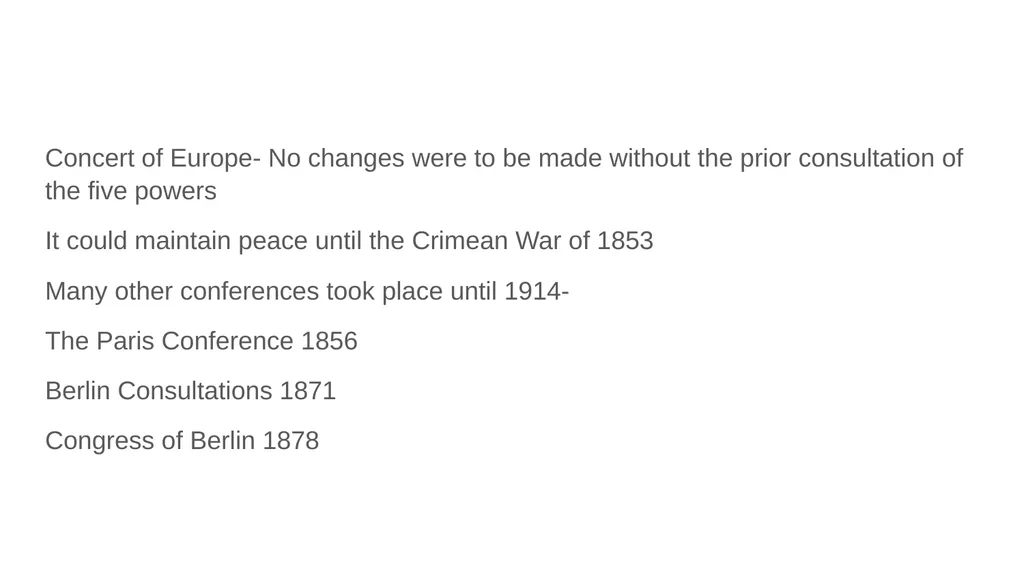
Concert of Europe- No changes were to be made without the prior consultation of the five powers
It could maintain peace until the Crimean War of 1853
Many other conferences took place until 1914-
The Paris Conference 1856
Berlin Consultations 1871
Congress of Berlin 1878<br>
It could maintain peace until the Crimean War of 1853
Many other conferences took place until 1914-
The Paris Conference 1856
Berlin Consultations 1871
Congress of Berlin 1878<br>
10
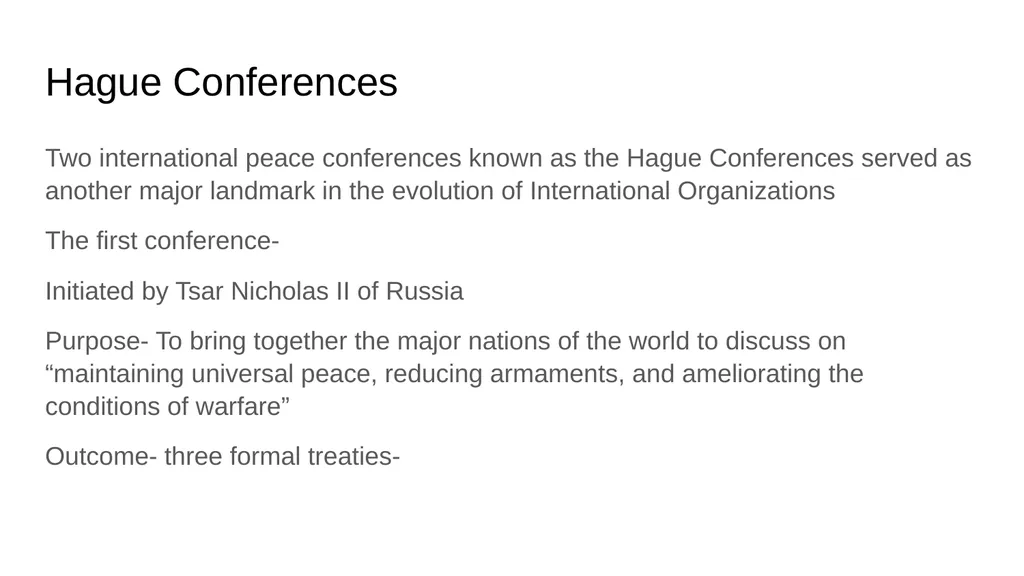
Hague Conferences Two international peace conferences known as the Hague Conferences served as another major landmark in the evolution of International Organizations
The first conference-
Initiated by Tsar Nicholas II of Russia
Purpose- To bring together the major nations of the world to discuss on “maintaining universal peace, reducing armaments, and ameliorating the conditions of warfare”
Outcome- three formal treaties-<br>
The first conference-
Initiated by Tsar Nicholas II of Russia
Purpose- To bring together the major nations of the world to discuss on “maintaining universal peace, reducing armaments, and ameliorating the conditions of warfare”
Outcome- three formal treaties-<br>
11
“The first and most important one set up permanent machinery for the optional arbitration of controversial issues between nations. This machinery took the form of the Permanent Court of Arbitration, popularly known as The Hague Court or Hague Tribunal
to eliminate unnecessary suffering during a war on the part of all concerned, whether combatants, non-combatants, or neutrals.
Forbidding the use of poison gas, bullets, bombardments from air”
Despite failure in these issues, it was a major landmark<br>
to eliminate unnecessary suffering during a war on the part of all concerned, whether combatants, non-combatants, or neutrals.
Forbidding the use of poison gas, bullets, bombardments from air”
Despite failure in these issues, it was a major landmark<br>
12
Second Peace Conference-
Promulgated by US Secretary of State, John Milton Hay in 1904
Outcome- 13 conventions- “ new principles were established in regard to various aspects of warfare, including the rights and duties of neutrals, naval bombardment, the laying of automatic submarine contact mines, and the conditions under which merchant ships might be converted into warships”
A third conference was supposed to be held within 8 years but was prevented by the outbreak of WWI<br>
Promulgated by US Secretary of State, John Milton Hay in 1904
Outcome- 13 conventions- “ new principles were established in regard to various aspects of warfare, including the rights and duties of neutrals, naval bombardment, the laying of automatic submarine contact mines, and the conditions under which merchant ships might be converted into warships”
A third conference was supposed to be held within 8 years but was prevented by the outbreak of WWI<br>
13
Rise of modern institutions From the middle of 19th century many administrative international institutions were formed-
Geodetic Union, 1964
ITU ,1865
International Meteorological Organization, 1873
UPU
he International Copyright Union (1886); the Central Office for International Railway Transport (1890); and the United International Bureau for the Protection of Intellectual Property (1893)<br>
Geodetic Union, 1964
ITU ,1865
International Meteorological Organization, 1873
UPU
he International Copyright Union (1886); the Central Office for International Railway Transport (1890); and the United International Bureau for the Protection of Intellectual Property (1893)<br>
14
A major breakthrough in the evolution of international organisation took place in the year 1919 through the Versailles peace settlement following the first world war
1918- US President Woodrow Wilson made his famous 14 points speech
Here he called for the creation of a general association of nations to ensure political independence and territorial integrity
This led to the formation of League of Nations this was the first international organisation to ensure international peace and collective security
It nevertheless failed to prevent war!<br>
1918- US President Woodrow Wilson made his famous 14 points speech
Here he called for the creation of a general association of nations to ensure political independence and territorial integrity
This led to the formation of League of Nations this was the first international organisation to ensure international peace and collective security
It nevertheless failed to prevent war!<br>
15
After the second world war, organization at the international level received more impetus – UN
In 1944 economic cooperation was given importance. In Bretton Woods agreement was made towards the necessity of cooperation in monetary and trade issues. Hence came up organizations like the IMF, GATT
Many organizations came up in Europe- European Union
The cold war led to military cooperation in Europe- NATO by Western Europe and Warsaw pact of Eastern Europe
Following independence in Africa and Asia in 1950s and 60s the need for organization rose leading to the creation of Organization of African Unity in 1963, ASEAN, SAARC and the APEC in the Asia-Pacific region<br>
In 1944 economic cooperation was given importance. In Bretton Woods agreement was made towards the necessity of cooperation in monetary and trade issues. Hence came up organizations like the IMF, GATT
Many organizations came up in Europe- European Union
The cold war led to military cooperation in Europe- NATO by Western Europe and Warsaw pact of Eastern Europe
Following independence in Africa and Asia in 1950s and 60s the need for organization rose leading to the creation of Organization of African Unity in 1963, ASEAN, SAARC and the APEC in the Asia-Pacific region<br>
16
Sources https://www.britannica.com/topic/international-organization
https www.scribd.com/doc/37994331/Evolution-of-International-Organisations)
https://www.abyssinialaw.com/study-on-line/item/475-the-historical-development-of-international-organizations
https://oxfordre.com/internationalstudies/view/10.1093/acrefore/9780190846626.001.0001/acrefore-9780190846626-e-328#:~:text=The%20first%20phase%20started%20with,the%20building%20of%20permanent%20institutions.<br>
https www.scribd.com/doc/37994331/Evolution-of-International-Organisations)
https://www.abyssinialaw.com/study-on-line/item/475-the-historical-development-of-international-organizations
https://oxfordre.com/internationalstudies/view/10.1093/acrefore/9780190846626.001.0001/acrefore-9780190846626-e-328#:~:text=The%20first%20phase%20started%20with,the%20building%20of%20permanent%20institutions.<br>