Interprofessional Education Introduction Department of Speech, Language and Hearing Sciences National Student Speech, Language and Hearing Association Aunusha Sundarrajan Nancy Robinson Interprofessional Education for Inclusive Schools
"Interprofessional Education Introduction" is the property of its rightful owner. Permission is granted to
download and print the materials on this website for personal, non-commercial use only, and to display it
on your personal computer provided you do not modify the materials and that you retain all copyright
notices contained in the materials. By downloading content from our website, you accept the terms of this
agreement.
Presentation Transcript
01
Interprofessional Education Introduction Department of Speech, Language and Hearing Sciences
&
National Student Speech, Language and Hearing Association
Aunusha Sundarrajan & Nancy Robinson<br>
02
Interprofessional Education for Inclusive Schools Defining Interprofessional Education (IPE) and Interprofessional Practice (IPP)
Application of IPE in Education Professions
What do IPE and IPP Look Like?
Resources to Develop IPE
IPE Case-Study Discussions
Evaluation and Wrap-up<br>
03
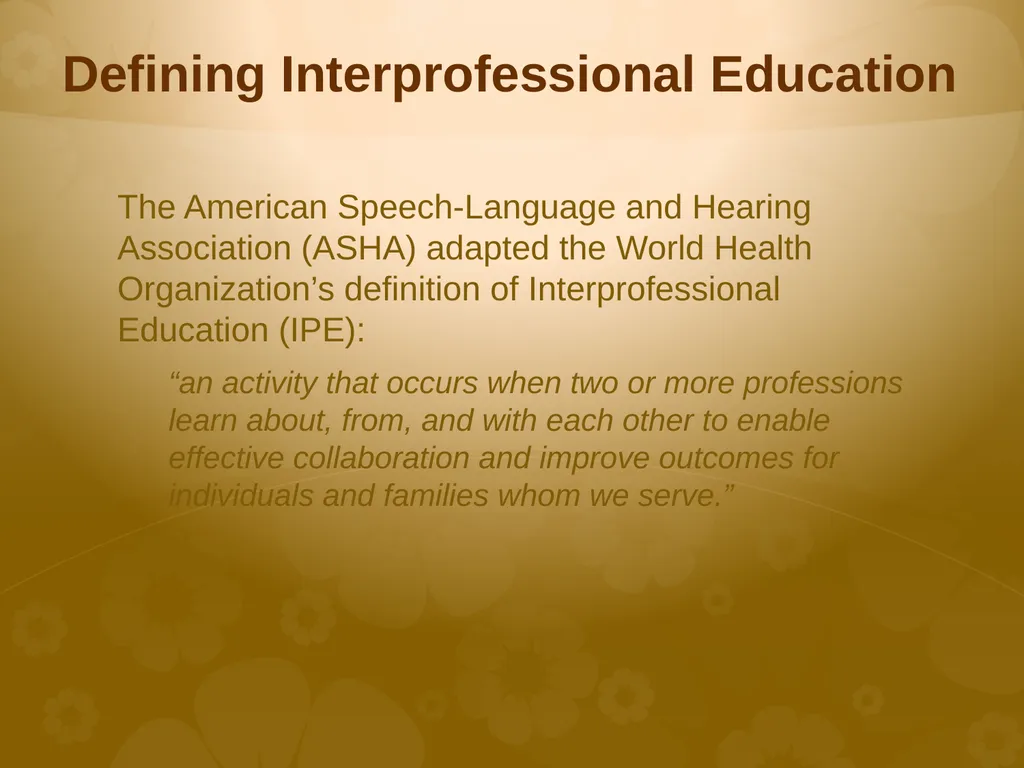
Defining Interprofessional Education The American Speech-Language and Hearing Association (ASHA) adapted the World Health Organization’s definition of Interprofessional Education (IPE):
“an activity that occurs when two or more professions learn about, from, and with each other to enable effective collaboration and improve outcomes for individuals and families whom we serve.”<br>
04
Interprofessional Education (IPE) and Interprofessional Practice (IPP) How are IPE and IPP related?
We all work in settings where collaboration is necessary for optimal programs for the people we serve.
However, focused attention to building skills for collaboration are not uniformly addressed in pre-professional training.
Education in effective collaboration across disciplines (IPE) leads to improved outcomes in service delivery (IPP).<br>
05
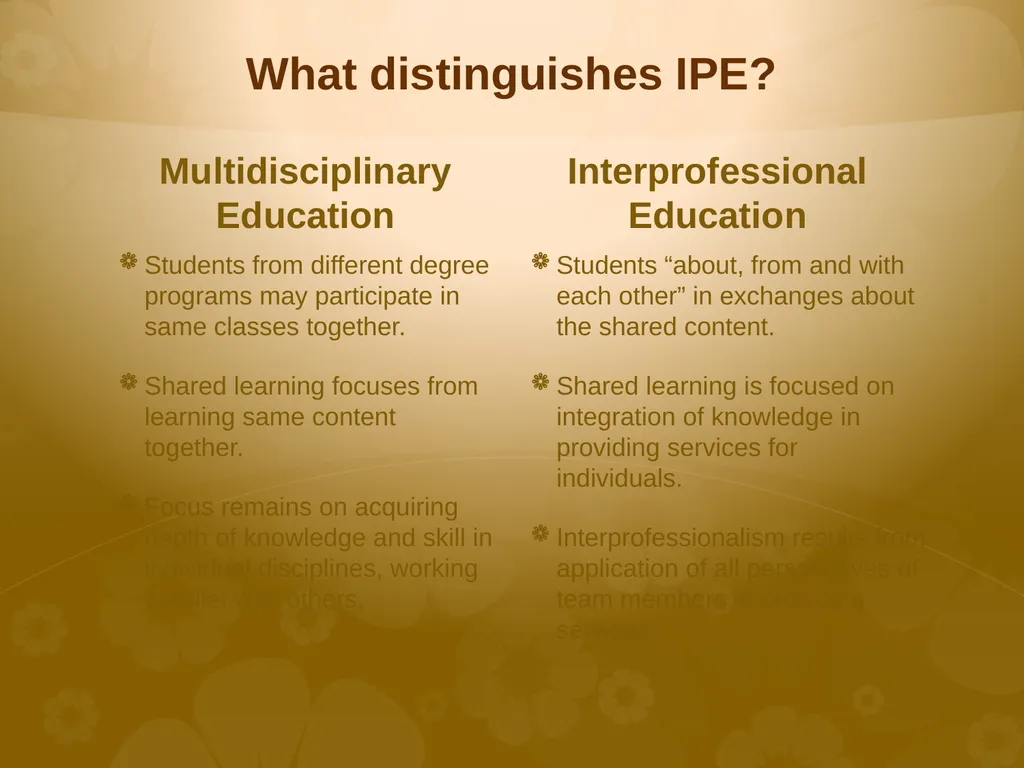
What distinguishes IPE? Multidisciplinary Education Students from different degree programs may participate in same classes together.
Shared learning focuses from learning same content together.
Focus remains on acquiring depth of knowledge and skill in individual disciplines, working parallel with others. Interprofessional Education Students “about, from and with each other” in exchanges about the shared content.
Shared learning is focused on integration of knowledge in providing services for individuals.
Interprofessionalism results from application of all perspectives of team members in providing services.<br>
06
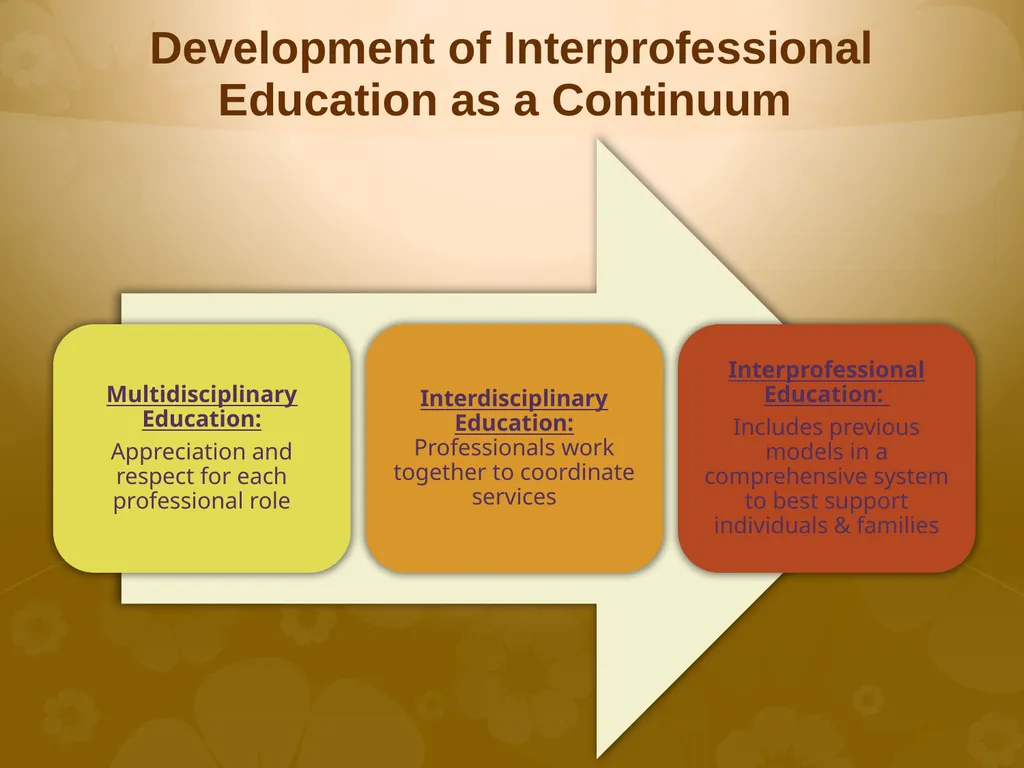
Development of Interprofessional Education as a Continuum<br>
07
Principles of IPE Principle #1. IPE/IPP is not a replacement for rigorous education specific to each health care profession. This indicates that interprofessional identity complements—but does not replace—professional identity.
Principle #2. IPE/IPP represents one solution—not all solutions—to the problems of the health system.
Principle #3. Experiential and team-based learning are the hallmarks of IPE/IPP.<br>
08
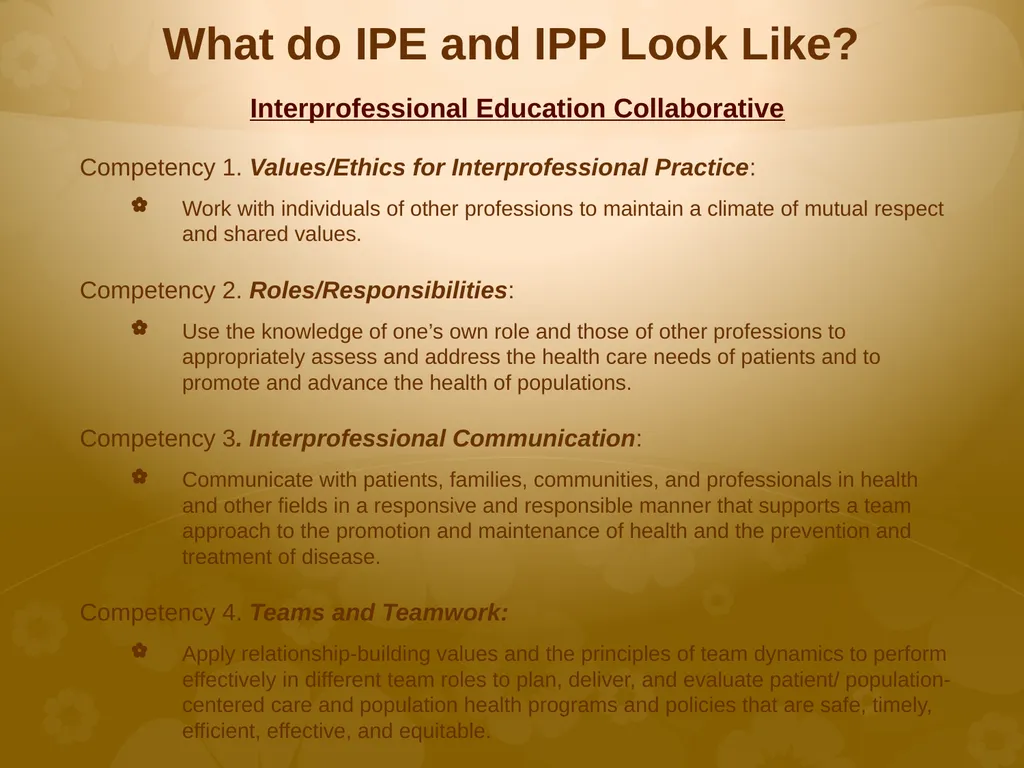
What do IPE and IPP Look Like? Interprofessional Education Collaborative
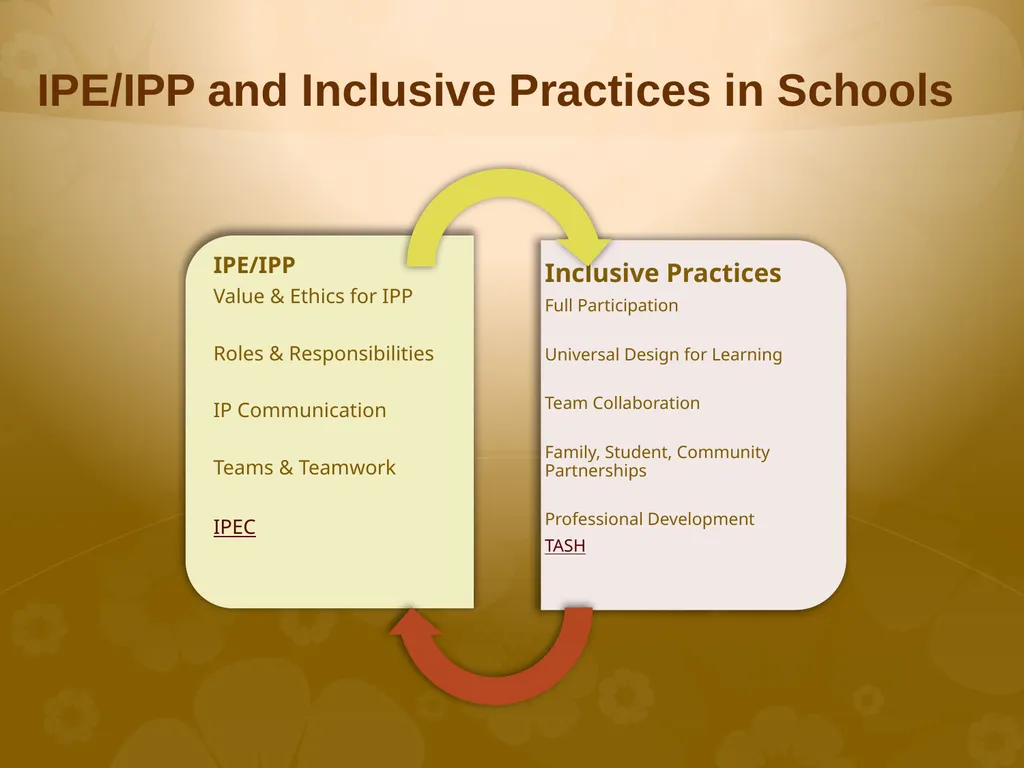
Competency 1. Values/Ethics for Interprofessional Practice:
Work with individuals of other professions to maintain a climate of mutual respect and shared values.
Competency 2. Roles/Responsibilities:
Use the knowledge of one’s own role and those of other professions to appropriately assess and address the health care needs of patients and to promote and advance the health of populations.
Competency 3. Interprofessional Communication:
Communicate with patients, families, communities, and professionals in health and other fields in a responsive and responsible manner that supports a team approach to the promotion and maintenance of health and the prevention and treatment of disease.
Competency 4. Teams and Teamwork:
Apply relationship-building values and the principles of team dynamics to perform effectively in different team roles to plan, deliver, and evaluate patient/ population-centered care and population health programs and policies that are safe, timely, efficient, effective, and equitable.<br>
09
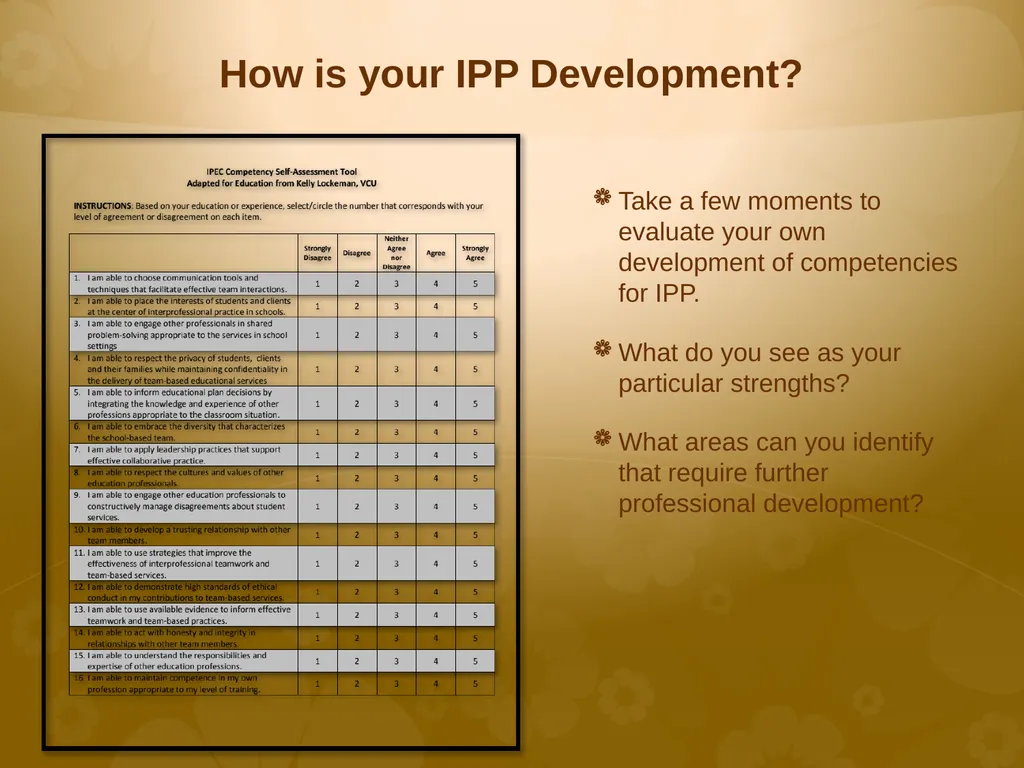
How is your IPP Development? Take a few moments to evaluate your own development of competencies for IPP.
What do you see as your particular strengths?
What areas can you identify that require further professional development?<br>
10
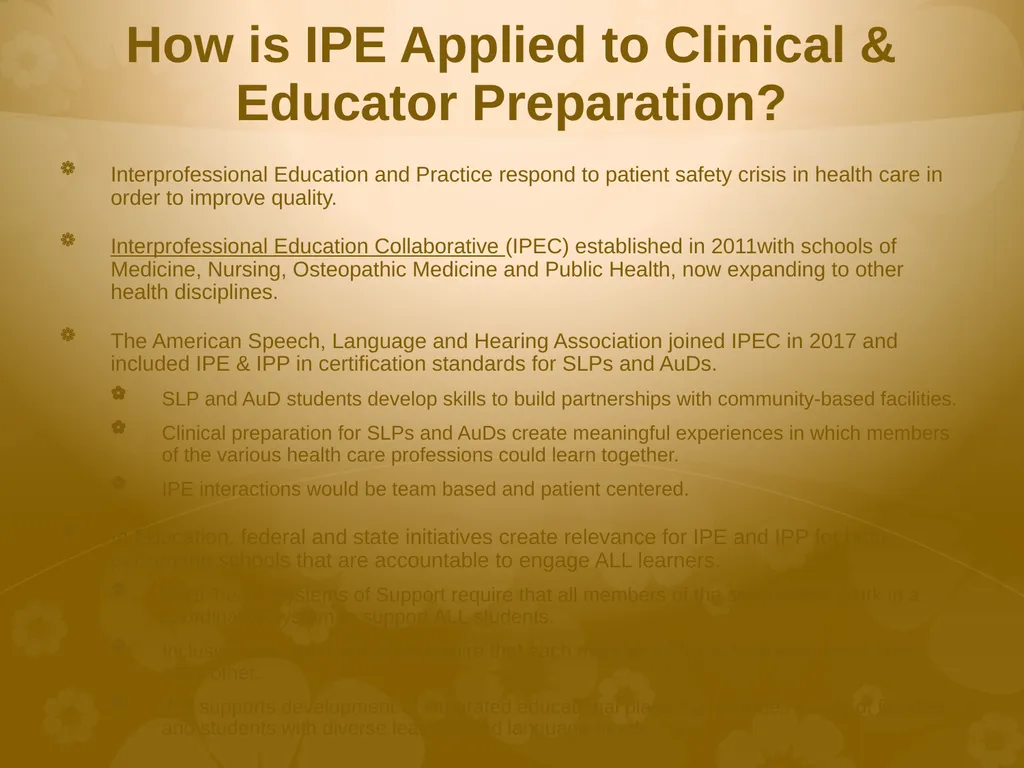
How is IPE Applied to Clinical & Educator Preparation? Interprofessional Education and Practice respond to patient safety crisis in health care in order to improve quality.
Interprofessional Education Collaborative (IPEC) established in 2011with schools of Medicine, Nursing, Osteopathic Medicine and Public Health, now expanding to other health disciplines.
The American Speech, Language and Hearing Association joined IPEC in 2017 and included IPE & IPP in certification standards for SLPs and AuDs.
SLP and AuD students develop skills to build partnerships with community-based facilities.
Clinical preparation for SLPs and AuDs create meaningful experiences in which members of the various health care professions could learn together.
IPE interactions would be team based and patient centered.
In Education, federal and state initiatives create relevance for IPE and IPP for high-performing schools that are accountable to engage ALL learners.
Multi-Tiered Systems of Support require that all members of the school team work in a coordinated system to support ALL students.
Inclusive education practices require that each member of the school team learn from each other.
IPE supports development of integrated educational plans that includes needs of families and students with diverse learning and language needs<br>
11
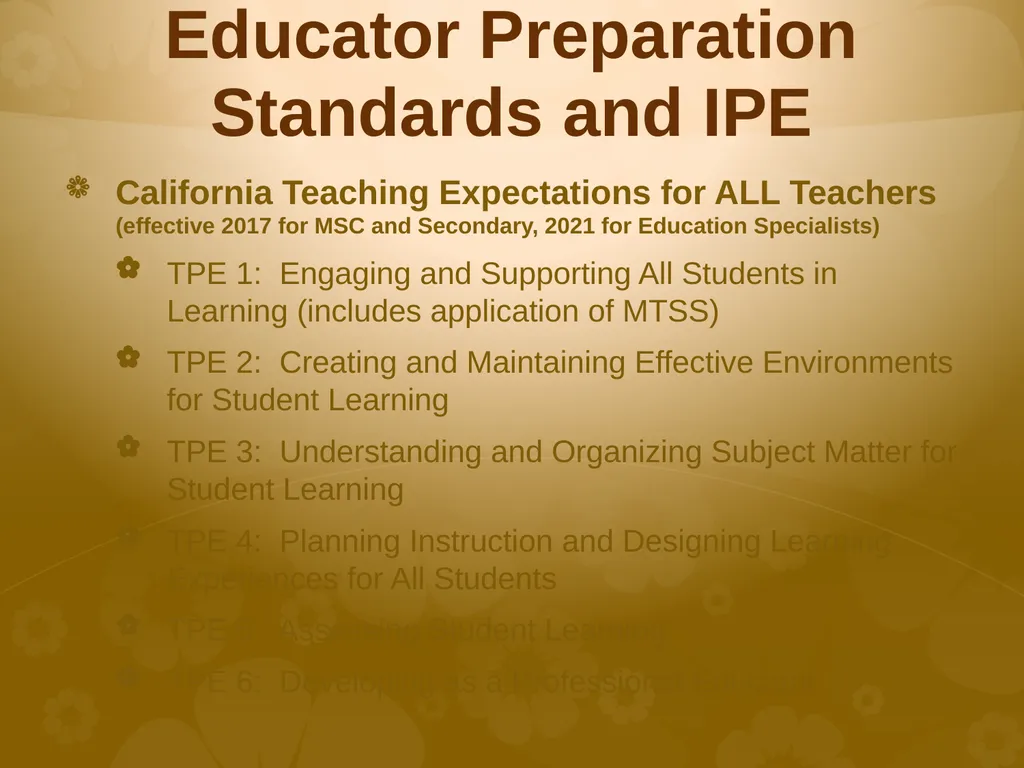
Educator Preparation Standards and IPE California Teaching Expectations for ALL Teachers (effective 2017 for MSC and Secondary, 2021 for Education Specialists)
TPE 1: Engaging and Supporting All Students in Learning (includes application of MTSS)
TPE 2: Creating and Maintaining Effective Environments for Student Learning
TPE 3: Understanding and Organizing Subject Matter for Student Learning
TPE 4: Planning Instruction and Designing Learning Experiences for All Students
TPE 5: Assessing Student Learning
TPE 6: Developing as a Professional Educator<br>
12
IPE/IPP and Inclusive Practices in Schools<br>
13
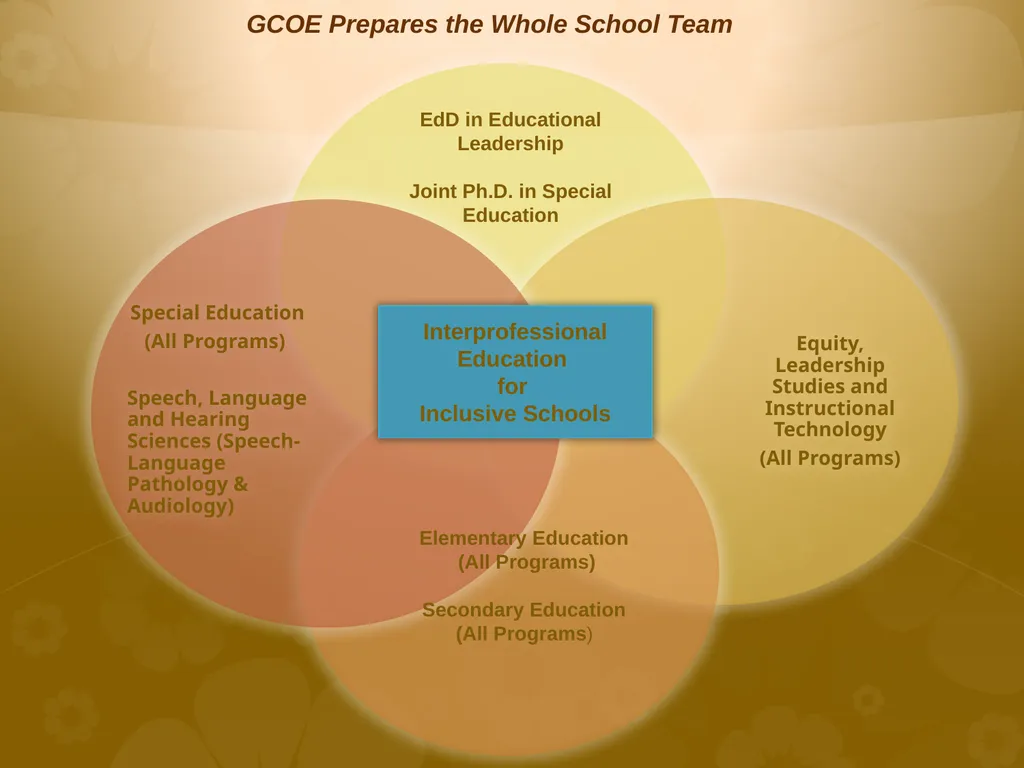
Interprofessional Education
for Inclusive Schools Elementary Education
(All Programs)
Secondary Education
(All Programs) EdD in Educational Leadership
Joint Ph.D. in Special Education GCOE Prepares the Whole School Team<br>
14
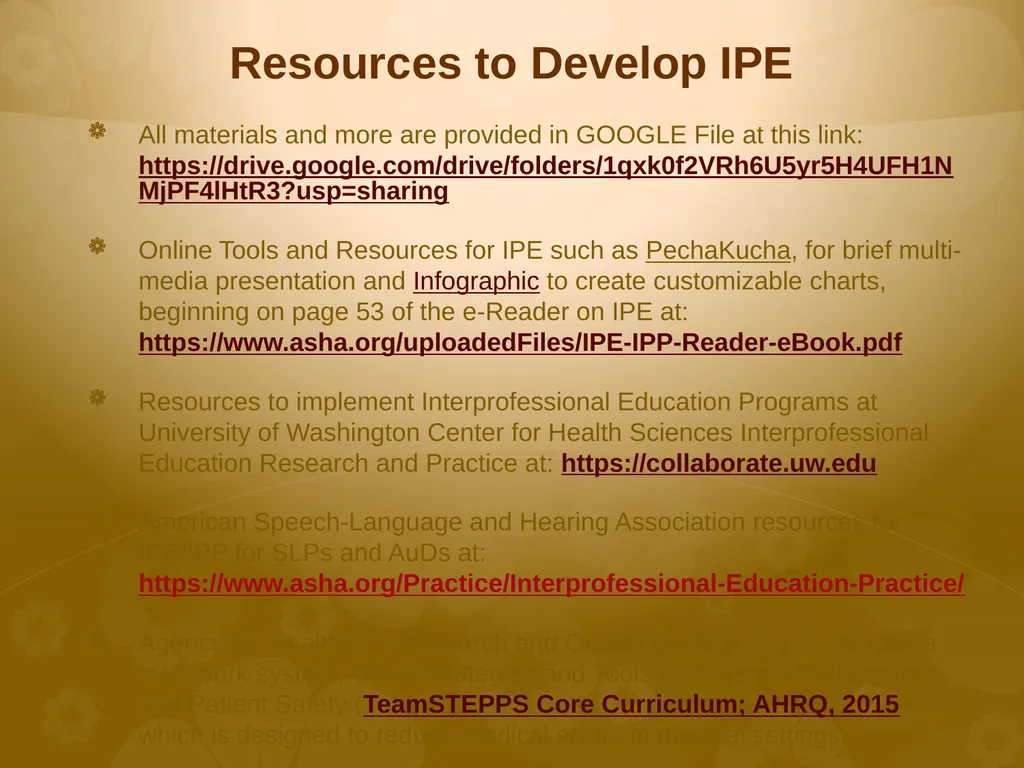
Resources to Develop IPE All materials and more are provided in GOOGLE File at this link: https://drive.google.com/drive/folders/1qxk0f2VRh6U5yr5H4UFH1NMjPF4lHtR3?usp=sharing
Online Tools and Resources for IPE such as PechaKucha, for brief multi-media presentation and Infographic to create customizable charts, beginning on page 53 of the e-Reader on IPE at: https://www.asha.org/uploadedFiles/IPE-IPP-Reader-eBook.pdf
Resources to implement Interprofessional Education Programs at University of Washington Center for Health Sciences Interprofessional Education Research and Practice at: https://collaborate.uw.edu
American Speech-Language and Hearing Association resources for IPE/IPP for SLPs and AuDs at: https://www.asha.org/Practice/Interprofessional-Education-Practice/
Agency for Healthcare Research and Quality (AHRQ) has developed a teamwork system, Team Strategies and Tools to Enhance Performance and Patient Safety (TeamSTEPPS Core Curriculum; AHRQ, 2015), which is designed to reduce medical errors in medical settings<br>
15
Case Study Discussions Approximately 40 minutes
Introductions and background of each member.
Volunteer to read the case study aloud.
Follow discussion questions as a guide, with contributions from each member in the group.
Volunteer to keep notes on table easel re: discussion.
Summarize key points before moving on to the next question.
Allow approximately 8 minutes per question.
Summarize discussion on easel to share with large group.<br>
16
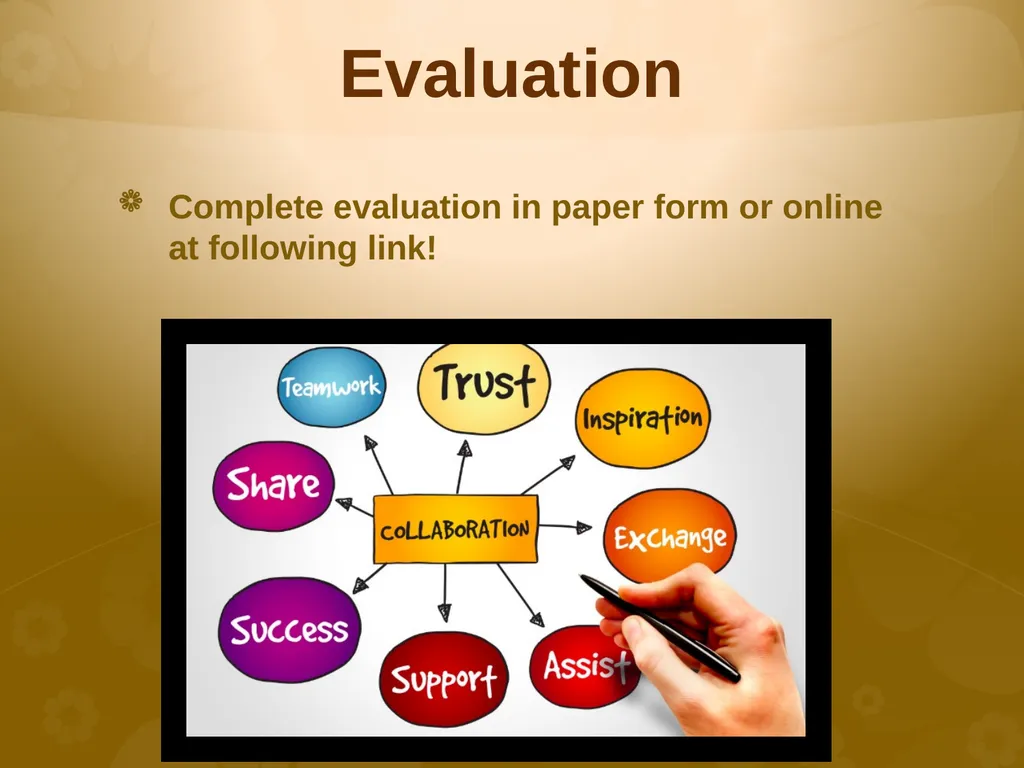
Evaluation Complete evaluation in paper form or online at following link!<br>