
Interviewing INTERNATIONAL PROTOCOL PART V –
MS
Published · 37 slides · 0 views
1 / 1
Description
Interviewing INTERNATIONAL PROTOCOL PART V DOCUMENTATION IN PRACTICE: GATHERING INFORMATION PAGES 160-185 Training Materials on the International Protocol Institute for International Criminal Investigations 2018 Module 11 Training
Related Topics
Share
Embed code
Download this presentation From Below
"Interviewing INTERNATIONAL PROTOCOL PART V –" is the property of its rightful owner. Permission is granted to download and print the materials on this website for personal, non-commercial use only, and to display it on your personal computer provided you do not modify the materials and that you retain all copyright notices contained in the materials. By downloading content from our website, you accept the terms of this agreement.
Presentation Transcript
01
Interviewing
INTERNATIONAL PROTOCOL
PART V – DOCUMENTATION IN PRACTICE: GATHERING INFORMATION
PAGES 160-185 Training Materials on the International Protocol
© Institute for International Criminal Investigations 2018 Module 11<br>
INTERNATIONAL PROTOCOL
PART V – DOCUMENTATION IN PRACTICE: GATHERING INFORMATION
PAGES 160-185 Training Materials on the International Protocol
© Institute for International Criminal Investigations 2018 Module 11<br>
02
Training Materials on the International Protocol
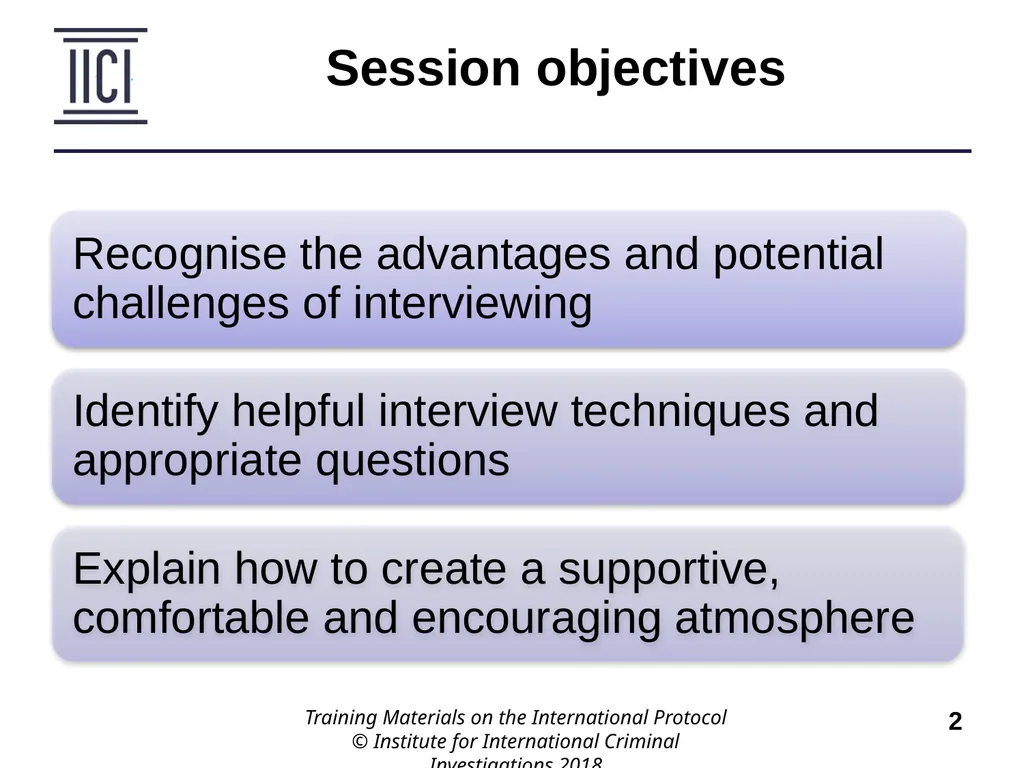
© Institute for International Criminal Investigations 2018 Session objectives 2<br>
© Institute for International Criminal Investigations 2018 Session objectives 2<br>
03
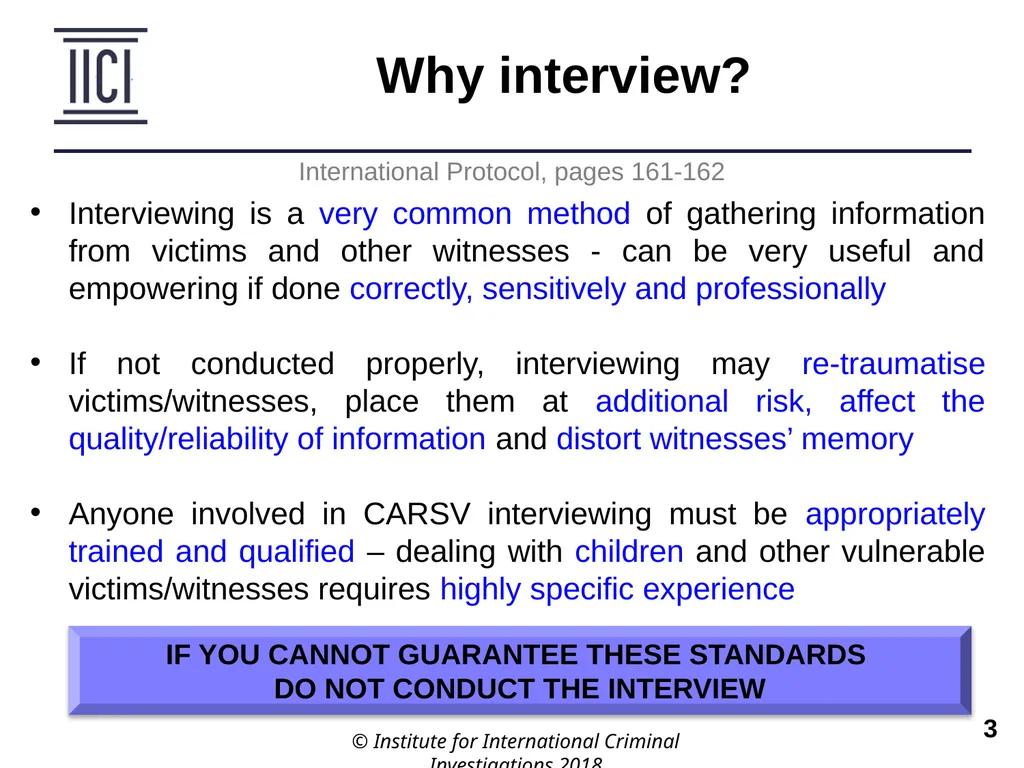
© Institute for International Criminal Investigations 2018 Why interview? 3 International Protocol, pages 161-162 Interviewing is a very common method of gathering information from victims and other witnesses - can be very useful and empowering if done correctly, sensitively and professionally
If not conducted properly, interviewing may re-traumatise victims/witnesses, place them at additional risk, affect the quality/reliability of information and distort witnesses’ memory
Anyone involved in CARSV interviewing must be appropriately trained and qualified – dealing with children and other vulnerable victims/witnesses requires highly specific experience IF YOU CANNOT GUARANTEE THESE STANDARDS
DO NOT CONDUCT THE INTERVIEW<br>
If not conducted properly, interviewing may re-traumatise victims/witnesses, place them at additional risk, affect the quality/reliability of information and distort witnesses’ memory
Anyone involved in CARSV interviewing must be appropriately trained and qualified – dealing with children and other vulnerable victims/witnesses requires highly specific experience IF YOU CANNOT GUARANTEE THESE STANDARDS
DO NOT CONDUCT THE INTERVIEW<br>
04
Training Materials on the International Protocol
© Institute for International Criminal Investigations 2018 Why interview? 4 International Protocol, pages 161-162
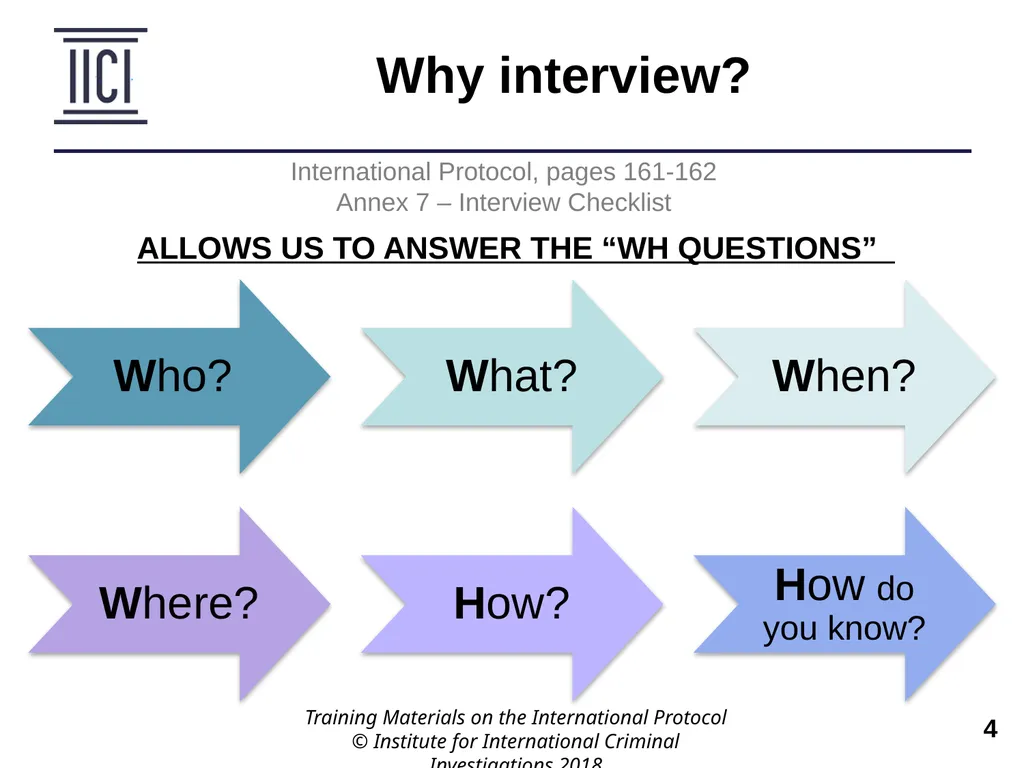
Annex 7 – Interview Checklist ALLOWS US TO ANSWER THE “WH QUESTIONS”<br>
© Institute for International Criminal Investigations 2018 Why interview? 4 International Protocol, pages 161-162
Annex 7 – Interview Checklist ALLOWS US TO ANSWER THE “WH QUESTIONS”<br>
05
© Institute for International Criminal Investigations 2018 Interview framework 5 International Protocol, pages 163-184 and Annex 7 – Interview Checklist
Module 7 – Do No Harm and Module 9 – Planning
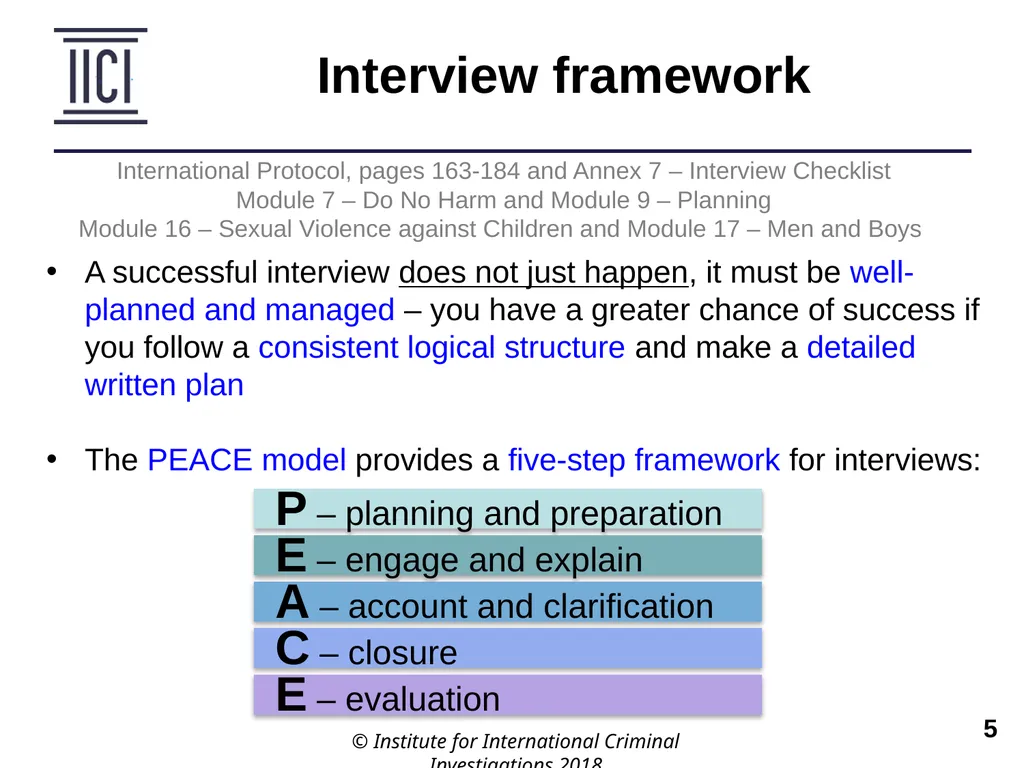
Module 16 – Sexual Violence against Children and Module 17 – Men and Boys A successful interview does not just happen, it must be well-planned and managed – you have a greater chance of success if you follow a consistent logical structure and make a detailed written plan
The PEACE model provides a five-step framework for interviews:<br>
Module 7 – Do No Harm and Module 9 – Planning
Module 16 – Sexual Violence against Children and Module 17 – Men and Boys A successful interview does not just happen, it must be well-planned and managed – you have a greater chance of success if you follow a consistent logical structure and make a detailed written plan
The PEACE model provides a five-step framework for interviews:<br>
06
Training Materials on the International Protocol
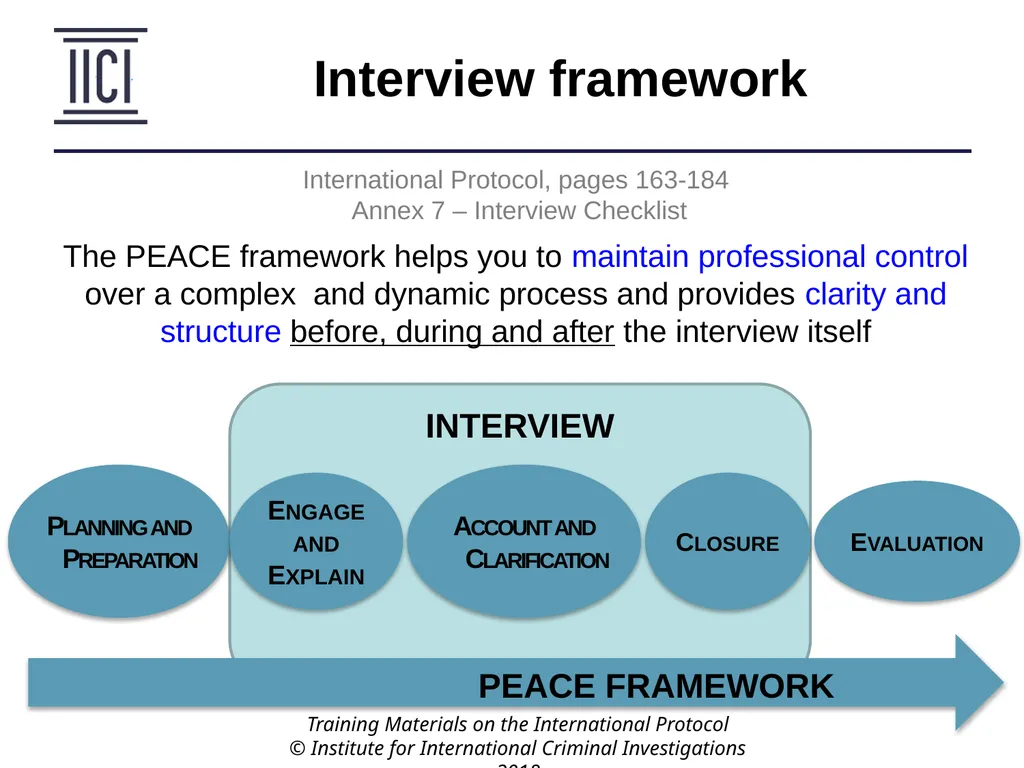
© Institute for International Criminal Investigations 2018 The PEACE framework helps you to maintain professional control over a complex and dynamic process and provides clarity and structure before, during and after the interview itself INTERVIEW Planning and Preparation Engage and Explain Account and Clarification Closure Evaluation PEACE FRAMEWORK Interview framework International Protocol, pages 163-184
Annex 7 – Interview Checklist<br>
© Institute for International Criminal Investigations 2018 The PEACE framework helps you to maintain professional control over a complex and dynamic process and provides clarity and structure before, during and after the interview itself INTERVIEW Planning and Preparation Engage and Explain Account and Clarification Closure Evaluation PEACE FRAMEWORK Interview framework International Protocol, pages 163-184
Annex 7 – Interview Checklist<br>
07
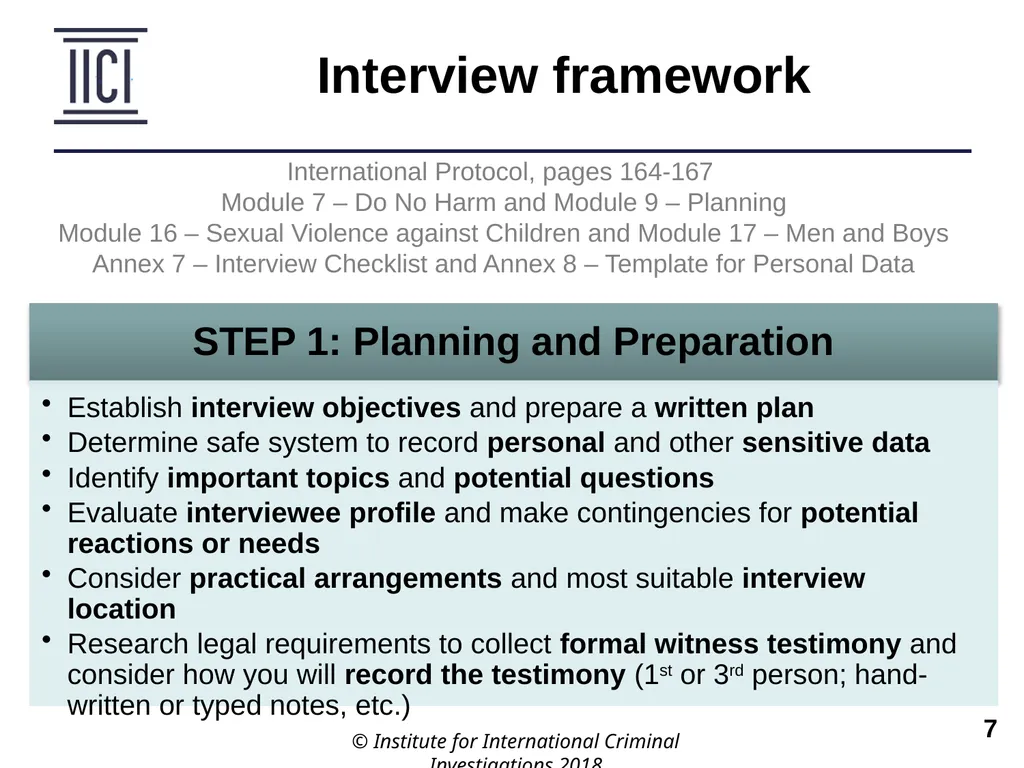
© Institute for International Criminal Investigations 2018 Interview framework 7 International Protocol, pages 164-167
Module 7 – Do No Harm and Module 9 – Planning
Module 16 – Sexual Violence against Children and Module 17 – Men and Boys
Annex 7 – Interview Checklist and Annex 8 – Template for Personal Data<br>
Module 7 – Do No Harm and Module 9 – Planning
Module 16 – Sexual Violence against Children and Module 17 – Men and Boys
Annex 7 – Interview Checklist and Annex 8 – Template for Personal Data<br>
08
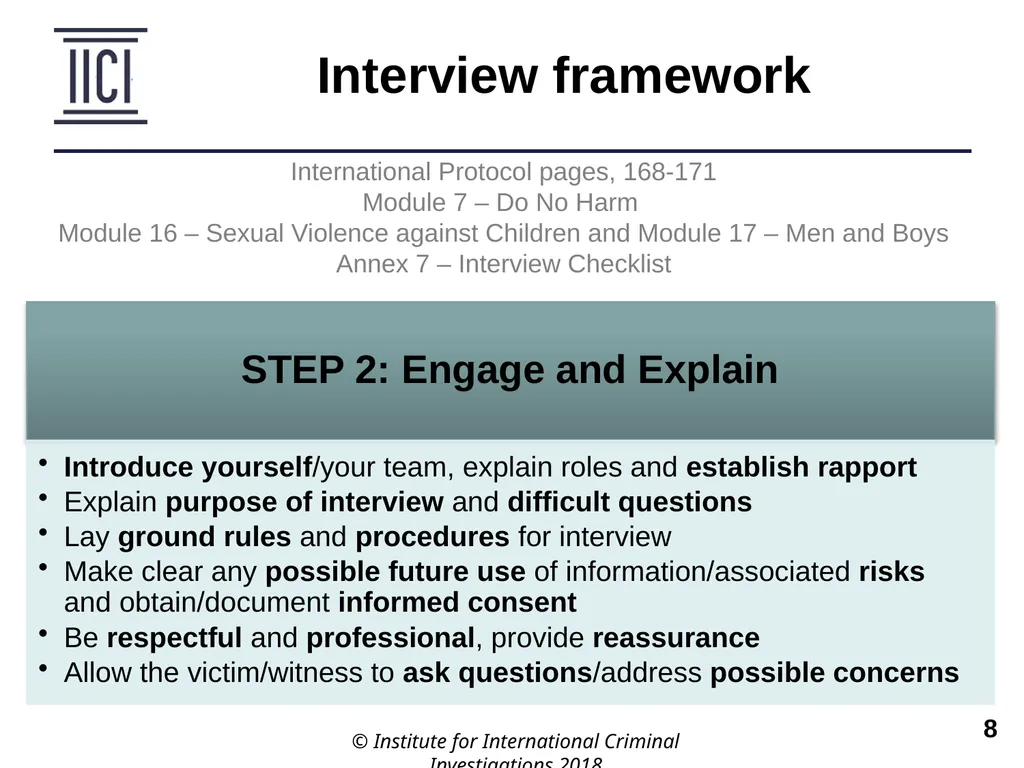
© Institute for International Criminal Investigations 2018 Interview framework 8 International Protocol pages, 168-171
Module 7 – Do No Harm
Module 16 – Sexual Violence against Children and Module 17 – Men and Boys
Annex 7 – Interview Checklist<br>
Module 7 – Do No Harm
Module 16 – Sexual Violence against Children and Module 17 – Men and Boys
Annex 7 – Interview Checklist<br>
09
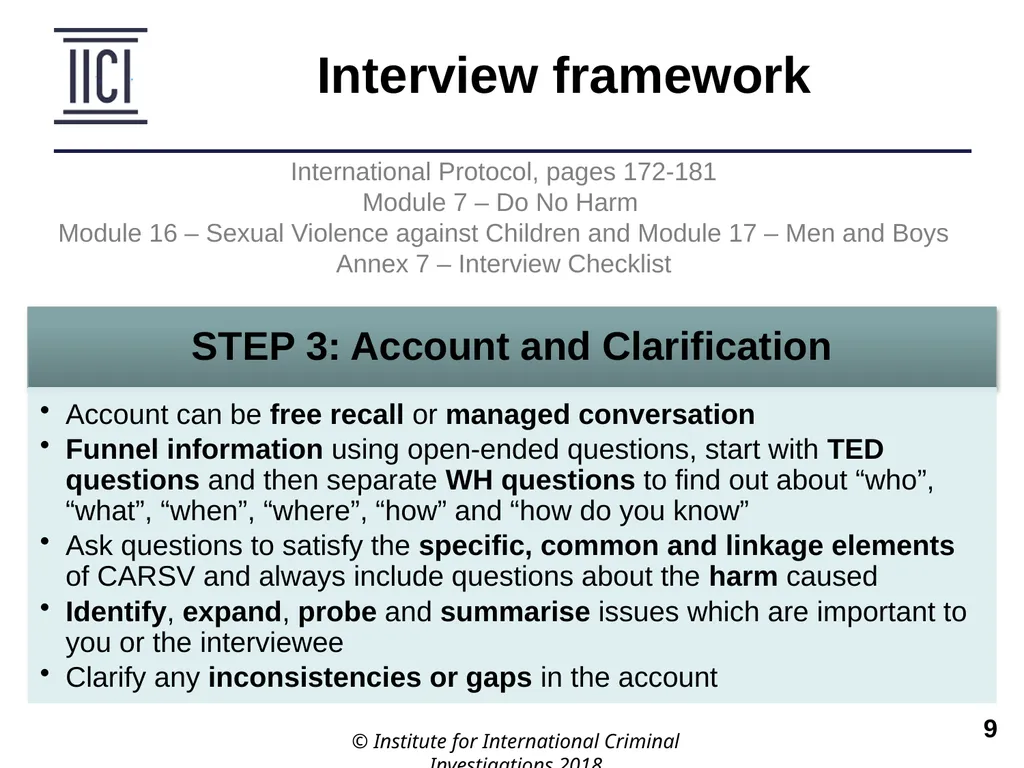
© Institute for International Criminal Investigations 2018 Interview framework 9 International Protocol, pages 172-181
Module 7 – Do No Harm
Module 16 – Sexual Violence against Children and Module 17 – Men and Boys
Annex 7 – Interview Checklist<br>
Module 7 – Do No Harm
Module 16 – Sexual Violence against Children and Module 17 – Men and Boys
Annex 7 – Interview Checklist<br>
10
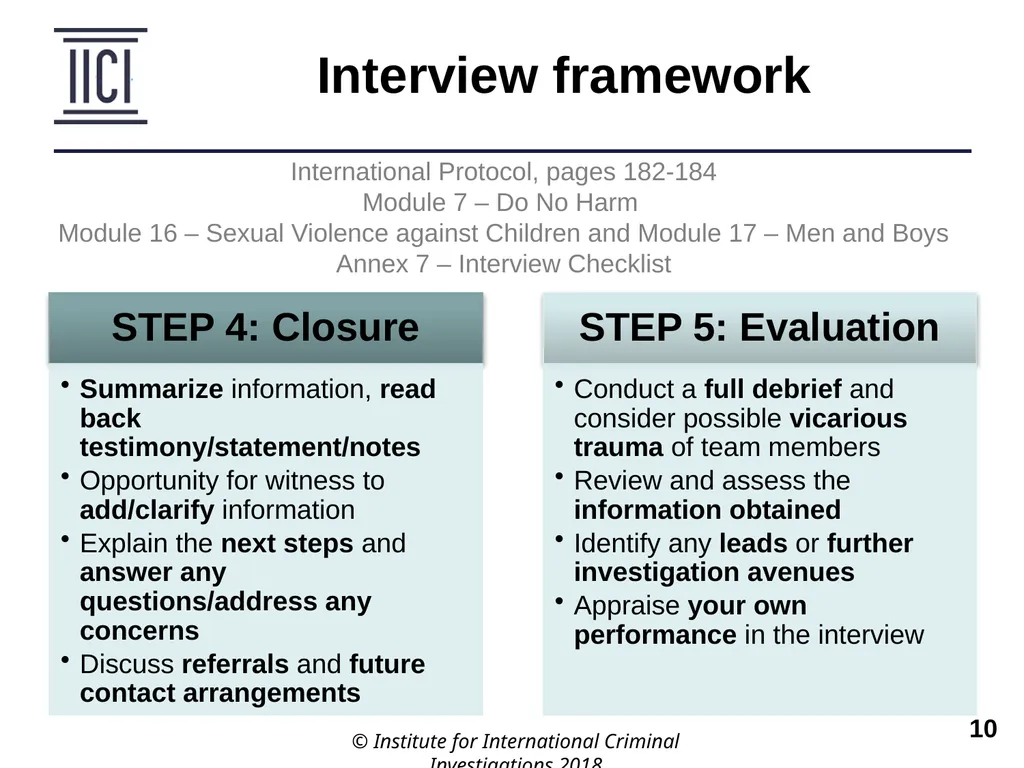
© Institute for International Criminal Investigations 2018 Interview framework 10 International Protocol, pages 182-184
Module 7 – Do No Harm
Module 16 – Sexual Violence against Children and Module 17 – Men and Boys
Annex 7 – Interview Checklist<br>
Module 7 – Do No Harm
Module 16 – Sexual Violence against Children and Module 17 – Men and Boys
Annex 7 – Interview Checklist<br>
11
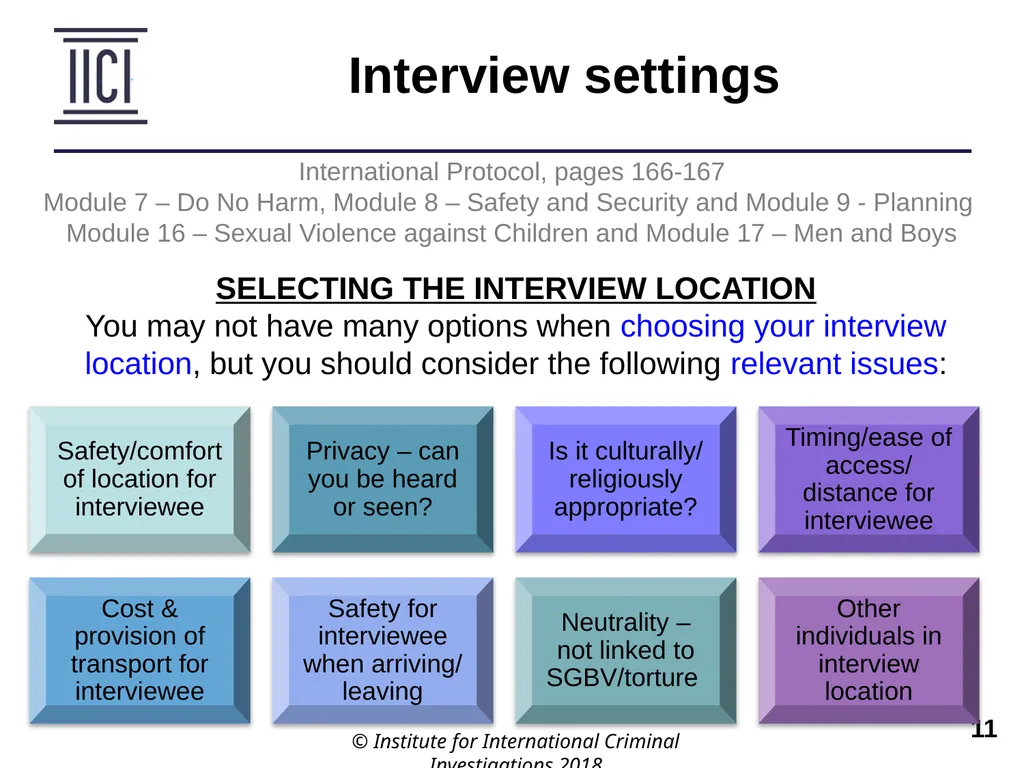
© Institute for International Criminal Investigations 2018 Interview settings 11 International Protocol, pages 166-167
Module 7 – Do No Harm, Module 8 – Safety and Security and Module 9 - Planning
Module 16 – Sexual Violence against Children and Module 17 – Men and Boys SELECTING THE INTERVIEW LOCATION
You may not have many options when choosing your interview location, but you should consider the following relevant issues:<br>
Module 7 – Do No Harm, Module 8 – Safety and Security and Module 9 - Planning
Module 16 – Sexual Violence against Children and Module 17 – Men and Boys SELECTING THE INTERVIEW LOCATION
You may not have many options when choosing your interview location, but you should consider the following relevant issues:<br>
12
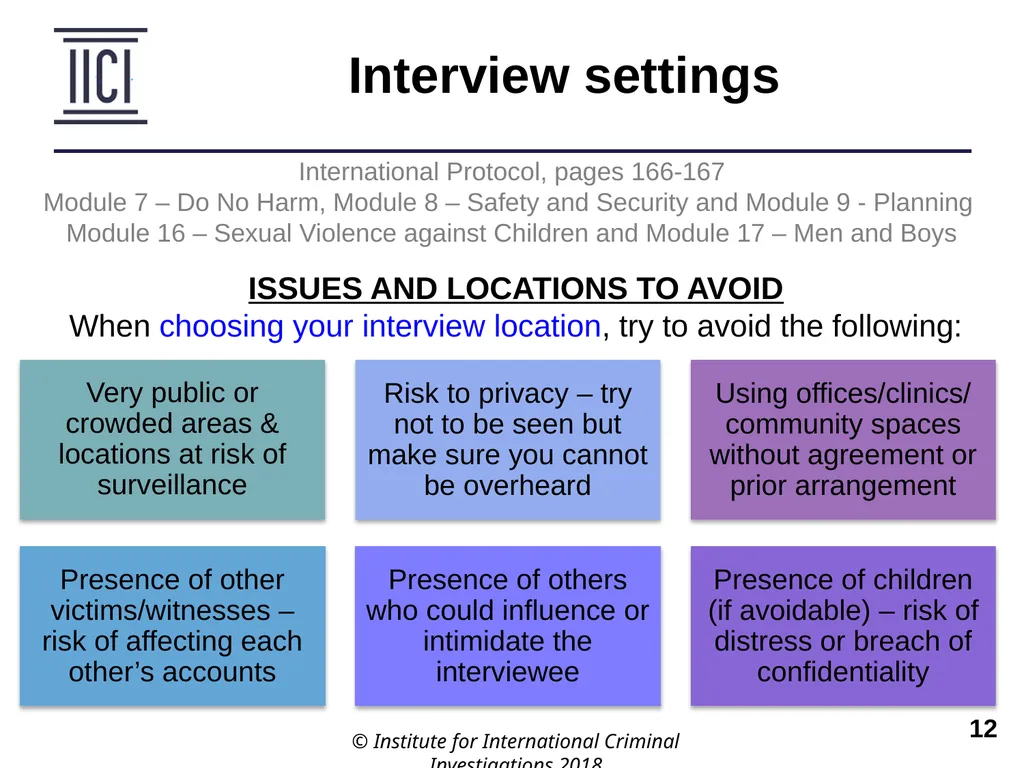
© Institute for International Criminal Investigations 2018 Interview settings 12 International Protocol, pages 166-167
Module 7 – Do No Harm, Module 8 – Safety and Security and Module 9 - Planning
Module 16 – Sexual Violence against Children and Module 17 – Men and Boys ISSUES AND LOCATIONS TO AVOID
When choosing your interview location, try to avoid the following:<br>
Module 7 – Do No Harm, Module 8 – Safety and Security and Module 9 - Planning
Module 16 – Sexual Violence against Children and Module 17 – Men and Boys ISSUES AND LOCATIONS TO AVOID
When choosing your interview location, try to avoid the following:<br>
13
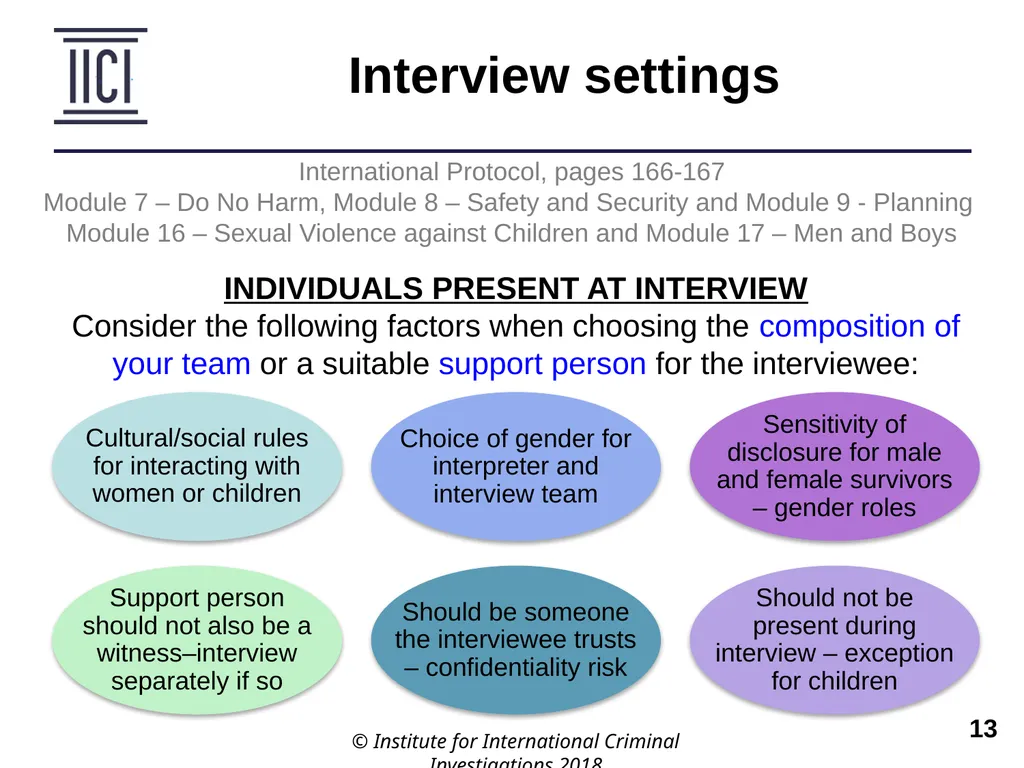
© Institute for International Criminal Investigations 2018 Interview settings 13 International Protocol, pages 166-167
Module 7 – Do No Harm, Module 8 – Safety and Security and Module 9 - Planning
Module 16 – Sexual Violence against Children and Module 17 – Men and Boys INDIVIDUALS PRESENT AT INTERVIEW
Consider the following factors when choosing the composition of your team or a suitable support person for the interviewee:<br>
Module 7 – Do No Harm, Module 8 – Safety and Security and Module 9 - Planning
Module 16 – Sexual Violence against Children and Module 17 – Men and Boys INDIVIDUALS PRESENT AT INTERVIEW
Consider the following factors when choosing the composition of your team or a suitable support person for the interviewee:<br>
14
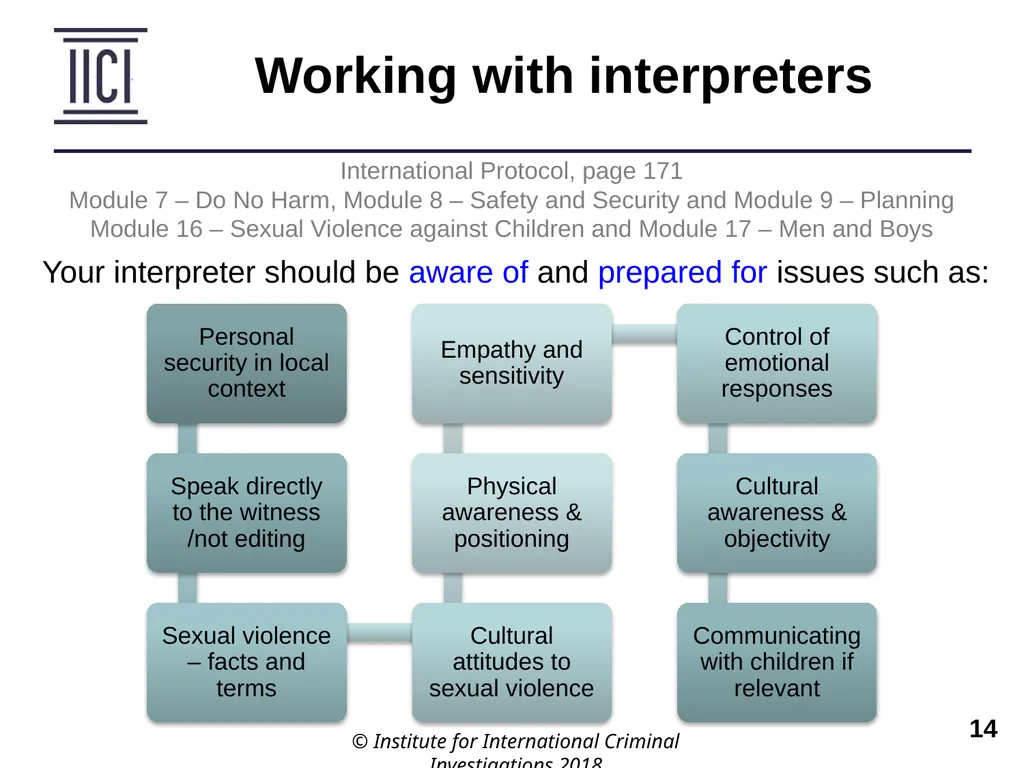
© Institute for International Criminal Investigations 2018 Working with interpreters 14 International Protocol, page 171
Module 7 – Do No Harm, Module 8 – Safety and Security and Module 9 – Planning
Module 16 – Sexual Violence against Children and Module 17 – Men and Boys Your interpreter should be aware of and prepared for issues such as:<br>
Module 7 – Do No Harm, Module 8 – Safety and Security and Module 9 – Planning
Module 16 – Sexual Violence against Children and Module 17 – Men and Boys Your interpreter should be aware of and prepared for issues such as:<br>
15
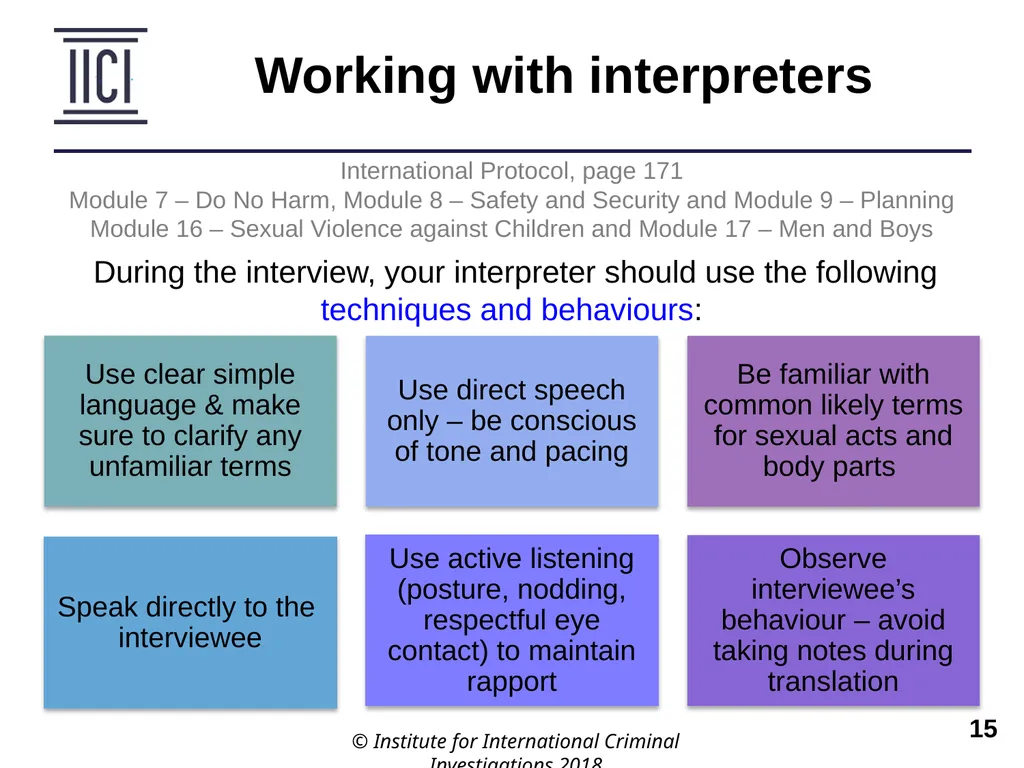
© Institute for International Criminal Investigations 2018 Working with interpreters 15 International Protocol, page 171
Module 7 – Do No Harm, Module 8 – Safety and Security and Module 9 – Planning
Module 16 – Sexual Violence against Children and Module 17 – Men and Boys During the interview, your interpreter should use the following techniques and behaviours:<br>
Module 7 – Do No Harm, Module 8 – Safety and Security and Module 9 – Planning
Module 16 – Sexual Violence against Children and Module 17 – Men and Boys During the interview, your interpreter should use the following techniques and behaviours:<br>
16
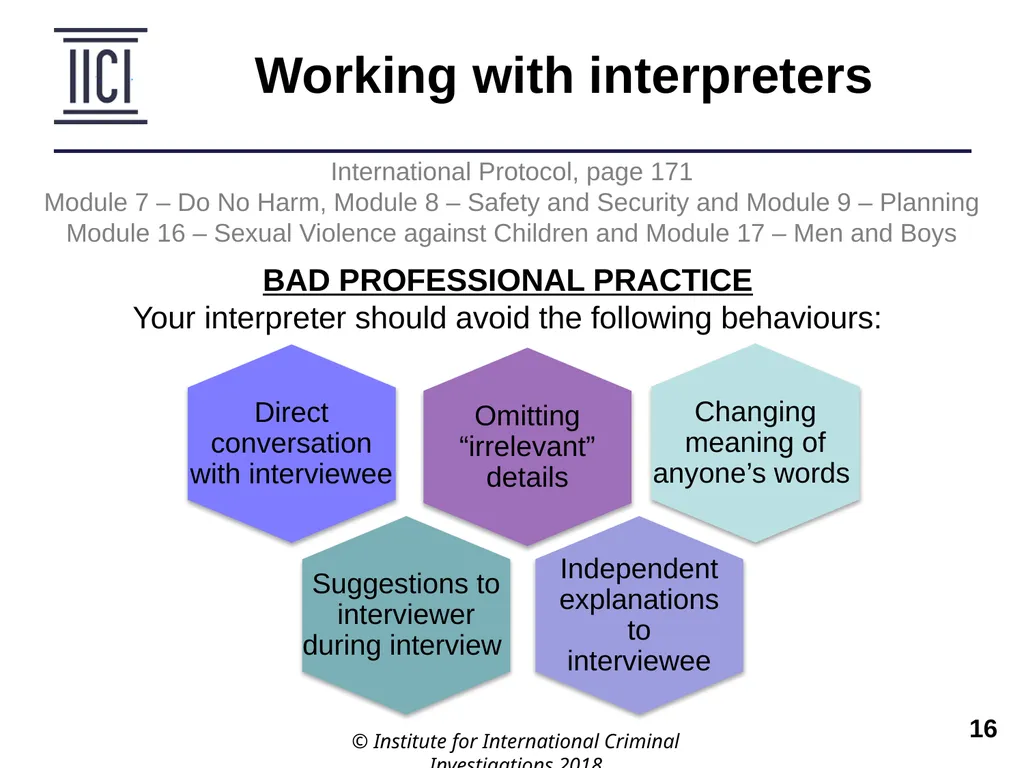
© Institute for International Criminal Investigations 2018 Working with interpreters 16 International Protocol, page 171
Module 7 – Do No Harm, Module 8 – Safety and Security and Module 9 – Planning
Module 16 – Sexual Violence against Children and Module 17 – Men and Boys BAD PROFESSIONAL PRACTICE
Your interpreter should avoid the following behaviours:<br>
Module 7 – Do No Harm, Module 8 – Safety and Security and Module 9 – Planning
Module 16 – Sexual Violence against Children and Module 17 – Men and Boys BAD PROFESSIONAL PRACTICE
Your interpreter should avoid the following behaviours:<br>
17
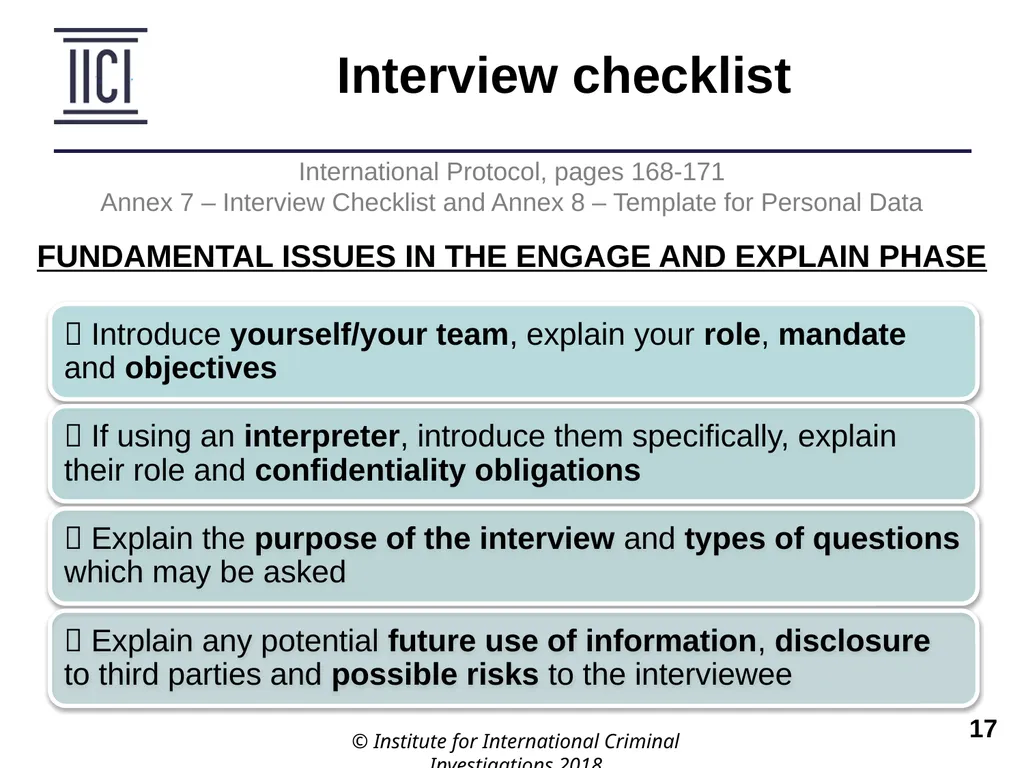
© Institute for International Criminal Investigations 2018 Interview checklist 17 International Protocol, pages 168-171
Annex 7 – Interview Checklist and Annex 8 – Template for Personal Data FUNDAMENTAL ISSUES IN THE ENGAGE AND EXPLAIN PHASE<br>
Annex 7 – Interview Checklist and Annex 8 – Template for Personal Data FUNDAMENTAL ISSUES IN THE ENGAGE AND EXPLAIN PHASE<br>
18
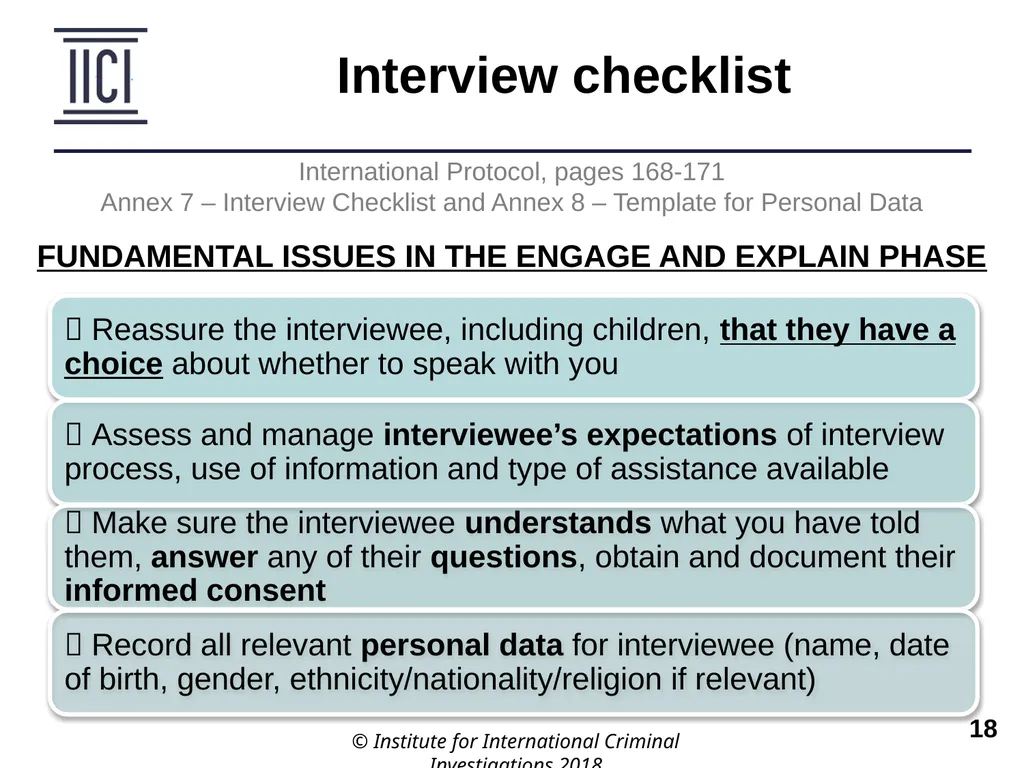
© Institute for International Criminal Investigations 2018 Interview checklist 18 International Protocol, pages 168-171
Annex 7 – Interview Checklist and Annex 8 – Template for Personal Data FUNDAMENTAL ISSUES IN THE ENGAGE AND EXPLAIN PHASE<br>
Annex 7 – Interview Checklist and Annex 8 – Template for Personal Data FUNDAMENTAL ISSUES IN THE ENGAGE AND EXPLAIN PHASE<br>
19
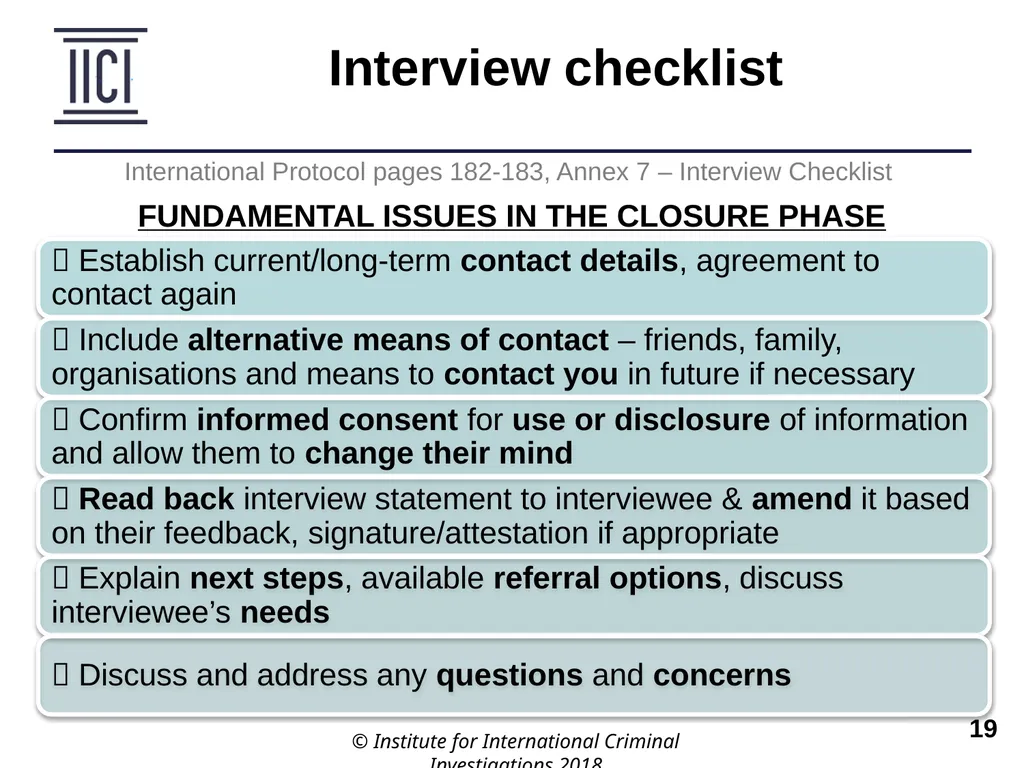
© Institute for International Criminal Investigations 2018 Interview checklist 19 International Protocol pages 182-183, Annex 7 – Interview Checklist FUNDAMENTAL ISSUES IN THE CLOSURE PHASE<br>
20
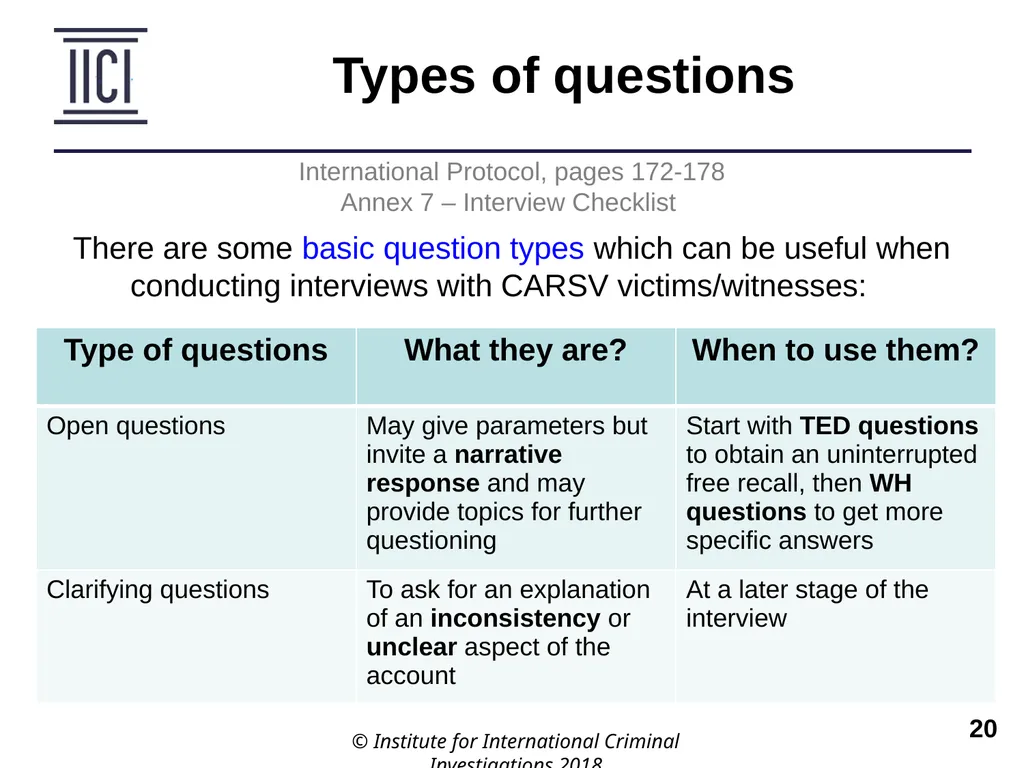
© Institute for International Criminal Investigations 2018 Types of questions 20 International Protocol, pages 172-178
Annex 7 – Interview Checklist There are some basic question types which can be useful when conducting interviews with CARSV victims/witnesses:<br>
Annex 7 – Interview Checklist There are some basic question types which can be useful when conducting interviews with CARSV victims/witnesses:<br>
21
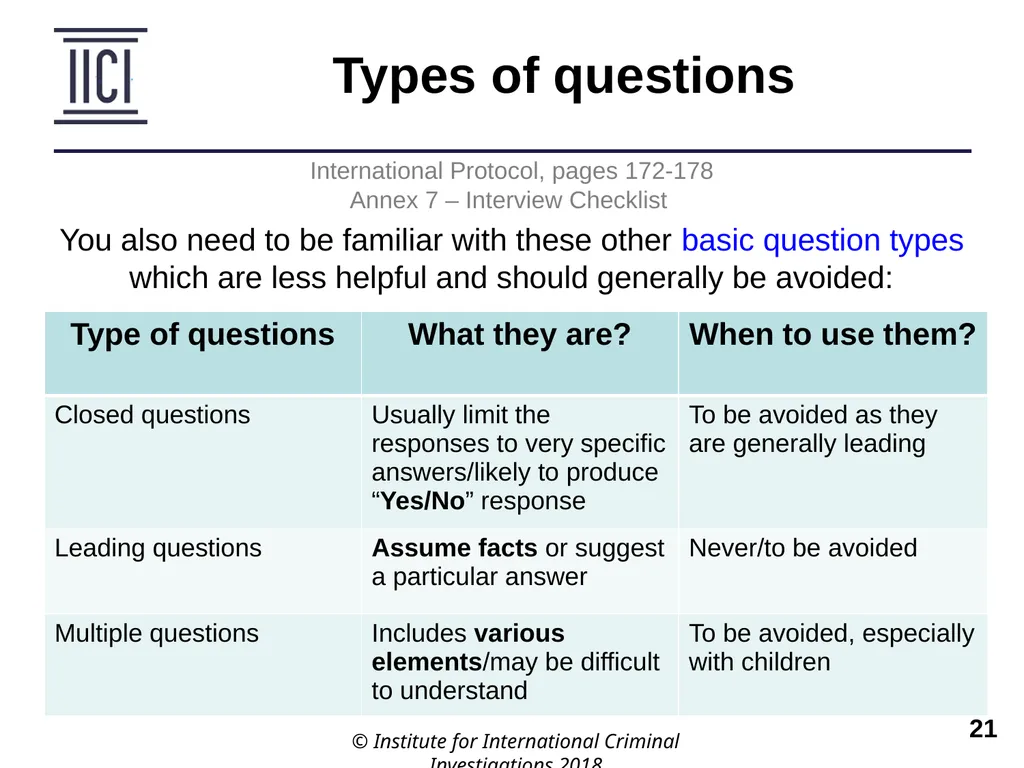
© Institute for International Criminal Investigations 2018 Types of questions 21 International Protocol, pages 172-178
Annex 7 – Interview Checklist You also need to be familiar with these other basic question types which are less helpful and should generally be avoided:<br>
Annex 7 – Interview Checklist You also need to be familiar with these other basic question types which are less helpful and should generally be avoided:<br>
22
© Institute for International Criminal Investigations 2018 Types of questions 22 International Protocol, pages 172-178
Module 4 – Individual Criminal Responsibility and Module 5 – State Responsibility
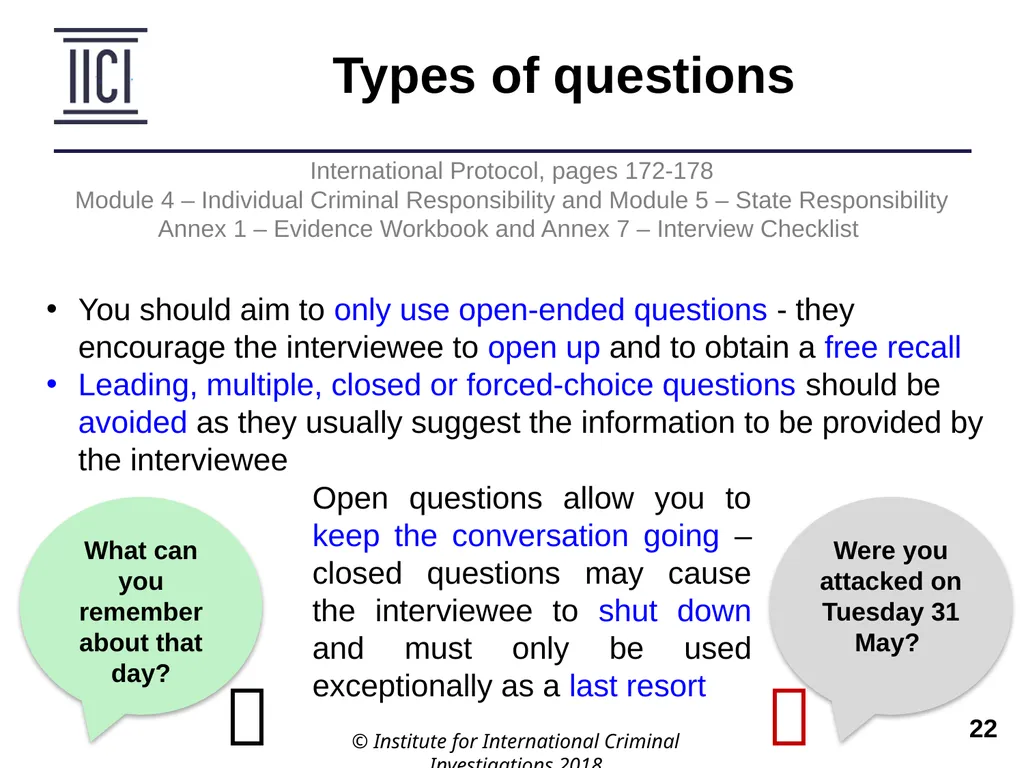
Annex 1 – Evidence Workbook and Annex 7 – Interview Checklist You should aim to only use open-ended questions - they encourage the interviewee to open up and to obtain a free recall
Leading, multiple, closed or forced-choice questions should be avoided as they usually suggest the information to be provided by the interviewee What can you remember about that day? Were you attacked on Tuesday 31 May? Open questions allow you to keep the conversation going – closed questions may cause the interviewee to shut down and must only be used exceptionally as a last resort<br>
Module 4 – Individual Criminal Responsibility and Module 5 – State Responsibility
Annex 1 – Evidence Workbook and Annex 7 – Interview Checklist You should aim to only use open-ended questions - they encourage the interviewee to open up and to obtain a free recall
Leading, multiple, closed or forced-choice questions should be avoided as they usually suggest the information to be provided by the interviewee What can you remember about that day? Were you attacked on Tuesday 31 May? Open questions allow you to keep the conversation going – closed questions may cause the interviewee to shut down and must only be used exceptionally as a last resort<br>
23
© Institute for International Criminal Investigations 2018 Types of questions 23 International Protocol, pages 172-178
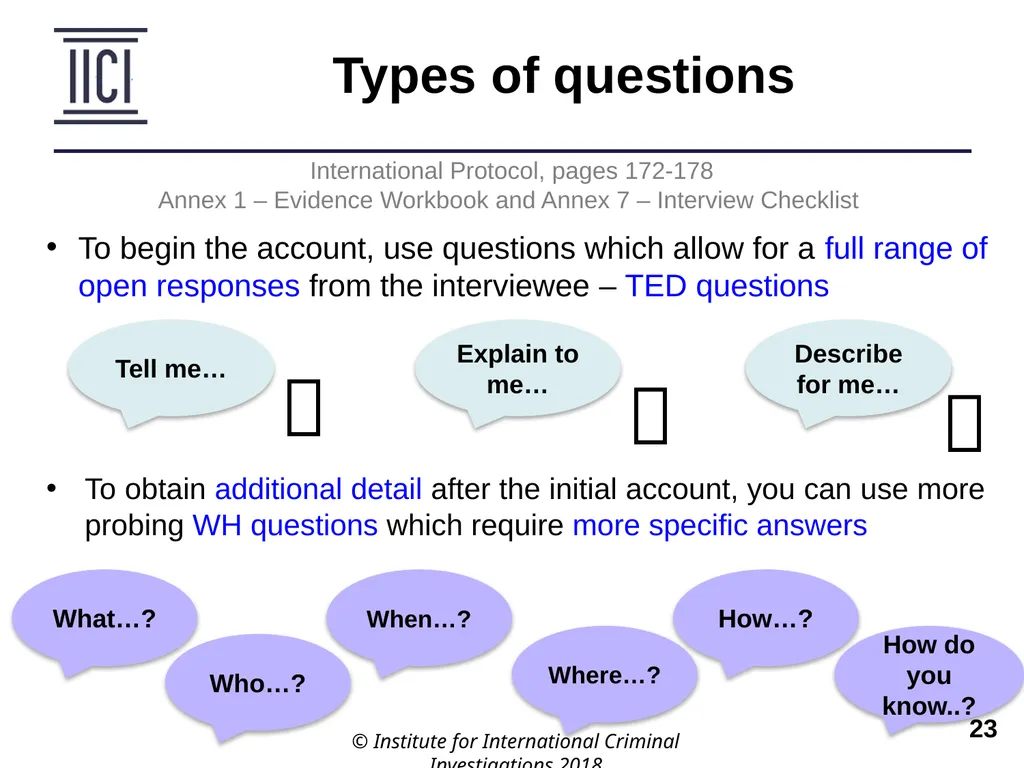
Annex 1 – Evidence Workbook and Annex 7 – Interview Checklist To begin the account, use questions which allow for a full range of open responses from the interviewee – TED questions Tell me… Explain to me… Describe for me… To obtain additional detail after the initial account, you can use more probing WH questions which require more specific answers What…? Who…? When…? Where…? How…? How do you know..? <br>
Annex 1 – Evidence Workbook and Annex 7 – Interview Checklist To begin the account, use questions which allow for a full range of open responses from the interviewee – TED questions Tell me… Explain to me… Describe for me… To obtain additional detail after the initial account, you can use more probing WH questions which require more specific answers What…? Who…? When…? Where…? How…? How do you know..? <br>
24
© Institute for International Criminal Investigations 2018 Types of questions 24 International Protocol, pages 172-178
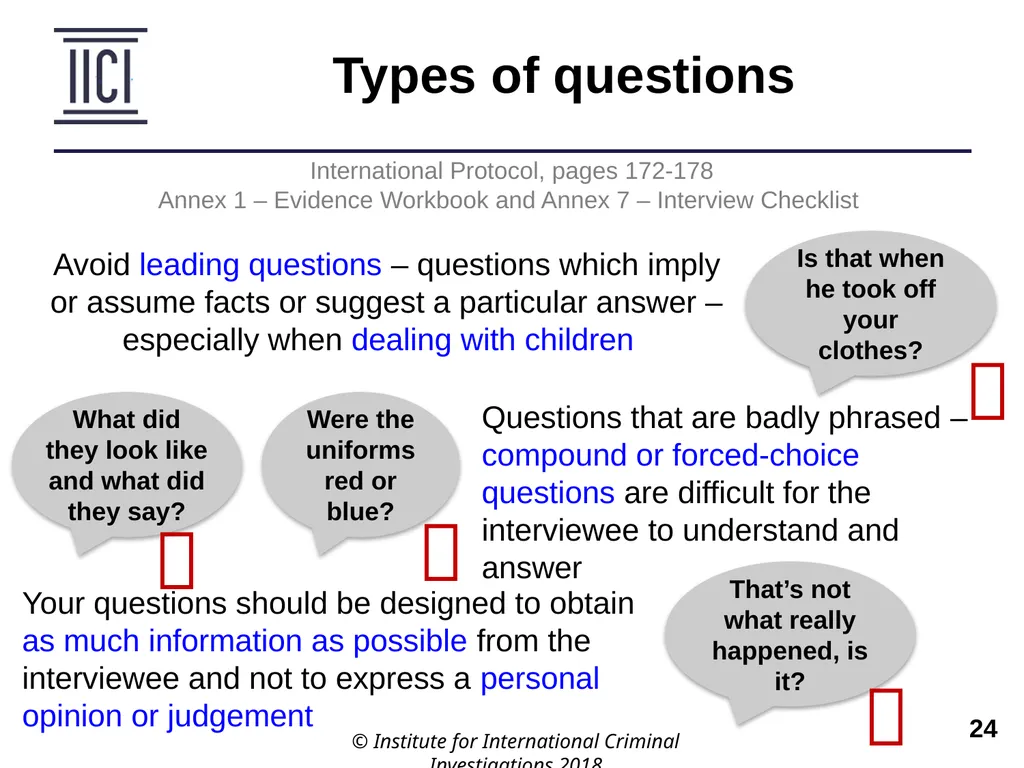
Annex 1 – Evidence Workbook and Annex 7 – Interview Checklist Avoid leading questions – questions which imply or assume facts or suggest a particular answer – especially when dealing with children Is that when he took off your clothes? What did they look like and what did they say? Were the uniforms red or blue? That’s not what really happened, is it? Questions that are badly phrased – compound or forced-choice questions are difficult for the interviewee to understand and answer Your questions should be designed to obtain as much information as possible from the interviewee and not to express a personal opinion or judgement<br>
Annex 1 – Evidence Workbook and Annex 7 – Interview Checklist Avoid leading questions – questions which imply or assume facts or suggest a particular answer – especially when dealing with children Is that when he took off your clothes? What did they look like and what did they say? Were the uniforms red or blue? That’s not what really happened, is it? Questions that are badly phrased – compound or forced-choice questions are difficult for the interviewee to understand and answer Your questions should be designed to obtain as much information as possible from the interviewee and not to express a personal opinion or judgement<br>
25
© Institute for International Criminal Investigations 2018 Subject areas for questions 25 International Protocol, pages 176-178
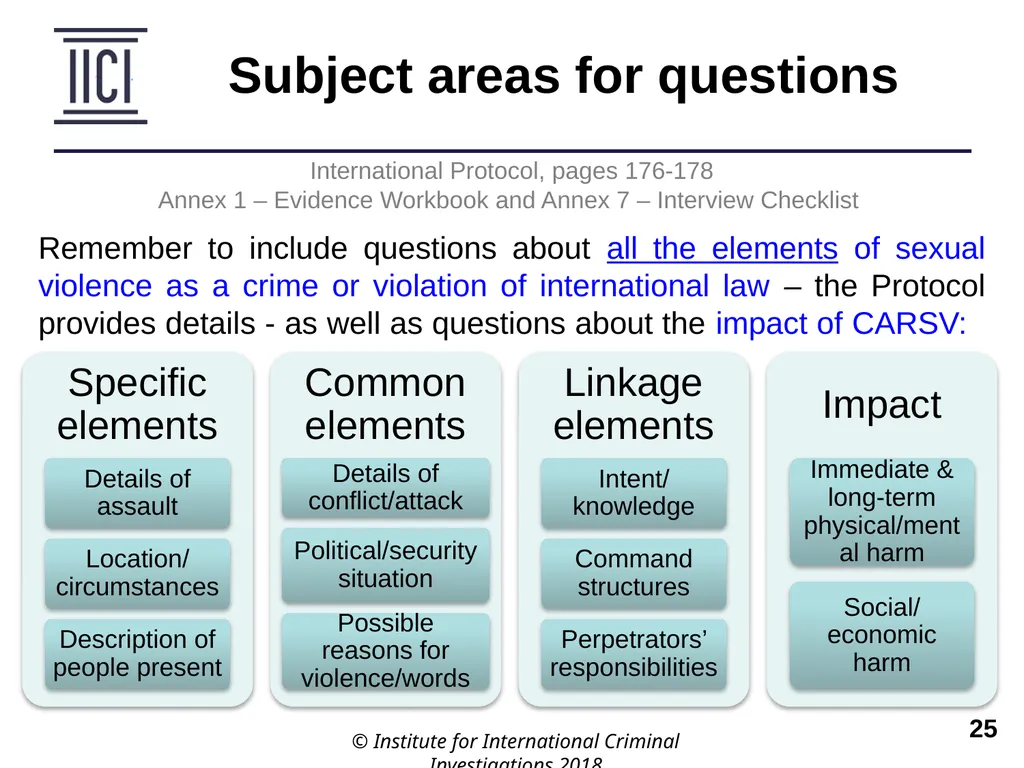
Annex 1 – Evidence Workbook and Annex 7 – Interview Checklist Remember to include questions about all the elements of sexual violence as a crime or violation of international law – the Protocol provides details - as well as questions about the impact of CARSV:<br>
Annex 1 – Evidence Workbook and Annex 7 – Interview Checklist Remember to include questions about all the elements of sexual violence as a crime or violation of international law – the Protocol provides details - as well as questions about the impact of CARSV:<br>
26
© Institute for International Criminal Investigations 2018 Subject areas for questions 26 International Protocol, pages 176-178
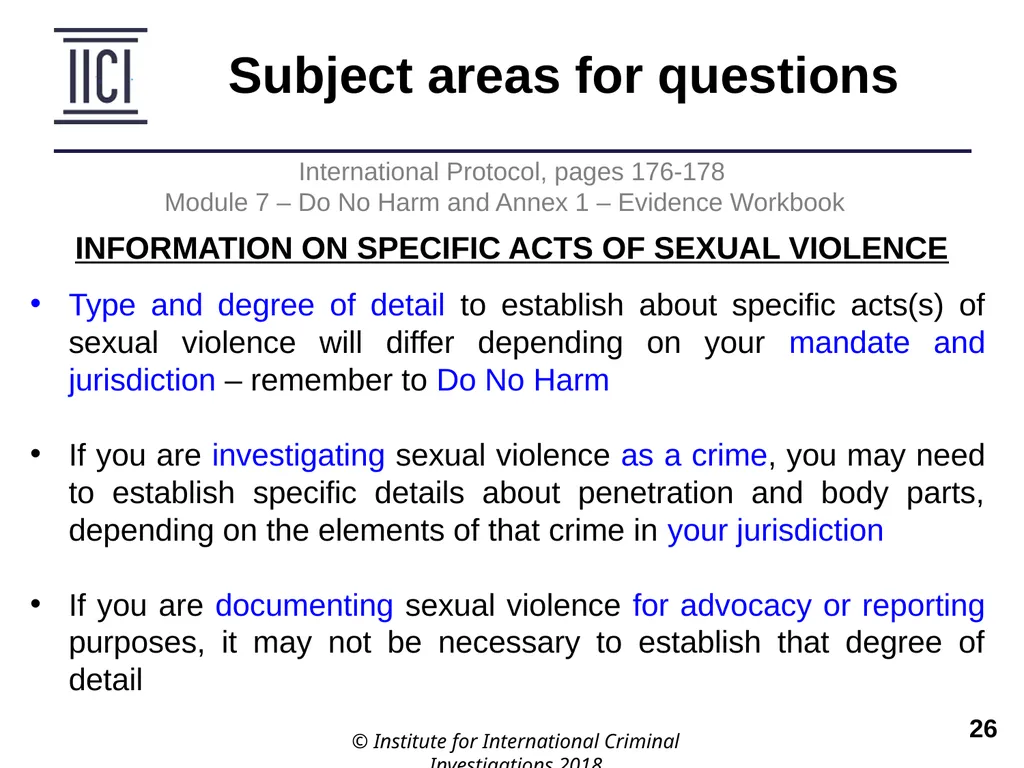
Module 7 – Do No Harm and Annex 1 – Evidence Workbook INFORMATION ON SPECIFIC ACTS OF SEXUAL VIOLENCE Type and degree of detail to establish about specific acts(s) of sexual violence will differ depending on your mandate and jurisdiction – remember to Do No Harm
If you are investigating sexual violence as a crime, you may need to establish specific details about penetration and body parts, depending on the elements of that crime in your jurisdiction
If you are documenting sexual violence for advocacy or reporting purposes, it may not be necessary to establish that degree of detail<br>
Module 7 – Do No Harm and Annex 1 – Evidence Workbook INFORMATION ON SPECIFIC ACTS OF SEXUAL VIOLENCE Type and degree of detail to establish about specific acts(s) of sexual violence will differ depending on your mandate and jurisdiction – remember to Do No Harm
If you are investigating sexual violence as a crime, you may need to establish specific details about penetration and body parts, depending on the elements of that crime in your jurisdiction
If you are documenting sexual violence for advocacy or reporting purposes, it may not be necessary to establish that degree of detail<br>
27
© Institute for International Criminal Investigations 2018 Interviewing techniques 27 International Protocol, pages 178-181 and Annex 7 – Interview Checklist
Module 7 – Do No Harm and Module 9 – Planning Employing the right techniques and behaviour is critical to the success of any interview – you must create a rapport and an atmosphere in which the interviewee feels comfortable enough to share their story – if they trust/like you, they will be more comfortable speaking with you
Be confident, professional and polite, assure the interviewee of your competence and discretion – take a patient and relaxed approach and be prepared to spend as much time as necessary
The interviewee should feel respected, supported and in control – they should be given a clear choice about whether to speak about what happened to them and be empowered to cooperate<br>
Module 7 – Do No Harm and Module 9 – Planning Employing the right techniques and behaviour is critical to the success of any interview – you must create a rapport and an atmosphere in which the interviewee feels comfortable enough to share their story – if they trust/like you, they will be more comfortable speaking with you
Be confident, professional and polite, assure the interviewee of your competence and discretion – take a patient and relaxed approach and be prepared to spend as much time as necessary
The interviewee should feel respected, supported and in control – they should be given a clear choice about whether to speak about what happened to them and be empowered to cooperate<br>
28
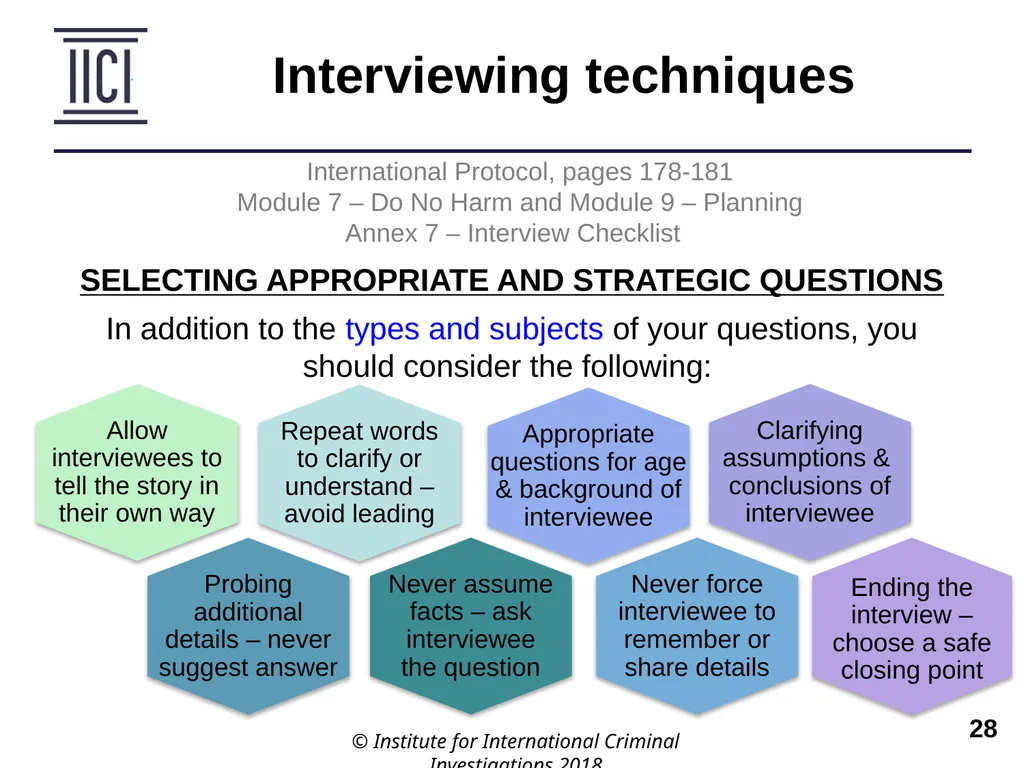
© Institute for International Criminal Investigations 2018 Interviewing techniques 28 International Protocol, pages 178-181
Module 7 – Do No Harm and Module 9 – Planning
Annex 7 – Interview Checklist SELECTING APPROPRIATE AND STRATEGIC QUESTIONS In addition to the types and subjects of your questions, you should consider the following:<br>
Module 7 – Do No Harm and Module 9 – Planning
Annex 7 – Interview Checklist SELECTING APPROPRIATE AND STRATEGIC QUESTIONS In addition to the types and subjects of your questions, you should consider the following:<br>
29
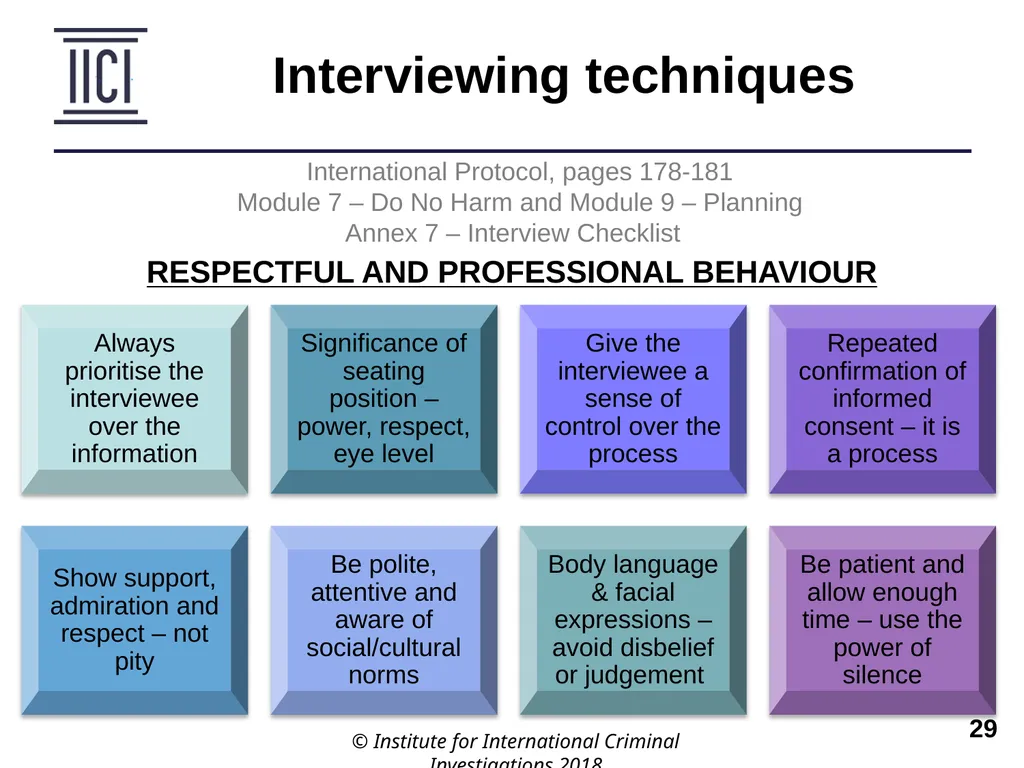
© Institute for International Criminal Investigations 2018 Interviewing techniques 29 International Protocol, pages 178-181
Module 7 – Do No Harm and Module 9 – Planning
Annex 7 – Interview Checklist RESPECTFUL AND PROFESSIONAL BEHAVIOUR<br>
Module 7 – Do No Harm and Module 9 – Planning
Annex 7 – Interview Checklist RESPECTFUL AND PROFESSIONAL BEHAVIOUR<br>
30
Training Materials on the International Protocol
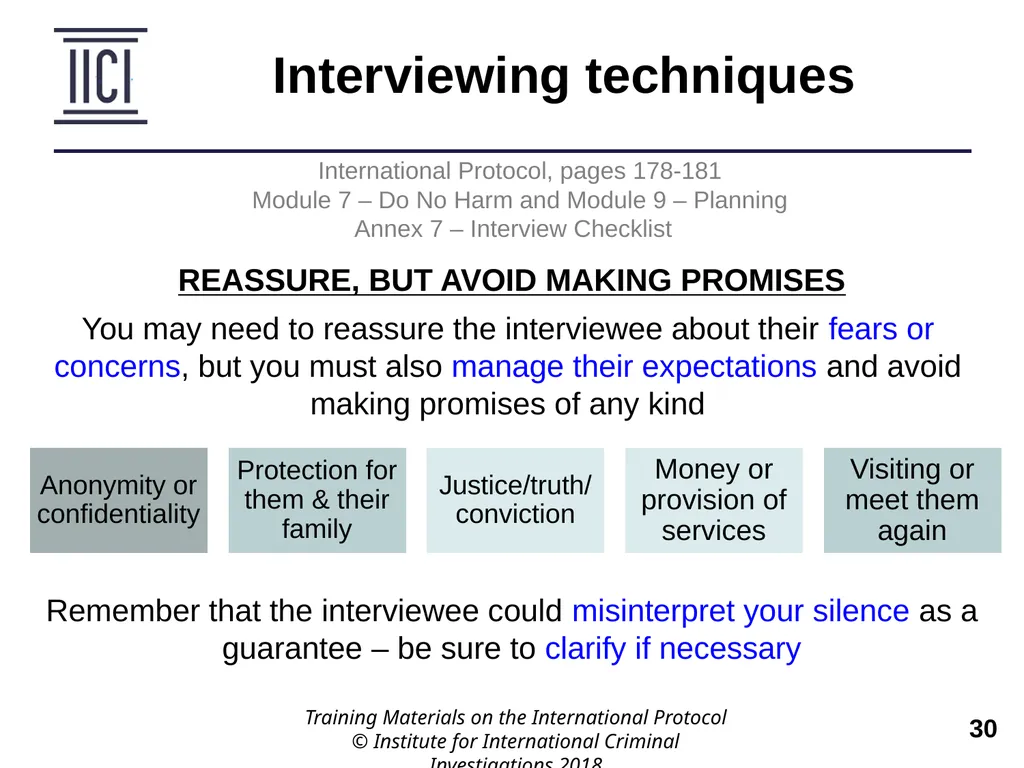
© Institute for International Criminal Investigations 2018 Interviewing techniques 30 International Protocol, pages 178-181
Module 7 – Do No Harm and Module 9 – Planning
Annex 7 – Interview Checklist REASSURE, BUT AVOID MAKING PROMISES You may need to reassure the interviewee about their fears or concerns, but you must also manage their expectations and avoid making promises of any kind Remember that the interviewee could misinterpret your silence as a guarantee – be sure to clarify if necessary<br>
© Institute for International Criminal Investigations 2018 Interviewing techniques 30 International Protocol, pages 178-181
Module 7 – Do No Harm and Module 9 – Planning
Annex 7 – Interview Checklist REASSURE, BUT AVOID MAKING PROMISES You may need to reassure the interviewee about their fears or concerns, but you must also manage their expectations and avoid making promises of any kind Remember that the interviewee could misinterpret your silence as a guarantee – be sure to clarify if necessary<br>
31
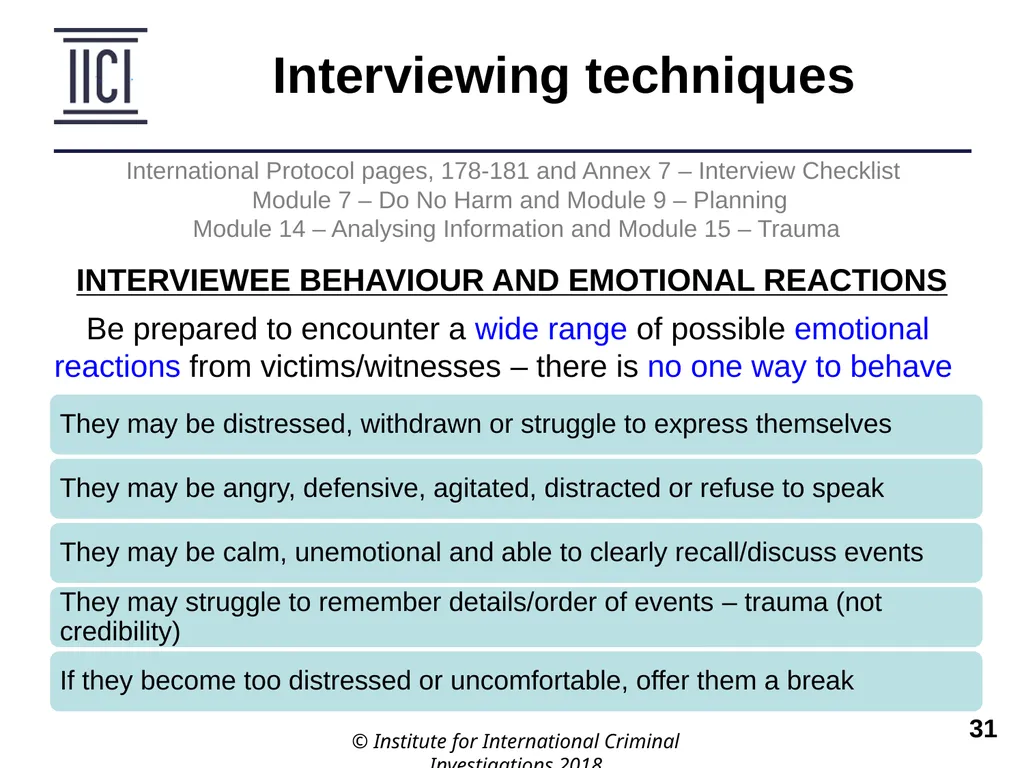
© Institute for International Criminal Investigations 2018 Interviewing techniques 31 International Protocol pages, 178-181 and Annex 7 – Interview Checklist
Module 7 – Do No Harm and Module 9 – Planning
Module 14 – Analysing Information and Module 15 – Trauma INTERVIEWEE BEHAVIOUR AND EMOTIONAL REACTIONS Be prepared to encounter a wide range of possible emotional reactions from victims/witnesses – there is no one way to behave<br>
Module 7 – Do No Harm and Module 9 – Planning
Module 14 – Analysing Information and Module 15 – Trauma INTERVIEWEE BEHAVIOUR AND EMOTIONAL REACTIONS Be prepared to encounter a wide range of possible emotional reactions from victims/witnesses – there is no one way to behave<br>
32
© Institute for International Criminal Investigations 2018 Interviewing techniques 32 International Protocol pages, 178-181 and Annex 7 – Interview Checklist
Module 2 – Understanding Sexual Violence and Module 7 – Do No Harm
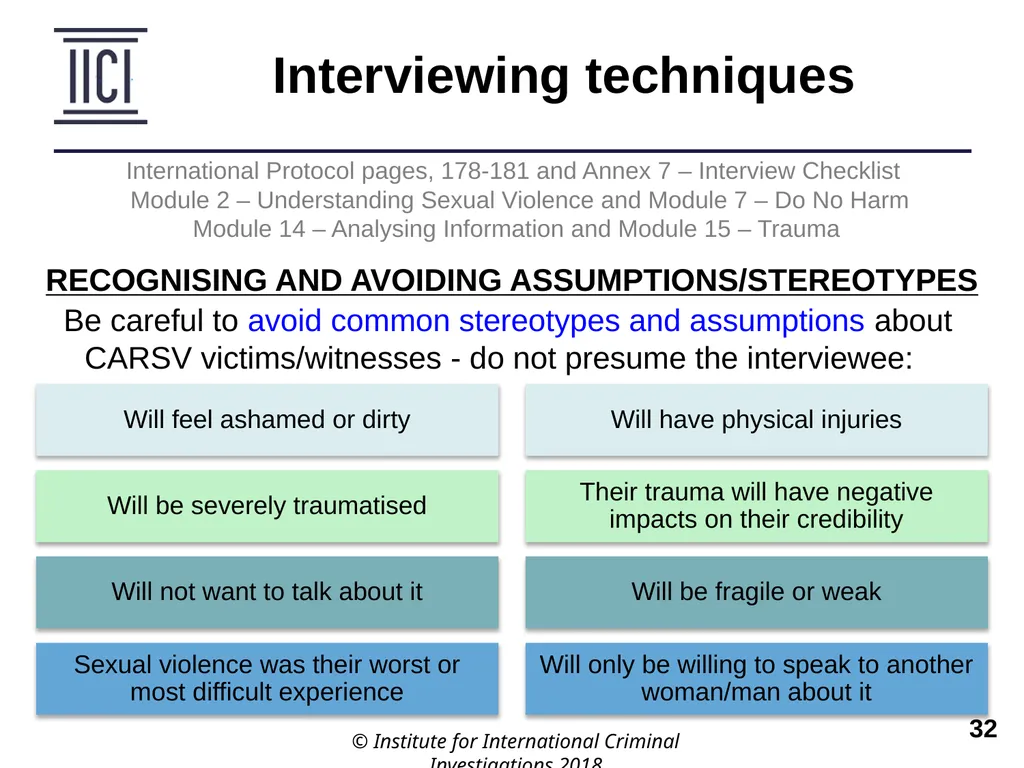
Module 14 – Analysing Information and Module 15 – Trauma RECOGNISING AND AVOIDING ASSUMPTIONS/STEREOTYPES Be careful to avoid common stereotypes and assumptions about CARSV victims/witnesses - do not presume the interviewee:<br>
Module 2 – Understanding Sexual Violence and Module 7 – Do No Harm
Module 14 – Analysing Information and Module 15 – Trauma RECOGNISING AND AVOIDING ASSUMPTIONS/STEREOTYPES Be careful to avoid common stereotypes and assumptions about CARSV victims/witnesses - do not presume the interviewee:<br>
33
© Institute for International Criminal Investigations 2018 Recording interview information 33 International Protocol, page 185
Module 7 – Do No Harm and Module 8 - Safety and Security
Module 9 – Planning and Module 13 – Storing and Handling Information
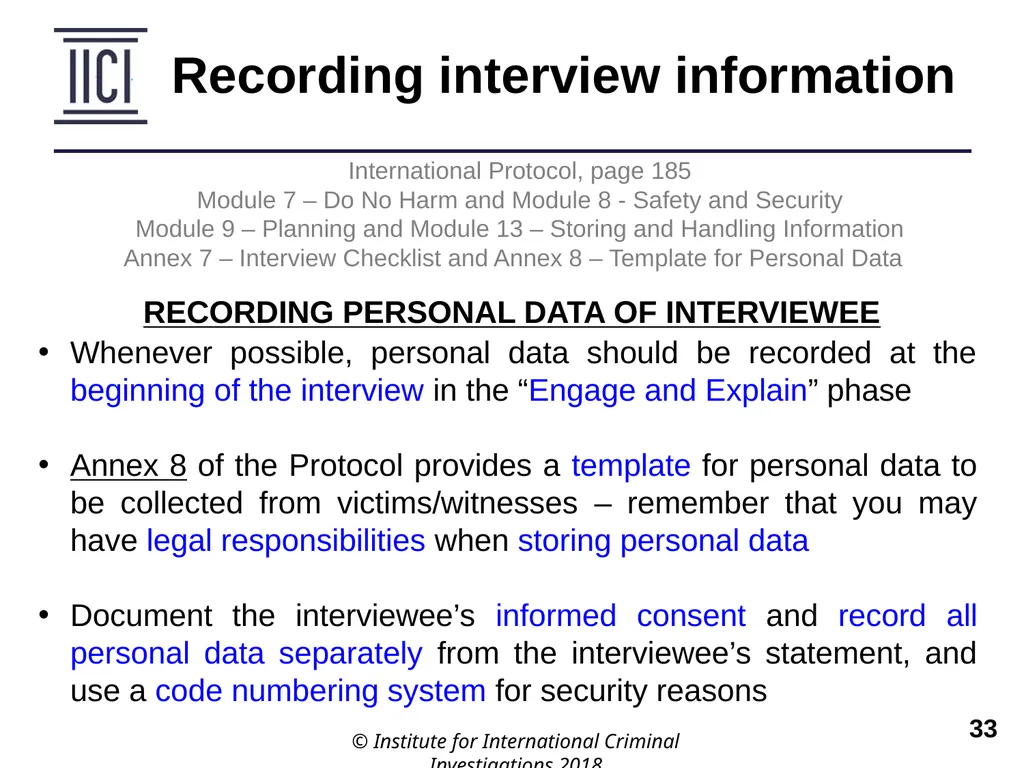
Annex 7 – Interview Checklist and Annex 8 – Template for Personal Data RECORDING PERSONAL DATA OF INTERVIEWEE Whenever possible, personal data should be recorded at the beginning of the interview in the “Engage and Explain” phase
Annex 8 of the Protocol provides a template for personal data to be collected from victims/witnesses – remember that you may have legal responsibilities when storing personal data
Document the interviewee’s informed consent and record all personal data separately from the interviewee’s statement, and use a code numbering system for security reasons<br>
Module 7 – Do No Harm and Module 8 - Safety and Security
Module 9 – Planning and Module 13 – Storing and Handling Information
Annex 7 – Interview Checklist and Annex 8 – Template for Personal Data RECORDING PERSONAL DATA OF INTERVIEWEE Whenever possible, personal data should be recorded at the beginning of the interview in the “Engage and Explain” phase
Annex 8 of the Protocol provides a template for personal data to be collected from victims/witnesses – remember that you may have legal responsibilities when storing personal data
Document the interviewee’s informed consent and record all personal data separately from the interviewee’s statement, and use a code numbering system for security reasons<br>
34
Training Materials on the International Protocol
© Institute for International Criminal Investigations 2018 Recording interview information 34 International Protocol, page 185
Module 7 – Do No Harm and Module 8 - Safety and Security
Module 9 – Planning and Module 13 – Storing and Handling Information
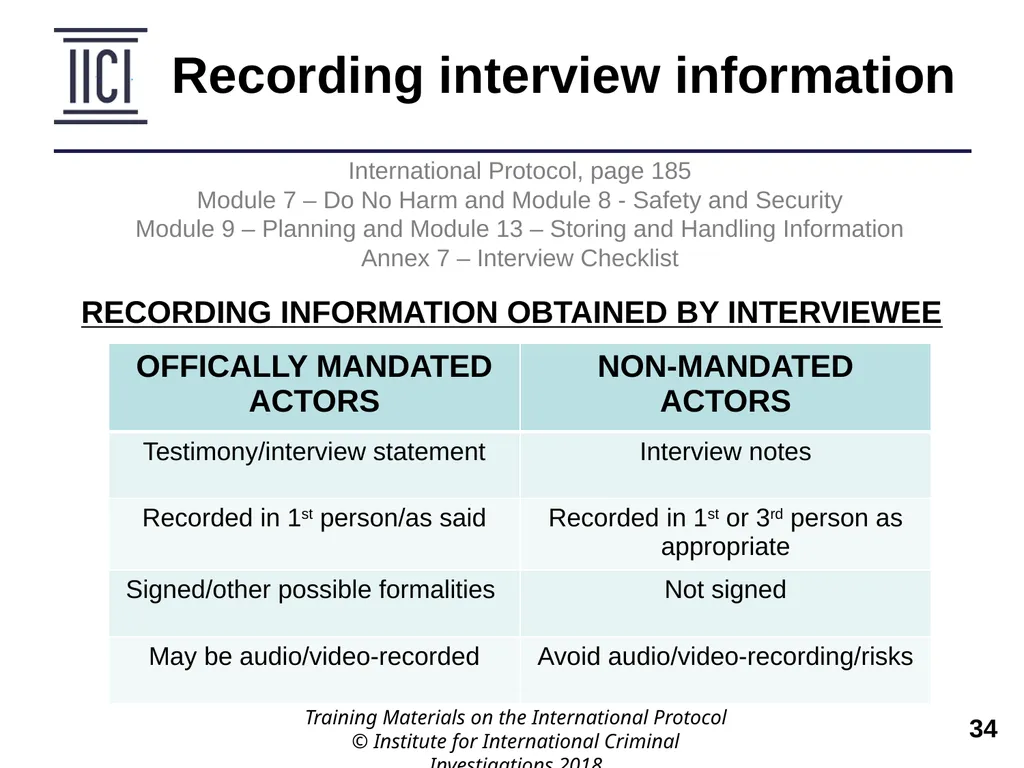
Annex 7 – Interview Checklist RECORDING INFORMATION OBTAINED BY INTERVIEWEE<br>
© Institute for International Criminal Investigations 2018 Recording interview information 34 International Protocol, page 185
Module 7 – Do No Harm and Module 8 - Safety and Security
Module 9 – Planning and Module 13 – Storing and Handling Information
Annex 7 – Interview Checklist RECORDING INFORMATION OBTAINED BY INTERVIEWEE<br>
35
Training Materials on the International Protocol
© Institute for International Criminal Investigations 2018 Recording interview information 35 International Protocol, page 185
Module 7 – Do No Harm and Module 8 - Safety and Security
Module 9 – Planning and Module 13 – Storing and Handling Information
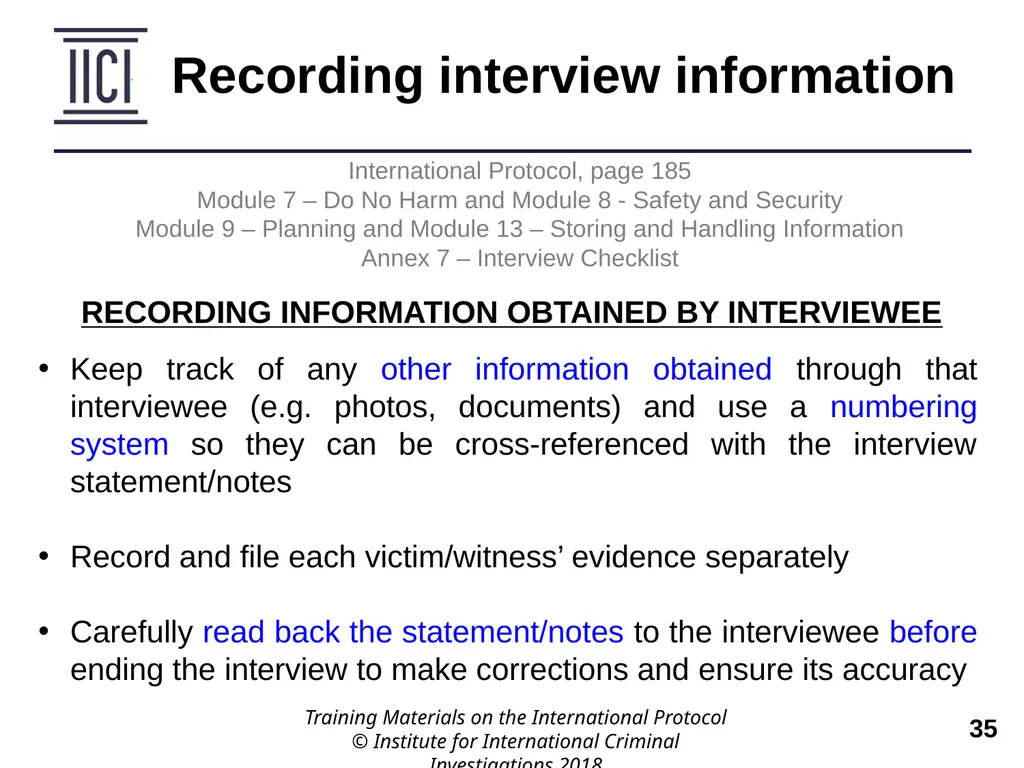
Annex 7 – Interview Checklist RECORDING INFORMATION OBTAINED BY INTERVIEWEE Keep track of any other information obtained through that interviewee (e.g. photos, documents) and use a numbering system so they can be cross-referenced with the interview statement/notes
Record and file each victim/witness’ evidence separately
Carefully read back the statement/notes to the interviewee before ending the interview to make corrections and ensure its accuracy<br>
© Institute for International Criminal Investigations 2018 Recording interview information 35 International Protocol, page 185
Module 7 – Do No Harm and Module 8 - Safety and Security
Module 9 – Planning and Module 13 – Storing and Handling Information
Annex 7 – Interview Checklist RECORDING INFORMATION OBTAINED BY INTERVIEWEE Keep track of any other information obtained through that interviewee (e.g. photos, documents) and use a numbering system so they can be cross-referenced with the interview statement/notes
Record and file each victim/witness’ evidence separately
Carefully read back the statement/notes to the interviewee before ending the interview to make corrections and ensure its accuracy<br>
36
© Institute for International Criminal Investigations 2018 Storing interview information 36 International Protocol, page 185
Module 7 – Do No Harm and Module 8 - Safety and Security
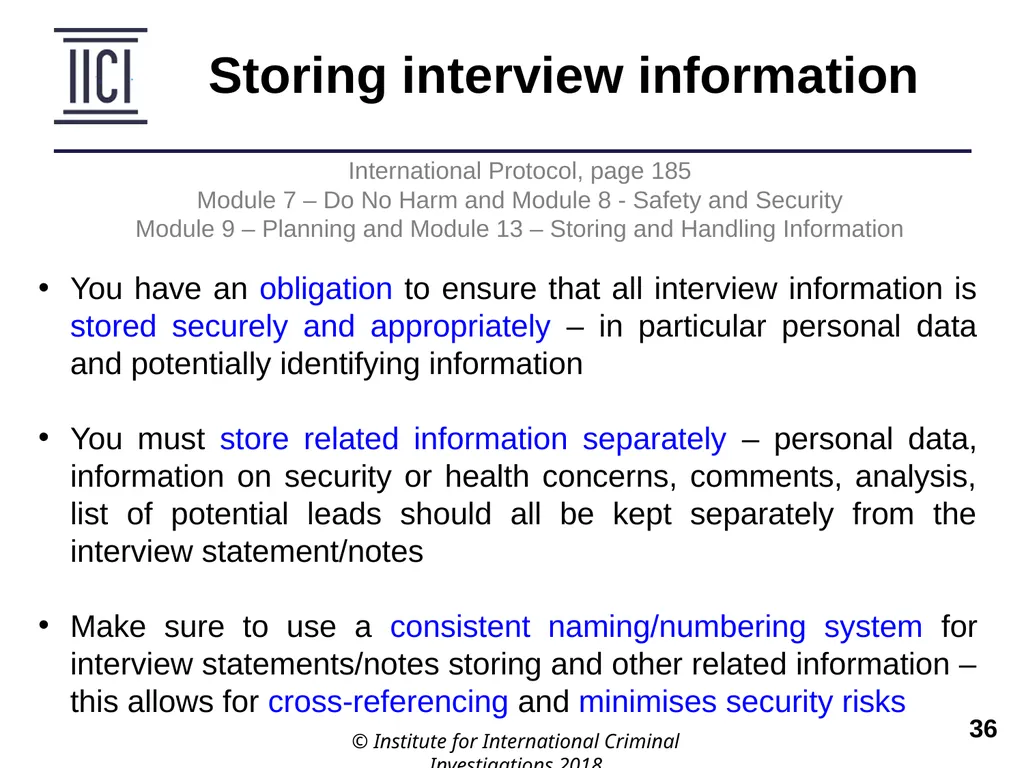
Module 9 – Planning and Module 13 – Storing and Handling Information You have an obligation to ensure that all interview information is stored securely and appropriately – in particular personal data and potentially identifying information
You must store related information separately – personal data, information on security or health concerns, comments, analysis, list of potential leads should all be kept separately from the interview statement/notes
Make sure to use a consistent naming/numbering system for interview statements/notes storing and other related information – this allows for cross-referencing and minimises security risks<br>
Module 7 – Do No Harm and Module 8 - Safety and Security
Module 9 – Planning and Module 13 – Storing and Handling Information You have an obligation to ensure that all interview information is stored securely and appropriately – in particular personal data and potentially identifying information
You must store related information separately – personal data, information on security or health concerns, comments, analysis, list of potential leads should all be kept separately from the interview statement/notes
Make sure to use a consistent naming/numbering system for interview statements/notes storing and other related information – this allows for cross-referencing and minimises security risks<br>
37
Training Materials on the International Protocol
© Institute for International Criminal Investigations 2018 Interview planning 37 International Protocol, pages 58 (Box 9), 88 (Box 1), 126 (Box 3),
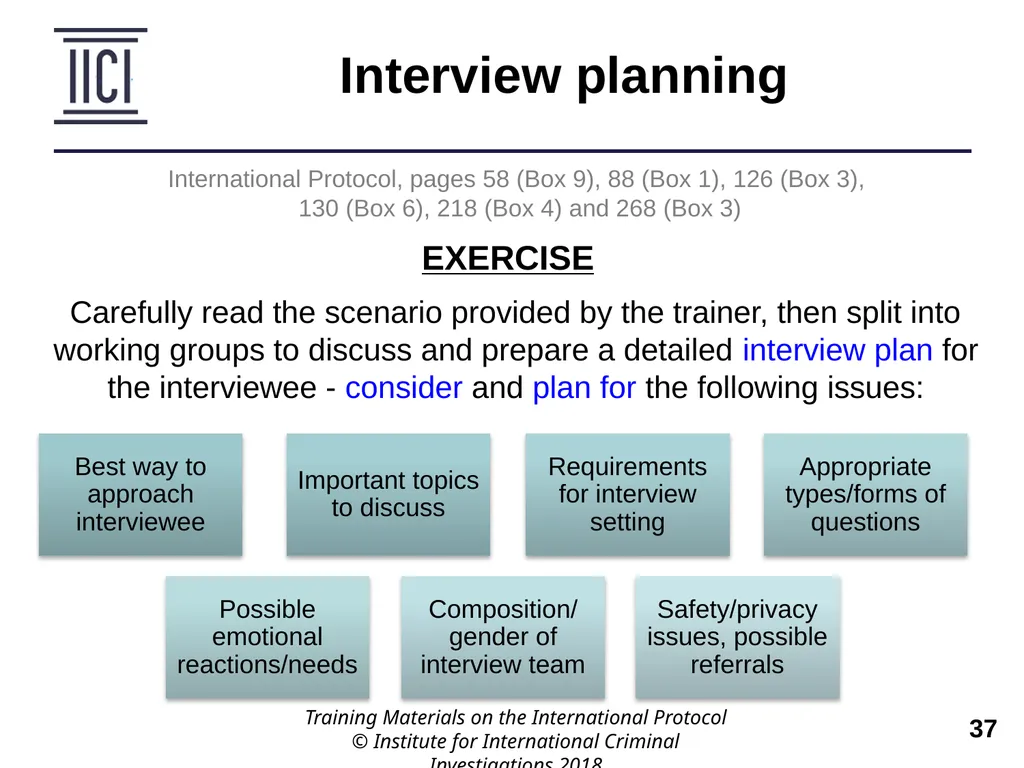
130 (Box 6), 218 (Box 4) and 268 (Box 3) EXERCISE Carefully read the scenario provided by the trainer, then split into working groups to discuss and prepare a detailed interview plan for the interviewee - consider and plan for the following issues:<br>
© Institute for International Criminal Investigations 2018 Interview planning 37 International Protocol, pages 58 (Box 9), 88 (Box 1), 126 (Box 3),
130 (Box 6), 218 (Box 4) and 268 (Box 3) EXERCISE Carefully read the scenario provided by the trainer, then split into working groups to discuss and prepare a detailed interview plan for the interviewee - consider and plan for the following issues:<br>