
Introduction Integrating Environmental Health and

Description: Introduction Integrating Environmental Health and Science: Resources for K-12 Teachers in Pennsylvania Division of Environmental Health Epidemiology Bureau of Epidemiology Pennsylvania Department of Health Objective Identify information and
Related Topics
Download Presentation
"Introduction Integrating Environmental Health and" is the property of its rightful owner. Permission is granted to download and print the materials on this website for personal, non-commercial use only, and to display it on your personal computer provided you do not modify the materials and that you retain all copyright notices contained in the materials. By downloading content from our website, you accept the terms of this agreement.
Presentation Transcript
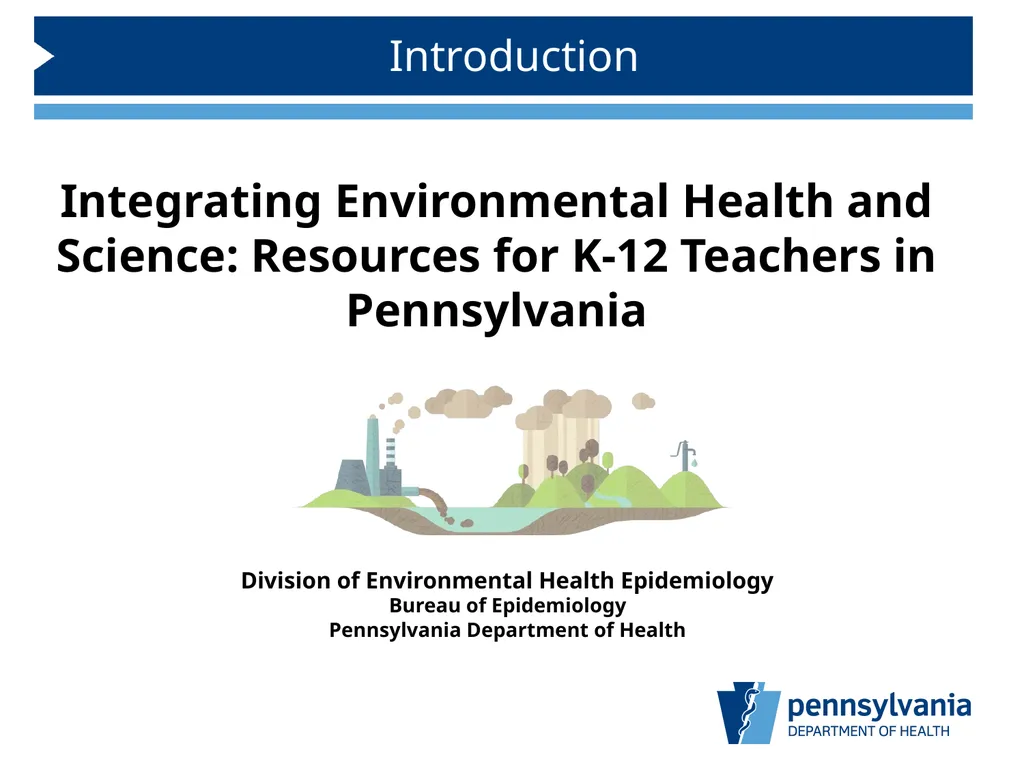
slide1. Introduction Integrating Environmental Health and Science: Resources for K-12 Teachers in Pennsylvania Division of Environmental Health Epidemiology
Bureau of Epidemiology
Pennsylvania Department of Health<br>
slide2. Objective Identify information and resources available to K-12 educators for effectively teaching environmental health and air quality education in alignment with the Pennsylvania Department of Education's Science, Technology, and Engineering Standards and Environmental Literacy and Sustainability (STEELS) Standards.<br>
slide3. Content Overview Introduction: Understanding the Standards
Overview of Pennsylvania’s STEELS Standards
Importance of Environmental Health Education
Emphasizing the value of integrating environmental health
Key Concepts in Environmental Health
Exploring fundamental concepts
Identifying real-world (Pennsylvania) examples and case studies
Pedagogical Approaches and Strategies
Teaching strategies for environmental health
Lesson Plan Development
Review of lesson plan development process guided by the Pennsylvania STEELS
Environmental Health Curriculum
Highlighting STEELS-aligned environmental health curriculum
Sample Lesson Plans
Highlighting suggested lesson plans<br>
slide4. Content Overview (continued) 8. Interdisciplinary Connections
Identifying opportunities to integrate environmental health and science across other subjects
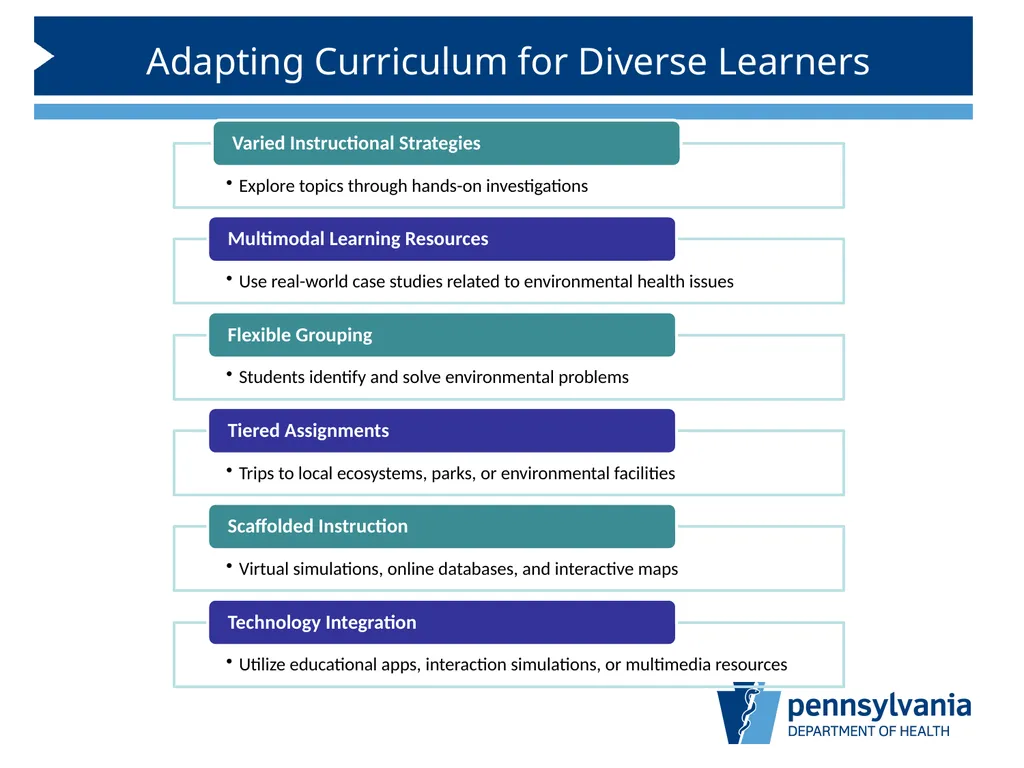
9. Adapting Curriculum for Diverse Learners
Addressing the needs of diverse learners
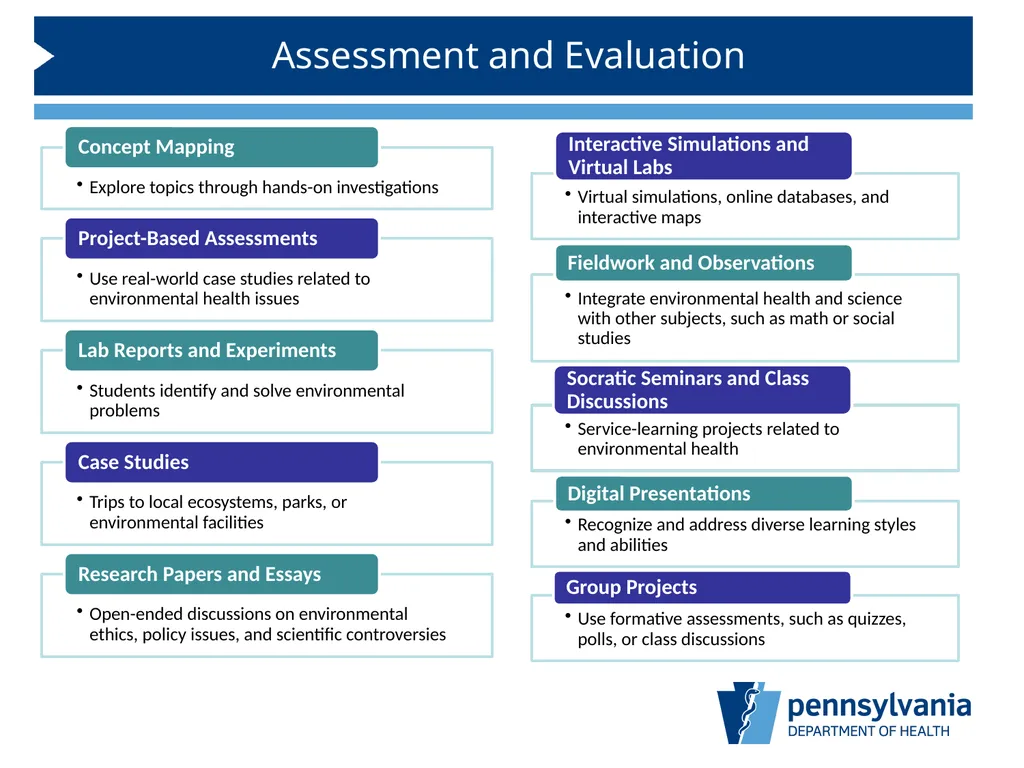
10. Assessment and Evaluation
Strategies for assessing students’ understanding of environmental health and science concepts
11. Air Quality Education Resources
Air quality resources including AirNow, Environmental Protection Agency (EPA) and the University Corporation for Atmospheric Research (UCAR)
12. Additional Education Resources
Showcasing additional air quality resources.
Availability of an air quality resource guide for teachers created by the Department of Health (DOH)<br>
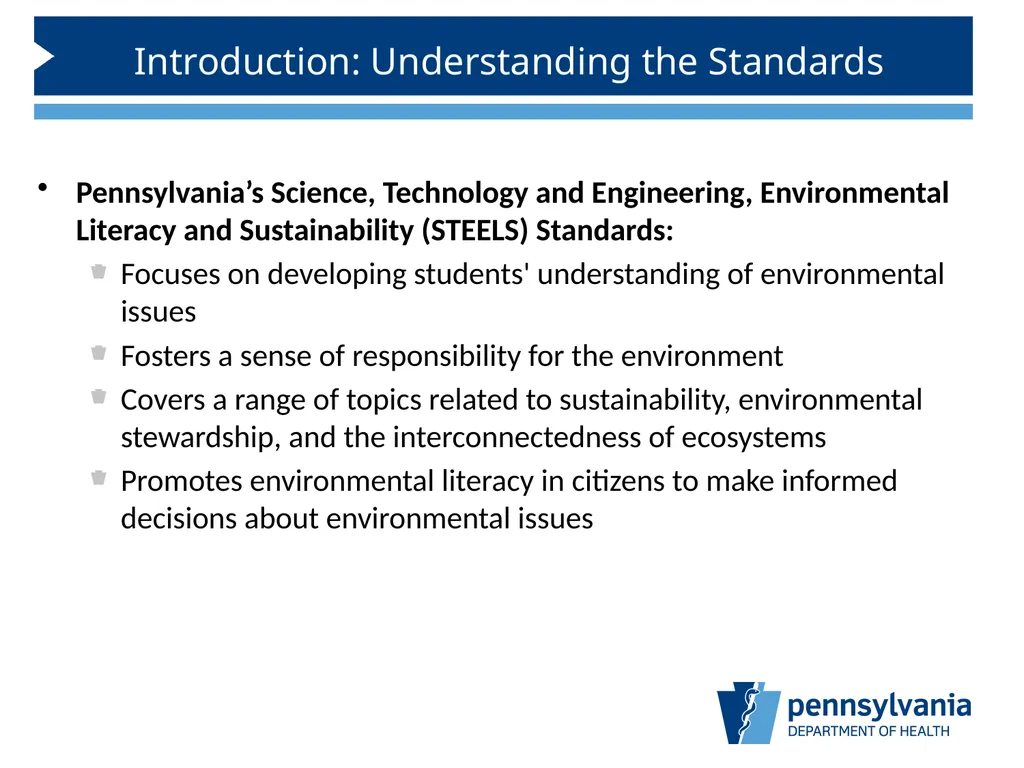
slide5. Introduction: Understanding the Standards Pennsylvania’s Science, Technology and Engineering, Environmental Literacy and Sustainability (STEELS) Standards:
Focuses on developing students' understanding of environmental issues
Fosters a sense of responsibility for the environment
Covers a range of topics related to sustainability, environmental stewardship, and the interconnectedness of ecosystems
Promotes environmental literacy in citizens to make informed decisions about environmental issues<br>
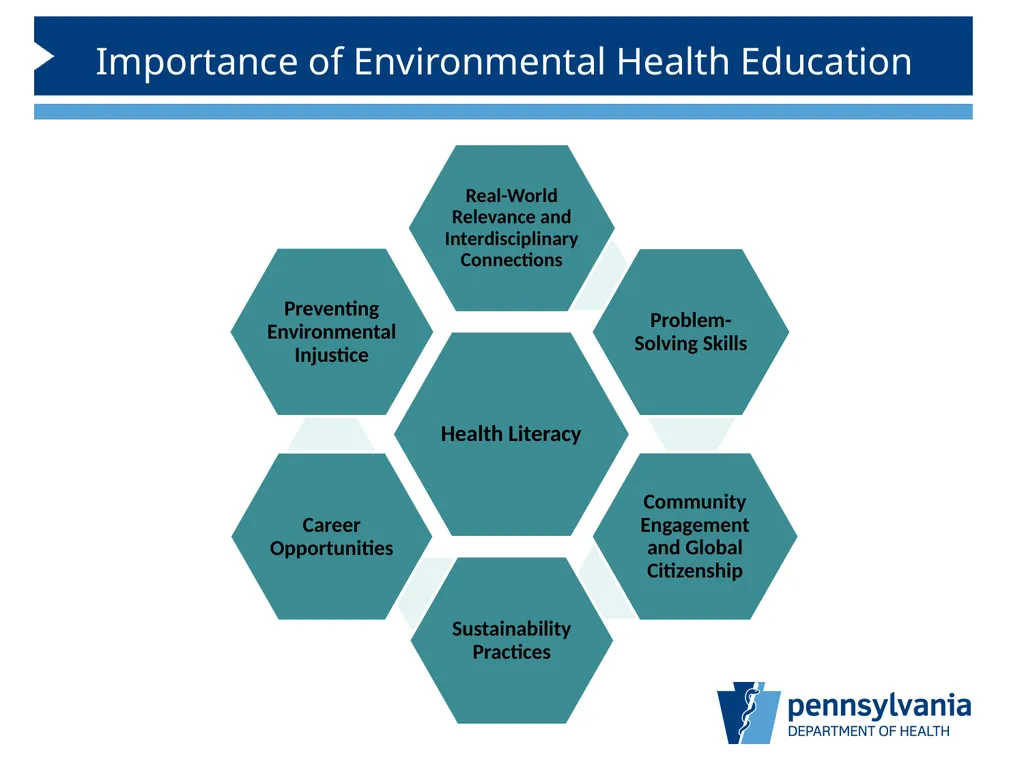
slide6. Importance of Environmental Health Education<br>
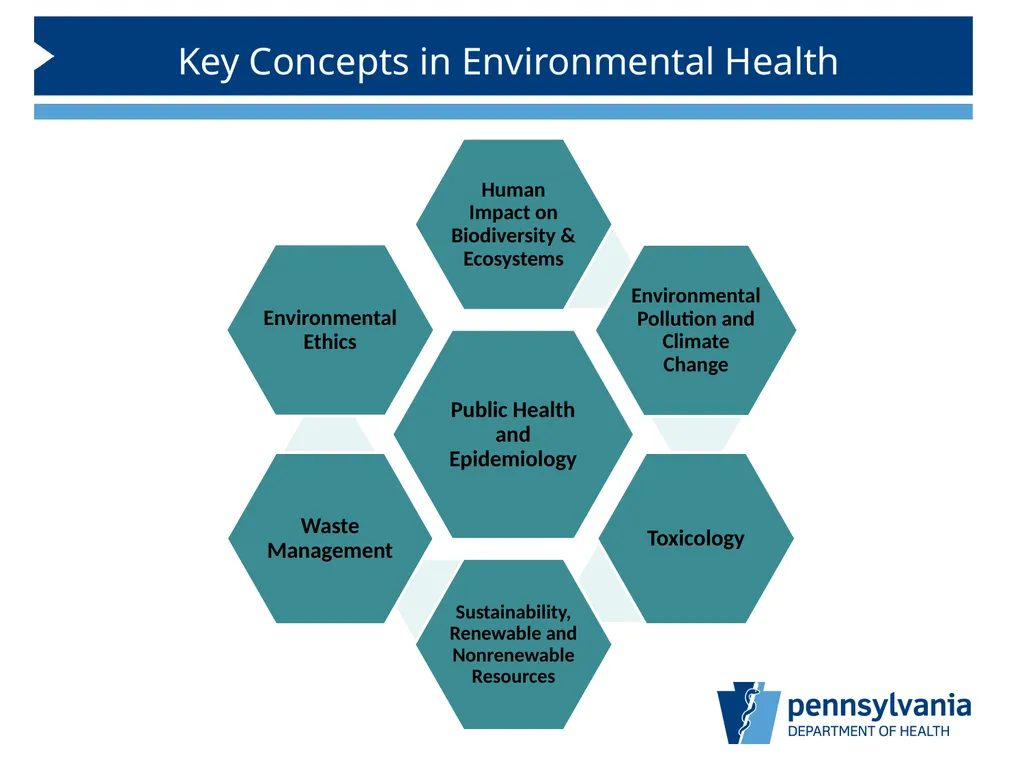
slide7. Key Concepts in Environmental Health<br>
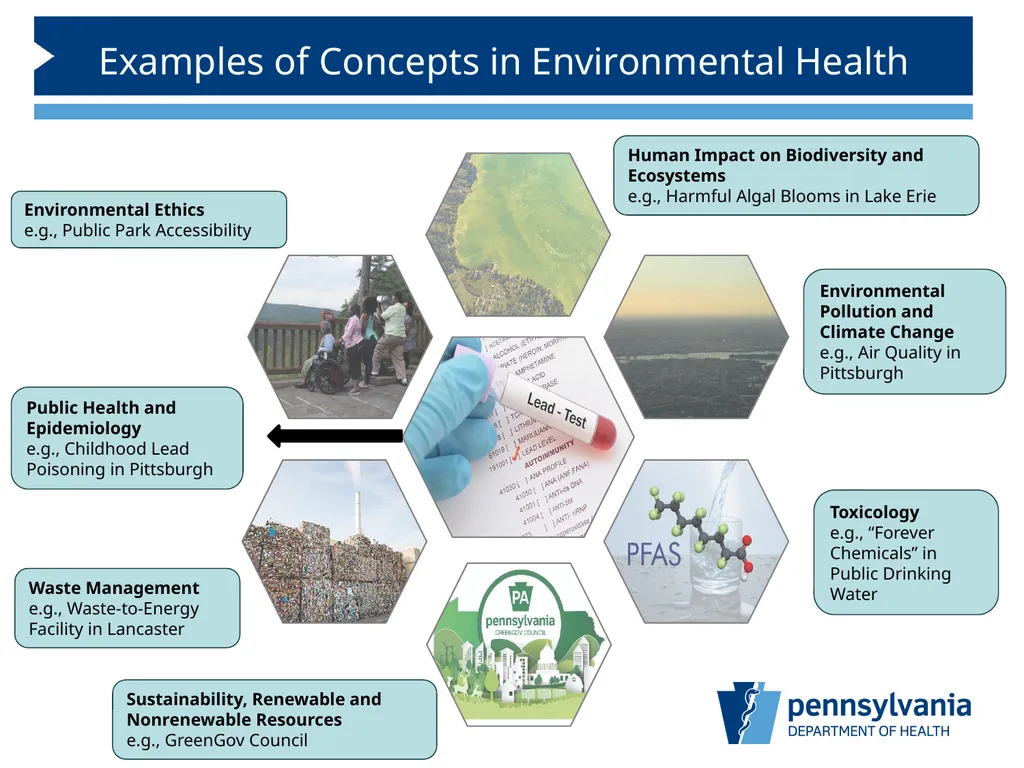
slide8. Examples of Concepts in Environmental Health Public Health and Epidemiology
e.g., Childhood Lead Poisoning in Pittsburgh Human Impact on Biodiversity and Ecosystems
e.g., Harmful Algal Blooms in Lake Erie Environmental Pollution and Climate Change
e.g., Air Quality in Pittsburgh Toxicology
e.g., “Forever Chemicals” in Public Drinking Water Sustainability, Renewable and Nonrenewable Resources
e.g., GreenGov Council Waste Management
e.g., Waste-to-Energy Facility in Lancaster Environmental Ethics
e.g., Public Park Accessibility<br>
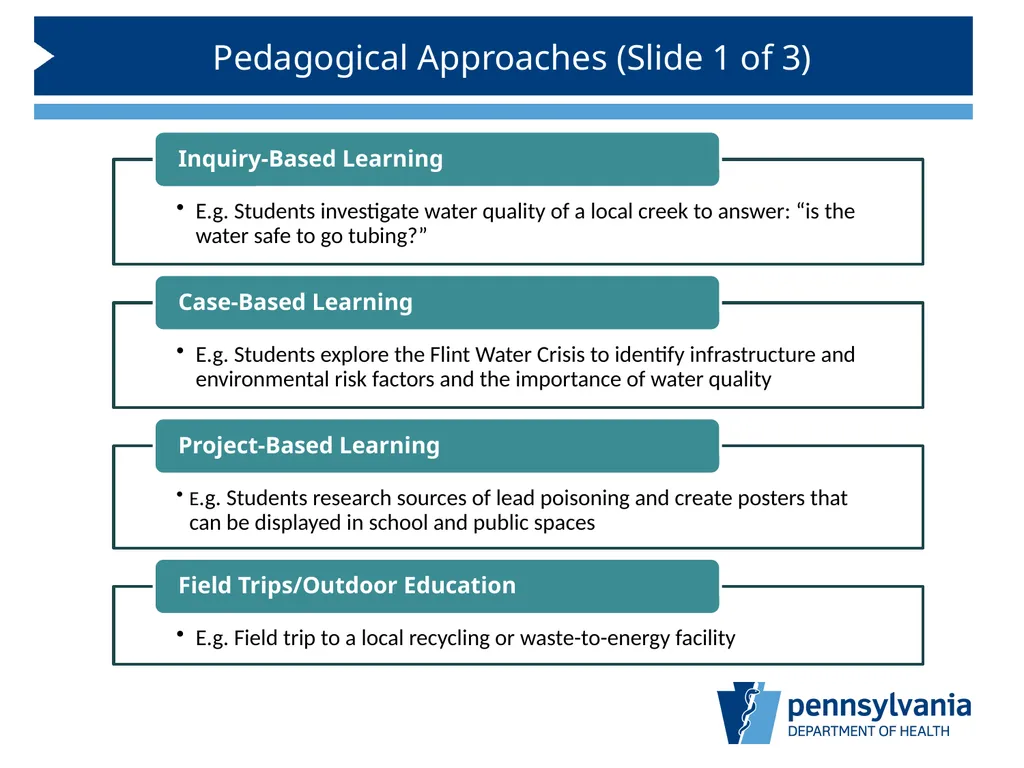
slide9. Pedagogical Approaches (Slide 1 of 3)<br>
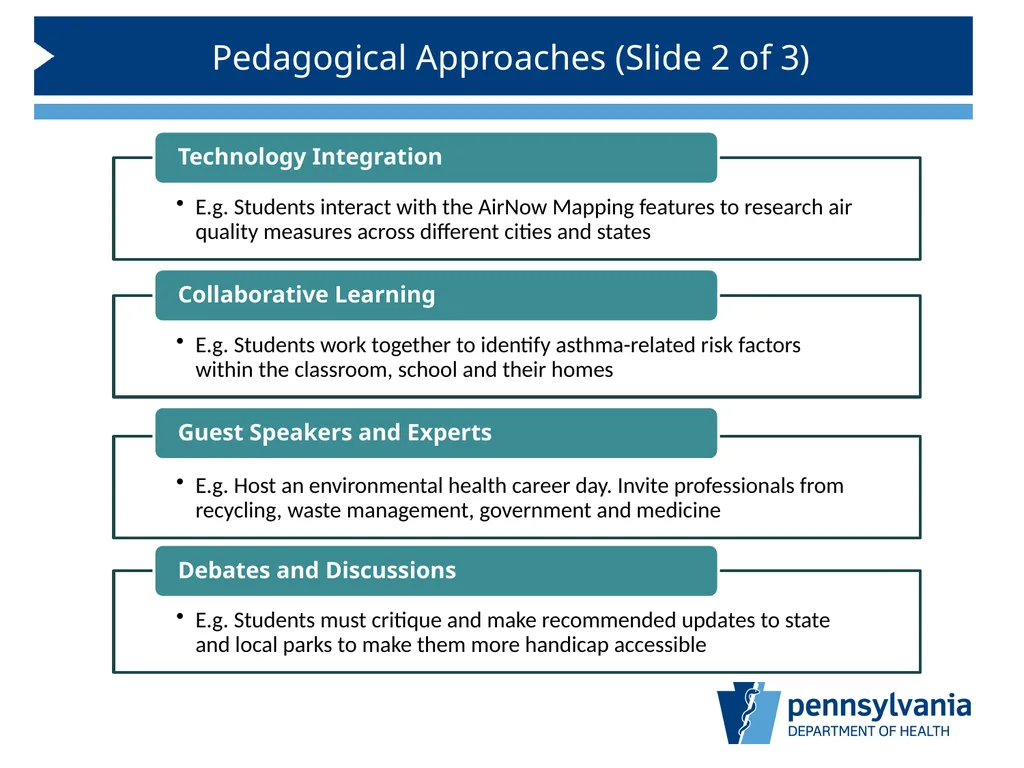
slide10. Pedagogical Approaches (Slide 2 of 3)<br>
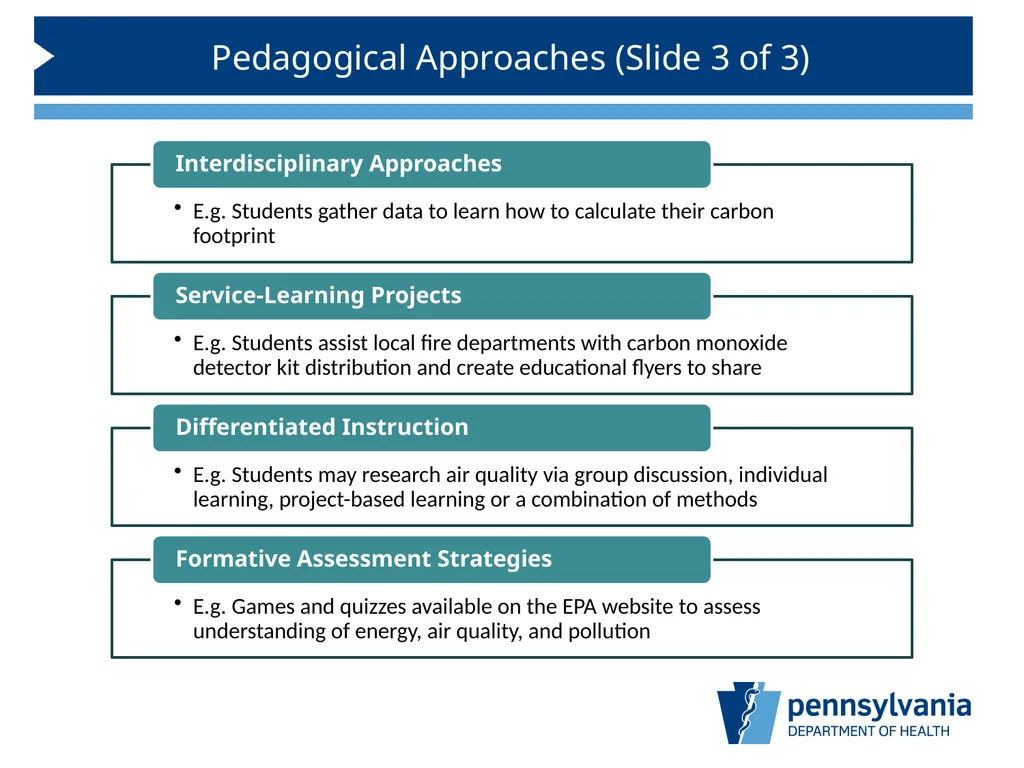
slide11. Pedagogical Approaches (Slide 3 of 3)<br>
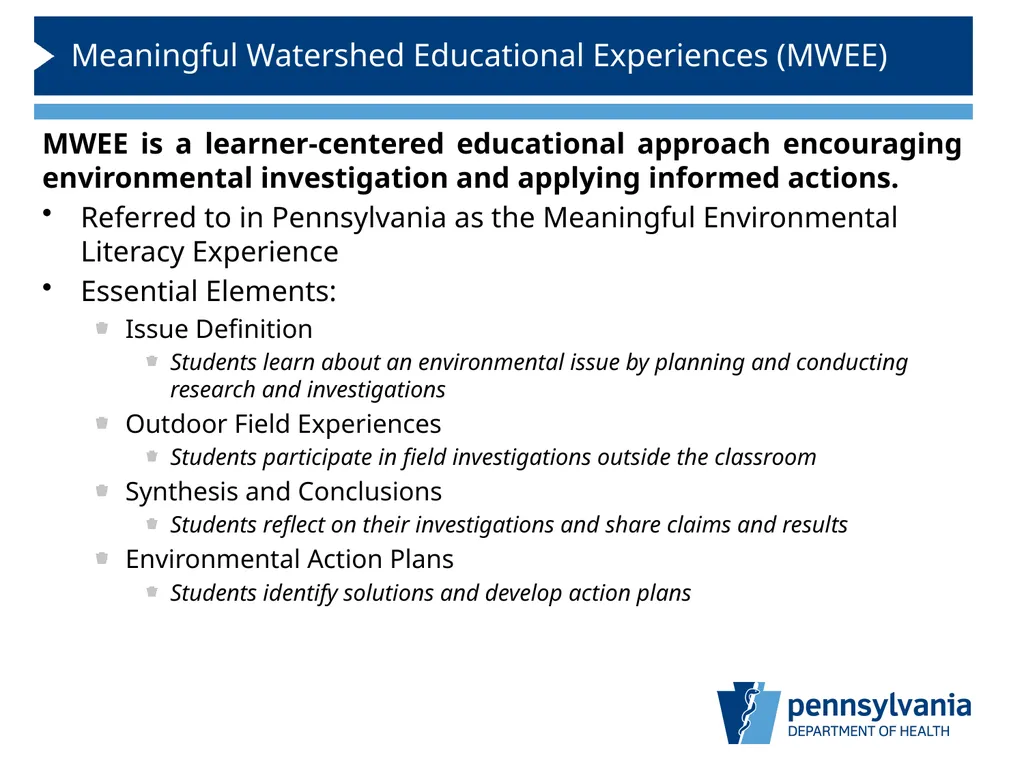
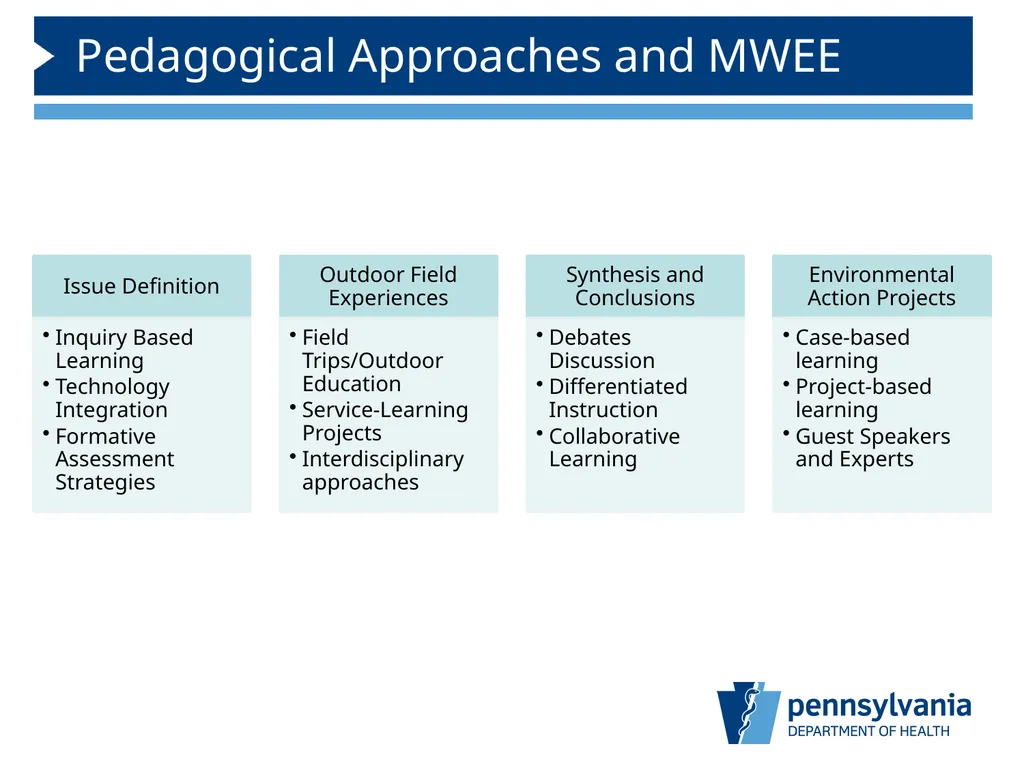
slide12. Meaningful Watershed Educational Experiences (MWEE) MWEE is a learner-centered educational approach encouraging environmental investigation and applying informed actions.
Referred to in Pennsylvania as the Meaningful Environmental Literacy Experience
Essential Elements:
Issue Definition
Students learn about an environmental issue by planning and conducting research and investigations
Outdoor Field Experiences
Students participate in field investigations outside the classroom
Synthesis and Conclusions
Students reflect on their investigations and share claims and results
Environmental Action Plans
Students identify solutions and develop action plans<br>
slide13. Pedagogical Approaches and MWEE<br>
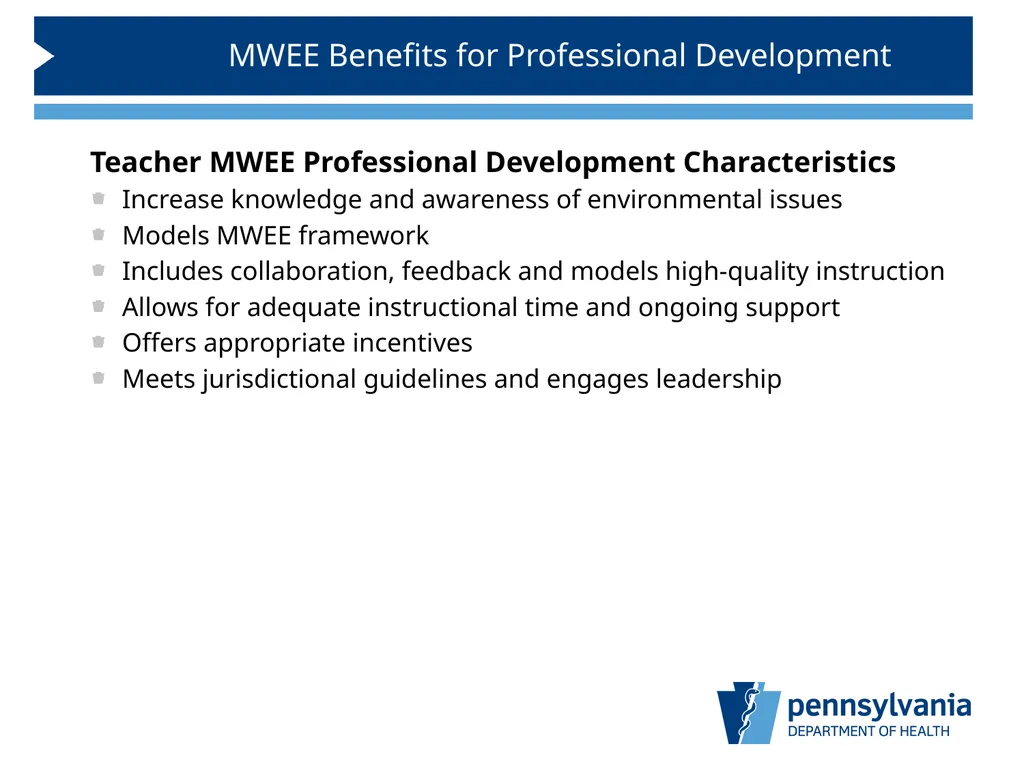
slide14. MWEE Benefits for Professional Development Teacher MWEE Professional Development Characteristics
Increase knowledge and awareness of environmental issues
Models MWEE framework
Includes collaboration, feedback and models high-quality instruction
Allows for adequate instructional time and ongoing support
Offers appropriate incentives
Meets jurisdictional guidelines and engages leadership<br>
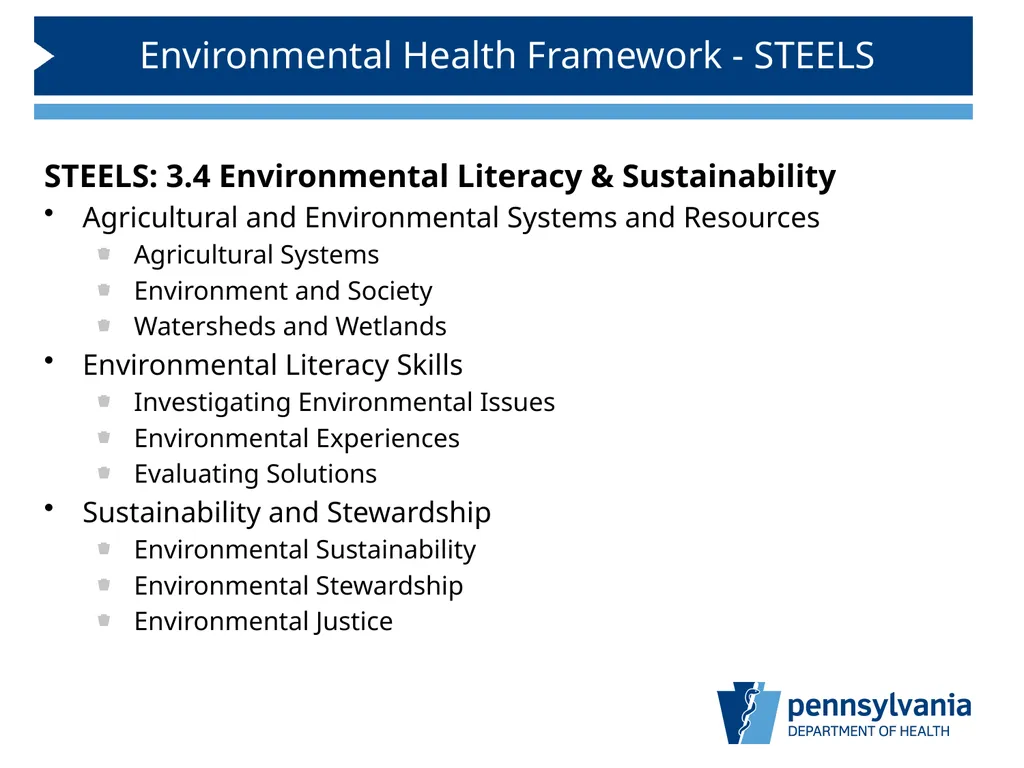
slide15. Environmental Health Framework - STEELS STEELS: 3.4 Environmental Literacy & Sustainability
Agricultural and Environmental Systems and Resources
Agricultural Systems
Environment and Society
Watersheds and Wetlands
Environmental Literacy Skills
Investigating Environmental Issues
Environmental Experiences
Evaluating Solutions
Sustainability and Stewardship
Environmental Sustainability
Environmental Stewardship
Environmental Justice<br>
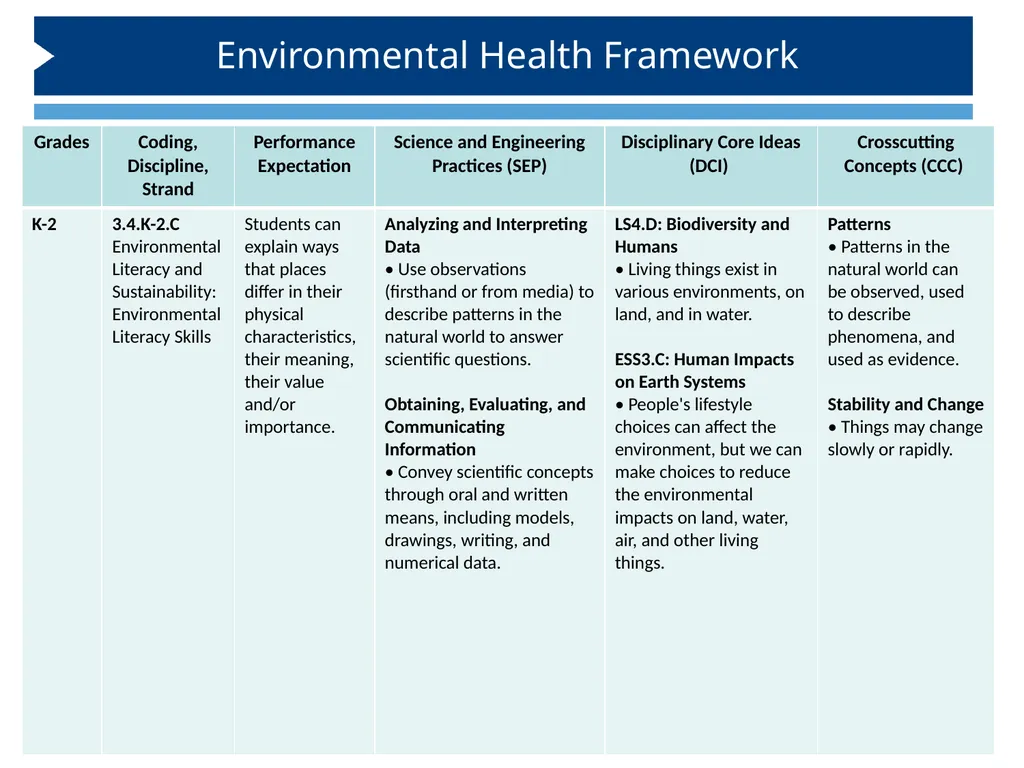
slide16. Environmental Health Framework<br>
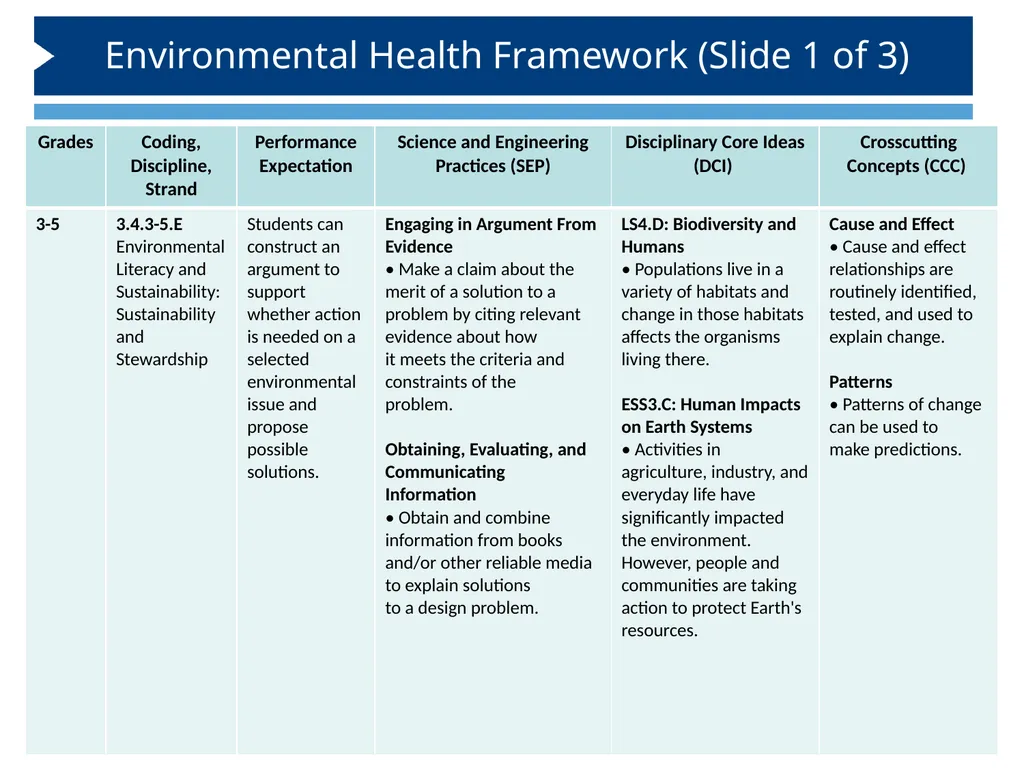
slide17. Environmental Health Framework (Slide 1 of 3)<br>
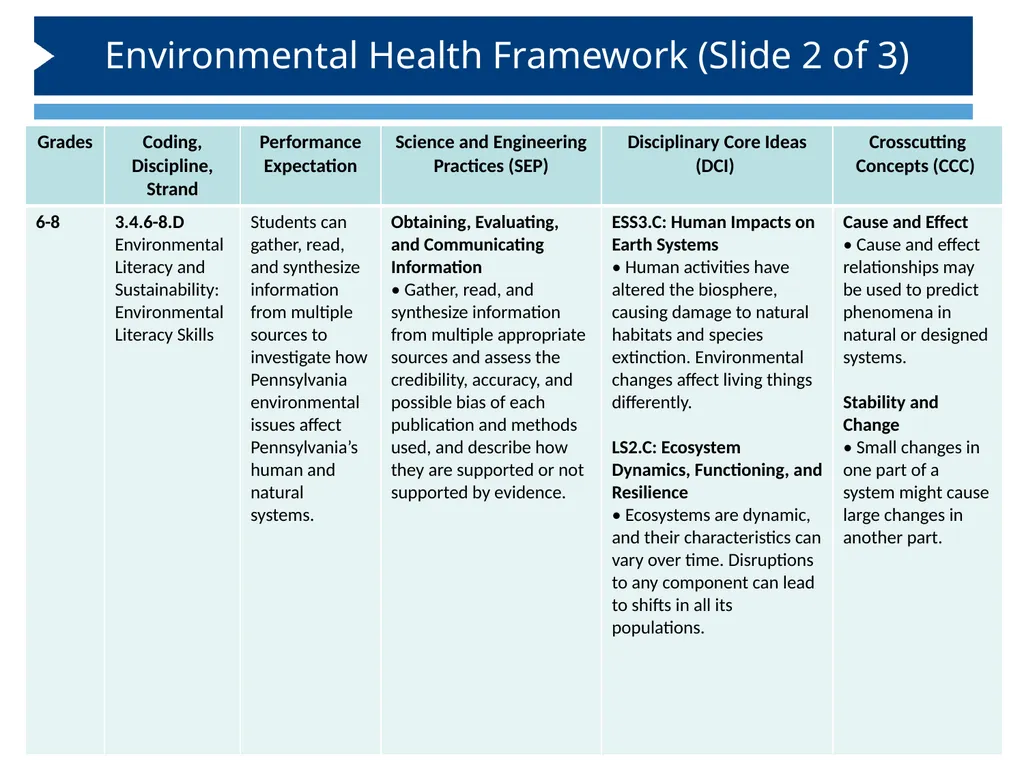
slide18. Environmental Health Framework (Slide 2 of 3)<br>
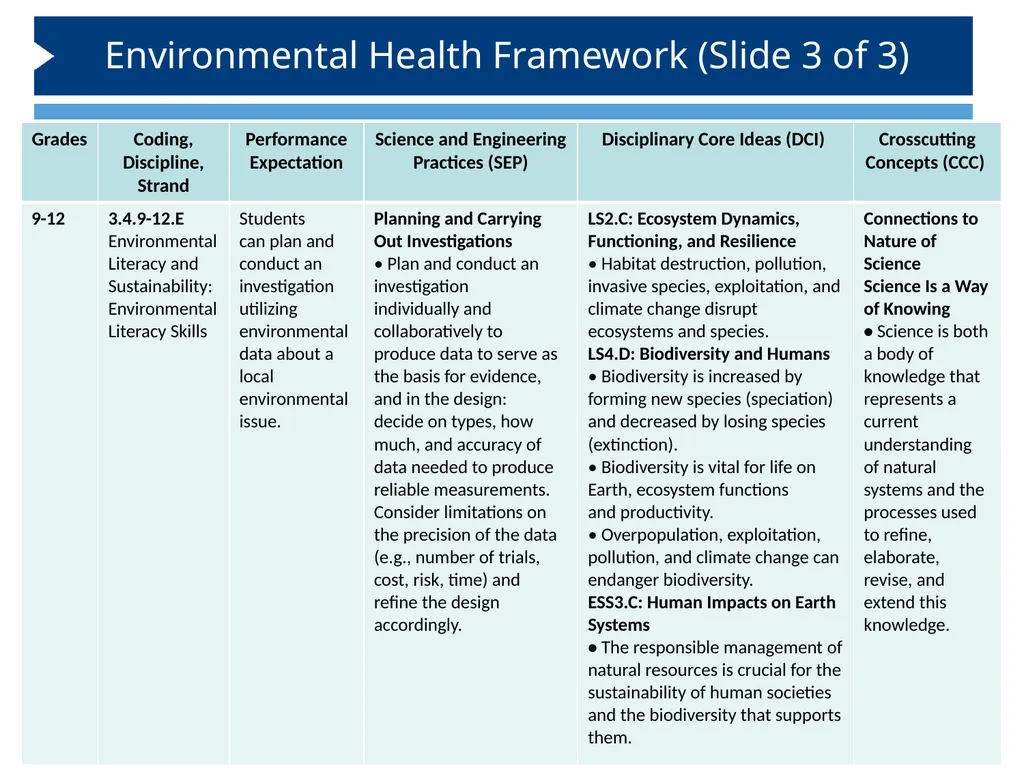
slide19. Environmental Health Framework (Slide 3 of 3)<br>
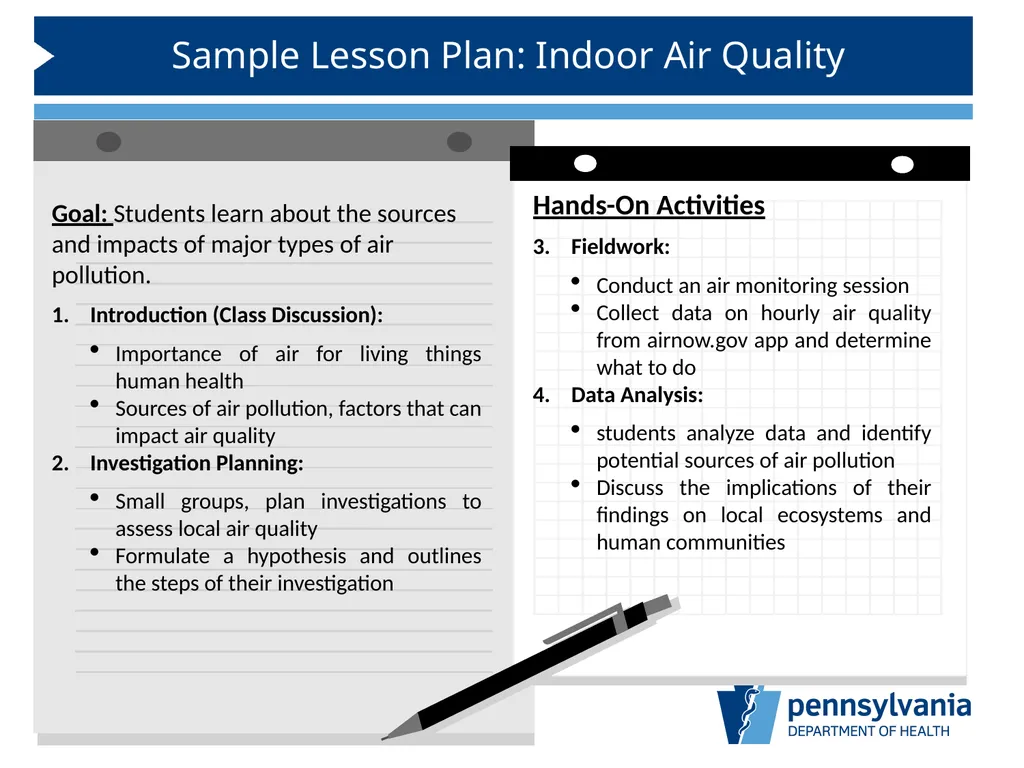
slide20. Sample Lesson Plan: Indoor Air Quality Goal: Students learn about the sources and impacts of major types of air pollution.
Introduction (Class Discussion):
Importance of air for living things human health
Sources of air pollution, factors that can impact air quality
Investigation Planning:
Small groups, plan investigations to assess local air quality
Formulate a hypothesis and outlines the steps of their investigation Hands-On Activities
Fieldwork:
Conduct an air monitoring session
Collect data on hourly air quality from airnow.gov app and determine what to do
Data Analysis:
students analyze data and identify potential sources of air pollution
Discuss the implications of their findings on local ecosystems and human communities<br>
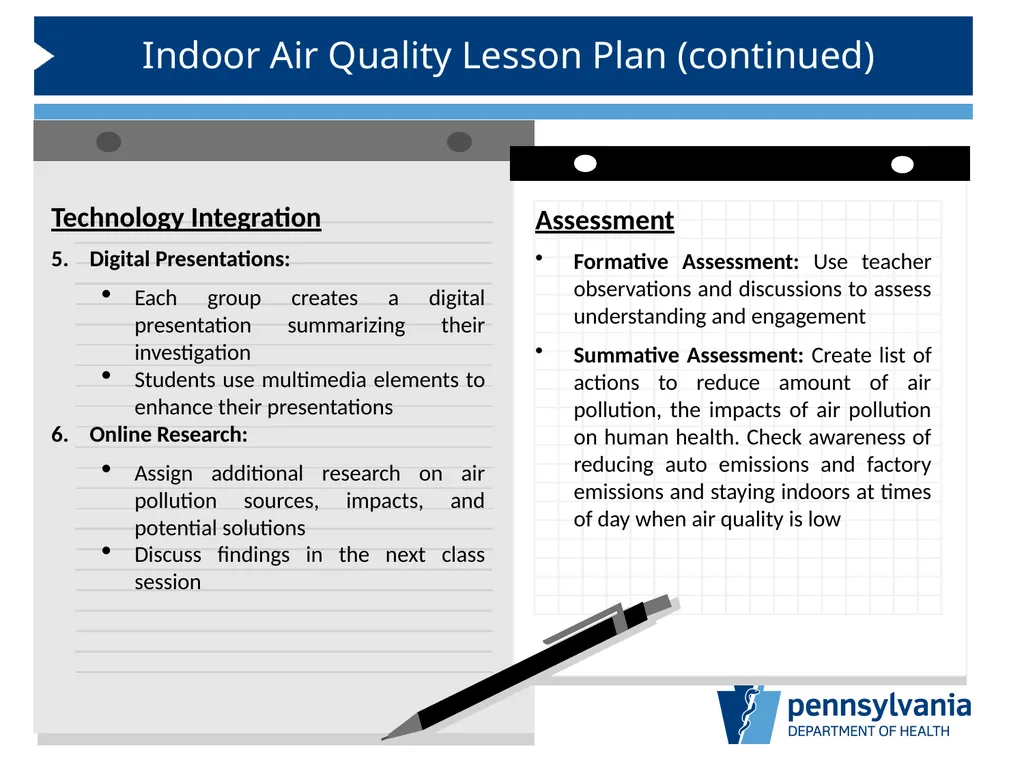
slide21. Indoor Air Quality Lesson Plan (continued) Technology Integration
Digital Presentations:
Each group creates a digital presentation summarizing their investigation
Students use multimedia elements to enhance their presentations
Online Research:
Assign additional research on air pollution sources, impacts, and potential solutions
Discuss findings in the next class session Assessment
Formative Assessment: Use teacher observations and discussions to assess understanding and engagement
Summative Assessment: Create list of actions to reduce amount of air pollution, the impacts of air pollution on human health. Check awareness of reducing auto emissions and factory emissions and staying indoors at times of day when air quality is low<br>
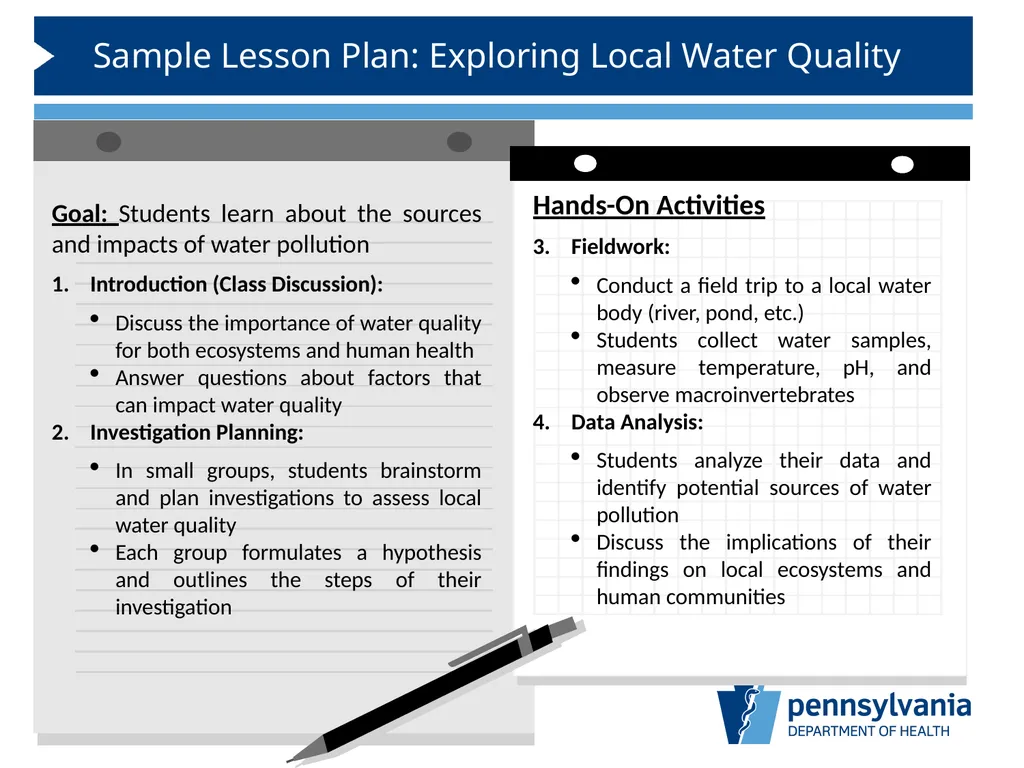
slide22. Sample Lesson Plan: Exploring Local Water Quality Goal: Students learn about the sources and impacts of water pollution
Introduction (Class Discussion):
Discuss the importance of water quality for both ecosystems and human health
Answer questions about factors that can impact water quality
Investigation Planning:
In small groups, students brainstorm and plan investigations to assess local water quality
Each group formulates a hypothesis and outlines the steps of their investigation Hands-On Activities
Fieldwork:
Conduct a field trip to a local water body (river, pond, etc.)
Students collect water samples, measure temperature, pH, and observe macroinvertebrates
Data Analysis:
Students analyze their data and identify potential sources of water pollution
Discuss the implications of their findings on local ecosystems and human communities<br>
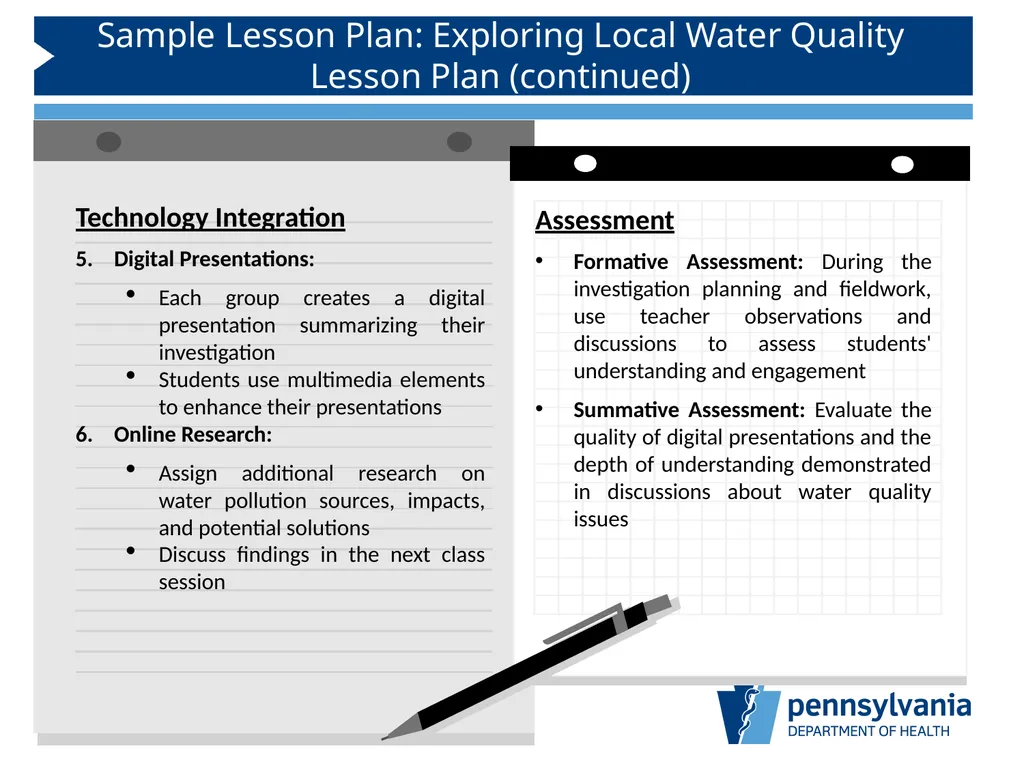
slide23. Sample Lesson Plan: Exploring Local Water Quality Lesson Plan (continued) Technology Integration
Digital Presentations:
Each group creates a digital presentation summarizing their investigation
Students use multimedia elements to enhance their presentations
Online Research:
Assign additional research on water pollution sources, impacts, and potential solutions
Discuss findings in the next class session Assessment
Formative Assessment: During the investigation planning and fieldwork, use teacher observations and discussions to assess students' understanding and engagement
Summative Assessment: Evaluate the quality of digital presentations and the depth of understanding demonstrated in discussions about water quality issues<br>
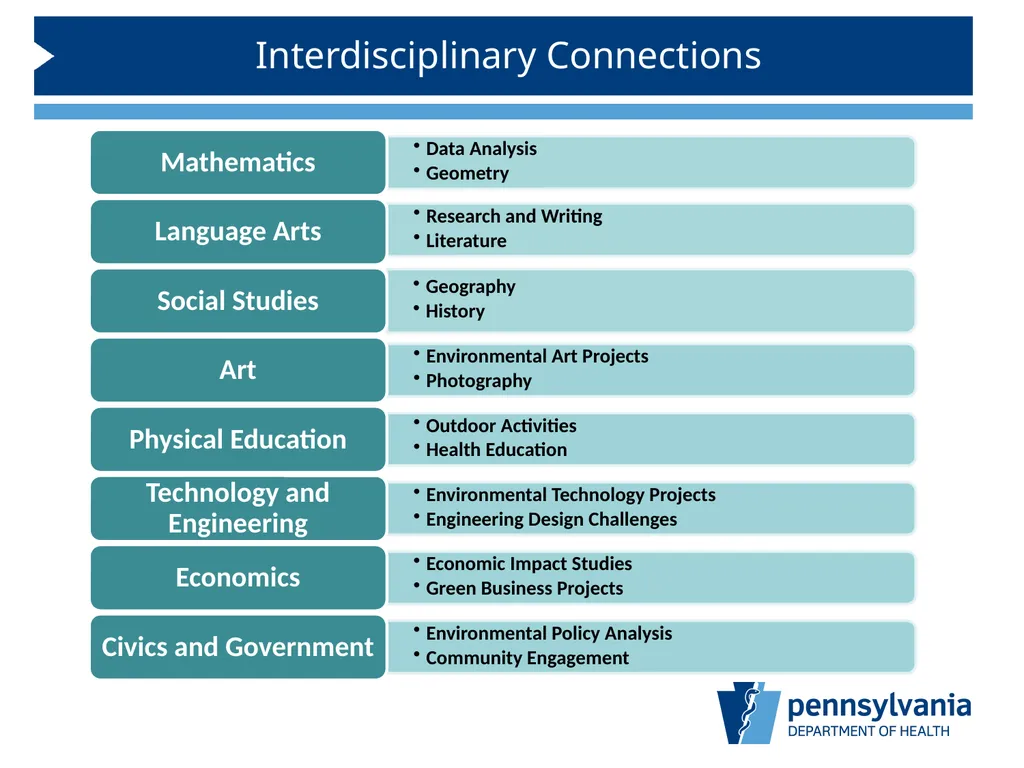
slide24. Interdisciplinary Connections<br>
slide25. Adapting Curriculum for Diverse Learners<br>
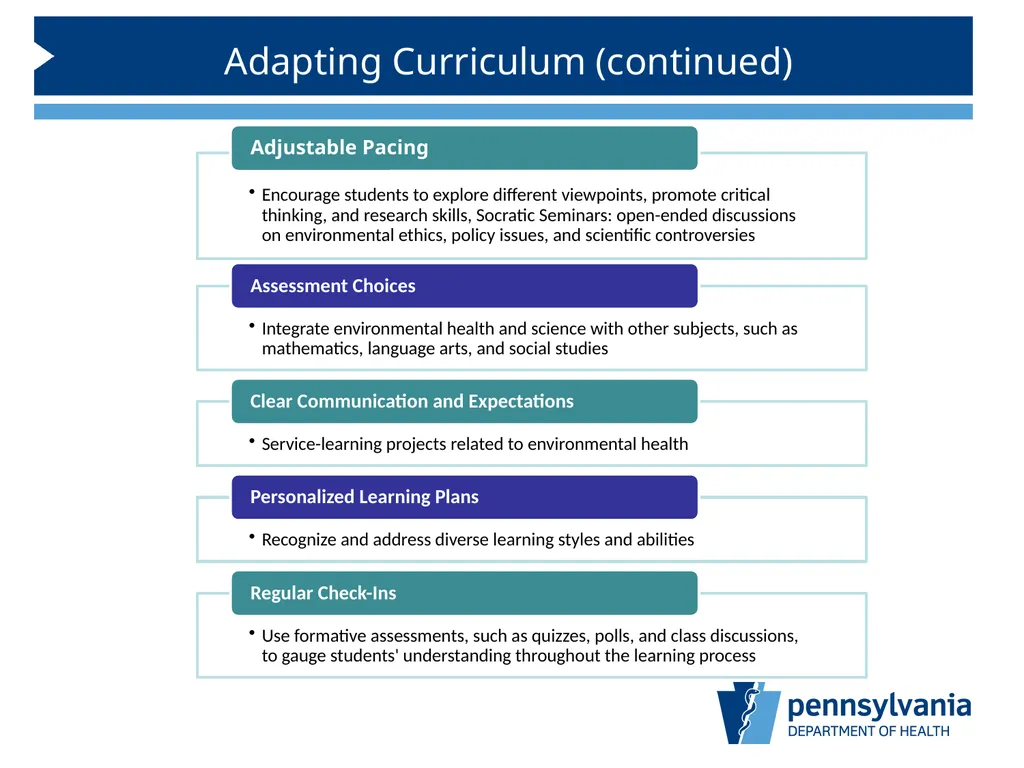
slide26. Adapting Curriculum (continued)<br>
slide27. Assessment and Evaluation<br>
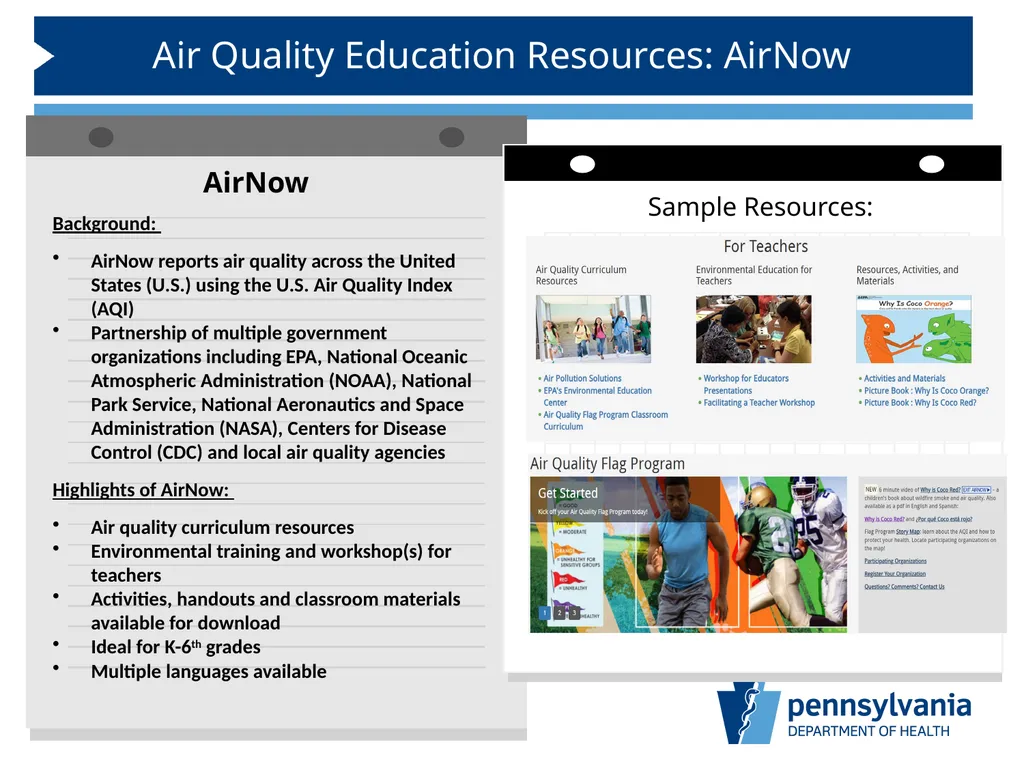
slide28. Air Quality Education Resources: AirNow AirNow Background:
AirNow reports air quality across the United States (U.S.) using the U.S. Air Quality Index (AQI)
Partnership of multiple government organizations including EPA, National Oceanic Atmospheric Administration (NOAA), National Park Service, National Aeronautics and Space Administration (NASA), Centers for Disease Control (CDC) and local air quality agencies
Highlights of AirNow:
Air quality curriculum resources
Environmental training and workshop(s) for teachers
Activities, handouts and classroom materials available for download
Ideal for K-6th grades
Multiple languages available Sample Resources:<br>
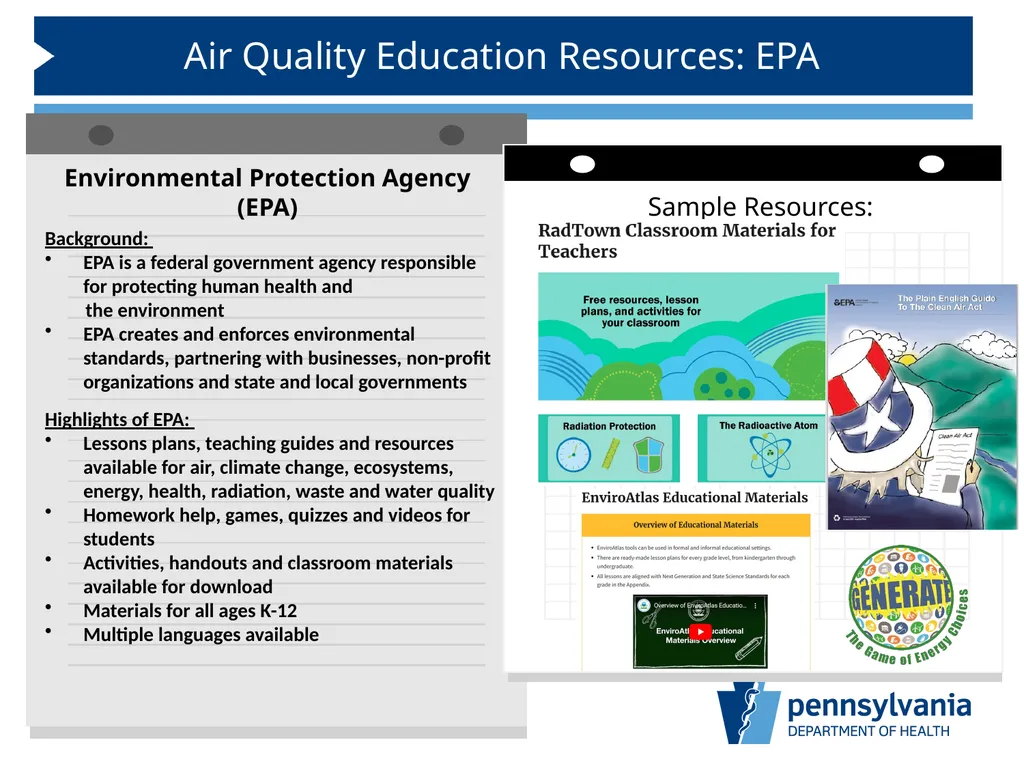
slide29. Air Quality Education Resources: EPA Environmental Protection Agency (EPA) Background:
EPA is a federal government agency responsible for protecting human health and
the environment
EPA creates and enforces environmental standards, partnering with businesses, non-profit organizations and state and local governments
Highlights of EPA:
Lessons plans, teaching guides and resources available for air, climate change, ecosystems, energy, health, radiation, waste and water quality
Homework help, games, quizzes and videos for students
Activities, handouts and classroom materials available for download
Materials for all ages K-12
Multiple languages available Sample Resources:<br>
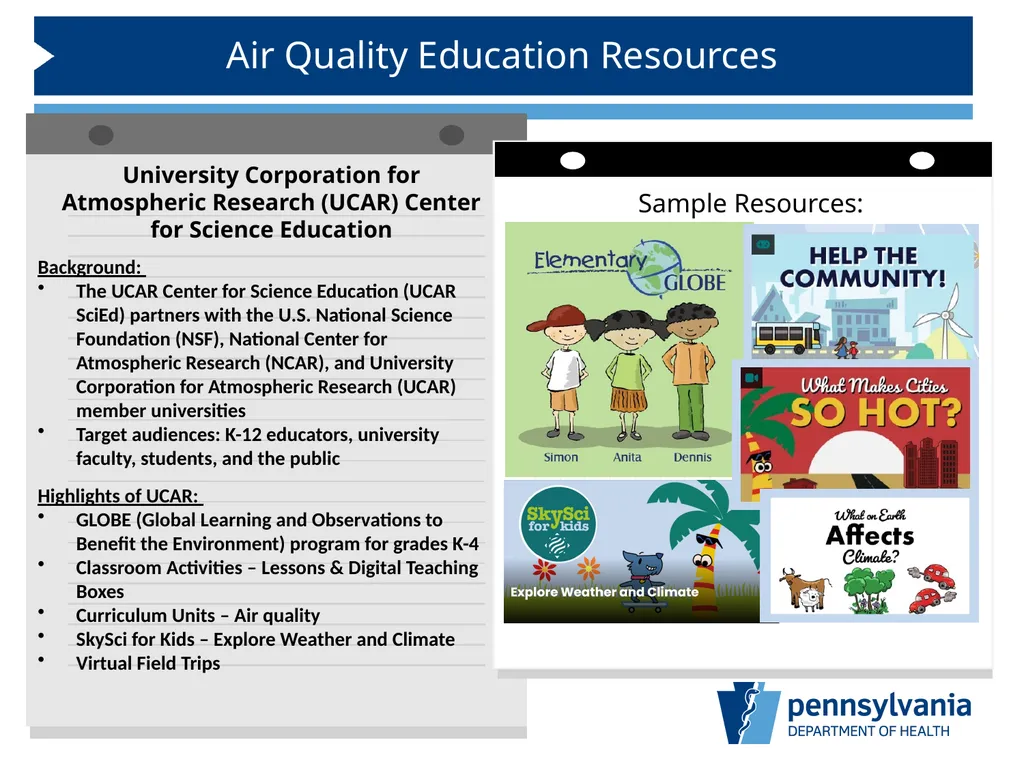
slide30. Air Quality Education Resources University Corporation for Atmospheric Research (UCAR) Center for Science Education Background:
The UCAR Center for Science Education (UCAR SciEd) partners with the U.S. National Science Foundation (NSF), National Center for Atmospheric Research (NCAR), and University Corporation for Atmospheric Research (UCAR) member universities
Target audiences: K-12 educators, university faculty, students, and the public
Highlights of UCAR:
GLOBE (Global Learning and Observations to Benefit the Environment) program for grades K-4
Classroom Activities – Lessons & Digital Teaching Boxes
Curriculum Units – Air quality
SkySci for Kids – Explore Weather and Climate
Virtual Field Trips Sample Resources:<br>
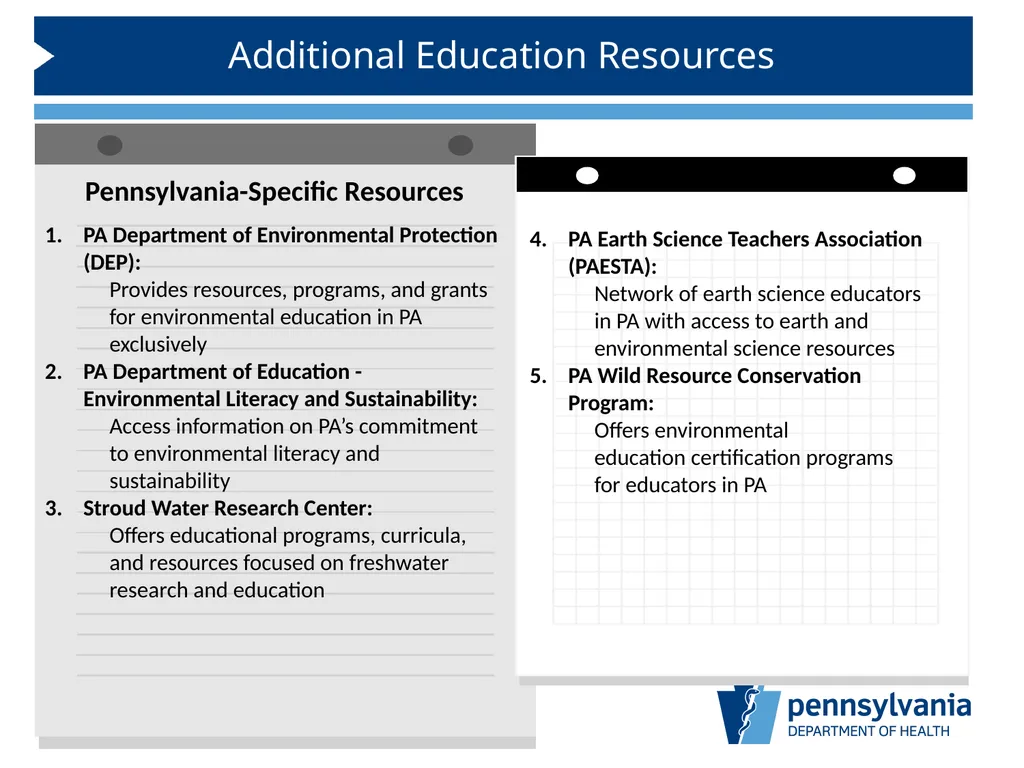
slide31. Additional Education Resources Pennsylvania-Specific Resources
PA Department of Environmental Protection (DEP):
Provides resources, programs, and grants for environmental education in PA exclusively
PA Department of Education - Environmental Literacy and Sustainability:
Access information on PA’s commitment to environmental literacy and
sustainability
Stroud Water Research Center:
Offers educational programs, curricula, and resources focused on freshwater research and education PA Earth Science Teachers Association (PAESTA):
Network of earth science educators in PA with access to earth and environmental science resources
PA Wild Resource Conservation Program:
Offers environmental education certification programs for educators in PA<br>
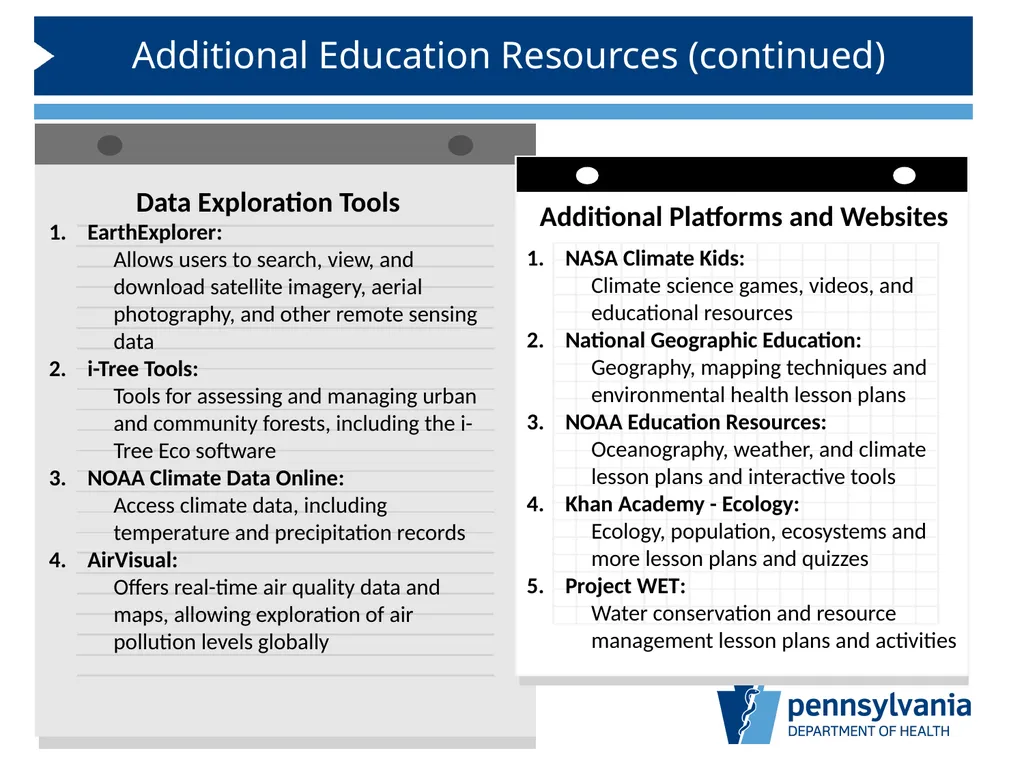
slide32. Additional Education Resources (continued) Data Exploration Tools
EarthExplorer:
Allows users to search, view, and download satellite imagery, aerial photography, and other remote sensing data
i-Tree Tools:
Tools for assessing and managing urban and community forests, including the i-Tree Eco software
NOAA Climate Data Online:
Access climate data, including temperature and precipitation records
AirVisual:
Offers real-time air quality data and maps, allowing exploration of air pollution levels globally Additional Platforms and Websites
NASA Climate Kids:
Climate science games, videos, and educational resources
National Geographic Education:
Geography, mapping techniques and environmental health lesson plans
NOAA Education Resources:
Oceanography, weather, and climate lesson plans and interactive tools
Khan Academy - Ecology:
Ecology, population, ecosystems and more lesson plans and quizzes
Project WET:
Water conservation and resource management lesson plans and activities<br>
slide33. Air Quality Resource Guide All air quality and environmental science lessons and resources referenced are available for educators as a comprehensive education guide.<br>
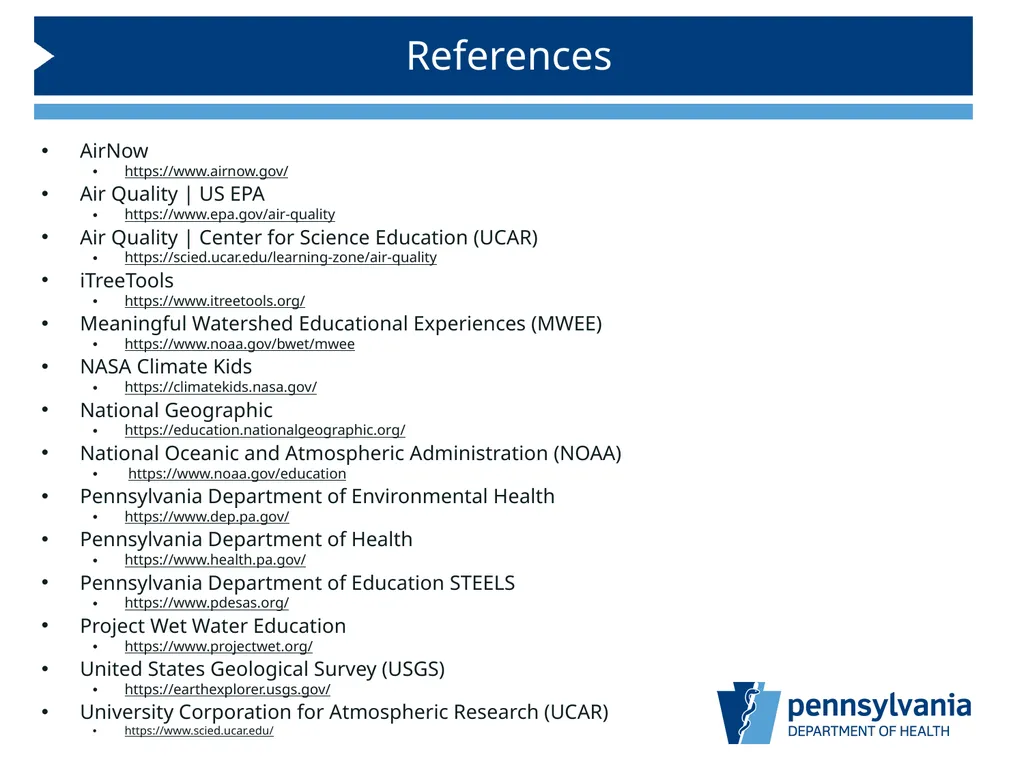
slide34. References AirNow
https://www.airnow.gov/
Air Quality | US EPA
https://www.epa.gov/air-quality
Air Quality | Center for Science Education (UCAR)
https://scied.ucar.edu/learning-zone/air-quality
iTreeTools
https://www.itreetools.org/
Meaningful Watershed Educational Experiences (MWEE)
https://www.noaa.gov/bwet/mwee
NASA Climate Kids
https://climatekids.nasa.gov/
National Geographic
https://education.nationalgeographic.org/
National Oceanic and Atmospheric Administration (NOAA)
https://www.noaa.gov/education
Pennsylvania Department of Environmental Health
https://www.dep.pa.gov/
Pennsylvania Department of Health
https://www.health.pa.gov/
Pennsylvania Department of Education STEELS
https://www.pdesas.org/
Project Wet Water Education
https://www.projectwet.org/
United States Geological Survey (USGS)
https://earthexplorer.usgs.gov/
University Corporation for Atmospheric Research (UCAR)
https://www.scied.ucar.edu/<br>
slide35. Questions? Department of Environmental Health Epidemiology
Email: dehe@pa.gov https://www.health.pa.gov/<br>
Bureau of Epidemiology
Pennsylvania Department of Health<br>
slide2. Objective Identify information and resources available to K-12 educators for effectively teaching environmental health and air quality education in alignment with the Pennsylvania Department of Education's Science, Technology, and Engineering Standards and Environmental Literacy and Sustainability (STEELS) Standards.<br>
slide3. Content Overview Introduction: Understanding the Standards
Overview of Pennsylvania’s STEELS Standards
Importance of Environmental Health Education
Emphasizing the value of integrating environmental health
Key Concepts in Environmental Health
Exploring fundamental concepts
Identifying real-world (Pennsylvania) examples and case studies
Pedagogical Approaches and Strategies
Teaching strategies for environmental health
Lesson Plan Development
Review of lesson plan development process guided by the Pennsylvania STEELS
Environmental Health Curriculum
Highlighting STEELS-aligned environmental health curriculum
Sample Lesson Plans
Highlighting suggested lesson plans<br>
slide4. Content Overview (continued) 8. Interdisciplinary Connections
Identifying opportunities to integrate environmental health and science across other subjects
9. Adapting Curriculum for Diverse Learners
Addressing the needs of diverse learners
10. Assessment and Evaluation
Strategies for assessing students’ understanding of environmental health and science concepts
11. Air Quality Education Resources
Air quality resources including AirNow, Environmental Protection Agency (EPA) and the University Corporation for Atmospheric Research (UCAR)
12. Additional Education Resources
Showcasing additional air quality resources.
Availability of an air quality resource guide for teachers created by the Department of Health (DOH)<br>
slide5. Introduction: Understanding the Standards Pennsylvania’s Science, Technology and Engineering, Environmental Literacy and Sustainability (STEELS) Standards:
Focuses on developing students' understanding of environmental issues
Fosters a sense of responsibility for the environment
Covers a range of topics related to sustainability, environmental stewardship, and the interconnectedness of ecosystems
Promotes environmental literacy in citizens to make informed decisions about environmental issues<br>
slide6. Importance of Environmental Health Education<br>
slide7. Key Concepts in Environmental Health<br>
slide8. Examples of Concepts in Environmental Health Public Health and Epidemiology
e.g., Childhood Lead Poisoning in Pittsburgh Human Impact on Biodiversity and Ecosystems
e.g., Harmful Algal Blooms in Lake Erie Environmental Pollution and Climate Change
e.g., Air Quality in Pittsburgh Toxicology
e.g., “Forever Chemicals” in Public Drinking Water Sustainability, Renewable and Nonrenewable Resources
e.g., GreenGov Council Waste Management
e.g., Waste-to-Energy Facility in Lancaster Environmental Ethics
e.g., Public Park Accessibility<br>
slide9. Pedagogical Approaches (Slide 1 of 3)<br>
slide10. Pedagogical Approaches (Slide 2 of 3)<br>
slide11. Pedagogical Approaches (Slide 3 of 3)<br>
slide12. Meaningful Watershed Educational Experiences (MWEE) MWEE is a learner-centered educational approach encouraging environmental investigation and applying informed actions.
Referred to in Pennsylvania as the Meaningful Environmental Literacy Experience
Essential Elements:
Issue Definition
Students learn about an environmental issue by planning and conducting research and investigations
Outdoor Field Experiences
Students participate in field investigations outside the classroom
Synthesis and Conclusions
Students reflect on their investigations and share claims and results
Environmental Action Plans
Students identify solutions and develop action plans<br>
slide13. Pedagogical Approaches and MWEE<br>
slide14. MWEE Benefits for Professional Development Teacher MWEE Professional Development Characteristics
Increase knowledge and awareness of environmental issues
Models MWEE framework
Includes collaboration, feedback and models high-quality instruction
Allows for adequate instructional time and ongoing support
Offers appropriate incentives
Meets jurisdictional guidelines and engages leadership<br>
slide15. Environmental Health Framework - STEELS STEELS: 3.4 Environmental Literacy & Sustainability
Agricultural and Environmental Systems and Resources
Agricultural Systems
Environment and Society
Watersheds and Wetlands
Environmental Literacy Skills
Investigating Environmental Issues
Environmental Experiences
Evaluating Solutions
Sustainability and Stewardship
Environmental Sustainability
Environmental Stewardship
Environmental Justice<br>
slide16. Environmental Health Framework<br>
slide17. Environmental Health Framework (Slide 1 of 3)<br>
slide18. Environmental Health Framework (Slide 2 of 3)<br>
slide19. Environmental Health Framework (Slide 3 of 3)<br>
slide20. Sample Lesson Plan: Indoor Air Quality Goal: Students learn about the sources and impacts of major types of air pollution.
Introduction (Class Discussion):
Importance of air for living things human health
Sources of air pollution, factors that can impact air quality
Investigation Planning:
Small groups, plan investigations to assess local air quality
Formulate a hypothesis and outlines the steps of their investigation Hands-On Activities
Fieldwork:
Conduct an air monitoring session
Collect data on hourly air quality from airnow.gov app and determine what to do
Data Analysis:
students analyze data and identify potential sources of air pollution
Discuss the implications of their findings on local ecosystems and human communities<br>
slide21. Indoor Air Quality Lesson Plan (continued) Technology Integration
Digital Presentations:
Each group creates a digital presentation summarizing their investigation
Students use multimedia elements to enhance their presentations
Online Research:
Assign additional research on air pollution sources, impacts, and potential solutions
Discuss findings in the next class session Assessment
Formative Assessment: Use teacher observations and discussions to assess understanding and engagement
Summative Assessment: Create list of actions to reduce amount of air pollution, the impacts of air pollution on human health. Check awareness of reducing auto emissions and factory emissions and staying indoors at times of day when air quality is low<br>
slide22. Sample Lesson Plan: Exploring Local Water Quality Goal: Students learn about the sources and impacts of water pollution
Introduction (Class Discussion):
Discuss the importance of water quality for both ecosystems and human health
Answer questions about factors that can impact water quality
Investigation Planning:
In small groups, students brainstorm and plan investigations to assess local water quality
Each group formulates a hypothesis and outlines the steps of their investigation Hands-On Activities
Fieldwork:
Conduct a field trip to a local water body (river, pond, etc.)
Students collect water samples, measure temperature, pH, and observe macroinvertebrates
Data Analysis:
Students analyze their data and identify potential sources of water pollution
Discuss the implications of their findings on local ecosystems and human communities<br>
slide23. Sample Lesson Plan: Exploring Local Water Quality Lesson Plan (continued) Technology Integration
Digital Presentations:
Each group creates a digital presentation summarizing their investigation
Students use multimedia elements to enhance their presentations
Online Research:
Assign additional research on water pollution sources, impacts, and potential solutions
Discuss findings in the next class session Assessment
Formative Assessment: During the investigation planning and fieldwork, use teacher observations and discussions to assess students' understanding and engagement
Summative Assessment: Evaluate the quality of digital presentations and the depth of understanding demonstrated in discussions about water quality issues<br>
slide24. Interdisciplinary Connections<br>
slide25. Adapting Curriculum for Diverse Learners<br>
slide26. Adapting Curriculum (continued)<br>
slide27. Assessment and Evaluation<br>
slide28. Air Quality Education Resources: AirNow AirNow Background:
AirNow reports air quality across the United States (U.S.) using the U.S. Air Quality Index (AQI)
Partnership of multiple government organizations including EPA, National Oceanic Atmospheric Administration (NOAA), National Park Service, National Aeronautics and Space Administration (NASA), Centers for Disease Control (CDC) and local air quality agencies
Highlights of AirNow:
Air quality curriculum resources
Environmental training and workshop(s) for teachers
Activities, handouts and classroom materials available for download
Ideal for K-6th grades
Multiple languages available Sample Resources:<br>
slide29. Air Quality Education Resources: EPA Environmental Protection Agency (EPA) Background:
EPA is a federal government agency responsible for protecting human health and
the environment
EPA creates and enforces environmental standards, partnering with businesses, non-profit organizations and state and local governments
Highlights of EPA:
Lessons plans, teaching guides and resources available for air, climate change, ecosystems, energy, health, radiation, waste and water quality
Homework help, games, quizzes and videos for students
Activities, handouts and classroom materials available for download
Materials for all ages K-12
Multiple languages available Sample Resources:<br>
slide30. Air Quality Education Resources University Corporation for Atmospheric Research (UCAR) Center for Science Education Background:
The UCAR Center for Science Education (UCAR SciEd) partners with the U.S. National Science Foundation (NSF), National Center for Atmospheric Research (NCAR), and University Corporation for Atmospheric Research (UCAR) member universities
Target audiences: K-12 educators, university faculty, students, and the public
Highlights of UCAR:
GLOBE (Global Learning and Observations to Benefit the Environment) program for grades K-4
Classroom Activities – Lessons & Digital Teaching Boxes
Curriculum Units – Air quality
SkySci for Kids – Explore Weather and Climate
Virtual Field Trips Sample Resources:<br>
slide31. Additional Education Resources Pennsylvania-Specific Resources
PA Department of Environmental Protection (DEP):
Provides resources, programs, and grants for environmental education in PA exclusively
PA Department of Education - Environmental Literacy and Sustainability:
Access information on PA’s commitment to environmental literacy and
sustainability
Stroud Water Research Center:
Offers educational programs, curricula, and resources focused on freshwater research and education PA Earth Science Teachers Association (PAESTA):
Network of earth science educators in PA with access to earth and environmental science resources
PA Wild Resource Conservation Program:
Offers environmental education certification programs for educators in PA<br>
slide32. Additional Education Resources (continued) Data Exploration Tools
EarthExplorer:
Allows users to search, view, and download satellite imagery, aerial photography, and other remote sensing data
i-Tree Tools:
Tools for assessing and managing urban and community forests, including the i-Tree Eco software
NOAA Climate Data Online:
Access climate data, including temperature and precipitation records
AirVisual:
Offers real-time air quality data and maps, allowing exploration of air pollution levels globally Additional Platforms and Websites
NASA Climate Kids:
Climate science games, videos, and educational resources
National Geographic Education:
Geography, mapping techniques and environmental health lesson plans
NOAA Education Resources:
Oceanography, weather, and climate lesson plans and interactive tools
Khan Academy - Ecology:
Ecology, population, ecosystems and more lesson plans and quizzes
Project WET:
Water conservation and resource management lesson plans and activities<br>
slide33. Air Quality Resource Guide All air quality and environmental science lessons and resources referenced are available for educators as a comprehensive education guide.<br>
slide34. References AirNow
https://www.airnow.gov/
Air Quality | US EPA
https://www.epa.gov/air-quality
Air Quality | Center for Science Education (UCAR)
https://scied.ucar.edu/learning-zone/air-quality
iTreeTools
https://www.itreetools.org/
Meaningful Watershed Educational Experiences (MWEE)
https://www.noaa.gov/bwet/mwee
NASA Climate Kids
https://climatekids.nasa.gov/
National Geographic
https://education.nationalgeographic.org/
National Oceanic and Atmospheric Administration (NOAA)
https://www.noaa.gov/education
Pennsylvania Department of Environmental Health
https://www.dep.pa.gov/
Pennsylvania Department of Health
https://www.health.pa.gov/
Pennsylvania Department of Education STEELS
https://www.pdesas.org/
Project Wet Water Education
https://www.projectwet.org/
United States Geological Survey (USGS)
https://earthexplorer.usgs.gov/
University Corporation for Atmospheric Research (UCAR)
https://www.scied.ucar.edu/<br>
slide35. Questions? Department of Environmental Health Epidemiology
Email: dehe@pa.gov https://www.health.pa.gov/<br>