
Introduction to Animal Science 6th Edition Chapter
LV
Published · 74 slides · 0 views
1 / 1

Description
Introduction to Animal Science 6th Edition Chapter 9 Animal Breeding Learning Objectives (1 of 3) After studying this chapter, you should be able to: define animal breeding and explain its contribution to animal science. describe the
Related Topics
Share
Embed code
Download this presentation From Below
"Introduction to Animal Science 6th Edition Chapter" is the property of its rightful owner. Permission is granted to download and print the materials on this website for personal, non-commercial use only, and to display it on your personal computer provided you do not modify the materials and that you retain all copyright notices contained in the materials. By downloading content from our website, you accept the terms of this agreement.
Presentation Transcript
01
Introduction to Animal Science 6th Edition Chapter 9 Animal Breeding<br>
02
Learning Objectives (1 of 3) After studying this chapter, you should be able to:
define animal breeding and explain its contribution to animal science.
describe the general principles of animal breeding as it applies to beef cattle.
define heritability and genetic correlations.
explain how to use EPDs in beef cattle breeding.<br>
define animal breeding and explain its contribution to animal science.
describe the general principles of animal breeding as it applies to beef cattle.
define heritability and genetic correlations.
explain how to use EPDs in beef cattle breeding.<br>
03
Learning Objectives (2 of 3) describe the uses and benefits of a beef cattle sire summary.
describe the general principles of animal breeding as it applies to dairy cattle.
explain why associations among traits are so important to dairy cattle selection.
describe the DHI system and explain its use in dairy cattle selection.<br>
describe the general principles of animal breeding as it applies to dairy cattle.
explain why associations among traits are so important to dairy cattle selection.
describe the DHI system and explain its use in dairy cattle selection.<br>
04
Learning Objectives (3 of 3) list the ways in which swine genetic improvement is similar to and different from the other major species.
describe the difference in the way breeds influence the swine industry compared to the other industries.
describe the general principles of animal breeding as it applies to sheep.<br>
describe the difference in the way breeds influence the swine industry compared to the other industries.
describe the general principles of animal breeding as it applies to sheep.<br>
05
Introduction Animal breeding is the application of genetic principles to improve the efficiency of production of farm animals, particularly all the food-producing species.
The tools of genetic engineering, such as marker-assisted selection and transgenics are enhancing the work of animal breeders, enabling genetic progress to occur much more rapidly.<br>
The tools of genetic engineering, such as marker-assisted selection and transgenics are enhancing the work of animal breeders, enabling genetic progress to occur much more rapidly.<br>
06
Beef Cattle Genetic Improvement (1 of 22) The beef cow-calf producer is in business to produce beef as efficiently as possible.
Modern breeding requires selecting for a balance of
production performance (such as rate of gain)
and end product merit (such as tenderness).
Bull selection is a primary area in which producers can make directional change in their herd genetics.<br>
Modern breeding requires selecting for a balance of
production performance (such as rate of gain)
and end product merit (such as tenderness).
Bull selection is a primary area in which producers can make directional change in their herd genetics.<br>
07
Beef Cattle Genetic Improvement (2 of 22) The major areas of economic importance include:
reproductive efficiency,
mature size,
calf growth,
maternal performance,
and carcass traits.
The design of the herd is very difficult because rarely is a successful breeding program designed around selection for a single trait.<br>
reproductive efficiency,
mature size,
calf growth,
maternal performance,
and carcass traits.
The design of the herd is very difficult because rarely is a successful breeding program designed around selection for a single trait.<br>
08
Beef Cattle Genetic Improvement (3 of 22) Heritability
Differences in traits measured in animal populations are the sum of genetic and environmental factors associated with those traits.
Heritability indicates the proportion of the differences between individuals that is genetic.
Probably the most practical use of heritability is that it indicates the ease with which we can make genetic improvement through selection.<br>
Differences in traits measured in animal populations are the sum of genetic and environmental factors associated with those traits.
Heritability indicates the proportion of the differences between individuals that is genetic.
Probably the most practical use of heritability is that it indicates the ease with which we can make genetic improvement through selection.<br>
09
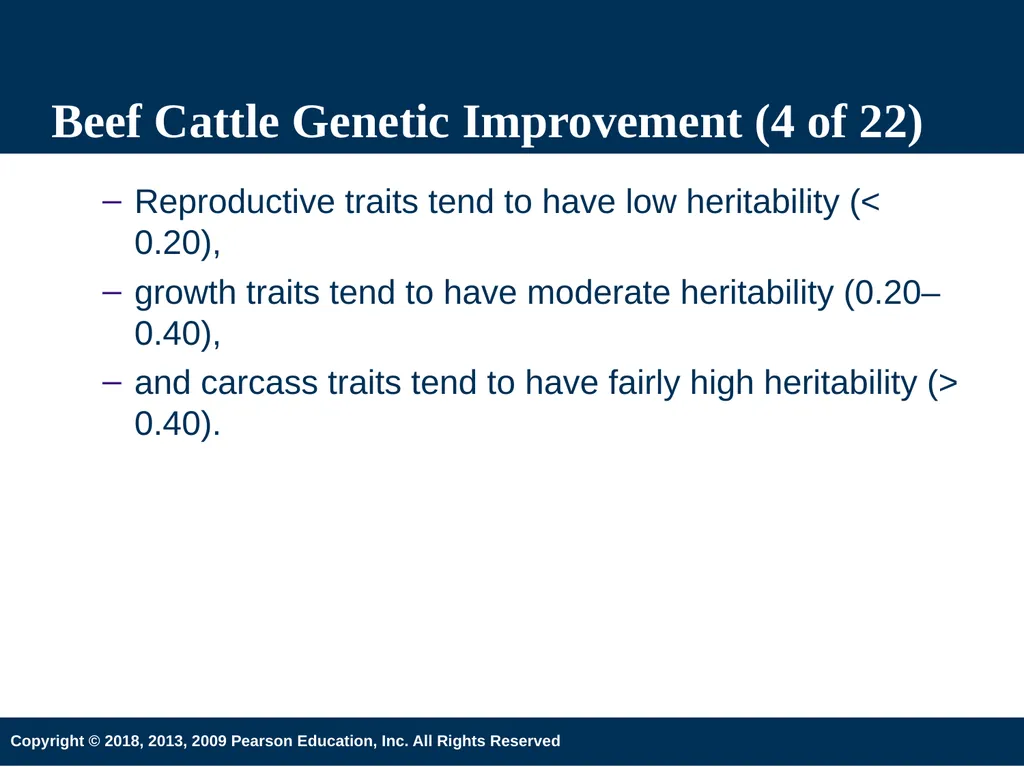
Beef Cattle Genetic Improvement (4 of 22) Reproductive traits tend to have low heritability (< 0.20),
growth traits tend to have moderate heritability (0.20–0.40),
and carcass traits tend to have fairly high heritability (> 0.40).<br>
growth traits tend to have moderate heritability (0.20–0.40),
and carcass traits tend to have fairly high heritability (> 0.40).<br>
10
Beef Cattle Genetic Improvement (5 of 22) Heritability also indicates the proportion of the superiority in an individual or in a group of individuals that can be passed on to the next generation.
This property is used to estimate breeding value.
Breeding value is the value of an individual as a parent.<br>
This property is used to estimate breeding value.
Breeding value is the value of an individual as a parent.<br>
11
Beef Cattle Genetic Improvement (6 of 22) Genetic Correlations
Very rarely are successful breeding programs based on single-trait selection.
It is important to understand the genetic relationship between traits of interest.
Genetic correlation refers to a situation in which the same or many of the same genes control two traits.<br>
Very rarely are successful breeding programs based on single-trait selection.
It is important to understand the genetic relationship between traits of interest.
Genetic correlation refers to a situation in which the same or many of the same genes control two traits.<br>
12
Beef Cattle Genetic Improvement (7 of 22) The magnitude of genetic correlations may vary between -1 and +1.
A genetic correlation of 0 indicates that different genes influence the two traits.
If the sign is positive, then the breeding values of the animals for the two traits tend to vary together; the reverse is true for a negative correlation.
The absolute value of the correlation indicates the strength of the association between the two traits.<br>
A genetic correlation of 0 indicates that different genes influence the two traits.
If the sign is positive, then the breeding values of the animals for the two traits tend to vary together; the reverse is true for a negative correlation.
The absolute value of the correlation indicates the strength of the association between the two traits.<br>
13
Beef Cattle Genetic Improvement (8 of 22) Knowledge of the magnitude of the genetic correlation between various traits is useful in a selection program.
For example, a favorable genetic correlation exists between rate of gain and feed efficiency.<br>
For example, a favorable genetic correlation exists between rate of gain and feed efficiency.<br>
14
Beef Cattle Genetic Improvement (9 of 22) Genetic correlations are not always favorable.
For example, selection for increased yearling weight has an adverse effect on calving difficulty.
Performance Information
To make genetic change in a desired direction, cow-calf producers have to know the current performance level of their herd.<br>
For example, selection for increased yearling weight has an adverse effect on calving difficulty.
Performance Information
To make genetic change in a desired direction, cow-calf producers have to know the current performance level of their herd.<br>
15
Beef Cattle Genetic Improvement (10 of 22) The program should be designed with performance items in the plan that address these objectives:
breeding,
calving,
weaning
yearling,
carcass,
and maternal breeding.<br>
breeding,
calving,
weaning
yearling,
carcass,
and maternal breeding.<br>
16
Beef Cattle Genetic Improvement (11 of 22) Performance programs come in many forms.
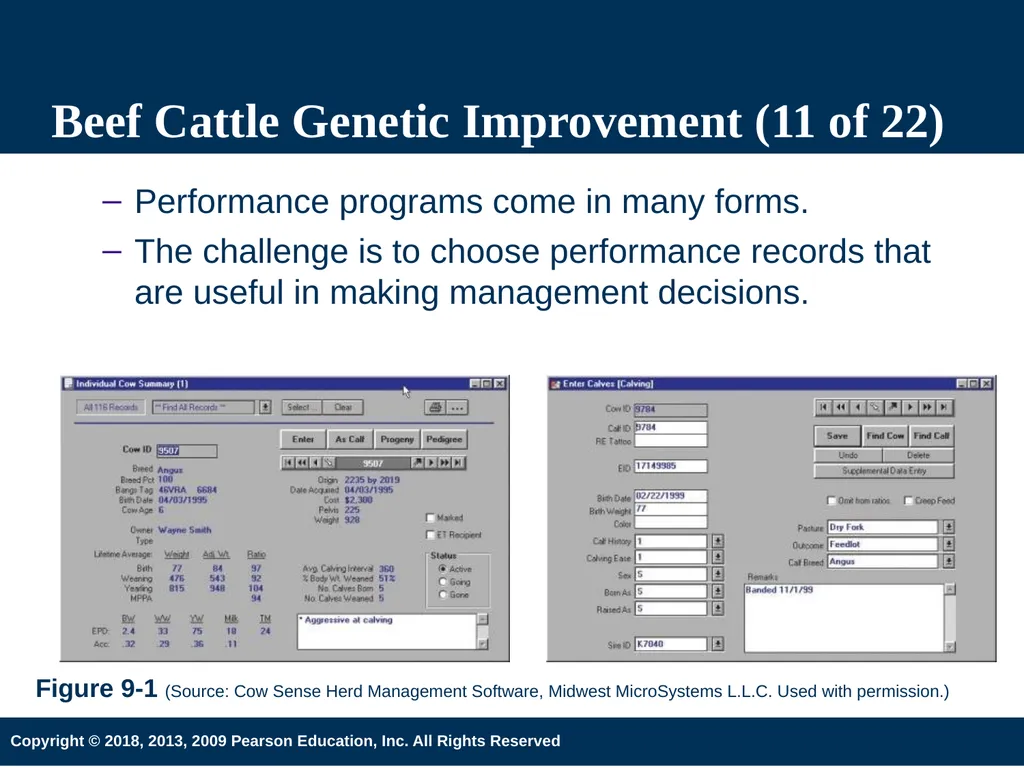
The challenge is to choose performance records that are useful in making management decisions. Figure 9-1 (Source: Cow Sense Herd Management Software, Midwest MicroSystems L.L.C. Used with permission.)<br>
The challenge is to choose performance records that are useful in making management decisions. Figure 9-1 (Source: Cow Sense Herd Management Software, Midwest MicroSystems L.L.C. Used with permission.)<br>
17
Beef Cattle Genetic Improvement (12 of 22) Seedstock breeders work closely with breed associations to develop extensive on-farm performance programs.
Commercial producers need an effective program that encourages the culling of inferior animals and selection of herd replacement breeding stock.
Sire selection is the area in which commercial herds can place the greatest selection pressure.<br>
Commercial producers need an effective program that encourages the culling of inferior animals and selection of herd replacement breeding stock.
Sire selection is the area in which commercial herds can place the greatest selection pressure.<br>
18
Beef Cattle Genetic Improvement (13 of 22) Genetic Evaluation, Breeding Values, and Expected Progeny Differences
Breeding value, or genetic merit, is calculated from information on an individual’s performance and the performance of related individuals.
Half of the breeding value is equal to the expected progeny difference.
EPDs provide a prediction of future progeny performance of one individual compared to another individual within a breed for a specific trait.<br>
Breeding value, or genetic merit, is calculated from information on an individual’s performance and the performance of related individuals.
Half of the breeding value is equal to the expected progeny difference.
EPDs provide a prediction of future progeny performance of one individual compared to another individual within a breed for a specific trait.<br>
19
Beef Cattle Genetic Improvement (14 of 22) National Cattle Evaluations
All of the major beef breed associations annually conduct national cattle evaluations (NCEs) and compute EPDs as a service to their breeders.
Contemporary Group
A contemporary group is a group in which animals of a given sex and age, having similar treatment, are given an equal opportunity to perform.<br>
All of the major beef breed associations annually conduct national cattle evaluations (NCEs) and compute EPDs as a service to their breeders.
Contemporary Group
A contemporary group is a group in which animals of a given sex and age, having similar treatment, are given an equal opportunity to perform.<br>
20
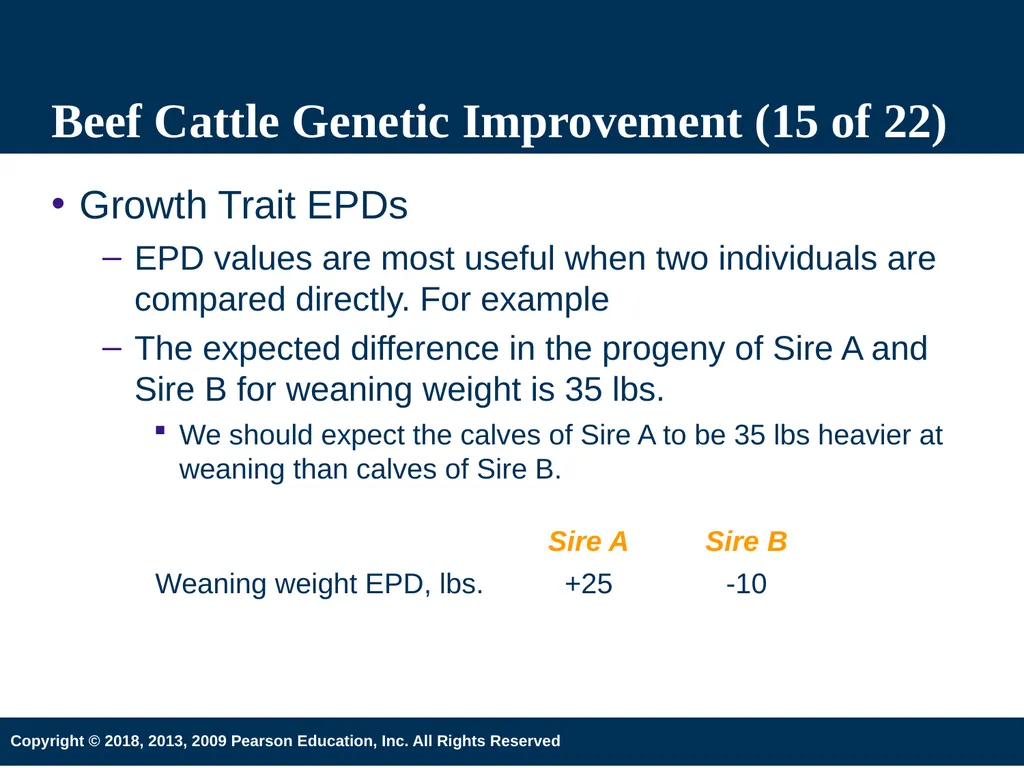
Beef Cattle Genetic Improvement (15 of 22) Growth Trait EPDs
EPD values are most useful when two individuals are compared directly. For example
The expected difference in the progeny of Sire A and Sire B for weaning weight is 35 lbs.
We should expect the calves of Sire A to be 35 lbs heavier at weaning than calves of Sire B.<br>
EPD values are most useful when two individuals are compared directly. For example
The expected difference in the progeny of Sire A and Sire B for weaning weight is 35 lbs.
We should expect the calves of Sire A to be 35 lbs heavier at weaning than calves of Sire B.<br>
21
Beef Cattle Genetic Improvement (16 of 22) Breed Average EPD and Base Year
It is frequently said that an EPD is a comparison to an average bull; this, unfortunately, is not true.
A zero EPD represents the average genetic merit of animals in the database at the time when sufficient information existed to calculate EPDs. Therefore, it represents a historic base point, or base year.
Breed associations publish the average EPDs in the sire summaries made available to the public.<br>
It is frequently said that an EPD is a comparison to an average bull; this, unfortunately, is not true.
A zero EPD represents the average genetic merit of animals in the database at the time when sufficient information existed to calculate EPDs. Therefore, it represents a historic base point, or base year.
Breed associations publish the average EPDs in the sire summaries made available to the public.<br>
22
Beef Cattle Genetic Improvement (17 of 22) Accuracy
Accuracy is the measure of reliability associated with an EPD and is expressed as a value between 0 and 1.
Possible Change
Possible change is the measure of the potential error associated with EPD values.<br>
Accuracy is the measure of reliability associated with an EPD and is expressed as a value between 0 and 1.
Possible Change
Possible change is the measure of the potential error associated with EPD values.<br>
23
Beef Cattle Genetic Improvement (18 of 22) Sire Summaries
Sire summaries include a sampling of the available genetic material in each breed.
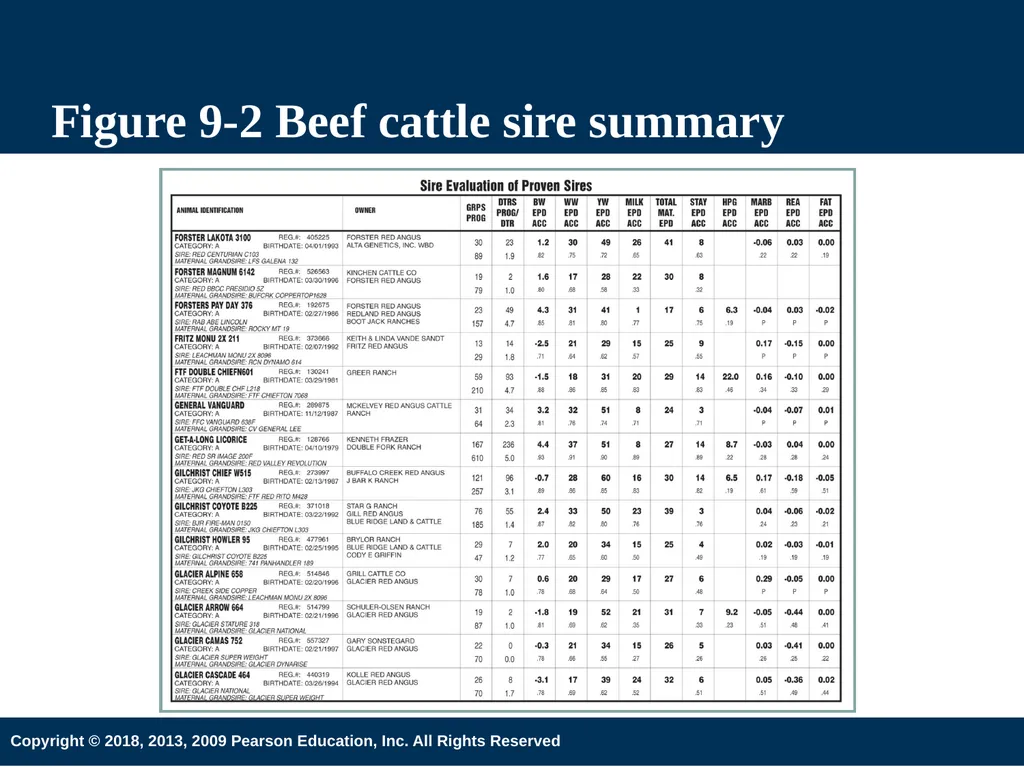
Summaries include EPDs, accuracies, graphs of the average change in EPD for the particular breed, breed average EPDs, possible change values, and other useful materials.<br>
Sire summaries include a sampling of the available genetic material in each breed.
Summaries include EPDs, accuracies, graphs of the average change in EPD for the particular breed, breed average EPDs, possible change values, and other useful materials.<br>
24
Beef Cattle Genetic Improvement (19 of 22) Maternal Trait EPDs
In beef cattle, the dam makes at least two contributions to the offspring phenotypic value:
half of her genes passed directly to the offspring
and the maternal effect she provides her calf.
A maternal effect is defined as any environmental influence that the dam contributes to the phenotype of her offspring.
Examples include mothering ability, milk production environment, and maternal instinct.<br>
In beef cattle, the dam makes at least two contributions to the offspring phenotypic value:
half of her genes passed directly to the offspring
and the maternal effect she provides her calf.
A maternal effect is defined as any environmental influence that the dam contributes to the phenotype of her offspring.
Examples include mothering ability, milk production environment, and maternal instinct.<br>
25
Beef Cattle Genetic Improvement (20 of 22) Milk EPD
The milk EPD is the expected difference in weaning weight of calves out of daughters of a particular sire, due to differences in mothering ability.
Combined Maternal EPD
The combined maternal EPD (sometimes called maternal weaning weight) reflects both the milking ability transmitted to daughters and the direct weaning growth transmitted through daughters to their calves.<br>
The milk EPD is the expected difference in weaning weight of calves out of daughters of a particular sire, due to differences in mothering ability.
Combined Maternal EPD
The combined maternal EPD (sometimes called maternal weaning weight) reflects both the milking ability transmitted to daughters and the direct weaning growth transmitted through daughters to their calves.<br>
26
Beef Cattle Genetic Improvement (21 of 22) Carcass EPD
Carcass trait EPDs are generated from progeny carcass data for various sires within a breed.
Ultrasonic scan measures can be used to evaluate carcass merit as well as actual measurements on carcasses.<br>
Carcass trait EPDs are generated from progeny carcass data for various sires within a breed.
Ultrasonic scan measures can be used to evaluate carcass merit as well as actual measurements on carcasses.<br>
27
Beef Cattle Genetic Improvement (22 of 22) Mature Size
Size is composed of closely related measures of weight and height; both of these are highly heritable traits.
Genetic prediction of mature size may allow beef cattle breeders to make a directional change in the mature size of their cow herd or to emphasize uniformity of cow size for a particular production environment.<br>
Size is composed of closely related measures of weight and height; both of these are highly heritable traits.
Genetic prediction of mature size may allow beef cattle breeders to make a directional change in the mature size of their cow herd or to emphasize uniformity of cow size for a particular production environment.<br>
28
Figure 9-2 Beef cattle sire summary<br>
29
Use of EPDs (1 of 5) Use of EPDs for Selection in Seedstock Herds
Purebred producers know that they need to use EPDs in their breeding programs.
Care needs to be exercised when making selection decisions.
Type fads have caused some problems in the past when single traits were emphasized.<br>
Purebred producers know that they need to use EPDs in their breeding programs.
Care needs to be exercised when making selection decisions.
Type fads have caused some problems in the past when single traits were emphasized.<br>
30
Use of EPDs (2 of 5) Use of EPDs for Selection in Commercial Herds
Commercial producers should make maximum use of available EPDs when considering purchases of breeding stock.
EPDs within a breed are directly comparable between herds.
Unfortunately, EPDs cannot be compared between breeds.<br>
Commercial producers should make maximum use of available EPDs when considering purchases of breeding stock.
EPDs within a breed are directly comparable between herds.
Unfortunately, EPDs cannot be compared between breeds.<br>
31
Use of EPDs (3 of 5) Pedigree Estimated EPDs
After the first of each year, sale catalogs prepared for production sales and full of information on potential herd sires become available.
Data on some bulls appear in catalogs with limited or no EPD information, particularly young bulls.
Pedigree EPDs can be computed provided there is access to EPDs on the animals in the pedigree of the young bull.<br>
After the first of each year, sale catalogs prepared for production sales and full of information on potential herd sires become available.
Data on some bulls appear in catalogs with limited or no EPD information, particularly young bulls.
Pedigree EPDs can be computed provided there is access to EPDs on the animals in the pedigree of the young bull.<br>
32
Use of EPDs (4 of 5) Across Breed EPDs
Currently, most EPDs are calculated for a specific breed.
The across-breed EPD concept (AB-EPD) would allow commercial bull buyers using more than one breed of bull to compare cattle of different breeds.
Breed comparison data from the U.S. Meat and Animal Research Center are the best resources available to date.<br>
Currently, most EPDs are calculated for a specific breed.
The across-breed EPD concept (AB-EPD) would allow commercial bull buyers using more than one breed of bull to compare cattle of different breeds.
Breed comparison data from the U.S. Meat and Animal Research Center are the best resources available to date.<br>
33
Use of EPDs (5 of 5) EPDs and Crossbreeding
Planning a crossbreeding system first relies on the choices of breeds, followed by the use of within-breed EPDs as selection tools for performance traits.
To assist beef producers in their choices of breeds, studies have tried to group or categorize breeds into general biological types.<br>
Planning a crossbreeding system first relies on the choices of breeds, followed by the use of within-breed EPDs as selection tools for performance traits.
To assist beef producers in their choices of breeds, studies have tried to group or categorize breeds into general biological types.<br>
34
Dairy Cattle Genetic Improvement (1 of 7) Dairy producers have been leaders in genetic improvement.
One advantage the dairy industry has is the focus on a limited number of economically important traits
Milk yield has been the primary driver in trait emphasis for profitability.<br>
One advantage the dairy industry has is the focus on a limited number of economically important traits
Milk yield has been the primary driver in trait emphasis for profitability.<br>
35
Dairy Cattle Genetic Improvement (2 of 7) Dairy producers are challenged to balance traits of economic importance to address some of the following goals:
Achieve profitable milk yield levels.
Monitor milk composition.
Generate profitable replacement animals that are productive under the stress of high production levels.
Sustain and improve cow longevity in the herd.<br>
Achieve profitable milk yield levels.
Monitor milk composition.
Generate profitable replacement animals that are productive under the stress of high production levels.
Sustain and improve cow longevity in the herd.<br>
36
Dairy Cattle Genetic Improvement (3 of 7) Heritability Estimates
An understanding of the heritability and genetic correlations for dairy cattle traits is necessary to take advantage of the variety of selection tools and breed trait information available.
It is important to review the heritabilities of other commonly known dairy production traits.<br>
An understanding of the heritability and genetic correlations for dairy cattle traits is necessary to take advantage of the variety of selection tools and breed trait information available.
It is important to review the heritabilities of other commonly known dairy production traits.<br>
37
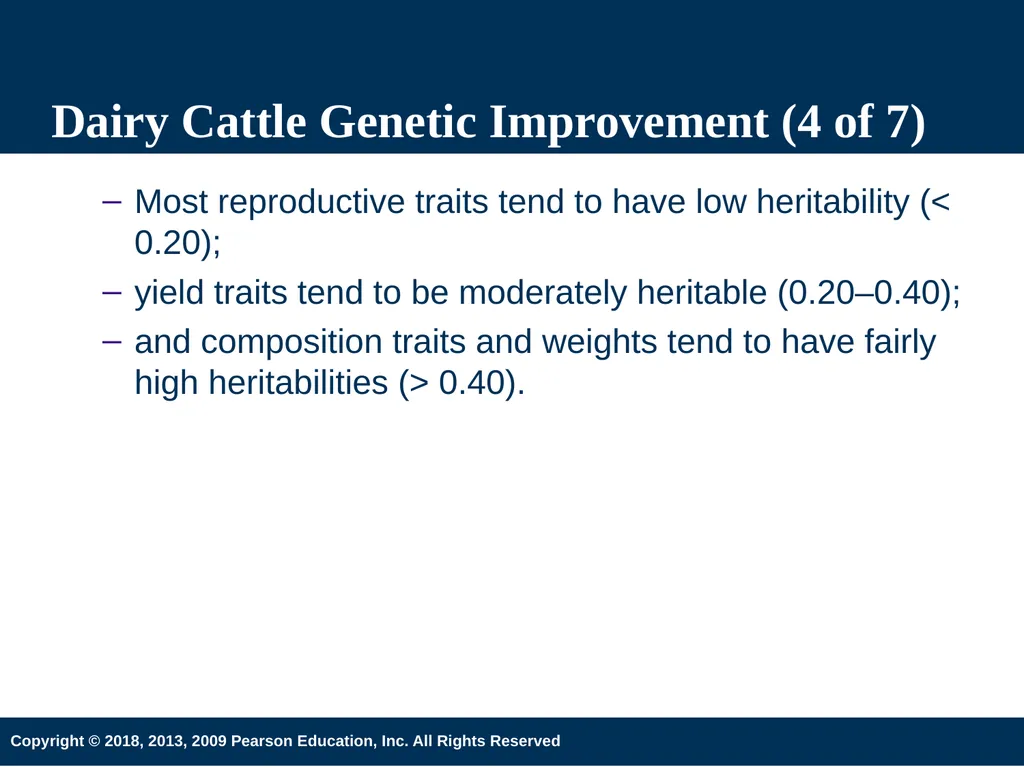
Dairy Cattle Genetic Improvement (4 of 7) Most reproductive traits tend to have low heritability (< 0.20);
yield traits tend to be moderately heritable (0.20–0.40);
and composition traits and weights tend to have fairly high heritabilities (> 0.40).<br>
yield traits tend to be moderately heritable (0.20–0.40);
and composition traits and weights tend to have fairly high heritabilities (> 0.40).<br>
38
Dairy Cattle Genetic Improvement (5 of 7) Association Among Traits
Genetic correlation refers to a situation in which the same or many of the same genes control two traits.
Phenotypic correlations are correlations between two traits that producers actually measure or see.
Knowledge of the magnitude of the genetic correlation between various traits is useful in a selection program.<br>
Genetic correlation refers to a situation in which the same or many of the same genes control two traits.
Phenotypic correlations are correlations between two traits that producers actually measure or see.
Knowledge of the magnitude of the genetic correlation between various traits is useful in a selection program.<br>
39
Dairy Cattle Genetic Improvement (6 of 7) Goal Setting and Trait Emphasis
The genetic improvement program for every dairy herd must have goals to design the cow herd with the genetics for making a profit.
Most producers begin planning a well-founded breeding program through basic use of:
Dairy Herd Improvement Association (DHI) records and
semen purchase of bulls with genetic superiority for economically important traits.<br>
The genetic improvement program for every dairy herd must have goals to design the cow herd with the genetics for making a profit.
Most producers begin planning a well-founded breeding program through basic use of:
Dairy Herd Improvement Association (DHI) records and
semen purchase of bulls with genetic superiority for economically important traits.<br>
40
Dairy Cattle Genetic Improvement (7 of 7) Trait emphasis should be balanced with respect to the heritability of the trait, genetic correlations among traits, the reliability of the information, and economic importance of the trait.
This is no small task considering there are national genetic evaluations for about 30 traits.
Individual dairies may want to change emphases depending on their management systems and goals.<br>
This is no small task considering there are national genetic evaluations for about 30 traits.
Individual dairies may want to change emphases depending on their management systems and goals.<br>
41
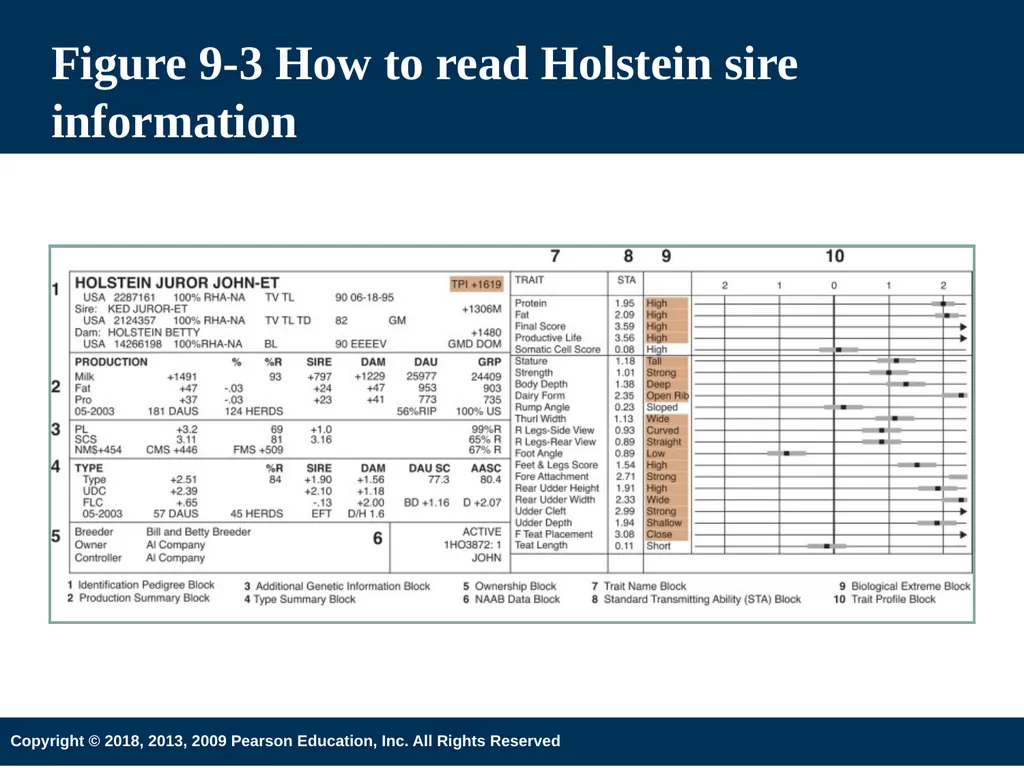
Figure 9-3 How to read Holstein sire information<br>
42
Genetic Evaluation Procedures (1 of 5) DHI System
Much of the genetic improvement in milk production in the United States is attributable in part to good use of performance records through the Dairy Herd Improvement (DHI) system.
The DHI system of genetic evaluation consists of comparing sire daughters with contemporaries in the same herd.<br>
Much of the genetic improvement in milk production in the United States is attributable in part to good use of performance records through the Dairy Herd Improvement (DHI) system.
The DHI system of genetic evaluation consists of comparing sire daughters with contemporaries in the same herd.<br>
43
Genetic Evaluation Procedures (2 of 5) Animal Model
The animal model procedure produces predictions of the breeding (genetic) value of an animal.
The USDA-DHI Animal Model Genetic Evaluation compiles lactation yield information for various economically important traits:
milk, fat, protein, somatic cell score, productive life, and pedigree.<br>
The animal model procedure produces predictions of the breeding (genetic) value of an animal.
The USDA-DHI Animal Model Genetic Evaluation compiles lactation yield information for various economically important traits:
milk, fat, protein, somatic cell score, productive life, and pedigree.<br>
44
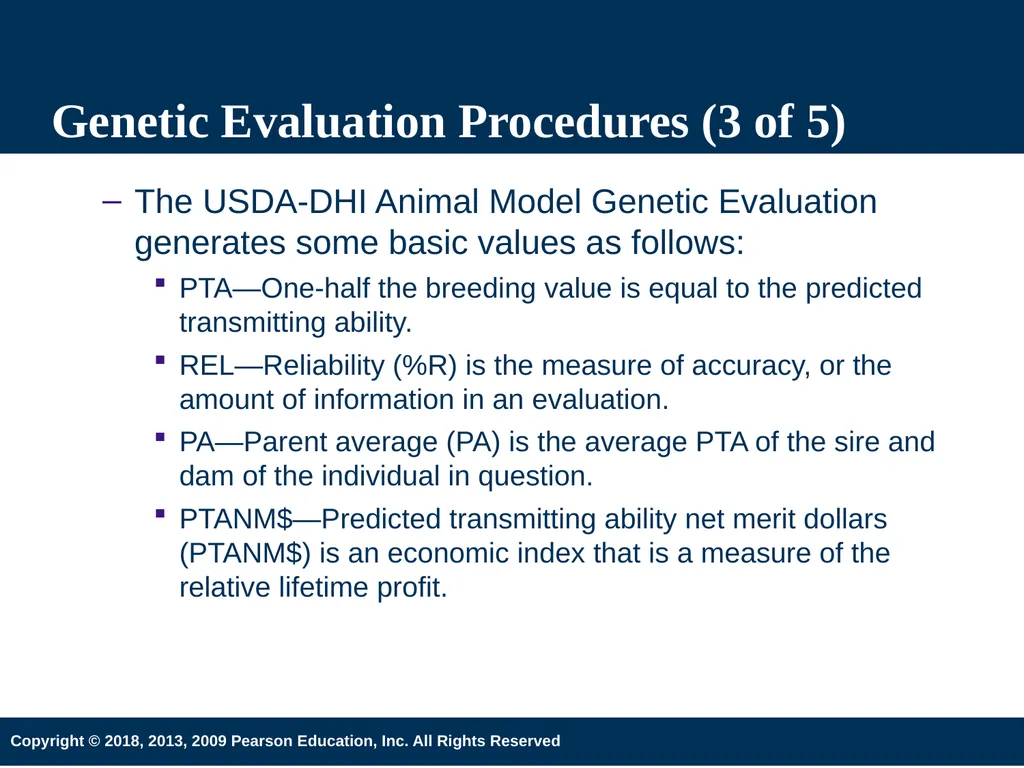
Genetic Evaluation Procedures (3 of 5) The USDA-DHI Animal Model Genetic Evaluation generates some basic values as follows:
PTA—One-half the breeding value is equal to the predicted transmitting ability.
REL—Reliability (%R) is the measure of accuracy, or the amount of information in an evaluation.
PA—Parent average (PA) is the average PTA of the sire and dam of the individual in question.
PTANM$—Predicted transmitting ability net merit dollars (PTANM$) is an economic index that is a measure of the relative lifetime profit.<br>
PTA—One-half the breeding value is equal to the predicted transmitting ability.
REL—Reliability (%R) is the measure of accuracy, or the amount of information in an evaluation.
PA—Parent average (PA) is the average PTA of the sire and dam of the individual in question.
PTANM$—Predicted transmitting ability net merit dollars (PTANM$) is an economic index that is a measure of the relative lifetime profit.<br>
45
Genetic Evaluation Procedures (4 of 5) Producers benefit from the extensive herd summary reports provided by DHI.
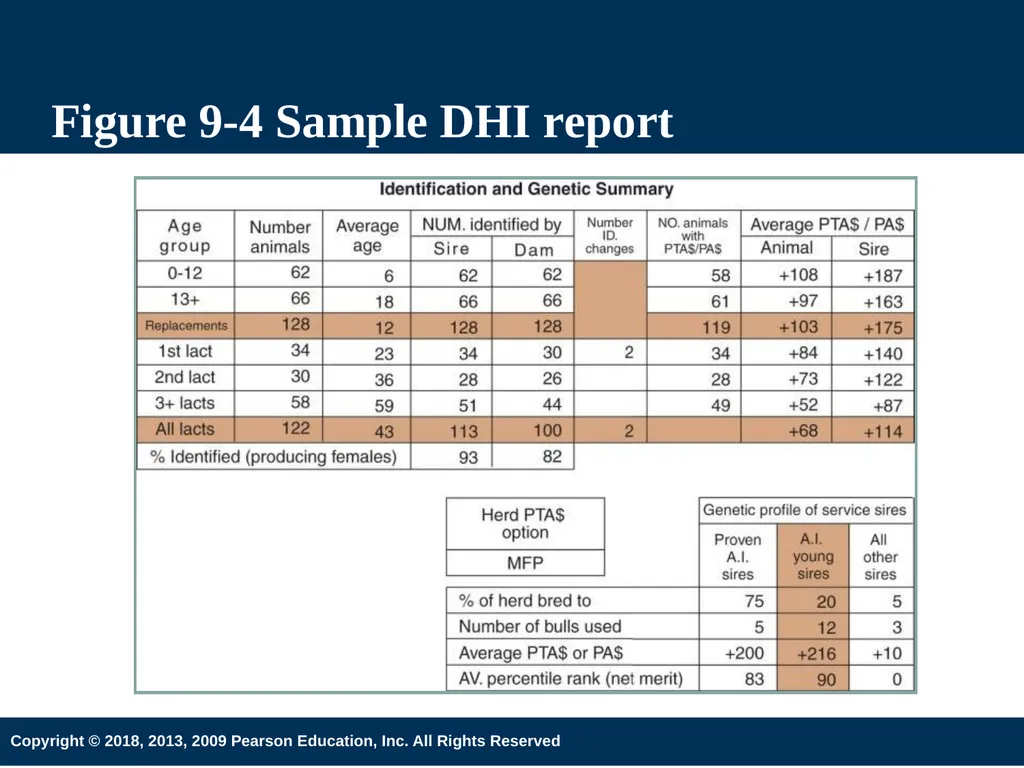
Herd analysis and management reports include production, reproduction, genetics, udder health, and feed cost information.
This report is useful in verifying the number of replacement and producing animals in the operation.<br>
Herd analysis and management reports include production, reproduction, genetics, udder health, and feed cost information.
This report is useful in verifying the number of replacement and producing animals in the operation.<br>
46
Genetic Evaluation Procedures (5 of 5) Sire Selection
The total performance index (TPI) is used by the Holstein Association to rank sires on their ability to transmit a balance of traits.
Net merit dollars (NM$) is the economic index calculated by the USDA as an index of relative lifetime profit.
The somatic cell score (SCS) PTA is a tool that allows producers to select bulls based on their ability to sire daughters with lower rates of mastitis.<br>
The total performance index (TPI) is used by the Holstein Association to rank sires on their ability to transmit a balance of traits.
Net merit dollars (NM$) is the economic index calculated by the USDA as an index of relative lifetime profit.
The somatic cell score (SCS) PTA is a tool that allows producers to select bulls based on their ability to sire daughters with lower rates of mastitis.<br>
47
Figure 9-4 Sample DHI report<br>
48
Swine Genetic Improvement (1 of 14) Genetic improvement programs are a primary focal point for today’s swine industry.
The high reproductive rate and short generation interval in swine allow rapid genetic progress.
The NSIF and NPPC, as well as other agencies, have historically sponsored “Guidelines for Uniform Swine Improvement Programs.”<br>
The high reproductive rate and short generation interval in swine allow rapid genetic progress.
The NSIF and NPPC, as well as other agencies, have historically sponsored “Guidelines for Uniform Swine Improvement Programs.”<br>
49
Swine Genetic Improvement (2 of 14) Performance Information
Efficient pork production relies on objective data collection for economically important traits, breeding value estimation, and planned selection decisions.
Key areas include the reproductive complex, growth rate and efficiency, and carcass traits.<br>
Efficient pork production relies on objective data collection for economically important traits, breeding value estimation, and planned selection decisions.
Key areas include the reproductive complex, growth rate and efficiency, and carcass traits.<br>
50
Swine Genetic Improvement (3 of 14) Herd reproductive measures include:
pigs per sow per year,
pregnancy percentage,
farrowing percentage,
weaning rate percentage,
live pigs per litter,
and mated female to service boar ratio.<br>
pigs per sow per year,
pregnancy percentage,
farrowing percentage,
weaning rate percentage,
live pigs per litter,
and mated female to service boar ratio.<br>
51
Swine Genetic Improvement (4 of 14) Growth rate and feed efficiency are evaluated extensively in the swine production system;
Economically important measures include:
days to 250 lbs,
average daily gain (ADG),
and feed efficiency.<br>
Economically important measures include:
days to 250 lbs,
average daily gain (ADG),
and feed efficiency.<br>
52
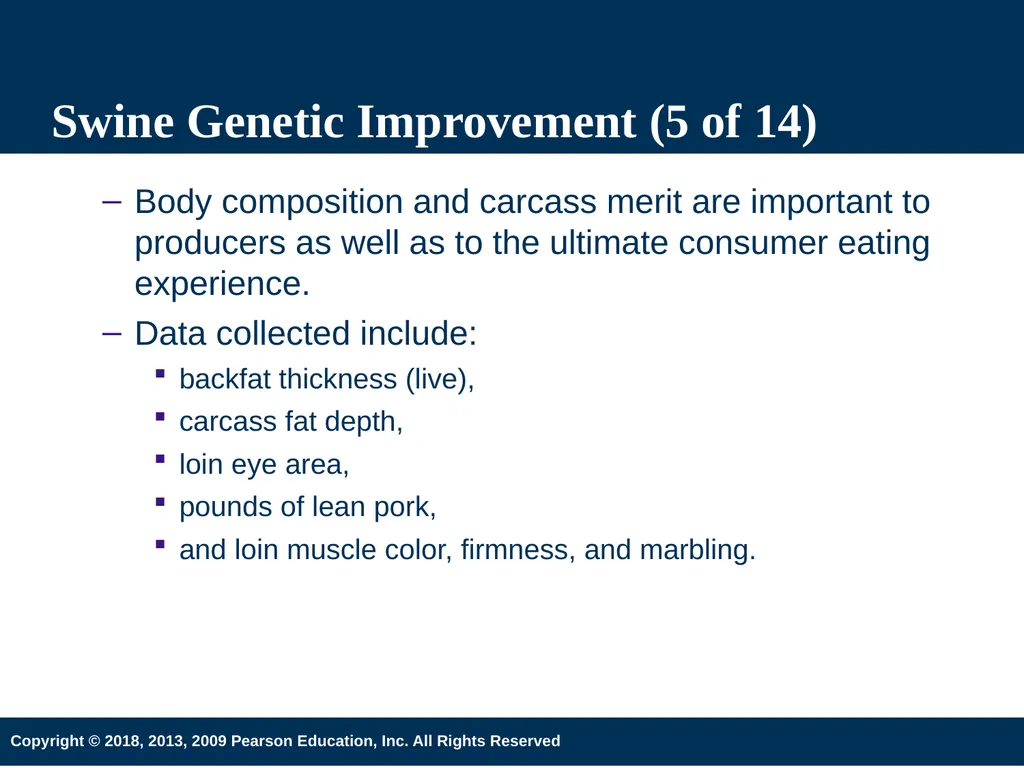
Swine Genetic Improvement (5 of 14) Body composition and carcass merit are important to producers as well as to the ultimate consumer eating experience.
Data collected include:
backfat thickness (live),
carcass fat depth,
loin eye area,
pounds of lean pork,
and loin muscle color, firmness, and marbling.<br>
Data collected include:
backfat thickness (live),
carcass fat depth,
loin eye area,
pounds of lean pork,
and loin muscle color, firmness, and marbling.<br>
53
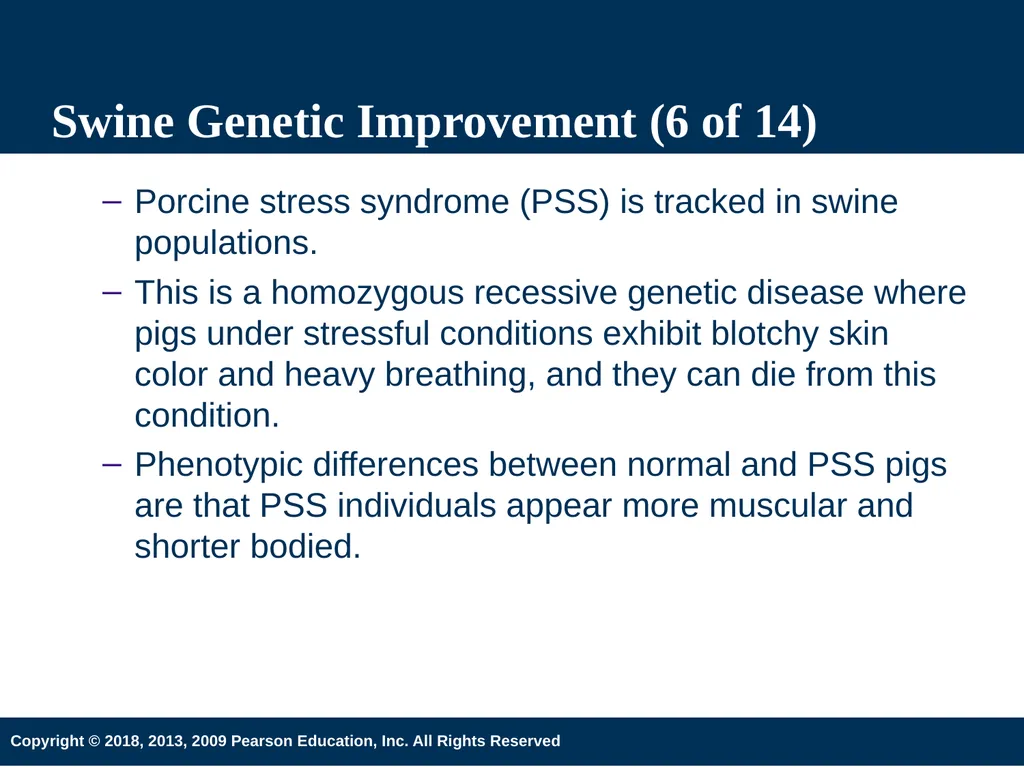
Swine Genetic Improvement (6 of 14) Porcine stress syndrome (PSS) is tracked in swine populations.
This is a homozygous recessive genetic disease where pigs under stressful conditions exhibit blotchy skin color and heavy breathing, and they can die from this condition.
Phenotypic differences between normal and PSS pigs are that PSS individuals appear more muscular and shorter bodied.<br>
This is a homozygous recessive genetic disease where pigs under stressful conditions exhibit blotchy skin color and heavy breathing, and they can die from this condition.
Phenotypic differences between normal and PSS pigs are that PSS individuals appear more muscular and shorter bodied.<br>
54
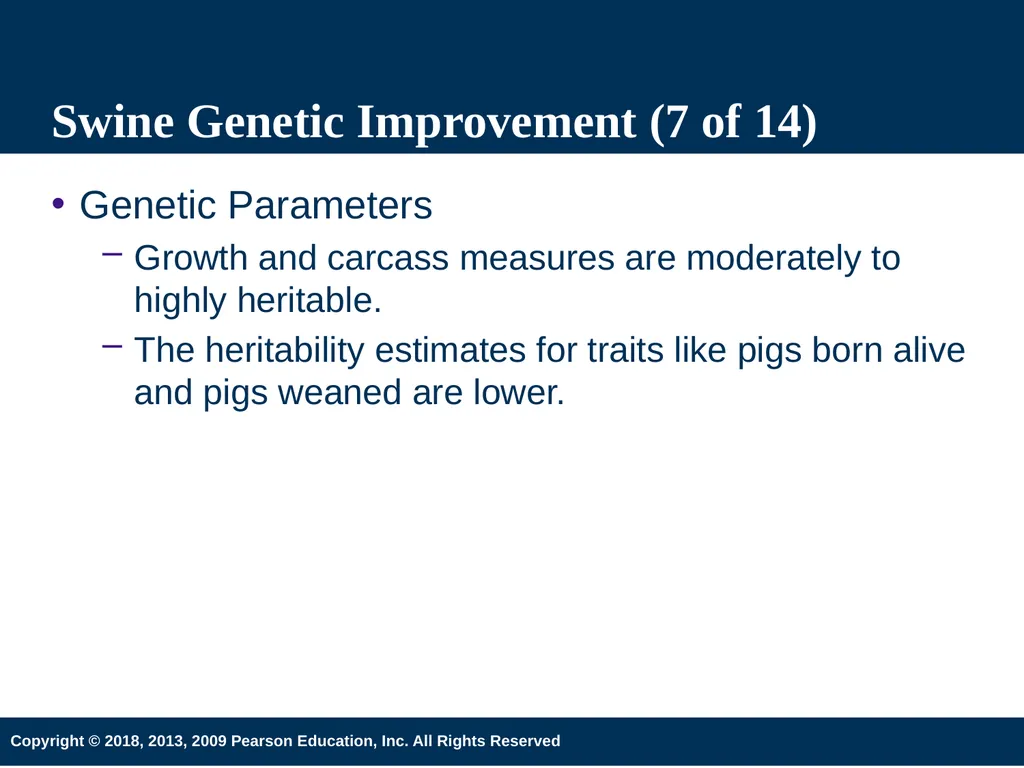
Swine Genetic Improvement (7 of 14) Genetic Parameters
Growth and carcass measures are moderately to highly heritable.
The heritability estimates for traits like pigs born alive and pigs weaned are lower.<br>
Growth and carcass measures are moderately to highly heritable.
The heritability estimates for traits like pigs born alive and pigs weaned are lower.<br>
55
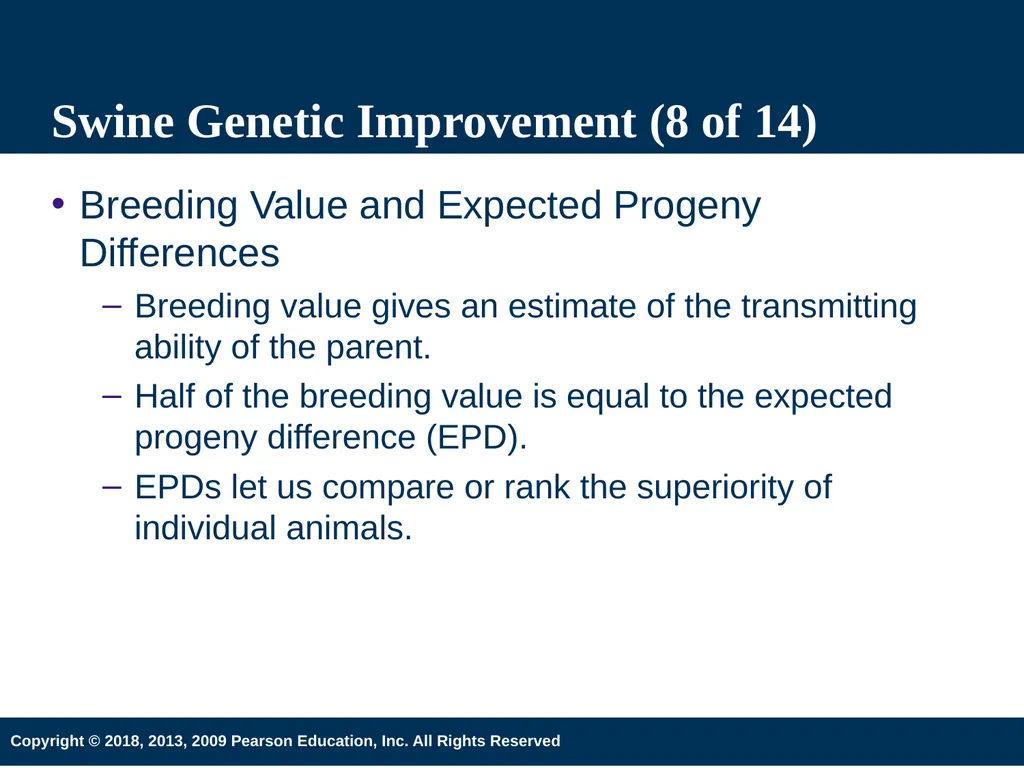
Swine Genetic Improvement (8 of 14) Breeding Value and Expected Progeny Differences
Breeding value gives an estimate of the transmitting ability of the parent.
Half of the breeding value is equal to the expected progeny difference (EPD).
EPDs let us compare or rank the superiority of individual animals.<br>
Breeding value gives an estimate of the transmitting ability of the parent.
Half of the breeding value is equal to the expected progeny difference (EPD).
EPDs let us compare or rank the superiority of individual animals.<br>
56
Swine Genetic Improvement (9 of 14) Swine Breeds
Unlike the beef industry, fewer swine breeds have had a large impact on commercial swine production.
Specialized sire and dam lines have been developed using these evaluations.
Subsequent commercial crossbreeding systems are designed for efficient pork production.<br>
Unlike the beef industry, fewer swine breeds have had a large impact on commercial swine production.
Specialized sire and dam lines have been developed using these evaluations.
Subsequent commercial crossbreeding systems are designed for efficient pork production.<br>
57
Swine Genetic Improvement (10 of 14) An interesting angle to the swine industry is that many times the actual breed composition of a particular breeding line is not known.
Commercial units rely on the seedstock producer choices or corporate genetic selections to set the genetics of their animals.
Private companies employ geneticists to carefully evaluate all production aspects of their base genetics.<br>
Commercial units rely on the seedstock producer choices or corporate genetic selections to set the genetics of their animals.
Private companies employ geneticists to carefully evaluate all production aspects of their base genetics.<br>
58
Swine Genetic Improvement (11 of 14) Selection index application is very common in the swine breeding programs.
Index equations allow the simultaneous evaluation of two or more traits based on their economic value and the overall selection objectives for the breeding population.<br>
Index equations allow the simultaneous evaluation of two or more traits based on their economic value and the overall selection objectives for the breeding population.<br>
59
Swine Genetic Improvement (12 of 14) Breeds from other countries have been studied to determine if specialized genetics would benefit commercial hog production.
Perhaps the most well-known quest is that of the Chinese breeds of swine.
These breeds are of great interest because of their high reproductive rate (9–17 pigs born alive) as well as early puberty advantages.<br>
Perhaps the most well-known quest is that of the Chinese breeds of swine.
These breeds are of great interest because of their high reproductive rate (9–17 pigs born alive) as well as early puberty advantages.<br>
60
Swine Genetic Improvement (13 of 14) STAGES
A well-known performance resource in swine genetic evaluation is STAGES (Swine Testing and Genetic Evaluation System).
STAGES incorporates performance information on individuals and their relatives, as well the relationships among these animals, to generate breeding values (and ultimately within-herd EPDs).<br>
A well-known performance resource in swine genetic evaluation is STAGES (Swine Testing and Genetic Evaluation System).
STAGES incorporates performance information on individuals and their relatives, as well the relationships among these animals, to generate breeding values (and ultimately within-herd EPDs).<br>
61
Swine Genetic Improvement (14 of 14) A STAGES national evaluation is run for specific herds to generate across-herd EPDs.
Through genetic improvement programs like STAGES, the swine industry has been able to make good progress in several important traits.
The sow productivity index (SPI), used to select litters with future replacement gilt candidates.
Also, the time it takes an animal to reach 250 lbs has been shortened genetically.<br>
Through genetic improvement programs like STAGES, the swine industry has been able to make good progress in several important traits.
The sow productivity index (SPI), used to select litters with future replacement gilt candidates.
Also, the time it takes an animal to reach 250 lbs has been shortened genetically.<br>
62
Sheep Genetic Improvement (1 of 10) The sheep producer is in the business of producing two products, lambs and wool, as efficiently as possible.
The major areas of economic importance to the sheep producer are lamb growth, prolificacy, and, in some areas, wool quality and quantity.<br>
The major areas of economic importance to the sheep producer are lamb growth, prolificacy, and, in some areas, wool quality and quantity.<br>
63
Sheep Genetic Improvement (2 of 10) The tools are not the same for sheep breeding and genetic improvement as they are for the other major meat breeds.
EPDs have only been available for sheep since 1986 and are not yet as useful as they are for the other species.
In addition, artificial insemination is rarely used in the sheep industry.
This makes gaining genetic progress through the widespread use of superior sires less of an influence on the industry.<br>
EPDs have only been available for sheep since 1986 and are not yet as useful as they are for the other species.
In addition, artificial insemination is rarely used in the sheep industry.
This makes gaining genetic progress through the widespread use of superior sires less of an influence on the industry.<br>
64
Sheep Genetic Improvement (3 of 10) Breeds and Breed Types
Breeds of sheep available in the United States can range from fine-wool breeds, to long-wool breeds, to hair breeds.
These breeds can range in mature size from 100 lbs to over 400 lbs, and average from one lamb per ewe per year to over three lambs per ewe per year.
The appropriate choice depends on the geographic location, feed conditions, weather conditions, and goals of the operation.<br>
Breeds of sheep available in the United States can range from fine-wool breeds, to long-wool breeds, to hair breeds.
These breeds can range in mature size from 100 lbs to over 400 lbs, and average from one lamb per ewe per year to over three lambs per ewe per year.
The appropriate choice depends on the geographic location, feed conditions, weather conditions, and goals of the operation.<br>
65
Sheep Genetic Improvement (4 of 10) For simplification and ease of understanding, the breeds are grouped together and classified.
The most common classification is by use, based on the major function of the breed in common mating systems:
ewe breed,
dual-purpose breed,
and ram breed<br>
The most common classification is by use, based on the major function of the breed in common mating systems:
ewe breed,
dual-purpose breed,
and ram breed<br>
66
Sheep Genetic Improvement (5 of 10) Ewe Breeds
Ewe breeds are generally the fine-wool, white-faced breeds and those that were developed from crosses of the fine-wool breeds with long-wool breeds, or the highly prolific breeds.
The breed most widely seen in commercial flocks in the United States is the Rambouillet or Rambouillet cross (a.k.a. Western ewe or Western White-face ewe).<br>
Ewe breeds are generally the fine-wool, white-faced breeds and those that were developed from crosses of the fine-wool breeds with long-wool breeds, or the highly prolific breeds.
The breed most widely seen in commercial flocks in the United States is the Rambouillet or Rambouillet cross (a.k.a. Western ewe or Western White-face ewe).<br>
67
Sheep Genetic Improvement (6 of 10) Ram Breeds
Ram breeds are the meat-type breeds used primarily as terminal sires on the ewe breeds or dual-purpose breed to increase lamb gain and carcass quality for market lamb production.
The two most widely used ram breeds in the United States are the Suffolk and Hampshire breeds.
Others include the the Dorset, Shropshire, Oxford, and Southdown breeds.<br>
Ram breeds are the meat-type breeds used primarily as terminal sires on the ewe breeds or dual-purpose breed to increase lamb gain and carcass quality for market lamb production.
The two most widely used ram breeds in the United States are the Suffolk and Hampshire breeds.
Others include the the Dorset, Shropshire, Oxford, and Southdown breeds.<br>
68
Sheep Genetic Improvement (7 of 10) Dual-Purpose Breeds
The breeds classified as dual purpose are those that can be used as either ewe breeds or ram breeds.
These are breeds that are noted for milk production, mothering ability, and twinning rate, as well as better growth rate and carcass quality.
Examples of dual-purpose breeds are the Dorset, Columbia, and Corriedale.<br>
The breeds classified as dual purpose are those that can be used as either ewe breeds or ram breeds.
These are breeds that are noted for milk production, mothering ability, and twinning rate, as well as better growth rate and carcass quality.
Examples of dual-purpose breeds are the Dorset, Columbia, and Corriedale.<br>
69
Sheep Genetic Improvement (8 of 10) Heritability
Reproductive traits have low heritability,
growth traits are moderately heritable,
and carcass and fleece are highly heritable.
Selection for growth traits
Because growth traits show moderate levels of heritability, selection programs that emphasize growth traits can show good genetic improvement.
Selection for growth is most important in the ram breeds.
In the sheep industry, the most important growth trait is weaning weight.<br>
Reproductive traits have low heritability,
growth traits are moderately heritable,
and carcass and fleece are highly heritable.
Selection for growth traits
Because growth traits show moderate levels of heritability, selection programs that emphasize growth traits can show good genetic improvement.
Selection for growth is most important in the ram breeds.
In the sheep industry, the most important growth trait is weaning weight.<br>
70
Sheep Genetic Improvement (9 of 10) National Sheep Improvement Program (NSIP)
The NSIP began in 1986 and was designed to provide both purebred and commercial producers with a performance recording and genetic evaluation program.
The NSIP evaluates maternal traits, growth traits, wool traits, and is developing carcass traits.
Some breed associations are using across-flock genetic evaluations through NSIP.<br>
The NSIP began in 1986 and was designed to provide both purebred and commercial producers with a performance recording and genetic evaluation program.
The NSIP evaluates maternal traits, growth traits, wool traits, and is developing carcass traits.
Some breed associations are using across-flock genetic evaluations through NSIP.<br>
71
Sheep Genetic Improvement (10 of 10) Heterosis in Sheep Breeding
Traits that are lowly heritable show high levels of heterosis, such as reproductive traits.
Moderately heritable traits show moderate levels of heterosis, such as the growth traits.
Highly heritable traits such as fleece and carcass traits show little hybrid vigor.<br>
Traits that are lowly heritable show high levels of heterosis, such as reproductive traits.
Moderately heritable traits show moderate levels of heterosis, such as the growth traits.
Highly heritable traits such as fleece and carcass traits show little hybrid vigor.<br>
72
Figure 9-7 Sheep breeds are often classified by use of the breed.
The pictured breeds of sheep are examples of the different breed classes: (a) ewe breed, Rambouillet; (b) ram breed, Shropshire; and (c) dual-purpose breed, Corriedale. (a) (b) (c)<br>
73
Summary and Conclusion (1 of 2) Animal breeding is a discipline that takes the principles of genetics and applies them to practical selection and management systems.
EPDs are a tool to assist in this process for the cow-calf producer.
The DHI system has allowed rapid genetic progress in the dairy industry.<br>
EPDs are a tool to assist in this process for the cow-calf producer.
The DHI system has allowed rapid genetic progress in the dairy industry.<br>
74
Summary and Conclusion (2 of 2) STAGES and NSIP have allowed for the selection of genetically superior animals in the swine and sheep industries, respectively.<br>