
INTRODUCTION TO MASCULINITIES STUDIES Masculinity
PT
Published · 30 slides · 0 views
1 / 1



Description
INTRODUCTION TO MASCULINITIES STUDIES Masculinity Todays class Explore Explore masculinity theories Explore Explore different understandings of masculinities Recap on Recap on feminisms: some of the key concepts (to make the connection
Related Topics
Share
Embed code
Download this presentation From Below
"INTRODUCTION TO MASCULINITIES STUDIES Masculinity" is the property of its rightful owner. Permission is granted to download and print the materials on this website for personal, non-commercial use only, and to display it on your personal computer provided you do not modify the materials and that you retain all copyright notices contained in the materials. By downloading content from our website, you accept the terms of this agreement.
Presentation Transcript
01
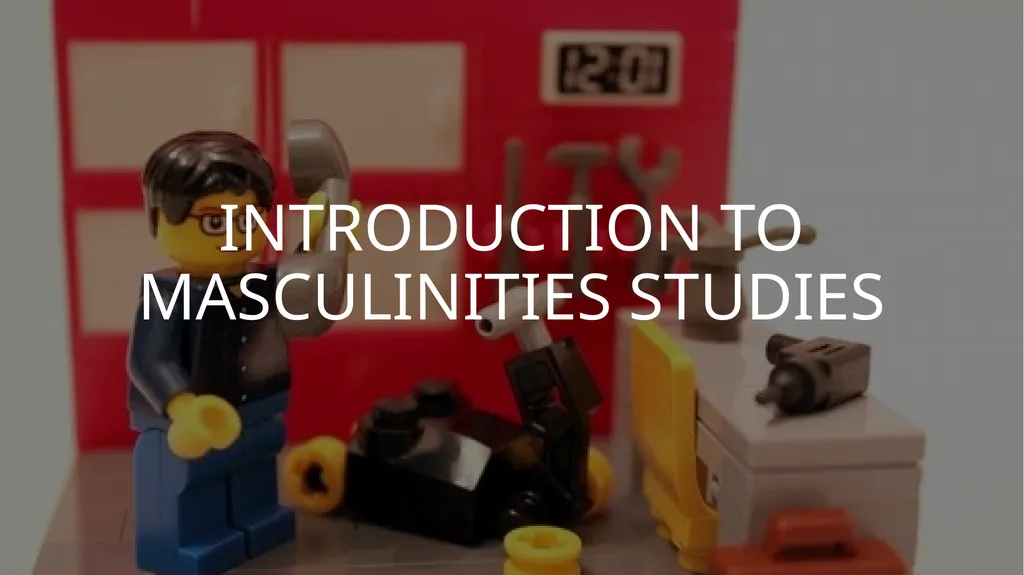
INTRODUCTION TO MASCULINITIES STUDIES<br>
02
Masculinity<br>
03
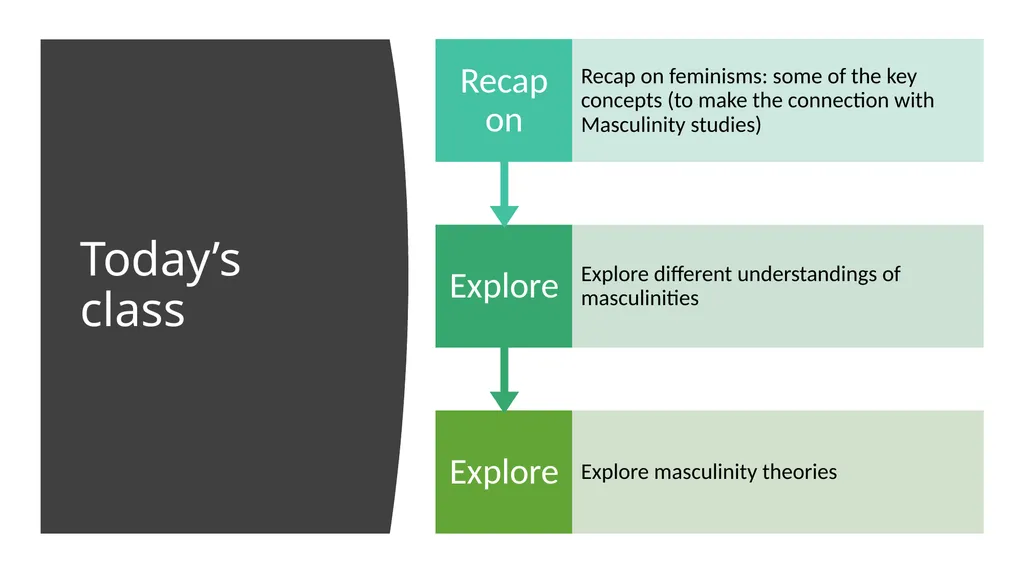
Today’s class Explore Explore masculinity theories Explore Explore different understandings of masculinities Recap on Recap on feminisms: some of the key concepts (to make the connection with Masculinity studies)<br>
04
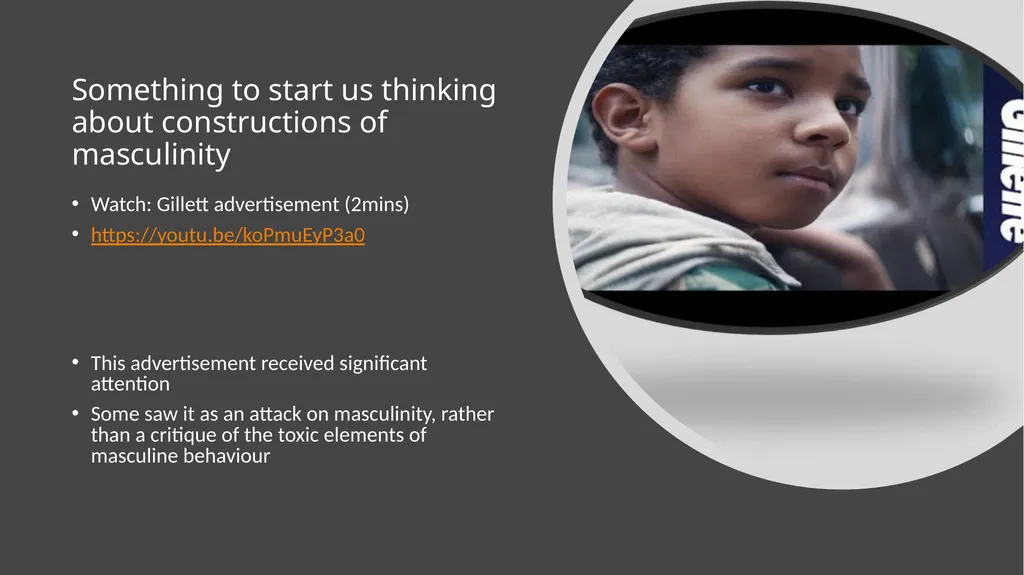
Something to start us thinking about constructions of masculinity Watch: Gillett advertisement (2mins)
https://youtu.be/koPmuEyP3a0
This advertisement received significant attention
Some saw it as an attack on masculinity, rather than a critique of the toxic elements of masculine behaviour<br>
https://youtu.be/koPmuEyP3a0
This advertisement received significant attention
Some saw it as an attack on masculinity, rather than a critique of the toxic elements of masculine behaviour<br>
05
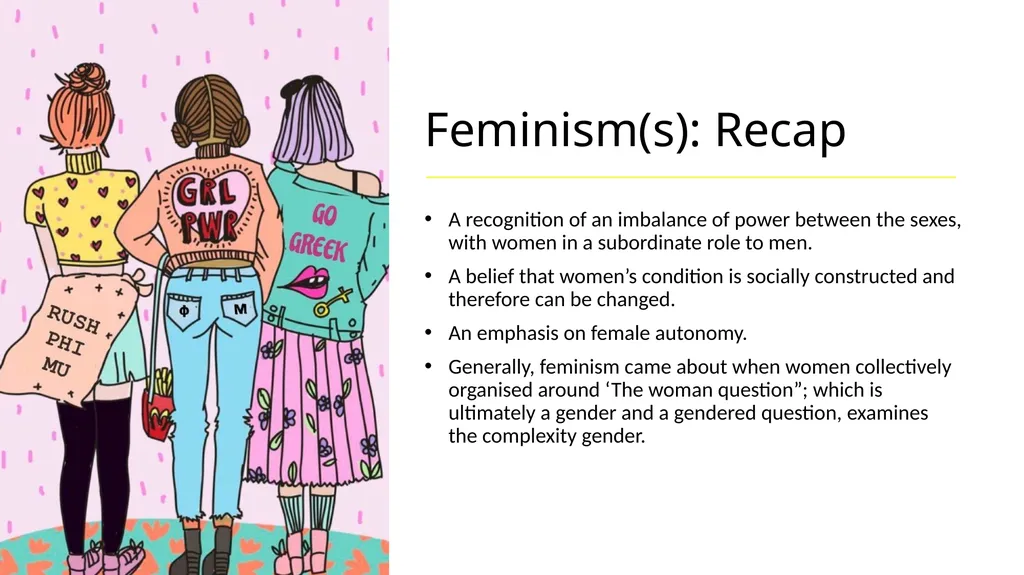
Feminism(s): Recap A recognition of an imbalance of power between the sexes, with women in a subordinate role to men.
A belief that women’s condition is socially constructed and therefore can be changed.
An emphasis on female autonomy.
Generally, feminism came about when women collectively organised around ‘The woman question”; which is ultimately a gender and a gendered question, examines the complexity gender.<br>
A belief that women’s condition is socially constructed and therefore can be changed.
An emphasis on female autonomy.
Generally, feminism came about when women collectively organised around ‘The woman question”; which is ultimately a gender and a gendered question, examines the complexity gender.<br>
06
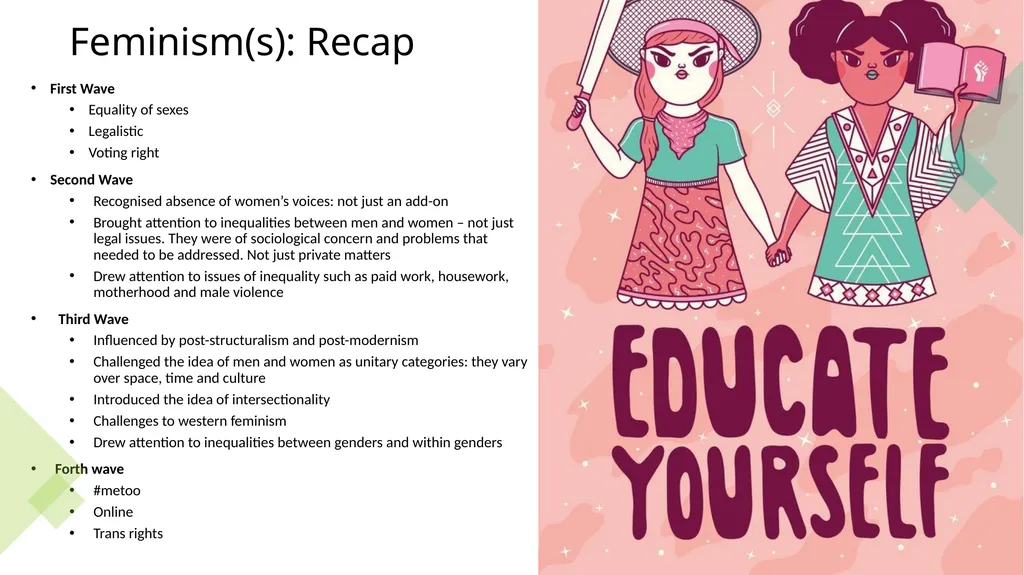
Feminism(s): Recap First Wave
Equality of sexes
Legalistic
Voting right
Second Wave
Recognised absence of women’s voices: not just an add-on
Brought attention to inequalities between men and women – not just legal issues. They were of sociological concern and problems that needed to be addressed. Not just private matters
Drew attention to issues of inequality such as paid work, housework, motherhood and male violence
Third Wave
Influenced by post-structuralism and post-modernism
Challenged the idea of men and women as unitary categories: they vary over space, time and culture
Introduced the idea of intersectionality
Challenges to western feminism
Drew attention to inequalities between genders and within genders
Forth wave
#metoo
Online
Trans rights<br>
Equality of sexes
Legalistic
Voting right
Second Wave
Recognised absence of women’s voices: not just an add-on
Brought attention to inequalities between men and women – not just legal issues. They were of sociological concern and problems that needed to be addressed. Not just private matters
Drew attention to issues of inequality such as paid work, housework, motherhood and male violence
Third Wave
Influenced by post-structuralism and post-modernism
Challenged the idea of men and women as unitary categories: they vary over space, time and culture
Introduced the idea of intersectionality
Challenges to western feminism
Drew attention to inequalities between genders and within genders
Forth wave
#metoo
Online
Trans rights<br>
07
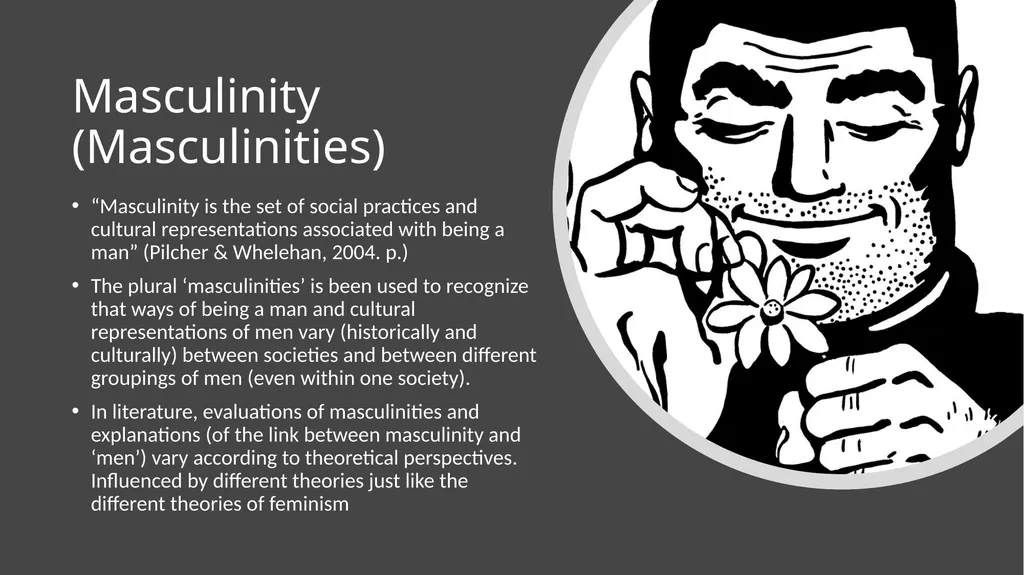
Masculinity (Masculinities) “Masculinity is the set of social practices and cultural representations associated with being a man” (Pilcher & Whelehan, 2004. p.)
The plural ‘masculinities’ is been used to recognize that ways of being a man and cultural representations of men vary (historically and culturally) between societies and between different groupings of men (even within one society).
In literature, evaluations of masculinities and explanations (of the link between masculinity and ‘men’) vary according to theoretical perspectives. Influenced by different theories just like the different theories of feminism<br>
The plural ‘masculinities’ is been used to recognize that ways of being a man and cultural representations of men vary (historically and culturally) between societies and between different groupings of men (even within one society).
In literature, evaluations of masculinities and explanations (of the link between masculinity and ‘men’) vary according to theoretical perspectives. Influenced by different theories just like the different theories of feminism<br>
08
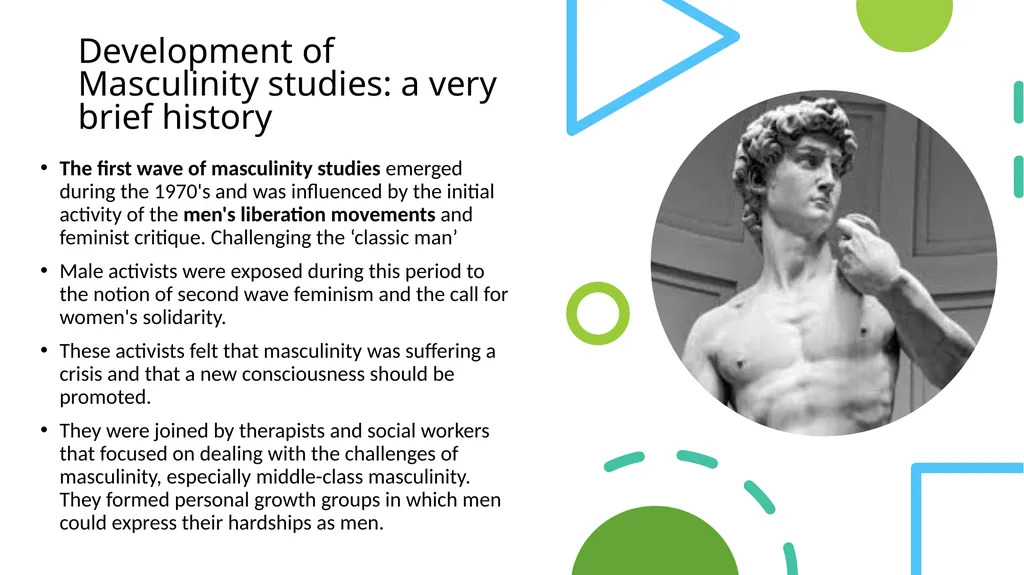
Development of Masculinity studies: a very brief history The first wave of masculinity studies emerged during the 1970's and was influenced by the initial activity of the men's liberation movements and feminist critique. Challenging the ‘classic man’
Male activists were exposed during this period to the notion of second wave feminism and the call for women's solidarity.
These activists felt that masculinity was suffering a crisis and that a new consciousness should be promoted.
They were joined by therapists and social workers that focused on dealing with the challenges of masculinity, especially middle-class masculinity. They formed personal growth groups in which men could express their hardships as men.<br>
Male activists were exposed during this period to the notion of second wave feminism and the call for women's solidarity.
These activists felt that masculinity was suffering a crisis and that a new consciousness should be promoted.
They were joined by therapists and social workers that focused on dealing with the challenges of masculinity, especially middle-class masculinity. They formed personal growth groups in which men could express their hardships as men.<br>
09
a very brief history…continued Men were largely invisible within early concerns with gender and women’s studies.
Only in the 1970s, academic interest in men as gendered beings emerged.
Feminism, gay and lesbians studies and a little later mythopoetic men’s movement (MMM) inspired the development of gendered critique of men and masculinity (Adams and Savran, 2002, p. 1-13). The MMM is a relatively progressive strand of the men’s movement. In comparison with the Promise Keepers and Father’s Rights groups, the MMM is (implicitly) politically left-leaning, though not as much as pro-feminist men’s groups (Flood, 1998). It seeks to create communities of men that are rooted in forms of spiritual, emotional and embodied intimacy which challenge dominant Western norms of competition, isolation, hyper-rationality, and self-control for men (Magnuson, 2007). The MMM invokes a range of ‘tribal’ and Jungian archetypes in the con-text of residential, experiential, ‘personal growth’ workshops and retreats for groups of men. In New Zealand there are several institutions that fall within the MMM ‘umbrella’, such as Essentially Men (based in Auckland) and MensTrust (based in Christchurch). The movement is small, but arguably influential in New Zealand’s relatively small-scale society. (Gremillion, 2011).<br>
Only in the 1970s, academic interest in men as gendered beings emerged.
Feminism, gay and lesbians studies and a little later mythopoetic men’s movement (MMM) inspired the development of gendered critique of men and masculinity (Adams and Savran, 2002, p. 1-13). The MMM is a relatively progressive strand of the men’s movement. In comparison with the Promise Keepers and Father’s Rights groups, the MMM is (implicitly) politically left-leaning, though not as much as pro-feminist men’s groups (Flood, 1998). It seeks to create communities of men that are rooted in forms of spiritual, emotional and embodied intimacy which challenge dominant Western norms of competition, isolation, hyper-rationality, and self-control for men (Magnuson, 2007). The MMM invokes a range of ‘tribal’ and Jungian archetypes in the con-text of residential, experiential, ‘personal growth’ workshops and retreats for groups of men. In New Zealand there are several institutions that fall within the MMM ‘umbrella’, such as Essentially Men (based in Auckland) and MensTrust (based in Christchurch). The movement is small, but arguably influential in New Zealand’s relatively small-scale society. (Gremillion, 2011).<br>
10
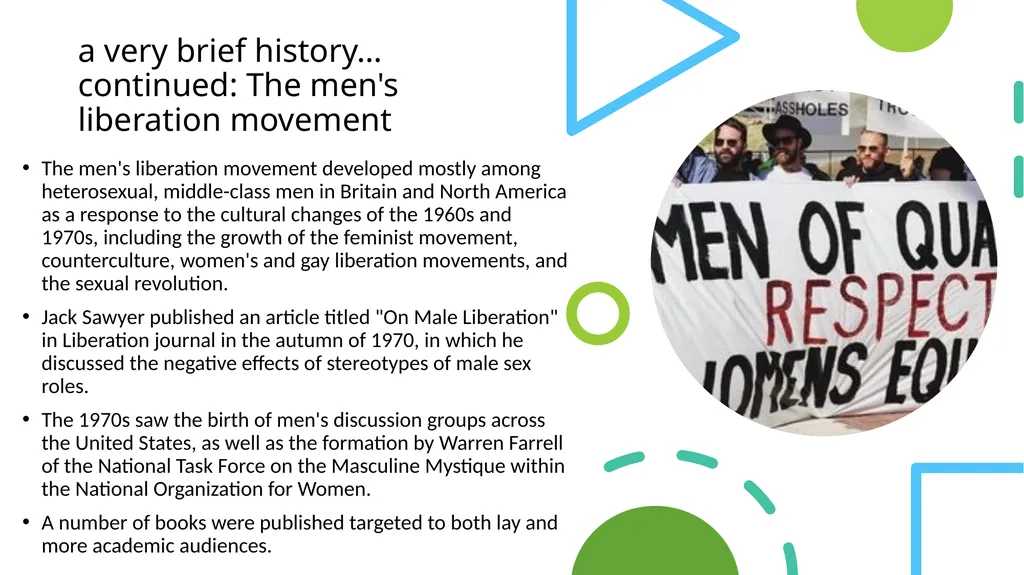
a very brief history…continued: The men's liberation movement The men's liberation movement developed mostly among heterosexual, middle-class men in Britain and North America as a response to the cultural changes of the 1960s and 1970s, including the growth of the feminist movement, counterculture, women's and gay liberation movements, and the sexual revolution.
Jack Sawyer published an article titled "On Male Liberation" in Liberation journal in the autumn of 1970, in which he discussed the negative effects of stereotypes of male sex roles.
The 1970s saw the birth of men's discussion groups across the United States, as well as the formation by Warren Farrell of the National Task Force on the Masculine Mystique within the National Organization for Women.
A number of books were published targeted to both lay and more academic audiences.<br>
Jack Sawyer published an article titled "On Male Liberation" in Liberation journal in the autumn of 1970, in which he discussed the negative effects of stereotypes of male sex roles.
The 1970s saw the birth of men's discussion groups across the United States, as well as the formation by Warren Farrell of the National Task Force on the Masculine Mystique within the National Organization for Women.
A number of books were published targeted to both lay and more academic audiences.<br>
11
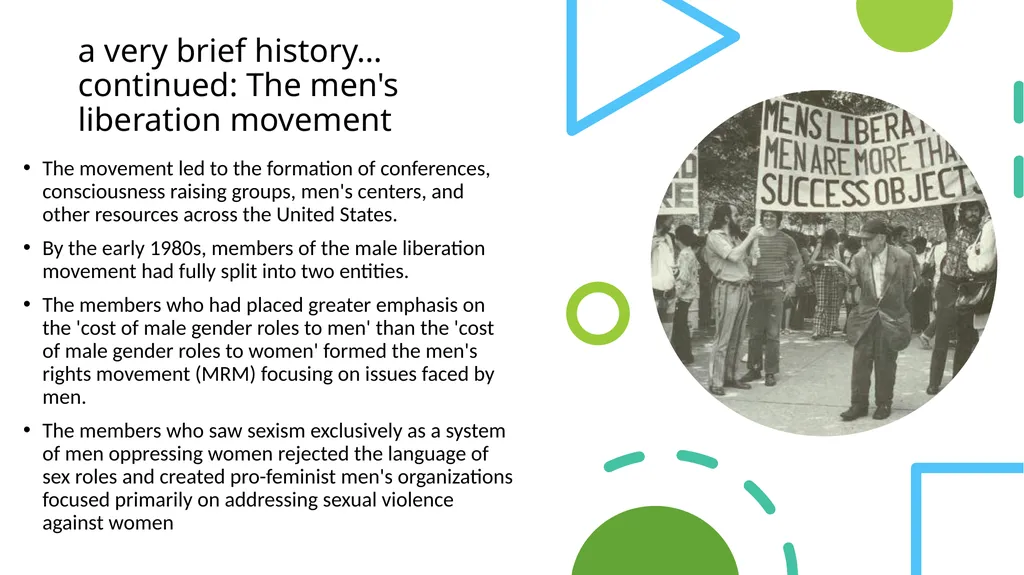
a very brief history…continued: The men's liberation movement The movement led to the formation of conferences, consciousness raising groups, men's centers, and other resources across the United States.
By the early 1980s, members of the male liberation movement had fully split into two entities.
The members who had placed greater emphasis on the 'cost of male gender roles to men' than the 'cost of male gender roles to women' formed the men's rights movement (MRM) focusing on issues faced by men.
The members who saw sexism exclusively as a system of men oppressing women rejected the language of sex roles and created pro-feminist men's organizations focused primarily on addressing sexual violence against women<br>
By the early 1980s, members of the male liberation movement had fully split into two entities.
The members who had placed greater emphasis on the 'cost of male gender roles to men' than the 'cost of male gender roles to women' formed the men's rights movement (MRM) focusing on issues faced by men.
The members who saw sexism exclusively as a system of men oppressing women rejected the language of sex roles and created pro-feminist men's organizations focused primarily on addressing sexual violence against women<br>
12
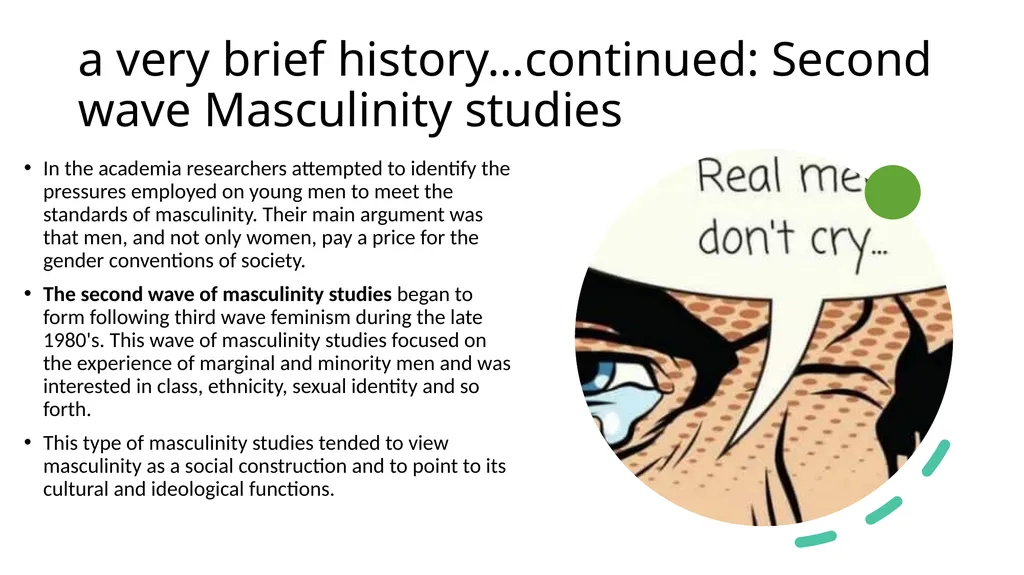
a very brief history…continued: Second wave Masculinity studies In the academia researchers attempted to identify the pressures employed on young men to meet the standards of masculinity. Their main argument was that men, and not only women, pay a price for the gender conventions of society.
The second wave of masculinity studies began to form following third wave feminism during the late 1980's. This wave of masculinity studies focused on the experience of marginal and minority men and was interested in class, ethnicity, sexual identity and so forth.
This type of masculinity studies tended to view masculinity as a social construction and to point to its cultural and ideological functions.<br>
The second wave of masculinity studies began to form following third wave feminism during the late 1980's. This wave of masculinity studies focused on the experience of marginal and minority men and was interested in class, ethnicity, sexual identity and so forth.
This type of masculinity studies tended to view masculinity as a social construction and to point to its cultural and ideological functions.<br>
13
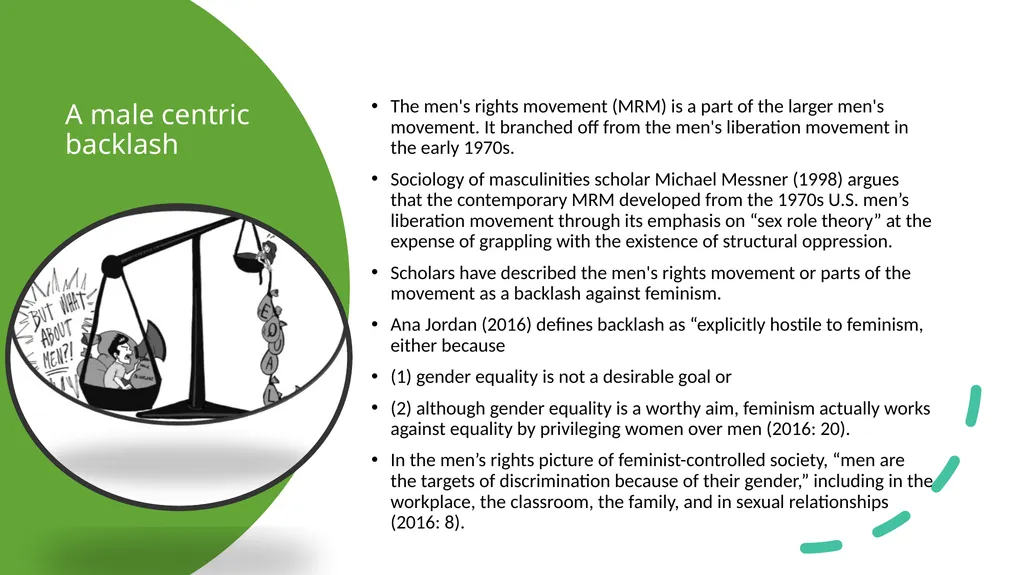
A male centric backlash The men's rights movement (MRM) is a part of the larger men's movement. It branched off from the men's liberation movement in the early 1970s.
Sociology of masculinities scholar Michael Messner (1998) argues that the contemporary MRM developed from the 1970s U.S. men’s liberation movement through its emphasis on “sex role theory” at the expense of grappling with the existence of structural oppression.
Scholars have described the men's rights movement or parts of the movement as a backlash against feminism.
Ana Jordan (2016) defines backlash as “explicitly hostile to feminism, either because
(1) gender equality is not a desirable goal or
(2) although gender equality is a worthy aim, feminism actually works against equality by privileging women over men (2016: 20).
In the men’s rights picture of feminist-controlled society, “men are the targets of discrimination because of their gender,” including in the workplace, the classroom, the family, and in sexual relationships (2016: 8).<br>
Sociology of masculinities scholar Michael Messner (1998) argues that the contemporary MRM developed from the 1970s U.S. men’s liberation movement through its emphasis on “sex role theory” at the expense of grappling with the existence of structural oppression.
Scholars have described the men's rights movement or parts of the movement as a backlash against feminism.
Ana Jordan (2016) defines backlash as “explicitly hostile to feminism, either because
(1) gender equality is not a desirable goal or
(2) although gender equality is a worthy aim, feminism actually works against equality by privileging women over men (2016: 20).
In the men’s rights picture of feminist-controlled society, “men are the targets of discrimination because of their gender,” including in the workplace, the classroom, the family, and in sexual relationships (2016: 8).<br>
14
The men’s rights movement (MRM) The men's rights movement is notably anti-feminist and made up of a variety of groups and individuals who focus on numerous social issues:
(including family law, parenting, reproduction, domestic violence against men and opposition to circumcision) and government services (including education, compulsory military service, social safety nets, and health policies), which men's rights advocates say discriminate against men.
From the 1970s through early 2000s, men’s rights activists criticized institutional bias against men in the family court system, and the issue of “father’s rights” emerged as the “most successful rallying point” for the early MRM (Messner 1998: 267).
Some of these issues do have aspects of validity and require critique, however the majority of those within the MRM hold to an ideology of male supremacy and are overtly or covertly misogynous<br>
(including family law, parenting, reproduction, domestic violence against men and opposition to circumcision) and government services (including education, compulsory military service, social safety nets, and health policies), which men's rights advocates say discriminate against men.
From the 1970s through early 2000s, men’s rights activists criticized institutional bias against men in the family court system, and the issue of “father’s rights” emerged as the “most successful rallying point” for the early MRM (Messner 1998: 267).
Some of these issues do have aspects of validity and require critique, however the majority of those within the MRM hold to an ideology of male supremacy and are overtly or covertly misogynous<br>
15
Men's Rights Movement The constellation of male supremacist mobilizations (movements?) include the Men’s Rights Movement (MRM), pickup artists (PUA), and The Red Pill communities.
This “manosphere,” (an umbrella term including MRM, PUA, and other misogynist forums) has been characterized as a largely internet-based movement, comprised of a web of blogs, discussion forums, and websites (e.g. youtube, reditt, 4chan, 8chan, and others)
This online aspect does not mean that these movements do not have real world impacts or effects<br>
This “manosphere,” (an umbrella term including MRM, PUA, and other misogynist forums) has been characterized as a largely internet-based movement, comprised of a web of blogs, discussion forums, and websites (e.g. youtube, reditt, 4chan, 8chan, and others)
This online aspect does not mean that these movements do not have real world impacts or effects<br>
16
Men's Rights Movement/
Red pill communities The Red Pill is a philosophy, and reddit.com/r/TheRedPill is its home.
Also websites that host a number of misogynistic videos
Example https://www.avoiceformen.com/policies/
to “swallow the Red Pill” is to accept the uncomfortable truth about reality. The phrase comes from 1999’s hit film The Matrix, in which the protagonist Neo must choose between the Red Pill – which would allow him to escape the Matrix but see the real, darker world – and the Blue Pill – continued existence in his comfortable, but ultimately fake, life.
In r/TheRedPill’s instance, the “dark truths” that the subreddit’s subscribers have swallowed are these: feminism is toxic, sexism is fake, men have it harder than women, and everything the media teaches about relationships is a lie. In reality (the argument goes) women don’t want soft-centred men/chocolates; they want to be dominated, controlled, and manipulated.<br>
Also websites that host a number of misogynistic videos
Example https://www.avoiceformen.com/policies/
to “swallow the Red Pill” is to accept the uncomfortable truth about reality. The phrase comes from 1999’s hit film The Matrix, in which the protagonist Neo must choose between the Red Pill – which would allow him to escape the Matrix but see the real, darker world – and the Blue Pill – continued existence in his comfortable, but ultimately fake, life.
In r/TheRedPill’s instance, the “dark truths” that the subreddit’s subscribers have swallowed are these: feminism is toxic, sexism is fake, men have it harder than women, and everything the media teaches about relationships is a lie. In reality (the argument goes) women don’t want soft-centred men/chocolates; they want to be dominated, controlled, and manipulated.<br>
17
Men's Rights Movement/Pick up artists Pickup/seduction leaders provide advice and trainings on how to date and have sexual intercourse with women. In the 1990s pickup artist (PUA) leaders turned against advice to be a “nice guy” and increasingly advocated techniques that rely on insulting women.
An example: While some dating coaches in the seduction movement avoid feminism or politics, Roosh V (a high profile PUA) is “[a]t the other end of the extreme,” actively engaging in antifeminist and antifemale rhetoric (2017: 310-311).
Hodapps finds that Roosh V. “encourages men on the site to stop taking no as an answer” and denies the “reality of rape, claiming that coercion by males is a normal aspect of heterosexual experiences”
3: Watch: A bbc investigation on a Glasgow based “pick up artist” (4.5mins) CONTENT WARNING https://youtu.be/SlNU1Gksr4g<br>
An example: While some dating coaches in the seduction movement avoid feminism or politics, Roosh V (a high profile PUA) is “[a]t the other end of the extreme,” actively engaging in antifeminist and antifemale rhetoric (2017: 310-311).
Hodapps finds that Roosh V. “encourages men on the site to stop taking no as an answer” and denies the “reality of rape, claiming that coercion by males is a normal aspect of heterosexual experiences”
3: Watch: A bbc investigation on a Glasgow based “pick up artist” (4.5mins) CONTENT WARNING https://youtu.be/SlNU1Gksr4g<br>
18
Toxic masculinity The term “toxic masculinity” can be used to describe a set of very narrow standards, behaviors, and expectations for manhood and masculinity that values dominance, power, and control and devalues empathy, the acknowledgment of emotions, and other traits that fit outside of this narrow definition. (Thompkins-Jones, 2017).
The “man box” is a concept that is helpful to describe some of the narrow behaviors that men are “supposed” to exhibit to be considered a man. Showing behaviors or possessing traits that are outside of the man box is considered a punishable offense under a toxic masculinity framework, because doing so would mean being less than a man (Thompkins-Jones, 2017)<br>
The “man box” is a concept that is helpful to describe some of the narrow behaviors that men are “supposed” to exhibit to be considered a man. Showing behaviors or possessing traits that are outside of the man box is considered a punishable offense under a toxic masculinity framework, because doing so would mean being less than a man (Thompkins-Jones, 2017)<br>
19
Masculinity studies Similar to Feminisms, masculinity writers can be credited to bringing to attention just how much gender is part and parcel of social life and social organisation
Also attention to how masculinity is implicated in all aspects of sociality… “assumes the banality of the unstated norm – not requiring comment, let alone explanation” (Beasley, 2008. p. 86)
[t]he very processes that confer privilege to one group and not to another are often invisible to those upon whom that privilege is conferred . . . men have come to think of themselves as genderless, in part because they can afford the luxury of ignoring the centrality of gender . . . And the invisibility of gender to those privileged by it reproduces the inequalities that are circumscribed by gender (Kimmel 1993, 2003).
Thus rendering gender and masculinity visible offers a challenge to existing power relations and their continuing reiteration<br>
Also attention to how masculinity is implicated in all aspects of sociality… “assumes the banality of the unstated norm – not requiring comment, let alone explanation” (Beasley, 2008. p. 86)
[t]he very processes that confer privilege to one group and not to another are often invisible to those upon whom that privilege is conferred . . . men have come to think of themselves as genderless, in part because they can afford the luxury of ignoring the centrality of gender . . . And the invisibility of gender to those privileged by it reproduces the inequalities that are circumscribed by gender (Kimmel 1993, 2003).
Thus rendering gender and masculinity visible offers a challenge to existing power relations and their continuing reiteration<br>
20
Masculinity studies Masculinity studies is feminist inspired its origin and continues to define itself in relation to a feminist ‘sympathetic’ more often an explicitly ‘pro-feminist’ perspective
The most basic sources were feminist theories of patriarchy and the related debates over the role of men in transforming patriarchy.
Some writers have drawn attention to class and race differences in the expression of masculinity – thus laying the foundation for questioning any universalizing claims about the category ‘men’.
On-going dialogue between Feminist and Masculinity Studies is important and worthwhile for both…
Masculinity studies examines such issues as the incompatibility of the "classic man" with the challenges of modern times, the discussion of the "new man" and its message to the world and issues of masculinity and other social categories such as class, race, ethnicity and nationality.<br>
The most basic sources were feminist theories of patriarchy and the related debates over the role of men in transforming patriarchy.
Some writers have drawn attention to class and race differences in the expression of masculinity – thus laying the foundation for questioning any universalizing claims about the category ‘men’.
On-going dialogue between Feminist and Masculinity Studies is important and worthwhile for both…
Masculinity studies examines such issues as the incompatibility of the "classic man" with the challenges of modern times, the discussion of the "new man" and its message to the world and issues of masculinity and other social categories such as class, race, ethnicity and nationality.<br>
21
Critical social sciences: Masculinity Masculinities are understood as a form of power relations, both among men themselves and between men and women Masculinities arise from the social contexts in which men live: from positions in the various institutions or organisations of the society: (both created and reinforced by these institutions) Or in the context of the socially acceptable discourses about gender: discourses of who a man should be and/or a woman should be (social constructions of gender)<br>
22
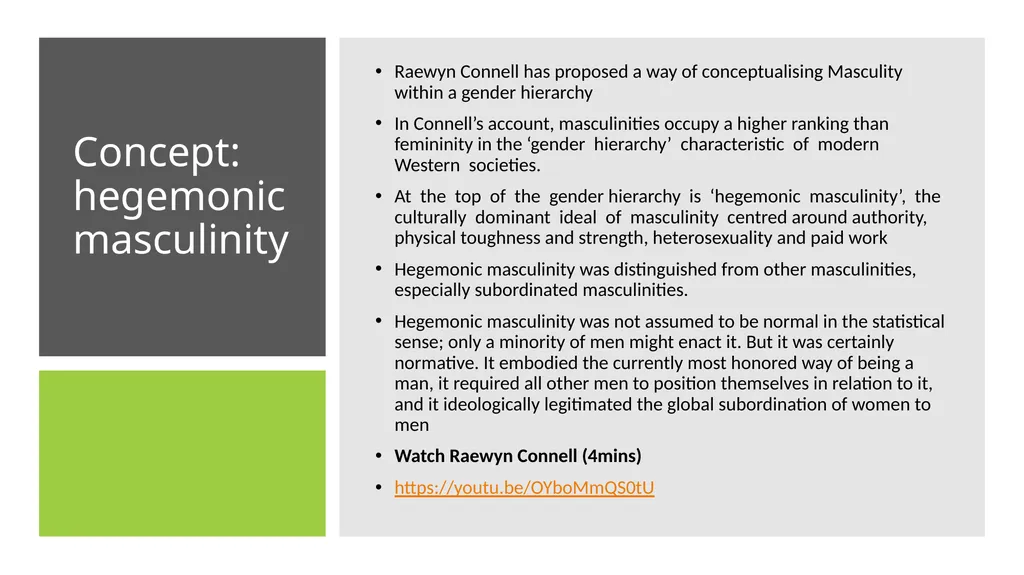
Concept: hegemonic masculinity Raewyn Connell has proposed a way of conceptualising Masculity within a gender hierarchy
In Connell’s account, masculinities occupy a higher ranking than femininity in the ‘gender hierarchy’ characteristic of modern Western societies.
At the top of the gender hierarchy is ‘hegemonic masculinity’, the culturally dominant ideal of masculinity centred around authority, physical toughness and strength, heterosexuality and paid work
Hegemonic masculinity was distinguished from other masculinities, especially subordinated masculinities.
Hegemonic masculinity was not assumed to be normal in the statistical sense; only a minority of men might enact it. But it was certainly normative. It embodied the currently most honored way of being a man, it required all other men to position themselves in relation to it, and it ideologically legitimated the global subordination of women to men
Watch Raewyn Connell (4mins)
https://youtu.be/OYboMmQS0tU<br>
In Connell’s account, masculinities occupy a higher ranking than femininity in the ‘gender hierarchy’ characteristic of modern Western societies.
At the top of the gender hierarchy is ‘hegemonic masculinity’, the culturally dominant ideal of masculinity centred around authority, physical toughness and strength, heterosexuality and paid work
Hegemonic masculinity was distinguished from other masculinities, especially subordinated masculinities.
Hegemonic masculinity was not assumed to be normal in the statistical sense; only a minority of men might enact it. But it was certainly normative. It embodied the currently most honored way of being a man, it required all other men to position themselves in relation to it, and it ideologically legitimated the global subordination of women to men
Watch Raewyn Connell (4mins)
https://youtu.be/OYboMmQS0tU<br>
23
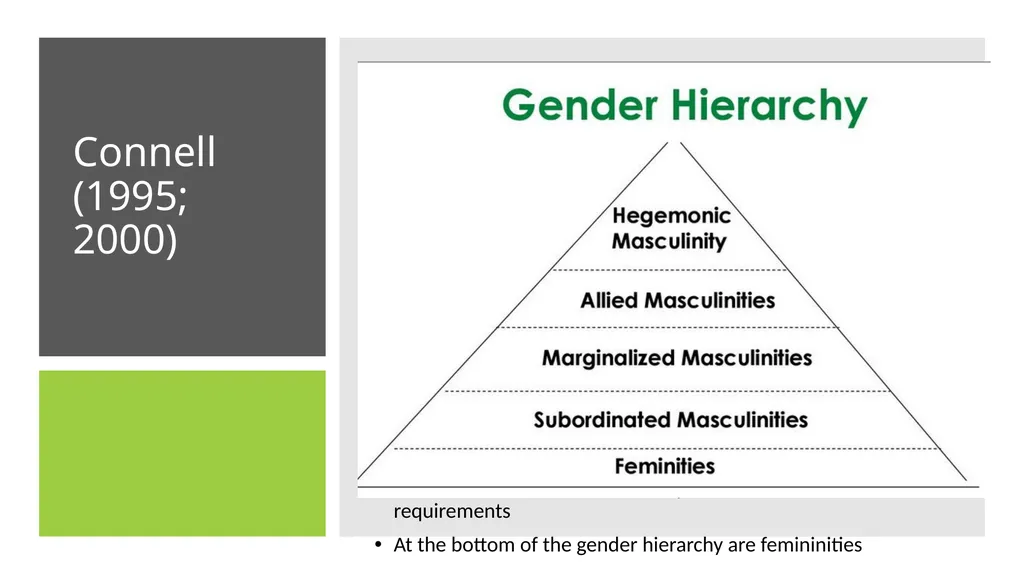
Connell (1995; 2000) Connnell, at the top of the gender hierarchy is ‘hegemonic masculinity’.
Hegemonic masculinity: is the culturally dominant ideal masculinity centred around: authority; physical toughness and strength; heterosexuality; and paid work. This is the ideal that few men live up to
Complicit masculinities: the next level from which most men gain advantage… below this are: cannot meet the requirements of HM but benefit from it by status of being a ‘man’
Subordinated masculinities – the most important of which is homosexual masculinity. Include a range of masculine behaviour which does not fully match the macho ideals of hegemonic masculinity. Cannot meet the requirements of HM and do not benefit from it as they do not meet ‘man’ requirements
At the bottom of the gender hierarchy are femininities<br>
Hegemonic masculinity: is the culturally dominant ideal masculinity centred around: authority; physical toughness and strength; heterosexuality; and paid work. This is the ideal that few men live up to
Complicit masculinities: the next level from which most men gain advantage… below this are: cannot meet the requirements of HM but benefit from it by status of being a ‘man’
Subordinated masculinities – the most important of which is homosexual masculinity. Include a range of masculine behaviour which does not fully match the macho ideals of hegemonic masculinity. Cannot meet the requirements of HM and do not benefit from it as they do not meet ‘man’ requirements
At the bottom of the gender hierarchy are femininities<br>
24
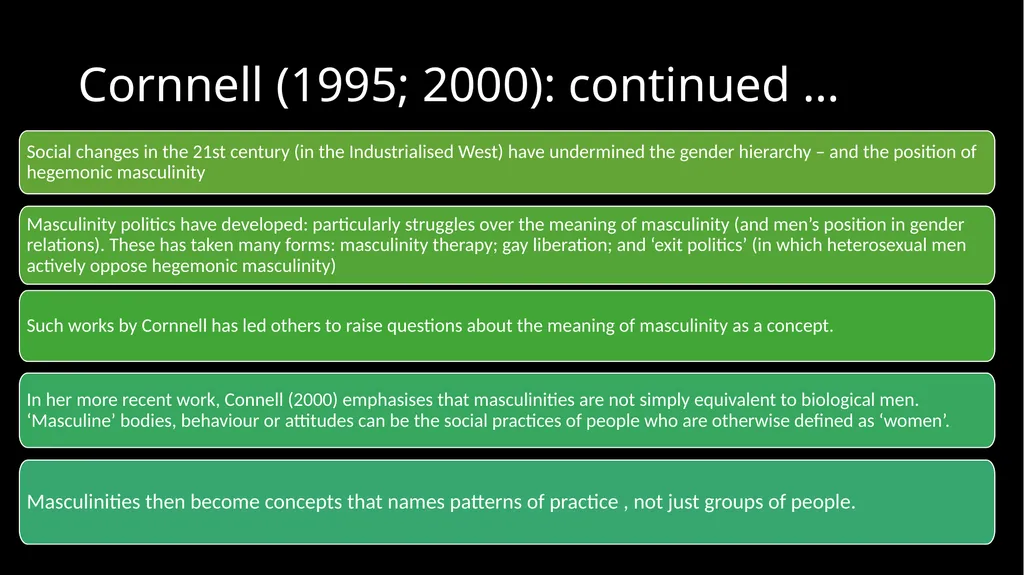
Cornnell (1995; 2000): continued … Social changes in the 21st century (in the Industrialised West) have undermined the gender hierarchy – and the position of hegemonic masculinity Masculinity politics have developed: particularly struggles over the meaning of masculinity (and men’s position in gender relations). These has taken many forms: masculinity therapy; gay liberation; and ‘exit politics’ (in which heterosexual men actively oppose hegemonic masculinity) Such works by Cornnell has led others to raise questions about the meaning of masculinity as a concept. In her more recent work, Connell (2000) emphasises that masculinities are not simply equivalent to biological men. ‘Masculine’ bodies, behaviour or attitudes can be the social practices of people who are otherwise defined as ‘women’. Masculinities then become concepts that names patterns of practice , not just groups of people.<br>
25
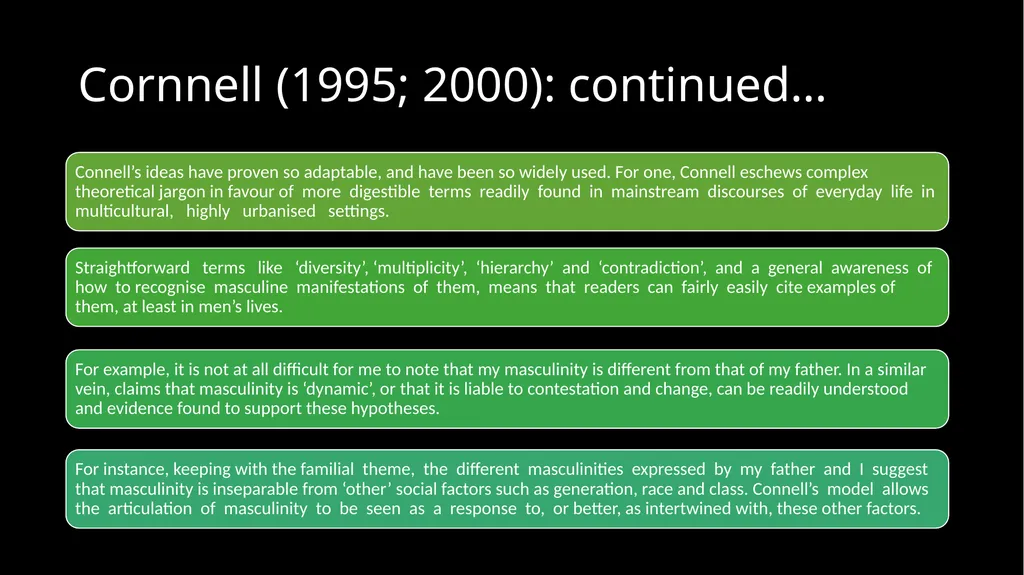
Cornnell (1995; 2000): continued… Connell’s ideas have proven so adaptable, and have been so widely used. For one, Connell eschews complex theoretical jargon in favour of more digestible terms readily found in mainstream discourses of everyday life in multicultural, highly urbanised settings. Straightforward terms like ‘diversity’, ‘multiplicity’, ‘hierarchy’ and ‘contradiction’, and a general awareness of how to recognise masculine manifestations of them, means that readers can fairly easily cite examples of them, at least in men’s lives. For example, it is not at all difficult for me to note that my masculinity is different from that of my father. In a similar vein, claims that masculinity is ‘dynamic’, or that it is liable to contestation and change, can be readily understood and evidence found to support these hypotheses. For instance, keeping with the familial theme, the different masculinities expressed by my father and I suggest that masculinity is inseparable from ‘other’ social factors such as generation, race and class. Connell’s model allows the articulation of masculinity to be seen as a response to, or better, as intertwined with, these other factors.<br>
26
Eric Anderson (2009): Inclusive Masculinity A new approach?
proposing an alternative to hegemonic masculinity theory
Based on ethnographic research with predominantly white, middle- to upper-middle-class university-aged men in the United States and United Kingdom, the main thesis of this work is that recent shifts in the social and cultural landscape have brought about the development of more ‘inclusive’ or non-homophobic forms of masculinity (2009, 7)
three ‘‘cultural zeitgeists’’ of elevated, diminishing, and diminished homohysteria.
In the first of these settings hegemonic masculinity dominates, but as cultural homohysteria diminishes, more inclusive forms of masculinity emerge alongside orthodox masculinities. In these contexts, ‘‘multiple masculinities will proliferate without hierarchy and hegemony, and men are permitted an expansion of acceptable heteromasculine behaviours.
Specifically contends that decreasing ‘the fear of being homo-sexualized’, enables men to develop softer, more expressive forms of masculinity.
Suggests that multiple forms of masculinity can exist in a horizontal (not stratified) alignment. All exist at the same time…
https://goodmenproject.com/featured-content/what-is-inclusive-masculinity-wcz/<br>
proposing an alternative to hegemonic masculinity theory
Based on ethnographic research with predominantly white, middle- to upper-middle-class university-aged men in the United States and United Kingdom, the main thesis of this work is that recent shifts in the social and cultural landscape have brought about the development of more ‘inclusive’ or non-homophobic forms of masculinity (2009, 7)
three ‘‘cultural zeitgeists’’ of elevated, diminishing, and diminished homohysteria.
In the first of these settings hegemonic masculinity dominates, but as cultural homohysteria diminishes, more inclusive forms of masculinity emerge alongside orthodox masculinities. In these contexts, ‘‘multiple masculinities will proliferate without hierarchy and hegemony, and men are permitted an expansion of acceptable heteromasculine behaviours.
Specifically contends that decreasing ‘the fear of being homo-sexualized’, enables men to develop softer, more expressive forms of masculinity.
Suggests that multiple forms of masculinity can exist in a horizontal (not stratified) alignment. All exist at the same time…
https://goodmenproject.com/featured-content/what-is-inclusive-masculinity-wcz/<br>
27
Critique of Inclusive Masculinity Lack of engagement with feminism
Lack of attention to agency
Anderson seems to suggest that Anglo-American societies are somehow predisposed toward gender and sexual equality. This account of social change is peculiarly agentless, premising that more progressive attitudes to homosexuality are the result of ‘‘the increasing loss of our puritan sentiment’’ (Anderson 2009, 5).
While feminist campaigns and gay liberation are given mention, they are very much in the background of this narrative; if any group of social actors is to be credited with the decline of homophobia, it is the young, white, heterosexual, middle-class men of Anderson’s study, here imagined as the harbingers of new and more equitable forms of gender relations.
“post-feminist” epistemology
postfeminism is to be under-stood as a social and cultural landscape marked by a new kind of antifeminist sentiment quite different from earlier backlashes against the (real and apparent)gains made by feminism in the 1970s and 1980s.
Rather than directly opposing or disputing feminist claims, postfeminism gains rhetorical efficacy through the suggestion that gender and sexual equality have been achieved, such that feminism is no longer needed. In this way, postfeminism operates through a double movement or entanglement; feminism is simultaneously taken into account and undone.<br>
Lack of attention to agency
Anderson seems to suggest that Anglo-American societies are somehow predisposed toward gender and sexual equality. This account of social change is peculiarly agentless, premising that more progressive attitudes to homosexuality are the result of ‘‘the increasing loss of our puritan sentiment’’ (Anderson 2009, 5).
While feminist campaigns and gay liberation are given mention, they are very much in the background of this narrative; if any group of social actors is to be credited with the decline of homophobia, it is the young, white, heterosexual, middle-class men of Anderson’s study, here imagined as the harbingers of new and more equitable forms of gender relations.
“post-feminist” epistemology
postfeminism is to be under-stood as a social and cultural landscape marked by a new kind of antifeminist sentiment quite different from earlier backlashes against the (real and apparent)gains made by feminism in the 1970s and 1980s.
Rather than directly opposing or disputing feminist claims, postfeminism gains rhetorical efficacy through the suggestion that gender and sexual equality have been achieved, such that feminism is no longer needed. In this way, postfeminism operates through a double movement or entanglement; feminism is simultaneously taken into account and undone.<br>
28
Self directed (watch in your own time) Tony Porter (escaping the “man box”)
https://www.ted.com/talks/tony_porter_a_call_to_men?utm_campaign=tedspread&utm_medium=referral&utm_source=tedcomshare<br>
https://www.ted.com/talks/tony_porter_a_call_to_men?utm_campaign=tedspread&utm_medium=referral&utm_source=tedcomshare<br>
29
References Adams, R., & Savran, D. (2002). Introduction. In Adams, R., & Savran, D. (Eds.), The masculinity studies reader (pp. 1-8). Oxford: Blackwell Publishers.
Understanding Contemporary Male Supremacism. (2019). Conference Papers -- American Sociological Association, 1–35.
Gremillion, H. (2011). Feminism and the mythopoetic men’s movement: Some shared concepts of gender. Women’s Studies Journal, Volume 25 Number 2, December 2011: 43-55
Thompkins-Jones, R. (2017). Toxic Masculinity Is a Macro Social Work Issue. New Social Worker, 24(3), 26–27.<br>
Understanding Contemporary Male Supremacism. (2019). Conference Papers -- American Sociological Association, 1–35.
Gremillion, H. (2011). Feminism and the mythopoetic men’s movement: Some shared concepts of gender. Women’s Studies Journal, Volume 25 Number 2, December 2011: 43-55
Thompkins-Jones, R. (2017). Toxic Masculinity Is a Macro Social Work Issue. New Social Worker, 24(3), 26–27.<br>