INTRODUCTION TO PLATYHELMINTHES SYSTEMATIC General characteristics of the Platyhelminthes: Platyhelminthes is one of the most important phylum with numerous species were identified worldwide and their general characteristics are briefly as
"INTRODUCTION TO PLATYHELMINTHES SYSTEMATIC General" is the property of its rightful owner. Permission is granted to
download and print the materials on this website for personal, non-commercial use only, and to display it
on your personal computer provided you do not modify the materials and that you retain all copyright
notices contained in the materials. By downloading content from our website, you accept the terms of this
agreement.
Presentation Transcript
01
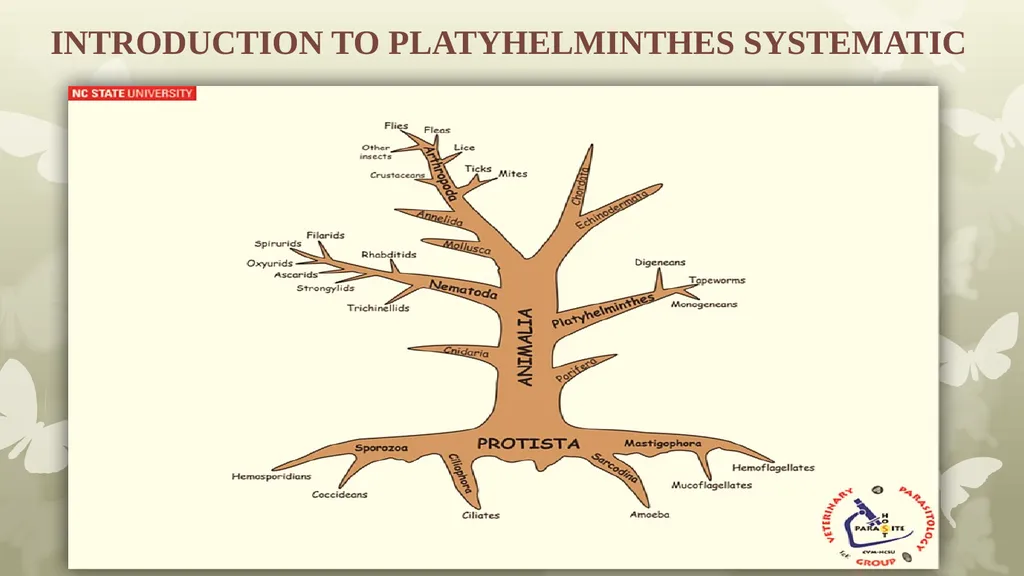
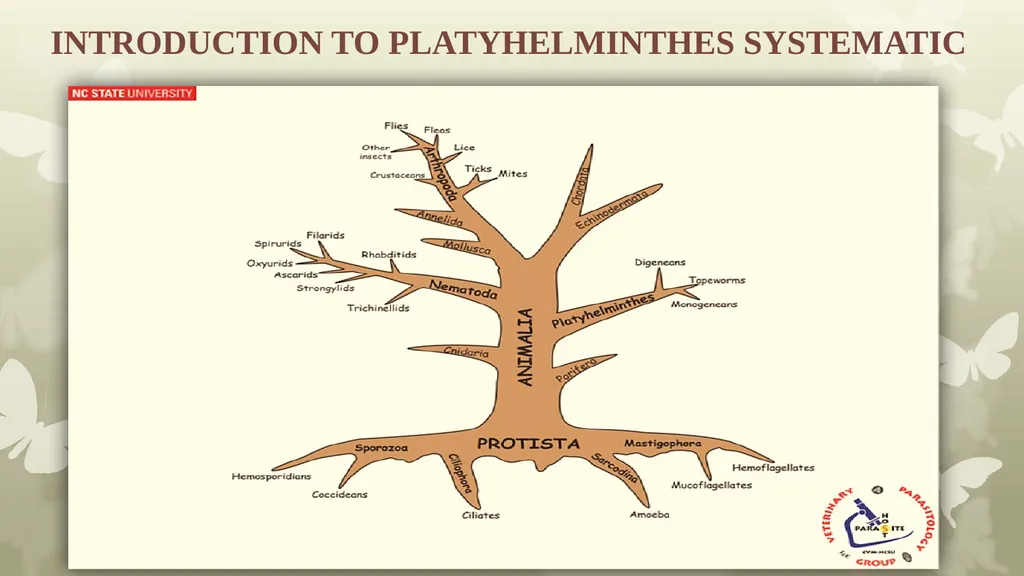
INTRODUCTION TO PLATYHELMINTHES SYSTEMATIC<br>
02
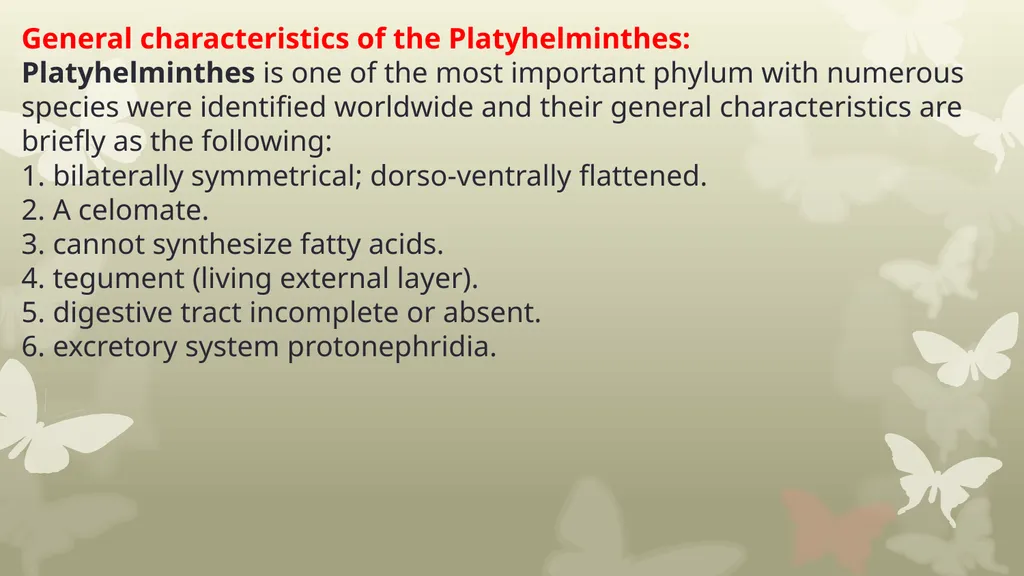
General characteristics of the Platyhelminthes: Platyhelminthes is one of the most important phylum with numerous species were identified worldwide and their general characteristics are briefly as the following: 1. bilaterally symmetrical; dorso-ventrally flattened. 2. A celomate. 3. cannot synthesize fatty acids. 4. tegument (living external layer). 5. digestive tract incomplete or absent. 6. excretory system protonephridia.<br>
03
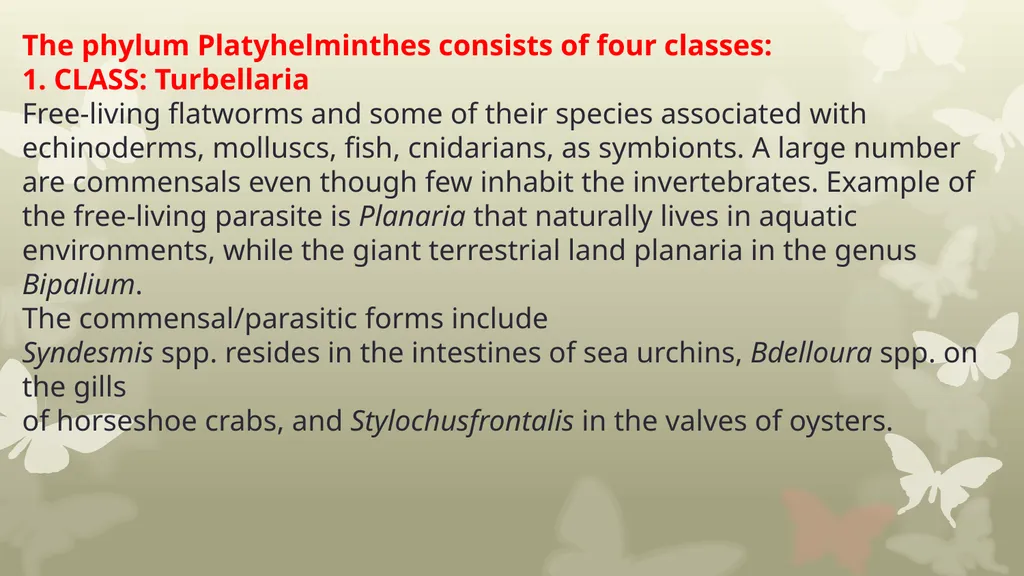
The phylum Platyhelminthes consists of four classes: 1. CLASS: Turbellaria Free-living flatworms and some of their species associated with echinoderms, molluscs, fish, cnidarians, as symbionts. A large number are commensals even though few inhabit the invertebrates. Example of the free-living parasite is Planaria that naturally lives in aquatic environments, while the giant terrestrial land planaria in the genus Bipalium.
The commensal/parasitic forms include Syndesmis spp. resides in the intestines of sea urchins, Bdelloura spp. on the gills of horseshoe crabs, and Stylochusfrontalis in the valves of oysters.<br>
04
2. CLASS: Monogenoidea (Monogenea)
All parasitic, with the majority of species choosing to live on fish gills or skin; however, some internal species have been found to inhabit the urinary bladder, nasal passages, and cloaca. Biologically, this class appears to be more closely, related to cestodes than trematodes, with two main "traditional" subclasses: • Subclass: Monopisthocotylea • Subclass: Polyopisthocotylea<br>
05
CLASS: Trematoda Live in the digestive tract, provided with suckers, and have two hosts for their life cycles, and divided into three subclasses:
1.Subclass: Digenea (typical flukes) 2.Subclass: Aspidogastrea 3.Subclass: Didymozoidea
CLASS: Cestoidea
Note: All parasitic; tapeworms, most have 2-more host life cycles, no digestive tract, with segmented body<br>
06
Class: Monogenea Introduction: Monogenea occur at low levels on fish and has no serious harm. Infested fish farms with monogenea causes significant mortality.
General characteristics of Monogenea:
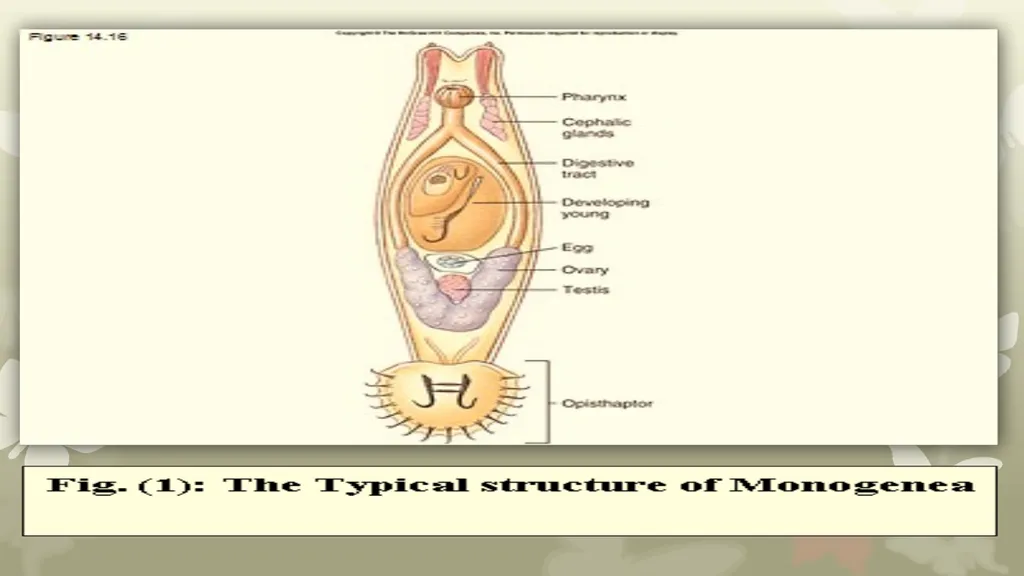
1. hermaphrodites 2. normally ectoparasites on aquatic vertebrates 3. generally, site specific on host and host specific 4. live a few days - years, depending on species 5. morphologically: anterior end bear adhesive or feeding organs. Eyespots sometime present, photoreceptors near two anterior ganglia. The tegument is the external layer.<br>
07
Alimentary tract consists of:
1. mouth anterior, usually with Prohaptor. 2. esophagus with muscular pharynx 3. intestine branches into cecae, often with diverticula 4. Monopisthocotylea feed mainly on epidermis and mucus; Polyopisthocotylea mainly on blood, host cells, and mucus
5. blind-ended gut, regurgitate waste Protonephridia [excretion] consists of:
1. have two main lateral ducts, extend posteriorly; then curve and extend anteriorly. 2. contractile bladders laterally. 3. flame cells drive fluid within ducts.<br>
08
Reproductive systems consist of:
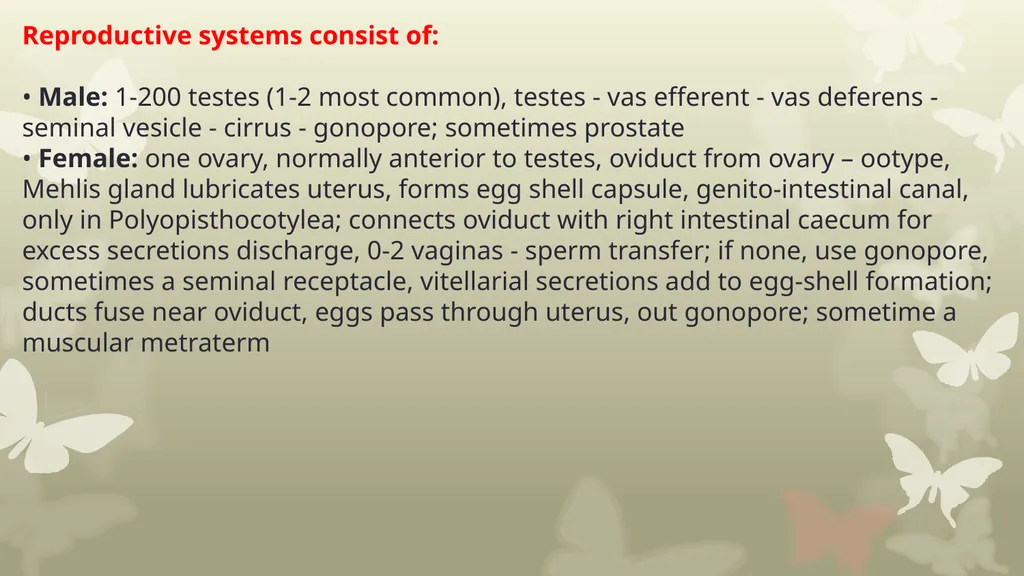
• Male: 1-200 testes (1-2 most common), testes - vas efferent - vas deferens - seminal vesicle - cirrus - gonopore; sometimes prostate • Female: one ovary, normally anterior to testes, oviduct from ovary – ootype, Mehlis gland lubricates uterus, forms egg shell capsule, genito-intestinal canal, only in Polyopisthocotylea; connects oviduct with right intestinal caecum for excess secretions discharge, 0-2 vaginas - sperm transfer; if none, use gonopore, sometimes a seminal receptacle, vitellarial secretions add to egg-shell formation; ducts fuse near oviduct, eggs pass through uterus, out gonopore; sometime a muscular metraterm<br>
09
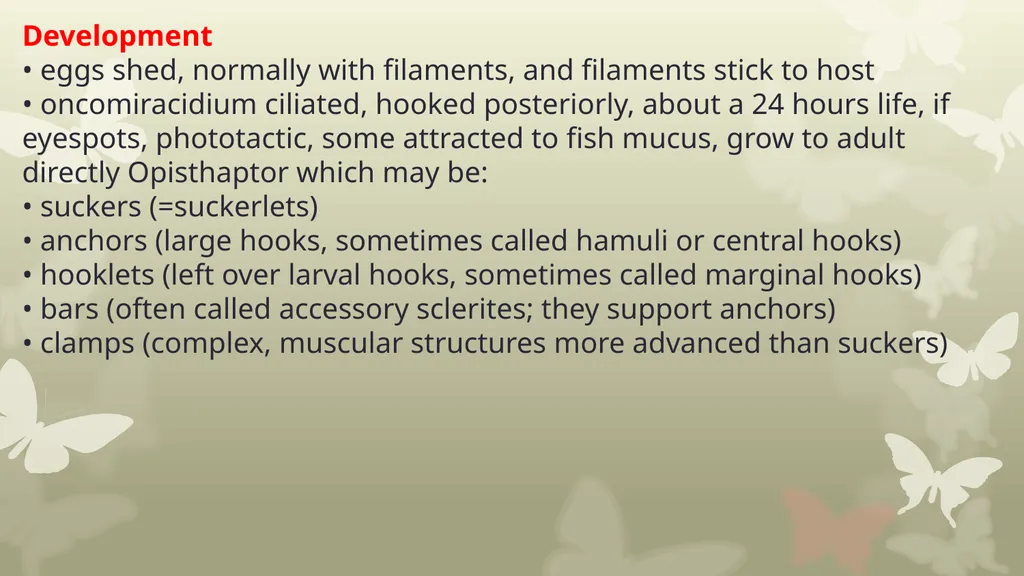
Development • eggs shed, normally with filaments, and filaments stick to host • oncomiracidium ciliated, hooked posteriorly, about a 24 hours life, if eyespots, phototactic, some attracted to fish mucus, grow to adult directly Opisthaptor which may be: • suckers (=suckerlets) • anchors (large hooks, sometimes called hamuli or central hooks) • hooklets (left over larval hooks, sometimes called marginal hooks) • bars (often called accessory sclerites; they support anchors) • clamps (complex, muscular structures more advanced than suckers)<br>