
INVENTORY MANAGEMENT MEANING OF INVENTORY
AS
Published · 25 slides · 0 views

1 / 1

Description
INVENTORY MANAGEMENT MEANING OF INVENTORY MANAGEMENT Inventory management refers to the process of ordering,storing,using and selling a companys inventory. This includes the management of raw materials, components, finished products, as
Related Topics
Share
Embed code
Download this presentation From Below
"INVENTORY MANAGEMENT MEANING OF INVENTORY" is the property of its rightful owner. Permission is granted to download and print the materials on this website for personal, non-commercial use only, and to display it on your personal computer provided you do not modify the materials and that you retain all copyright notices contained in the materials. By downloading content from our website, you accept the terms of this agreement.
Presentation Transcript
01
INVENTORY MANAGEMENT<br>
02
MEANING OF INVENTORY MANAGEMENT Inventory management refers to the process of ordering,storing,using and selling a companys’ inventory. This includes the management of raw materials, components, finished products, as well as warehousing and processing of such items.<br>
03
OBJECTIVES OF INVENTORY MANAGEMENT The main objective of inventory management is to determine the level for each type of inventory. For this purchasing and carrying costs should be compared with its benefits. For example, when a firm purchases in bulk quantity, its out of stock costs and risk decrease but in case it continues to purchase, it reaches a point where its carrying costs exceede its benefits. Therefore, the management should maintain only a proper level of inventory. Not only the financial manager is concerned with inventory management, but it also affects marketing and production managers. For determining an optimum level of inventory, proper co-ordination among all of them is essential.<br>
04
OBJECTIVES OF INVENTORY MANAGEMENT(explained in detail) To ensure that the supply of raw material and finished goods will remain continuous so that production process is not halted and the demands of the customers are duly met.
To minimize the carrying costs of inventory.
To keep investment in inventory at the optimum level.
To reduce the losses of theft, obsolescence and wastage, etc.
To make arrangement for the sale of slow moving items.
To minimize inventory ordering costs.<br>
To minimize the carrying costs of inventory.
To keep investment in inventory at the optimum level.
To reduce the losses of theft, obsolescence and wastage, etc.
To make arrangement for the sale of slow moving items.
To minimize inventory ordering costs.<br>
05
Features of Inventory Management Comprised of many components, the inventory management system makes handling the inventories an easy and simpler task. Owing to the inventory management services, the overall efficiency and productivity of the business improve. It is essential to use such kinds of inventory software for the business as they handle the regular tasks and time consuming chores efficiently and this, in turn, lets the focus be on the production part.<br>
06
The following are a few of the features of an inventory management system:-<br>
07
ORDER MANAGEMENT: With the help of a proper and effective inventory system, an adequate amount of inventory can maintain at all times. The system raises an alarm in the case where the inventory drops down a specific threshold limit or exceeds over and above the prescribed limit.
ASSET TRACKING: Tracking of the asset is yet another feature of asset management. In the case where there is a specific product/raw material and it’s not easily traceable with the naked eye or stored in the warehouse, then in that case measures take and the location of the same is identified using the software.
SERCVICE MANAGEMENT: In the case of companies that deal primarily with the service industry, this kind of management system helps in tracking the cost of the materials which use for providing services and includes the cost of the materials which use for providing services and includes the cost of cleansing supplies, etc.
INVENTORY OPTIMIZATION: Inventory management methods help a great deal in optimizing the inventory. It helps in deciding the reorder point for a manufacturing process, i.e., when should the fresh order for inventory be place along with the appropriate quantity of incventory.<br>
ASSET TRACKING: Tracking of the asset is yet another feature of asset management. In the case where there is a specific product/raw material and it’s not easily traceable with the naked eye or stored in the warehouse, then in that case measures take and the location of the same is identified using the software.
SERCVICE MANAGEMENT: In the case of companies that deal primarily with the service industry, this kind of management system helps in tracking the cost of the materials which use for providing services and includes the cost of the materials which use for providing services and includes the cost of cleansing supplies, etc.
INVENTORY OPTIMIZATION: Inventory management methods help a great deal in optimizing the inventory. It helps in deciding the reorder point for a manufacturing process, i.e., when should the fresh order for inventory be place along with the appropriate quantity of incventory.<br>
08
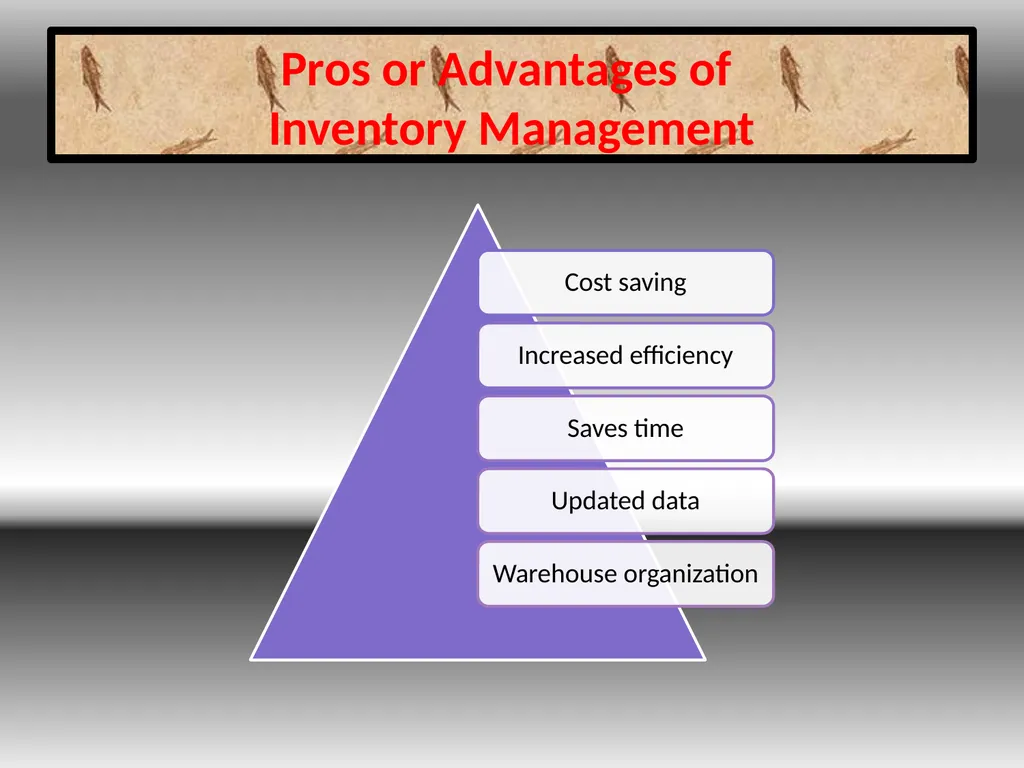
Pros or Advantages of
Inventory Management<br>
09
COST SAVING: if taken into consideration, the inventory of any organization comprises of the maximum investment along with the workforce employed.
SAVES TIME: Any automated system saves on to the time
as compared to the manual one. Once the system automated then there is a great deal of time that saves.
INCREASED EFFICIENCY: With the help of inventory management software, the tasks which relate to inventory automated. This automation, in turn, helps in increasing the overall efficiency of the organization.
WAREHOUSE ORGANIZATION: Optimization of resources is yet another benefit of the inventory management software. This kind of management helps the wholesalers, distributors, retailers, etc in organizing their warehouses.
UPDATED DATA: Yet another advantage of inventory management is the maintenance of updated data. Due to the use of an inventory management system/software, and up-to-date and real time data of the levels of inventory can be successfully maintained.<br>
SAVES TIME: Any automated system saves on to the time
as compared to the manual one. Once the system automated then there is a great deal of time that saves.
INCREASED EFFICIENCY: With the help of inventory management software, the tasks which relate to inventory automated. This automation, in turn, helps in increasing the overall efficiency of the organization.
WAREHOUSE ORGANIZATION: Optimization of resources is yet another benefit of the inventory management software. This kind of management helps the wholesalers, distributors, retailers, etc in organizing their warehouses.
UPDATED DATA: Yet another advantage of inventory management is the maintenance of updated data. Due to the use of an inventory management system/software, and up-to-date and real time data of the levels of inventory can be successfully maintained.<br>
10
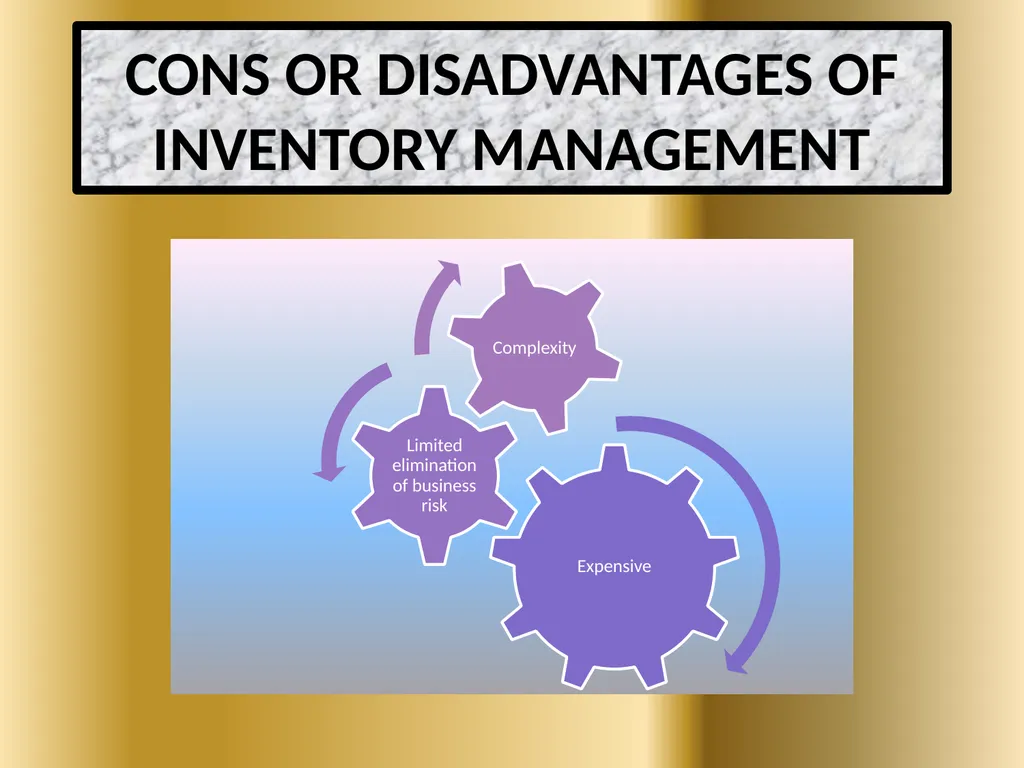
CONS OR DISADVANTAGES OF INVENTORY MANAGEMENT<br>
11
EXPENSIVE: Extremely beneficial in many aspects, this management, is available in the market at a high cost. Although the system provides such great features and makes the entire business a lot better and efficient, all this comes at a cost.
COMPLEXITY: Although the use of an inventory management system makes handling the inventory quite easy but learning how to operate if it’s quite a task. Special training sessions and manuals should be adhered to, to successfully operate the system.
LIMITED ELIMINATION OF BUSINESS RISK: Although the management system helps the business in eliminating many kinds of risk, even after using the system, the business is open to many other risks. The business helps in controlling many risks but the fear of facing and encouraging many others is still open. Hence, with this system in use , many kinds of risks restricted but fail to make the entire process risk proof.<br>
COMPLEXITY: Although the use of an inventory management system makes handling the inventory quite easy but learning how to operate if it’s quite a task. Special training sessions and manuals should be adhered to, to successfully operate the system.
LIMITED ELIMINATION OF BUSINESS RISK: Although the management system helps the business in eliminating many kinds of risk, even after using the system, the business is open to many other risks. The business helps in controlling many risks but the fear of facing and encouraging many others is still open. Hence, with this system in use , many kinds of risks restricted but fail to make the entire process risk proof.<br>
12
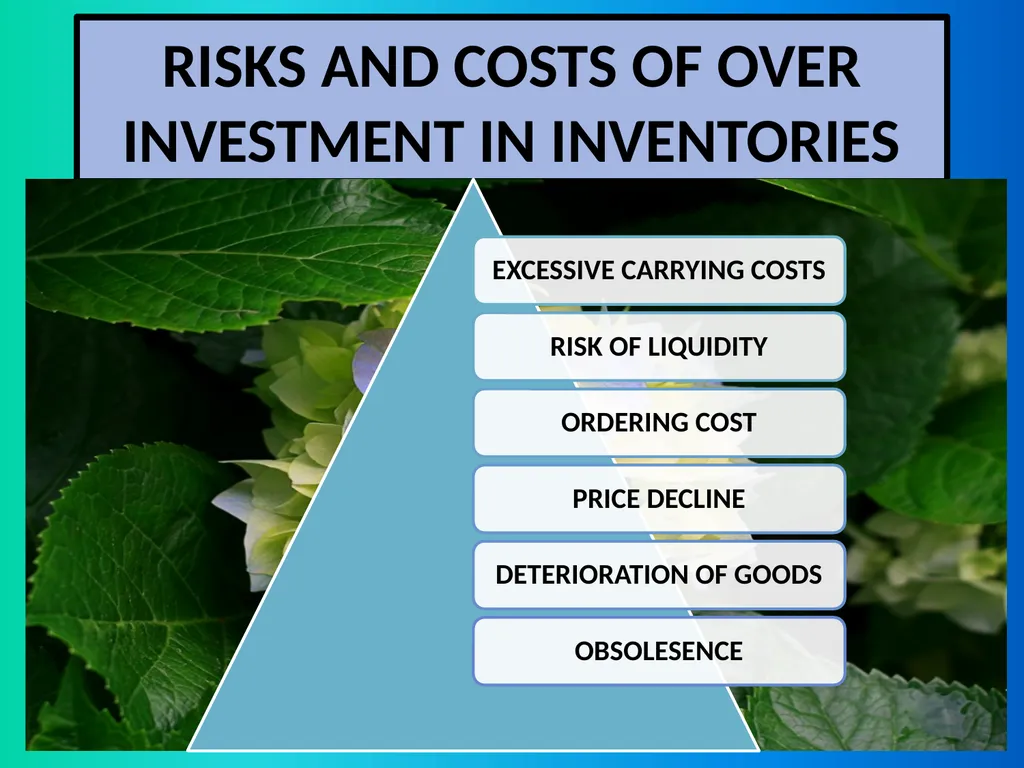
RISKS AND COSTS OF OVER INVESTMENT IN INVENTORIES<br>
13
RISKS AND COSTS OF OVER INVESTMENT IN INVENTORIES EXCESSIVE CARRYING COSTS: In these costs, cost of godown, insurance expenses, cost of spoilage of goods, cost of funds blocked in inventory, etc. are included.
RISK OF LIQUIDITY: High investment in inventory involves use of excessive funds in inventory which are deprived to be used elsewhere.
ORDERING COSTS: Among the cost, the cost of placing orders is included.
PRICE DECLINE: Due to decrease in price in the market and due to seasonal factors, there is fear of sale of finished goods at low price.
DETERIORATION OF GOODS: With the passage of time and due to improper storage facilities, certain goods deteriorate.
OBSOLENCE: Goods become obsolete due to change in the interests of the consumers, improvement in design, etc. As a result, they have to be sold at low price.<br>
RISK OF LIQUIDITY: High investment in inventory involves use of excessive funds in inventory which are deprived to be used elsewhere.
ORDERING COSTS: Among the cost, the cost of placing orders is included.
PRICE DECLINE: Due to decrease in price in the market and due to seasonal factors, there is fear of sale of finished goods at low price.
DETERIORATION OF GOODS: With the passage of time and due to improper storage facilities, certain goods deteriorate.
OBSOLENCE: Goods become obsolete due to change in the interests of the consumers, improvement in design, etc. As a result, they have to be sold at low price.<br>
14
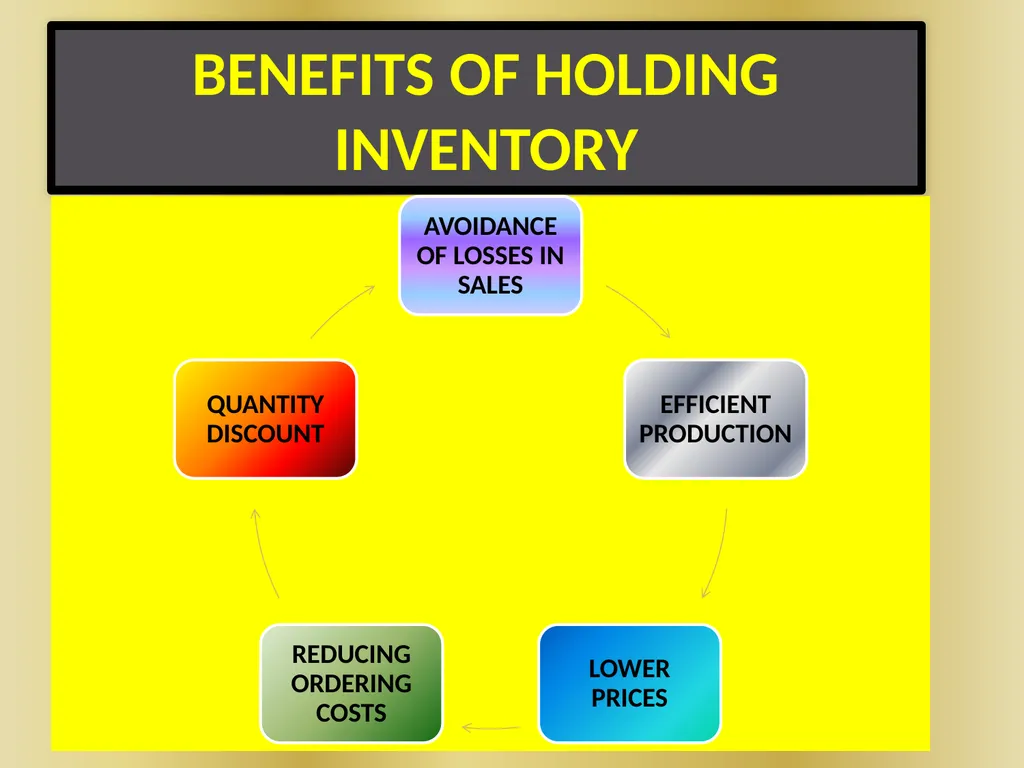
BENEFITS OF HOLDING INVENTORY<br>
15
AVOIDANCE OF LOSSES IN SALES: Due to non-availability of goods, customers will buy the goods from the competitors. As a result, the sales of firm will decrease but by keeping adequate inventory, this loss can be avoided.
QUANTITY DISCOUNT: By keeping stock of inventory firm can avail of quantity discount.
EFFICIENT PRODUCTION: Due to adequate stock of raw material, firm can perform the production process without a break. The firm which produces on seasonal basis, can continue the production process for the whole year by keeping stock of manufactured goods for months or seasons.
REDUCING ORDERING COSTS: By ordering large quantities, firm can reduce its ordering costs.
LOWER PRICES: If in future, there is possibility of price rise, firm can keep more stock of inventory at low prices.<br>
QUANTITY DISCOUNT: By keeping stock of inventory firm can avail of quantity discount.
EFFICIENT PRODUCTION: Due to adequate stock of raw material, firm can perform the production process without a break. The firm which produces on seasonal basis, can continue the production process for the whole year by keeping stock of manufactured goods for months or seasons.
REDUCING ORDERING COSTS: By ordering large quantities, firm can reduce its ordering costs.
LOWER PRICES: If in future, there is possibility of price rise, firm can keep more stock of inventory at low prices.<br>
16
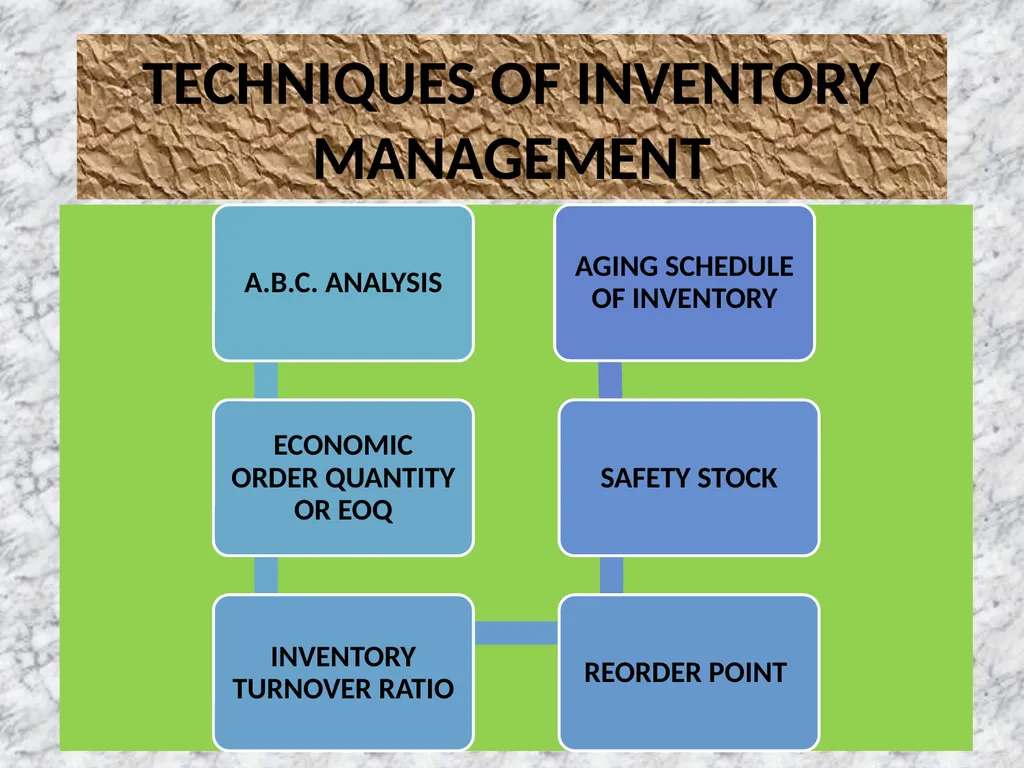
TECHNIQUES OF INVENTORY MANAGEMENT<br>
17
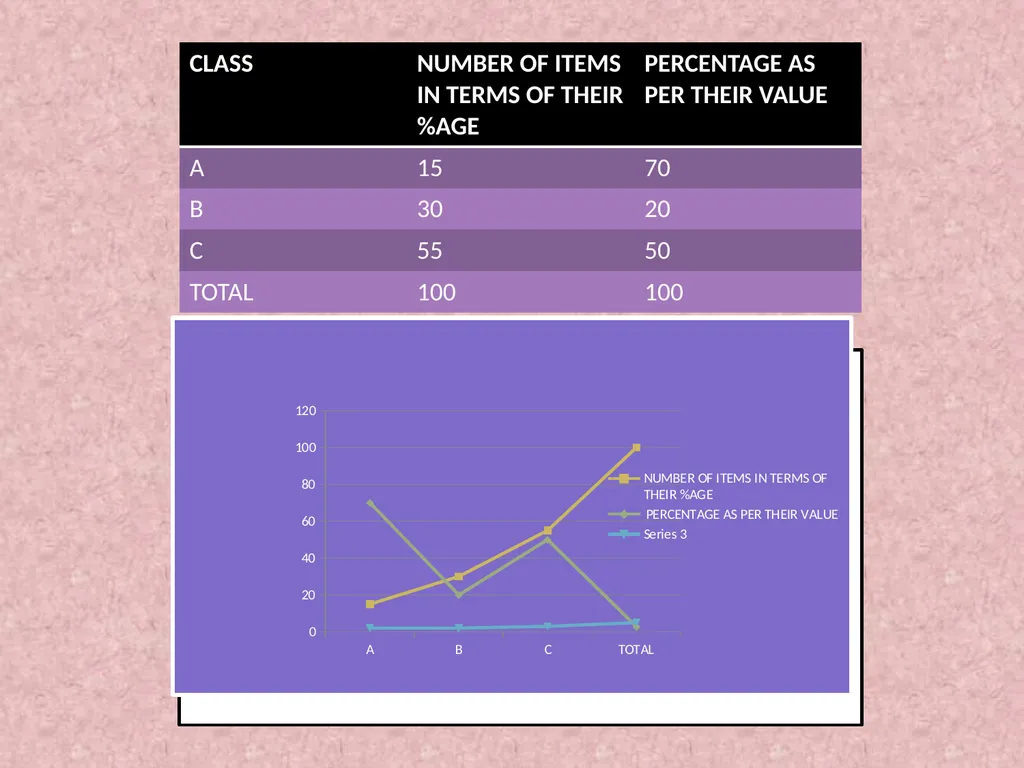
A.B.C. ANALYSIS:- A.B.C. Analysis is a selective technique of controlling different items of inventory. In actual practice, thousands of items are included in business as inventories. But all these items are not equally important. According to this technique, only those items of inventory are paid more attention which are significant for business. According to this technique, all items are classified into three categories-A.B. and C. In ‘A’ but category those items are taken which are more precious and their quantity or number is small. In ‘B’ category those items are taken which are less costly than the items of category ‘A’ but their number is greater. In category ‘C’ all those items are included which are low priced but their number is highest. In a manufacturing organisation, the items of inventory can be classified as under:<br>
18
REORDER POINT: It becomes essential to find out when to order for the material. If the stock of raw material is adequate in business and fresh order has been placed, the carrying costs will increase but the risk for its being out of stock will decline. Contractually, if the recorder is given at a time when the stock is less, the carrying costs will decrease but the chances of firm being out of stock will rise. Because both of these situations are not favourable for business, therefore, the management should minimise carrying costs and out of stock costs. Recorder point establishes balance in these two situations.
REORDER POINT MEANS THE POINT OF INVENTORY LEVEL AT WHICH THE NEW ORDER IS PLACED.
FOR DETERMINING REORDER POINT TWO INFORMATIONS ARE NEEDED:<br>
REORDER POINT MEANS THE POINT OF INVENTORY LEVEL AT WHICH THE NEW ORDER IS PLACED.
FOR DETERMINING REORDER POINT TWO INFORMATIONS ARE NEEDED:<br>
19
LEAD TIME
THE USAGE RATE
Lead time is the time period between the date of placing order and the date of receiving delivery.
Average usage is the quantity of raw material which is used daily in business.<br>
THE USAGE RATE
Lead time is the time period between the date of placing order and the date of receiving delivery.
Average usage is the quantity of raw material which is used daily in business.<br>
20
SAFETY STOCK: The determination of reorder point is based on the fact that average usage rate and lead time are correctly estimated. But in actual practice due to uncertainties, the changes in demand for goods take place. Sometimes, the supply of goods is delayed due to strikes, floods, transportation problems, etc.
ECONOMIC ORDER QUANTITY OR EOQ: Economic order quantity means the quantum of material purchased by each order so that the sum of ordering costs of material and its carrying costs are minimum.
It establishes balance between two types of costs:
Ordering Costs
Carrying Costs<br>
ECONOMIC ORDER QUANTITY OR EOQ: Economic order quantity means the quantum of material purchased by each order so that the sum of ordering costs of material and its carrying costs are minimum.
It establishes balance between two types of costs:
Ordering Costs
Carrying Costs<br>
21
ORDERING COSTS: in the ordering costs, costs of placing orders and costs of getting delivery are included, for example, clerical expenses, transport expenses, supervision expenses and dispatch to godown expenses.
CARRYING COSTS: These are the costs of stocking the goods. They include interest on capital invested, cost of physical labour, insurance, storage cost, etc.<br>
CARRYING COSTS: These are the costs of stocking the goods. They include interest on capital invested, cost of physical labour, insurance, storage cost, etc.<br>
22
INVENTORY TURNOVER RATIO: To exercise control over inventory several types of inventory turnover ratios are calculated. These inventory ratios can be calculated for each item of inventory.
AGING SCHEDULE OF INVENTORY: According to time, inventory can be classified to find out those items which are used in the production process at a slow rate or which are sold at slow rate.<br>
AGING SCHEDULE OF INVENTORY: According to time, inventory can be classified to find out those items which are used in the production process at a slow rate or which are sold at slow rate.<br>
23
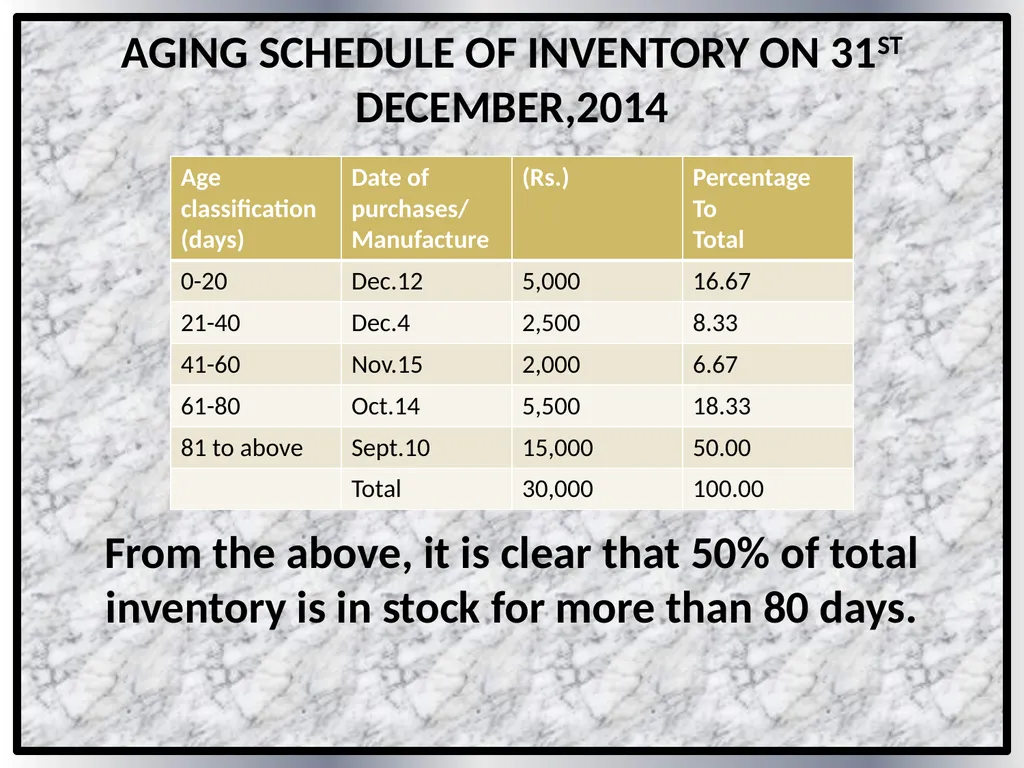
AGING SCHEDULE OF INVENTORY ON 31ST DECEMBER,2014
From the above, it is clear that 50% of total inventory is in stock for more than 80 days.<br>
From the above, it is clear that 50% of total inventory is in stock for more than 80 days.<br>
24
Inventory management has to do with keeping accurate records of goods that are ready for shipment. This often means having enough stock of goods that are ready for shipment. This often means having enough stock of goods to the inventory totals as well as subtracting the most recent shipments of finished goods to buyers. When the company has a return policy in place, there is usually a sub-category contained in the finished goods inventory makes it possible to quickly convey information to sales personnel as to what is available and ready for shipment at any given time by buyer.
Inventory management is important for keeping costs down, while meeting regulation. Supply and demand is a delicate balance, and inventory management hopes to ensure that the balance is undistributed. Highly trained inventory management and high quality software will help make Inventory management a success. The ROI of Inventory Management will be seen in the forms of increased revenue and profits, positive employee atmosphere, and on overall increase of customer satisfaction. CONCLUSION<br>
Inventory management is important for keeping costs down, while meeting regulation. Supply and demand is a delicate balance, and inventory management hopes to ensure that the balance is undistributed. Highly trained inventory management and high quality software will help make Inventory management a success. The ROI of Inventory Management will be seen in the forms of increased revenue and profits, positive employee atmosphere, and on overall increase of customer satisfaction. CONCLUSION<br>