
Investment Banking Interview Prep Workshop
BR
Published · 29 slides · 0 views
1 / 1




Description
Investment Banking Interview Prep Workshop Presentation Topics: 2 How to land the interview Format and strategies to ace the interview Other resources Networking is extremely important for sourcing job opportunities, getting interviews, and
Related Topics
Share
Embed code
Download this presentation From Below
"Investment Banking Interview Prep Workshop" is the property of its rightful owner. Permission is granted to download and print the materials on this website for personal, non-commercial use only, and to display it on your personal computer provided you do not modify the materials and that you retain all copyright notices contained in the materials. By downloading content from our website, you accept the terms of this agreement.
Presentation Transcript
01
Investment Banking
Interview Prep Workshop<br>
02
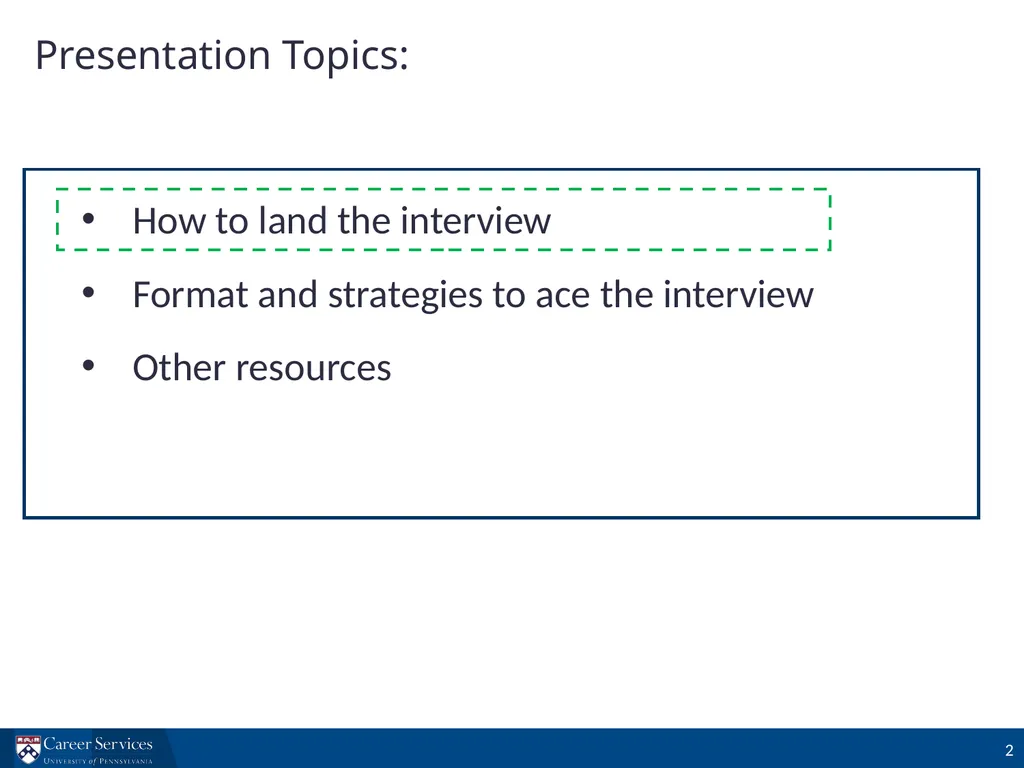
Presentation Topics: 2 How to land the interview
Format and strategies to ace the interview
Other resources<br>
Format and strategies to ace the interview
Other resources<br>
03
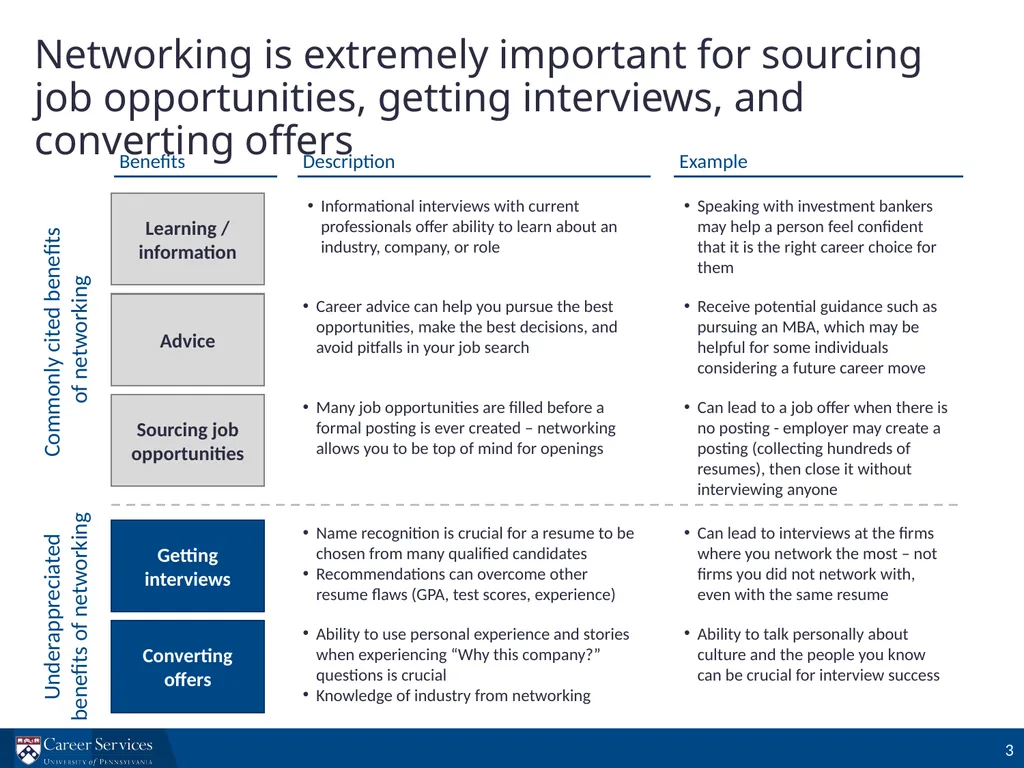
Networking is extremely important for sourcing job opportunities, getting interviews, and converting offers 3 Commonly cited benefits
of networking Underappreciated benefits of networking Learning / information Advice Sourcing job opportunities Getting interviews Converting offers Benefits Description Example Informational interviews with current professionals offer ability to learn about an industry, company, or role Speaking with investment bankers may help a person feel confident that it is the right career choice for them Receive potential guidance such as pursuing an MBA, which may be helpful for some individuals considering a future career move Can lead to a job offer when there is no posting - employer may create a posting (collecting hundreds of resumes), then close it without interviewing anyone Can lead to interviews at the firms where you network the most – not firms you did not network with, even with the same resume Ability to talk personally about culture and the people you know can be crucial for interview success Career advice can help you pursue the best opportunities, make the best decisions, and avoid pitfalls in your job search Many job opportunities are filled before a formal posting is ever created – networking allows you to be top of mind for openings Name recognition is crucial for a resume to be chosen from many qualified candidates
Recommendations can overcome other resume flaws (GPA, test scores, experience) Ability to use personal experience and stories when experiencing “Why this company?” questions is crucial
Knowledge of industry from networking<br>
Recommendations can overcome other resume flaws (GPA, test scores, experience) Ability to use personal experience and stories when experiencing “Why this company?” questions is crucial
Knowledge of industry from networking<br>
04
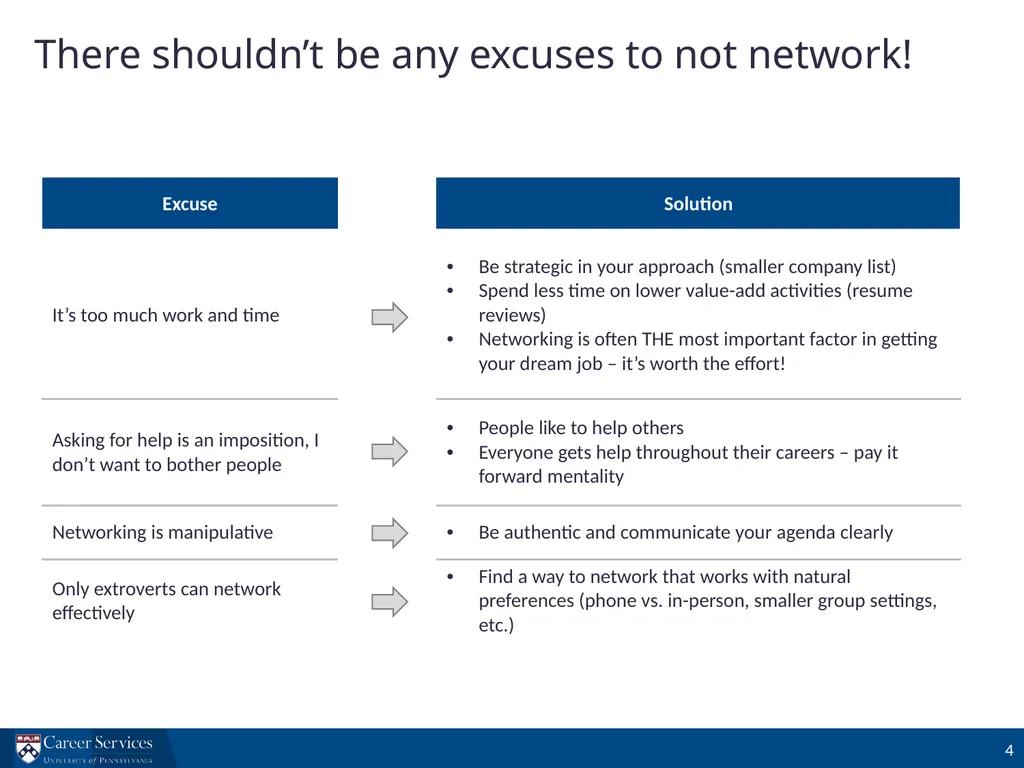
There shouldn’t be any excuses to not network! 4<br>
05
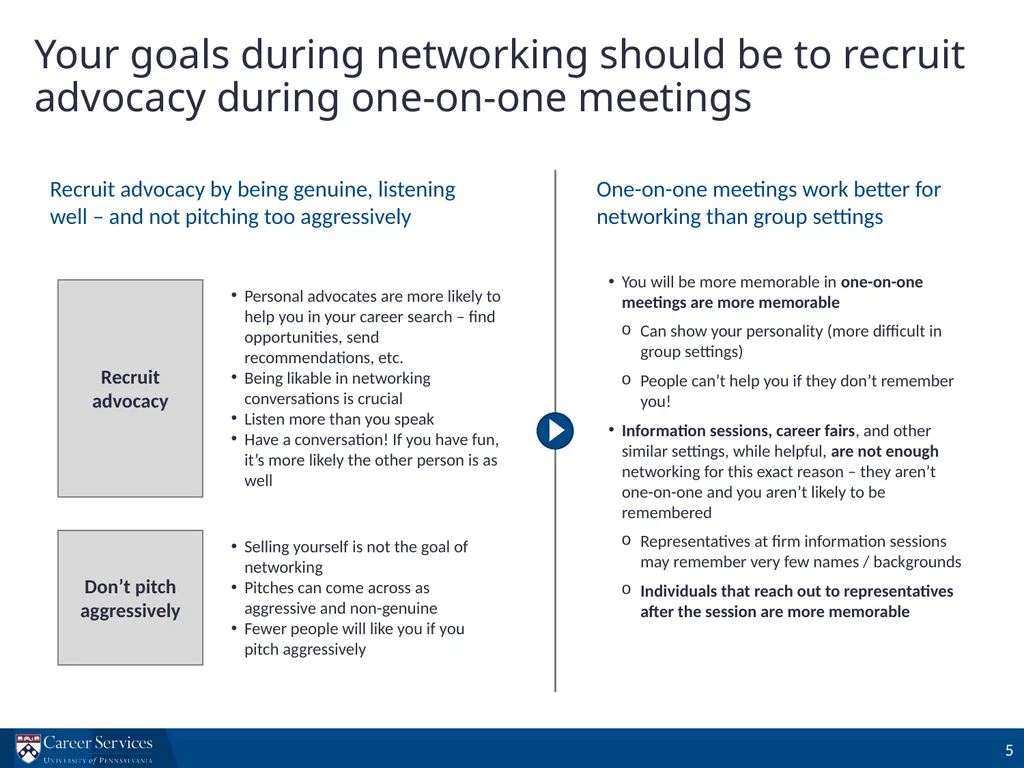
Your goals during networking should be to recruit advocacy during one-on-one meetings 5 Recruit advocacy Don’t pitch aggressively Personal advocates are more likely to help you in your career search – find opportunities, send recommendations, etc.
Being likable in networking conversations is crucial
Listen more than you speak
Have a conversation! If you have fun, it’s more likely the other person is as well Selling yourself is not the goal of networking
Pitches can come across as aggressive and non-genuine
Fewer people will like you if you pitch aggressively Recruit advocacy by being genuine, listening well – and not pitching too aggressively One-on-one meetings work better for networking than group settings You will be more memorable in one-on-one meetings are more memorable
Can show your personality (more difficult in group settings)
People can’t help you if they don’t remember you!
Information sessions, career fairs, and other similar settings, while helpful, are not enough networking for this exact reason – they aren’t one-on-one and you aren’t likely to be remembered
Representatives at firm information sessions may remember very few names / backgrounds
Individuals that reach out to representatives after the session are more memorable<br>
Being likable in networking conversations is crucial
Listen more than you speak
Have a conversation! If you have fun, it’s more likely the other person is as well Selling yourself is not the goal of networking
Pitches can come across as aggressive and non-genuine
Fewer people will like you if you pitch aggressively Recruit advocacy by being genuine, listening well – and not pitching too aggressively One-on-one meetings work better for networking than group settings You will be more memorable in one-on-one meetings are more memorable
Can show your personality (more difficult in group settings)
People can’t help you if they don’t remember you!
Information sessions, career fairs, and other similar settings, while helpful, are not enough networking for this exact reason – they aren’t one-on-one and you aren’t likely to be remembered
Representatives at firm information sessions may remember very few names / backgrounds
Individuals that reach out to representatives after the session are more memorable<br>
06
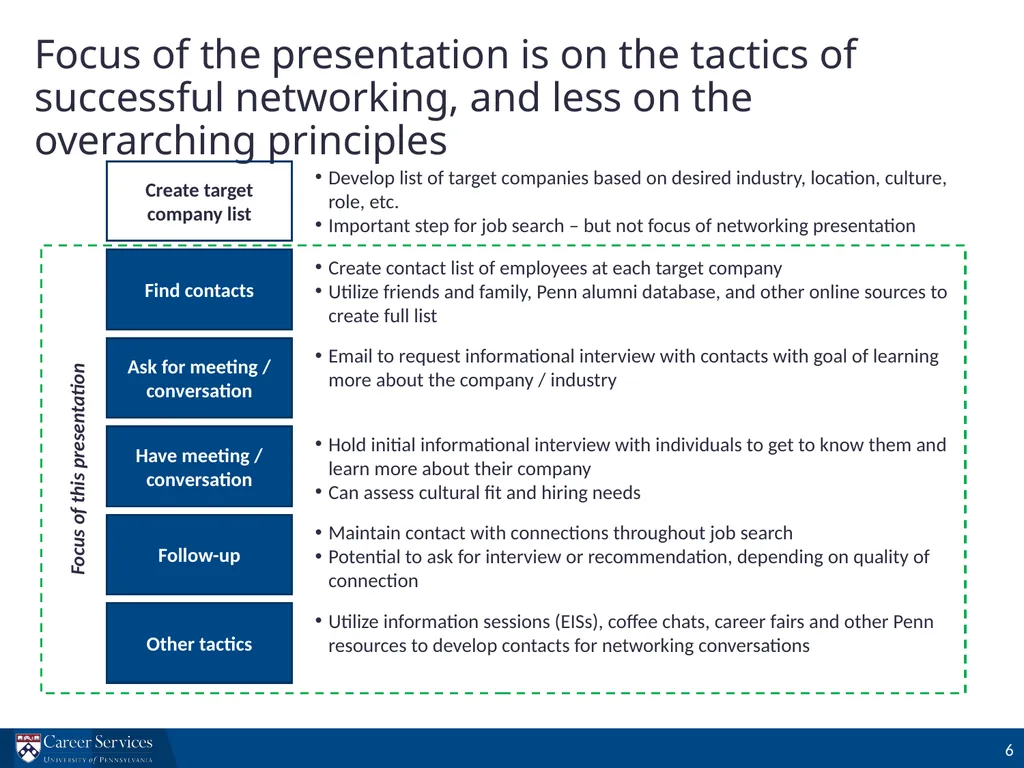
Focus of the presentation is on the tactics of successful networking, and less on the overarching principles 6 Find contacts Create target company list Ask for meeting / conversation Have meeting / conversation Follow-up Other tactics Focus of this presentation Develop list of target companies based on desired industry, location, culture, role, etc.
Important step for job search – but not focus of networking presentation Create contact list of employees at each target company
Utilize friends and family, Penn alumni database, and other online sources to create full list Email to request informational interview with contacts with goal of learning more about the company / industry Hold initial informational interview with individuals to get to know them and learn more about their company
Can assess cultural fit and hiring needs Maintain contact with connections throughout job search
Potential to ask for interview or recommendation, depending on quality of connection Utilize information sessions (EISs), coffee chats, career fairs and other Penn resources to develop contacts for networking conversations<br>
Important step for job search – but not focus of networking presentation Create contact list of employees at each target company
Utilize friends and family, Penn alumni database, and other online sources to create full list Email to request informational interview with contacts with goal of learning more about the company / industry Hold initial informational interview with individuals to get to know them and learn more about their company
Can assess cultural fit and hiring needs Maintain contact with connections throughout job search
Potential to ask for interview or recommendation, depending on quality of connection Utilize information sessions (EISs), coffee chats, career fairs and other Penn resources to develop contacts for networking conversations<br>
07
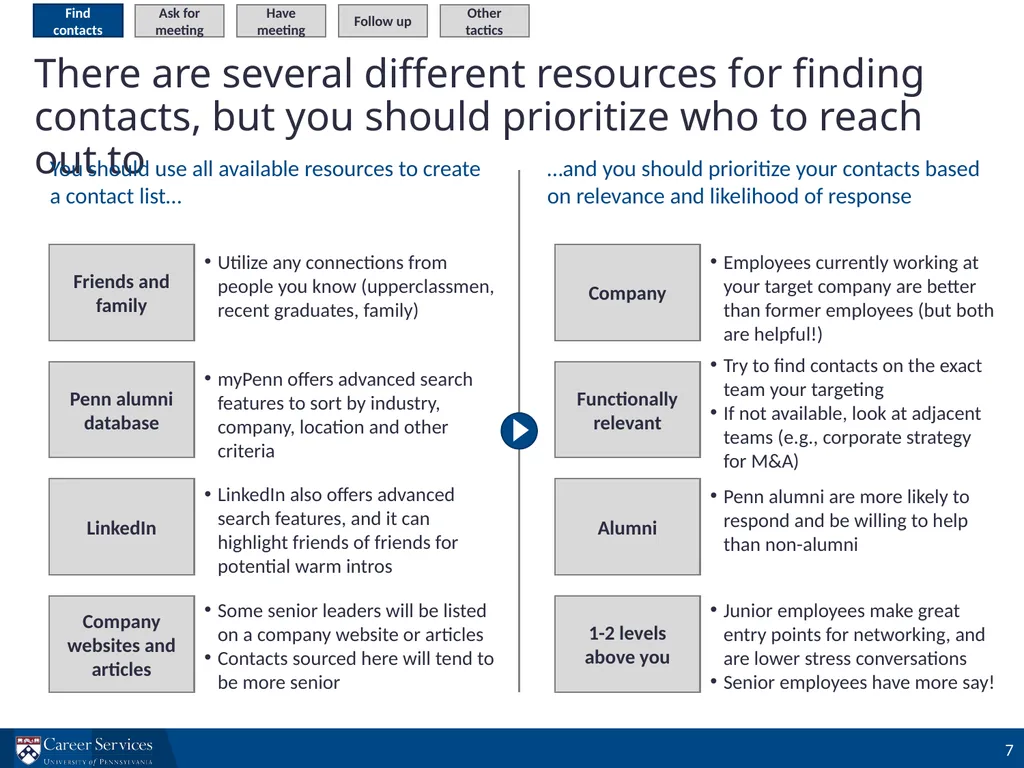
There are several different resources for finding contacts, but you should prioritize who to reach out to 7 You should use all available resources to create a contact list… …and you should prioritize your contacts based on relevance and likelihood of response Friends and family Penn alumni database LinkedIn Company websites and articles Utilize any connections from people you know (upperclassmen, recent graduates, family) myPenn offers advanced search features to sort by industry, company, location and other criteria LinkedIn also offers advanced search features, and it can highlight friends of friends for potential warm intros Some senior leaders will be listed on a company website or articles
Contacts sourced here will tend to be more senior Company 1-2 levels above you Employees currently working at your target company are better than former employees (but both are helpful!) Alumni Penn alumni are more likely to respond and be willing to help than non-alumni Functionally relevant Try to find contacts on the exact team your targeting
If not available, look at adjacent teams (e.g., corporate strategy for M&A) Junior employees make great entry points for networking, and are lower stress conversations
Senior employees have more say! Find contacts Ask for meeting Have meeting Follow up Other tactics<br>
Contacts sourced here will tend to be more senior Company 1-2 levels above you Employees currently working at your target company are better than former employees (but both are helpful!) Alumni Penn alumni are more likely to respond and be willing to help than non-alumni Functionally relevant Try to find contacts on the exact team your targeting
If not available, look at adjacent teams (e.g., corporate strategy for M&A) Junior employees make great entry points for networking, and are lower stress conversations
Senior employees have more say! Find contacts Ask for meeting Have meeting Follow up Other tactics<br>
08
Ask for a meeting or conversation through a short, direct email 8 Find contacts Ask for meeting Have meeting Follow up Other tactics Hi John,
My name is Eddie Roberts, and I’m a sophomore at Penn studying Economics. After interning in private wealth management this past summer, I am interested in exploring investment banking.
After seeing your profile on LinkedIn, I was hoping you would be willing to schedule a short, 15-20 minute phone call with me. I would love to learn more about your background in middle market investment banking, especially how you transitioned from private wealth management. I would also appreciate any advice you would be willing to give.
I am relatively free in the afternoons on weekdays, but let me know a time that works for you and we can set something up. Look forward to chatting.
Best,
Eddie Short Introduction Direct ask Why Availability Sample email structure Your email should have several similar components to the sample People won’t read long emails!
Keep to ~100-150 words State who you are and what you’re interested in Ask for advice / insight, not job assistance via a phone call or coffee chat Tell them what you want to talk about and why it will be helpful (can be broad and specific) Give them your availability – and be flexible! How you found them Let the person know where you found their information<br>
My name is Eddie Roberts, and I’m a sophomore at Penn studying Economics. After interning in private wealth management this past summer, I am interested in exploring investment banking.
After seeing your profile on LinkedIn, I was hoping you would be willing to schedule a short, 15-20 minute phone call with me. I would love to learn more about your background in middle market investment banking, especially how you transitioned from private wealth management. I would also appreciate any advice you would be willing to give.
I am relatively free in the afternoons on weekdays, but let me know a time that works for you and we can set something up. Look forward to chatting.
Best,
Eddie Short Introduction Direct ask Why Availability Sample email structure Your email should have several similar components to the sample People won’t read long emails!
Keep to ~100-150 words State who you are and what you’re interested in Ask for advice / insight, not job assistance via a phone call or coffee chat Tell them what you want to talk about and why it will be helpful (can be broad and specific) Give them your availability – and be flexible! How you found them Let the person know where you found their information<br>
09
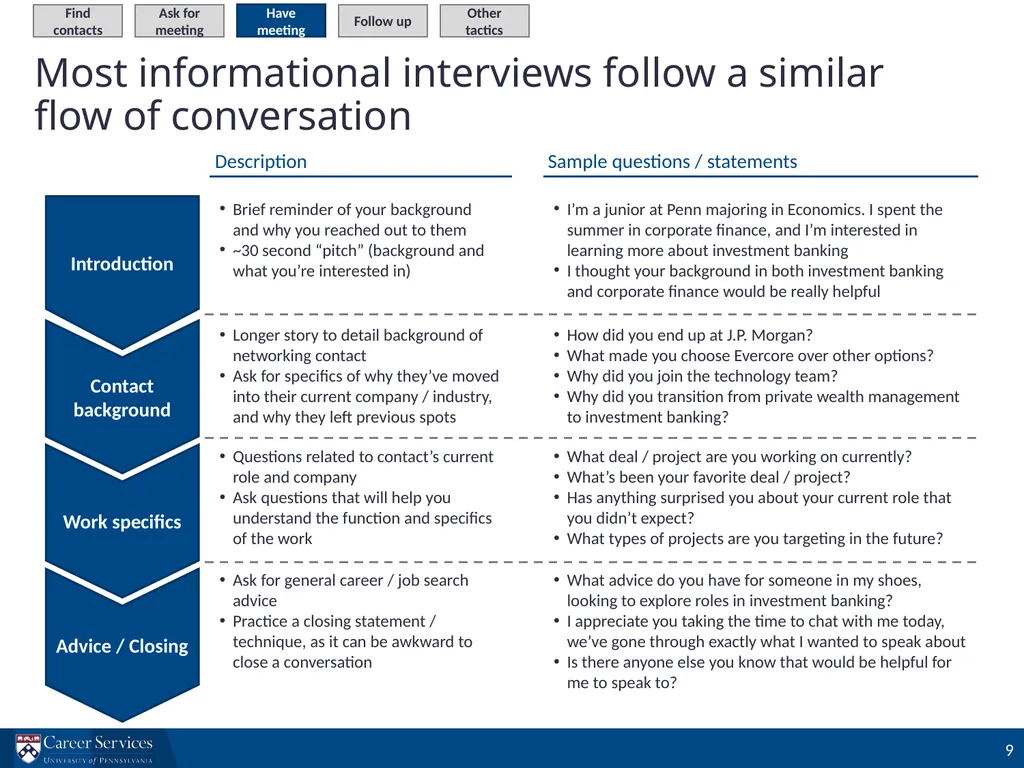
Most informational interviews follow a similar flow of conversation 9 Find contacts Ask for meeting Have meeting Follow up Other tactics Introduction Contact background Work specifics Advice / Closing Description Sample questions / statements Brief reminder of your background and why you reached out to them
~30 second “pitch” (background and what you’re interested in) I’m a junior at Penn majoring in Economics. I spent the summer in corporate finance, and I’m interested in learning more about investment banking
I thought your background in both investment banking and corporate finance would be really helpful Longer story to detail background of networking contact
Ask for specifics of why they’ve moved into their current company / industry, and why they left previous spots How did you end up at J.P. Morgan?
What made you choose Evercore over other options?
Why did you join the technology team?
Why did you transition from private wealth management to investment banking? Questions related to contact’s current role and company
Ask questions that will help you understand the function and specifics of the work What deal / project are you working on currently?
What’s been your favorite deal / project?
Has anything surprised you about your current role that you didn’t expect?
What types of projects are you targeting in the future? Ask for general career / job search advice
Practice a closing statement / technique, as it can be awkward to close a conversation What advice do you have for someone in my shoes, looking to explore roles in investment banking?
I appreciate you taking the time to chat with me today, we’ve gone through exactly what I wanted to speak about
Is there anyone else you know that would be helpful for me to speak to?<br>
~30 second “pitch” (background and what you’re interested in) I’m a junior at Penn majoring in Economics. I spent the summer in corporate finance, and I’m interested in learning more about investment banking
I thought your background in both investment banking and corporate finance would be really helpful Longer story to detail background of networking contact
Ask for specifics of why they’ve moved into their current company / industry, and why they left previous spots How did you end up at J.P. Morgan?
What made you choose Evercore over other options?
Why did you join the technology team?
Why did you transition from private wealth management to investment banking? Questions related to contact’s current role and company
Ask questions that will help you understand the function and specifics of the work What deal / project are you working on currently?
What’s been your favorite deal / project?
Has anything surprised you about your current role that you didn’t expect?
What types of projects are you targeting in the future? Ask for general career / job search advice
Practice a closing statement / technique, as it can be awkward to close a conversation What advice do you have for someone in my shoes, looking to explore roles in investment banking?
I appreciate you taking the time to chat with me today, we’ve gone through exactly what I wanted to speak about
Is there anyone else you know that would be helpful for me to speak to?<br>
10
It is important to follow up with contacts after your initial conversation to keep them in your network 10 Find contacts Ask for meeting Have meeting Follow up Other tactics General updates Reason to follow up Description Examples Targeted asks When you apply for a position within a company, you should make direct asks of your contacts at a company
Can also directly ask for interviews
Be direct and ask for exactly what you want – don’t be indirect! After giving it some thought, I do think I would like to work in investment banking. How can I get an interview at your firm?
I just applied through Handshake to the summer analyst position – would it be possible for you to send a recommendation on my behalf? Reach out to relevant contacts when you achieve a career milestone (e.g., accept an internship offer, start a new job, etc.)
Reach out when contact achieves career milestone (e.g., news about company, new job)
Short email – do not need to ask for longer conversation I wanted to let you know that I accepted an offer to join Evercore over the summer. Thank you again for all your help…
I saw an article about your company’s recent acquisition of Shire – congratulations on completing the deal! Most candidates do not directly ask for what they want (interview, recommendation, etc.). It may feel awkward, but being direct works!<br>
Can also directly ask for interviews
Be direct and ask for exactly what you want – don’t be indirect! After giving it some thought, I do think I would like to work in investment banking. How can I get an interview at your firm?
I just applied through Handshake to the summer analyst position – would it be possible for you to send a recommendation on my behalf? Reach out to relevant contacts when you achieve a career milestone (e.g., accept an internship offer, start a new job, etc.)
Reach out when contact achieves career milestone (e.g., news about company, new job)
Short email – do not need to ask for longer conversation I wanted to let you know that I accepted an offer to join Evercore over the summer. Thank you again for all your help…
I saw an article about your company’s recent acquisition of Shire – congratulations on completing the deal! Most candidates do not directly ask for what they want (interview, recommendation, etc.). It may feel awkward, but being direct works!<br>
11
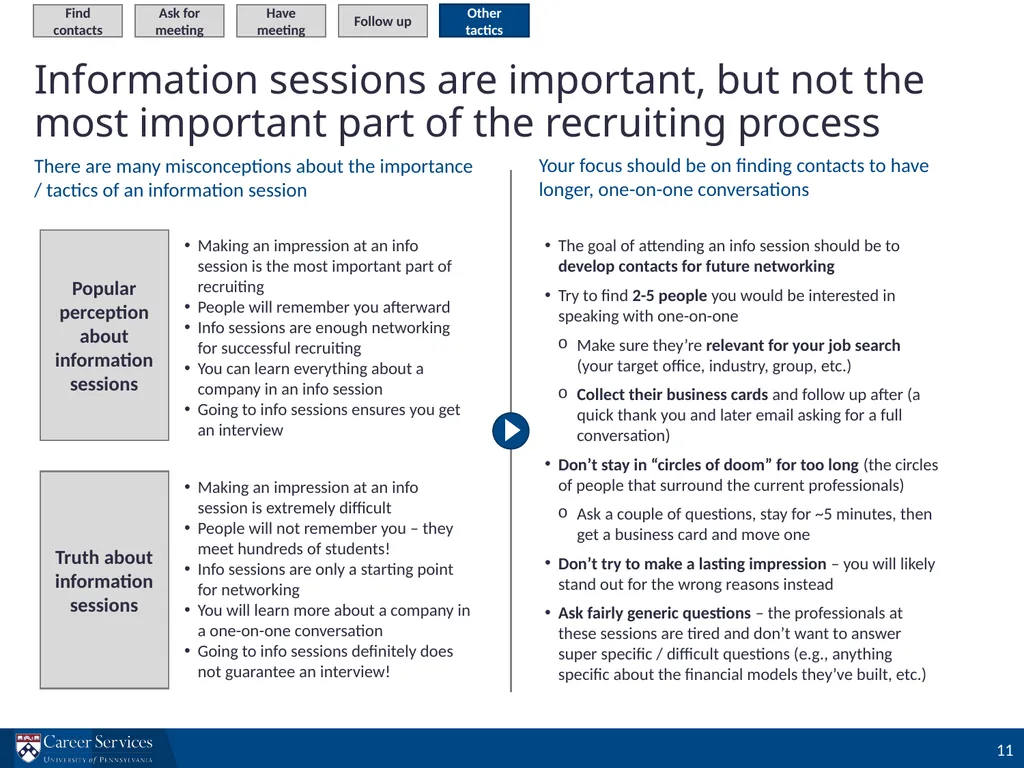
Information sessions are important, but not the most important part of the recruiting process 11 Find contacts Ask for meeting Have meeting Follow up Other tactics There are many misconceptions about the importance / tactics of an information session Your focus should be on finding contacts to have longer, one-on-one conversations The goal of attending an info session should be to develop contacts for future networking
Try to find 2-5 people you would be interested in speaking with one-on-one
Make sure they’re relevant for your job search (your target office, industry, group, etc.)
Collect their business cards and follow up after (a quick thank you and later email asking for a full conversation)
Don’t stay in “circles of doom” for too long (the circles of people that surround the current professionals)
Ask a couple of questions, stay for ~5 minutes, then get a business card and move one
Don’t try to make a lasting impression – you will likely stand out for the wrong reasons instead
Ask fairly generic questions – the professionals at these sessions are tired and don’t want to answer super specific / difficult questions (e.g., anything specific about the financial models they’ve built, etc.) Popular perception about information sessions Truth about information sessions Making an impression at an info session is the most important part of recruiting
People will remember you afterward
Info sessions are enough networking for successful recruiting
You can learn everything about a company in an info session
Going to info sessions ensures you get an interview Making an impression at an info session is extremely difficult
People will not remember you – they meet hundreds of students!
Info sessions are only a starting point for networking
You will learn more about a company in a one-on-one conversation
Going to info sessions definitely does not guarantee an interview!<br>
Try to find 2-5 people you would be interested in speaking with one-on-one
Make sure they’re relevant for your job search (your target office, industry, group, etc.)
Collect their business cards and follow up after (a quick thank you and later email asking for a full conversation)
Don’t stay in “circles of doom” for too long (the circles of people that surround the current professionals)
Ask a couple of questions, stay for ~5 minutes, then get a business card and move one
Don’t try to make a lasting impression – you will likely stand out for the wrong reasons instead
Ask fairly generic questions – the professionals at these sessions are tired and don’t want to answer super specific / difficult questions (e.g., anything specific about the financial models they’ve built, etc.) Popular perception about information sessions Truth about information sessions Making an impression at an info session is the most important part of recruiting
People will remember you afterward
Info sessions are enough networking for successful recruiting
You can learn everything about a company in an info session
Going to info sessions ensures you get an interview Making an impression at an info session is extremely difficult
People will not remember you – they meet hundreds of students!
Info sessions are only a starting point for networking
You will learn more about a company in a one-on-one conversation
Going to info sessions definitely does not guarantee an interview!<br>
12
Presentation Topics: 12 How to land the interview
Format and strategies to ace the interview
Other resources<br>
Format and strategies to ace the interview
Other resources<br>
13
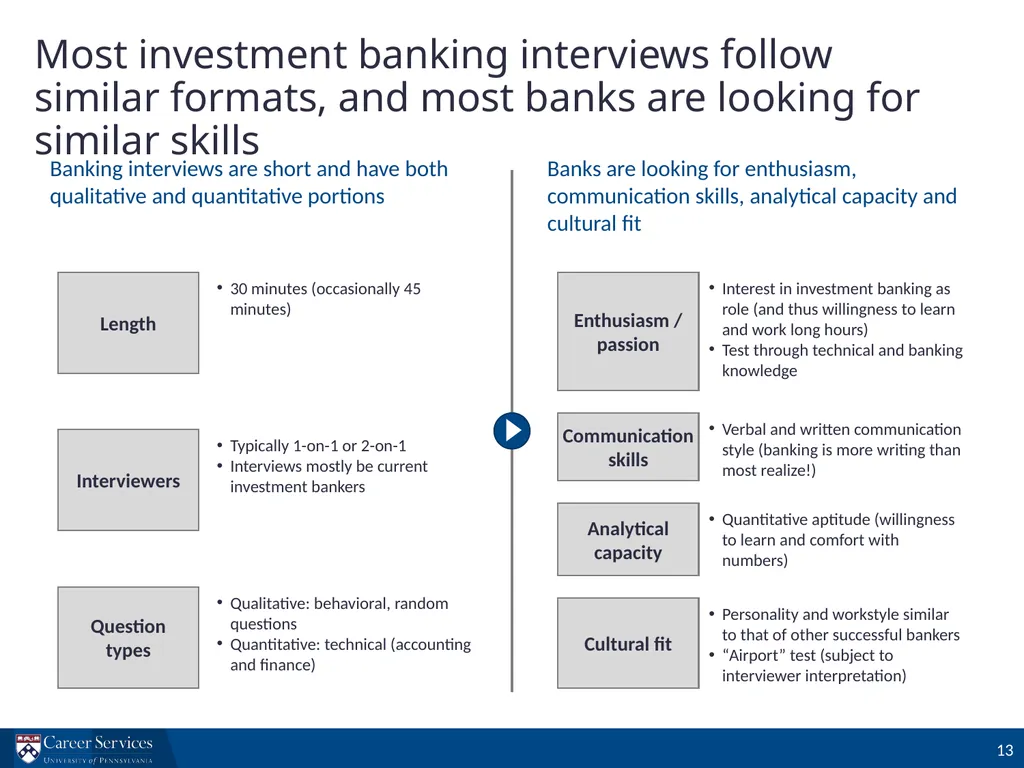
Most investment banking interviews follow similar formats, and most banks are looking for similar skills 13 Length Interviewers Question types Banking interviews are short and have both qualitative and quantitative portions Banks are looking for enthusiasm, communication skills, analytical capacity and cultural fit 30 minutes (occasionally 45 minutes) Typically 1-on-1 or 2-on-1
Interviews mostly be current investment bankers Qualitative: behavioral, random questions
Quantitative: technical (accounting and finance) Enthusiasm / passion Communication skills Cultural fit Interest in investment banking as role (and thus willingness to learn and work long hours)
Test through technical and banking knowledge Analytical capacity Verbal and written communication style (banking is more writing than most realize!) Quantitative aptitude (willingness to learn and comfort with numbers) Personality and workstyle similar to that of other successful bankers
“Airport” test (subject to interviewer interpretation)<br>
Interviews mostly be current investment bankers Qualitative: behavioral, random questions
Quantitative: technical (accounting and finance) Enthusiasm / passion Communication skills Cultural fit Interest in investment banking as role (and thus willingness to learn and work long hours)
Test through technical and banking knowledge Analytical capacity Verbal and written communication style (banking is more writing than most realize!) Quantitative aptitude (willingness to learn and comfort with numbers) Personality and workstyle similar to that of other successful bankers
“Airport” test (subject to interviewer interpretation)<br>
14
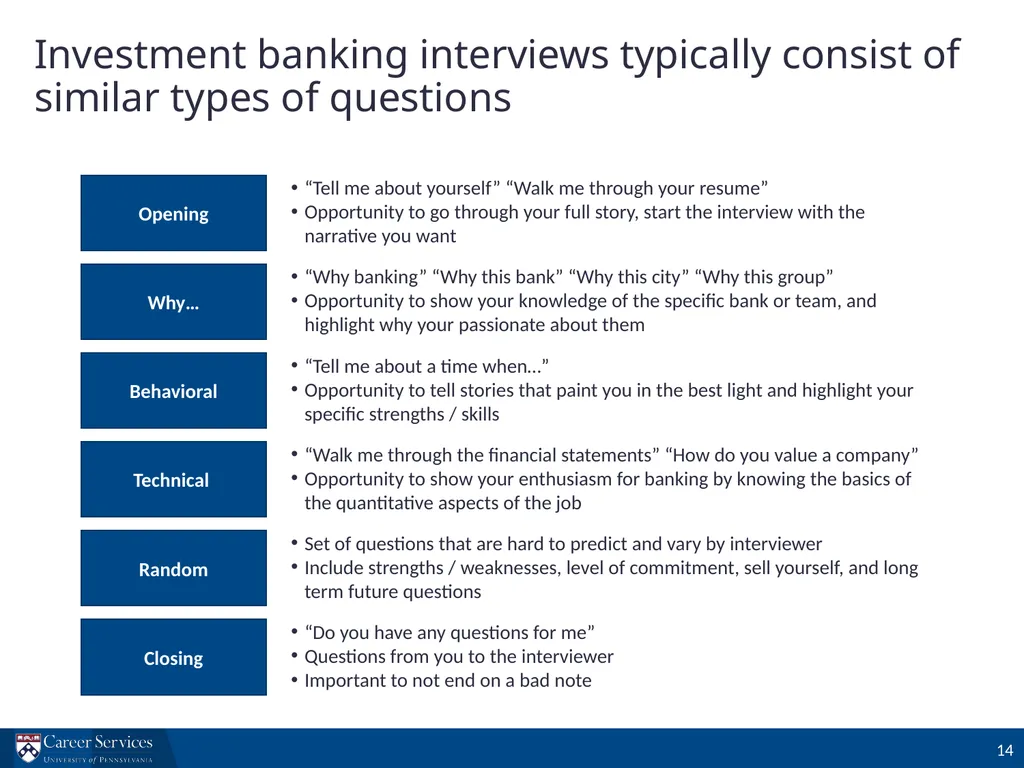
Investment banking interviews typically consist of similar types of questions 14 Opening Behavioral Technical Random Closing “Tell me about yourself” “Walk me through your resume”
Opportunity to go through your full story, start the interview with the narrative you want “Tell me about a time when…”
Opportunity to tell stories that paint you in the best light and highlight your specific strengths / skills “Walk me through the financial statements” “How do you value a company”
Opportunity to show your enthusiasm for banking by knowing the basics of the quantitative aspects of the job Set of questions that are hard to predict and vary by interviewer
Include strengths / weaknesses, level of commitment, sell yourself, and long term future questions “Do you have any questions for me”
Questions from you to the interviewer
Important to not end on a bad note Why… “Why banking” “Why this bank” “Why this city” “Why this group”
Opportunity to show your knowledge of the specific bank or team, and highlight why your passionate about them<br>
Opportunity to go through your full story, start the interview with the narrative you want “Tell me about a time when…”
Opportunity to tell stories that paint you in the best light and highlight your specific strengths / skills “Walk me through the financial statements” “How do you value a company”
Opportunity to show your enthusiasm for banking by knowing the basics of the quantitative aspects of the job Set of questions that are hard to predict and vary by interviewer
Include strengths / weaknesses, level of commitment, sell yourself, and long term future questions “Do you have any questions for me”
Questions from you to the interviewer
Important to not end on a bad note Why… “Why banking” “Why this bank” “Why this city” “Why this group”
Opportunity to show your knowledge of the specific bank or team, and highlight why your passionate about them<br>
15
Telling your story clearly and chronologically is hugely important for interviews 15 Opening Behavioral Technical Random Closing Why… Story Overview Tell your story in response to questions like, “Tell me about yourself” or “Walk me through your resume” (almost always the first question of an interview)
Should be chronological and last between 2-3 minutes
Focus on why you’ve made choices (why Penn? why banking? etc.)
The most important question of any interview Description Sample (abbreviated) story Brief introduction to your background (hometown, college major) Specific event or experience that led to your interest in finance / banking Progression through student groups or jobs that has led to banking Why investment banking and why this firm I grew up in a small town and Mississippi, and knew I wanted to go to college in a larger city. Penn was a great opportunity for me to come up to Philadelphia and experience a new culture. I major in Economics here because I’ve always enjoyed math, and Economics is a more practical application of the subjects I enjoyed. I discovered my interest in Finance through the upperclassmen that major in Economics. A ton of them go into Finance, and it seemed like a good fit for me – I’ve always enjoyed working with numbers and more analytical problems. So I joined a finance group on campus, where I got to learn the basics of finance and valuation. For my junior year internship, I decided to try Private Wealth Management. I thought it would be a good blend of the finance I was enjoying, and plenty of people interaction. While I had a great summer, I realized the balance wasn’t exactly what I wanted. I wanted a bit more analytics / financial modeling, and a bit less sales. I think investment banking will be a better blend, where I get the hard financial modeling skillset I want. In addition, I think a middle market bank like Lincoln is the perfect fit for me, since I would still get more interpersonal interactions with the clients and the small deal teams than I would at a bulge bracket bank.<br>
Should be chronological and last between 2-3 minutes
Focus on why you’ve made choices (why Penn? why banking? etc.)
The most important question of any interview Description Sample (abbreviated) story Brief introduction to your background (hometown, college major) Specific event or experience that led to your interest in finance / banking Progression through student groups or jobs that has led to banking Why investment banking and why this firm I grew up in a small town and Mississippi, and knew I wanted to go to college in a larger city. Penn was a great opportunity for me to come up to Philadelphia and experience a new culture. I major in Economics here because I’ve always enjoyed math, and Economics is a more practical application of the subjects I enjoyed. I discovered my interest in Finance through the upperclassmen that major in Economics. A ton of them go into Finance, and it seemed like a good fit for me – I’ve always enjoyed working with numbers and more analytical problems. So I joined a finance group on campus, where I got to learn the basics of finance and valuation. For my junior year internship, I decided to try Private Wealth Management. I thought it would be a good blend of the finance I was enjoying, and plenty of people interaction. While I had a great summer, I realized the balance wasn’t exactly what I wanted. I wanted a bit more analytics / financial modeling, and a bit less sales. I think investment banking will be a better blend, where I get the hard financial modeling skillset I want. In addition, I think a middle market bank like Lincoln is the perfect fit for me, since I would still get more interpersonal interactions with the clients and the small deal teams than I would at a bulge bracket bank.<br>
16
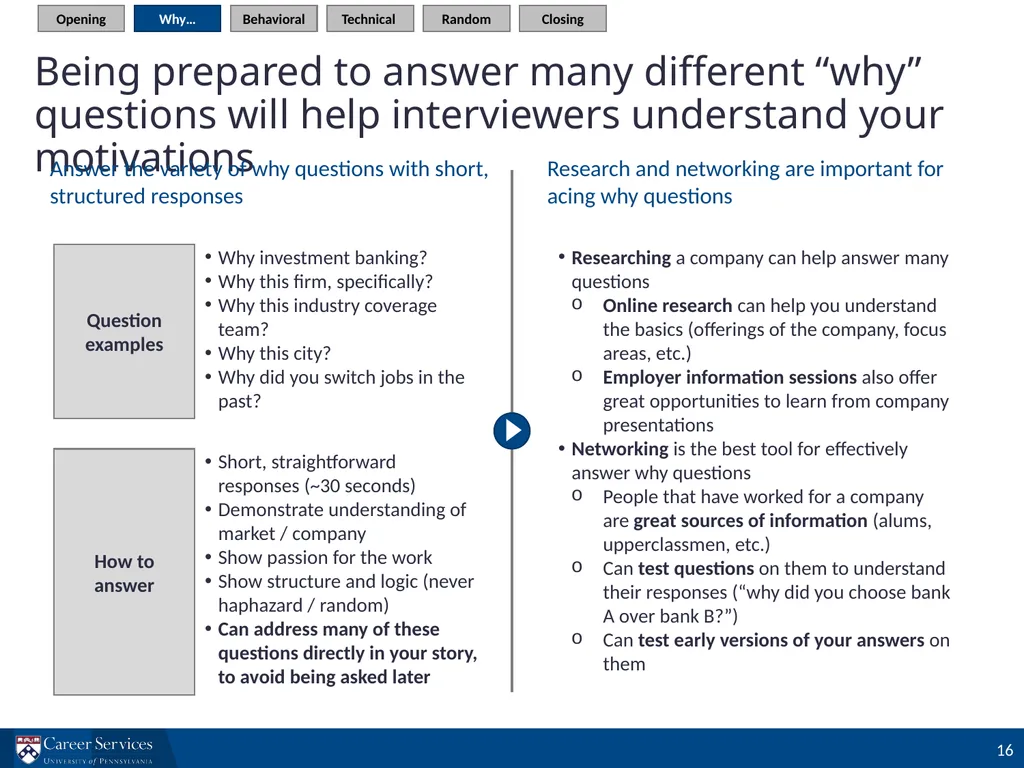
Being prepared to answer many different “why” questions will help interviewers understand your motivations 16 Opening Behavioral Technical Random Closing Why… Question examples Answer the variety of why questions with short, structured responses Research and networking are important for acing why questions How to answer Short, straightforward responses (~30 seconds)
Demonstrate understanding of market / company
Show passion for the work
Show structure and logic (never haphazard / random)
Can address many of these questions directly in your story, to avoid being asked later Why investment banking?
Why this firm, specifically?
Why this industry coverage team?
Why this city?
Why did you switch jobs in the past? Researching a company can help answer many questions
Online research can help you understand the basics (offerings of the company, focus areas, etc.)
Employer information sessions also offer great opportunities to learn from company presentations
Networking is the best tool for effectively answer why questions
People that have worked for a company are great sources of information (alums, upperclassmen, etc.)
Can test questions on them to understand their responses (“why did you choose bank A over bank B?”)
Can test early versions of your answers on them<br>
Demonstrate understanding of market / company
Show passion for the work
Show structure and logic (never haphazard / random)
Can address many of these questions directly in your story, to avoid being asked later Why investment banking?
Why this firm, specifically?
Why this industry coverage team?
Why this city?
Why did you switch jobs in the past? Researching a company can help answer many questions
Online research can help you understand the basics (offerings of the company, focus areas, etc.)
Employer information sessions also offer great opportunities to learn from company presentations
Networking is the best tool for effectively answer why questions
People that have worked for a company are great sources of information (alums, upperclassmen, etc.)
Can test questions on them to understand their responses (“why did you choose bank A over bank B?”)
Can test early versions of your answers on them<br>
17
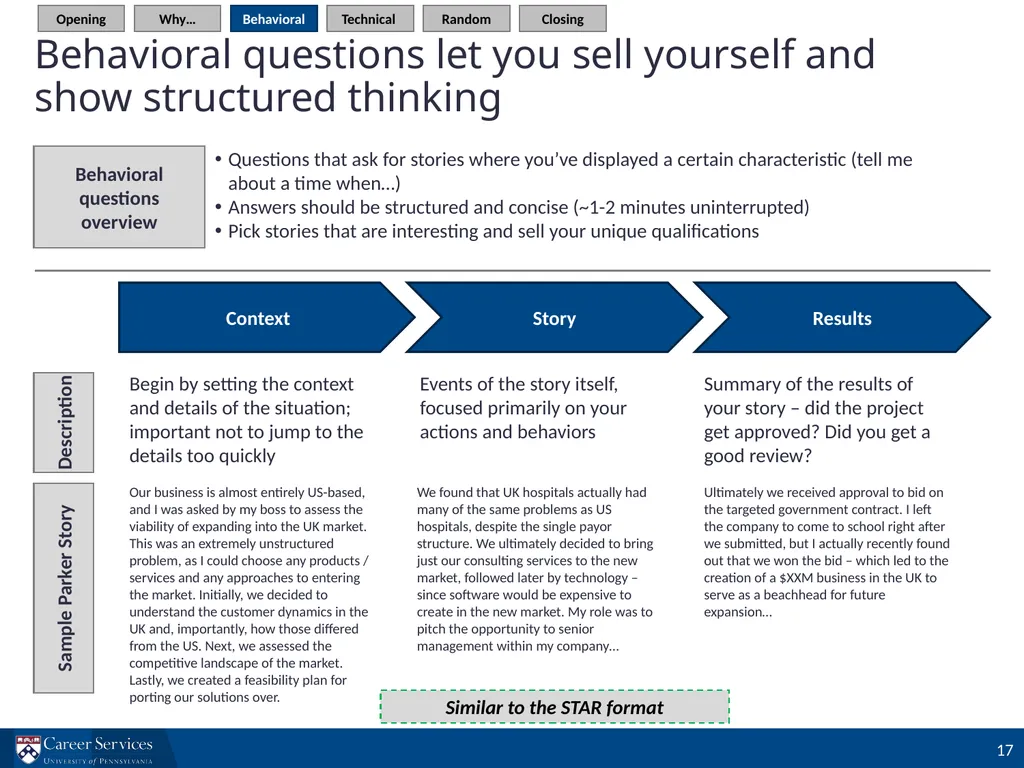
Behavioral questions let you sell yourself and show structured thinking 17 Opening Behavioral Technical Random Closing Why… Behavioral questions overview Questions that ask for stories where you’ve displayed a certain characteristic (tell me about a time when…)
Answers should be structured and concise (~1-2 minutes uninterrupted)
Pick stories that are interesting and sell your unique qualifications Context Story Results Description Sample Parker Story Begin by setting the context and details of the situation; important not to jump to the details too quickly Events of the story itself, focused primarily on your actions and behaviors Summary of the results of your story – did the project get approved? Did you get a good review? Our business is almost entirely US-based, and I was asked by my boss to assess the viability of expanding into the UK market. This was an extremely unstructured problem, as I could choose any products / services and any approaches to entering the market. Initially, we decided to understand the customer dynamics in the UK and, importantly, how those differed from the US. Next, we assessed the competitive landscape of the market. Lastly, we created a feasibility plan for porting our solutions over. We found that UK hospitals actually had many of the same problems as US hospitals, despite the single payor structure. We ultimately decided to bring just our consulting services to the new market, followed later by technology – since software would be expensive to create in the new market. My role was to pitch the opportunity to senior management within my company… Ultimately we received approval to bid on the targeted government contract. I left the company to come to school right after we submitted, but I actually recently found out that we won the bid – which led to the creation of a $XXM business in the UK to serve as a beachhead for future expansion… Similar to the STAR format<br>
Answers should be structured and concise (~1-2 minutes uninterrupted)
Pick stories that are interesting and sell your unique qualifications Context Story Results Description Sample Parker Story Begin by setting the context and details of the situation; important not to jump to the details too quickly Events of the story itself, focused primarily on your actions and behaviors Summary of the results of your story – did the project get approved? Did you get a good review? Our business is almost entirely US-based, and I was asked by my boss to assess the viability of expanding into the UK market. This was an extremely unstructured problem, as I could choose any products / services and any approaches to entering the market. Initially, we decided to understand the customer dynamics in the UK and, importantly, how those differed from the US. Next, we assessed the competitive landscape of the market. Lastly, we created a feasibility plan for porting our solutions over. We found that UK hospitals actually had many of the same problems as US hospitals, despite the single payor structure. We ultimately decided to bring just our consulting services to the new market, followed later by technology – since software would be expensive to create in the new market. My role was to pitch the opportunity to senior management within my company… Ultimately we received approval to bid on the targeted government contract. I left the company to come to school right after we submitted, but I actually recently found out that we won the bid – which led to the creation of a $XXM business in the UK to serve as a beachhead for future expansion… Similar to the STAR format<br>
18
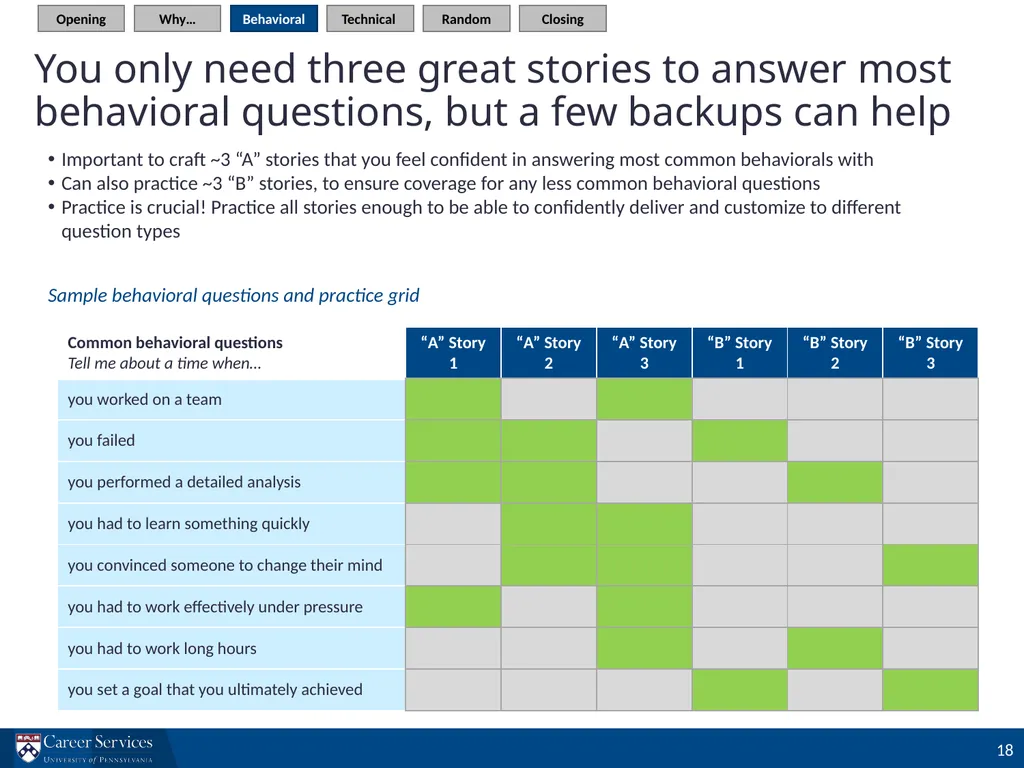
You only need three great stories to answer most behavioral questions, but a few backups can help 18 Opening Behavioral Technical Random Closing Why… Important to craft ~3 “A” stories that you feel confident in answering most common behaviorals with
Can also practice ~3 “B” stories, to ensure coverage for any less common behavioral questions
Practice is crucial! Practice all stories enough to be able to confidently deliver and customize to different question types Sample behavioral questions and practice grid<br>
Can also practice ~3 “B” stories, to ensure coverage for any less common behavioral questions
Practice is crucial! Practice all stories enough to be able to confidently deliver and customize to different question types Sample behavioral questions and practice grid<br>
19
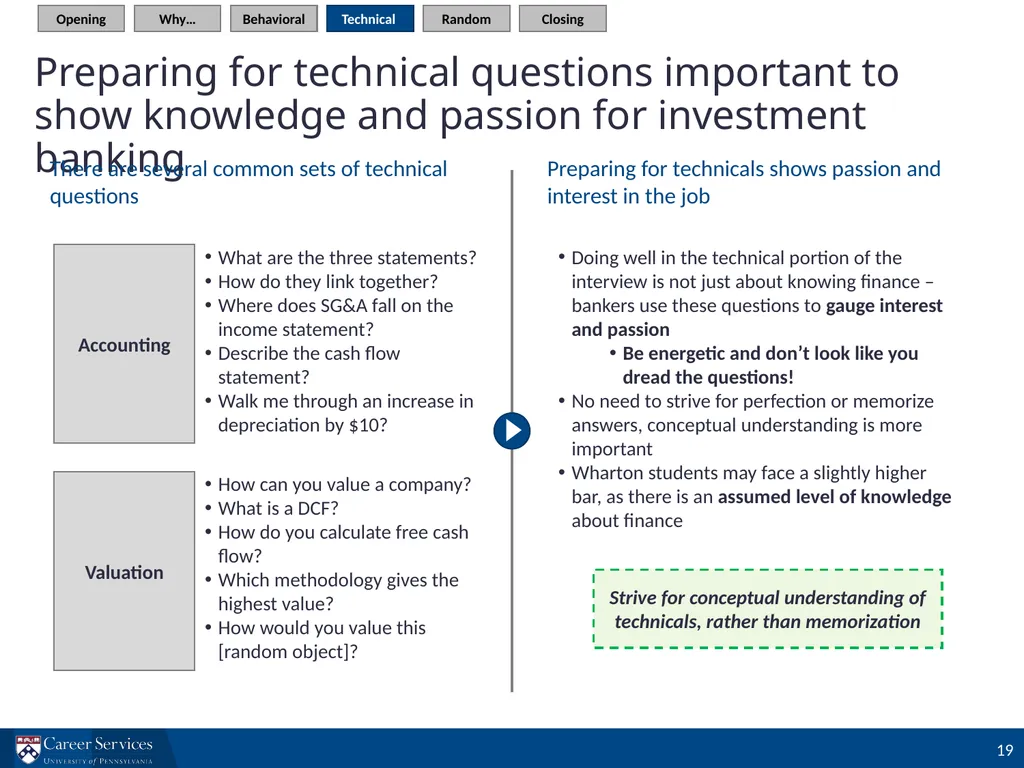
Preparing for technical questions important to show knowledge and passion for investment banking 19 Opening Behavioral Technical Random Closing Why… Accounting There are several common sets of technical questions Preparing for technicals shows passion and interest in the job What are the three statements?
How do they link together?
Where does SG&A fall on the income statement?
Describe the cash flow statement?
Walk me through an increase in depreciation by $10? Doing well in the technical portion of the interview is not just about knowing finance – bankers use these questions to gauge interest and passion
Be energetic and don’t look like you dread the questions!
No need to strive for perfection or memorize answers, conceptual understanding is more important
Wharton students may face a slightly higher bar, as there is an assumed level of knowledge about finance Valuation Strive for conceptual understanding of technicals, rather than memorization How can you value a company?
What is a DCF?
How do you calculate free cash flow?
Which methodology gives the highest value?
How would you value this [random object]?<br>
How do they link together?
Where does SG&A fall on the income statement?
Describe the cash flow statement?
Walk me through an increase in depreciation by $10? Doing well in the technical portion of the interview is not just about knowing finance – bankers use these questions to gauge interest and passion
Be energetic and don’t look like you dread the questions!
No need to strive for perfection or memorize answers, conceptual understanding is more important
Wharton students may face a slightly higher bar, as there is an assumed level of knowledge about finance Valuation Strive for conceptual understanding of technicals, rather than memorization How can you value a company?
What is a DCF?
How do you calculate free cash flow?
Which methodology gives the highest value?
How would you value this [random object]?<br>
20
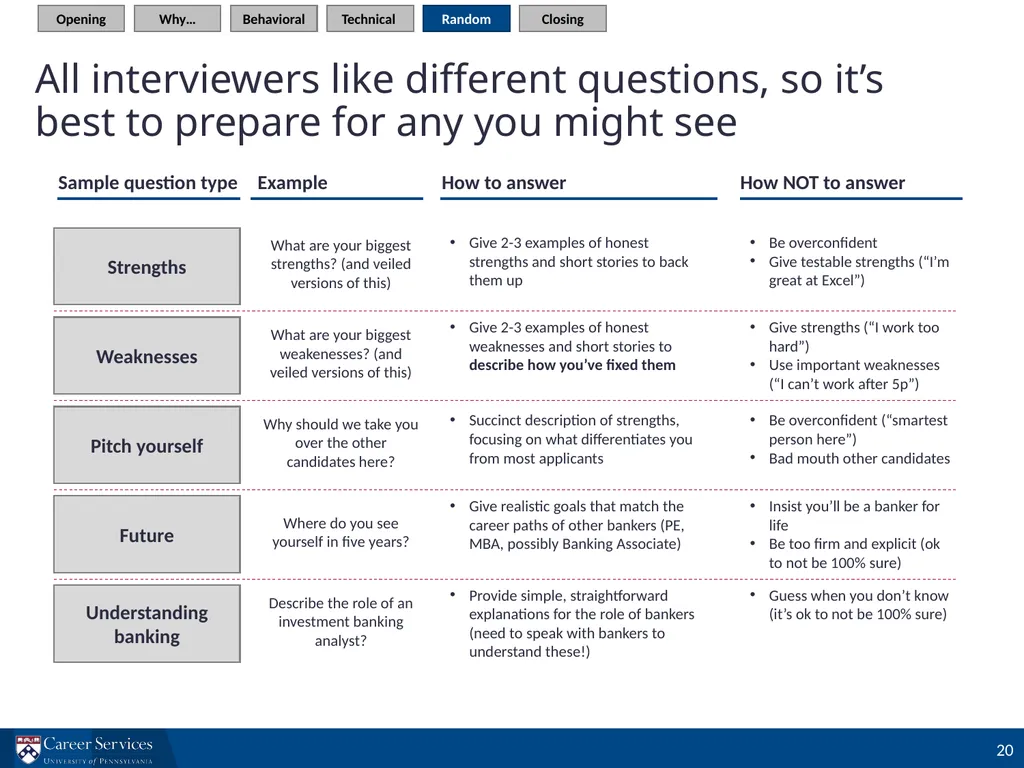
How to answer How NOT to answer All interviewers like different questions, so it’s best to prepare for any you might see 20 Opening Behavioral Technical Random Closing Why… Sample question type Strengths Weaknesses Pitch yourself Future Example Understanding banking What are your biggest strengths? (and veiled versions of this) What are your biggest weakenesses? (and veiled versions of this) Why should we take you over the other candidates here? Where do you see yourself in five years? Describe the role of an investment banking analyst? Give 2-3 examples of honest strengths and short stories to back them up Be overconfident
Give testable strengths (“I’m great at Excel”) Give 2-3 examples of honest weaknesses and short stories to describe how you’ve fixed them Give strengths (“I work too hard”)
Use important weaknesses (“I can’t work after 5p”) Succinct description of strengths, focusing on what differentiates you from most applicants Be overconfident (“smartest person here”)
Bad mouth other candidates Give realistic goals that match the career paths of other bankers (PE, MBA, possibly Banking Associate) Insist you’ll be a banker for life
Be too firm and explicit (ok to not be 100% sure) Provide simple, straightforward explanations for the role of bankers (need to speak with bankers to understand these!) Guess when you don’t know (it’s ok to not be 100% sure)<br>
Give testable strengths (“I’m great at Excel”) Give 2-3 examples of honest weaknesses and short stories to describe how you’ve fixed them Give strengths (“I work too hard”)
Use important weaknesses (“I can’t work after 5p”) Succinct description of strengths, focusing on what differentiates you from most applicants Be overconfident (“smartest person here”)
Bad mouth other candidates Give realistic goals that match the career paths of other bankers (PE, MBA, possibly Banking Associate) Insist you’ll be a banker for life
Be too firm and explicit (ok to not be 100% sure) Provide simple, straightforward explanations for the role of bankers (need to speak with bankers to understand these!) Guess when you don’t know (it’s ok to not be 100% sure)<br>
21
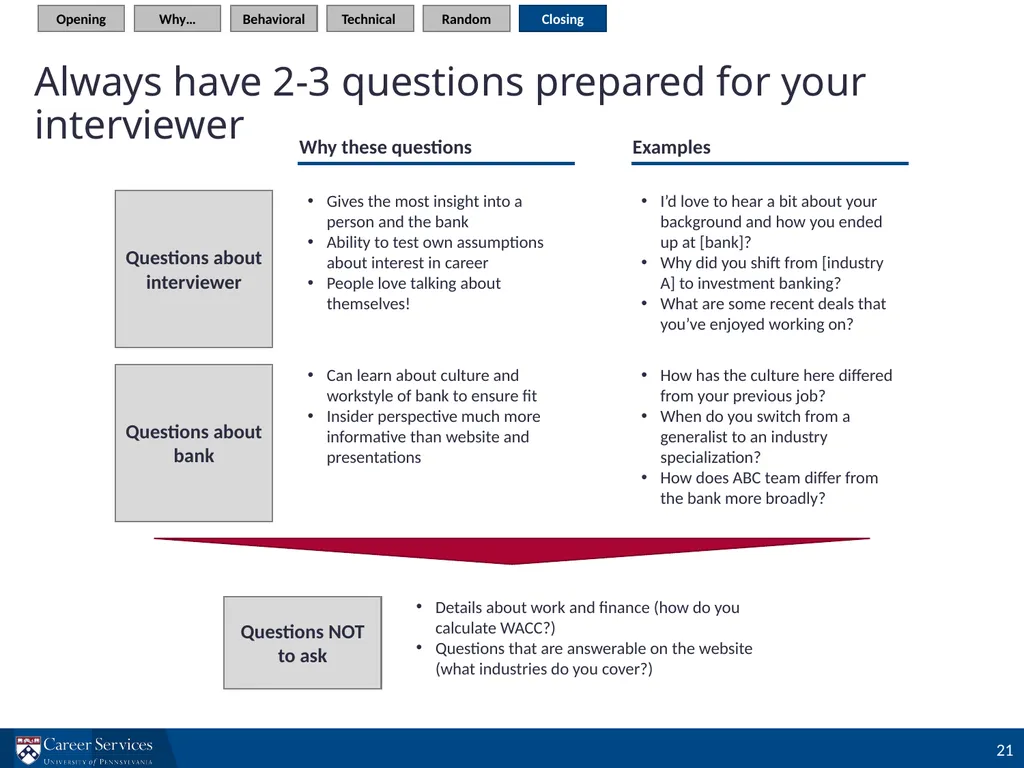
Always have 2-3 questions prepared for your interviewer 21 Opening Behavioral Technical Random Closing Why… Questions about interviewer Why these questions Examples Questions about bank Gives the most insight into a person and the bank
Ability to test own assumptions about interest in career
People love talking about themselves! I’d love to hear a bit about your background and how you ended up at [bank]?
Why did you shift from [industry A] to investment banking?
What are some recent deals that you’ve enjoyed working on? Can learn about culture and workstyle of bank to ensure fit
Insider perspective much more informative than website and presentations How has the culture here differed from your previous job?
When do you switch from a generalist to an industry specialization?
How does ABC team differ from the bank more broadly? Questions NOT to ask Details about work and finance (how do you calculate WACC?)
Questions that are answerable on the website (what industries do you cover?)<br>
Ability to test own assumptions about interest in career
People love talking about themselves! I’d love to hear a bit about your background and how you ended up at [bank]?
Why did you shift from [industry A] to investment banking?
What are some recent deals that you’ve enjoyed working on? Can learn about culture and workstyle of bank to ensure fit
Insider perspective much more informative than website and presentations How has the culture here differed from your previous job?
When do you switch from a generalist to an industry specialization?
How does ABC team differ from the bank more broadly? Questions NOT to ask Details about work and finance (how do you calculate WACC?)
Questions that are answerable on the website (what industries do you cover?)<br>
22
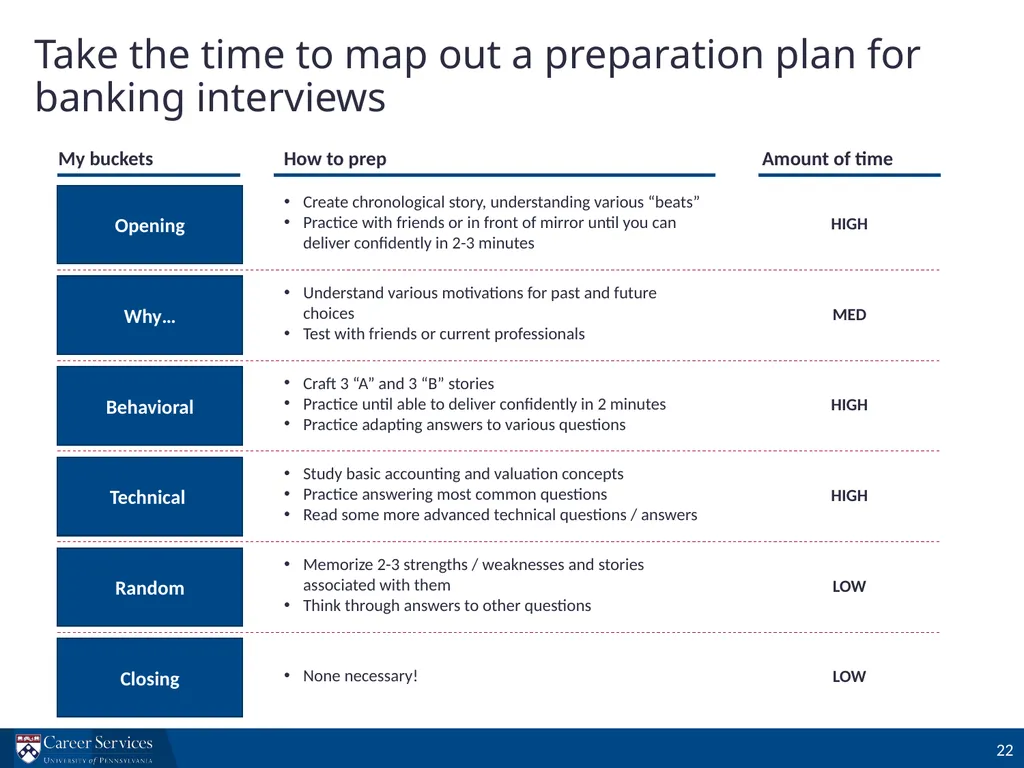
Take the time to map out a preparation plan for banking interviews 22 My buckets How to prep Amount of time Opening Behavioral Technical Random Closing Why… HIGH MED HIGH HIGH LOW LOW Create chronological story, understanding various “beats”
Practice with friends or in front of mirror until you can deliver confidently in 2-3 minutes Understand various motivations for past and future choices
Test with friends or current professionals Craft 3 “A” and 3 “B” stories
Practice until able to deliver confidently in 2 minutes
Practice adapting answers to various questions Study basic accounting and valuation concepts
Practice answering most common questions
Read some more advanced technical questions / answers Memorize 2-3 strengths / weaknesses and stories associated with them
Think through answers to other questions None necessary!<br>
Practice with friends or in front of mirror until you can deliver confidently in 2-3 minutes Understand various motivations for past and future choices
Test with friends or current professionals Craft 3 “A” and 3 “B” stories
Practice until able to deliver confidently in 2 minutes
Practice adapting answers to various questions Study basic accounting and valuation concepts
Practice answering most common questions
Read some more advanced technical questions / answers Memorize 2-3 strengths / weaknesses and stories associated with them
Think through answers to other questions None necessary!<br>
23
Presentation Topics: 23 Overview of banking interviews
Format and strategies to ace the interview
Other resources<br>
Format and strategies to ace the interview
Other resources<br>
24
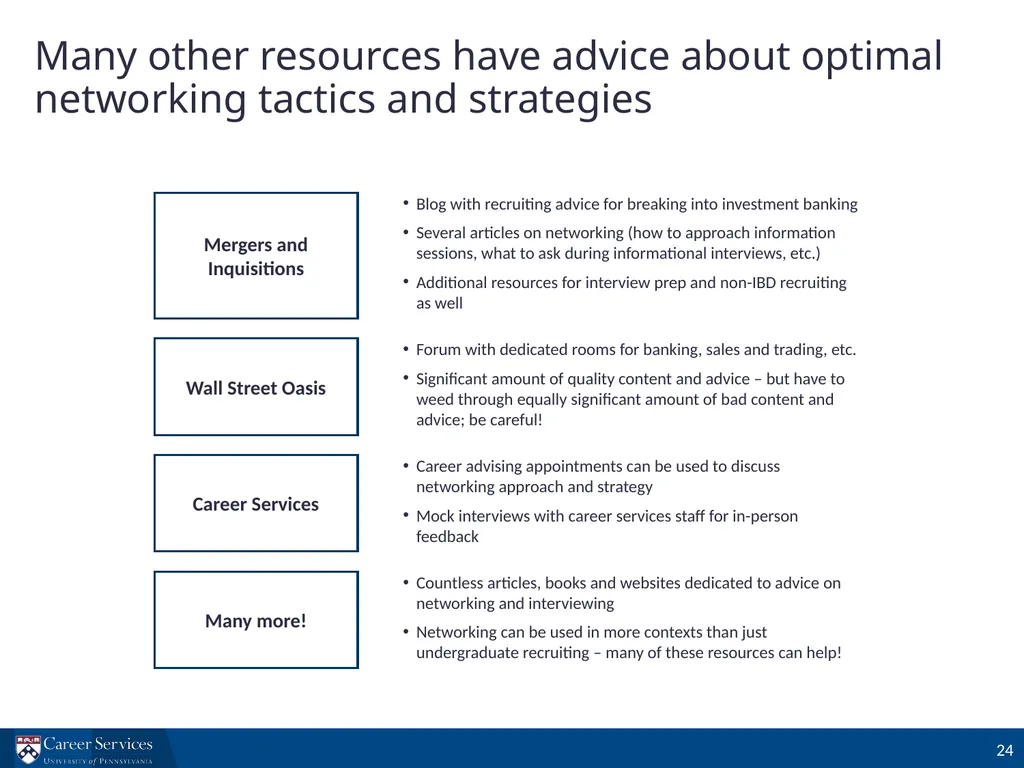
Many other resources have advice about optimal networking tactics and strategies 24 Mergers and Inquisitions Blog with recruiting advice for breaking into investment banking
Several articles on networking (how to approach information sessions, what to ask during informational interviews, etc.)
Additional resources for interview prep and non-IBD recruiting as well Wall Street Oasis Forum with dedicated rooms for banking, sales and trading, etc.
Significant amount of quality content and advice – but have to weed through equally significant amount of bad content and advice; be careful! Career Services Career advising appointments can be used to discuss networking approach and strategy
Mock interviews with career services staff for in-person feedback Many more! Countless articles, books and websites dedicated to advice on networking and interviewing
Networking can be used in more contexts than just undergraduate recruiting – many of these resources can help!<br>
Several articles on networking (how to approach information sessions, what to ask during informational interviews, etc.)
Additional resources for interview prep and non-IBD recruiting as well Wall Street Oasis Forum with dedicated rooms for banking, sales and trading, etc.
Significant amount of quality content and advice – but have to weed through equally significant amount of bad content and advice; be careful! Career Services Career advising appointments can be used to discuss networking approach and strategy
Mock interviews with career services staff for in-person feedback Many more! Countless articles, books and websites dedicated to advice on networking and interviewing
Networking can be used in more contexts than just undergraduate recruiting – many of these resources can help!<br>
25
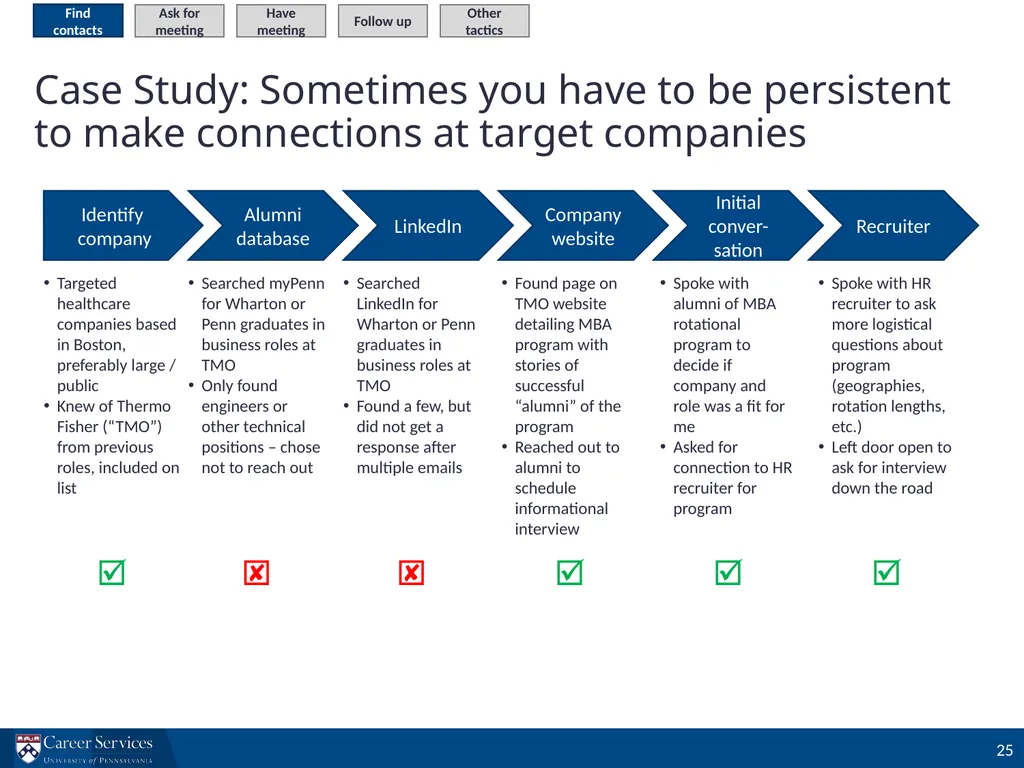
Case Study: Sometimes you have to be persistent to make connections at target companies 25 Identify
company Alumni database LinkedIn Company website Initial conver-sation Recruiter Targeted healthcare companies based in Boston, preferably large / public
Knew of Thermo Fisher (“TMO”) from previous roles, included on list Searched myPenn for Wharton or Penn graduates in business roles at TMO
Only found engineers or other technical positions – chose not to reach out Searched LinkedIn for Wharton or Penn graduates in business roles at TMO
Found a few, but did not get a response after multiple emails Found page on TMO website detailing MBA program with stories of successful “alumni” of the program
Reached out to alumni to schedule informational interview Spoke with alumni of MBA rotational program to decide if company and role was a fit for me
Asked for connection to HR recruiter for program Spoke with HR recruiter to ask more logistical questions about program (geographies, rotation lengths, etc.)
Left door open to ask for interview down the road Find contacts Ask for meeting Have meeting Follow up Other tactics <br>
Knew of Thermo Fisher (“TMO”) from previous roles, included on list Searched myPenn for Wharton or Penn graduates in business roles at TMO
Only found engineers or other technical positions – chose not to reach out Searched LinkedIn for Wharton or Penn graduates in business roles at TMO
Found a few, but did not get a response after multiple emails Found page on TMO website detailing MBA program with stories of successful “alumni” of the program
Reached out to alumni to schedule informational interview Spoke with alumni of MBA rotational program to decide if company and role was a fit for me
Asked for connection to HR recruiter for program Spoke with HR recruiter to ask more logistical questions about program (geographies, rotation lengths, etc.)
Left door open to ask for interview down the road Find contacts Ask for meeting Have meeting Follow up Other tactics <br>
26
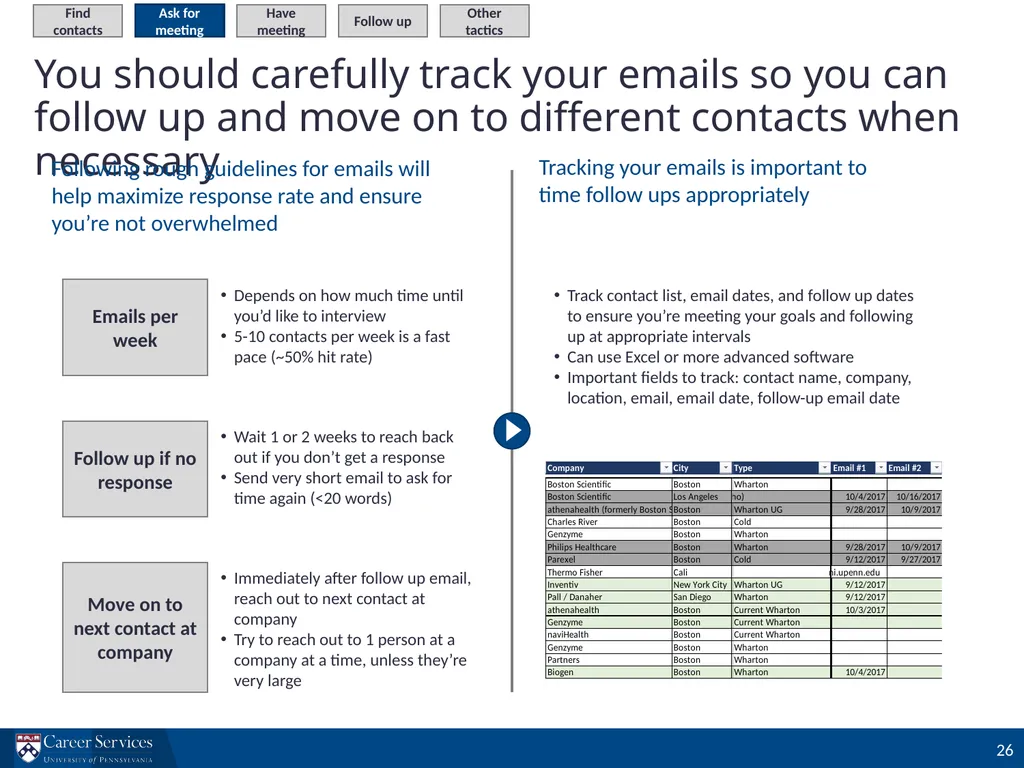
You should carefully track your emails so you can follow up and move on to different contacts when necessary 26 Find contacts Ask for meeting Have meeting Follow up Other tactics Emails per week Follow up if no response Move on to next contact at company Following rough guidelines for emails will help maximize response rate and ensure you’re not overwhelmed Tracking your emails is important to time follow ups appropriately Depends on how much time until you’d like to interview
5-10 contacts per week is a fast pace (~50% hit rate) Wait 1 or 2 weeks to reach back out if you don’t get a response
Send very short email to ask for time again (<20 words) Immediately after follow up email, reach out to next contact at company
Try to reach out to 1 person at a company at a time, unless they’re very large Track contact list, email dates, and follow up dates to ensure you’re meeting your goals and following up at appropriate intervals
Can use Excel or more advanced software
Important fields to track: contact name, company, location, email, email date, follow-up email date<br>
5-10 contacts per week is a fast pace (~50% hit rate) Wait 1 or 2 weeks to reach back out if you don’t get a response
Send very short email to ask for time again (<20 words) Immediately after follow up email, reach out to next contact at company
Try to reach out to 1 person at a company at a time, unless they’re very large Track contact list, email dates, and follow up dates to ensure you’re meeting your goals and following up at appropriate intervals
Can use Excel or more advanced software
Important fields to track: contact name, company, location, email, email date, follow-up email date<br>
27
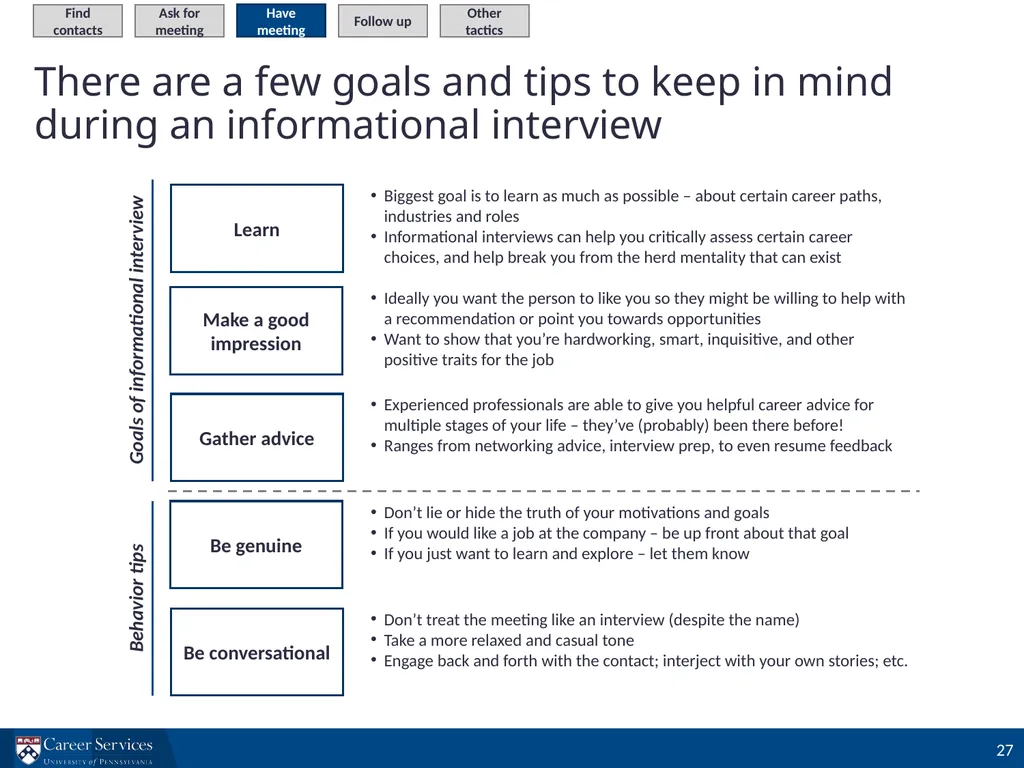
There are a few goals and tips to keep in mind during an informational interview 27 Find contacts Ask for meeting Have meeting Follow up Other tactics Make a good impression Be conversational Be genuine Learn Gather advice Goals of informational interview Behavior tips Ideally you want the person to like you so they might be willing to help with a recommendation or point you towards opportunities
Want to show that you’re hardworking, smart, inquisitive, and other positive traits for the job Biggest goal is to learn as much as possible – about certain career paths, industries and roles
Informational interviews can help you critically assess certain career choices, and help break you from the herd mentality that can exist Experienced professionals are able to give you helpful career advice for multiple stages of your life – they’ve (probably) been there before!
Ranges from networking advice, interview prep, to even resume feedback Don’t lie or hide the truth of your motivations and goals
If you would like a job at the company – be up front about that goal
If you just want to learn and explore – let them know Don’t treat the meeting like an interview (despite the name)
Take a more relaxed and casual tone
Engage back and forth with the contact; interject with your own stories; etc.<br>
Want to show that you’re hardworking, smart, inquisitive, and other positive traits for the job Biggest goal is to learn as much as possible – about certain career paths, industries and roles
Informational interviews can help you critically assess certain career choices, and help break you from the herd mentality that can exist Experienced professionals are able to give you helpful career advice for multiple stages of your life – they’ve (probably) been there before!
Ranges from networking advice, interview prep, to even resume feedback Don’t lie or hide the truth of your motivations and goals
If you would like a job at the company – be up front about that goal
If you just want to learn and explore – let them know Don’t treat the meeting like an interview (despite the name)
Take a more relaxed and casual tone
Engage back and forth with the contact; interject with your own stories; etc.<br>
28
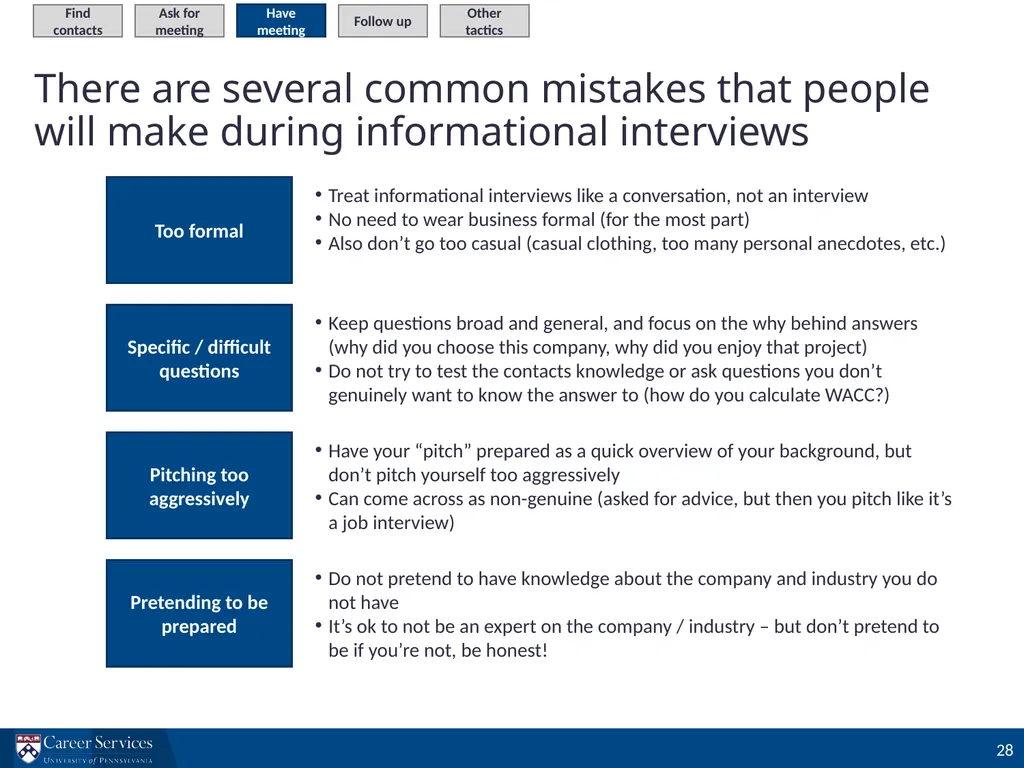
There are several common mistakes that people will make during informational interviews 28 Find contacts Ask for meeting Have meeting Follow up Other tactics Too formal Treat informational interviews like a conversation, not an interview
No need to wear business formal (for the most part)
Also don’t go too casual (casual clothing, too many personal anecdotes, etc.) Specific / difficult questions Pitching too aggressively Pretending to be prepared Keep questions broad and general, and focus on the why behind answers (why did you choose this company, why did you enjoy that project)
Do not try to test the contacts knowledge or ask questions you don’t genuinely want to know the answer to (how do you calculate WACC?) Have your “pitch” prepared as a quick overview of your background, but don’t pitch yourself too aggressively
Can come across as non-genuine (asked for advice, but then you pitch like it’s a job interview) Do not pretend to have knowledge about the company and industry you do not have
It’s ok to not be an expert on the company / industry – but don’t pretend to be if you’re not, be honest!<br>
No need to wear business formal (for the most part)
Also don’t go too casual (casual clothing, too many personal anecdotes, etc.) Specific / difficult questions Pitching too aggressively Pretending to be prepared Keep questions broad and general, and focus on the why behind answers (why did you choose this company, why did you enjoy that project)
Do not try to test the contacts knowledge or ask questions you don’t genuinely want to know the answer to (how do you calculate WACC?) Have your “pitch” prepared as a quick overview of your background, but don’t pitch yourself too aggressively
Can come across as non-genuine (asked for advice, but then you pitch like it’s a job interview) Do not pretend to have knowledge about the company and industry you do not have
It’s ok to not be an expert on the company / industry – but don’t pretend to be if you’re not, be honest!<br>
29
Penn also offers other resources for networking that students should take advantage of 29 Find contacts Ask for meeting Have meeting Follow up Other tactics Career fairs Coffee chats Similar to information sessions, career fairs offer the opportunity to learn a little about several different companies and develop contacts for informational interviews
Don’t spend too much time with any one employer
Do collect business cards and reach out to people after the event Penn offers opportunity to sign up for 1-on-1 or 2-on-1 coffee chats
Operate exactly like informational interviews, offering you a great opportunity to make a good impression, learn about the company / industry, and get career advice
Sign up for as many as possible! Great opportunities to expand your network<br>
Don’t spend too much time with any one employer
Do collect business cards and reach out to people after the event Penn offers opportunity to sign up for 1-on-1 or 2-on-1 coffee chats
Operate exactly like informational interviews, offering you a great opportunity to make a good impression, learn about the company / industry, and get career advice
Sign up for as many as possible! Great opportunities to expand your network<br>