
Item types Assessing item quality ELA Item TYPES 4
DP
Published · 31 slides · 0 views

1 / 1


Description
Item types Assessing item quality ELA Item TYPES 4 building blocks Learning Progression Item Design OutcomesScoring Assessment Quality Classification of item types: Objective Performance based Item types (SBAC, 2012, pp. 27 32): Selected
Related Topics
Share
Embed code
Download this presentation From Below
"Item types Assessing item quality ELA Item TYPES 4" is the property of its rightful owner. Permission is granted to download and print the materials on this website for personal, non-commercial use only, and to display it on your personal computer provided you do not modify the materials and that you retain all copyright notices contained in the materials. By downloading content from our website, you accept the terms of this agreement.
Presentation Transcript
01
Item types
Assessing item quality ELA Item TYPES<br>
Assessing item quality ELA Item TYPES<br>
02
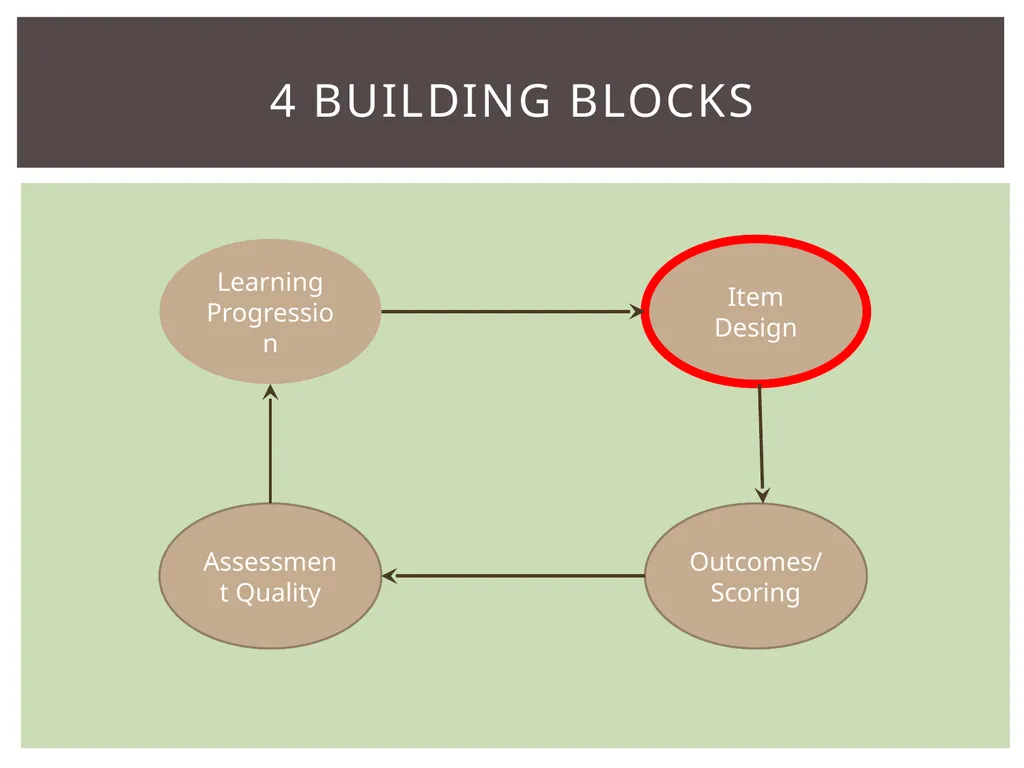
4 building blocks Learning Progression Item Design Outcomes/Scoring Assessment Quality<br>
03
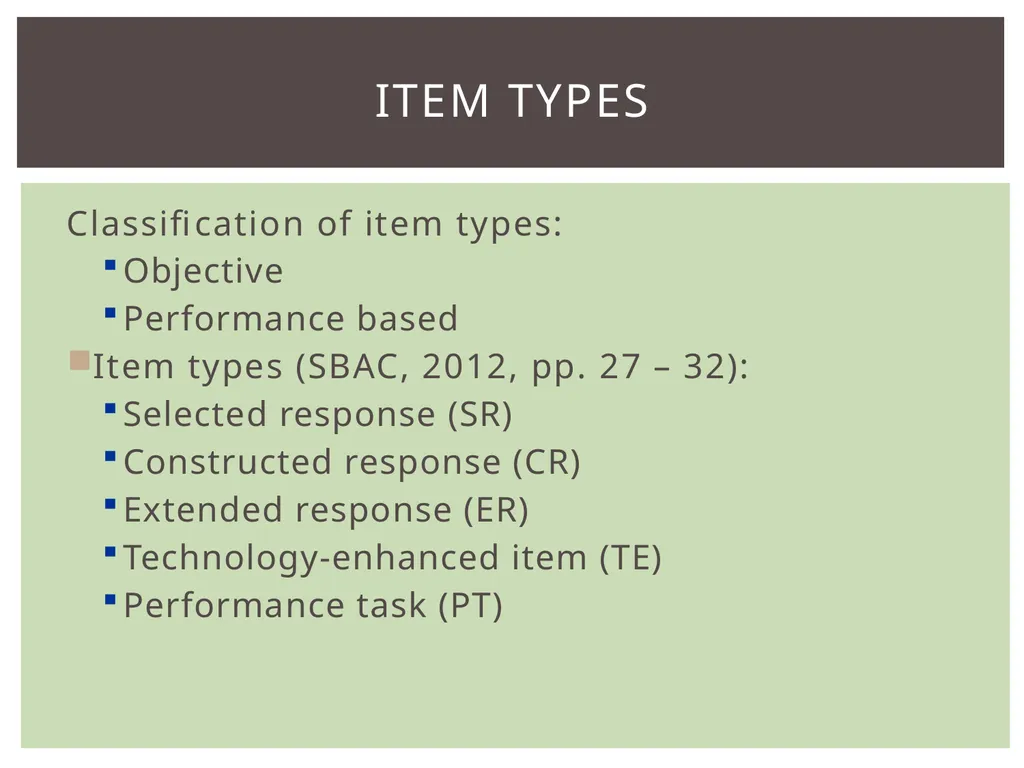
Classification of item types:
Objective
Performance based
Item types (SBAC, 2012, pp. 27 – 32):
Selected response (SR)
Constructed response (CR)
Extended response (ER)
Technology-enhanced item (TE)
Performance task (PT) Item types<br>
Objective
Performance based
Item types (SBAC, 2012, pp. 27 – 32):
Selected response (SR)
Constructed response (CR)
Extended response (ER)
Technology-enhanced item (TE)
Performance task (PT) Item types<br>
04
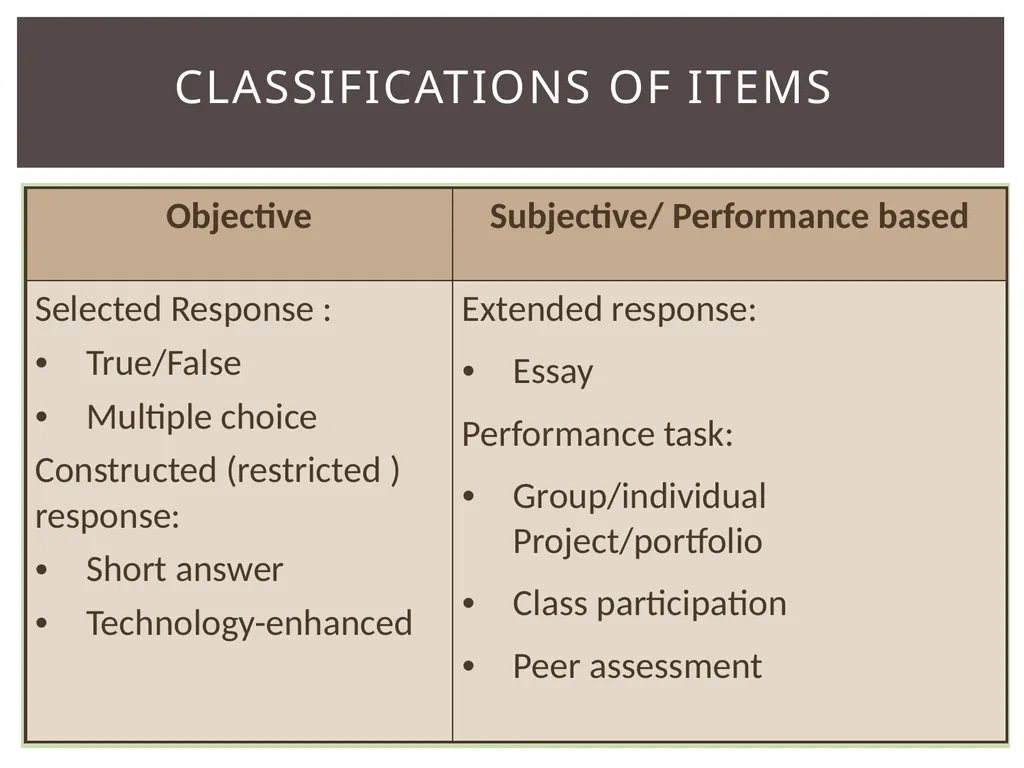
Classifications of items<br>
05
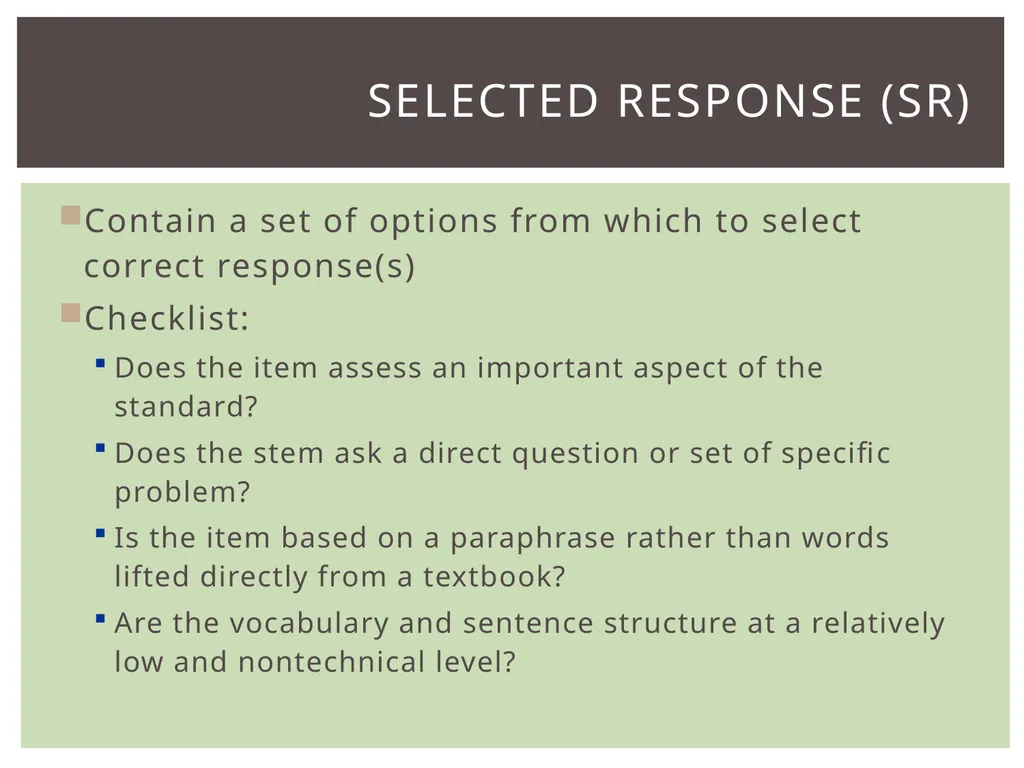
Contain a set of options from which to select correct response(s)
Checklist:
Does the item assess an important aspect of the standard?
Does the stem ask a direct question or set of specific problem?
Is the item based on a paraphrase rather than words lifted directly from a textbook?
Are the vocabulary and sentence structure at a relatively low and nontechnical level? Selected response (SR)<br>
Checklist:
Does the item assess an important aspect of the standard?
Does the stem ask a direct question or set of specific problem?
Is the item based on a paraphrase rather than words lifted directly from a textbook?
Are the vocabulary and sentence structure at a relatively low and nontechnical level? Selected response (SR)<br>
06
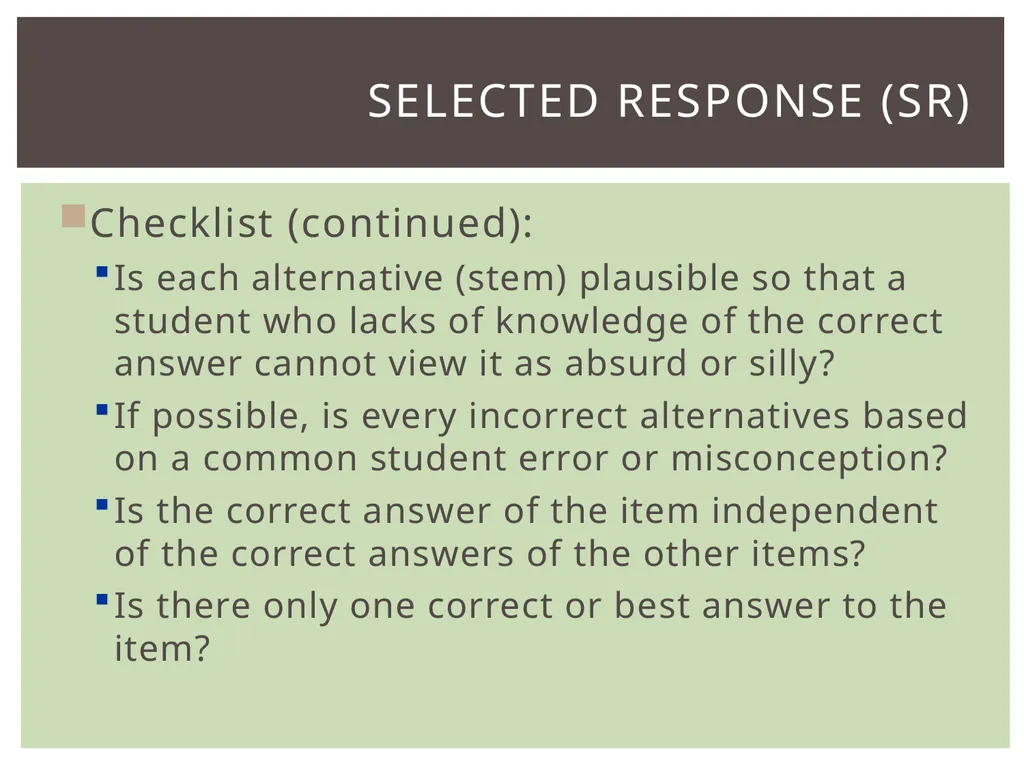
Checklist (continued):
Is each alternative (stem) plausible so that a student who lacks of knowledge of the correct answer cannot view it as absurd or silly?
If possible, is every incorrect alternatives based on a common student error or misconception?
Is the correct answer of the item independent of the correct answers of the other items?
Is there only one correct or best answer to the item? Selected response (SR)<br>
Is each alternative (stem) plausible so that a student who lacks of knowledge of the correct answer cannot view it as absurd or silly?
If possible, is every incorrect alternatives based on a common student error or misconception?
Is the correct answer of the item independent of the correct answers of the other items?
Is there only one correct or best answer to the item? Selected response (SR)<br>
07
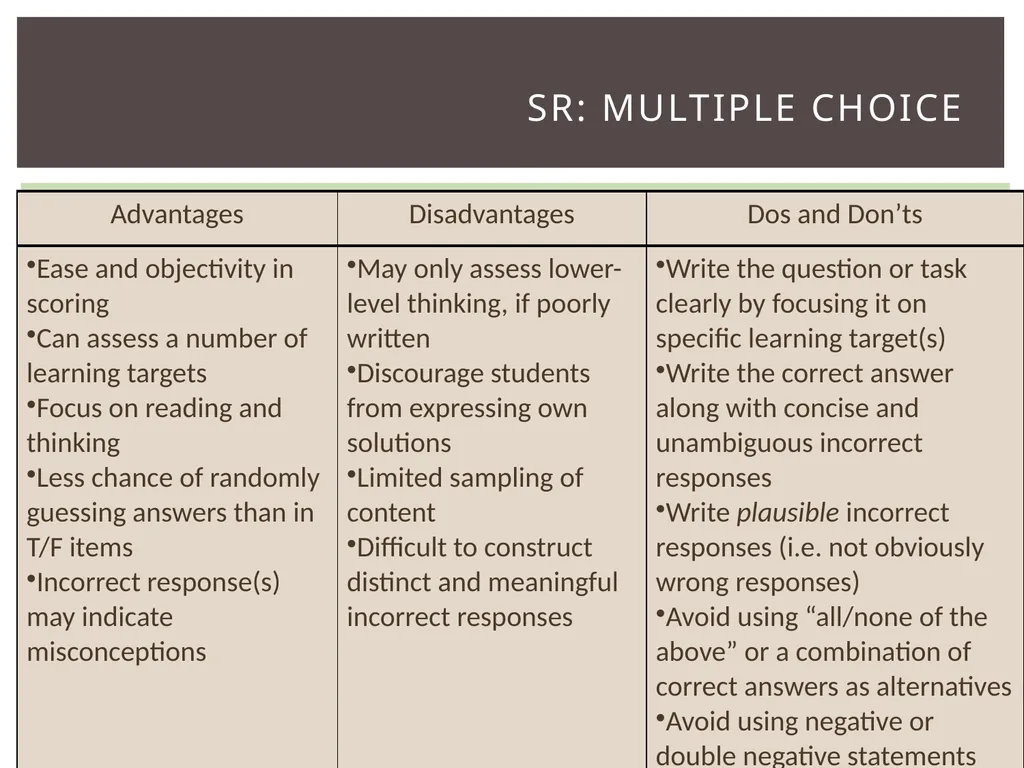
SR: Multiple choice<br>
08
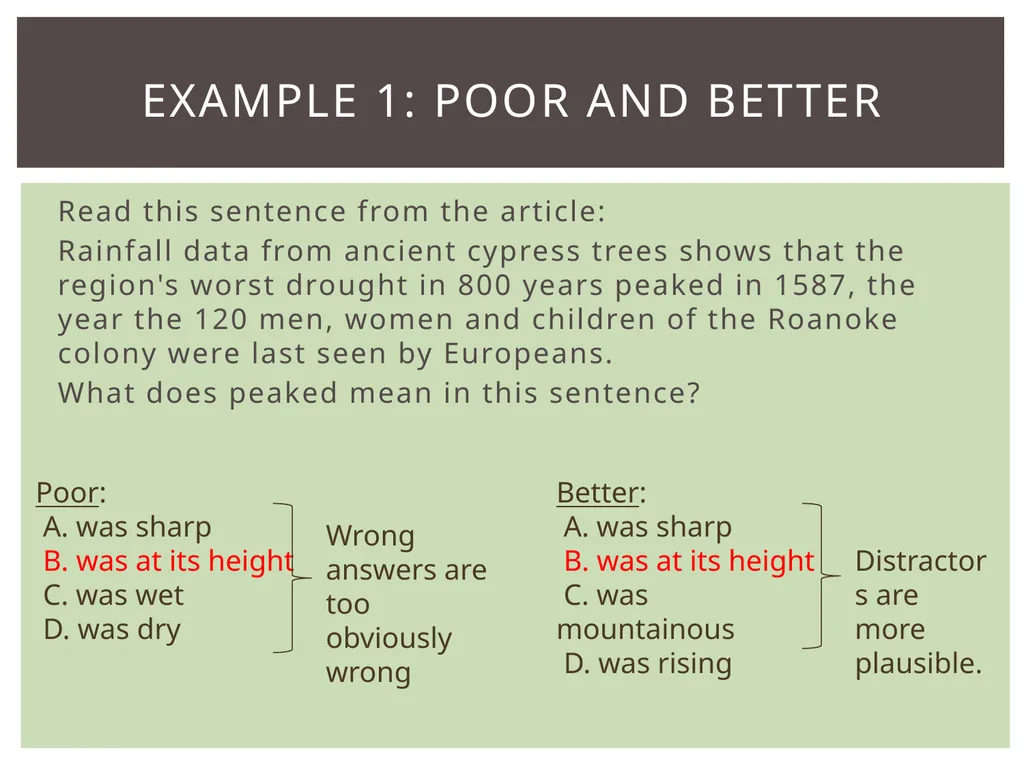
Example 1: Poor and better Read this sentence from the article:
Rainfall data from ancient cypress trees shows that the region's worst drought in 800 years peaked in 1587, the year the 120 men, women and children of the Roanoke colony were last seen by Europeans.
What does peaked mean in this sentence? Poor:
A. was sharp
B. was at its height
C. was wet
D. was dry Better:
A. was sharp
B. was at its height
C. was mountainous
D. was rising Wrong answers are too obviously wrong Distractors are more plausible.<br>
Rainfall data from ancient cypress trees shows that the region's worst drought in 800 years peaked in 1587, the year the 120 men, women and children of the Roanoke colony were last seen by Europeans.
What does peaked mean in this sentence? Poor:
A. was sharp
B. was at its height
C. was wet
D. was dry Better:
A. was sharp
B. was at its height
C. was mountainous
D. was rising Wrong answers are too obviously wrong Distractors are more plausible.<br>
09
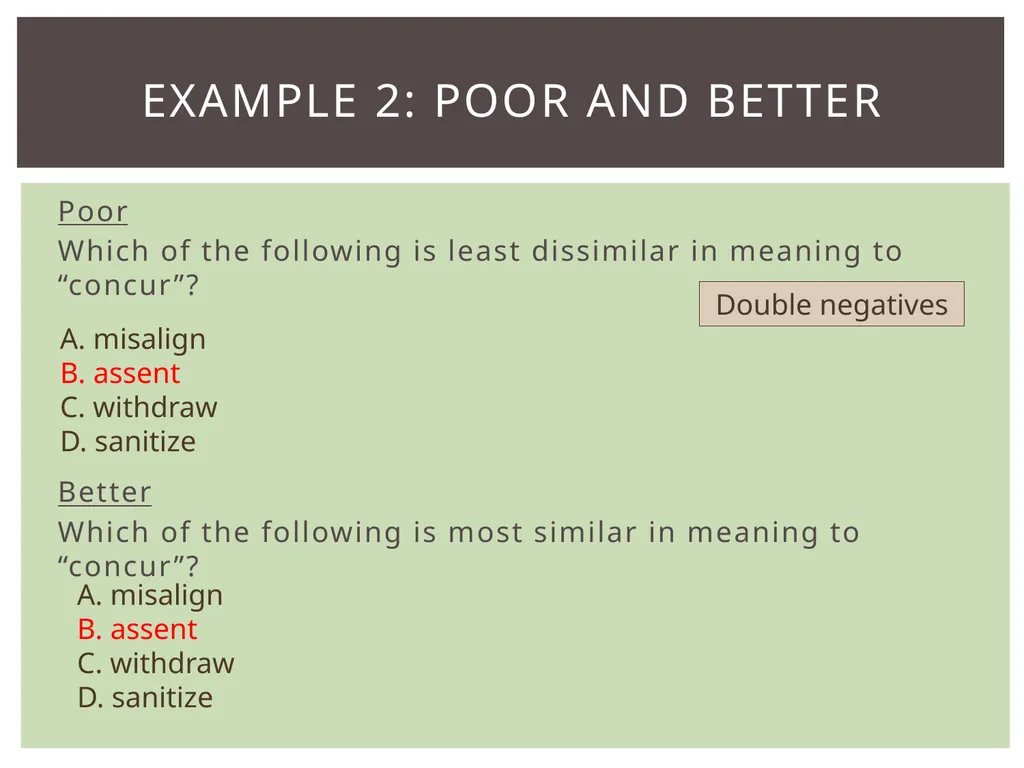
Example 2: Poor and better Poor
Which of the following is least dissimilar in meaning to “concur”?
Better
Which of the following is most similar in meaning to “concur”? A. misalign
B. assent
C. withdraw
D. sanitize Double negatives A. misalign
B. assent
C. withdraw
D. sanitize<br>
Which of the following is least dissimilar in meaning to “concur”?
Better
Which of the following is most similar in meaning to “concur”? A. misalign
B. assent
C. withdraw
D. sanitize Double negatives A. misalign
B. assent
C. withdraw
D. sanitize<br>
10
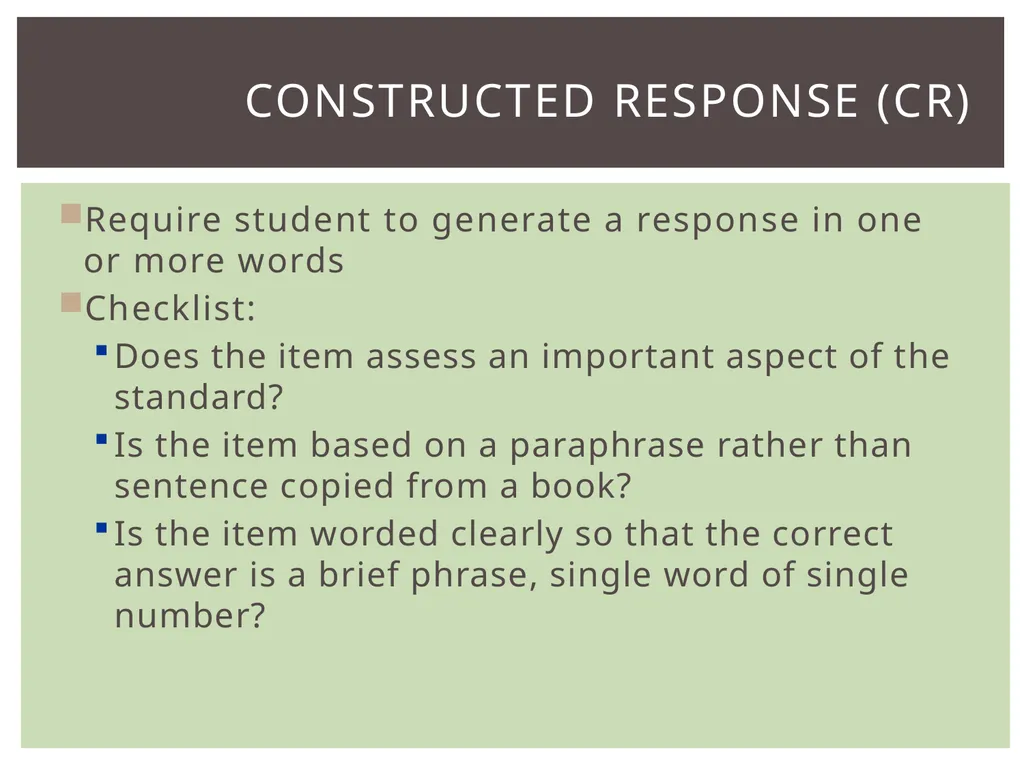
Require student to generate a response in one or more words
Checklist:
Does the item assess an important aspect of the standard?
Is the item based on a paraphrase rather than sentence copied from a book?
Is the item worded clearly so that the correct answer is a brief phrase, single word of single number? constructed response (cR)<br>
Checklist:
Does the item assess an important aspect of the standard?
Is the item based on a paraphrase rather than sentence copied from a book?
Is the item worded clearly so that the correct answer is a brief phrase, single word of single number? constructed response (cR)<br>
11
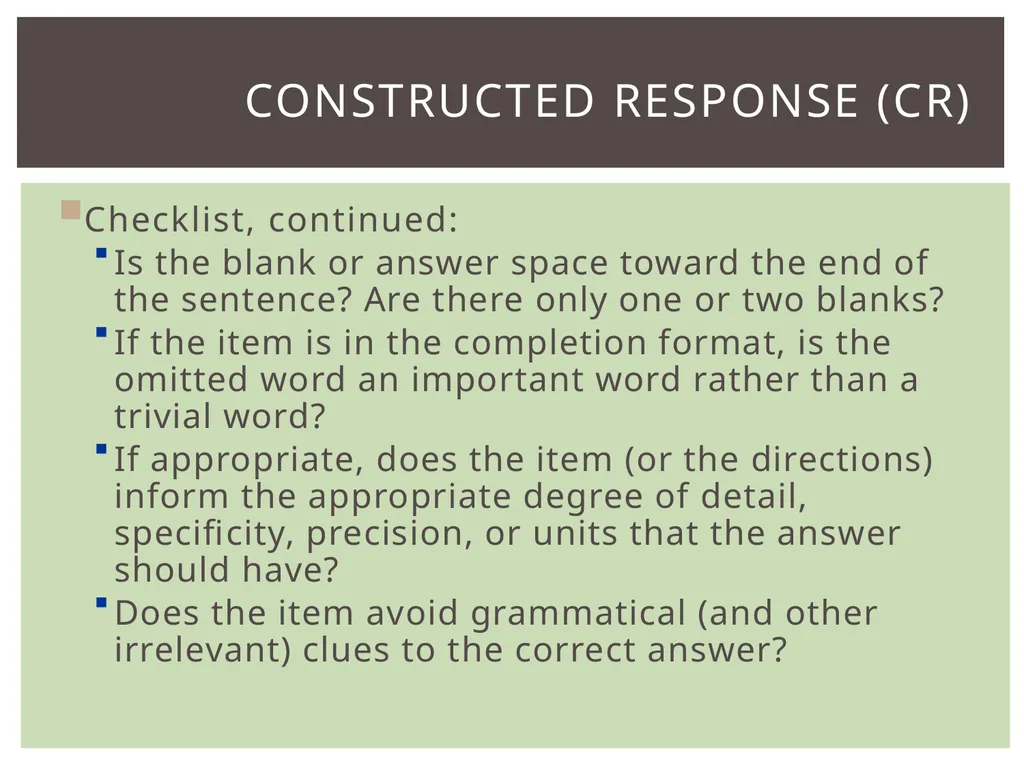
Checklist, continued:
Is the blank or answer space toward the end of the sentence? Are there only one or two blanks?
If the item is in the completion format, is the omitted word an important word rather than a trivial word?
If appropriate, does the item (or the directions) inform the appropriate degree of detail, specificity, precision, or units that the answer should have?
Does the item avoid grammatical (and other irrelevant) clues to the correct answer? constructed response (cR)<br>
Is the blank or answer space toward the end of the sentence? Are there only one or two blanks?
If the item is in the completion format, is the omitted word an important word rather than a trivial word?
If appropriate, does the item (or the directions) inform the appropriate degree of detail, specificity, precision, or units that the answer should have?
Does the item avoid grammatical (and other irrelevant) clues to the correct answer? constructed response (cR)<br>
12
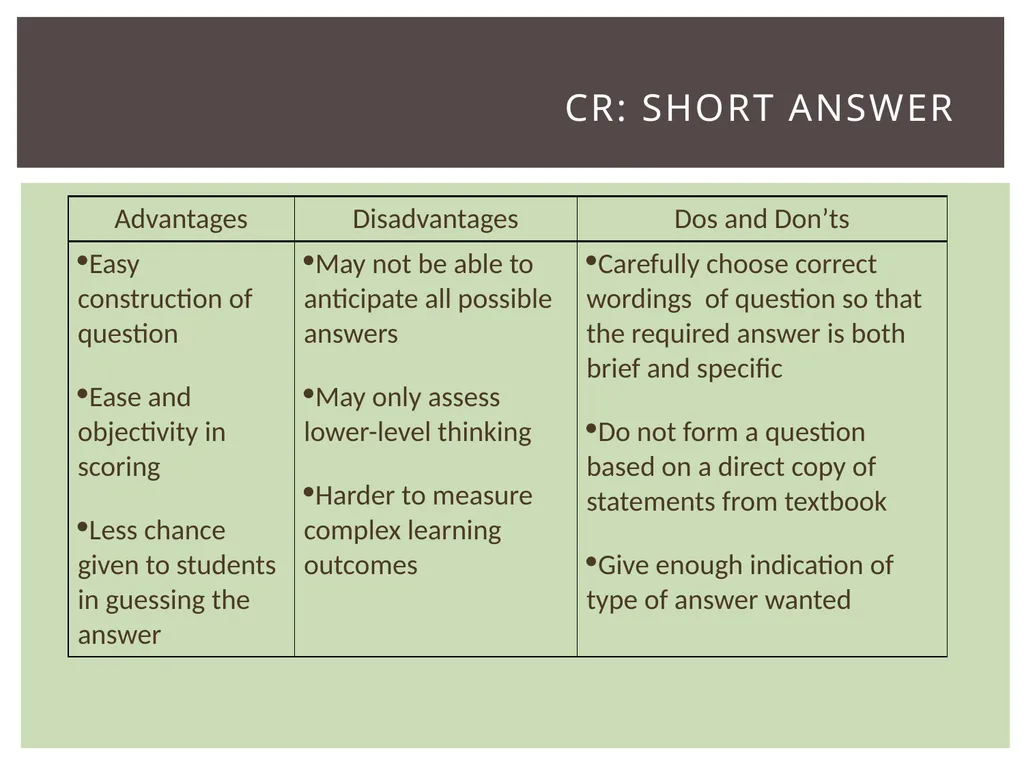
CR: Short answer<br>
13
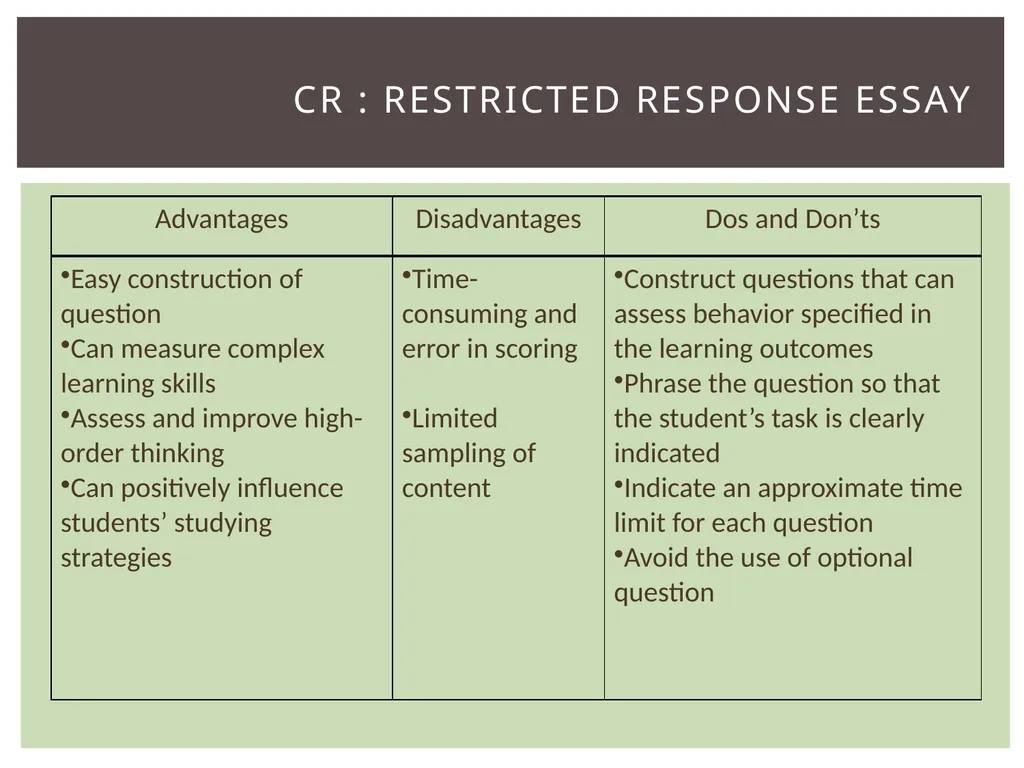
CR : Restricted response Essay<br>
14
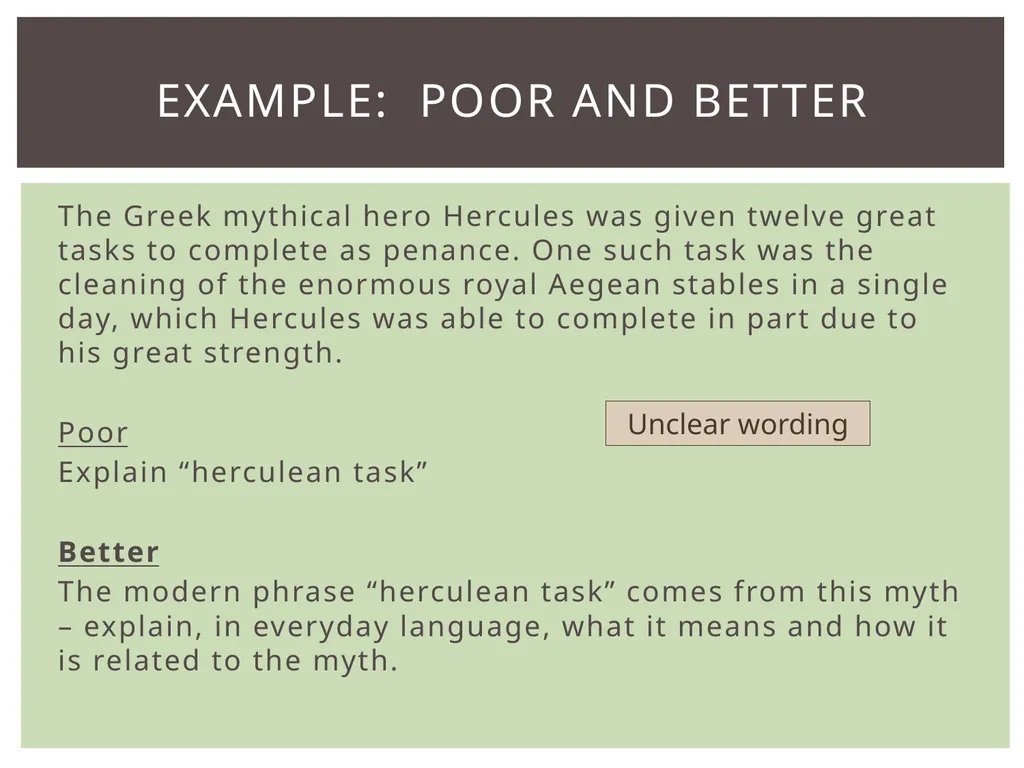
The Greek mythical hero Hercules was given twelve great tasks to complete as penance. One such task was the cleaning of the enormous royal Aegean stables in a single day, which Hercules was able to complete in part due to his great strength.
Poor
Explain “herculean task”
Better
The modern phrase “herculean task” comes from this myth – explain, in everyday language, what it means and how it is related to the myth. Example: Poor and better Unclear wording<br>
Poor
Explain “herculean task”
Better
The modern phrase “herculean task” comes from this myth – explain, in everyday language, what it means and how it is related to the myth. Example: Poor and better Unclear wording<br>
15
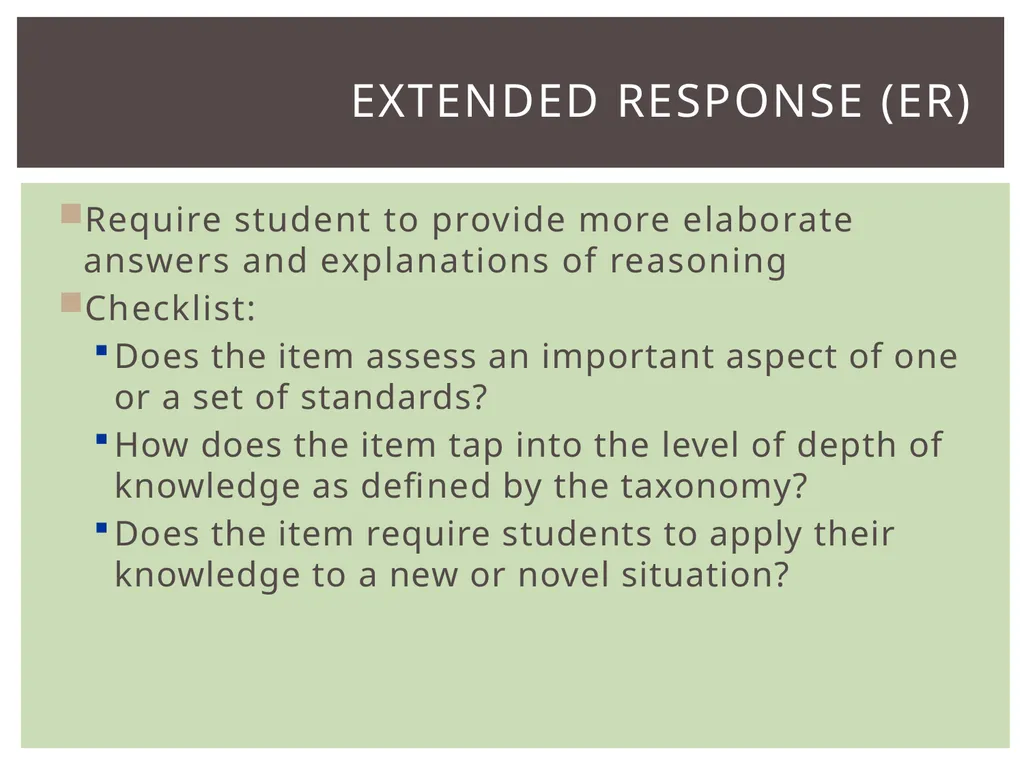
Require student to provide more elaborate answers and explanations of reasoning
Checklist:
Does the item assess an important aspect of one or a set of standards?
How does the item tap into the level of depth of knowledge as defined by the taxonomy?
Does the item require students to apply their knowledge to a new or novel situation? extended response (ER)<br>
Checklist:
Does the item assess an important aspect of one or a set of standards?
How does the item tap into the level of depth of knowledge as defined by the taxonomy?
Does the item require students to apply their knowledge to a new or novel situation? extended response (ER)<br>
16
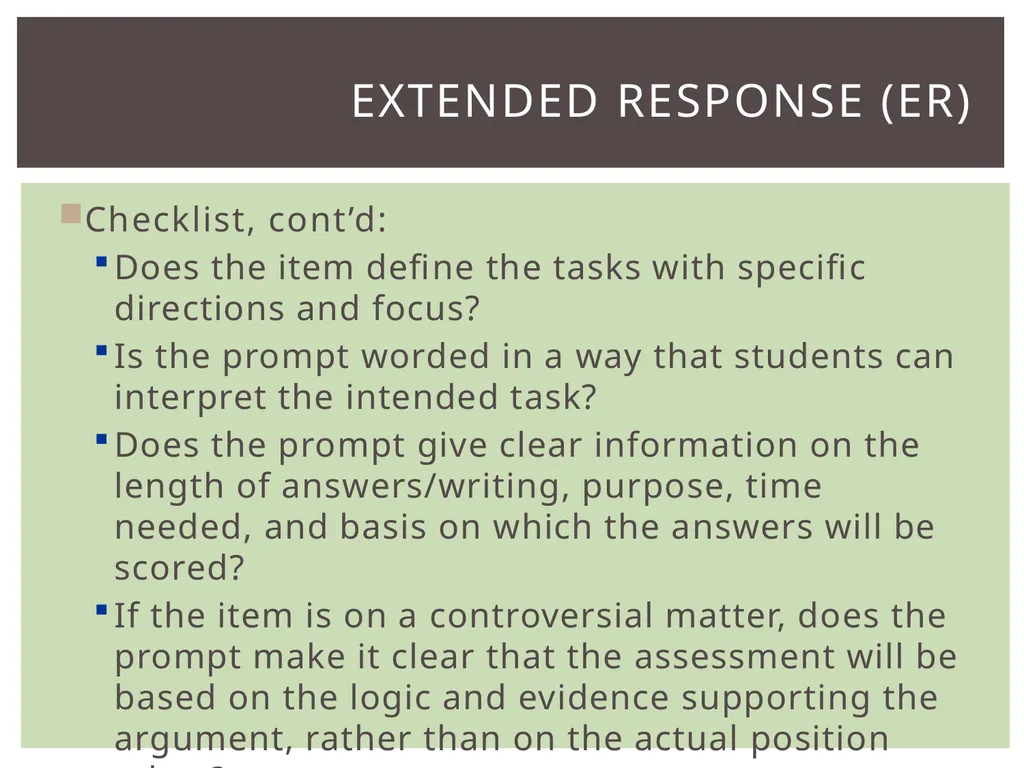
Checklist, cont’d:
Does the item define the tasks with specific directions and focus?
Is the prompt worded in a way that students can interpret the intended task?
Does the prompt give clear information on the length of answers/writing, purpose, time needed, and basis on which the answers will be scored?
If the item is on a controversial matter, does the prompt make it clear that the assessment will be based on the logic and evidence supporting the argument, rather than on the actual position taken? extended response (ER)<br>
Does the item define the tasks with specific directions and focus?
Is the prompt worded in a way that students can interpret the intended task?
Does the prompt give clear information on the length of answers/writing, purpose, time needed, and basis on which the answers will be scored?
If the item is on a controversial matter, does the prompt make it clear that the assessment will be based on the logic and evidence supporting the argument, rather than on the actual position taken? extended response (ER)<br>
17
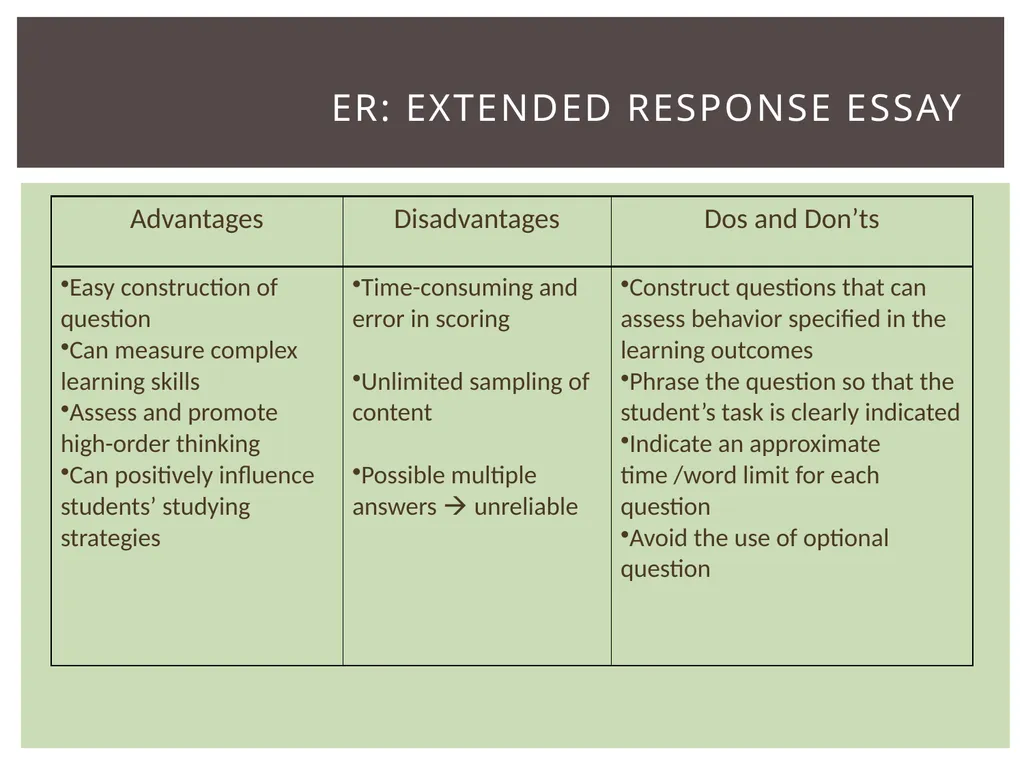
ER: Extended response Essay<br>
18
Sisyphus was the son of King Aeolus of Thessaly, and was avaricious, deceitful, and murderous. In life, Sisyphus believed himself more clever than the gods. In some versions of the myth, after his death he was sent to Tartarus (a deep abyss of torment, as far below Hades as the earth is below the heavens). Once there, Sisyphus deceived Thanatos, the personification of death, into chaining himself and escaped. While Thanatos was trapped in Tartarus, no human could die. As punishment for his trickery and hubris, Sisyphus was made to endlessly roll a huge boulder up a steep hill. Each time Sisyphus neared the top of the hill, the boulder would roll back to the bottom, and he would have to begin again.
In plain words, what is a Sisyphean task? How is it different from a herculean task? In common usage, what aspect of the story of Sisyphus is most important for how the term “sisyphean task” is used commonly today? Example: Poor Vocabulary is unnecessarily complicated<br>
In plain words, what is a Sisyphean task? How is it different from a herculean task? In common usage, what aspect of the story of Sisyphus is most important for how the term “sisyphean task” is used commonly today? Example: Poor Vocabulary is unnecessarily complicated<br>
19
Sisyphus was the son of King Aeolus of Thessaly. He was greedy, dishonest, and murderous. He thought he was more clever than the gods. After his death he was sent to Tartarus (a deep abyss of torment, worse than Hades). Once there, Sisyphus deceived Thanatos, the personification of death, into chaining himself, and escaped. As punishment for his trickery and arrogance, Sisyphus was forced to roll a huge boulder up a steep hill, forever. Each time Sisyphus neared the top of the hill, the boulder would roll back to the bottom, and he would have to begin again.
Based on this story, what does it mean when something is described as a sisyphean task? How is it different from a herculean task? What aspect of the story of Sisyphus is most important for how the term “sisyphean task” is used today? Same example: better<br>
Based on this story, what does it mean when something is described as a sisyphean task? How is it different from a herculean task? What aspect of the story of Sisyphus is most important for how the term “sisyphean task” is used today? Same example: better<br>
20
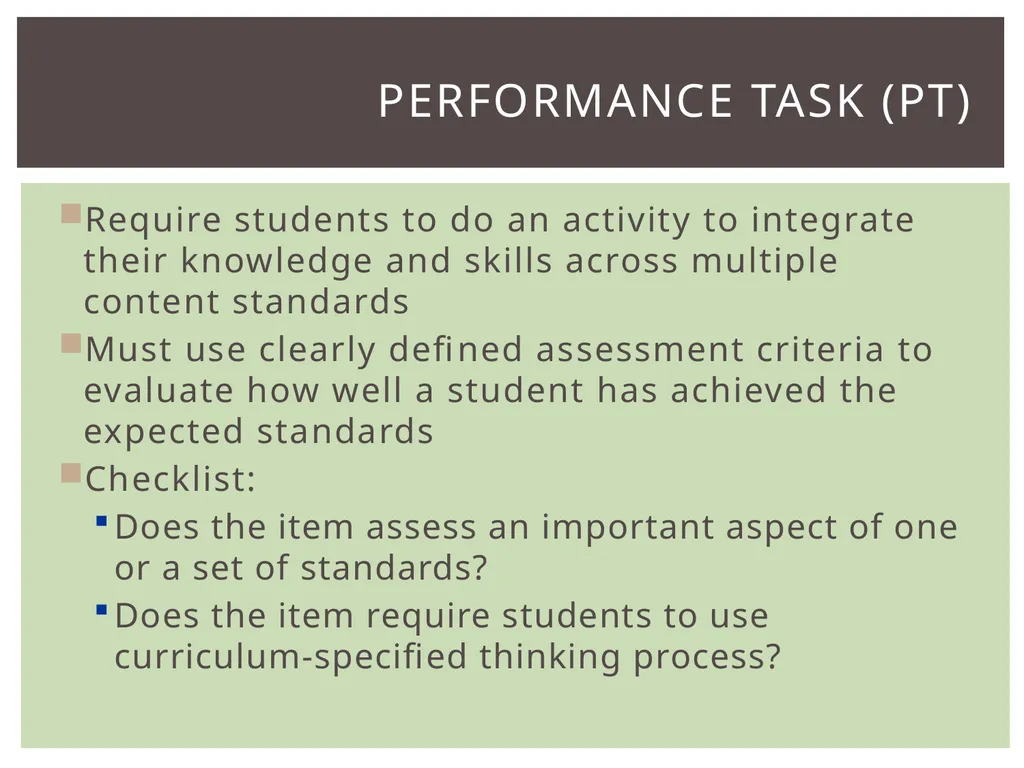
Require students to do an activity to integrate their knowledge and skills across multiple content standards
Must use clearly defined assessment criteria to evaluate how well a student has achieved the expected standards
Checklist:
Does the item assess an important aspect of one or a set of standards?
Does the item require students to use curriculum-specified thinking process? Performance Task (PT)<br>
Must use clearly defined assessment criteria to evaluate how well a student has achieved the expected standards
Checklist:
Does the item assess an important aspect of one or a set of standards?
Does the item require students to use curriculum-specified thinking process? Performance Task (PT)<br>
21
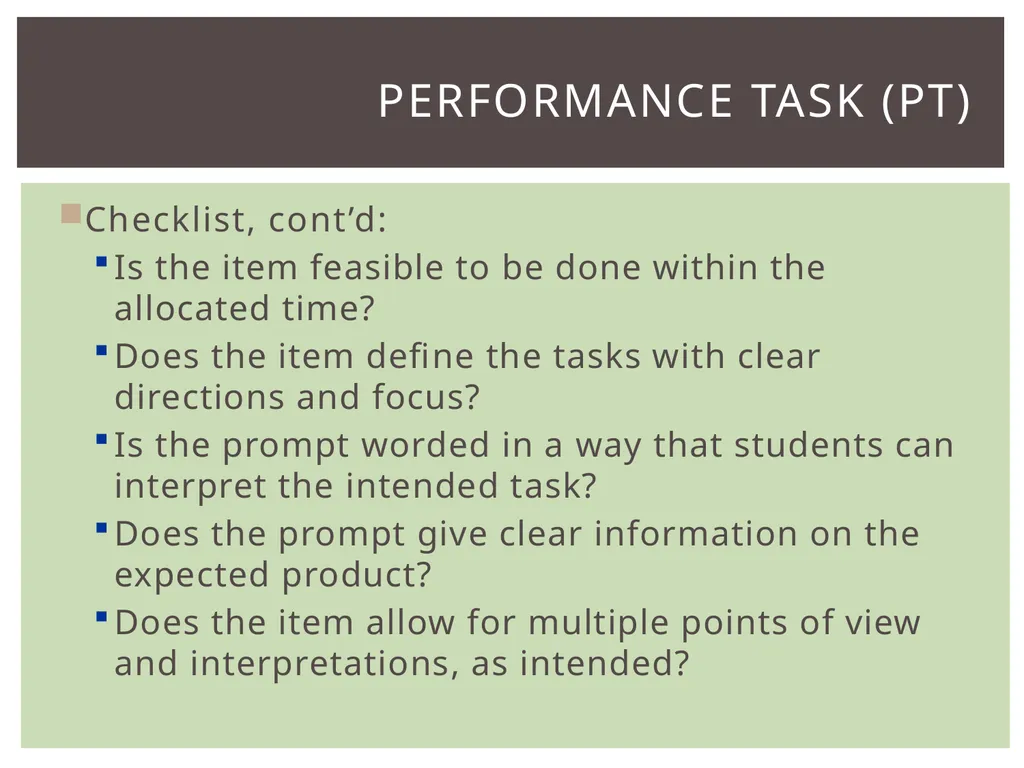
Checklist, cont’d:
Is the item feasible to be done within the allocated time?
Does the item define the tasks with clear directions and focus?
Is the prompt worded in a way that students can interpret the intended task?
Does the prompt give clear information on the expected product?
Does the item allow for multiple points of view and interpretations, as intended? Performance Task (PT)<br>
Is the item feasible to be done within the allocated time?
Does the item define the tasks with clear directions and focus?
Is the prompt worded in a way that students can interpret the intended task?
Does the prompt give clear information on the expected product?
Does the item allow for multiple points of view and interpretations, as intended? Performance Task (PT)<br>
22
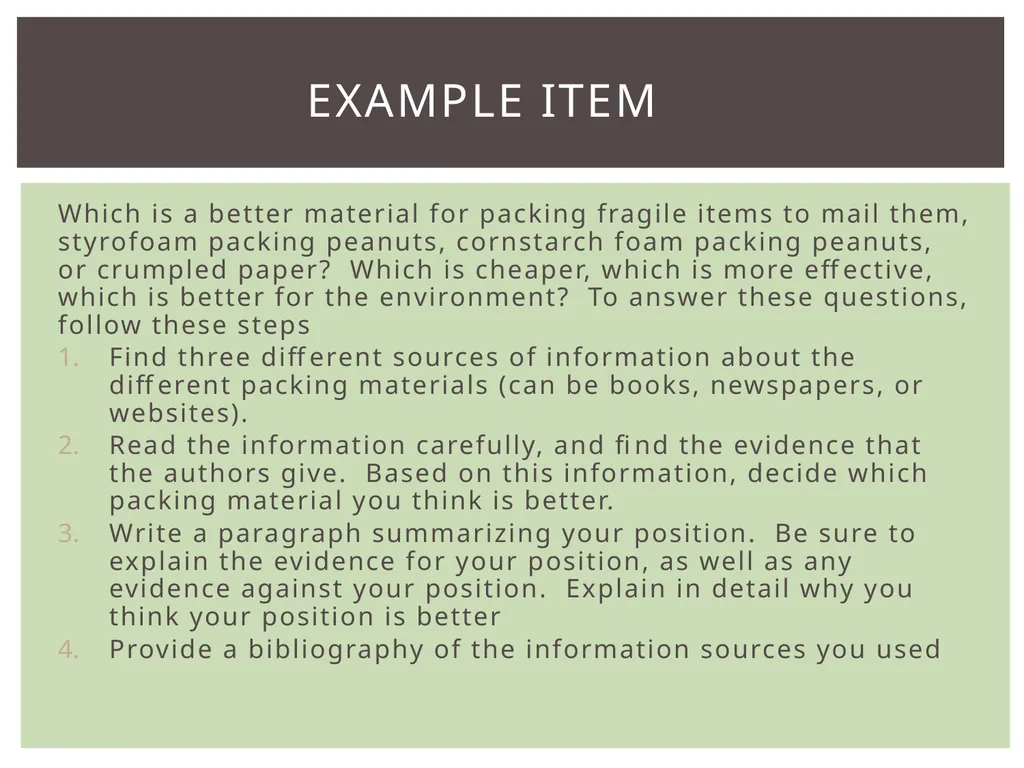
Which is a better material for packing fragile items to mail them, styrofoam packing peanuts, cornstarch foam packing peanuts, or crumpled paper? Which is cheaper, which is more effective, which is better for the environment? To answer these questions, follow these steps
Find three different sources of information about the different packing materials (can be books, newspapers, or websites).
Read the information carefully, and find the evidence that the authors give. Based on this information, decide which packing material you think is better.
Write a paragraph summarizing your position. Be sure to explain the evidence for your position, as well as any evidence against your position. Explain in detail why you think your position is better
Provide a bibliography of the information sources you used Example Item<br>
Find three different sources of information about the different packing materials (can be books, newspapers, or websites).
Read the information carefully, and find the evidence that the authors give. Based on this information, decide which packing material you think is better.
Write a paragraph summarizing your position. Be sure to explain the evidence for your position, as well as any evidence against your position. Explain in detail why you think your position is better
Provide a bibliography of the information sources you used Example Item<br>
23
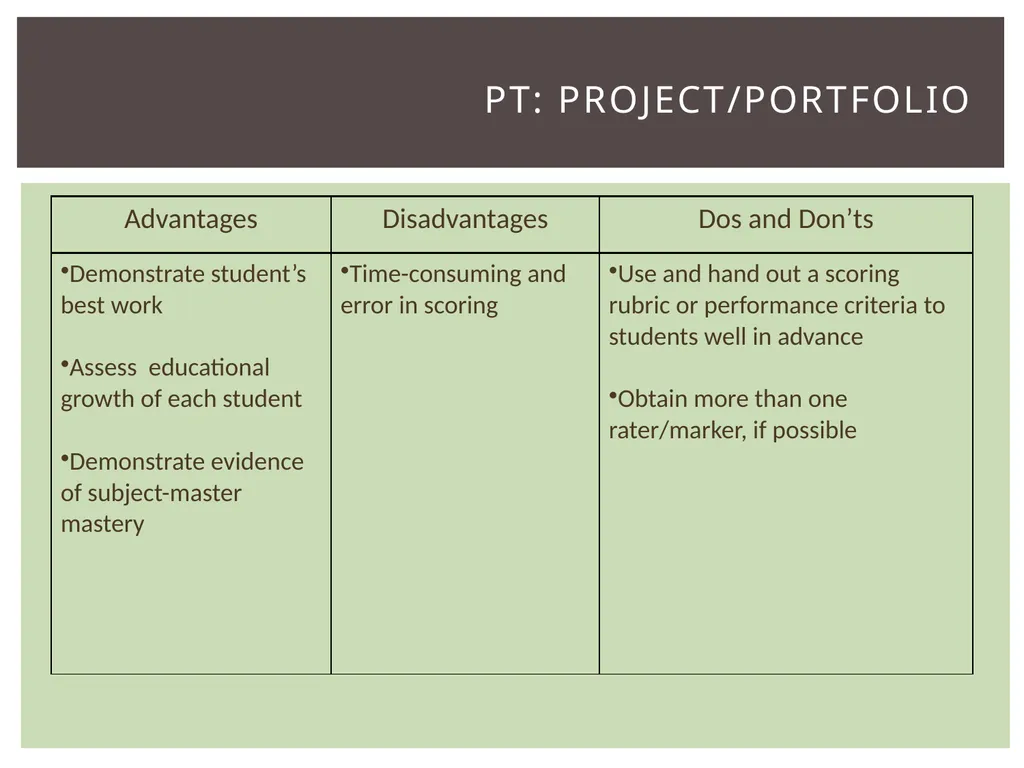
PT: Project/Portfolio<br>
24
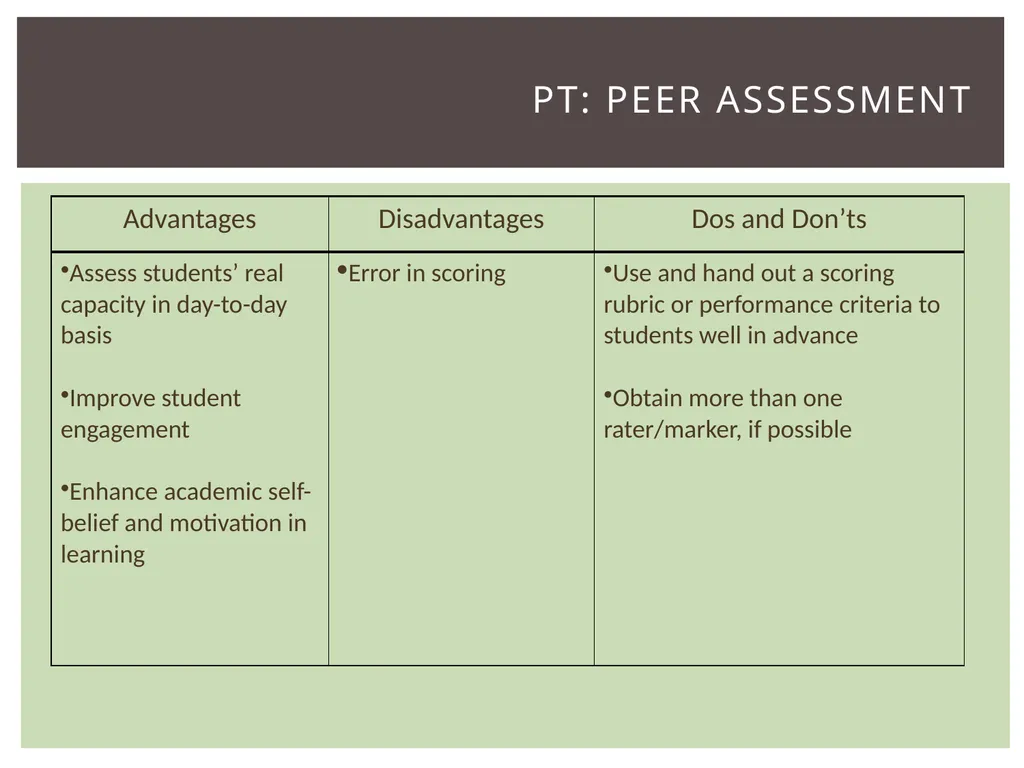
PT: Peer Assessment<br>
25
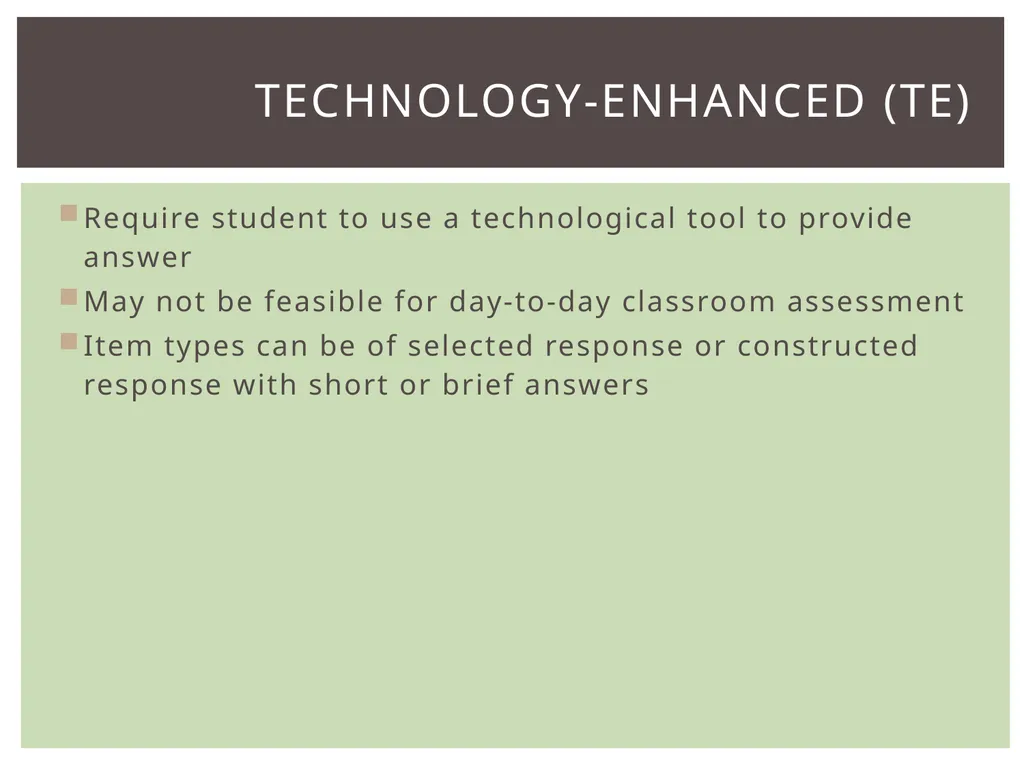
Require student to use a technological tool to provide answer
May not be feasible for day-to-day classroom assessment
Item types can be of selected response or constructed response with short or brief answers Technology-Enhanced (TE)<br>
May not be feasible for day-to-day classroom assessment
Item types can be of selected response or constructed response with short or brief answers Technology-Enhanced (TE)<br>
26
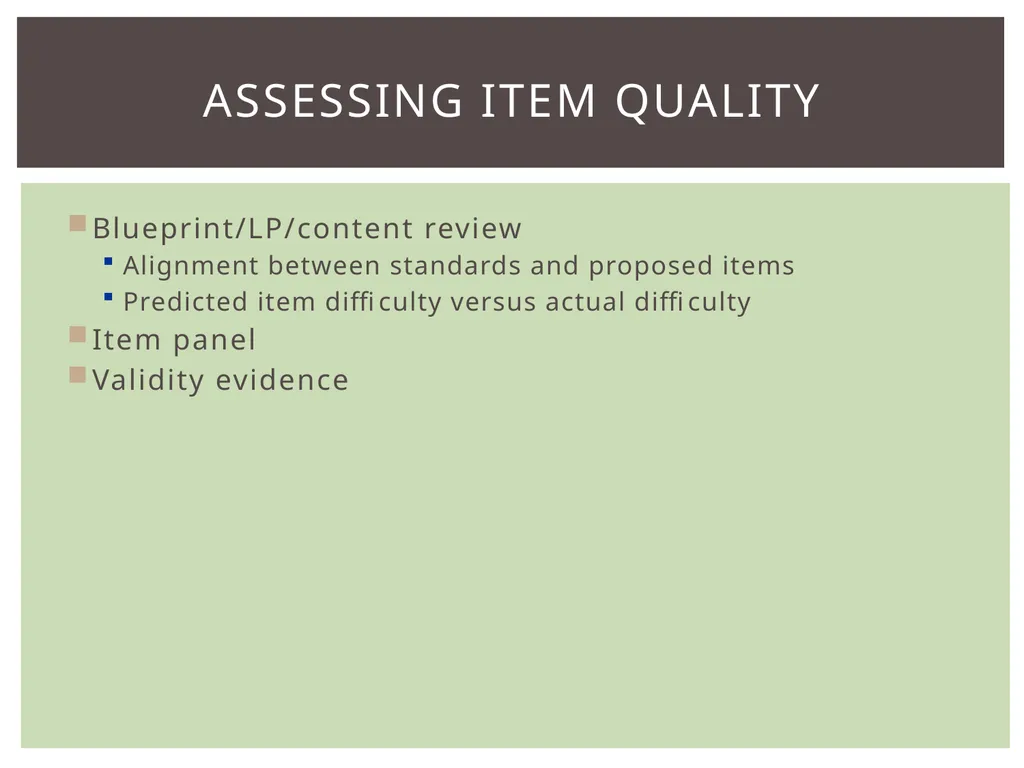
Blueprint/LP/content review
Alignment between standards and proposed items
Predicted item difficulty versus actual difficulty
Item panel
Validity evidence Assessing Item Quality<br>
Alignment between standards and proposed items
Predicted item difficulty versus actual difficulty
Item panel
Validity evidence Assessing Item Quality<br>
27
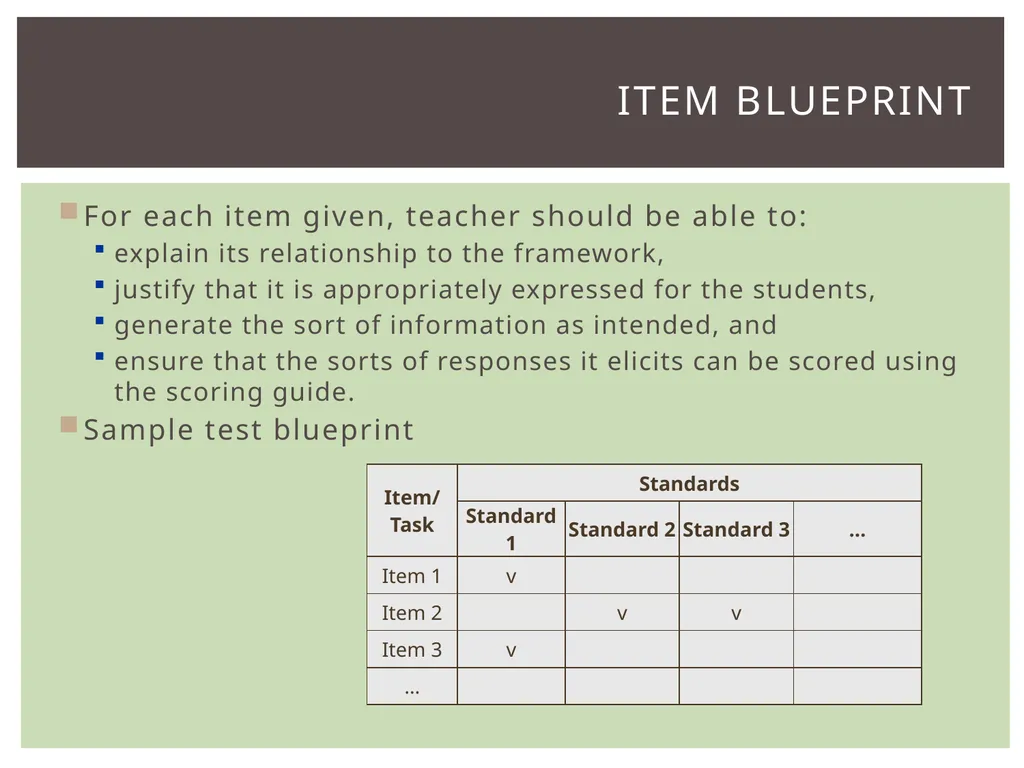
For each item given, teacher should be able to:
explain its relationship to the framework,
justify that it is appropriately expressed for the students,
generate the sort of information as intended, and
ensure that the sorts of responses it elicits can be scored using the scoring guide.
Sample test blueprint Item BLUEPRINT<br>
explain its relationship to the framework,
justify that it is appropriately expressed for the students,
generate the sort of information as intended, and
ensure that the sorts of responses it elicits can be scored using the scoring guide.
Sample test blueprint Item BLUEPRINT<br>
28
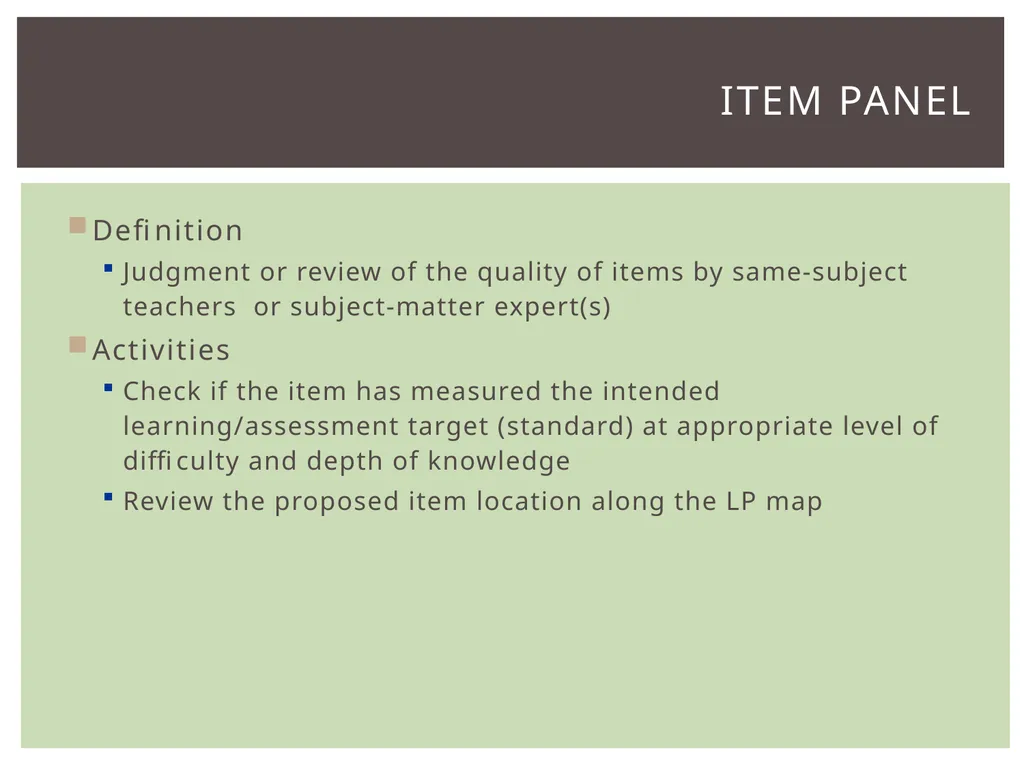
Definition
Judgment or review of the quality of items by same-subject teachers or subject-matter expert(s)
Activities
Check if the item has measured the intended learning/assessment target (standard) at appropriate level of difficulty and depth of knowledge
Review the proposed item location along the LP map Item Panel<br>
Judgment or review of the quality of items by same-subject teachers or subject-matter expert(s)
Activities
Check if the item has measured the intended learning/assessment target (standard) at appropriate level of difficulty and depth of knowledge
Review the proposed item location along the LP map Item Panel<br>
29
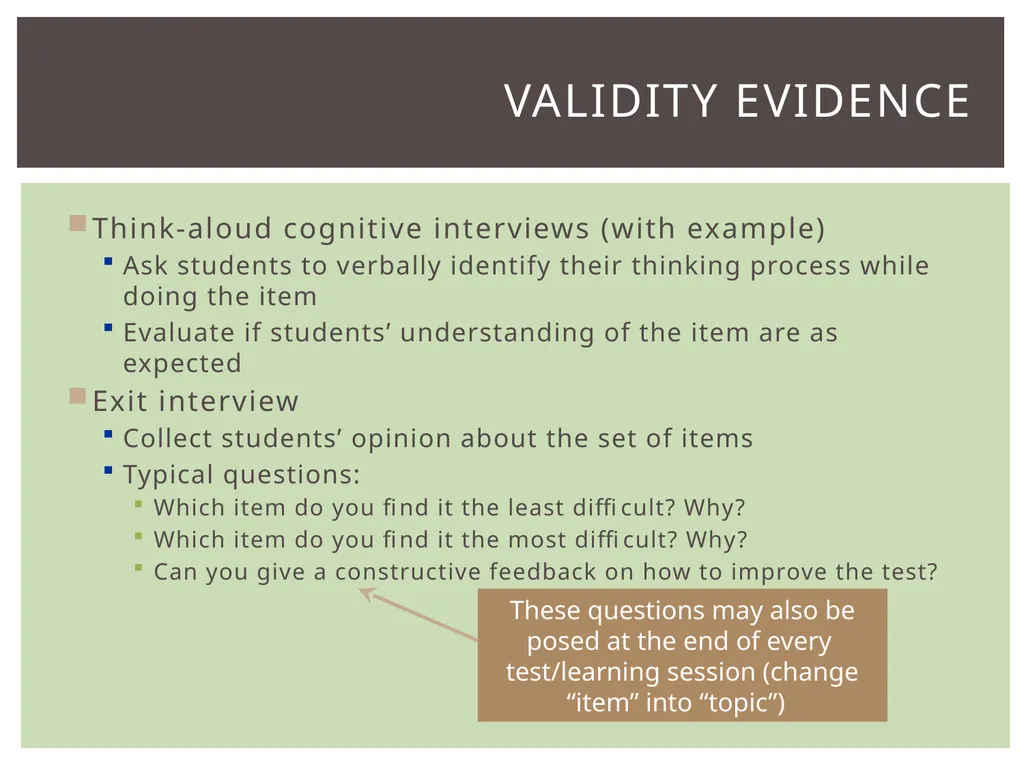
Think-aloud cognitive interviews (with example)
Ask students to verbally identify their thinking process while doing the item
Evaluate if students’ understanding of the item are as expected
Exit interview
Collect students’ opinion about the set of items
Typical questions:
Which item do you find it the least difficult? Why?
Which item do you find it the most difficult? Why?
Can you give a constructive feedback on how to improve the test? Validity Evidence These questions may also be posed at the end of every test/learning session (change “item” into “topic”)<br>
Ask students to verbally identify their thinking process while doing the item
Evaluate if students’ understanding of the item are as expected
Exit interview
Collect students’ opinion about the set of items
Typical questions:
Which item do you find it the least difficult? Why?
Which item do you find it the most difficult? Why?
Can you give a constructive feedback on how to improve the test? Validity Evidence These questions may also be posed at the end of every test/learning session (change “item” into “topic”)<br>
30
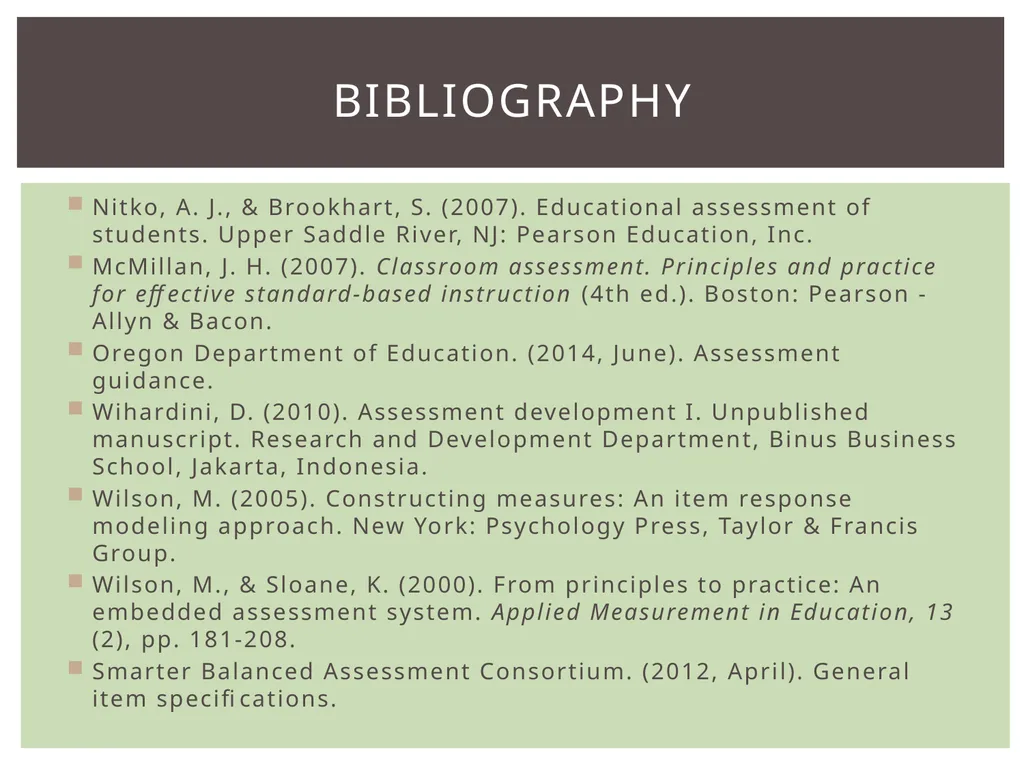
Nitko, A. J., & Brookhart, S. (2007). Educational assessment of students. Upper Saddle River, NJ: Pearson Education, Inc.
McMillan, J. H. (2007). Classroom assessment. Principles and practice for effective standard-based instruction (4th ed.). Boston: Pearson - Allyn & Bacon.
Oregon Department of Education. (2014, June). Assessment guidance.
Wihardini, D. (2010). Assessment development I. Unpublished manuscript. Research and Development Department, Binus Business School, Jakarta, Indonesia.
Wilson, M. (2005). Constructing measures: An item response modeling approach. New York: Psychology Press, Taylor & Francis Group.
Wilson, M., & Sloane, K. (2000). From principles to practice: An embedded assessment system. Applied Measurement in Education, 13 (2), pp. 181-208.
Smarter Balanced Assessment Consortium. (2012, April). General item specifications. Bibliography<br>
McMillan, J. H. (2007). Classroom assessment. Principles and practice for effective standard-based instruction (4th ed.). Boston: Pearson - Allyn & Bacon.
Oregon Department of Education. (2014, June). Assessment guidance.
Wihardini, D. (2010). Assessment development I. Unpublished manuscript. Research and Development Department, Binus Business School, Jakarta, Indonesia.
Wilson, M. (2005). Constructing measures: An item response modeling approach. New York: Psychology Press, Taylor & Francis Group.
Wilson, M., & Sloane, K. (2000). From principles to practice: An embedded assessment system. Applied Measurement in Education, 13 (2), pp. 181-208.
Smarter Balanced Assessment Consortium. (2012, April). General item specifications. Bibliography<br>
31
Item Types (ELA) PPT by the Oregon Department of Education and Berkeley Evaluation and Assessment Research Center is licensed under a CC BY 4.0.
You are free to:
Share — copy and redistribute the material in any medium or format
Adapt — remix, transform, and build upon the material
Under the following terms:
Attribution — You must give appropriate credit, provide a link to the license, and indicate if changes were made. You may do so in any reasonable manner, but not in any way that suggests the licensor endorses you or your use.
NonCommercial — You may not use the material for commercial purposes.
ShareAlike — If you remix, transform, or build upon the material, you must distribute your contributions under the same license as the original.
Oregon Department of Education welcomes editing of these resources and would greatly appreciate being able to learn from the changes made. To share an edited version of this resource, please contact Cristen McLean, cristen.mclean@state.or.us. Creative Commons License<br>
You are free to:
Share — copy and redistribute the material in any medium or format
Adapt — remix, transform, and build upon the material
Under the following terms:
Attribution — You must give appropriate credit, provide a link to the license, and indicate if changes were made. You may do so in any reasonable manner, but not in any way that suggests the licensor endorses you or your use.
NonCommercial — You may not use the material for commercial purposes.
ShareAlike — If you remix, transform, or build upon the material, you must distribute your contributions under the same license as the original.
Oregon Department of Education welcomes editing of these resources and would greatly appreciate being able to learn from the changes made. To share an edited version of this resource, please contact Cristen McLean, cristen.mclean@state.or.us. Creative Commons License<br>