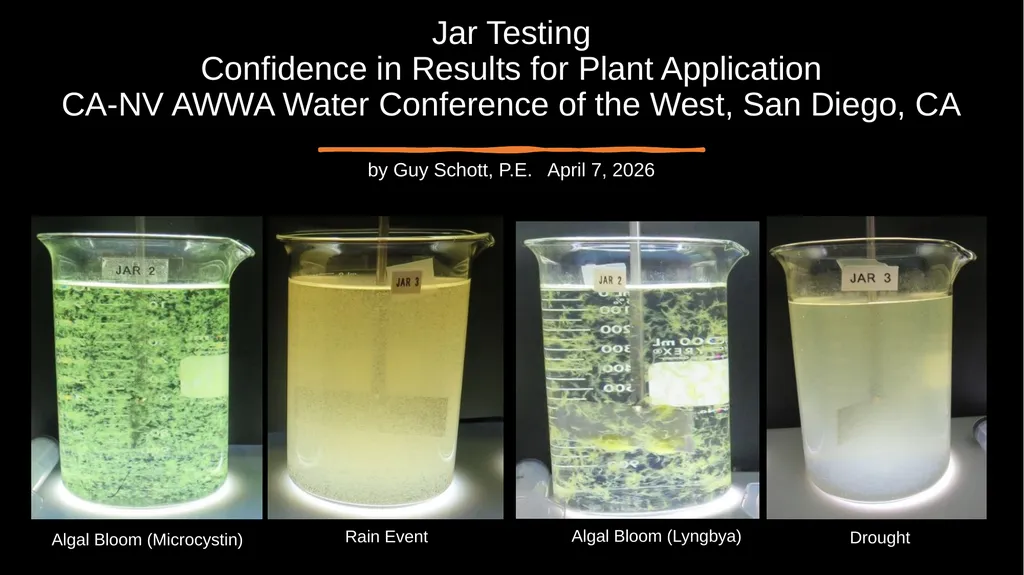
Jar Testing Confidence in Results for Plant Application CA-NV AWWA Water Conference of the West, San Diego, CA by Guy Schott, P.E. April 7, 2026 Drought Algal Bloom (Microcystin) Rain Event Algal Bloom (Lyngbya) Presentation Overview The
"Jar Testing Confidence in Results for Plant" is the property of its rightful owner. Permission is granted to
download and print the materials on this website for personal, non-commercial use only, and to display it
on your personal computer provided you do not modify the materials and that you retain all copyright
notices contained in the materials. By downloading content from our website, you accept the terms of this
agreement.
Presentation Transcript
01
Jar Testing Confidence in Results for Plant Application CA-NV AWWA Water Conference of the West, San Diego, CA by Guy Schott, P.E. April 7, 2026 Drought Algal Bloom (Microcystin) Rain Event Algal Bloom (Lyngbya)<br>
02
Presentation Overview The importance of jar testing and outcomes
Lab Equipment/Materials
Analysis (Filterability, UVT/UVA & Settleability)
Procedures
Case/Application Study
Training Video – Jar Testing Done Right<br>
03
Why Jar Test? When there is a change in source water quality that can impact
Filtration process
Disinfection by-product formations
Evaluate
pre-oxidants (chlorine, KMnO4, ozone)
pH adjustment
powder activated carbon
other coagulants and organic polymers
To practice<br>
04
Jar Testing & Analysis – What’s Important The chemistry that results in the best
Filterability (floc strength, turbidity, and head loss)
Dissolved organic carbon reduction (UVA surrogate)
Settleability (turbidity)
Confidence in your jar testing results
Fast, simple, and effective<br>
05
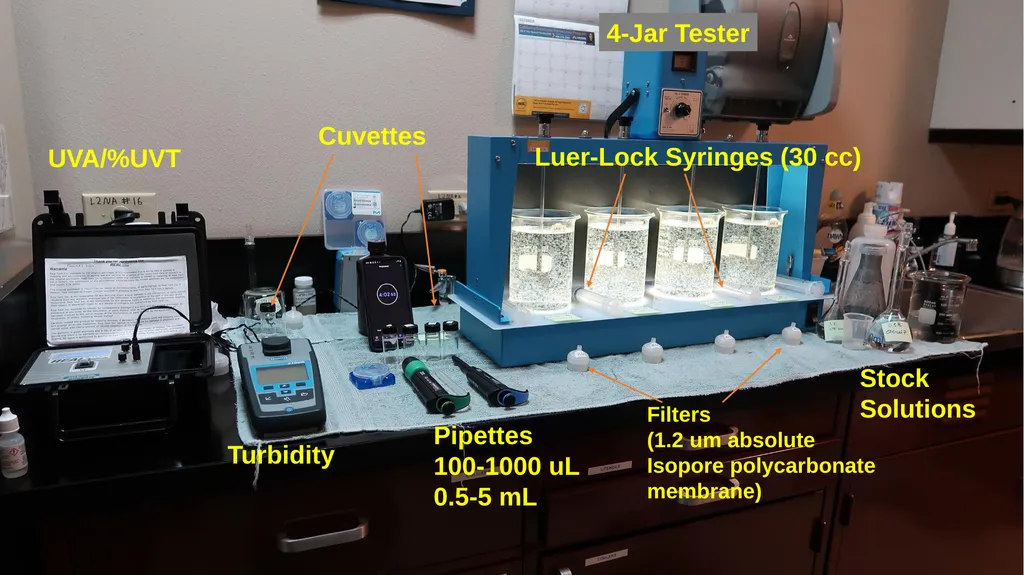
Lab UVA/%UVT Turbidity Cuvettes Stock
Solutions Pipettes
100-1000 uL
0.5-5 mL Filters
(1.2 um absolute
Isopore polycarbonate
membrane) Luer-Lock Syringes (30 cc) 4-Jar Tester<br>
06
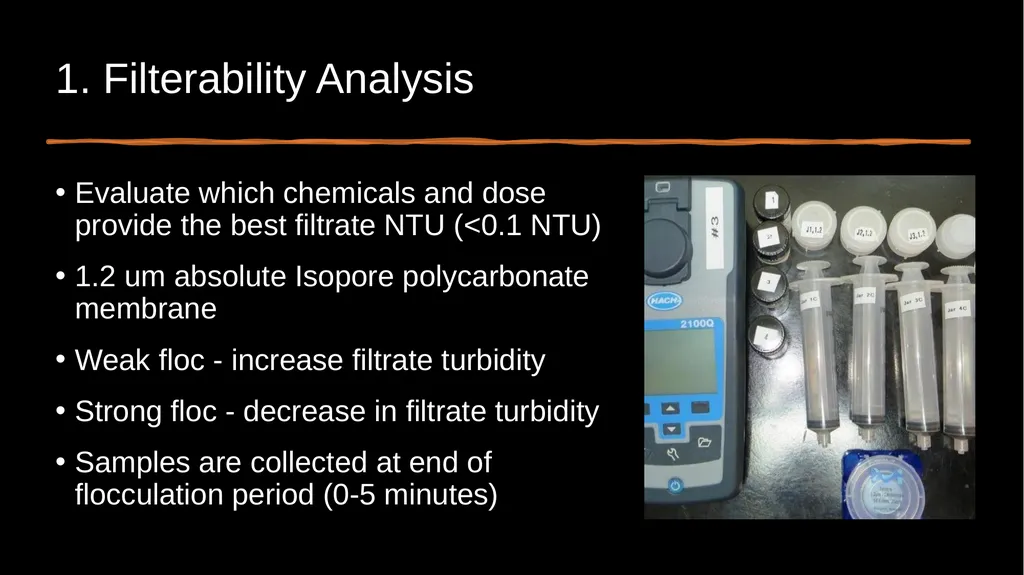
1. Filterability Analysis Evaluate which chemicals and dose provide the best filtrate NTU (<0.1 NTU)
1.2 um absolute Isopore polycarbonate membrane
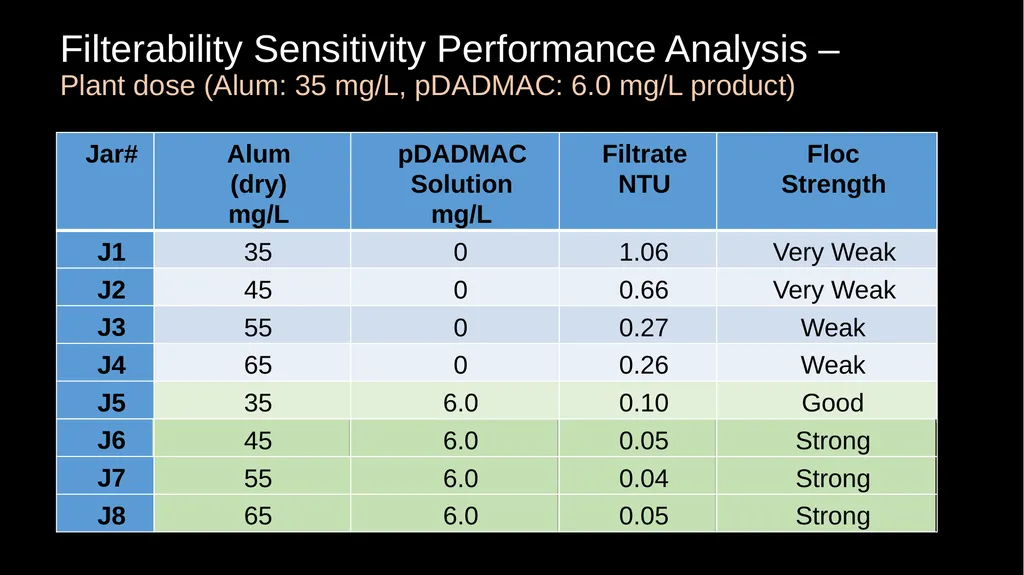
Weak floc - increase filtrate turbidity
Strong floc - decrease in filtrate turbidity
Samples are collected at end of flocculation period (0-5 minutes)<br>
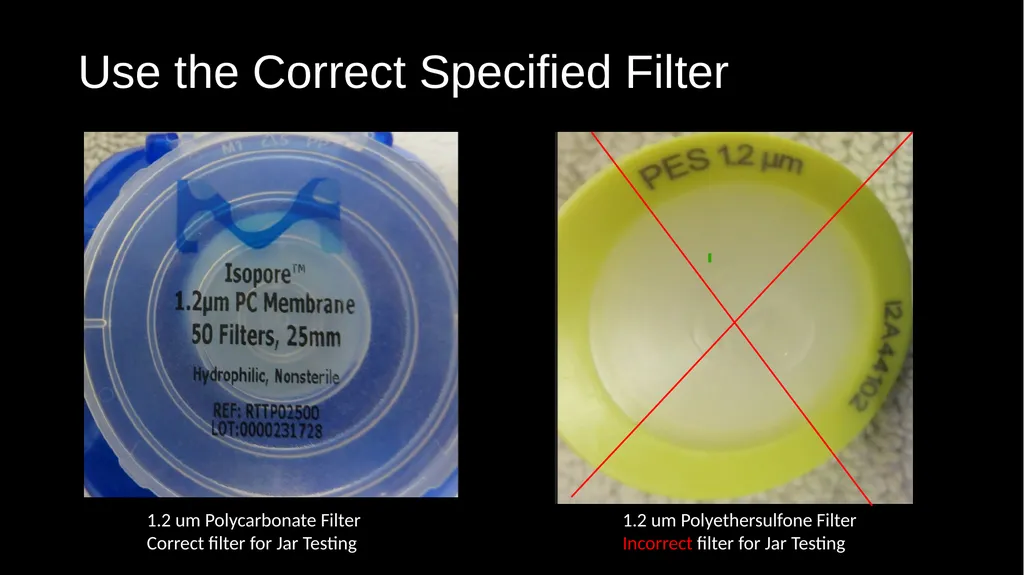
Use the Correct Specified Filter 1.2 um Polycarbonate Filter
Correct filter for Jar Testing 1.2 um Polyethersulfone Filter
Incorrect filter for Jar Testing<br>
09
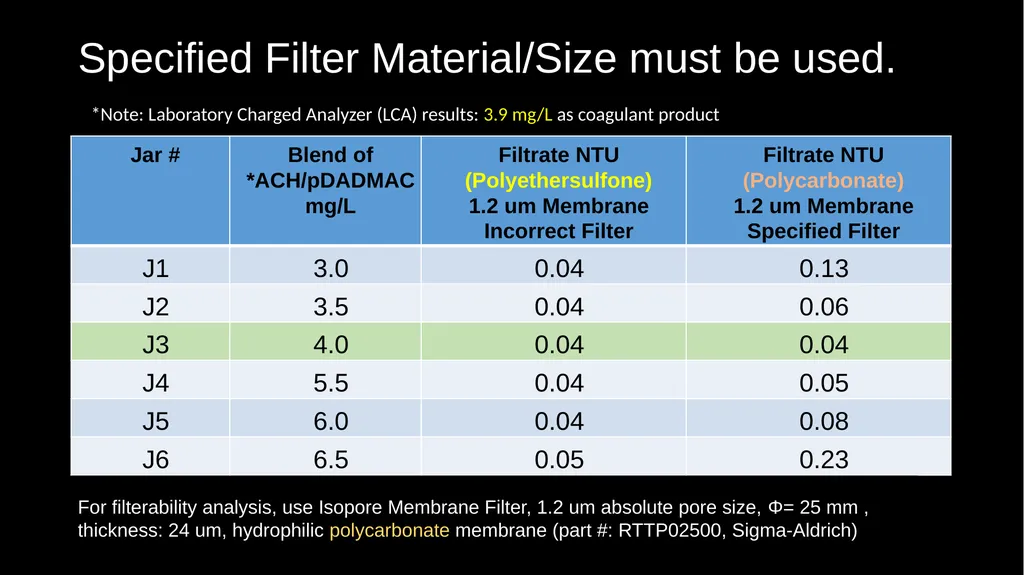
Specified Filter Material/Size must be used. For filterability analysis, use Isopore Membrane Filter, 1.2 um absolute pore size, Φ= 25 mm , thickness: 24 um, hydrophilic polycarbonate membrane (part #: RTTP02500, Sigma-Aldrich) *Note: Laboratory Charged Analyzer (LCA) results: 3.9 mg/L as coagulant product Filtrate NTU (Polycarbonate) 1.2 um Membrane Specified Filter Filtrate NTU (Polyethersulfone) 1.2 um Membrane Incorrect Filter Blend of *ACH/pDADMAC mg/L Jar # 0.13 0.04 3.0 J1 0.06 0.04 3.5 J2 0.04 0.04 4.0 J3 0.05 0.04 5.5 J4 0.08 0.04 6.0 J5 0.23 0.05 6.5 J6<br>
10
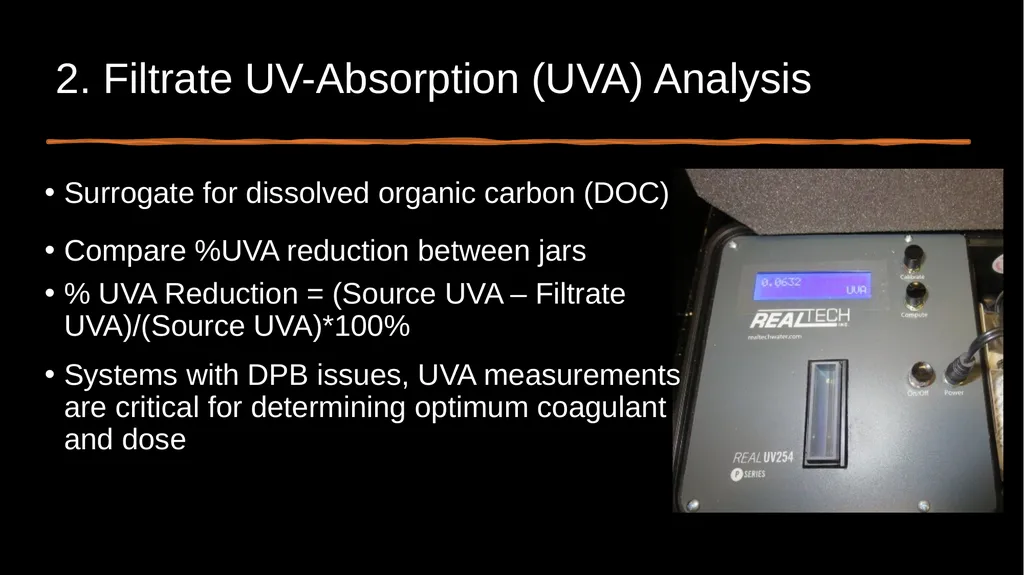
2. Filtrate UV-Absorption (UVA) Analysis Surrogate for dissolved organic carbon (DOC)
Compare %UVA reduction between jars
% UVA Reduction = (Source UVA – Filtrate UVA)/(Source UVA)*100%
Systems with DPB issues, UVA measurements are critical for determining optimum coagulant and dose<br>
11
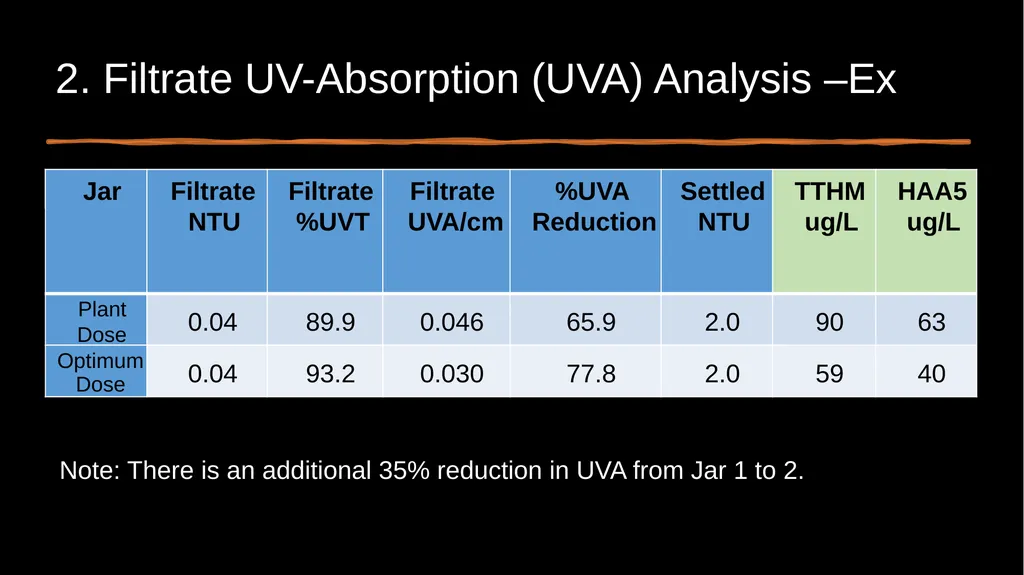
2. Filtrate UV-Absorption (UVA) Analysis –Ex Note: There is an additional 35% reduction in UVA from Jar 1 to 2. HAA5 ug/L TTHM ug/L Settled NTU %UVA Reduction Filtrate UVA/cm Filtrate %UVT Filtrate NTU Jar 63 90 2.0 65.9 0.046 89.9 0.04 Plant Dose 40 59 2.0 77.8 0.030 93.2 0.04 Optimum Dose<br>
12
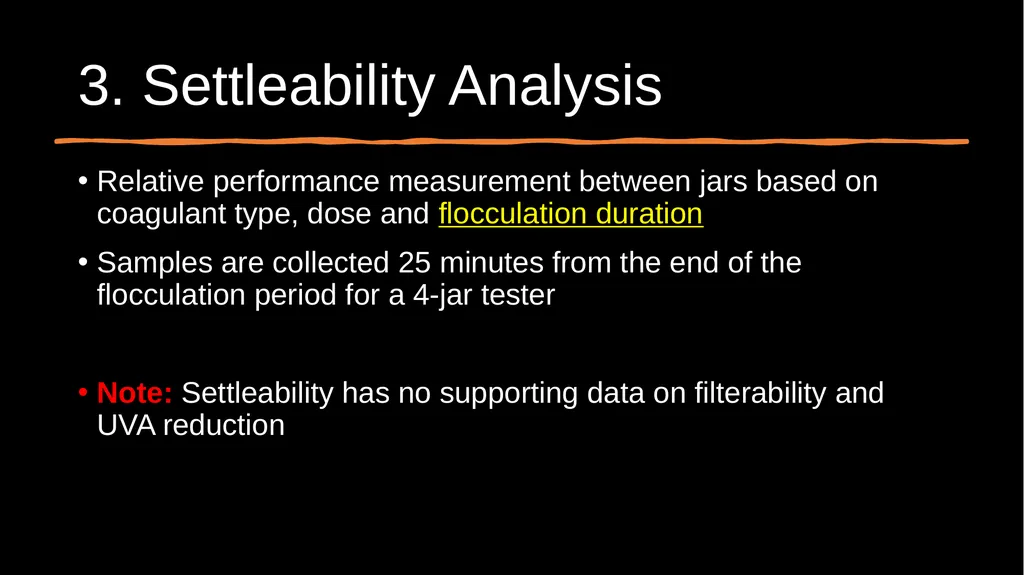
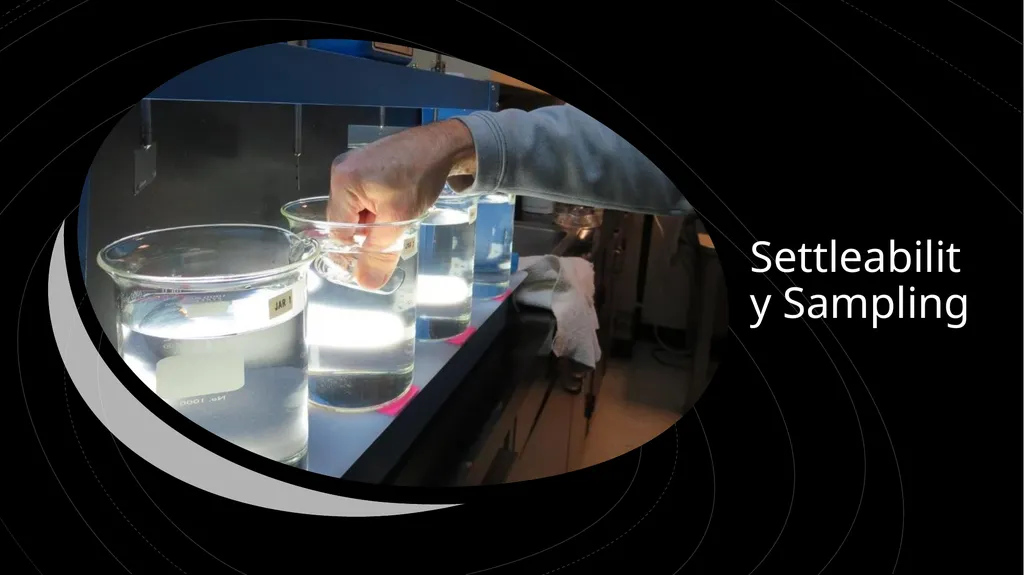
3. Settleability Analysis Relative performance measurement between jars based on coagulant type, dose and flocculation duration
Samples are collected 25 minutes from the end of the flocculation period for a 4-jar tester
Note: Settleability has no supporting data on filterability and UVA reduction<br>
13
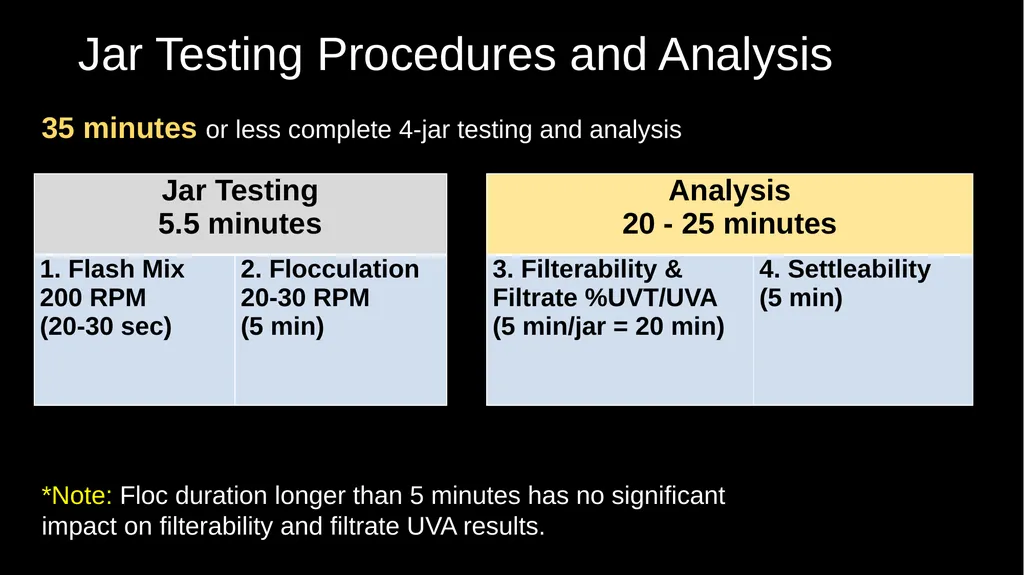
Jar Testing Procedures and Analysis *Note: Floc duration longer than 5 minutes has no significant impact on filterability and filtrate UVA results. 35 minutes or less complete 4-jar testing and analysis<br>
14
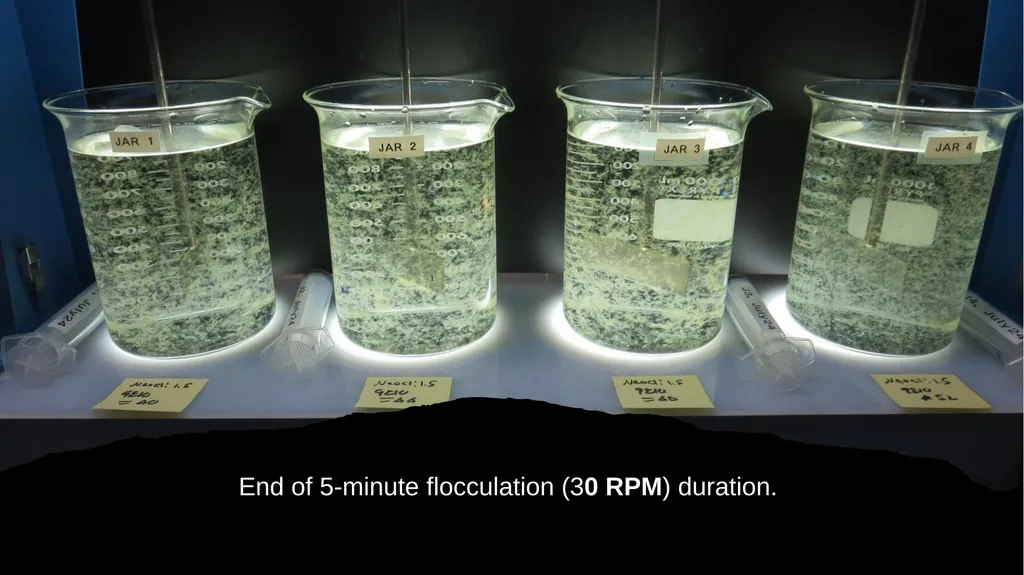
End of 5-minute flocculation (30 RPM) duration.<br>
15
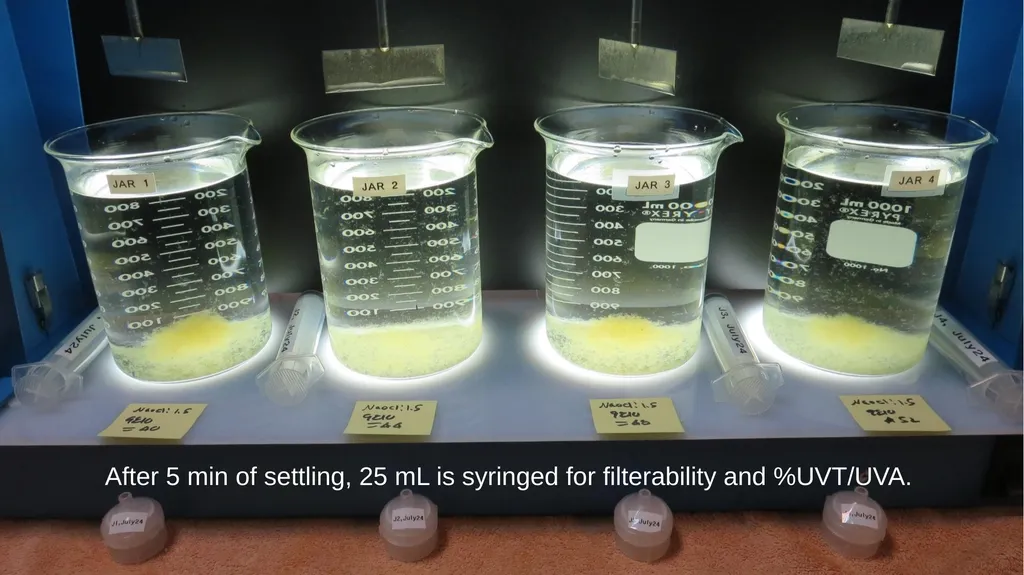
After 5 min of settling, 25 mL is syringed for filterability and %UVT/UVA.<br>
16
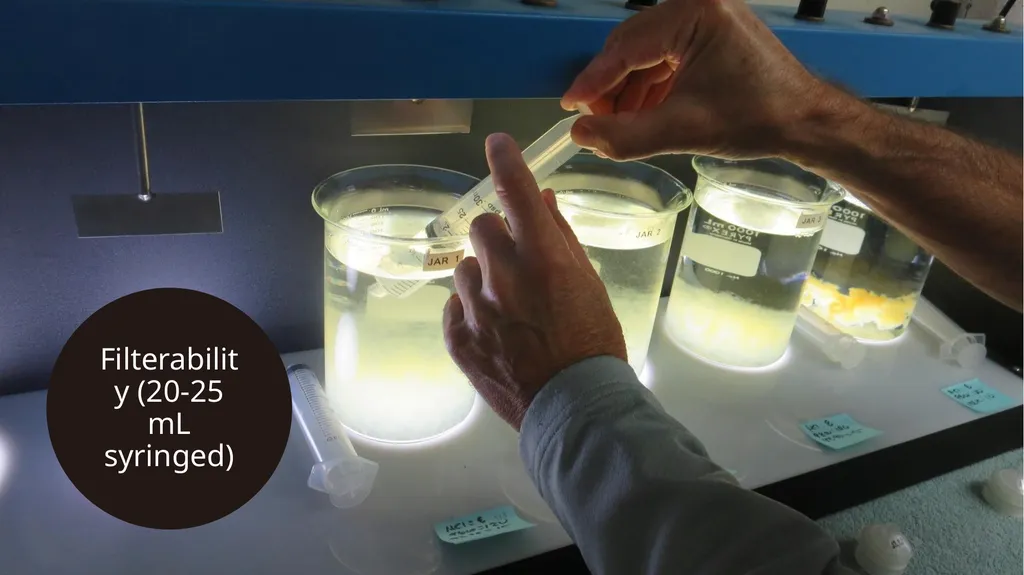
Filterability (20-25 mL syringed) Syringing<br>
17
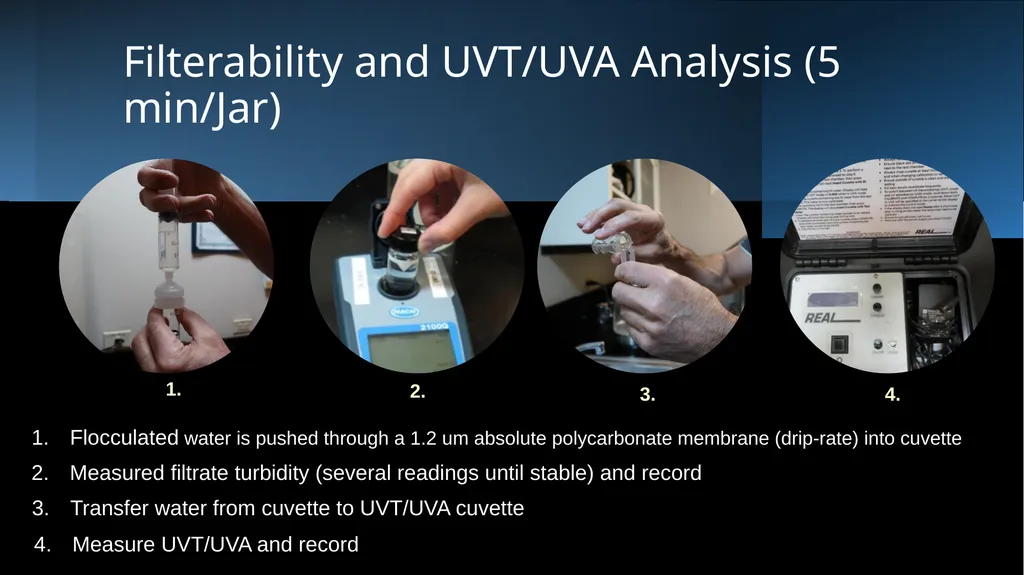
Filterability and UVT/UVA Analysis (5 min/Jar) 1. 2. 3. 4. Flocculated water is pushed through a 1.2 um absolute polycarbonate membrane (drip-rate) into cuvette Measured filtrate turbidity (several readings until stable) and record Transfer water from cuvette to UVT/UVA cuvette Measure UVT/UVA and record<br>
18
Settleability Sampling<br>
19
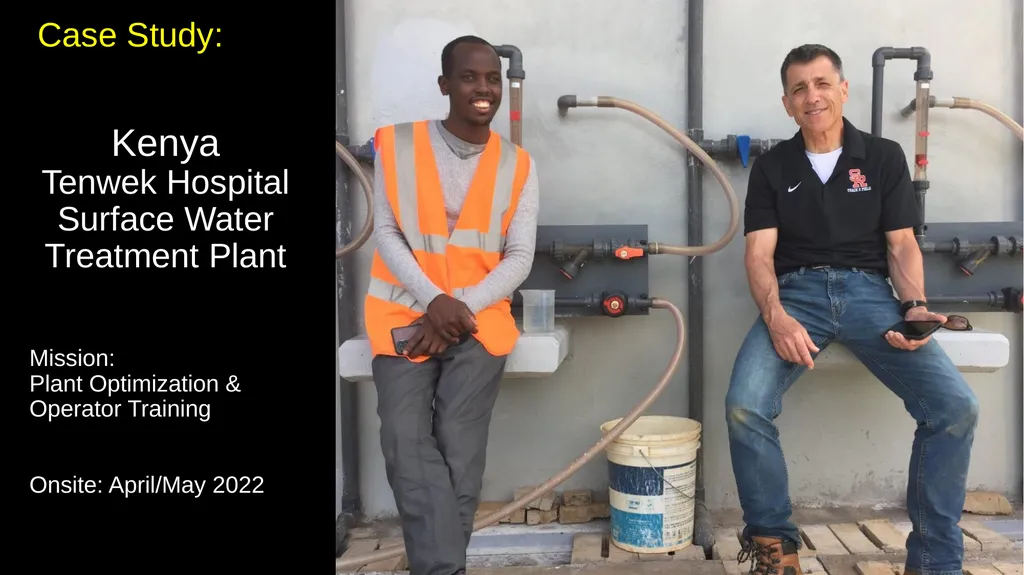
Kenya Tenwek Hospital Surface Water Treatment Plant Mission:
Plant Optimization & Operator Training
Onsite: April/May 2022 Case Study:<br>
20
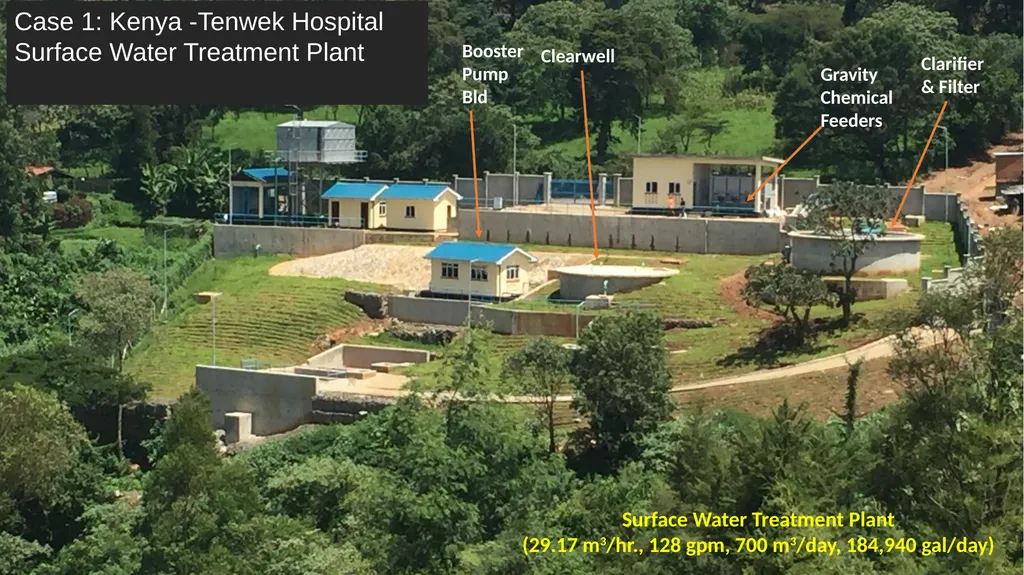
Surface Water Treatment Plant
(29.17 m3/hr., 128 gpm, 700 m3/day, 184,940 gal/day) Case 1: Kenya -Tenwek Hospital Surface Water Treatment Plant Gravity
Chemical
Feeders Clarifier
& Filter Clearwell Booster
Pump
Bld<br>
21
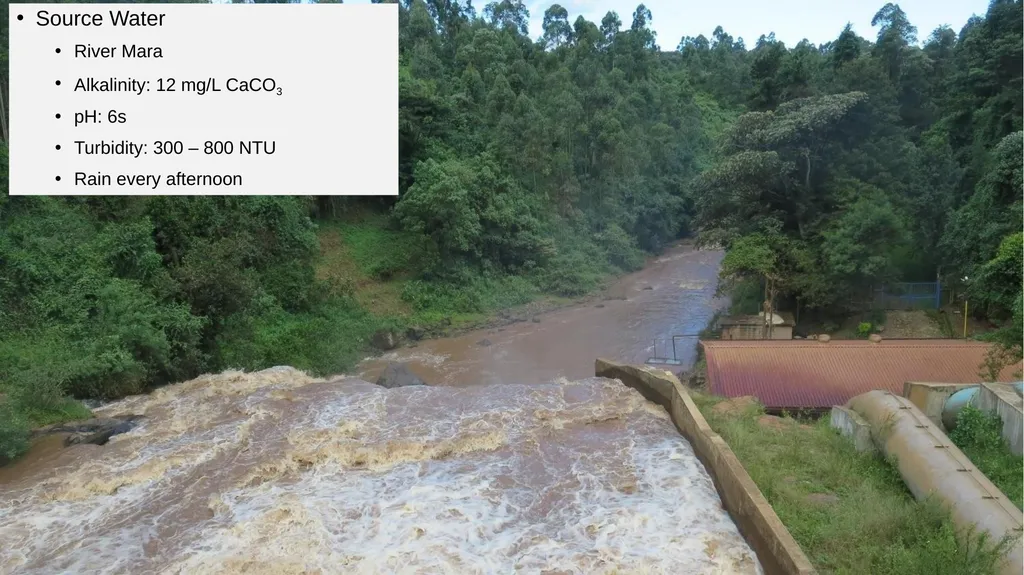
Source Water
River Mara
Alkalinity: 12 mg/L CaCO3
pH: 6s
Turbidity: 300 – 800 NTU
Rain every afternoon River Mara<br>
22
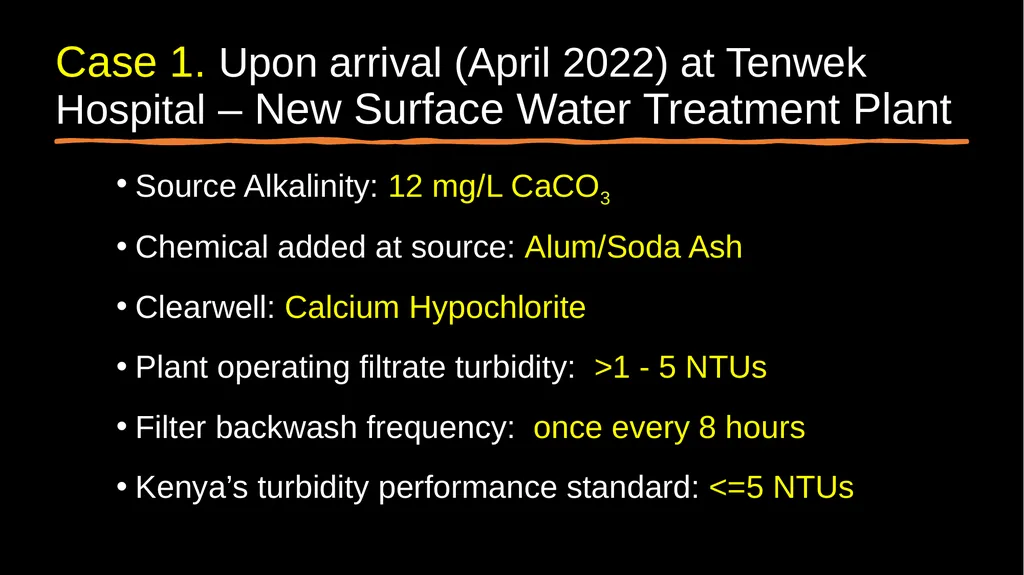
Case 1. Upon arrival (April 2022) at Tenwek Hospital – New Surface Water Treatment Plant Source Alkalinity: 12 mg/L CaCO3
Chemical added at source: Alum/Soda Ash
Clearwell: Calcium Hypochlorite
Plant operating filtrate turbidity: >1 - 5 NTUs
Filter backwash frequency: once every 8 hours
Kenya’s turbidity performance standard: <=5 NTUs<br>
23
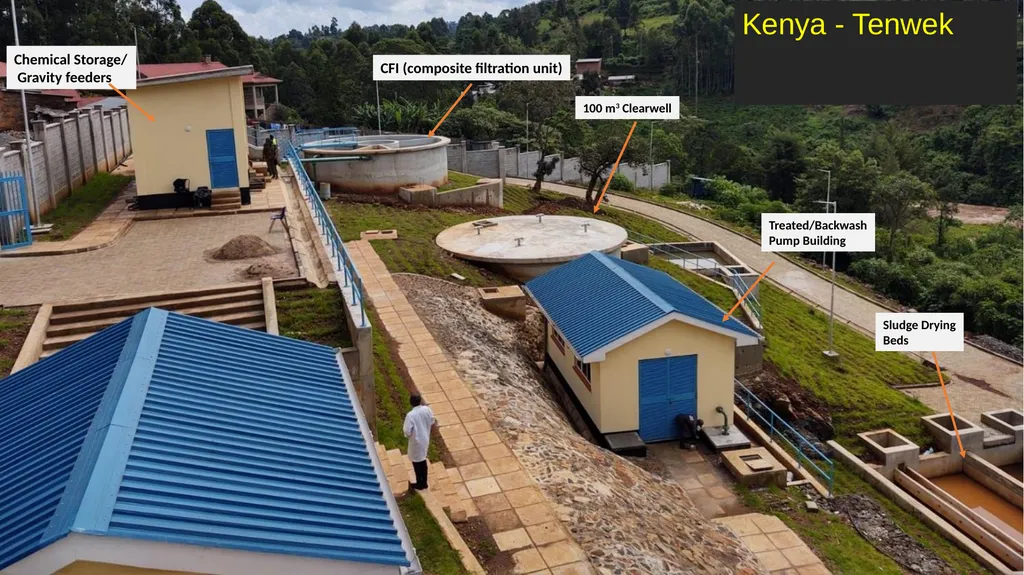
Kenya - Tenwek Chemical Storage/
Gravity feeders CFI (composite filtration unit) 100 m3 Clearwell Treated/Backwash
Pump Building Sludge Drying
Beds<br>
24
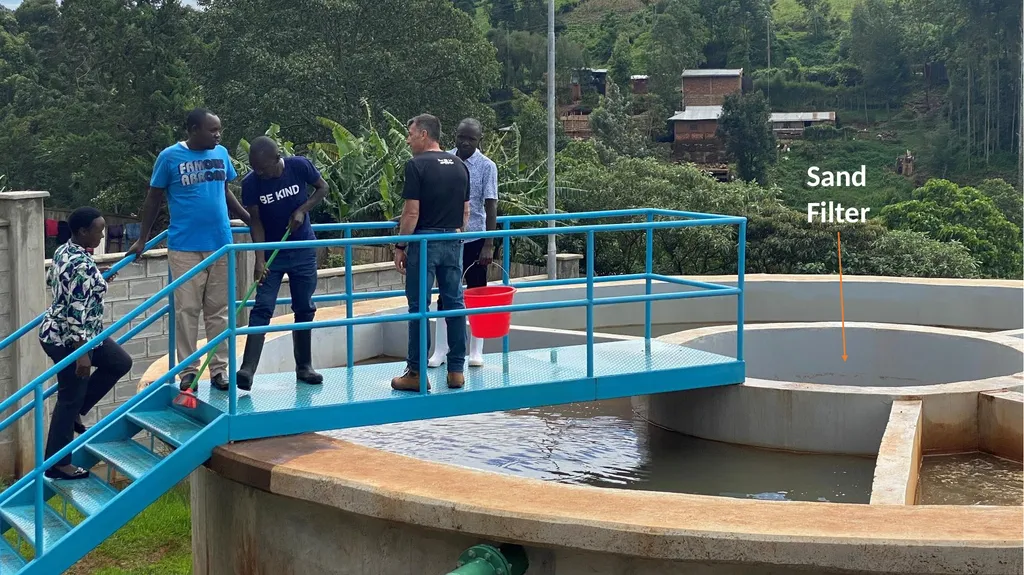
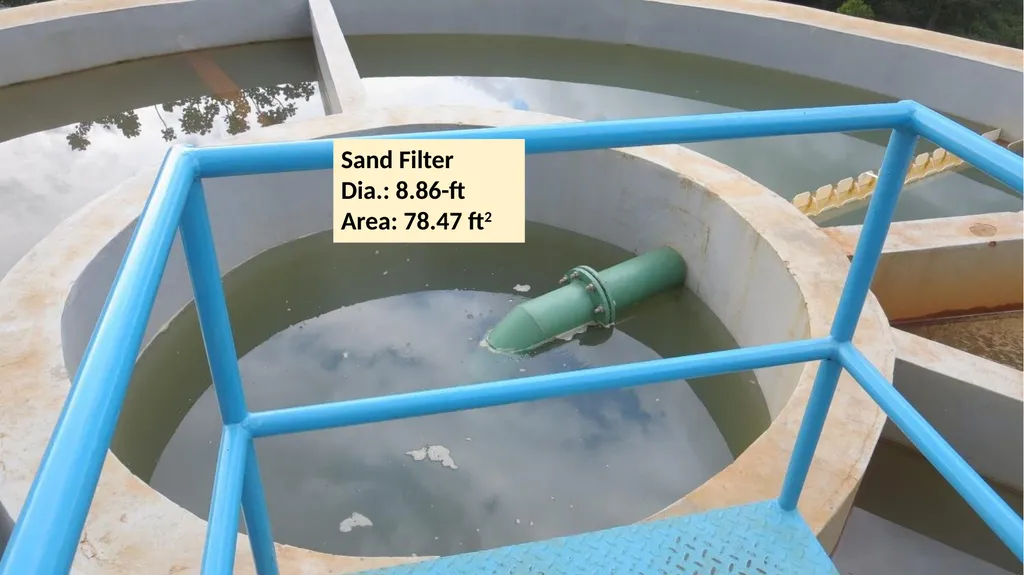
Sand
Filter Clarifier/Filter<br>
25
Sand Filter
Dia.: 8.86-ft
Area: 78.47 ft2<br>
26
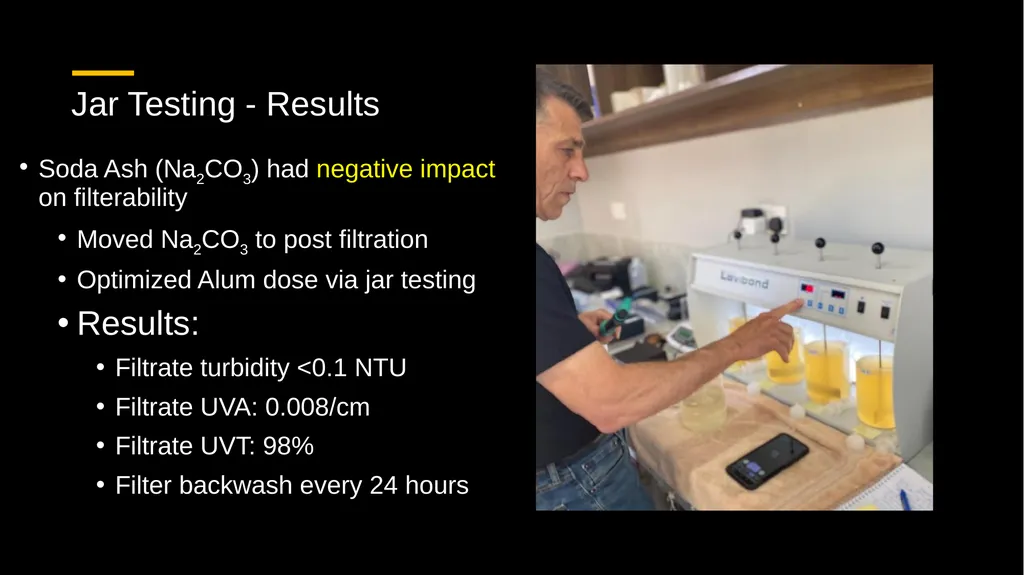
Jar Testing - Results Soda Ash (Na2CO3) had negative impact on filterability
Moved Na2CO3 to post filtration
Optimized Alum dose via jar testing
Results:
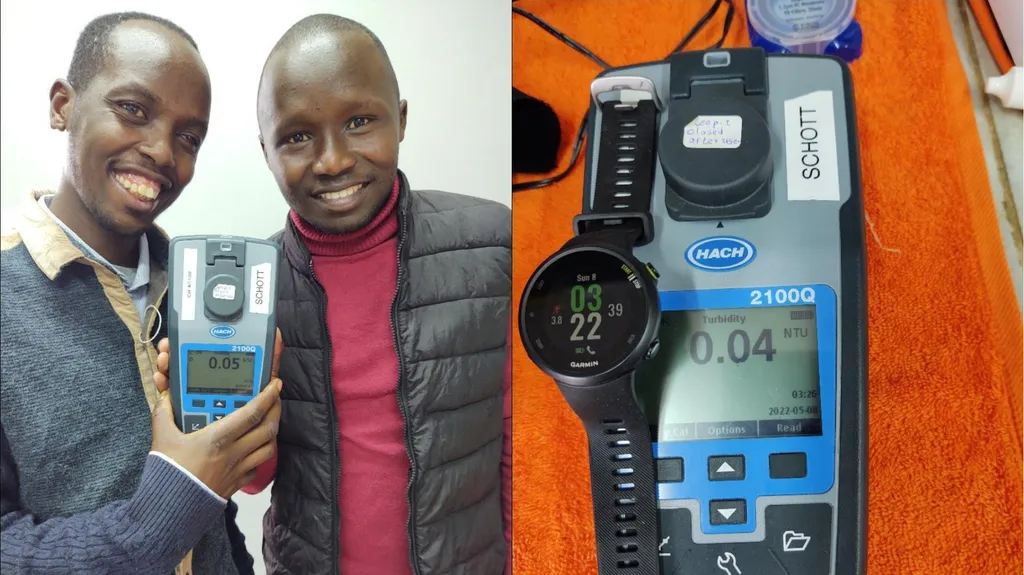
Filtrate turbidity <0.1 NTU
Filtrate UVA: 0.008/cm
Filtrate UVT: 98%
Filter backwash every 24 hours<br>
27
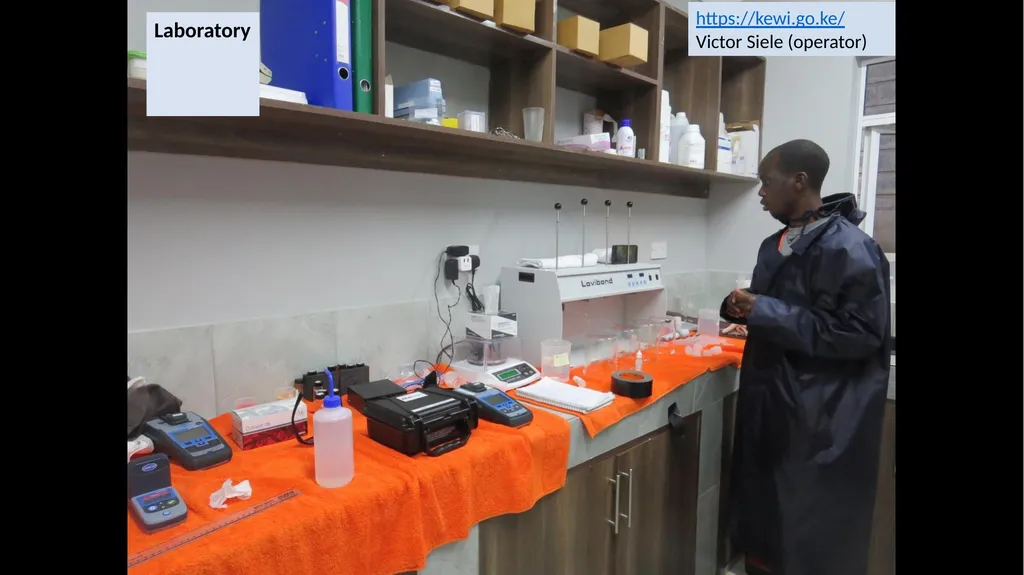
Laboratory https://kewi.go.ke/
Victor Siele (operator)<br>
28
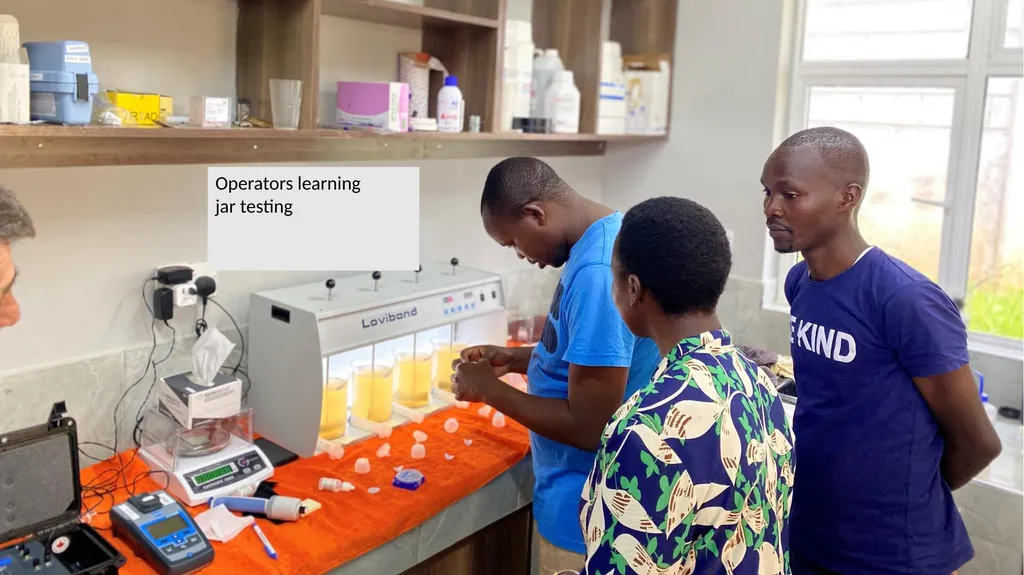
Operators learning
jar testing<br>
29
Victor with NTU<br>
30
Thank you for attending! Contact and Links Guy Schott, P.E.
State Water Resources Control Board
Division of Drinking Water
Santa Rosa, CA
Go to Jar Test Results/Procedures for tools to download
www.waterboards.ca.gov/drinking_water/programs/districts/mendocino_district.html
Jar Testing Done Right video training https://youtu.be/aGByyxhelkI
Email: Guy Schott - Guy.Schott@waterboards.ca.gov
Office Number: 707-576-2732<br>