
Jeremy Kenny Project Manager NASA Marshall Space
TD
Published · 12 slides · 0 views

1 / 1
Description
Jeremy Kenny Project Manager NASA Marshall Space Flight Center January 7, 2025 AIAA Scitech 2025 CFMPP Office Overview and 2024 Highlights CFM Portfolio Project (CFMPP) Space Technology Mission Directorate (STMD) Portfolio Project comprised
Related Topics
Share
Embed code
Download this presentation From Below
"Jeremy Kenny Project Manager NASA Marshall Space" is the property of its rightful owner. Permission is granted to download and print the materials on this website for personal, non-commercial use only, and to display it on your personal computer provided you do not modify the materials and that you retain all copyright notices contained in the materials. By downloading content from our website, you accept the terms of this agreement.
Presentation Transcript
01
Jeremy Kenny
Project Manager
NASA Marshall Space Flight Center
January 7, 2025 AIAA Scitech 2025
CFMPP Office Overview and 2024 Highlights<br>
Project Manager
NASA Marshall Space Flight Center
January 7, 2025 AIAA Scitech 2025
CFMPP Office Overview and 2024 Highlights<br>
02
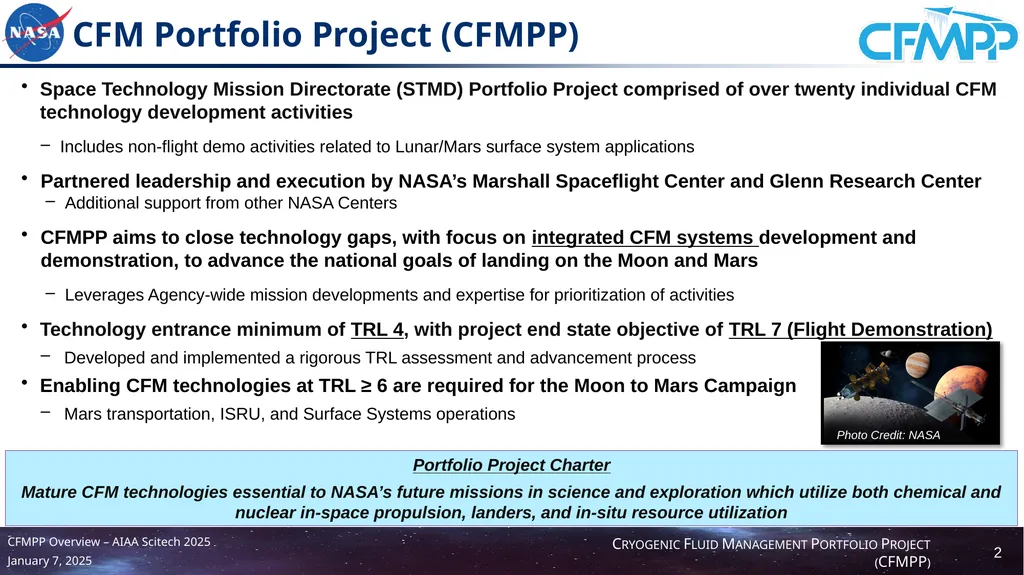
CFM Portfolio Project (CFMPP) Space Technology Mission Directorate (STMD) Portfolio Project comprised of over twenty individual CFM technology development activities
Includes non-flight demo activities related to Lunar/Mars surface system applications
Partnered leadership and execution by NASA’s Marshall Spaceflight Center and Glenn Research Center
Additional support from other NASA Centers
CFMPP aims to close technology gaps, with focus on integrated CFM systems development and demonstration, to advance the national goals of landing on the Moon and Mars
Leverages Agency-wide mission developments and expertise for prioritization of activities
Technology entrance minimum of TRL 4, with project end state objective of TRL 7 (Flight Demonstration)
Developed and implemented a rigorous TRL assessment and advancement process
Enabling CFM technologies at TRL ≥ 6 are required for the Moon to Mars Campaign
Mars transportation, ISRU, and Surface Systems operations Portfolio Project Charter
Mature CFM technologies essential to NASA’s future missions in science and exploration which utilize both chemical and nuclear in-space propulsion, landers, and in-situ resource utilization Photo Credit: NASA<br>
03
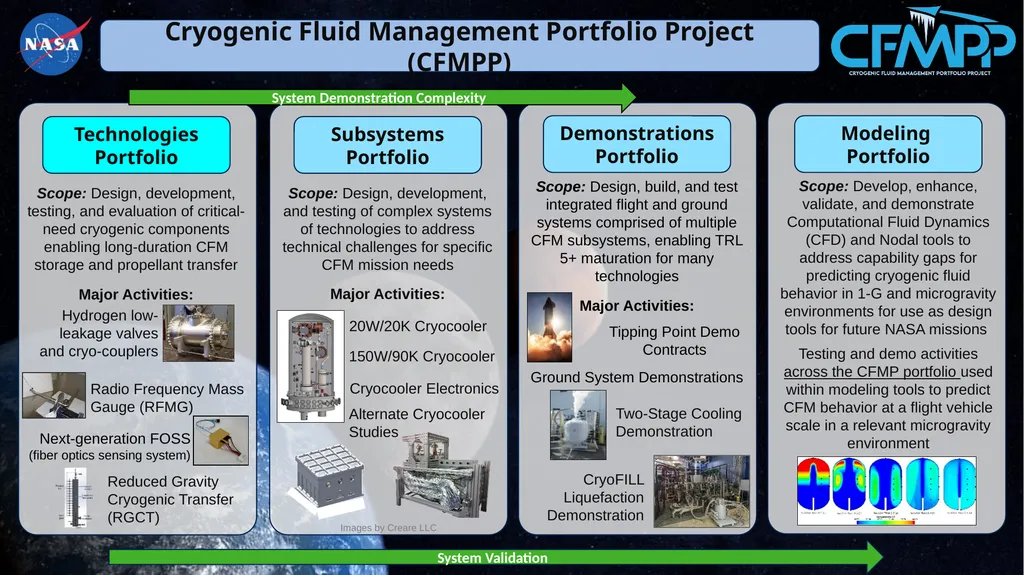
Cryogenic Fluid Management Portfolio Project (CFMPP) Technologies Portfolio Subsystems Portfolio Demonstrations Portfolio Modeling
Portfolio Scope: Develop, enhance, validate, and demonstrate Computational Fluid Dynamics (CFD) and Nodal tools to address capability gaps for predicting cryogenic fluid behavior in 1-G and microgravity environments for use as design tools for future NASA missions
Testing and demo activities across the CFMP portfolio used within modeling tools to predict CFM behavior at a flight vehicle scale in a relevant microgravity environment Scope: Design, build, and test integrated flight and ground systems comprised of multiple CFM subsystems, enabling TRL 5+ maturation for many technologies
Major Activities:
Ground System Demonstrations Scope: Design, development, and testing of complex systems of technologies to address technical challenges for specific CFM mission needs
Major Activities: Scope: Design, development, testing, and evaluation of critical-need cryogenic components enabling long-duration CFM storage and propellant transfer
Major Activities: System Validation Radio Frequency Mass Gauge (RFMG) Hydrogen low-leakage valves and cryo-couplers Next-generation FOSS (fiber optics sensing system) 20W/20K Cryocooler 150W/90K Cryocooler Two-Stage Cooling Demonstration CryoFILL Liquefaction Demonstration Cryocooler Electronics Reduced Gravity Cryogenic Transfer (RGCT) System Demonstration Complexity Alternate Cryocooler Studies Images by Creare LLC Tipping Point Demo Contracts<br>
04
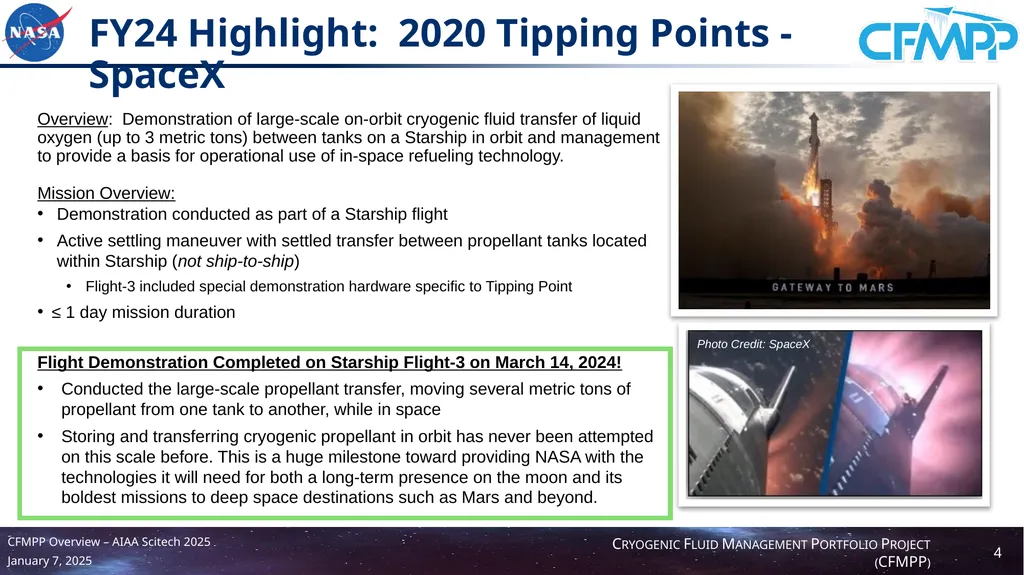
FY24 Highlight: 2020 Tipping Points - SpaceX Overview: Demonstration of large-scale on-orbit cryogenic fluid transfer of liquid oxygen (up to 3 metric tons) between tanks on a Starship in orbit and management to provide a basis for operational use of in-space refueling technology.
Mission Overview:
Demonstration conducted as part of a Starship flight
Active settling maneuver with settled transfer between propellant tanks located within Starship (not ship-to-ship)
Flight-3 included special demonstration hardware specific to Tipping Point
≤ 1 day mission duration
Flight Demonstration Completed on Starship Flight-3 on March 14, 2024!
Conducted the large-scale propellant transfer, moving several metric tons of propellant from one tank to another, while in space
Storing and transferring cryogenic propellant in orbit has never been attempted on this scale before. This is a huge milestone toward providing NASA with the technologies it will need for both a long-term presence on the moon and its boldest missions to deep space destinations such as Mars and beyond. Photo Credit: SpaceX<br>
05
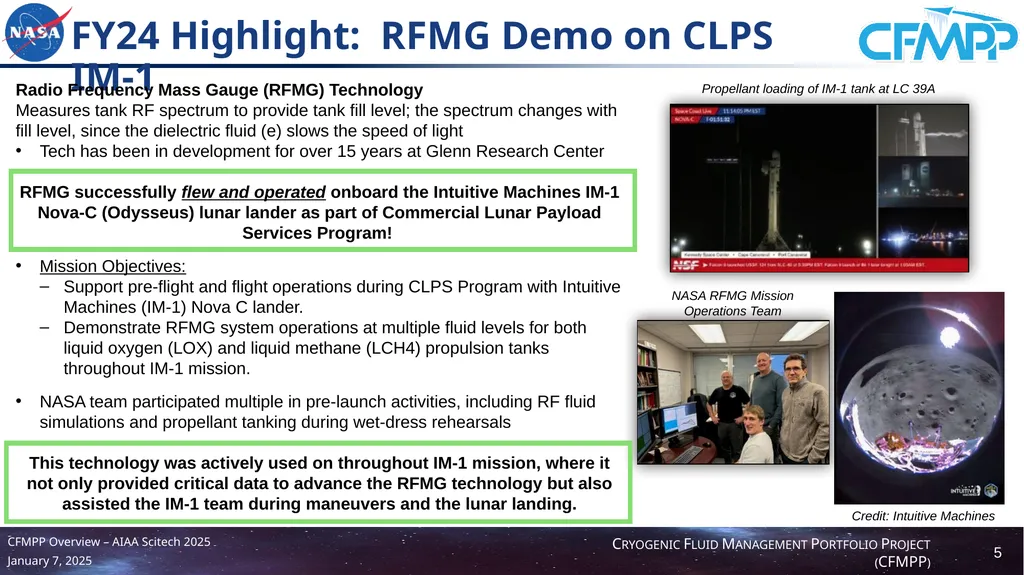
FY24 Highlight: RFMG Demo on CLPS IM-1 Radio Frequency Mass Gauge (RFMG) Technology
Measures tank RF spectrum to provide tank fill level; the spectrum changes with fill level, since the dielectric fluid (e) slows the speed of light
Tech has been in development for over 15 years at Glenn Research Center
RFMG successfully flew and operated onboard the Intuitive Machines IM-1 Nova-C (Odysseus) lunar lander as part of Commercial Lunar Payload Services Program!
Mission Objectives:
Support pre-flight and flight operations during CLPS Program with Intuitive Machines (IM-1) Nova C lander.
Demonstrate RFMG system operations at multiple fluid levels for both liquid oxygen (LOX) and liquid methane (LCH4) propulsion tanks throughout IM-1 mission.
NASA team participated multiple in pre-launch activities, including RF fluid simulations and propellant tanking during wet-dress rehearsals
This technology was actively used on throughout IM-1 mission, where it not only provided critical data to advance the RFMG technology but also assisted the IM-1 team during maneuvers and the lunar landing. Propellant loading of IM-1 tank at LC 39A NASA RFMG Mission Operations Team Credit: Intuitive Machines<br>
06
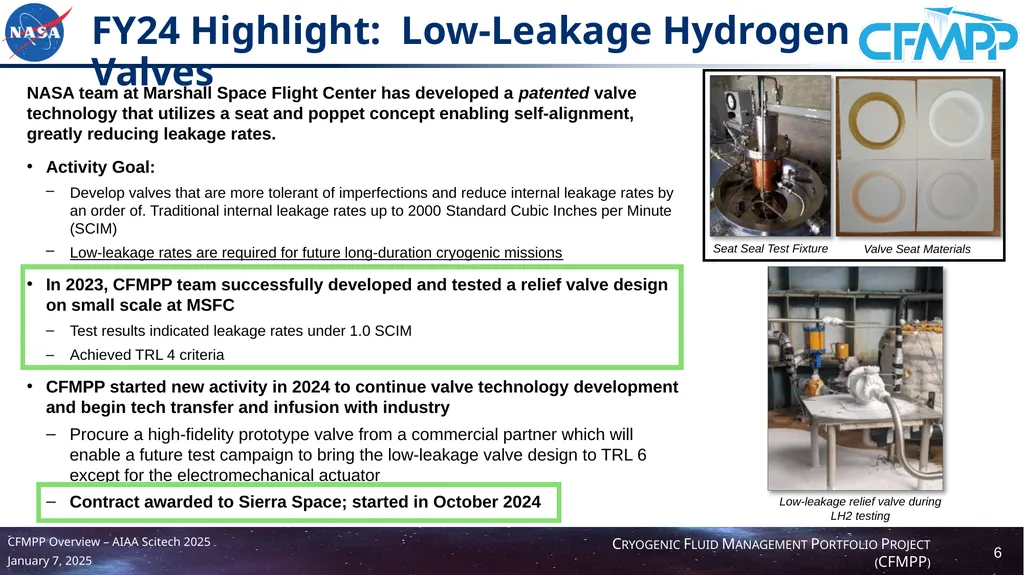
FY24 Highlight: Low-Leakage Hydrogen Valves NASA team at Marshall Space Flight Center has developed a patented valve technology that utilizes a seat and poppet concept enabling self-alignment, greatly reducing leakage rates.
Activity Goal:
Develop valves that are more tolerant of imperfections and reduce internal leakage rates by an order of. Traditional internal leakage rates up to 2000 Standard Cubic Inches per Minute (SCIM)
Low-leakage rates are required for future long-duration cryogenic missions
In 2023, CFMPP team successfully developed and tested a relief valve design on small scale at MSFC
Test results indicated leakage rates under 1.0 SCIM
Achieved TRL 4 criteria
CFMPP started new activity in 2024 to continue valve technology development and begin tech transfer and infusion with industry
Procure a high-fidelity prototype valve from a commercial partner which will enable a future test campaign to bring the low-leakage valve design to TRL 6 except for the electromechanical actuator
Contract awarded to Sierra Space; started in October 2024 6 Low-leakage relief valve during LH2 testing<br>
07
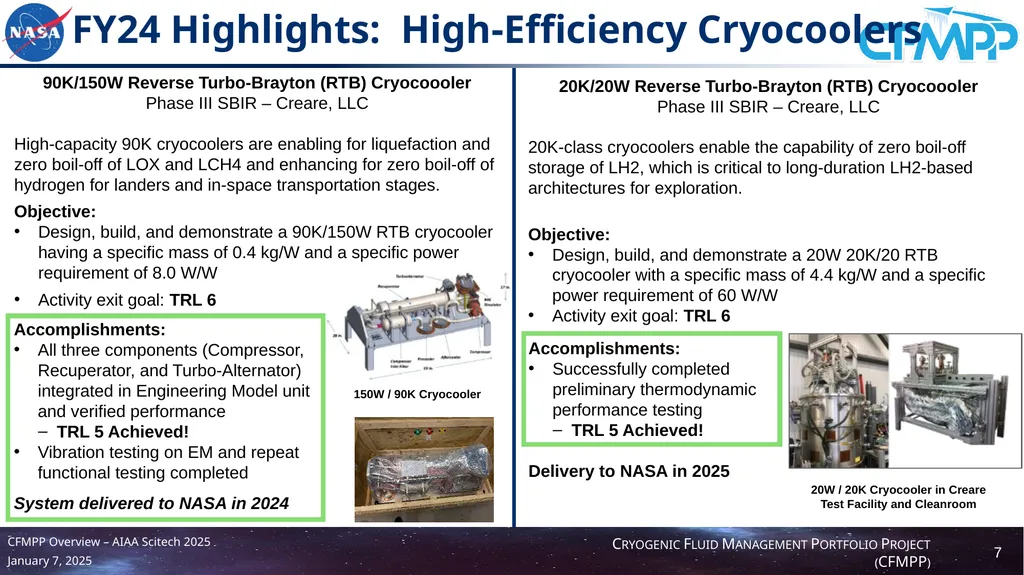
FY24 Highlights: High-Efficiency Cryocoolers 150W / 90K Cryocooler 90K/150W Reverse Turbo-Brayton (RTB) Cryocoooler
Phase III SBIR – Creare, LLC
High-capacity 90K cryocoolers are enabling for liquefaction and zero boil-off of LOX and LCH4 and enhancing for zero boil-off of hydrogen for landers and in-space transportation stages.
Objective:
Design, build, and demonstrate a 90K/150W RTB cryocooler having a specific mass of 0.4 kg/W and a specific power requirement of 8.0 W/W
Activity exit goal: TRL 6 20K/20W Reverse Turbo-Brayton (RTB) Cryocoooler
Phase III SBIR – Creare, LLC
20K-class cryocoolers enable the capability of zero boil-off storage of LH2, which is critical to long-duration LH2-based architectures for exploration.
Objective:
Design, build, and demonstrate a 20W 20K/20 RTB cryocooler with a specific mass of 4.4 kg/W and a specific power requirement of 60 W/W
Activity exit goal: TRL 6 20W / 20K Cryocooler in Creare Test Facility and Cleanroom Accomplishments:
All three components (Compressor, Recuperator, and Turbo-Alternator) integrated in Engineering Model unit and verified performance
TRL 5 Achieved!
Vibration testing on EM and repeat functional testing completed
System delivered to NASA in 2024 Accomplishments:
Successfully completed preliminary thermodynamic performance testing
TRL 5 Achieved!
Delivery to NASA in 2025<br>
Phase III SBIR – Creare, LLC
High-capacity 90K cryocoolers are enabling for liquefaction and zero boil-off of LOX and LCH4 and enhancing for zero boil-off of hydrogen for landers and in-space transportation stages.
Objective:
Design, build, and demonstrate a 90K/150W RTB cryocooler having a specific mass of 0.4 kg/W and a specific power requirement of 8.0 W/W
Activity exit goal: TRL 6 20K/20W Reverse Turbo-Brayton (RTB) Cryocoooler
Phase III SBIR – Creare, LLC
20K-class cryocoolers enable the capability of zero boil-off storage of LH2, which is critical to long-duration LH2-based architectures for exploration.
Objective:
Design, build, and demonstrate a 20W 20K/20 RTB cryocooler with a specific mass of 4.4 kg/W and a specific power requirement of 60 W/W
Activity exit goal: TRL 6 20W / 20K Cryocooler in Creare Test Facility and Cleanroom Accomplishments:
All three components (Compressor, Recuperator, and Turbo-Alternator) integrated in Engineering Model unit and verified performance
TRL 5 Achieved!
Vibration testing on EM and repeat functional testing completed
System delivered to NASA in 2024 Accomplishments:
Successfully completed preliminary thermodynamic performance testing
TRL 5 Achieved!
Delivery to NASA in 2025<br>
08
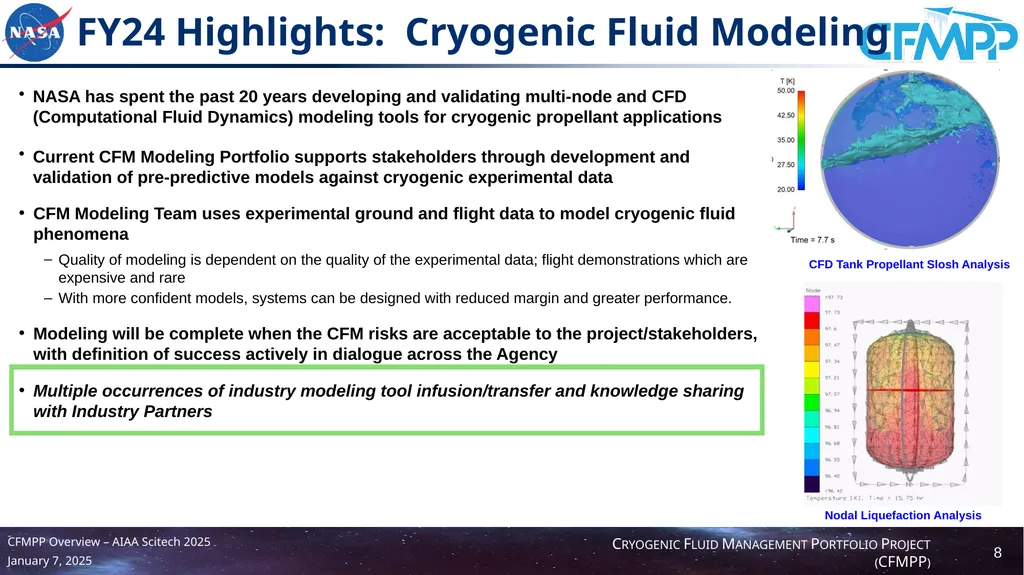
FY24 Highlights: Cryogenic Fluid Modeling NASA has spent the past 20 years developing and validating multi-node and CFD (Computational Fluid Dynamics) modeling tools for cryogenic propellant applications
Current CFM Modeling Portfolio supports stakeholders through development and validation of pre-predictive models against cryogenic experimental data
CFM Modeling Team uses experimental ground and flight data to model cryogenic fluid phenomena
Quality of modeling is dependent on the quality of the experimental data; flight demonstrations which are expensive and rare
With more confident models, systems can be designed with reduced margin and greater performance.
Modeling will be complete when the CFM risks are acceptable to the project/stakeholders, with definition of success actively in dialogue across the Agency
Multiple occurrences of industry modeling tool infusion/transfer and knowledge sharing with Industry Partners CFD Tank Propellant Slosh Analysis Nodal Liquefaction Analysis<br>
09
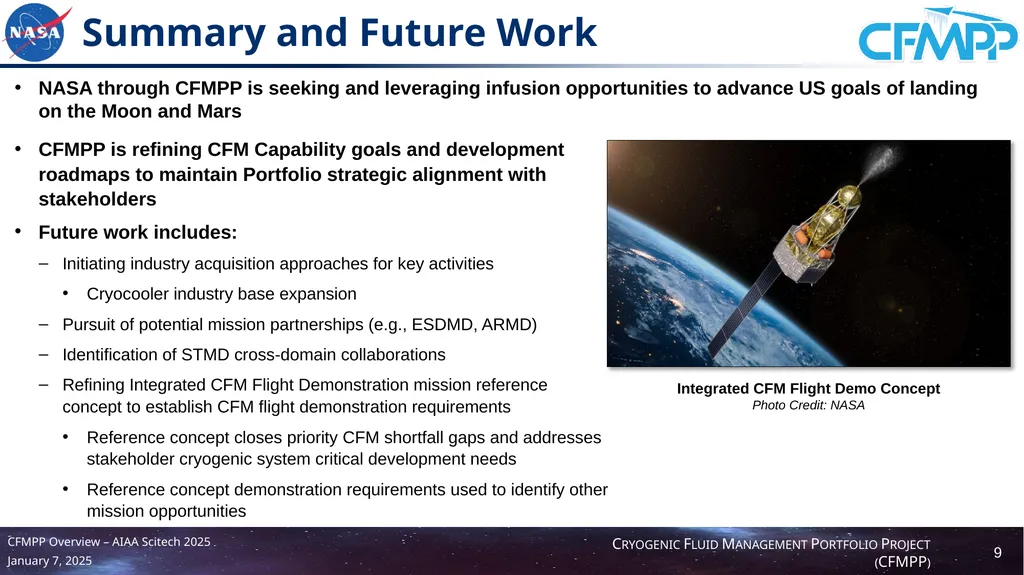
CFMPP is refining CFM Capability goals and development roadmaps to maintain Portfolio strategic alignment with stakeholders
Future work includes:
Initiating industry acquisition approaches for key activities
Cryocooler industry base expansion
Pursuit of potential mission partnerships (e.g., ESDMD, ARMD)
Identification of STMD cross-domain collaborations
Refining Integrated CFM Flight Demonstration mission reference concept to establish CFM flight demonstration requirements
Reference concept closes priority CFM shortfall gaps and addresses stakeholder cryogenic system critical development needs
Reference concept demonstration requirements used to identify other mission opportunities Summary and Future Work Integrated CFM Flight Demo Concept
Photo Credit: NASA NASA through CFMPP is seeking and leveraging infusion opportunities to advance US goals of landing on the Moon and Mars<br>
10
QUESTIONS?<br>
11
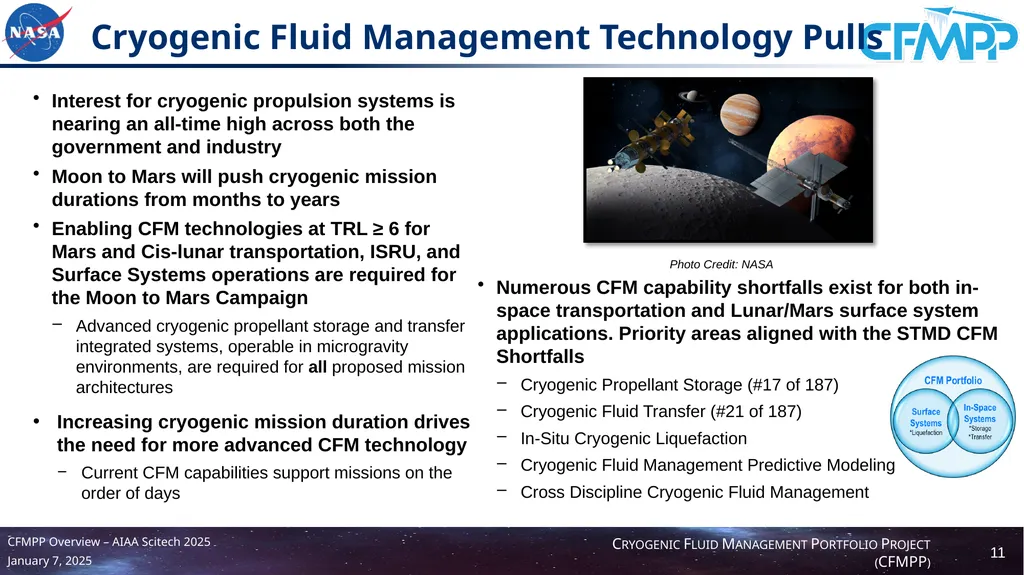
Cryogenic Fluid Management Technology Pulls Interest for cryogenic propulsion systems is nearing an all-time high across both the government and industry
Moon to Mars will push cryogenic mission durations from months to years
Enabling CFM technologies at TRL ≥ 6 for Mars and Cis-lunar transportation, ISRU, and Surface Systems operations are required for the Moon to Mars Campaign
Advanced cryogenic propellant storage and transfer integrated systems, operable in microgravity environments, are required for all proposed mission architectures
Increasing cryogenic mission duration drives the need for more advanced CFM technology
Current CFM capabilities support missions on the order of days Photo Credit: NASA Numerous CFM capability shortfalls exist for both in-space transportation and Lunar/Mars surface system applications. Priority areas aligned with the STMD CFM Shortfalls
Cryogenic Propellant Storage (#17 of 187)
Cryogenic Fluid Transfer (#21 of 187)
In-Situ Cryogenic Liquefaction
Cryogenic Fluid Management Predictive Modeling
Cross Discipline Cryogenic Fluid Management<br>
12
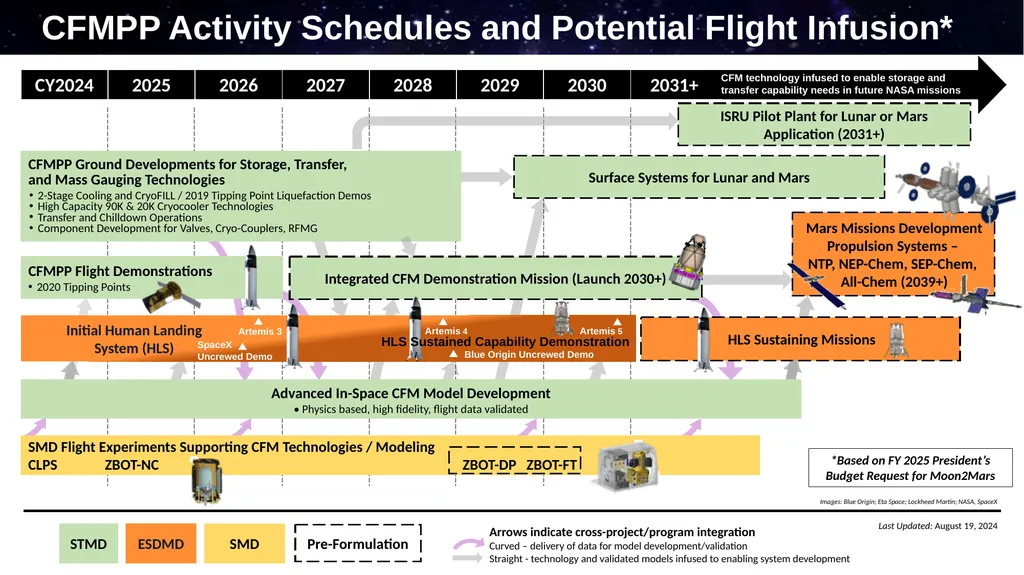
Integrated CFM Demonstration Mission (Launch 2030+) Surface Systems for Lunar and Mars CFMPP Activity Schedules and Potential Flight Infusion* SMD Flight Experiments Supporting CFM Technologies / Modeling
CLPS ZBOT-NC ZBOT-DP ZBOT-FT CFMPP Flight Demonstrations
2020 Tipping Points Artemis 4 Artemis 3 Images: Blue Origin; Eta Space; Lockheed Martin; NASA, SpaceX Initial Human Landing
System (HLS) Mars Missions Development
Propulsion Systems –
NTP, NEP-Chem, SEP-Chem,
All-Chem (2039+) HLS Sustaining Missions Advanced In-Space CFM Model Development
• Physics based, high fidelity, flight data validated CFM technology infused to enable storage and transfer capability needs in future NASA missions SpaceX
Uncrewed Demo Artemis 5 Blue Origin Uncrewed Demo ISRU Pilot Plant for Lunar or Mars Application (2031+) CFMPP Ground Developments for Storage, Transfer, and Mass Gauging Technologies 2-Stage Cooling and CryoFILL / 2019 Tipping Point Liquefaction Demos
High Capacity 90K & 20K Cryocooler Technologies
Transfer and Chilldown Operations
Component Development for Valves, Cryo-Couplers, RFMG HLS Sustained Capability Demonstration Last Updated: August 19, 2024 *Based on FY 2025 President’s Budget Request for Moon2Mars<br>