Job analysis, Job Description, Job Specification and Job Design, Chapter 4 Job Analysis is a primary tool to collect job-related data. The process results in collecting and recording two data sets including job description and job
"Job analysis, Job Description, Job Specification" is the property of its rightful owner. Permission is granted to
download and print the materials on this website for personal, non-commercial use only, and to display it
on your personal computer provided you do not modify the materials and that you retain all copyright
notices contained in the materials. By downloading content from our website, you accept the terms of this
agreement.
Job Analysis is a primary tool to collect job-related data. The process results in collecting and recording two data sets including job description and job specification. Any job vacancy cannot be filled until and unless HR manager has these two sets of data. It is necessary to define them accurately in order to fit the right person at the right place and at the right time. This helps both employer and employee understand what exactly needs to be delivered and how. Both job description and job specification are essential parts of job analysis information. Writing them clearly and accurately helps organization and workers cope with many challenges while onboard. Job Analysis<br>
03
Though preparing job description and job specification are not legal requirements yet play a vital role in getting the desired outcome. These data sets help in determining the necessity, worth and scope of a specific job.
Job Description:
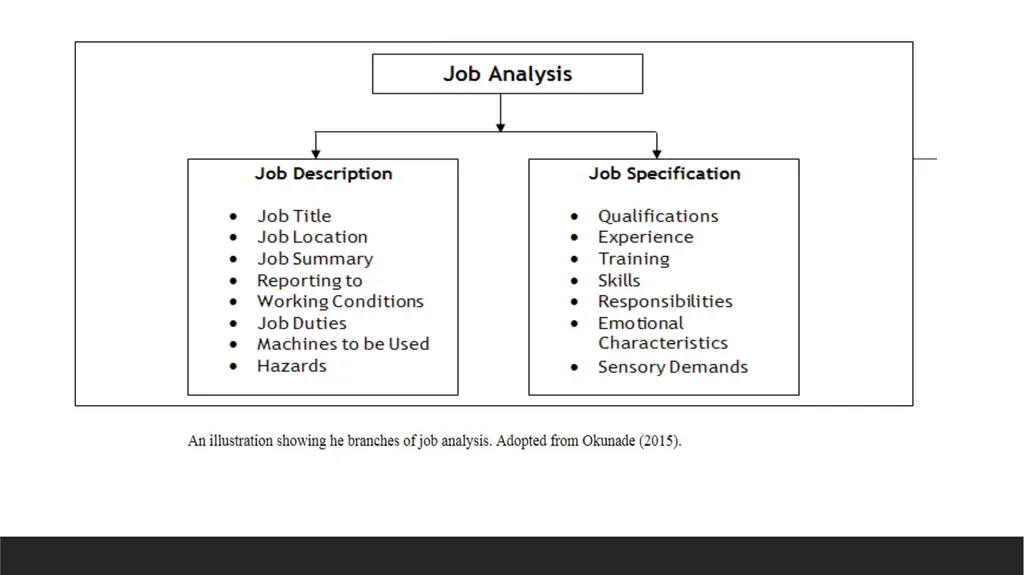
Job description includes basic job-related data that is useful to advertise a specific job and attract a pool of talent. It includes information such as job title, job location, reporting to and of employees, job summary, nature and objectives of a job, tasks and duties to be performed, working conditions, machines, tools and equipment to be used by a prospective worker and hazards involved in it.<br>
04
Purpose of Job Description The main purpose of job description is to collect job-related data in order to advertise for a particular job. It helps in attracting, targeting, recruiting and selecting the right candidate for the right job.
It is done to determine what needs to be delivered in a particular job. It clarifies what employees are supposed to do if selected for that particular job opening.
It gives recruiting staff a clear view what kind of candidate is required by a particular department or division to perform a specific task or job.
It also clarifies who will report to whom.<br>
05
Job Specification:
Also known as employee specifications, a job specification is a written statement of educational qualifications, specific qualities, level of experience, physical, emotional, technical and communication skills required to perform a job, responsibilities involved in a job and other unusual sensory demands. It also includes general health, mental health, intelligence, aptitude, memory, judgment, leadership skills, emotional ability, adaptability, flexibility, values and ethics, manners and creativity, etc.<br>
06
2. Job Design:
Job design follows job analysis i.e. it is the next step after job analysis. It aims at outlining and organizing tasks, duties and responsibilities into a single unit of work for the achievement of certain objectives. It also outlines the methods and relationships that are essential for the success of a certain job. In simpler terms it refers to the what, how much, how many and the order of the tasks for a job/s.
Job design essentially involves integrating job responsibilities or content and certain qualifications that are required to perform the same. It outlines the job responsibilities very clearly and also helps in attracting the right candidates to the right job. Further it also makes the job look interesting and specialized.<br>
07
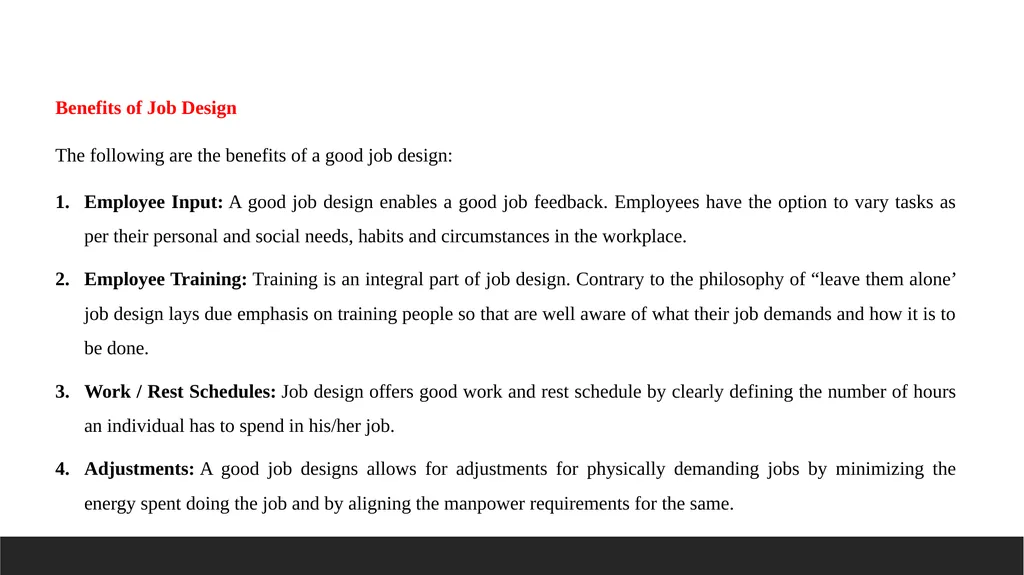
Benefits of Job Design
The following are the benefits of a good job design:
Employee Input: A good job design enables a good job feedback. Employees have the option to vary tasks as per their personal and social needs, habits and circumstances in the workplace.
Employee Training: Training is an integral part of job design. Contrary to the philosophy of “leave them alone’ job design lays due emphasis on training people so that are well aware of what their job demands and how it is to be done.
Work / Rest Schedules: Job design offers good work and rest schedule by clearly defining the number of hours an individual has to spend in his/her job.
Adjustments: A good job designs allows for adjustments for physically demanding jobs by minimizing the energy spent doing the job and by aligning the manpower requirements for the same.<br>
08
Conclusion:
Job design is a continuous and ever evolving process that is aimed at helping employees make adjustments with the changes in the workplace. The end goal is reducing dissatisfaction, enhancing motivation and employee engagement at the workplace.