
Key Topics Ch 3 & 4 © 2015 Cengage Learning
EM
Published · 35 slides · 0 views
1 / 1

Description
Key Topics Ch 3 4 2015 Cengage Learning 1 Covering Key Topics need more time than expected Because importance of each topic is different That is why Discussions for each group on the Blackboard was created. It can be used for any
Related Topics
Share
Embed code
Download this presentation From Below
"Key Topics Ch 3 & 4 © 2015 Cengage Learning" is the property of its rightful owner. Permission is granted to download and print the materials on this website for personal, non-commercial use only, and to display it on your personal computer provided you do not modify the materials and that you retain all copyright notices contained in the materials. By downloading content from our website, you accept the terms of this agreement.
Presentation Transcript
01
Key Topics
Ch 3 & 4 © 2015 Cengage Learning 1<br>
02
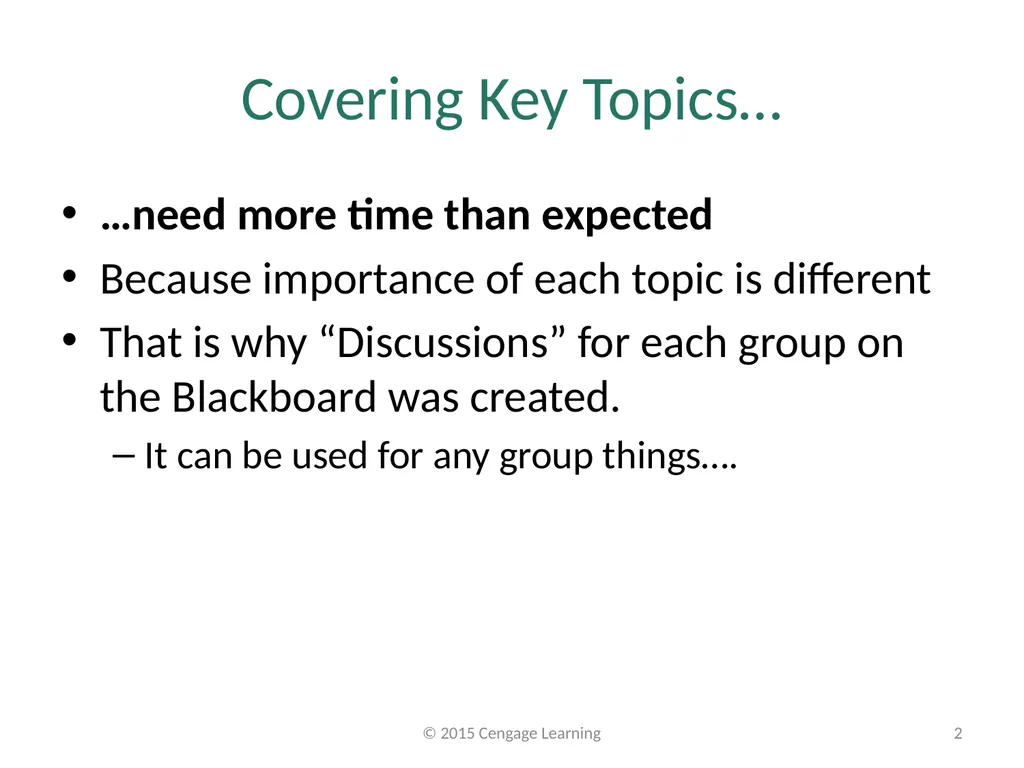
Covering Key Topics… …need more time than expected
Because importance of each topic is different
That is why “Discussions” for each group on the Blackboard was created.
It can be used for any group things…. © 2015 Cengage Learning 2<br>
Because importance of each topic is different
That is why “Discussions” for each group on the Blackboard was created.
It can be used for any group things…. © 2015 Cengage Learning 2<br>
03
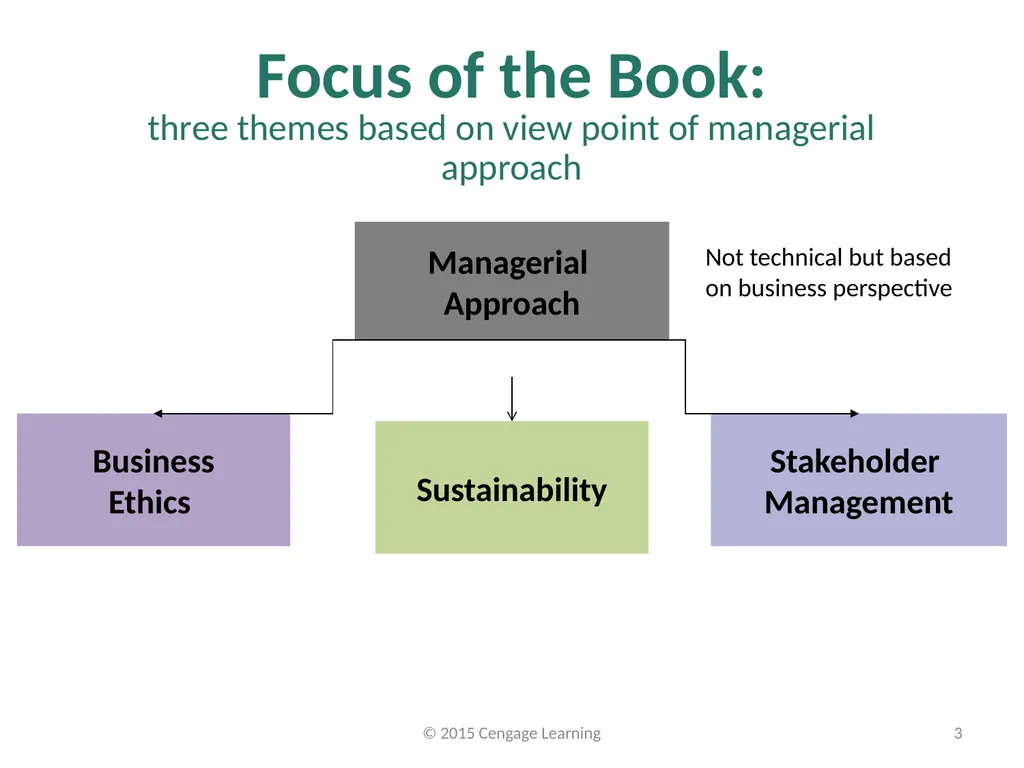
Focus of the Book:
three themes based on view point of managerial approach Sustainability © 2015 Cengage Learning 3 Not technical but based on business perspective<br>
04
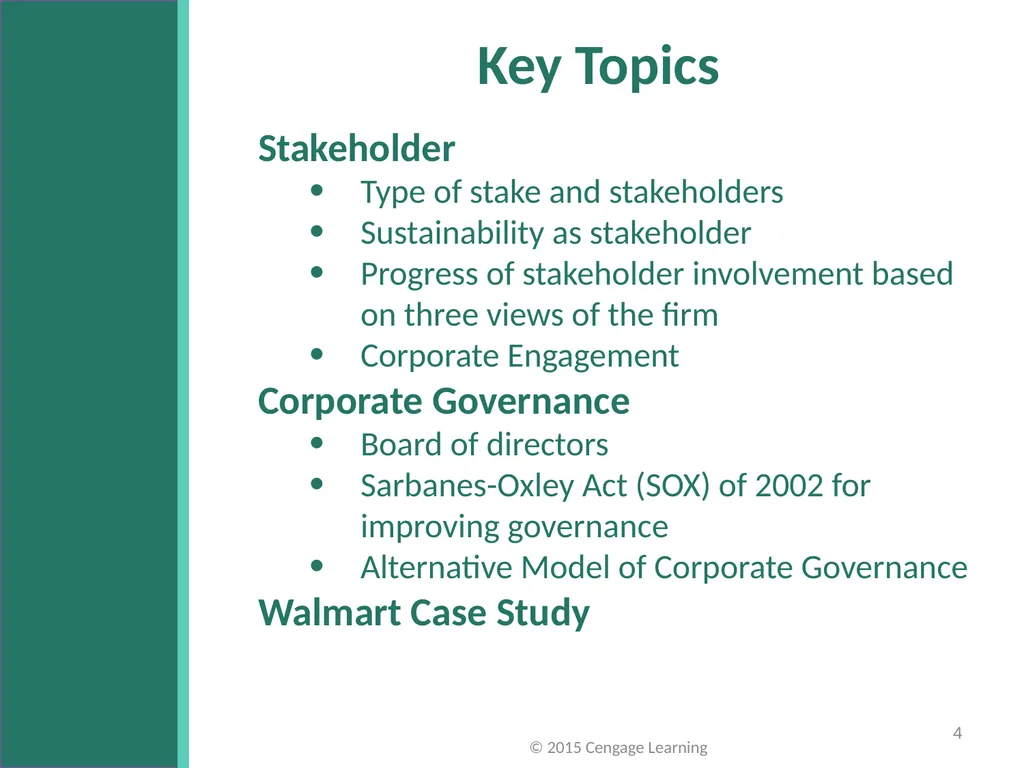
Key Topics Stakeholder
Type of stake and stakeholders
Sustainability as stakeholder
Progress of stakeholder involvement based on three views of the firm
Corporate Engagement
Corporate Governance
Board of directors
Sarbanes-Oxley Act (SOX) of 2002 for improving governance
Alternative Model of Corporate Governance
Walmart Case Study © 2015 Cengage Learning 4<br>
Type of stake and stakeholders
Sustainability as stakeholder
Progress of stakeholder involvement based on three views of the firm
Corporate Engagement
Corporate Governance
Board of directors
Sarbanes-Oxley Act (SOX) of 2002 for improving governance
Alternative Model of Corporate Governance
Walmart Case Study © 2015 Cengage Learning 4<br>
05
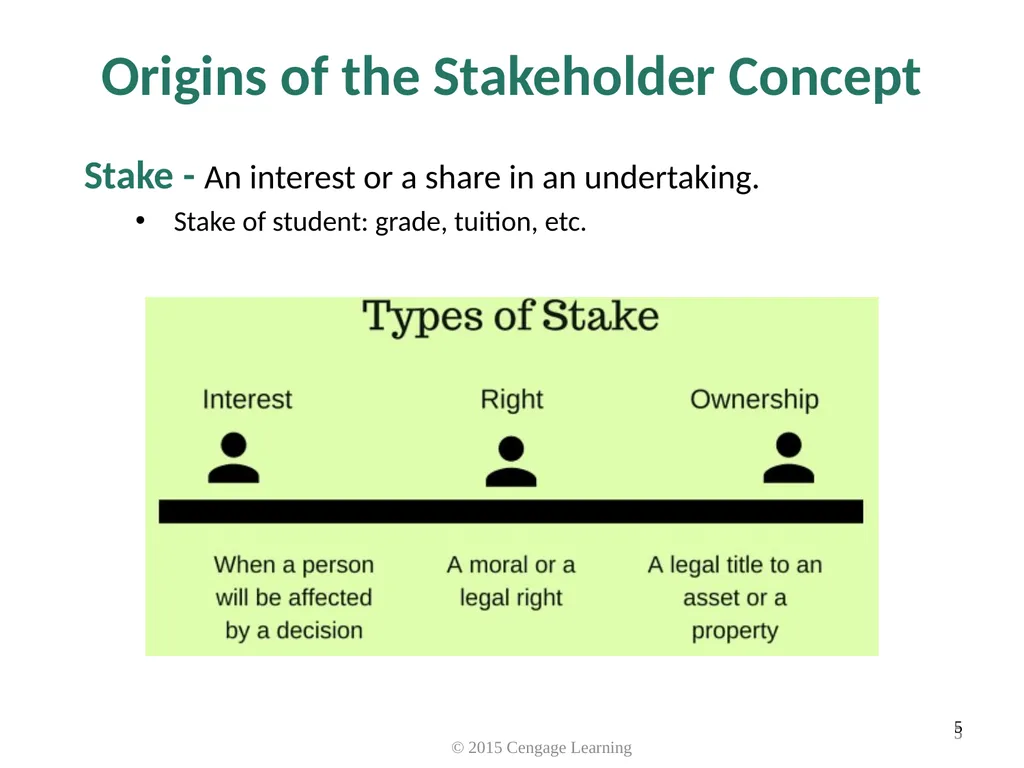
Origins of the Stakeholder Concept Stake - An interest or a share in an undertaking.
Stake of student: grade, tuition, etc. © 2015 Cengage Learning 5 5 5<br>
Stake of student: grade, tuition, etc. © 2015 Cengage Learning 5 5 5<br>
06
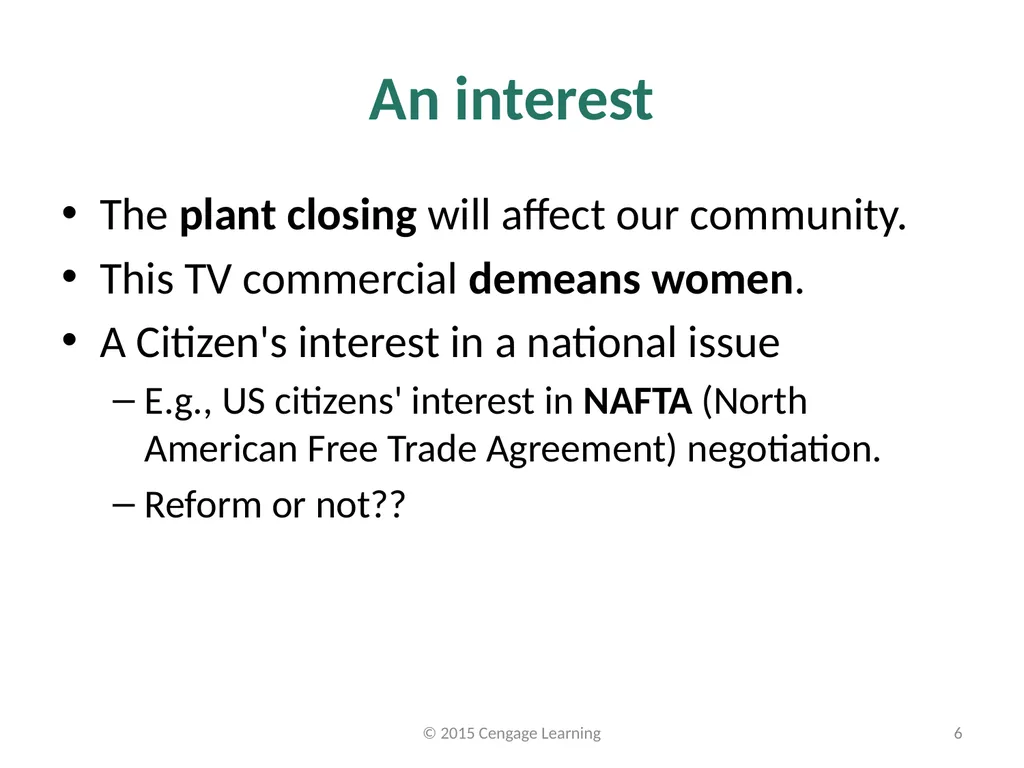
An interest The plant closing will affect our community.
This TV commercial demeans women.
A Citizen's interest in a national issue
E.g., US citizens' interest in NAFTA (North American Free Trade Agreement) negotiation.
Reform or not?? © 2015 Cengage Learning 6<br>
This TV commercial demeans women.
A Citizen's interest in a national issue
E.g., US citizens' interest in NAFTA (North American Free Trade Agreement) negotiation.
Reform or not?? © 2015 Cengage Learning 6<br>
07
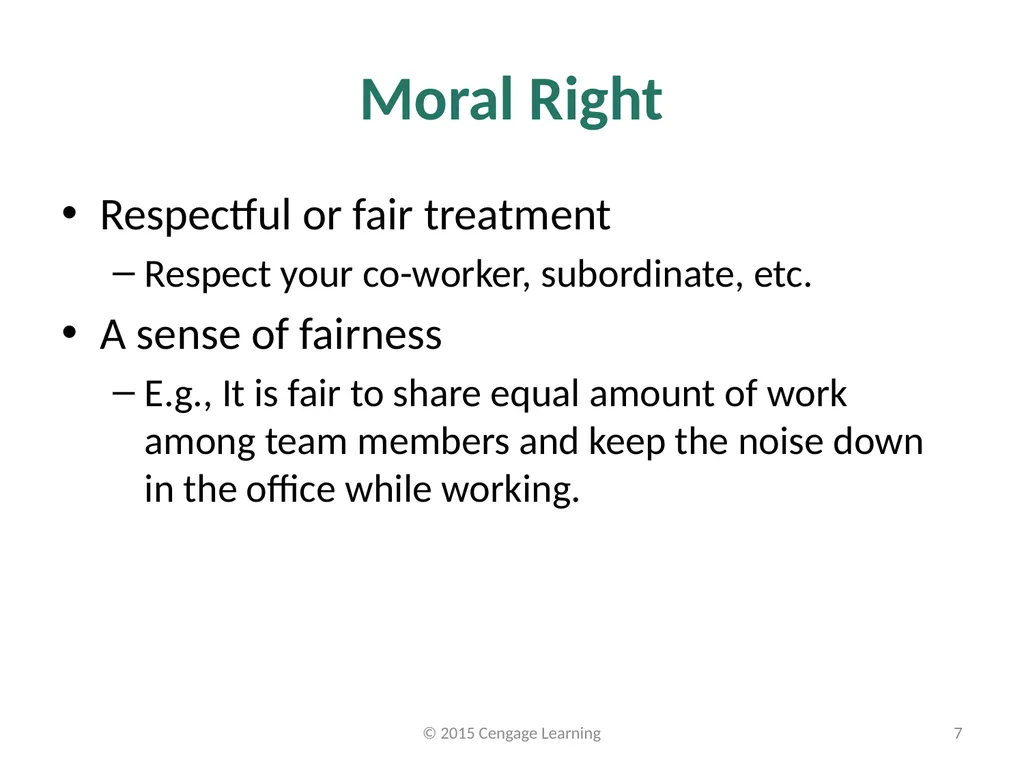
Moral Right Respectful or fair treatment
Respect your co-worker, subordinate, etc.
A sense of fairness
E.g., It is fair to share equal amount of work among team members and keep the noise down in the office while working. © 2015 Cengage Learning 7<br>
Respect your co-worker, subordinate, etc.
A sense of fairness
E.g., It is fair to share equal amount of work among team members and keep the noise down in the office while working. © 2015 Cengage Learning 7<br>
08
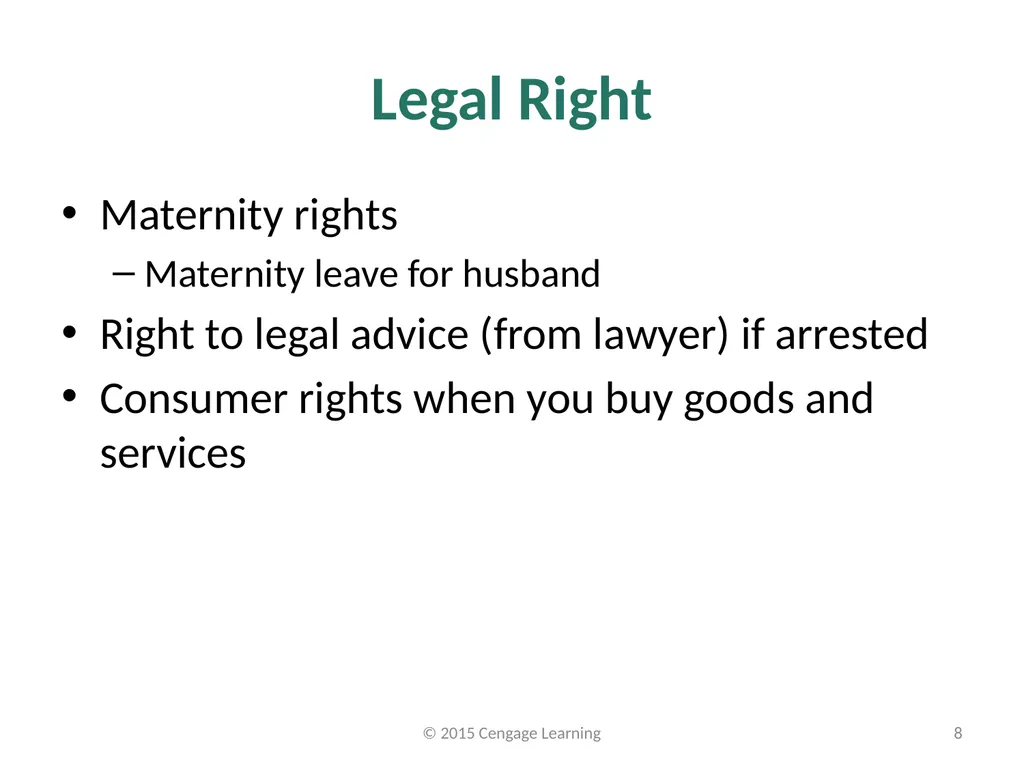
Legal Right Maternity rights
Maternity leave for husband
Right to legal advice (from lawyer) if arrested
Consumer rights when you buy goods and services © 2015 Cengage Learning 8<br>
Maternity leave for husband
Right to legal advice (from lawyer) if arrested
Consumer rights when you buy goods and services © 2015 Cengage Learning 8<br>
09
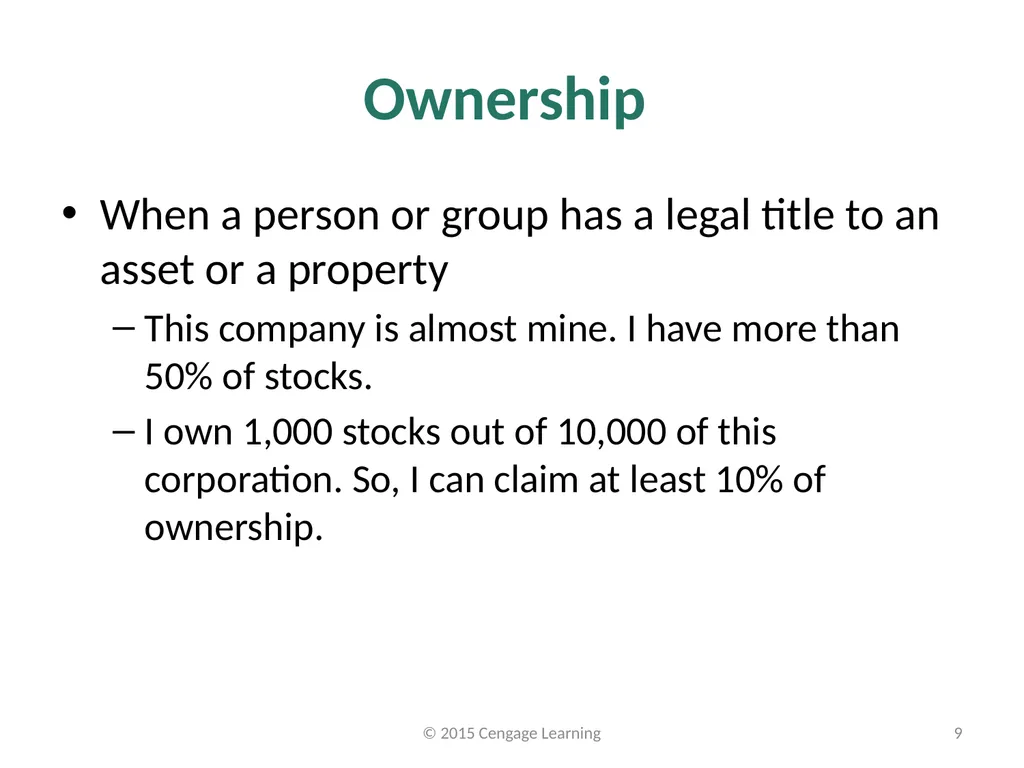
Ownership When a person or group has a legal title to an asset or a property
This company is almost mine. I have more than 50% of stocks.
I own 1,000 stocks out of 10,000 of this corporation. So, I can claim at least 10% of ownership. © 2015 Cengage Learning 9<br>
This company is almost mine. I have more than 50% of stocks.
I own 1,000 stocks out of 10,000 of this corporation. So, I can claim at least 10% of ownership. © 2015 Cengage Learning 9<br>
10
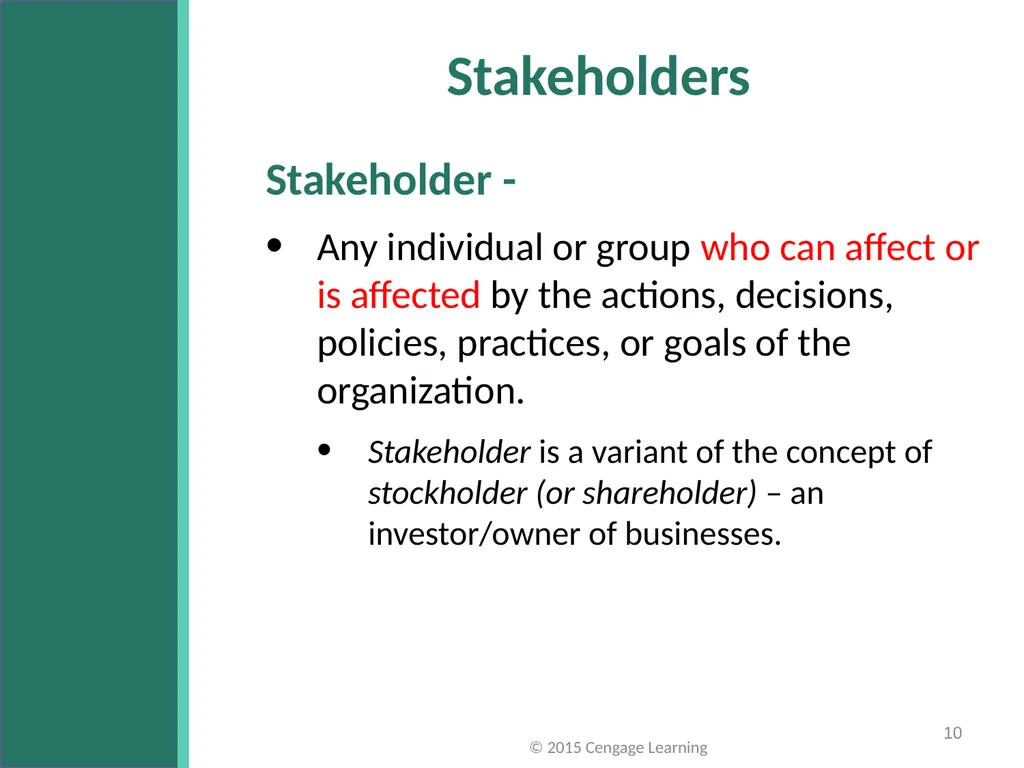
Stakeholders Stakeholder -
Any individual or group who can affect or is affected by the actions, decisions, policies, practices, or goals of the organization.
Stakeholder is a variant of the concept of stockholder (or shareholder) – an investor/owner of businesses. © 2015 Cengage Learning 10<br>
Any individual or group who can affect or is affected by the actions, decisions, policies, practices, or goals of the organization.
Stakeholder is a variant of the concept of stockholder (or shareholder) – an investor/owner of businesses. © 2015 Cengage Learning 10<br>
11
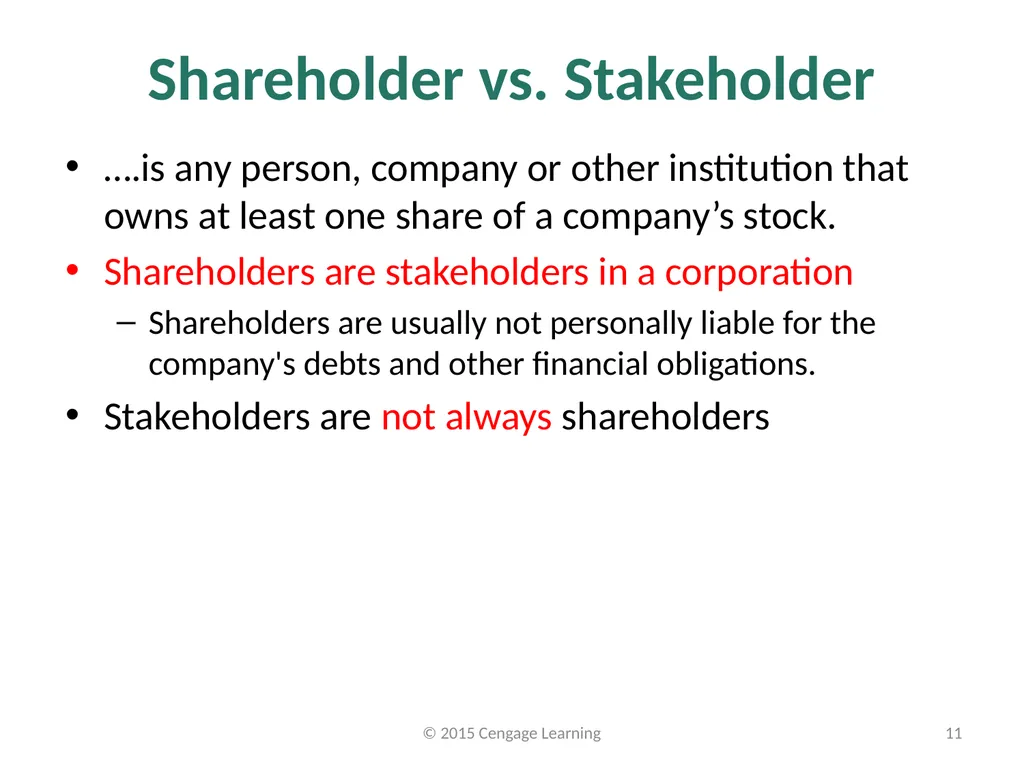
Shareholder vs. Stakeholder ….is any person, company or other institution that owns at least one share of a company’s stock.
Shareholders are stakeholders in a corporation
Shareholders are usually not personally liable for the company's debts and other financial obligations.
Stakeholders are not always shareholders © 2015 Cengage Learning 11<br>
Shareholders are stakeholders in a corporation
Shareholders are usually not personally liable for the company's debts and other financial obligations.
Stakeholders are not always shareholders © 2015 Cengage Learning 11<br>
12
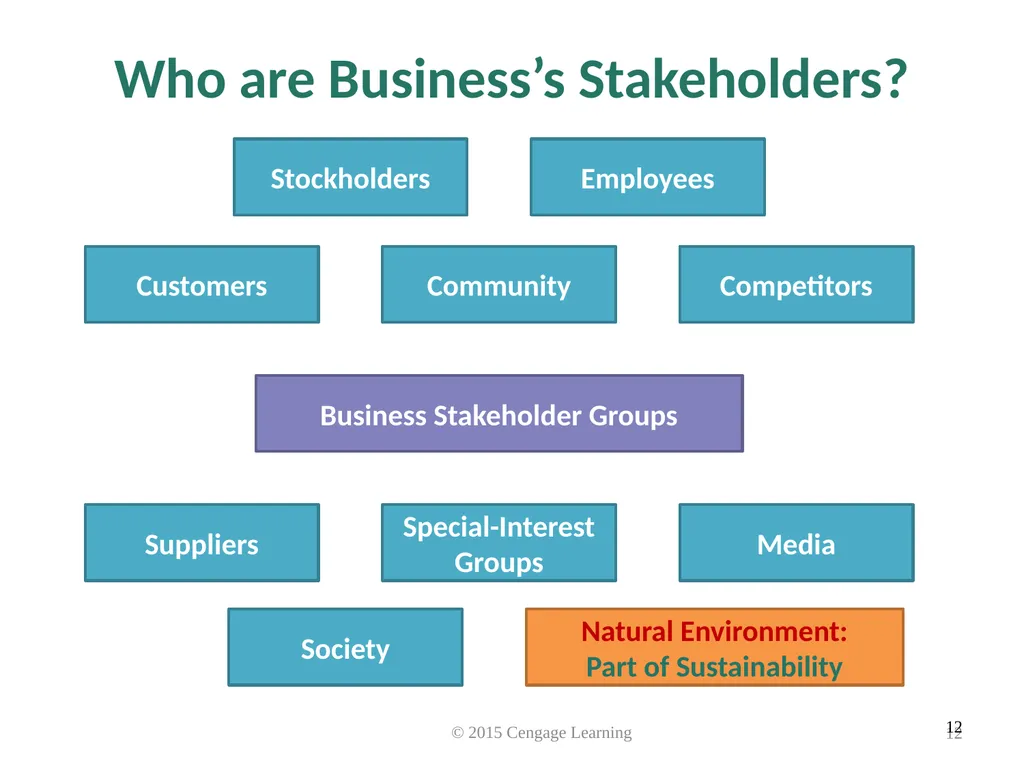
Who are Business’s Stakeholders? © 2015 Cengage Learning 12 12<br>
13
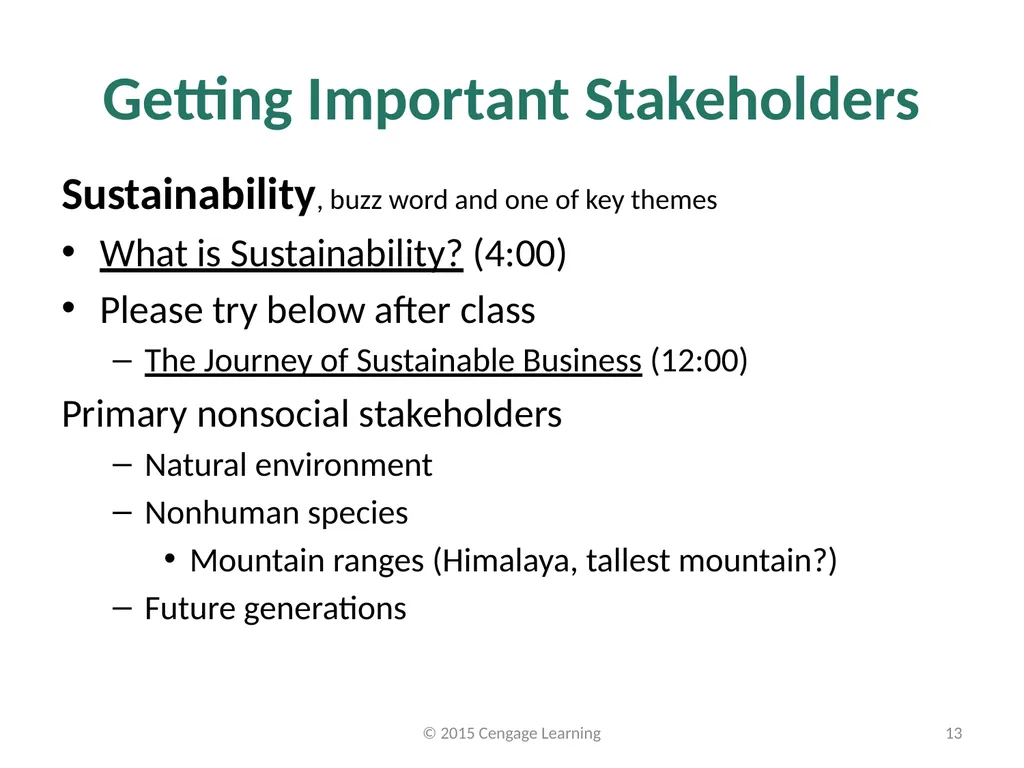
Getting Important Stakeholders Sustainability, buzz word and one of key themes
What is Sustainability? (4:00)
Please try below after class
The Journey of Sustainable Business (12:00)
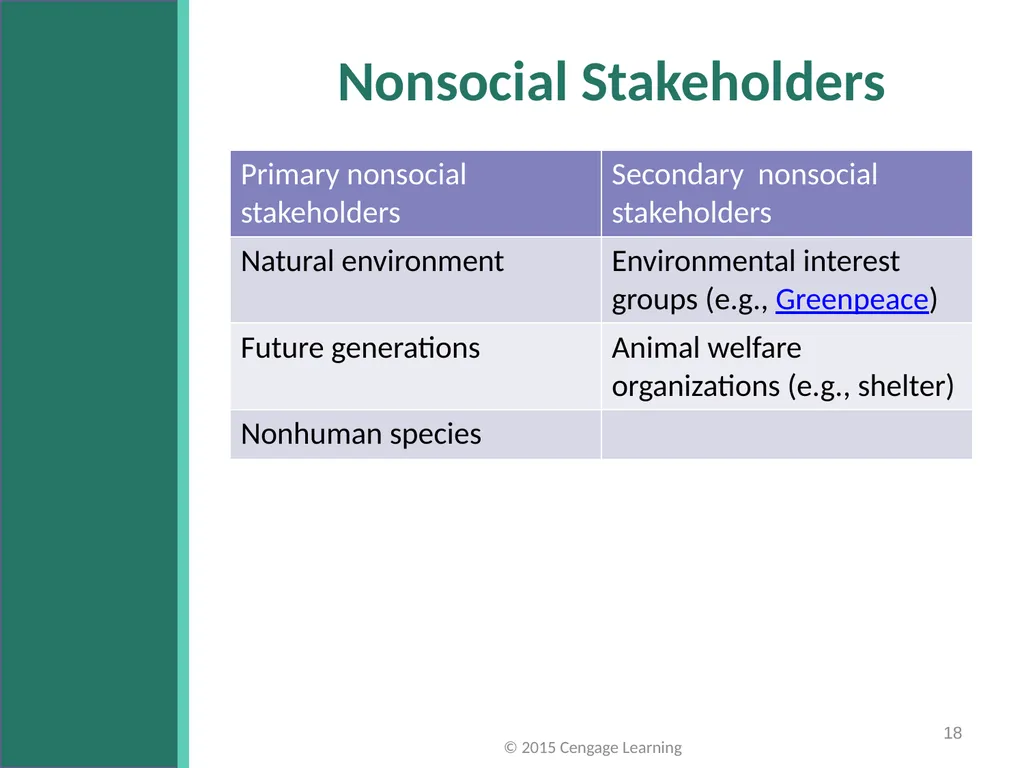
Primary nonsocial stakeholders
Natural environment
Nonhuman species
Mountain ranges (Himalaya, tallest mountain?)
Future generations © 2015 Cengage Learning 13<br>
What is Sustainability? (4:00)
Please try below after class
The Journey of Sustainable Business (12:00)
Primary nonsocial stakeholders
Natural environment
Nonhuman species
Mountain ranges (Himalaya, tallest mountain?)
Future generations © 2015 Cengage Learning 13<br>
14
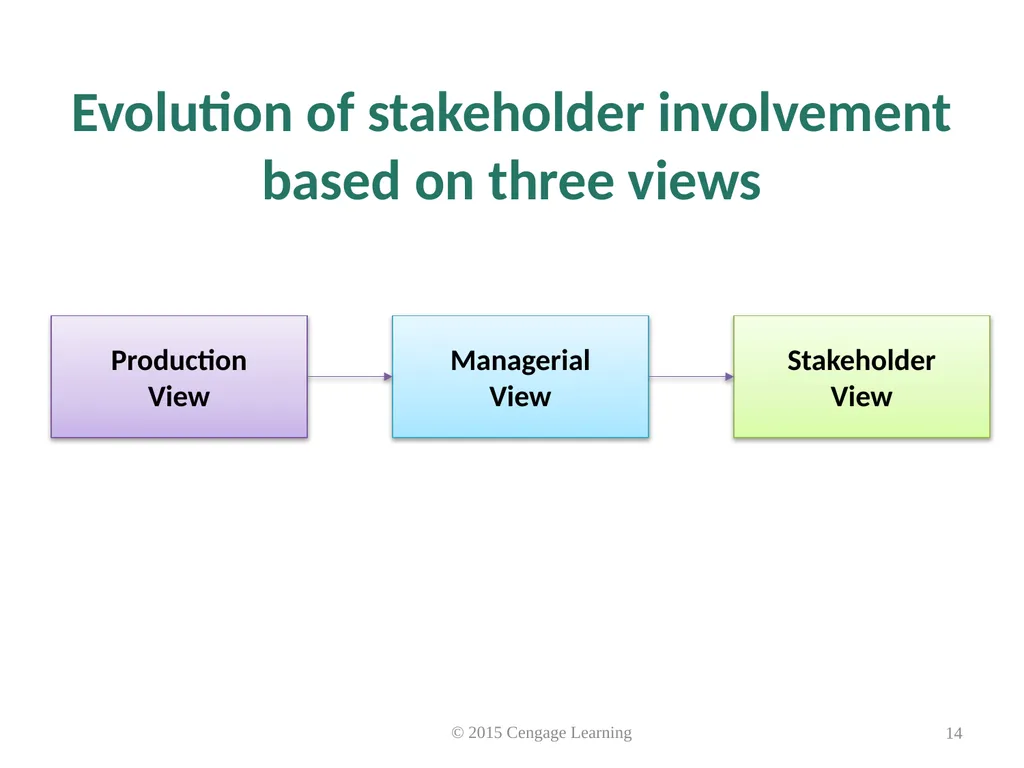
Evolution of stakeholder involvement
based on three views © 2015 Cengage Learning 14<br>
15
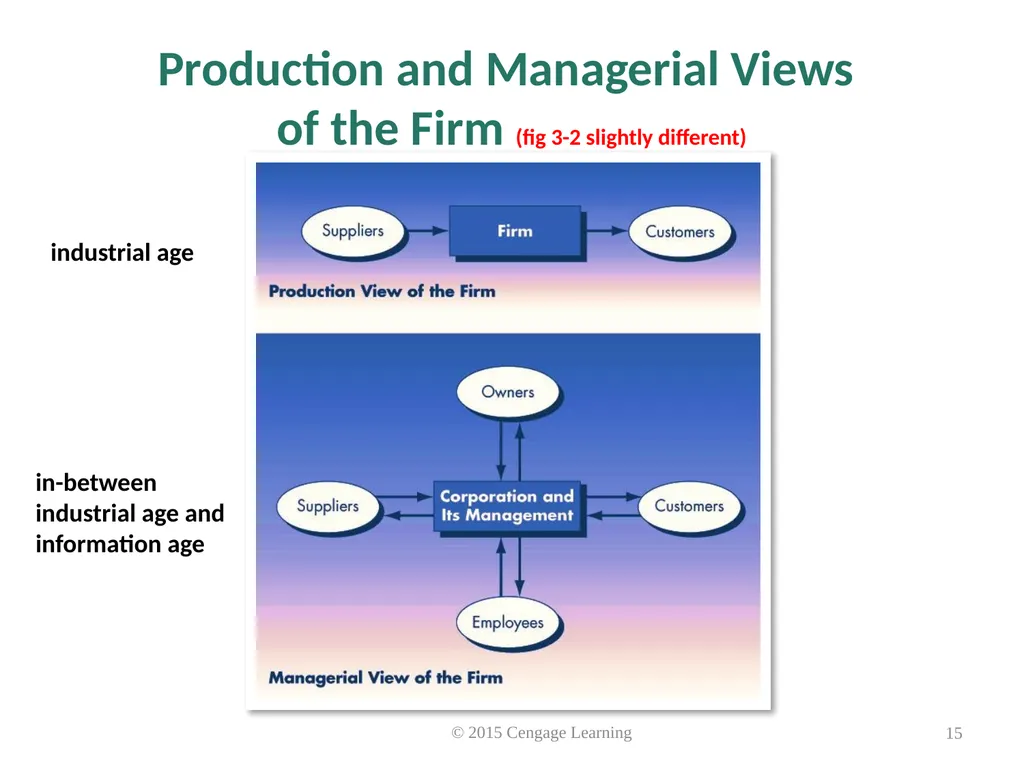
Production and Managerial Views
of the Firm (fig 3-2 slightly different) © 2015 Cengage Learning 15 industrial age in-between industrial age and information age<br>
16
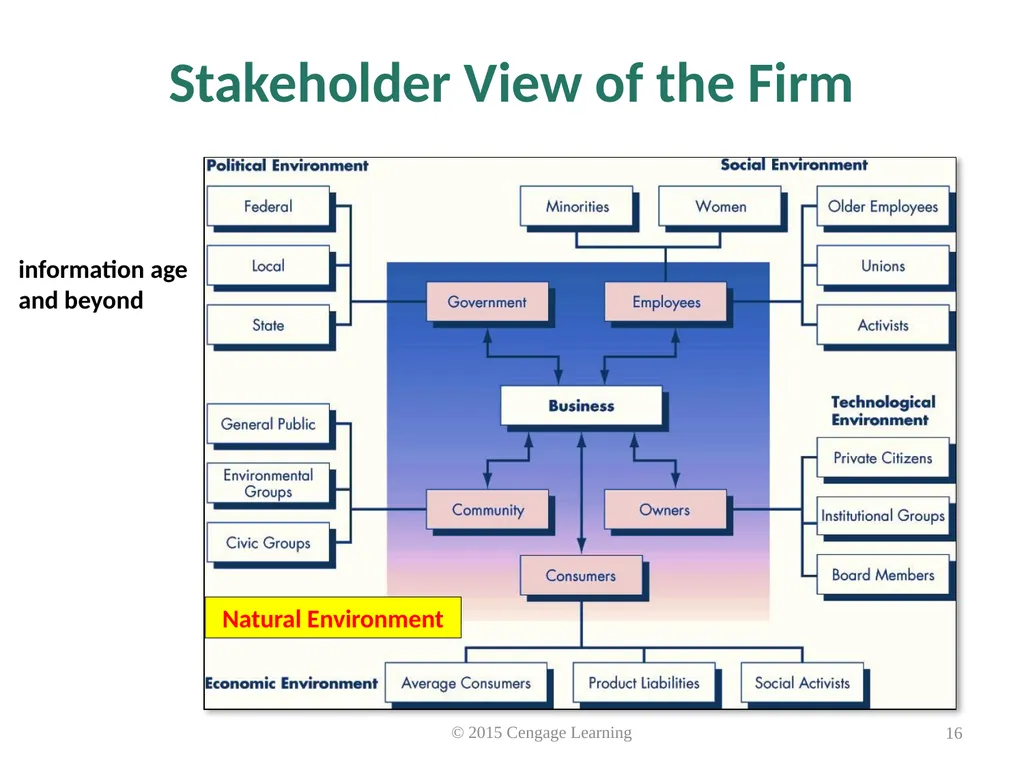
Stakeholder View of the Firm © 2015 Cengage Learning 16 information age and beyond Natural Environment<br>
17
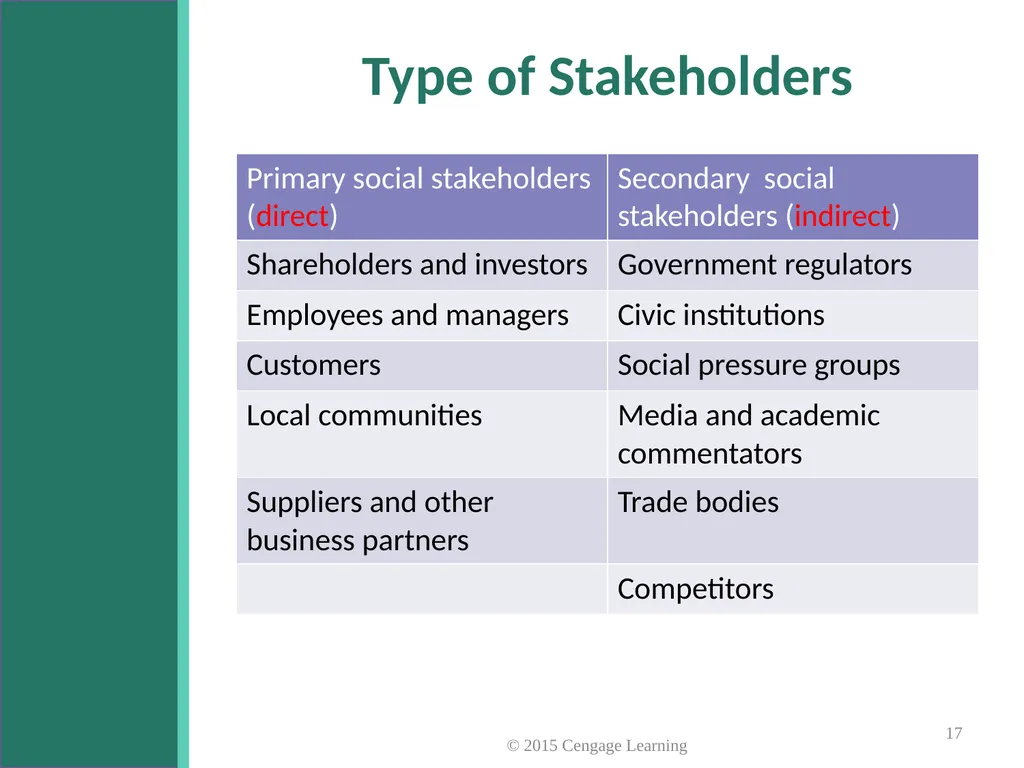
Type of Stakeholders © 2015 Cengage Learning 17<br>
18
Nonsocial Stakeholders © 2015 Cengage Learning 18<br>
19
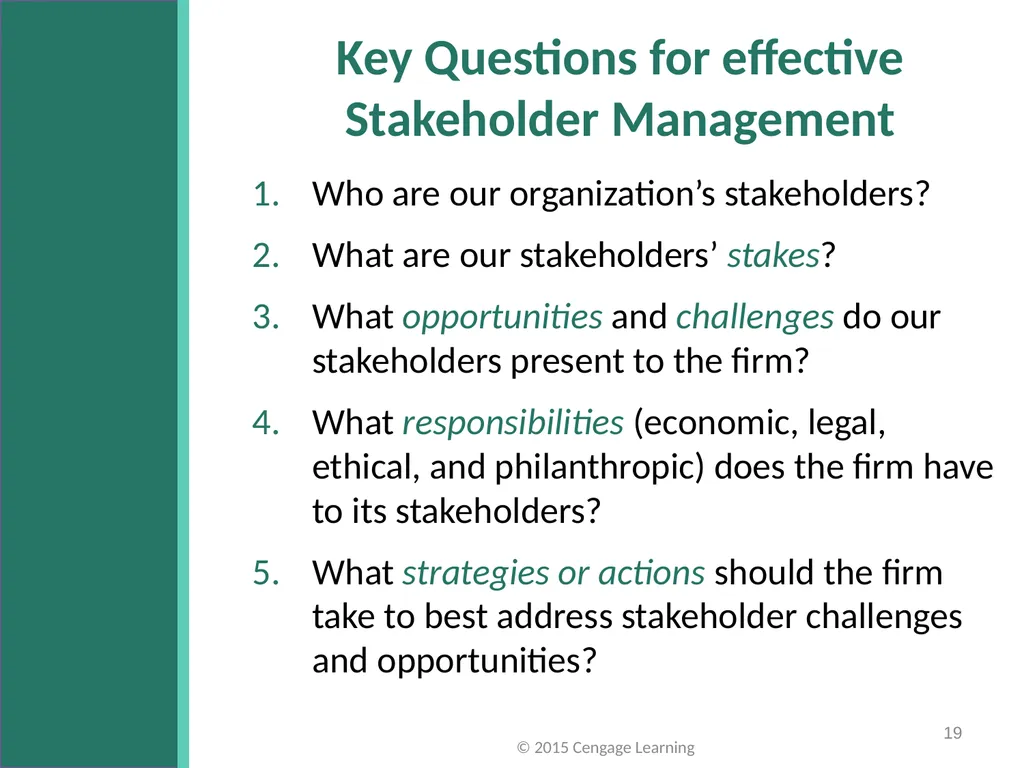
Key Questions for effective
Stakeholder Management Who are our organization’s stakeholders?
What are our stakeholders’ stakes?
What opportunities and challenges do our stakeholders present to the firm?
What responsibilities (economic, legal, ethical, and philanthropic) does the firm have to its stakeholders?
What strategies or actions should the firm take to best address stakeholder challenges and opportunities? © 2015 Cengage Learning 19<br>
What are our stakeholders’ stakes?
What opportunities and challenges do our stakeholders present to the firm?
What responsibilities (economic, legal, ethical, and philanthropic) does the firm have to its stakeholders?
What strategies or actions should the firm take to best address stakeholder challenges and opportunities? © 2015 Cengage Learning 19<br>
20
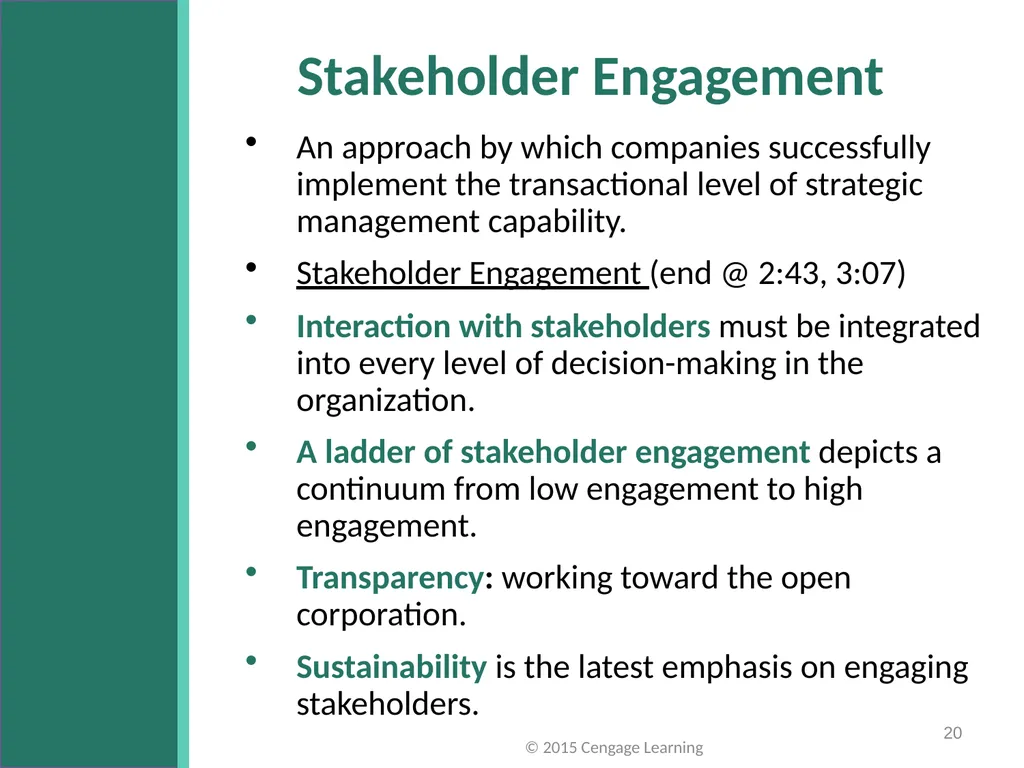
Stakeholder Engagement An approach by which companies successfully implement the transactional level of strategic management capability.
Stakeholder Engagement (end @ 2:43, 3:07)
Interaction with stakeholders must be integrated into every level of decision-making in the organization.
A ladder of stakeholder engagement depicts a continuum from low engagement to high engagement.
Transparency: working toward the open corporation.
Sustainability is the latest emphasis on engaging stakeholders. © 2015 Cengage Learning 20<br>
Stakeholder Engagement (end @ 2:43, 3:07)
Interaction with stakeholders must be integrated into every level of decision-making in the organization.
A ladder of stakeholder engagement depicts a continuum from low engagement to high engagement.
Transparency: working toward the open corporation.
Sustainability is the latest emphasis on engaging stakeholders. © 2015 Cengage Learning 20<br>
21
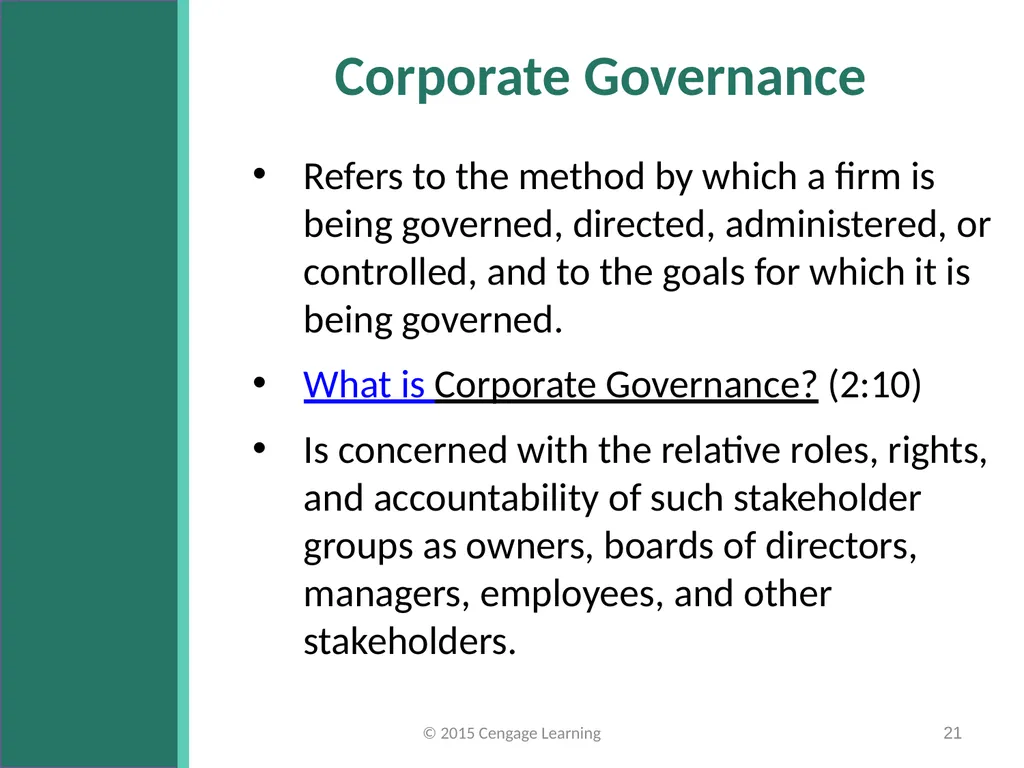
Corporate Governance Refers to the method by which a firm is being governed, directed, administered, or controlled, and to the goals for which it is being governed.
What is Corporate Governance? (2:10)
Is concerned with the relative roles, rights, and accountability of such stakeholder groups as owners, boards of directors, managers, employees, and other stakeholders. © 2015 Cengage Learning 21<br>
What is Corporate Governance? (2:10)
Is concerned with the relative roles, rights, and accountability of such stakeholder groups as owners, boards of directors, managers, employees, and other stakeholders. © 2015 Cengage Learning 21<br>
22
The Corporation’s
Hierarchy of Authority © 2015 Cengage Learning 22 Issued by the state - allow right to exist. So, not a major group in a corporation<br>
23
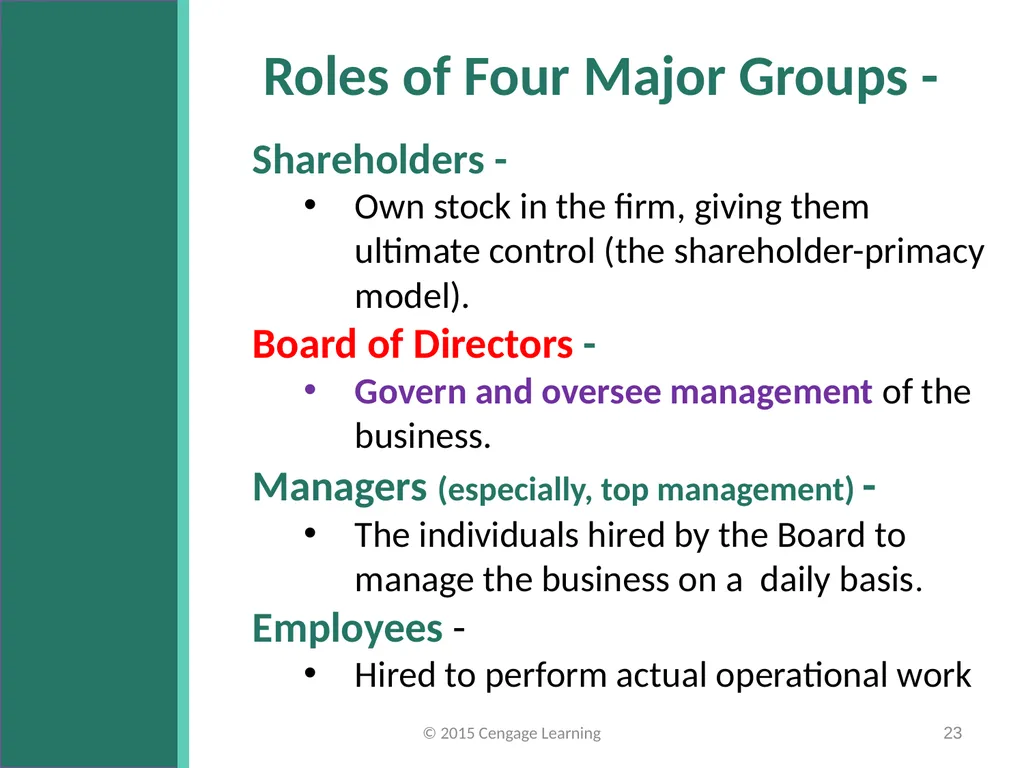
Roles of Four Major Groups - Shareholders -
Own stock in the firm, giving them ultimate control (the shareholder-primacy model).
Board of Directors -
Govern and oversee management of the business.
Managers (especially, top management) -
The individuals hired by the Board to manage the business on a daily basis.
Employees -
Hired to perform actual operational work © 2015 Cengage Learning 23<br>
Own stock in the firm, giving them ultimate control (the shareholder-primacy model).
Board of Directors -
Govern and oversee management of the business.
Managers (especially, top management) -
The individuals hired by the Board to manage the business on a daily basis.
Employees -
Hired to perform actual operational work © 2015 Cengage Learning 23<br>
24
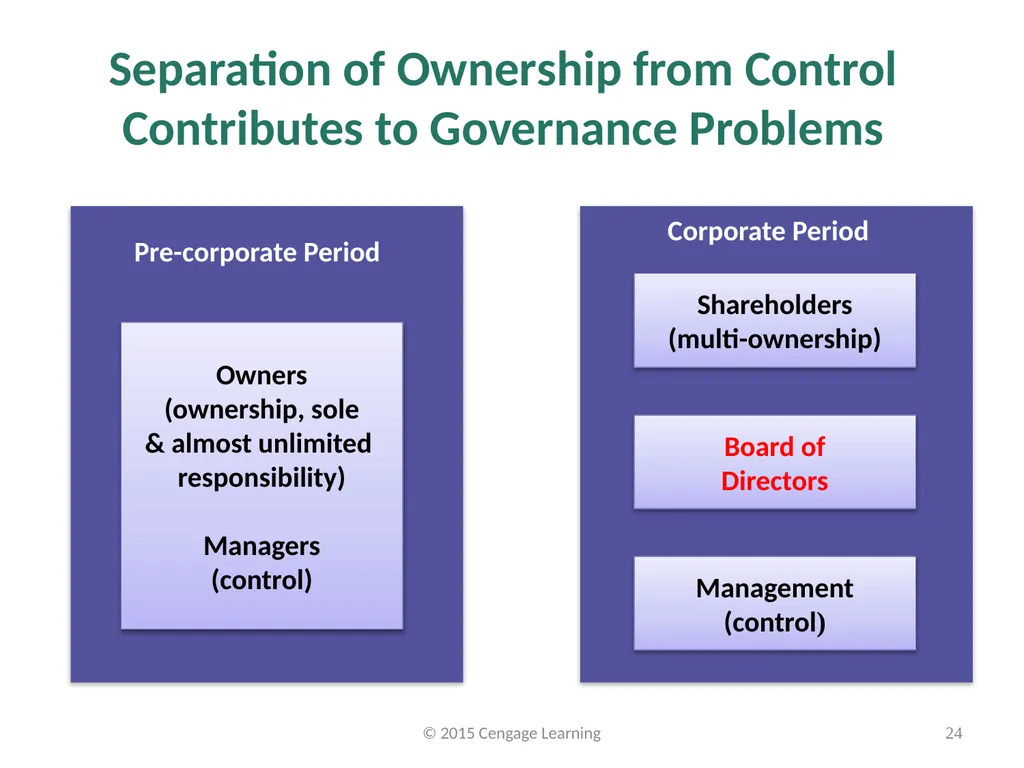
Separation of Ownership from Control
Contributes to Governance Problems © 2015 Cengage Learning 24 Pre-corporate Period Owners
(ownership, sole
& almost unlimited
responsibility)
Managers (control) Corporate Period<br>
& almost unlimited
responsibility)
Managers (control) Corporate Period<br>
25
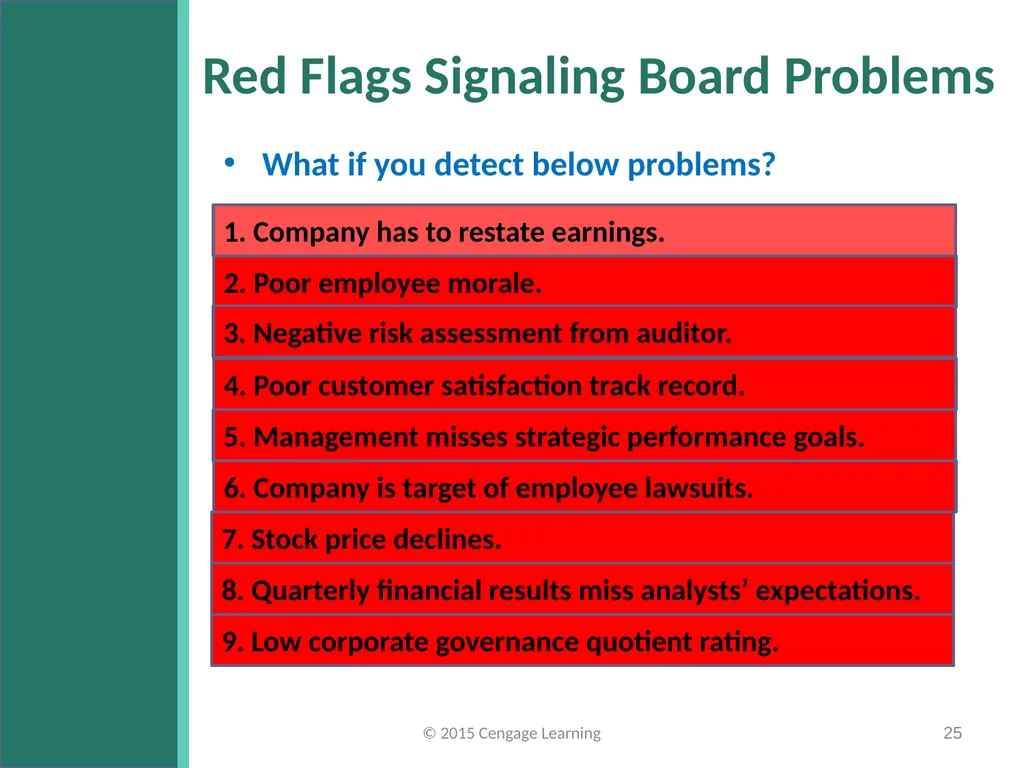
Red Flags Signaling Board Problems What if you detect below problems? © 2015 Cengage Learning 25 2. Poor employee morale. 1. Company has to restate earnings. 3. Negative risk assessment from auditor. 4. Poor customer satisfaction track record. 5. Management misses strategic performance goals. 6. Company is target of employee lawsuits. 7. Stock price declines. 8. Quarterly financial results miss analysts’ expectations. 9. Low corporate governance quotient rating.<br>
26
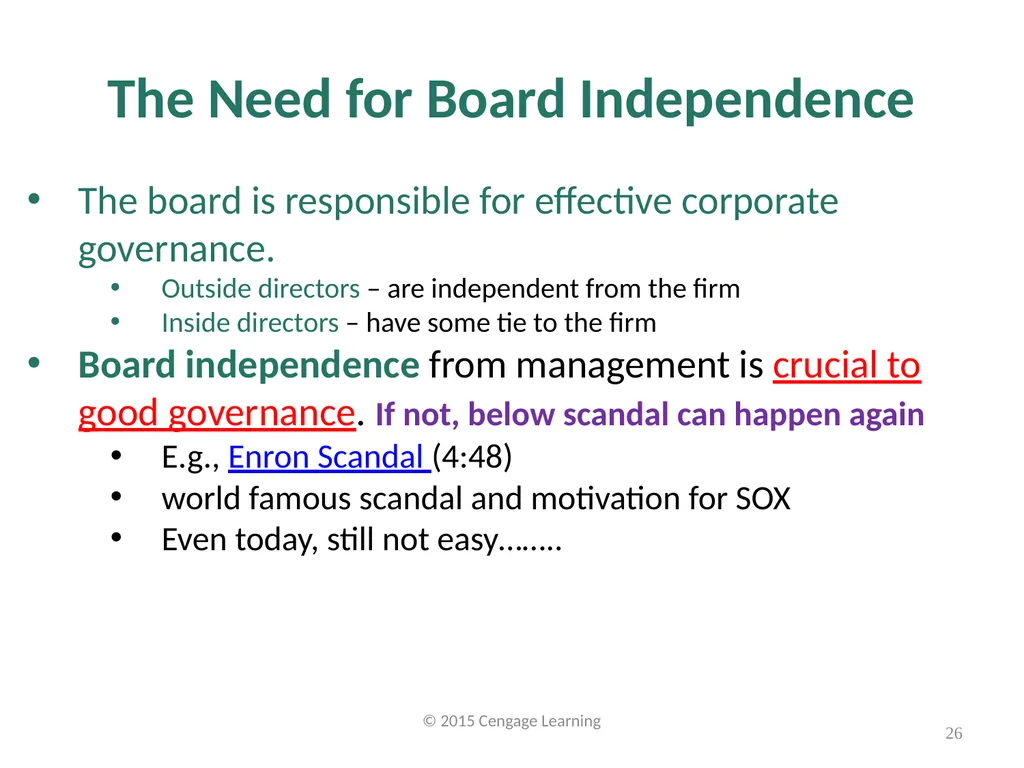
The Need for Board Independence © 2015 Cengage Learning 26 The board is responsible for effective corporate governance.
Outside directors – are independent from the firm
Inside directors – have some tie to the firm
Board independence from management is crucial to good governance. If not, below scandal can happen again
E.g., Enron Scandal (4:48)
world famous scandal and motivation for SOX
Even today, still not easy……..<br>
Outside directors – are independent from the firm
Inside directors – have some tie to the firm
Board independence from management is crucial to good governance. If not, below scandal can happen again
E.g., Enron Scandal (4:48)
world famous scandal and motivation for SOX
Even today, still not easy……..<br>
27
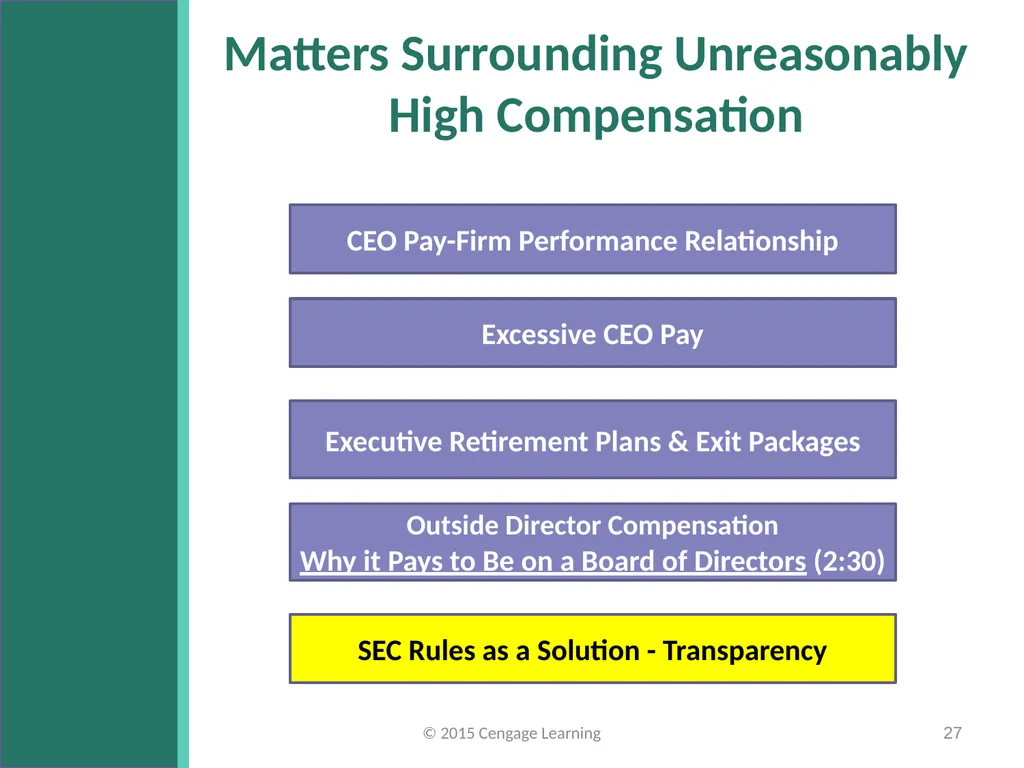
Matters Surrounding Unreasonably High Compensation © 2015 Cengage Learning 27 Excessive CEO Pay Outside Director Compensation
Why it Pays to Be on a Board of Directors (2:30)<br>
Why it Pays to Be on a Board of Directors (2:30)<br>
28
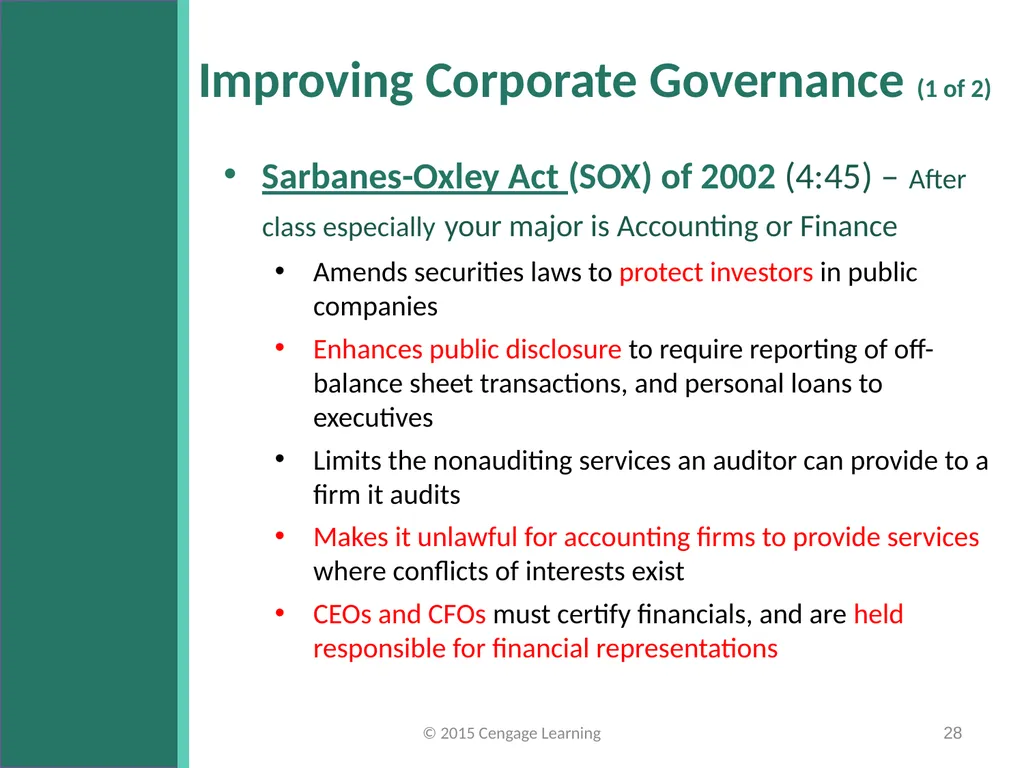
Improving Corporate Governance (1 of 2) Sarbanes-Oxley Act (SOX) of 2002 (4:45) – After class especially your major is Accounting or Finance
Amends securities laws to protect investors in public companies
Enhances public disclosure to require reporting of off-balance sheet transactions, and personal loans to executives
Limits the nonauditing services an auditor can provide to a firm it audits
Makes it unlawful for accounting firms to provide services where conflicts of interests exist
CEOs and CFOs must certify financials, and are held responsible for financial representations © 2015 Cengage Learning 28<br>
Amends securities laws to protect investors in public companies
Enhances public disclosure to require reporting of off-balance sheet transactions, and personal loans to executives
Limits the nonauditing services an auditor can provide to a firm it audits
Makes it unlawful for accounting firms to provide services where conflicts of interests exist
CEOs and CFOs must certify financials, and are held responsible for financial representations © 2015 Cengage Learning 28<br>
29
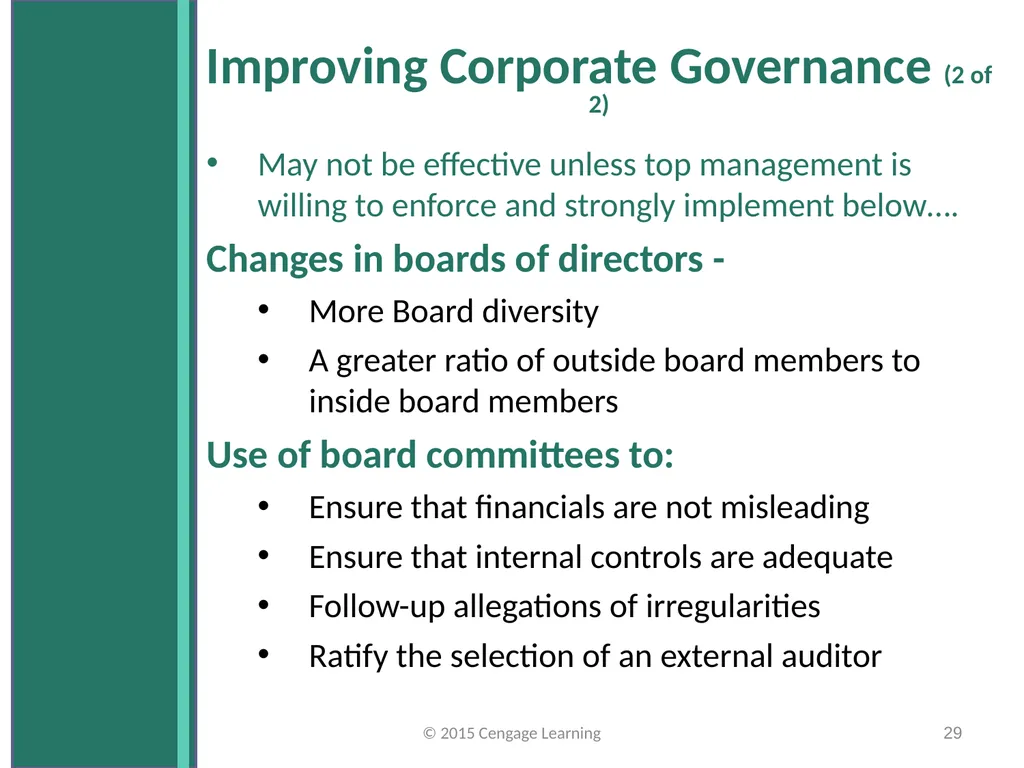
Improving Corporate Governance (2 of 2) May not be effective unless top management is willing to enforce and strongly implement below….
Changes in boards of directors -
More Board diversity
A greater ratio of outside board members to inside board members
Use of board committees to:
Ensure that financials are not misleading
Ensure that internal controls are adequate
Follow-up allegations of irregularities
Ratify the selection of an external auditor © 2015 Cengage Learning 29<br>
Changes in boards of directors -
More Board diversity
A greater ratio of outside board members to inside board members
Use of board committees to:
Ensure that financials are not misleading
Ensure that internal controls are adequate
Follow-up allegations of irregularities
Ratify the selection of an external auditor © 2015 Cengage Learning 29<br>
30
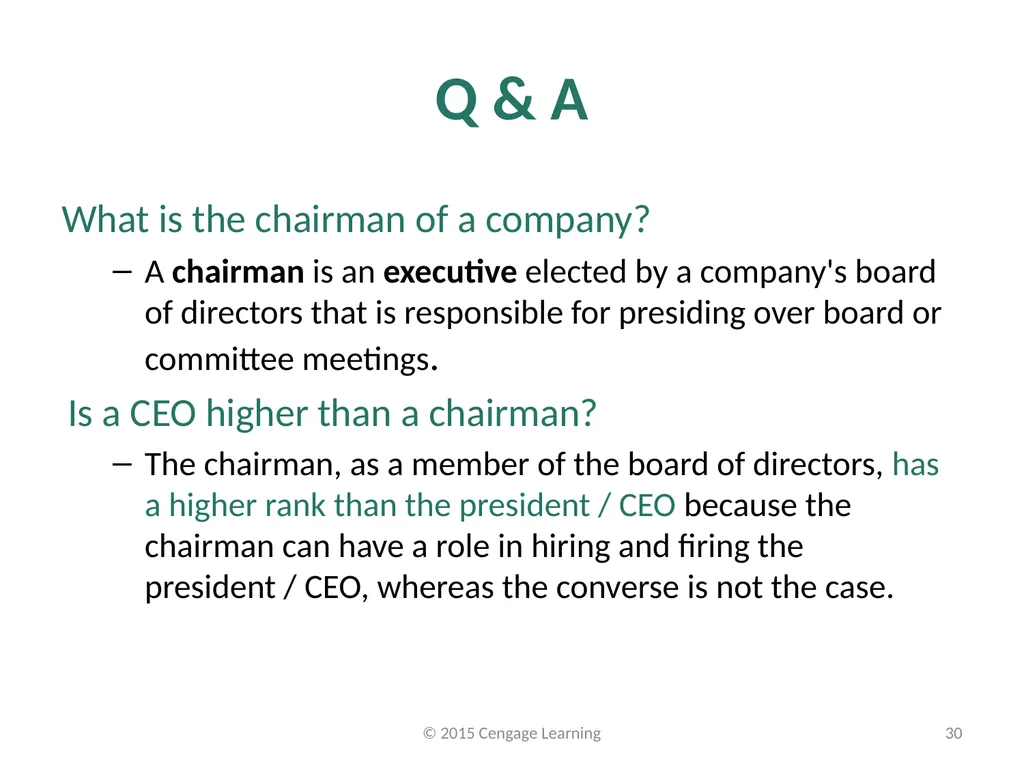
Q & A What is the chairman of a company?
A chairman is an executive elected by a company's board of directors that is responsible for presiding over board or committee meetings.
Is a CEO higher than a chairman?
The chairman, as a member of the board of directors, has a higher rank than the president / CEO because the chairman can have a role in hiring and firing the president / CEO, whereas the converse is not the case. © 2015 Cengage Learning 30<br>
A chairman is an executive elected by a company's board of directors that is responsible for presiding over board or committee meetings.
Is a CEO higher than a chairman?
The chairman, as a member of the board of directors, has a higher rank than the president / CEO because the chairman can have a role in hiring and firing the president / CEO, whereas the converse is not the case. © 2015 Cengage Learning 30<br>
31
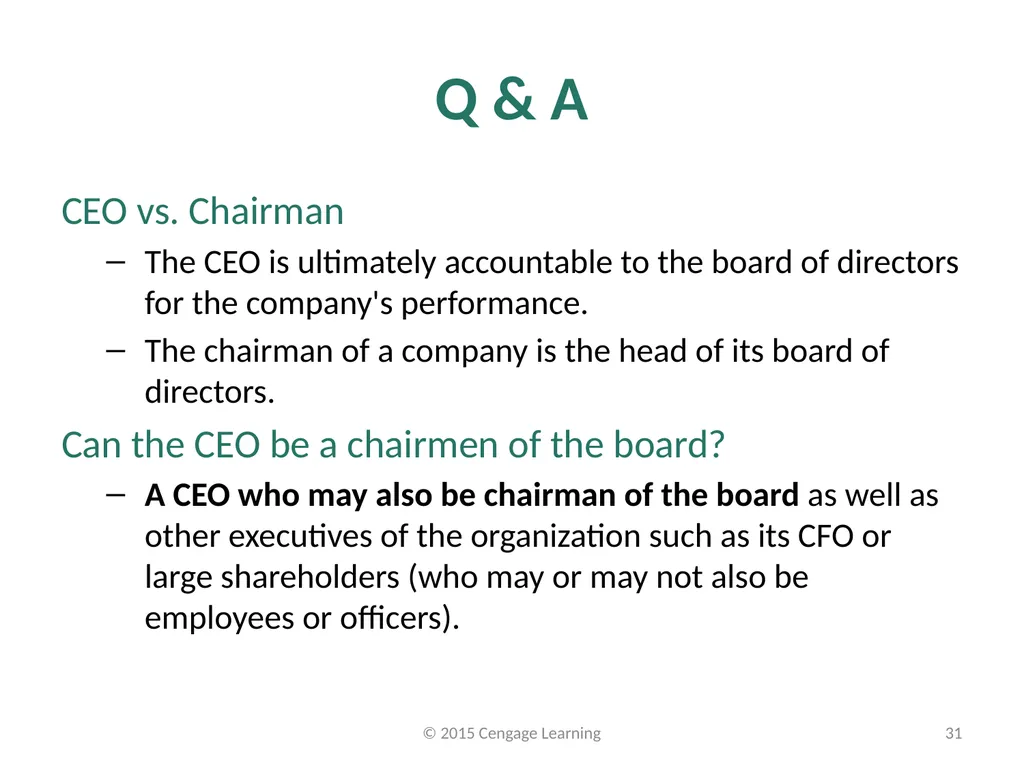
Q & A CEO vs. Chairman
The CEO is ultimately accountable to the board of directors for the company's performance.
The chairman of a company is the head of its board of directors.
Can the CEO be a chairmen of the board?
A CEO who may also be chairman of the board as well as other executives of the organization such as its CFO or large shareholders (who may or may not also be employees or officers). © 2015 Cengage Learning 31<br>
The CEO is ultimately accountable to the board of directors for the company's performance.
The chairman of a company is the head of its board of directors.
Can the CEO be a chairmen of the board?
A CEO who may also be chairman of the board as well as other executives of the organization such as its CFO or large shareholders (who may or may not also be employees or officers). © 2015 Cengage Learning 31<br>
32
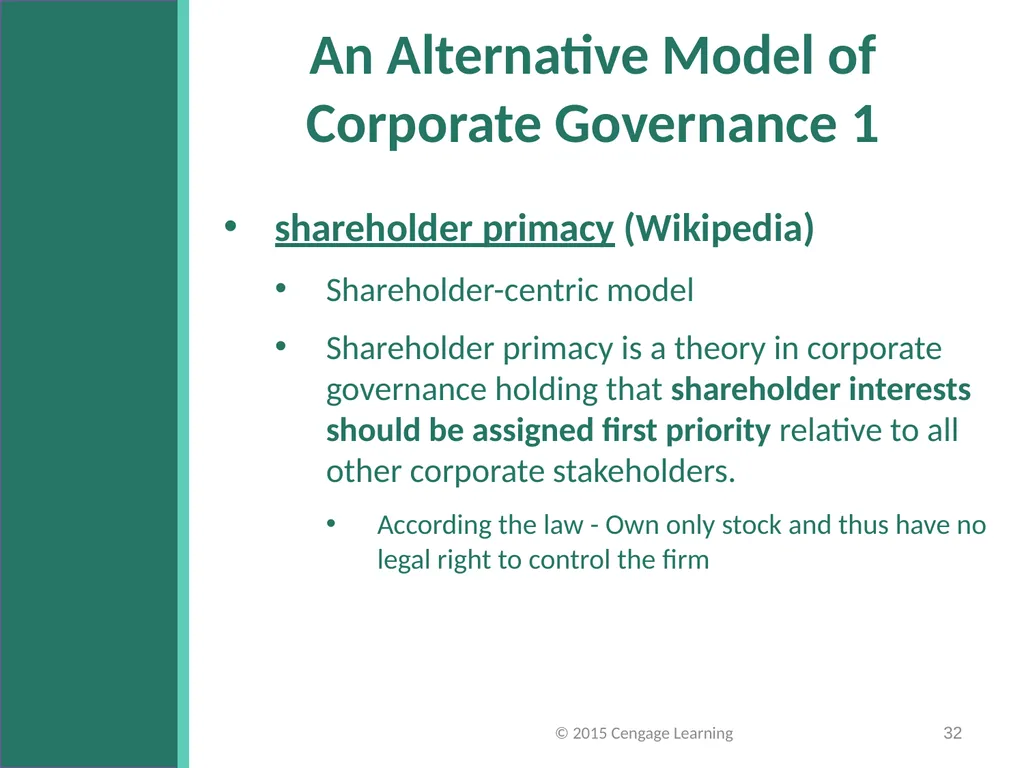
An Alternative Model of
Corporate Governance 1 shareholder primacy (Wikipedia)
Shareholder-centric model
Shareholder primacy is a theory in corporate governance holding that shareholder interests should be assigned first priority relative to all other corporate stakeholders.
According the law - Own only stock and thus have no legal right to control the firm © 2015 Cengage Learning 32<br>
Shareholder-centric model
Shareholder primacy is a theory in corporate governance holding that shareholder interests should be assigned first priority relative to all other corporate stakeholders.
According the law - Own only stock and thus have no legal right to control the firm © 2015 Cengage Learning 32<br>
33
An Alternative Model of
Corporate Governance 2 Director primacy is board-centric, but shareholder wealth focused.
More broader: Boards have a duty to shareholders, but boards members are the ultimate decision makers and their primary duty is to the corporation.
Works better in the long-term by providing needed autonomy for boards directors. © 2015 Cengage Learning 33<br>
More broader: Boards have a duty to shareholders, but boards members are the ultimate decision makers and their primary duty is to the corporation.
Works better in the long-term by providing needed autonomy for boards directors. © 2015 Cengage Learning 33<br>
34
Corporate Governance Structure information from SEC www.sec.gov
Company’s annual report (Form 10-K)
Proxy statement (Form Def 14A).
Review these documents to get you a better understanding of the company’s corporate governance structure.
Good idea to review your company for the sake of your job, security, etc. © 2015 Cengage Learning 34<br>
Company’s annual report (Form 10-K)
Proxy statement (Form Def 14A).
Review these documents to get you a better understanding of the company’s corporate governance structure.
Good idea to review your company for the sake of your job, security, etc. © 2015 Cengage Learning 34<br>
35
Walmart Answer questions on the link instead of the textbook questions)
Overview of the Walmart Case: How Powerful (or ethical) Is Walmart? (3:40)
After class,
CSR by Walmart in 2013 (2:36)
Walmart Mexico Scandal (2:27) © 2015 Cengage Learning 35<br>
Overview of the Walmart Case: How Powerful (or ethical) Is Walmart? (3:40)
After class,
CSR by Walmart in 2013 (2:36)
Walmart Mexico Scandal (2:27) © 2015 Cengage Learning 35<br>