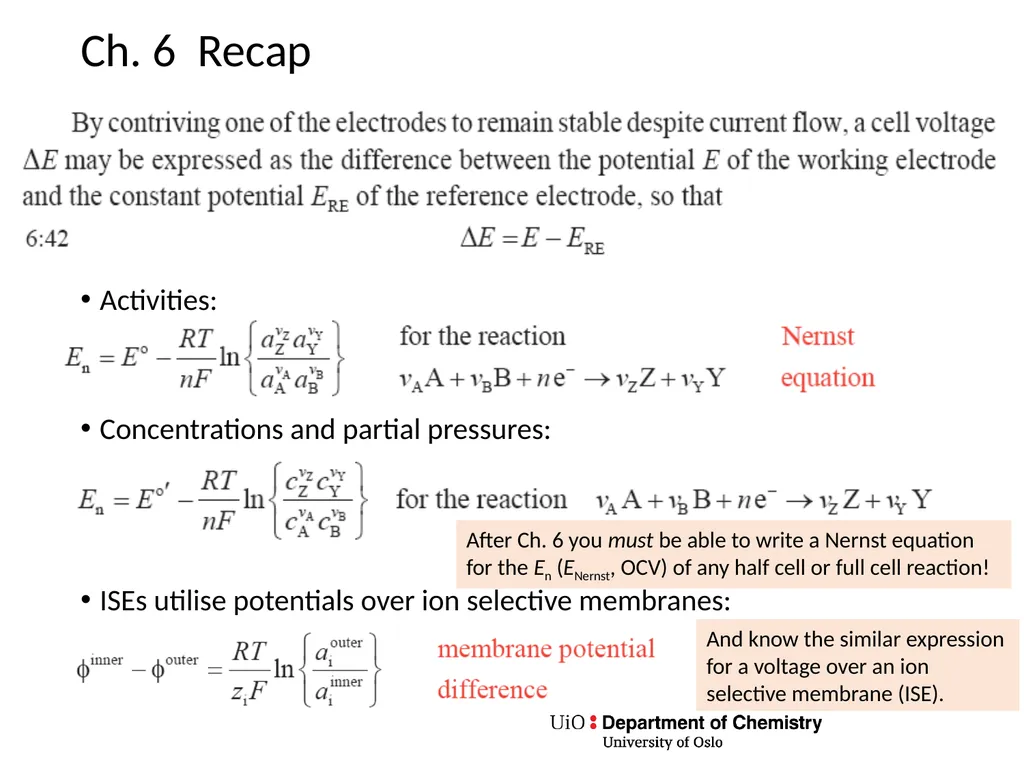
KJM 3110 Electrochemistry Chapter 7. Electrode reactions 2022 Activities: Concentrations and partial pressures: ISEs utilise potentials over ion selective membranes: Ch. 6 Recap After Ch. 6 you must be able to write a Nernst equation for
"KJM 3110 Electrochemistry Chapter 7. Electrode" is the property of its rightful owner. Permission is granted to
download and print the materials on this website for personal, non-commercial use only, and to display it
on your personal computer provided you do not modify the materials and that you retain all copyright
notices contained in the materials. By downloading content from our website, you accept the terms of this
agreement.
ISEs utilise potentials over ion selective membranes: Ch. 6 Recap After Ch. 6 you must be able to write a Nernst equation for the En (ENernst, OCV) of any half cell or full cell reaction! And know the similar expression for a voltage over an ion selective membrane (ISE).<br>
03
Till now, we have been introduced to electricity, chemistry and thermodynamics, electrochemical cells and their operating modes, electrolytic cells (electricity to chemical energy) and galvanic cells (chemical energy to electricity).
We have started to look at electrodes.
We have in Ch. 6 looked at the thermodynamics of electrodes, and ways to describe it in tables and graphs.
We have looked at the use of thermodynamics in potentiometric electrodes, in particular ion selective electrodes (ISEs).
In Ch. 7 we’ll look closer at electrode reactions. Status<br>
04
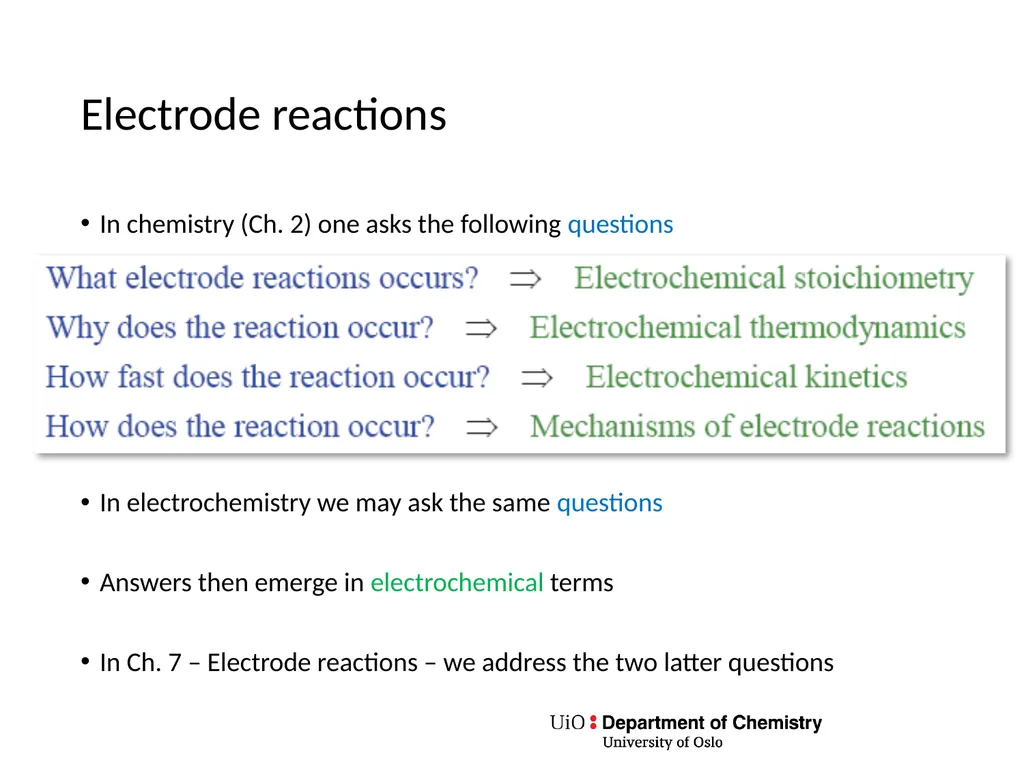
In chemistry (Ch. 2) one asks the following questions
In electrochemistry we may ask the same questions
Answers then emerge in electrochemical terms
In Ch. 7 – Electrode reactions – we address the two latter questions Electrode reactions<br>
05
What is Faraday’s law?
The amount (number of moles) of any substance produced or consumed in an electrode reaction is proportional to the quantity of charge passed
Michael Faraday, 1832
Faradaic currents
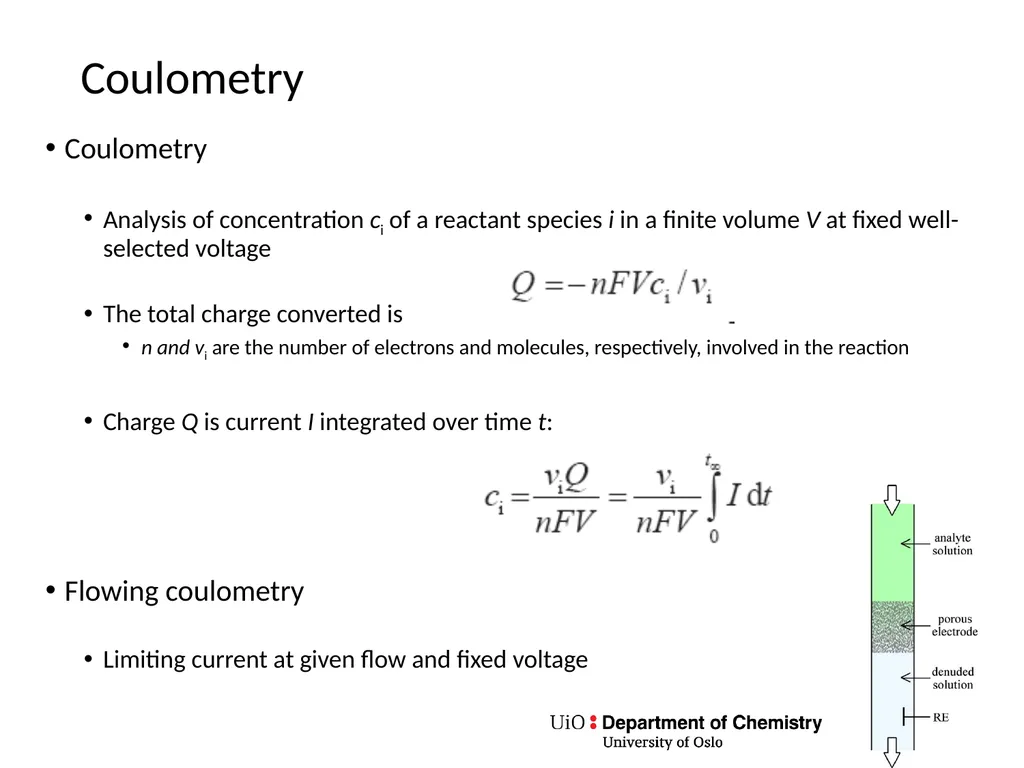
Analysis of concentration ci of a reactant species i in a finite volume V at fixed well-selected voltage
The total charge converted is
n and vi are the number of electrons and molecules, respectively, involved in the reaction
Charge Q is current I integrated over time t:
Flowing coulometry
Limiting current at given flow and fixed voltage Coulometry<br>
07
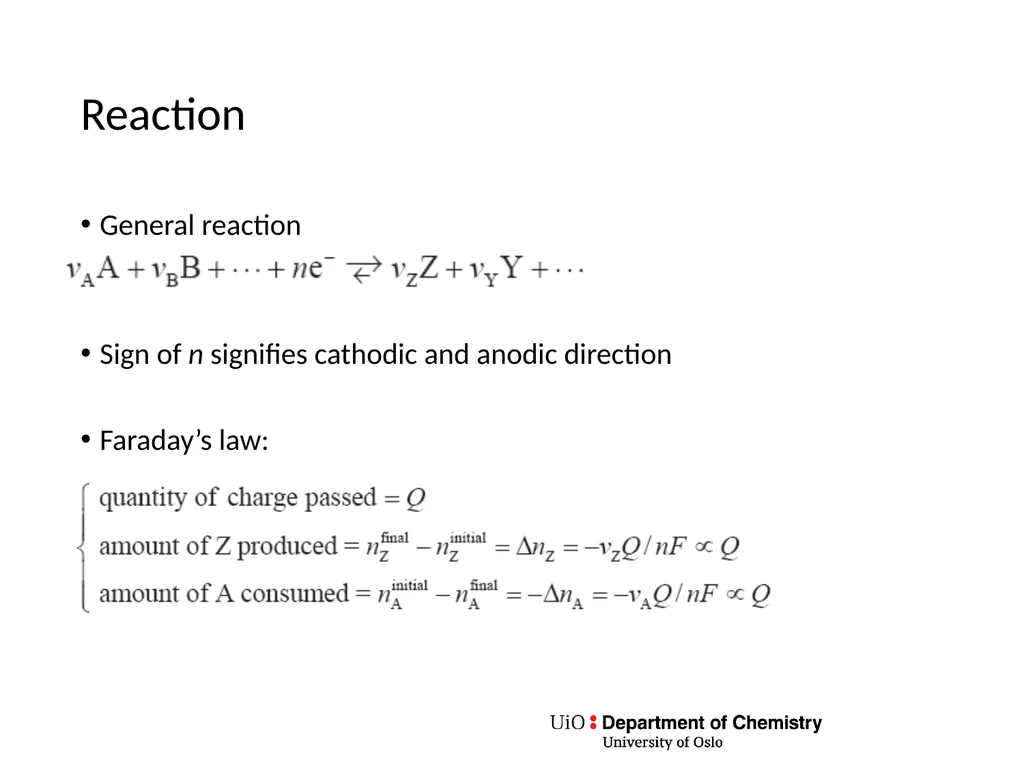
General reaction
Sign of n signifies cathodic and anodic direction
Faraday’s law: Reaction<br>
08
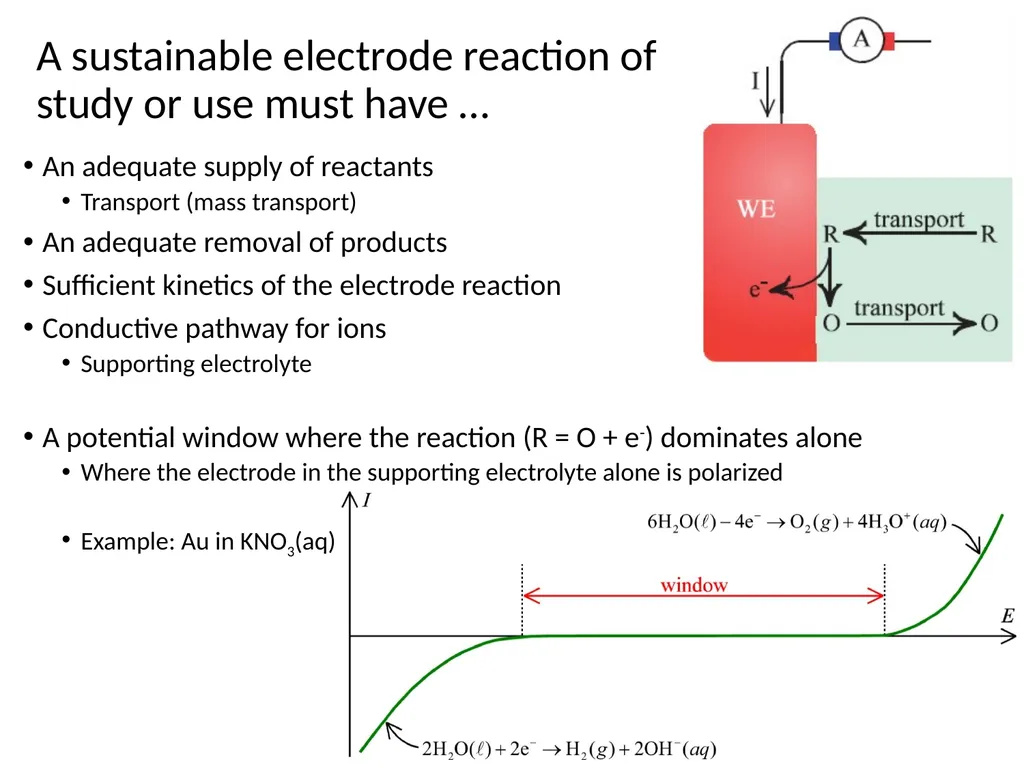
An adequate supply of reactants
Transport (mass transport)
An adequate removal of products
Sufficient kinetics of the electrode reaction
Conductive pathway for ions
Supporting electrolyte
A potential window where the reaction (R = O + e-) dominates alone
Where the electrode in the supporting electrolyte alone is polarized
Example: Au in KNO3(aq) A sustainable electrode reaction of study or use must have …<br>
09
Now, the book takes us through a derivation of the BV equation.
It is as important as it is difficult, and there are as many versions and understandings as there are uses of it.
It is difficult to derive, and many approaches to making it simpler.
The book is one.
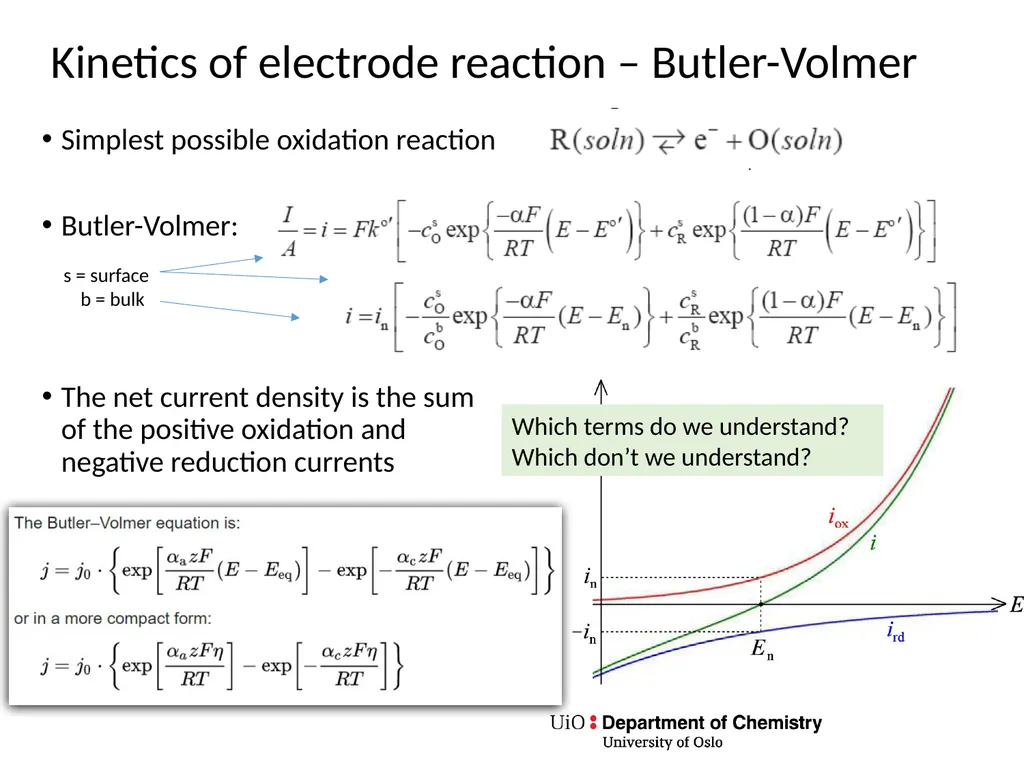
Let us first take a look at the end result - what we will derive. Can we understand it qualitatively and does it make sense even before we do it in more depth? The Butler-Volmer equation<br>
10
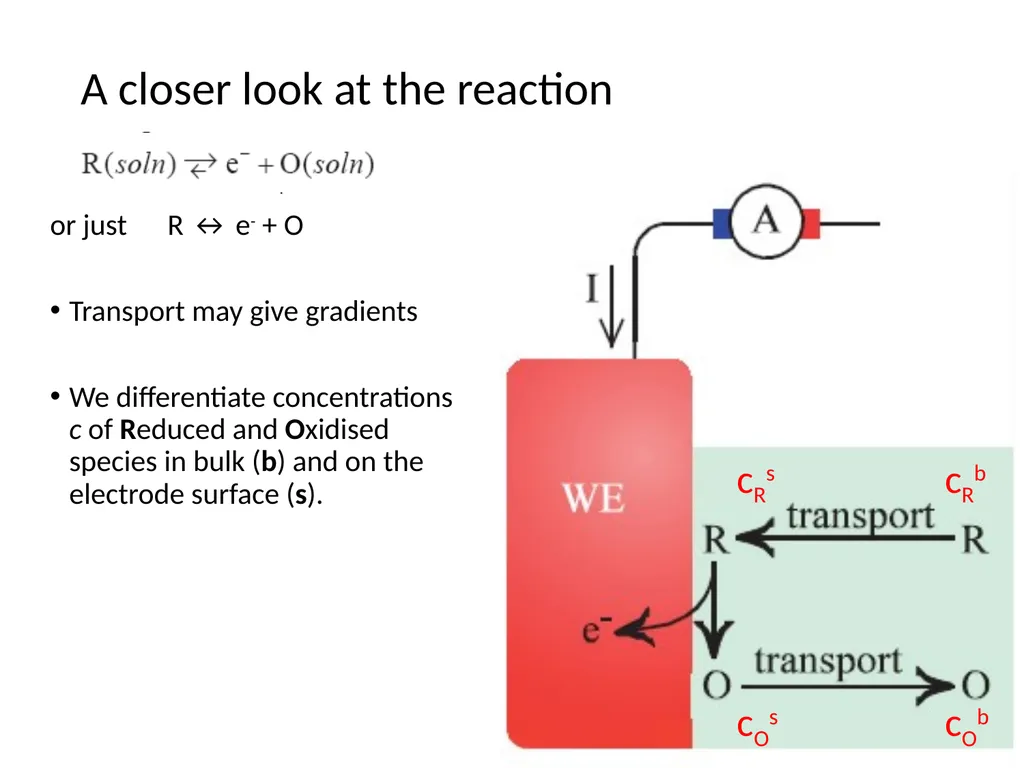
or just R ↔ e- + O
Transport may give gradients
We differentiate concentrations c of Reduced and Oxidised species in bulk (b) and on the electrode surface (s). A closer look at the reaction<br>
11
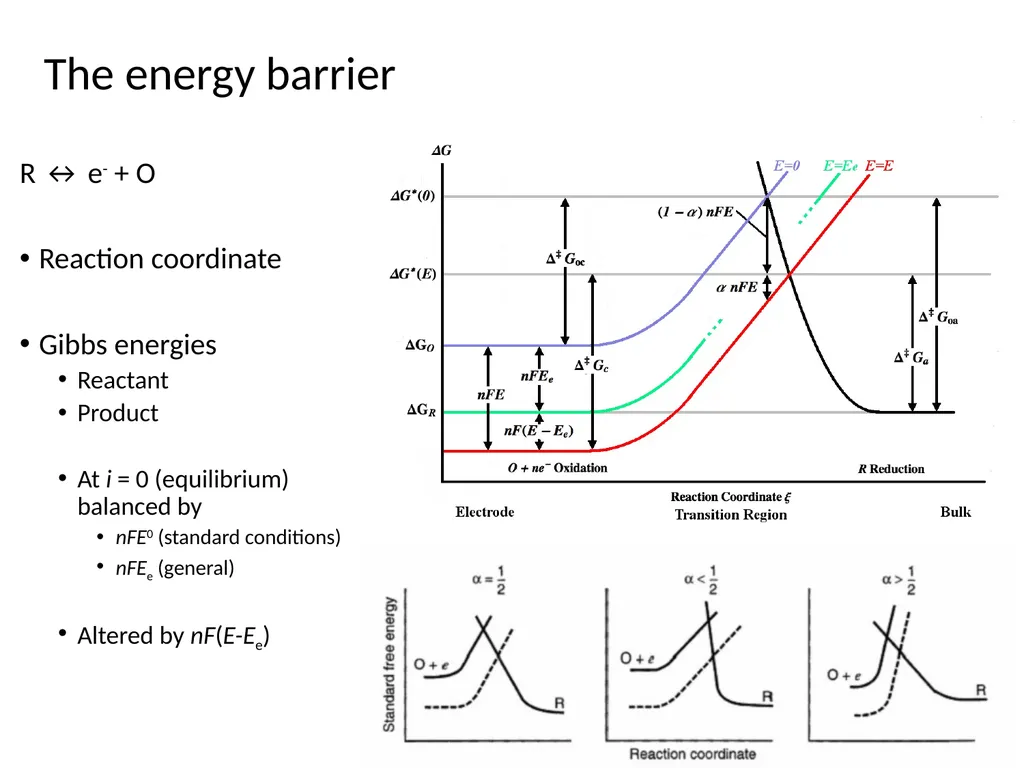
R ↔ e- + O
Reaction coordinate
Gibbs energies
Reactant
Product
At i = 0 (equilibrium) balanced by
nFE0 (standard conditions)
nFEe (general)
Altered by nF(E-Ee) The energy barrier<br>
12
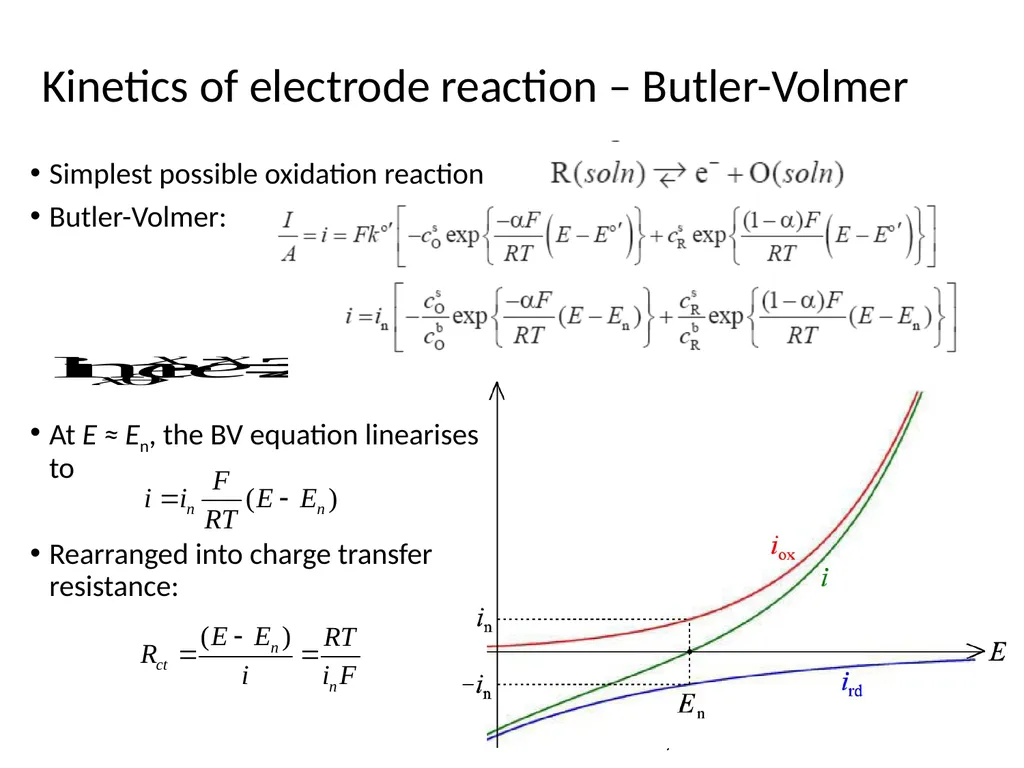
Simplest possible oxidation reaction
Butler-Volmer:
The net current density is the sum of the positive oxidation and negative reduction currents Kinetics of electrode reaction – Butler-Volmer Which terms do we understand?
Which don’t we understand?<br>
13
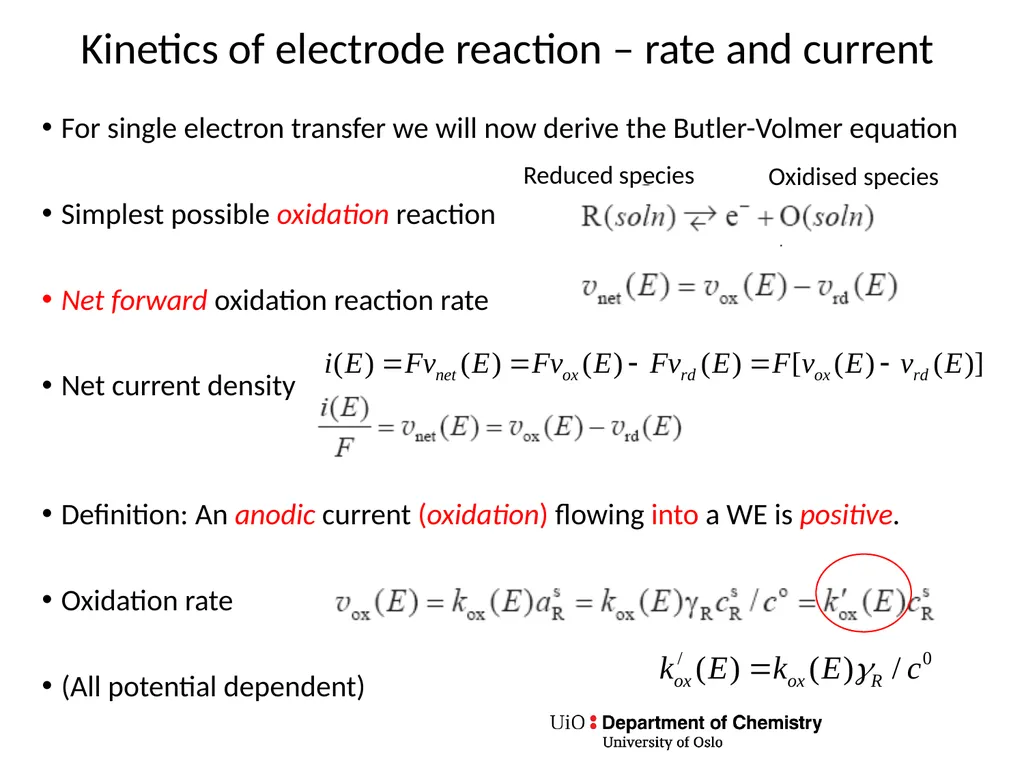
For single electron transfer we will now derive the Butler-Volmer equation
Simplest possible oxidation reaction
Net forward oxidation reaction rate
Net current density
Definition: An anodic current (oxidation) flowing into a WE is positive.
Oxidation rate
(All potential dependent) Kinetics of electrode reaction – rate and current<br>
14
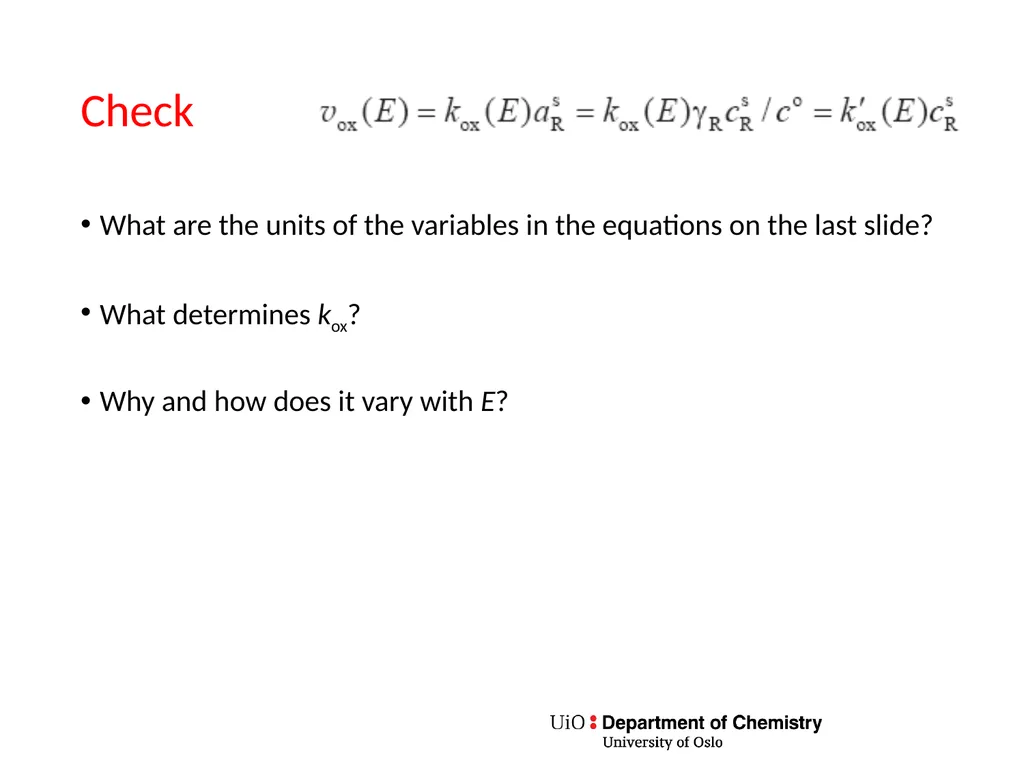
What are the units of the variables in the equations on the last slide?
What determines kox?
Why and how does it vary with E? Check<br>
15
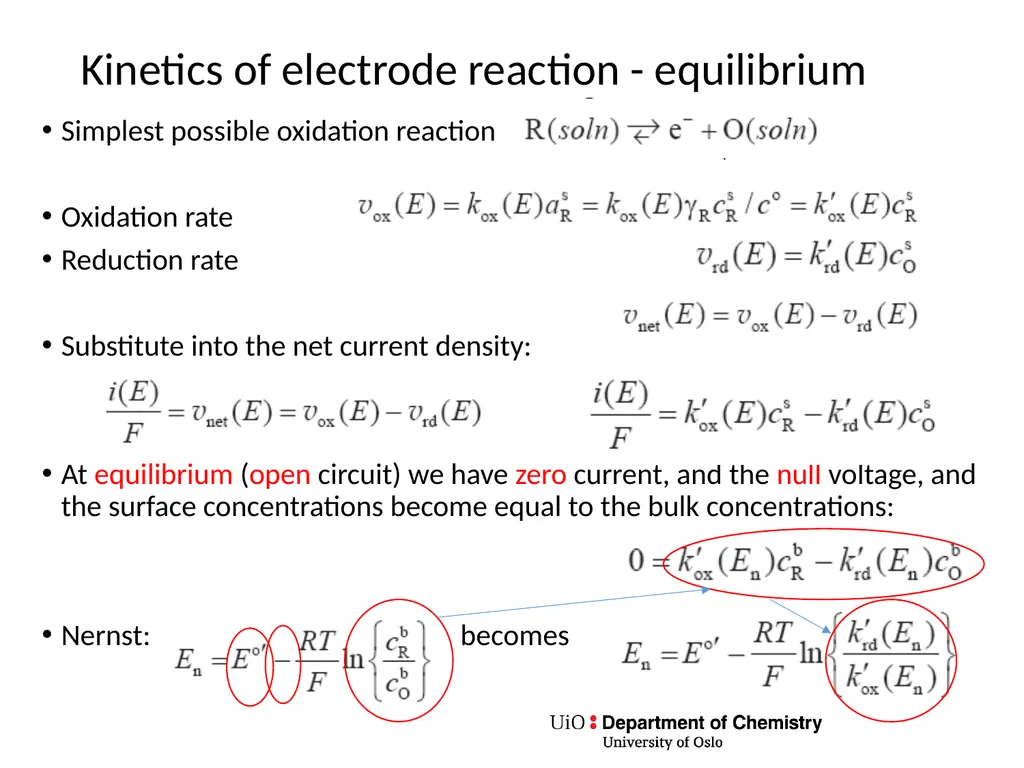
Simplest possible oxidation reaction
Oxidation rate
Reduction rate
Substitute into the net current density:
At equilibrium (open circuit) we have zero current, and the null voltage, and the surface concentrations become equal to the bulk concentrations:
Nernst: becomes Kinetics of electrode reaction - equilibrium<br>
16
What are En (the null, or open circuit, or equilibrium potential) and E°’ (the “formal” potential) exactly?
What is the significance of the prime (‘) throughout here?
We have seen that the mass action quotient Q can be expressed by different parameters, like
Activity, or concentration
Rate constants
More?
Discuss how this works for normal chemical reactions and for electrochemical reactions. Check<br>
17
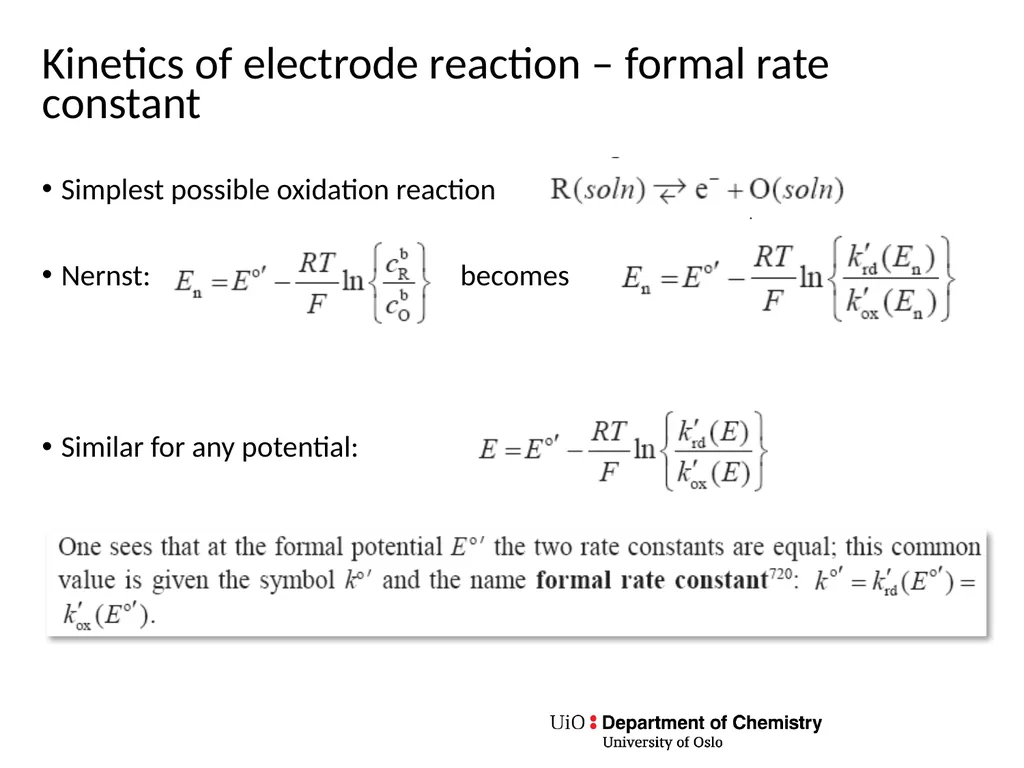
Simplest possible oxidation reaction
Nernst: becomes
Similar for any potential: Kinetics of electrode reaction – formal rate constant<br>
18
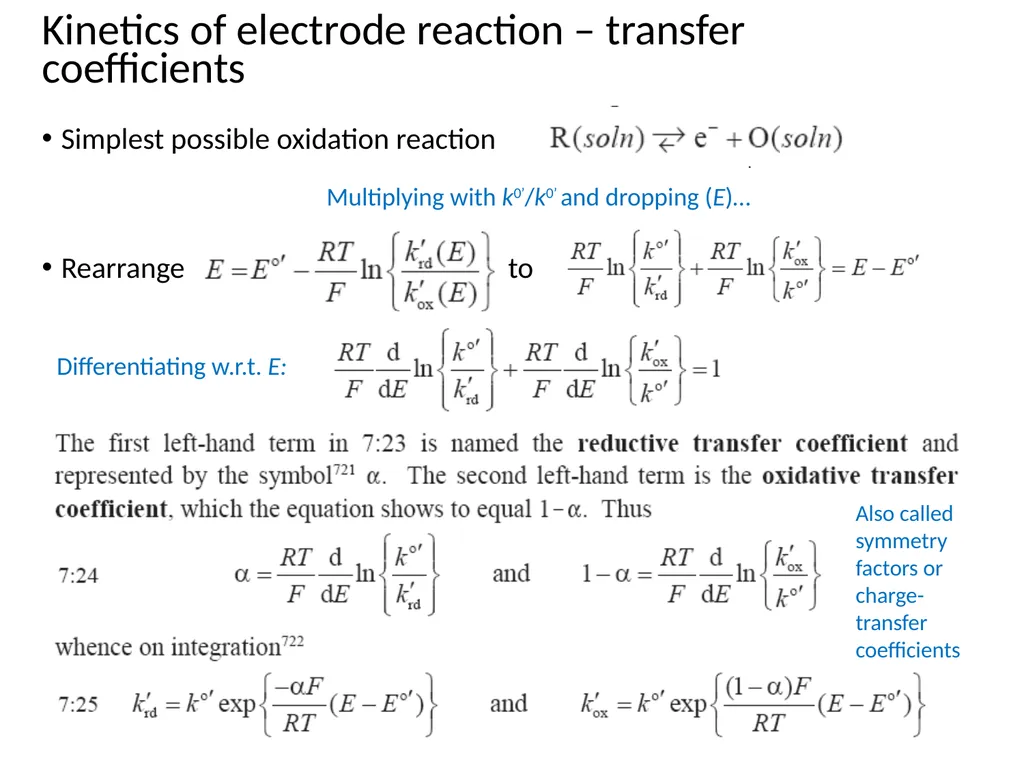
Simplest possible oxidation reaction
Rearrange to Kinetics of electrode reaction – transfer coefficients Multiplying with k0’/k0’ and dropping (E)… Differentiating w.r.t. E: Also called symmetry factors or charge-transfer coefficients<br>
19
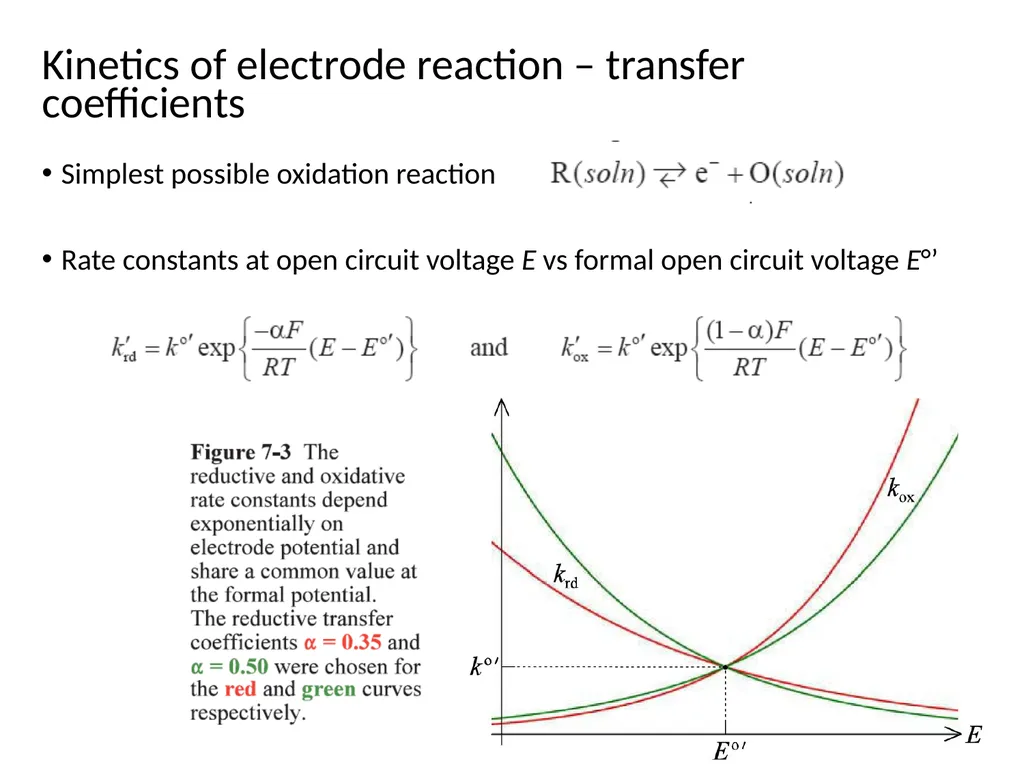
Simplest possible oxidation reaction
Rate constants at open circuit voltage E vs formal open circuit voltage E°’ Kinetics of electrode reaction – transfer coefficients<br>
20
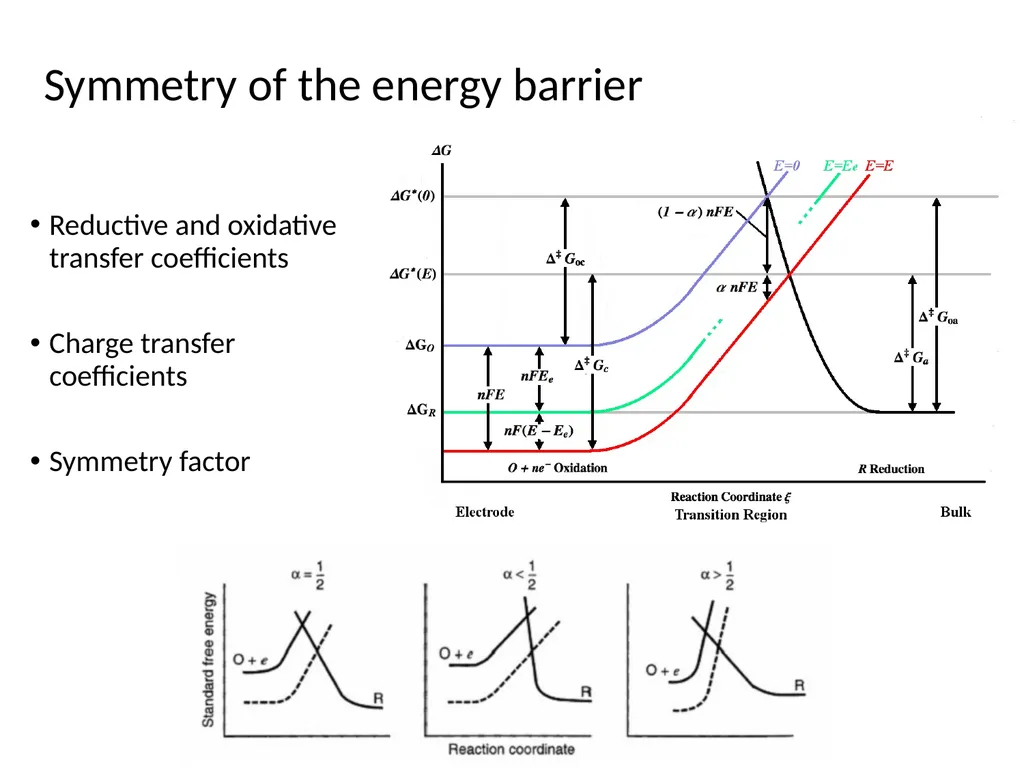
Reductive and oxidative transfer coefficients
Charge transfer coefficients
Symmetry factor Symmetry of the energy barrier<br>
21
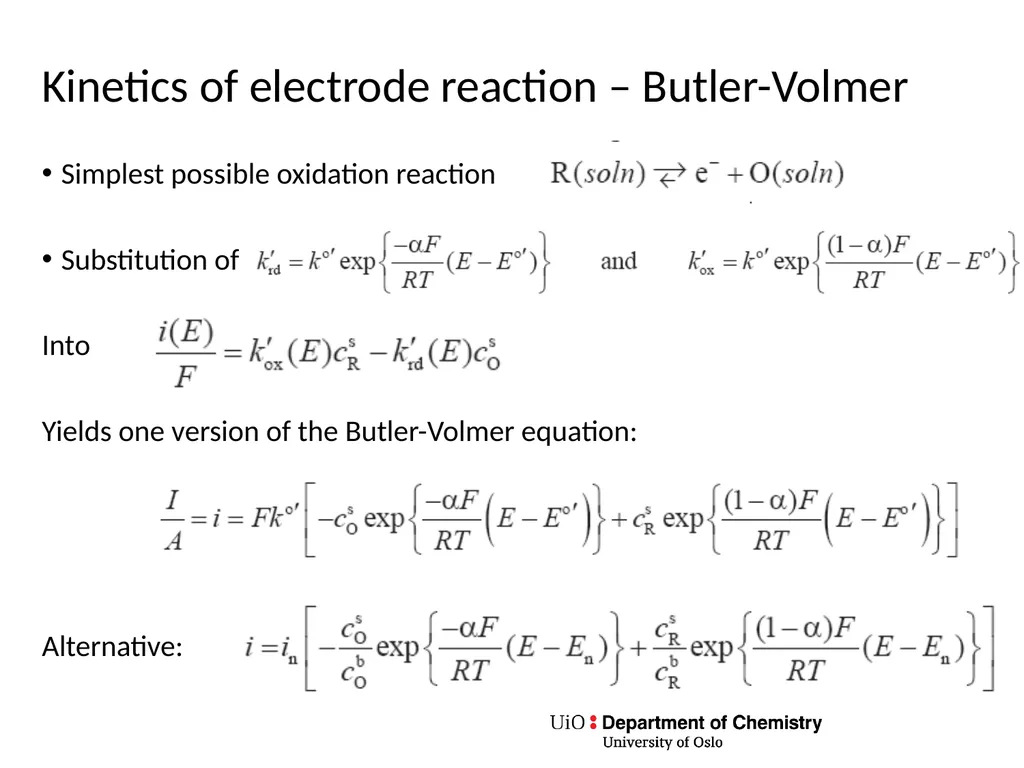
Simplest possible oxidation reaction
Substitution of
Into
Yields one version of the Butler-Volmer equation:
Alternative: Kinetics of electrode reaction – Butler-Volmer<br>
22
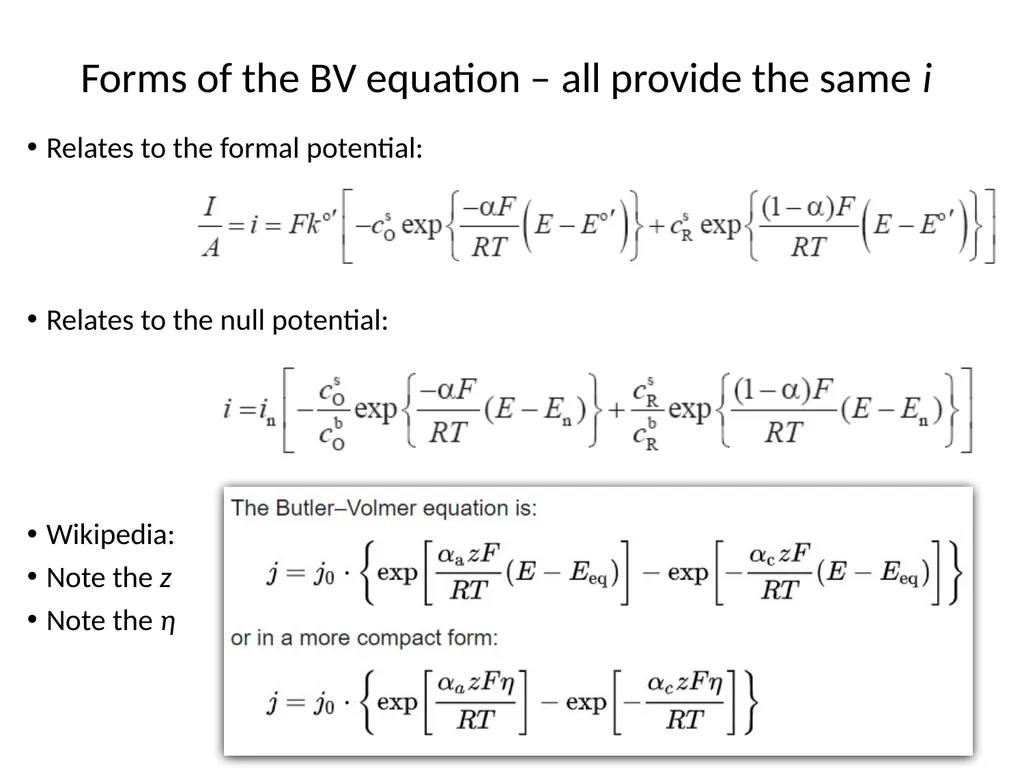
Relates to the formal potential:
Relates to the null potential:
Wikipedia:
Note the z
Note the η Forms of the BV equation – all provide the same i<br>
23
Kinetics of electrode reaction – Butler-Volmer Simplest possible oxidation reaction
Butler-Volmer:
At E ≈ En, the BV equation linearises to
Rearranged into charge transfer resistance:<br>
24
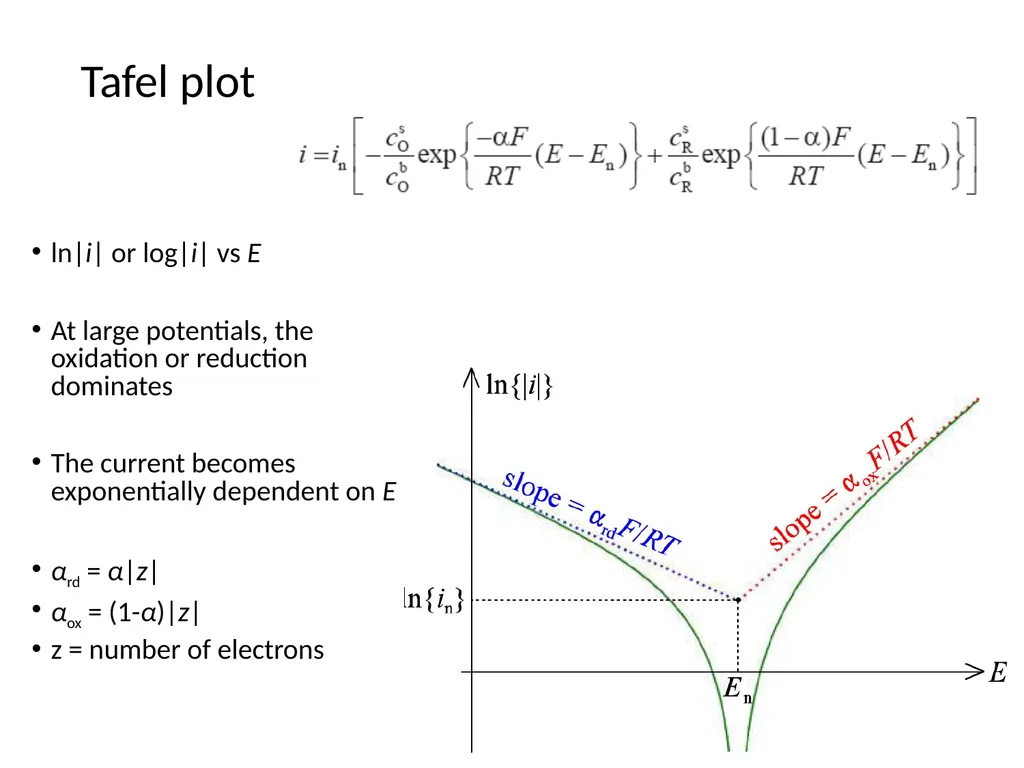
ln|i| or log|i| vs E
At large potentials, the oxidation or reduction dominates
The current becomes exponentially dependent on E
αrd = α|z|
αox = (1-α)|z|
z = number of electrons Tafel plot<br>
25
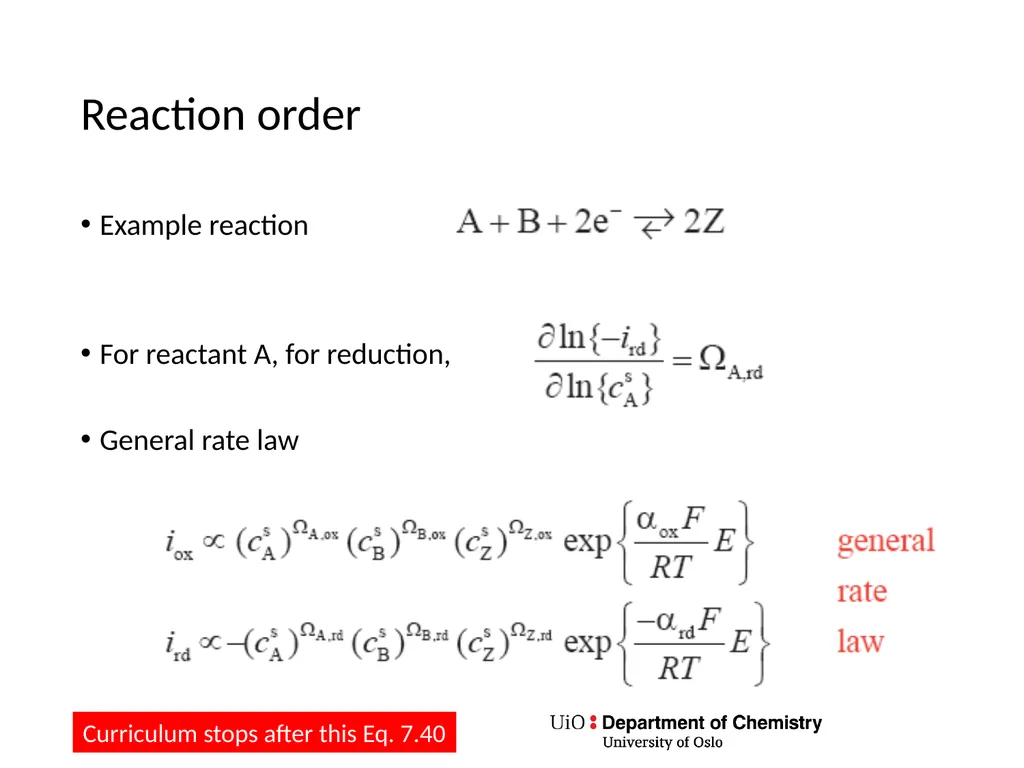
Example reaction
For reactant A, for reduction,
General rate law Reaction order Curriculum stops after this Eq. 7.40<br>
26
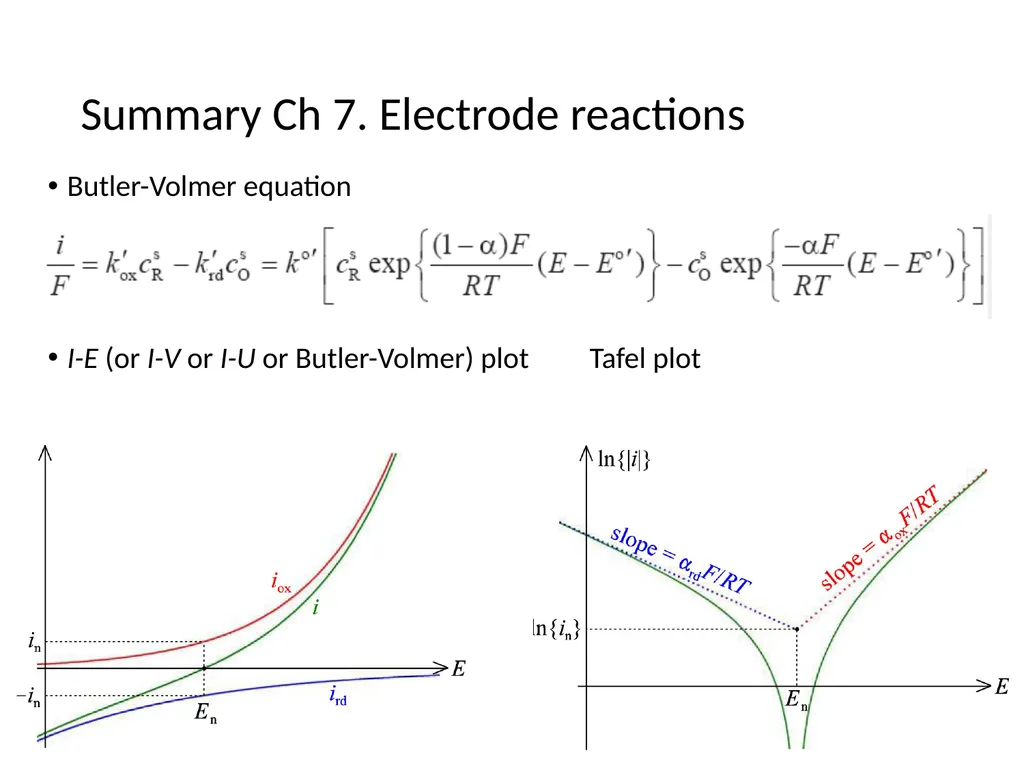
Butler-Volmer equation
I-E (or I-V or I-U or Butler-Volmer) plot Tafel plot Summary Ch 7. Electrode reactions<br>