04
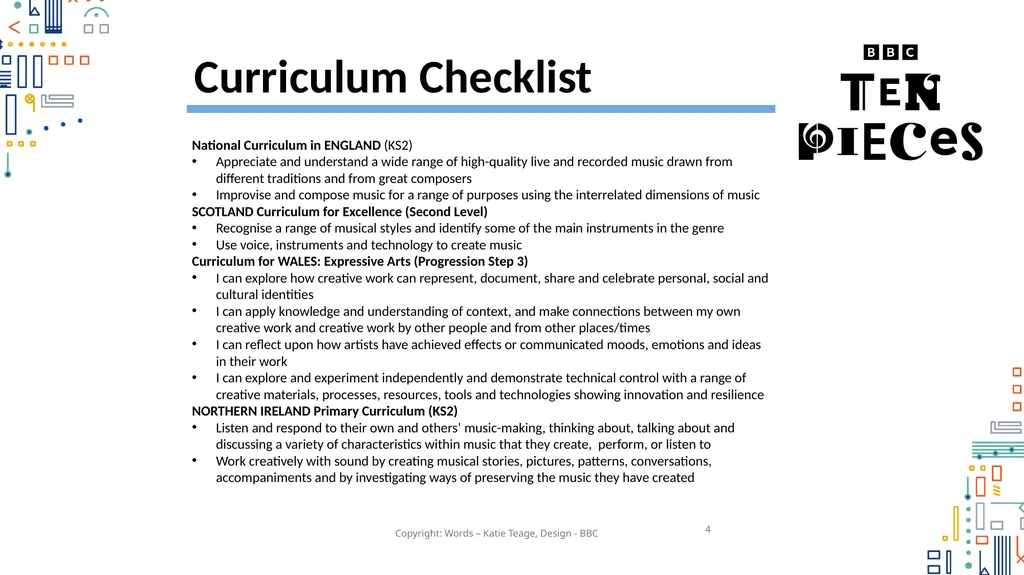
Curriculum Checklist Copyright: Words – Katie Teage, Design - BBC 4 National Curriculum in ENGLAND (KS2)
Appreciate and understand a wide range of high-quality live and recorded music drawn from different traditions and from great composers
Improvise and compose music for a range of purposes using the interrelated dimensions of music
SCOTLAND Curriculum for Excellence (Second Level)
Recognise a range of musical styles and identify some of the main instruments in the genre
Use voice, instruments and technology to create music
Curriculum for WALES: Expressive Arts (Progression Step 3)
I can explore how creative work can represent, document, share and celebrate personal, social and cultural identities
I can apply knowledge and understanding of context, and make connections between my own creative work and creative work by other people and from other places/times
I can reflect upon how artists have achieved effects or communicated moods, emotions and ideas in their work
I can explore and experiment independently and demonstrate technical control with a range of creative materials, processes, resources, tools and technologies showing innovation and resilience
NORTHERN IRELAND Primary Curriculum (KS2)
Listen and respond to their own and others’ music-making, thinking about, talking about and discussing a variety of characteristics within music that they create, perform, or listen to
Work creatively with sound by creating musical stories, pictures, patterns, conversations, accompaniments and by investigating ways of preserving the music they have created<br>
05
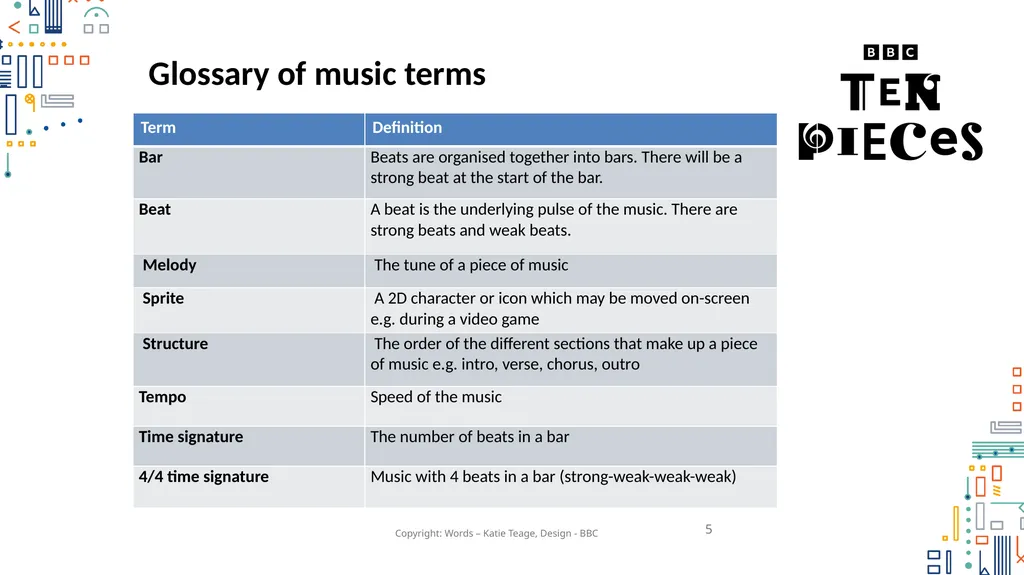
Glossary of music terms 5 Copyright: Words – Katie Teage, Design - BBC<br>
06
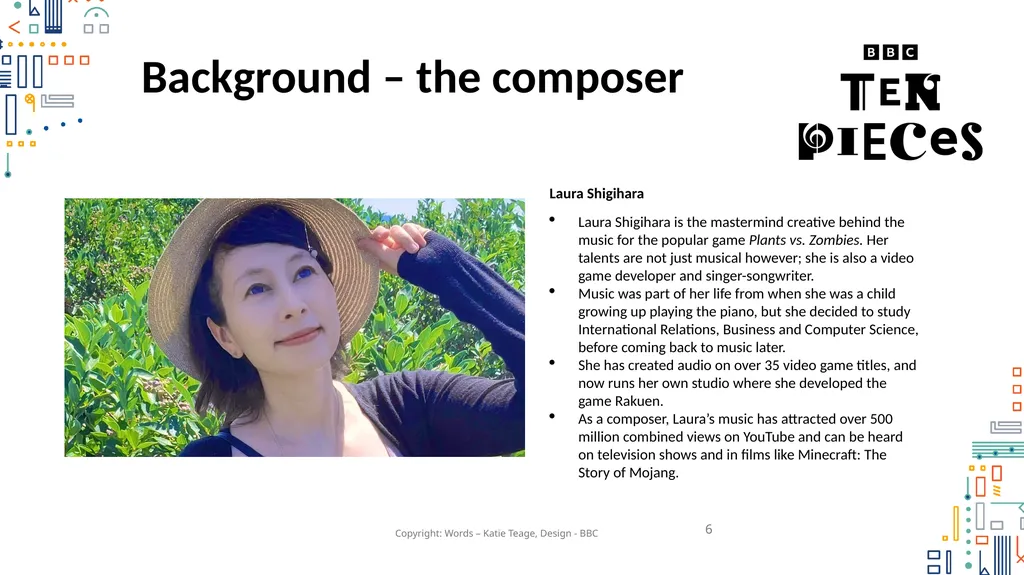
Background – the composer 6 Laura Shigihara
Laura Shigihara is the mastermind creative behind the music for the popular game Plants vs. Zombies. Her talents are not just musical however; she is also a video game developer and singer-songwriter.
Music was part of her life from when she was a child growing up playing the piano, but she decided to study International Relations, Business and Computer Science, before coming back to music later.
She has created audio on over 35 video game titles, and now runs her own studio where she developed the game Rakuen.
As a composer, Laura’s music has attracted over 500 million combined views on YouTube and can be heard on television shows and in films like Minecraft: The Story of Mojang. Copyright: Words – Katie Teage, Design - BBC<br>
07
Background – the music 7 ‘Grasswalk’ from Plants vs. Zombies
Grasswalk is one piece that forms part of a soundtrack. The soundtrack is played whilst the gamer is protecting their home from the Zombie Apocalypse by using the power of plants.
Laura Shigihara’s original music was produced using a digital music synthesizer. This instrument is very versatile and can be used to create other music such as dance music, film music and contemporary classical music. Laura also uses composition software to notate her work.
This piece contains short, memorable melodies that are repeated in different instruments. They are distinct so that the gamer remembers them, but not so complicated that they distract the gamer from their game! Copyright: Words – Katie Teage, Design - BBC<br>
08
Lesson 1 Copyright Katie Teage & BBC<br>
09
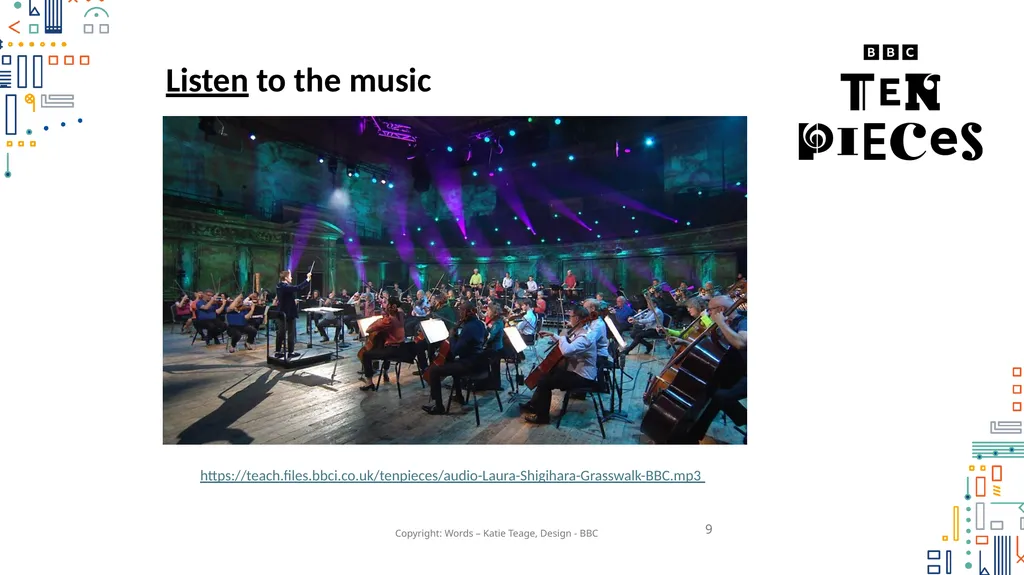
Listen to the music 9 Copyright: Words – Katie Teage, Design - BBC<br>
10
10 What do you think might be happening?
What characters might be in this game?
Draw what you think the characters will look like
Why does the music make you think of that?
Does the music change?
Why do you think the composer chose this time signature? (4/4) Video game music Copyright: Words – Katie Teage, Design - BBC<br>
11
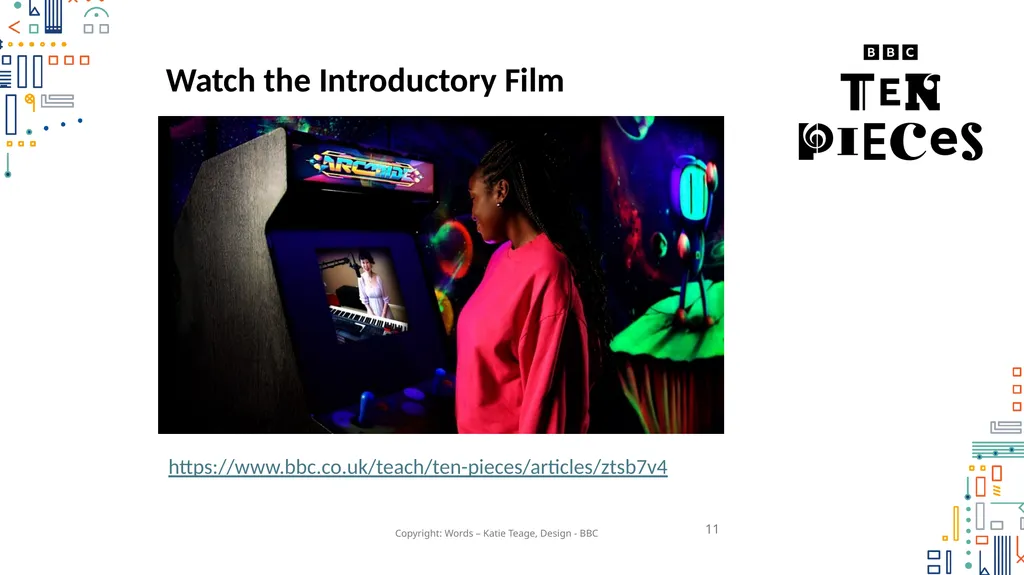
11 Watch the Introductory Film Copyright: Words – Katie Teage, Design - BBC<br>
12
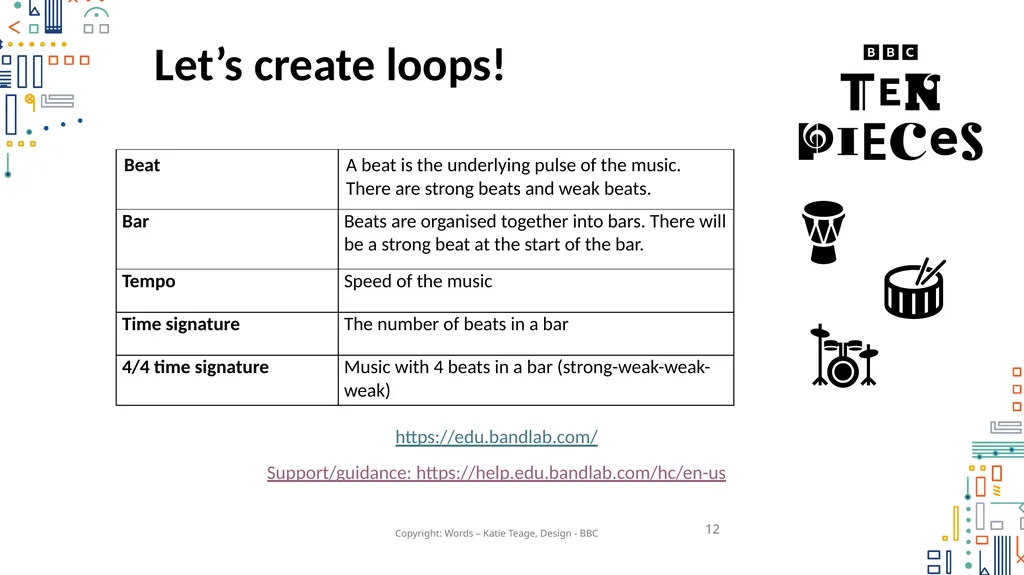
12 https://edu.bandlab.com/
Support/guidance: https://help.edu.bandlab.com/hc/en-us Let’s create loops! Copyright: Words – Katie Teage, Design - BBC<br>
13
Lesson 2 Copyright Katie Teage & BBC<br>
14
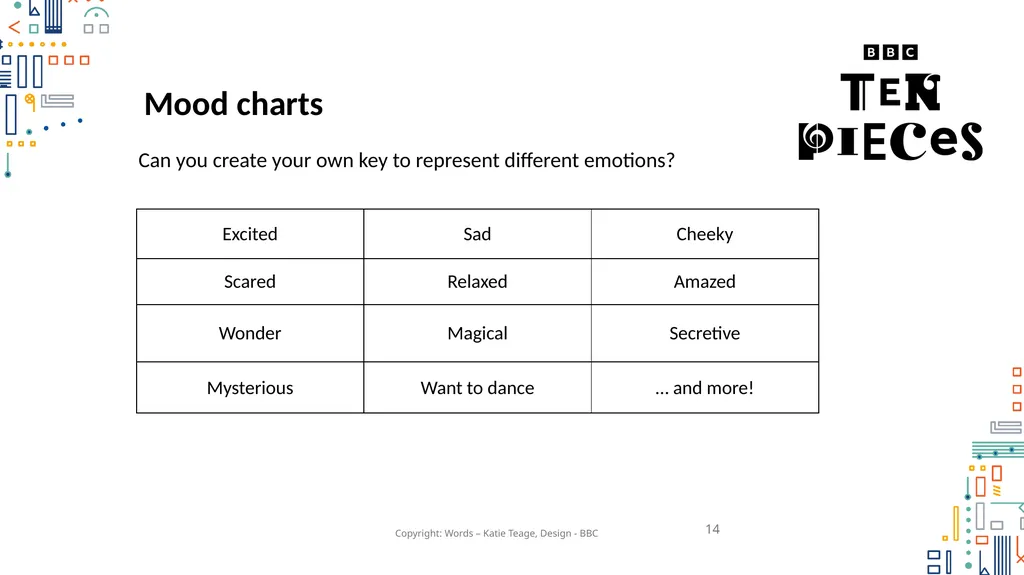
14 Mood charts Can you create your own key to represent different emotions? Copyright: Words – Katie Teage, Design - BBC<br>
15
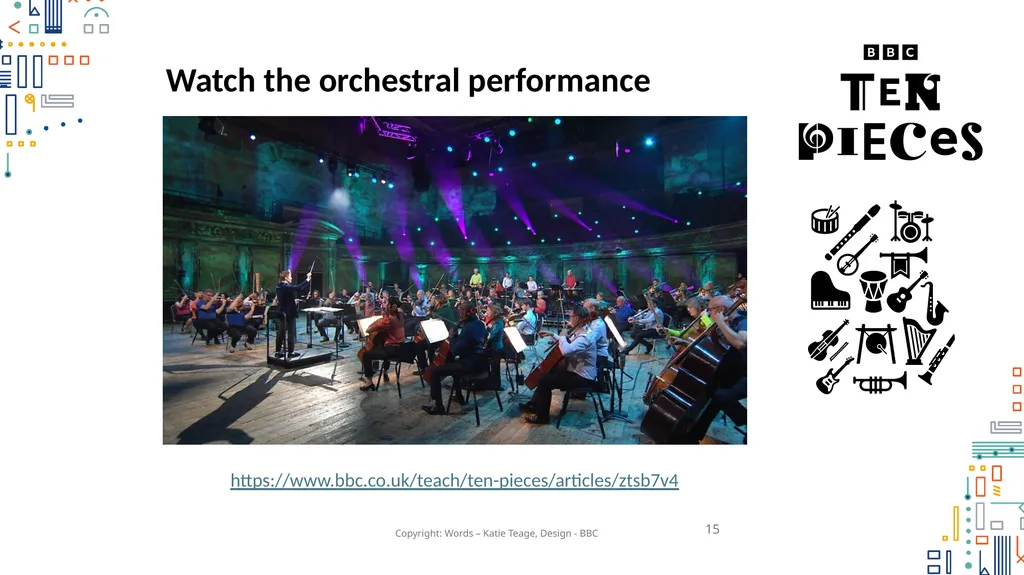
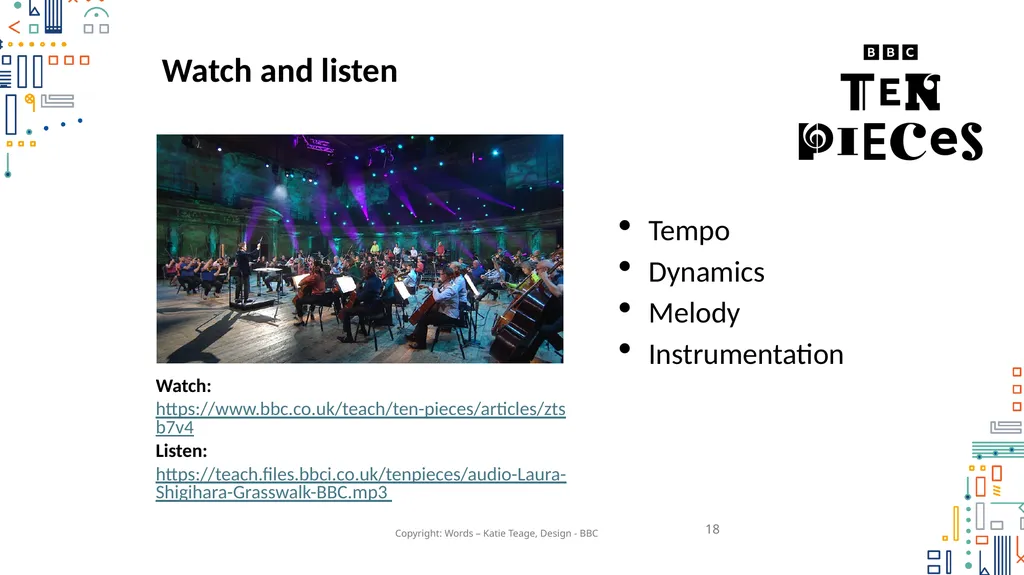
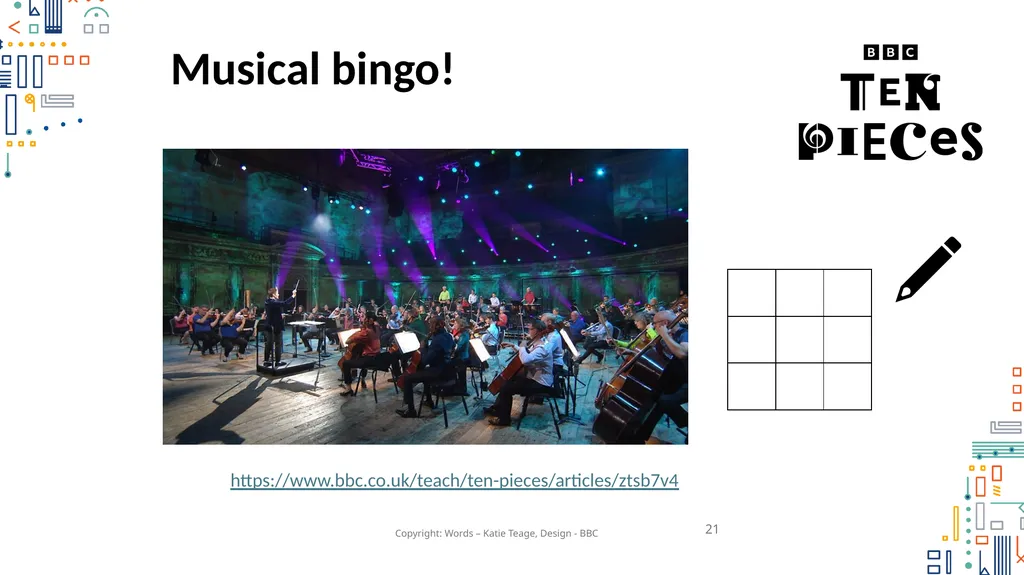
15 Watch the orchestral performance https://www.bbc.co.uk/teach/ten-pieces/articles/ztsb7v4 Copyright: Words – Katie Teage, Design - BBC<br>
16
16 https://scratch.mit.edu/projects/editor/?tutorial=getStarted
Support: https://scratch.mit.edu/educators Our video game music Can you keep improving your 8-bar loops for the music?
What is your character going to look like? Do they match the mood of the music?
What is your setting or backdrop going to be? Does it match the mood of the music? Copyright: Words – Katie Teage, Design - BBC<br>
17
Lesson 3 Copyright Katie Teage & BBC<br>
18
18 Watch and listen Tempo
Dynamics
Melody
Instrumentation Copyright: Words – Katie Teage, Design - BBC<br>
19
19 Create your own video game music! https://edu.bandlab.com/
Support: https://help.edu.bandlab.com/hc/en-us How can you make the next section of your music contrast with your 8-bar loops?
Can you change the tempo? (the speed of the music)
Can you change the dynamics? (how loud or quiet the music is)
Can you change the texture? (the number of layers to the music)
Can you change the instrumentation? Copyright: Words – Katie Teage, Design - BBC<br>
20
Lesson 4 Copyright Katie Teage & BBC<br>
21
21 https://www.bbc.co.uk/teach/ten-pieces/articles/ztsb7v4 Musical bingo! Copyright: Words – Katie Teage, Design - BBC<br>
22
22 https://scratch.mit.edu/projects/editor/?tutorial=getStarted
Support: https://scratch.mit.edu/educators Build your own video game! Checklist:
Your two different musical compositions
Two different backdrops
A sprite (character)
Code which changes the music when the backdrop changes
Share your creations and give each other feedback! Copyright: Words – Katie Teage, Design - BBC<br>
23
23 Taking it further – cross curricular activities HISTORY: Laura Shigihara taught herself how to use software to write music for computer games. As a class, can you find out how computer games were invented and why? If you were one of the first to invent computer games, what kind of game would you have designed?
CREATIVE WRITING: Plants Vs. Zombies is based on a zombie apocalypse. As a class, brainstorm scary/spooky ideas (common characters/themes/plots etc.). Give the children pen and paper and 10 minutes to independently try and write the opening to their own scary story, setting the scene as vividly as they can. If time, students can swap stories for peers to read, or read aloud to the class. Copyright: Words – Katie Teage, Design - BBC<br>