
Learning Modules Nuclear Magnetic Resonance
TA
Published · 63 slides · 0 views
1 / 1


Description
Learning Modules Nuclear Magnetic Resonance Spectroscopy Learning Module 1 - The Electromagnetic Spectrum and Radiation Learning Module 2 Nuclear Magnetic Resonace (NMR) Spectroscopy Learning Module 3 - Chemical Shift and Spin-Spin
Related Topics
Share
Embed code
Download this presentation From Below
"Learning Modules Nuclear Magnetic Resonance" is the property of its rightful owner. Permission is granted to download and print the materials on this website for personal, non-commercial use only, and to display it on your personal computer provided you do not modify the materials and that you retain all copyright notices contained in the materials. By downloading content from our website, you accept the terms of this agreement.
Presentation Transcript
01
Learning Modules Nuclear Magnetic Resonance
Spectroscopy<br>
02
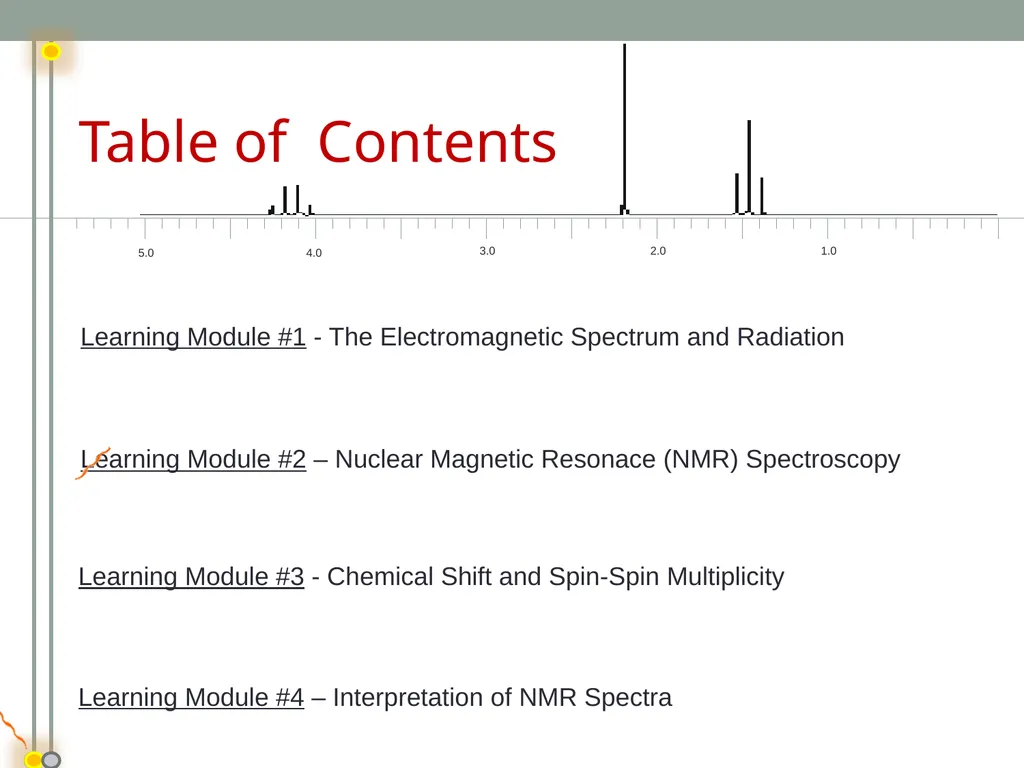
Learning Module #1 - The Electromagnetic Spectrum and Radiation Learning Module #2 – Nuclear Magnetic Resonace (NMR) Spectroscopy Learning Module #3 - Chemical Shift and Spin-Spin Multiplicity Learning Module #4 – Interpretation of NMR Spectra 1.0 2.0 3.0 4.0 5.0 Table of Contents<br>
03
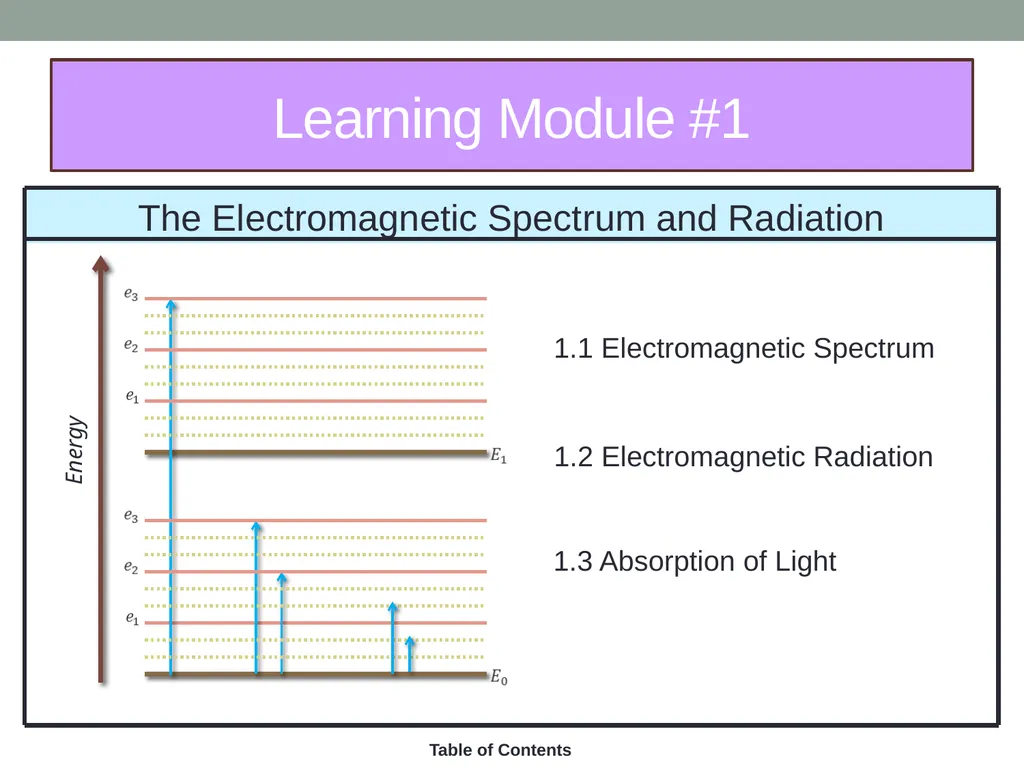
Learning Module #1 The Electromagnetic Spectrum and Radiation 1.1 Electromagnetic Spectrum 1.2 Electromagnetic Radiation 1.3 Absorption of Light Energy Table of Contents<br>
04
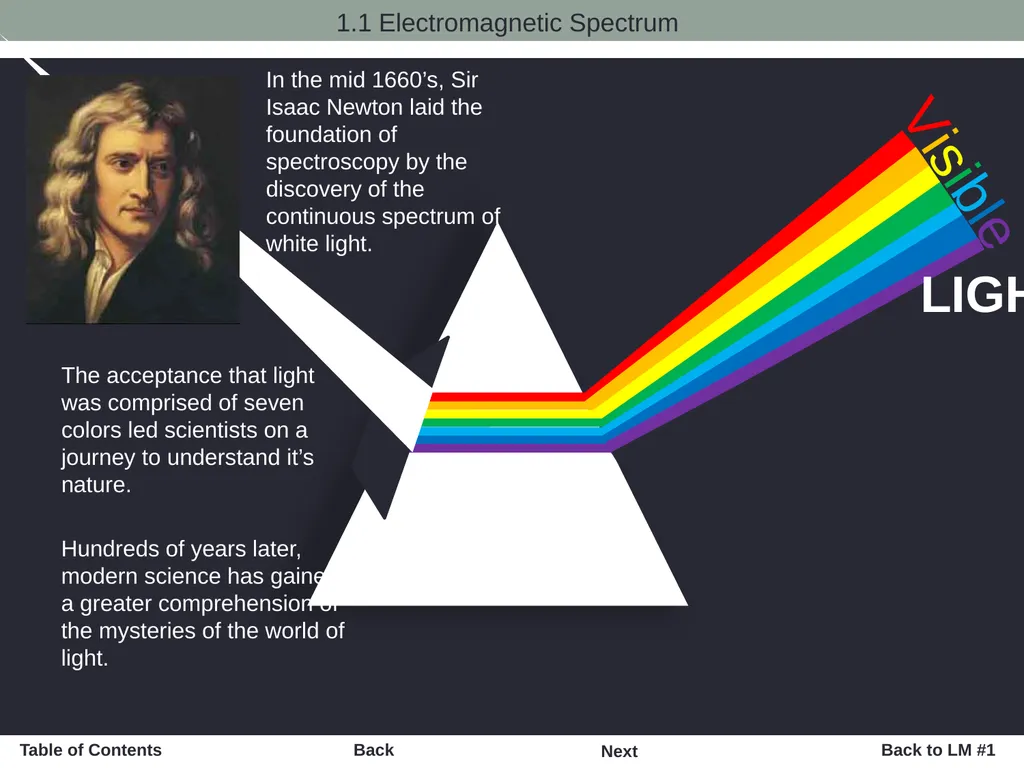
Visible In the mid 1660’s, Sir Isaac Newton laid the foundation of spectroscopy by the discovery of the continuous spectrum of white light. The acceptance that light was comprised of seven colors led scientists on a journey to understand it’s nature. LIGHT Hundreds of years later, modern science has gained a greater comprehension of the mysteries of the world of light. Table of Contents Next Back to LM #1 1.1 Electromagnetic Spectrum Back<br>
05
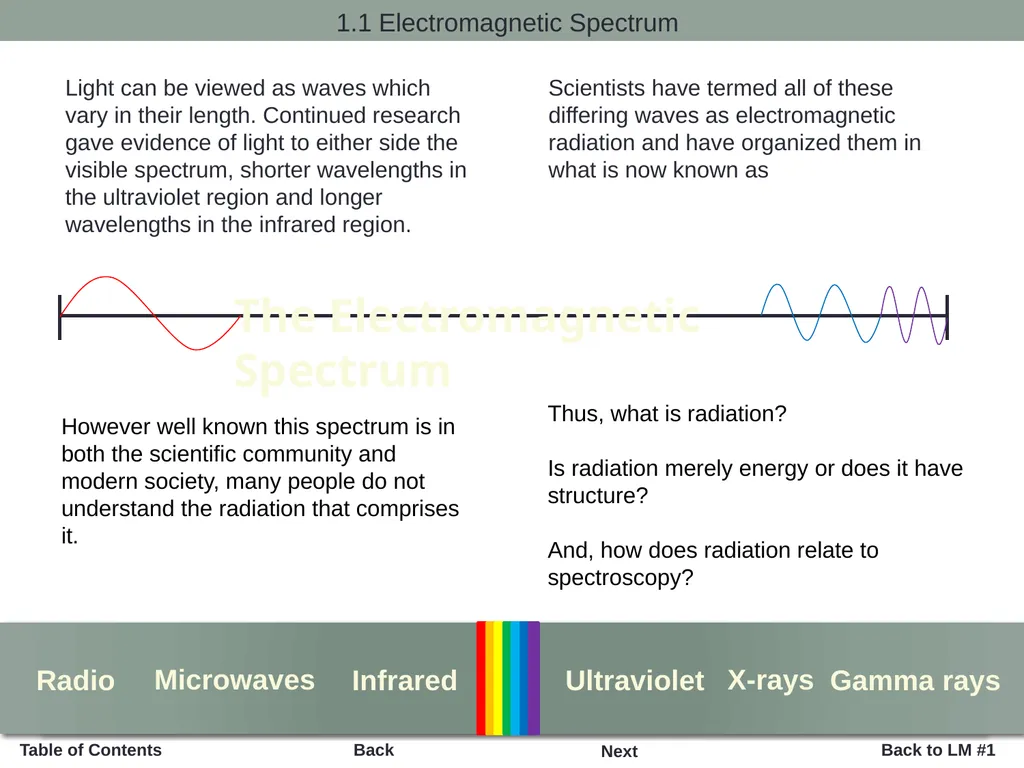
Light can be viewed as waves which vary in their length. Continued research gave evidence of light to either side the visible spectrum, shorter wavelengths in the ultraviolet region and longer wavelengths in the infrared region. Scientists have termed all of these differing waves as electromagnetic radiation and have organized them in what is now known as However well known this spectrum is in both the scientific community and modern society, many people do not understand the radiation that comprises it. The Electromagnetic Spectrum Infrared Gamma rays X-rays Radio Microwaves Ultraviolet Thus, what is radiation?
Is radiation merely energy or does it have structure?
And, how does radiation relate to spectroscopy? 1.1 Electromagnetic Spectrum Table of Contents Next Back to LM #1 Back<br>
Is radiation merely energy or does it have structure?
And, how does radiation relate to spectroscopy? 1.1 Electromagnetic Spectrum Table of Contents Next Back to LM #1 Back<br>
06
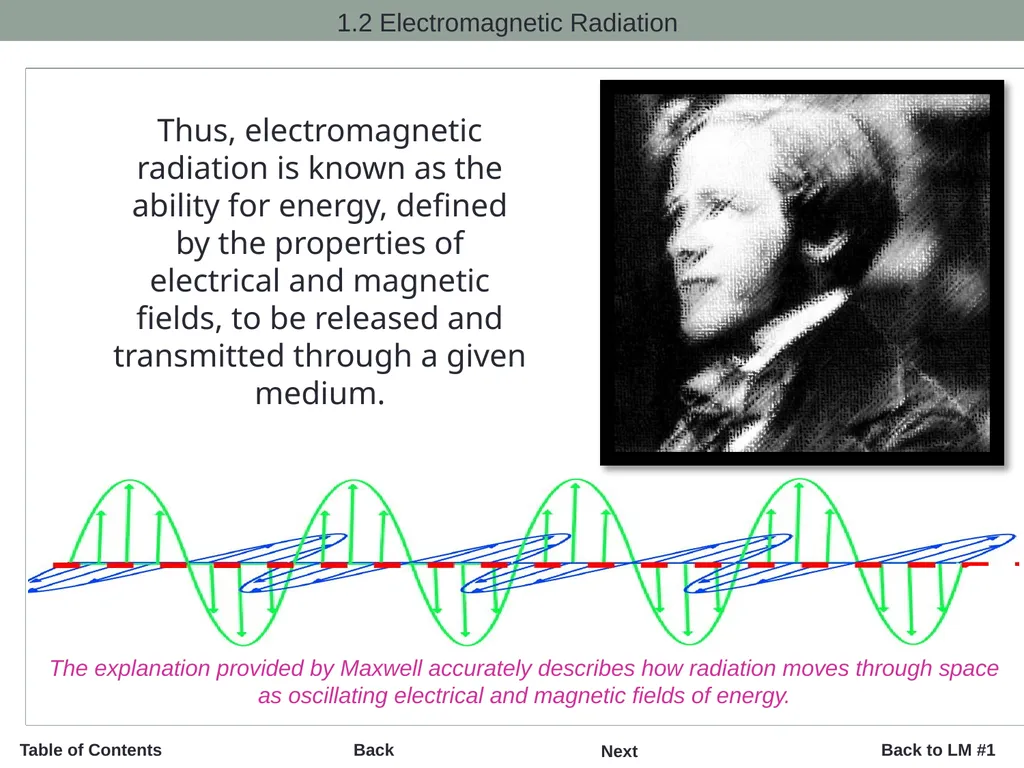
In the late 1800’s James C. Maxwell postulated that instead of visible light being composed of small tiny divisible particles of matter, as is described by Newton in his Corpuscular Theory of Light, it was comprised of electromagnetic waves. He further stated that this form of energy was in the form of waves that contained two fields, electrical and magnetic. These two components having equal wavelength and frequency are perpendicular to each other. Electromagnetic Radiation Z X Y 1.2 Electromagnetic Radiation Table of Contents Next Back to LM #1 Back<br>
07
Thus, electromagnetic radiation is known as the ability for energy, defined by the properties of electrical and magnetic fields, to be released and transmitted through a given medium. 1.2 Electromagnetic Radiation The explanation provided by Maxwell accurately describes how radiation moves through space as oscillating electrical and magnetic fields of energy. Table of Contents Next Back to LM #1 Back<br>
08
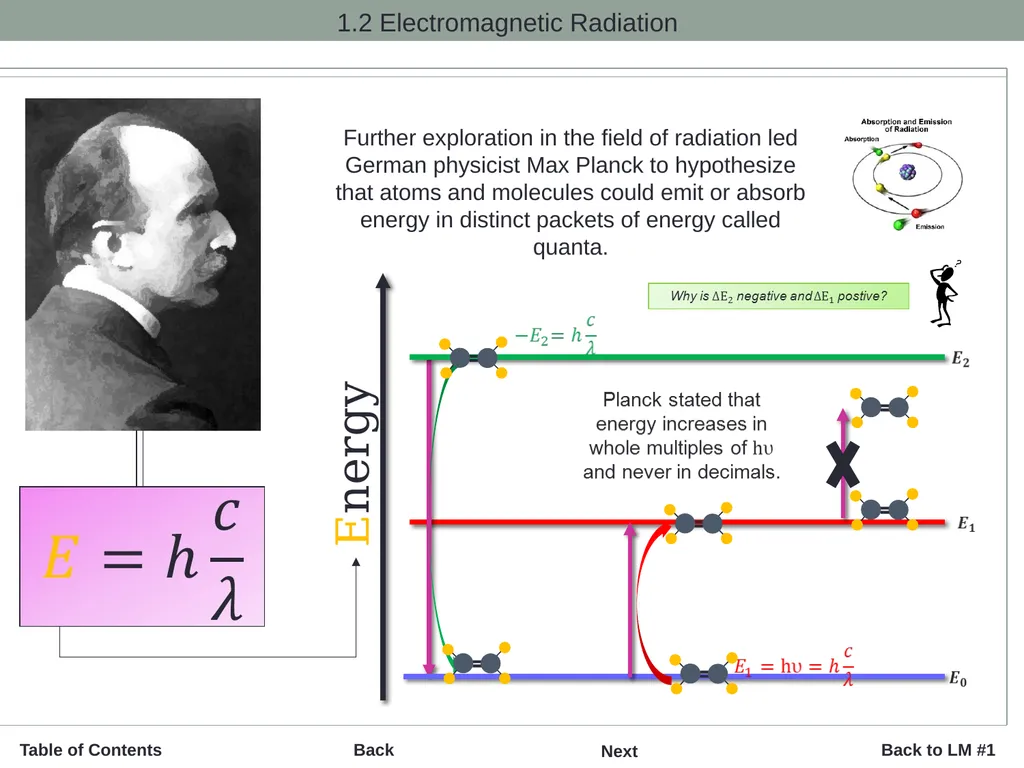
Further exploration in the field of radiation led German physicist Max Planck to hypothesize that atoms and molecules could emit or absorb energy in distinct packets of energy called quanta. 1.2 Electromagnetic Radiation Energy Table of Contents Next Back to LM #1 Back<br>
09
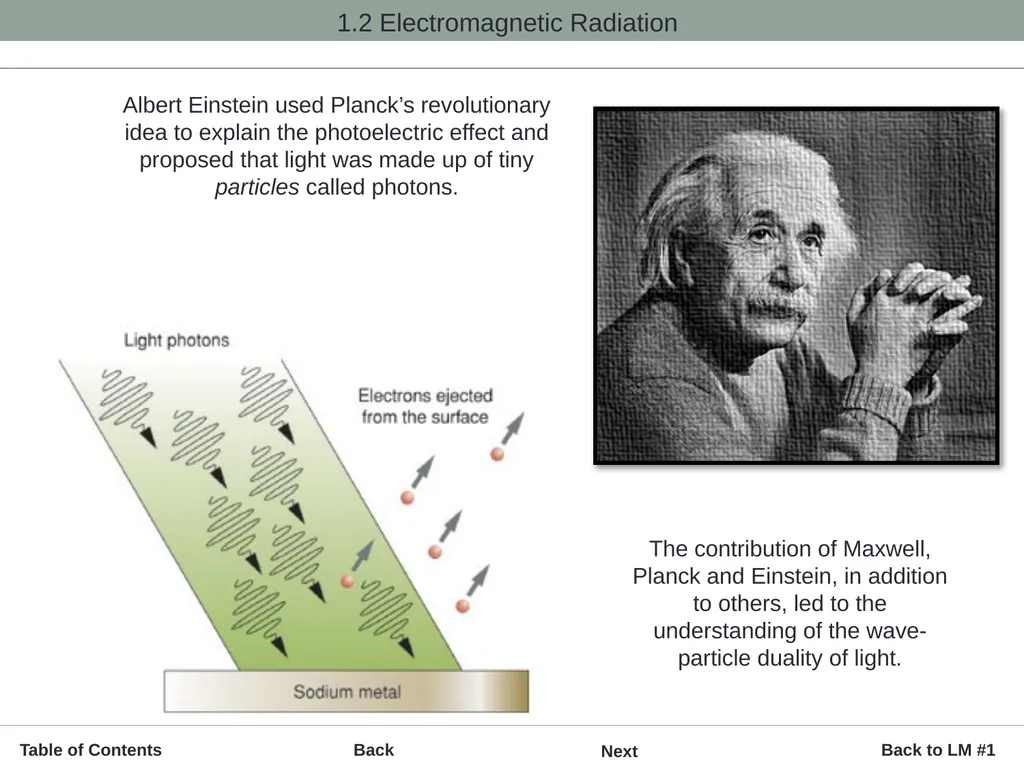
Albert Einstein used Planck’s revolutionary idea to explain the photoelectric effect and proposed that light was made up of tiny particles called photons. 1.2 Electromagnetic Radiation The contribution of Maxwell, Planck and Einstein, in addition to others, led to the understanding of the wave-particle duality of light. Table of Contents Next Back to LM #1 Back<br>
10
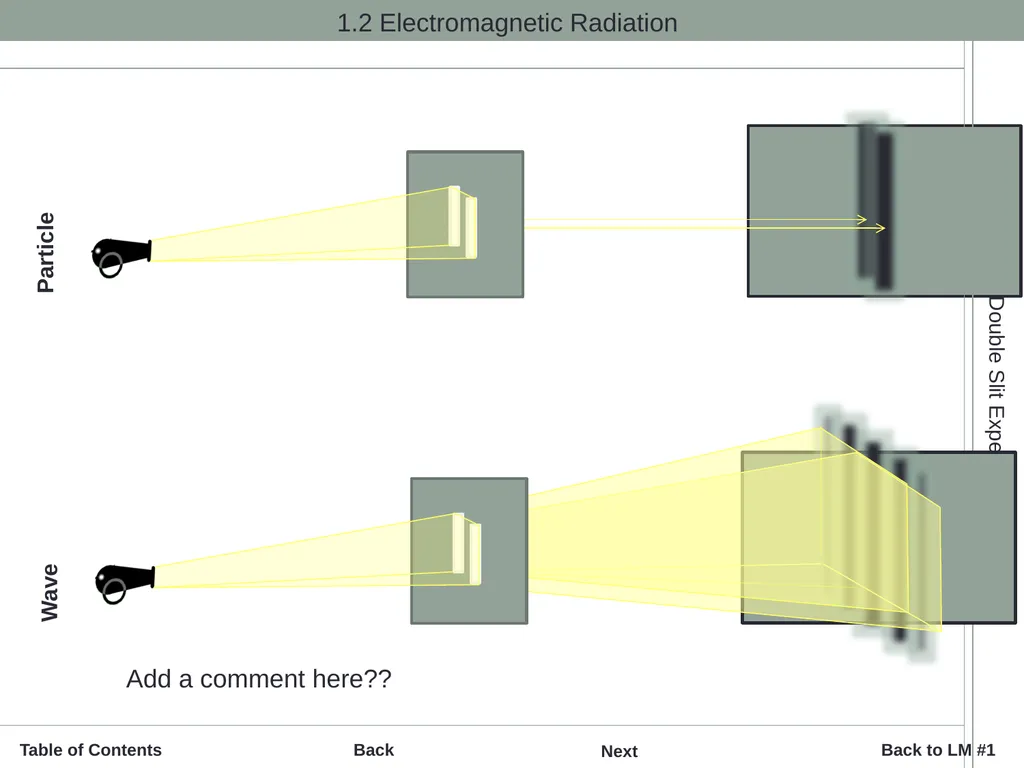
Double Slit Experiment Wave Particle 1.2 Electromagnetic Radiation Table of Contents Next Back to LM #1 Back Add a comment here??<br>
11
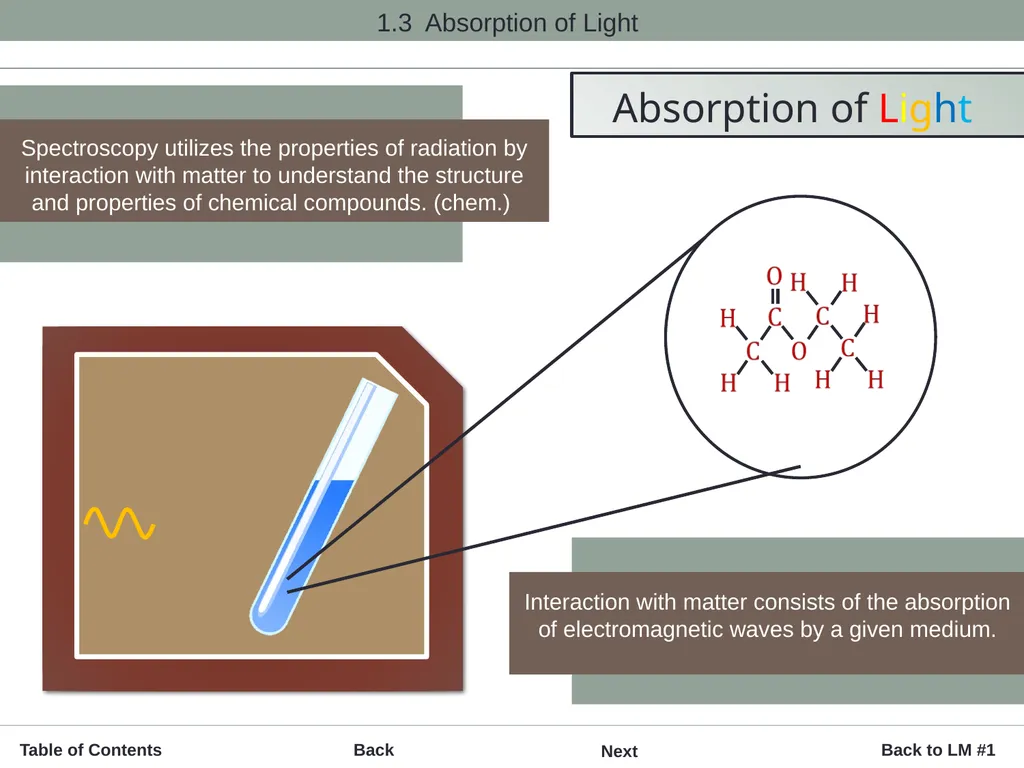
1.3 Absorption of Light Spectroscopy utilizes the properties of radiation by interaction with matter to understand the structure and properties of chemical compounds. (chem.) Interaction with matter consists of the absorption of electromagnetic waves by a given medium. Absorption of Light Table of Contents Next Back to LM #1 Back<br>
12
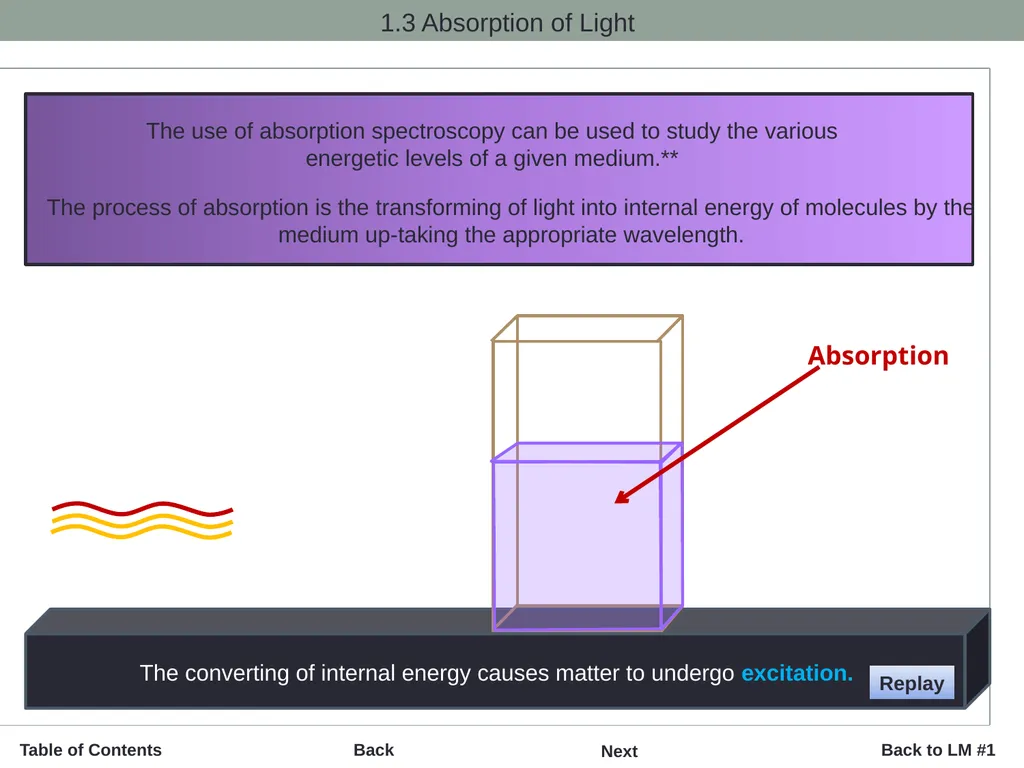
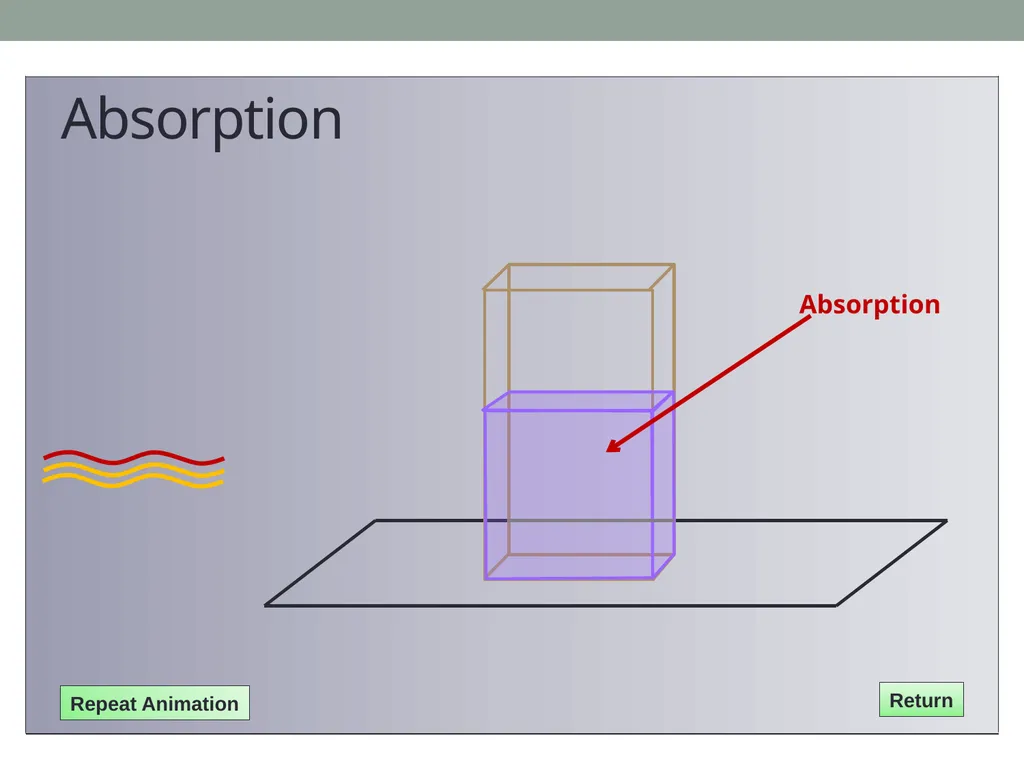
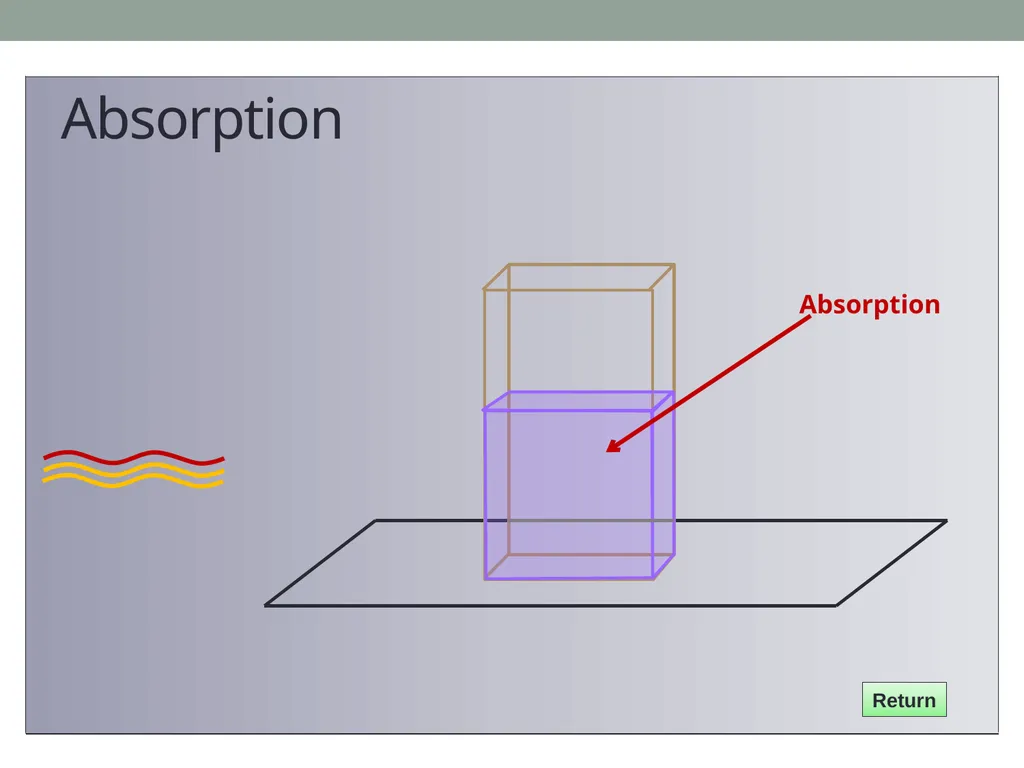
1.3 Absorption of Light The converting of internal energy causes matter to undergo excitation. Absorption The process of absorption is the transforming of light into internal energy of molecules by the medium up-taking the appropriate wavelength. The use of absorption spectroscopy can be used to study the various energetic levels of a given medium.** Replay Table of Contents Next Back to LM #1 Back<br>
13
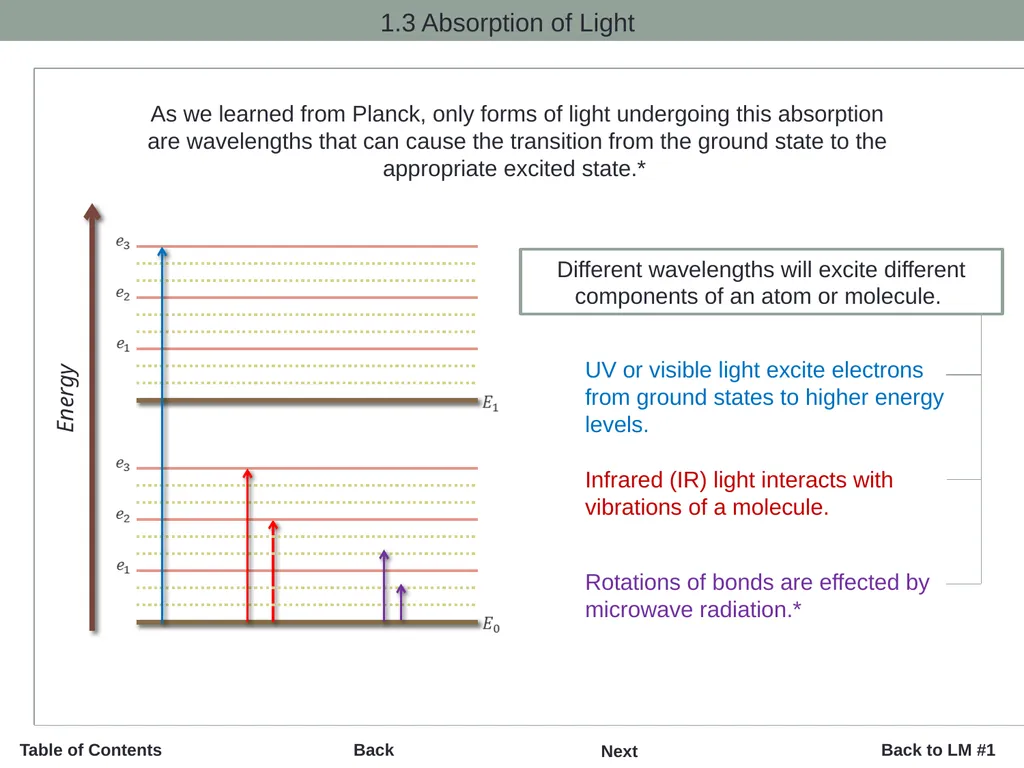
1.3 Absorption of Light As we learned from Planck, only forms of light undergoing this absorption are wavelengths that can cause the transition from the ground state to the appropriate excited state.* Energy Different wavelengths will excite different components of an atom or molecule. Infrared (IR) light interacts with vibrations of a molecule. UV or visible light excite electrons from ground states to higher energy levels. Rotations of bonds are effected by microwave radiation.* Table of Contents Next Back to LM #1 Back<br>
14
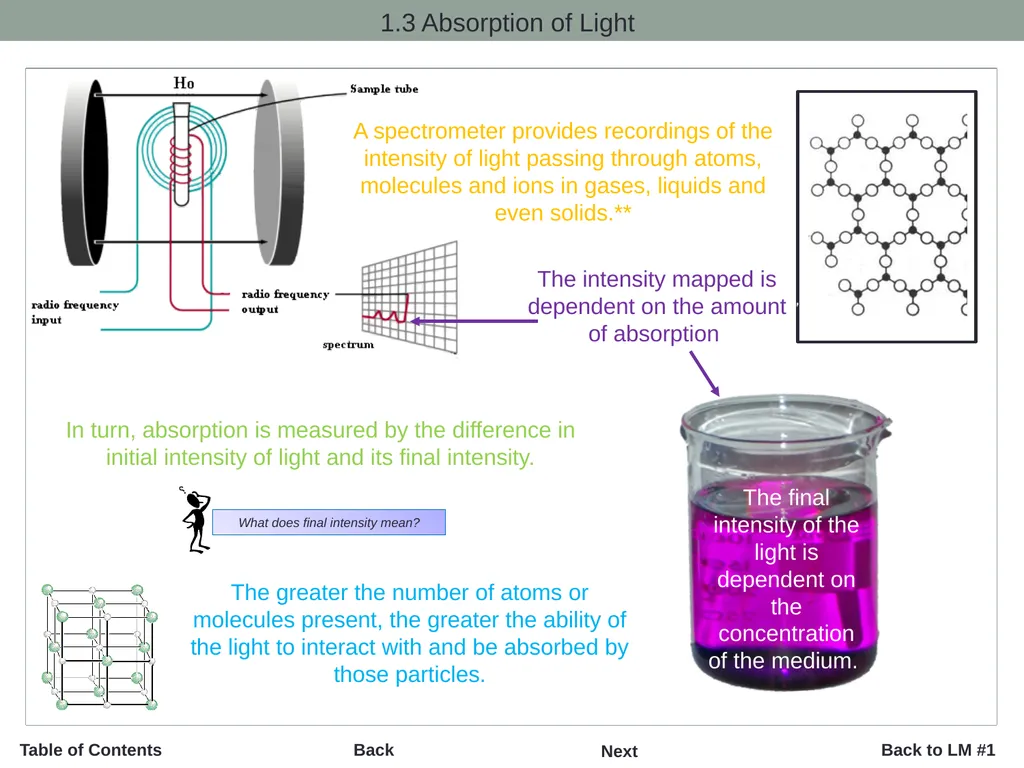
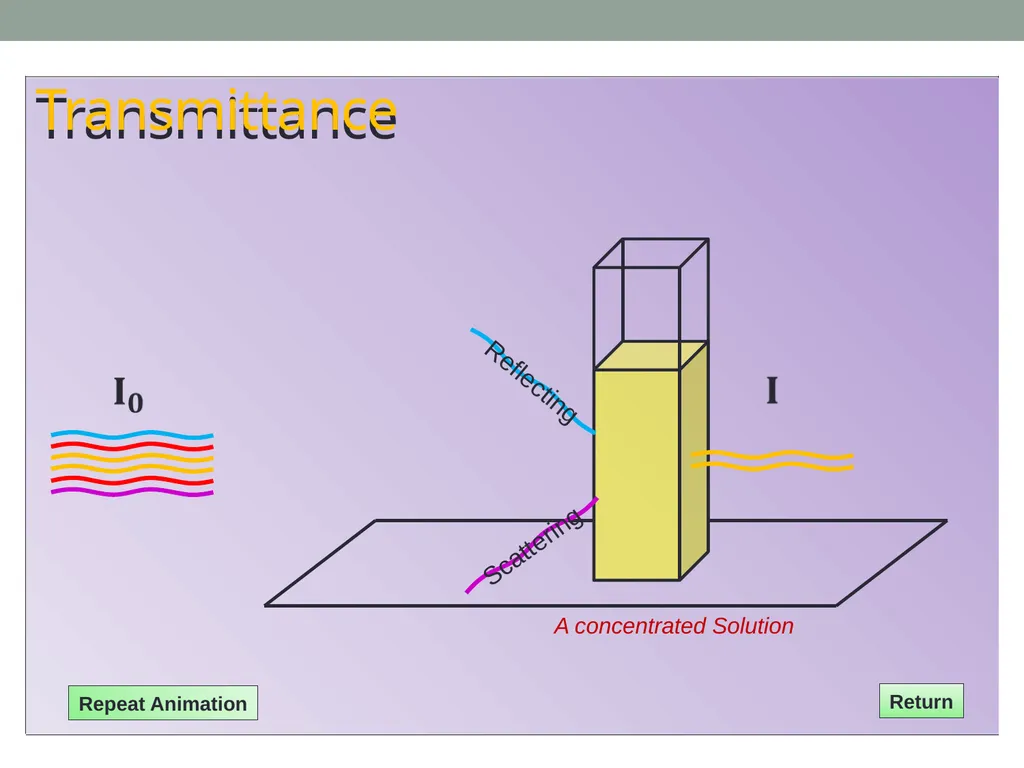
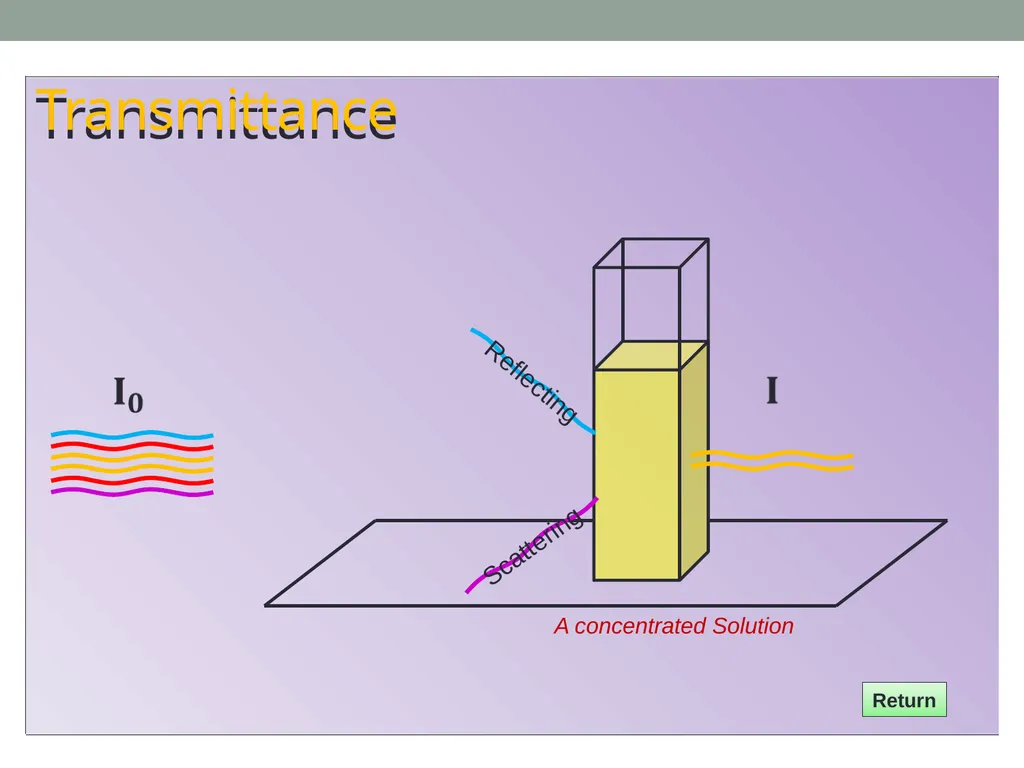
1.3 Absorption of Light A spectrometer provides recordings of the intensity of light passing through atoms, molecules and ions in gases, liquids and even solids.** In turn, absorption is measured by the difference in initial intensity of light and its final intensity. The greater the number of atoms or molecules present, the greater the ability of the light to interact with and be absorbed by those particles. The final intensity of the light is dependent on the concentration of the medium. The intensity mapped is dependent on the amount of absorption What does final intensity mean? Table of Contents Next Back to LM #1 Back<br>
15
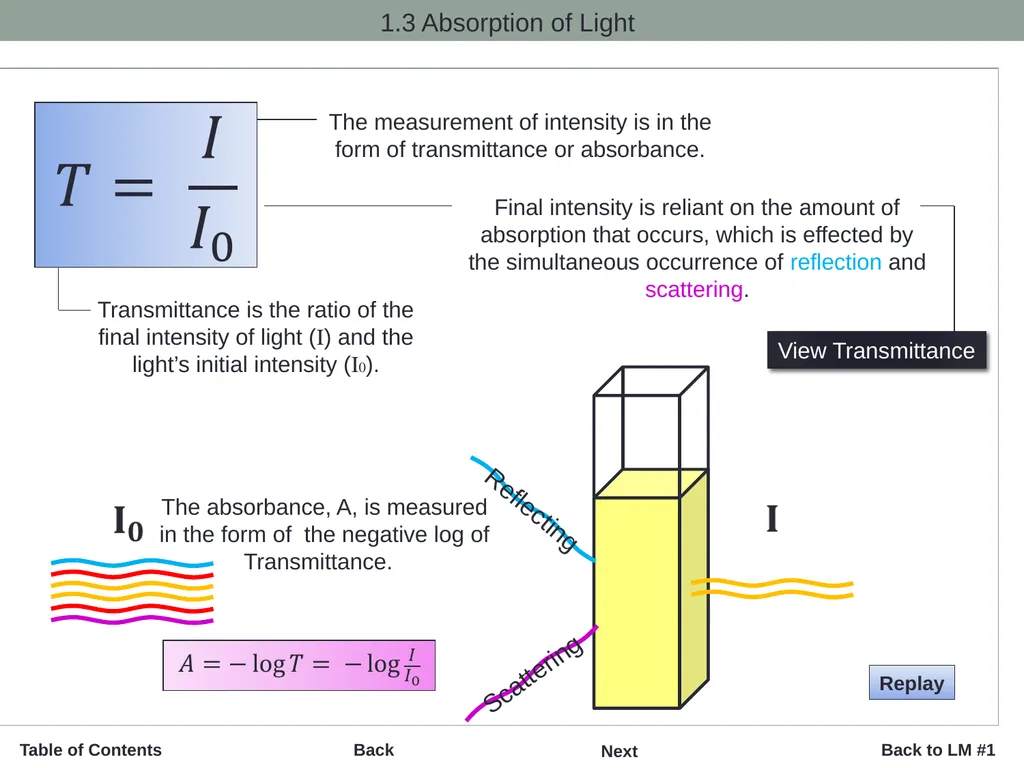
1.3 Absorption of Light Transmittance is the ratio of the final intensity of light (I) and the light’s initial intensity (I0). The measurement of intensity is in the form of transmittance or absorbance. Final intensity is reliant on the amount of absorption that occurs, which is effected by the simultaneous occurrence of reflection and scattering. Reflecting Scattering View Transmittance The absorbance, A, is measured in the form of the negative log of Transmittance. Table of Contents Next Back to LM #1 Back Replay<br>
16
Table of Contents Need to Review? Light Intensity Light Absorption Wave-Particle Duality of Light Planck’s Quantum Theory Electromagnetic Radiation Newton’s Study of Light Electromagnetic Spectrum Light Transmittance Module #4 Module #1 Module #2 Module #3<br>
17
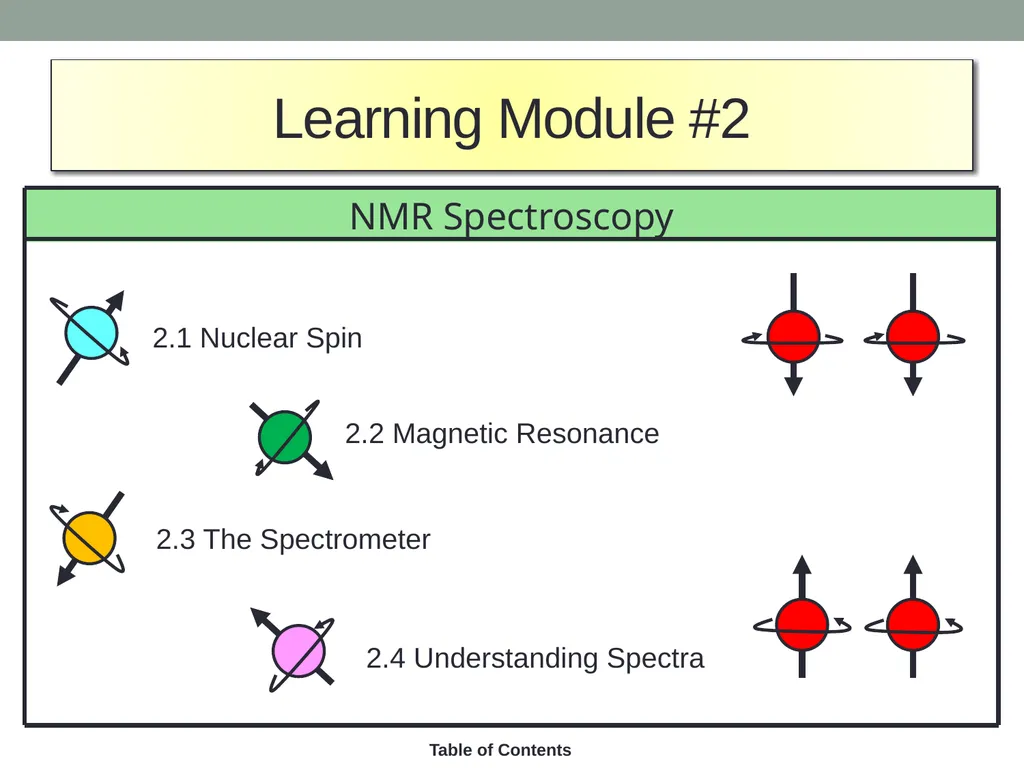
Learning Module #2 NMR Spectroscopy 2.1 Nuclear Spin 2.2 Magnetic Resonance 2.3 The Spectrometer 2.4 Understanding Spectra Table of Contents<br>
18
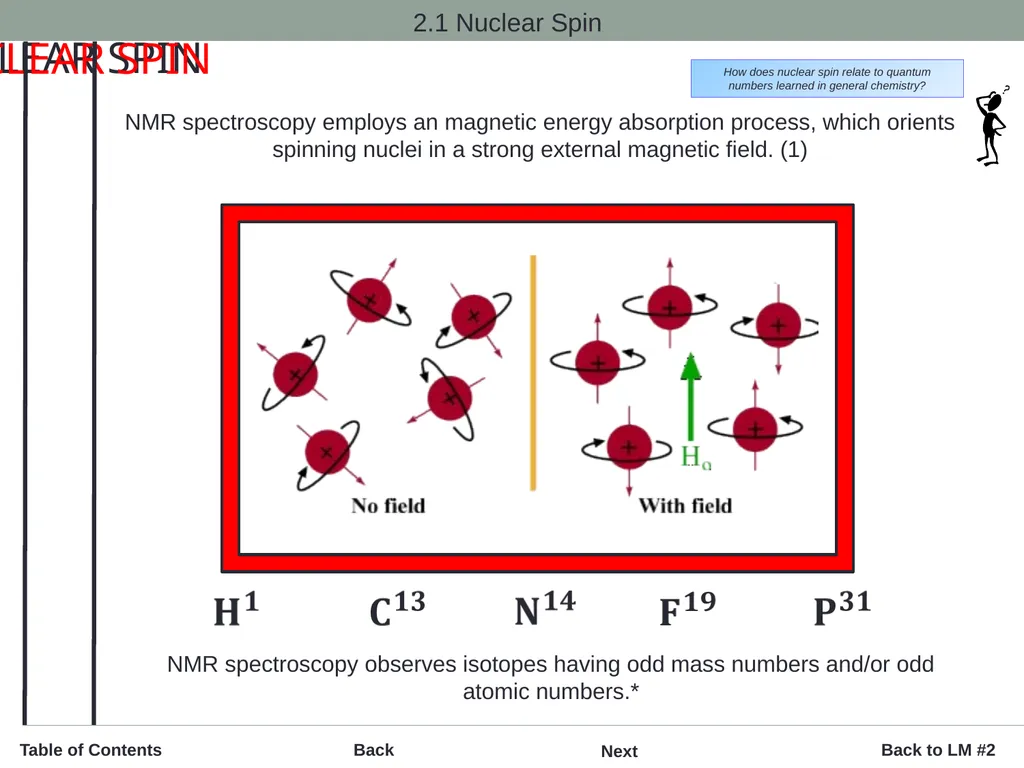
2.1 Nuclear Spin NMR spectroscopy employs an magnetic energy absorption process, which orients spinning nuclei in a strong external magnetic field. (1) NUCLEAR SPIN NUCLEAR SPIN NMR spectroscopy observes isotopes having odd mass numbers and/or odd atomic numbers.* How does nuclear spin relate to quantum numbers learned in general chemistry? Nuclear spin is notated by I. Table of Contents Next Back to LM #2 Back<br>
19
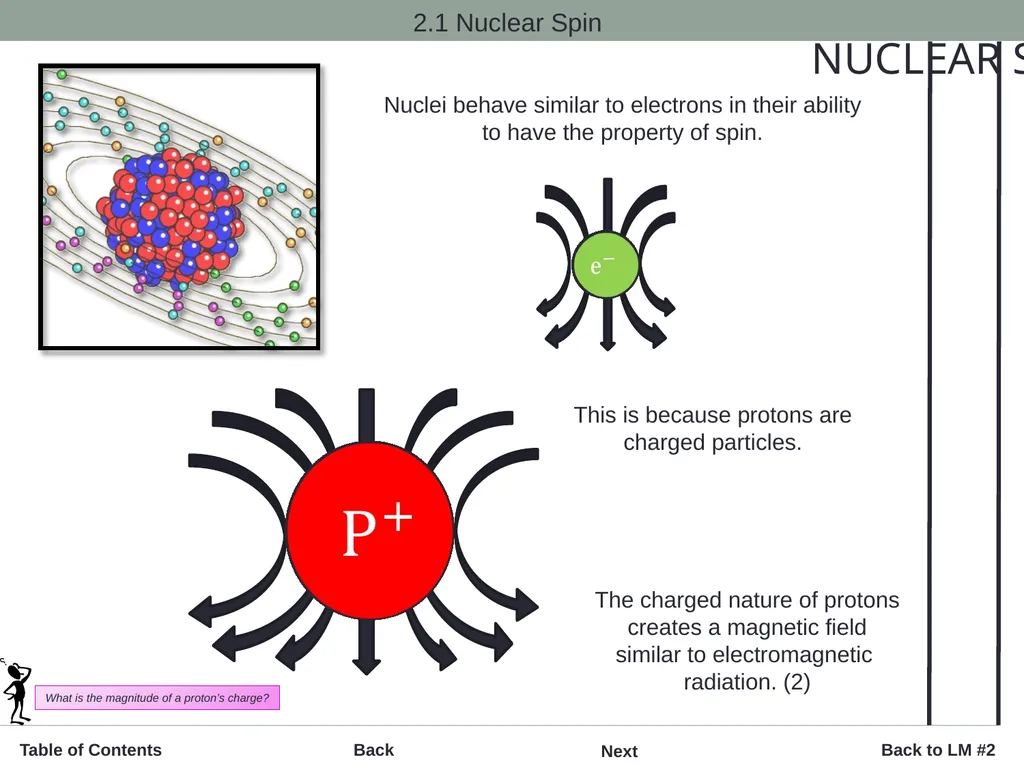
Nuclei behave similar to electrons in their ability to have the property of spin. This is because protons are charged particles. 2.1 Nuclear Spin NUCLEAR SPIN The charged nature of protons creates a magnetic field similar to electromagnetic radiation. (2) What is the magnitude of a proton’s charge? Table of Contents Next Back to LM #2 Back<br>
20
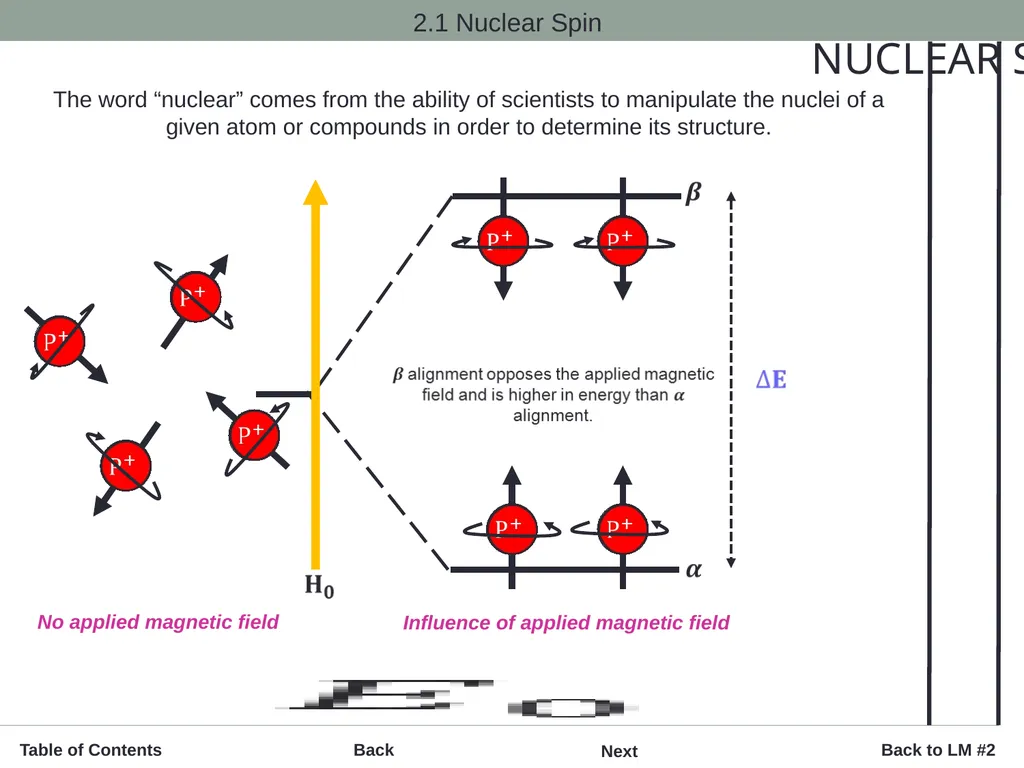
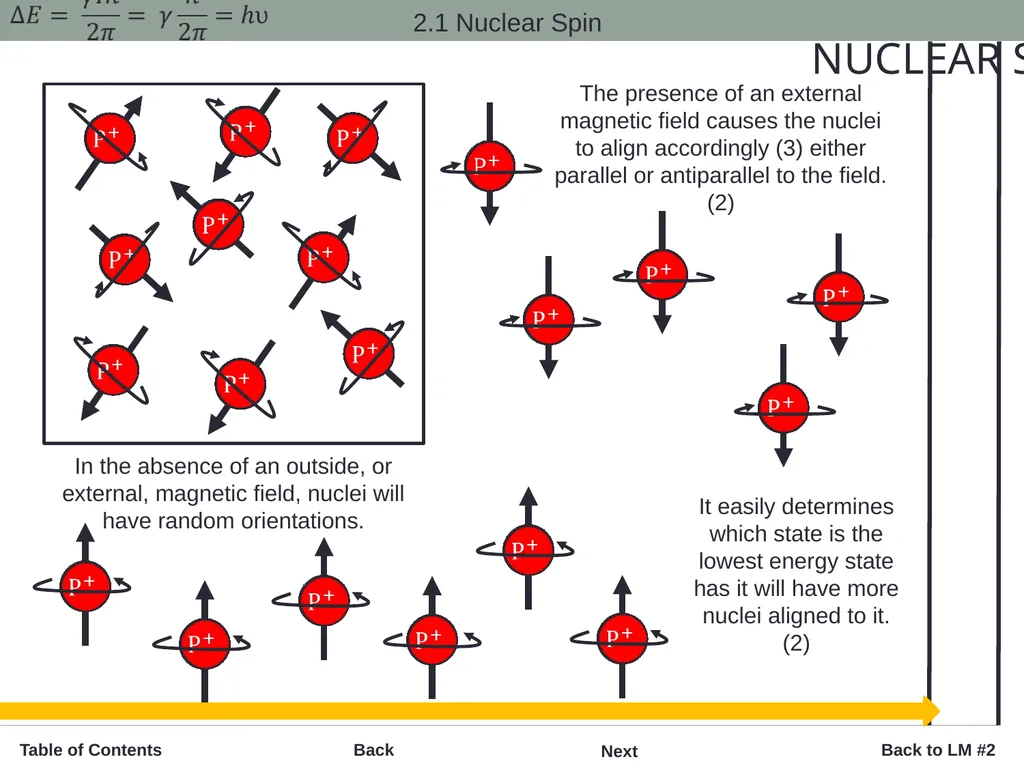
The word “nuclear” comes from the ability of scientists to manipulate the nuclei of a given atom or compounds in order to determine its structure. 2.1 Nuclear Spin NUCLEAR SPIN No applied magnetic field Influence of applied magnetic field Table of Contents Next Back to LM #2 Back<br>
21
2.1 Nuclear Spin NUCLEAR SPIN In the absence of an outside, or external, magnetic field, nuclei will have random orientations. The presence of an external magnetic field causes the nuclei to align accordingly (3) either parallel or antiparallel to the field. (2) It easily determines which state is the lowest energy state has it will have more nuclei aligned to it. (2) Table of Contents Next Back to LM #2 Back<br>
22
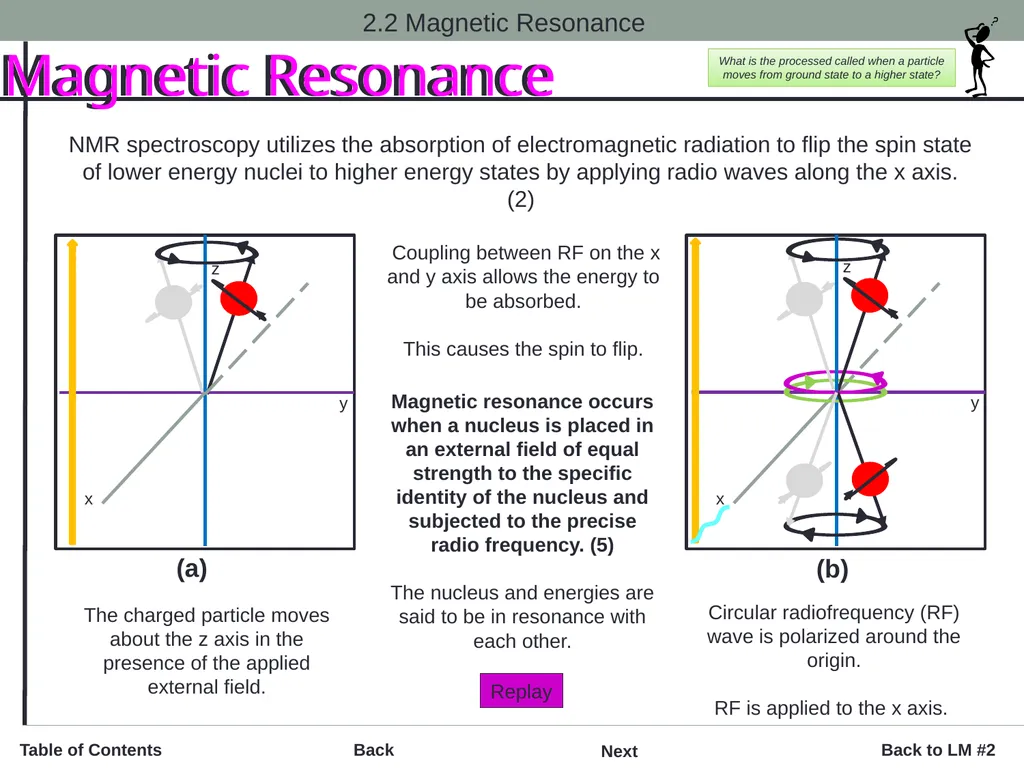
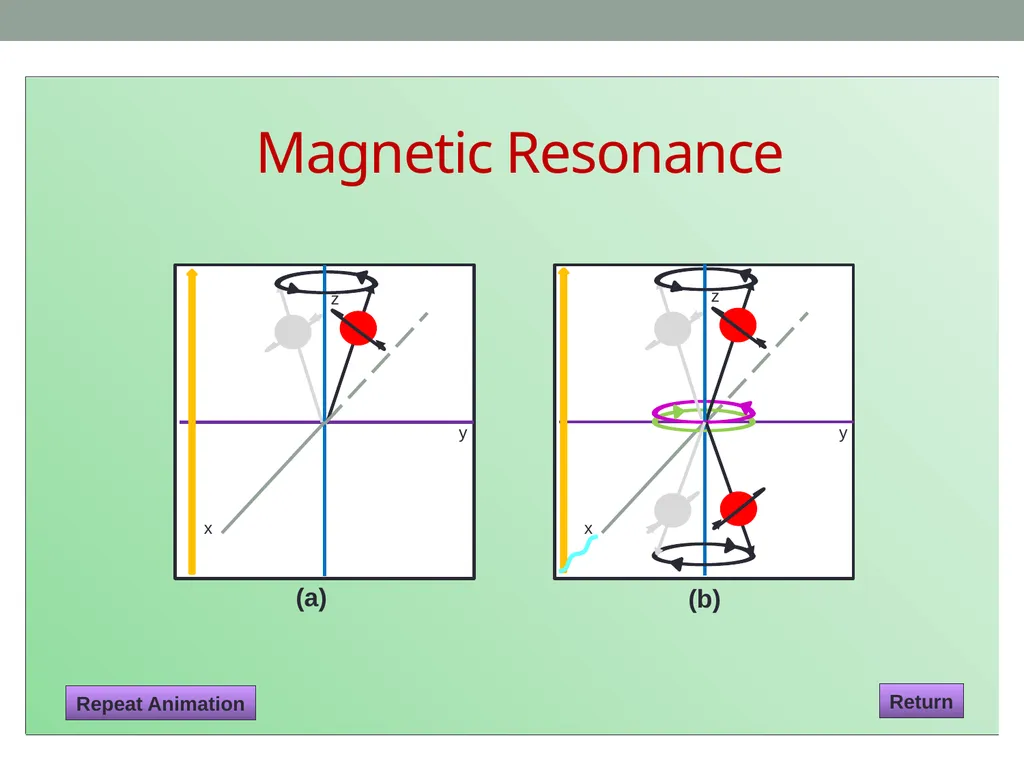
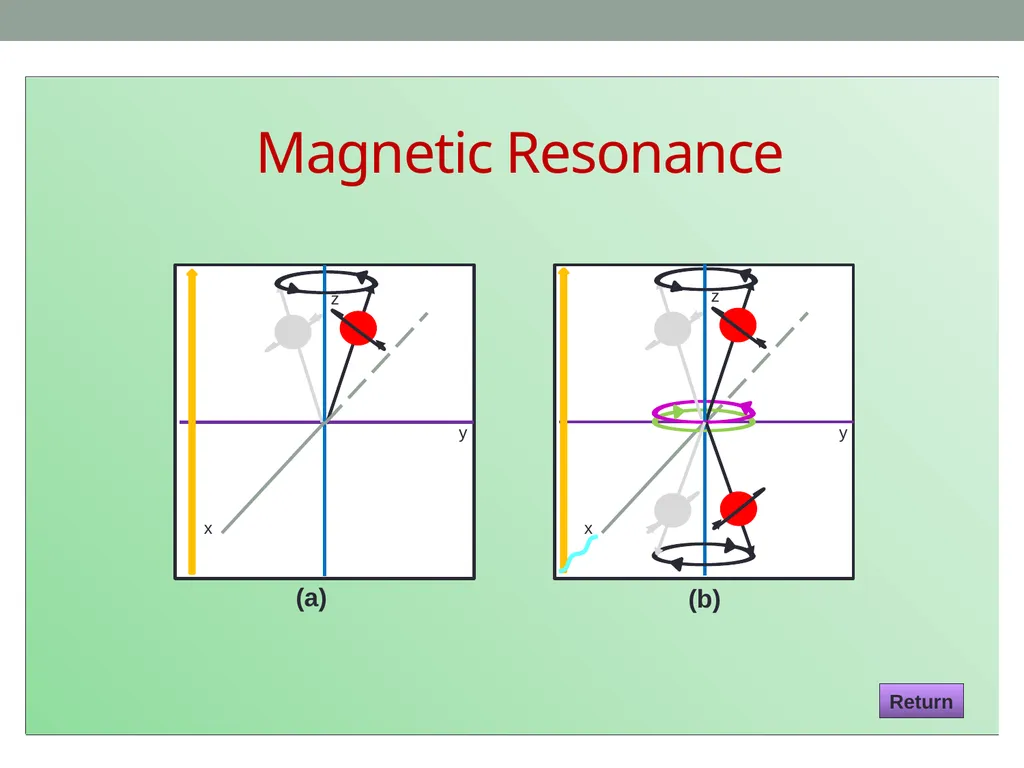
2.2 Magnetic Resonance Magnetic Resonance Magnetic Resonance NMR spectroscopy utilizes the absorption of electromagnetic radiation to flip the spin state of lower energy nuclei to higher energy states by applying radio waves along the x axis. (2) Circular radiofrequency (RF) wave is polarized around the origin.
RF is applied to the x axis. (a) (b) x y x y z z The charged particle moves about the z axis in the presence of the applied external field. Coupling between RF on the x and y axis allows the energy to be absorbed.
This causes the spin to flip. Magnetic resonance occurs when a nucleus is placed in an external field of equal strength to the specific identity of the nucleus and subjected to the precise radio frequency. (5)
The nucleus and energies are said to be in resonance with each other. Replay What is the processed called when a particle moves from ground state to a higher state? Table of Contents Next Back to LM #2 Back<br>
23
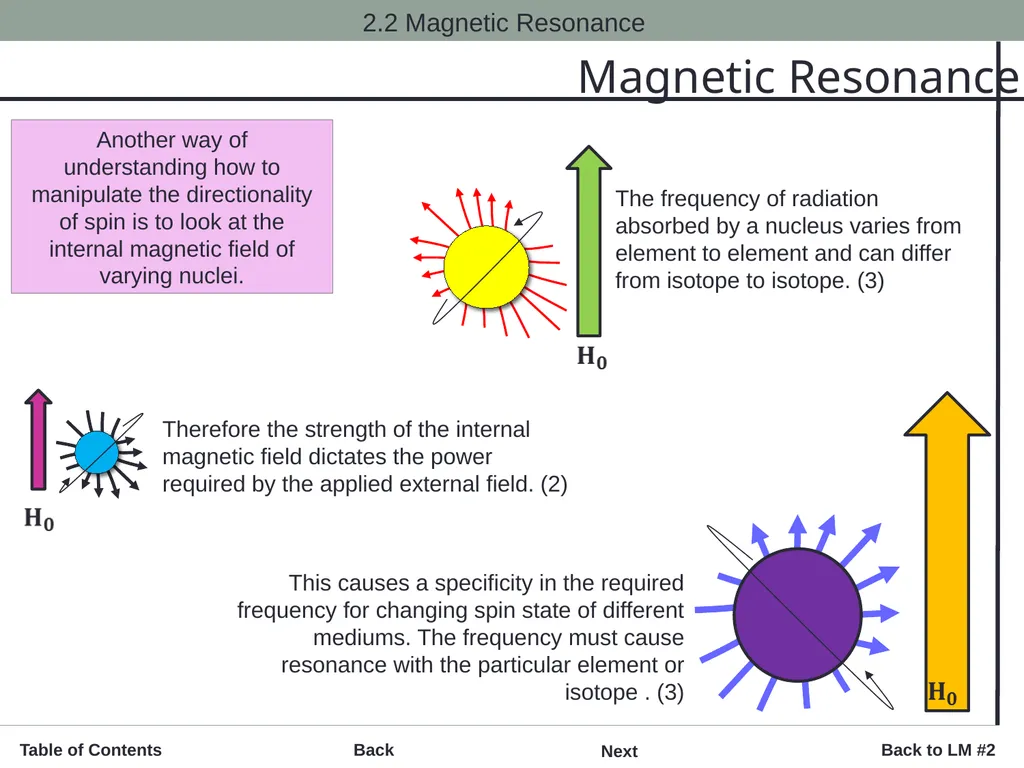
2.2 Magnetic Resonance Magnetic Resonance Another way of understanding how to manipulate the directionality of spin is to look at the internal magnetic field of varying nuclei. Therefore the strength of the internal magnetic field dictates the power required by the applied external field. (2) The frequency of radiation absorbed by a nucleus varies from element to element and can differ from isotope to isotope. (3) This causes a specificity in the required frequency for changing spin state of different mediums. The frequency must cause resonance with the particular element or isotope . (3) Table of Contents Next Back to LM #2 Back<br>
24
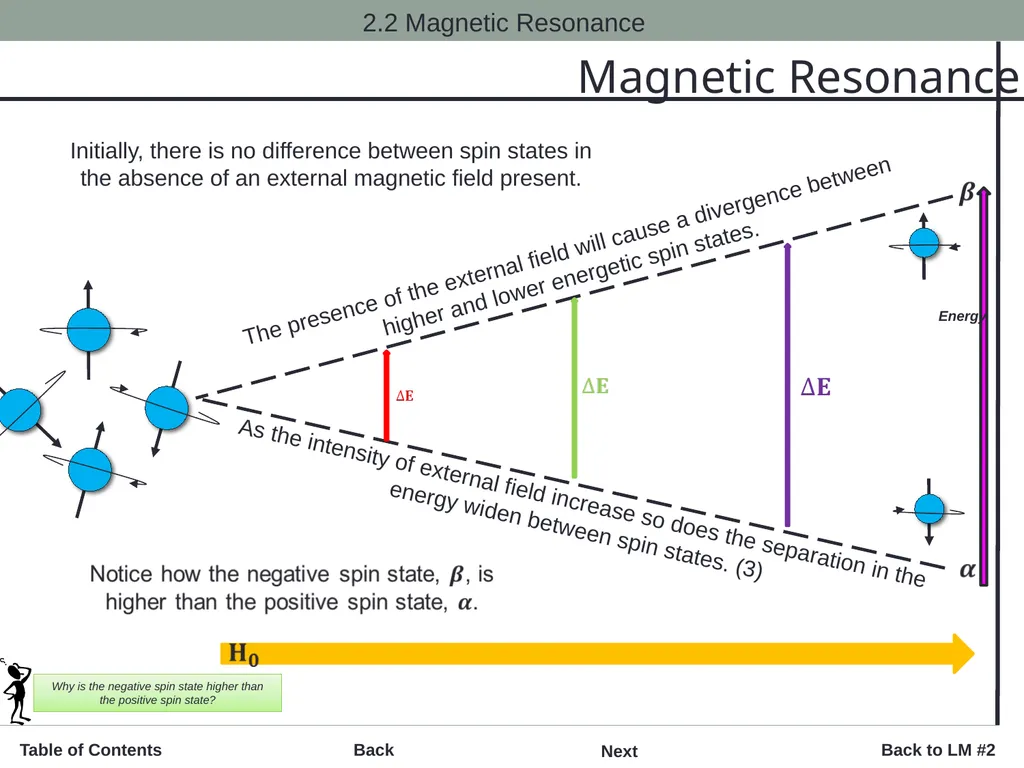
Initially, there is no difference between spin states in the absence of an external magnetic field present. The presence of the external field will cause a divergence between higher and lower energetic spin states. As the intensity of external field increase so does the separation in the energy widen between spin states. (3) 2.2 Magnetic Resonance Magnetic Resonance Why is the negative spin state higher than the positive spin state? Energy Table of Contents Next Back to LM #2 Back<br>
25
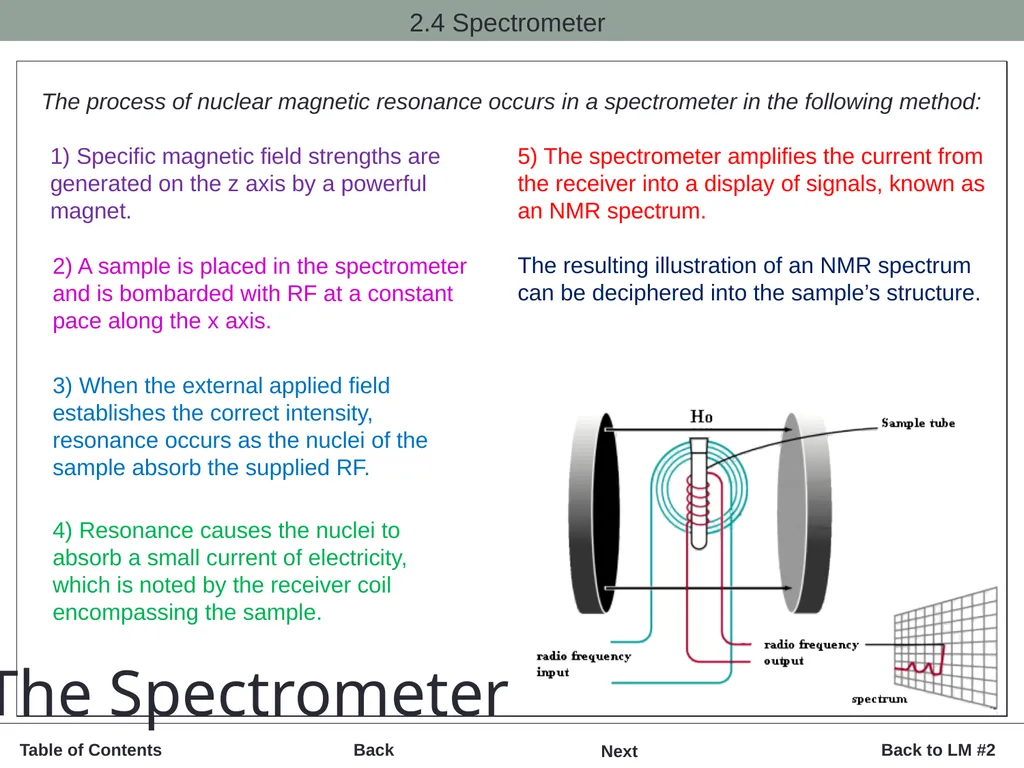
2.4 Spectrometer The process of nuclear magnetic resonance occurs in a spectrometer in the following method: 5) The spectrometer amplifies the current from the receiver into a display of signals, known as an NMR spectrum.
The resulting illustration of an NMR spectrum can be deciphered into the sample’s structure. 1) Specific magnetic field strengths are generated on the z axis by a powerful magnet. 2) A sample is placed in the spectrometer and is bombarded with RF at a constant pace along the x axis. 3) When the external applied field establishes the correct intensity, resonance occurs as the nuclei of the sample absorb the supplied RF. 4) Resonance causes the nuclei to absorb a small current of electricity, which is noted by the receiver coil encompassing the sample. The Spectrometer Table of Contents Next Back to LM #2 Back<br>
The resulting illustration of an NMR spectrum can be deciphered into the sample’s structure. 1) Specific magnetic field strengths are generated on the z axis by a powerful magnet. 2) A sample is placed in the spectrometer and is bombarded with RF at a constant pace along the x axis. 3) When the external applied field establishes the correct intensity, resonance occurs as the nuclei of the sample absorb the supplied RF. 4) Resonance causes the nuclei to absorb a small current of electricity, which is noted by the receiver coil encompassing the sample. The Spectrometer Table of Contents Next Back to LM #2 Back<br>
26
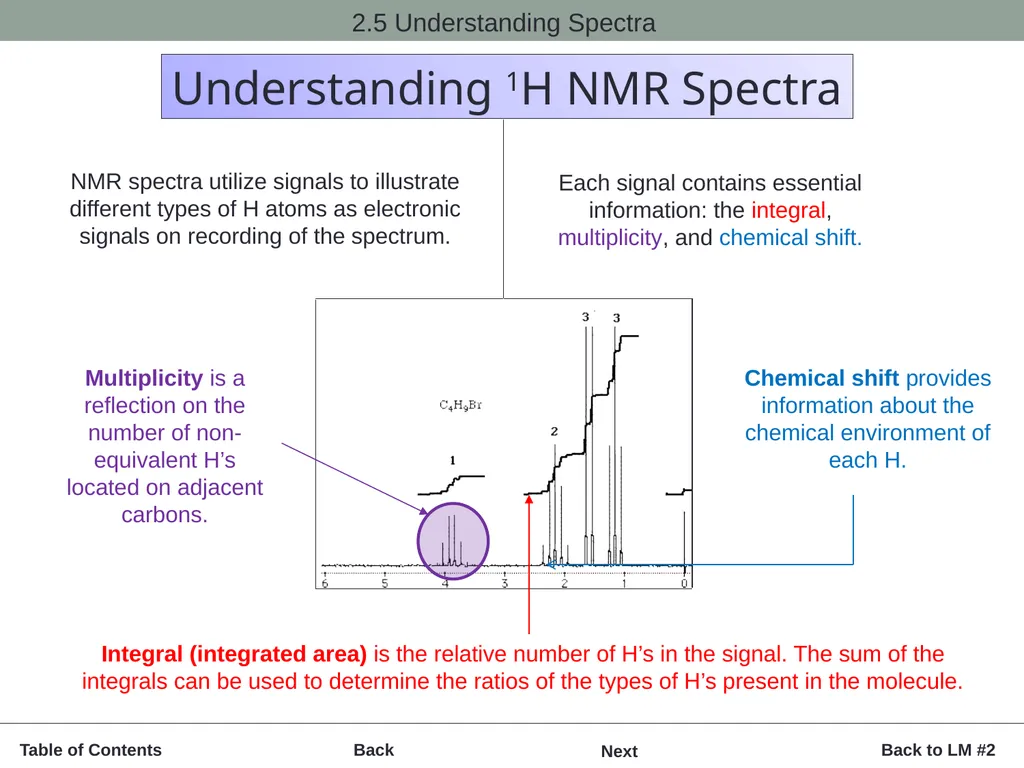
2.5 Understanding Spectra NMR spectra utilize signals to illustrate different types of H atoms as electronic signals on recording of the spectrum. Each signal contains essential information: the integral, multiplicity, and chemical shift. Integral (integrated area) is the relative number of H’s in the signal. The sum of the integrals can be used to determine the ratios of the types of H’s present in the molecule. Multiplicity is a reflection on the number of non-equivalent H’s located on adjacent carbons. Chemical shift provides information about the chemical environment of each H. Understanding 1H NMR Spectra Table of Contents Next Back to LM #2 Back<br>
27
Need to Review? Understanding Spectra Magnetic Resonance Nuclear Spin The Spectrometer Module #2 Module #4 Module #1 Module #3 Table of Contents<br>
28
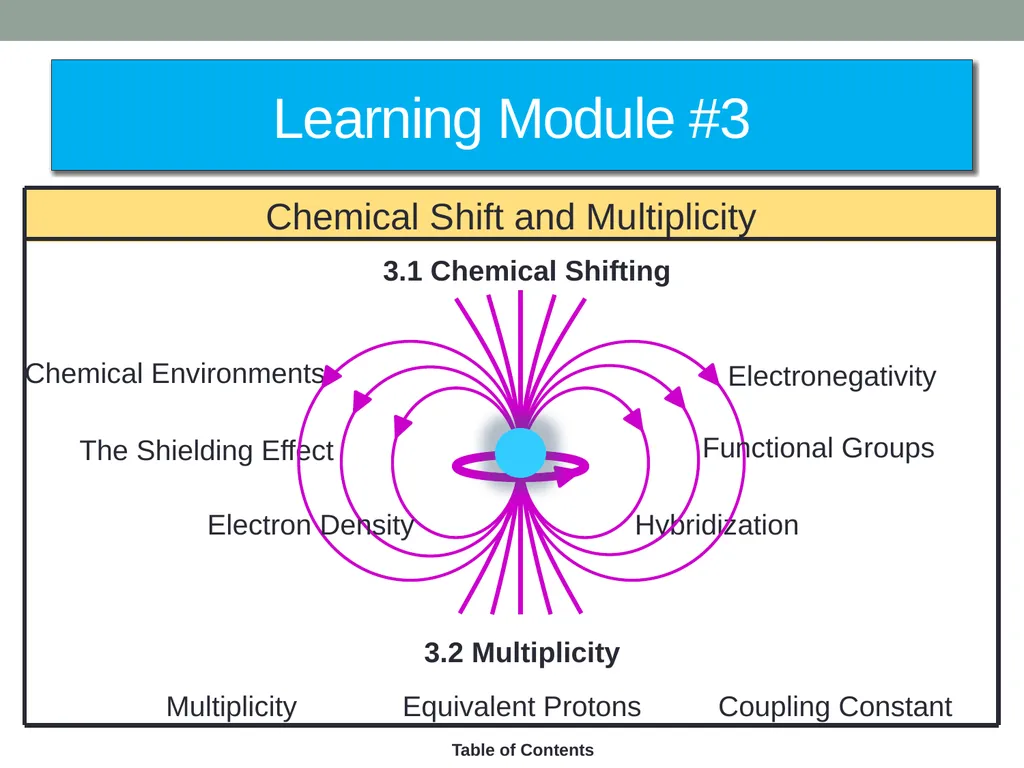
Learning Module #3 Chemical Shift and Multiplicity Electronegativity Hybridization Chemical Environments Multiplicity Coupling Constant Equivalent Protons The Shielding Effect 3.2 Multiplicity 3.1 Chemical Shifting Electron Density Functional Groups Table of Contents<br>
29
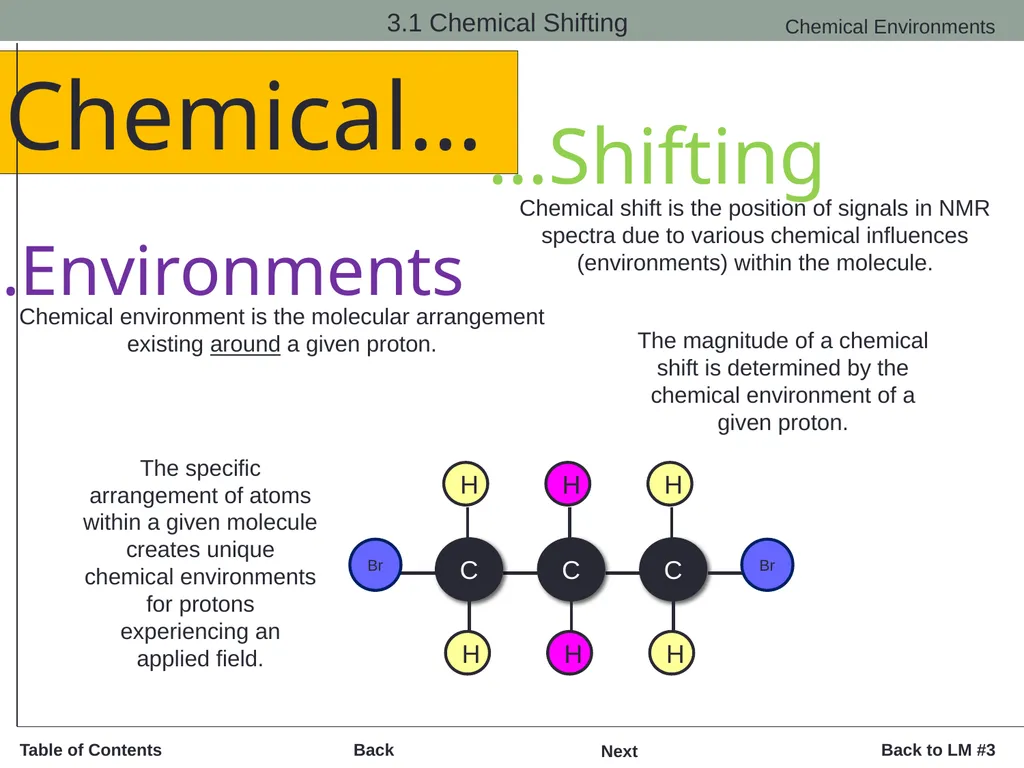
3.1 Chemical Shifting Chemical Environments Chemical shift is the position of signals in NMR spectra due to various chemical influences (environments) within the molecule. The magnitude of a chemical shift is determined by the chemical environment of a given proton. Chemical environment is the molecular arrangement existing around a given proton. The specific arrangement of atoms within a given molecule creates unique chemical environments for protons experiencing an applied field. …Shifting Chemical… C H Br H C H H C H H Br …Environments Table of Contents Next Back to LM #3 Back<br>
30
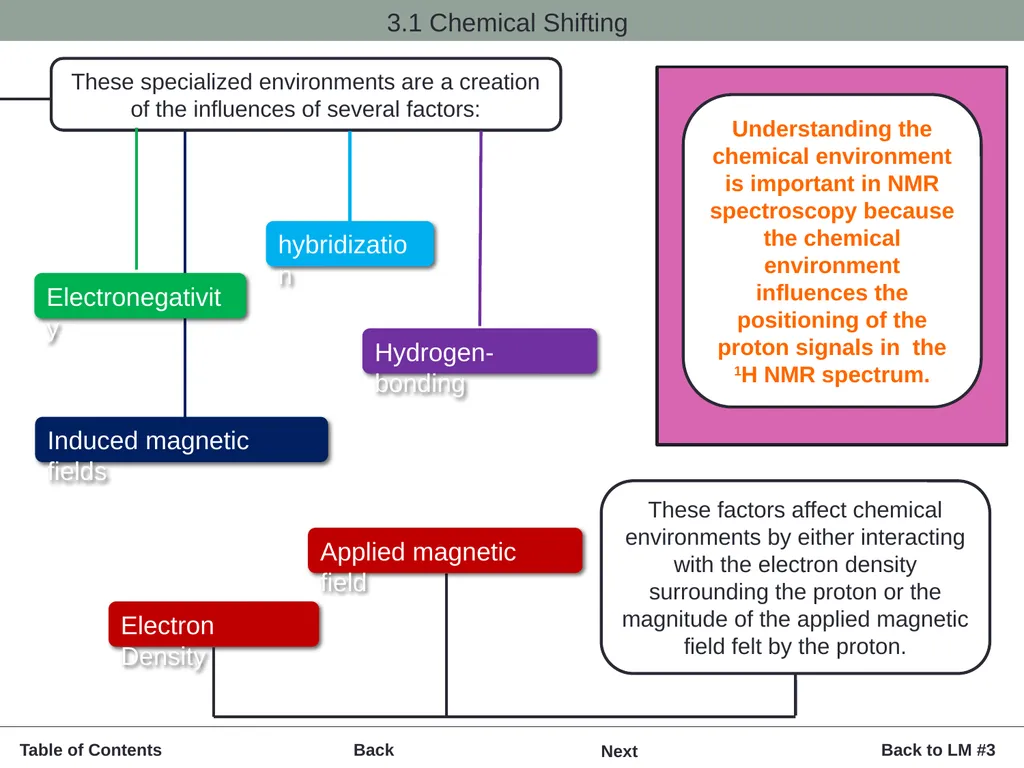
3.1 Chemical Shifting These specialized environments are a creation of the influences of several factors: These factors affect chemical environments by either interacting with the electron density surrounding the proton or the magnitude of the applied magnetic field felt by the proton. Induced magnetic fields hybridization Hydrogen-bonding Electronegativity Electron Density Applied magnetic field Understanding the chemical environment is important in NMR spectroscopy because the chemical environment influences the positioning of the proton signals in the 1H NMR spectrum. Table of Contents Next Back to LM #3 Back<br>
31
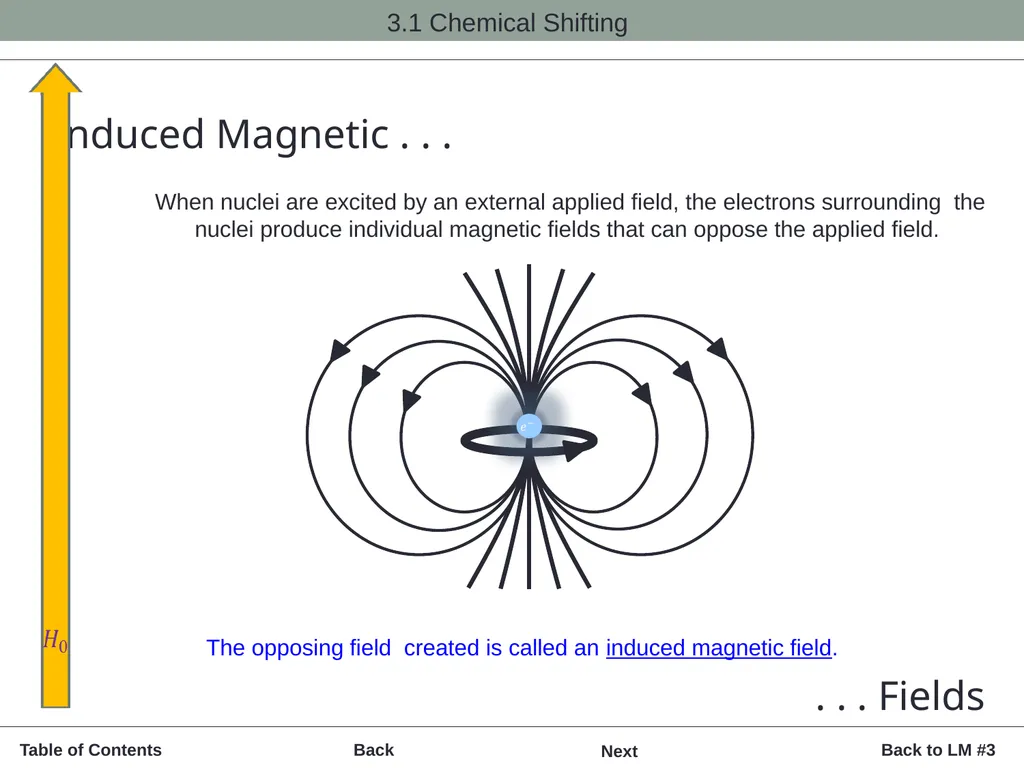
3.1 Chemical Shifting Induced Magnetic . . . When nuclei are excited by an external applied field, the electrons surrounding the nuclei produce individual magnetic fields that can oppose the applied field. The opposing field created is called an induced magnetic field. . . . Fields Table of Contents Next Back to LM #3 Back<br>
32
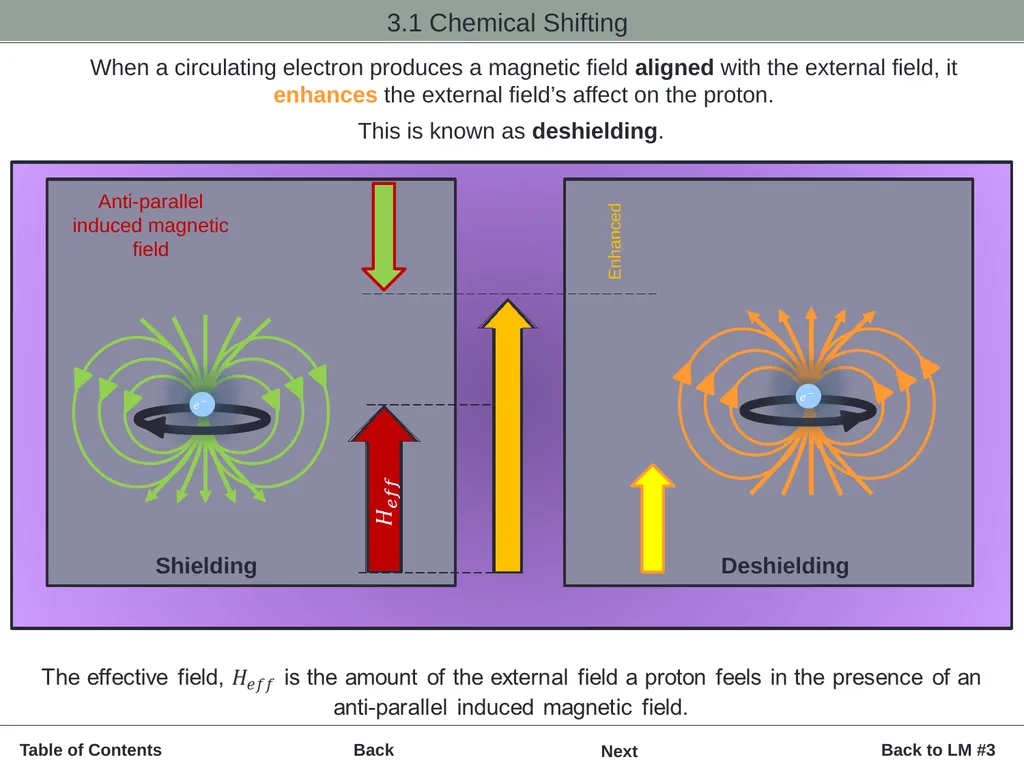
The presence of an induced magnetic field slightly diminishes the influence of the applied external field on a proton because of its anti-parallel magnetic field. 3.1 Chemical Shifting The Shielding Effect What effect do induced magnetic fields have on the interaction between the nucleus and the applied external field? This interaction is known as the Shielding Effect. Induced magnetic field Table of Contents Next Back to LM #3 Back<br>
33
When a circulating electron produces a magnetic field aligned with the external field, it enhances the external field’s affect on the proton. 3.1 Chemical Shifting This is known as deshielding. Deshielding Table of Contents Next Back to LM #3 Back Shielding Anti-parallel induced magnetic field Enhanced<br>
34
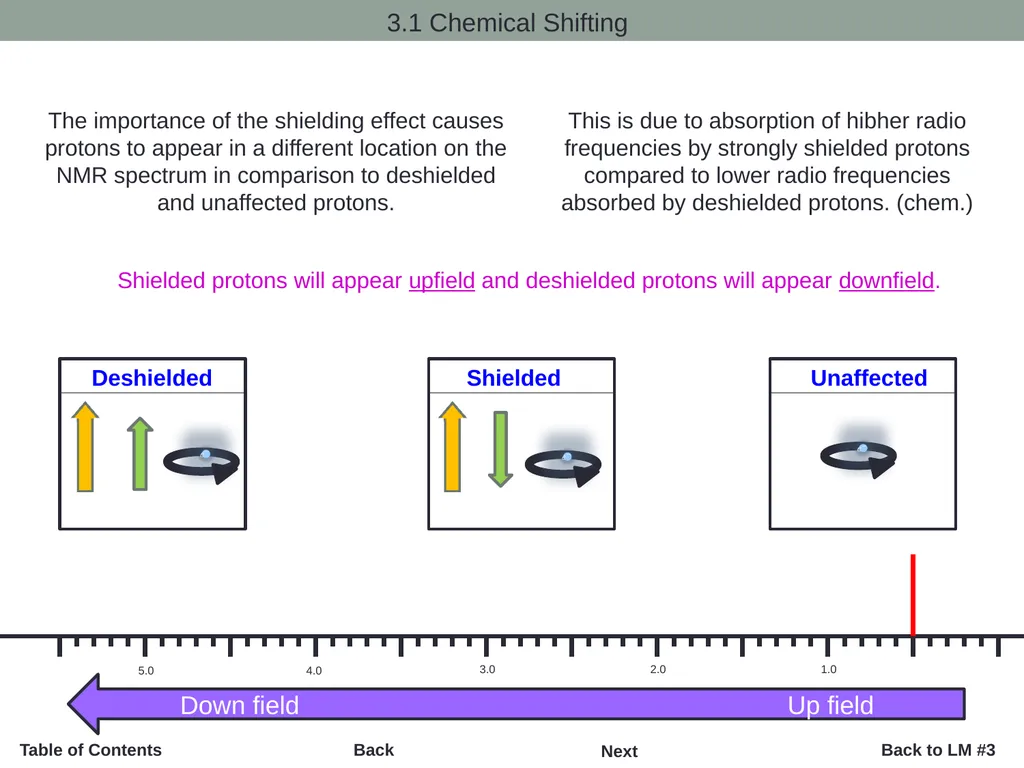
3.1 Chemical Shifting This is due to absorption of hibher radio frequencies by strongly shielded protons compared to lower radio frequencies absorbed by deshielded protons. (chem.) The importance of the shielding effect causes protons to appear in a different location on the NMR spectrum in comparison to deshielded and unaffected protons. Shielded protons will appear upfield and deshielded protons will appear downfield. 1.0 2.0 3.0 4.0 5.0 Down field Up field Shielded Deshielded Unaffected Table of Contents Next Back to LM #3 Back<br>
35
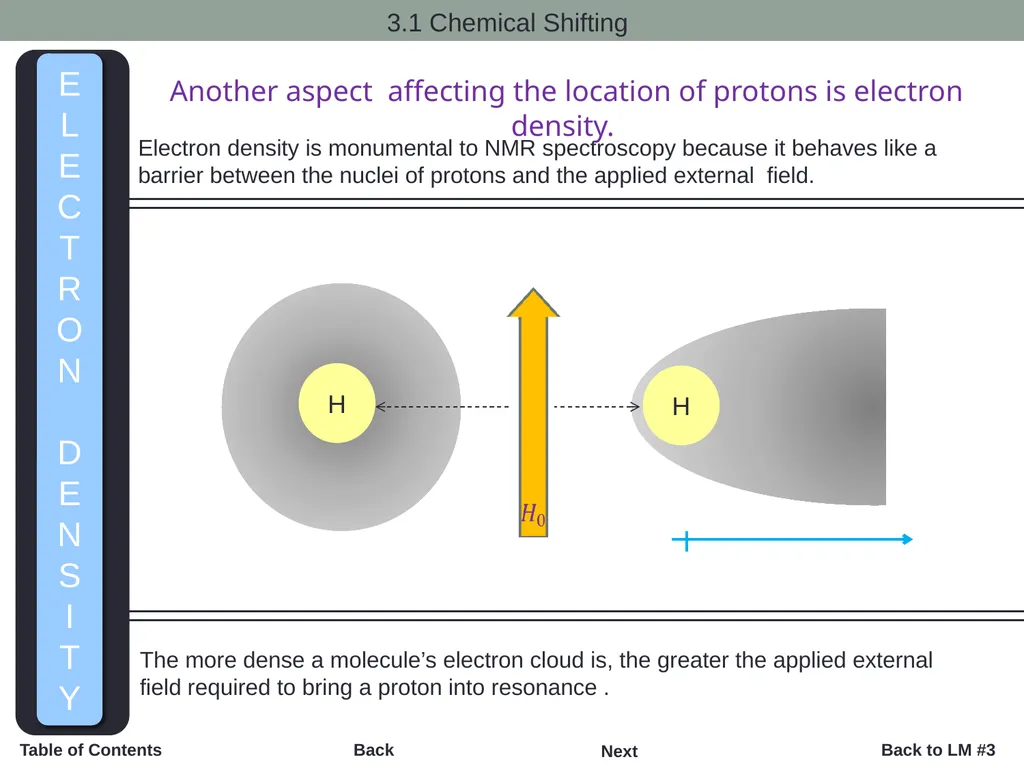
3.1 Chemical Shifting Electron density is monumental to NMR spectroscopy because it behaves like a barrier between the nuclei of protons and the applied external field. The more dense a molecule’s electron cloud is, the greater the applied external field required to bring a proton into resonance . E
LE
C
T
R
O
N
DENS
I
TY H H Another aspect affecting the location of protons is electron density. Table of Contents Next Back to LM #3 Back<br>
LE
C
T
R
O
N
DENS
I
TY H H Another aspect affecting the location of protons is electron density. Table of Contents Next Back to LM #3 Back<br>
36
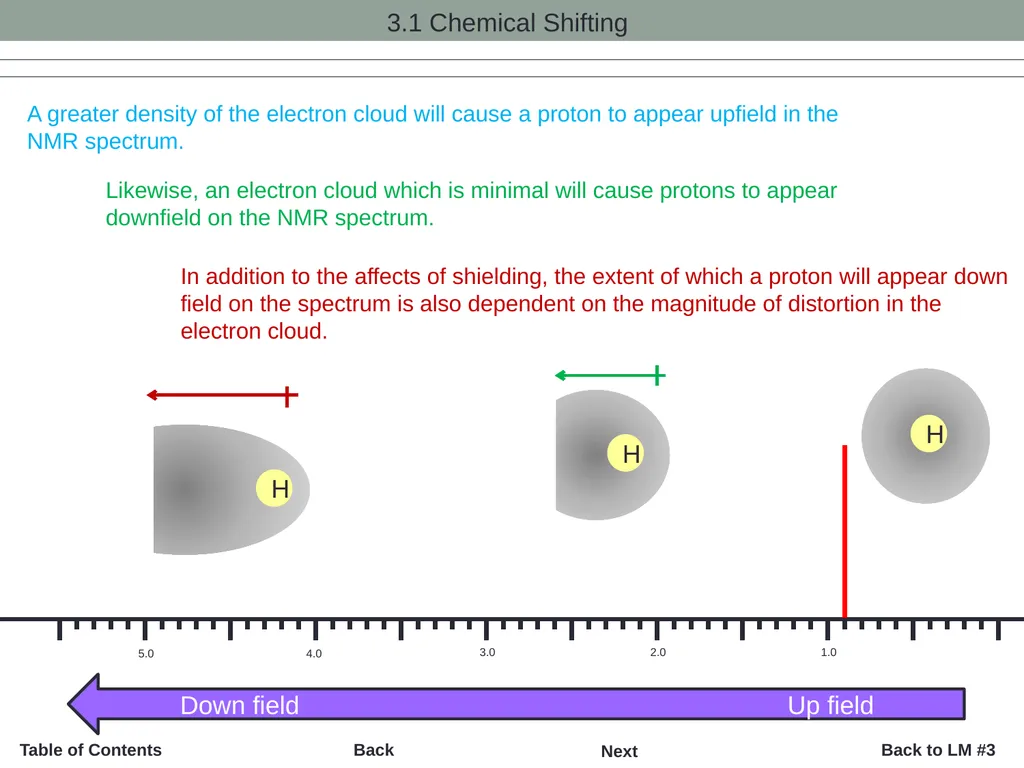
A greater density of the electron cloud will cause a proton to appear upfield in the NMR spectrum. 3.1 Chemical Shifting Likewise, an electron cloud which is minimal will cause protons to appear downfield on the NMR spectrum. 1.0 2.0 3.0 4.0 5.0 Down field Up field H In addition to the affects of shielding, the extent of which a proton will appear down field on the spectrum is also dependent on the magnitude of distortion in the electron cloud. H H Table of Contents Next Back to LM #3 Back<br>
37
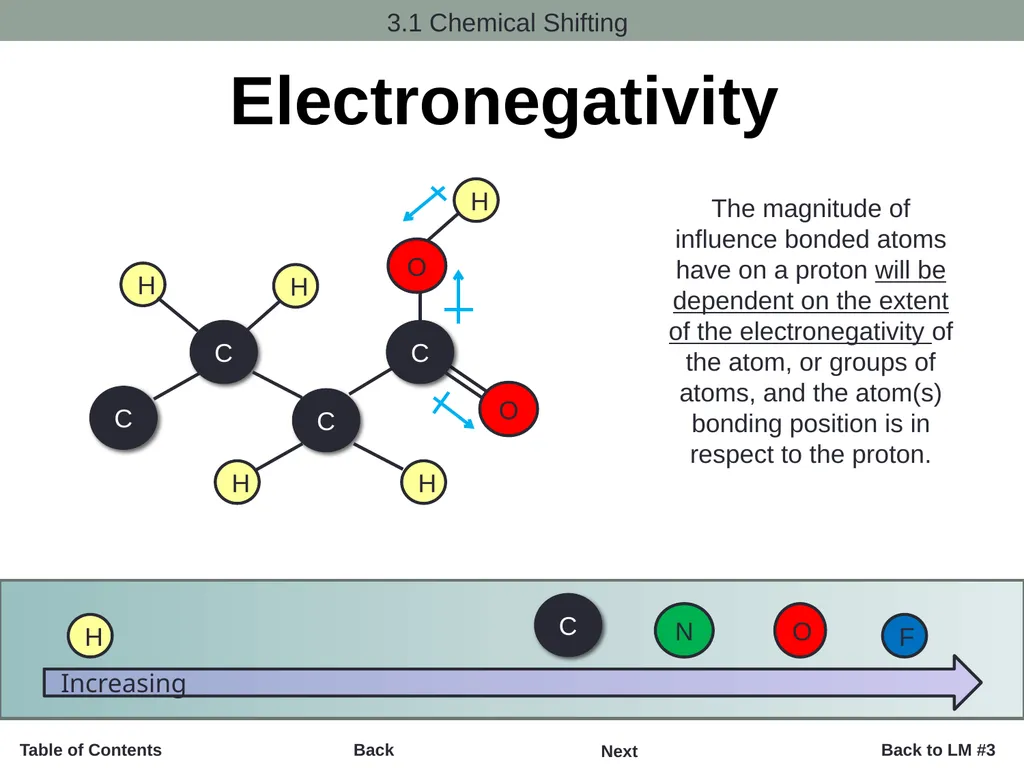
The magnitude of influence bonded atoms have on a proton will be dependent on the extent of the electronegativity of the atom, or groups of atoms, and the atom(s) bonding position is in respect to the proton. 3.1 Chemical Shifting Electronegativity C H C C H H H C O H O Increasing C H N O F Table of Contents Next Back to LM #3 Back<br>
38
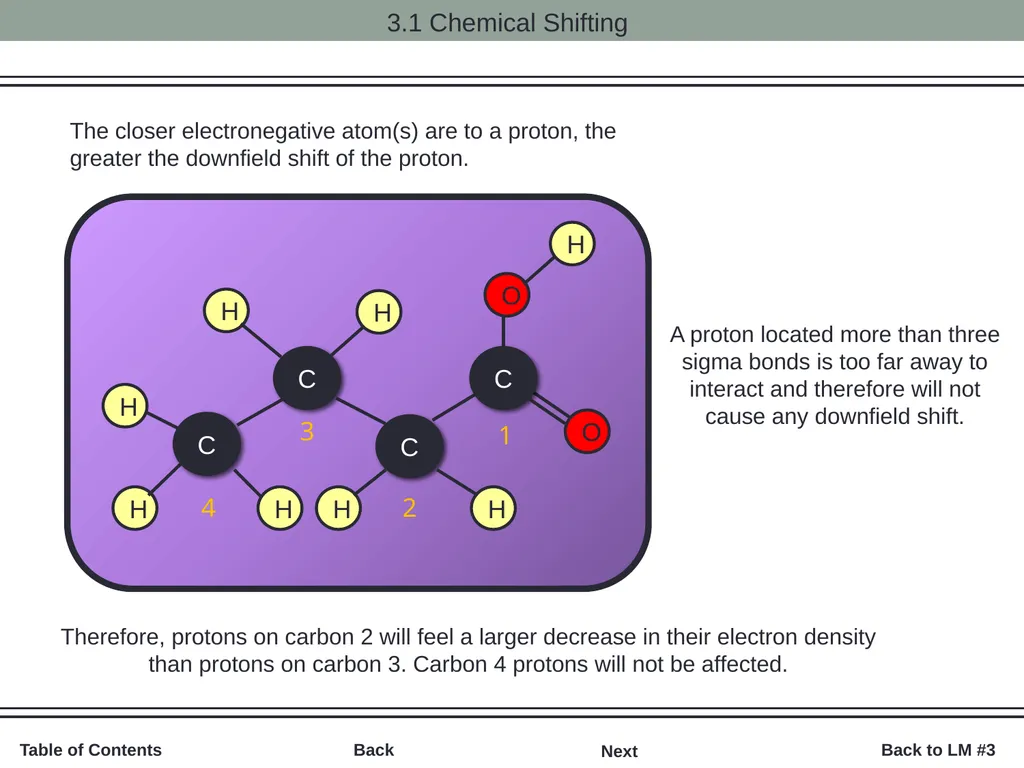
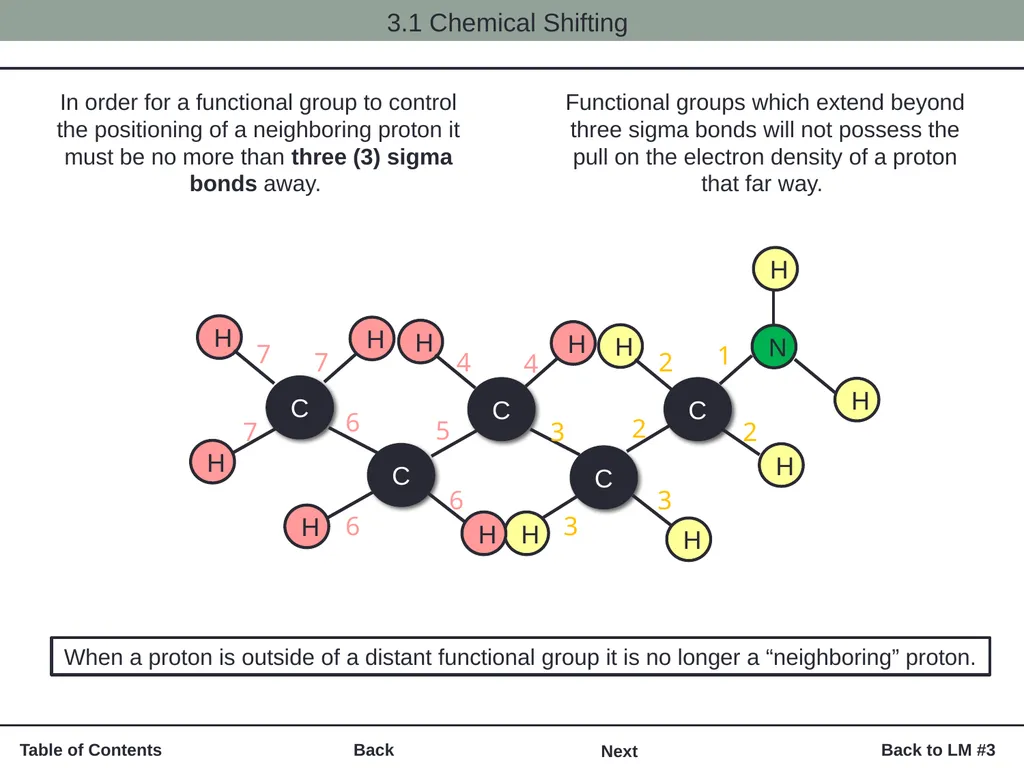
The closer electronegative atom(s) are to a proton, the greater the downfield shift of the proton. 3.1 Chemical Shifting Therefore, protons on carbon 2 will feel a larger decrease in their electron density than protons on carbon 3. Carbon 4 protons will not be affected. C H C C H H H C O H O 1 2 3 4 H H H A proton located more than three sigma bonds is too far away to interact and therefore will not cause any downfield shift. Table of Contents Next Back to LM #3 Back<br>
39
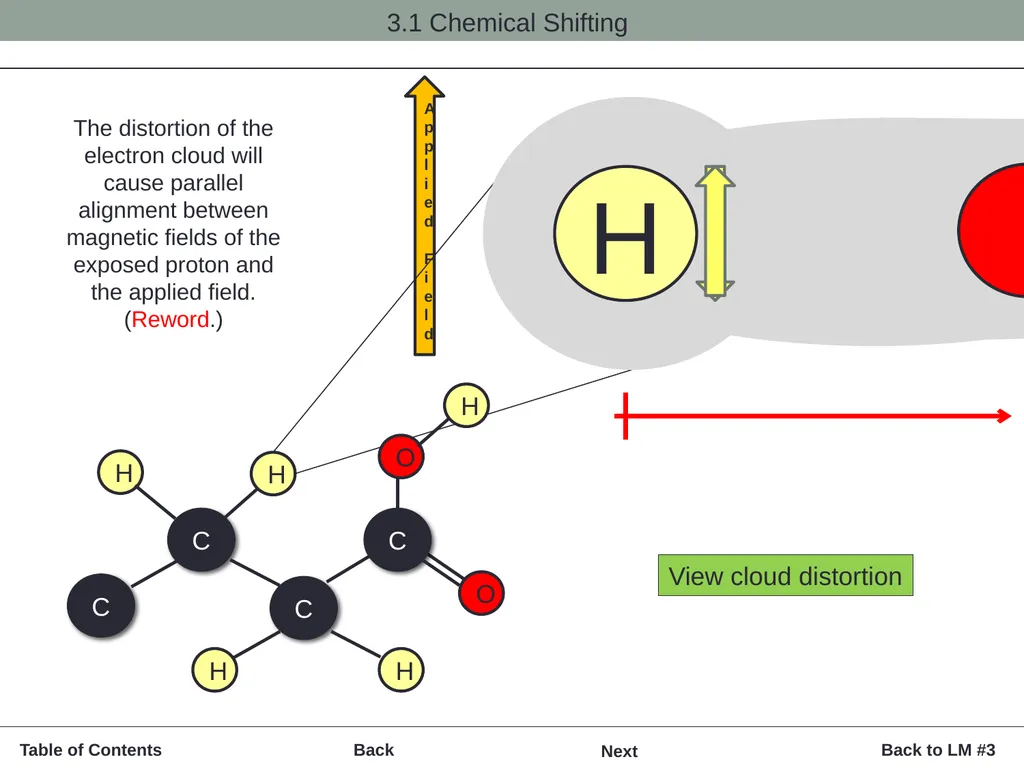
The distortion of the electron cloud will cause parallel alignment between magnetic fields of the exposed proton and the applied field.
(Reword.) 3.1 Chemical Shifting C H C C H H C O Applied Field H H O H View cloud distortion Table of Contents Next Back to LM #3 Back<br>
(Reword.) 3.1 Chemical Shifting C H C C H H C O Applied Field H H O H View cloud distortion Table of Contents Next Back to LM #3 Back<br>
40
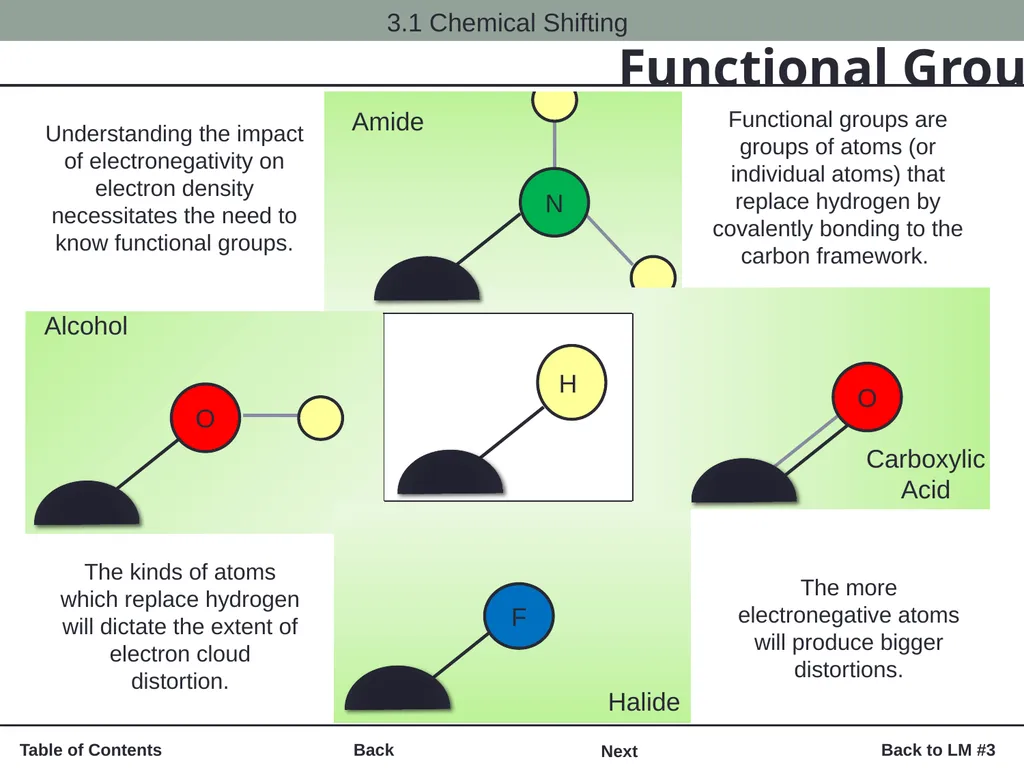
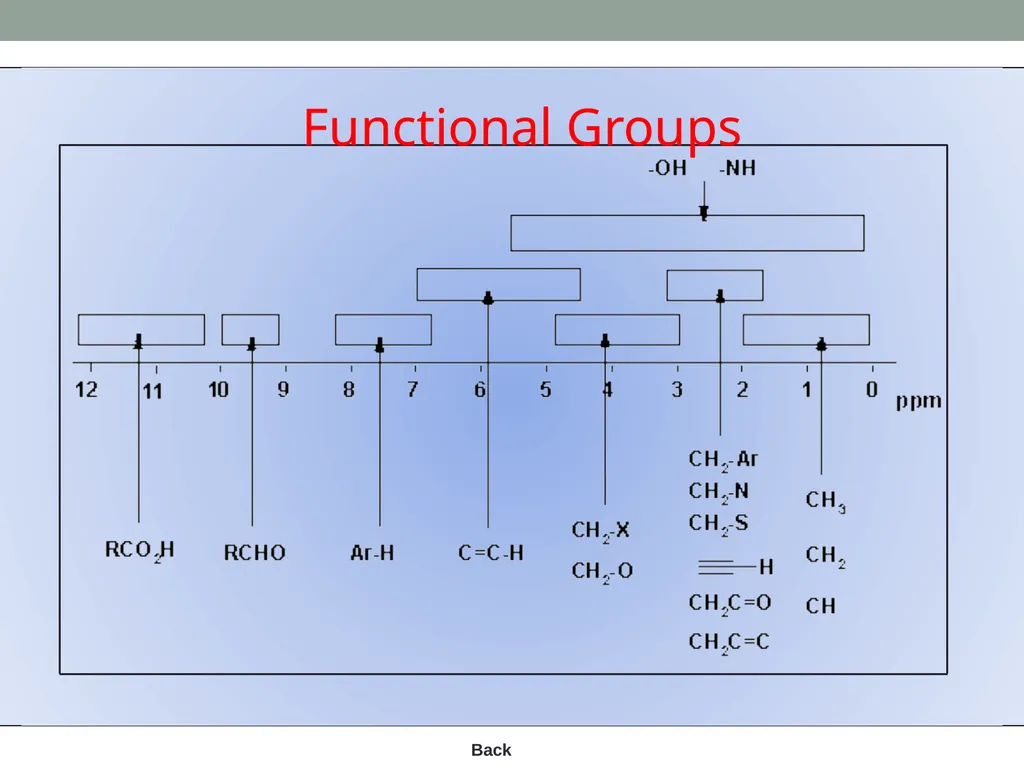
3.1 Chemical Shifting H Understanding the impact of electronegativity on electron density necessitates the need to know functional groups. Functional groups are groups of atoms (or individual atoms) that replace hydrogen by covalently bonding to the carbon framework. The kinds of atoms which replace hydrogen will dictate the extent of electron cloud distortion. O F N O Alcohol Amide Carboxylic Acid Halide The more electronegative atoms will produce bigger distortions. Functional Groups Table of Contents Next Back to LM #3 Back<br>
41
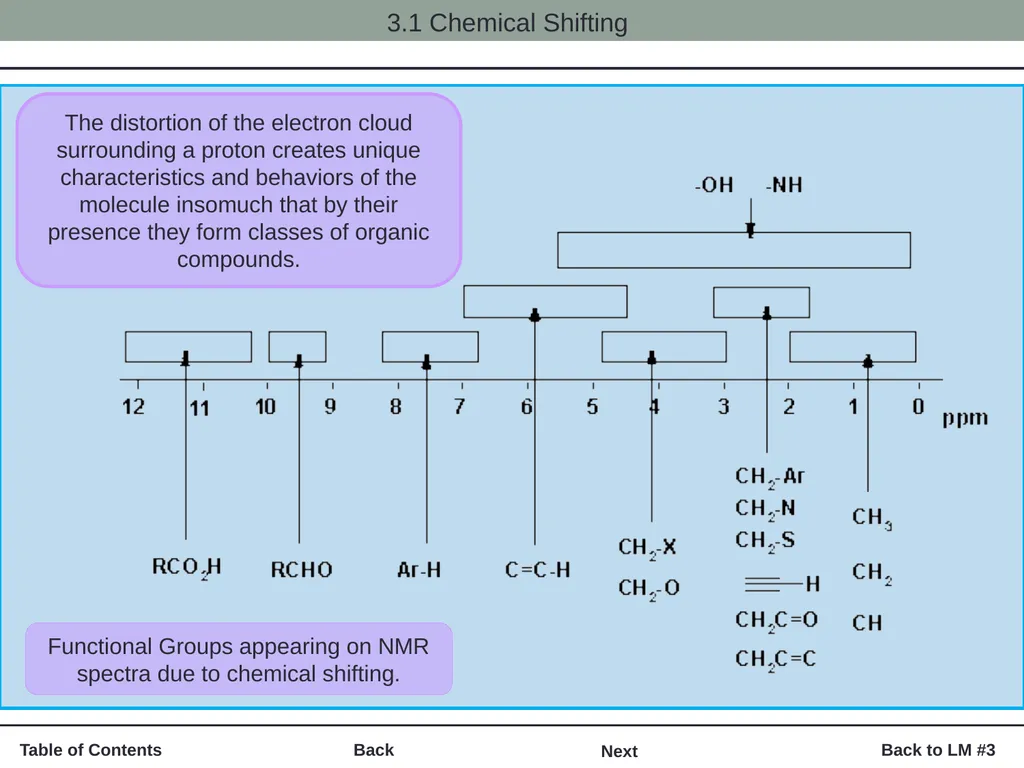
3.1 Chemical Shifting Table of Contents Next Back to LM #3 Back The distortion of the electron cloud surrounding a proton creates unique characteristics and behaviors of the molecule insomuch that by their presence they form classes of organic compounds. Functional Groups appearing on NMR spectra due to chemical shifting.<br>
42
3.1 Chemical Shifting In order for a functional group to control the positioning of a neighboring proton it must be no more than three (3) sigma bonds away. Functional groups which extend beyond three sigma bonds will not possess the pull on the electron density of a proton that far way. When a proton is outside of a distant functional group it is no longer a “neighboring” proton. C H C C H H C H C H N H H H H H H H H 1 2 2 2 3 3 3 4 4 5 6 6 6 7 7 7 Table of Contents Next Back to LM #3 Back<br>
43
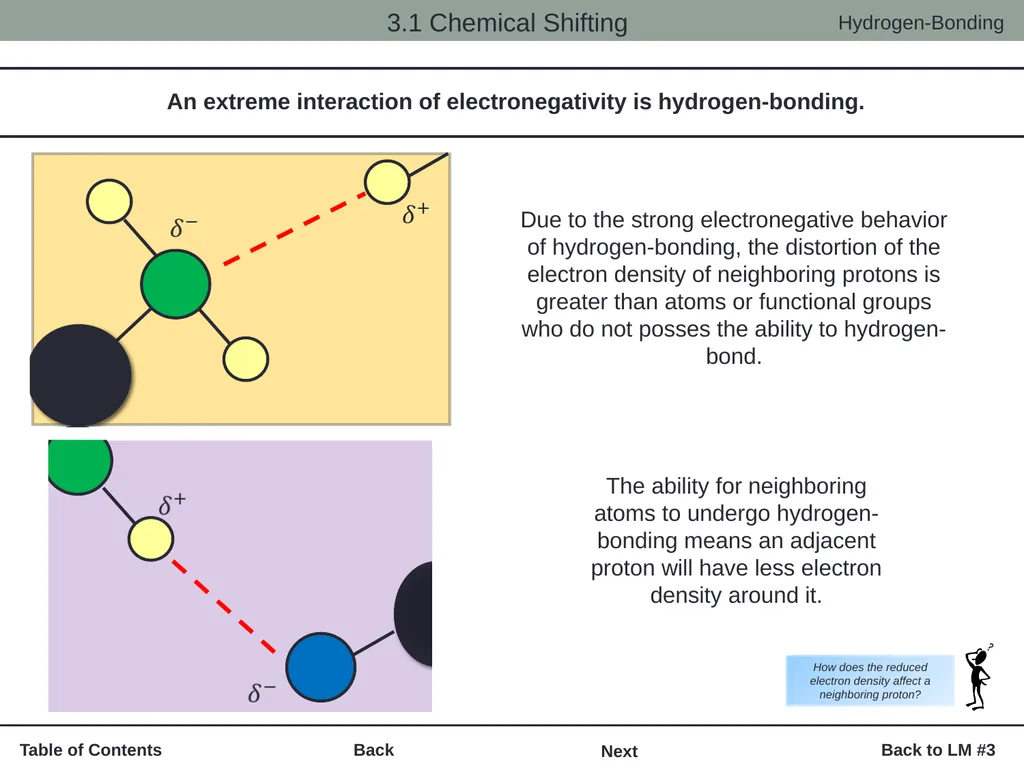
3.1 Chemical Shifting Hydrogen-Bonding An extreme interaction of electronegativity is hydrogen-bonding. The ability for neighboring atoms to undergo hydrogen-bonding means an adjacent proton will have less electron density around it. Due to the strong electronegative behavior of hydrogen-bonding, the distortion of the electron density of neighboring protons is greater than atoms or functional groups who do not posses the ability to hydrogen-bond. How does the reduced electron density affect a neighboring proton? Table of Contents Next Back to LM #3 Back<br>
44
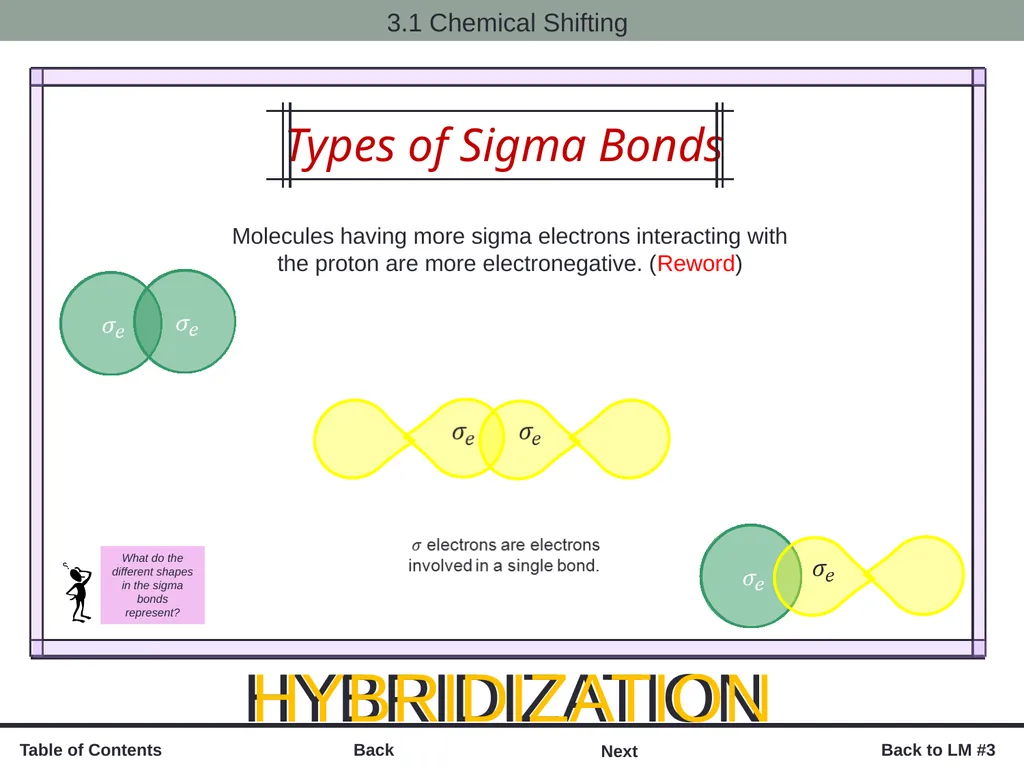
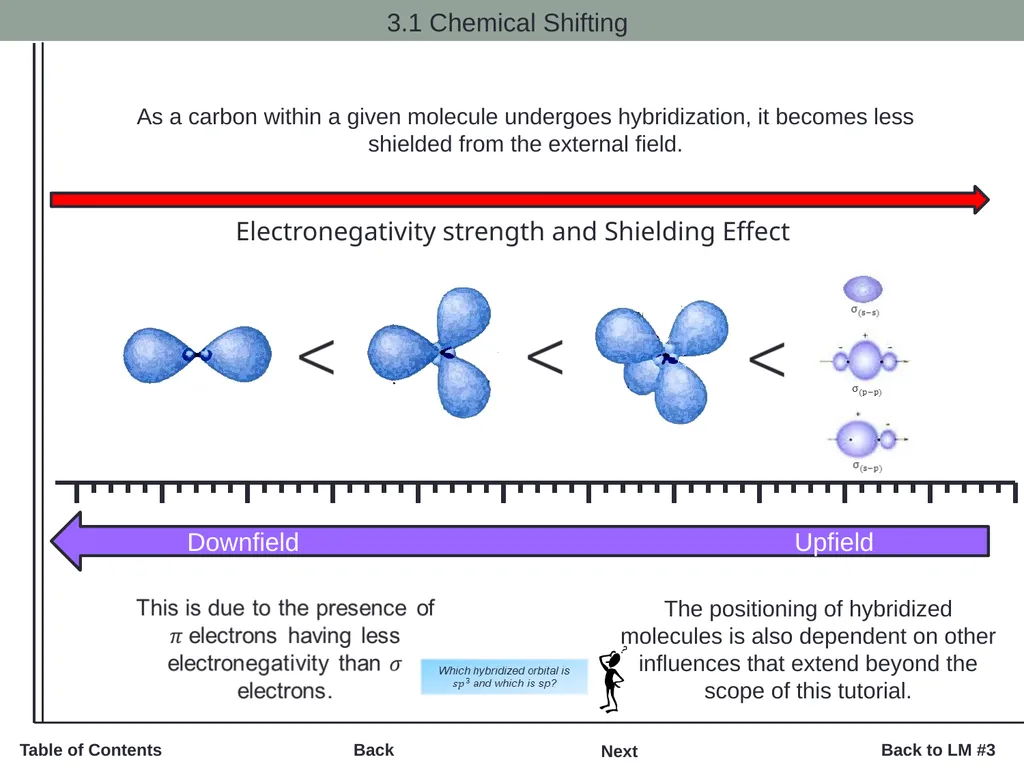
3.1 Chemical Shifting HYBRIDIZATION Molecules having more sigma electrons interacting with the proton are more electronegative. (Reword) HYBRIDIZATION Types of Sigma Bonds What do the different shapes in the sigma bonds represent? Table of Contents Next Back to LM #3 Back<br>
45
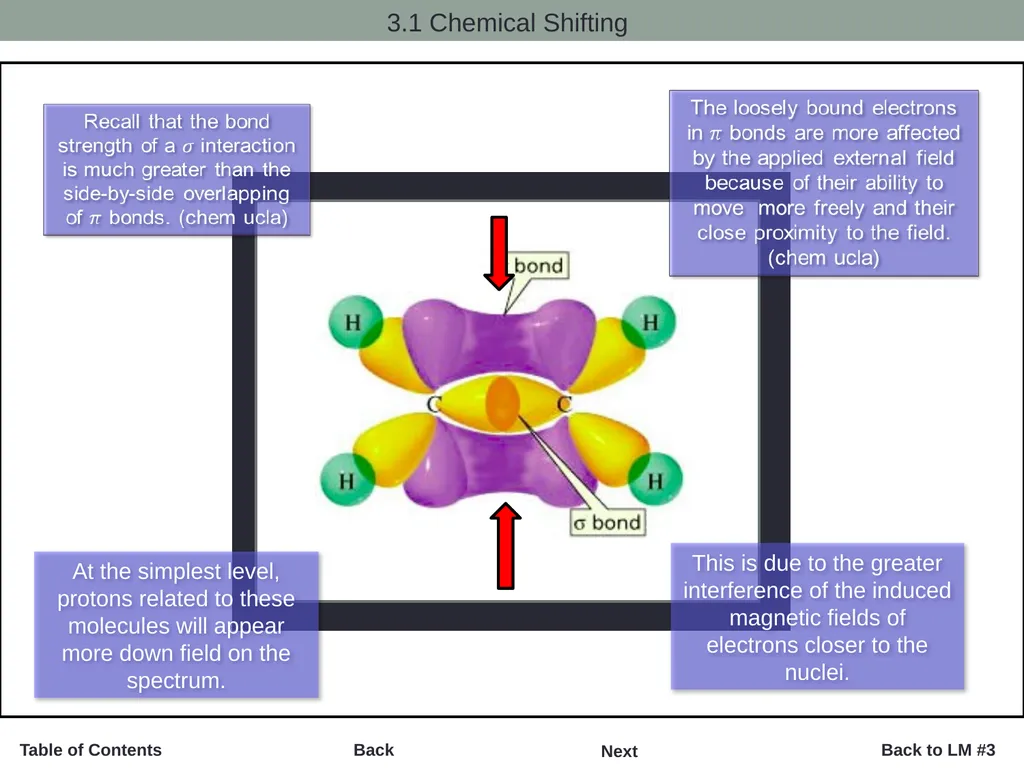
3.1 Chemical Shifting At the simplest level, protons related to these molecules will appear more down field on the spectrum. This is due to the greater interference of the induced magnetic fields of electrons closer to the nuclei. Table of Contents Next Back to LM #3 Back<br>
46
As a carbon within a given molecule undergoes hybridization, it becomes less shielded from the external field. 3.1 Chemical Shifting Electronegativity strength and Shielding Effect Downfield Upfield The positioning of hybridized molecules is also dependent on other influences that extend beyond the scope of this tutorial. Table of Contents Next Back to LM #3 Back<br>
47
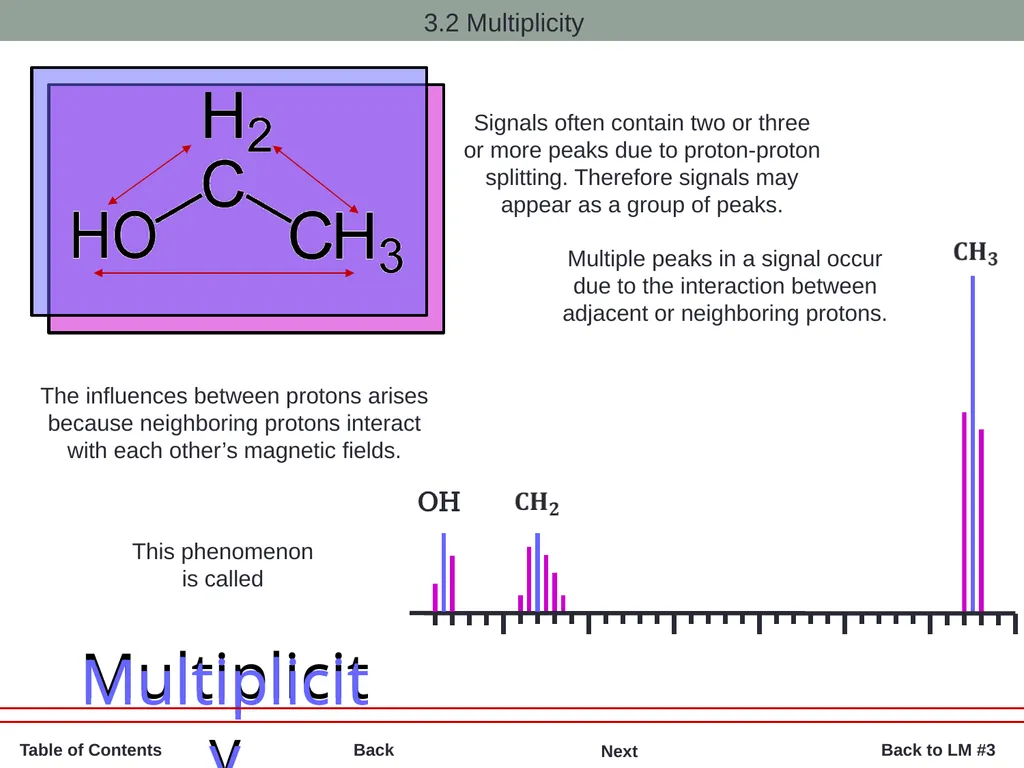
3.2 Multiplicity Signals often contain two or three or more peaks due to proton-proton splitting. Therefore signals may appear as a group of peaks. Multiple peaks in a signal occur due to the interaction between adjacent or neighboring protons. This phenomenon is called The influences between protons arises because neighboring protons interact with each other’s magnetic fields. OH Multiplicity Multiplicity Table of Contents Next Back to LM #3 Back<br>
48
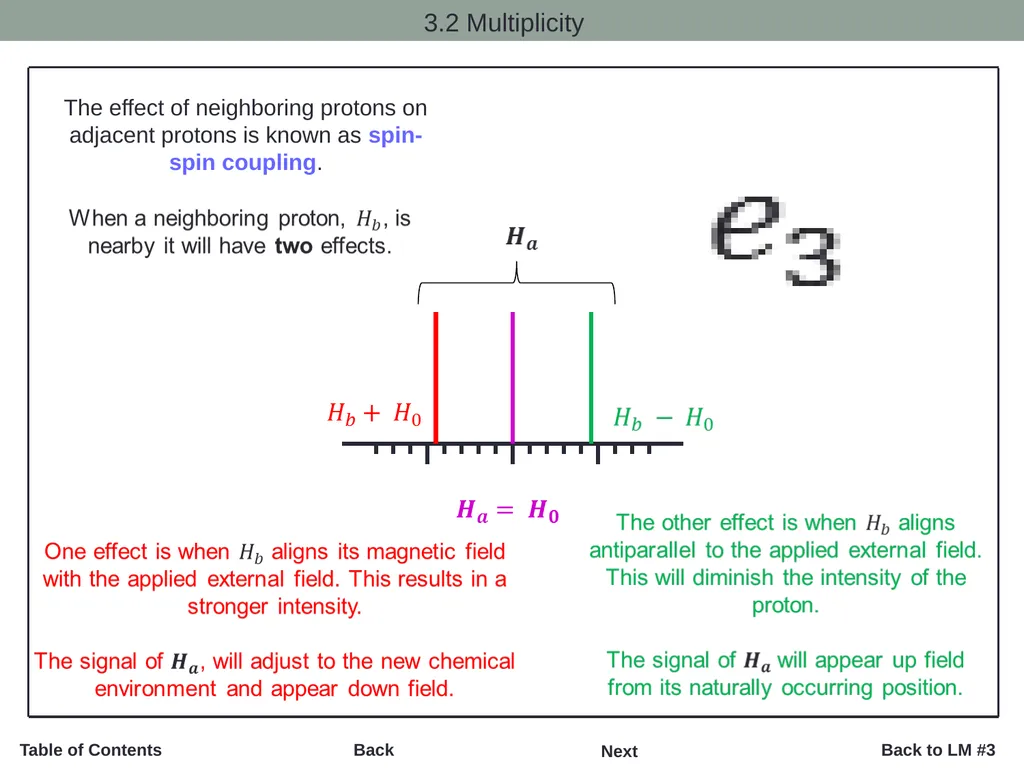
3.2 Multiplicity The effect of neighboring protons on adjacent protons is known as spin-spin coupling. Table of Contents Next Back to LM #3 Back<br>
49
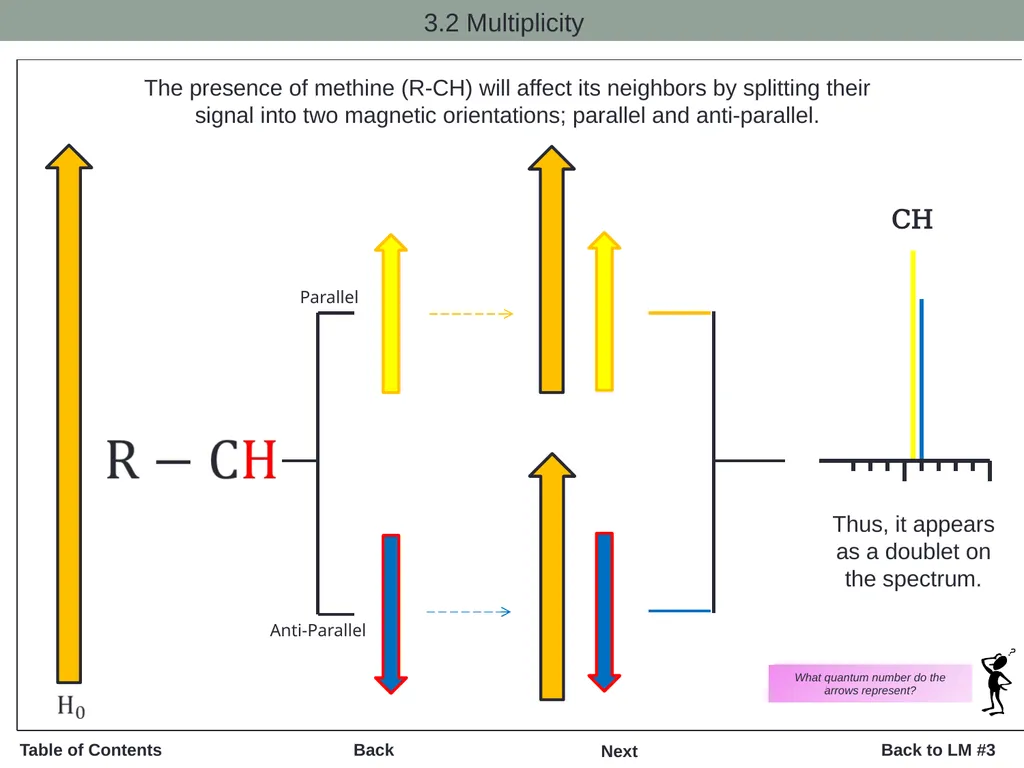
3.2 Multiplicity The presence of methine (R-CH) will affect its neighbors by splitting their signal into two magnetic orientations; parallel and anti-parallel. Thus, it appears as a doublet on the spectrum. What quantum number do the arrows represent? CH Table of Contents Next Back to LM #3 Back Parallel Anti-Parallel<br>
50
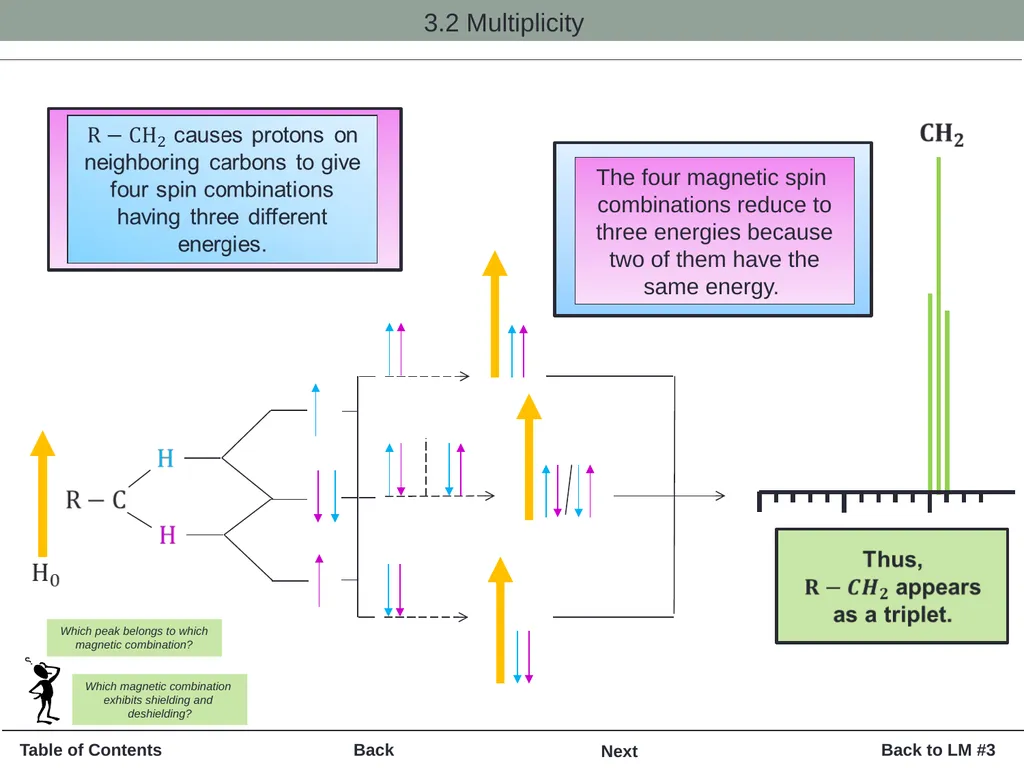
3.2 Multiplicity The four magnetic spin combinations reduce to three energies because two of them have the same energy. Which peak belongs to which magnetic combination? Which magnetic combination exhibits shielding and deshielding? Table of Contents Next Back to LM #3 Back<br>
51
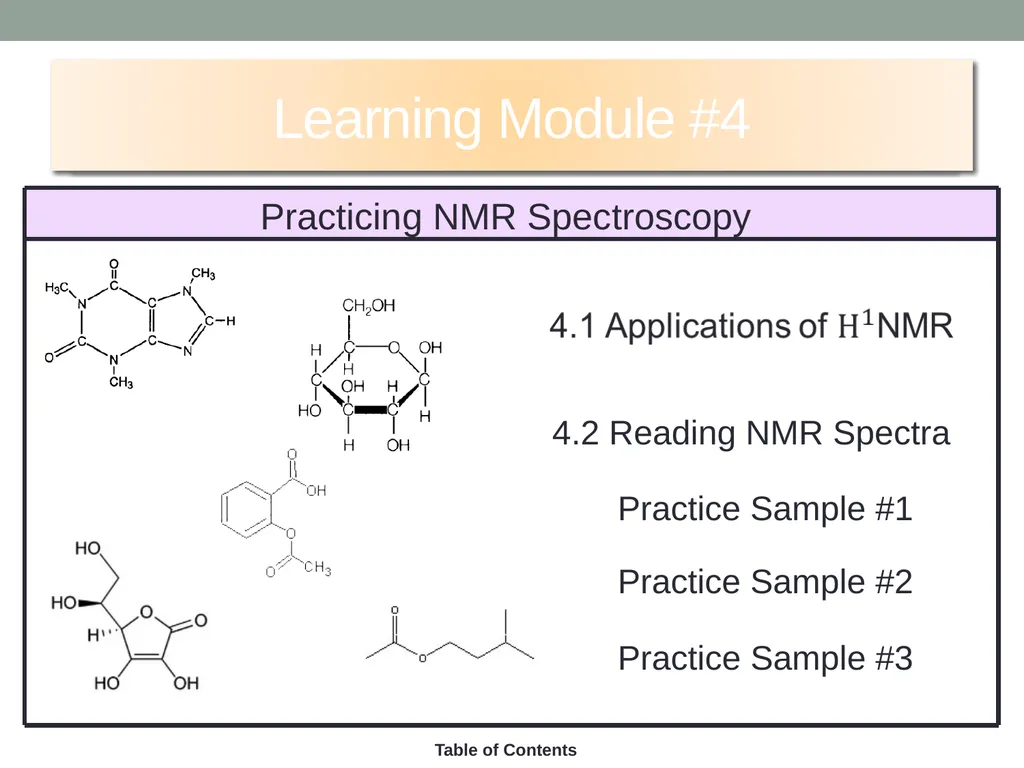
Learning Module #4 Practicing NMR Spectroscopy 4.2 Reading NMR Spectra Practice Sample #1 Practice Sample #2 Practice Sample #3 Table of Contents<br>
52
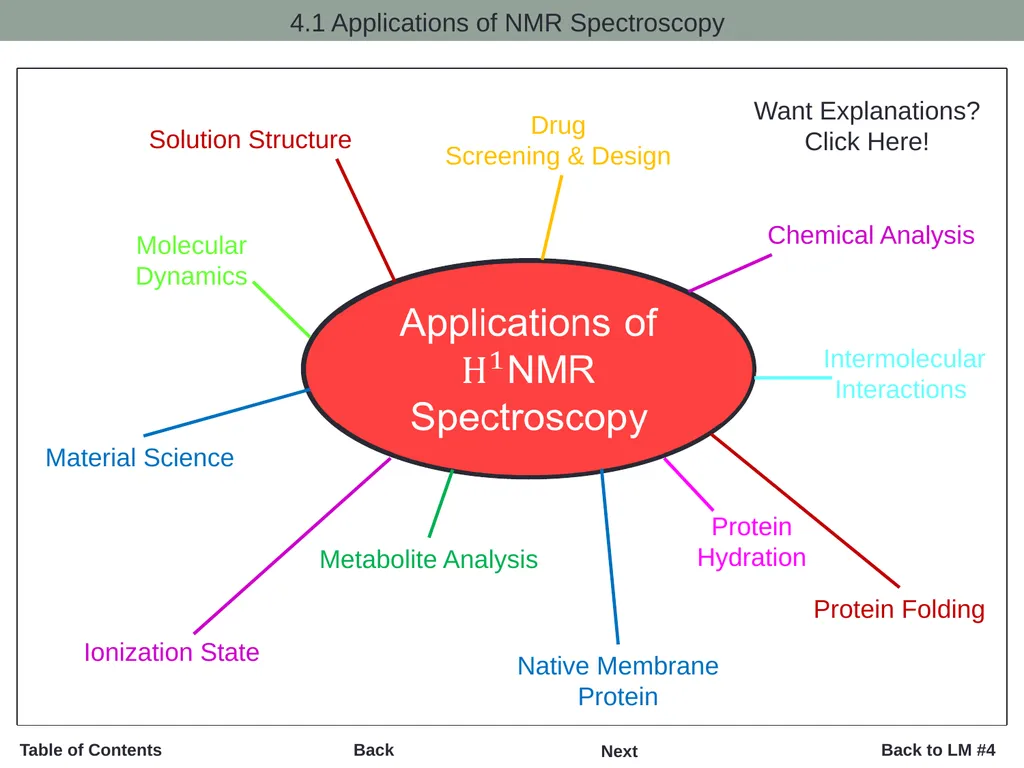
Table of Contents Next Back to LM #4 Back Solution Structure Molecular
Dynamics Protein Folding Ionization State Intermolecular Interactions Drug
Screening & Design Native Membrane Protein Metabolite Analysis Chemical Analysis Material Science Protein
Hydration Want Explanations?
Click Here! 4.1 Applications of NMR Spectroscopy<br>
Dynamics Protein Folding Ionization State Intermolecular Interactions Drug
Screening & Design Native Membrane Protein Metabolite Analysis Chemical Analysis Material Science Protein
Hydration Want Explanations?
Click Here! 4.1 Applications of NMR Spectroscopy<br>
53
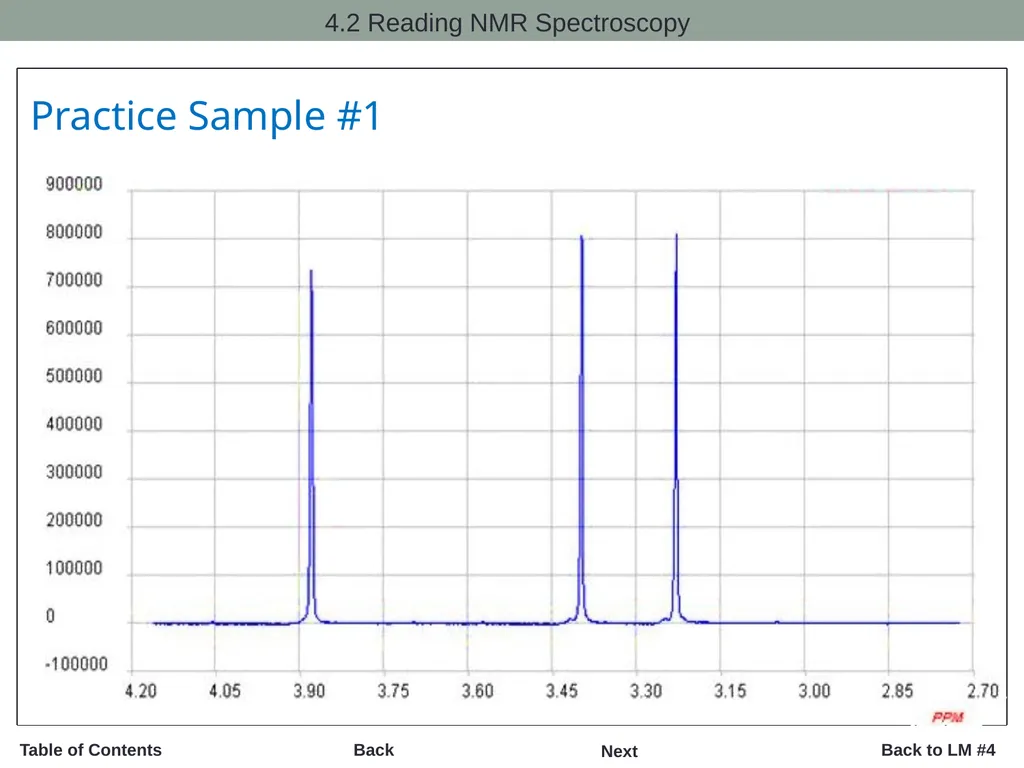
Table of Contents Next Back to LM #4 Back Practice Sample #1 4.2 Reading NMR Spectroscopy<br>
54
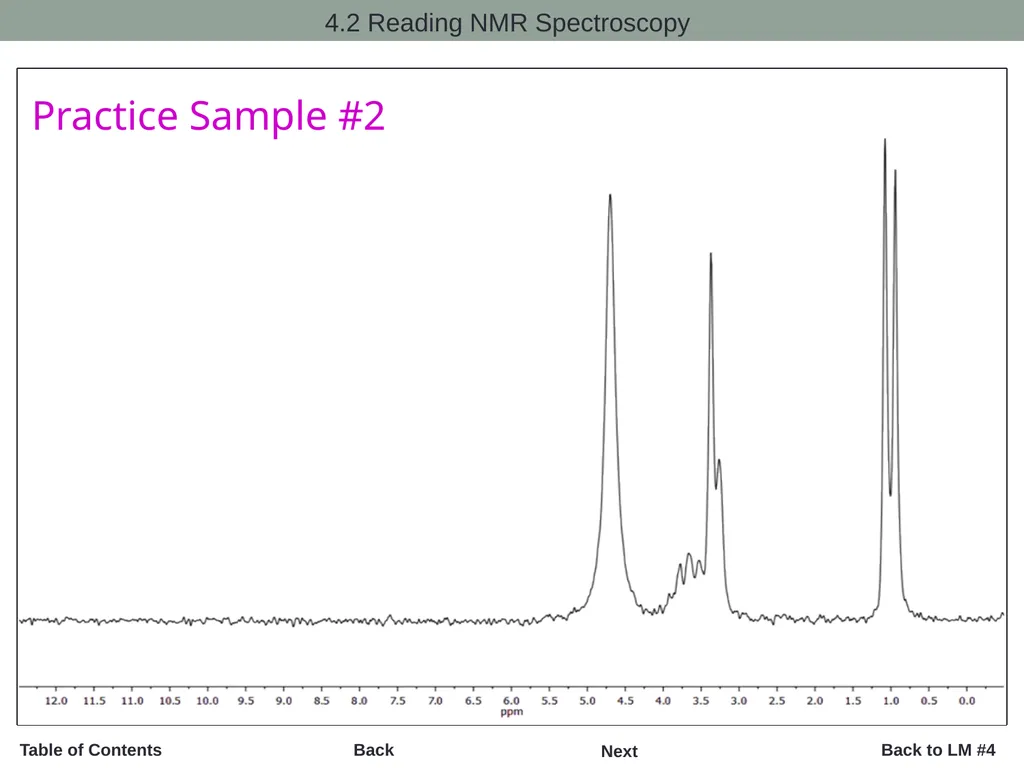
Table of Contents Next Back to LM #4 Back Practice Sample #2 4.2 Reading NMR Spectroscopy<br>
55
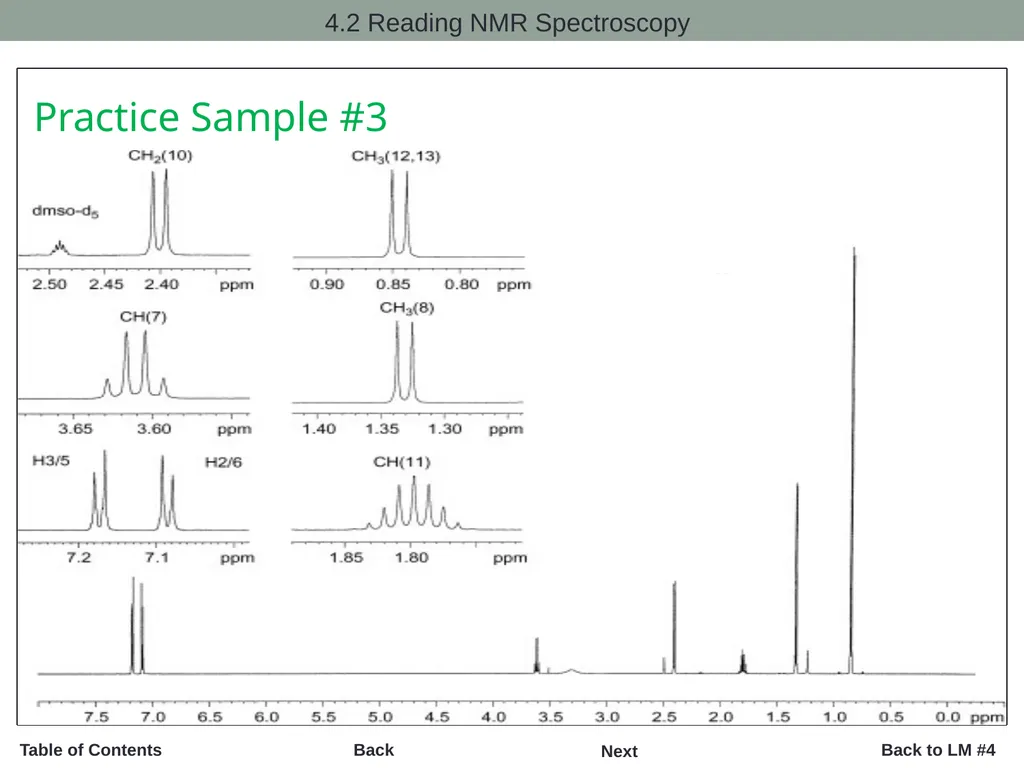
Table of Contents Next Back to LM #4 Back Practice Sample #3 4.2 Reading NMR Spectroscopy<br>
56
Table of Contents Back to LM #4 This presentation was created for the sole purpose of secondary level education by Kait M. Cumsille in conjunction with Dr. Allen Schoffstall and the University of Colorado Colorado Springs with the financial support of NSF Award #0736941.<br>
57
Return Play Animation Repeat Animation Absorption Absorption<br>
58
Return Absorption Absorption<br>
59
Return Transmittance Transmittance Reflecting Scattering A concentrated Solution Play Animation Repeat Animation<br>
60
Transmittance Transmittance Reflecting Scattering A concentrated Solution Return<br>
61
Magnetic Resonance Return Play Animation Repeat Animation (a) (b) x y x y z z<br>
62
Magnetic Resonance Return (a) (b) x y x y z z<br>
63
Functional Groups Back<br>