
Lecture 04 Availability Topics Chapter 5 –

Description: Lecture 04 Availability Topics Chapter 5 Availability September 13, 2017 CSCE 741 Software Process Lecture 4 -- Spring Spring Boot assignment 1 Readings:ES Ch 4- Last Time Sprints ESEssential Scrum chapter 4 Abbreviations ES for
Related Topics
Download Presentation
"Lecture 04 Availability Topics Chapter 5 –" is the property of its rightful owner. Permission is granted to download and print the materials on this website for personal, non-commercial use only, and to display it on your personal computer provided you do not modify the materials and that you retain all copyright notices contained in the materials. By downloading content from our website, you accept the terms of this agreement.
Presentation Transcript
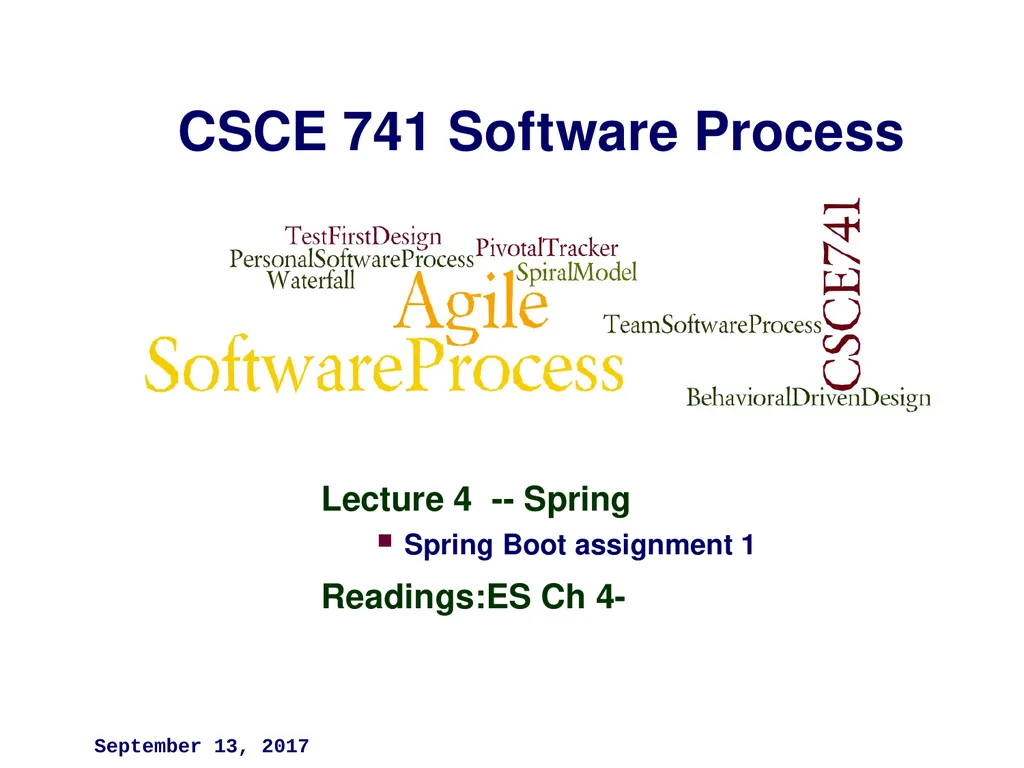
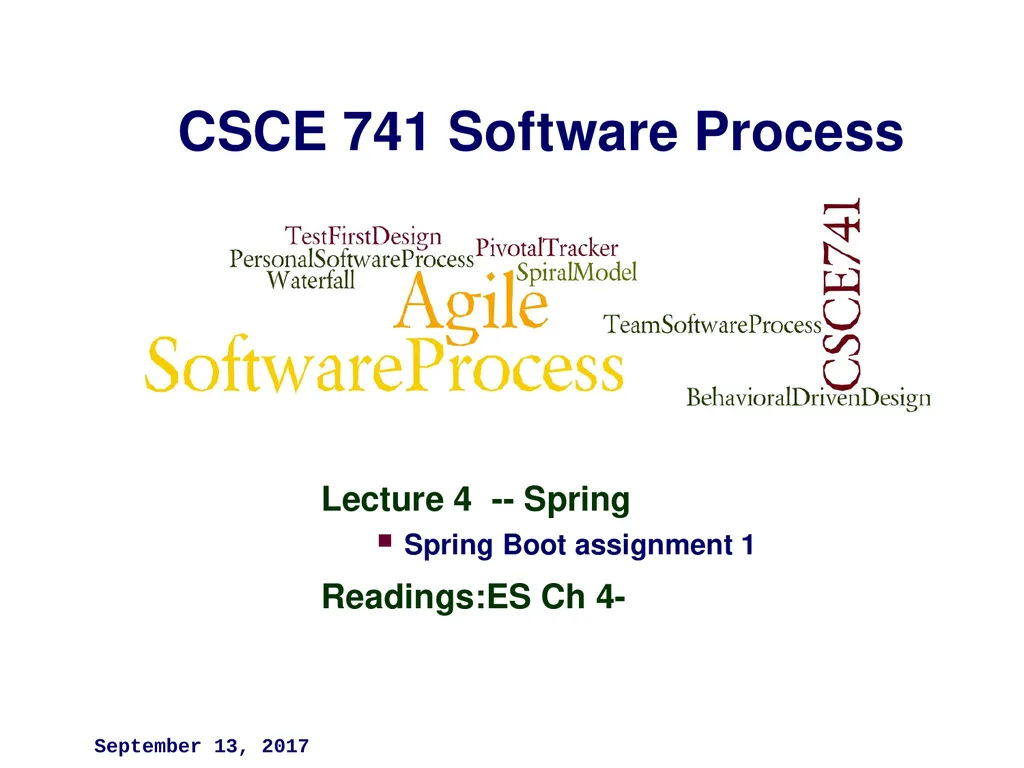
slide1. Lecture 04
Availability Topics
Chapter 5 – Availability September 13, 2017 CSCE 741 Software Process Lecture 4 -- Spring
Spring Boot assignment 1
Readings:ES Ch 4-<br>
slide2. Last Time
Sprints <ES=Essential Scrum chapter 4>
Abbreviations
ES for Essential Scrum = Rubin, Kenneth S.. Essential Scrum: A Practical Guide to the Most Popular Agile Process (Addison-Wesley Signature Series (Cohn)) (p. 61). Pearson Education. Kindle Edition.
New
yyy<br>
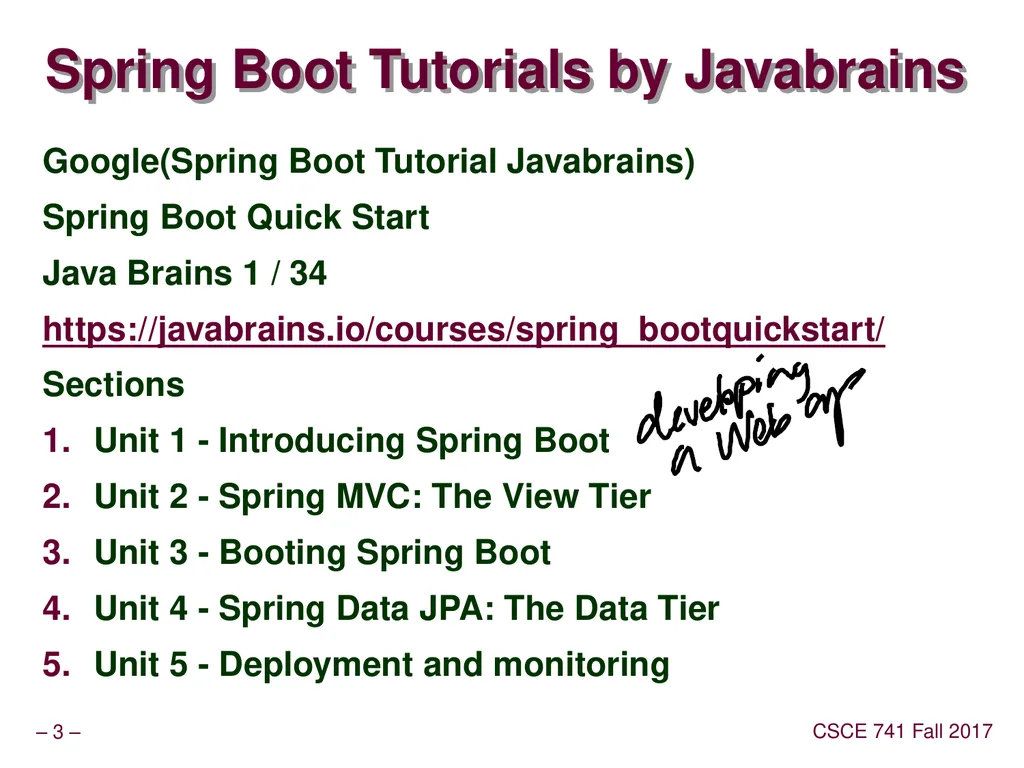
slide3. Spring Boot Tutorials by Javabrains Google(Spring Boot Tutorial Javabrains)
Spring Boot Quick Start
Java Brains 1 / 34
https://javabrains.io/courses/spring_bootquickstart/
Sections
Unit 1 - Introducing Spring Boot
Unit 2 - Spring MVC: The View Tier
Unit 3 - Booting Spring Boot
Unit 4 - Spring Data JPA: The Data Tier
Unit 5 - Deployment and monitoring<br>
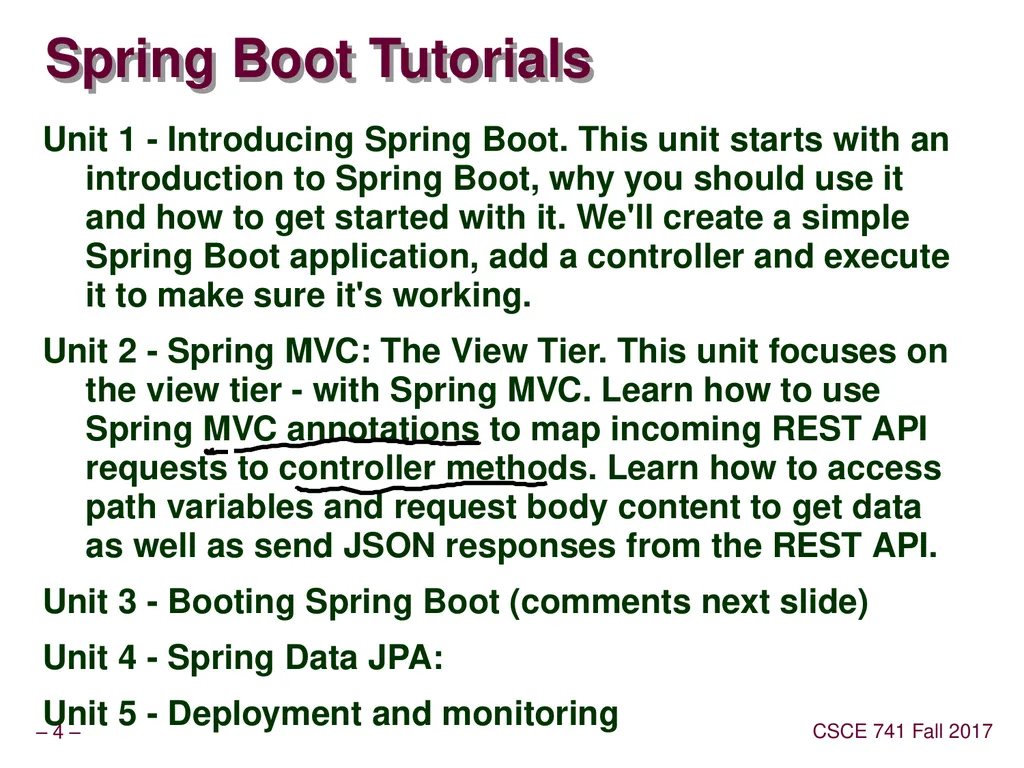
slide4. Spring Boot Tutorials Unit 1 - Introducing Spring Boot. This unit starts with an introduction to Spring Boot, why you should use it and how to get started with it. We'll create a simple Spring Boot application, add a controller and execute it to make sure it's working.
Unit 2 - Spring MVC: The View Tier. This unit focuses on the view tier - with Spring MVC. Learn how to use Spring MVC annotations to map incoming REST API requests to controller methods. Learn how to access path variables and request body content to get data as well as send JSON responses from the REST API.
Unit 3 - Booting Spring Boot (comments next slide)
Unit 4 - Spring Data JPA:
Unit 5 - Deployment and monitoring<br>
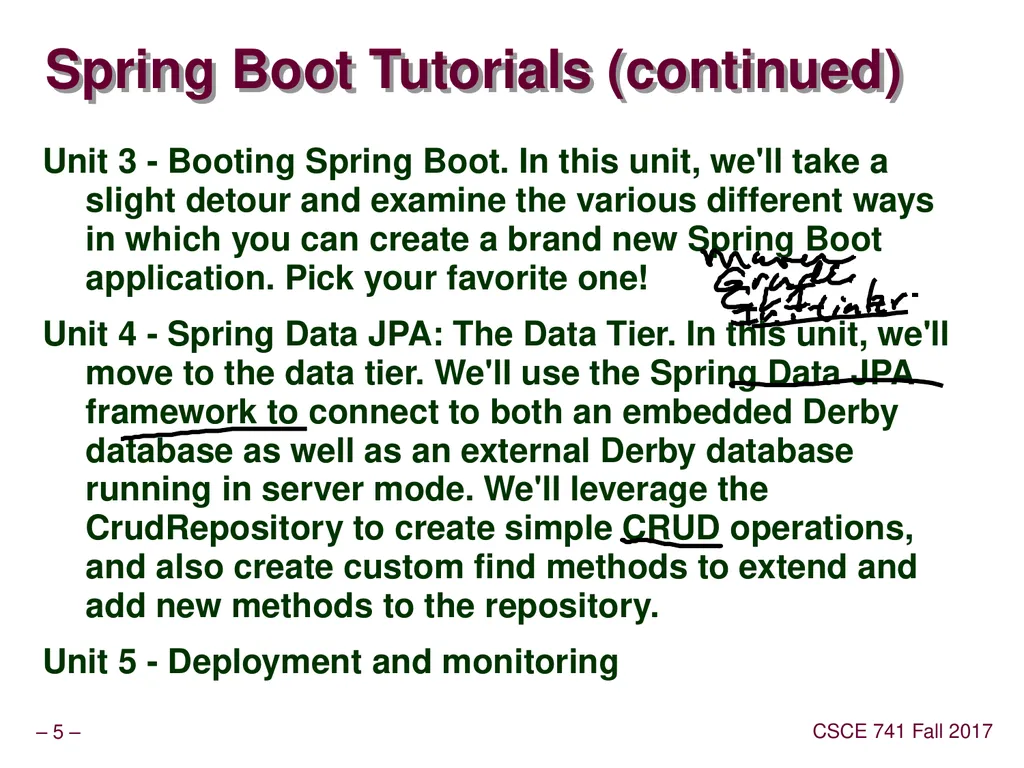
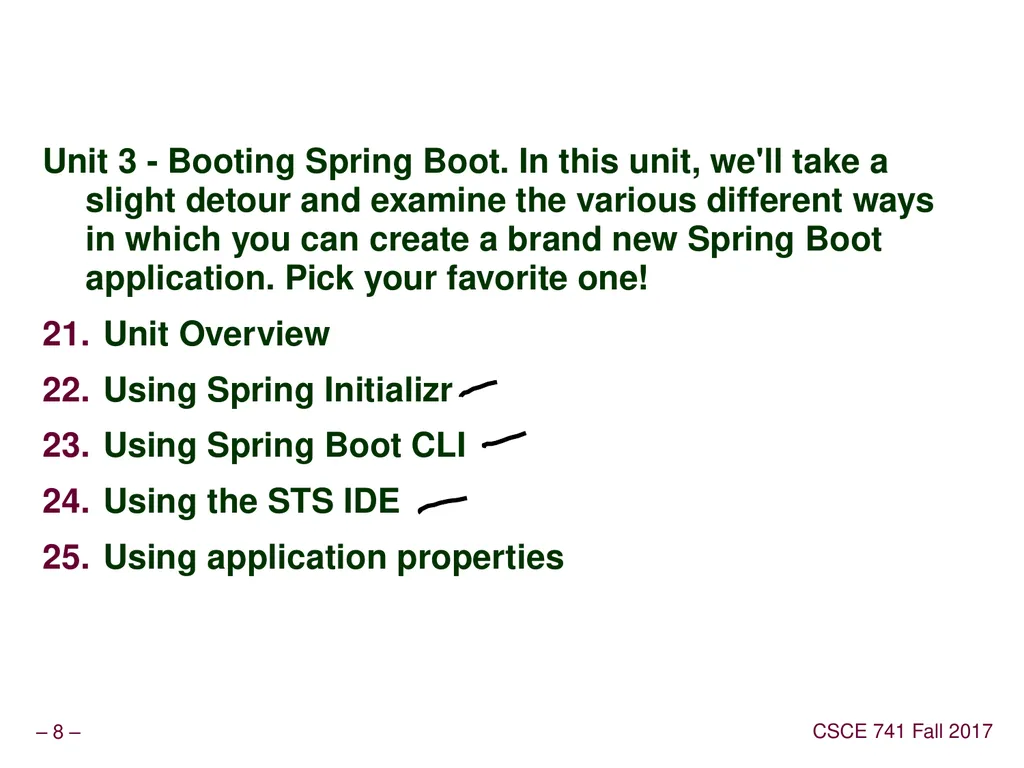
slide5. Spring Boot Tutorials (continued) Unit 3 - Booting Spring Boot. In this unit, we'll take a slight detour and examine the various different ways in which you can create a brand new Spring Boot application. Pick your favorite one!
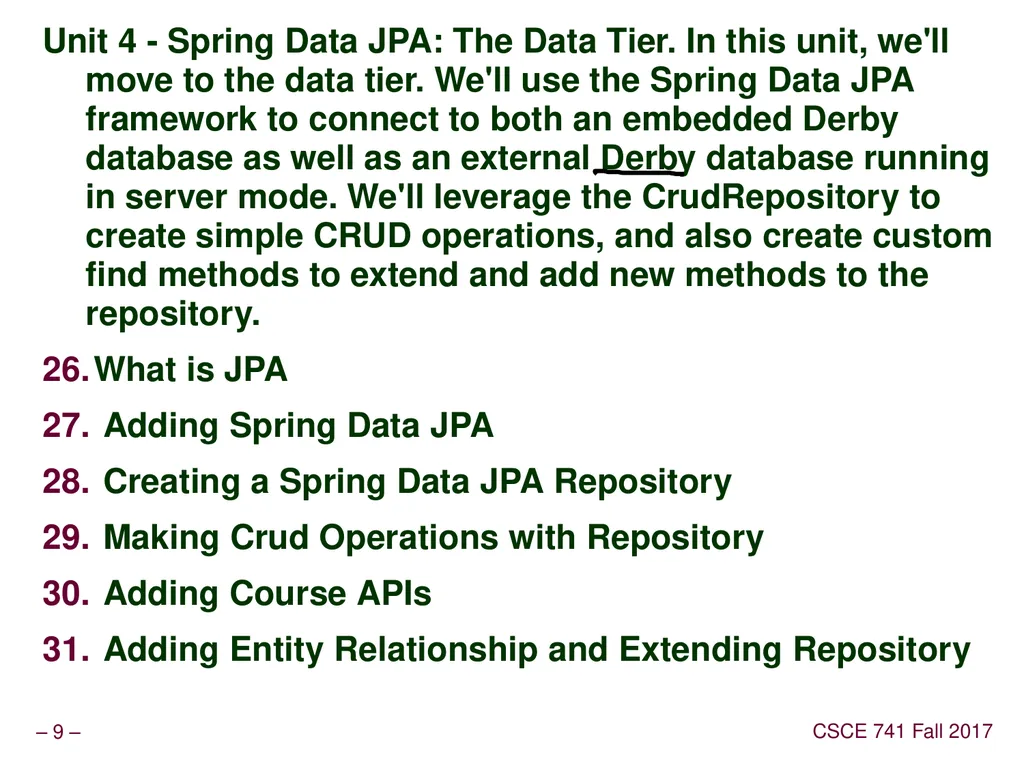
Unit 4 - Spring Data JPA: The Data Tier. In this unit, we'll move to the data tier. We'll use the Spring Data JPA framework to connect to both an embedded Derby database as well as an external Derby database running in server mode. We'll leverage the CrudRepository to create simple CRUD operations, and also create custom find methods to extend and add new methods to the repository.
Unit 5 - Deployment and monitoring<br>
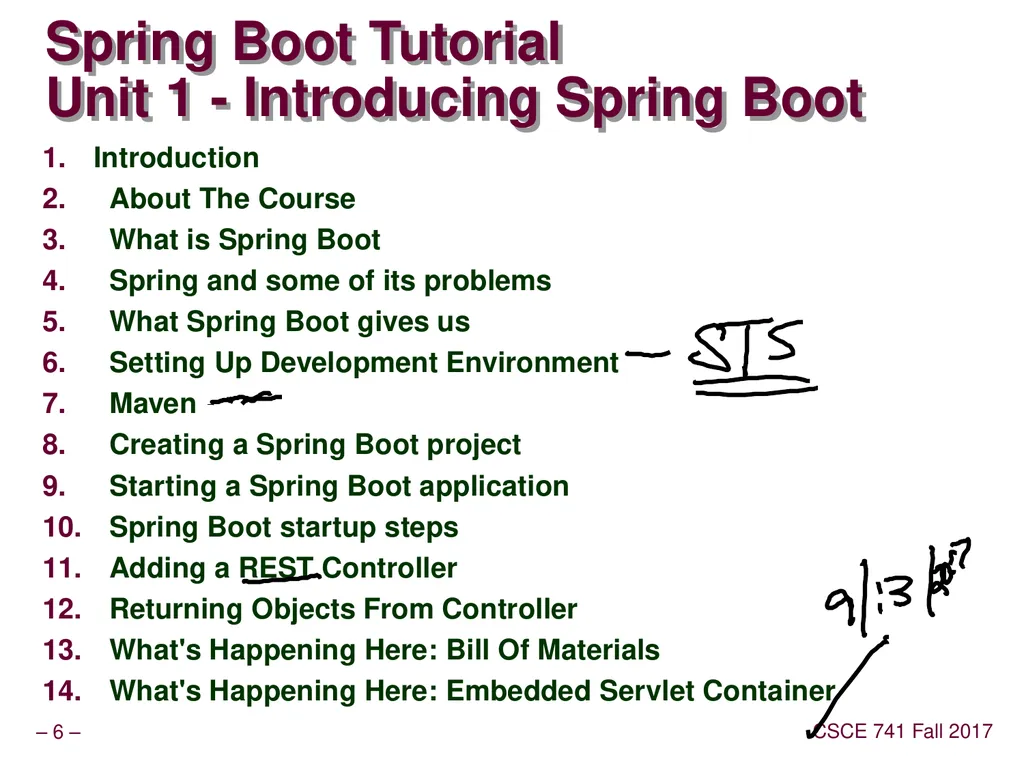
slide6. Spring Boot Tutorial Unit 1 - Introducing Spring Boot Introduction
About The Course
What is Spring Boot
Spring and some of its problems
What Spring Boot gives us
Setting Up Development Environment
Maven
Creating a Spring Boot project
Starting a Spring Boot application
Spring Boot startup steps
Adding a REST Controller
Returning Objects From Controller
What's Happening Here: Bill Of Materials
What's Happening Here: Embedded Servlet Container<br>
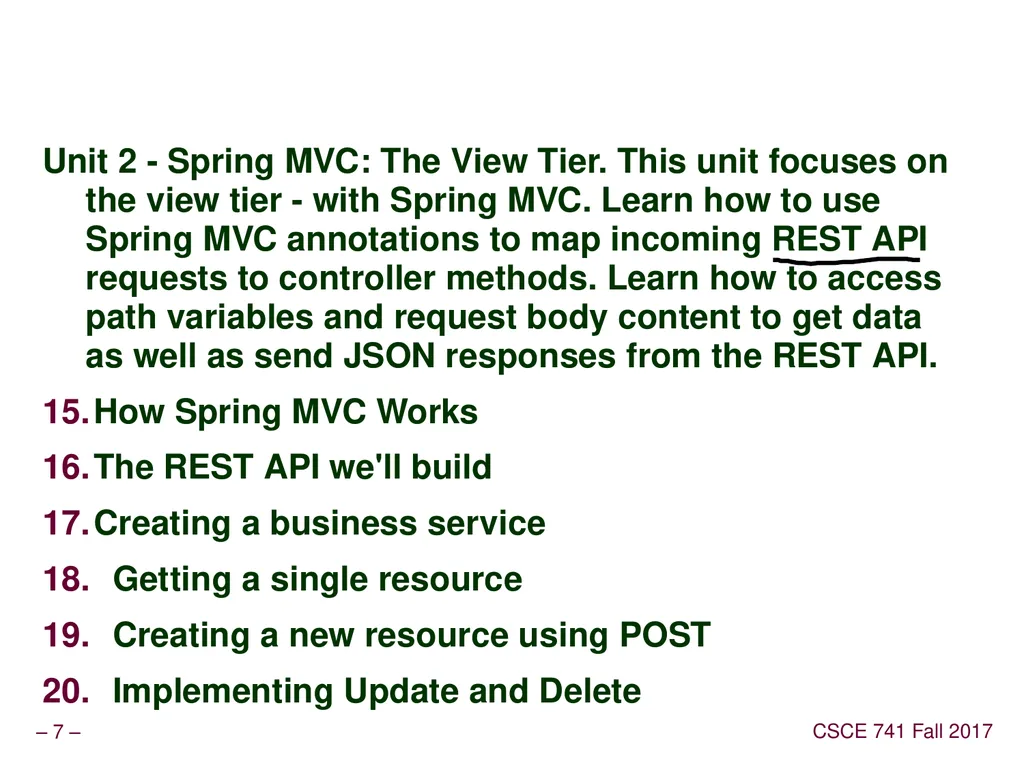
slide7. Unit 2 - Spring MVC: The View Tier. This unit focuses on the view tier - with Spring MVC. Learn how to use Spring MVC annotations to map incoming REST API requests to controller methods. Learn how to access path variables and request body content to get data as well as send JSON responses from the REST API.
How Spring MVC Works
The REST API we'll build
Creating a business service
Getting a single resource
Creating a new resource using POST
Implementing Update and Delete<br>
slide8. Unit 3 - Booting Spring Boot. In this unit, we'll take a slight detour and examine the various different ways in which you can create a brand new Spring Boot application. Pick your favorite one!
Unit Overview
Using Spring Initializr
Using Spring Boot CLI
Using the STS IDE
Using application properties<br>
slide9. Unit 4 - Spring Data JPA: The Data Tier. In this unit, we'll move to the data tier. We'll use the Spring Data JPA framework to connect to both an embedded Derby database as well as an external Derby database running in server mode. We'll leverage the CrudRepository to create simple CRUD operations, and also create custom find methods to extend and add new methods to the repository.
What is JPA
Adding Spring Data JPA
Creating a Spring Data JPA Repository
Making Crud Operations with Repository
Adding Course APIs
Adding Entity Relationship and Extending Repository<br>
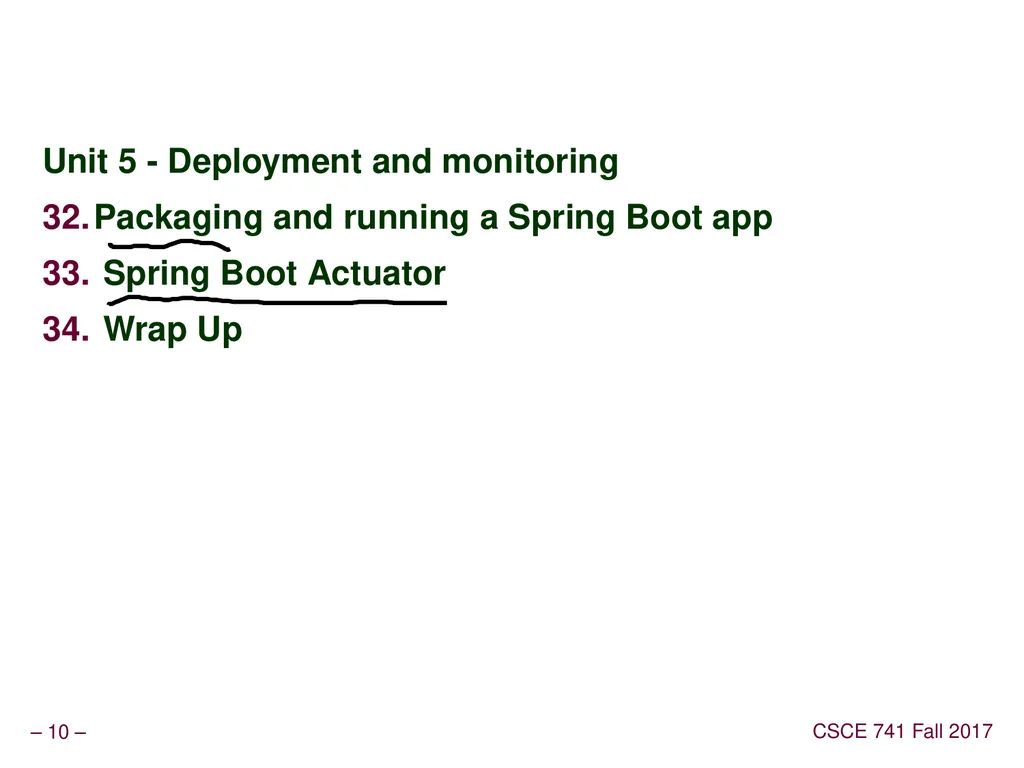
slide10. Unit 5 - Deployment and monitoring
Packaging and running a Spring Boot app
Spring Boot Actuator
Wrap Up<br>
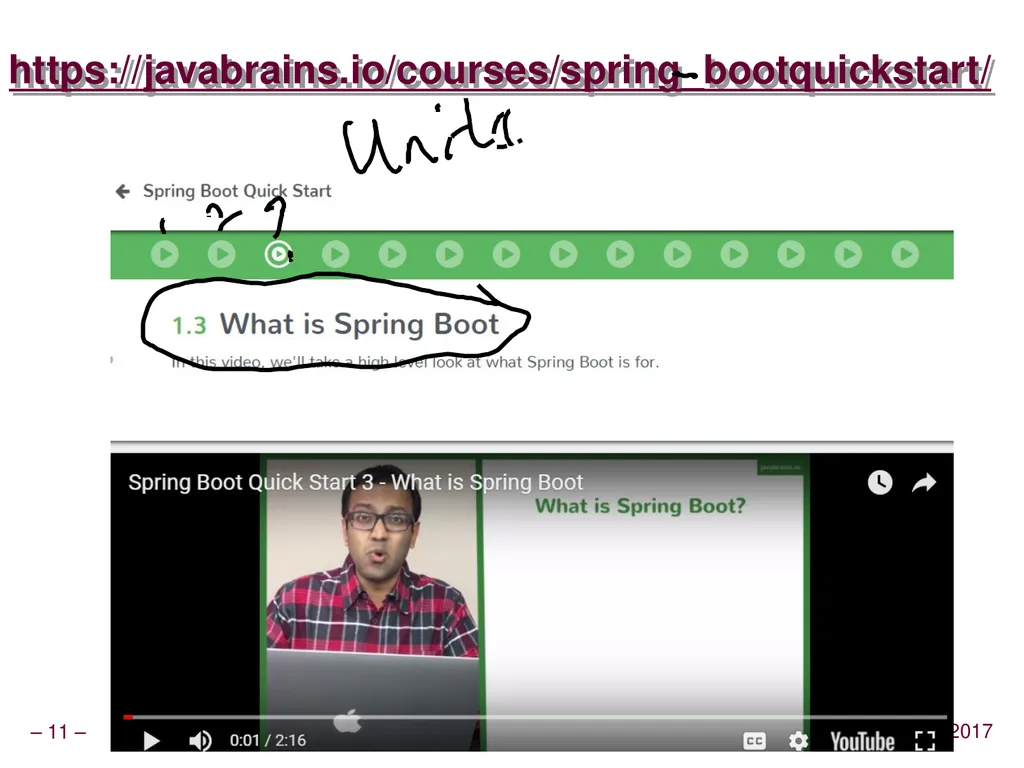
slide11. https://javabrains.io/courses/spring_bootquickstart/<br>
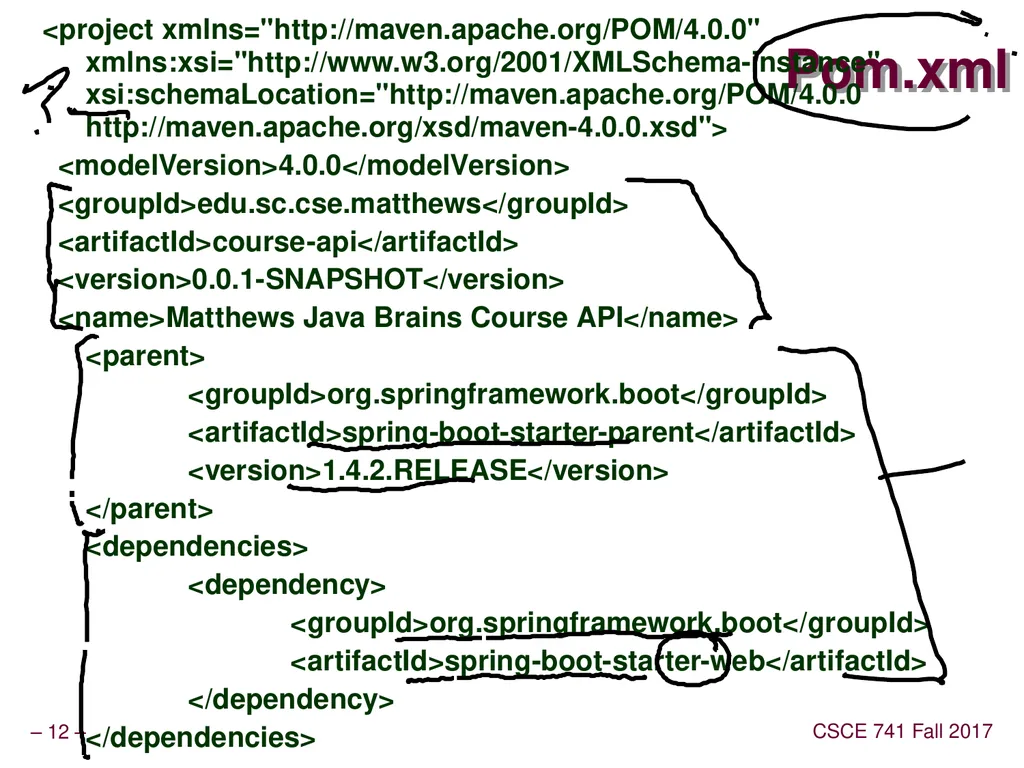
slide12. Pom.xml <project xmlns="http://maven.apache.org/POM/4.0.0" xmlns:xsi="http://www.w3.org/2001/XMLSchema-instance" xsi:schemaLocation="http://maven.apache.org/POM/4.0.0 http://maven.apache.org/xsd/maven-4.0.0.xsd">
<modelVersion>4.0.0</modelVersion>
<groupId>edu.sc.cse.matthews</groupId>
<artifactId>course-api</artifactId>
<version>0.0.1-SNAPSHOT</version>
<name>Matthews Java Brains Course API</name>
<parent>
<groupId>org.springframework.boot</groupId>
<artifactId>spring-boot-starter-parent</artifactId>
<version>1.4.2.RELEASE</version>
</parent>
<dependencies>
<dependency>
<groupId>org.springframework.boot</groupId>
<artifactId>spring-boot-starter-web</artifactId>
</dependency>
</dependencies>
<properties>
<java.version>1.8</java.version>
</properties>
</project><br>
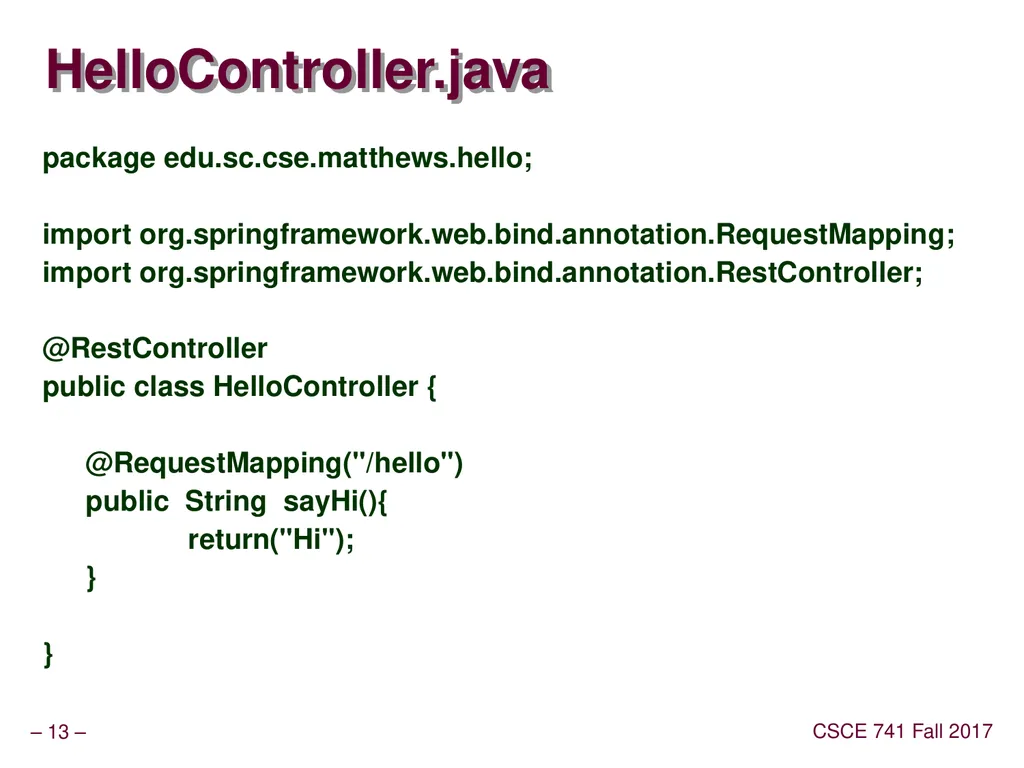
slide13. HelloController.java package edu.sc.cse.matthews.hello;
import org.springframework.web.bind.annotation.RequestMapping;
import org.springframework.web.bind.annotation.RestController;
@RestController
public class HelloController {
@RequestMapping("/hello")
public String sayHi(){
return("Hi");
}
}<br>
slide14. http://localhost:8080/hello<br>
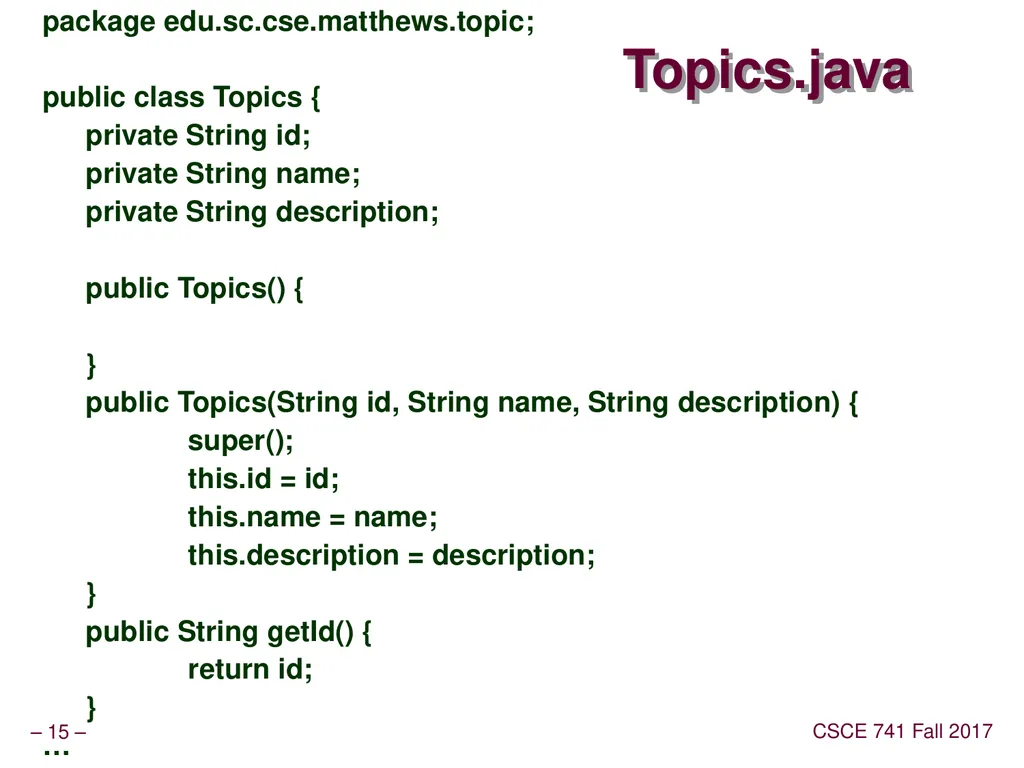
slide15. Topics.java package edu.sc.cse.matthews.topic;
public class Topics {
private String id;
private String name;
private String description;
public Topics() {
}
public Topics(String id, String name, String description) {
super();
this.id = id;
this.name = name;
this.description = description;
}
public String getId() {
return id;
}
…<br>
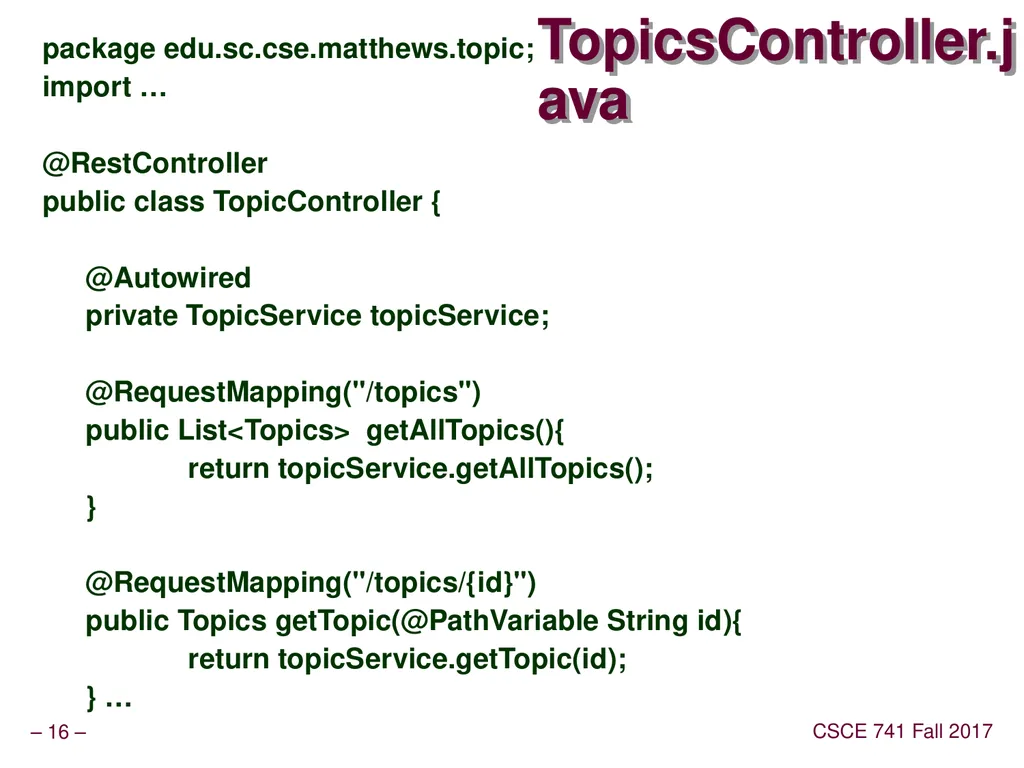
slide16. TopicsController.java package edu.sc.cse.matthews.topic;
import …
@RestController
public class TopicController {
@Autowired
private TopicService topicService;
@RequestMapping("/topics")
public List<Topics> getAllTopics(){
return topicService.getAllTopics();
}
@RequestMapping("/topics/{id}")
public Topics getTopic(@PathVariable String id){
return topicService.getTopic(id);
} …<br>
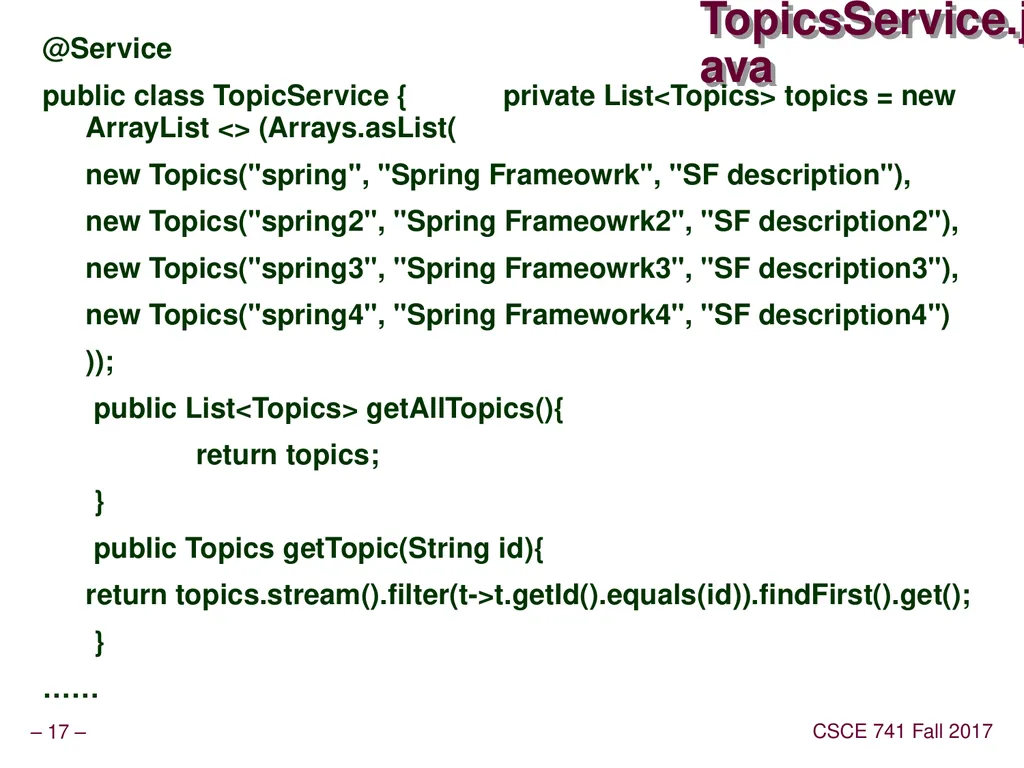
slide17. TopicsService.java @Service
public class TopicService { private List<Topics> topics = new ArrayList <> (Arrays.asList(
new Topics("spring", "Spring Frameowrk", "SF description"),
new Topics("spring2", "Spring Frameowrk2", "SF description2"),
new Topics("spring3", "Spring Frameowrk3", "SF description3"),
new Topics("spring4", "Spring Framework4", "SF description4")
));
public List<Topics> getAllTopics(){
return topics;
}
public Topics getTopic(String id){
return topics.stream().filter(t->t.getId().equals(id)).findFirst().get();
}
……<br>
slide18. Spring Boot – YouTube
https://www.youtube.com/playlist?list=PLhd_vL3a3i7ooy1uGc_mz5C4s9Y1Pt7WZ
Spring Boot - JSP – YouTube
https://www.youtube.com/playlist?list=PLhd_vL3a3i7om8OkPSr0flhVgSY0aS2QR
Spring Boot - Bootstrap – YouTube
https://www.youtube.com/playlist?list=PLhd_vL3a3i7oAygrG9hVRRXADWyAwYdE1<br>
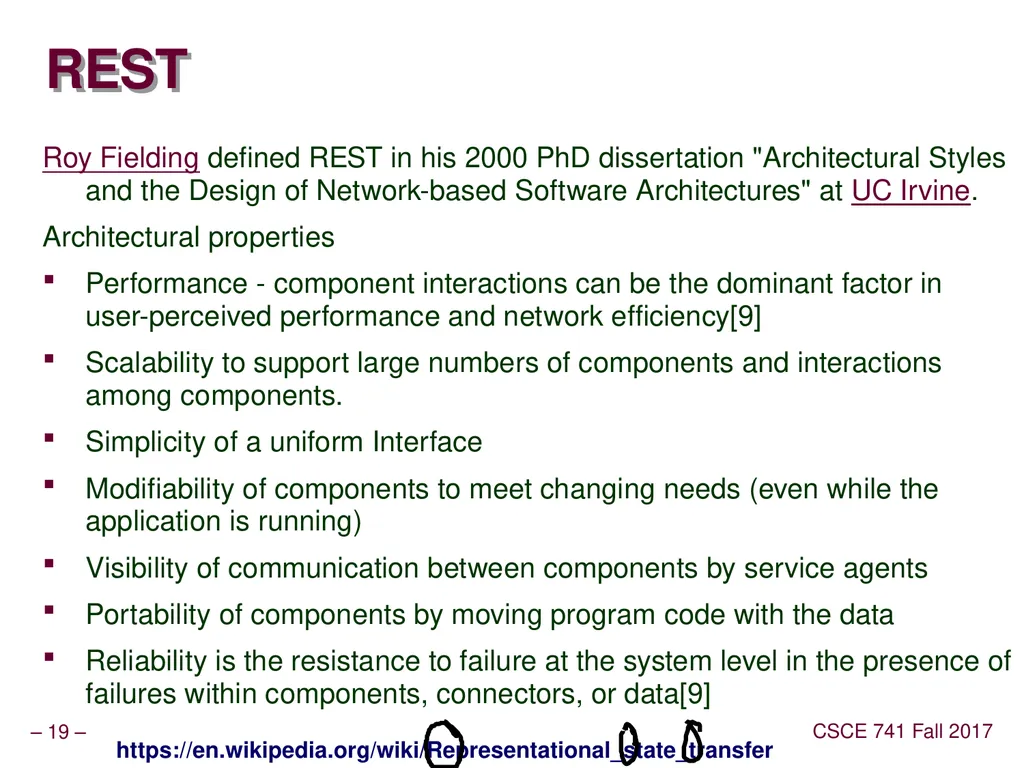
slide19. REST Roy Fielding defined REST in his 2000 PhD dissertation "Architectural Styles and the Design of Network-based Software Architectures" at UC Irvine.
Architectural properties
Performance - component interactions can be the dominant factor in user-perceived performance and network efficiency[9]
Scalability to support large numbers of components and interactions among components.
Simplicity of a uniform Interface
Modifiability of components to meet changing needs (even while the application is running)
Visibility of communication between components by service agents
Portability of components by moving program code with the data
Reliability is the resistance to failure at the system level in the presence of failures within components, connectors, or data[9] https://en.wikipedia.org/wiki/Representational_state_transfer<br>
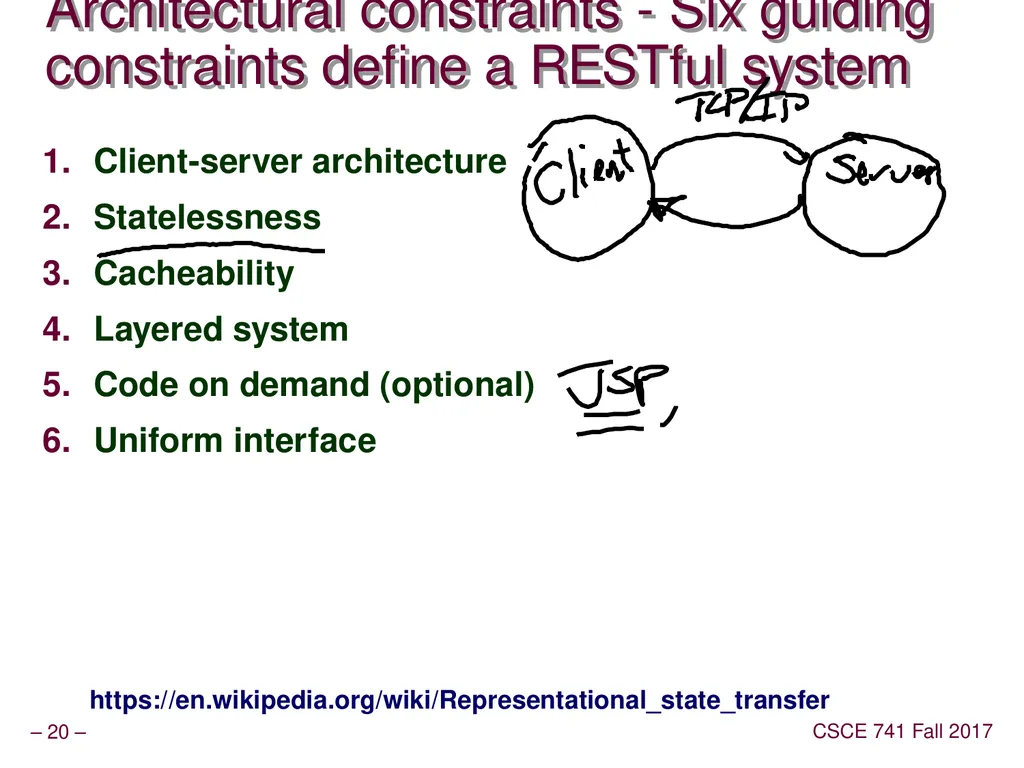
slide20. Architectural constraints - Six guiding constraints define a RESTful system Client-server architecture
Statelessness
Cacheability
Layered system
Code on demand (optional)
Uniform interface https://en.wikipedia.org/wiki/Representational_state_transfer<br>
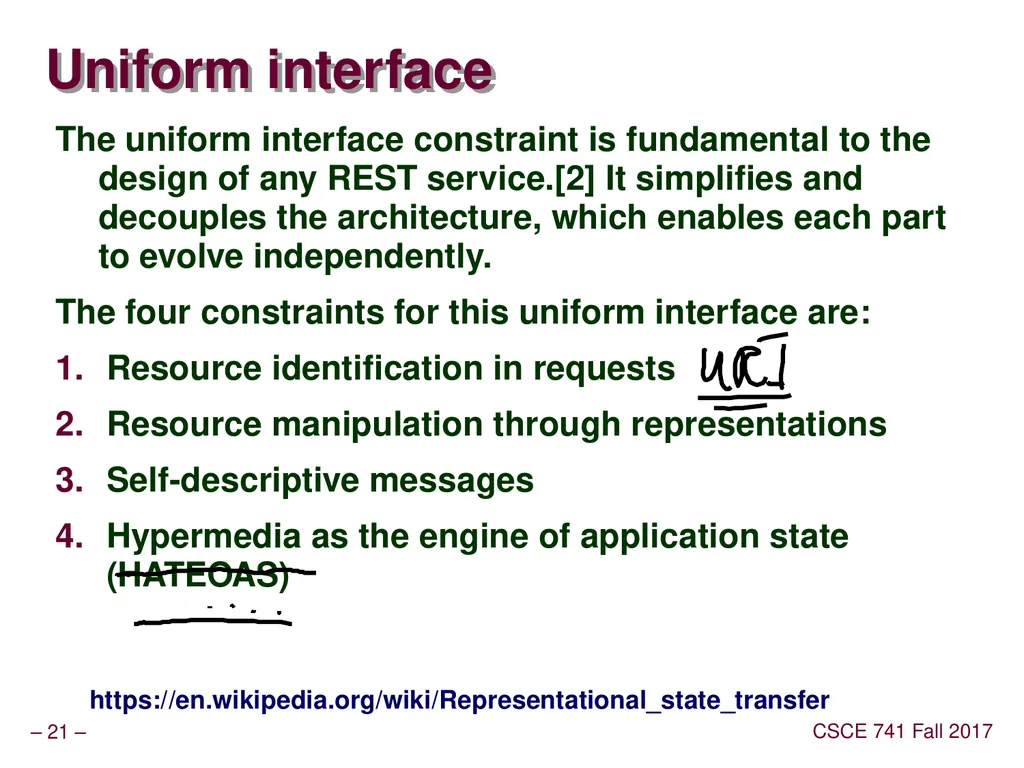
slide21. Uniform interface The uniform interface constraint is fundamental to the design of any REST service.[2] It simplifies and decouples the architecture, which enables each part to evolve independently.
The four constraints for this uniform interface are:
Resource identification in requests
Resource manipulation through representations
Self-descriptive messages
Hypermedia as the engine of application state (HATEOAS) https://en.wikipedia.org/wiki/Representational_state_transfer<br>
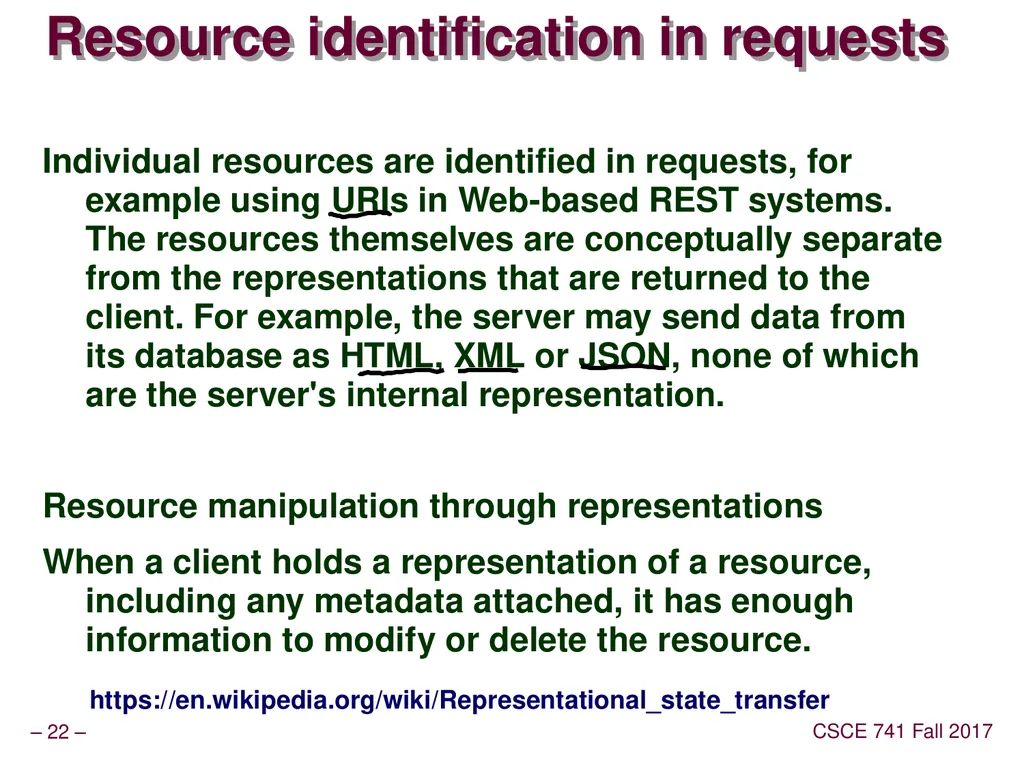
slide22. Resource identification in requests Individual resources are identified in requests, for example using URIs in Web-based REST systems. The resources themselves are conceptually separate from the representations that are returned to the client. For example, the server may send data from its database as HTML, XML or JSON, none of which are the server's internal representation.
Resource manipulation through representations
When a client holds a representation of a resource, including any metadata attached, it has enough information to modify or delete the resource. https://en.wikipedia.org/wiki/Representational_state_transfer<br>
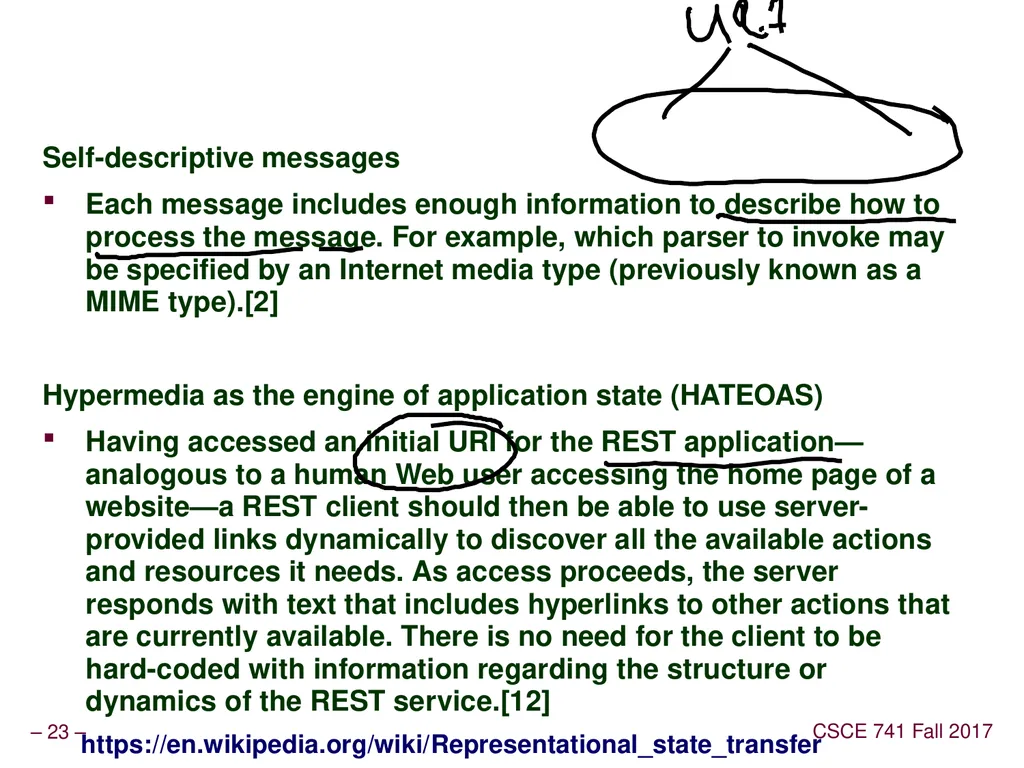
slide23. Self-descriptive messages
Each message includes enough information to describe how to process the message. For example, which parser to invoke may be specified by an Internet media type (previously known as a MIME type).[2]
Hypermedia as the engine of application state (HATEOAS)
Having accessed an initial URI for the REST application—analogous to a human Web user accessing the home page of a website—a REST client should then be able to use server-provided links dynamically to discover all the available actions and resources it needs. As access proceeds, the server responds with text that includes hyperlinks to other actions that are currently available. There is no need for the client to be hard-coded with information regarding the structure or dynamics of the REST service.[12] https://en.wikipedia.org/wiki/Representational_state_transfer<br>
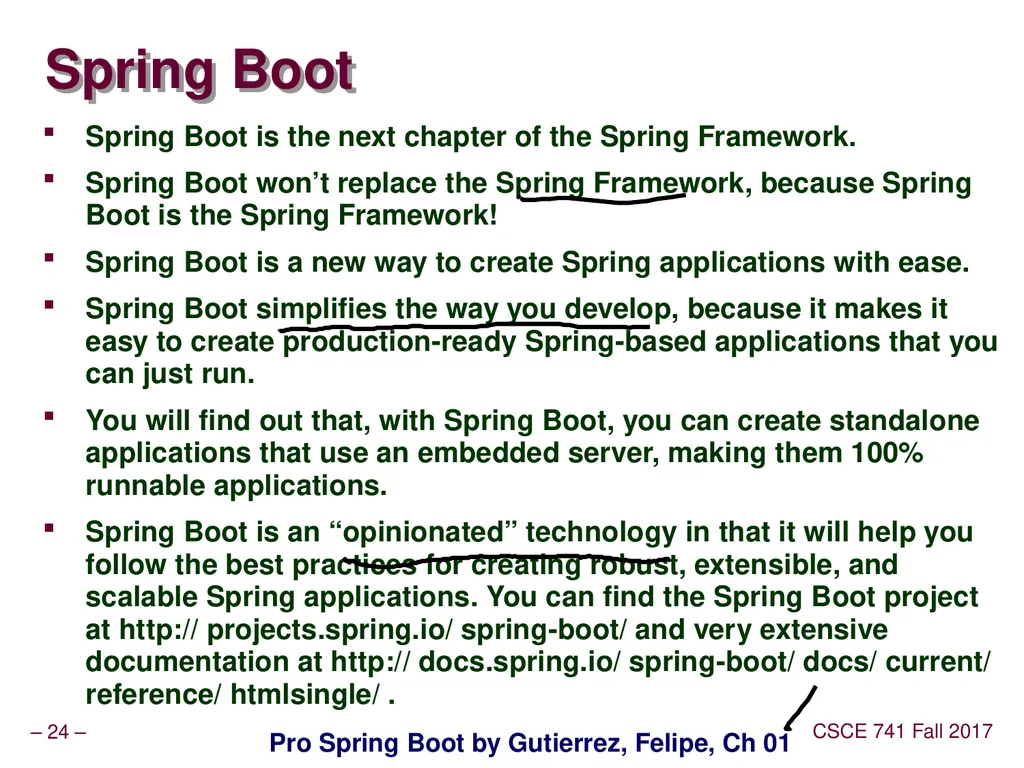
slide24. Spring Boot Spring Boot is the next chapter of the Spring Framework.
Spring Boot won’t replace the Spring Framework, because Spring Boot is the Spring Framework!
Spring Boot is a new way to create Spring applications with ease.
Spring Boot simplifies the way you develop, because it makes it easy to create production-ready Spring-based applications that you can just run.
You will find out that, with Spring Boot, you can create standalone applications that use an embedded server, making them 100% runnable applications.
Spring Boot is an “opinionated” technology in that it will help you follow the best practices for creating robust, extensible, and scalable Spring applications. You can find the Spring Boot project at http:// projects.spring.io/ spring-boot/ and very extensive documentation at http:// docs.spring.io/ spring-boot/ docs/ current/ reference/ htmlsingle/ . Pro Spring Boot by Gutierrez, Felipe, Ch 01<br>
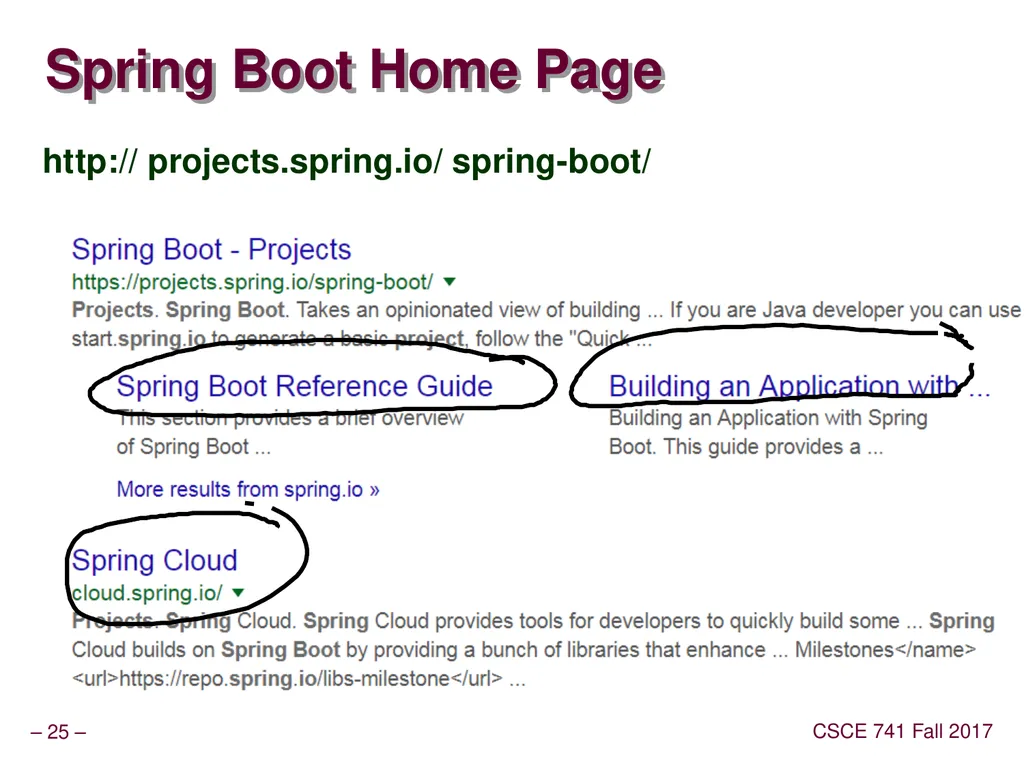
slide25. Spring Boot Home Page http:// projects.spring.io/ spring-boot/<br>
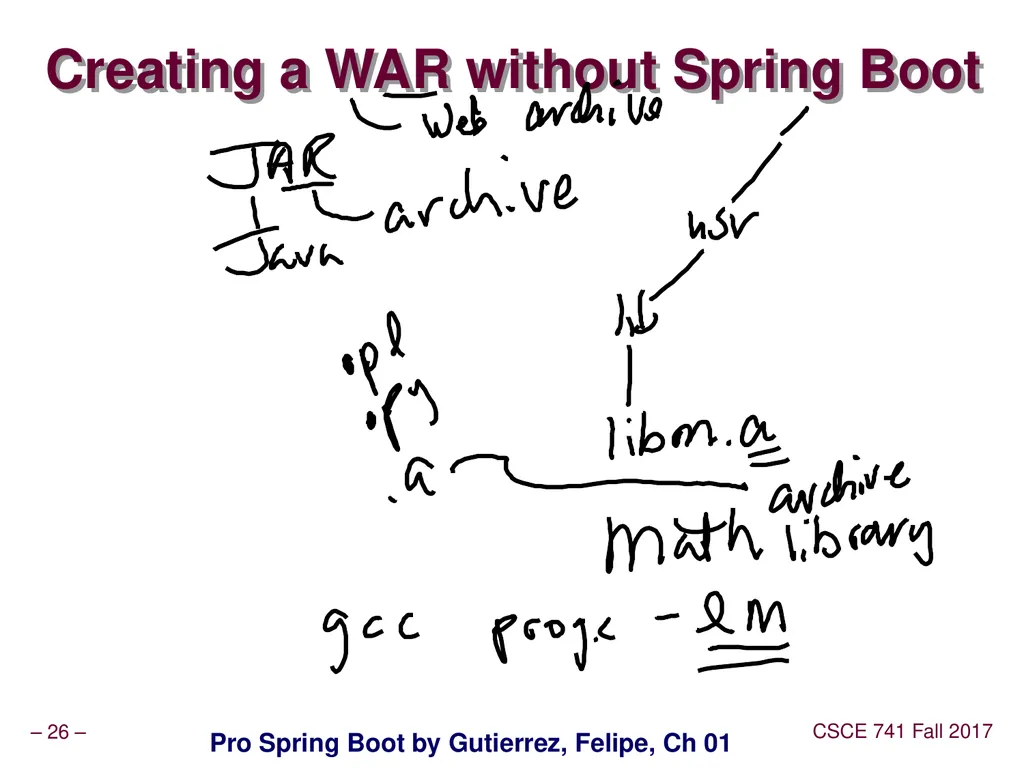
slide26. Creating a WAR without Spring Boot Pro Spring Boot by Gutierrez, Felipe, Ch 01<br>
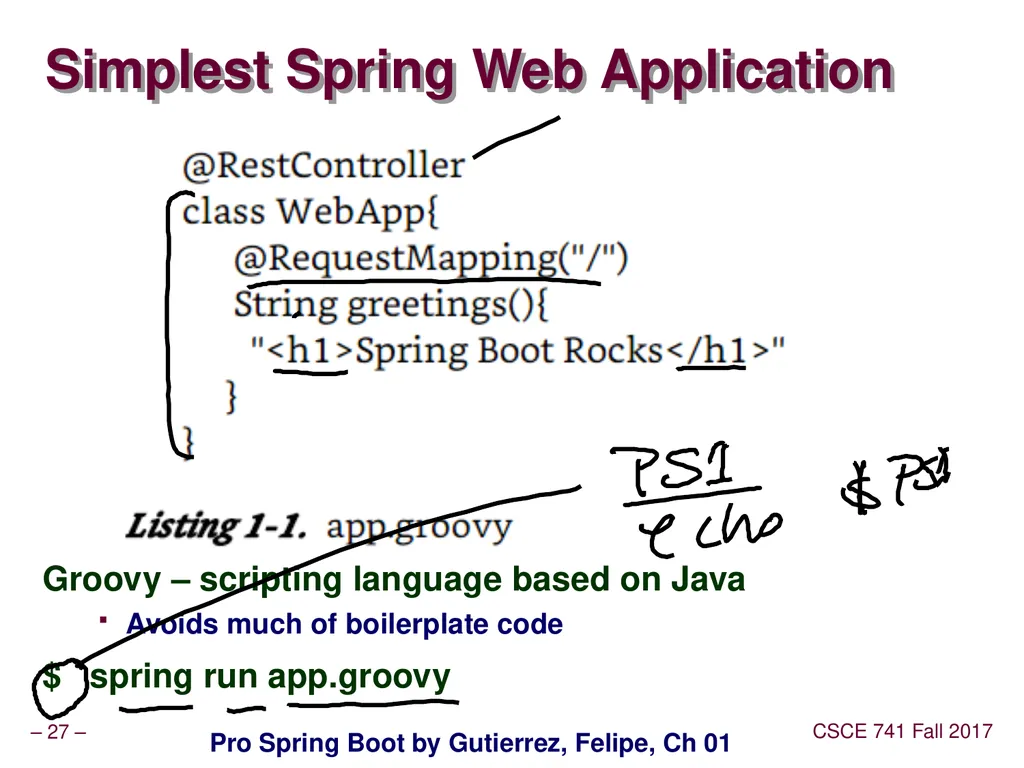
slide27. Simplest Spring Web Application Groovy – scripting language based on Java
Avoids much of boilerplate code
$ spring run app.groovy Pro Spring Boot by Gutierrez, Felipe, Ch 01<br>
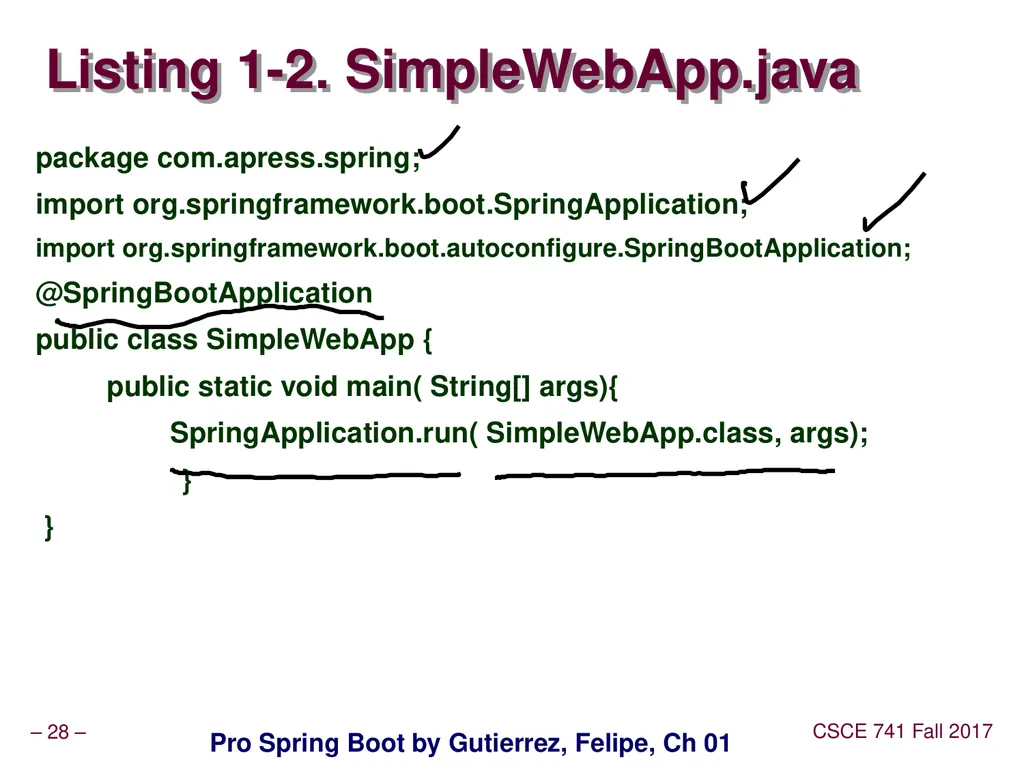
slide28. Listing 1-2. SimpleWebApp.java package com.apress.spring;
import org.springframework.boot.SpringApplication;
import org.springframework.boot.autoconfigure.SpringBootApplication;
@SpringBootApplication
public class SimpleWebApp {
public static void main( String[] args){
SpringApplication.run( SimpleWebApp.class, args);
}
} Pro Spring Boot by Gutierrez, Felipe, Ch 01<br>
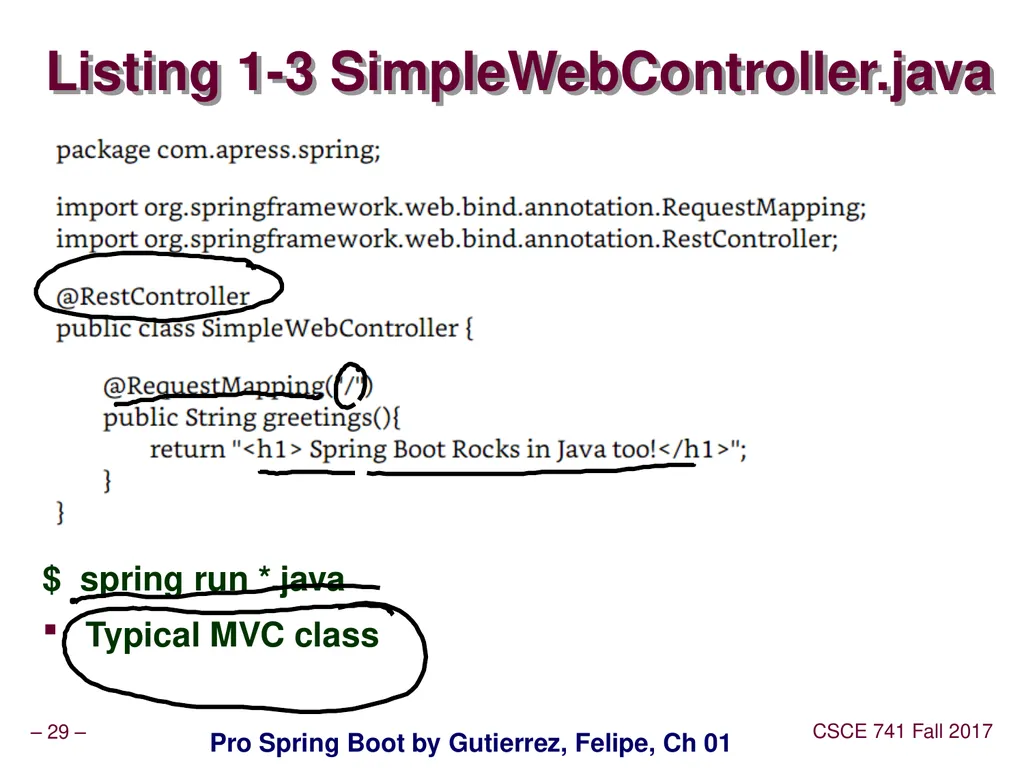
slide29. Listing 1-3 SimpleWebController.java $ spring run *.java
Typical MVC class Pro Spring Boot by Gutierrez, Felipe, Ch 01<br>
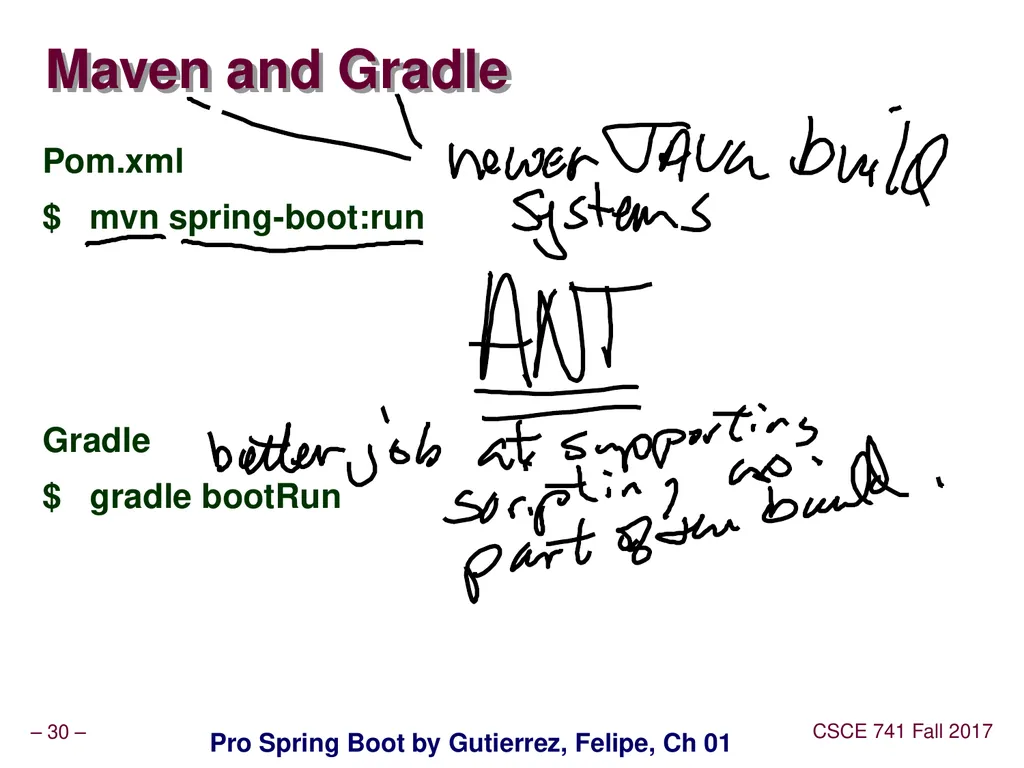
slide30. Maven and Gradle Pom.xml
$ mvn spring-boot:run
Gradle
$ gradle bootRun Pro Spring Boot by Gutierrez, Felipe, Ch 01<br>
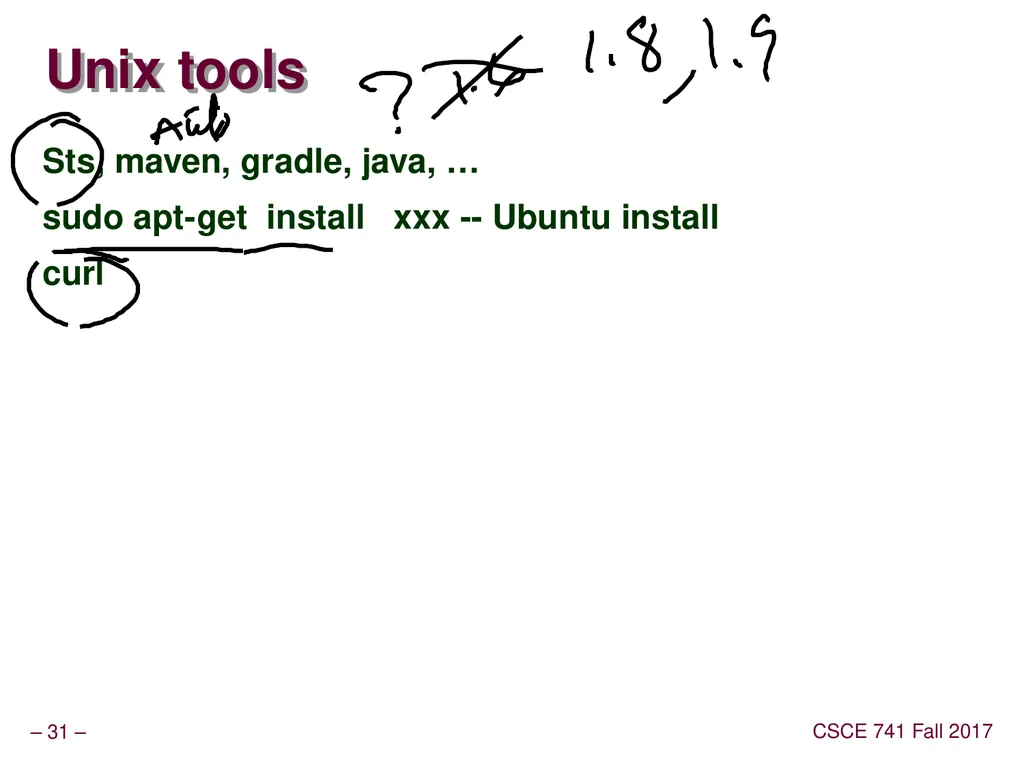
slide31. Unix tools Sts, maven, gradle, java, …
sudo apt-get install xxx -- Ubuntu install
curl<br>
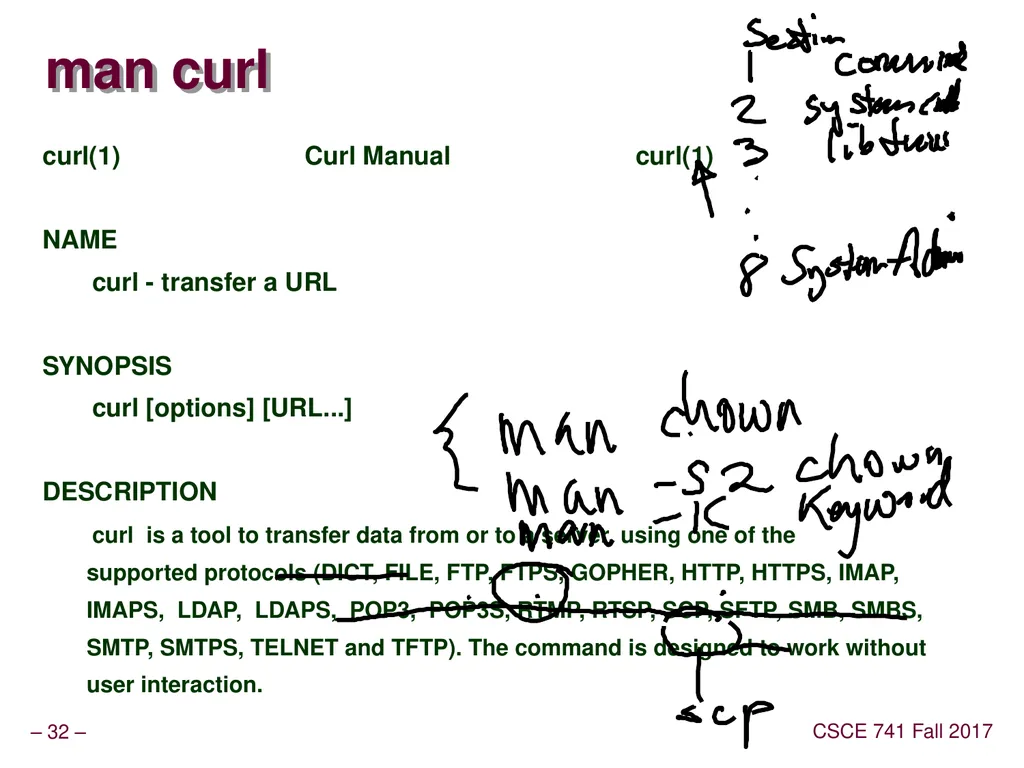
slide32. man curl curl(1) Curl Manual curl(1)
NAME
curl - transfer a URL
SYNOPSIS
curl [options] [URL...]
DESCRIPTION
curl is a tool to transfer data from or to a server, using one of the
supported protocols (DICT, FILE, FTP, FTPS, GOPHER, HTTP, HTTPS, IMAP,
IMAPS, LDAP, LDAPS, POP3, POP3S, RTMP, RTSP, SCP, SFTP, SMB, SMBS,
SMTP, SMTPS, TELNET and TFTP). The command is designed to work without
user interaction.<br>
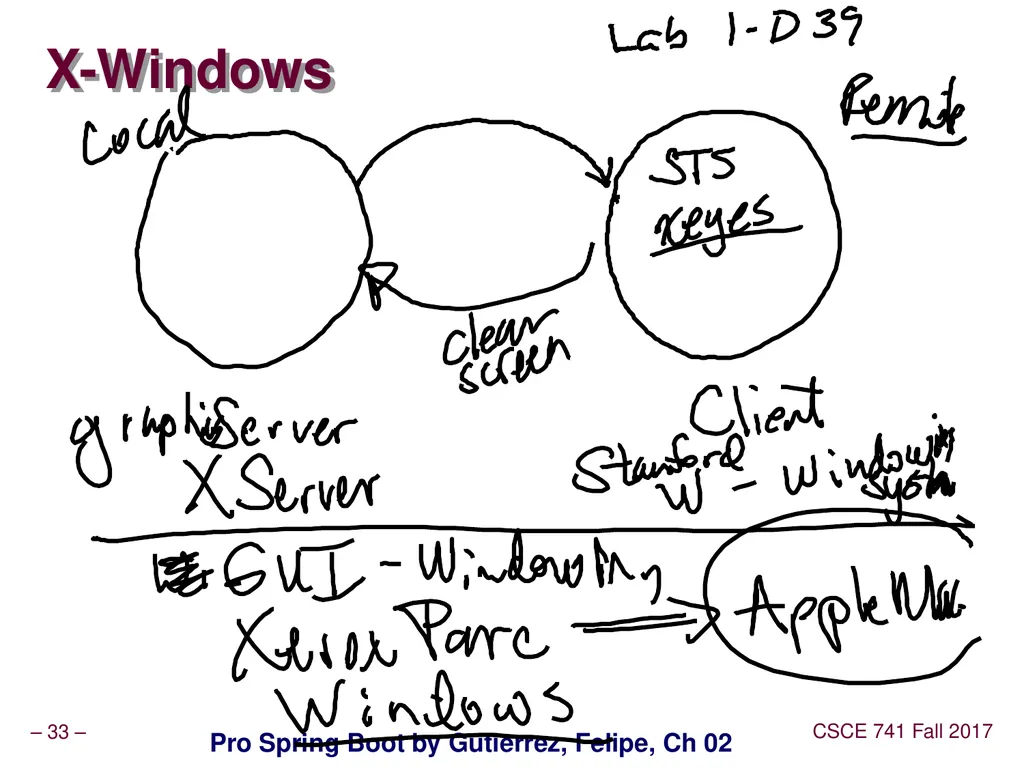
slide33. X-Windows Pro Spring Boot by Gutierrez, Felipe, Ch 02<br>
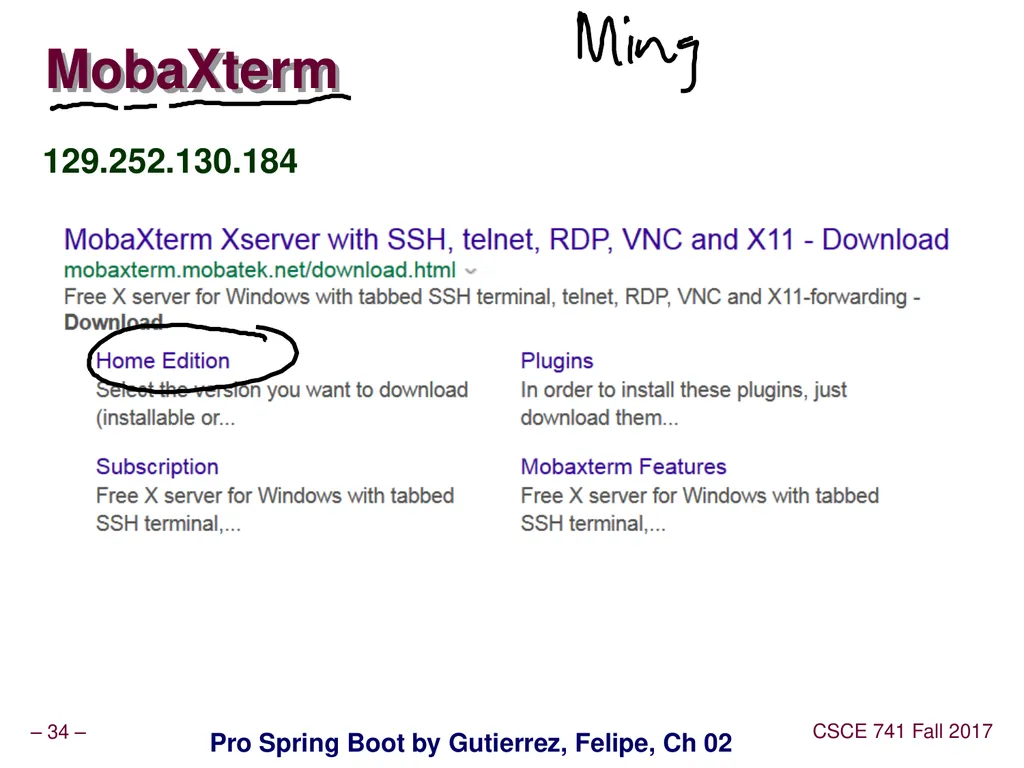
slide34. MobaXterm 129.252.130.184 Pro Spring Boot by Gutierrez, Felipe, Ch 02<br>
slide35. Next HW Integrating Spring Boot and Schedule program Pro Spring Boot by Gutierrez, Felipe, Ch 02<br>
slide36. Pro Spring Boot by Gutierrez, Felipe, Ch 02<br>
Chapter 5 – Availability September 13, 2017 CSCE 741 Software Process Lecture 4 -- Spring
Spring Boot assignment 1
Readings:ES Ch 4-<br>
slide2. Last Time
Sprints <ES=Essential Scrum chapter 4>
Abbreviations
ES for Essential Scrum = Rubin, Kenneth S.. Essential Scrum: A Practical Guide to the Most Popular Agile Process (Addison-Wesley Signature Series (Cohn)) (p. 61). Pearson Education. Kindle Edition.
New
yyy<br>
slide3. Spring Boot Tutorials by Javabrains Google(Spring Boot Tutorial Javabrains)
Spring Boot Quick Start
Java Brains 1 / 34
https://javabrains.io/courses/spring_bootquickstart/
Sections
Unit 1 - Introducing Spring Boot
Unit 2 - Spring MVC: The View Tier
Unit 3 - Booting Spring Boot
Unit 4 - Spring Data JPA: The Data Tier
Unit 5 - Deployment and monitoring<br>
slide4. Spring Boot Tutorials Unit 1 - Introducing Spring Boot. This unit starts with an introduction to Spring Boot, why you should use it and how to get started with it. We'll create a simple Spring Boot application, add a controller and execute it to make sure it's working.
Unit 2 - Spring MVC: The View Tier. This unit focuses on the view tier - with Spring MVC. Learn how to use Spring MVC annotations to map incoming REST API requests to controller methods. Learn how to access path variables and request body content to get data as well as send JSON responses from the REST API.
Unit 3 - Booting Spring Boot (comments next slide)
Unit 4 - Spring Data JPA:
Unit 5 - Deployment and monitoring<br>
slide5. Spring Boot Tutorials (continued) Unit 3 - Booting Spring Boot. In this unit, we'll take a slight detour and examine the various different ways in which you can create a brand new Spring Boot application. Pick your favorite one!
Unit 4 - Spring Data JPA: The Data Tier. In this unit, we'll move to the data tier. We'll use the Spring Data JPA framework to connect to both an embedded Derby database as well as an external Derby database running in server mode. We'll leverage the CrudRepository to create simple CRUD operations, and also create custom find methods to extend and add new methods to the repository.
Unit 5 - Deployment and monitoring<br>
slide6. Spring Boot Tutorial Unit 1 - Introducing Spring Boot Introduction
About The Course
What is Spring Boot
Spring and some of its problems
What Spring Boot gives us
Setting Up Development Environment
Maven
Creating a Spring Boot project
Starting a Spring Boot application
Spring Boot startup steps
Adding a REST Controller
Returning Objects From Controller
What's Happening Here: Bill Of Materials
What's Happening Here: Embedded Servlet Container<br>
slide7. Unit 2 - Spring MVC: The View Tier. This unit focuses on the view tier - with Spring MVC. Learn how to use Spring MVC annotations to map incoming REST API requests to controller methods. Learn how to access path variables and request body content to get data as well as send JSON responses from the REST API.
How Spring MVC Works
The REST API we'll build
Creating a business service
Getting a single resource
Creating a new resource using POST
Implementing Update and Delete<br>
slide8. Unit 3 - Booting Spring Boot. In this unit, we'll take a slight detour and examine the various different ways in which you can create a brand new Spring Boot application. Pick your favorite one!
Unit Overview
Using Spring Initializr
Using Spring Boot CLI
Using the STS IDE
Using application properties<br>
slide9. Unit 4 - Spring Data JPA: The Data Tier. In this unit, we'll move to the data tier. We'll use the Spring Data JPA framework to connect to both an embedded Derby database as well as an external Derby database running in server mode. We'll leverage the CrudRepository to create simple CRUD operations, and also create custom find methods to extend and add new methods to the repository.
What is JPA
Adding Spring Data JPA
Creating a Spring Data JPA Repository
Making Crud Operations with Repository
Adding Course APIs
Adding Entity Relationship and Extending Repository<br>
slide10. Unit 5 - Deployment and monitoring
Packaging and running a Spring Boot app
Spring Boot Actuator
Wrap Up<br>
slide11. https://javabrains.io/courses/spring_bootquickstart/<br>
slide12. Pom.xml <project xmlns="http://maven.apache.org/POM/4.0.0" xmlns:xsi="http://www.w3.org/2001/XMLSchema-instance" xsi:schemaLocation="http://maven.apache.org/POM/4.0.0 http://maven.apache.org/xsd/maven-4.0.0.xsd">
<modelVersion>4.0.0</modelVersion>
<groupId>edu.sc.cse.matthews</groupId>
<artifactId>course-api</artifactId>
<version>0.0.1-SNAPSHOT</version>
<name>Matthews Java Brains Course API</name>
<parent>
<groupId>org.springframework.boot</groupId>
<artifactId>spring-boot-starter-parent</artifactId>
<version>1.4.2.RELEASE</version>
</parent>
<dependencies>
<dependency>
<groupId>org.springframework.boot</groupId>
<artifactId>spring-boot-starter-web</artifactId>
</dependency>
</dependencies>
<properties>
<java.version>1.8</java.version>
</properties>
</project><br>
slide13. HelloController.java package edu.sc.cse.matthews.hello;
import org.springframework.web.bind.annotation.RequestMapping;
import org.springframework.web.bind.annotation.RestController;
@RestController
public class HelloController {
@RequestMapping("/hello")
public String sayHi(){
return("Hi");
}
}<br>
slide14. http://localhost:8080/hello<br>
slide15. Topics.java package edu.sc.cse.matthews.topic;
public class Topics {
private String id;
private String name;
private String description;
public Topics() {
}
public Topics(String id, String name, String description) {
super();
this.id = id;
this.name = name;
this.description = description;
}
public String getId() {
return id;
}
…<br>
slide16. TopicsController.java package edu.sc.cse.matthews.topic;
import …
@RestController
public class TopicController {
@Autowired
private TopicService topicService;
@RequestMapping("/topics")
public List<Topics> getAllTopics(){
return topicService.getAllTopics();
}
@RequestMapping("/topics/{id}")
public Topics getTopic(@PathVariable String id){
return topicService.getTopic(id);
} …<br>
slide17. TopicsService.java @Service
public class TopicService { private List<Topics> topics = new ArrayList <> (Arrays.asList(
new Topics("spring", "Spring Frameowrk", "SF description"),
new Topics("spring2", "Spring Frameowrk2", "SF description2"),
new Topics("spring3", "Spring Frameowrk3", "SF description3"),
new Topics("spring4", "Spring Framework4", "SF description4")
));
public List<Topics> getAllTopics(){
return topics;
}
public Topics getTopic(String id){
return topics.stream().filter(t->t.getId().equals(id)).findFirst().get();
}
……<br>
slide18. Spring Boot – YouTube
https://www.youtube.com/playlist?list=PLhd_vL3a3i7ooy1uGc_mz5C4s9Y1Pt7WZ
Spring Boot - JSP – YouTube
https://www.youtube.com/playlist?list=PLhd_vL3a3i7om8OkPSr0flhVgSY0aS2QR
Spring Boot - Bootstrap – YouTube
https://www.youtube.com/playlist?list=PLhd_vL3a3i7oAygrG9hVRRXADWyAwYdE1<br>
slide19. REST Roy Fielding defined REST in his 2000 PhD dissertation "Architectural Styles and the Design of Network-based Software Architectures" at UC Irvine.
Architectural properties
Performance - component interactions can be the dominant factor in user-perceived performance and network efficiency[9]
Scalability to support large numbers of components and interactions among components.
Simplicity of a uniform Interface
Modifiability of components to meet changing needs (even while the application is running)
Visibility of communication between components by service agents
Portability of components by moving program code with the data
Reliability is the resistance to failure at the system level in the presence of failures within components, connectors, or data[9] https://en.wikipedia.org/wiki/Representational_state_transfer<br>
slide20. Architectural constraints - Six guiding constraints define a RESTful system Client-server architecture
Statelessness
Cacheability
Layered system
Code on demand (optional)
Uniform interface https://en.wikipedia.org/wiki/Representational_state_transfer<br>
slide21. Uniform interface The uniform interface constraint is fundamental to the design of any REST service.[2] It simplifies and decouples the architecture, which enables each part to evolve independently.
The four constraints for this uniform interface are:
Resource identification in requests
Resource manipulation through representations
Self-descriptive messages
Hypermedia as the engine of application state (HATEOAS) https://en.wikipedia.org/wiki/Representational_state_transfer<br>
slide22. Resource identification in requests Individual resources are identified in requests, for example using URIs in Web-based REST systems. The resources themselves are conceptually separate from the representations that are returned to the client. For example, the server may send data from its database as HTML, XML or JSON, none of which are the server's internal representation.
Resource manipulation through representations
When a client holds a representation of a resource, including any metadata attached, it has enough information to modify or delete the resource. https://en.wikipedia.org/wiki/Representational_state_transfer<br>
slide23. Self-descriptive messages
Each message includes enough information to describe how to process the message. For example, which parser to invoke may be specified by an Internet media type (previously known as a MIME type).[2]
Hypermedia as the engine of application state (HATEOAS)
Having accessed an initial URI for the REST application—analogous to a human Web user accessing the home page of a website—a REST client should then be able to use server-provided links dynamically to discover all the available actions and resources it needs. As access proceeds, the server responds with text that includes hyperlinks to other actions that are currently available. There is no need for the client to be hard-coded with information regarding the structure or dynamics of the REST service.[12] https://en.wikipedia.org/wiki/Representational_state_transfer<br>
slide24. Spring Boot Spring Boot is the next chapter of the Spring Framework.
Spring Boot won’t replace the Spring Framework, because Spring Boot is the Spring Framework!
Spring Boot is a new way to create Spring applications with ease.
Spring Boot simplifies the way you develop, because it makes it easy to create production-ready Spring-based applications that you can just run.
You will find out that, with Spring Boot, you can create standalone applications that use an embedded server, making them 100% runnable applications.
Spring Boot is an “opinionated” technology in that it will help you follow the best practices for creating robust, extensible, and scalable Spring applications. You can find the Spring Boot project at http:// projects.spring.io/ spring-boot/ and very extensive documentation at http:// docs.spring.io/ spring-boot/ docs/ current/ reference/ htmlsingle/ . Pro Spring Boot by Gutierrez, Felipe, Ch 01<br>
slide25. Spring Boot Home Page http:// projects.spring.io/ spring-boot/<br>
slide26. Creating a WAR without Spring Boot Pro Spring Boot by Gutierrez, Felipe, Ch 01<br>
slide27. Simplest Spring Web Application Groovy – scripting language based on Java
Avoids much of boilerplate code
$ spring run app.groovy Pro Spring Boot by Gutierrez, Felipe, Ch 01<br>
slide28. Listing 1-2. SimpleWebApp.java package com.apress.spring;
import org.springframework.boot.SpringApplication;
import org.springframework.boot.autoconfigure.SpringBootApplication;
@SpringBootApplication
public class SimpleWebApp {
public static void main( String[] args){
SpringApplication.run( SimpleWebApp.class, args);
}
} Pro Spring Boot by Gutierrez, Felipe, Ch 01<br>
slide29. Listing 1-3 SimpleWebController.java $ spring run *.java
Typical MVC class Pro Spring Boot by Gutierrez, Felipe, Ch 01<br>
slide30. Maven and Gradle Pom.xml
$ mvn spring-boot:run
Gradle
$ gradle bootRun Pro Spring Boot by Gutierrez, Felipe, Ch 01<br>
slide31. Unix tools Sts, maven, gradle, java, …
sudo apt-get install xxx -- Ubuntu install
curl<br>
slide32. man curl curl(1) Curl Manual curl(1)
NAME
curl - transfer a URL
SYNOPSIS
curl [options] [URL...]
DESCRIPTION
curl is a tool to transfer data from or to a server, using one of the
supported protocols (DICT, FILE, FTP, FTPS, GOPHER, HTTP, HTTPS, IMAP,
IMAPS, LDAP, LDAPS, POP3, POP3S, RTMP, RTSP, SCP, SFTP, SMB, SMBS,
SMTP, SMTPS, TELNET and TFTP). The command is designed to work without
user interaction.<br>
slide33. X-Windows Pro Spring Boot by Gutierrez, Felipe, Ch 02<br>
slide34. MobaXterm 129.252.130.184 Pro Spring Boot by Gutierrez, Felipe, Ch 02<br>
slide35. Next HW Integrating Spring Boot and Schedule program Pro Spring Boot by Gutierrez, Felipe, Ch 02<br>
slide36. Pro Spring Boot by Gutierrez, Felipe, Ch 02<br>