Lecture-15 Microbial diversity and groups Fungi
Description: Lecture-15 Microbial diversity and groups Fungi and Algae Fungi Fungi are important microorganisms in food chain , they decompose dead plant and animal matter, recycling vital elements. They use extracellular enzymes. Nearly all plants
Related Topics
Download Presentation
"Lecture-15 Microbial diversity and groups Fungi" is the property of its rightful owner. Permission is granted to download and print the materials on this website for personal, non-commercial use only, and to display it on your personal computer provided you do not modify the materials and that you retain all copyright notices contained in the materials. By downloading content from our website, you accept the terms of this agreement.
Presentation Transcript
slide1. Lecture-15
Microbial diversity and groups Fungi and Algae<br>
slide2. Fungi Fungi are important microorganisms in food chain , they decompose dead plant and animal matter,
recycling vital elements. They use extracellular enzymes.
Nearly all plants depend on symbiotic fungi known as mycorrhizae , which help their roots absorb minerals and water from soil .
Fungi can cause serious fungal infections (human, animal and plants) .
Fungi are used by humans for food (mushrooms) ,to produce foods(bread and citric acid)and drugs (penicillin).
Study of fungi is called Mycology .<br>
slide3. Fungal Physiology and structure Most fungi are multicellular and some of them unicellular (yeast)
Fungal colonies are described as vegetative structures because they are composed of the cells involved in catabolism and growth.
The thallus (body) of fungus consists of long filaments of cells joined together and forming a network and called Hyphae .
In most molds , the hyphae contain cross-walls called septate hyphae which divide them into distinct
uninucleate cell- like unit.
In few classes of fungi, the hyphae contain no septa and appear as long continuous cells with many nuclei and called coenocytic hyphae.<br>
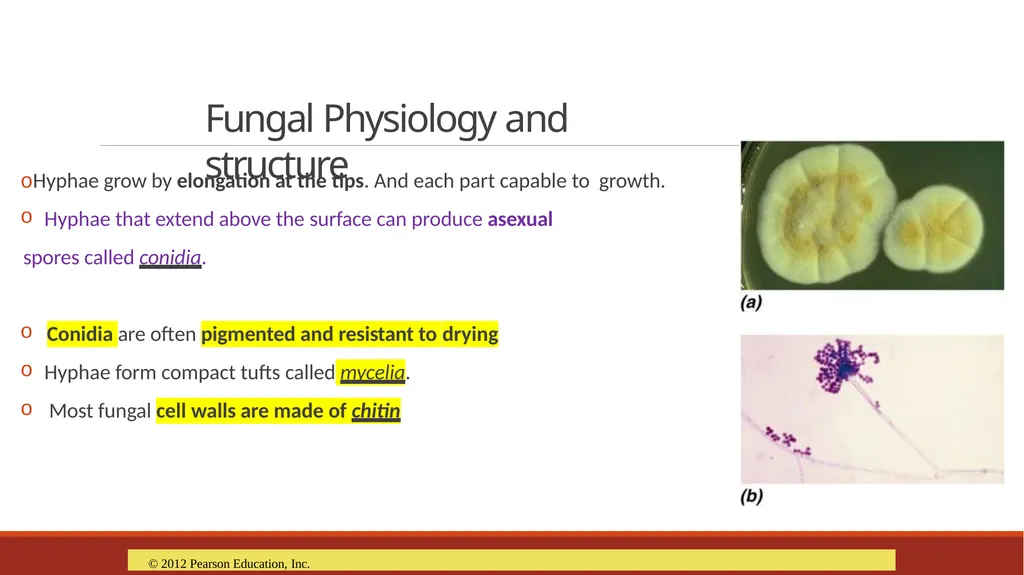
slide4. Fungal Physiology and structure oHyphae grow by elongation at the tips. And each part capable to growth.
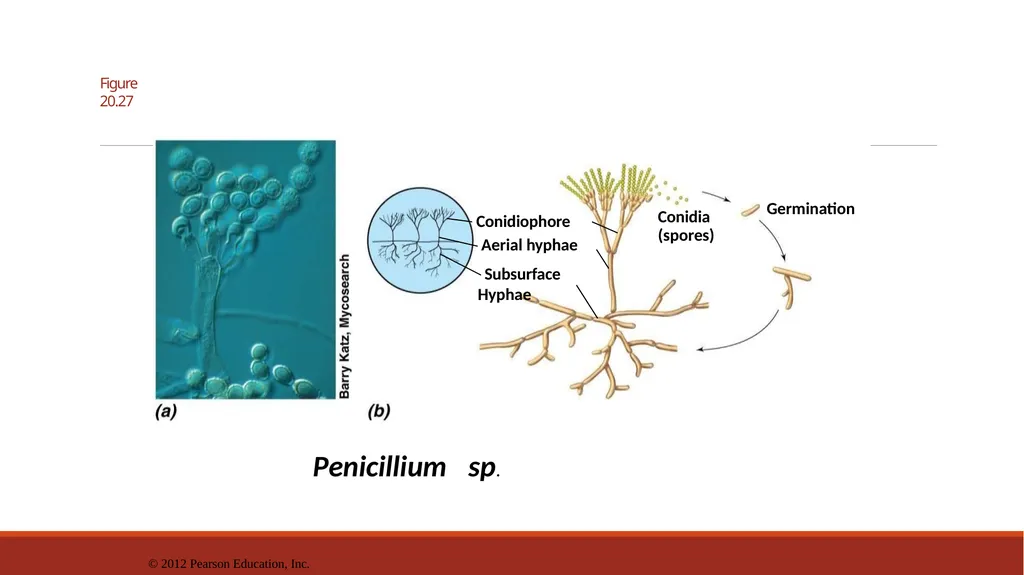
Hyphae that extend above the surface can produce asexual
spores called conidia.
Conidia are often pigmented and resistant to drying
Hyphae form compact tufts called mycelia.
Most fungal cell walls are made of chitin © 2012 Pearson Education, Inc.<br>
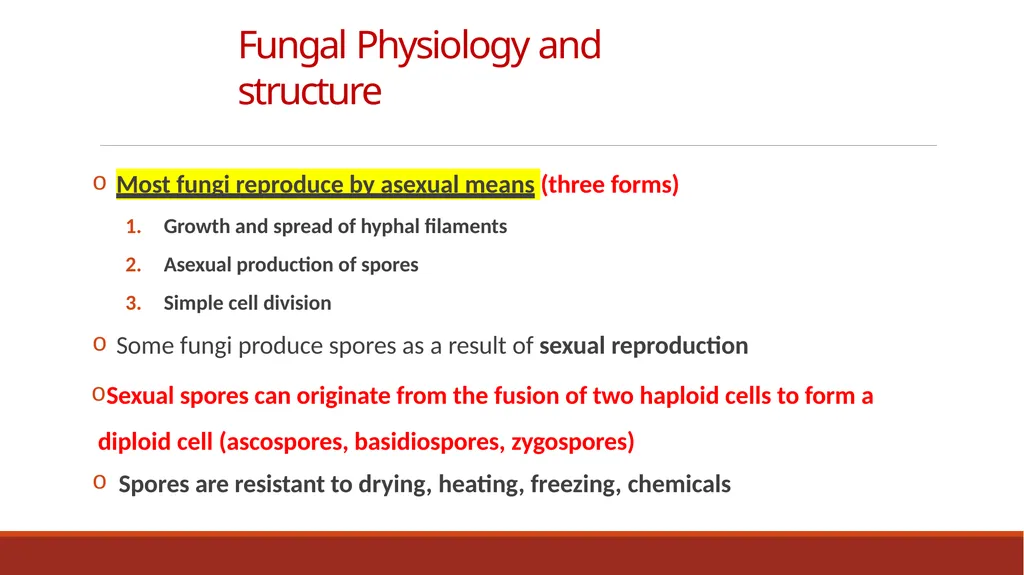
slide5. Fungal Physiology and structure Most fungi reproduce by asexual means (three forms)
Growth and spread of hyphal filaments
Asexual production of spores
Simple cell division
Some fungi produce spores as a result of sexual reproduction
Sexual spores can originate from the fusion of two haploid cells to form a diploid cell (ascospores, basidiospores, zygospores)
Spores are resistant to drying, heating, freezing, chemicals<br>
slide6. Figure 20.27 Conidia (spores) Germination Conidiophore Aerial hyphae
Subsurface
Hyphae Penicillium sp. © 2012 Pearson Education, Inc.<br>
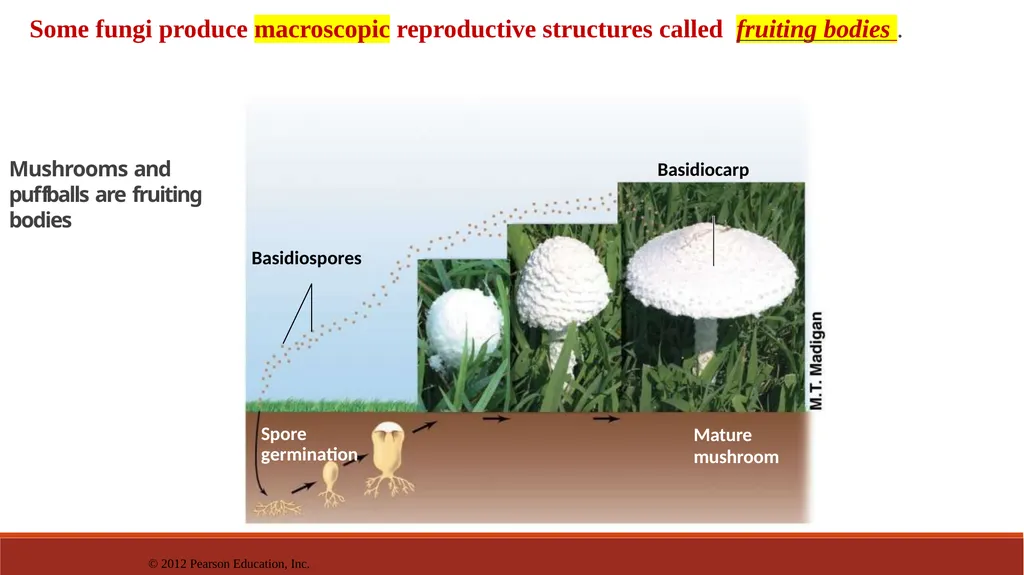
slide7. Some fungi produce macroscopic reproductive structures called fruiting bodies . Mushrooms and puffballs are fruiting bodies Basidiospores Basidiocarp Spore germination Mature
mushroom © 2012 Pearson Education, Inc.<br>
slide8. Yeast are non filamentous, unicellular fungi
that are typically spherical or oval.
One yeast cell can reproduce by budding. © 2012 Pearson Education, Inc.<br>
slide9. Algae<br>
slide10. Algae Algae are mostly aquatic , some are found in soil or trees .
Algae are eukaryotic photoautotrophs that lack tissues (roots, stem and leaves) of plants.
The identification of unicellular and filamentous algae requires microscopic examination .
Algae are an important part of any aquatic food chain because they fix carbon dioxide CO2 into organic molecules that can be consumed by chemohetrotrophs, and O2 is a by-prodcut of their photosynthesis.<br>

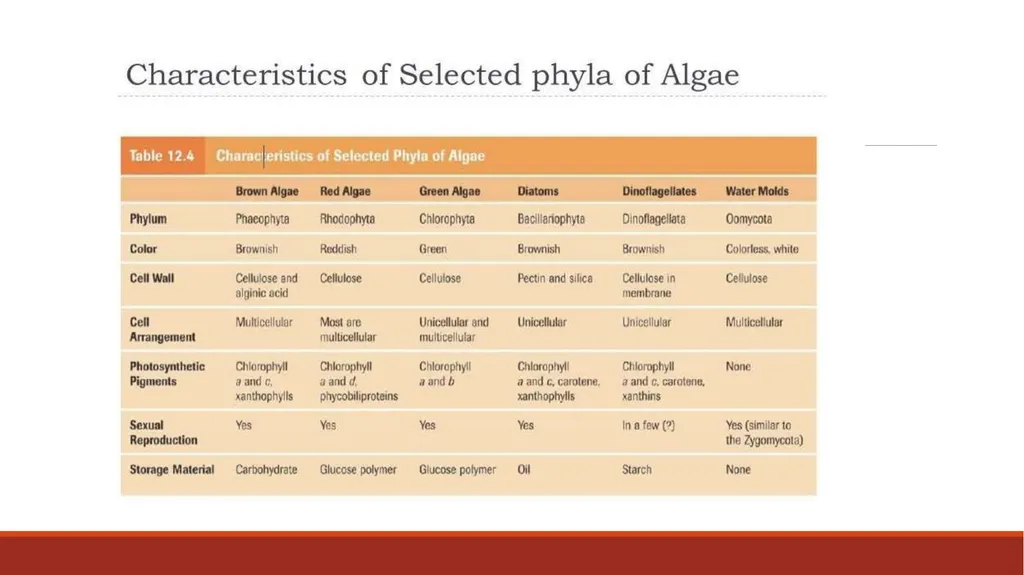
slide12. Red and Green Algae Red Algae
Green Algae © 2012 Pearson Education, Inc.<br>
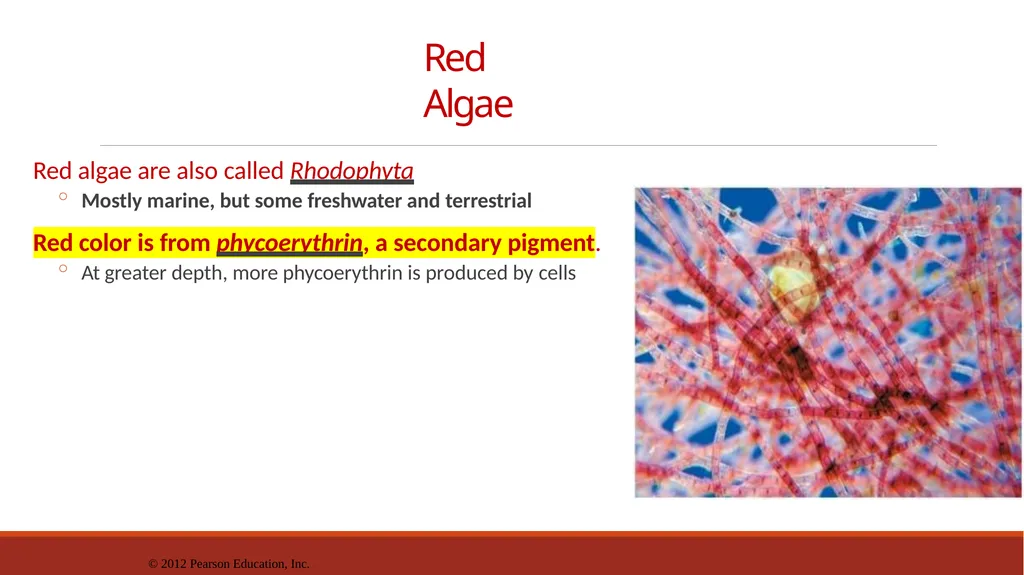
slide13. Red Algae Red algae are also called Rhodophyta
Mostly marine, but some freshwater and terrestrial
Red color is from phycoerythrin, a secondary pigment.
At greater depth, more phycoerythrin is produced by cells © 2012 Pearson Education, Inc.<br>
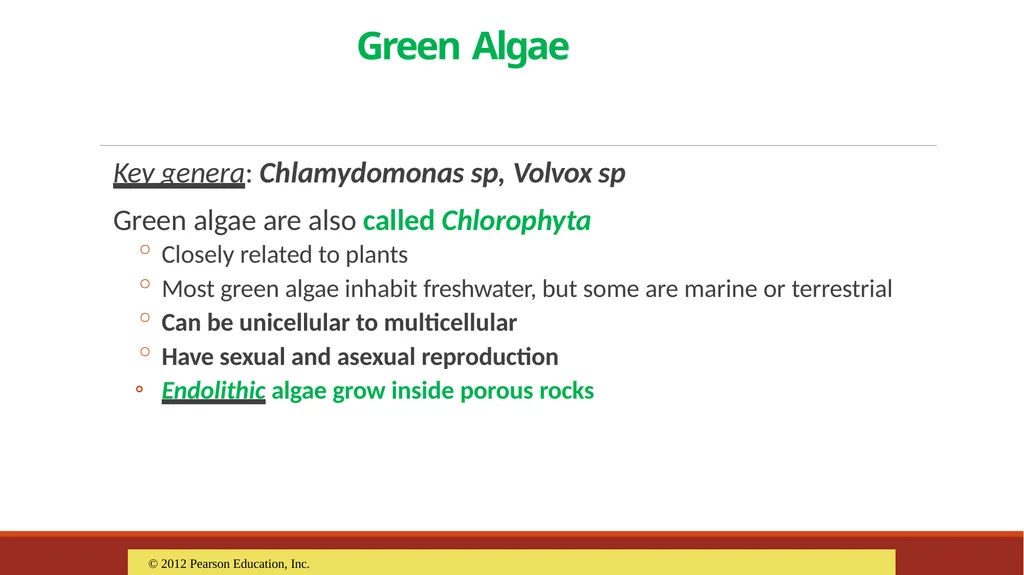
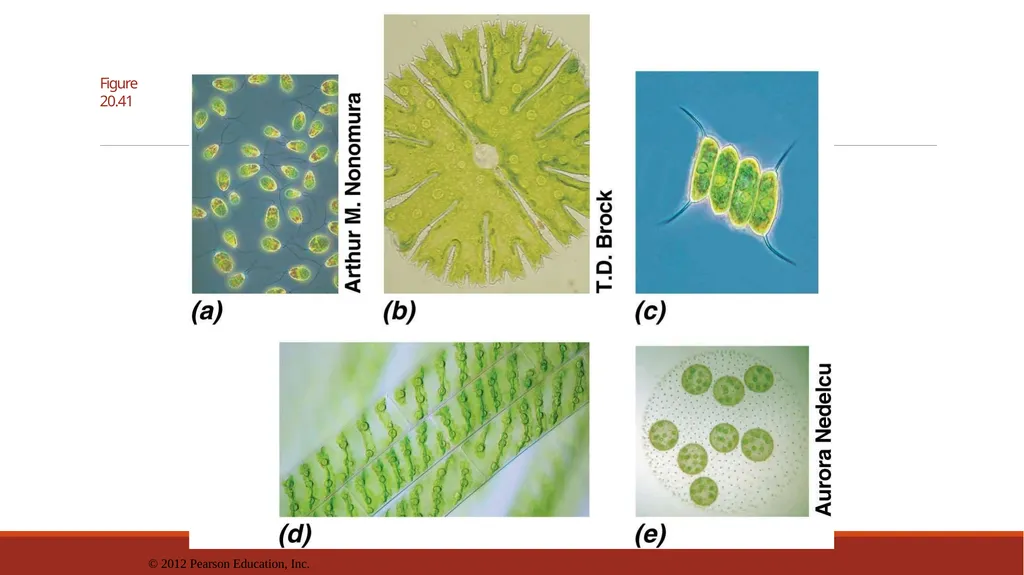
slide14. Green Algae Key genera: Chlamydomonas sp, Volvox sp
Green algae are also called Chlorophyta
Closely related to plants
Most green algae inhabit freshwater, but some are marine or terrestrial
Can be unicellular to multicellular
Have sexual and asexual reproduction
Endolithic algae grow inside porous rocks © 2012 Pearson Education, Inc.<br>
slide15. Figure 20.41 © 2012 Pearson Education, Inc.<br>
Microbial diversity and groups Fungi and Algae<br>
slide2. Fungi Fungi are important microorganisms in food chain , they decompose dead plant and animal matter,
recycling vital elements. They use extracellular enzymes.
Nearly all plants depend on symbiotic fungi known as mycorrhizae , which help their roots absorb minerals and water from soil .
Fungi can cause serious fungal infections (human, animal and plants) .
Fungi are used by humans for food (mushrooms) ,to produce foods(bread and citric acid)and drugs (penicillin).
Study of fungi is called Mycology .<br>
slide3. Fungal Physiology and structure Most fungi are multicellular and some of them unicellular (yeast)
Fungal colonies are described as vegetative structures because they are composed of the cells involved in catabolism and growth.
The thallus (body) of fungus consists of long filaments of cells joined together and forming a network and called Hyphae .
In most molds , the hyphae contain cross-walls called septate hyphae which divide them into distinct
uninucleate cell- like unit.
In few classes of fungi, the hyphae contain no septa and appear as long continuous cells with many nuclei and called coenocytic hyphae.<br>
slide4. Fungal Physiology and structure oHyphae grow by elongation at the tips. And each part capable to growth.
Hyphae that extend above the surface can produce asexual
spores called conidia.
Conidia are often pigmented and resistant to drying
Hyphae form compact tufts called mycelia.
Most fungal cell walls are made of chitin © 2012 Pearson Education, Inc.<br>
slide5. Fungal Physiology and structure Most fungi reproduce by asexual means (three forms)
Growth and spread of hyphal filaments
Asexual production of spores
Simple cell division
Some fungi produce spores as a result of sexual reproduction
Sexual spores can originate from the fusion of two haploid cells to form a diploid cell (ascospores, basidiospores, zygospores)
Spores are resistant to drying, heating, freezing, chemicals<br>
slide6. Figure 20.27 Conidia (spores) Germination Conidiophore Aerial hyphae
Subsurface
Hyphae Penicillium sp. © 2012 Pearson Education, Inc.<br>
slide7. Some fungi produce macroscopic reproductive structures called fruiting bodies . Mushrooms and puffballs are fruiting bodies Basidiospores Basidiocarp Spore germination Mature
mushroom © 2012 Pearson Education, Inc.<br>
slide8. Yeast are non filamentous, unicellular fungi
that are typically spherical or oval.
One yeast cell can reproduce by budding. © 2012 Pearson Education, Inc.<br>
slide9. Algae<br>
slide10. Algae Algae are mostly aquatic , some are found in soil or trees .
Algae are eukaryotic photoautotrophs that lack tissues (roots, stem and leaves) of plants.
The identification of unicellular and filamentous algae requires microscopic examination .
Algae are an important part of any aquatic food chain because they fix carbon dioxide CO2 into organic molecules that can be consumed by chemohetrotrophs, and O2 is a by-prodcut of their photosynthesis.<br>
slide12. Red and Green Algae Red Algae
Green Algae © 2012 Pearson Education, Inc.<br>
slide13. Red Algae Red algae are also called Rhodophyta
Mostly marine, but some freshwater and terrestrial
Red color is from phycoerythrin, a secondary pigment.
At greater depth, more phycoerythrin is produced by cells © 2012 Pearson Education, Inc.<br>
slide14. Green Algae Key genera: Chlamydomonas sp, Volvox sp
Green algae are also called Chlorophyta
Closely related to plants
Most green algae inhabit freshwater, but some are marine or terrestrial
Can be unicellular to multicellular
Have sexual and asexual reproduction
Endolithic algae grow inside porous rocks © 2012 Pearson Education, Inc.<br>
slide15. Figure 20.41 © 2012 Pearson Education, Inc.<br>