
Lecture 16 Regulatory variation and eQTLs Chris
SB
Published · 59 slides · 0 views

1 / 1
Description
Lecture 16 Regulatory variation and eQTLs Chris Cotsapas cotsapasbroadinstitute.org 6.0476.878HST.507 Computational Biology: Genomes, Networks, Evolution Module 4: Population Evolution Phylogeny L1516: Association mapping for
Related Topics
Share
Embed code
Download this presentation From Below
"Lecture 16 Regulatory variation and eQTLs Chris" is the property of its rightful owner. Permission is granted to download and print the materials on this website for personal, non-commercial use only, and to display it on your personal computer provided you do not modify the materials and that you retain all copyright notices contained in the materials. By downloading content from our website, you accept the terms of this agreement.
Presentation Transcript
01
Lecture 16
Regulatory variation and eQTLs Chris Cotsapas
cotsapas@broadinstitute.org 6.047/6.878/HST.507 Computational Biology: Genomes, Networks, Evolution<br>
cotsapas@broadinstitute.org 6.047/6.878/HST.507 Computational Biology: Genomes, Networks, Evolution<br>
02
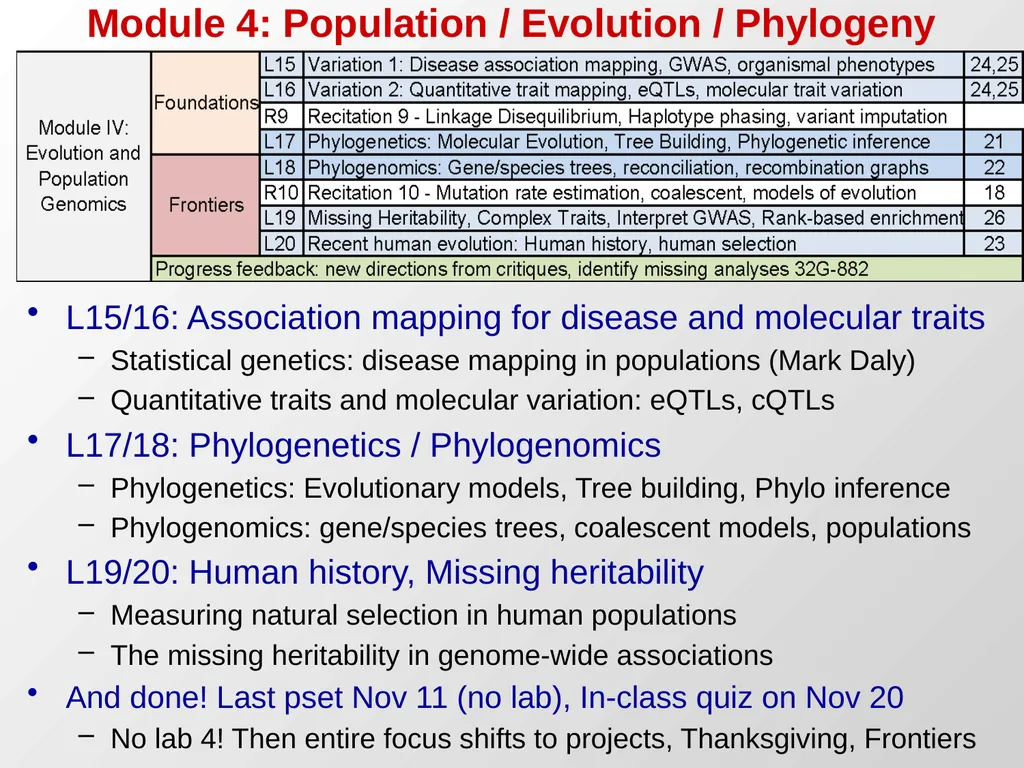
Module 4: Population / Evolution / Phylogeny L15/16: Association mapping for disease and molecular traits
Statistical genetics: disease mapping in populations (Mark Daly)
Quantitative traits and molecular variation: eQTLs, cQTLs
L17/18: Phylogenetics / Phylogenomics
Phylogenetics: Evolutionary models, Tree building, Phylo inference
Phylogenomics: gene/species trees, coalescent models, populations
L19/20: Human history, Missing heritability
Measuring natural selection in human populations
The missing heritability in genome-wide associations
And done! Last pset Nov 11 (no lab), In-class quiz on Nov 20
No lab 4! Then entire focus shifts to projects, Thanksgiving, Frontiers<br>
Statistical genetics: disease mapping in populations (Mark Daly)
Quantitative traits and molecular variation: eQTLs, cQTLs
L17/18: Phylogenetics / Phylogenomics
Phylogenetics: Evolutionary models, Tree building, Phylo inference
Phylogenomics: gene/species trees, coalescent models, populations
L19/20: Human history, Missing heritability
Measuring natural selection in human populations
The missing heritability in genome-wide associations
And done! Last pset Nov 11 (no lab), In-class quiz on Nov 20
No lab 4! Then entire focus shifts to projects, Thanksgiving, Frontiers<br>
03
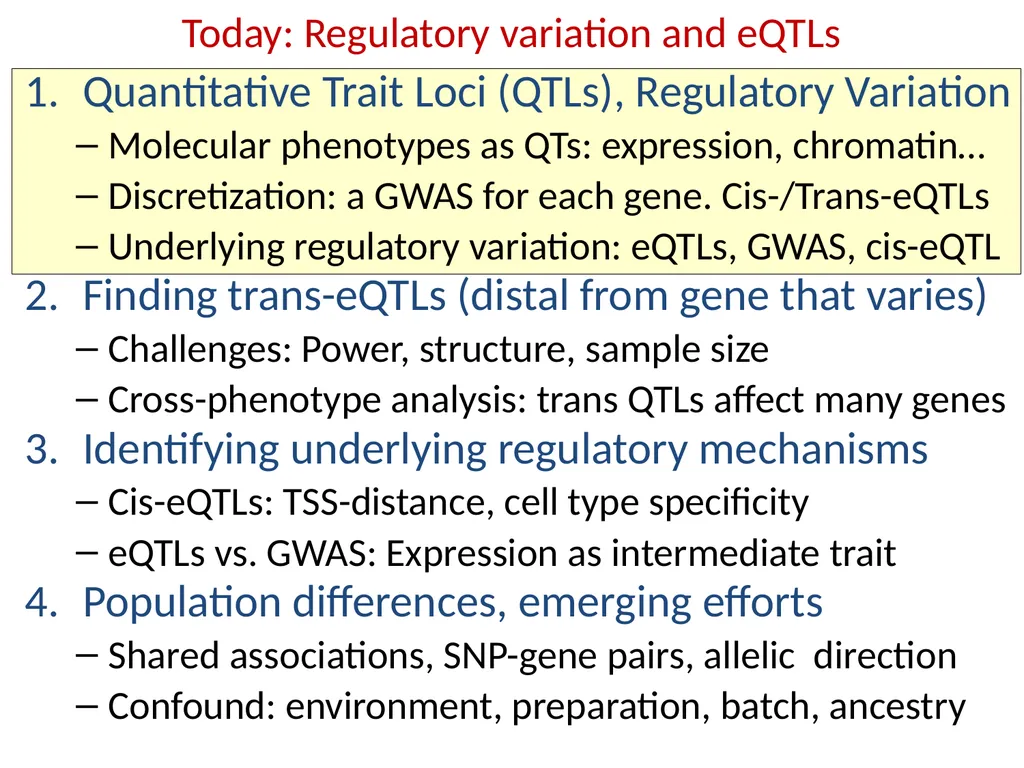
Today: Regulatory variation and eQTLs Quantitative Trait Loci (QTLs), Regulatory Variation
Molecular phenotypes as QTs: expression, chromatin…
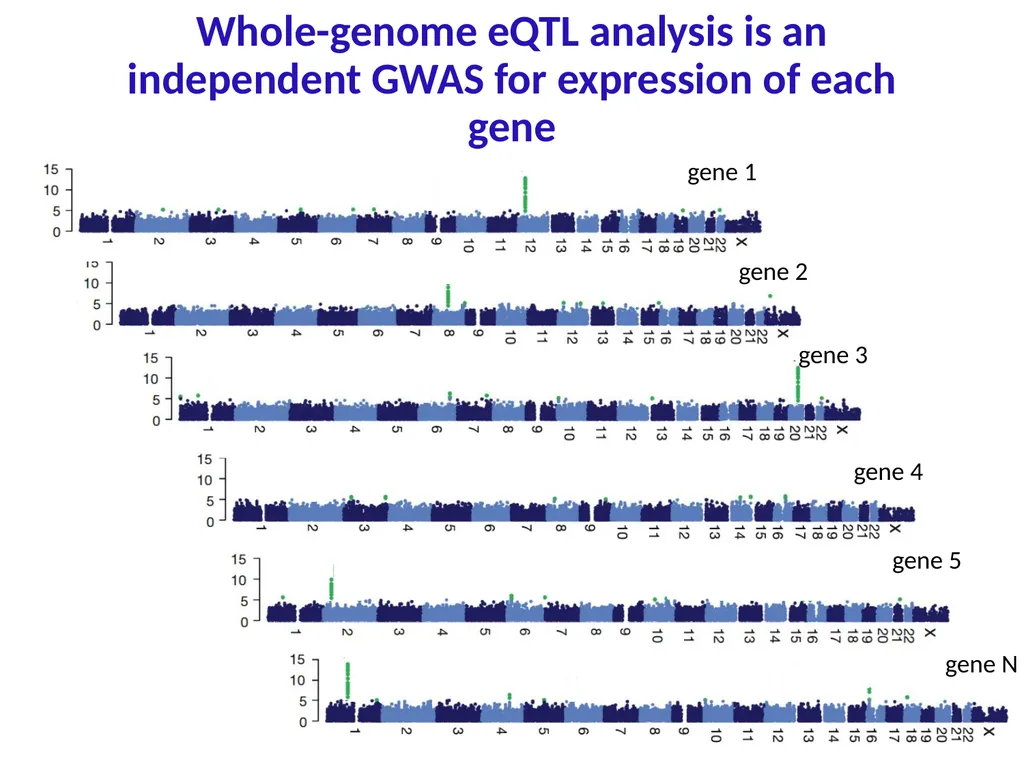
Discretization: a GWAS for each gene. Cis-/Trans-eQTLs
Underlying regulatory variation: eQTLs, GWAS, cis-eQTL
Finding trans-eQTLs (distal from gene that varies)
Challenges: Power, structure, sample size
Cross-phenotype analysis: trans QTLs affect many genes
Identifying underlying regulatory mechanisms
Cis-eQTLs: TSS-distance, cell type specificity
eQTLs vs. GWAS: Expression as intermediate trait
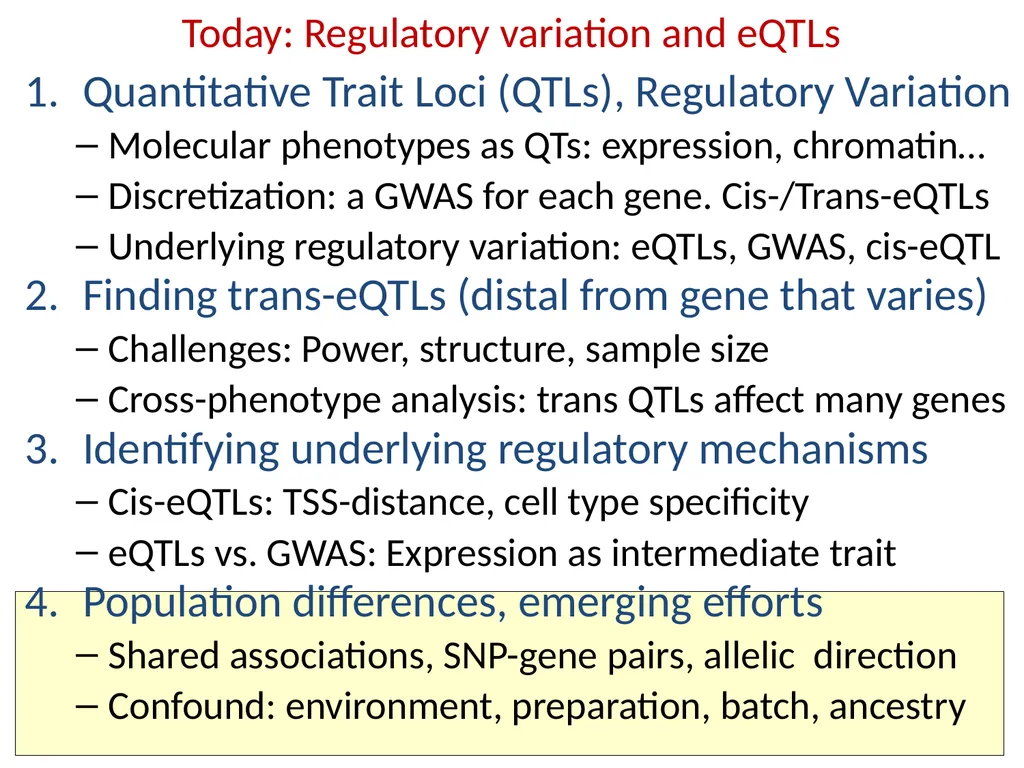
Population differences, emerging efforts
Shared associations, SNP-gene pairs, allelic direction
Confound: environment, preparation, batch, ancestry<br>
Molecular phenotypes as QTs: expression, chromatin…
Discretization: a GWAS for each gene. Cis-/Trans-eQTLs
Underlying regulatory variation: eQTLs, GWAS, cis-eQTL
Finding trans-eQTLs (distal from gene that varies)
Challenges: Power, structure, sample size
Cross-phenotype analysis: trans QTLs affect many genes
Identifying underlying regulatory mechanisms
Cis-eQTLs: TSS-distance, cell type specificity
eQTLs vs. GWAS: Expression as intermediate trait
Population differences, emerging efforts
Shared associations, SNP-gene pairs, allelic direction
Confound: environment, preparation, batch, ancestry<br>
04
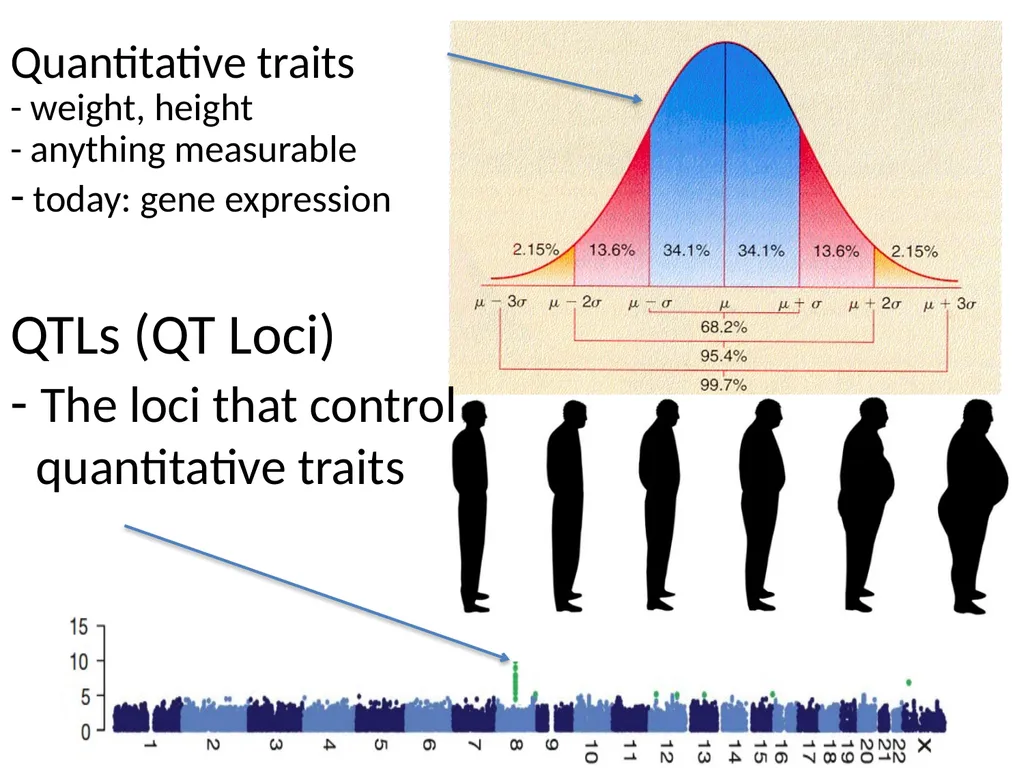
Quantitative traits
- weight, height
- anything measurable
- today: gene expression QTLs (QT Loci)
- The loci that control quantitative traits<br>
- The loci that control quantitative traits<br>
05
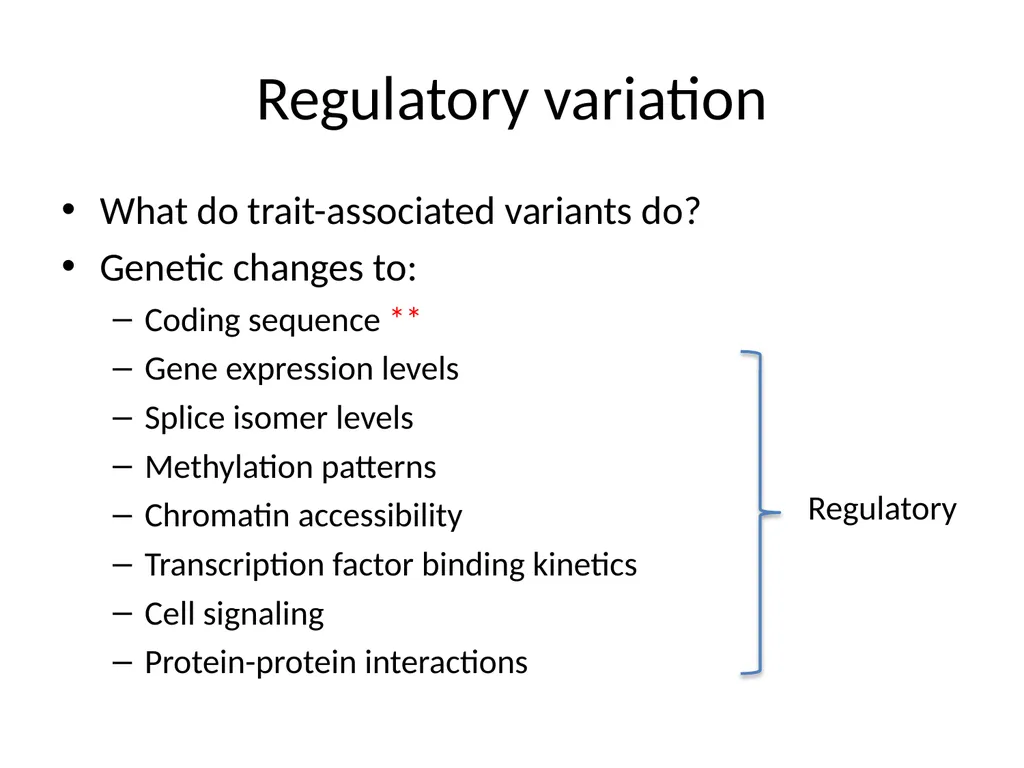
Regulatory variation What do trait-associated variants do?
Genetic changes to:
Coding sequence **
Gene expression levels
Splice isomer levels
Methylation patterns
Chromatin accessibility
Transcription factor binding kinetics
Cell signaling
Protein-protein interactions Regulatory<br>
Genetic changes to:
Coding sequence **
Gene expression levels
Splice isomer levels
Methylation patterns
Chromatin accessibility
Transcription factor binding kinetics
Cell signaling
Protein-protein interactions Regulatory<br>
06
Basic Concepts History, eQTL, mQTL, others<br>
07
Within a population Damerval et al 1994
42/72 protein levels differ in maize
2D electrophoresis, eyeball spot quantitation
Problems:
genome coverage
quantitation
post-translational modifications
Solution: use expression levels instead!<br>
42/72 protein levels differ in maize
2D electrophoresis, eyeball spot quantitation
Problems:
genome coverage
quantitation
post-translational modifications
Solution: use expression levels instead!<br>
08
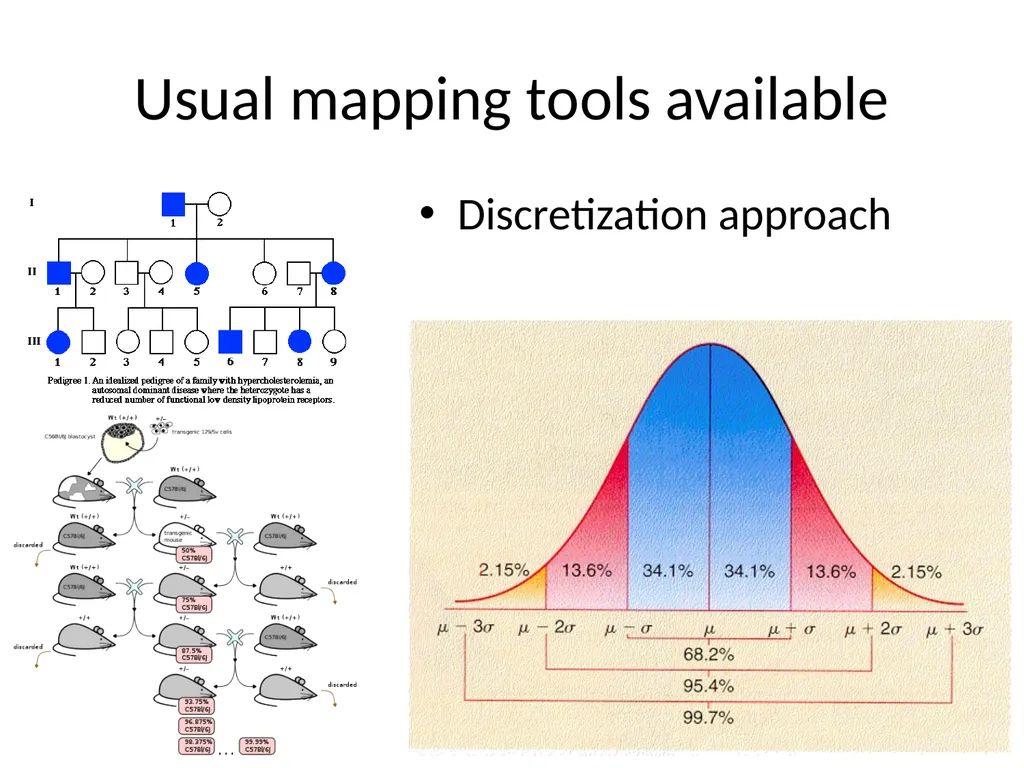
Usual mapping tools available Discretization approach<br>
09
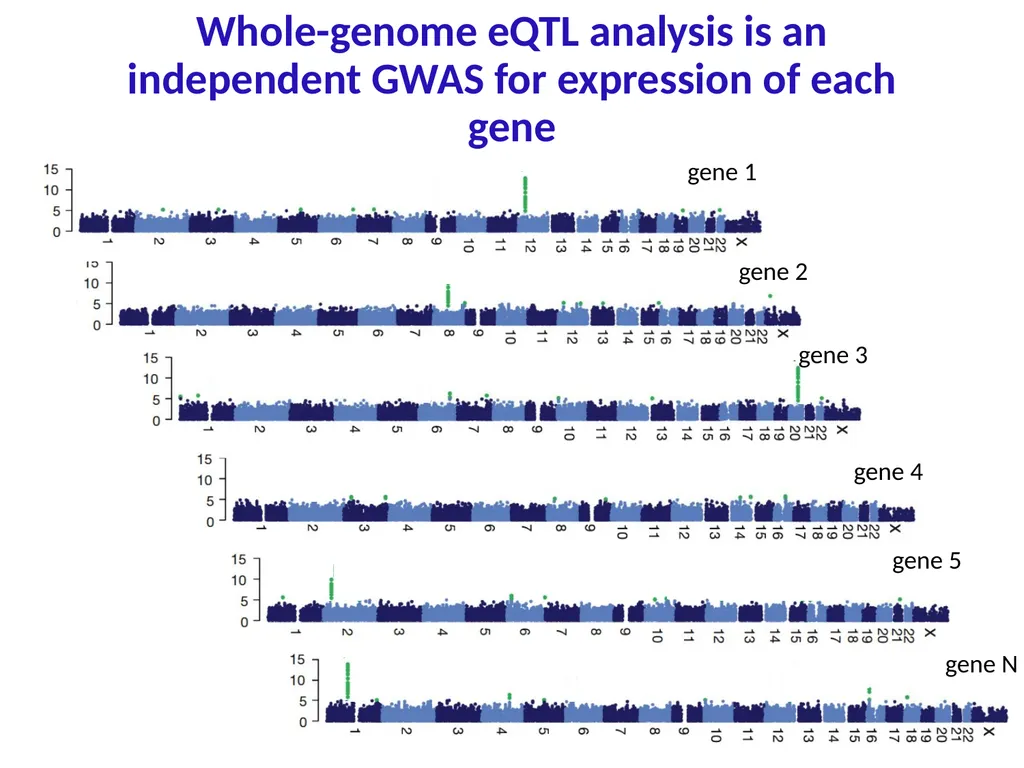
Whole-genome eQTL analysis is an independent GWAS for expression of each gene<br>
10
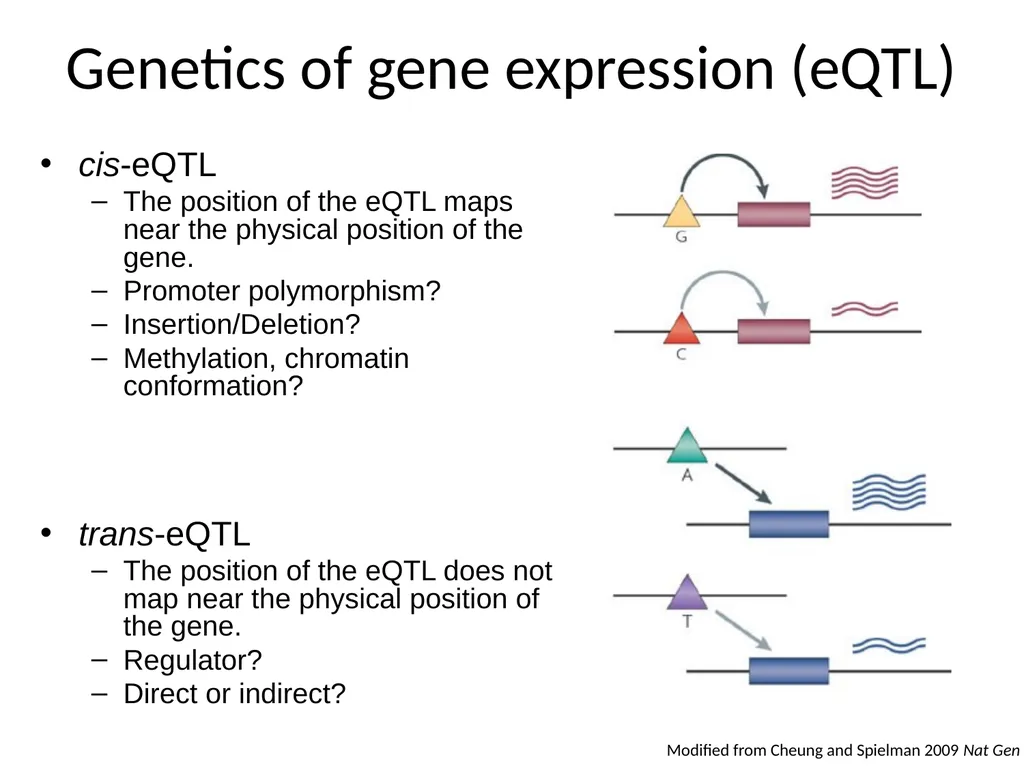
cis-eQTL
The position of the eQTL maps near the physical position of the gene.
Promoter polymorphism?
Insertion/Deletion?
Methylation, chromatin conformation?
trans-eQTL
The position of the eQTL does not map near the physical position of the gene.
Regulator?
Direct or indirect? Modified from Cheung and Spielman 2009 Nat Gen Genetics of gene expression (eQTL)<br>
The position of the eQTL maps near the physical position of the gene.
Promoter polymorphism?
Insertion/Deletion?
Methylation, chromatin conformation?
trans-eQTL
The position of the eQTL does not map near the physical position of the gene.
Regulator?
Direct or indirect? Modified from Cheung and Spielman 2009 Nat Gen Genetics of gene expression (eQTL)<br>
11
eqtl – the array era yeast, mouse, maize, human<br>
12
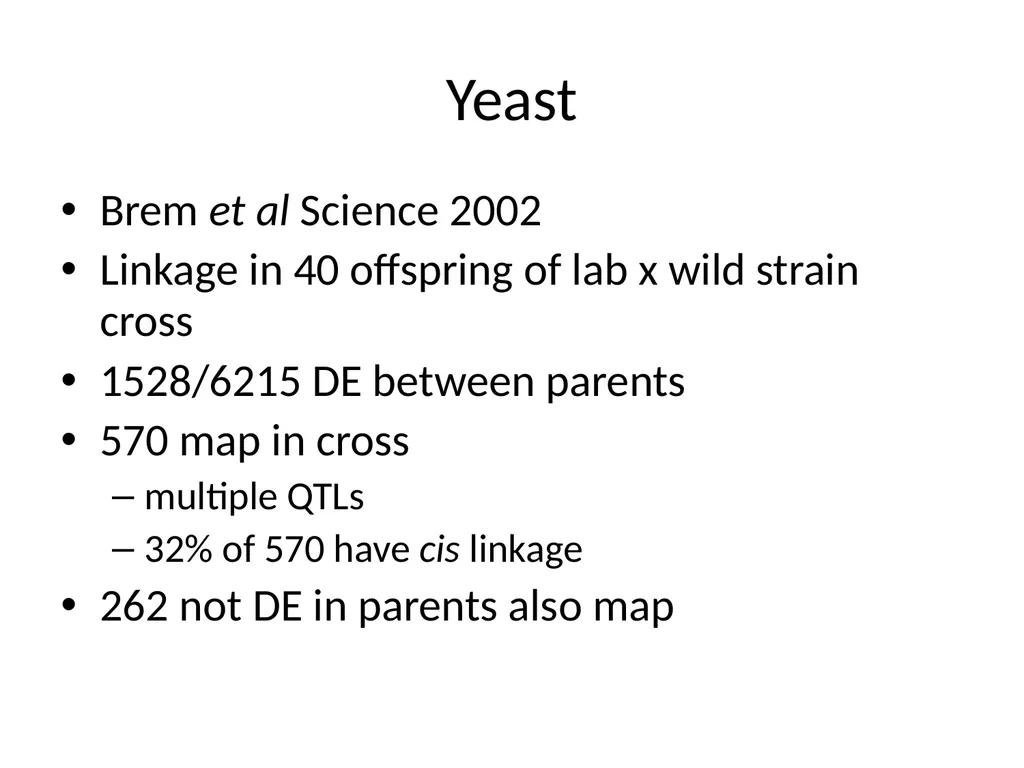
Yeast Brem et al Science 2002
Linkage in 40 offspring of lab x wild strain cross
1528/6215 DE between parents
570 map in cross
multiple QTLs
32% of 570 have cis linkage
262 not DE in parents also map<br>
Linkage in 40 offspring of lab x wild strain cross
1528/6215 DE between parents
570 map in cross
multiple QTLs
32% of 570 have cis linkage
262 not DE in parents also map<br>
13
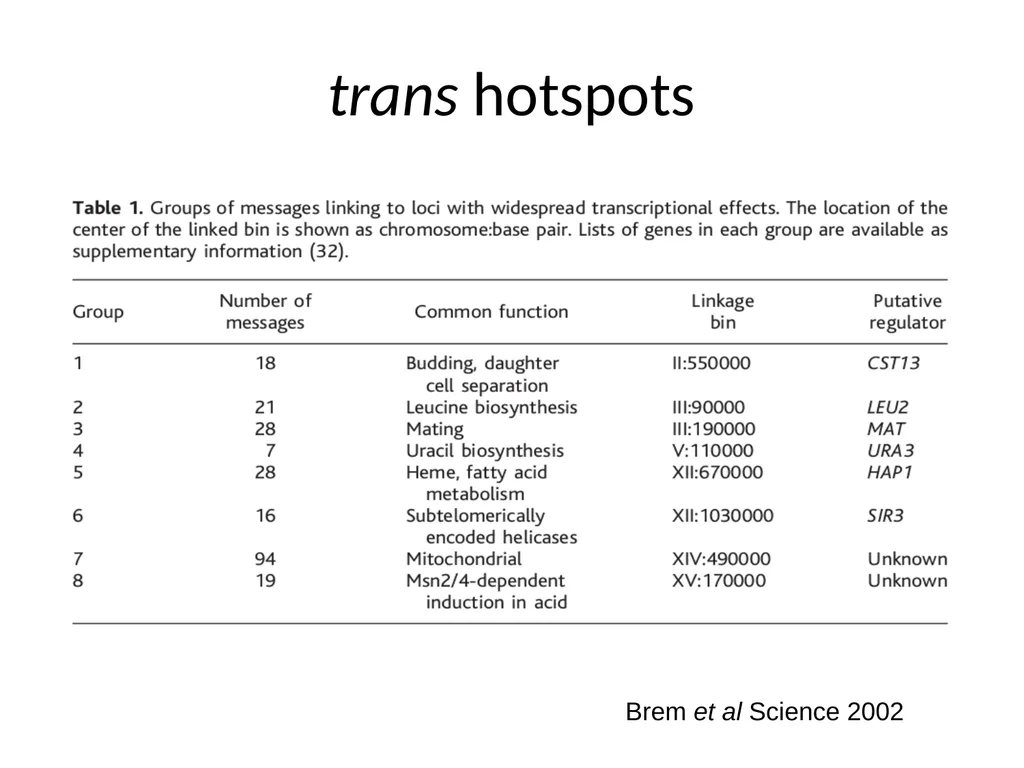
trans hotspots Brem et al Science 2002<br>
14
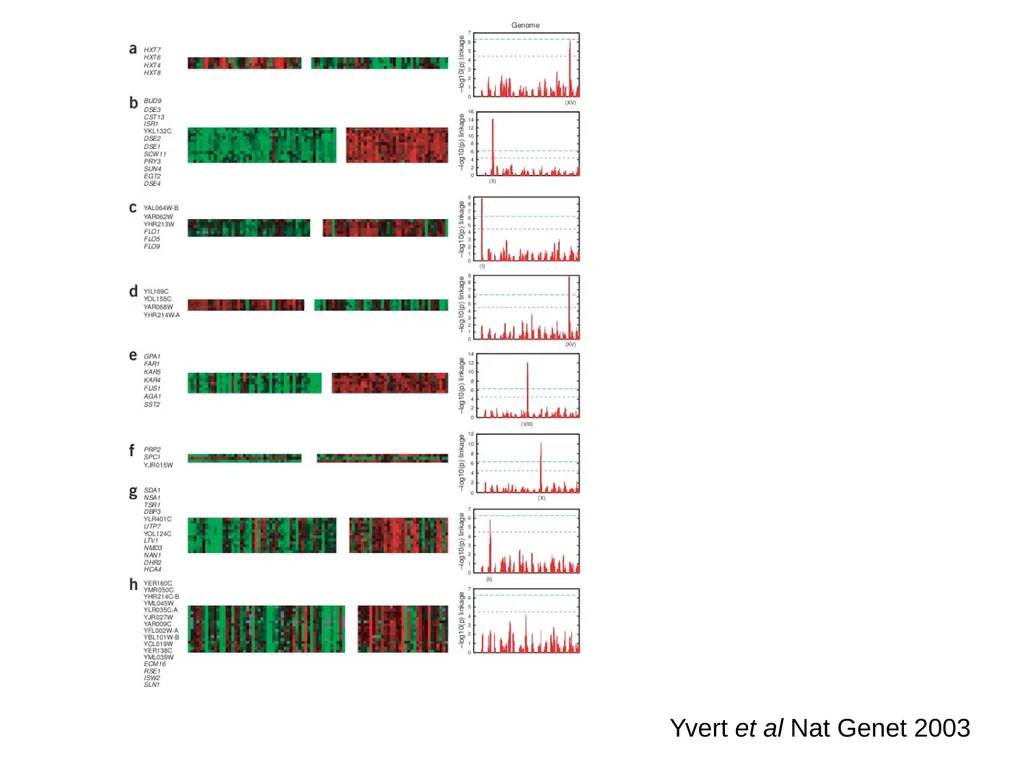
Yvert et al Nat Genet 2003<br>
15
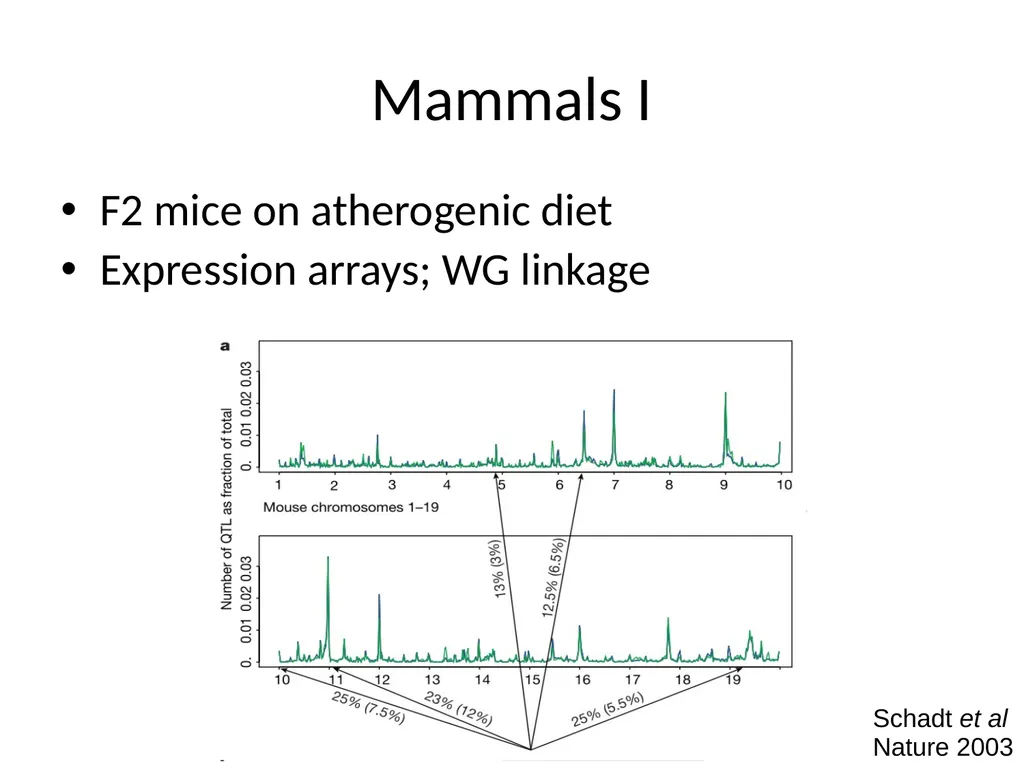
Mammals I F2 mice on atherogenic diet
Expression arrays; WG linkage Schadt et al
Nature 2003<br>
Expression arrays; WG linkage Schadt et al
Nature 2003<br>
16
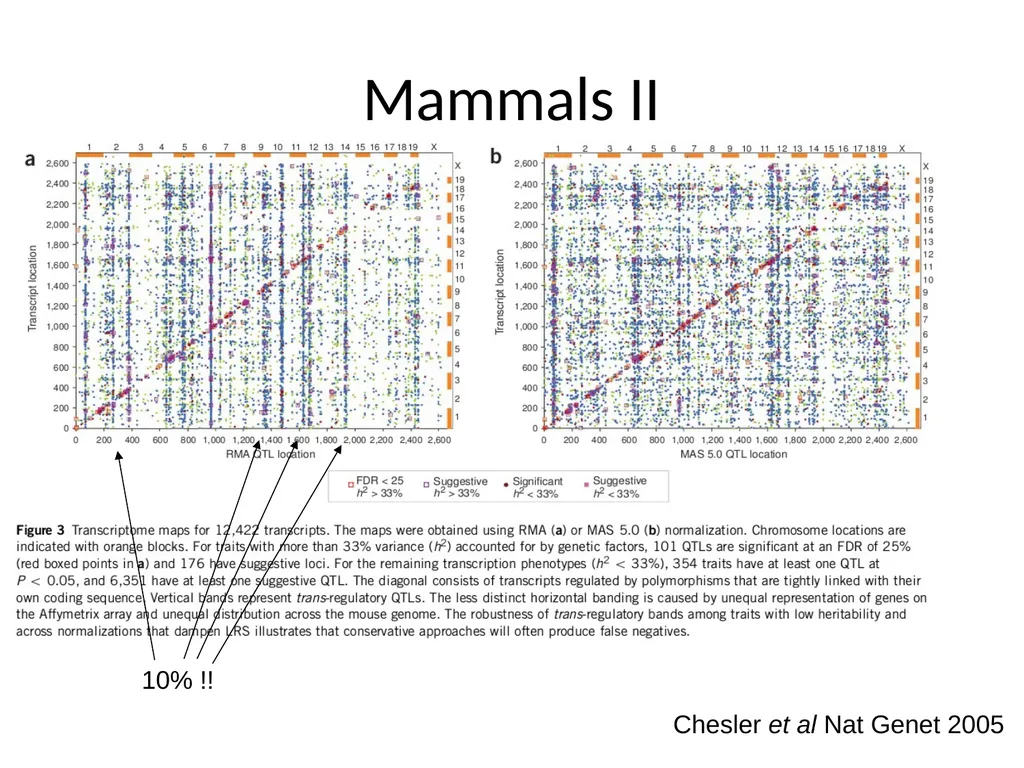
Mammals II Chesler et al Nat Genet 2005 10% !!<br>
17
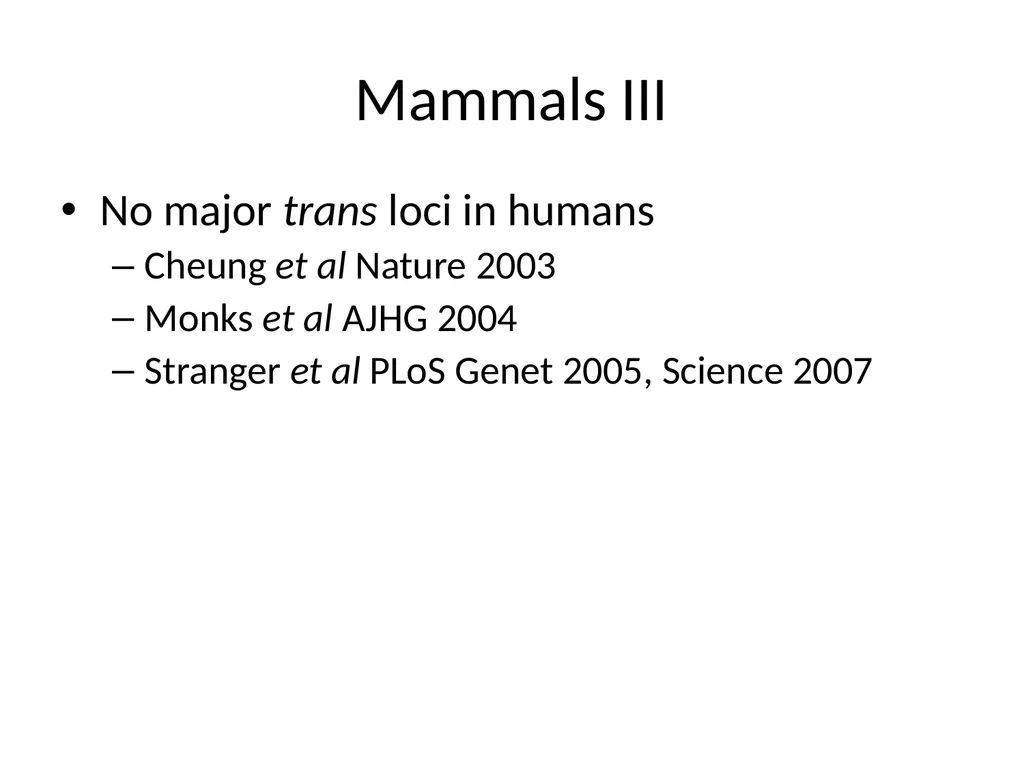
Mammals III No major trans loci in humans
Cheung et al Nature 2003
Monks et al AJHG 2004
Stranger et al PLoS Genet 2005, Science 2007<br>
Cheung et al Nature 2003
Monks et al AJHG 2004
Stranger et al PLoS Genet 2005, Science 2007<br>
18
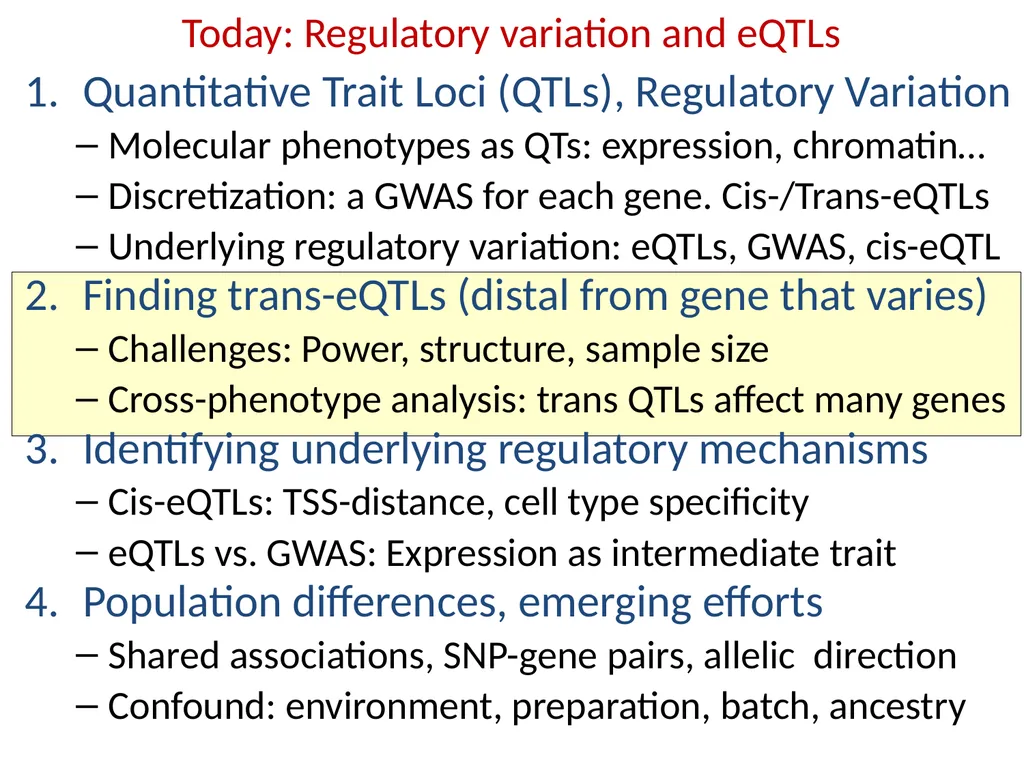
Today: Regulatory variation and eQTLs Quantitative Trait Loci (QTLs), Regulatory Variation
Molecular phenotypes as QTs: expression, chromatin…
Discretization: a GWAS for each gene. Cis-/Trans-eQTLs
Underlying regulatory variation: eQTLs, GWAS, cis-eQTL
Finding trans-eQTLs (distal from gene that varies)
Challenges: Power, structure, sample size
Cross-phenotype analysis: trans QTLs affect many genes
Identifying underlying regulatory mechanisms
Cis-eQTLs: TSS-distance, cell type specificity
eQTLs vs. GWAS: Expression as intermediate trait
Population differences, emerging efforts
Shared associations, SNP-gene pairs, allelic direction
Confound: environment, preparation, batch, ancestry<br>
Molecular phenotypes as QTs: expression, chromatin…
Discretization: a GWAS for each gene. Cis-/Trans-eQTLs
Underlying regulatory variation: eQTLs, GWAS, cis-eQTL
Finding trans-eQTLs (distal from gene that varies)
Challenges: Power, structure, sample size
Cross-phenotype analysis: trans QTLs affect many genes
Identifying underlying regulatory mechanisms
Cis-eQTLs: TSS-distance, cell type specificity
eQTLs vs. GWAS: Expression as intermediate trait
Population differences, emerging efforts
Shared associations, SNP-gene pairs, allelic direction
Confound: environment, preparation, batch, ancestry<br>
19
Where are the trans eQTLS? Open question<br>
20
Whole-genome eQTL analysis is an independent GWAS for expression of each gene<br>
21
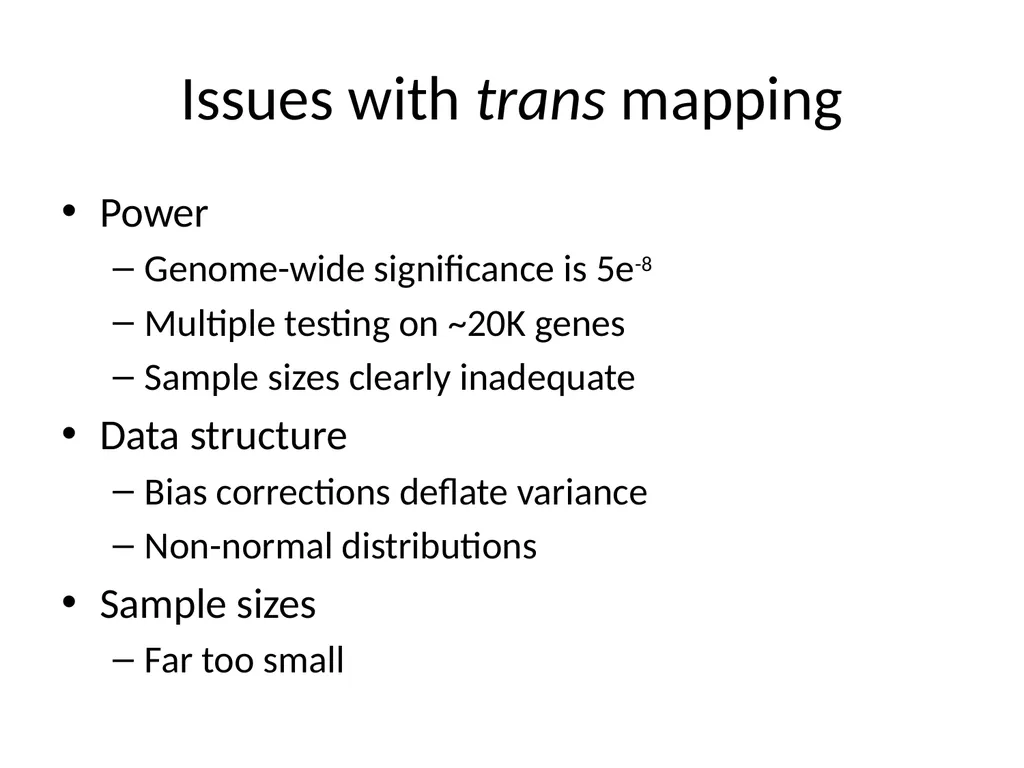
Issues with trans mapping Power
Genome-wide significance is 5e-8
Multiple testing on ~20K genes
Sample sizes clearly inadequate
Data structure
Bias corrections deflate variance
Non-normal distributions
Sample sizes
Far too small<br>
Genome-wide significance is 5e-8
Multiple testing on ~20K genes
Sample sizes clearly inadequate
Data structure
Bias corrections deflate variance
Non-normal distributions
Sample sizes
Far too small<br>
22
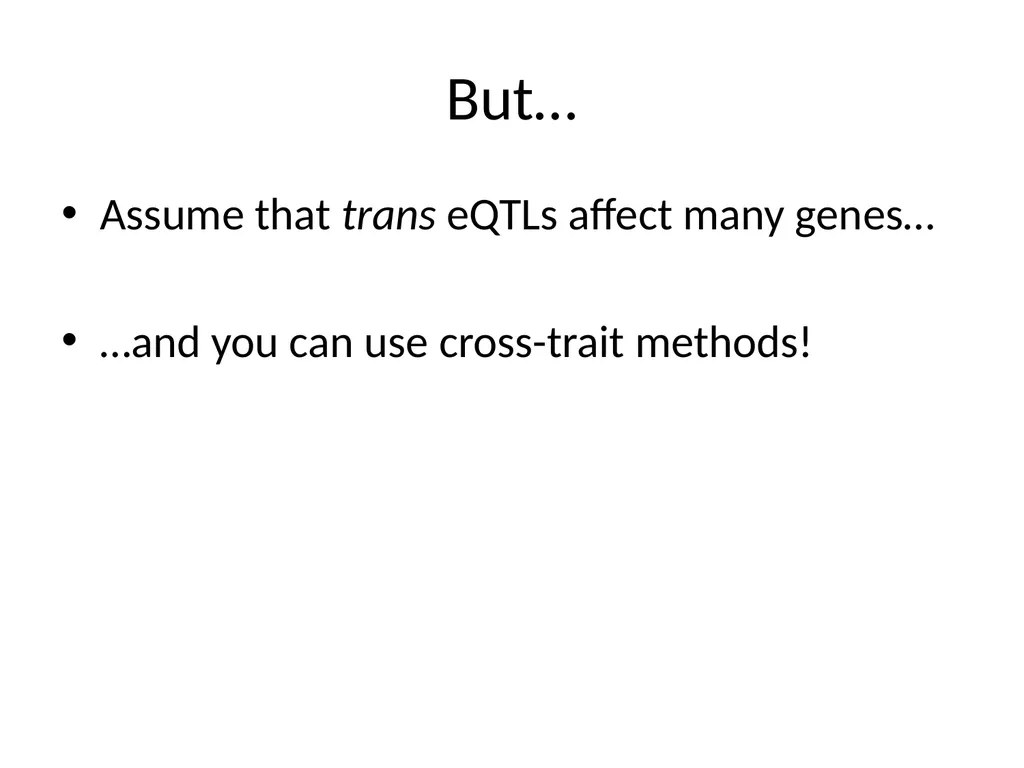
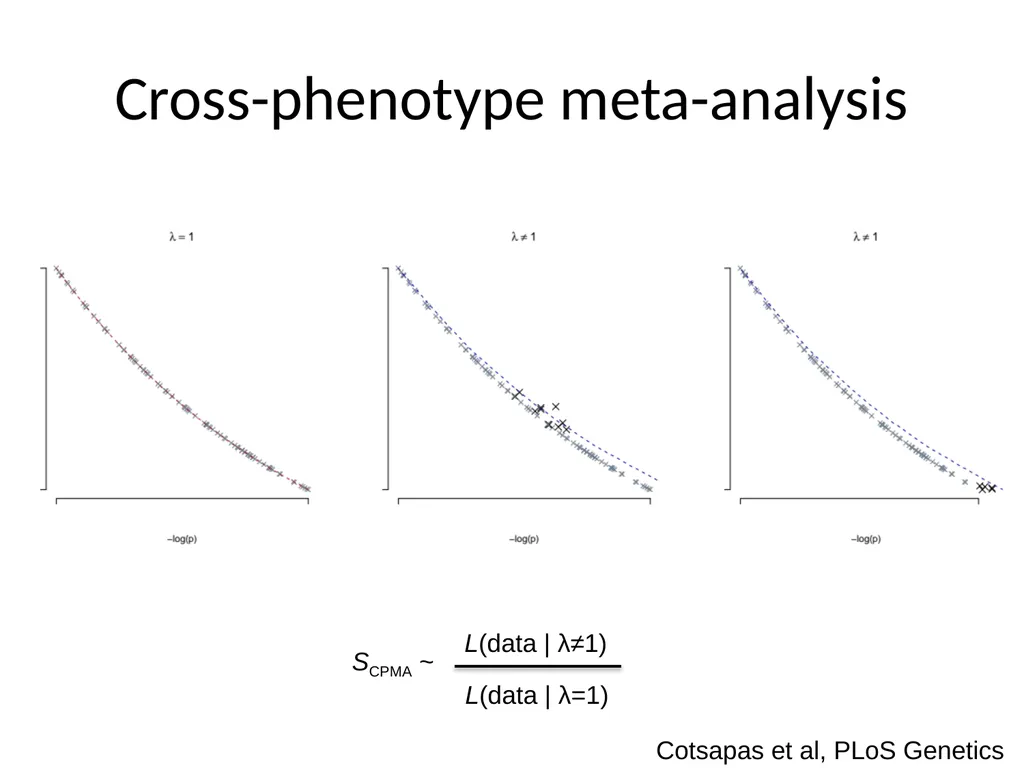
But… Assume that trans eQTLs affect many genes…
…and you can use cross-trait methods!<br>
…and you can use cross-trait methods!<br>
23
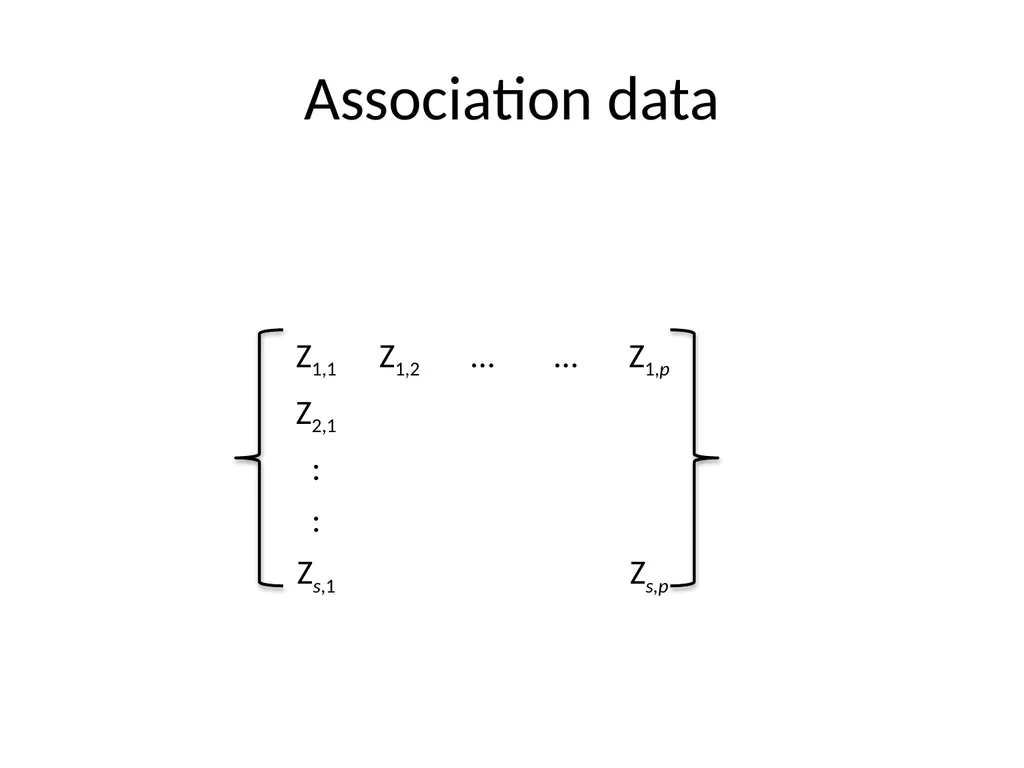
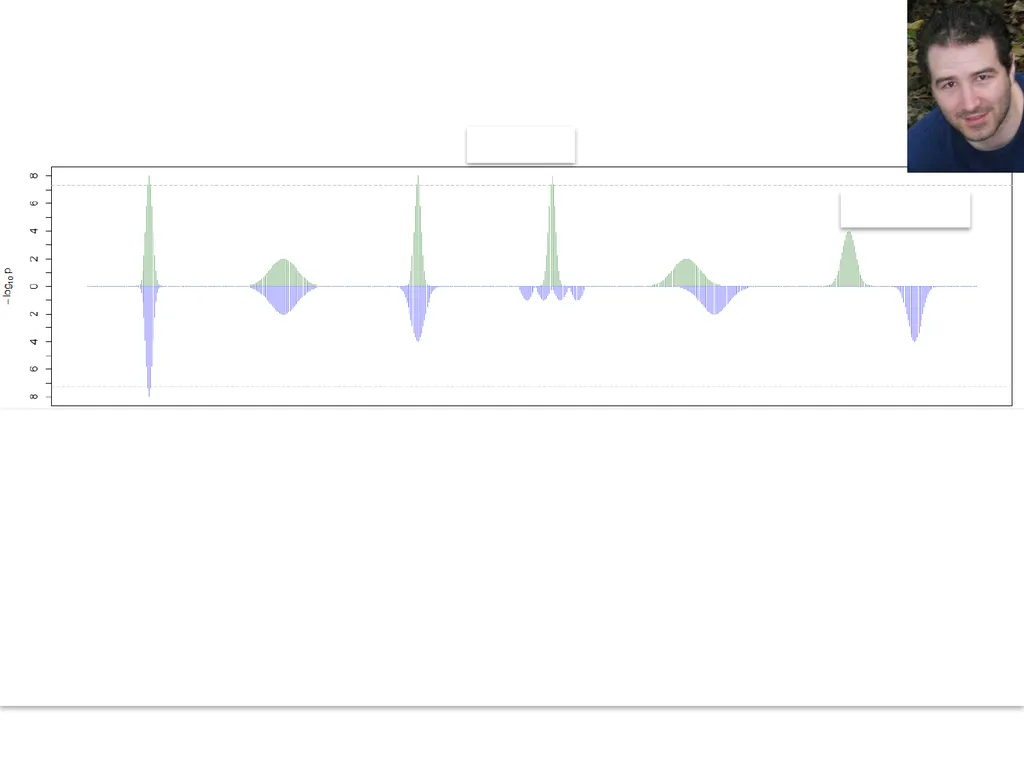
Association data<br>
24
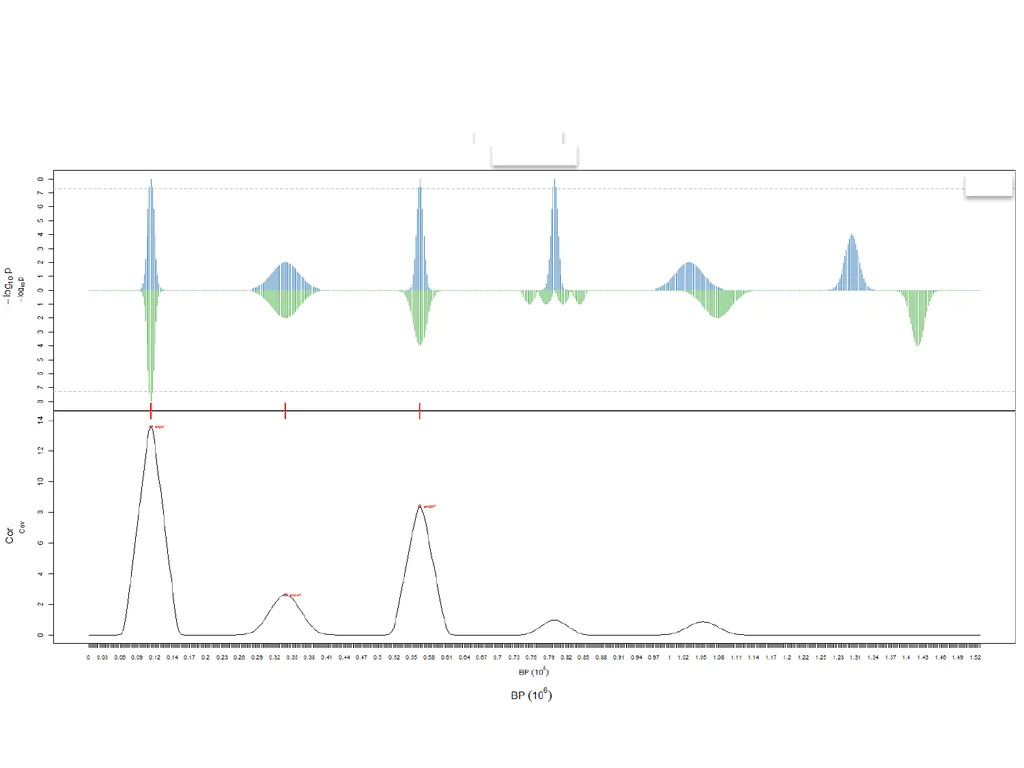
Cross-phenotype meta-analysis Cotsapas et al, PLoS Genetics<br>
25
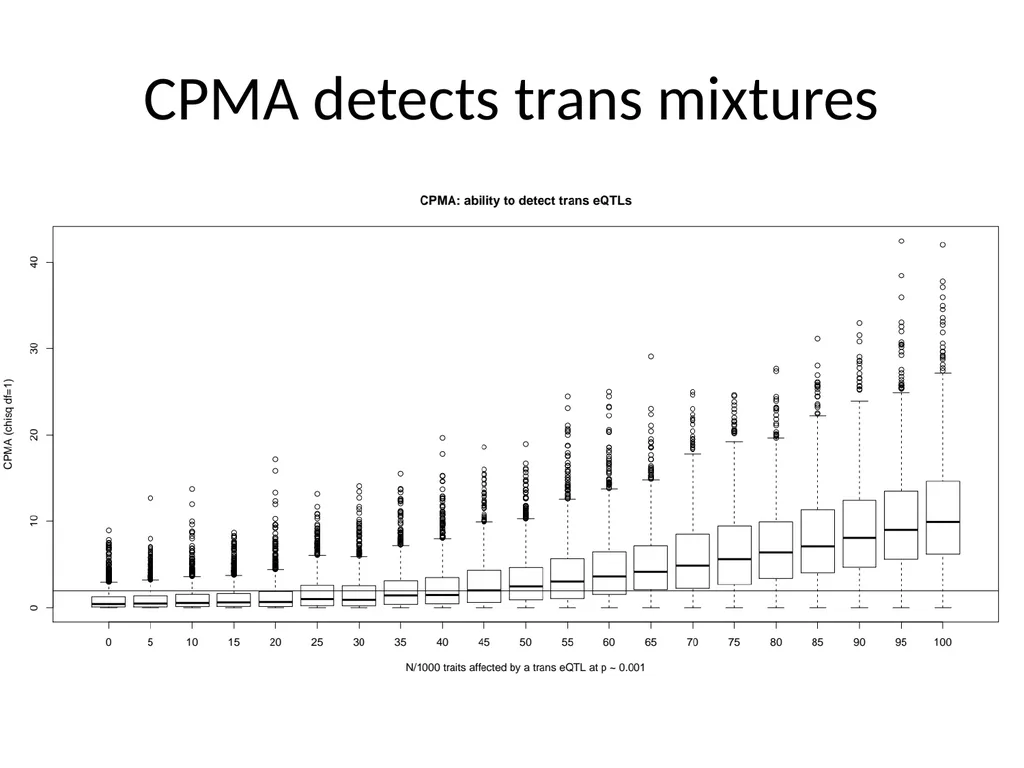
CPMA detects trans mixtures<br>
26
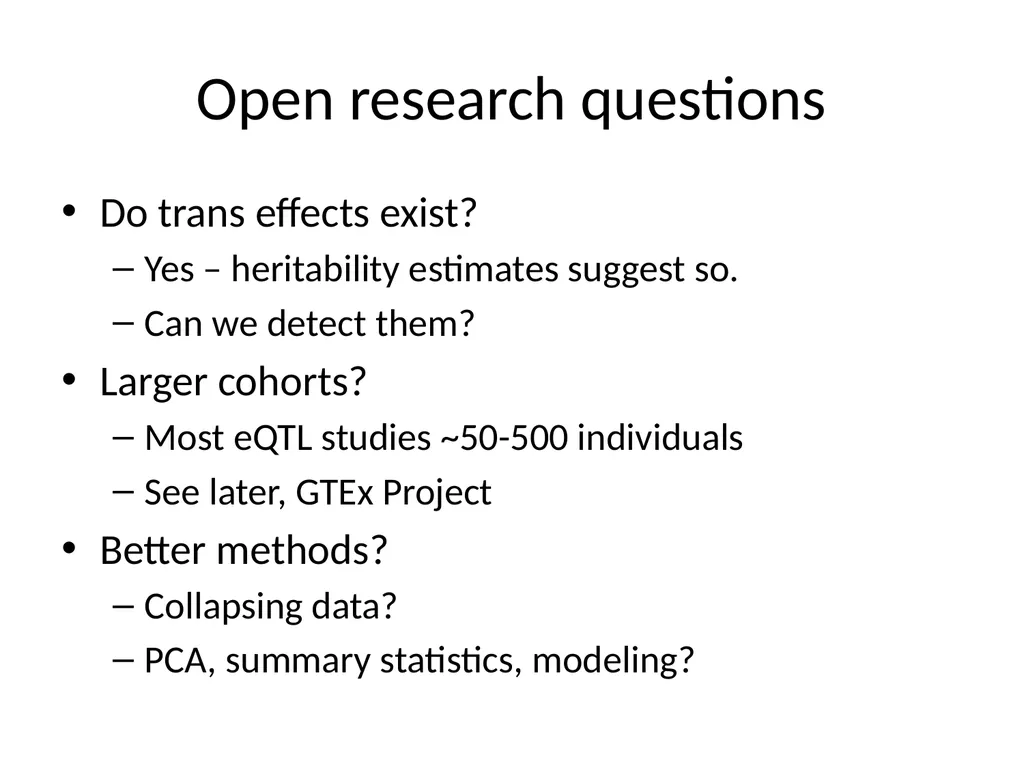
Open research questions Do trans effects exist?
Yes – heritability estimates suggest so.
Can we detect them?
Larger cohorts?
Most eQTL studies ~50-500 individuals
See later, GTEx Project
Better methods?
Collapsing data?
PCA, summary statistics, modeling?<br>
Yes – heritability estimates suggest so.
Can we detect them?
Larger cohorts?
Most eQTL studies ~50-500 individuals
See later, GTEx Project
Better methods?
Collapsing data?
PCA, summary statistics, modeling?<br>
27
Today: Regulatory variation and eQTLs Quantitative Trait Loci (QTLs), Regulatory Variation
Molecular phenotypes as QTs: expression, chromatin…
Discretization: a GWAS for each gene. Cis-/Trans-eQTLs
Underlying regulatory variation: eQTLs, GWAS, cis-eQTL
Finding trans-eQTLs (distal from gene that varies)
Challenges: Power, structure, sample size
Cross-phenotype analysis: trans QTLs affect many genes
Identifying underlying regulatory mechanisms
Cis-eQTLs: TSS-distance, cell type specificity
eQTLs vs. GWAS: Expression as intermediate trait
Population differences, emerging efforts
Shared associations, SNP-gene pairs, allelic direction
Confound: environment, preparation, batch, ancestry<br>
Molecular phenotypes as QTs: expression, chromatin…
Discretization: a GWAS for each gene. Cis-/Trans-eQTLs
Underlying regulatory variation: eQTLs, GWAS, cis-eQTL
Finding trans-eQTLs (distal from gene that varies)
Challenges: Power, structure, sample size
Cross-phenotype analysis: trans QTLs affect many genes
Identifying underlying regulatory mechanisms
Cis-eQTLs: TSS-distance, cell type specificity
eQTLs vs. GWAS: Expression as intermediate trait
Population differences, emerging efforts
Shared associations, SNP-gene pairs, allelic direction
Confound: environment, preparation, batch, ancestry<br>
28
Can we learn regulatory variation from eQTL?<br>
29
First, let’s define the question Can we use genetic perturbations as a way to understand how genes are regulated?
In what groups, in which tissues?
To what stimuli/signaling events?
Do cis eQTLs perturb promoter elements?
Do trans perturb TFs? Signaling cascades?<br>
In what groups, in which tissues?
To what stimuli/signaling events?
Do cis eQTLs perturb promoter elements?
Do trans perturb TFs? Signaling cascades?<br>
30
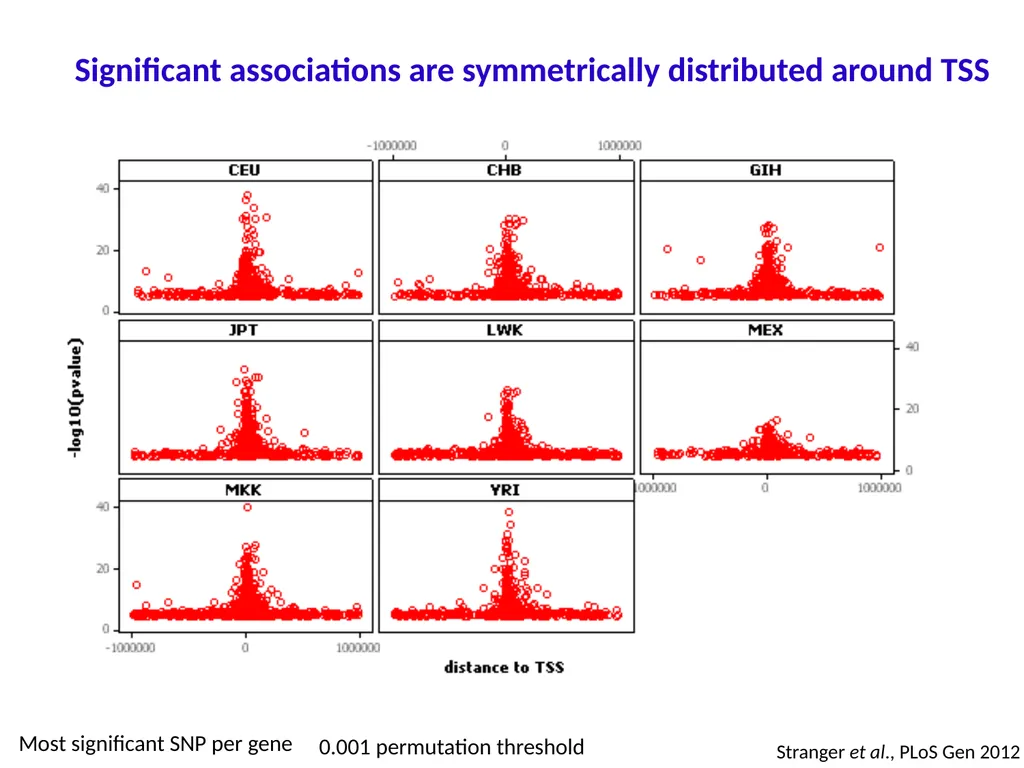
Most significant SNP per gene 0.001 permutation threshold Significant associations are symmetrically distributed around TSS Stranger et al., PLoS Gen 2012<br>
31
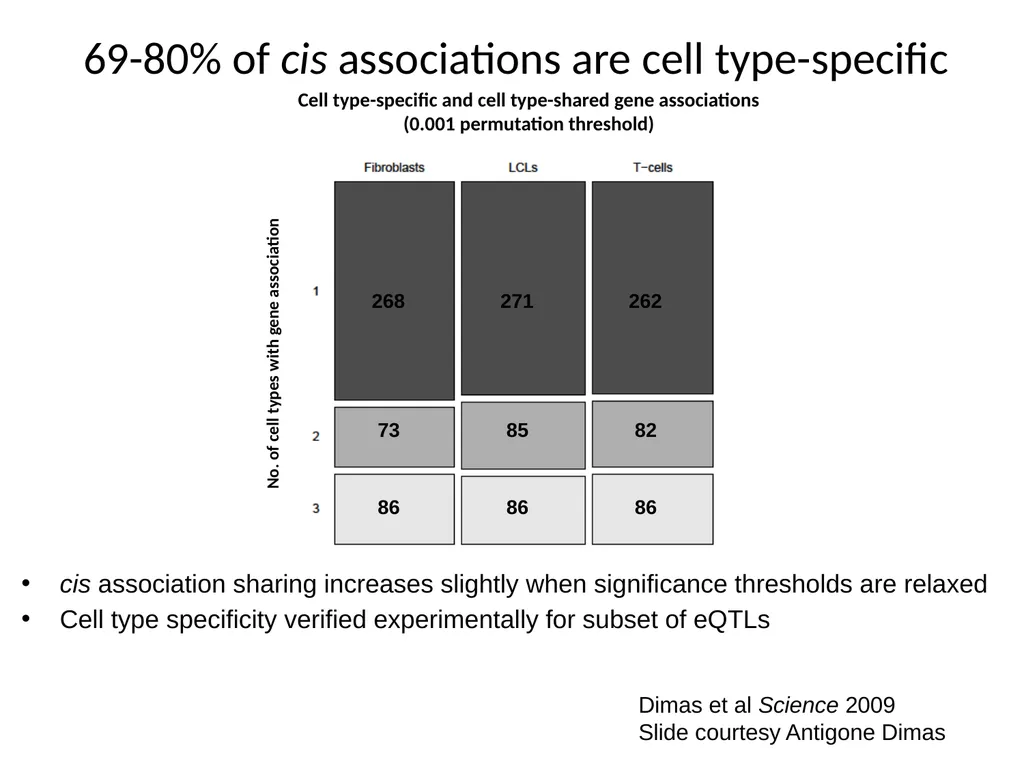
69-80% of cis associations are cell type-specific cis association sharing increases slightly when significance thresholds are relaxed
Cell type specificity verified experimentally for subset of eQTLs Dimas et al Science 2009 Dimas et al Science 2009
Slide courtesy Antigone Dimas<br>
Cell type specificity verified experimentally for subset of eQTLs Dimas et al Science 2009 Dimas et al Science 2009
Slide courtesy Antigone Dimas<br>
32
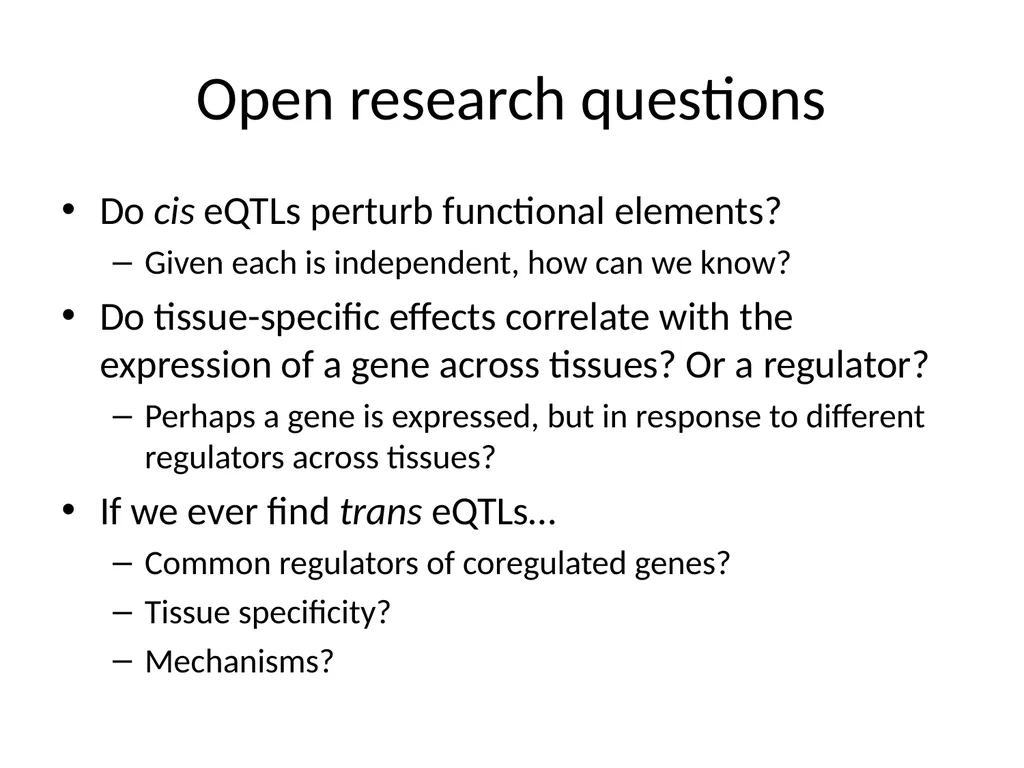
Open research questions Do cis eQTLs perturb functional elements?
Given each is independent, how can we know?
Do tissue-specific effects correlate with the expression of a gene across tissues? Or a regulator?
Perhaps a gene is expressed, but in response to different regulators across tissues?
If we ever find trans eQTLs…
Common regulators of coregulated genes?
Tissue specificity?
Mechanisms?<br>
Given each is independent, how can we know?
Do tissue-specific effects correlate with the expression of a gene across tissues? Or a regulator?
Perhaps a gene is expressed, but in response to different regulators across tissues?
If we ever find trans eQTLs…
Common regulators of coregulated genes?
Tissue specificity?
Mechanisms?<br>
33
Application to GWAS Candidate genes, perturbations underlying organismal phenotypes<br>
34
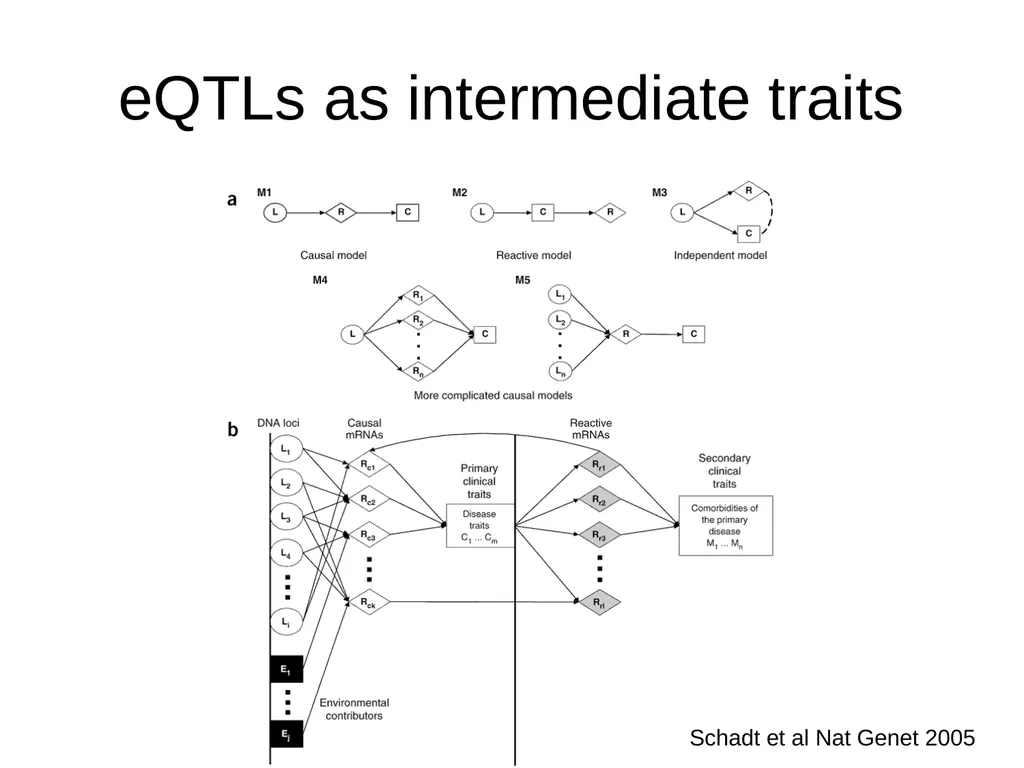
eQTLs as intermediate traits Schadt et al Nat Genet 2005<br>
35
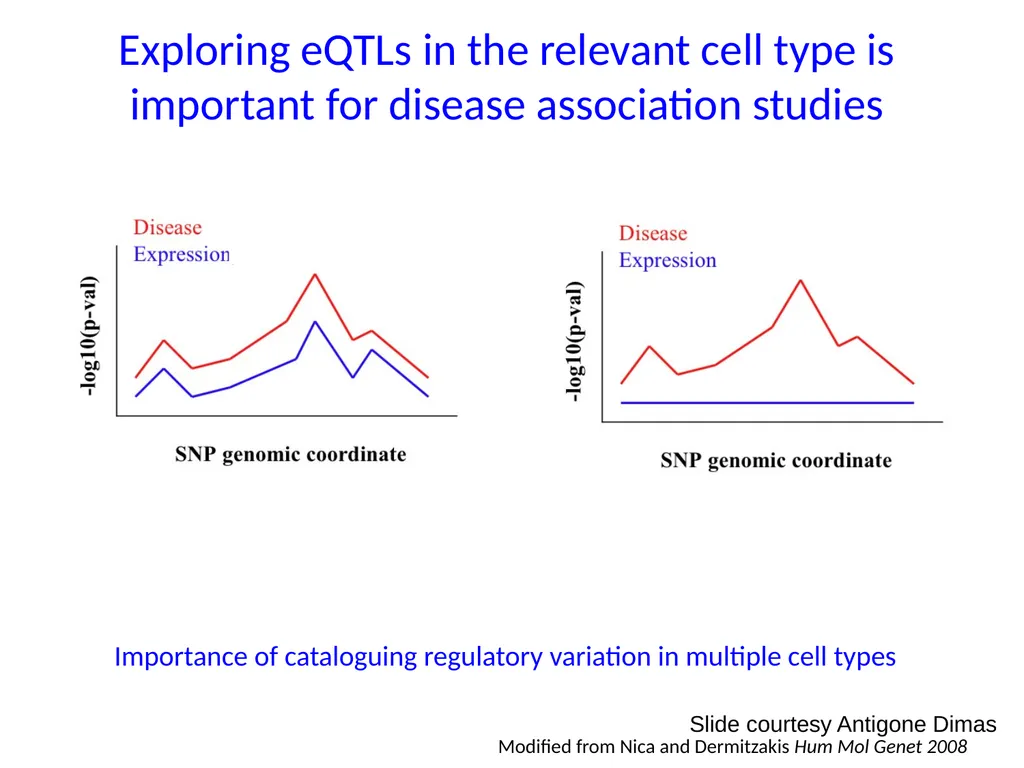
Modified from Nica and Dermitzakis Hum Mol Genet 2008 Exploring eQTLs in the relevant cell type is important for disease association studies Importance of cataloguing regulatory variation in multiple cell types Slide courtesy Antigone Dimas<br>
36
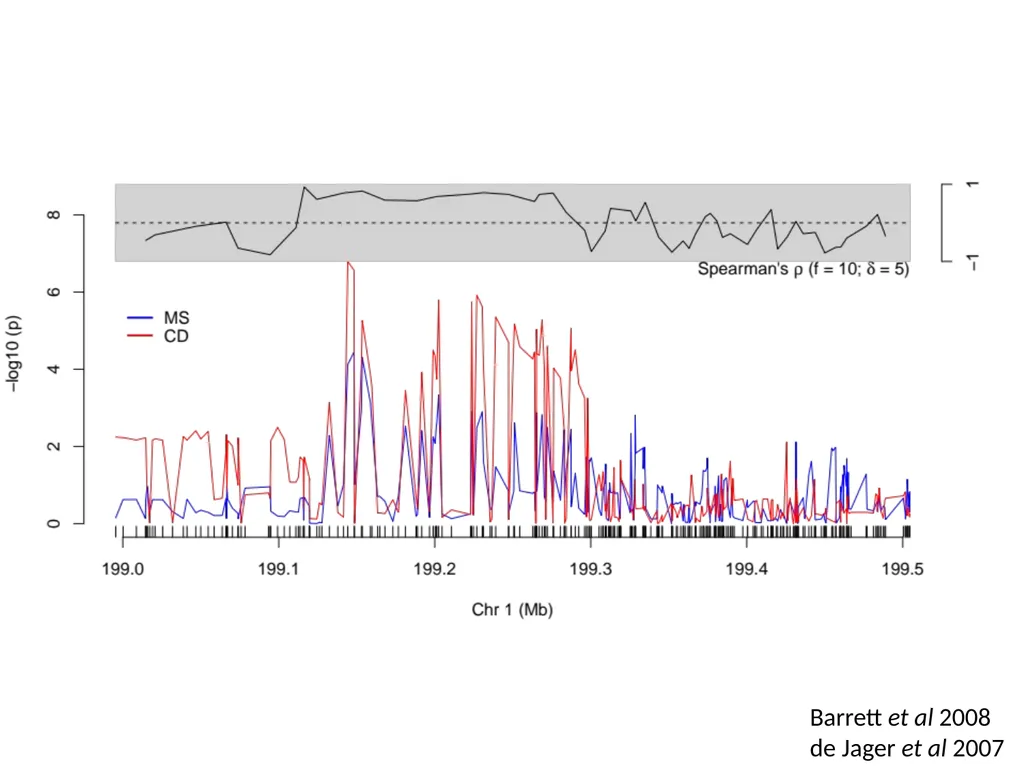
Barrett et al 2008
de Jager et al 2007<br>
de Jager et al 2007<br>
37
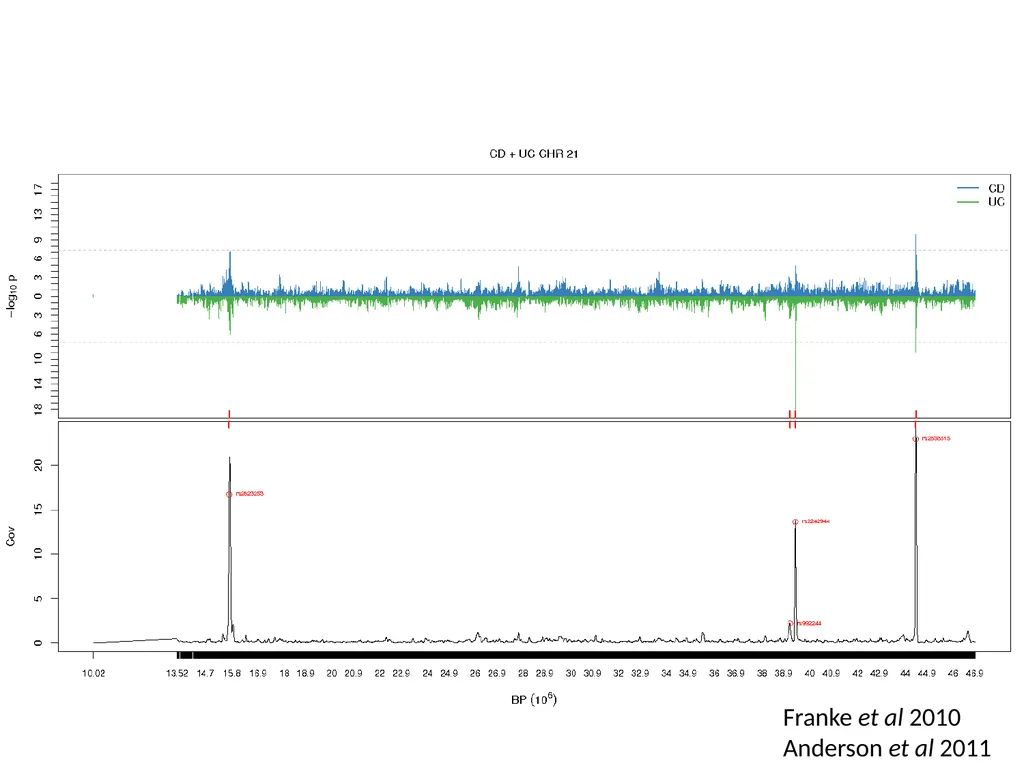
Franke et al 2010
Anderson et al 2011<br>
Anderson et al 2011<br>
38
Today: Regulatory variation and eQTLs Quantitative Trait Loci (QTLs), Regulatory Variation
Molecular phenotypes as QTs: expression, chromatin…
Discretization: a GWAS for each gene. Cis-/Trans-eQTLs
Underlying regulatory variation: eQTLs, GWAS, cis-eQTL
Finding trans-eQTLs (distal from gene that varies)
Challenges: Power, structure, sample size
Cross-phenotype analysis: trans QTLs affect many genes
Identifying underlying regulatory mechanisms
Cis-eQTLs: TSS-distance, cell type specificity
eQTLs vs. GWAS: Expression as intermediate trait
Population differences, emerging efforts
Shared associations, SNP-gene pairs, allelic direction
Confound: environment, preparation, batch, ancestry<br>
Molecular phenotypes as QTs: expression, chromatin…
Discretization: a GWAS for each gene. Cis-/Trans-eQTLs
Underlying regulatory variation: eQTLs, GWAS, cis-eQTL
Finding trans-eQTLs (distal from gene that varies)
Challenges: Power, structure, sample size
Cross-phenotype analysis: trans QTLs affect many genes
Identifying underlying regulatory mechanisms
Cis-eQTLs: TSS-distance, cell type specificity
eQTLs vs. GWAS: Expression as intermediate trait
Population differences, emerging efforts
Shared associations, SNP-gene pairs, allelic direction
Confound: environment, preparation, batch, ancestry<br>
39
Population differences<br>
40
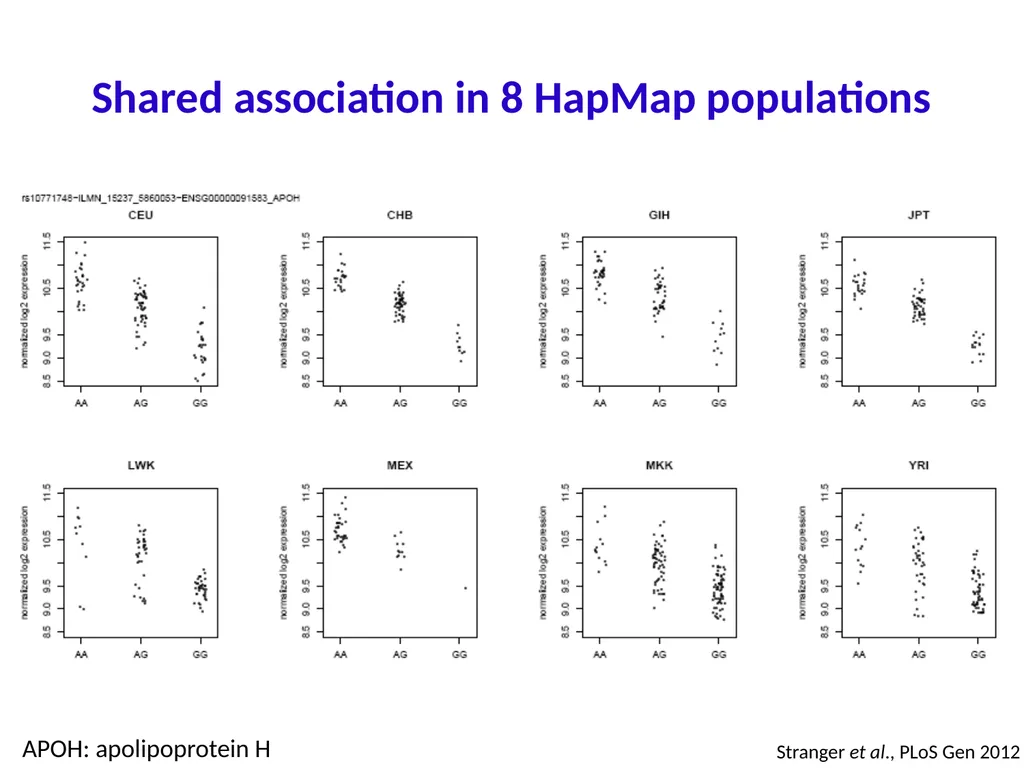
Shared association in 8 HapMap populations APOH: apolipoprotein H Stranger et al., PLoS Gen 2012<br>
41
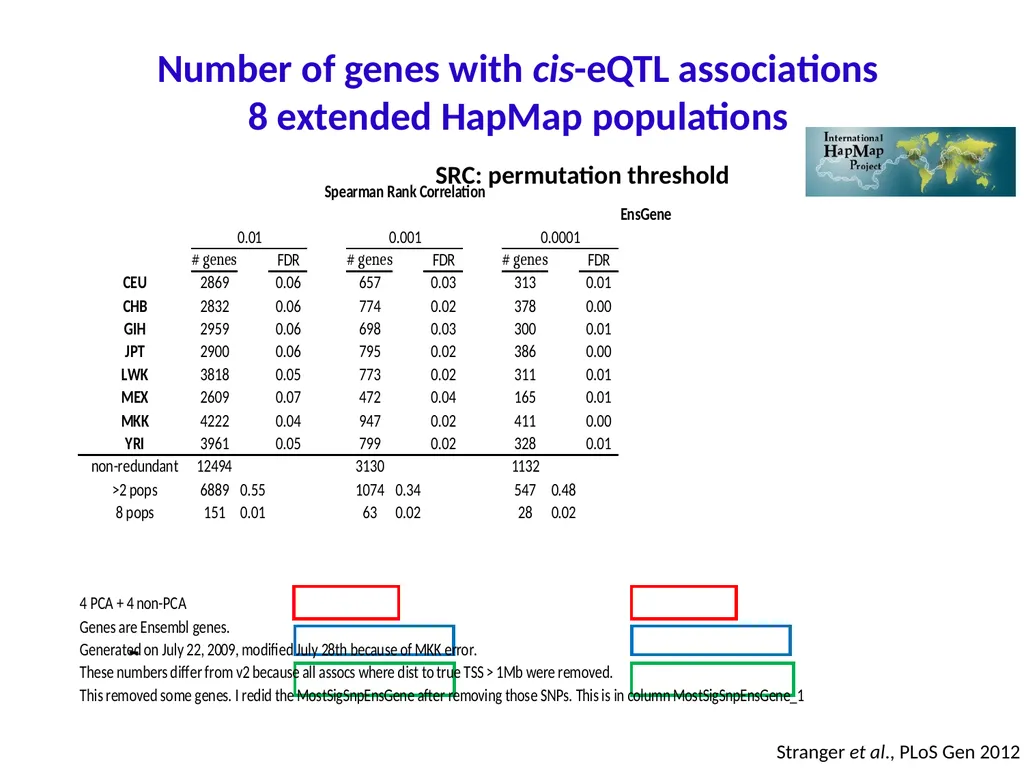
Number of genes with cis-eQTL associations
8 extended HapMap populations SRC: permutation threshold Stranger et al., PLoS Gen 2012<br>
8 extended HapMap populations SRC: permutation threshold Stranger et al., PLoS Gen 2012<br>
42
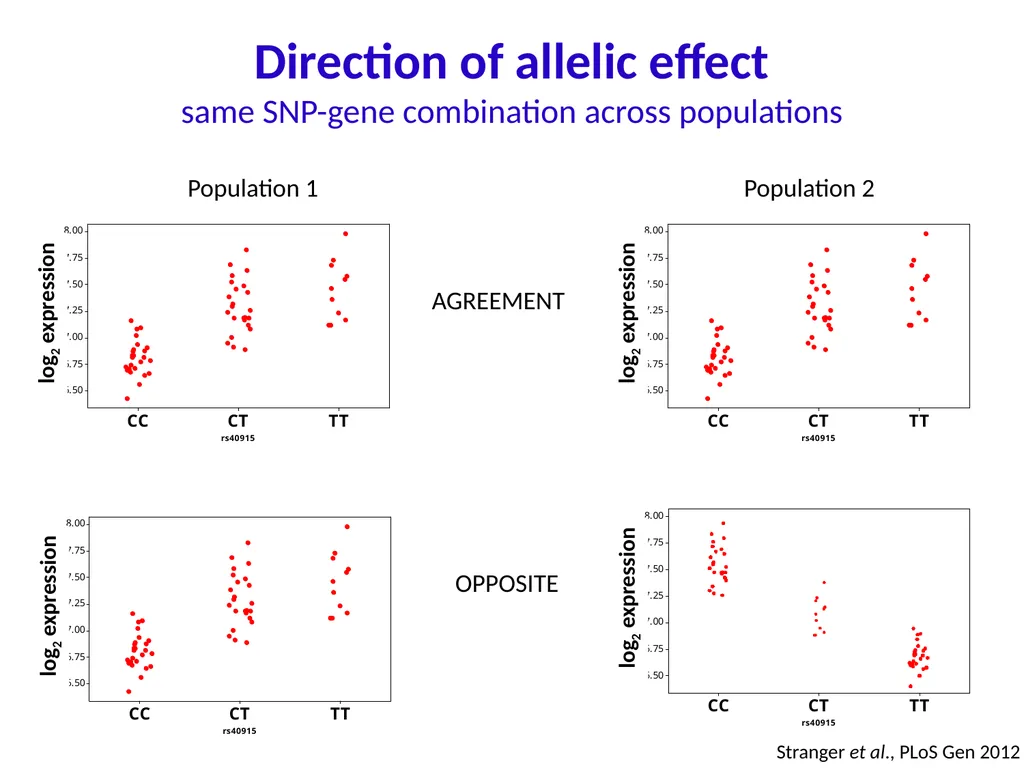
Direction of allelic effect
same SNP-gene combination across populations AGREEMENT OPPOSITE Population 1 Population 2 log2 expression log2 expression log2 expression log2 expression Stranger et al., PLoS Gen 2012<br>
43
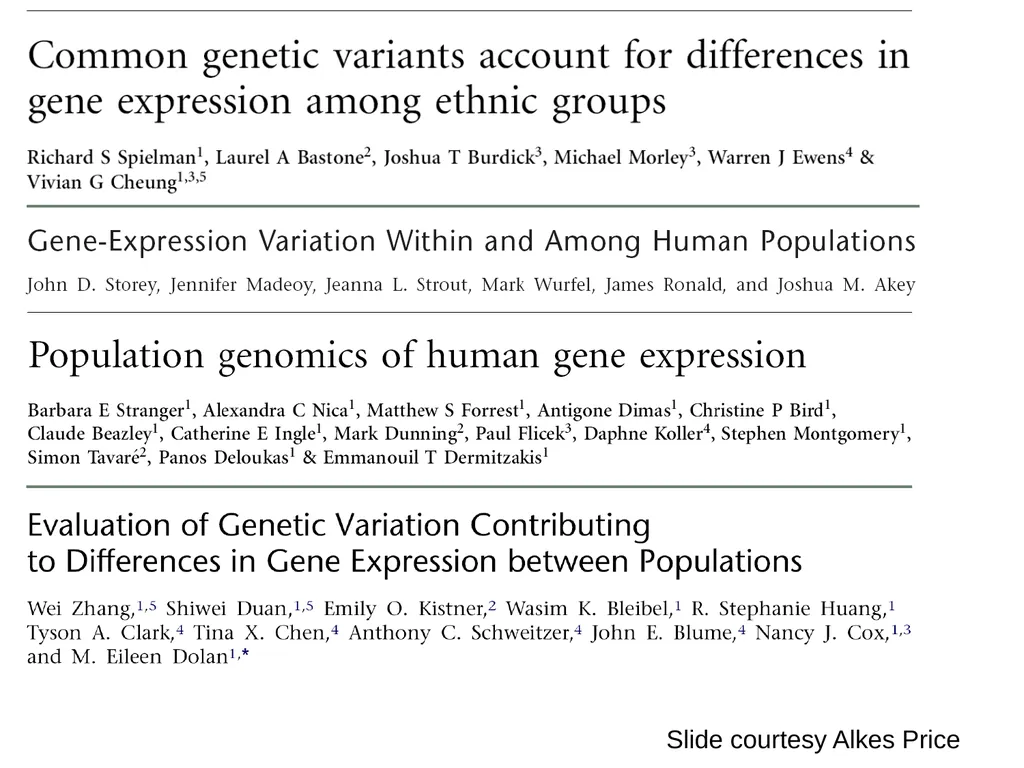
Slide courtesy Alkes Price<br>
44
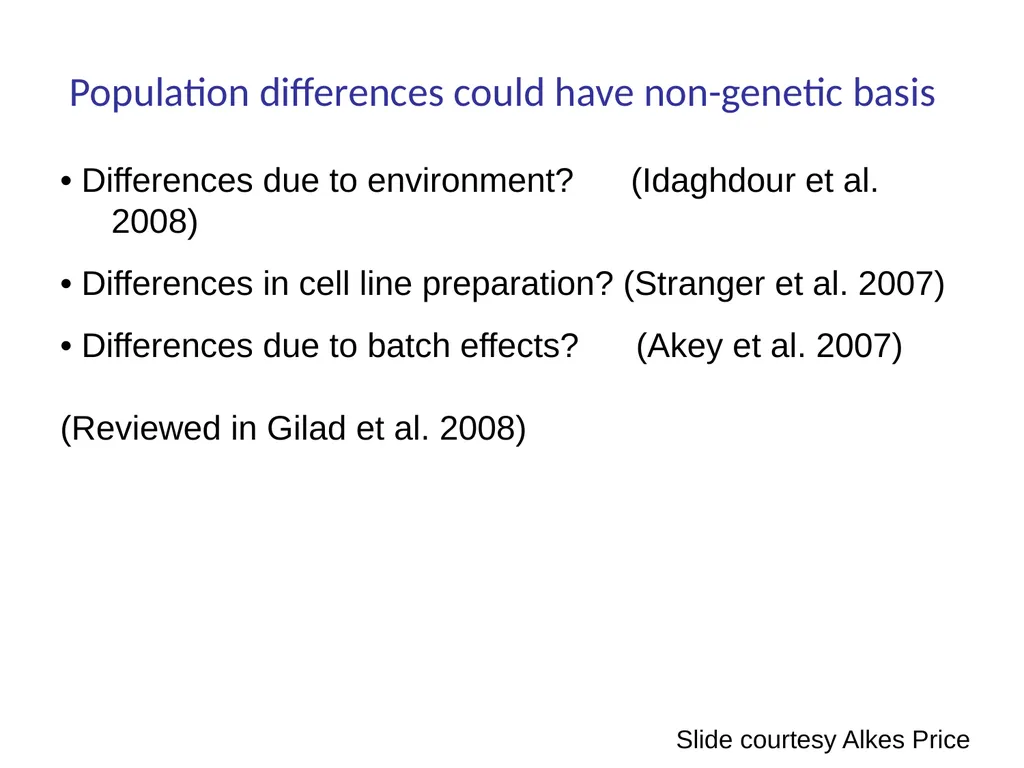
Population differences could have non-genetic basis • Differences due to environment? (Idaghdour et al. 2008)
• Differences in cell line preparation? (Stranger et al. 2007)
• Differences due to batch effects? (Akey et al. 2007)
(Reviewed in Gilad et al. 2008) Slide courtesy Alkes Price<br>
• Differences in cell line preparation? (Stranger et al. 2007)
• Differences due to batch effects? (Akey et al. 2007)
(Reviewed in Gilad et al. 2008) Slide courtesy Alkes Price<br>
45
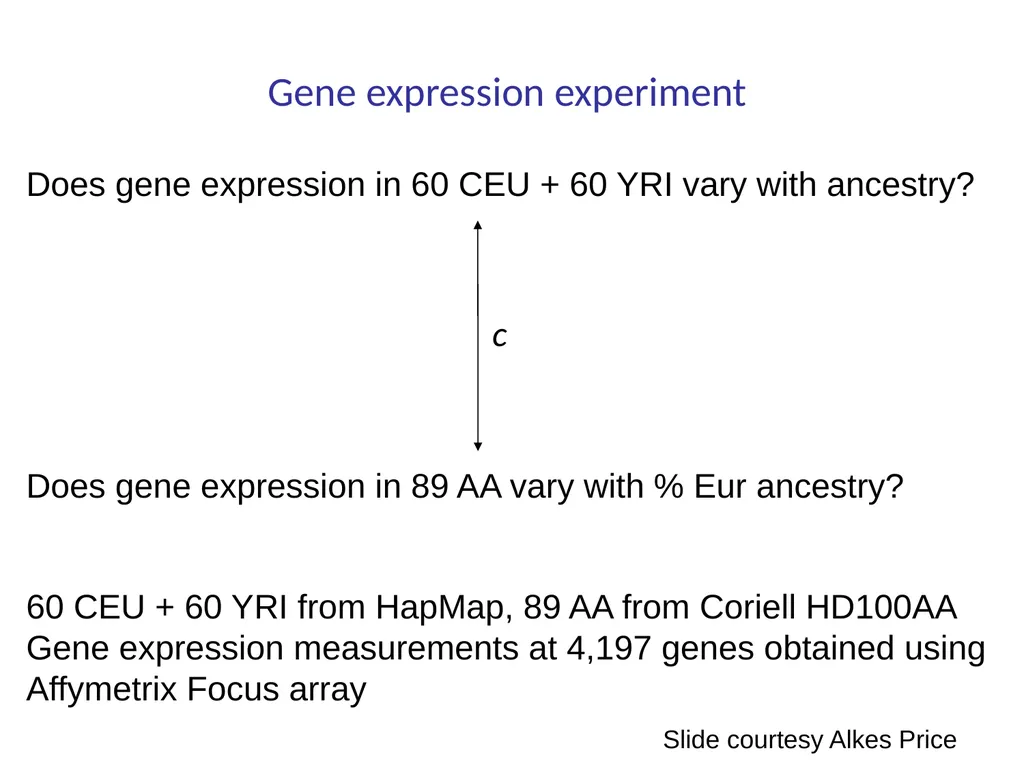
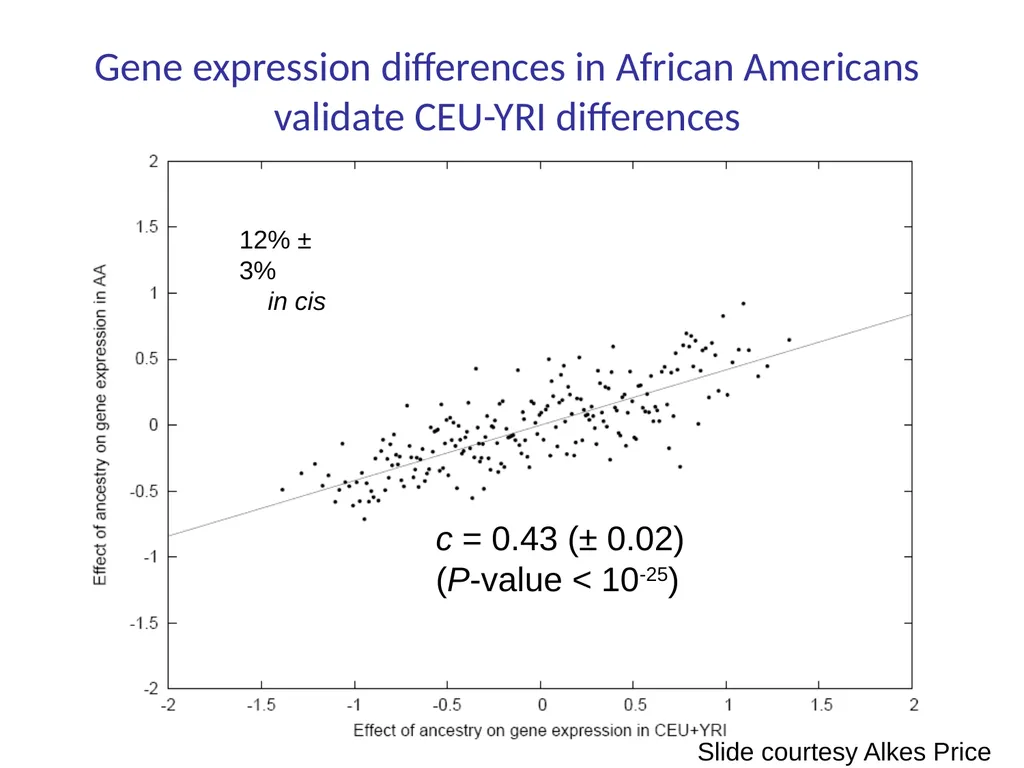
Gene expression experiment Does gene expression in 60 CEU + 60 YRI vary with ancestry?
Does gene expression in 89 AA vary with % Eur ancestry?
60 CEU + 60 YRI from HapMap, 89 AA from Coriell HD100AA
Gene expression measurements at 4,197 genes obtained using Affymetrix Focus array c Slide courtesy Alkes Price<br>
Does gene expression in 89 AA vary with % Eur ancestry?
60 CEU + 60 YRI from HapMap, 89 AA from Coriell HD100AA
Gene expression measurements at 4,197 genes obtained using Affymetrix Focus array c Slide courtesy Alkes Price<br>
46
Gene expression differences in African Americans validate CEU-YRI differences c = 0.43 (± 0.02)
(P-value < 10-25) 12% ± 3%
in cis Slide courtesy Alkes Price<br>
(P-value < 10-25) 12% ± 3%
in cis Slide courtesy Alkes Price<br>
47
Emerging efforts RNAseq, GTEx<br>
48
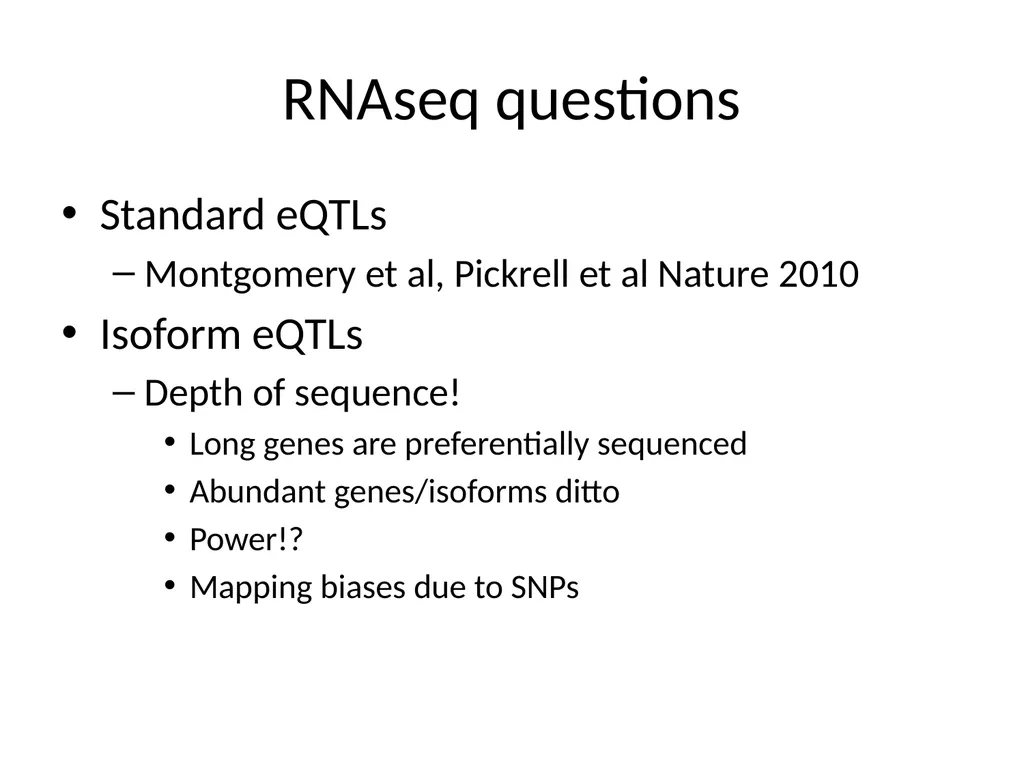
RNAseq questions Standard eQTLs
Montgomery et al, Pickrell et al Nature 2010
Isoform eQTLs
Depth of sequence!
Long genes are preferentially sequenced
Abundant genes/isoforms ditto
Power!?
Mapping biases due to SNPs<br>
Montgomery et al, Pickrell et al Nature 2010
Isoform eQTLs
Depth of sequence!
Long genes are preferentially sequenced
Abundant genes/isoforms ditto
Power!?
Mapping biases due to SNPs<br>
49
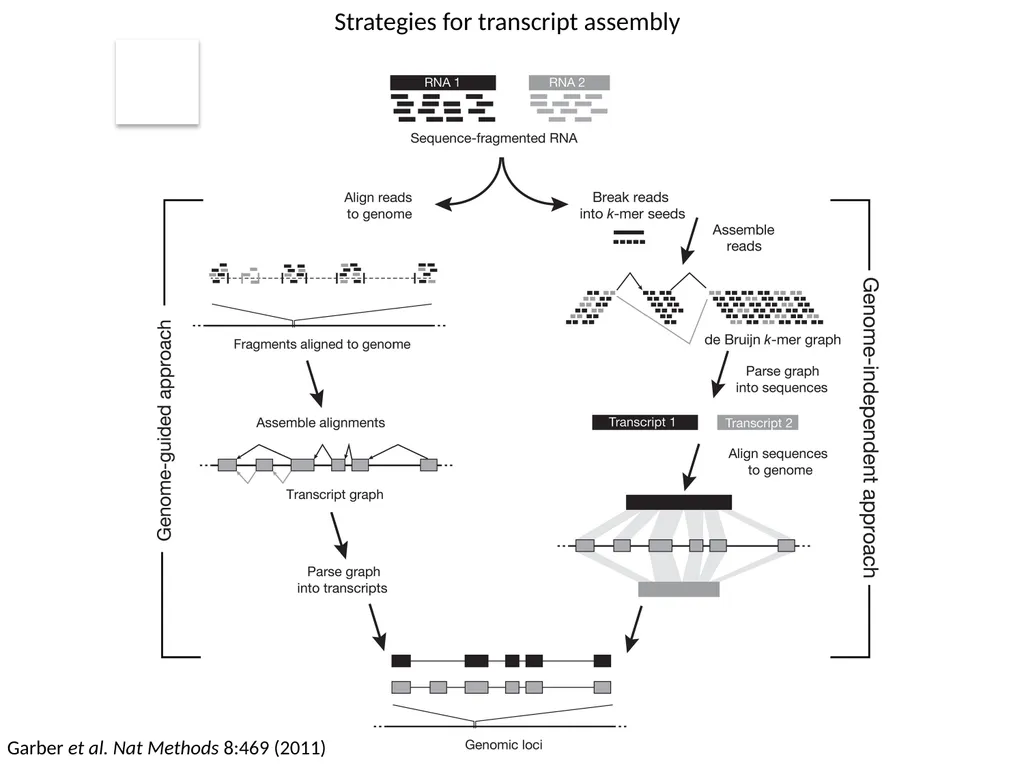
Strategies for transcript assembly Garber et al. Nat Methods 8:469 (2011)<br>
50
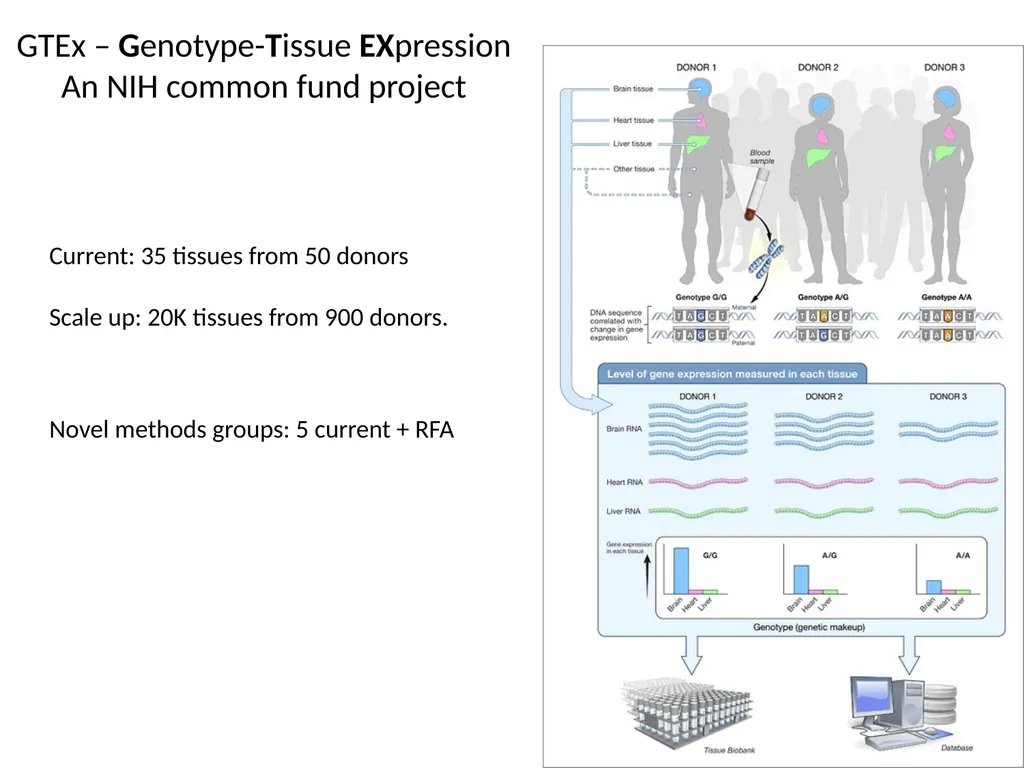
GTEx – Genotype-Tissue EXpression
An NIH common fund project Current: 35 tissues from 50 donors
Scale up: 20K tissues from 900 donors. Novel methods groups: 5 current + RFA<br>
An NIH common fund project Current: 35 tissues from 50 donors
Scale up: 20K tissues from 900 donors. Novel methods groups: 5 current + RFA<br>
51
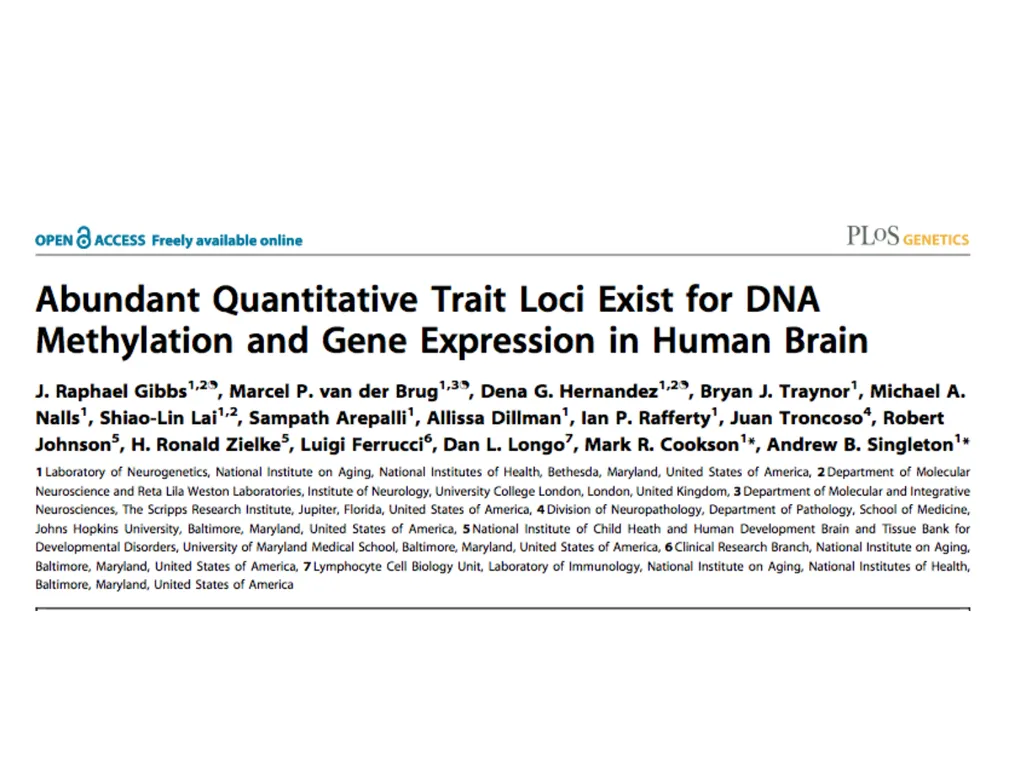
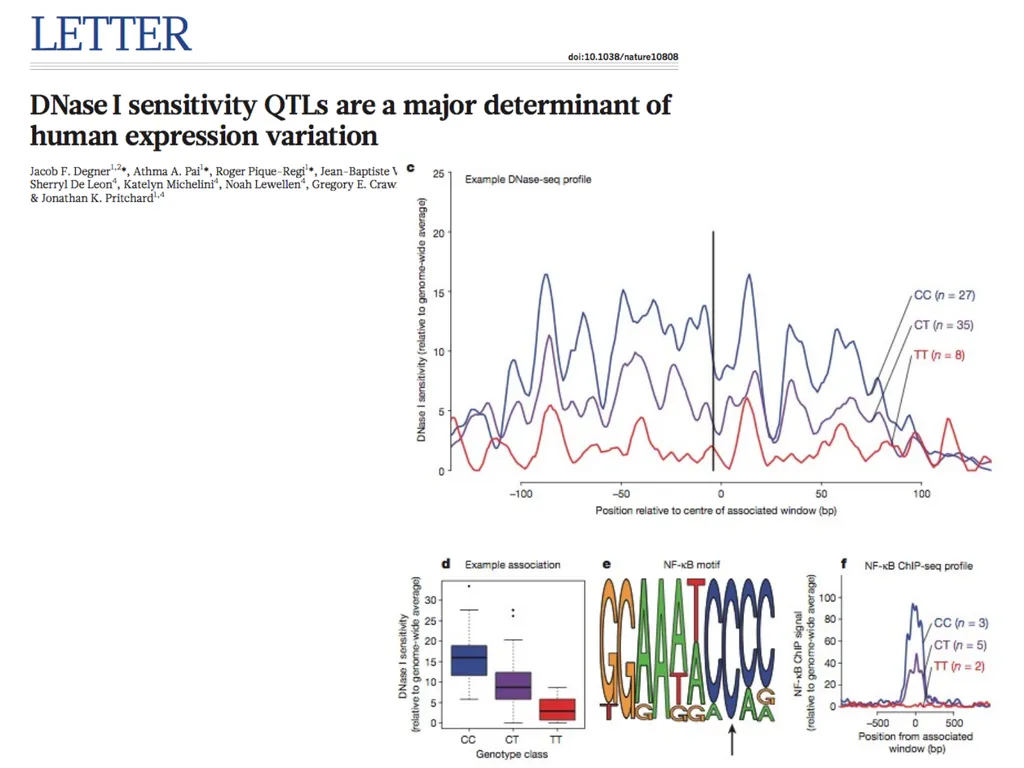
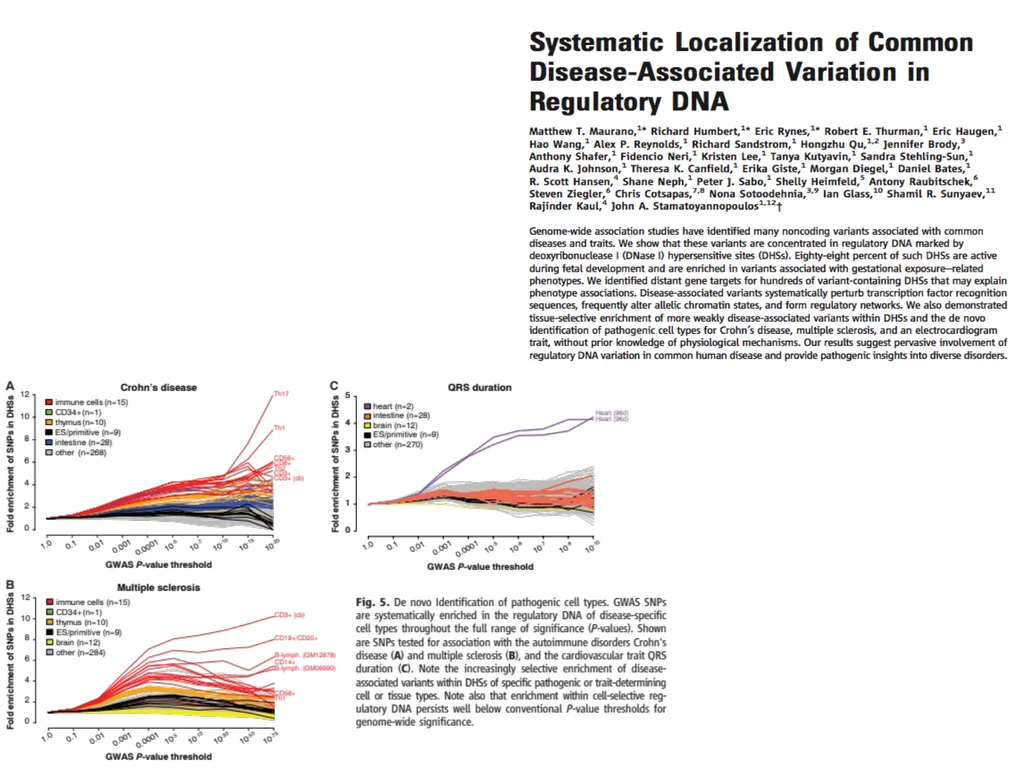
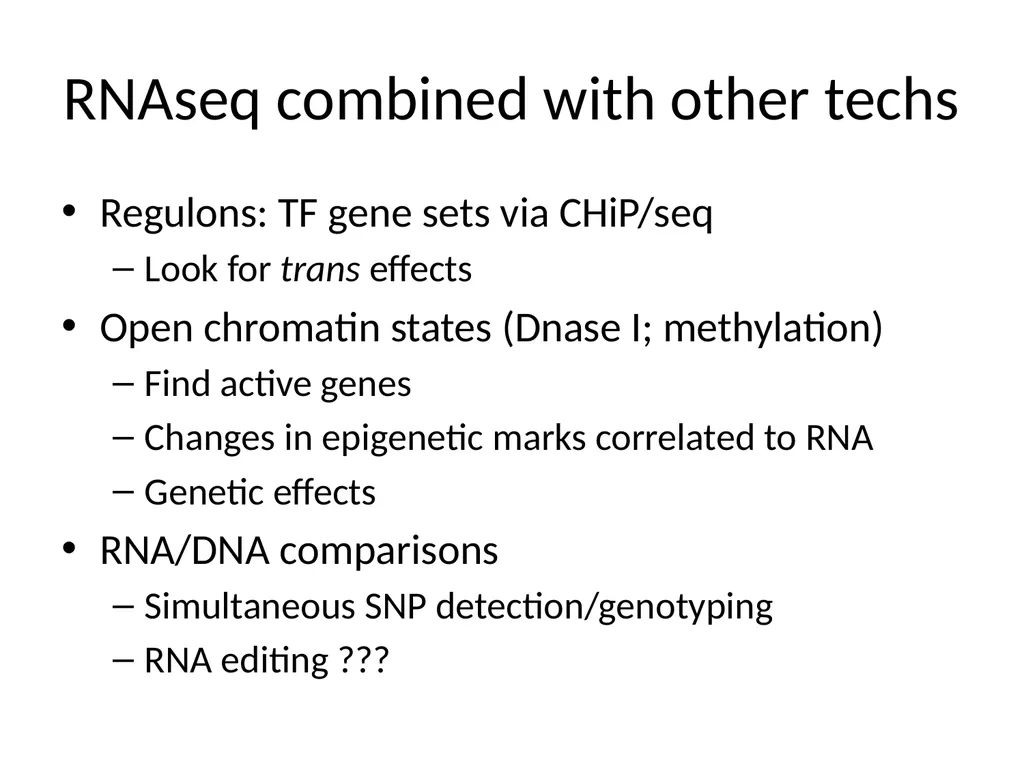
RNAseq combined with other techs Regulons: TF gene sets via CHiP/seq
Look for trans effects
Open chromatin states (Dnase I; methylation)
Find active genes
Changes in epigenetic marks correlated to RNA
Genetic effects
RNA/DNA comparisons
Simultaneous SNP detection/genotyping
RNA editing ???<br>
Look for trans effects
Open chromatin states (Dnase I; methylation)
Find active genes
Changes in epigenetic marks correlated to RNA
Genetic effects
RNA/DNA comparisons
Simultaneous SNP detection/genotyping
RNA editing ???<br>
52
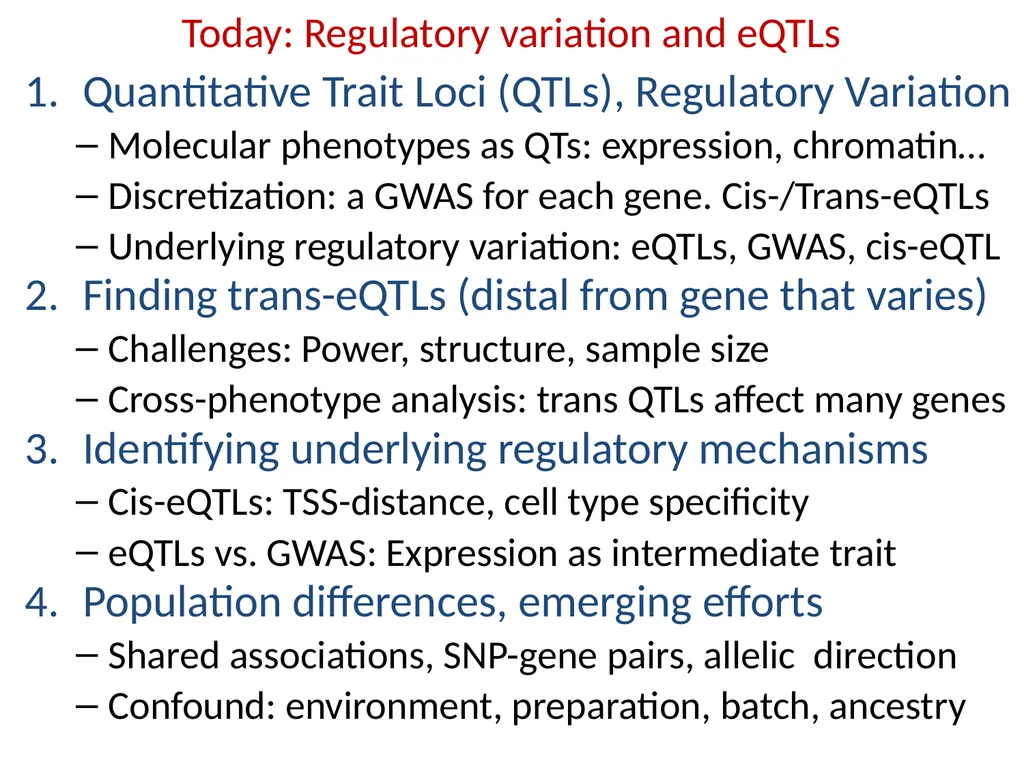
Today: Regulatory variation and eQTLs Quantitative Trait Loci (QTLs), Regulatory Variation
Molecular phenotypes as QTs: expression, chromatin…
Discretization: a GWAS for each gene. Cis-/Trans-eQTLs
Underlying regulatory variation: eQTLs, GWAS, cis-eQTL
Finding trans-eQTLs (distal from gene that varies)
Challenges: Power, structure, sample size
Cross-phenotype analysis: trans QTLs affect many genes
Identifying underlying regulatory mechanisms
Cis-eQTLs: TSS-distance, cell type specificity
eQTLs vs. GWAS: Expression as intermediate trait
Population differences, emerging efforts
Shared associations, SNP-gene pairs, allelic direction
Confound: environment, preparation, batch, ancestry<br>
Molecular phenotypes as QTs: expression, chromatin…
Discretization: a GWAS for each gene. Cis-/Trans-eQTLs
Underlying regulatory variation: eQTLs, GWAS, cis-eQTL
Finding trans-eQTLs (distal from gene that varies)
Challenges: Power, structure, sample size
Cross-phenotype analysis: trans QTLs affect many genes
Identifying underlying regulatory mechanisms
Cis-eQTLs: TSS-distance, cell type specificity
eQTLs vs. GWAS: Expression as intermediate trait
Population differences, emerging efforts
Shared associations, SNP-gene pairs, allelic direction
Confound: environment, preparation, batch, ancestry<br>