Lecture 5: Introduction to Gene Expression: The central dogma We have seen how DNA, with the aid of specific polymerases and accessory proteins, is able to replicate. We have also seen how we can use this information to create
"Lecture 5: Introduction to Gene Expression: The" is the property of its rightful owner. Permission is granted to
download and print the materials on this website for personal, non-commercial use only, and to display it
on your personal computer provided you do not modify the materials and that you retain all copyright
notices contained in the materials. By downloading content from our website, you accept the terms of this
agreement.
Presentation Transcript
01
Lecture 5: Introduction to Gene Expression:<br>
02
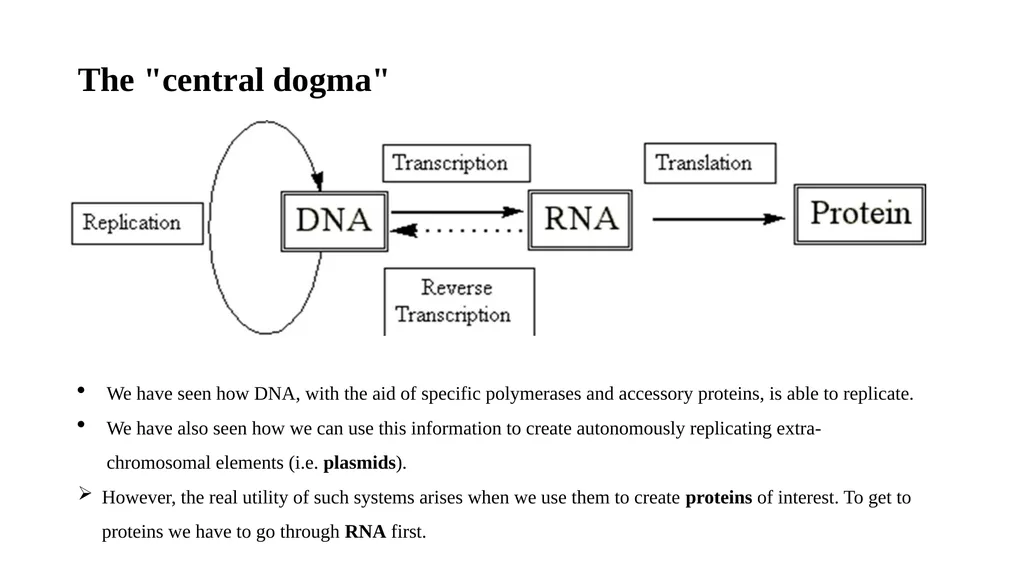
The "central dogma" We have seen how DNA, with the aid of specific polymerases and accessory proteins, is able to replicate.
We have also seen how we can use this information to create autonomously replicating extra-chromosomal elements (i.e. plasmids).
However, the real utility of such systems arises when we use them to create proteins of interest. To get to proteins we have to go through RNA first.<br>
03
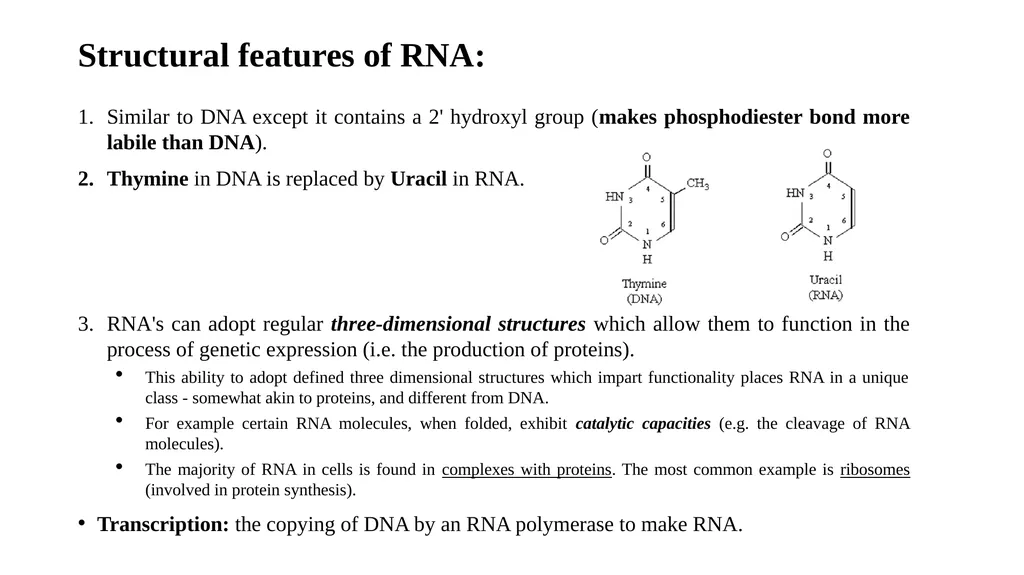
Structural features of RNA: Similar to DNA except it contains a 2' hydroxyl group (makes phosphodiester bond more labile than DNA).
Thymine in DNA is replaced by Uracil in RNA.
RNA's can adopt regular three-dimensional structures which allow them to function in the process of genetic expression (i.e. the production of proteins).
This ability to adopt defined three dimensional structures which impart functionality places RNA in a unique class - somewhat akin to proteins, and different from DNA.
For example certain RNA molecules, when folded, exhibit catalytic capacities (e.g. the cleavage of RNA molecules).
The majority of RNA in cells is found in complexes with proteins. The most common example is ribosomes (involved in protein synthesis).
Transcription: the copying of DNA by an RNA polymerase to make RNA.<br>
04
RNA polymerase: Can initiate a new nucleic acid strand given a template.
DNA polymerases cannot; they require a primer (or more typically, an RNA polymerase to provide the primer).
Three kinds of RNA molecules perform different functions in the protein synthesizing apparatus:
Messenger RNA (mRNA) encodes the genetic information copied from DNA in the form of a sequence of bases that specifics a sequence of amino acids
Transfer RNA (tRNA) is part of the structural machinery which deciphers the mRNA code.
They carry specific amino acids which are transferred to a nascent polypeptide according to the instructions contained within the mRNA.
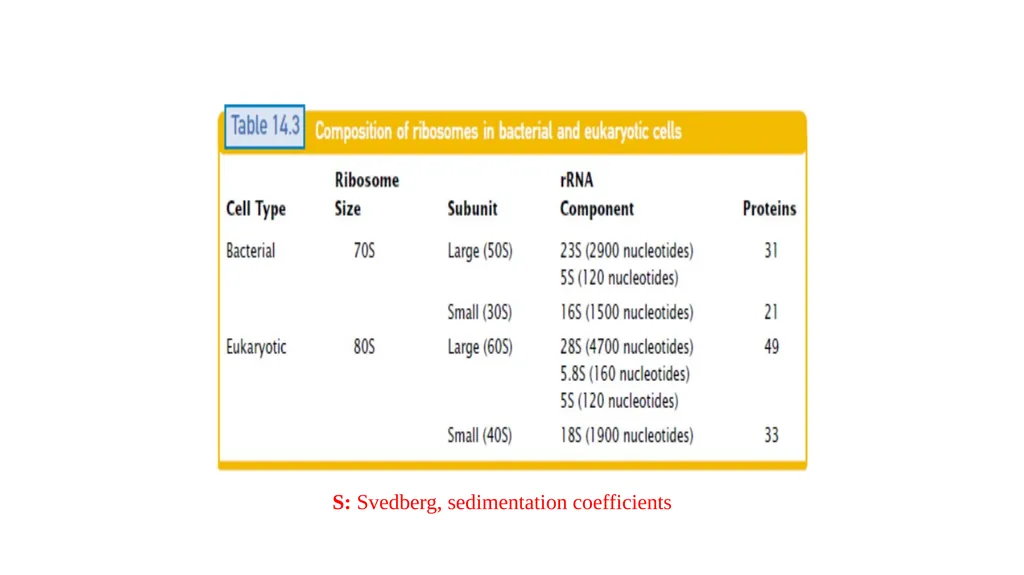
Ribosomal RNA (rRNA) forms a complex with specific proteins to form the ribosome which is the key translational component
the ribosome complexes with mRNA and directs appropriate tRNA's and the synthesis of the polypeptide bond.<br>
05
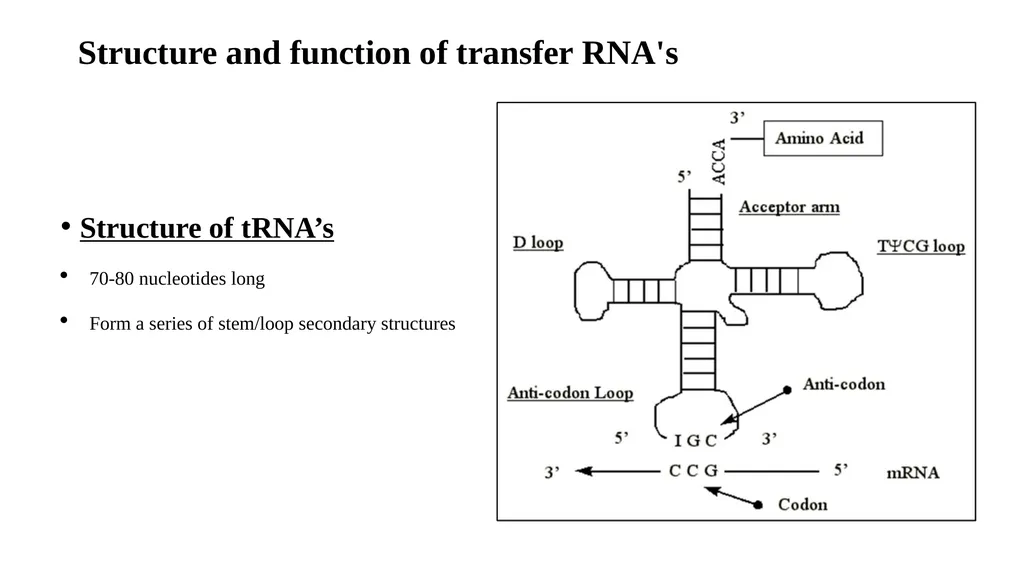
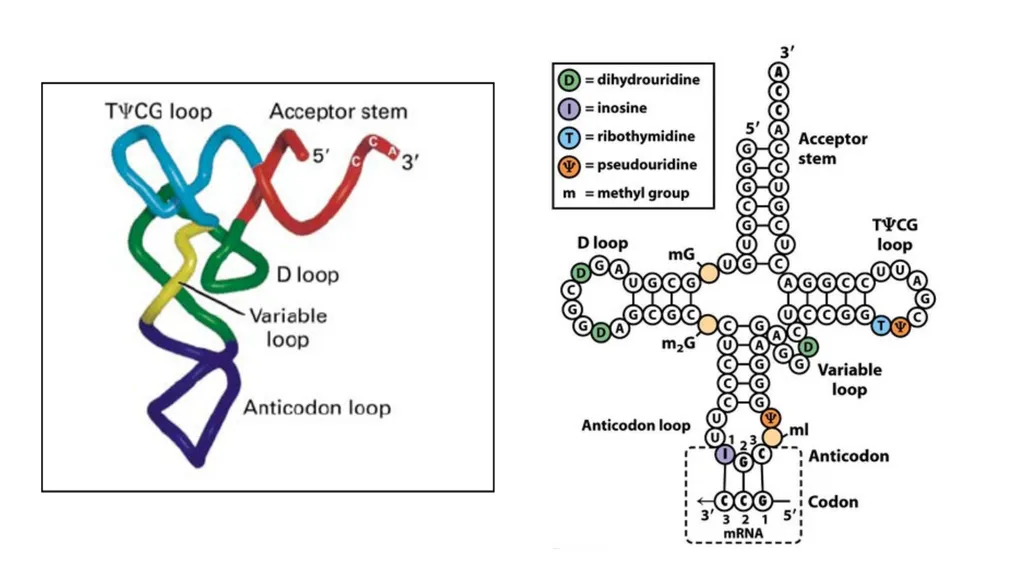
Structure and function of transfer RNA's Structure of tRNA’s
70-80 nucleotides long
Form a series of stem/loop secondary structures<br>
06
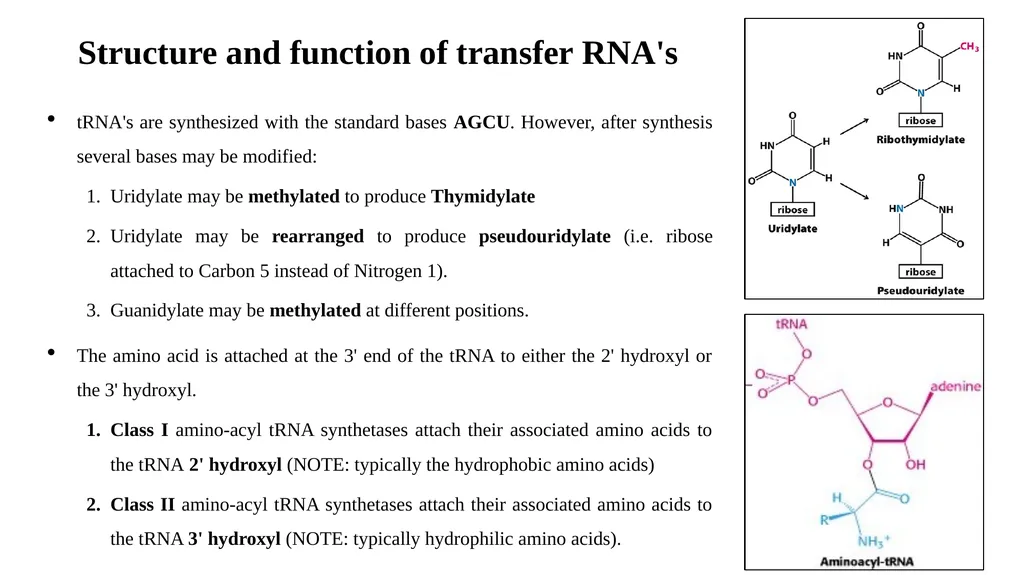
Structure and function of transfer RNA's tRNA's are synthesized with the standard bases AGCU. However, after synthesis several bases may be modified:
Uridylate may be methylated to produce Thymidylate
Uridylate may be rearranged to produce pseudouridylate (i.e. ribose attached to Carbon 5 instead of Nitrogen 1).
Guanidylate may be methylated at different positions.
The amino acid is attached at the 3' end of the tRNA to either the 2' hydroxyl or the 3' hydroxyl.
Class I amino-acyl tRNA synthetases attach their associated amino acids to the tRNA 2' hydroxyl (NOTE: typically the hydrophobic amino acids)
Class II amino-acyl tRNA synthetases attach their associated amino acids to the tRNA 3' hydroxyl (NOTE: typically hydrophilic amino acids).<br>
07
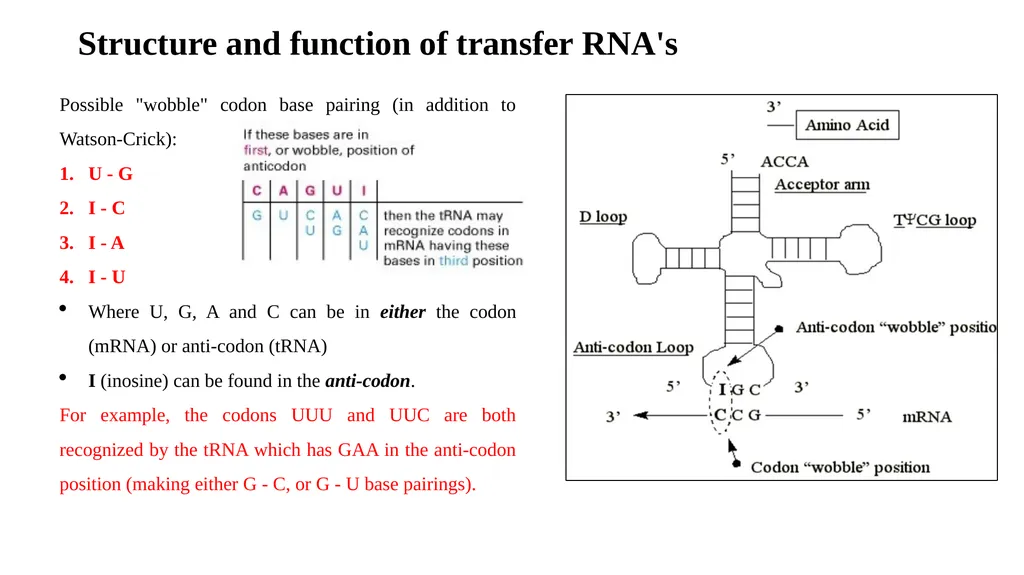
If perfect Watson-Crick base pairing were required at the codon/anti-codon triplet then 61 different tRNA's would be required.
We know this is not the case, therefore a single tRNA anti-codon must be able to recognized several different mRNA codon triplets.
This greater recognition of tRNA is possible due to "wobble" base pair interactions at the third base in the codon / first base in the anti-codon: Structure and function of transfer RNA's<br>
08
Possible "wobble" codon base pairing (in addition to Watson-Crick):
U - G
I - C
I - A
I - U
Where U, G, A and C can be in either the codon (mRNA) or anti-codon (tRNA)
I (inosine) can be found in the anti-codon.
For example, the codons UUU and UUC are both recognized by the tRNA which has GAA in the anti-codon position (making either G - C, or G - U base pairings). Structure and function of transfer RNA's<br>
09
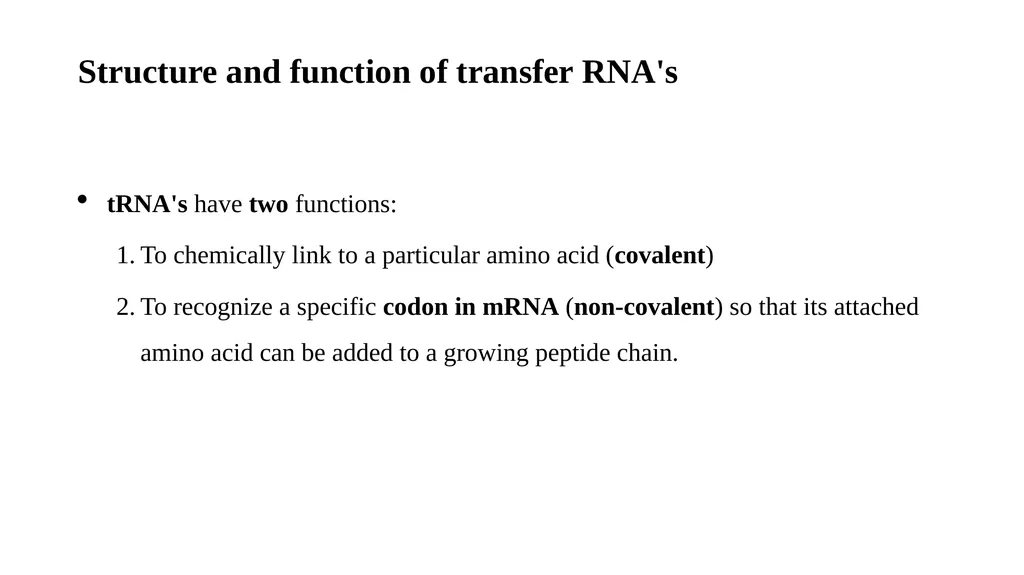
tRNA's have two functions:
To chemically link to a particular amino acid (covalent)
To recognize a specific codon in mRNA (non-covalent) so that its attached amino acid can be added to a growing peptide chain. Structure and function of transfer RNA's<br>
10
Amino-acyl tRNA synthetases Function is to "charge" tRNA molecules; i.e. to chemically link a specific amino acid to its associated tRNA molecule. Conclusions:
There is one amino-acyl tRNA synthetase per amino acid (they are quite specific).
There is potentially more than one tRNA per amino acid.
Therefore, amino-acyl tRNA synthetases must be able to recognize more than one tRNA.
There is potentially more than one codon per tRNA.
Therefore each tRNA must be able to recognize more than one codon (there is not a unique tRNA for each codon).<br>
11
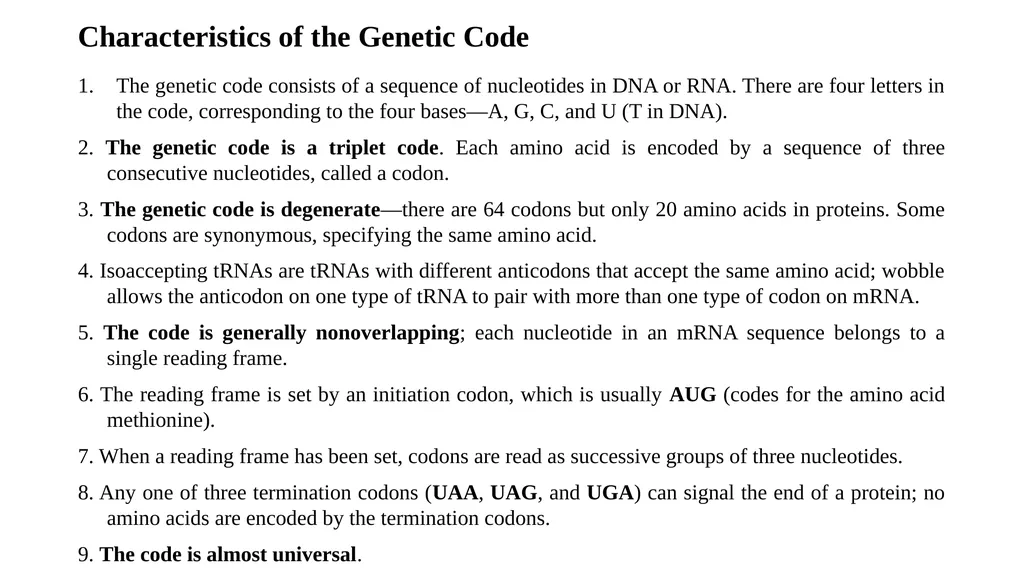
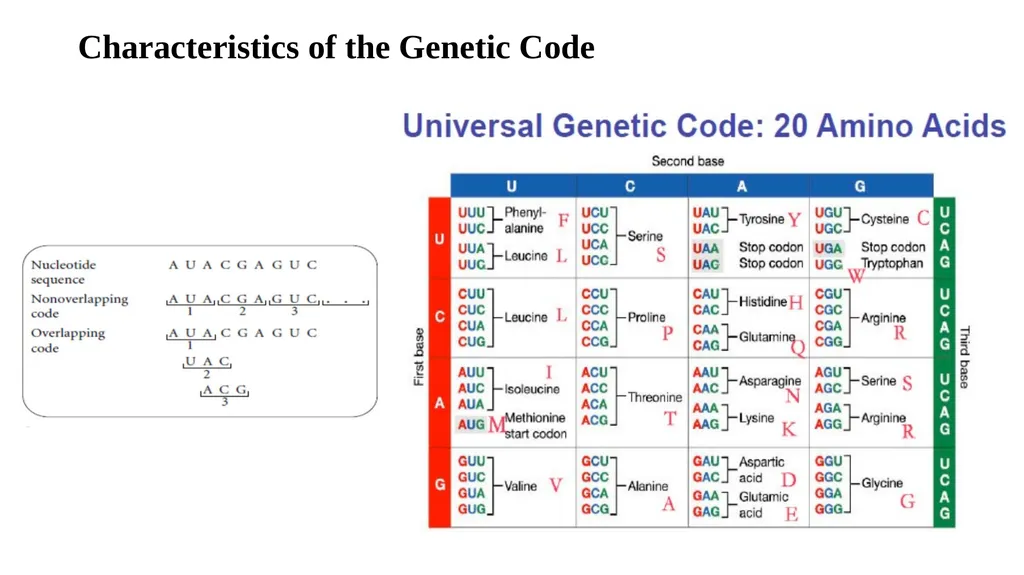
Characteristics of the Genetic Code The genetic code consists of a sequence of nucleotides in DNA or RNA. There are four letters in the code, corresponding to the four bases—A, G, C, and U (T in DNA).
2. The genetic code is a triplet code. Each amino acid is encoded by a sequence of three consecutive nucleotides, called a codon.
3. The genetic code is degenerate—there are 64 codons but only 20 amino acids in proteins. Some codons are synonymous, specifying the same amino acid.
4. Isoaccepting tRNAs are tRNAs with different anticodons that accept the same amino acid; wobble allows the anticodon on one type of tRNA to pair with more than one type of codon on mRNA.
5. The code is generally nonoverlapping; each nucleotide in an mRNA sequence belongs to a single reading frame.
6. The reading frame is set by an initiation codon, which is usually AUG (codes for the amino acid methionine).
7. When a reading frame has been set, codons are read as successive groups of three nucleotides.
8. Any one of three termination codons (UAA, UAG, and UGA) can signal the end of a protein; no amino acids are encoded by the termination codons.
9. The code is almost universal.<br>