Lecture 8 First semester Endocrine system Disorders Al-Mustaqbal University College Nursing Department 2nd Class Adult Nursing :by lecturer Dr. Sadiq Salam H. AL-Salih The endocrine system is a network of glands and hormones that regulate
"Lecture #8 First semester Endocrine system" is the property of its rightful owner. Permission is granted to
download and print the materials on this website for personal, non-commercial use only, and to display it
on your personal computer provided you do not modify the materials and that you retain all copyright
notices contained in the materials. By downloading content from our website, you accept the terms of this
agreement.
Presentation Transcript
01
Lecture #8
First semester
Endocrine system
Disorders
Al-Mustaqbal University College Nursing Department
2nd Class
Adult Nursing :by
lecturer
Dr. Sadiq Salam H. AL-Salih<br>
02
The endocrine system is a network of glands and hormones that regulate and control the activity of cells or organs and many important body functions.
•The endocrine system regulates body activities by releasing hormones (chemical messengers) into the bloodstream or through ducts , where they are carried throughout the entire body.
•Hormonal responses may be almost instantaneous (Sudden), or may occur days later. There is a wide variety of hormonal effects. The Endocrine System<br>
03
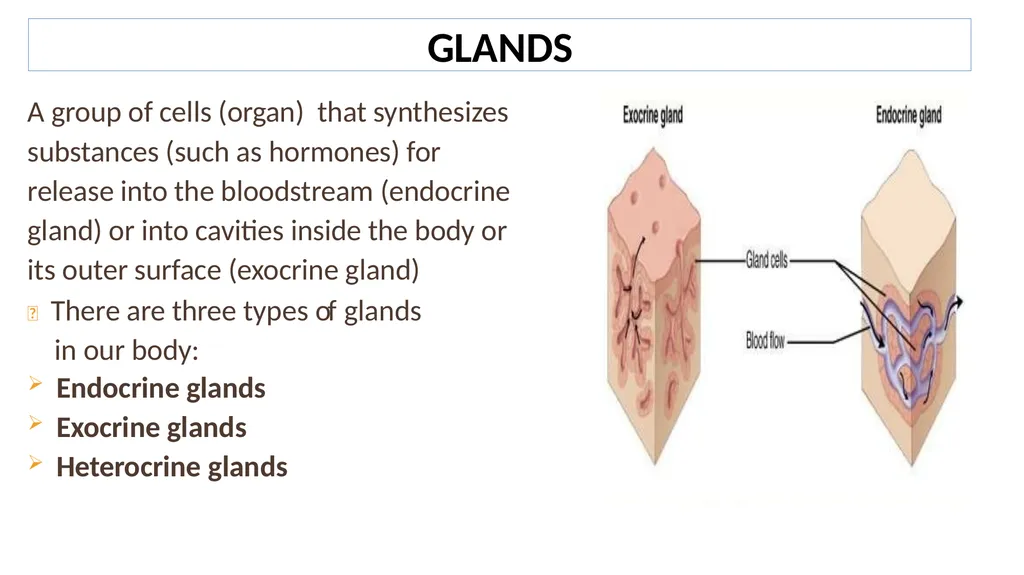
GLANDS A group of cells (organ) that synthesizes substances (such as hormones) for release into the bloodstream (endocrine gland) or into cavities inside the body or its outer surface (exocrine gland)
There are three types of glands in our body:
Endocrine glands
Exocrine glands
Heterocrine glands<br>
04
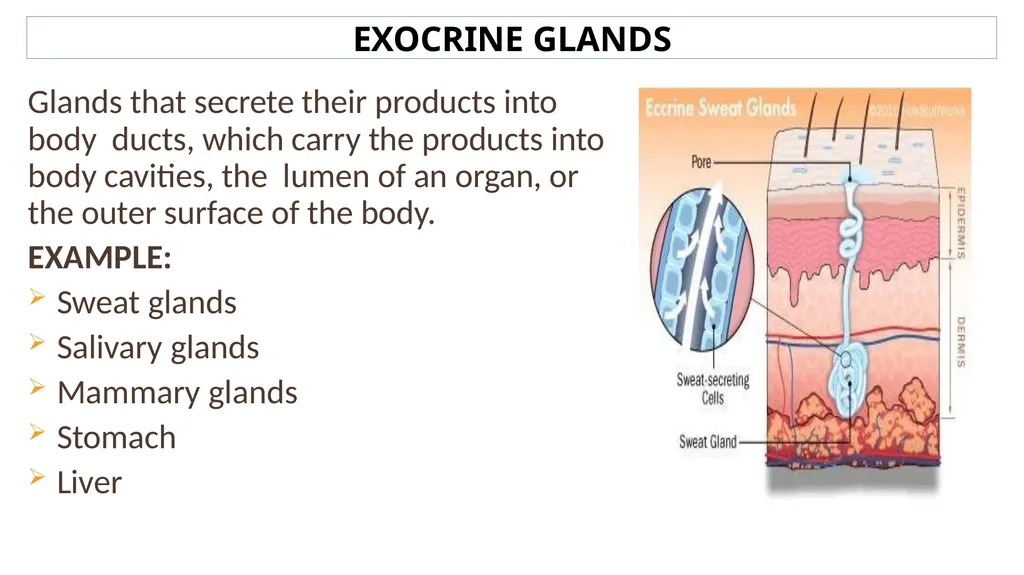
EXOCRINE GLANDS Glands that secrete their products into body ducts, which carry the products into body cavities, the lumen of an organ, or the outer surface of the body.
EXAMPLE:
Sweat glands
Salivary glands
Mammary glands
Stomach
Liver<br>
05
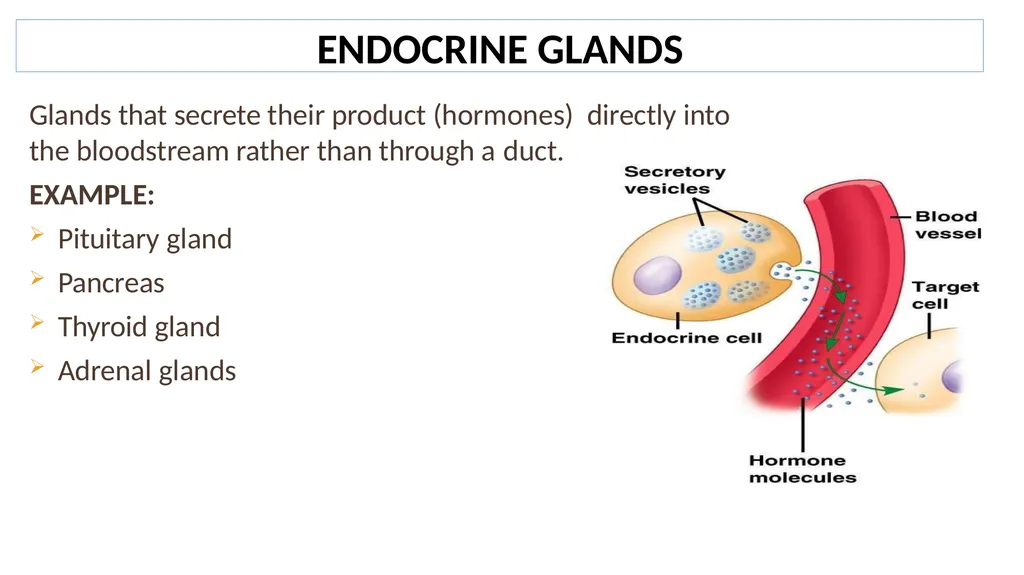
ENDOCRINE GLANDS Glands that secrete their product (hormones) directly into the bloodstream rather than through a duct.
EXAMPLE:
Pituitary gland
Pancreas
Thyroid gland
Adrenal glands<br>
06
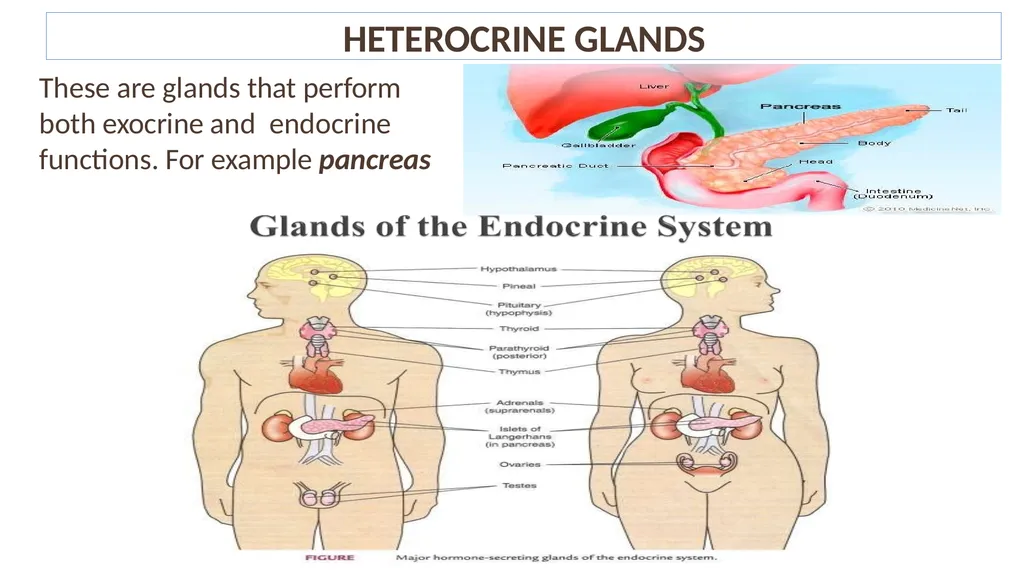
HETEROCRINE GLANDS These are glands that perform both exocrine and endocrine functions. For example pancreas<br>
07
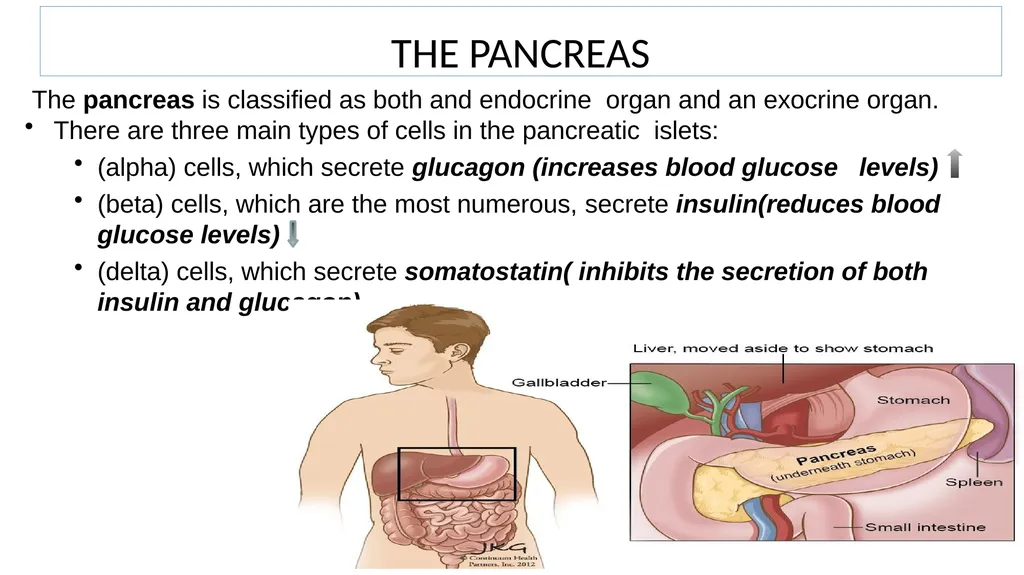
THE PANCREAS The pancreas is classified as both and endocrine organ and an exocrine organ.
There are three main types of cells in the pancreatic islets:
(alpha) cells, which secrete glucagon (increases blood glucose levels)
(beta) cells, which are the most numerous, secrete insulin(reduces blood glucose levels)
(delta) cells, which secrete somatostatin( inhibits the secretion of both insulin and glucagon).<br>
08
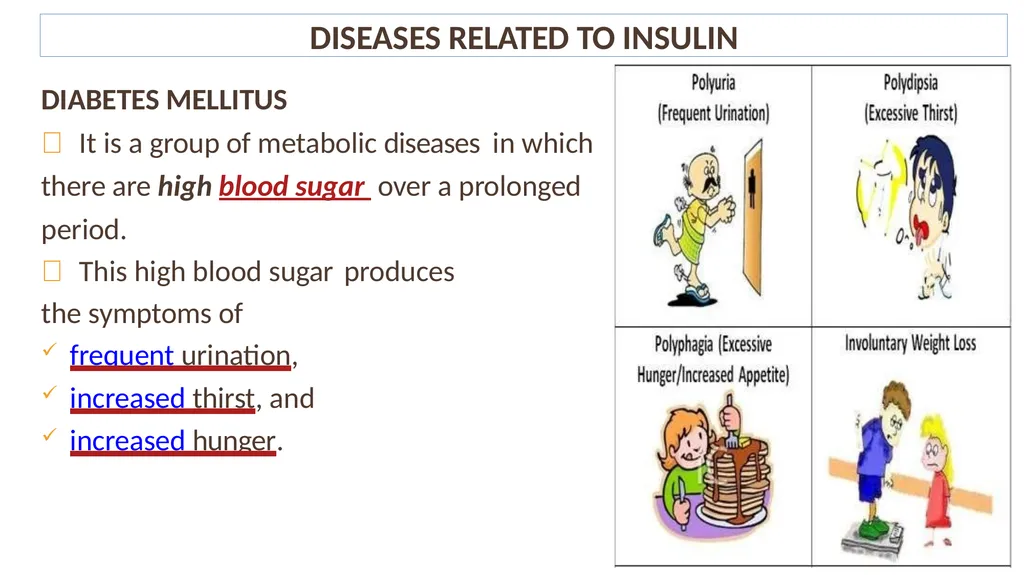
DISEASES RELATED TO INSULIN DIABETES MELLITUS
It is a group of metabolic diseases in which there are high blood sugar over a prolonged period.
This high blood sugar produces
the symptoms of
frequent urination,
increased thirst, and
increased hunger.<br>
09
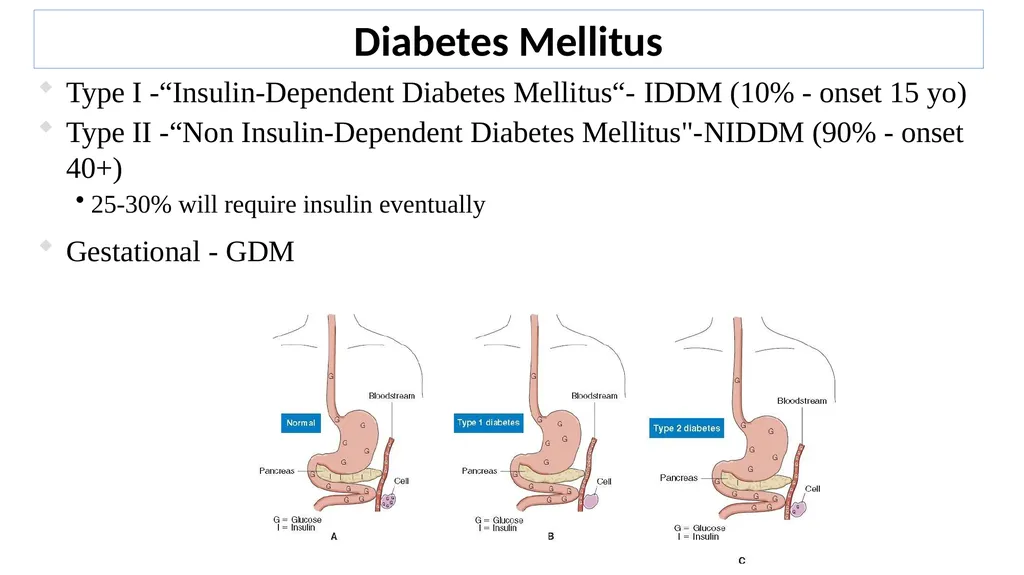
Type I -“Insulin-Dependent Diabetes Mellitus“- IDDM (10% - onset 15 yo)
Type II -“Non Insulin-Dependent Diabetes Mellitus"-NIDDM (90% - onset 40+)
25-30% will require insulin eventually
Gestational - GDM Diabetes Mellitus<br>
10
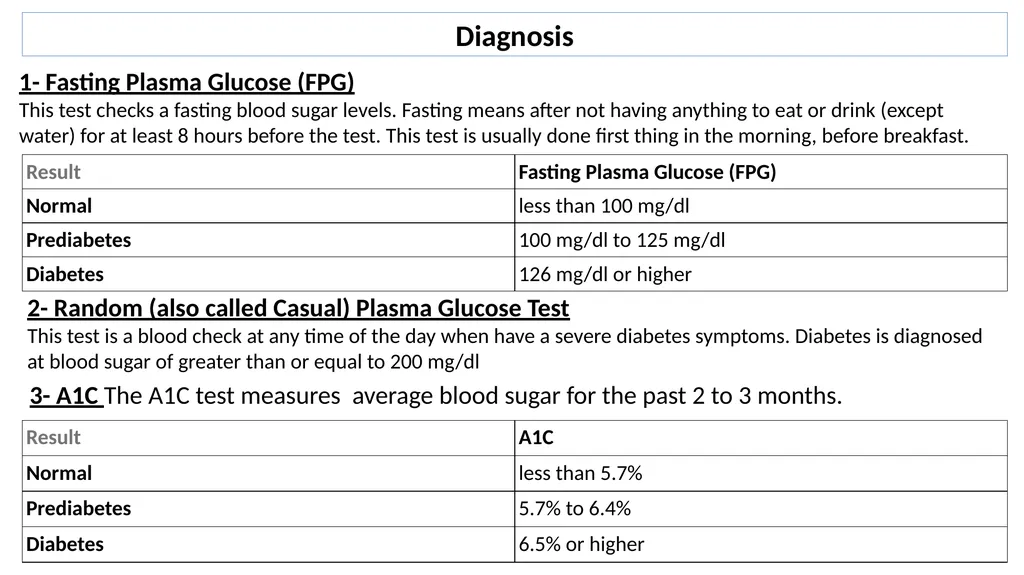
2- Random (also called Casual) Plasma Glucose Test
This test is a blood check at any time of the day when have a severe diabetes symptoms. Diabetes is diagnosed at blood sugar of greater than or equal to 200 mg/dl 1- Fasting Plasma Glucose (FPG)
This test checks a fasting blood sugar levels. Fasting means after not having anything to eat or drink (except water) for at least 8 hours before the test. This test is usually done first thing in the morning, before breakfast. 3- A1C The A1C test measures average blood sugar for the past 2 to 3 months. Diagnosis<br>
11
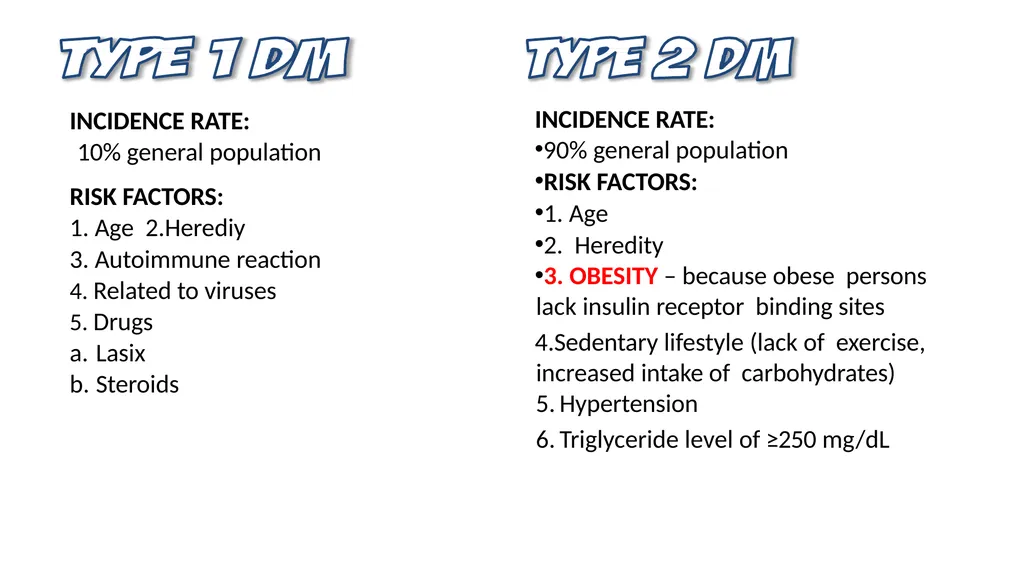
INCIDENCE RATE: 10% general population
RISK FACTORS:
1. Age 2.Herediy
3. Autoimmune reaction
Related to viruses
Drugs
Lasix
Steroids INCIDENCE RATE:
90% general population
RISK FACTORS:
1. Age
2. Heredity
3. OBESITY – because obese persons lack insulin receptor binding sites
Sedentary lifestyle (lack of exercise, increased intake of carbohydrates)
Hypertension
Triglyceride level of ≥250 mg/dL<br>
12
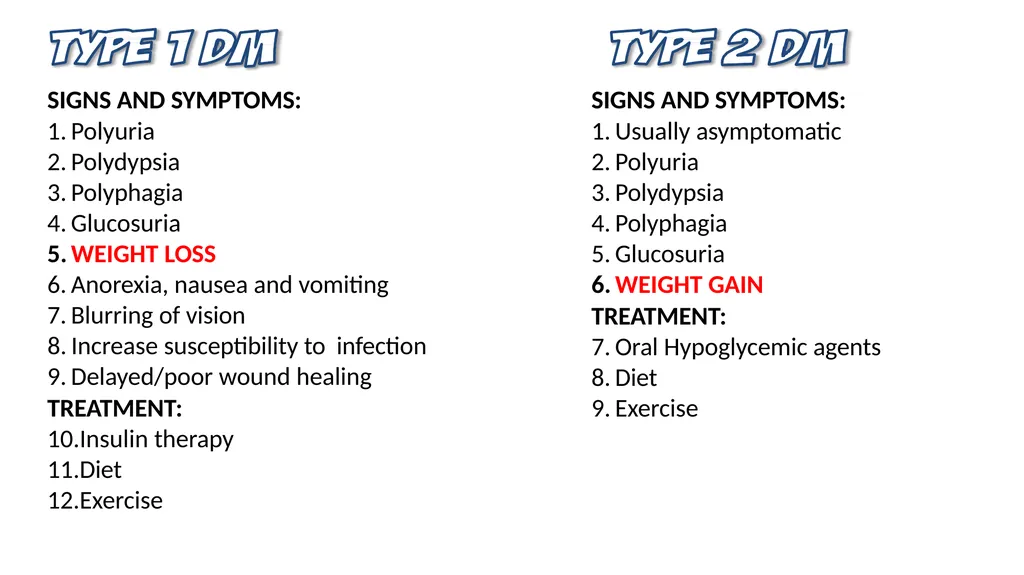
SIGNS AND SYMPTOMS:
Polyuria
Polydypsia
Polyphagia
Glucosuria
WEIGHT LOSS
Anorexia, nausea and vomiting
Blurring of vision
Increase susceptibility to infection
Delayed/poor wound healing
TREATMENT:
Insulin therapy
Diet
Exercise SIGNS AND SYMPTOMS:
Usually asymptomatic
Polyuria
Polydypsia
Polyphagia
Glucosuria
WEIGHT GAIN
TREATMENT:
Oral Hypoglycemic agents
Diet
Exercise<br>
13
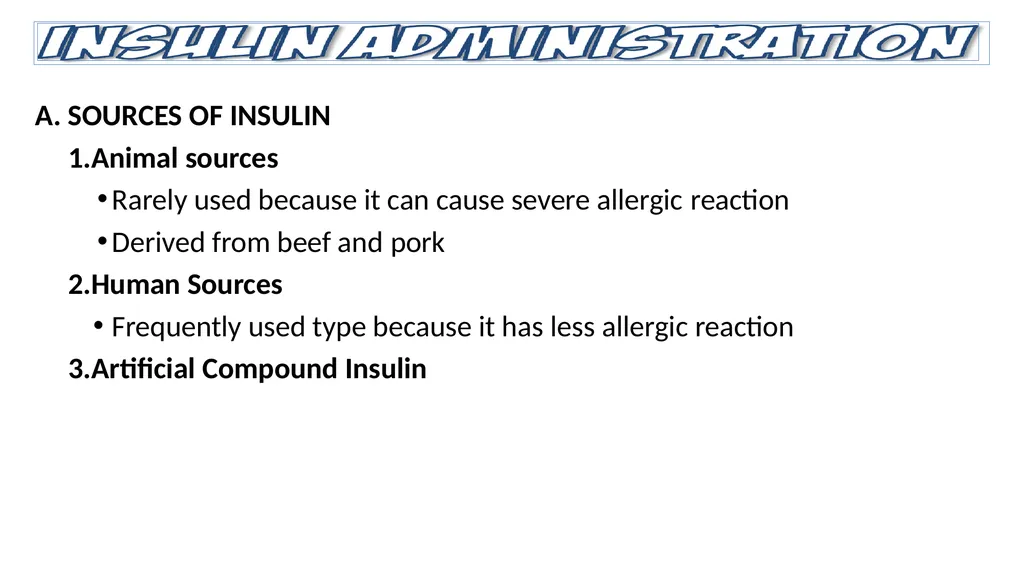
A. SOURCES OF INSULIN
Animal sources
Rarely used because it can cause severe allergic reaction
Derived from beef and pork
Human Sources
Frequently used type because it has less allergic reaction
Artificial Compound Insulin<br>
14
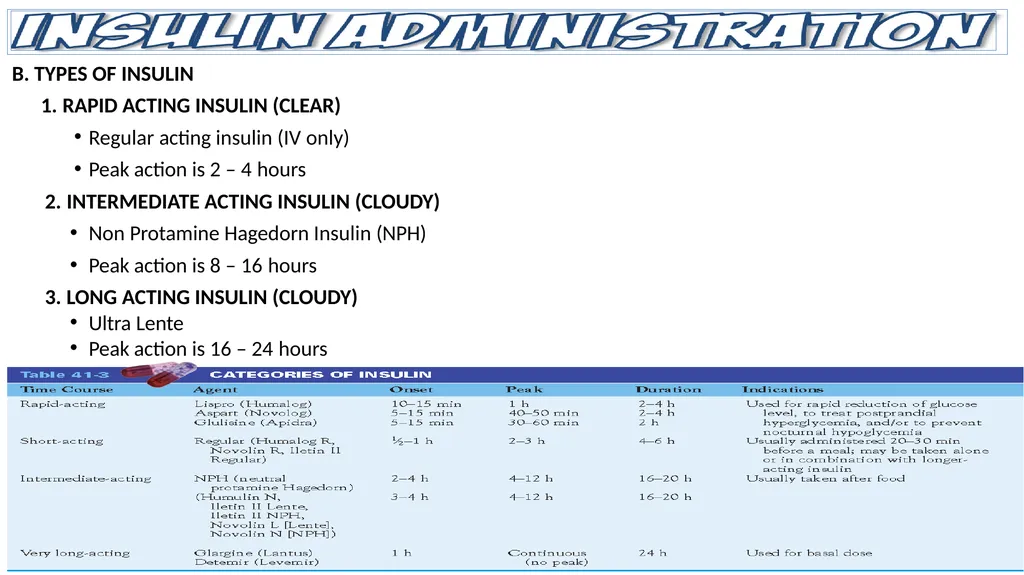
B. TYPES OF INSULIN
RAPID ACTING INSULIN (CLEAR)
Regular acting insulin (IV only)
Peak action is 2 – 4 hours
INTERMEDIATE ACTING INSULIN (CLOUDY)
Non Protamine Hagedorn Insulin (NPH)
Peak action is 8 – 16 hours
LONG ACTING INSULIN (CLOUDY)
Ultra Lente
Peak action is 16 – 24 hours<br>
15
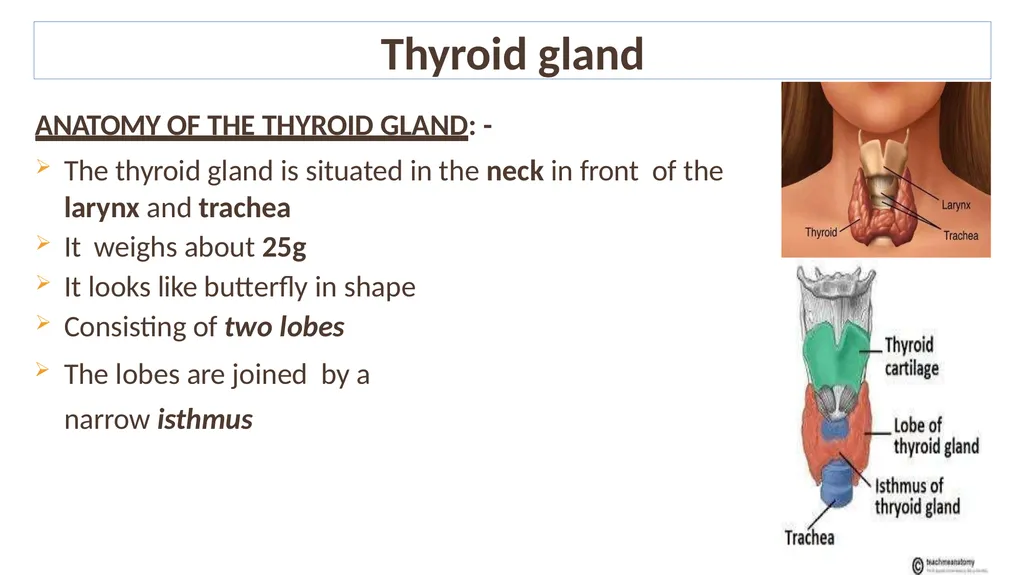
Thyroid gland ANATOMY OF THE THYROID GLAND: -
The thyroid gland is situated in the neck in front of the larynx and trachea
It weighs about 25g
It looks like butterfly in shape
Consisting of two lobes
The lobes are joined by a narrow isthmus<br>
16
THYROID HORMONES Tri-iodothyronine (T3): It affects almost every physiological process in the body:
Growth and development,
Metabolism,
Body temperature, and
Heart rate
Thyroxin (T4):
Controls development and maturation
Excess thyroxin results rapid development
Deficiency of thyroxin results in delayed development<br>
17
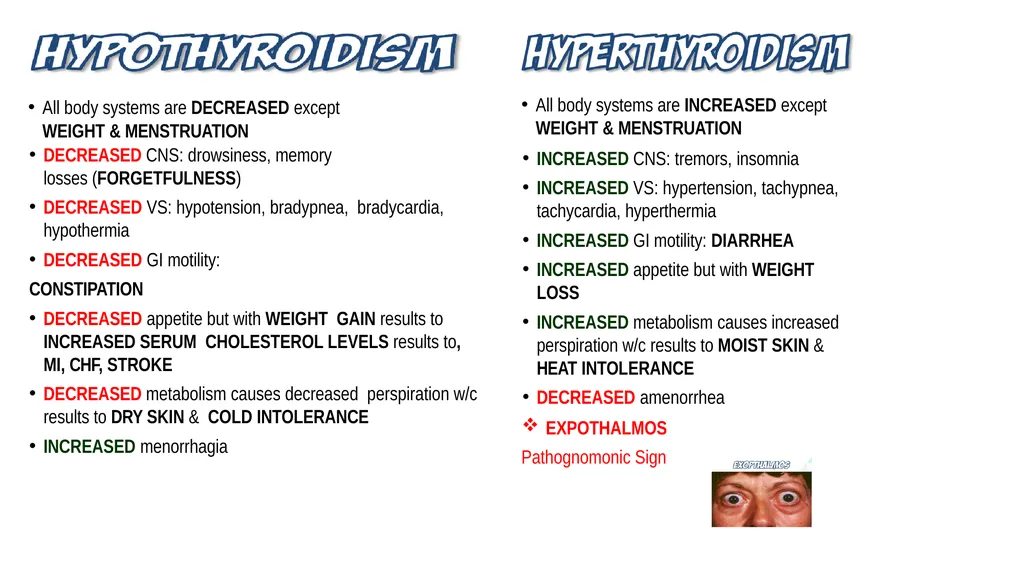
All body systems are DECREASED except
WEIGHT & MENSTRUATION
DECREASED CNS: drowsiness, memory
losses (FORGETFULNESS)
DECREASED VS: hypotension, bradypnea, bradycardia, hypothermia
DECREASED GI motility:
CONSTIPATION
DECREASED appetite but with WEIGHT GAIN results to INCREASED SERUM CHOLESTEROL LEVELS results to, MI, CHF, STROKE
DECREASED metabolism causes decreased perspiration w/c results to DRY SKIN & COLD INTOLERANCE
INCREASED menorrhagia All body systems are INCREASED except
WEIGHT & MENSTRUATION
INCREASED CNS: tremors, insomnia
INCREASED VS: hypertension, tachypnea, tachycardia, hyperthermia
INCREASED GI motility: DIARRHEA
INCREASED appetite but with WEIGHT
LOSS
INCREASED metabolism causes increased perspiration w/c results to MOIST SKIN & HEAT INTOLERANCE
DECREASED amenorrhea
EXPOTHALMOS
Pathognomonic Sign<br>
18
DIAGNOSTIC TESTS:
Serum T3 and T4 is DECREASED
Serum Cholesterol is INCREASED
NURSING MANAGEMENT:
1.Monitor vital signs and intake and output to determine presence of:
MYXEDEMA COMA is a severe form of hypothyroidism is characterized by severe hypotension, bradycardia, bradypnea ,hyponatremia, hypoglycemia leading progressive to coma.
NURSING MANAGEMENT FOR MYXEDEMA
COMA
comfortable and warm environment
Assist in mechanical ventilation
Administer thyroid hormones as ordered
IV fluids (isotonic) DIAGNOSTIC TESTS:
Serum T3 and T4 is INCREASED
Thyroid Scan - reveals an ENLARGED
THYROID GLAND
NURSING MANAGEMENT:
1. Monitor vital signs and intake and output to determine presence of:
THYROID STORM is a severe form of hyperthyroidism is characterized by severe hypertension, tachycardia, tachypnea, hyperpyrexia, altered neurologic or mental state, which frequently appears as delirium psychosis, coma
NURSING MANAGEMENT FOR THYROTOXICOSIS
Cool quiet environment
O2 inhalation
IV fluids (hypertonic)
Antithyroid agents<br>