
Leptospirosis is a bacterial disease that affects
DJ
Published · 28 slides · 0 views

1 / 1


Description
Leptospirosis is a bacterial disease that affects humans and animals. It is caused by bacteria of the genus Leptospira. In humans, it can cause a wide range of symptoms. Without treatment, Leptospirosis can lead to kidney damage,
Related Topics
Share
Embed code
Download this presentation From Below
"Leptospirosis is a bacterial disease that affects" is the property of its rightful owner. Permission is granted to download and print the materials on this website for personal, non-commercial use only, and to display it on your personal computer provided you do not modify the materials and that you retain all copyright notices contained in the materials. By downloading content from our website, you accept the terms of this agreement.
Presentation Transcript
01
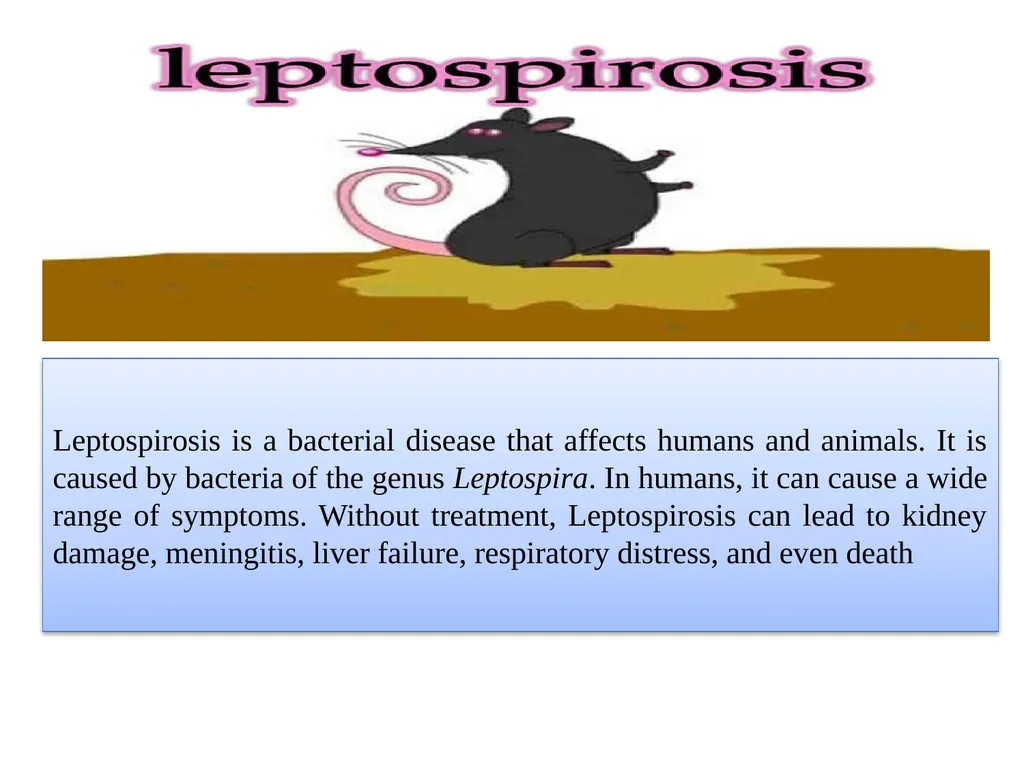
Leptospirosis is a bacterial disease that affects humans and animals. It is caused by bacteria of the genus Leptospira. In humans, it can cause a wide range of symptoms. Without treatment, Leptospirosis can lead to kidney damage, meningitis, liver failure, respiratory distress, and even death<br>
02
Autmnal fever,
Cane cutter's disease,
Canicola fever,
Harvest fever,
Infectious jaundice, "Lepro",
Mud fever,
Rice field worker's disease,
Seven day fever,
Swamp fever,
Swine herd's disease,
Walter fever, Weil's disease
Fort Braggs disease
Fish handlers disease Synonyms<br>
Cane cutter's disease,
Canicola fever,
Harvest fever,
Infectious jaundice, "Lepro",
Mud fever,
Rice field worker's disease,
Seven day fever,
Swamp fever,
Swine herd's disease,
Walter fever, Weil's disease
Fort Braggs disease
Fish handlers disease Synonyms<br>
03
Etiology Caused by- L. interrogans
Genus- Leptospira (Group1- Spirochaets)
L. interrogans L. biflexa
(Parasitic & Pathogenic ) (Saprophytic & Non-pathogenic )
Pathogenic leptospires have been divided into 38 groups and 65 serovars
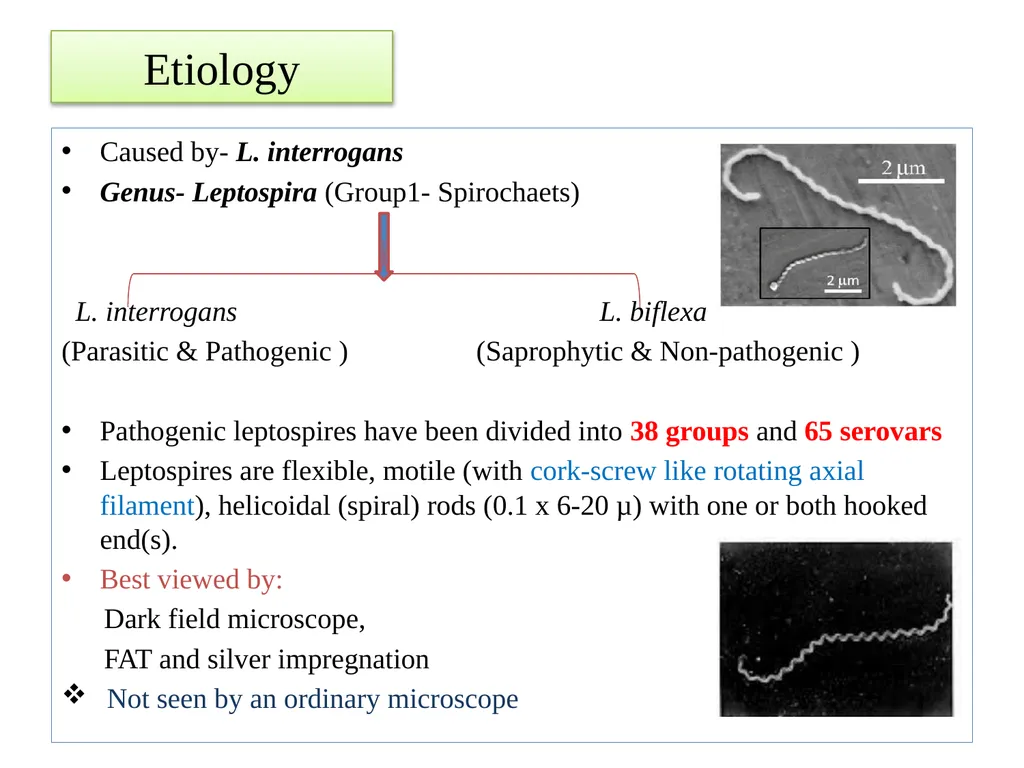
Leptospires are flexible, motile (with cork-screw like rotating axial filament), helicoidal (spiral) rods (0.1 x 6-20 µ) with one or both hooked end(s).
Best viewed by:
Dark field microscope,
FAT and silver impregnation
Not seen by an ordinary microscope<br>
Genus- Leptospira (Group1- Spirochaets)
L. interrogans L. biflexa
(Parasitic & Pathogenic ) (Saprophytic & Non-pathogenic )
Pathogenic leptospires have been divided into 38 groups and 65 serovars
Leptospires are flexible, motile (with cork-screw like rotating axial filament), helicoidal (spiral) rods (0.1 x 6-20 µ) with one or both hooked end(s).
Best viewed by:
Dark field microscope,
FAT and silver impregnation
Not seen by an ordinary microscope<br>
04
Epidemiology In Animals
Worldwide
Occurs in the form of inapparent infections or varied clinical manifestations
The disease has been identified in all domestic animals, pets, almost all of the species commonly kept in zoological gardens or as laboratory animals, and majority of wild animals particularly rodents
Reported more frequently: Southern states although few reports are also available from western states (Gujarat and Rajasthan)<br>
Worldwide
Occurs in the form of inapparent infections or varied clinical manifestations
The disease has been identified in all domestic animals, pets, almost all of the species commonly kept in zoological gardens or as laboratory animals, and majority of wild animals particularly rodents
Reported more frequently: Southern states although few reports are also available from western states (Gujarat and Rajasthan)<br>
05
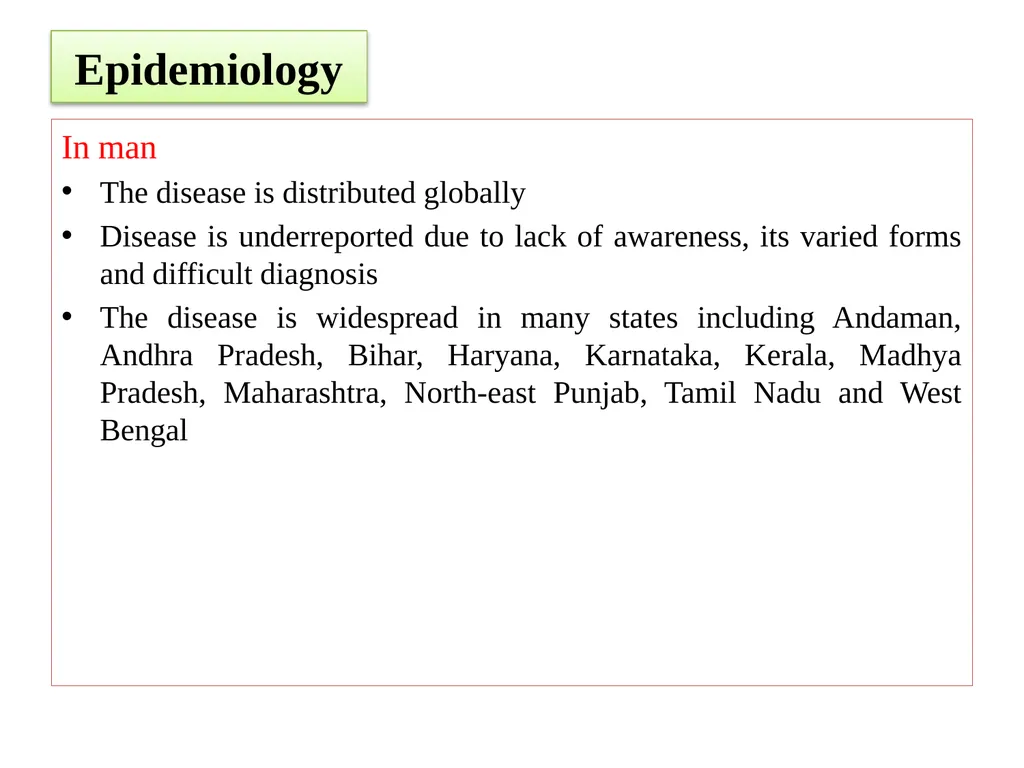
In man
The disease is distributed globally
Disease is underreported due to lack of awareness, its varied forms and difficult diagnosis
The disease is widespread in many states including Andaman, Andhra Pradesh, Bihar, Haryana, Karnataka, Kerala, Madhya Pradesh, Maharashtra, North-east Punjab, Tamil Nadu and West Bengal Epidemiology<br>
The disease is distributed globally
Disease is underreported due to lack of awareness, its varied forms and difficult diagnosis
The disease is widespread in many states including Andaman, Andhra Pradesh, Bihar, Haryana, Karnataka, Kerala, Madhya Pradesh, Maharashtra, North-east Punjab, Tamil Nadu and West Bengal Epidemiology<br>
06
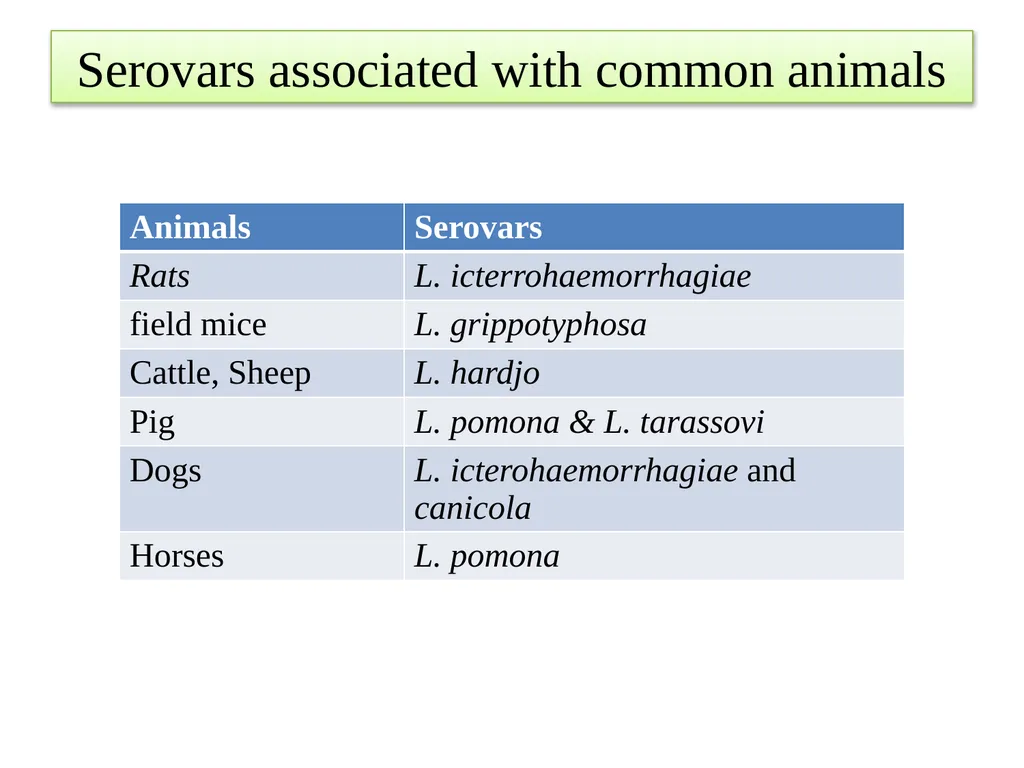
Serovars associated with common animals<br>
07
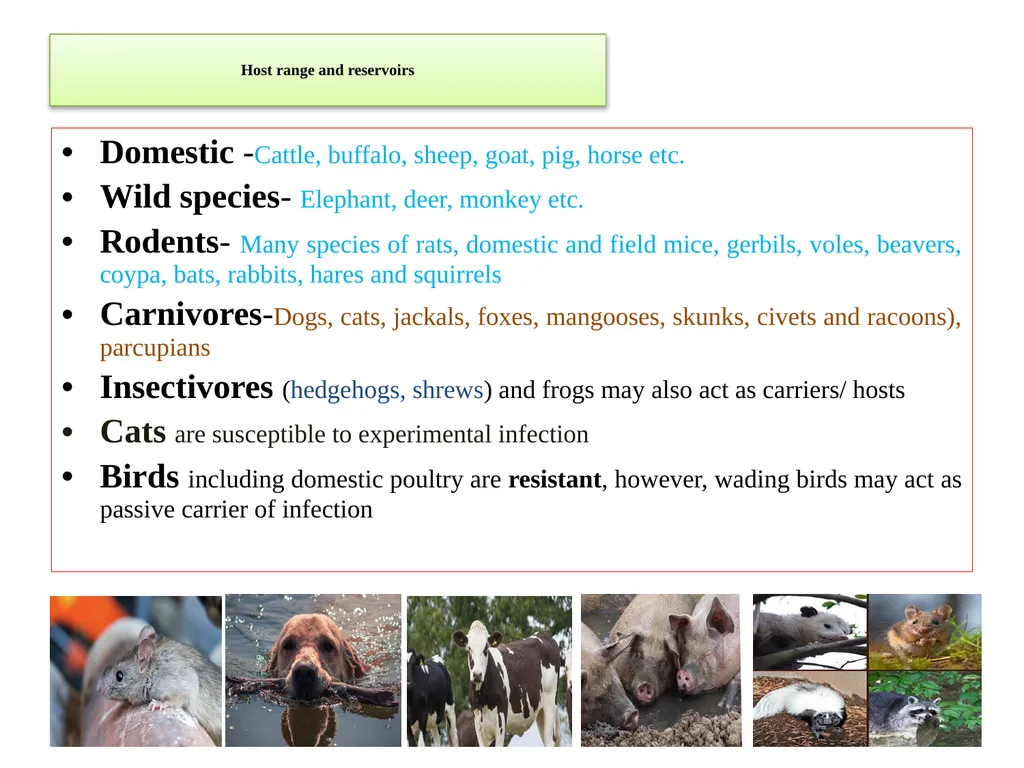
Host range and reservoirs Domestic -Cattle, buffalo, sheep, goat, pig, horse etc.
Wild species- Elephant, deer, monkey etc.
Rodents- Many species of rats, domestic and field mice, gerbils, voles, beavers, coypa, bats, rabbits, hares and squirrels
Carnivores-Dogs, cats, jackals, foxes, mangooses, skunks, civets and racoons), parcupians
Insectivores (hedgehogs, shrews) and frogs may also act as carriers/ hosts
Cats are susceptible to experimental infection
Birds including domestic poultry are resistant, however, wading birds may act as passive carrier of infection<br>
Wild species- Elephant, deer, monkey etc.
Rodents- Many species of rats, domestic and field mice, gerbils, voles, beavers, coypa, bats, rabbits, hares and squirrels
Carnivores-Dogs, cats, jackals, foxes, mangooses, skunks, civets and racoons), parcupians
Insectivores (hedgehogs, shrews) and frogs may also act as carriers/ hosts
Cats are susceptible to experimental infection
Birds including domestic poultry are resistant, however, wading birds may act as passive carrier of infection<br>
08
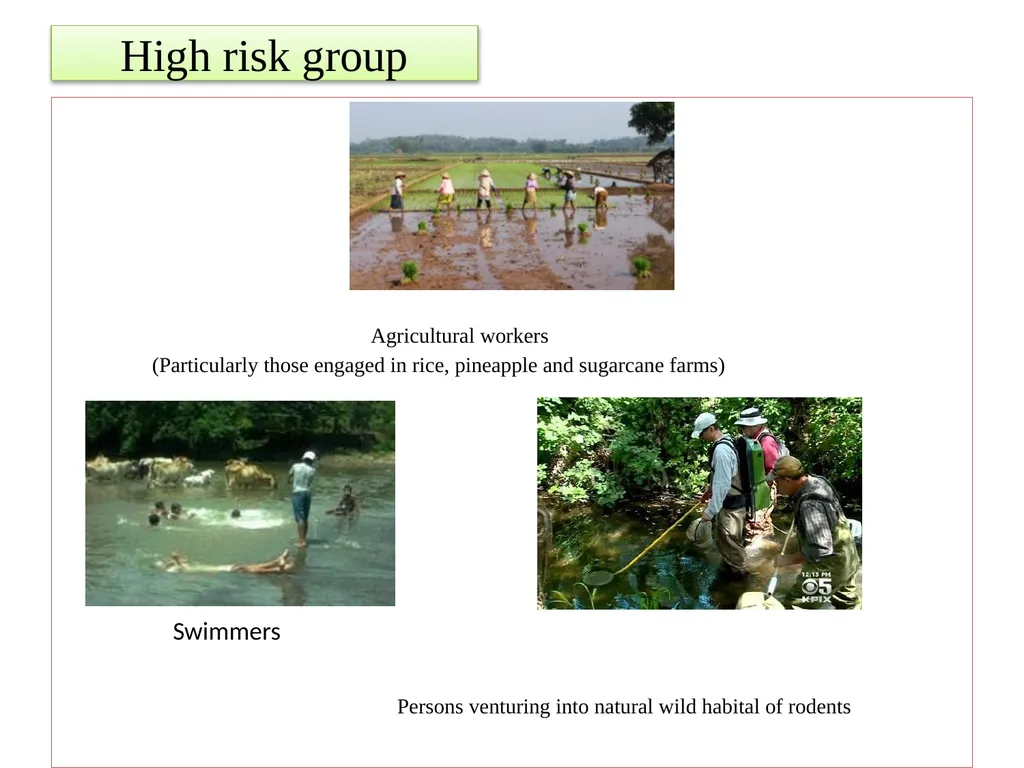
High risk group Agricultural workers
(Particularly those engaged in rice, pineapple and sugarcane farms)
Persons venturing into natural wild habital of rodents Swimmers<br>
(Particularly those engaged in rice, pineapple and sugarcane farms)
Persons venturing into natural wild habital of rodents Swimmers<br>
09
Transmission Animals
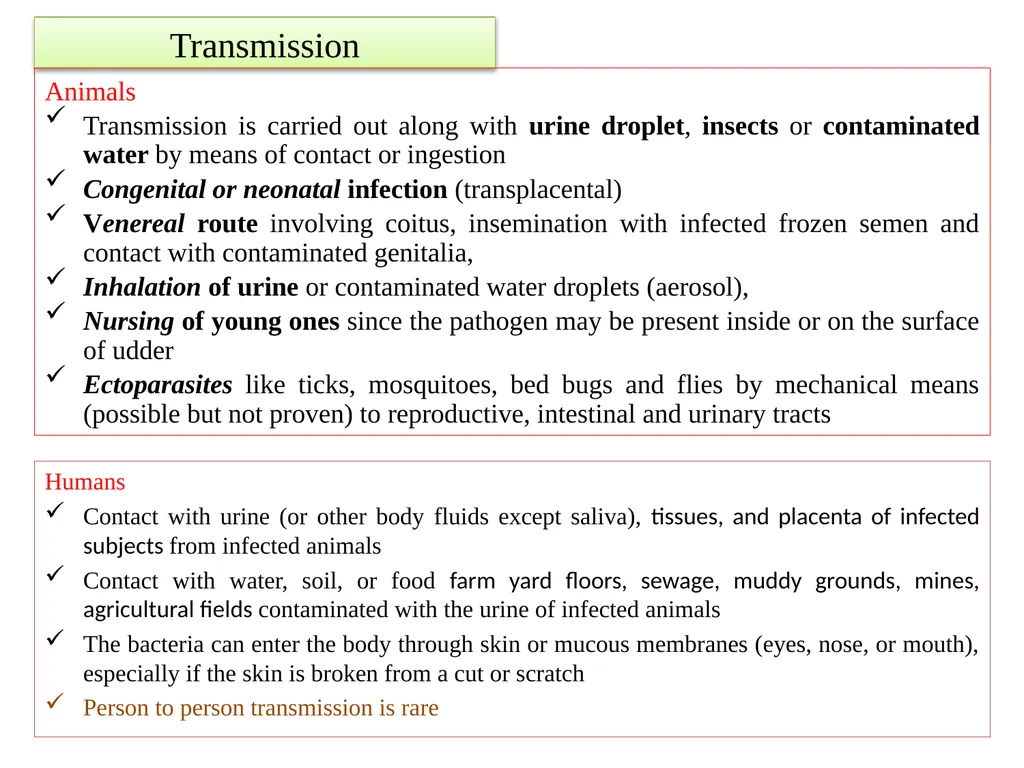
Transmission is carried out along with urine droplet, insects or contaminated water by means of contact or ingestion
Congenital or neonatal infection (transplacental)
Venereal route involving coitus, insemination with infected frozen semen and contact with contaminated genitalia,
Inhalation of urine or contaminated water droplets (aerosol),
Nursing of young ones since the pathogen may be present inside or on the surface of udder
Ectoparasites like ticks, mosquitoes, bed bugs and flies by mechanical means (possible but not proven) to reproductive, intestinal and urinary tracts Humans
Contact with urine (or other body fluids except saliva), tissues, and placenta of infected subjects from infected animals
Contact with water, soil, or food farm yard floors, sewage, muddy grounds, mines, agricultural fields contaminated with the urine of infected animals
The bacteria can enter the body through skin or mucous membranes (eyes, nose, or mouth), especially if the skin is broken from a cut or scratch
Person to person transmission is rare<br>
Transmission is carried out along with urine droplet, insects or contaminated water by means of contact or ingestion
Congenital or neonatal infection (transplacental)
Venereal route involving coitus, insemination with infected frozen semen and contact with contaminated genitalia,
Inhalation of urine or contaminated water droplets (aerosol),
Nursing of young ones since the pathogen may be present inside or on the surface of udder
Ectoparasites like ticks, mosquitoes, bed bugs and flies by mechanical means (possible but not proven) to reproductive, intestinal and urinary tracts Humans
Contact with urine (or other body fluids except saliva), tissues, and placenta of infected subjects from infected animals
Contact with water, soil, or food farm yard floors, sewage, muddy grounds, mines, agricultural fields contaminated with the urine of infected animals
The bacteria can enter the body through skin or mucous membranes (eyes, nose, or mouth), especially if the skin is broken from a cut or scratch
Person to person transmission is rare<br>
10
The organism enter the host via ..
Mucous membrane of the eyes
Genitals
Nasopharynx or
The alimentary tract Main mode of transmission are ..
Ingestion of contaminated material
Inhalation of urine droplet
Contact with infected material
Congenital, neonatal, venereal route Leptospires can survive for weeks in soil and water frequently contaminated by urine of carriers, particularly if the pH is alkaline<br>
Mucous membrane of the eyes
Genitals
Nasopharynx or
The alimentary tract Main mode of transmission are ..
Ingestion of contaminated material
Inhalation of urine droplet
Contact with infected material
Congenital, neonatal, venereal route Leptospires can survive for weeks in soil and water frequently contaminated by urine of carriers, particularly if the pH is alkaline<br>
11
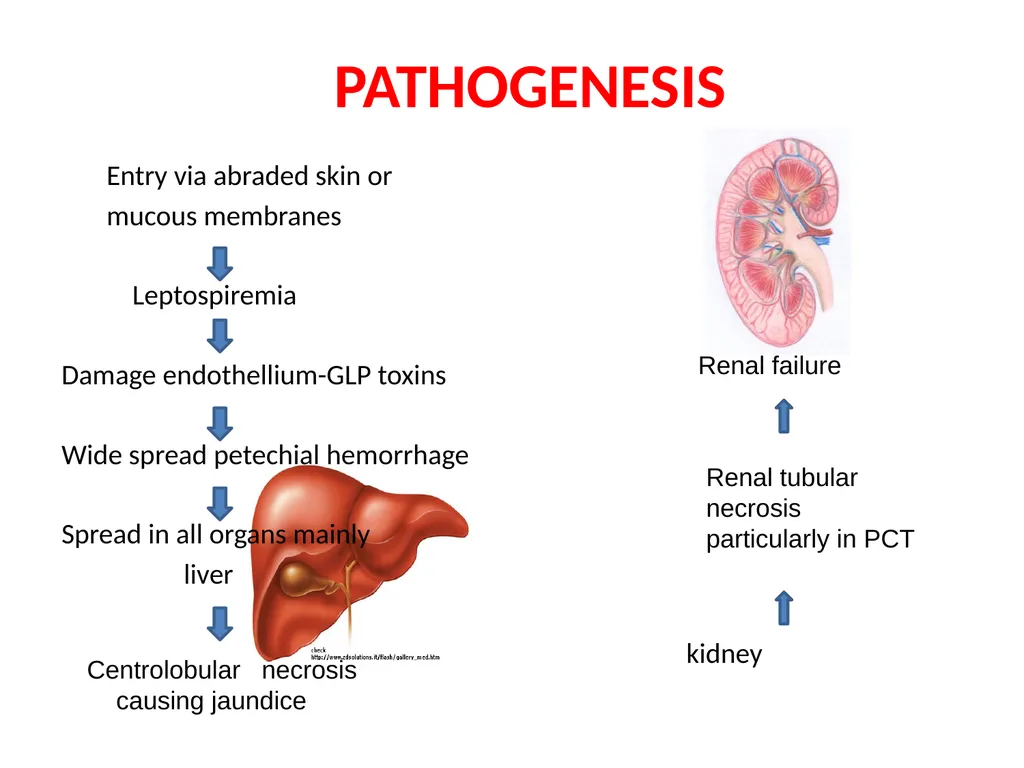
PATHOGENESIS Entry via abraded skin or
mucous membranes
Leptospiremia
Damage endothellium-GLP toxins
Wide spread petechial hemorrhage
Spread in all organs mainly
liver
kidney Renal tubular necrosis particularly in PCT Renal failure Centrolobular necrosis causing jaundice<br>
mucous membranes
Leptospiremia
Damage endothellium-GLP toxins
Wide spread petechial hemorrhage
Spread in all organs mainly
liver
kidney Renal tubular necrosis particularly in PCT Renal failure Centrolobular necrosis causing jaundice<br>
12
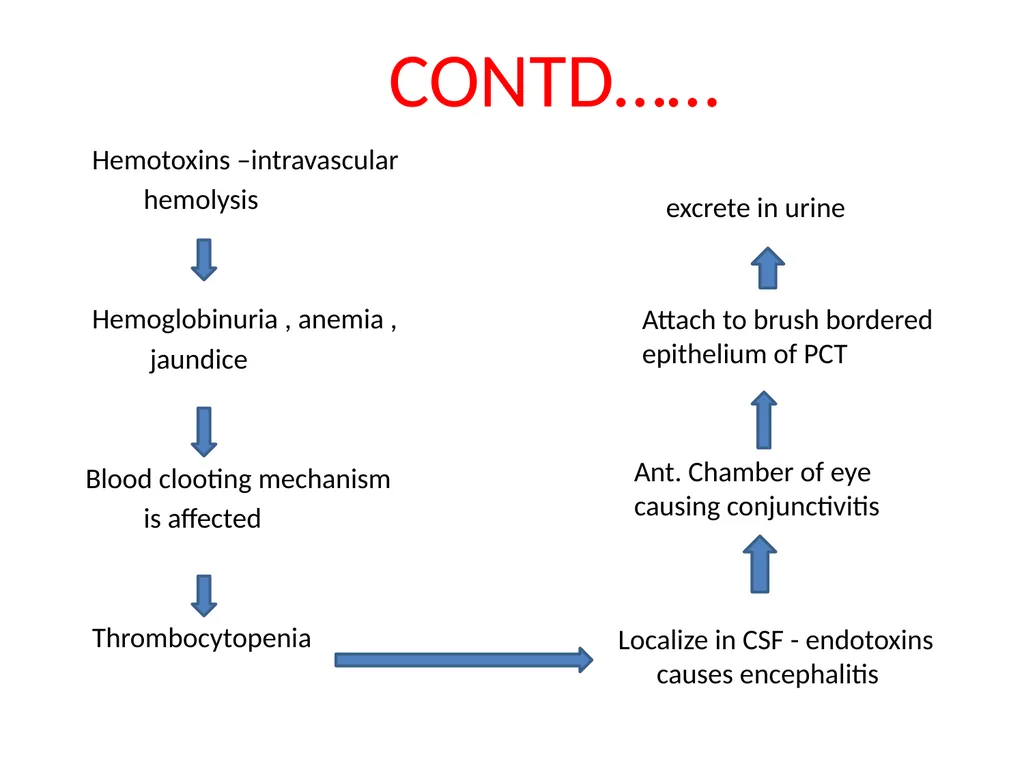
CONTD…… Hemotoxins –intravascular
hemolysis
Hemoglobinuria , anemia ,
jaundice
Blood clooting mechanism
is affected
Thrombocytopenia Localize in CSF - endotoxins causes encephalitis Ant. Chamber of eye causing conjunctivitis Attach to brush bordered epithelium of PCT excrete in urine<br>
hemolysis
Hemoglobinuria , anemia ,
jaundice
Blood clooting mechanism
is affected
Thrombocytopenia Localize in CSF - endotoxins causes encephalitis Ant. Chamber of eye causing conjunctivitis Attach to brush bordered epithelium of PCT excrete in urine<br>
13
1. Cattle
The infection is usually in-apparent Symptoms In acute form:
Sudden onset of elevated temperature (40-41.1C), anorexia, anaemia/jaundice, haemoglobinurea, abortion (usually late in pregnancy, 3-12 weeks post infection) and depression may be seen In subacute form:
Onset is slow, "milk drop syndrome" due to mastitis resulting in reduced yield, thick flaking (like of colostrum) and yellow to blood coloration of milk is common. The symptoms lasts for about 2 weeks. Jaundice may be seen in some cases In chronic form:
Abortions, still births, fetal deaths, weak calves and retained placenta cases are common in herds<br>
The infection is usually in-apparent Symptoms In acute form:
Sudden onset of elevated temperature (40-41.1C), anorexia, anaemia/jaundice, haemoglobinurea, abortion (usually late in pregnancy, 3-12 weeks post infection) and depression may be seen In subacute form:
Onset is slow, "milk drop syndrome" due to mastitis resulting in reduced yield, thick flaking (like of colostrum) and yellow to blood coloration of milk is common. The symptoms lasts for about 2 weeks. Jaundice may be seen in some cases In chronic form:
Abortions, still births, fetal deaths, weak calves and retained placenta cases are common in herds<br>
14
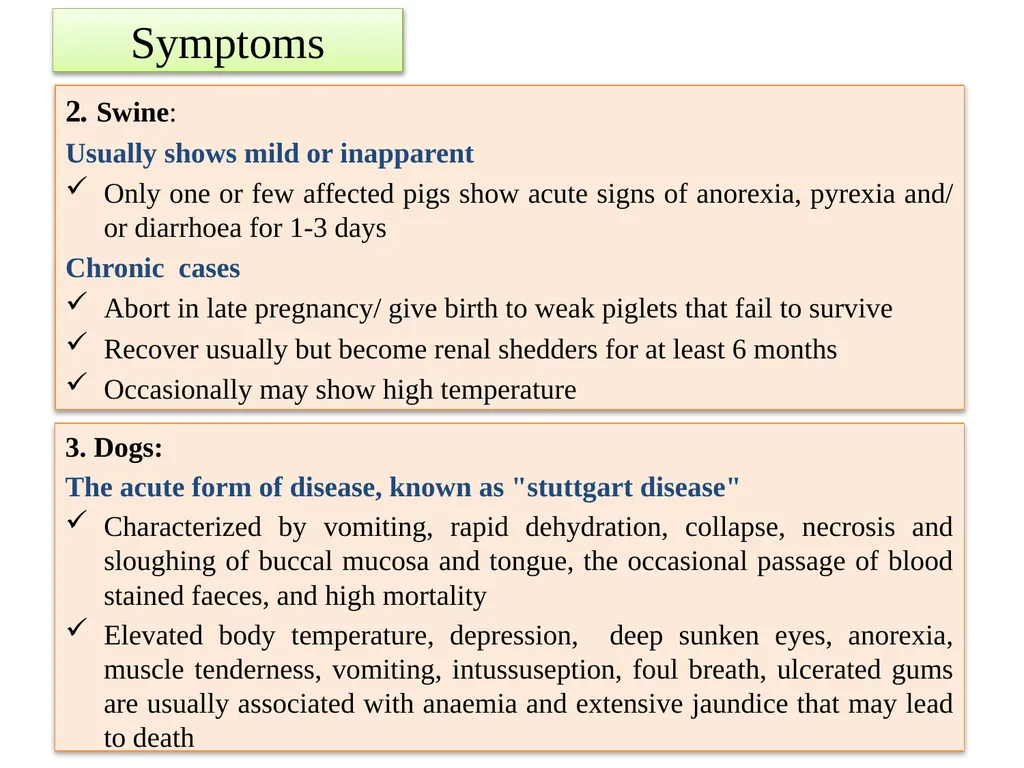
2. Swine:
Usually shows mild or inapparent
Only one or few affected pigs show acute signs of anorexia, pyrexia and/ or diarrhoea for 1-3 days
Chronic cases
Abort in late pregnancy/ give birth to weak piglets that fail to survive
Recover usually but become renal shedders for at least 6 months
Occasionally may show high temperature Symptoms 3. Dogs:
The acute form of disease, known as "stuttgart disease"
Characterized by vomiting, rapid dehydration, collapse, necrosis and sloughing of buccal mucosa and tongue, the occasional passage of blood stained faeces, and high mortality
Elevated body temperature, depression, deep sunken eyes, anorexia, muscle tenderness, vomiting, intussuseption, foul breath, ulcerated gums are usually associated with anaemia and extensive jaundice that may lead to death<br>
Usually shows mild or inapparent
Only one or few affected pigs show acute signs of anorexia, pyrexia and/ or diarrhoea for 1-3 days
Chronic cases
Abort in late pregnancy/ give birth to weak piglets that fail to survive
Recover usually but become renal shedders for at least 6 months
Occasionally may show high temperature Symptoms 3. Dogs:
The acute form of disease, known as "stuttgart disease"
Characterized by vomiting, rapid dehydration, collapse, necrosis and sloughing of buccal mucosa and tongue, the occasional passage of blood stained faeces, and high mortality
Elevated body temperature, depression, deep sunken eyes, anorexia, muscle tenderness, vomiting, intussuseption, foul breath, ulcerated gums are usually associated with anaemia and extensive jaundice that may lead to death<br>
15
4. Horses :
Rare and usually mild, include pyrexia, icterus, periodic opthalmia and abortion
5. Sheep :
Abortion, fever, agalactia, dysponea, jaundice, haematuria and sudden death
6. Goats :
May remain symptomless but shed leptospires in the urine for short periods or
May develop jaundice, haemaglobinurea and abortions Symptoms<br>
Rare and usually mild, include pyrexia, icterus, periodic opthalmia and abortion
5. Sheep :
Abortion, fever, agalactia, dysponea, jaundice, haematuria and sudden death
6. Goats :
May remain symptomless but shed leptospires in the urine for short periods or
May develop jaundice, haemaglobinurea and abortions Symptoms<br>
16
Symptoms Early or Leptospiaremic phase
The pathogen appears in blood and cerebrospinal fluid (CSF)
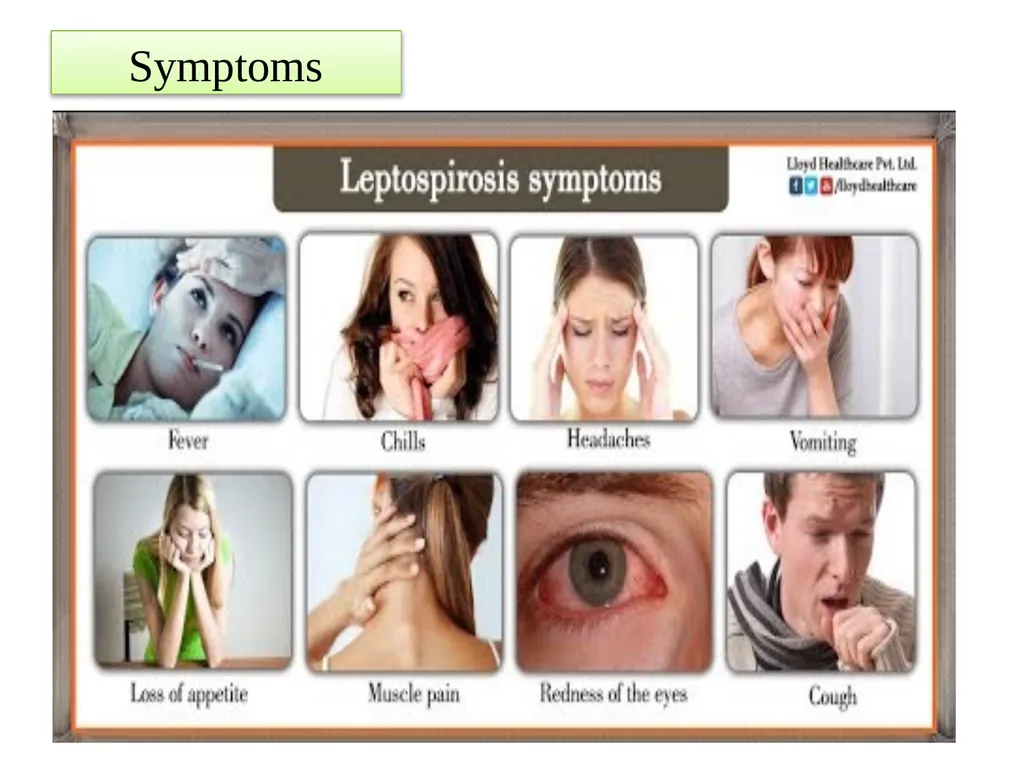
'flu-like' syndrome which is characterized by sudden high fever, chills, headache, muscle aches, vomiting and conjunctivitis
Most of the cases (90%) recover completely from the milder form of infection even without medication
Second or Immune phase/Weil's syndrome
Mild fever is noticed as the blood infection disappears due to action of phagocytes, IgM and complement
Gradually worsen leading to kidney and liver failure, of which the latter results in jaundice
Widespread haemorrhages occur leading to anaemia, coma and finally death (mainly in elderly or due to virulent strain).
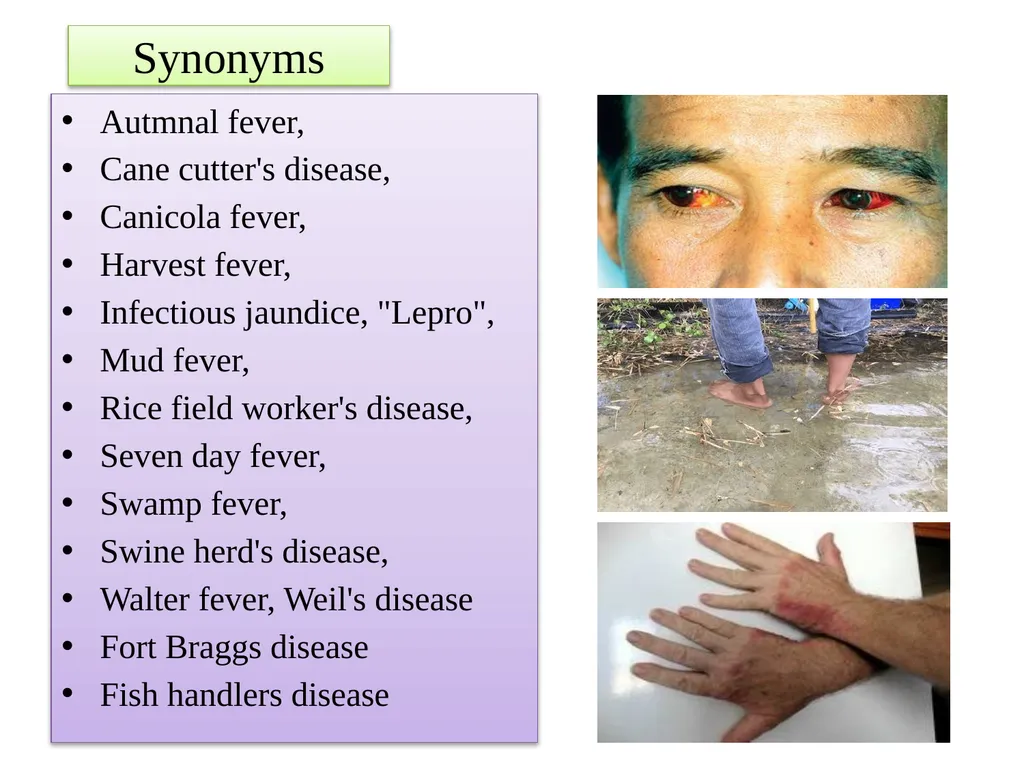
"Red eye" (conjunctival suffusion due to immune reaction ) is a constant and characteristic feature All the severe form have a mortality rate of 5-10% Incubation period -7-14 days<br>
The pathogen appears in blood and cerebrospinal fluid (CSF)
'flu-like' syndrome which is characterized by sudden high fever, chills, headache, muscle aches, vomiting and conjunctivitis
Most of the cases (90%) recover completely from the milder form of infection even without medication
Second or Immune phase/Weil's syndrome
Mild fever is noticed as the blood infection disappears due to action of phagocytes, IgM and complement
Gradually worsen leading to kidney and liver failure, of which the latter results in jaundice
Widespread haemorrhages occur leading to anaemia, coma and finally death (mainly in elderly or due to virulent strain).
"Red eye" (conjunctival suffusion due to immune reaction ) is a constant and characteristic feature All the severe form have a mortality rate of 5-10% Incubation period -7-14 days<br>
17
Symptoms<br>
18
Diagnosis The disease can be tentatively diagnosed on the basis of:
Clinical symptoms
History
Cases in high risk group
Case from endemic area
Confirmatory diagnosed by:
a. Direct examination of the samples
(Samples: Blood, CSF, urine, tissue scrapping/emulsion, kidney, brain, aborted foetus, semen) 10% acetic acid/5-19 min
(in case of impression smears) 0.25% trypsin/3-5 min
(in case of tissues) 40% formalin
(to decontaminate i.e. urine) (i)Dark field microscopy: Leptospires are best seen under dark field at 40x magnification
(ii)Silver staining (Fontana stain): Visualization of leptospires in silver stained tissue sections is possible but it lacks specificity<br>
Clinical symptoms
History
Cases in high risk group
Case from endemic area
Confirmatory diagnosed by:
a. Direct examination of the samples
(Samples: Blood, CSF, urine, tissue scrapping/emulsion, kidney, brain, aborted foetus, semen) 10% acetic acid/5-19 min
(in case of impression smears) 0.25% trypsin/3-5 min
(in case of tissues) 40% formalin
(to decontaminate i.e. urine) (i)Dark field microscopy: Leptospires are best seen under dark field at 40x magnification
(ii)Silver staining (Fontana stain): Visualization of leptospires in silver stained tissue sections is possible but it lacks specificity<br>
19
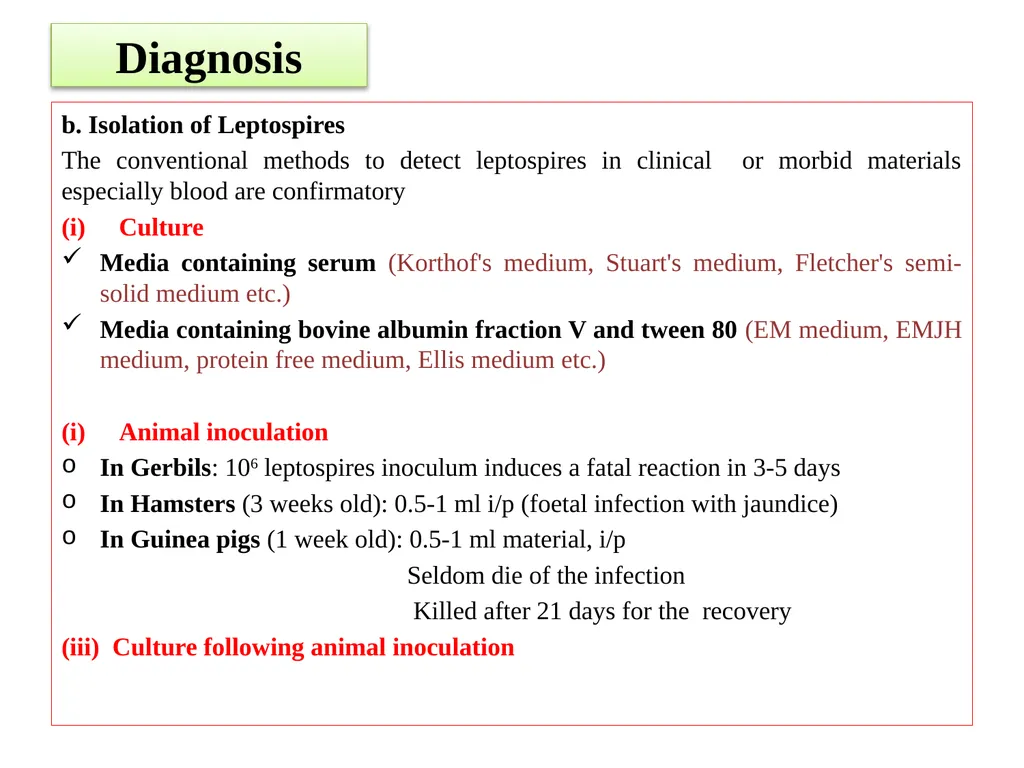
b. Isolation of Leptospires
The conventional methods to detect leptospires in clinical or morbid materials especially blood are confirmatory
Culture
Media containing serum (Korthof's medium, Stuart's medium, Fletcher's semi-solid medium etc.)
Media containing bovine albumin fraction V and tween 80 (EM medium, EMJH medium, protein free medium, Ellis medium etc.)
Animal inoculation
In Gerbils: 106 leptospires inoculum induces a fatal reaction in 3-5 days
In Hamsters (3 weeks old): 0.5-1 ml i/p (foetal infection with jaundice)
In Guinea pigs (1 week old): 0.5-1 ml material, i/p
Seldom die of the infection
Killed after 21 days for the recovery
(iii) Culture following animal inoculation Diagnosis<br>
The conventional methods to detect leptospires in clinical or morbid materials especially blood are confirmatory
Culture
Media containing serum (Korthof's medium, Stuart's medium, Fletcher's semi-solid medium etc.)
Media containing bovine albumin fraction V and tween 80 (EM medium, EMJH medium, protein free medium, Ellis medium etc.)
Animal inoculation
In Gerbils: 106 leptospires inoculum induces a fatal reaction in 3-5 days
In Hamsters (3 weeks old): 0.5-1 ml i/p (foetal infection with jaundice)
In Guinea pigs (1 week old): 0.5-1 ml material, i/p
Seldom die of the infection
Killed after 21 days for the recovery
(iii) Culture following animal inoculation Diagnosis<br>
20
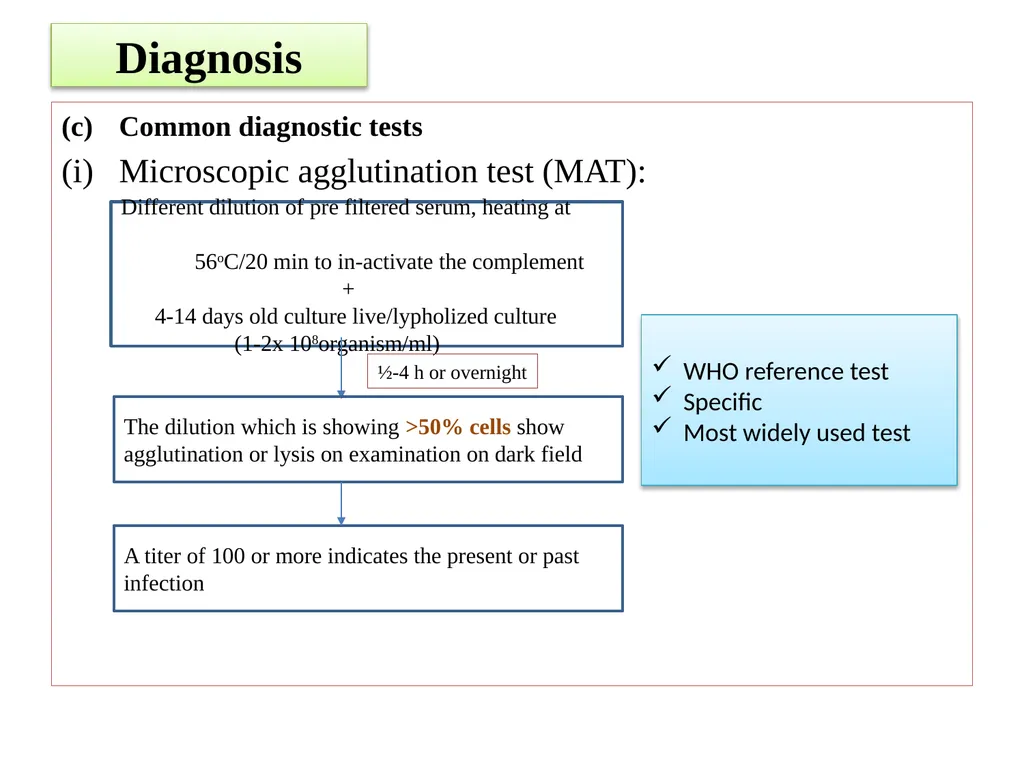
Common diagnostic tests
Microscopic agglutination test (MAT): Diagnosis WHO reference test
Specific
Most widely used test Different dilution of pre filtered serum, heating at
56oC/20 min to in-activate the complement
+
4-14 days old culture live/lypholized culture
(1-2x 10⁸organism/ml) ½-4 h or overnight The dilution which is showing >50% cells show agglutination or lysis on examination on dark field A titer of 100 or more indicates the present or past infection<br>
Microscopic agglutination test (MAT): Diagnosis WHO reference test
Specific
Most widely used test Different dilution of pre filtered serum, heating at
56oC/20 min to in-activate the complement
+
4-14 days old culture live/lypholized culture
(1-2x 10⁸organism/ml) ½-4 h or overnight The dilution which is showing >50% cells show agglutination or lysis on examination on dark field A titer of 100 or more indicates the present or past infection<br>
21
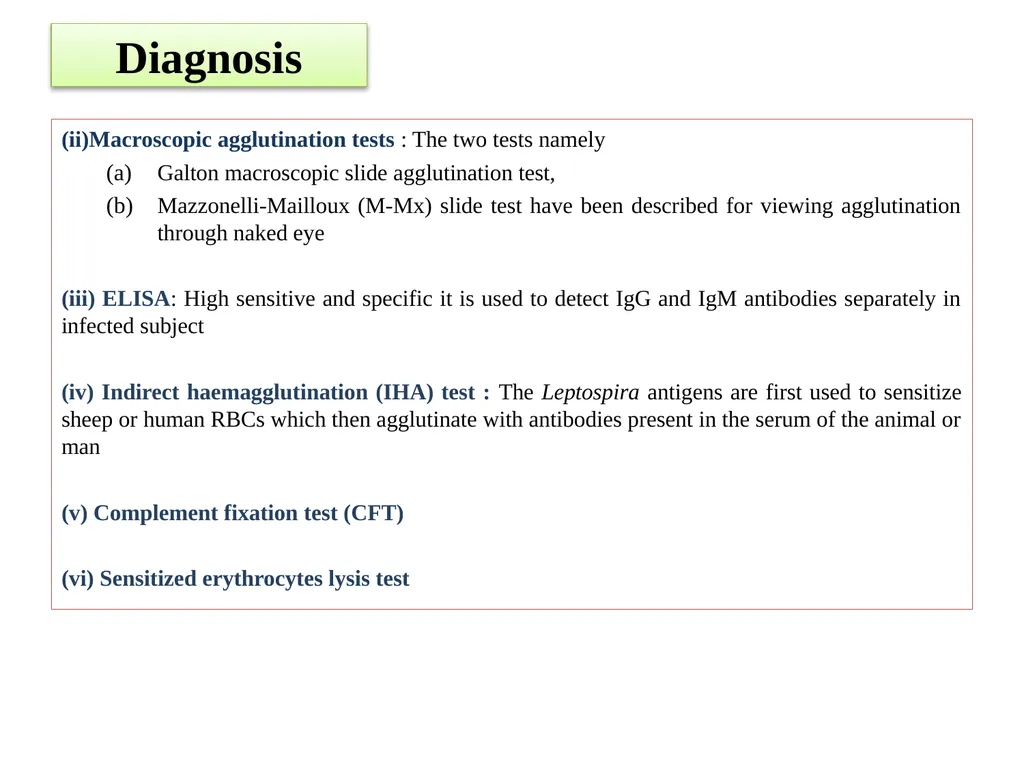
(ii)Macroscopic agglutination tests : The two tests namely
Galton macroscopic slide agglutination test,
Mazzonelli-Mailloux (M-Mx) slide test have been described for viewing agglutination through naked eye
(iii) ELISA: High sensitive and specific it is used to detect IgG and IgM antibodies separately in infected subject
(iv) Indirect haemagglutination (IHA) test : The Leptospira antigens are first used to sensitize sheep or human RBCs which then agglutinate with antibodies present in the serum of the animal or man
(v) Complement fixation test (CFT)
(vi) Sensitized erythrocytes lysis test Diagnosis<br>
Galton macroscopic slide agglutination test,
Mazzonelli-Mailloux (M-Mx) slide test have been described for viewing agglutination through naked eye
(iii) ELISA: High sensitive and specific it is used to detect IgG and IgM antibodies separately in infected subject
(iv) Indirect haemagglutination (IHA) test : The Leptospira antigens are first used to sensitize sheep or human RBCs which then agglutinate with antibodies present in the serum of the animal or man
(v) Complement fixation test (CFT)
(vi) Sensitized erythrocytes lysis test Diagnosis<br>
22
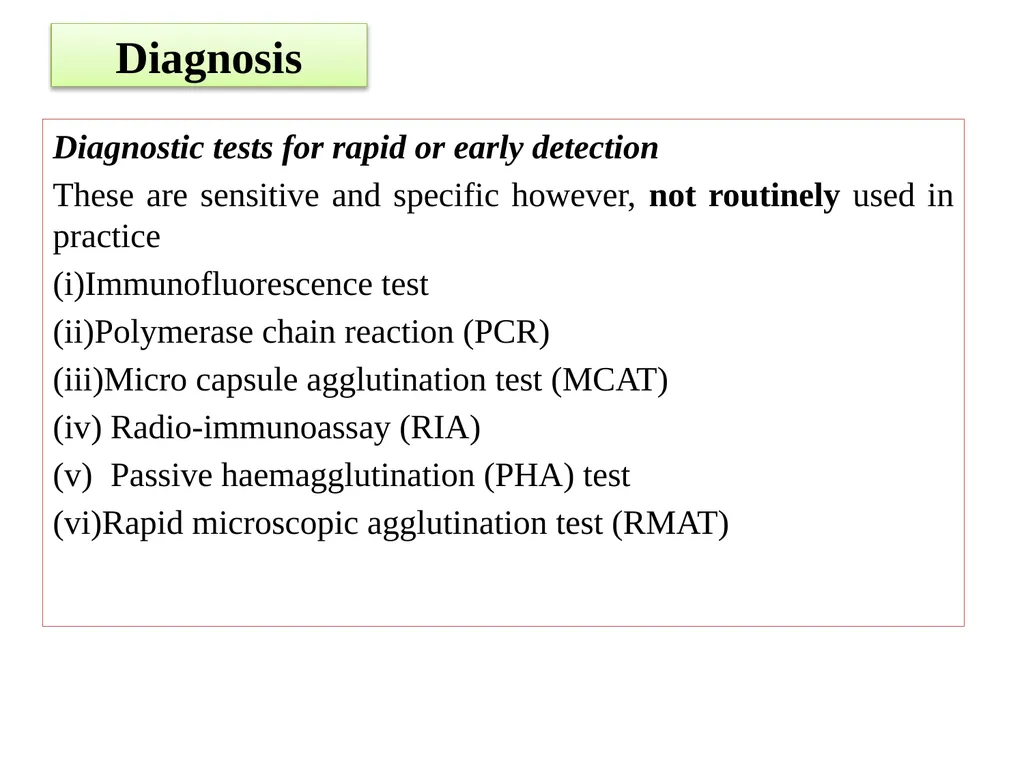
Diagnostic tests for rapid or early detection
These are sensitive and specific however, not routinely used in practice
(i)Immunofluorescence test
(ii)Polymerase chain reaction (PCR)
(iii)Micro capsule agglutination test (MCAT)
Radio-immunoassay (RIA)
Passive haemagglutination (PHA) test
(vi)Rapid microscopic agglutination test (RMAT) Diagnosis<br>
These are sensitive and specific however, not routinely used in practice
(i)Immunofluorescence test
(ii)Polymerase chain reaction (PCR)
(iii)Micro capsule agglutination test (MCAT)
Radio-immunoassay (RIA)
Passive haemagglutination (PHA) test
(vi)Rapid microscopic agglutination test (RMAT) Diagnosis<br>
23
Treatment Dihydrostreptomycine
Doxycycline
Ampicillin or amoxicillin
Azithromycin or clarithromycin
Fluoroquinolone such as ciprofloxacin or levofloxacin
Antibiotics for leptospirosis requiring hospitalization include the following:
I/V penicillin G
I/V third-generation cephalosporins (cefotaxime and ceftriaxone)
I/V ampicillin or amoxicillin (second-line agents)
I/V erythromycin (in penicillin-allergic pregnant women)<br>
Doxycycline
Ampicillin or amoxicillin
Azithromycin or clarithromycin
Fluoroquinolone such as ciprofloxacin or levofloxacin
Antibiotics for leptospirosis requiring hospitalization include the following:
I/V penicillin G
I/V third-generation cephalosporins (cefotaxime and ceftriaxone)
I/V ampicillin or amoxicillin (second-line agents)
I/V erythromycin (in penicillin-allergic pregnant women)<br>
24
Immunization:
Strain-specific killed vaccines for human use, particularly in endemic areas, are available but these have limited use due to many infecting serotypes.
Vaccination is valuable when large numbers of workers are exposed to infection in situations (e.g. rice fields) that preclude satisfactory control of reservoir hosts<br>
Strain-specific killed vaccines for human use, particularly in endemic areas, are available but these have limited use due to many infecting serotypes.
Vaccination is valuable when large numbers of workers are exposed to infection in situations (e.g. rice fields) that preclude satisfactory control of reservoir hosts<br>
25
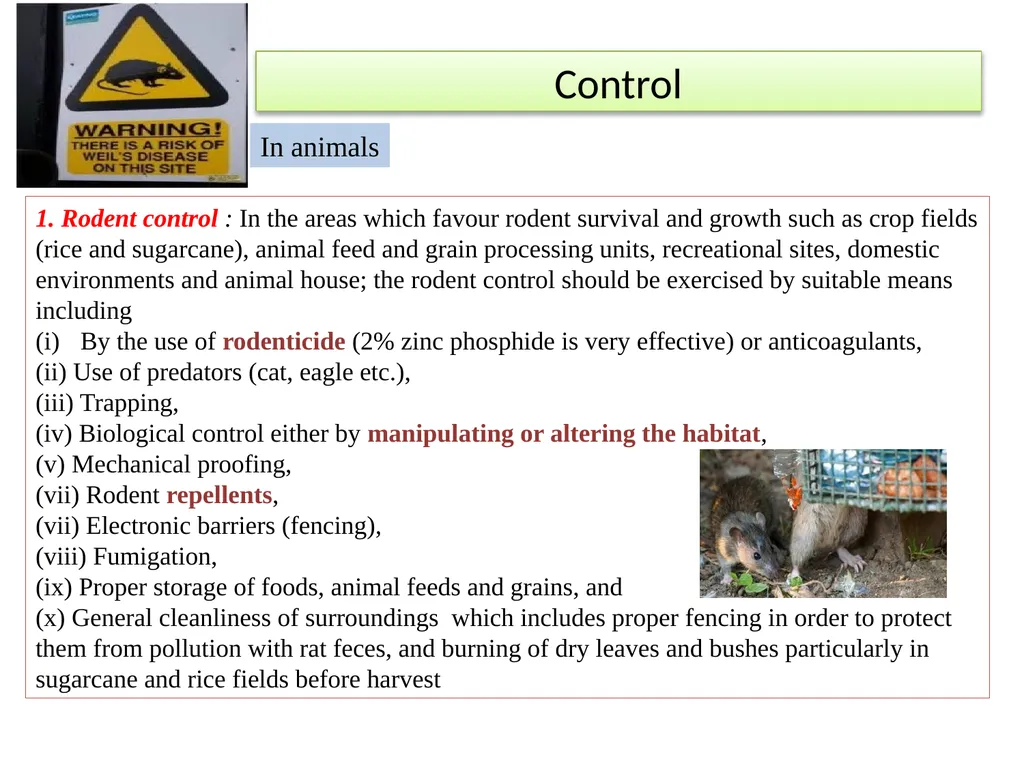
Control 1. Rodent control : In the areas which favour rodent survival and growth such as crop fields (rice and sugarcane), animal feed and grain processing units, recreational sites, domestic environments and animal house; the rodent control should be exercised by suitable means including
By the use of rodenticide (2% zinc phosphide is very effective) or anticoagulants,
(ii) Use of predators (cat, eagle etc.),
(iii) Trapping,
(iv) Biological control either by manipulating or altering the habitat,
(v) Mechanical proofing,
(vii) Rodent repellents,
(vii) Electronic barriers (fencing),
(viii) Fumigation,
(ix) Proper storage of foods, animal feeds and grains, and
(x) General cleanliness of surroundings which includes proper fencing in order to protect them from pollution with rat feces, and burning of dry leaves and bushes particularly in sugarcane and rice fields before harvest In animals<br>
By the use of rodenticide (2% zinc phosphide is very effective) or anticoagulants,
(ii) Use of predators (cat, eagle etc.),
(iii) Trapping,
(iv) Biological control either by manipulating or altering the habitat,
(v) Mechanical proofing,
(vii) Rodent repellents,
(vii) Electronic barriers (fencing),
(viii) Fumigation,
(ix) Proper storage of foods, animal feeds and grains, and
(x) General cleanliness of surroundings which includes proper fencing in order to protect them from pollution with rat feces, and burning of dry leaves and bushes particularly in sugarcane and rice fields before harvest In animals<br>
26
2. Sanitation
(i) Proper draining of yards, pens, sheds and kennels and their regular disinfection (with cresol or 1:4000 solution of sodium hypochlorite etc.),
(ii) avoidance of stagnation of water, urine and faeces, and
(iii) burial or burning of infected carcasses, aborted foetuses, placentas and/or bedding
3. Proper management
(i) Breaking of the cycle of infection,
(ii) Quaratine for 30 days,
(iii) Sero-testing of herd by MAT
4. Immunization
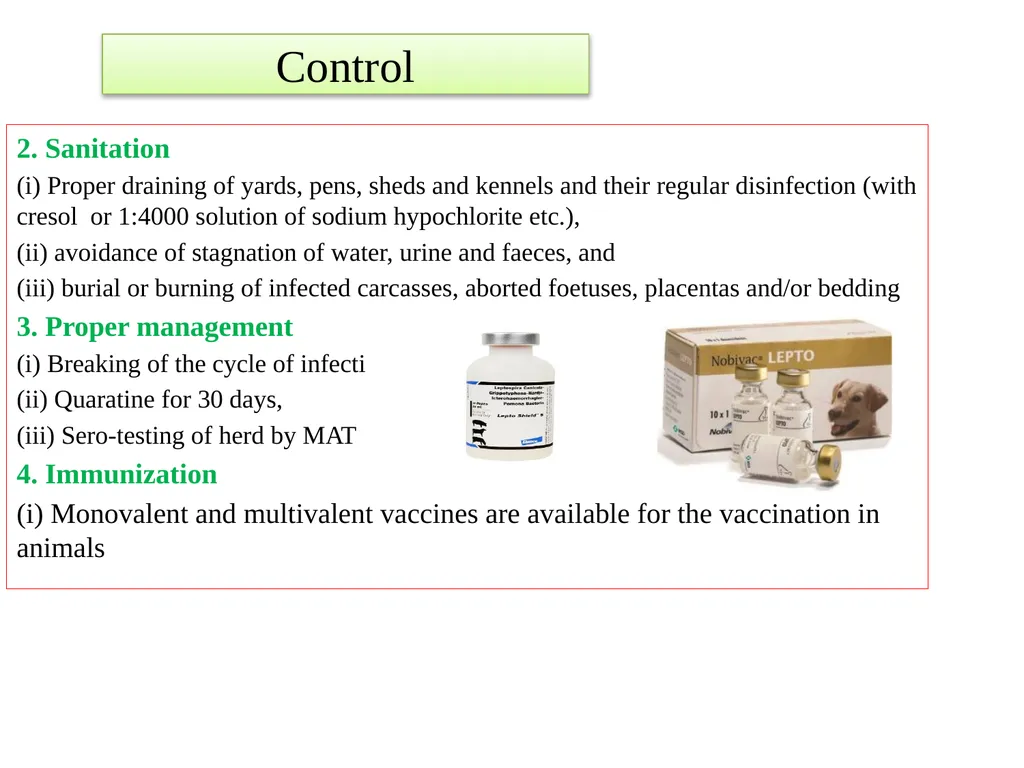
(i) Monovalent and multivalent vaccines are available for the vaccination in animals Control<br>
(i) Proper draining of yards, pens, sheds and kennels and their regular disinfection (with cresol or 1:4000 solution of sodium hypochlorite etc.),
(ii) avoidance of stagnation of water, urine and faeces, and
(iii) burial or burning of infected carcasses, aborted foetuses, placentas and/or bedding
3. Proper management
(i) Breaking of the cycle of infection,
(ii) Quaratine for 30 days,
(iii) Sero-testing of herd by MAT
4. Immunization
(i) Monovalent and multivalent vaccines are available for the vaccination in animals Control<br>
27
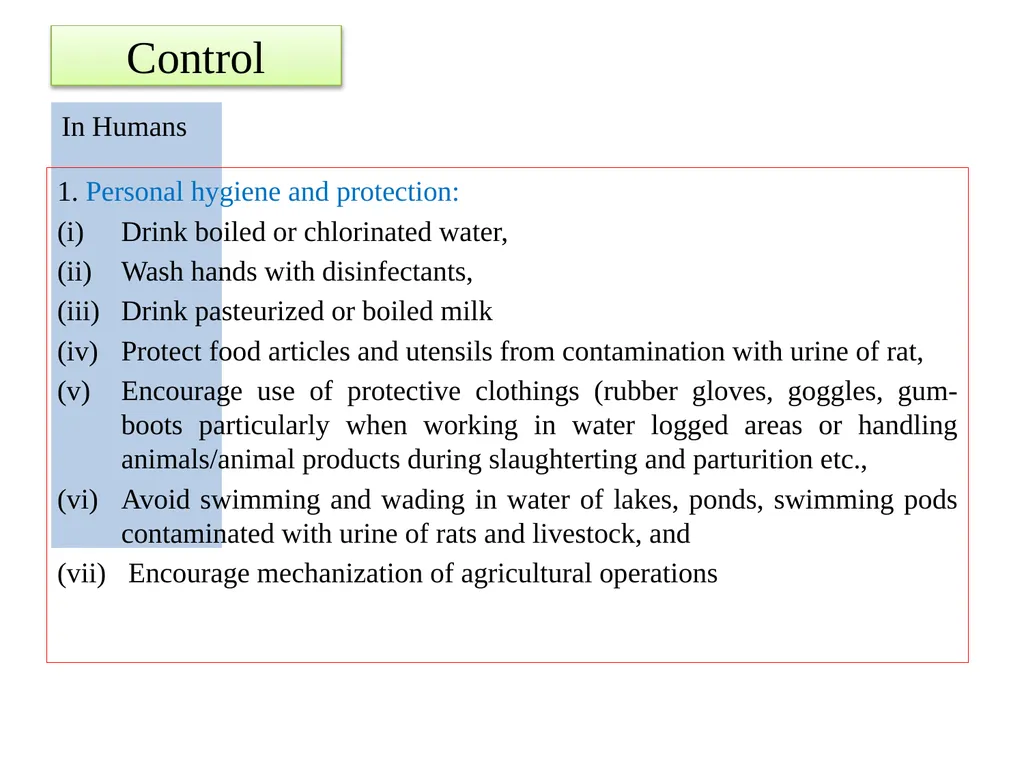
In Humans Control 1. Personal hygiene and protection:
Drink boiled or chlorinated water,
Wash hands with disinfectants,
Drink pasteurized or boiled milk
Protect food articles and utensils from contamination with urine of rat,
Encourage use of protective clothings (rubber gloves, goggles, gum-boots particularly when working in water logged areas or handling animals/animal products during slaughterting and parturition etc.,
Avoid swimming and wading in water of lakes, ponds, swimming pods contaminated with urine of rats and livestock, and
Encourage mechanization of agricultural operations<br>
Drink boiled or chlorinated water,
Wash hands with disinfectants,
Drink pasteurized or boiled milk
Protect food articles and utensils from contamination with urine of rat,
Encourage use of protective clothings (rubber gloves, goggles, gum-boots particularly when working in water logged areas or handling animals/animal products during slaughterting and parturition etc.,
Avoid swimming and wading in water of lakes, ponds, swimming pods contaminated with urine of rats and livestock, and
Encourage mechanization of agricultural operations<br>
28
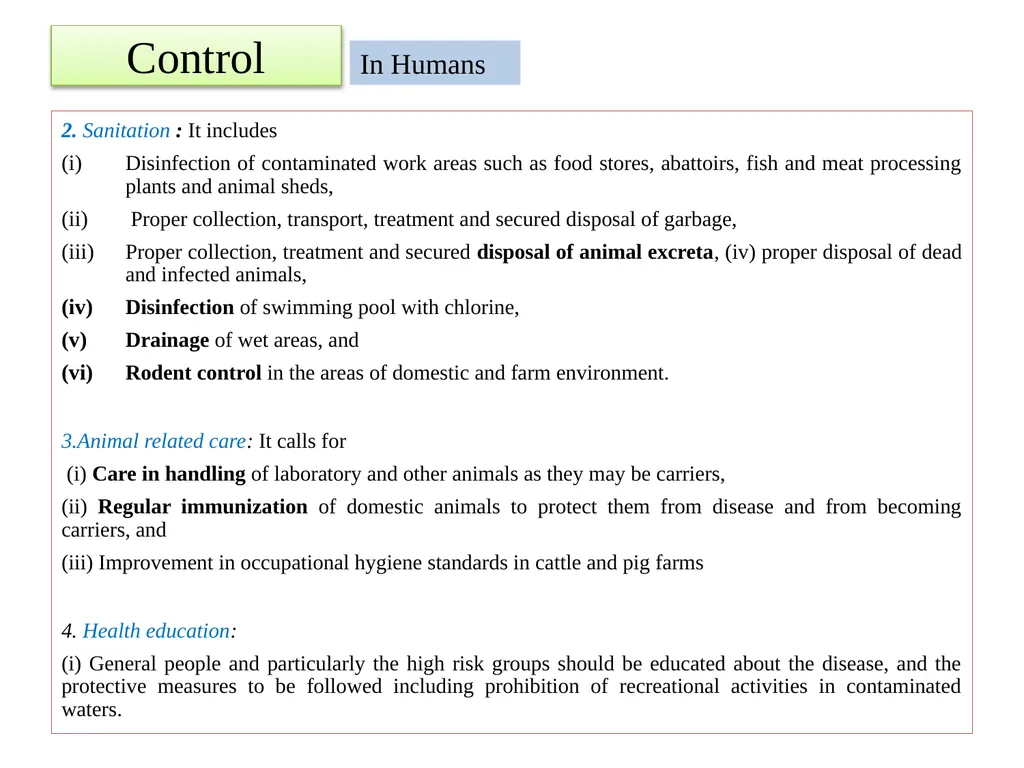
2. Sanitation : It includes
Disinfection of contaminated work areas such as food stores, abattoirs, fish and meat processing plants and animal sheds,
Proper collection, transport, treatment and secured disposal of garbage,
Proper collection, treatment and secured disposal of animal excreta, (iv) proper disposal of dead and infected animals,
Disinfection of swimming pool with chlorine,
Drainage of wet areas, and
Rodent control in the areas of domestic and farm environment.
3.Animal related care: It calls for
(i) Care in handling of laboratory and other animals as they may be carriers,
(ii) Regular immunization of domestic animals to protect them from disease and from becoming carriers, and
(iii) Improvement in occupational hygiene standards in cattle and pig farms
4. Health education:
(i) General people and particularly the high risk groups should be educated about the disease, and the protective measures to be followed including prohibition of recreational activities in contaminated waters. Control In Humans<br>
Disinfection of contaminated work areas such as food stores, abattoirs, fish and meat processing plants and animal sheds,
Proper collection, transport, treatment and secured disposal of garbage,
Proper collection, treatment and secured disposal of animal excreta, (iv) proper disposal of dead and infected animals,
Disinfection of swimming pool with chlorine,
Drainage of wet areas, and
Rodent control in the areas of domestic and farm environment.
3.Animal related care: It calls for
(i) Care in handling of laboratory and other animals as they may be carriers,
(ii) Regular immunization of domestic animals to protect them from disease and from becoming carriers, and
(iii) Improvement in occupational hygiene standards in cattle and pig farms
4. Health education:
(i) General people and particularly the high risk groups should be educated about the disease, and the protective measures to be followed including prohibition of recreational activities in contaminated waters. Control In Humans<br>