Lesson 2.1 Conditional Statements Learning Target: Understand and write conditional statements. Success Criteria: I can identify the hypothesis and conclusion of a statement. I can write conditional statements and their related conditional
"Lesson 2.1 Conditional Statements Learning Target:" is the property of its rightful owner. Permission is granted to
download and print the materials on this website for personal, non-commercial use only, and to display it
on your personal computer provided you do not modify the materials and that you retain all copyright
notices contained in the materials. By downloading content from our website, you accept the terms of this
agreement.
Presentation Transcript
01
Lesson 2.1 Conditional Statements<br>
02
Learning Target:
Understand and write conditional statements. Success Criteria:
I can identify the hypothesis and conclusion of a statement.
I can write conditional statements and their related conditional statements.
I can write biconditional statements.<br>
03
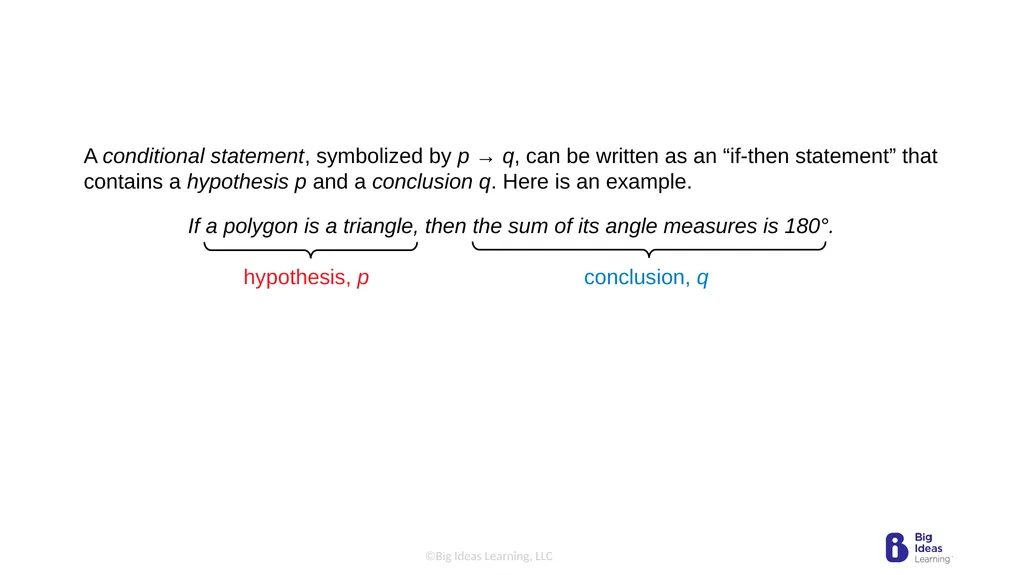
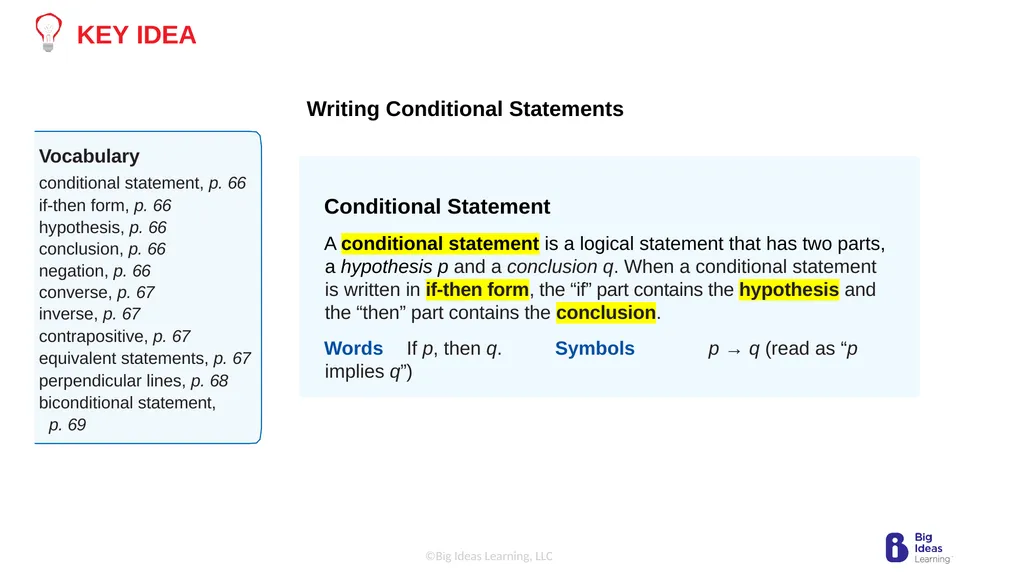
A conditional statement, symbolized by p → q, can be written as an “if-then statement” that contains a hypothesis p and a conclusion q. Here is an example.
If a polygon is a triangle, then the sum of its angle measures is 180°. hypothesis, p conclusion, q<br>
04
KEY IDEA Writing Conditional Statements<br>
05
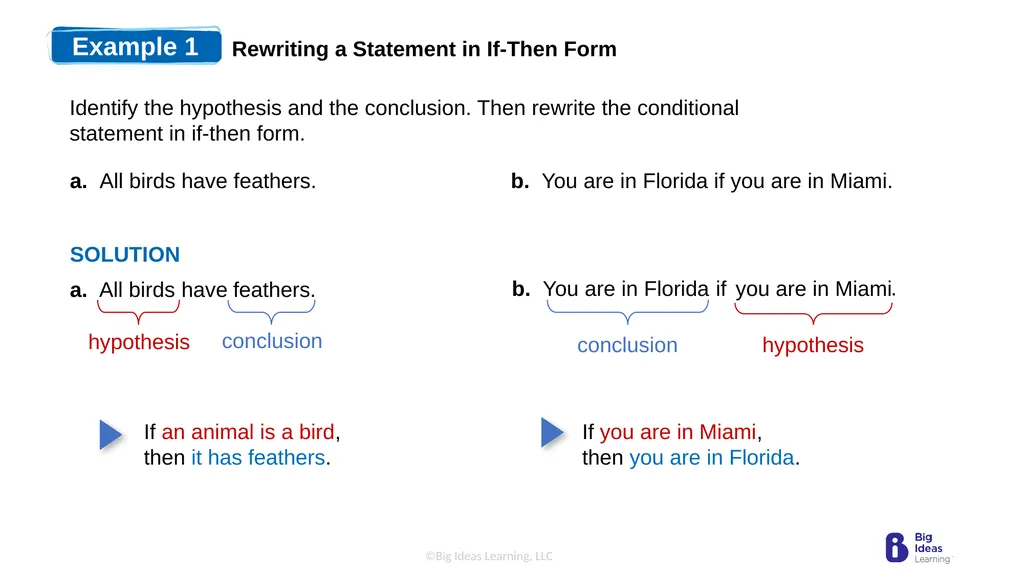
Example 1 Rewriting a Statement in If-Then Form All birds Identify the hypothesis and the conclusion. Then rewrite the conditional statement in if-then form. a. All birds have feathers. b. You are in Florida if you are in Miami. a. b. If an animal is a bird, then it has feathers. If you are in Miami, then you are in Florida. SOLUTION have feathers . You are in Florida if you are in Miami hypothesis conclusion hypothesis conclusion .<br>
06
KEY IDEA Negation
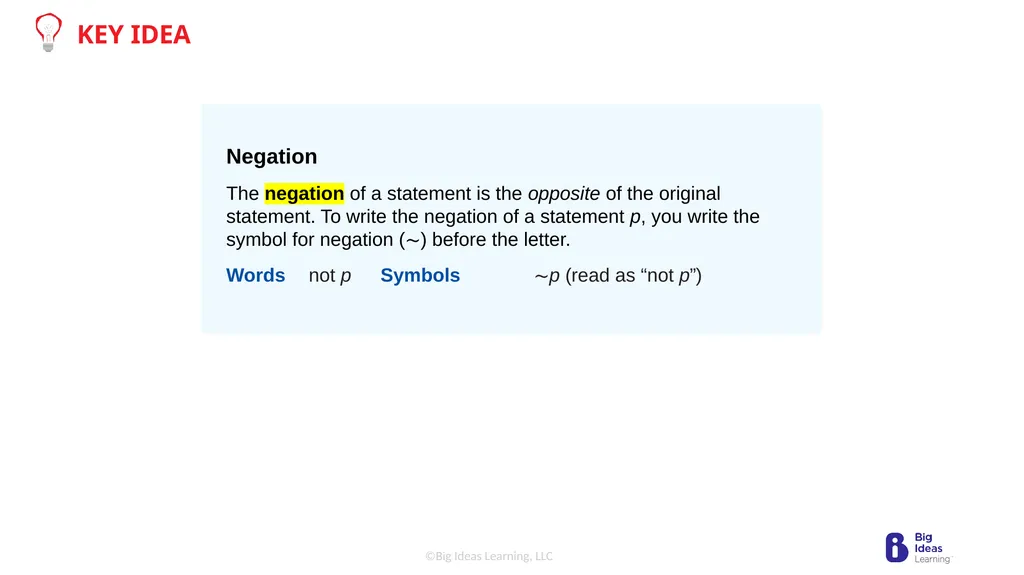
The negation of a statement is the opposite of the original statement. To write the negation of a statement p, you write the symbol for negation (∼) before the letter.
Words not p Symbols ∼p (read as “not p”)<br>
07
KEY IDEA<br>
08
KEY IDEA COMMON ERROR
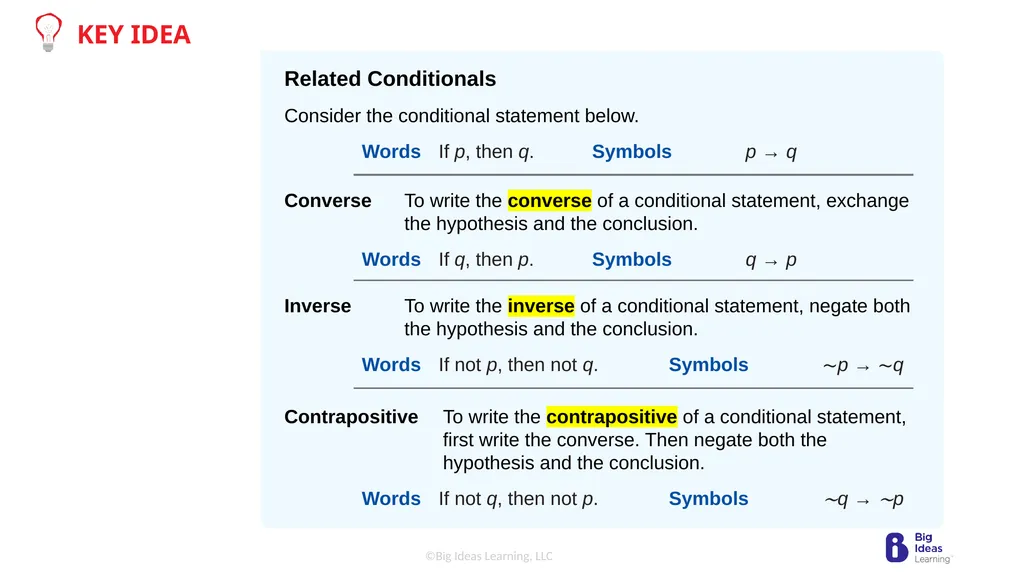
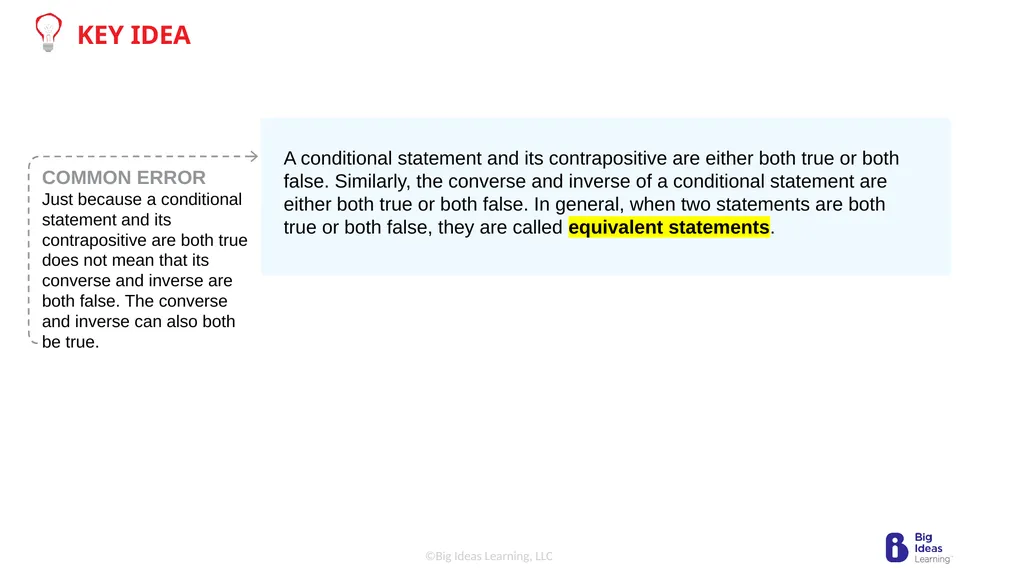
Just because a conditional statement and its contrapositive are both true does not mean that its converse and inverse are both false. The converse and inverse can also both be true.<br>
09
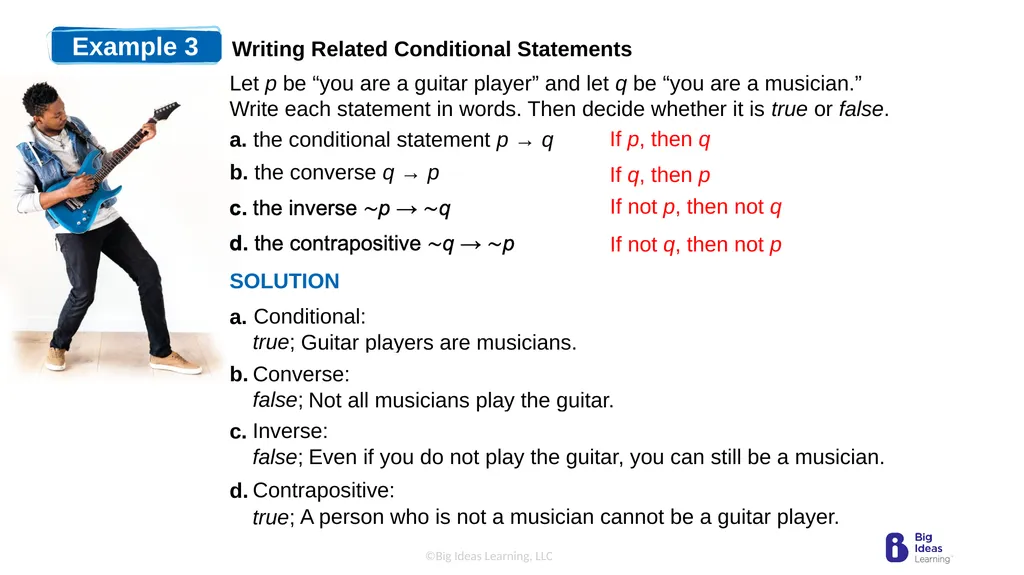
Example 3 Writing Related Conditional Statements Let p be “you are a guitar player” and let q be “you are a musician.” Write each statement in words. Then decide whether it is true or false. a. the conditional statement p → q b. the converse q → p a. b. c. d. SOLUTION Conditional: If you are a guitar player, then you are a musician. true; Guitar players are musicians. Converse: If you are a musician, then you are a guitar player. false; Not all musicians play the guitar. Inverse: If you are not a guitar player, then you are not a musician. false; Even if you do not play the guitar, you can still be a musician. Contrapositive: If you are not a musician, then you are not a guitar player. true; A person who is not a musician cannot be a guitar player. If q, then p If p, then q If not p, then not q If not q, then not p<br>
10
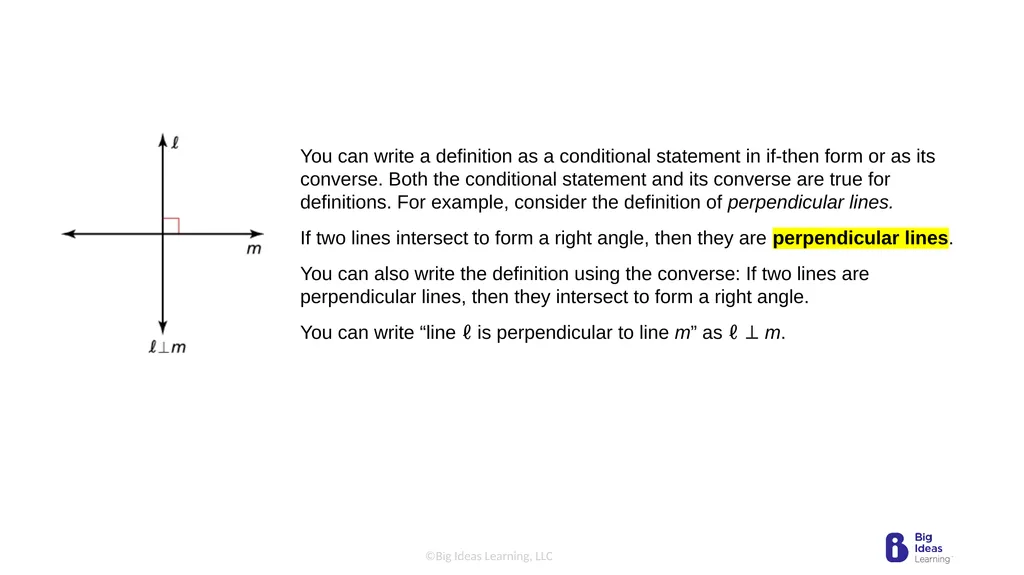
You can write a definition as a conditional statement in if-then form or as its converse. Both the conditional statement and its converse are true for definitions. For example, consider the definition of perpendicular lines.
If two lines intersect to form a right angle, then they are perpendicular lines.
You can also write the definition using the converse: If two lines are perpendicular lines, then they intersect to form a right angle.
You can write “line ℓ is perpendicular to line m” as ℓ ⊥ m.<br>
11
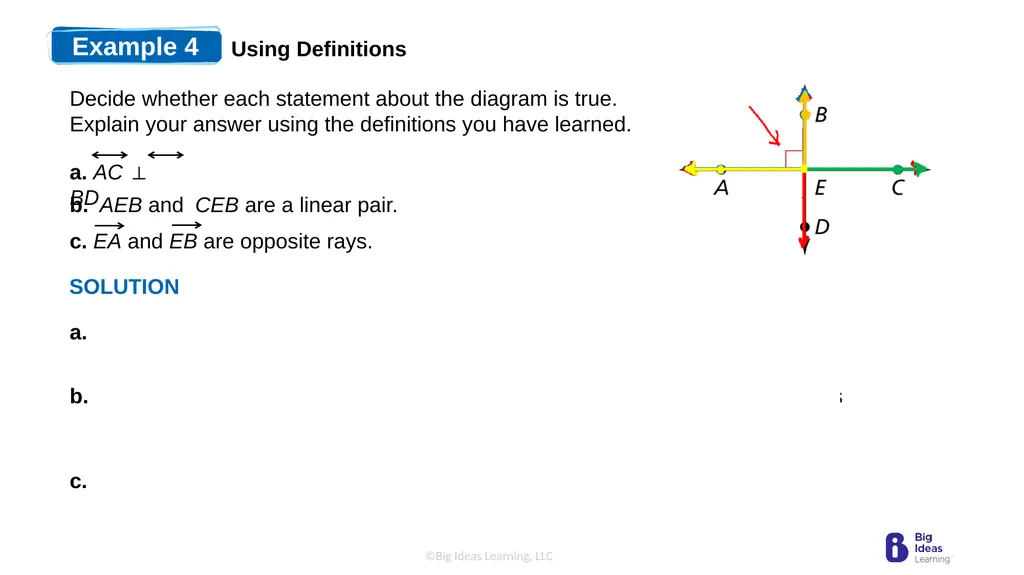
Example 4 Using Definitions a. This statement is true. The right angle symbol in the diagram indicates that the lines intersect to form a right angle. So, you can say the lines are perpendicular. b. This statement is true. By definition, if the noncommon sides of adjacent angles are opposite rays, then the angles are a linear pair. Because EA and EC are opposite rays, AEB and CEB are a linear pair. c. This statement is false. The rays have the same endpoint, but they do not form a line. So, the rays are not opposite rays. SOLUTION<br>
12
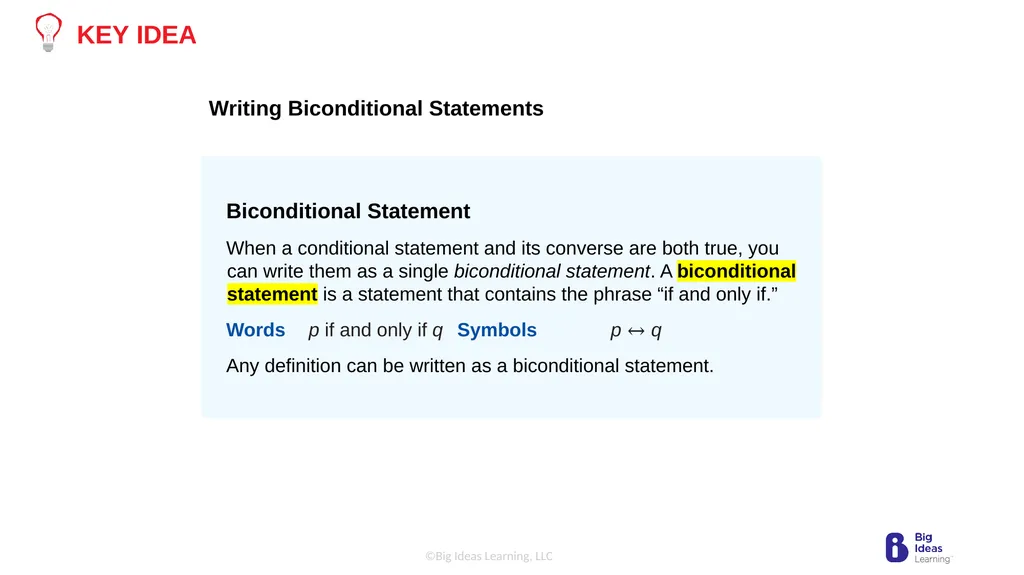
KEY IDEA Writing Biconditional Statements<br>
13
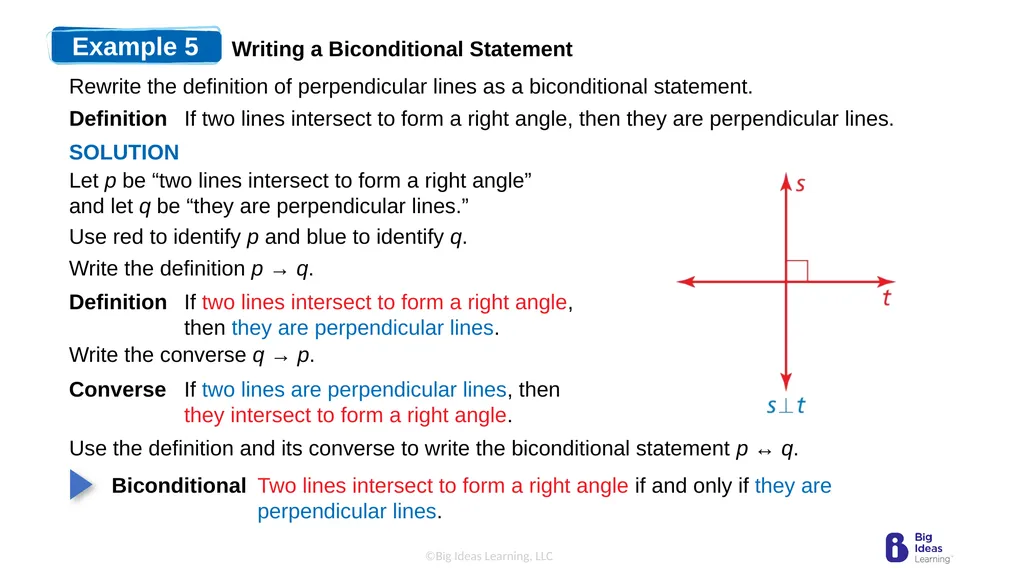
Example 5 Writing a Biconditional Statement Rewrite the definition of perpendicular lines as a biconditional statement. Definition If two lines intersect to form a right angle, then they are perpendicular lines. Let p be “two lines intersect to form a right angle” and let q be “they are perpendicular lines.” Definition If two lines intersect to form a right angle, then they are perpendicular lines. Write the converse q → p. Converse If two lines are perpendicular lines, then they intersect to form a right angle. Use the definition and its converse to write the biconditional statement p ↔ q. Biconditional Two lines intersect to form a right angle if and only if they are perpendicular lines. SOLUTION Use red to identify p and blue to identify q. Write the definition p → q.<br>