
Lesson 5: Deixis Introduction To fully understand
LV
Published · 10 slides · 0 views

1 / 1

Description
Lesson 5: Deixis Introduction To fully understand the speakerwriters intended meaning, his identity, situation, time and environment should be known to the readerhearer. If you get a short note that says: meet us there this evening it
Related Topics
Share
Embed code
Download this presentation From Below
"Lesson 5: Deixis Introduction To fully understand" is the property of its rightful owner. Permission is granted to download and print the materials on this website for personal, non-commercial use only, and to display it on your personal computer provided you do not modify the materials and that you retain all copyright notices contained in the materials. By downloading content from our website, you accept the terms of this agreement.
Presentation Transcript
01
Lesson 5: Deixis Introduction
To fully understand the speaker/writer’s intended meaning, his identity, situation, time and environment should be known to the reader/hearer. If you get a short note that says: “meet us there this evening” it is assumed you understand ‘us’, ‘there’ or ‘this evening’ since meaning depends on the knowledge of who is speaking, about whom, where and when the expressions are made. In this unit we shall be looking at how little words like ‘us’ ‘there’ ‘this evening’ etc. are used to identify particular persons, time or place associated with utterances.<br>
To fully understand the speaker/writer’s intended meaning, his identity, situation, time and environment should be known to the reader/hearer. If you get a short note that says: “meet us there this evening” it is assumed you understand ‘us’, ‘there’ or ‘this evening’ since meaning depends on the knowledge of who is speaking, about whom, where and when the expressions are made. In this unit we shall be looking at how little words like ‘us’ ‘there’ ‘this evening’ etc. are used to identify particular persons, time or place associated with utterances.<br>
02
Deictic Reference Words such as us, I, we, him, then, now, there, here etc. usually identify referents so that the addressee may be able to quickly pick out a person, place or time relevant to the understanding of the intended meaning. These words are called ‘indexical’ and their functions, i.e. being able to encode the context are called ‘deictic’ borrowing from the Greek word meaning ‘pointing’ or ‘to point out.’ The above deictic references are therefore used as pointers to persons, place or time the speaker has in mind. It is important to note that it is the context of utterance that again gives meaning to indexical like you, here, now, or there. If you hear me say:
You, you and you, see me in my office
(2) You don’t come here often, do you?
(3) When you pick up the book, you don’t know whether to read the entire text or a few chapters
(4) Now is the right place to meet there<br>
You, you and you, see me in my office
(2) You don’t come here often, do you?
(3) When you pick up the book, you don’t know whether to read the entire text or a few chapters
(4) Now is the right place to meet there<br>
03
In (1) you will expect that I practically point specifically to certain persons using gestures or eye contact apart from just speaking. And you will also notice that each of the ‘you’ will refer to a different person whose identity will be known only by those present when I make the statement. In (2) ‘you’ refers to a particular person at a particular time and place and ‘here’ will be meaningful if both the speaker and the hearer are at the same place. My ‘here’ in (2) and ‘now’ and ‘there’ in (4) may not be your ‘here’ or ‘now’ if both of us are at different places and at different times. But notice the ‘you’ in (3). The ‘you’ does not refer to any particular referent, so that being present when it is used does not help you to identify the referent. This generalized use of ‘you’ is said to be non-deictic. Deictic expressions used to point to persons are called person deixis, e.g. I, him, we, you etc. Place deixis is used to point to locations e.g. here, there, beside, etc., while time deixis is used to point to time, e.g. now, then, this evening, tomorrow etc.<br>
04
Person Deixis Among the indexical that refer to persons in English, only the word YOU appears to be the only deictic, i.e. the context is required to determine the referent. Other third person pronouns he, she, it or they do not function as deictic rather refer anaphorically to persons or objects already mentioned in the text. Unlike other languages like French or German, ‘you’ has both the polite and familiar forms (vous/tu in French) ‘you’ in English is used to refer to an individual or a group. Sometimes a speaker may add ‘you-all’ when s/he wishes to make a distinction but has only one form available to him/her. However in Nigerian English we do have a way of using pronouns honorifically (use of pronouns to show respect or group identification). This explains why we often use ‘we’, ‘us’ or ‘they’ as referents (person/persons being referred to) rather than to an addressed (person being addressed). Look at the following examples:
(i) As I told us, we do need not wait any longer
(ii) I was talking to us, about the Niger Delta conflicts
(iii) In this Unit, we shall be looking at how little words …function…<br>
(i) As I told us, we do need not wait any longer
(ii) I was talking to us, about the Niger Delta conflicts
(iii) In this Unit, we shall be looking at how little words …function…<br>
05
Notice that the we in (i) includes the speaker but the we in (iii) although appears to include the speaker does not. The teacher applies the honorific ‘we’ as a form of identification with the students even when it is clear that ‘we’ in that context refers to the students. Again notice the use of ‘us’ in (i) and (ii). Why do you think the speaker uses ‘us’ instead of ‘you’?
(iv) They are calling you We often hear this statement, sometimes from children where ‘they’ is used to refer to an individual as a means of showing respect. In this case ‘they’ is not a referent to the antecedent in the co-text but a pointer to the context.<br>
(iv) They are calling you We often hear this statement, sometimes from children where ‘they’ is used to refer to an individual as a means of showing respect. In this case ‘they’ is not a referent to the antecedent in the co-text but a pointer to the context.<br>
06
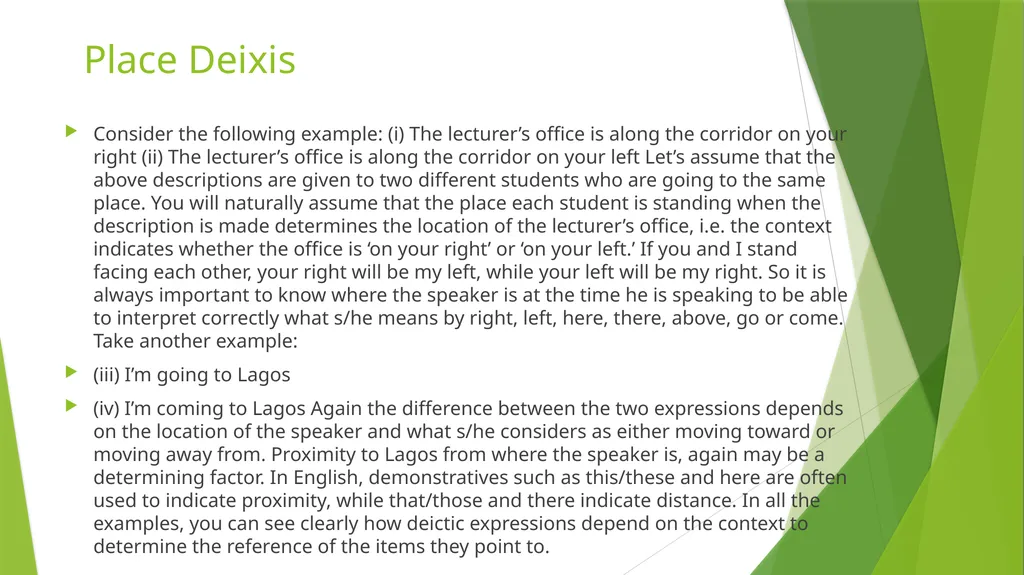
Place Deixis Consider the following example: (i) The lecturer’s office is along the corridor on your right (ii) The lecturer’s office is along the corridor on your left Let’s assume that the above descriptions are given to two different students who are going to the same place. You will naturally assume that the place each student is standing when the description is made determines the location of the lecturer’s office, i.e. the context indicates whether the office is ‘on your right’ or ‘on your left.’ If you and I stand facing each other, your right will be my left, while your left will be my right. So it is always important to know where the speaker is at the time he is speaking to be able to interpret correctly what s/he means by right, left, here, there, above, go or come. Take another example:
(iii) I’m going to Lagos
(iv) I’m coming to Lagos Again the difference between the two expressions depends on the location of the speaker and what s/he considers as either moving toward or moving away from. Proximity to Lagos from where the speaker is, again may be a determining factor. In English, demonstratives such as this/these and here are often used to indicate proximity, while that/those and there indicate distance. In all the examples, you can see clearly how deictic expressions depend on the context to determine the reference of the items they point to.<br>
(iii) I’m going to Lagos
(iv) I’m coming to Lagos Again the difference between the two expressions depends on the location of the speaker and what s/he considers as either moving toward or moving away from. Proximity to Lagos from where the speaker is, again may be a determining factor. In English, demonstratives such as this/these and here are often used to indicate proximity, while that/those and there indicate distance. In all the examples, you can see clearly how deictic expressions depend on the context to determine the reference of the items they point to.<br>
07
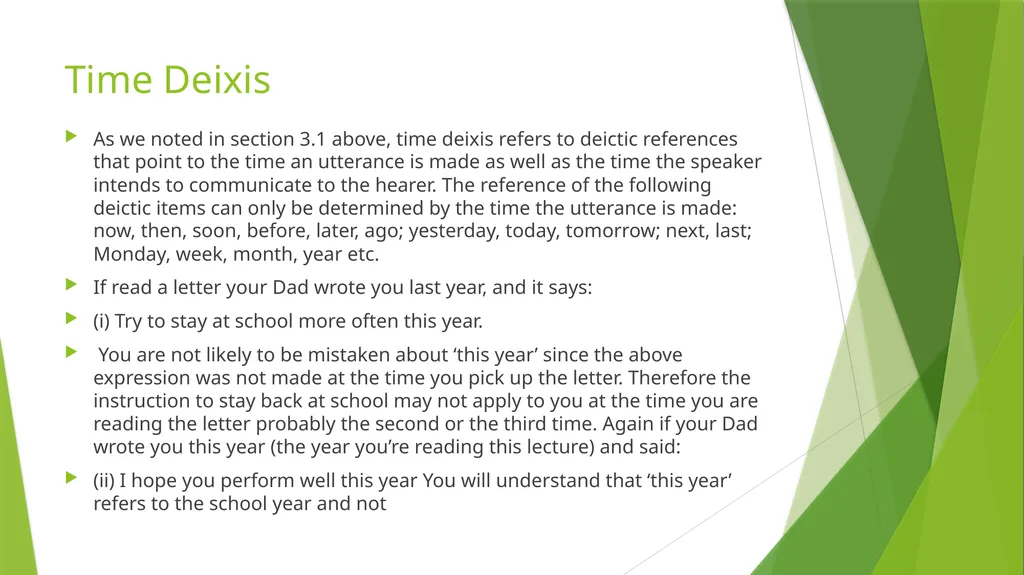
Time Deixis As we noted in section 3.1 above, time deixis refers to deictic references that point to the time an utterance is made as well as the time the speaker intends to communicate to the hearer. The reference of the following deictic items can only be determined by the time the utterance is made: now, then, soon, before, later, ago; yesterday, today, tomorrow; next, last; Monday, week, month, year etc.
If read a letter your Dad wrote you last year, and it says:
(i) Try to stay at school more often this year.
You are not likely to be mistaken about ‘this year’ since the above expression was not made at the time you pick up the letter. Therefore the instruction to stay back at school may not apply to you at the time you are reading the letter probably the second or the third time. Again if your Dad wrote you this year (the year you’re reading this lecture) and said:
(ii) I hope you perform well this year You will understand that ‘this year’ refers to the school year and not<br>
If read a letter your Dad wrote you last year, and it says:
(i) Try to stay at school more often this year.
You are not likely to be mistaken about ‘this year’ since the above expression was not made at the time you pick up the letter. Therefore the instruction to stay back at school may not apply to you at the time you are reading the letter probably the second or the third time. Again if your Dad wrote you this year (the year you’re reading this lecture) and said:
(ii) I hope you perform well this year You will understand that ‘this year’ refers to the school year and not<br>
08
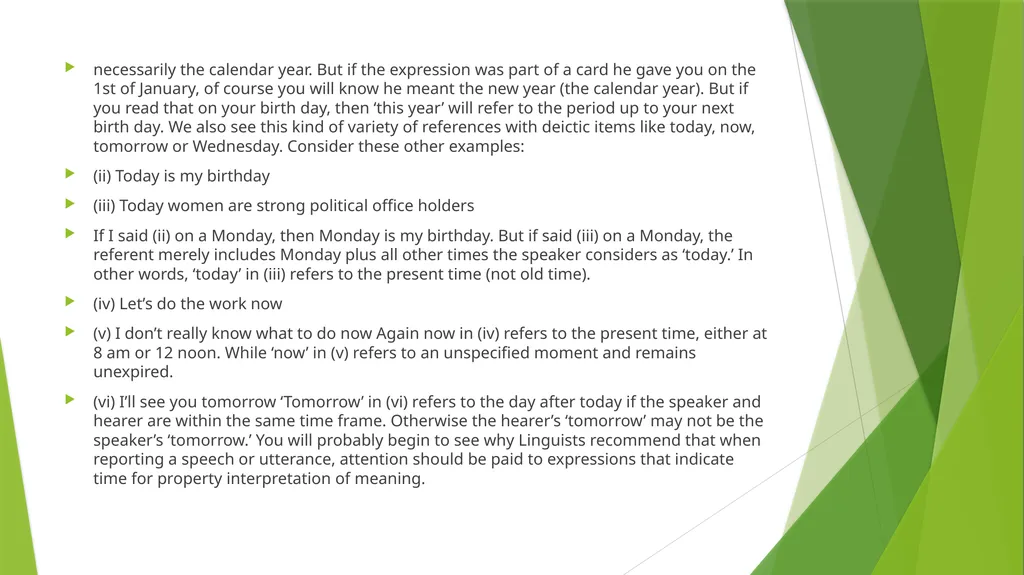
necessarily the calendar year. But if the expression was part of a card he gave you on the 1st of January, of course you will know he meant the new year (the calendar year). But if you read that on your birth day, then ‘this year’ will refer to the period up to your next birth day. We also see this kind of variety of references with deictic items like today, now, tomorrow or Wednesday. Consider these other examples:
(ii) Today is my birthday
(iii) Today women are strong political office holders
If I said (ii) on a Monday, then Monday is my birthday. But if said (iii) on a Monday, the referent merely includes Monday plus all other times the speaker considers as ‘today.’ In other words, ‘today’ in (iii) refers to the present time (not old time).
(iv) Let’s do the work now
(v) I don’t really know what to do now Again now in (iv) refers to the present time, either at 8 am or 12 noon. While ‘now’ in (v) refers to an unspecified moment and remains unexpired.
(vi) I’ll see you tomorrow ‘Tomorrow’ in (vi) refers to the day after today if the speaker and hearer are within the same time frame. Otherwise the hearer’s ‘tomorrow’ may not be the speaker’s ‘tomorrow.’ You will probably begin to see why Linguists recommend that when reporting a speech or utterance, attention should be paid to expressions that indicate time for property interpretation of meaning.<br>
(ii) Today is my birthday
(iii) Today women are strong political office holders
If I said (ii) on a Monday, then Monday is my birthday. But if said (iii) on a Monday, the referent merely includes Monday plus all other times the speaker considers as ‘today.’ In other words, ‘today’ in (iii) refers to the present time (not old time).
(iv) Let’s do the work now
(v) I don’t really know what to do now Again now in (iv) refers to the present time, either at 8 am or 12 noon. While ‘now’ in (v) refers to an unspecified moment and remains unexpired.
(vi) I’ll see you tomorrow ‘Tomorrow’ in (vi) refers to the day after today if the speaker and hearer are within the same time frame. Otherwise the hearer’s ‘tomorrow’ may not be the speaker’s ‘tomorrow.’ You will probably begin to see why Linguists recommend that when reporting a speech or utterance, attention should be paid to expressions that indicate time for property interpretation of meaning.<br>
09
If someone says:
(vii) I’ll be traveling to Abuja tomorrow.
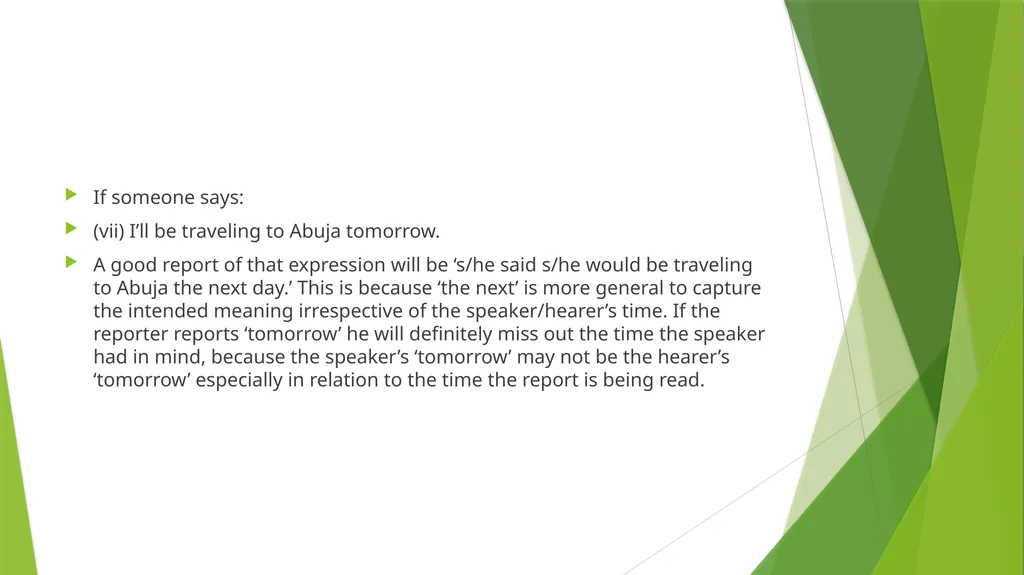
A good report of that expression will be ‘s/he said s/he would be traveling to Abuja the next day.’ This is because ‘the next’ is more general to capture the intended meaning irrespective of the speaker/hearer’s time. If the reporter reports ‘tomorrow’ he will definitely miss out the time the speaker had in mind, because the speaker’s ‘tomorrow’ may not be the hearer’s ‘tomorrow’ especially in relation to the time the report is being read.<br>
(vii) I’ll be traveling to Abuja tomorrow.
A good report of that expression will be ‘s/he said s/he would be traveling to Abuja the next day.’ This is because ‘the next’ is more general to capture the intended meaning irrespective of the speaker/hearer’s time. If the reporter reports ‘tomorrow’ he will definitely miss out the time the speaker had in mind, because the speaker’s ‘tomorrow’ may not be the hearer’s ‘tomorrow’ especially in relation to the time the report is being read.<br>
10
CONCLUSION
When people make statements they are usually careful to let the listeners understand when they are speaking and where they are speaking to enable the listeners interpret their intentions correctly. If they don’t manage words that indicate time, for instance effectively, they may end up confusing the listeners. We can then conclude that deictic expressions are very important elements in communication and demand proper understanding and management. You will agree with me that a word like ‘we’ would definitely create a problem to a listener who does not understand whether it represents a deictic reference or just a mere first person pronoun. Similarly, words like here, there, right, left, now, then, today etc. that indicate place and time need properly understanding and interpretation which the context of utterance generally provide. From the above discussion, you can see that a strong relationship exist between the context and deictic reference, because it is the context that indicates the referent which deictic elements refer to<br>
When people make statements they are usually careful to let the listeners understand when they are speaking and where they are speaking to enable the listeners interpret their intentions correctly. If they don’t manage words that indicate time, for instance effectively, they may end up confusing the listeners. We can then conclude that deictic expressions are very important elements in communication and demand proper understanding and management. You will agree with me that a word like ‘we’ would definitely create a problem to a listener who does not understand whether it represents a deictic reference or just a mere first person pronoun. Similarly, words like here, there, right, left, now, then, today etc. that indicate place and time need properly understanding and interpretation which the context of utterance generally provide. From the above discussion, you can see that a strong relationship exist between the context and deictic reference, because it is the context that indicates the referent which deictic elements refer to<br>